
BAAM AI Blog
Digital Stacks: The Practical Framework For Building A Smarter Online Business
Most online businesses do not fail because they lack tools. They fail because the tools are scattered, duplicated, poorly connected, or chosen without a clear operating system behind them. That is why digital stacks...
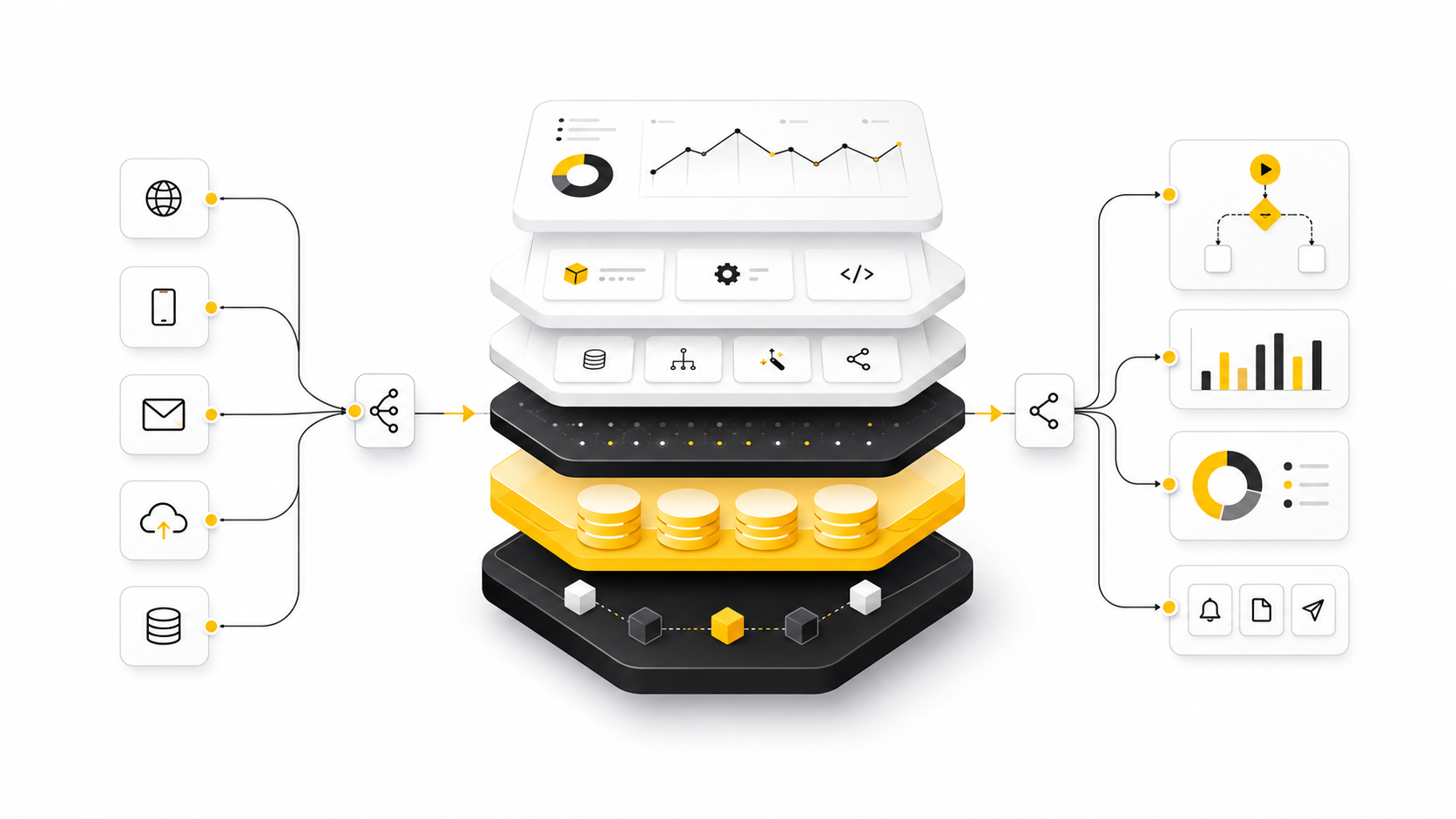
Most online businesses do not fail because they lack tools. They fail because the tools are scattered, duplicated, poorly connected, or chosen without a clear operating system behind them. That is why digital stacks matter: they turn software from a random collection of subscriptions into a working business infrastructure.
A digital stack is the set of platforms, automations, workflows, data sources, and content systems that help a business attract leads, convert customers, deliver value, and measure what is working. The keyword sounds technical, but the idea is simple. Your stack is the way your business runs when you are not manually pushing every task forward.
This has become urgent because the software market keeps expanding. The 2025 marketing technology landscape lists 15,384 martech solutions, while Gartner’s 2025 marketing technology research shows that teams are using only 49% of their martech stack capability. That gap is where money, time, and growth potential quietly disappear.
this guide is split into six parts so the full framework can build naturally instead of dumping a massive checklist on you at once. Part 1 sets the direction, defines what digital stacks are, and explains the framework the rest of the article will use. Each later part goes deeper into one layer of the stack, from strategy and systems to implementation and optimization.
The structure matters because a good digital stack is not built tool-first. It is built outcome-first, then mapped into workflows, then supported by the right platforms. That order prevents the classic mistake: buying another tool to solve a problem that is actually caused by unclear process.
Digital Stacks And Why They Matter
Digital stacks matter because modern businesses are now operating across more channels, more data points, and more customer touchpoints than a human team can manage manually. Content, ads, email, CRM, payments, analytics, chat, scheduling, onboarding, fulfillment, and customer support all need to work together. When they do not, the business starts leaking attention and revenue in places that are hard to see.
The biggest issue is not just complexity. It is fragmentation. One tool captures leads, another sends emails, another tracks calls, another manages appointments, another handles checkout, and another reports performance, but nobody has designed how the pieces should talk to each other.
That is why a digital stack should be treated like infrastructure, not decoration. A serious stack helps you know where a lead came from, what they did, what they need next, and whether your system moved them closer to becoming a customer. Without that, growth becomes guesswork wearing a software subscription.
Framework Overview
A useful digital stack has four layers: acquisition, conversion, delivery, and intelligence. Acquisition brings the right people into your world. Conversion turns attention into leads, appointments, trials, purchases, or sales conversations.
Delivery is where the promise gets fulfilled. That might mean a course, service workflow, onboarding sequence, customer portal, support process, or repeat purchase system. Intelligence is the layer that tells you what is working, what is slow, what is profitable, and what needs to change.
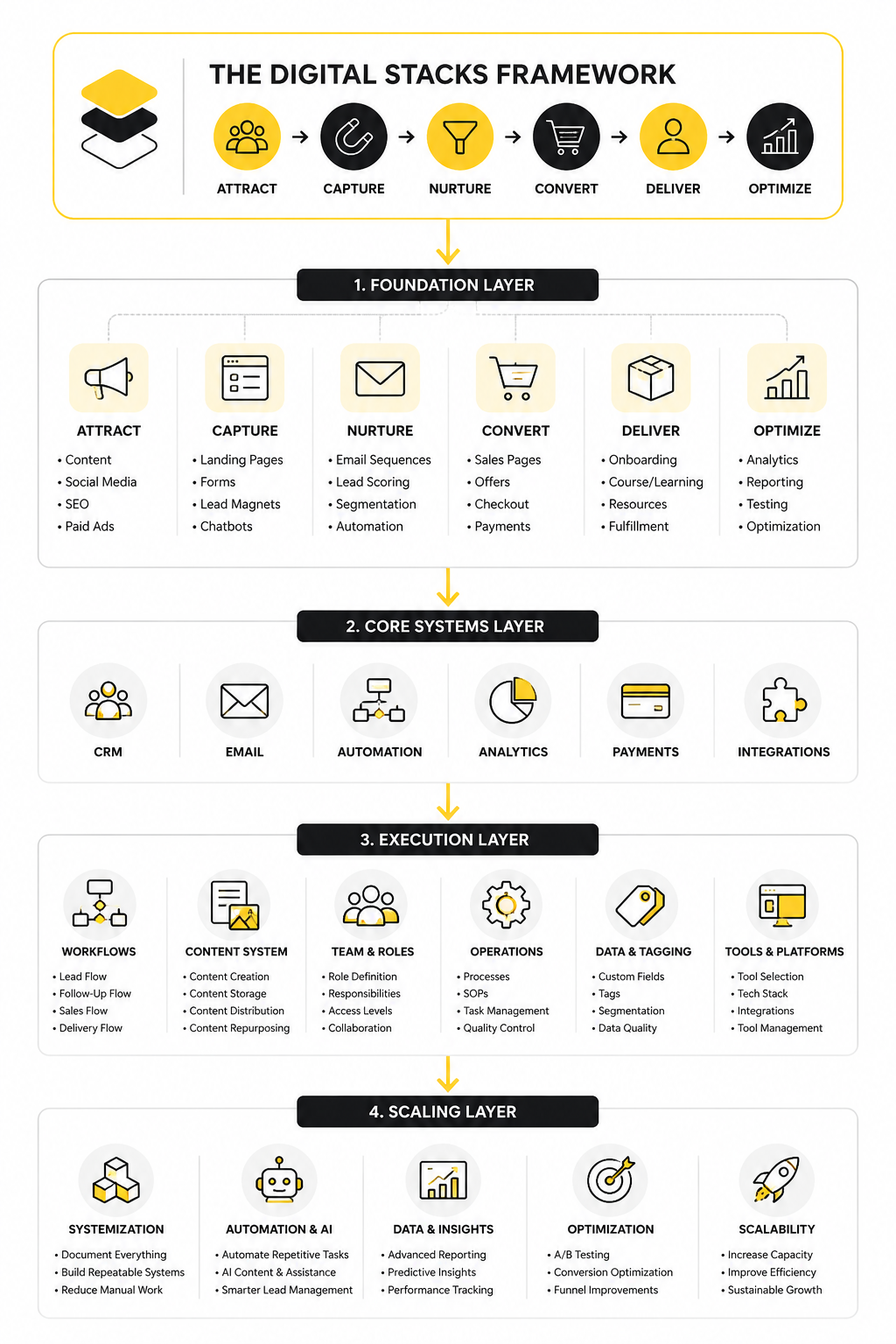
The framework is intentionally practical. A creator, agency, ecommerce brand, coach, SaaS startup, or local service business can all use the same logic, even if the exact tools differ. For example, a service business may build around a CRM and automation platform like GoHighLevel, while a social-first brand may care more about messaging automation, scheduling, and lightweight conversion paths through tools like ManyChat or Buffer.
Core Components
Every digital stack needs a clear source of truth. This is usually the CRM, customer database, ecommerce backend, or subscriber system where the business can identify who someone is and what relationship they have with the company. Without that source of truth, every other tool becomes less reliable.
The second core component is the conversion system. This includes landing pages, forms, booking pages, checkout flows, chat automation, email sequences, and sales pipelines. Tools like ClickFunnels, Systeme.io, Replo, and Fillout can all sit in this layer, depending on the business model.
The third component is automation. Automation does not mean replacing strategy with robots. It means removing repetitive work, reducing human error, and making sure the next right action happens when a lead, customer, or team member triggers it.
Professional Implementation
Professional implementation starts with mapping the customer journey before choosing the software. You need to know what happens from first impression to first purchase, from purchase to delivery, and from delivery to retention. Only then can you decide which tools deserve a place in the stack.
The second step is integration discipline. Every tool should have a reason to exist, a defined owner, a data role, and a clear connection to the rest of the system. If a tool does not improve acquisition, conversion, delivery, retention, reporting, or operational speed, it is probably clutter.
The third step is documentation. A digital stack that only one person understands is fragile. A stack that is documented, reviewed, and improved becomes an asset the business can actually scale.
The Digital Stack Framework
A strong digital stack starts with one uncomfortable question: what job is each tool actually doing? Not what features it has, not how popular it is, and not whether everyone on LinkedIn is talking about it. The only thing that matters is whether it helps the business move a person from attention to trust, from trust to action, and from action to a better customer experience.
That is why the framework should be simple enough to use before you buy anything. A digital stack is easier to build when you separate it into layers instead of thinking about it as one giant software decision. The four practical layers are acquisition, conversion, delivery, and intelligence.
This structure also prevents tool overlap. The 2025 marketing technology landscape reached 15,384 solutions, so the risk is no longer that you cannot find a tool. The risk is that you keep adding tools without knowing which layer they belong to.
Acquisition: Bringing The Right People In
The acquisition layer includes every channel and system that introduces people to your business. That can mean organic content, paid ads, SEO, referrals, partnerships, newsletters, social media, webinars, communities, or direct outreach. The point is not to be everywhere; the point is to know which channels consistently bring in people who are likely to care.
This layer should answer three questions clearly. Where are qualified people discovering you? What message is getting their attention? What action moves them from passive viewer to known lead, subscriber, visitor, or prospect?
For many businesses, acquisition becomes messy because traffic sources are separated from the rest of the stack. A social scheduler like Buffer, a messaging system like ManyChat, or a landing page tool can create attention, but attention only becomes useful when the next step is obvious. Acquisition is not just reach; it is the first controlled handoff in the customer journey.
Conversion: Turning Attention Into Action
The conversion layer is where interest becomes measurable intent. This is where someone fills out a form, books a call, starts a trial, joins a list, buys a product, requests a quote, or enters a sales pipeline. If acquisition gets people to the door, conversion gives them a reason to step inside.
A conversion system needs fewer distractions than most businesses think. It should have a clear offer, a focused page or conversation path, a frictionless action, and a follow-up sequence that makes the next step feel natural. This is where tools like ClickFunnels, Systeme.io, Fillout, or Cal.com can fit naturally, depending on whether the business needs funnels, forms, checkout, or scheduling.
The mistake is treating conversion as a page design problem only. Design matters, but the bigger issue is the promise, the timing, and the follow-up. If the stack captures interest but does not route it correctly, notify the right person, trigger the right message, or update the CRM, the conversion layer is incomplete.
Delivery: Fulfilling The Promise
The delivery layer is where the customer receives what they were promised. For a service business, that may include onboarding, project management, client communication, reporting, and renewal workflows. For a creator or education business, it may include course access, community onboarding, email guidance, and support.
This layer matters because sales create expectations, but delivery creates retention. A business can have great marketing and still lose trust if customers feel confused after they buy. The digital stack should reduce that confusion by giving people clear next steps, timely reminders, easy access, and a consistent support path.
Delivery is also where many teams discover whether their earlier systems were designed properly. If the sales team collects the wrong information, onboarding slows down. If the checkout flow does not trigger the right access, support gets flooded. If customer data is spread across five platforms, nobody has the full picture when something goes wrong.
Intelligence: Knowing What Is Actually Working
The intelligence layer is the reporting and decision-making layer of the stack. It includes analytics, dashboards, attribution, CRM reporting, campaign performance, customer behavior data, and operational metrics. This is the layer that turns activity into decisions.
The goal is not to track everything. The goal is to track the few numbers that explain whether the business is moving in the right direction. For most digital stacks, that means knowing where leads come from, how they convert, how long they take to close, how much they spend, how often they return, and where the system breaks.
This matters even more now because teams are being pushed to do more with AI and automation. McKinsey’s 2025 AI research notes that value depends heavily on management practices across strategy, operating model, technology, data, adoption, and scaling. In plain English, tools alone do not create leverage; systems do.
The Stack Map
Once the four layers are clear, the next step is to map the tools you already use. Do not start by shopping. Start by writing down every platform, spreadsheet, automation, form, page, inbox, calendar, and dashboard currently involved in the customer journey.
Then assign each item to one of the four layers. Some tools may sit across multiple layers, which is fine if that role is intentional. For example, GoHighLevel can support CRM, automation, funnels, appointment booking, pipeline management, and client communication, so it may touch conversion, delivery, and intelligence at the same time.
The map should reveal gaps and duplicates quickly. A gap means an important workflow depends on manual effort or memory. A duplicate means two or more tools are doing the same job, usually creating extra cost, messy data, or confusion for the team.
The Simple Audit
A practical digital stack audit does not need to be complicated. You can start by reviewing each tool against four questions. If a tool cannot survive these questions, it probably needs to be removed, replaced, or redefined.
These questions force clarity. They also expose the hidden cost of a messy stack, because every unclear tool creates extra decisions, extra training, and extra cleanup. Gartner’s 2025 marketing technology research shows that teams are using only 49% of their martech stack capability, which is a strong reminder that buying software is not the same as implementing it.
Building From Workflow To Tool
The best digital stacks are designed from workflow to tool, not from tool to workflow. That means you first define the process, then choose the platform that can support it. This one shift saves a ridiculous amount of wasted effort.
A workflow-first stack might begin with a simple path: visitor sees content, clicks to a landing page, submits a form, receives a personalized email, gets routed into the CRM, books a call, receives reminders, gets tagged by source, and appears in a pipeline report. Once that path is clear, tool decisions become much easier. You are no longer asking, “What is the best software?” You are asking, “Which software supports this specific journey with the least friction?”
This is also how you avoid building a stack that only looks good on paper. A real digital stack has to work under pressure, with real leads, real customers, real team members, and real deadlines. The framework is only useful if it makes the business easier to operate.
Core Components Of A High-Performing Stack
Once the framework is clear, the next step is turning it into an actual operating system. This is where digital stacks stop being a strategy conversation and become a practical build. You need to decide which components are essential, how they connect, and what each one is responsible for.
The goal is not to create the biggest stack. The goal is to create the cleanest stack that can reliably support growth. That means every component should have a job, every handoff should be intentional, and every important customer action should be visible somewhere useful.
This is where most businesses overcomplicate things. They try to solve unclear workflows with more software, when the better move is to simplify the process first. A strong digital stack is not impressive because it has many tools; it is impressive because it works without constant babysitting.
Start With The Customer Journey
The customer journey is the spine of the stack. Before you think about automation, CRM fields, AI tools, dashboards, or funnels, map what a person actually experiences from the first touchpoint to the final outcome. If that journey is unclear, the stack will be unclear too.
A practical journey map should show how someone discovers the business, what they see next, what action they take, what happens after that action, and how the relationship continues. This does not need to be fancy. It just needs to be honest enough to reveal where leads drop off, where customers get confused, and where the team is doing repetitive manual work.
This is also where digital stacks become easier to design across different business models. A coach may need content, booking, reminders, calls, payments, onboarding, and client delivery. An ecommerce brand may need ads, landing pages, product pages, email flows, customer support, reviews, and retention campaigns. Different tools, same logic.
Define The Source Of Truth
Every stack needs one primary place where customer identity and status are trusted. This could be a CRM, ecommerce platform, membership system, email platform, or customer database. The important thing is that the business knows which system is the authority when there is conflicting information.
Without a source of truth, the stack becomes noisy. A person might be marked as a lead in one platform, a customer in another, and inactive in a third. That creates bad follow-up, awkward communication, and reporting that nobody fully trusts.
This is one reason CRM-centered systems are so common in service businesses and agencies. A platform like GoHighLevel can work well when the business wants CRM records, pipelines, forms, bookings, automations, messaging, and reporting closer together. For businesses that need a simpler CRM layer with relationship management as the priority, Copper may fit more naturally.
Build The Capture Layer
The capture layer is where anonymous attention becomes identifiable demand. This includes opt-in forms, lead magnets, quote requests, booking pages, quizzes, surveys, checkout forms, waitlists, and chat flows. It is the point where the stack starts collecting useful information.
This layer should be designed carefully because the data collected here affects everything that happens later. If the form asks for too little, sales or support may lack context. If it asks for too much, the user may abandon the process before completing it.
Tools like Fillout, ManyChat, and Cal.com can support this layer in different ways. The real decision is not which tool looks best. The real decision is what information you need at the exact moment someone raises their hand.
Create The Conversion Path
The conversion path turns captured interest into a business outcome. That outcome might be a booked call, a checkout, a subscription, a product demo, a consultation request, or a qualified sales opportunity. This is where the stack needs to feel smooth from the customer’s point of view and structured from the business’s point of view.
A good conversion path has a clear promise, a focused page or conversation, a simple action, and a relevant next step. If the person books a call, they should get confirmation, reminders, preparation instructions, and a clear expectation of what happens next. If they buy, they should receive access, onboarding, support information, and confidence that the purchase was handled properly.
For funnel-heavy businesses, ClickFunnels, Systeme.io, or Replo may sit close to this part of the stack. For service businesses, the conversion path may depend more on calendar routing, pipeline stages, email follow-up, and internal notifications. Either way, the path should be designed before the tool is configured.
Design The Execution Process
The execution process is where the digital stack becomes tangible. This is the step-by-step system that defines what happens after a user takes action. It should show the trigger, the data collected, the automation that runs, the team notification, the customer message, the CRM update, and the reporting event.
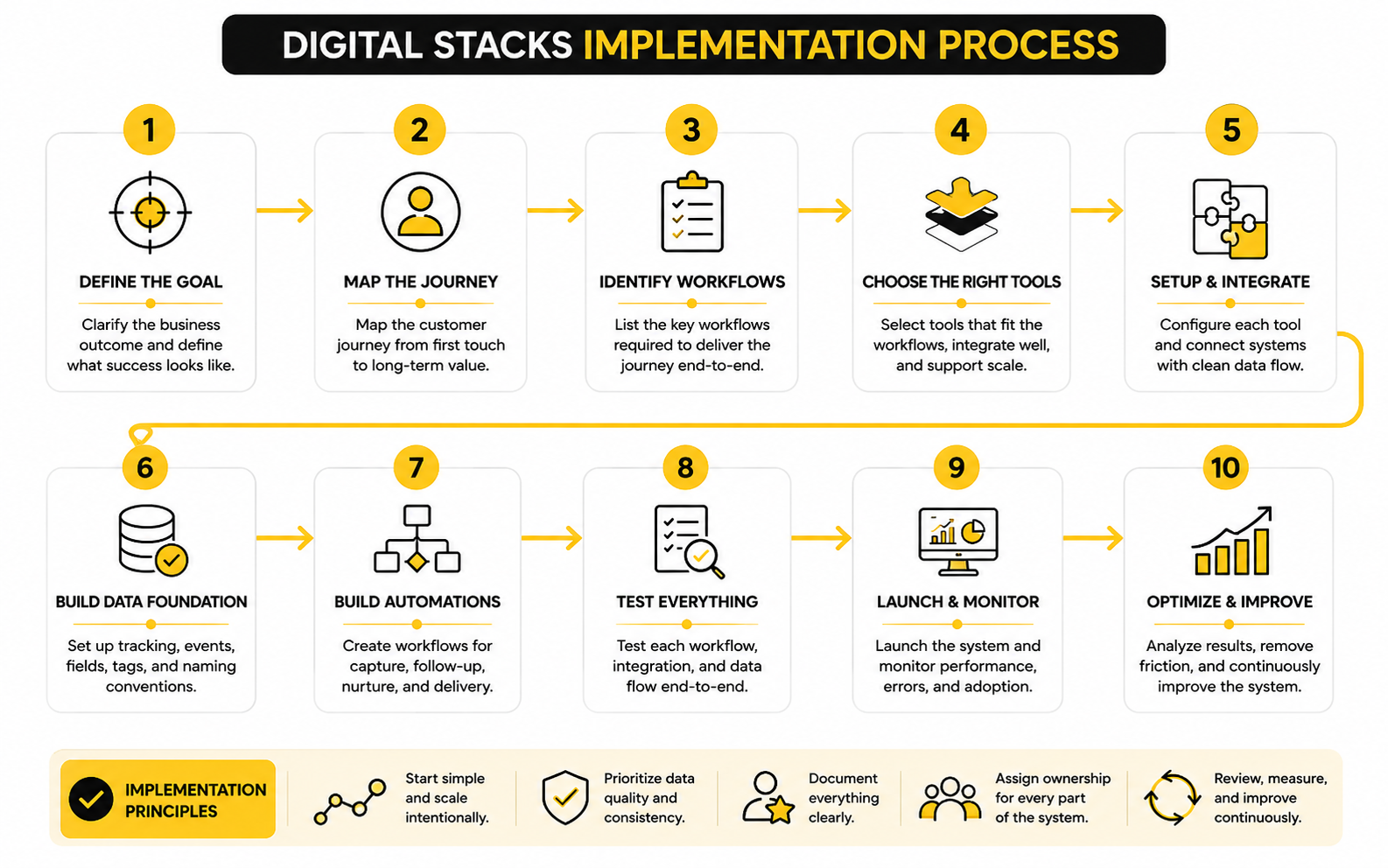
A simple execution process might look like this:
This kind of flow is not glamorous, but it is where real leverage lives. When these steps are missing, the business depends on memory, manual checking, and random follow-up. When they are built properly, the system keeps moving even when the team is busy.
Add Automation Carefully
Automation should remove friction, not create mystery. Every automation in the stack should be easy to explain in one sentence. If nobody can explain what it does, why it exists, and what happens when it fails, it is not mature enough to rely on.
Start with automations that protect revenue or customer experience. That usually means lead follow-up, appointment reminders, abandoned checkout flows, onboarding emails, support routing, renewal reminders, and internal alerts. These are boring automations, but boring automations often make the biggest difference.
The rise of AI makes this even more important. McKinsey’s 2025 AI research points to strategy, operating model, technology, data, adoption, and scaling as core dimensions for capturing value from AI. In stack terms, that means AI works best when it is placed inside a defined workflow, not thrown at a broken process and expected to magically clean it up.
Keep Data Clean From The Start
Clean data is not a luxury. It is what makes the stack trustworthy. If your tags, fields, stages, source labels, and customer statuses are inconsistent, the dashboard will look official while telling a messy story.
The best way to avoid this is to set simple naming rules early. Decide how sources are labeled, how lifecycle stages are defined, how offers are named, and which fields are required. Then document those rules so future changes do not slowly corrupt the system.
This matters because fragmented data limits visibility across teams and systems. Salesforce describes data silos as isolated collections of information that prevent a unified view across departments and tools. That is exactly what a digital stack should be designed to avoid.
Document The Operating Rules
A stack that is not documented becomes risky as soon as someone leaves, changes roles, or forgets how a workflow was built. Documentation does not need to be a massive manual. It needs to explain the parts of the system that people rely on.
At minimum, document the tools in use, the owner of each tool, the main workflows, the key automations, the naming conventions, the dashboard logic, and the failure points. This makes the stack easier to train, improve, and troubleshoot. It also stops the business from becoming dependent on one person’s memory.
Good documentation also makes optimization faster. When a conversion rate drops or a handoff breaks, you can inspect the system instead of guessing. That is the difference between a stack that feels fragile and one that can actually scale.
Statistics And Data
The measurement layer is where digital stacks either become strategic or stay cosmetic. A clean stack does not just collect numbers; it explains what the numbers mean and what decision should happen next. If the data does not change behavior, the business is not measuring performance, it is decorating dashboards.
The first number to respect is utilization. Gartner’s 2025 marketing technology research shows that teams are using only 49% of their martech stack capability, which means the average stack has a large amount of unused value sitting inside tools that are already being paid for. That matters because the cheapest performance gain may not come from buying another platform; it may come from implementing the current stack properly.
The second number is tool volume. The 2025 marketing technology landscape reached 15,384 solutions, which explains why businesses feel overwhelmed when choosing software. More choice does not automatically create better systems. It often creates more overlap, more dashboards, more integrations, and more chances for data to drift.
What Your Stack Should Actually Measure
A digital stack should measure the movement of people through the business, not just isolated activity. Website visits, impressions, email opens, and clicks can be useful, but they do not mean much unless they connect to pipeline, revenue, retention, or customer experience. The stack should show whether attention is becoming action and whether action is becoming value.
The cleanest measurement structure follows the same journey the stack supports. Start with acquisition metrics, then conversion metrics, then delivery metrics, then intelligence metrics. This makes reporting easier because every number has a place in the customer journey.
The point is not to track hundreds of metrics. The point is to know which few metrics expose the health of the system. A business that knows its lead source quality, conversion rate, sales cycle, average order value, churn risk, and follow-up speed is usually in a better position than a business with twenty dashboards nobody uses.
Acquisition Signals
Acquisition signals tell you whether the right people are entering the system. These signals include traffic source, content performance, cost per lead, subscriber growth, referral source, audience quality, and first-touch conversion. They help you understand which channels deserve more focus and which ones only look good on the surface.
The trap is confusing reach with momentum. A post can get attention without generating qualified leads. An ad can get clicks without producing buyers. A newsletter can grow while attracting people who never take the next step.
This is why acquisition data should always be interpreted with downstream behavior. If one channel sends fewer leads but those leads book more calls, buy faster, or retain longer, that channel may be stronger than a higher-volume source. Digital stacks should help you see that difference instead of rewarding whichever platform sends the biggest surface-level number.
Conversion Signals
Conversion signals tell you whether your stack is turning interest into action. These include form completion rate, booking rate, checkout conversion, lead-to-opportunity rate, opportunity-to-customer rate, abandoned checkout recovery, and follow-up response rate. These numbers matter because they show where intent is being created or lost.
A weak conversion signal does not always mean the offer is bad. It may mean the page is unclear, the form is too long, the call-to-action is buried, the follow-up is slow, or the wrong people are being sent into the flow. Measurement helps you diagnose the cause instead of guessing.
This is where tools need to pass data cleanly from one step to the next. A funnel builder like ClickFunnels, an all-in-one platform like Systeme.io, or a CRM-centered setup like GoHighLevel can all support conversion tracking, but only if the journey is mapped properly. The platform is not the strategy; it is the measurement container.
Delivery Signals
Delivery signals show whether customers are receiving value after they convert. These include onboarding completion, response time, support volume, usage behavior, project milestones, refund requests, renewal rate, repeat purchase behavior, and customer satisfaction. This layer matters because a stack that only measures marketing will miss the reasons customers stay or leave.
Delivery metrics should be interpreted as trust signals. If customers need too much support after buying, the onboarding may be unclear. If usage drops quickly, the product or service may not be creating early wins. If renewals are weak, the value may not be visible enough before the next decision point.
A good digital stack connects delivery data back to acquisition and conversion. That lets you see whether certain channels, offers, or promises create better long-term customers. Without that connection, the business may keep scaling campaigns that look profitable at the front end while quietly creating problems later.
The Analytics System
The analytics system should connect events, identities, sources, and outcomes. In plain English, it should show who did what, where they came from, what happened next, and whether the action created business value. This is the difference between isolated reporting and useful intelligence.
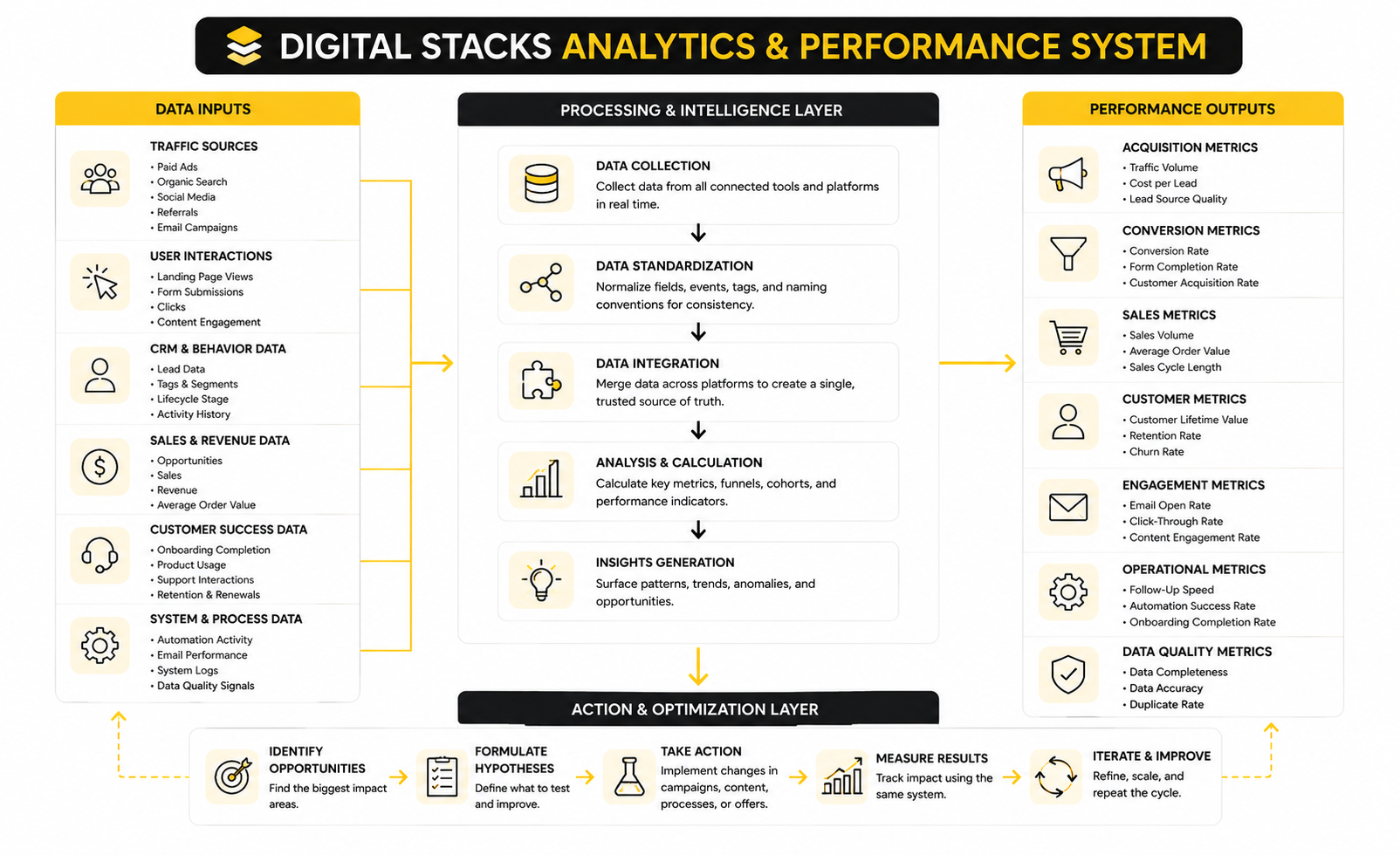
A practical analytics system usually needs four pieces. First, source tracking shows where people came from. Second, event tracking shows what they did. Third, identity tracking connects actions to contacts, customers, or accounts. Fourth, outcome tracking connects the journey to pipeline, revenue, retention, or delivery success.
This does not need to be enterprise-level to be useful. Even a simple stack can track lead source, offer, form submission, booked call, purchase, onboarding status, and customer value. The important part is consistency, because inconsistent tracking creates false confidence.
Benchmarks Without Blind Copying
Benchmarks can be useful, but they are dangerous when copied blindly. A conversion rate that is excellent for one business model may be weak for another. A high email open rate may not matter if the campaign does not create revenue, and a low lead cost may be irrelevant if the leads are unqualified.
The better way to use benchmarks is directional. They can tell you whether something is obviously broken, but they should not replace your own baseline. Once your stack has enough clean data, your best benchmark is your previous performance.
This is especially important when comparing channels. Paid search, organic social, email, referrals, affiliates, webinars, and outbound all behave differently. The question is not which channel has the prettiest benchmark; the question is which channel produces the best customer economics for your specific business.
Performance Signals That Deserve Attention
Some signals are worth watching because they reveal system health quickly. Speed to lead is one of them. If someone raises their hand and the business responds too slowly, conversion usually suffers because intent fades fast.
Drop-off points are another major signal. If many people click but few submit, the landing page or offer may be the problem. If many people submit but few book, the scheduling step may be too weak. If many people buy but do not activate, the onboarding flow needs work.
Data conflict is also a performance signal. If your CRM, email platform, payment system, and dashboard disagree, the stack is telling you something important. It is not just a reporting issue; it is an operational risk.
What The Data Should Make You Do
Measurement should drive action in three categories: simplify, improve, or scale. If a tool is not being used and does not support a critical workflow, simplify. If a workflow shows friction, improve the step that is causing the drop-off. If a channel or sequence is producing reliable outcomes, scale it carefully.
This is why random stats do not help. A number only matters when it creates a decision. If email engagement drops, test the message and segmentation. If booked calls are rising but sales are flat, inspect lead quality and sales process. If onboarding tickets increase after a new offer launches, fix the delivery expectations before buying another support tool.
The strongest digital stacks create a weekly rhythm around these decisions. Review the numbers, identify the bottleneck, make one focused change, and measure again. That rhythm is what turns analytics from a report into a growth system.
Avoiding Dashboard Theater
Dashboard theater happens when a business has attractive reports but no operational clarity. The charts look polished, the numbers update automatically, and everyone feels informed for a few minutes. Then nothing changes.
A useful dashboard should be boring in the best way. It should show the few numbers that matter, expose the current bottleneck, and make the next action obvious. If a metric does not help someone make a decision, it should not dominate the dashboard.
This is where many digital stacks need restraint. You do not need every possible metric on one screen. You need the right metric for the right person at the right decision point. Sales needs pipeline clarity, marketing needs source quality, delivery needs customer progress, and leadership needs the full connection between spend, revenue, and retention.
Choosing Tools Without Creating Software Chaos
By this point, the stack has a framework, a process, and a measurement layer. Now comes the harder part: making strategic choices without letting the software environment become bloated. This is where digital stacks either become cleaner as the business grows or turn into a patchwork of tools nobody fully understands.
The danger is subtle because every new tool usually has a reasonable explanation. One tool improves landing pages, another handles forms, another sends email, another books calls, another adds AI, another creates reports, and another promises better attribution. None of those decisions look terrible in isolation, but together they can create a slow, expensive, fragile system.
The right question is not, “Can this tool do something useful?” Most tools can. The better question is, “Does this tool improve the customer journey, reduce operational drag, or make better decisions possible without adding unnecessary complexity?”
The Real Cost Of Complexity
Software cost is not just the monthly subscription. The real cost includes implementation, migration, training, integration, maintenance, reporting cleanup, security review, documentation, and the mental load of managing another moving part. A cheap tool can become expensive when it creates confusion across the stack.
This matters because underused software is already a proven problem. Gartner’s 2025 marketing technology research shows that organizations use only 49% of their martech stack capability, which means many businesses are paying for capacity they have not operationalized. That is not just waste; it is a signal that the stack may be growing faster than the team’s ability to use it well.
Complexity also makes performance harder to diagnose. If lead quality drops, you need to know whether the issue came from traffic, targeting, landing page copy, form friction, automation logic, CRM routing, follow-up speed, or sales process. The more disconnected the stack becomes, the longer it takes to find the real bottleneck.
Consolidation Versus Best-In-Class
One of the biggest strategic tradeoffs is whether to use an all-in-one platform or a set of specialized tools. Both can work. The wrong answer is pretending one approach is always better.
A consolidated platform can reduce integration work, simplify ownership, and make reporting easier. For service businesses, agencies, and local businesses, a platform like GoHighLevel can make sense because CRM, funnels, forms, scheduling, messaging, pipelines, and automation can live closer together. That kind of setup is useful when speed, simplicity, and operational control matter more than having the most advanced tool in every category.
Best-in-class tools can make sense when a business has specialized needs and the team to manage them. An ecommerce team may want Replo for landing pages, Fillout for structured forms, Brevo or Moosend for email, and separate analytics or customer support tools. That can be powerful, but only if integrations, data rules, and ownership are mature enough to support it.
When To Add A New Tool
A new tool should enter the stack only when the problem is specific, valuable, and persistent. Specific means you can clearly name the workflow or decision that is currently weak. Valuable means solving the problem should improve revenue, customer experience, speed, risk, or strategic clarity. Persistent means the problem is not just a temporary annoyance caused by poor setup or lack of training.
Before adding software, ask whether the current stack can solve the problem with better configuration. Many teams buy new tools because they never fully implemented the ones they already have. That is especially common with automation, reporting, segmentation, and CRM workflows.
A tool is worth considering when it removes a bottleneck the current stack cannot solve cleanly. For example, a business that relies heavily on conversational lead capture may justify adding ManyChat. A team producing frequent social content may justify Buffer. The key is that the tool should solve a real workflow, not satisfy curiosity.
When To Remove A Tool
Removing tools is just as important as adding them. A stack audit should identify platforms that are unused, duplicated, poorly integrated, badly owned, or no longer aligned with the business model. If a tool is not making the business faster, clearer, safer, or more profitable, it deserves pressure.
The easiest candidates are duplicate tools. If two platforms are collecting leads, two systems are sending emails, or three dashboards are reporting different versions of the truth, the stack is creating unnecessary friction. Consolidation does not always mean fewer tools, but it should mean fewer unclear responsibilities.
The harder candidates are tools people like but do not need. Familiar software can survive because the team is used to it, not because it still creates value. That is why removal decisions should be tied to workflows and outcomes instead of preference.
Integration Risk
Every integration creates a promise: data will move correctly from one place to another. When that promise breaks, leads disappear, tags fail, orders do not trigger access, reminders do not send, dashboards misreport, or customers receive the wrong message. This is not a technical detail; it is a business risk.
Integration risk increases when the stack depends on fragile connections, unclear field mapping, inconsistent naming, or undocumented automations. It also increases when nobody owns the system end to end. If every tool has an owner but nobody owns the journey, the customer experience can still break.
A mature stack reduces integration risk by documenting triggers, fields, dependencies, and failure alerts. It also avoids unnecessary handoffs. If one platform can handle a workflow reliably, forcing that workflow through three tools just because it feels clever is usually a mistake.
Data Governance And Security
As digital stacks grow, data governance becomes more important. The stack may contain names, emails, phone numbers, payment events, customer notes, sales conversations, support history, and behavioral data. That information needs clear rules around access, retention, permission, and usage.
This is especially important with AI tools. IBM’s 2025 Cost of a Data Breach research highlights an AI oversight gap and reports a global average breach cost of USD 4.44 million, which makes governance more than a corporate checkbox. If customer data is copied into tools without access controls, review, or policy, the business is creating risk while trying to move faster.
The practical move is simple. Limit access to what each person needs, review connected apps regularly, remove old users quickly, document where sensitive data lives, and be careful about pushing private customer information into AI workflows. Speed is good, but reckless speed gets expensive.
AI Inside The Stack
AI can make digital stacks dramatically more useful, but only when it sits inside a clear process. It can help draft messages, summarize conversations, route support requests, score leads, generate content briefs, analyze patterns, and improve customer handoffs. But AI should not be treated as a replacement for process design.
McKinsey’s 2025 AI research makes the point clearly: organizations seeing more value from AI are redesigning workflows, not just adding tools. That matters because an AI layer placed on top of a messy stack will usually amplify the mess. It may produce faster outputs, but the underlying routing, data, and accountability problems remain.
The best use of AI in digital stacks is targeted. Use it where the input is clear, the output can be reviewed, and the business value is obvious. A chatbot through Chatbase, a voice workflow through Wispr Flow, or an automation layer inside GoHighLevel AI should be connected to a defined business workflow, not used as a random productivity toy.
Scaling Without Breaking The System
A stack that works at low volume can still break at higher volume. More leads mean more routing decisions. More customers mean more support cases. More campaigns mean more tracking rules. More team members mean more permission issues, more training needs, and more chances for inconsistent execution.
Scaling requires standardization before acceleration. Naming conventions, pipeline stages, offer structures, source tracking, automation rules, and dashboard definitions need to be stable enough for the team to follow. If everyone improvises inside the stack, scale will turn small inconsistencies into major operational problems.
This is why advanced digital stacks need change control. Before someone adds a new field, automation, tag, funnel, or integration, there should be a reason and a review. That does not mean bureaucracy. It means the system is important enough to protect.
The Expert-Level Rule
The expert-level rule is simple: optimize the system before optimizing the tool. A business with a clear offer, clean journey, fast follow-up, strong onboarding, and trustworthy reporting can win with a relatively simple stack. A business with a confusing offer and messy workflows will struggle even with premium software.
This is where restraint becomes a competitive advantage. While other teams keep chasing the next platform, a disciplined business improves the flow of information, decisions, and customer experience across the tools it already uses. That is less exciting than a new launch, but it is usually more profitable.
Digital stacks should make the business easier to run, easier to understand, and easier to improve. If the stack makes everything feel heavier, it is not mature. It is just complicated.
Measuring, Optimizing, And Scaling Your Digital Stack
A digital stack is never really finished. Markets change, offers change, customer behavior changes, team capacity changes, and tools change faster than most businesses can fully absorb. The job is not to build a perfect stack once; the job is to create a system that can keep improving without becoming unstable.
This final stage is where the stack becomes an ecosystem. Acquisition, conversion, delivery, intelligence, governance, and optimization are no longer separate ideas. They become connected parts of one operating system that helps the business make better decisions with less friction.
That is the standard worth aiming for. Not more tools. Not louder dashboards. Not endless automation for the sake of automation. A strong digital stack helps the business grow while staying easier to understand.
The Optimization Rhythm
Optimization works best when it follows a rhythm. Review the key numbers, identify the biggest bottleneck, make one focused change, and measure what happens. Then repeat the process instead of changing five things at once and pretending you know what worked.
This rhythm matters because digital stacks can create a false sense of control. When every platform has charts, alerts, automations, and AI suggestions, it becomes tempting to react to everything. That is how teams end up busy but not better.
A practical optimization rhythm should happen weekly for active campaigns and monthly for bigger system decisions. Weekly reviews should focus on flow: leads, conversion, follow-up, sales movement, delivery friction, and obvious errors. Monthly reviews should focus on structure: tool usage, data quality, cost, duplicated workflows, and whether the stack still matches the business model.
Scaling The Ecosystem
Scaling a stack means increasing volume without increasing confusion at the same rate. More leads should not automatically mean more manual follow-up. More customers should not automatically mean more support chaos. More campaigns should not automatically mean more reporting conflict.
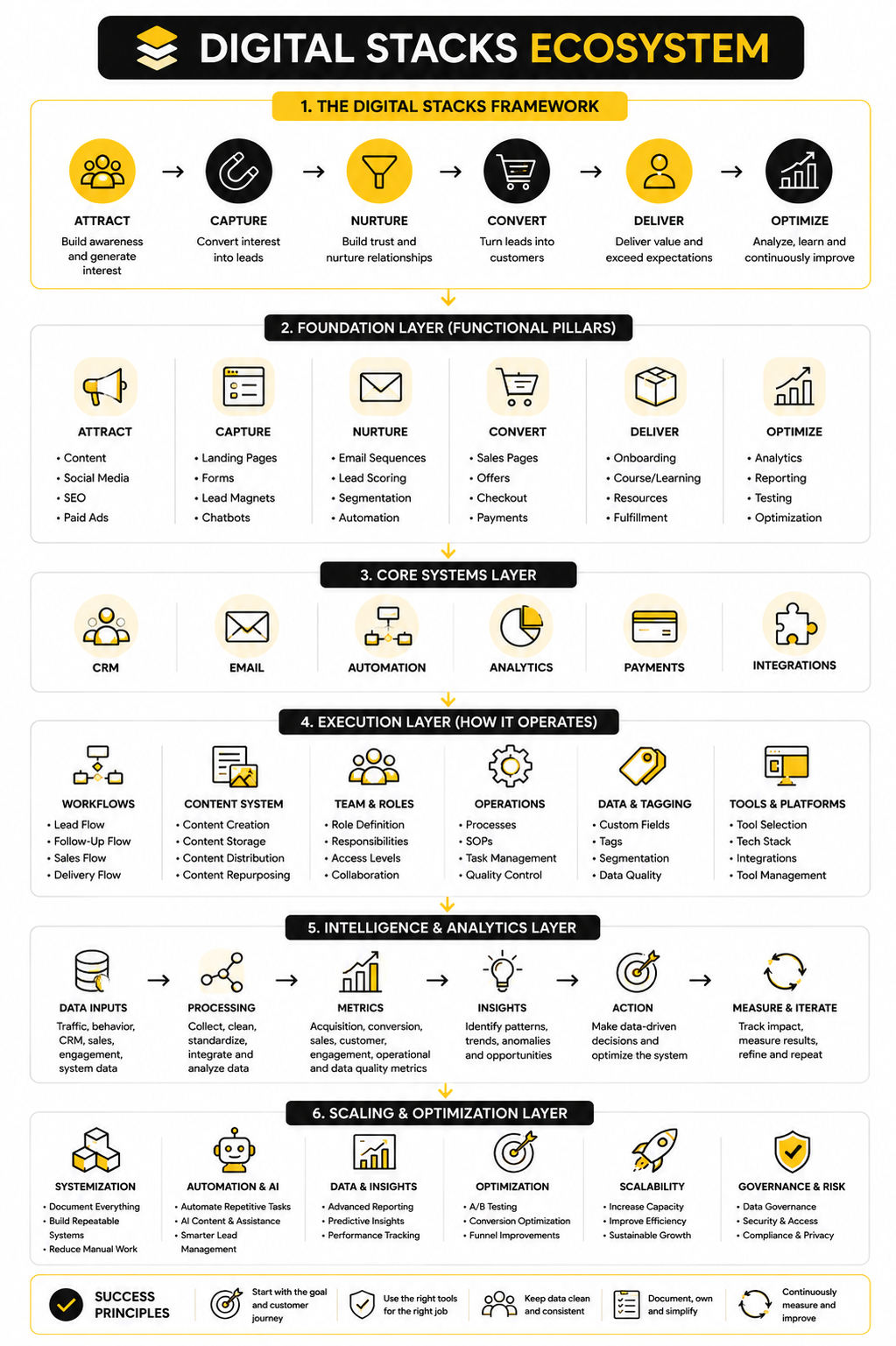
The ecosystem view is simple. Every new campaign, offer, automation, page, form, chatbot, email sequence, or dashboard should connect back to the same operating logic. Who is this for? What action should happen? Where does the data go? Who owns the outcome? What number proves it worked?
If those questions are answered consistently, digital stacks become easier to scale. If they are ignored, growth adds pressure to weak systems until something breaks. That is why mature businesses do not just ask whether a tool can handle more volume; they ask whether the workflow can handle more complexity.
The Stack Review Checklist
A stack review should be direct and practical. It should expose what is working, what is unclear, and what needs to be cleaned before the next growth push. This is not a branding exercise; it is operational maintenance.
Use this checklist when reviewing the full system:
This checklist should not be saved for an annual cleanup. A fast-moving business should review the stack often enough that small issues stay small. That is how you avoid the painful rebuild nobody wants to do later.
What are digital stacks?
Digital stacks are the tools, workflows, automations, data systems, and reporting layers a business uses to operate online. They usually include platforms for lead generation, CRM, email, landing pages, scheduling, payments, analytics, customer support, and delivery. The best digital stacks are not just collections of software; they are connected systems designed around the customer journey.
Why do digital stacks matter for online businesses?
Digital stacks matter because they determine how smoothly a business captures attention, converts demand, serves customers, and learns from performance data. When the stack is clear, the business can move faster with fewer manual gaps. When the stack is messy, leads get lost, reporting becomes unreliable, and teams waste time fixing avoidable problems.
What should a digital stack include?
A practical digital stack should include acquisition tools, conversion tools, delivery systems, and intelligence tools. That might mean content scheduling, landing pages, forms, CRM, email automation, calendar booking, payment processing, onboarding, support, and dashboards. The exact tools depend on the business model, but the structure should always support the journey from first touch to retained customer.
How do I know if my digital stack is too complicated?
Your stack is probably too complicated if nobody can clearly explain what each tool does, where customer data lives, or what happens after a lead takes action. It is also a warning sign if different platforms show different versions of the truth. Complexity becomes a problem when it slows decisions, creates duplicate work, or makes customer experience harder to manage.
Should I use an all-in-one platform or separate best-in-class tools?
An all-in-one platform can be better when you want speed, simplicity, and fewer integrations. A best-in-class setup can be better when your business has specialized needs and the team is capable of managing more tools. The right choice depends on your workflows, your internal capacity, and how much integration complexity you can realistically handle.
How often should I audit my digital stack?
A light review should happen monthly, especially if the business is running active campaigns or changing offers. A deeper audit should happen whenever you launch a new offer, change the sales process, hire new team members, or notice reporting problems. The point is to catch small issues before they become expensive operational problems.
What is the biggest mistake businesses make with digital stacks?
The biggest mistake is buying tools before defining the workflow. This usually leads to overlap, unclear ownership, poor implementation, and low utilization. A better approach is to map the customer journey first, identify the bottlenecks, and then choose tools that solve specific problems.
How does AI fit into digital stacks?
AI fits best when it supports a defined workflow. It can help with lead routing, customer support, content creation, summaries, personalization, sales assistance, and reporting. The mistake is adding AI before the business has clean data, clear processes, and rules for how AI output should be reviewed.
What metrics should digital stacks track?
Digital stacks should track metrics that connect activity to outcomes. Useful metrics include lead source quality, conversion rate, booking rate, checkout completion, sales cycle length, average order value, retention, onboarding completion, support volume, and customer lifetime value. Vanity metrics can be useful as early signals, but they should not be treated as proof of business performance unless they connect to revenue or customer value.
How can a small business start building a digital stack?
A small business should start with the customer journey, not a software wish list. Map how people discover the business, how they become leads, how they buy, how they receive value, and how they stay engaged. Then choose the smallest number of tools needed to support that journey reliably.
When should I remove a tool from my stack?
Remove a tool when it is unused, duplicated, poorly integrated, insecure, or no longer tied to a clear business outcome. A tool should also be questioned if the team keeps paying for it but cannot explain what would break if it disappeared. Removing software is not about being minimal for the sake of it; it is about protecting clarity.
What makes a digital stack scalable?
A scalable digital stack has consistent naming, clear ownership, reliable integrations, useful dashboards, documented workflows, and controlled permissions. It can handle more volume without depending on constant manual fixes. Most importantly, it can be improved without confusing the whole team.
Build a stronger local presence with BAAM AI
Turn your website, Google profile, social channels, and AI visibility into one growth engine
Most businesses do not need more random marketing activity. They need a consistent presence system that helps the right people find them, trust them, and take action. BAAM AI brings strategy, local SEO, website updates, Google Maps visibility, social content, AI-search readiness, media production, and reporting into one practical monthly engine.
If you want your marketing to keep working after the campaign ends, start with a free BAAM AI presence audit. See how your business shows up today and where the fastest visibility wins are at BAAM AI.