
BAAM AI Blog
Digital Performance Marketing Agency: The Practical Framework For Measurable Growth
A digital performance marketing agency is not just a team that runs ads. At its best, it is the growth operating system behind your acquisition, conversion, retention, and measurement. The agency’s job is simple to...
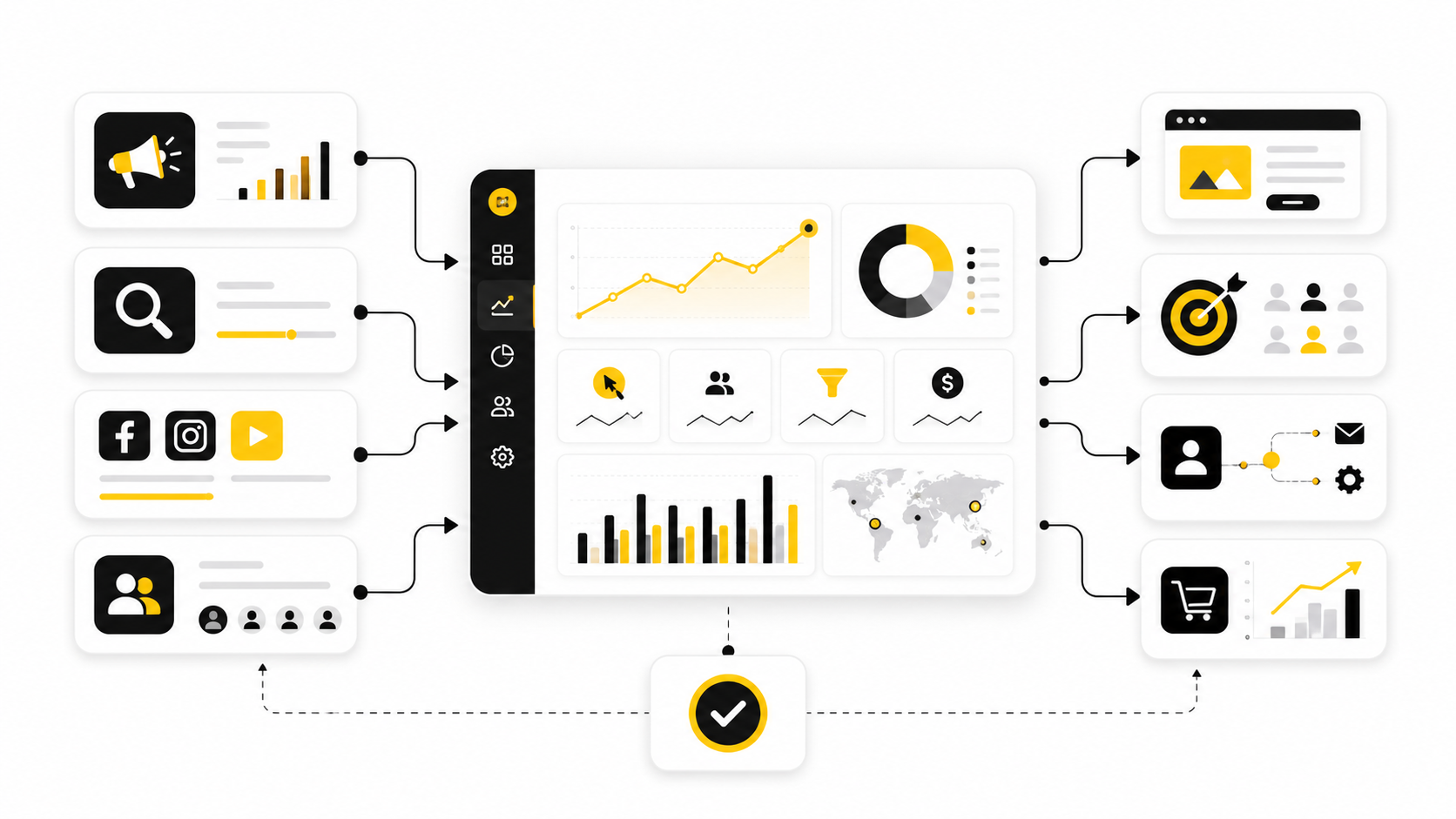
A digital performance marketing agency is not just a team that runs ads. At its best, it is the growth operating system behind your acquisition, conversion, retention, and measurement. The agency’s job is simple to say and hard to execute: turn marketing spend into measurable business outcomes without losing the brand, the customer, or the unit economics.
That matters more now because the digital market is bigger, faster, and more automated than it was even a year ago. U.S. internet advertising revenue reached nearly $300 billion in 2025, while marketing leaders are still under pressure to prove value because budgets have remained around 7.7% of company revenue. In plain English, more money is moving through digital channels, but nobody gets a free pass anymore.
The old playbook was mostly channel execution: launch campaigns, test audiences, adjust bids, report ROAS, repeat. That is no longer enough. Modern performance marketing now has to connect paid media, creative, landing pages, first-party data, CRM, automation, attribution, and AI-assisted testing into one system that can learn faster than the competition.
this guide is structured as a six-part guide so each section builds on the last. Part 1 sets the direction, defines the framework, and explains why a digital performance marketing agency has become a strategic growth partner rather than a media-buying vendor. The remaining parts will move from strategy into implementation, so the full article reads like one practical operating manual.
The structure is intentional because performance marketing breaks when it is treated as isolated tactics. A paid search campaign cannot carry a weak offer, a strong ad cannot fix a broken landing page, and a beautiful dashboard does not matter if nobody acts on the insight. The real advantage comes from connecting the system end to end.
Why A Digital Performance Marketing Agency Matters Now
A digital performance marketing agency matters because growth has become more measurable and more complex at the same time. Platforms such as Google, Meta, TikTok, LinkedIn, and retail media networks are pushing advertisers toward automation, but automation only works well when the inputs are strong. That means the agency has to bring strategy, creative judgment, data discipline, and commercial thinking before it ever touches the campaign settings.
The shift is visible across the major platforms. Google says advertisers using AI Max for Search campaigns typically see 14% more conversions or conversion value at a similar CPA or ROAS, while TikTok describes Smart+ as an AI-powered campaign system that automates targeting, optimization, and creative delivery for performance objectives. These tools can help, but they do not remove the need for a sharp offer, clean tracking, strong creative, and clear decision rules.
This is where the agency role has changed. A good agency no longer asks only, “How do we lower CPA?” It asks better questions: which customers are worth acquiring, which offers create profitable demand, which creative angles change behavior, which channels deserve scale, and which signals are trustworthy enough to guide spend.
Framework Overview
The framework for a digital performance marketing agency should start with business outcomes, not platform tactics. Revenue, profit, pipeline, customer acquisition cost, lifetime value, conversion rate, payback period, and retention are the numbers that matter. Clicks, impressions, CTR, and engagement still have a place, but they are supporting signals, not the final scoreboard.
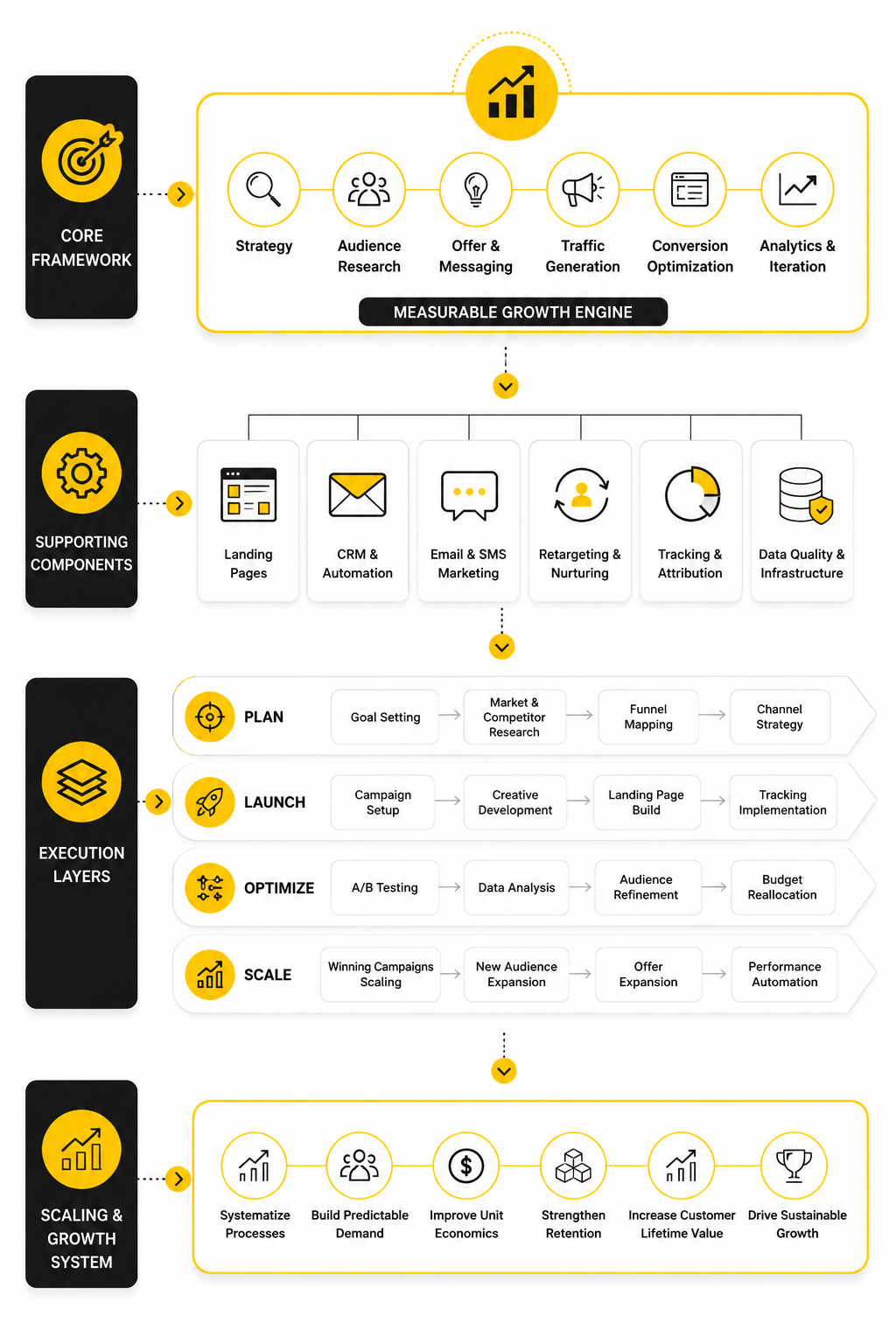
A strong framework has four layers. The first layer is strategy: market positioning, customer insight, offer design, and growth targets. The second layer is execution: campaigns, creative, landing pages, email, SMS, chat, CRM workflows, and sales handoff.
The third layer is measurement: tracking, attribution, incrementality, customer quality, and reporting that supports decisions instead of just documenting activity. The fourth layer is optimization: structured testing, budget movement, creative iteration, automation rules, and strategic review. When these layers work together, performance marketing becomes a compounding system instead of a monthly guessing game.
Core Components Of The Agency System
The first core component is audience and offer clarity. A digital performance marketing agency needs to understand who the company wants to reach, what pain or desire moves that person, and why the offer is worth acting on now. Without that clarity, targeting becomes lazy, creative becomes generic, and media spend turns into expensive noise.
The second component is conversion infrastructure. Landing pages, checkout flows, lead forms, booking pages, chat automation, CRM pipelines, and follow-up sequences decide whether traffic becomes revenue. Tools such as GoHighLevel, ClickFunnels, Replo, and ManyChat can support that system when they fit the business model, but tools are never the strategy by themselves.
The third component is creative testing. Performance creative is not just design; it is market research in public. Each ad tests an angle, a promise, a pain point, a proof point, a hook, or a buying trigger, and the best agencies treat creative learning as seriously as media optimization.
Professional Implementation Starts With Control
Professional implementation starts with control because performance marketing gets messy fast. If tracking is unreliable, naming conventions are random, landing pages are disconnected from campaigns, and reports show vanity metrics, the team will make confident decisions from weak data. That is one of the fastest ways to waste budget.
The practical approach is to define the operating rules before scaling spend. That includes what counts as a conversion, how leads are qualified, how revenue is matched back to campaigns, how creative tests are judged, and when budgets move up or down. Without those rules, every campaign review becomes opinion-driven.
The best digital performance marketing agency is not the one that promises magic. It is the one that builds a repeatable growth system, protects the economics, and improves the quality of decisions every week. That is the foundation the rest of this guide will build on.
Why Performance Marketing Matters More Than Ever
Performance marketing matters because the distance between marketing activity and business accountability has almost disappeared. Leadership teams no longer want vague explanations about awareness, reach, or “momentum” when revenue is under pressure. They want to know which campaigns created qualified demand, which channels produced profitable customers, and which parts of the journey are leaking money.
That pressure is not happening in a small market. Digital advertising reached nearly $300 billion in U.S. revenue in 2025, and digital channels now represent 61.1% of total marketing spend. When that much budget moves through measurable channels, the standard for proof gets higher.
This is exactly where a digital performance marketing agency becomes valuable. The right agency does not just buy traffic; it helps a business understand where growth is actually coming from. That means connecting media spend to revenue quality, sales velocity, customer lifetime value, and the operational reality behind the numbers.
The Budget Pressure Is Real
Most companies are trying to grow without getting a meaningful budget increase. Marketing budgets stayed flat at 7.7% of company revenue in 2025, which means teams are being asked to create more impact with roughly the same financial room. That is a tough environment for sloppy execution.
Flat budgets change the conversation. A campaign that looks acceptable on surface-level metrics can still be a bad investment if it attracts low-quality leads, slow-moving pipeline, discount-heavy customers, or one-time buyers with weak retention. The agency’s job is to expose that difference before the business scales the wrong thing.
This is why performance marketing is not only about lowering cost per click or cost per lead. Cheap traffic can be expensive when it wastes the sales team’s time or fills the CRM with people who were never likely to buy. A serious digital performance marketing agency looks at cost, quality, speed, and profit together.
Buyers Are Harder To Win
Buyers have more options, more comparison points, and less patience for weak messaging. They can research competitors, read reviews, compare prices, watch product demos, ask AI tools for alternatives, and abandon a buying journey in seconds. That makes generic marketing weaker than ever.
A performance strategy has to respect how people actually make decisions. The first click is rarely the whole journey, and the last click is rarely the whole truth. Good agencies build campaigns around customer intent, objections, timing, and context instead of pretending one ad or one landing page does all the work.
This is where creative quality becomes a growth lever. The best-performing brands are not just targeting better; they are explaining better. They make the offer easier to understand, the value easier to believe, and the next step easier to take.
AI Has Raised The Floor, Not Removed The Work
AI has made campaign setup faster, bidding more automated, and creative production easier to scale. Platforms are increasingly steering advertisers toward automated campaign types, predictive audiences, and machine-assisted optimization. That can be useful, but it also means more businesses are using similar tools inside the same auction environments.
The advantage now comes from what the machine cannot create from weak inputs. AI cannot invent a strong positioning strategy from a lazy brief, cannot fix an offer nobody wants, and cannot reliably judge which customers are profitable without clean data. Automation rewards the business that feeds it better signals.
That is why agency skill still matters. A digital performance marketing agency has to know how to guide the system, not just trust the system. The agency needs to shape the offer, structure the account, improve the creative pipeline, clean up measurement, and decide when platform recommendations support the business goal or quietly work against it.
Measurement Has Become A Competitive Advantage
Measurement used to be treated like a reporting task. Now it is a strategic advantage because the businesses that understand their numbers can move faster and spend with more confidence. If a team knows which campaigns produce customers with strong payback and retention, it can scale more aggressively without guessing.
The problem is that measurement is harder than most dashboards make it look. Privacy changes, platform attribution limits, cross-device behavior, offline sales, CRM gaps, and longer buying cycles all distort the picture. A clean-looking report can still hide bad assumptions.
Professional performance marketing solves this by using multiple views of truth. Platform data, analytics data, CRM data, sales feedback, customer cohorts, and finance numbers each reveal something different. The agency’s role is to turn those signals into decisions rather than letting the team argue over which dashboard is “right.”
The Funnel Is No Longer Linear
The classic funnel still helps as a planning model, but real buying journeys are messier. People move from social content to search, from reviews to email, from a sales call back to a comparison page, and from a retargeting ad to a direct visit. The path is not clean, and the strategy cannot be either.
That does not mean performance marketing should become chaotic. It means the system has to be designed around stages of intent. Cold audiences need education and relevance, warm audiences need proof and differentiation, and high-intent audiences need clarity, urgency, and a frictionless next step.
This is also why follow-up infrastructure matters. A lead that does not buy today may still become a customer later if the business has smart email, SMS, CRM, and retargeting systems in place. Platforms like GoHighLevel, Brevo, Moosend, and ManyChat can support that process when they are connected to a clear conversion strategy.
Performance Marketing Protects The Business From Waste
Waste rarely shows up as one obvious mistake. It usually appears as small leaks across the system: weak audience exclusions, unclear offers, slow landing pages, poor lead qualification, missing follow-up, messy tracking, and creative that stops improving. Each leak looks manageable on its own, but together they can quietly destroy profitability.
A digital performance marketing agency should find and fix those leaks. That requires more than campaign management. It requires commercial awareness, technical discipline, creative testing, and the confidence to challenge assumptions when the numbers do not support the current strategy.
This is why performance marketing matters now: it gives the business a way to learn before spending bigger. Instead of scaling hope, the team scales evidence. That shift is simple, but it changes everything.
The Performance Growth Framework
A digital performance marketing agency needs a framework that turns strategy into action without losing the commercial goal. The point is not to create a complicated process for the sake of looking sophisticated. The point is to make sure every campaign, creative test, landing page, follow-up sequence, and report is connected to measurable growth.
The framework starts with one uncomfortable truth: most performance problems are not media-buying problems at first. They are usually offer problems, tracking problems, message problems, funnel problems, or follow-up problems that become visible once paid traffic exposes them. A good agency does not hide behind platform metrics when the real issue sits deeper in the system.
That is why the process has to move in order. Strategy comes before scale, measurement comes before optimization, and learning comes before aggressive budget increases. When the order is wrong, the business does not get a growth system; it gets a louder version of the same confusion.
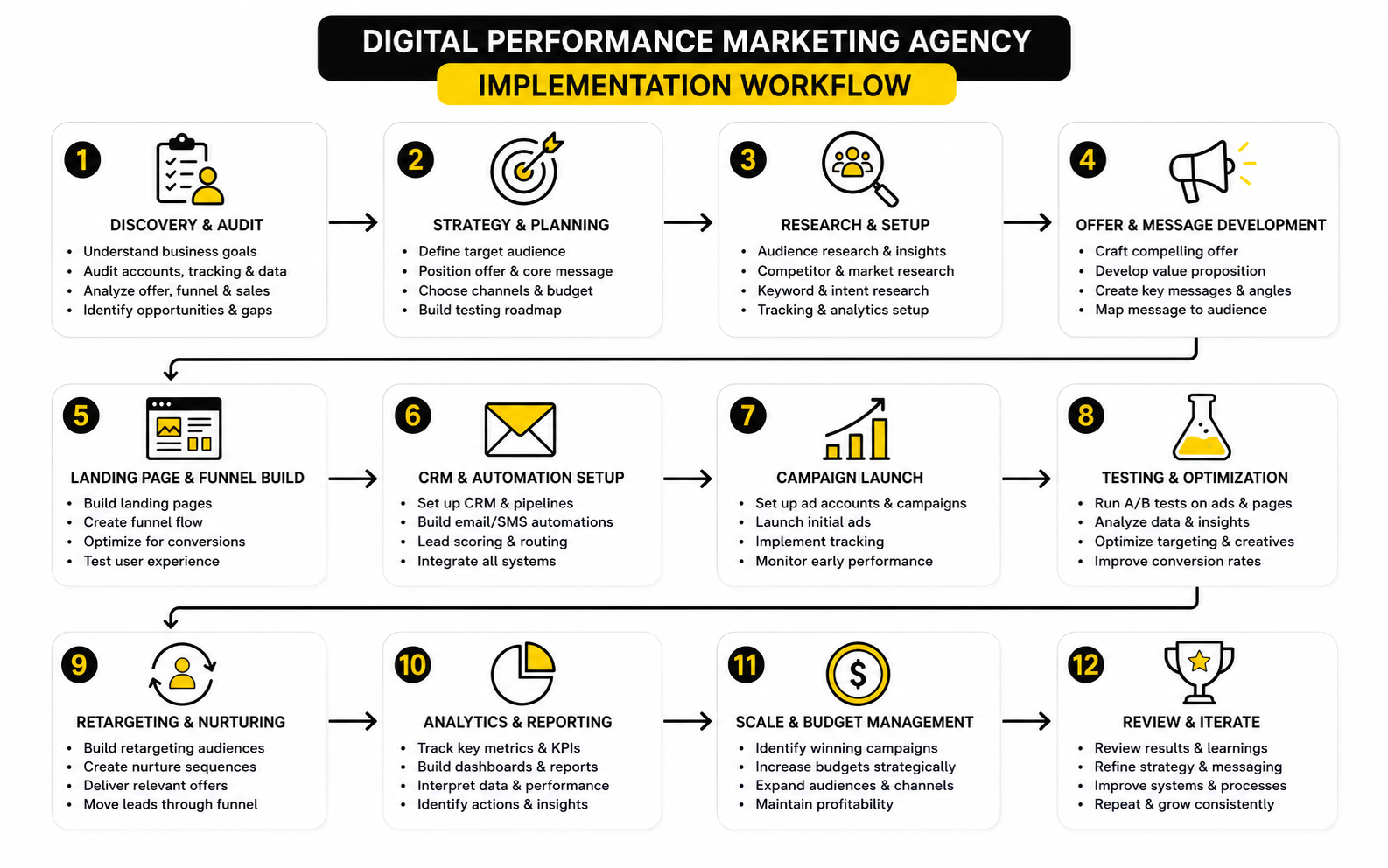
Step 1: Define The Commercial Target
The first step is to define what performance actually means for the business. A lead generation company may care about qualified appointments, show-up rate, close rate, and cost per acquired customer. An ecommerce brand may care about contribution margin, repeat purchase rate, average order value, and payback window.
This matters because the same campaign can look good or bad depending on the target. A low cost per lead means very little if those leads never answer the phone. A strong ROAS can still be weak if discounts, shipping, returns, and fulfillment costs destroy margin.
The agency and the client need to agree on the scoreboard before execution begins. That scoreboard should include the primary conversion, the economic target, the acceptable acquisition cost, and the quality signals that separate good volume from bad volume. Without that agreement, every review becomes a debate instead of a decision.
Step 2: Audit The Existing Growth System
Before launching new campaigns, the agency should audit the current growth system. That includes ad accounts, analytics, tracking pixels, conversion events, CRM data, landing pages, email flows, sales processes, creative assets, and past campaign performance. This is not busywork; it is how the agency finds the leaks that are already costing money.
The audit should answer practical questions. Are conversions being tracked correctly? Are campaigns optimized for the right event? Are landing pages aligned with the ads? Are leads being followed up fast enough? Are reports showing revenue quality or only platform activity?
This stage often reveals that the business does not need more traffic immediately. It may need better event tracking, stronger landing page messaging, a cleaner CRM pipeline, or a faster follow-up sequence. Tools such as GoHighLevel, Brevo, and Fillout can help tighten that infrastructure when they are used with a clear operating plan.
Step 3: Map The Customer Journey
The next step is to map how people move from first awareness to final decision. This should include the buying triggers, research moments, comparison points, objections, trust signals, and handoff points between marketing and sales. A digital performance marketing agency that skips this step usually ends up creating campaigns around platforms instead of people.
The journey map should show what the customer needs at each stage. Cold prospects need relevance and a reason to care. Warm prospects need proof, differentiation, and a clear next step. High-intent prospects need friction removed before doubt has time to grow.
This is where performance marketing becomes more human, not less. The agency is not just pushing users through a funnel; it is reducing confusion at the moments where buyers hesitate. That is a major difference.
Step 4: Build The Execution Plan
Once the commercial target, audit, and journey map are clear, the agency can build the execution plan. This is where the strategy becomes tangible: channels, campaign structure, creative angles, landing pages, offers, budget allocation, testing cadence, reporting rhythm, and responsibilities. Everything should have a reason.
A simple execution plan is often stronger than a bloated one. The agency should define which channels deserve attention now, which should wait, and which are not a fit. Just because a platform exists does not mean it belongs in the first phase.
The plan should also define what will be tested first. That could be a new offer, a new creative angle, a new landing page, a new lead magnet, a new audience structure, or a new follow-up sequence. The key is to test meaningful variables instead of making random changes and calling it optimization.
Step 5: Launch With Clean Measurement
Launch is not the finish line. It is the point where the learning system begins. The campaigns should go live only after tracking, naming conventions, conversion events, UTM structure, dashboards, and CRM handoffs are checked carefully.
Clean measurement matters because automated ad systems increasingly depend on strong conversion signals. Google’s AI Max documentation says advertisers that activate AI Max in Search campaigns typically see 14% more conversions or conversion value at a similar CPA or ROAS, but those systems still need reliable inputs to optimize toward the right outcomes. Bad data teaches the machine the wrong lesson.
This is why a professional launch process feels slightly boring. There are checklists, naming rules, QA steps, test submissions, CRM checks, and reporting reviews. That discipline is what prevents expensive confusion later.
Step 6: Optimize Based On Decision Rules
Optimization should not mean reacting emotionally to every daily fluctuation. Paid media performance moves around, and short-term noise can trick teams into killing good tests too early or scaling weak campaigns too fast. The agency needs decision rules that keep the process rational.
Good decision rules define when to pause, when to iterate, when to scale, and when to leave a test alone. They also define which metric matters at each stage. Early creative tests may be judged by qualified engagement and conversion rate, while mature campaigns may be judged by acquisition cost, revenue quality, and payback.
This is where the agency earns trust. It does not simply report that performance changed; it explains what changed, why it likely happened, and what action follows. That turns reporting into management, not documentation.
Step 7: Feed Learning Back Into The System
Every campaign should make the next campaign more carefully. Winning hooks should inform landing page headlines. Sales objections should inform ad copy. High-quality lead patterns should inform audience strategy. Customer questions should inform email sequences and retargeting content.
This feedback loop is where performance marketing starts compounding. The business stops treating each campaign as a separate push and starts building a bank of proven insights. Over time, the agency knows which angles move the market, which offers attract profitable customers, and which channels deserve more budget.
A digital performance marketing agency should protect this learning loop fiercely. If insights stay trapped inside ad accounts, sales calls, dashboards, or Slack threads, the system slows down. The best teams turn learning into better creative, cleaner funnels, stronger follow-up, and sharper decisions every week.
Statistics And Data That Actually Matter
Measurement is where performance marketing either becomes a serious growth system or collapses into dashboard theatre. A digital performance marketing agency should not dump numbers into a report and hope the client feels informed. The agency should explain what the numbers mean, what changed, why it matters, and what action should happen next.
The market itself makes this discipline non-negotiable. Digital advertising reached nearly $300 billion in U.S. revenue in 2025, while digital channels account for 61.1% of total marketing spend. When that much money is flowing through measurable channels, weak interpretation becomes expensive fast.
The mistake is treating every metric as equally important. They are not. Some metrics help diagnose attention, some help diagnose conversion, some help diagnose economics, and only a few should guide budget decisions.
The Difference Between Metrics And Decisions
A metric is just a number until it changes what the team does. Click-through rate can show whether an ad is earning attention, but it does not prove the campaign is profitable. Cost per lead can show acquisition efficiency, but it does not prove those leads are worth buying.
The real job is to connect each metric to a decision. If impressions are high but clicks are weak, the creative or audience match may need work. If clicks are strong but conversions are weak, the landing page, offer, form, or trust layer may be the issue. If conversions look strong but revenue is poor, the problem may be qualification, sales process, pricing, or customer fit.
This is why a good report should always answer one practical question: what should we do next? If the answer is not clear, the reporting system is incomplete. A digital performance marketing agency should make performance easier to act on, not harder to understand.
Benchmarks Are Useful, But They Are Not The Goal
Benchmarks can help a team spot obvious problems, especially when a campaign is far outside a normal range. Broad conversion-rate data can show whether a landing page or channel is performing unusually poorly, and cross-industry references such as the 2.9% average conversion rate across fourteen industries can create a starting point for discussion. But benchmarks are not a strategy.
The danger is that averages hide the details that actually drive profit. A high-ticket B2B offer, a low-margin ecommerce product, a local service business, and a subscription software company should not judge performance by the same conversion target. Their economics, buying cycles, sales processes, and customer values are different.
Use benchmarks to diagnose, not to declare victory. If your numbers are below the market range, investigate the bottleneck. If your numbers are above the market range, ask whether the quality, margin, and retention are also strong enough to justify scaling.
The Core Performance Signals
The strongest analytics systems separate performance signals into layers. This prevents the team from overreacting to one number while ignoring the bigger picture. It also helps the agency explain whether the problem is traffic quality, conversion experience, sales quality, or business economics.
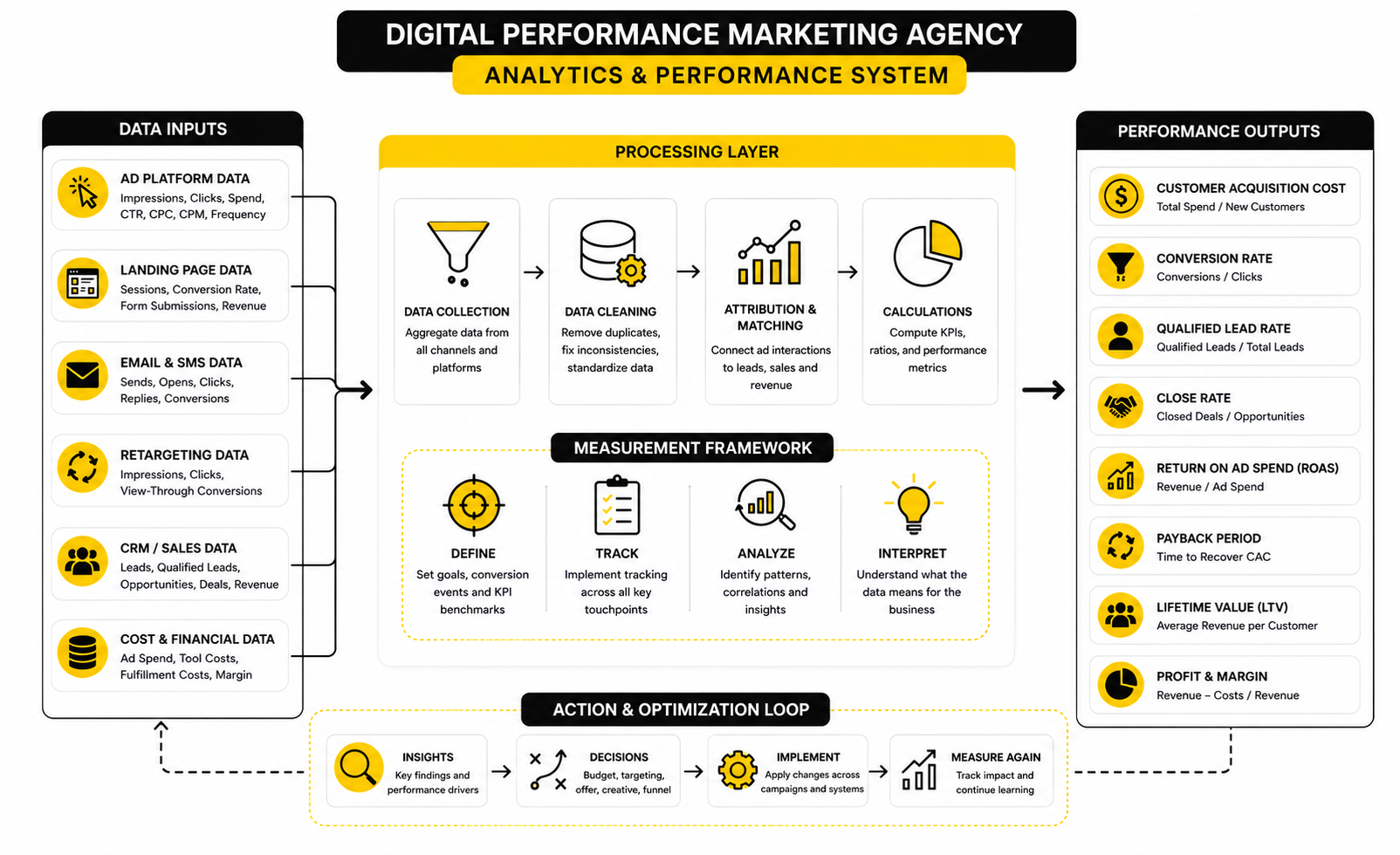
At the top of the system are attention signals. These include impressions, reach, frequency, video hold rate, click-through rate, thumb-stop rate, and engagement quality. These metrics help judge whether the market is noticing the message, but they should not be treated as proof of revenue impact.
The next layer is conversion behavior. This includes landing page conversion rate, form completion rate, checkout completion, booked calls, trial starts, demo requests, and lead magnet opt-ins. These numbers show whether people are taking the next step, but they still need to be connected to quality.
The final layer is business impact. This includes qualified lead rate, sales acceptance, close rate, customer acquisition cost, payback period, gross margin, repeat purchase rate, lifetime value, and revenue from new customers. These are the numbers that should influence serious budget movement.
Attribution Needs Multiple Views Of Truth
Attribution is useful, but it is not perfect. Platform dashboards are designed to help advertisers optimize inside that platform, not to give a neutral view of the whole business. Analytics tools, CRM systems, and finance reports all see different parts of the journey.
Privacy changes and signal loss have made this even more important. Modern attribution research and platform measurement work increasingly point toward blended methods, including first-party data, modeled conversions, incrementality testing, and marketing mix modeling, rather than relying only on user-level tracking. Recent work on privacy-preserving attribution also shows how measurement is moving toward systems that protect user privacy while still supporting campaign evaluation.
The practical takeaway is simple: do not let one dashboard become the boss. Compare platform-reported conversions against analytics data, CRM data, and actual revenue. When the numbers disagree, the question is not which tool is “lying”; the question is what each system can and cannot see.
What Good Reporting Should Show
Good reporting should be built around decisions, not decoration. A clean dashboard is useful only if it helps the team understand performance faster. The best reports are clear enough for leadership and detailed enough for the people doing the work.
A strong performance report should show:
That last point matters most. Reporting should create action. If a report has twenty charts but no decision, it is not a performance report; it is a screenshot collection.
Reading The Numbers Without Fooling Yourself
Performance data can be misleading when the sample size is too small, the test window is too short, or the team changes too many variables at once. A campaign can look bad early and recover after the algorithm gets enough conversion data. Another campaign can look strong for a week because it captured easy demand, then fall apart when the audience saturates.
This is why testing discipline matters. A digital performance marketing agency should define the minimum data needed before judging a test, especially when budget, conversion volume, and buying cycle length vary. The goal is not to wait forever; the goal is to avoid making expensive decisions from weak evidence.
The team also needs to watch for false positives. A creative angle might generate cheap leads because it attracts curiosity rather than buying intent. A discount offer might lift conversion rate while damaging margin. A campaign might show strong platform ROAS while CRM data reveals low repeat purchase or poor sales quality.
Turning Data Into Better Execution
The best use of data is not reporting the past; it is improving the next move. If a landing page has traffic but weak conversion, the action may be to rewrite the headline, strengthen proof, simplify the form, or improve page speed. If the sales team rejects a high percentage of leads, the action may be to adjust targeting, change the offer, or improve qualification questions.
If the creative data shows one angle consistently beating others, that insight should move beyond ads. It should influence landing pages, email subject lines, sales scripts, webinars, product positioning, and retargeting messages. Strong signals should travel through the whole growth system.
That is the real value of measurement. A digital performance marketing agency should not just tell you what happened. It should help you understand what to fix, what to scale, what to stop, and what to test next.
Professional Implementation Across Channels, Creative, Data, And Automation
Professional implementation is where a digital performance marketing agency proves whether it can turn strategy into a working growth system. The easy version is launching campaigns across paid search, paid social, email, landing pages, and automation. The harder version is making those pieces work together without creating confusion, overlap, or wasted spend.
The biggest mistake is treating each channel like its own island. Search captures existing intent, social creates and shapes demand, email and SMS convert delayed intent, landing pages control the conversion environment, and CRM systems show whether the traffic was actually worth buying. When those parts are managed separately, performance gets blurry.
A strong agency builds the system around the customer journey, not around platform departments. That means the same offer, message, proof, and follow-up logic should feel connected across every touchpoint. The customer should not feel like they are meeting a different company every time they click.
Channel Strategy Requires Tradeoffs
Every channel has strengths, limits, and hidden costs. Google Search can be powerful when people already know what they want, but it can get expensive when competitors bid aggressively on the same intent. Meta, TikTok, YouTube, and LinkedIn can create demand, but they need stronger creative and clearer testing discipline because the user is often not actively shopping in that moment.
A digital performance marketing agency should not recommend channels just because they are popular. The right channel mix depends on the offer, price point, buying cycle, audience sophistication, sales process, and available creative resources. A local service business, a B2B software company, and an ecommerce brand should not be scaled with the same media plan.
The tradeoff is focus versus coverage. Too few channels can limit learning and make the business dependent on one platform. Too many channels can spread the budget too thin and make results impossible to interpret. The practical answer is to start with the channels most likely to prove the offer, then expand once the data supports it.
Creative Becomes The Scaling Constraint
As automation improves, creative becomes one of the biggest levers left. Platforms can optimize delivery, but they still need messages that make people stop, care, believe, and act. Weak creative gives the algorithm weak material to work with.
A serious creative process starts with angles, not assets. The agency should test different customer pains, desires, objections, proof points, demonstrations, comparisons, and calls to action. One polished ad is less useful than a structured set of creative tests designed to learn what the market responds to.
Creative fatigue is another scaling issue. A campaign may work well at first, then decline as the audience sees the same message too often. The agency should have a creative pipeline ready before performance drops, not after the account is already struggling.
Landing Pages Decide Whether Traffic Converts
Paid media gets attention, but landing pages often decide profitability. A strong landing page carries the promise from the ad, explains the offer clearly, removes doubt, and makes the next step obvious. If the landing page is slow, vague, cluttered, or disconnected from the ad, the campaign pays for interest and loses it at the point of action.
This is where tools can help, but only when the strategy is clear. A landing page builder such as Replo can support ecommerce experimentation, while funnel builders like ClickFunnels or Systeme.io can help structure lead magnets, sales pages, order forms, and follow-up flows. The tool is useful only if the offer, message, and conversion path are already thought through.
The advanced move is to align landing pages with intent level. Cold traffic may need more education, story, proof, and objection handling. High-intent traffic may need speed, specificity, comparison clarity, and a direct path to purchase or booking.
Automation Should Increase Relevance, Not Noise
Automation is powerful when it helps the business respond faster and more personally. It becomes damaging when it simply sends more messages to people who are not ready, not qualified, or not interested. More automation does not automatically mean better marketing.
A digital performance marketing agency should use automation to improve timing, routing, qualification, and follow-up. That can include instant lead response, abandoned checkout recovery, appointment reminders, segmentation, pipeline updates, review requests, and reactivation campaigns. The goal is to reduce missed opportunities without making the customer feel trapped in a machine.
Platforms such as GoHighLevel, ManyChat, Brevo, and Moosend can support this kind of infrastructure. The important part is not the number of automations; it is whether each one helps the customer move forward with less friction.
Scaling Creates New Problems
Scaling is not just doing more of what already worked. When spend increases, audiences broaden, easy demand gets exhausted, creative fatigues faster, and attribution becomes harder to read. What worked at a small budget may not behave the same way at a larger budget.
This is why scaling should be staged. The agency should increase budget based on evidence, watch for efficiency changes, and separate temporary volatility from real performance decay. Aggressive scaling without guardrails can turn a profitable campaign into a fast-moving liability.
There are two basic ways to scale: vertical and horizontal. Vertical scaling increases spend inside proven campaigns, audiences, or channels. Horizontal scaling expands into new creative angles, offers, markets, channels, or funnel paths. Strong agencies know when to push one, when to test the other, and when to stop forcing growth that the system cannot support yet.
The Risk Of Over-Optimization
Performance marketing attracts people who love optimization, but over-optimization can quietly hurt the business. If every decision is based only on short-term conversion metrics, the brand can become more aggressive, more generic, and less trusted over time. That may lift immediate response while weakening long-term demand.
This is especially risky when teams optimize only for the cheapest conversion. Cheap leads are not always good leads, and high-intent customers are not always the cheapest to acquire. The agency has to protect the difference between efficient acquisition and low-quality volume.
The better approach is disciplined optimization with strategic boundaries. Improve conversion rates, reduce waste, and test hard, but do not destroy positioning, trust, or customer quality in the process. Performance should make the business stronger, not just busier.
Sales And Marketing Must Share The Same Reality
For lead generation businesses, performance marketing cannot stop at the form submission. The real question is what happens after the lead enters the pipeline. Does the sales team respond quickly, qualify properly, follow up consistently, and close the right customers?
If marketing celebrates lead volume while sales complains about quality, the system is broken. If sales rejects leads without giving useful feedback, the system is also broken. A digital performance marketing agency should help create a shared feedback loop where campaign data and sales outcomes inform each other.
This is where CRM discipline becomes critical. Lead source, campaign, offer, qualification status, appointment status, deal stage, close reason, and revenue should be tracked clearly. Without that connection, the agency is optimizing for the front half of the journey while the business makes money on the back half.
The Agency Should Challenge The Brief
A high-performing agency should not blindly accept every assumption in the client brief. Sometimes the target audience is too broad, the offer is weak, the landing page promise is unclear, the budget is unrealistic, or the sales process cannot support the expected lead volume. Saying nothing in those moments is not being polite; it is being ineffective.
The best agency relationships include productive tension. The client brings business knowledge, customer context, product understanding, and commercial goals. The agency brings market feedback, campaign data, creative insight, and implementation discipline.
That combination is powerful when both sides are honest. A digital performance marketing agency should be confident enough to say what needs to change and practical enough to help fix it. That is how the work moves from vendor execution to real growth partnership.
Choosing The Right Agency And Avoiding Common Mistakes
Choosing a digital performance marketing agency should not feel like buying mystery. The right partner should be able to explain its process clearly, challenge weak assumptions respectfully, and connect every major recommendation to a business outcome. If the agency hides behind jargon, vague promises, or platform screenshots, that is a warning sign.
A strong agency relationship starts with fit. Some agencies are excellent at ecommerce, others are better at B2B pipeline, local lead generation, SaaS trials, creator-led funnels, or paid social creative testing. The more specific your business model is, the more important that fit becomes.
The goal is not to hire the loudest agency. The goal is to hire the team that understands your economics, can operate inside your constraints, and knows how to improve the full growth system instead of only managing campaigns.
What To Look For In A Digital Performance Marketing Agency
The first thing to look for is commercial thinking. The agency should ask about margins, customer value, sales cycle length, close rates, lead quality, fulfillment capacity, and payback period. If every question is about ad spend and platform access, the conversation is too shallow.
The second thing to look for is a clear operating rhythm. You should know how strategy is built, how tests are prioritized, how reporting works, how often performance is reviewed, and who owns each part of the process. Performance marketing needs speed, but speed without structure becomes chaos.
The third thing to look for is honest measurement discipline. The agency should be comfortable discussing attribution limits, sample size, CRM quality, incrementality, and the difference between platform-reported results and actual business revenue. With digital advertising reaching nearly $300 billion in U.S. revenue in 2025, the teams that interpret data properly have a real advantage.
Red Flags That Should Make You Pause
Be careful with any agency that guarantees results without understanding the offer, audience, economics, and sales process. Performance marketing is measurable, but it is not magic. A confident projection is one thing; a guaranteed outcome before discovery is another.
Another red flag is reporting that celebrates activity instead of outcomes. More campaigns, more ads, more impressions, and more meetings do not automatically mean better performance. The agency should be able to show what changed, why it changed, and what action follows.
You should also be cautious when an agency pushes one channel as the answer to everything. A channel can be powerful, but no channel fixes a weak offer, poor follow-up, bad positioning, or broken conversion path. The best agencies know when the answer is not “spend more.”
How The Final System Should Work
By this stage, the full system should feel connected. Strategy defines the commercial target, research shapes the offer and message, media creates or captures demand, landing pages convert attention, automation supports follow-up, sales feedback validates quality, and analytics guide the next move. That is what separates professional performance marketing from random campaign management.
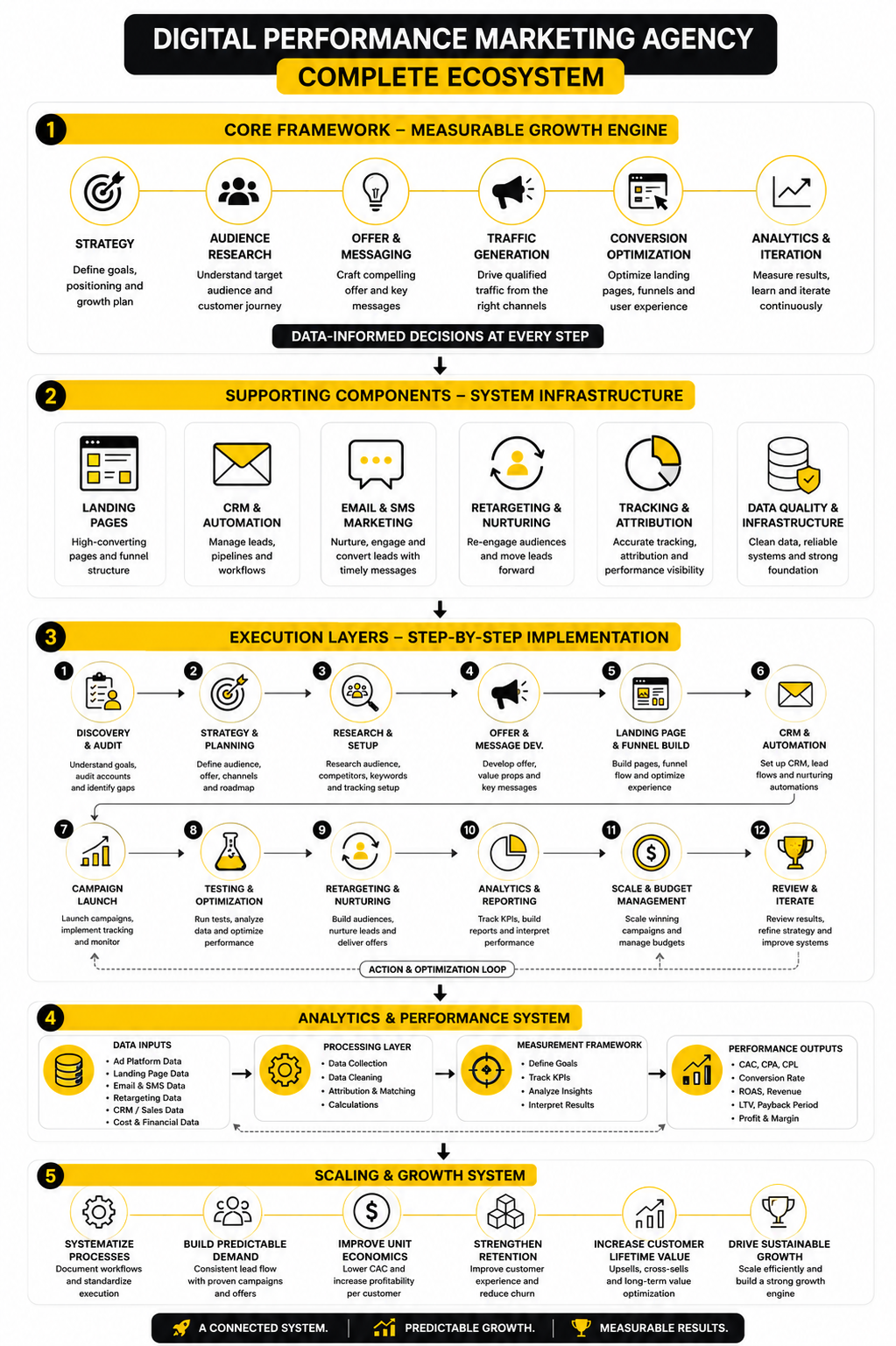
The final system should also create learning loops. Ads should teach the team which angles attract attention. Landing pages should reveal which promises create action. CRM data should show which leads become customers. Sales conversations should expose the objections that future creative needs to answer.
A digital performance marketing agency becomes valuable when it turns those loops into better decisions. The business should get sharper over time, not just busier. That is the standard.
What is a digital performance marketing agency?
A digital performance marketing agency helps businesses generate measurable outcomes through online channels such as paid search, paid social, landing pages, email, SMS, CRM, and conversion optimization. The focus is not just visibility; it is trackable growth tied to leads, sales, revenue, customer acquisition cost, and return on spend. A strong agency connects strategy, execution, measurement, and optimization into one system.
How is performance marketing different from traditional digital marketing?
Traditional digital marketing can include broad awareness, content, social presence, branding, and community building. Performance marketing is more directly tied to measurable actions, such as purchases, booked calls, qualified leads, trials, or pipeline. The two can work together, but performance marketing is judged more aggressively by business results.
When should a business hire a digital performance marketing agency?
A business should consider hiring an agency when it has a clear offer, some proof of demand, and enough budget to test properly. It also helps when the business has the operational capacity to handle new leads, sales calls, purchases, or onboarding. Hiring an agency too early can waste money if the offer, tracking, or fulfillment process is not ready.
What should an agency audit before launching campaigns?
The agency should audit ad accounts, analytics, conversion tracking, landing pages, CRM setup, past campaign data, email flows, sales follow-up, creative assets, and reporting quality. This audit helps identify whether the biggest opportunity is more traffic, better conversion, cleaner measurement, or stronger follow-up. Skipping this step often leads to scaling the wrong problem.
Which channels should a performance marketing agency manage?
A performance agency may manage Google Ads, Meta Ads, TikTok Ads, LinkedIn Ads, YouTube, programmatic, email, SMS, landing pages, funnels, CRM workflows, and retargeting. The right mix depends on the offer, audience, price point, buying cycle, and available budget. A smart agency does not force every channel into the plan just because it can.
What metrics matter most in performance marketing?
The most important metrics depend on the business model, but serious reporting usually includes customer acquisition cost, conversion rate, qualified lead rate, close rate, revenue, ROAS, payback period, lifetime value, margin, and retention. Clicks, impressions, CTR, and engagement can help diagnose performance, but they should not become the final goal. The best metrics are the ones that guide better budget and strategy decisions.
How long does it take to see results?
Some early signals can appear quickly, especially around click-through rate, landing page conversion, and lead volume. Business-level results usually take longer because the agency needs enough data to judge lead quality, customer value, sales outcomes, and repeat behavior. A professional agency should explain what can be learned early and what needs more time before making strong decisions.
How much should a business spend on performance marketing?
There is no universal number because spend depends on goals, industry, competition, margins, sales cycle, and conversion rates. The more carefully question is how much budget is needed to generate enough data for meaningful testing. If the budget is too small, the agency may not be able to separate real performance patterns from noise.
What makes an agency report useful?
A useful report explains what changed, why it matters, what the team learned, and what action comes next. It should connect platform metrics to business outcomes instead of listing numbers without interpretation. If the report does not help the business make a decision, it is not doing its job.
Should performance marketing rely on AI?
AI can help with bidding, targeting, creative variation, analysis, and workflow speed. But AI works best when the strategy, offer, tracking, creative direction, and business inputs are strong. The agency still needs human judgment to decide what should be tested, what should be scaled, and what the numbers actually mean.
What tools support a strong performance marketing system?
The right tools depend on the business, but the system usually needs landing page creation, CRM, automation, analytics, forms, scheduling, reporting, and customer communication. Tools like GoHighLevel, ClickFunnels, Systeme.io, Replo, ManyChat, and Brevo can support parts of the system when they fit the strategy. The tool stack should make execution clearer, not more complicated.
How do you know if a campaign is ready to scale?
A campaign is ready to scale when it shows consistent performance against the right business metrics, not just cheap clicks or leads. The agency should check conversion quality, sales outcomes, margin, payback, audience saturation, and creative fatigue before increasing spend aggressively. Scaling should be based on evidence, not excitement.
What is the biggest mistake companies make with performance marketing?
The biggest mistake is treating performance marketing as traffic buying instead of system building. More traffic will not fix a weak offer, unclear positioning, slow follow-up, poor sales handling, or unreliable tracking. The companies that win usually improve the whole journey, not just the campaign settings.
Build a stronger local presence with BAAM AI
Turn your website, Google profile, social channels, and AI visibility into one growth engine
Most businesses do not need more random marketing activity. They need a consistent presence system that helps the right people find them, trust them, and take action. BAAM AI brings strategy, local SEO, website updates, Google Maps visibility, social content, AI-search readiness, media production, and reporting into one practical monthly engine.
If you want your marketing to keep working after the campaign ends, start with a free BAAM AI presence audit. See how your business shows up today and where the fastest visibility wins are at BAAM AI.