
BAAM AI Blog
Digital Media Strategy: A Practical Framework For Building Media That Actually Grows The Business
Digital media strategy is the plan that connects your audience, message, channels, content, distribution, measurement, and business goals into one working system. It is not just “posting more content.” It is the...
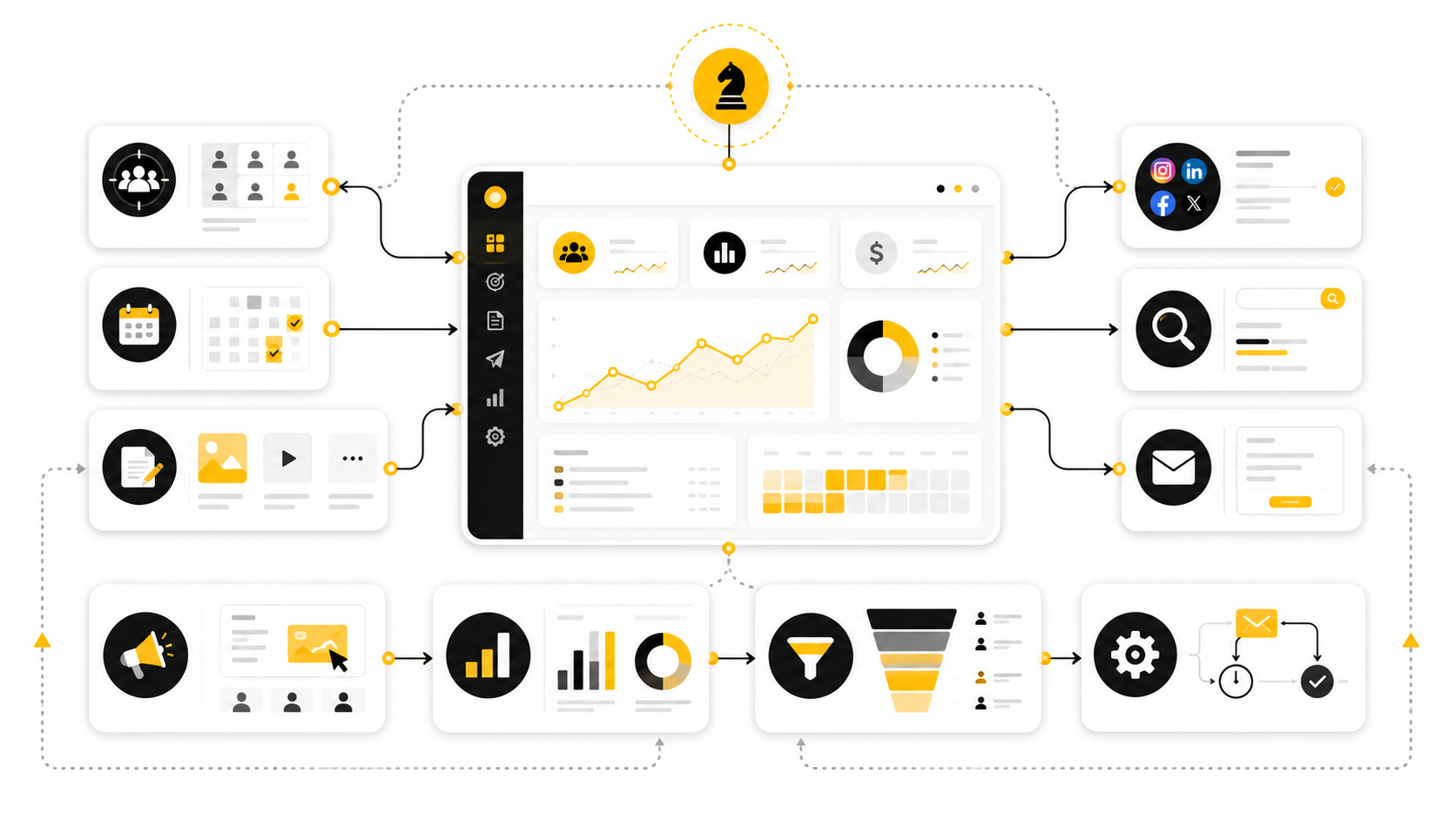
Digital media strategy is the plan that connects your audience, message, channels, content, distribution, measurement, and business goals into one working system. It is not just “posting more content.” It is the difference between random activity and media that earns attention, captures demand, and creates measurable momentum.
That matters because digital media is no longer a side channel. The digital advertising market reached nearly $294.6 billion in U.S. revenue in 2025, while global internet use has passed 6 billion people. The opportunity is huge, but so is the noise. A strong strategy helps you decide what to ignore, what to double down on, and how each channel should contribute to growth.
Why Digital Media Strategy Matters
Digital media strategy matters because attention is fragmented, platforms change quickly, and audiences move across channels before they make decisions. A potential customer might discover you through a short video, compare you through search, revisit you through email, and finally convert after seeing a retargeting ad or creator recommendation. Without strategy, every channel gets judged in isolation, which usually leads to bad decisions.
A practical digital media strategy gives each channel a job. Search can capture existing intent. Social can create familiarity and demand. Email can deepen the relationship. Landing pages can turn interest into action. Paid media can accelerate what is already working instead of covering up weak positioning.
The bigger point is simple: media is not the goal. Business movement is the goal. Strategy keeps the work tied to outcomes like qualified leads, sales conversations, product adoption, retention, or brand preference instead of vanity metrics that look good in a dashboard but do not change the business.
The Digital Media Strategy Framework
A useful framework starts with the business objective, not the platform. Before deciding whether to focus on TikTok, LinkedIn, YouTube, search, email, or paid ads, you need to know what the media system is supposed to accomplish. The right strategy for a local service business will not look the same as the right strategy for a SaaS company, ecommerce brand, creator-led business, or B2B consultancy.
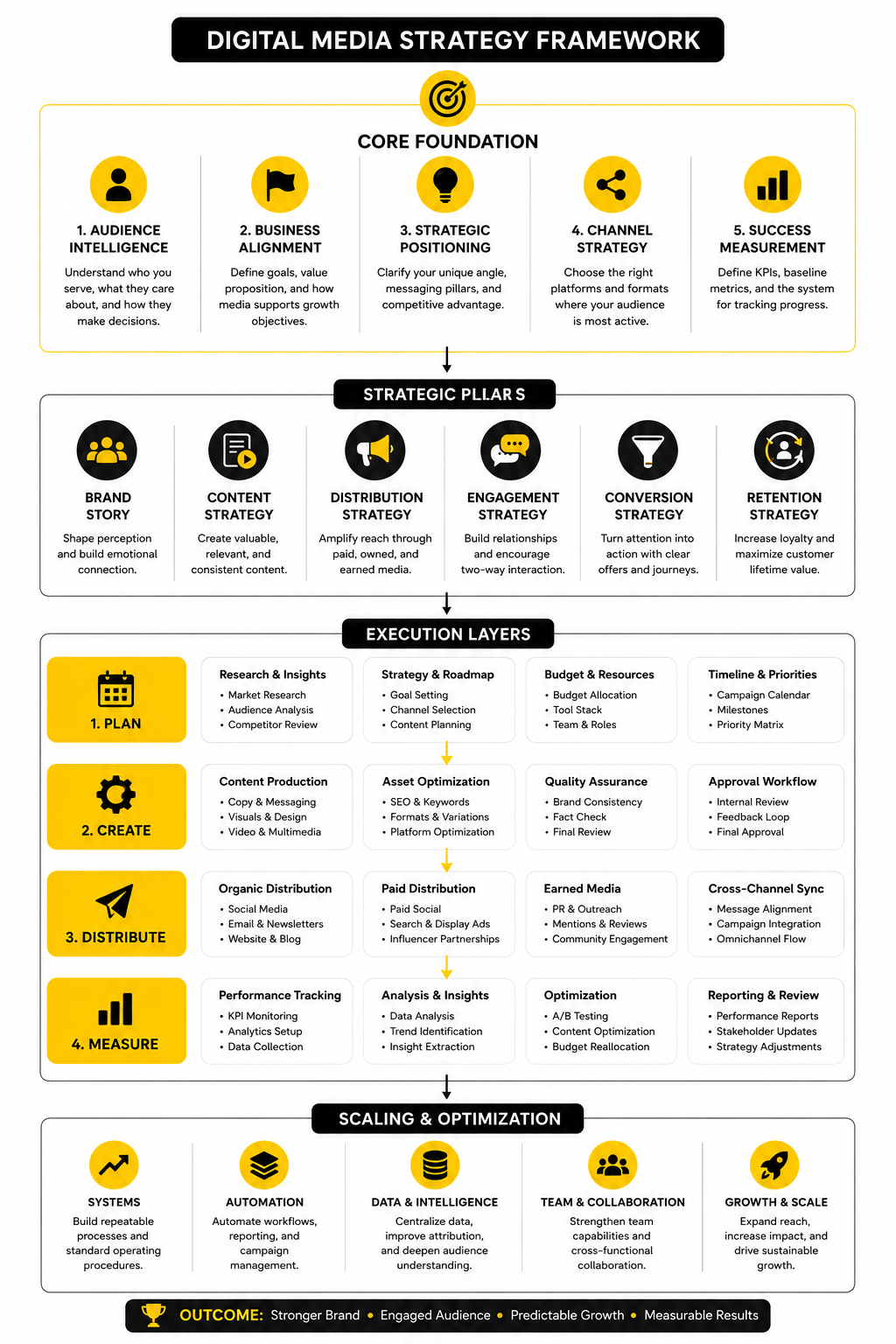
The framework here uses five connected layers: objective, audience, message, media system, and measurement. Each layer affects the next one. When the objective is unclear, the audience becomes too broad. When the audience is too broad, the message becomes generic. When the message is generic, the channel plan becomes expensive.
This is also where many teams make the mistake of treating tools as strategy. A platform like Buffer can help schedule and manage social publishing, and a system like GoHighLevel can help organize funnels, automation, and follow-up. But the tool only becomes valuable when it supports a clear media system. The strategy comes first; the stack comes after.
Core Components Of A Digital Media Strategy
The first core component is audience clarity. You need to know who you are trying to reach, what they already believe, what problem they are trying to solve, and what proof they need before they trust you. This is deeper than demographics. Good strategy looks at buying triggers, objections, awareness level, content habits, and decision criteria.
The second component is message architecture. This includes your main promise, proof points, objections, angles, content pillars, and conversion language. Strong digital media strategy makes the message consistent without making every channel sound identical. A search page, email sequence, LinkedIn post, and short-form video can all carry the same strategic idea while using different formats.
The third component is channel design. Every channel should have a role in the journey, not just a posting schedule. Some channels are better for reach, some for trust, some for intent, and some for conversion. Once those roles are clear, the content plan becomes easier because you are no longer asking, “What should we post today?” You are asking, “What does this audience need at this stage to move forward?”
Professional Implementation Starts With Focus
Professional implementation begins by narrowing the strategy enough that it can actually be executed. Most weak digital media plans fail because they try to cover every channel, every audience, and every content format at once. That creates complexity before there is evidence. A better approach is to build one strong media loop, prove it works, and then expand.
For example, a service business might start with educational search content, a simple lead magnet, email follow-up, and retargeting. An ecommerce brand might prioritize paid social testing, product education pages, creator content, and post-purchase email. A personal brand might focus on long-form authority content, short-form distribution, newsletter growth, and a clear offer path. The structure depends on the business model, but the principle stays the same.
This is why digital media strategy should feel practical, not theoretical. It should tell you what to create, where to publish, how to distribute it, what to measure, and when to change direction. The next part builds the framework in detail, starting with the decisions that shape everything else.
The Digital Media Strategy Framework
A strong digital media strategy works like an operating system, not a content calendar. It tells you what the business is trying to achieve, who the media needs to influence, what the audience must believe, where the message should show up, and how success will be measured. When those decisions are connected, your media stops feeling like scattered activity and starts behaving like a growth engine.
The framework has five layers: objective, audience, message, media system, and measurement. Each layer should be clear before you scale production or increase spend. This matters because more content does not fix weak positioning, and more budget does not fix a broken conversion path.
1. Define The Business Objective
The first question is not “Which platform should we use?” The first question is “What business result are we trying to create?” That result might be more qualified leads, more booked calls, more product trials, higher average order value, stronger retention, or better brand recall in a specific market.
This is where digital media strategy becomes practical. A brand trying to create demand needs a different media mix than a brand trying to capture existing demand. A company with a long sales cycle needs different touchpoints than a low-ticket ecommerce store. The clearer the objective, the easier it becomes to choose channels, formats, offers, and metrics.
Do not skip this step because it feels obvious. Teams often say they want “growth,” but growth can mean reach, revenue, pipeline, signups, repeat purchases, referrals, or retention. Those are not the same goals, and they should not be managed with the same media plan.
2. Map The Audience And Buying Journey
Once the objective is clear, the next layer is audience and journey mapping. You need to understand who the strategy is built for, what they care about, and what happens before they are ready to act. This is where most generic media plans fall apart because they describe the audience too broadly.
A useful audience map should include the person’s problem, current alternatives, objections, desired outcome, trusted information sources, and likely decision triggers. It should also separate people by awareness level. Someone who knows they need a solution behaves differently from someone who only feels the pain but cannot yet name the problem.
The buying journey does not need to be complicated, but it does need to be honest. People rarely move from first impression to purchase in one step. They notice, compare, hesitate, revisit, ask for proof, and then decide. Your media strategy should support that real behavior instead of pretending one post or one ad will do all the work.
3. Build The Message Before The Channel Plan
The message is the bridge between your audience and your offer. It explains why the audience should care, why now, why your approach, and why they should trust you. Without a strong message, even the best channel plan becomes expensive noise.
Your message should include a clear promise, supporting proof, specific angles, common objections, and language that matches the audience’s actual thinking. This does not mean every piece of content says the same thing. It means every piece of content supports the same strategic position.
This is also where differentiation becomes important. If your media sounds like every competitor, your audience has no reason to remember you. A good digital media strategy turns your strongest point of view into repeatable content themes, not random posts chasing whatever is trending this week.
4. Choose Channels By Their Strategic Role
Channels should be chosen by role, not popularity. Search is useful when people already have intent. Social is useful for discovery, familiarity, and trust-building. Email is useful for nurturing and repeat engagement. Paid media is useful for scaling proven messages and accelerating distribution.
This does not mean every business needs every channel. A small team with limited resources is usually better off building a focused system across two or three connected channels than spreading thin across seven. Consistency beats channel collection.
For example, a simple but strong media system might use short-form content for discovery, a newsletter for retention, and a landing page for conversion. A more advanced system might combine organic content, paid retargeting, automated follow-up, and CRM tracking inside a platform like GoHighLevel. The point is not the tool itself; the point is that every channel has a clear job.
5. Design The Media System
The media system is where strategy becomes execution. It defines what you will create, how often you will publish, where each asset goes, how content gets repurposed, and what happens after someone engages. This is the difference between a content plan and a real operating rhythm.
A strong system usually includes four flows: creation, distribution, capture, and follow-up. Creation turns ideas into useful assets. Distribution gets those assets in front of the right audience. Capture turns attention into an owned relationship. Follow-up moves people closer to action without forcing the sale too early.
This is where automation can help, but only after the flow is clear. Tools like ManyChat can support social messaging and lead capture when the audience is already engaging through chat-based channels. Email platforms like Brevo can support nurture sequences and campaign communication. But automation should improve the experience, not replace the thinking.
6. Set Measurement Before You Scale
Measurement should be defined before the strategy goes live. If you wait until after publishing to decide what matters, you will usually default to easy metrics like views, likes, clicks, and impressions. Those numbers can be useful, but they are not enough on their own.
Each channel needs metrics that match its role. Discovery channels can be measured by reach quality, engagement depth, and audience growth. Intent channels can be measured by qualified traffic, conversion rate, and cost per opportunity. Retention channels can be measured by repeat engagement, revenue per subscriber, and customer lifetime value.
The important thing is to avoid judging every channel by the same metric. A thought leadership post, a comparison page, a webinar invite, and a retargeting ad are doing different jobs. A mature digital media strategy respects those differences and measures each part of the system based on its actual purpose.
Turning The Framework Into Decisions
The framework only works when it changes what you do. It should help you say no to channels that do not fit, content ideas that do not support the message, and metrics that distract from the real objective. Strategy is valuable because it creates constraints.
A practical way to use the framework is to answer six questions before building the next campaign:
Those questions force the work to become connected. They also make execution easier because every asset has a reason to exist. The next step is to go deeper into audience, positioning, and channel fit, because that is where the strategy starts to become specific enough to compete.
Audience, Positioning, And Channel Fit
A digital media strategy becomes real when it stops describing “the market” and starts making specific choices about the people you want to influence. The audience is not just a demographic profile. It is a group of people with a problem, a context, a level of awareness, a set of objections, and a preferred way of learning before they act.
This is where strategy gets sharper. You are not trying to be relevant to everyone who could possibly buy. You are trying to become obvious to the people most likely to care, trust, and move. That requires tighter audience work, clearer positioning, and a channel plan that matches real behavior instead of internal preferences.
Start With The Audience’s Situation
The best audience research begins with the situation your buyer is already in. What problem are they dealing with? What have they already tried? What are they frustrated by? What would make them feel confident enough to take the next step?
This matters because digital media does not reach people in a neutral state. People see your content while they are scrolling, searching, comparing, ignoring ads, checking reviews, asking peers, or trying to make a decision under pressure. Your strategy should reflect that messy reality.
A useful audience profile should answer these questions:
These answers shape everything that follows. They influence the message, the content format, the channel mix, and the offer path. Without them, the strategy becomes generic fast.
Position The Offer Around A Clear Shift
Positioning is the reason your audience should pay attention to you instead of every other option. It is not just a tagline or a clever sentence. It is the strategic shift you want the market to understand.
A strong position usually says one clear thing: the old way is not enough anymore, and this better way helps you reach the outcome with less friction. That shift can be about speed, simplicity, control, quality, trust, cost, confidence, or a more effective process. The important part is that the audience can immediately understand why it matters.
This is especially important in digital media strategy because the audience often meets you through small fragments. A headline, a video hook, a search result, a landing page section, an email subject line, or a social post may be the first touchpoint. If the position is vague, the rest of the media system has to work much harder.
Turn Positioning Into Message Pillars
Once the position is clear, turn it into message pillars. These are the repeatable themes your content will keep coming back to without sounding like copy-and-paste marketing. They help you stay consistent while still creating fresh content.
A practical set of message pillars might include the main pain, the desired outcome, the common mistake, the unique mechanism, proof, objections, and next steps. These pillars give your team a simple filter for deciding what to create. If an idea does not support one of the pillars, it probably does not belong in the core strategy.
The goal is not to trap your creativity. The goal is to make sure creativity works in the same direction as the business. Random ideas can perform once, but a strong message system compounds because every asset strengthens the same strategic belief.
Build The Implementation Process
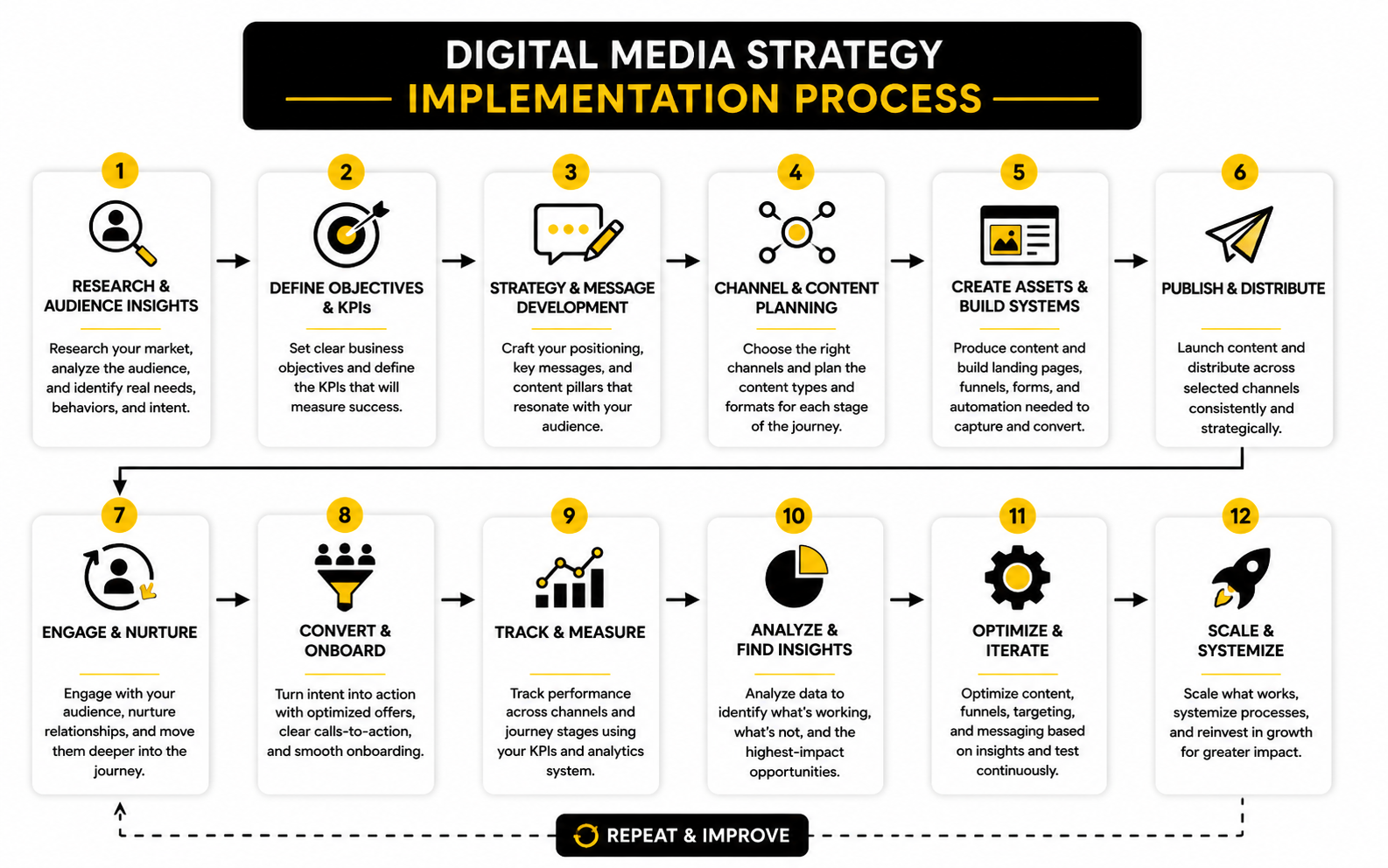
Implementation is where most digital media strategy breaks down. The thinking might be good, but the work becomes too broad, too slow, or too disconnected from the buyer journey. A clean process fixes that by turning strategy into repeatable execution.
The process should move from research to message, from message to channels, from channels to assets, and from assets to measurement. Each step should create something usable. If a strategy document does not help someone decide what to publish, where to publish it, or what to improve next, it is not finished.
Step 1: Audit The Current Media System
Start by looking at what already exists. Review your website, landing pages, social profiles, email flows, ads, search presence, lead magnets, analytics, and sales follow-up. The point is not to criticize everything. The point is to find gaps between what the business wants and what the current media system is actually doing.
A useful audit looks for four things: consistency, clarity, conversion, and continuity. Consistency asks whether the message feels aligned across channels. Clarity asks whether the audience can quickly understand the offer and next step. Conversion asks whether attention has a path to action. Continuity asks whether people are followed up with after they engage.
This step often reveals easy wins. A landing page may be clear but disconnected from follow-up. Social content may attract attention but never point to a useful next step. Email may exist but fail to segment people based on intent. Those gaps are not small details; they are where growth leaks out.
Step 2: Choose One Primary Journey
Do not try to fix every journey at once. Pick one primary journey that matters most right now. That might be visitor to lead, follower to subscriber, subscriber to booked call, trial user to customer, or first-time buyer to repeat buyer.
This focus gives the digital media strategy a clear execution path. Instead of creating content for “awareness” in a vague way, you build media around a specific movement. You know where the person starts, what they need to understand, what friction appears, and what action should happen next.
For a service business, that journey may move from educational content to a diagnostic call. For a creator-led business, it may move from social discovery to newsletter subscription to a paid offer. For ecommerce, it may move from product discovery to product education to purchase and post-purchase retention. The journey depends on the model, but it should always be specific.
Step 3: Match Content To Intent
Once the journey is clear, map content to intent. Early-stage content should help people understand the problem or opportunity. Mid-stage content should help them compare approaches and build trust. Late-stage content should remove doubt and make the next step feel safe.
This prevents a common mistake: asking every piece of content to sell. Some media should earn attention. Some should educate. Some should prove. Some should convert. When you know the intent behind the asset, you can judge it fairly.
For example, a short video may be designed to create recognition around a problem. A search article may capture people actively researching solutions. A landing page may turn that intent into a lead. A nurture sequence may handle objections and build confidence over time through a platform like Brevo or Moosend. Each asset has a job, and that job should be defined before it is created.
Step 4: Build The First Media Loop
A media loop is a connected set of actions that can repeat and improve. It might start with one long-form asset, then break into short-form posts, then drive people to an email list, then send them into a follow-up sequence, then measure what turned into real opportunities. This is much stronger than publishing disconnected assets and hoping something works.
The first loop should be simple enough to run consistently. Complexity is not a badge of honor. If the team cannot execute the loop every week, it is too heavy.
A basic loop could look like this:
This is where tools can support the workflow. Buffer can help organize publishing across social channels. Fillout can help capture structured responses from leads or subscribers. GoHighLevel can help connect CRM, funnels, automation, and follow-up when the strategy needs a more complete operating system.
Step 5: Create A Clear Ownership Rhythm
Even the best strategy fails when nobody owns the rhythm. Someone needs to be responsible for research, someone for content production, someone for publishing, someone for conversion assets, and someone for measurement. In a small team, one person may cover several roles, but the responsibilities still need to be clear.
The rhythm should include weekly execution and monthly review. Weekly execution keeps the loop moving. Monthly review creates space to look at patterns instead of reacting emotionally to one post, one ad, or one campaign.
This is also where documentation helps. You do not need a massive playbook, but you do need a simple source of truth for audience notes, message pillars, active channels, campaign assets, offers, and measurement rules. When the system is documented, it becomes easier to delegate, improve, and scale.
Step 6: Improve Based On Friction
Optimization should focus on friction, not just performance spikes. If people are clicking but not converting, the problem may be the landing page, offer, proof, or audience match. If people are engaging but not subscribing, the next step may not feel valuable enough. If leads are coming in but not closing, the follow-up or qualification process may be weak.
This is why implementation and measurement need to stay connected. A digital media strategy should create feedback, not just output. Every cycle should teach you something about the audience, message, channel, or offer.
The best teams do not change everything at once. They isolate one part of the system, improve it, and then watch what happens. That discipline is what turns digital media from a guessing game into a process you can actually manage.
Statistics And Data
Data should make your digital media strategy clearer, not heavier. The goal is not to collect every possible metric. The goal is to understand which signals show attention, which signals show intent, which signals show trust, and which signals show revenue movement.
The numbers matter because digital media is now too large and too competitive to manage by instinct alone. U.S. digital advertising revenue reached nearly $294.6 billion in 2025, with social media advertising reaching $117.7 billion. That does not mean every business should spend more on ads. It means your audience is surrounded by professional media systems, and your measurement has to be strong enough to show what is actually working.
Start With The Right Measurement Question
The first measurement question should be, “What decision will this data help us make?” If a metric does not change a decision, it is probably dashboard decoration. Views, impressions, followers, and likes can be useful, but only when they are connected to a specific job inside the media system.
For example, reach tells you whether the message is getting exposure. Engagement tells you whether the content is creating enough interest to earn a reaction. Clicks show whether the promise is strong enough to move someone forward. Conversions show whether the next step, offer, and page experience match the audience’s intent.
This is why measurement should follow the journey. Early-stage content needs different signals than late-stage conversion pages. A post that creates awareness should not be judged the same way as a landing page designed to capture a lead.
Build A Simple Analytics System
A practical analytics system has three layers: channel metrics, journey metrics, and business metrics. Channel metrics tell you how each platform is performing. Journey metrics show how people move from attention to action. Business metrics show whether the strategy is creating revenue, pipeline, retention, or another meaningful outcome.
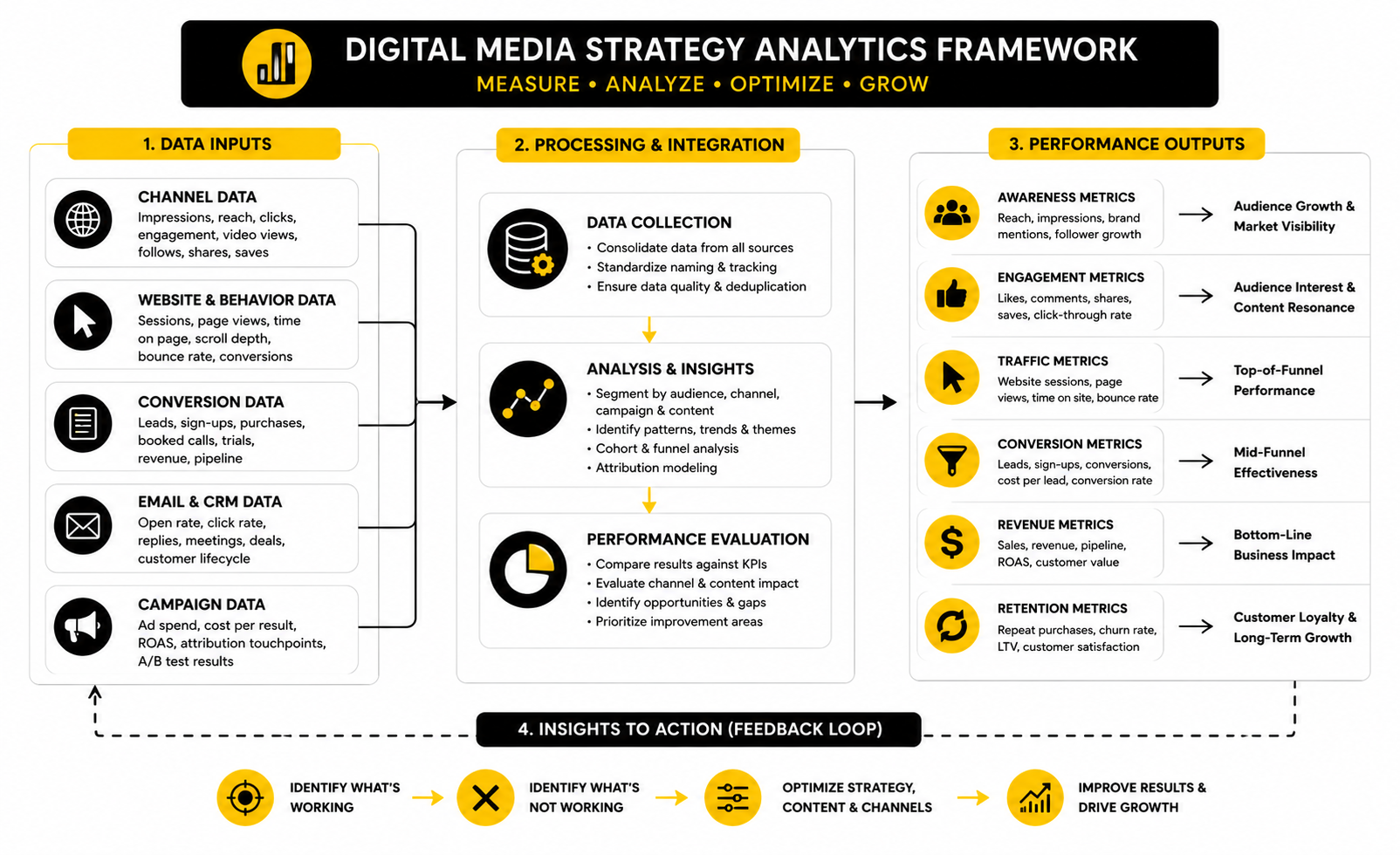
Channel metrics include impressions, reach, watch time, engagement rate, click-through rate, cost per click, and subscriber growth. Journey metrics include landing page conversion rate, lead quality, email engagement, booked calls, trial activation, cart activity, and sales follow-up performance. Business metrics include customer acquisition cost, return on ad spend, revenue per lead, lifetime value, payback period, and retention.
This structure keeps you from overvaluing whatever is easiest to measure. Social platforms make reach and engagement very visible, but those numbers are only part of the story. CRM and sales data may be less flashy, but they often reveal whether the media is attracting the right people.
Use Benchmarks As Context, Not Targets
Benchmarks are useful, but they are not the strategy. They help you understand whether performance is unusually weak, healthy, or strong compared with a broader market. They should not replace your own baseline.
Social media is a good example. Research from Rival IQ showed that engagement rates fell across major platforms in 2025, with Facebook down 36%, Instagram down 16%, TikTok down 34%, and X down 48% in its benchmark set. That kind of data matters because it changes how you interpret performance. A lower engagement rate may not mean your content suddenly became worse; it may reflect a broader shift in platform behavior.
Email has the same issue. Open rate can still be useful for directional reading, but privacy changes have made it less reliable as a pure engagement metric. A better interpretation combines opens with click-through rate, click-to-open rate, unsubscribes, replies, conversions, and list growth. If people open but do not click, the subject line may be doing its job while the offer or body copy is not.
Separate Attention From Intent
One of the biggest measurement mistakes is treating attention and intent as the same thing. They are not. A video can get strong watch time because it is entertaining, controversial, or visually satisfying, while still attracting people who are unlikely to buy.
Intent metrics usually sit closer to action. Search clicks, pricing page visits, demo requests, lead form completions, cart activity, product comparison visits, reply rates, and booked calls tell you more about commercial movement than general engagement alone. These signals are not always as big as reach numbers, but they are usually more useful for decision-making.
That does not mean awareness is unimportant. It means awareness should be measured as awareness. If a campaign is built to create familiarity, then reach quality, repeat exposure, branded search lift, audience growth, and direct traffic may matter more than immediate sales. The problem starts when every campaign is expected to produce the same kind of result.
Read Performance By Channel Role
A healthy digital media strategy gives every channel a job, so every channel needs a matching scorecard. Organic social might be judged by content resonance, audience growth, saves, shares, comments, and profile actions. Search might be judged by rankings, qualified traffic, assisted conversions, and lead quality. Email might be judged by click behavior, replies, conversions, unsubscribes, and revenue per subscriber.
Paid media needs even more discipline. Cost per lead looks good until the leads are unqualified. Return on ad spend looks good until you realize it is mostly capturing demand that would have converted anyway. Customer acquisition cost looks bad until you factor in lifetime value, retention, and repeat purchases.
This is why the analytics system should connect platform data with owned data. Platform dashboards can tell you what happened inside the channel. Tools like GoHighLevel can help connect forms, funnels, CRM activity, and follow-up into a clearer view of what happens after the click. That connection is where the strategy becomes measurable in a business sense.
Watch For Performance Signals That Actually Matter
Strong performance usually creates patterns before it creates huge results. The first signal might be that one content angle consistently gets saves, replies, or qualified comments. The next signal might be that traffic from that angle converts better than traffic from a broader campaign. Later, you may see lower acquisition costs, better lead quality, or higher close rates.
Weak performance also leaves clues. High reach with low engagement often means the hook is broad but the content is not resonating deeply. High clicks with low conversion usually points to a mismatch between the promise and the landing page. High lead volume with poor sales outcomes often means the offer is attracting the wrong intent.
The action is not to panic and rebuild everything. The action is to isolate the weak link. Improve the hook, tighten the audience, rewrite the landing page, strengthen the offer, adjust the follow-up, or change the channel role. Good data tells you where to look first.
Measure Content In Cohorts
Looking at all content together hides the truth. A better approach is to group assets by campaign, topic, format, audience segment, funnel stage, or message pillar. This helps you understand what is working because of the idea, not just because of one lucky post.
For example, if three posts about a specific pain point drive more saves, more profile visits, and better email signups, that topic deserves more attention. If comparison content converts better than broad educational content, that tells you the audience may be closer to buying than you thought. If creator-style short videos drive reach but search content drives leads, both can be valuable, but they should not be judged with the same metric.
This is also helpful when you use scheduling or publishing tools like Buffer. The tool can help organize output, but the strategic value comes from tagging, reviewing, and learning from patterns. Publishing more is not the win. Learning faster is the win.
Turn Data Into Action
Measurement only matters when it changes behavior. A monthly performance review should end with decisions, not just observations. You should know what to stop, what to improve, what to repeat, and what to test next.
A simple review can use four questions:
This keeps the process grounded. Digital media strategy is not about chasing perfect attribution, because perfect attribution rarely exists. It is about building enough clarity to make better decisions every cycle.
Optimization, Scaling, And Strategic Tradeoffs
Once the measurement system is in place, the next challenge is not simply doing more. Scaling a digital media strategy means deciding what deserves more budget, more production time, more distribution, and more operational support. That is where the strategy gets tested.
Most teams want scale too early. They see one campaign perform well and immediately try to multiply the output. But scaling weak foundations only makes the problems louder. If the audience is too broad, the message is unclear, the conversion path is thin, or the follow-up is inconsistent, more traffic will not create a better business result.
Scale The System, Not Just The Content
Content volume is only one part of scale. A mature media system also scales research, production, distribution, testing, reporting, and follow-up. If those parts do not grow together, the operation becomes messy fast.
For example, publishing more content without improving distribution usually creates more work with the same reach ceiling. Increasing paid spend without improving landing pages can raise costs without improving revenue. Driving more leads without better qualification can overwhelm sales and make the campaign look successful in marketing while failing in the business.
The more carefully move is to scale one constraint at a time. If content demand is high but production is slow, improve templates, workflows, and repurposing. If traffic is strong but conversion is weak, improve the offer and page experience. If leads are coming in but not closing, tighten qualification and follow-up before buying more attention.
Protect The Strategy From Channel Dependency
Channel dependency is one of the biggest risks in digital media. A business that relies too heavily on one platform is exposed to algorithm changes, ad cost increases, account restrictions, search volatility, and shifting user behavior. The channel may still be valuable, but it should not be the whole strategy.
Social platforms remain powerful because they shape discovery and entertainment behavior. Deloitte’s 2025 Digital Media Trends research points to social platforms, creators, user-generated content, and recommendation systems becoming a stronger center of gravity for entertainment and advertising attention. That makes social important, but it also makes the competition more intense.
The solution is not to abandon platforms. The solution is to build bridges from rented attention to owned relationships. Email lists, communities, CRM records, customer data, direct traffic, and branded search all make the strategy more durable. This is why capture and follow-up matter so much.
Balance Short-Term Performance With Long-Term Demand
Performance marketing is attractive because it gives fast feedback. You can launch, measure, and optimize quickly. That speed is useful, but it can also create tunnel vision if every decision is based only on immediate conversion.
Long-term demand works differently. Brand trust, category education, audience familiarity, and authority content may not convert instantly, but they can make future conversion cheaper and easier. The challenge is that these effects are harder to measure neatly, so they often get underfunded.
A strong digital media strategy needs both. Short-term campaigns capture demand that already exists. Long-term media creates and warms the demand you will need later. If you only capture demand, growth eventually becomes expensive. If you only create demand without conversion paths, attention never turns into business movement.
Treat AI As Leverage, Not A Replacement For Strategy
AI can speed up research, drafting, repurposing, analysis, and personalization. That is useful. But AI does not automatically know your audience, offer, positioning, constraints, customer objections, or brand judgment unless you build those inputs into the system.
This is where many teams get sloppy. They use AI to produce more content before they have a clear point of view. The result is polished sameness. It may look efficient, but it does not create much strategic advantage.
Use AI where it strengthens the workflow. It can help summarize interviews, generate variations, turn long-form assets into short-form drafts, analyze performance themes, or support chat-based experiences through tools like Chatbase. But the strategic decisions still need human judgment. The market rewards clarity, relevance, and trust, not just output speed.
Build Around First-Party Data
Privacy changes have made first-party data more important. Google’s own guidance for privacy-first marketing emphasizes building a first-party data strategy and setting up a privacy-first measurement foundation before relying heavily on AI-powered optimization. That is the right direction because platforms are giving marketers less clean visibility into individual user behavior.
First-party data includes information people share directly with you through forms, purchases, subscriptions, surveys, CRM activity, product usage, and customer conversations. It is valuable because it comes from your actual audience, not a borrowed proxy. It also helps you improve segmentation, personalization, retargeting, lifecycle messaging, and attribution.
The strategic tradeoff is responsibility. If you collect more data, you need stronger consent practices, cleaner systems, and better data hygiene. Tools like Fillout can help structure intake and survey collection, while CRM systems like Copper can help teams manage relationship data. But collecting data is not the win. Using it responsibly to improve the customer journey is the win.
Avoid The Attribution Trap
Attribution is useful, but it can also distort strategy. If you only value the last click, you will underinvest in the media that created trust before the conversion. If you give too much credit to first touch, you may overvalue broad awareness and ignore the assets that closed the gap.
The better approach is to use attribution as one lens, not the whole truth. Combine platform data, CRM data, customer interviews, sales notes, search behavior, direct traffic, and campaign trends. No single source will explain everything.
This matters because buyer journeys are not clean. People see posts, ignore ads, search later, read reviews, ask a friend, return through email, and convert days or weeks later. A digital media strategy should accept that complexity instead of pretending a dashboard can perfectly explain human decision-making.
Know When To Specialize The Media Team
At the beginning, a small team can run a simple media loop with generalists. As the system grows, specialization becomes more important. Strategy, content production, creative testing, analytics, paid media, SEO, email, automation, and conversion optimization all require different strengths.
The mistake is hiring or delegating before the system is clear. If you bring in specialists without a defined strategy, each person may optimize their own channel instead of improving the whole journey. That creates silos.
A better sequence is to document the strategy first, prove the primary loop, then add specialists where the constraint is obvious. If the constraint is creative output, add production support. If the constraint is conversion, add landing page or funnel expertise through a tool like ClickFunnels or a dedicated CRO resource. If the constraint is lifecycle communication, strengthen email, CRM, and automation.
Keep The Strategy Adaptable
The best media strategies are stable in direction and flexible in execution. The objective, audience, position, and core message should not change every week. The formats, hooks, channels, and tests can change much faster.
That balance matters. If everything changes constantly, the strategy never compounds. If nothing changes, the system gets stale. You need enough consistency to build memory in the market and enough experimentation to stay relevant as platforms and buyer behavior shift.
A practical operating rule is simple: protect the core, test the edges. Keep the main position clear. Keep the audience focused. Keep the offer path coherent. Then test new formats, new hooks, new distribution angles, and new conversion improvements around that core. This is how digital media strategy stays sharp without becoming chaotic.
Final System Check
At this stage, the digital media strategy should feel like a connected ecosystem rather than a collection of separate marketing activities. The audience work informs the message, the message guides the content, the content supports the channel roles, and the analytics show where the system should improve next. That connection is what makes the strategy useful.
The final check is simple: can someone on the team explain how attention becomes action? If the answer is vague, the system still has gaps. If the answer is clear, you can improve the pieces without losing the big picture.
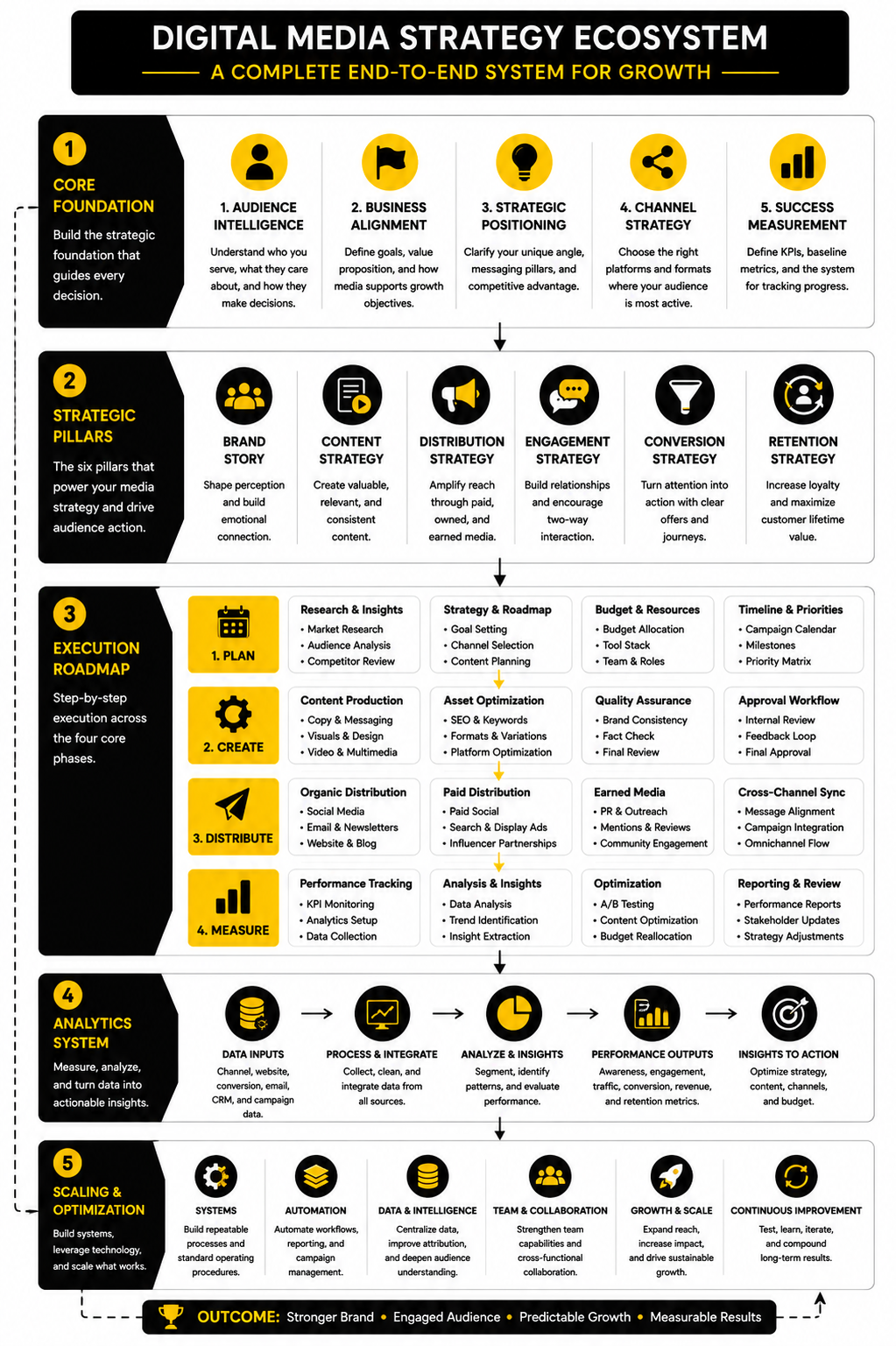
A strong digital media strategy should answer five practical questions:
When those answers are clear, execution becomes easier. Content decisions become faster. Reporting becomes more useful. Growth becomes less dependent on luck because every part of the media system has a defined role.
What Is A Digital Media Strategy?
A digital media strategy is a structured plan for using online channels to reach, influence, and convert a specific audience. It connects business goals with audience research, messaging, content, distribution, conversion paths, and measurement. The goal is not just to publish more content, but to make every media activity support a clear business outcome.
Why Is Digital Media Strategy Important?
Digital media strategy is important because attention is fragmented across search, social, email, video, communities, ads, and creator-led platforms. Without a strategy, teams often chase trends, post inconsistently, or measure the wrong signals. A clear strategy helps you focus resources on the channels, messages, and journeys most likely to create meaningful growth.
What Are The Core Components Of A Digital Media Strategy?
The core components are business objective, audience definition, positioning, message pillars, channel roles, content system, conversion path, and measurement plan. Each component supports the next one, so weak audience work usually leads to weak messaging and weak channel decisions. The best strategies keep these pieces simple enough to execute but specific enough to guide real decisions.
How Is Digital Media Strategy Different From Content Strategy?
Content strategy focuses on what content to create, why it matters, and how it supports the audience journey. Digital media strategy is broader because it also includes channel selection, paid and organic distribution, analytics, conversion systems, automation, and business outcomes. Content is a major part of the system, but it is not the whole system.
Which Channels Should A Digital Media Strategy Include?
The right channels depend on the audience, offer, business model, and stage of growth. Search is strong for intent, social is strong for discovery and trust, email is strong for nurturing, and paid media is strong for accelerating what already works. A focused strategy across a few connected channels is usually better than spreading weakly across every platform.
How Do You Measure Digital Media Strategy?
Measure digital media strategy by matching metrics to channel roles and business goals. Discovery channels may need reach, engagement depth, shares, saves, and audience growth, while conversion channels need leads, sales, booked calls, trials, or revenue. The key is to avoid judging every channel by the same metric because different channels do different jobs.
What Is The Biggest Mistake In Digital Media Strategy?
The biggest mistake is starting with platforms before clarifying the objective, audience, and message. That usually creates a scattered plan where content is published because the platform exists, not because it supports a specific journey. Strategy should decide the channel mix, not the other way around.
How Often Should A Digital Media Strategy Be Reviewed?
The execution rhythm should be reviewed weekly, while the broader strategy should usually be reviewed monthly or quarterly. Weekly reviews help catch tactical issues like weak hooks, poor conversion paths, or inconsistent publishing. Monthly and quarterly reviews help you evaluate bigger patterns without overreacting to one campaign or one piece of content.
Can Small Teams Build A Strong Digital Media Strategy?
Yes, small teams can build a strong digital media strategy by keeping the system focused. A small team does not need every channel, every format, or every automation layer from day one. It needs one clear audience, one strong message, one primary journey, and a repeatable media loop that can be improved over time.
What Tools Help With Digital Media Strategy?
Tools help when they support a clear process, not when they replace strategy. A publishing tool like Buffer can help manage social distribution, while GoHighLevel can support funnels, CRM, automation, and follow-up. For lead capture, surveys, or intake forms, Fillout can help structure the first-party data you collect from interested people.
How Does AI Fit Into Digital Media Strategy?
AI can help with research, content repurposing, campaign analysis, personalization, and customer interaction. It should be treated as leverage for a strong strategy, not as a shortcut around audience understanding or positioning. If the core message is unclear, AI will usually help you produce more unclear content faster.
How Do You Know When A Digital Media Strategy Is Working?
A digital media strategy is working when the right audience is engaging, the message is becoming clearer, the journey is producing measurable movement, and the team knows what to improve next. Early signs may include better qualified traffic, stronger replies, higher conversion rates, improved lead quality, or clearer content patterns. Over time, the strategy should connect media activity to business outcomes like pipeline, revenue, retention, or customer growth.
Build a stronger local presence with BAAM AI
Turn your website, Google profile, social channels, and AI visibility into one growth engine
Most businesses do not need more random marketing activity. They need a consistent presence system that helps the right people find them, trust them, and take action. BAAM AI brings strategy, local SEO, website updates, Google Maps visibility, social content, AI-search readiness, media production, and reporting into one practical monthly engine.
If you want your marketing to keep working after the campaign ends, start with a free BAAM AI presence audit. See how your business shows up today and where the fastest visibility wins are at BAAM AI.