
BAAM AI Blog
Digital Media Marketing Agency: A Practical Guide To Strategy, Channels, And Growth
A digital media marketing agency is not just a team that posts on social media, launches ads, or sends emails. At its best, it is a growth partner that connects audience research, creative strategy, media buying...
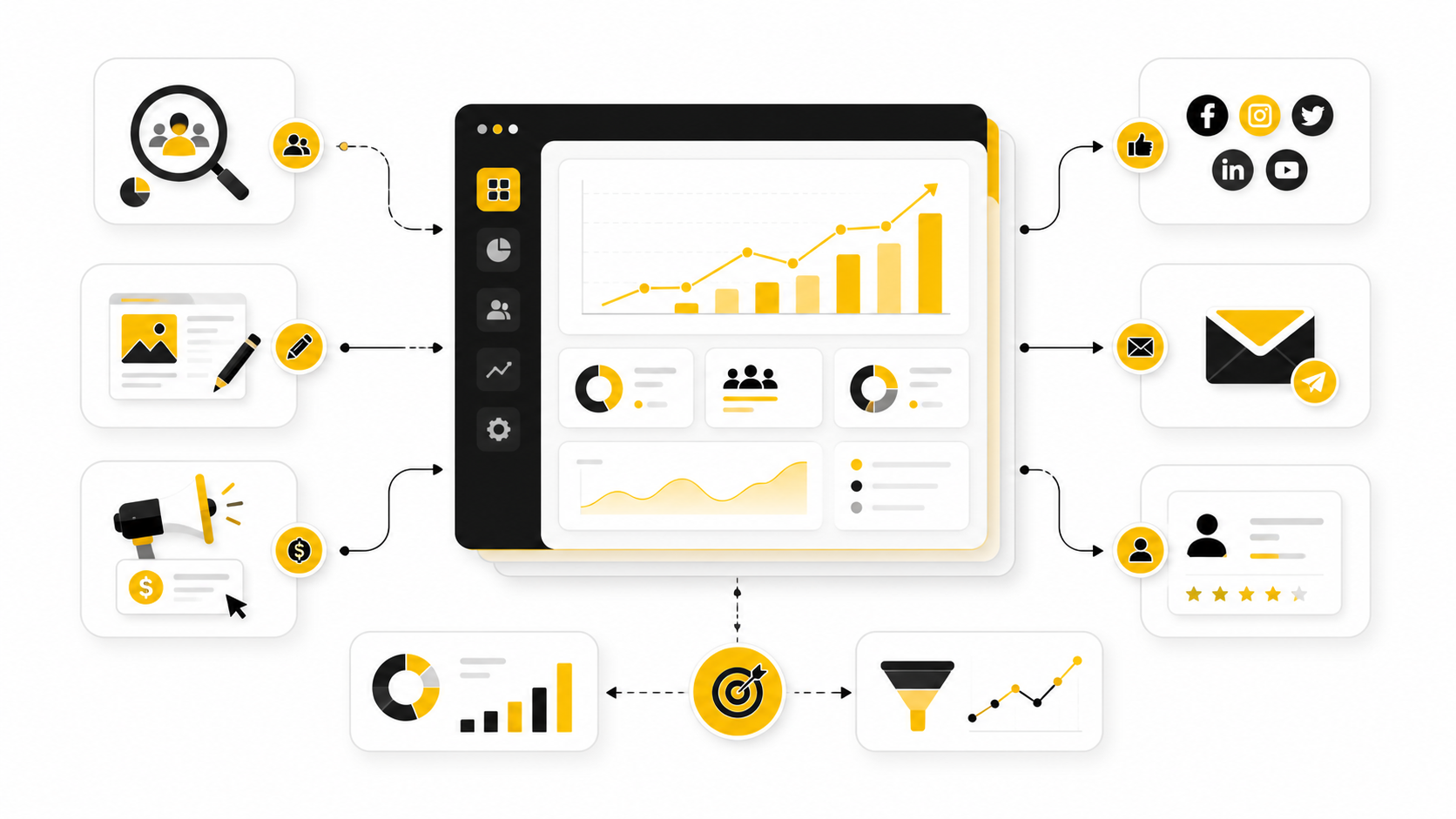
A digital media marketing agency is not just a team that posts on social media, launches ads, or sends emails. At its best, it is a growth partner that connects audience research, creative strategy, media buying, content production, analytics, automation, and conversion systems into one operating model. That distinction matters because modern marketing is no longer a collection of disconnected campaigns; it is a system that has to earn attention, convert demand, and prove what is working.
The pressure on that system is increasing. Digital ad spending now represents more than three quarters of global media ad spending, which means most brands are competing in channels where targeting, creative fatigue, attribution, privacy rules, AI-generated content, and platform volatility all collide at once. At the same time, Gartner’s 2025 CMO research shows that marketing budgets have stayed flat at about 7.7% of company revenue, while many teams still feel they do not have enough budget to execute their strategy. That creates a simple but uncomfortable reality: businesses cannot afford random marketing anymore.
A strong digital media marketing agency helps solve that problem by giving a company structure. It clarifies who the brand is trying to reach, what message should move them, which platforms deserve attention, how campaigns should be measured, and where automation can reduce manual work. Tools can help with pieces of the system, from customer journeys in GoHighLevel to landing page experimentation in Replo, but the real value comes from knowing how the pieces fit together.
What A Digital Media Marketing Agency Actually Does
A digital media marketing agency plans, builds, manages, and improves marketing across online channels where people discover, evaluate, and buy from brands. That usually includes paid advertising, organic social media, search visibility, email, landing pages, content, analytics, conversion optimization, and sometimes CRM or marketing automation. The key is not the list of services; the key is whether those services work together toward a commercial goal.
For example, paid media without landing page strategy usually leaks money. Social content without a conversion path often creates visibility but not revenue. Email automation without clear segmentation can annoy the same audience it is supposed to nurture. A capable agency understands those dependencies and builds campaigns around the whole customer journey rather than isolated deliverables.
This is why the phrase digital media marketing agency should not be treated as a fancy label for “outsourced posting.” The agency’s role is to turn media activity into a repeatable growth process. That means strategy before execution, measurement before scaling, and continuous improvement after launch.
Why Digital Media Marketing Matters Now
Digital media matters because buying behavior has become fragmented. A customer might discover a brand through TikTok, compare it through Google, check reviews on Reddit, visit a landing page, ignore the first offer, join an email list, and finally convert after a retargeting ad or a direct message. No single channel owns the whole journey anymore.
This shift is visible in media investment. IAB reported that U.S. digital video ad spend grew 18% year over year in 2024 to $64 billion and was projected to reach $72 billion in 2025, with digital video moving faster than total media. That does not mean every business should suddenly pour money into video, but it does show where attention and budgets are moving.
The challenge is that more digital spending does not automatically create better results. More channels can also mean more waste, more reporting confusion, and more creative pressure. A digital media marketing agency becomes valuable when it helps a business decide what not to do, not just what to launch next.
The Digital Media Marketing Agency Framework
The cleanest way to understand agency work is to see it as a framework with four connected layers: strategy, media, conversion, and learning. Strategy defines the market, audience, offer, positioning, and business goal. Media creates demand and captures attention through channels like search, social, video, creators, display, email, and owned content.
Conversion turns attention into action. This includes landing pages, forms, funnels, calls, demos, checkout flows, nurture sequences, and sales handoffs. Learning closes the loop by using analytics, attribution, testing, CRM data, and customer feedback to improve decisions over time.
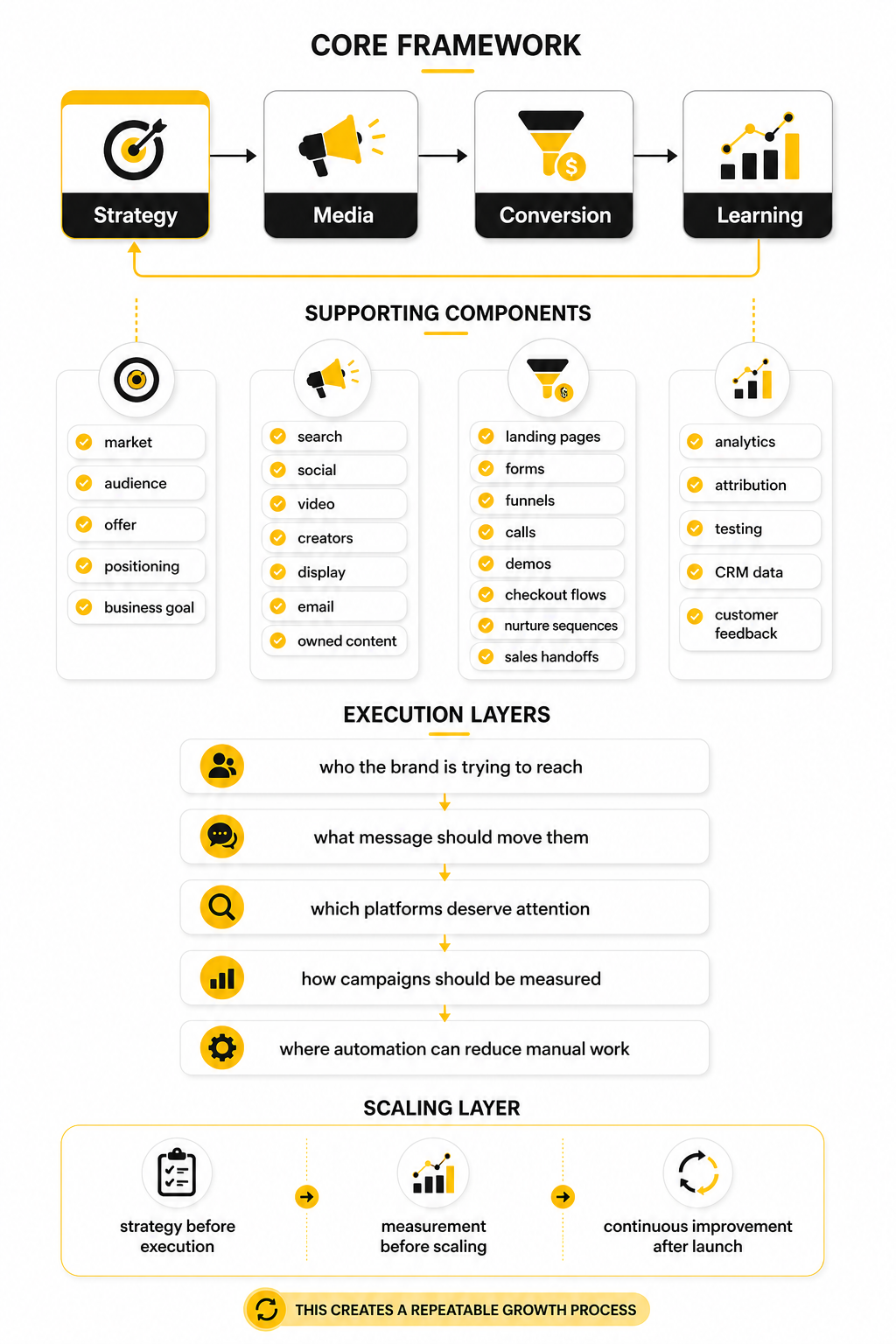
This framework is important because many underperforming campaigns are not actually channel problems. A Facebook ad can fail because the offer is weak. A Google campaign can look expensive because the landing page is unclear. An email sequence can underperform because the audience was poorly segmented from the start. The framework forces every part of the system to support the next one.
What The Rest Of This Guide Will Build Toward
The next sections will move from definition into practical execution. First, the article will explain why digital media marketing matters in more detail, especially for companies trying to grow with tighter budgets and higher competition. Then it will break down the operating framework an agency should use before discussing the actual services inside that framework.
After that, the guide will cover professional implementation. That includes team roles, campaign planning, creative workflows, measurement, reporting, automation, and how agencies should communicate with clients. The final part will focus on choosing the right agency, avoiding common mistakes, and answering the practical questions most businesses ask before hiring one.
Why Digital Media Marketing Matters Now
The reason digital media marketing matters is not “because everyone is online.” That is true, but it is too shallow to be useful. The real reason is that customer attention, product research, trust-building, and buying decisions now happen across multiple digital environments before a person ever speaks to a company.
The global audience is already there. DataReportal’s Digital 2025 report shows that there are now more than 5.5 billion internet users worldwide, which means digital channels are not a side bet for most markets anymore. They are where people compare options, discover brands, watch reviews, follow creators, search for answers, and decide whether a company feels credible.
That changes the job of a digital media marketing agency. The agency cannot only chase impressions or clicks. It has to understand how people move from awareness to trust to action, then build media around that journey instead of treating each channel like a separate task.
Attention Is Fragmented Across More Channels
A customer rarely follows a neat path anymore. They might see a short video first, search the brand later, read a comparison article, check comments, visit a landing page, leave, receive an email, and come back through a retargeting ad. That does not mean the journey is chaotic; it means the journey has more touchpoints than most businesses are prepared to manage.
This is where many companies lose momentum. One person owns paid ads, another person owns social, someone else updates the website, and email becomes an afterthought. Each piece might look acceptable by itself, but the customer experiences the whole thing as one brand.
A strong digital media marketing agency brings those touchpoints into one system. The message should feel consistent across platforms, but not copied and pasted. The offer should match the channel. The next step should feel obvious. That is basic, but it is also where a lot of growth is won.
Budgets Are Under More Pressure
Marketing teams are being asked to do more without getting much more room to move. Gartner’s 2025 CMO Spend Survey found that marketing budgets remained flat at 7.7% of overall company revenue, which puts real pressure on efficiency. When the budget is not expanding, the strategy has to get sharper.
That is why random channel testing becomes expensive fast. A company can burn budget on ads, content, tools, and freelancers without building any durable marketing asset. Worse, the team may end up with reports that show activity but not progress.
An agency earns its place when it protects focus. It should help the business decide which campaigns deserve investment, which channels are distractions, which metrics actually matter, and where conversion problems are hiding. More marketing is not the goal. Better marketing is.
Digital Media Is Now A Revenue System
Digital media used to be treated as a visibility engine. Get seen, get traffic, get leads, and hope sales can close the gap. That mindset is outdated because digital media now sits much closer to revenue than it used to.
Ecommerce brands can connect campaigns to checkout behavior. Service businesses can track booked calls, form submissions, pipeline stages, and closed deals. Local businesses can monitor calls, reviews, map visibility, and remarketing performance. B2B companies can connect content, paid search, webinars, email nurture, CRM activity, and sales conversations into one measurable funnel.
This is why platforms like GoHighLevel are popular with agencies and service businesses. They make it easier to connect landing pages, CRM, automations, follow-up, and pipeline visibility in one place. The tool does not replace strategy, but it can make execution cleaner when the agency knows what it is building.
Creative Has Become A Performance Lever
Creative is no longer just the “pretty” part of marketing. In many channels, creative is the targeting, the hook, the qualifier, and the first sales argument all at once. The difference between a weak ad and a strong ad is often not the media buying setup; it is whether the message earns attention from the right person.
This matters even more as platforms automate more of the bidding and delivery process. When algorithms handle more technical optimization, the agency’s edge moves toward audience insight, offer clarity, creative testing, and landing page quality. The businesses that win are not always the ones spending the most. They are often the ones learning the fastest.
A practical agency treats creative like a testing system. It develops angles, hooks, proof points, formats, and calls to action, then studies what the market responds to. That feedback should shape the next campaign, not sit in a dashboard nobody reads.
Organic And Paid Media Need Each Other
Paid media can create fast feedback, but it gets expensive when there is no brand trust behind it. Organic content can build credibility, but it often takes too long when there is no paid distribution or clear conversion path. The best strategies usually use both, with each channel doing a different job.
Organic media helps a brand become familiar. It can answer objections, show expertise, build community, and give prospects a reason to believe the company is active and real. Paid media helps amplify the right message, reach new audiences, retarget warm prospects, and test offers faster.
A digital media marketing agency should not treat organic and paid as rivals. The better question is how they support each other. A strong organic post can become an ad angle. A paid search query can become a content topic. A landing page objection can become a social video. That is how the system compounds.
The Customer Journey Needs Better Follow-Up
Most businesses do not lose leads only because their ads are bad. They lose leads because the follow-up is slow, generic, or inconsistent. Someone fills out a form, clicks a message, downloads a guide, or asks a question, and then the business responds too late or with the wrong next step.
That is a fixable problem. Email, SMS, chat, scheduling, CRM tasks, and retargeting can all support the journey when they are designed around intent. For example, a lead who asks for pricing should not receive the same nurture sequence as someone who downloaded a broad educational guide.
This is where tools like ManyChat, Brevo, and Fillout can be useful inside a broader system. They help capture intent, segment users, trigger follow-up, and reduce the gap between interest and action. The agency still has to define the journey, but the right tools make that journey easier to operate.
Measurement Has To Move Beyond Vanity Metrics
Clicks, impressions, views, and followers are not useless. They show whether a message is reaching people and whether the creative is getting attention. The problem starts when those numbers become the main definition of success.
A serious marketing system connects media metrics to business metrics. That means cost per qualified lead, landing page conversion rate, booked call rate, email engagement by segment, pipeline value, customer acquisition cost, retention, and revenue contribution. Not every business can measure everything perfectly, but every business can measure better than “the post did well.”
This is one of the biggest reasons to hire a digital media marketing agency rather than a collection of disconnected specialists. The agency should help create a shared scoreboard. When everyone is looking at the same business outcome, decisions get cleaner and campaigns improve faster.
The Digital Media Marketing Agency Framework
A digital media marketing agency needs a framework because execution without structure gets messy quickly. One campaign turns into ten disconnected tasks, reporting becomes reactive, and nobody can clearly explain why a channel is working or failing. The framework keeps the work tied to the business goal instead of letting the team drown in platform details.
The practical version has five layers: market insight, offer strategy, channel planning, conversion infrastructure, and optimization. Each layer supports the next one. If the market insight is weak, the offer will feel generic. If the offer is unclear, channel performance will look worse than it really is. If conversion infrastructure is broken, even good traffic becomes expensive.
That is why the best agencies do not start with “Which platform should we use?” They start with the customer, the problem, the buying moment, and the economics of the business. Platforms matter, but they should come after the strategy is clear.
Market Insight Comes First
Market insight is the foundation because it defines who the campaign is for and why they should care. This includes customer research, competitor positioning, search behavior, social listening, review mining, sales call notes, CRM data, and past campaign performance. The goal is not to collect endless information; the goal is to find the few insights that change the message.
A good agency looks for patterns in pain points, objections, triggers, buying language, and alternatives. It wants to know what customers already believe before the brand enters the conversation. That matters because marketing rarely creates demand from nothing. More often, it redirects existing intent, frustration, curiosity, or urgency.
This is also where many campaigns go wrong. Teams jump into content calendars and ad accounts before they understand the audience well enough. Then they blame the platform when the real issue is that the message was built from internal assumptions instead of market evidence.
Offer Strategy Turns Attention Into Intent
The offer is the bridge between attention and action. It answers the quiet question every prospect is asking: “Why should I do this now, with this company, instead of doing nothing or choosing someone else?” If that question is not answered clearly, the campaign has to work too hard.
An offer does not always mean a discount. It can be a consultation, free audit, demo, lead magnet, trial, product bundle, comparison guide, webinar, calculator, diagnostic, or direct purchase path. What matters is that the offer matches the buyer’s awareness level and the level of trust already built.
For example, a cold audience may not be ready to book a sales call, but they may be willing to complete a short assessment through a form built with Fillout. A warmer audience may respond better to a focused landing page or funnel built in ClickFunnels. The agency’s job is to choose the offer based on intent, not because a tool happens to be available.
Channel Planning Should Follow The Buying Journey
Channel planning is not about being everywhere. It is about choosing the environments where the audience already spends attention and where the brand can create a useful next step. Search, social, email, video, display, creators, communities, and retargeting all behave differently, so they should not be judged by the same short-term metric.
Search often captures demand that already exists. Social can create demand, educate the market, and test creative angles. Email and CRM help nurture people who are not ready to buy immediately. Retargeting keeps the brand visible after someone has shown intent. The mix depends on the business model, buying cycle, price point, and how much trust the prospect needs before acting.
A capable digital media marketing agency makes these tradeoffs explicit. It should explain which channels are meant to drive awareness, which channels should capture intent, which channels should convert, and which channels should support retention. Without that clarity, teams start comparing channels unfairly and cutting the wrong things.
Conversion Infrastructure Makes The Strategy Real
Conversion infrastructure is where the strategy becomes tangible. This includes landing pages, forms, tracking, CRM stages, lead routing, email sequences, chat flows, booking pages, call tracking, dashboards, and sales handoff processes. It is not glamorous, but it is often the difference between a campaign that scales and a campaign that quietly leaks revenue.
Digital experience still has a major friction problem. Contentsquare’s 2025 benchmark research highlights that almost half of online visits continue to suffer from preventable friction, which is exactly why traffic alone is not enough. If the page is slow, confusing, generic, or disconnected from the ad promise, the media budget is carrying a problem it cannot fix.
This is where tools need to be chosen carefully. A service business may need pipeline visibility and automated follow-up inside GoHighLevel. An ecommerce brand may need higher-converting landing pages through Replo. A content-heavy team may need cleaner publishing and scheduling with Buffer. The tool is useful only when it supports the process.
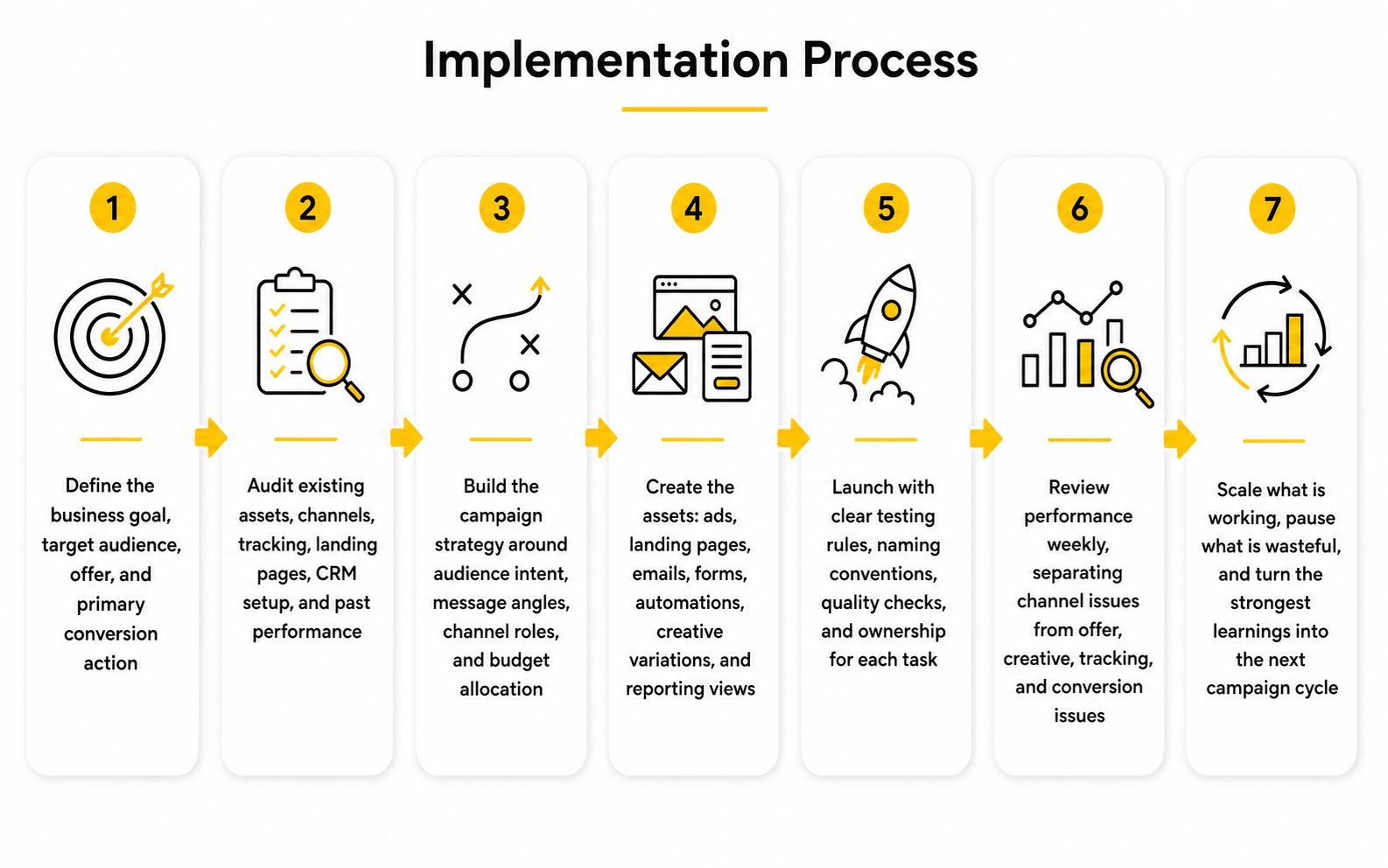
A Practical Execution Process
Once the framework is clear, implementation should move in a steady sequence. The goal is not to make the process complicated. The goal is to stop skipping the steps that prevent wasted spend later.
This process is simple on purpose. Most teams do not fail because they lack a complex methodology. They fail because nobody owns the basics consistently. A good agency makes the basics repeatable.
Optimization Is A Learning Loop
Optimization is not just changing bids, headlines, thumbnails, or buttons. Real optimization means learning why people respond, where they hesitate, and what needs to change next. That requires clean data, but it also requires judgment.
AI is making this loop faster, but it does not remove the need for strategy. IAB Europe’s 2025 research on AI in digital advertising found that privacy, expertise, and governance remain major concerns, even as many agencies and ad tech firms report performance gains from AI adoption. That is the right tension: AI can speed up production and analysis, but teams still need standards for quality, compliance, and brand consistency.
A digital media marketing agency should use automation where it improves speed and clarity, not where it creates noise. AI can help generate creative variations, summarize customer feedback, analyze performance patterns, and support reporting. But the agency still has to decide what matters, what is safe to use, and what the customer actually needs to hear.
Reporting Should Create Decisions
Reporting is only valuable if it changes what the team does next. A dashboard full of numbers may look professional, but it is useless if nobody can turn it into decisions. The best reports explain what happened, why it likely happened, what will change, and what the business should expect next.
A useful report separates leading indicators from business outcomes. Click-through rate, watch time, cost per click, and email engagement can help diagnose performance. Qualified leads, booked calls, pipeline value, sales, repeat purchases, and acquisition cost show whether the campaign is actually moving the business.
This is where agency-client communication becomes important. The client should not need to decode platform metrics to understand progress. The agency should translate performance into plain language, defend its recommendations, and be honest when the data shows that something is not working. That honesty is not negative. It is how the account gets better.
Statistics And Data
Data should make a digital media marketing agency more decisive, not more confused. The point is not to collect every metric available in Meta, Google, TikTok, LinkedIn, email software, analytics tools, and the CRM. The point is to understand which signals show attention, which signals show intent, which signals show friction, and which signals show actual business impact.
This is where a lot of reporting goes wrong. Agencies sometimes present numbers because the platform makes them easy to export, not because they answer a business question. A dashboard can look impressive and still hide the truth. Good measurement starts with the decision the data is supposed to support.
The Numbers Need Context
A benchmark is useful only when it gives context. It is not a target by itself. A 3% landing page conversion rate could be weak for a simple lead magnet, acceptable for a high-ticket consultation, or strong for a complex B2B offer with cold traffic.
That is why channel benchmarks should never be judged in isolation. Search traffic usually carries more intent than cold social traffic, so it may convert at a higher rate but cost more per click. Social traffic may convert lower on the first visit but create demand that later returns through branded search, email, or retargeting. Email may look small in traffic volume but produce strong revenue because the audience is warmer.
The job of a digital media marketing agency is to interpret those numbers based on the buying journey. If a metric is high but does not move qualified leads, revenue, or pipeline, it may be a vanity signal. If a metric looks low but feeds an important stage of the funnel, it may still deserve investment.
Digital Spend Shows Where Competition Is Moving
Digital advertising keeps absorbing more budget, which means competition is getting sharper. IAB and PwC reported that U.S. internet advertising revenue reached a record $294.6 billion in 2025, up 13.9% year over year. That matters because rising spend usually means more auction pressure, more creative competition, and less room for lazy campaigns.
This does not mean every business should spend more. It means the cost of weak execution is going up. If the targeting is broad, the creative is generic, the landing page is unclear, or the follow-up is slow, the market will punish that inefficiency faster than before.
The practical action is simple: treat media spend like fuel, not strategy. Before increasing budget, the agency should check whether the offer is clear, whether the conversion path works, whether tracking is reliable, and whether the creative has enough variation to avoid fatigue. Scaling a broken system only makes the leak more expensive.
Budgets Make Efficiency Non-Negotiable
Marketing budgets are not expanding fast enough to cover sloppy execution. Gartner’s 2025 CMO Spend Survey found that budgets stayed flat at 7.7% of overall company revenue. That is important because many teams still face higher expectations, more channels, more content demands, and more pressure to prove contribution.
Flat budgets change how measurement should work. The question becomes less “Did this campaign get engagement?” and more “What should we fund, fix, pause, or scale?” Measurement has to protect the budget from guesswork.
This is also why a digital media marketing agency should separate performance problems into categories. Some problems are traffic problems. Some are offer problems. Some are landing page problems. Some are sales process problems. If all underperformance gets blamed on the ad platform, the team will keep changing the wrong thing.
Conversion Data Reveals The Real Bottleneck
Conversion data is where marketing gets honest. It shows whether attention is turning into action and where people are dropping off. If the campaign gets clicks but no leads, the issue may be message mismatch, page friction, weak proof, slow load time, unclear call to action, or a poor offer.
Contentsquare’s 2025 benchmark research found that frustrating digital experiences can lower conversion rates by 6.1%. That matters because many companies try to solve conversion problems by buying more traffic. But if the customer journey is creating friction, more traffic just exposes the problem to more people.
A good agency looks at conversion as a chain. The ad has to create the right expectation. The page has to continue the same promise. The form has to feel worth completing. The follow-up has to happen quickly. The sales process has to match the intent that marketing created.
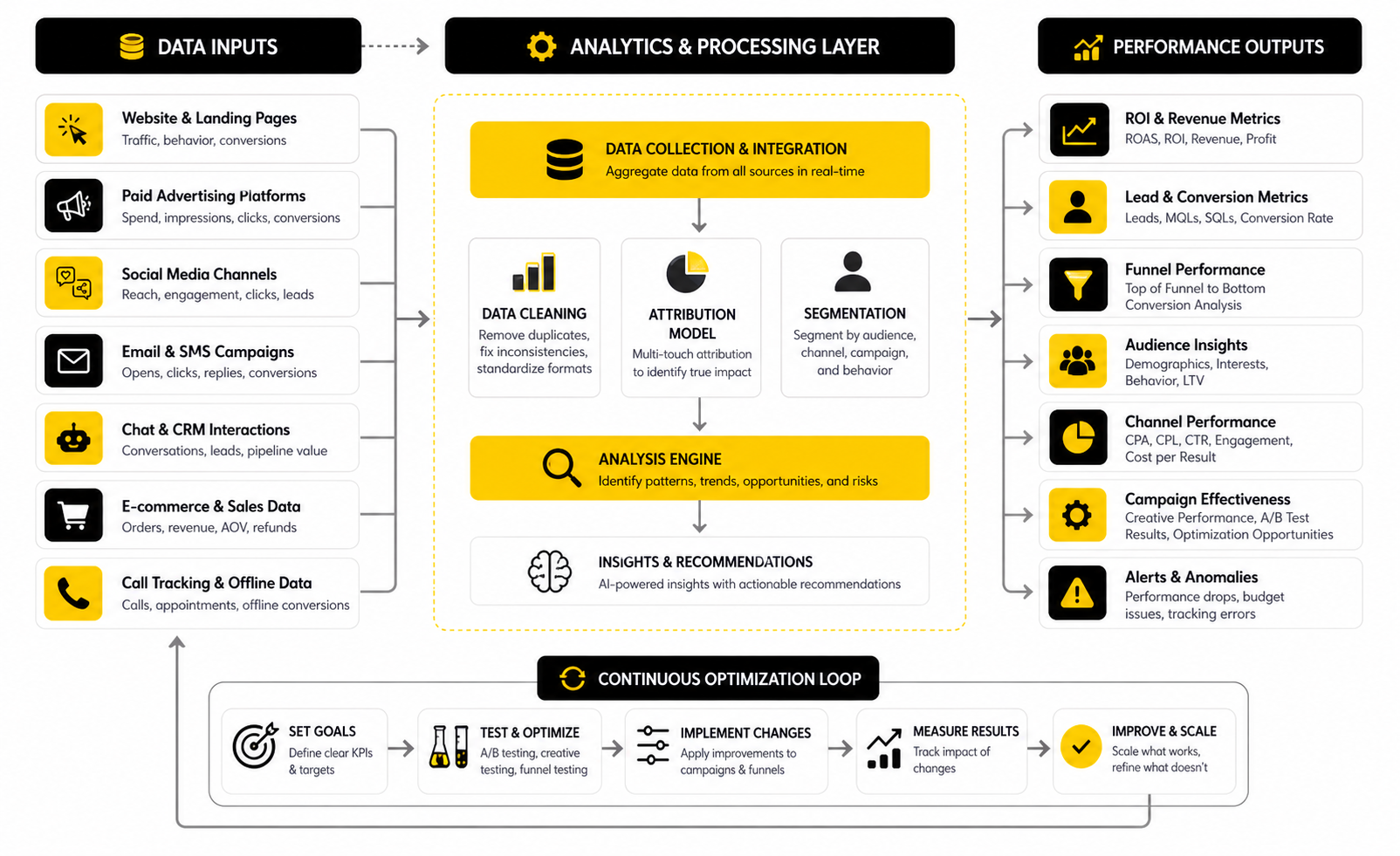
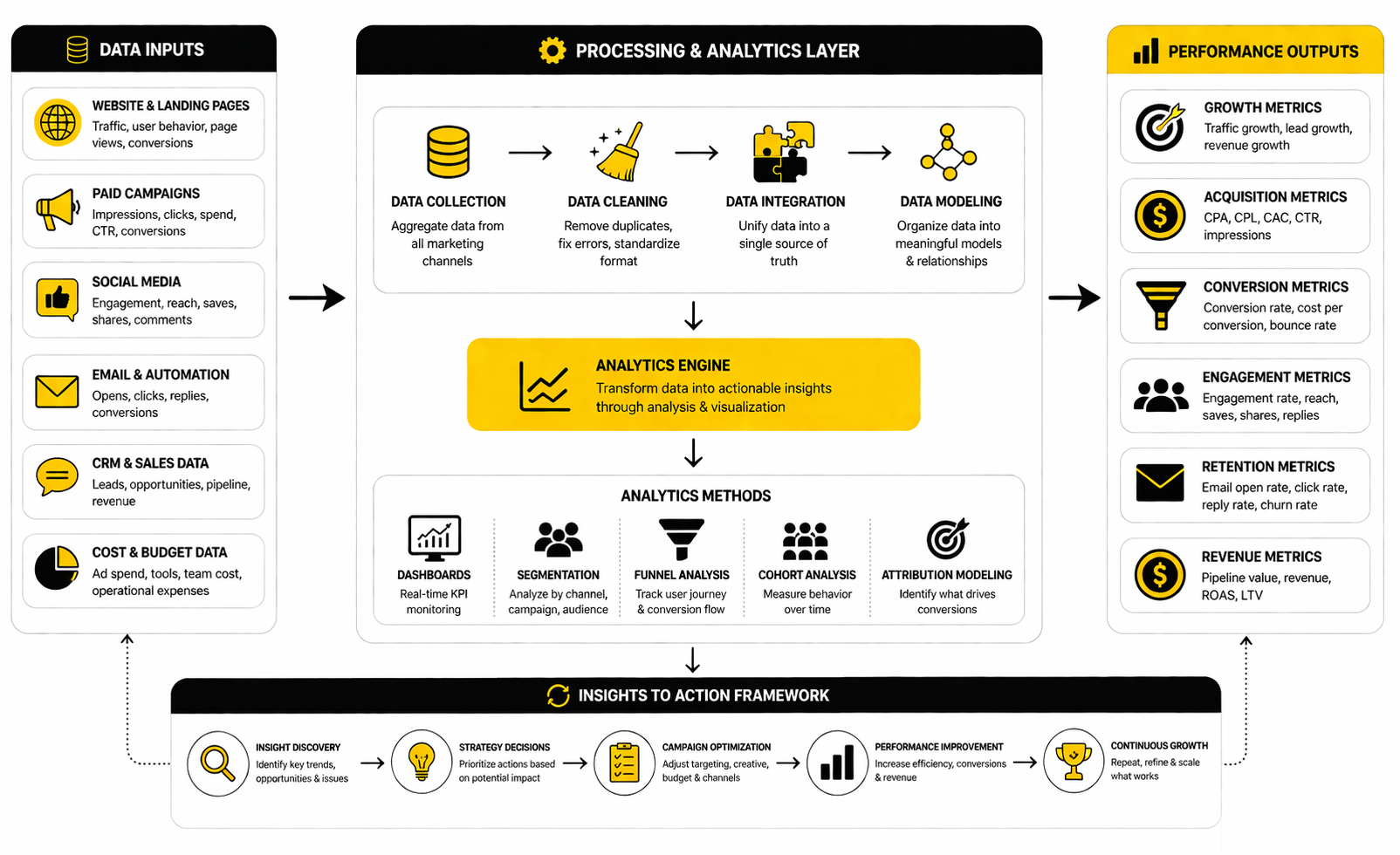
The Analytics System Should Follow The Funnel
The cleanest analytics system follows the customer journey from first touch to business outcome. It does not need to be perfect, but it does need to be consistent enough to support decisions. The agency should know what happens at each stage and where the biggest drop-offs appear.
A practical measurement system usually includes:
The important part is not having a longer list. The important part is knowing which metric answers which question. If reach is low, the campaign may need better distribution. If clicks are low, the creative or offer may not be compelling. If leads are low after strong clicks, the landing page or conversion path needs work. If sales are low after strong lead volume, the issue may be qualification or sales follow-up.
Benchmarks Should Start A Conversation, Not End It
Benchmarks are useful when they stop teams from panicking over normal variation. For example, WordStream’s 2025 Google Ads benchmark data shows that search advertising costs have continued rising across many industries, with major differences by category and intent level. That helps a business understand whether its cost per click or cost per lead is unusually high or simply part of the market it competes in.
Landing page benchmarks work the same way. Search Engine Land’s summary of Unbounce conversion benchmark data notes that median conversion rates can vary widely by industry, from 3.8% in SaaS to 12.3% in legal. That range is exactly why one universal “good conversion rate” is a bad idea.
The action is to compare carefully. A digital media marketing agency should benchmark by industry, offer type, channel, audience temperature, device, and conversion event. A cold social campaign for a premium B2B service should not be judged against a warm branded search campaign for a local legal consultation. Different intent, different friction, different expected performance.
Attribution Should Be Useful, Not Perfect
Attribution is one of the most misunderstood parts of digital marketing. Everyone wants to know which channel “caused” the sale, but modern journeys rarely work that cleanly. A customer may interact with several channels before converting, and privacy changes have made platform-level reporting less complete than many dashboards pretend.
That does not mean attribution is useless. It means the agency should treat attribution as directional evidence, not absolute truth. Platform data, analytics data, CRM data, call tracking, customer surveys, and sales feedback all show part of the picture.
A practical attribution approach asks better questions. Which channels create qualified demand? Which channels capture existing demand? Which campaigns assist conversion even if they do not get last-click credit? Which sources bring leads that actually close? This is where measurement becomes strategic instead of mechanical.
Performance Signals Should Trigger Specific Actions
The best reporting systems connect metrics to actions. If a number moves, the team should know what to investigate next. Otherwise, reporting becomes passive observation.
For example, a falling click-through rate may point to creative fatigue, weak hooks, audience saturation, or poor channel fit. A rising cost per lead may point to auction competition, weaker traffic quality, landing page friction, or a lower-intent audience. A high lead volume with poor close rates may point to targeting, qualification, offer mismatch, or sales follow-up.
This is why dashboards should be paired with operating rules. If cost per lead rises for two weeks, the agency reviews traffic quality, creative fatigue, and landing page conversion before increasing budget. If booked calls drop while form fills stay stable, the agency reviews scheduling friction and follow-up speed. If revenue does not follow lead growth, the agency reviews lead quality with sales instead of celebrating volume.
The CRM Is Where Marketing Data Becomes Commercial
Ad platforms show campaign behavior, but the CRM shows commercial reality. Without CRM data, an agency may optimize for cheap leads that never buy. With CRM data, the team can see which campaigns create qualified opportunities, which sources move through the pipeline, and which customer segments are worth more.
This is where a platform like GoHighLevel can make the measurement process more practical for service businesses and agencies. When forms, calls, pipelines, automations, and follow-up live closer together, it becomes easier to see what happens after the lead is captured. That visibility helps the agency optimize for revenue, not just lead volume.
The CRM also improves accountability. Marketing can see whether leads were contacted quickly. Sales can see what message or offer created the lead. Leadership can see whether spend is creating pipeline. That is the measurement standard a digital media marketing agency should be working toward.
Data Should Make The Next Move Obvious
The best data does not just describe performance. It makes the next move obvious. It shows whether the team should improve creative, tighten targeting, rebuild a landing page, change the offer, fix tracking, adjust follow-up, or shift budget.
This is why measurement is not a separate activity from strategy. It is the feedback loop that keeps the strategy alive. Every campaign should create learning that improves the next campaign, even when the first result is not perfect.
A digital media marketing agency that understands data will not hide behind dashboards. It will explain what the numbers mean, what they do not mean, and what action should happen next. That is the difference between reporting activity and managing growth.
Professional Implementation, Measurement, And Team Structure
Once the framework and measurement system are clear, the next challenge is operational. Strategy does not fail only because the idea was wrong. It often fails because the handoff between strategy, creative, media, analytics, and sales is too loose.
A digital media marketing agency has to manage that operational layer with discipline. The work needs owners, timelines, review cycles, quality checks, and a shared definition of success. Without that, even a strong campaign plan turns into scattered tasks and avoidable delays.
The Agency Model Has To Match The Business Stage
Not every business needs the same agency setup. A startup may need speed, testing, landing pages, and direct response campaigns. A local service company may need lead generation, CRM automation, call tracking, and reputation management. A larger B2B company may need account-based marketing, content strategy, paid search, LinkedIn campaigns, sales enablement, and complex attribution.
The wrong model creates friction. A brand-heavy agency may produce beautiful work but struggle with direct response measurement. A performance-only agency may generate leads but weaken positioning if it ignores brand trust. A full-service agency may be useful when the business needs coordination, but expensive and slow if the company only needs one narrow capability.
The decision should start with the constraint. If the business has traffic but poor conversion, fix the conversion system. If it has a strong offer but no demand, build channel reach. If it has leads but weak sales outcomes, improve qualification and follow-up. The agency model should solve the bottleneck, not simply sell a bigger package.
Strategy And Execution Need Different Rhythms
Strategy needs space to think, but execution needs speed. That tension is normal. The problem starts when agencies confuse the two and either over-plan every detail or launch campaigns without enough thinking.
A practical rhythm is to separate planning cycles from optimization cycles. Strategy might be reviewed monthly or quarterly, depending on the business and campaign maturity. Creative, media, landing pages, and follow-up should be reviewed more often because those are the parts that respond quickly to market feedback.
This matters because performance data can create false urgency. One bad day does not mean the strategy is broken. One strong week does not mean the campaign is ready to scale aggressively. A mature digital media marketing agency knows the difference between noise, trend, and signal.
Scaling Creates New Problems
Scaling is not just spending more money. It changes the campaign. Audiences get broader, creative gets tired faster, auction pressure increases, sales teams receive more volume, and reporting gaps become more expensive.
That is why scale should happen in stages. First, prove the offer works with a defined audience. Then test creative variety and landing page performance. Then increase budget while watching lead quality, conversion rate, pipeline, and fulfillment capacity. If quality drops as spend rises, the agency should diagnose the system before blaming the channel.
This is especially important because digital ad markets are more competitive than ever. U.S. internet advertising revenue reached nearly $294.6 billion in 2025, with social and video continuing to capture large shares of growth. That does not make paid media bad. It just means the margin for lazy scaling is thinner.
Creative Operations Become A Bottleneck Fast
At small budgets, a campaign may survive with a handful of ads. At larger budgets, creative production becomes one of the main growth constraints. The team needs more angles, formats, hooks, proof points, edits, and refresh cycles to keep learning and avoid fatigue.
This is why creative operations should be treated like a system, not an emergency. The agency should maintain a backlog of customer objections, sales insights, competitor angles, testimonials, product benefits, seasonal hooks, and content formats. That backlog becomes the raw material for new ads, emails, landing page sections, and social posts.
Tools can help here, but the workflow matters more than the tool. A team might use Buffer for publishing, Wispr Flow to speed up drafting, or Flick Social to support social content workflows. But the real advantage is having a repeatable process for turning market feedback into new creative.
AI Should Increase Leverage, Not Lower Standards
AI is now part of digital marketing operations, but it needs boundaries. IAB Europe’s 2025 AI report found that privacy is the top concern around AI in digital advertising, while lack of internal expertise and training remains a major obstacle. That is the key point: AI can make teams faster, but it can also multiply bad judgment.
A good agency uses AI to support research, analysis, ideation, content variation, reporting, and workflow automation. It should not use AI as an excuse to publish generic content, invent claims, ignore compliance, or replace strategic thinking. Faster output is only useful when the quality bar stays intact.
The safest approach is to define where AI is allowed, where human review is required, and what data cannot be used. For example, AI can summarize anonymized campaign findings, create first-draft creative angles, or help compare landing page variants. But client data, customer information, legal claims, medical claims, financial claims, and sensitive brand decisions need stricter controls.
Client Communication Is Part Of Performance
Client communication is not admin work. It directly affects performance because slow approvals, unclear priorities, and hidden business context can delay decisions. A campaign cannot move quickly if every asset sits in review for a week or every report leads to a new debate about the goal.
The agency should set a clear communication rhythm before launch. That includes who approves creative, who owns landing page changes, who reviews tracking, who receives reports, and who can make budget decisions. It should also define what needs urgent attention and what can wait for the regular review.
This protects both sides. The client knows what is happening and why. The agency gets the access and feedback it needs to improve performance. When communication is clean, the work gets faster and the relationship becomes less reactive.
Sales Alignment Can Make Or Break The Campaign
For lead generation campaigns, sales alignment is not optional. Marketing can create demand, but sales often determines whether that demand turns into revenue. If sales does not follow up quickly, qualify consistently, or give feedback on lead quality, the agency is optimizing with half the picture missing.
The handoff should be specific. What counts as a qualified lead? How fast should the team respond? What happens after a form submission? What objections are prospects raising? Which campaigns create the best conversations? These questions should be answered in the CRM, not scattered across calls and spreadsheets.
A platform like GoHighLevel can help agencies and service businesses connect forms, automations, pipelines, and follow-up. That matters because speed and visibility are practical advantages. If a lead is captured but not contacted, the campaign did its job and the system failed.
Risk Management Is Part Of Serious Marketing
Advanced marketing is not only about growth. It is also about protecting the brand from avoidable risk. That includes privacy issues, tracking mistakes, misleading claims, platform policy violations, poor data handling, weak creative approvals, and overdependence on one channel.
Privacy and measurement are especially important because the digital advertising ecosystem keeps changing. More automated buying, more AI-assisted targeting, and more fragmented attribution all make governance harder. The agency should know what data it collects, why it collects it, where it goes, and who can access it.
The same applies to claims. If an ad promises results the business cannot support, performance may look good in the short term but create trust problems later. A responsible digital media marketing agency protects credibility while still pushing for growth. That balance matters.
Tool Stack Decisions Should Stay Practical
A bloated tool stack slows teams down. Every new platform adds cost, training, integration work, permissions, reporting complexity, and another place for data to break. The best tool stack is not the most impressive one; it is the one the team actually uses well.
The core stack usually needs a CRM, analytics, landing page or website system, email or messaging tool, ad platforms, creative workflow, reporting, and scheduling. Some businesses may also need chat automation, call tracking, proposal software, enrichment, or customer support integrations. The agency should choose tools based on the workflow, not trend pressure.
For smaller teams, platforms like Systeme.io or ClickFunnels can be useful when the priority is getting funnels and simple automations live quickly. For service businesses that need deeper client management, GoHighLevel may fit better. The right answer depends on what the business needs to operate consistently.
The Best Agencies Build Transferable Assets
A weak agency creates dependency without building assets. A strong agency leaves the business with better systems, better data, better creative learnings, better customer insight, and stronger conversion paths. That is the difference between renting activity and building marketing infrastructure.
Transferable assets include tested messaging, audience research, landing page templates, email sequences, reporting dashboards, CRM stages, creative libraries, content frameworks, and documented workflows. These assets keep producing value after an individual campaign ends. They also make future campaigns faster because the team is not starting from zero.
This is the standard businesses should expect from a digital media marketing agency. The agency should not only run campaigns. It should make the company more carefully, faster, and more capable over time.
Choosing The Right Agency And Common Questions
Choosing a digital media marketing agency should feel like hiring an operating partner, not buying a list of services. The right agency will ask uncomfortable questions about your offer, sales process, margins, tracking, customer quality, and internal capacity. That is a good sign, because serious marketing cannot be separated from the business model behind it.
The wrong agency will rush straight into deliverables. It will promise traffic, content, leads, or followers before it understands what a good customer is worth and what the company can realistically handle. That is where many bad partnerships start: the client buys activity, the agency sells activity, and nobody owns the commercial outcome.
A better evaluation process looks at fit. Does the agency understand your market? Can it explain its process clearly? Does it know how to measure beyond platform metrics? Can it work with your team, your sales cycle, your budget, and your constraints? Those questions matter more than a polished pitch deck.
What To Look For Before Hiring
A strong agency should be able to explain how it thinks before it explains what it sells. Listen for how it diagnoses problems. If every answer leads to the same channel or package, the recommendation is probably built around the agency’s offer instead of your business.
You should also look for evidence of operational maturity. That includes clear onboarding, defined responsibilities, reporting cadence, creative review processes, tracking checks, and a realistic launch plan. The agency does not need to be huge, but it does need to be organized.
The best sign is clarity. A good digital media marketing agency can tell you what it will do, why it matters, what it needs from you, what results are realistic, and what could block performance. It should not hide behind jargon or make the process feel mysterious.
Red Flags To Avoid
Be careful with agencies that guarantee specific revenue numbers without seeing your economics, sales process, or past data. Marketing has too many variables for serious professionals to promise outcomes blindly. Confident projections are fine, but guarantees without diagnosis are usually sales pressure.
Another red flag is reporting that focuses only on activity. More posts, more clicks, more impressions, and more meetings do not automatically mean progress. The agency should connect its work to qualified demand, conversion quality, pipeline, revenue, or another business outcome that actually matters.
Also watch for tool-first thinking. A platform can be useful, but a tool does not create strategy by itself. Whether the team uses GoHighLevel, ClickFunnels, Systeme.io, Brevo, or another system, the bigger question is whether the workflow makes sense.
How To Start The Partnership Properly
The first phase should not be a chaotic rush to launch. It should be a focused discovery and setup period where the agency gets the foundation right. That includes access, tracking, past performance, offers, audience research, sales process, creative assets, analytics, and approval workflows.
The client also has work to do. The agency needs fast feedback, honest context, internal data, sales insights, customer objections, and someone with authority to approve decisions. If the client disappears after signing, the agency will be forced to guess.
A clean start creates momentum. Everyone knows what is being built, what success looks like, and what has to happen first. That is how the relationship avoids confusion and gets into productive execution faster.
The Final System
At this stage, the full picture should be clear. A digital media marketing agency is not valuable because it “does digital.” It is valuable when it connects strategy, media, creative, conversion, CRM, analytics, and optimization into one system.
That system should help the business attract the right audience, communicate a sharper offer, convert attention into action, follow up properly, measure honestly, and improve over time. It should also create assets the company can keep using, not just temporary campaign output.
When the system is working, marketing becomes less random. Decisions become easier. The team knows what to test, what to fix, what to scale, and what to stop doing. That is the real goal.
What does a digital media marketing agency do?
A digital media marketing agency helps businesses plan, execute, measure, and improve marketing across online channels. That can include paid ads, social media, search, content, email, landing pages, automation, CRM, reporting, and conversion optimization. The best agencies connect those pieces into one growth system instead of treating each channel as a separate task.
How is a digital media marketing agency different from a traditional marketing agency?
A traditional marketing agency may focus more on offline media, brand campaigns, print, TV, radio, or broad communications. A digital media marketing agency focuses on online environments where audience behavior, campaign performance, and conversion paths can be tracked and improved faster. The difference is not just the channel mix; it is the speed of testing, measurement, and optimization.
When should a business hire a digital media marketing agency?
A business should consider hiring an agency when it has a real offer, a clear market, and a need for more consistent growth. It also makes sense when the internal team lacks time, expertise, creative capacity, media buying skill, or analytics discipline. Hiring too early can waste money, but waiting too long can slow growth if the business is already missing qualified demand.
How much should a digital media marketing agency cost?
The cost depends on scope, market, channels, ad spend, creative needs, reporting complexity, and whether the agency is handling strategy only or full implementation. A small project may be priced very differently from a full-service monthly partnership. The better question is whether the agency can connect its fee to the value of the problem it is solving.
What services should a digital media marketing agency offer?
Core services often include strategy, paid media, organic content, landing pages, email marketing, CRM setup, analytics, reporting, and conversion optimization. Some agencies also offer SEO, influencer campaigns, automation, website design, video production, or sales enablement. The right service mix depends on the bottleneck in the business, not on a generic checklist.
How long does it take to see results?
Some signals can appear quickly, such as click-through rate, landing page conversion rate, cost per lead, and early creative performance. Business outcomes like qualified pipeline, revenue, retention, and payback usually take longer because they depend on sales cycle, offer quality, follow-up, and customer behavior. A serious agency should explain which results can be judged early and which need more time.
What metrics should an agency report?
An agency should report metrics that connect marketing activity to business progress. That may include reach, traffic quality, conversion rate, cost per lead, booked calls, lead quality, pipeline value, acquisition cost, return on ad spend, retention, and revenue contribution. The exact dashboard should match the customer journey and the decisions the business needs to make.
Is paid advertising enough by itself?
Paid advertising can create fast feedback and reach, but it is rarely enough by itself. If the offer, landing page, follow-up, trust signals, and sales process are weak, paid traffic will expose those weaknesses quickly. Paid media works best when it is supported by strong creative, clear positioning, conversion infrastructure, and a follow-up system.
Should an agency manage the CRM too?
In many lead generation businesses, yes, or at least the agency should be closely involved. The CRM shows what happens after the lead is captured, which is essential for judging lead quality and revenue impact. If the agency can only see ad platform data, it may optimize for cheap leads instead of profitable customers.
What is the biggest mistake businesses make when hiring an agency?
The biggest mistake is hiring for activity instead of outcomes. Businesses often ask for ads, posts, emails, or funnels before diagnosing the real constraint. A better approach is to identify the bottleneck first, then hire the agency that is best equipped to solve it.
Can a small business use a digital media marketing agency?
Yes, but the scope has to be realistic. A small business may not need a large full-service agency, but it may benefit from focused help with lead generation, landing pages, follow-up, content, or local search visibility. The key is to avoid spreading a small budget across too many channels before one path is working properly.
What should I prepare before speaking with an agency?
Prepare your offer, target customer, current website or landing pages, past campaign data, sales process, average customer value, margins, CRM setup, and main growth problem. You do not need everything perfect, but you should be ready to share honest context. The more clearly the agency understands the business, the better its recommendations will be.
How do I know if an agency is doing a good job?
A good agency gives you clarity, not just activity. You should understand what is being tested, why it matters, what the data shows, what decisions are being made, and how the work connects to business outcomes. If months pass and you still cannot explain what is improving, the partnership needs a serious review.
What tools should a digital media marketing agency use?
The tool stack depends on the business, but most agencies need systems for analytics, CRM, landing pages, email, forms, scheduling, reporting, creative workflow, and channel management. Tools like GoHighLevel, Replo, ManyChat, Buffer, and Fillout can all make sense in the right workflow. The tool should support the strategy, not replace it.
Should I choose a niche agency or a generalist agency?
A niche agency can be useful when your industry has specific compliance rules, sales cycles, buying behavior, or channel dynamics. A generalist agency can work well when it has strong strategic thinking, creative discipline, and measurement skills that transfer across markets. The best choice depends on whether industry specialization or broader growth capability matters more for your current problem.
Build a stronger local presence with BAAM AI
Turn your website, Google profile, social channels, and AI visibility into one growth engine
Most businesses do not need more random marketing activity. They need a consistent presence system that helps the right people find them, trust them, and take action. BAAM AI brings strategy, local SEO, website updates, Google Maps visibility, social content, AI-search readiness, media production, and reporting into one practical monthly engine.
If you want your marketing to keep working after the campaign ends, start with a free BAAM AI presence audit. See how your business shows up today and where the fastest visibility wins are at BAAM AI.