
BAAM AI Blog
Digital Media Advertising: A Practical Framework For Modern Growth
Digital media advertising is no longer just “running ads online.” It is the system a business uses to reach the right people across search, social, video, display, retail media, creator content, connected TV...
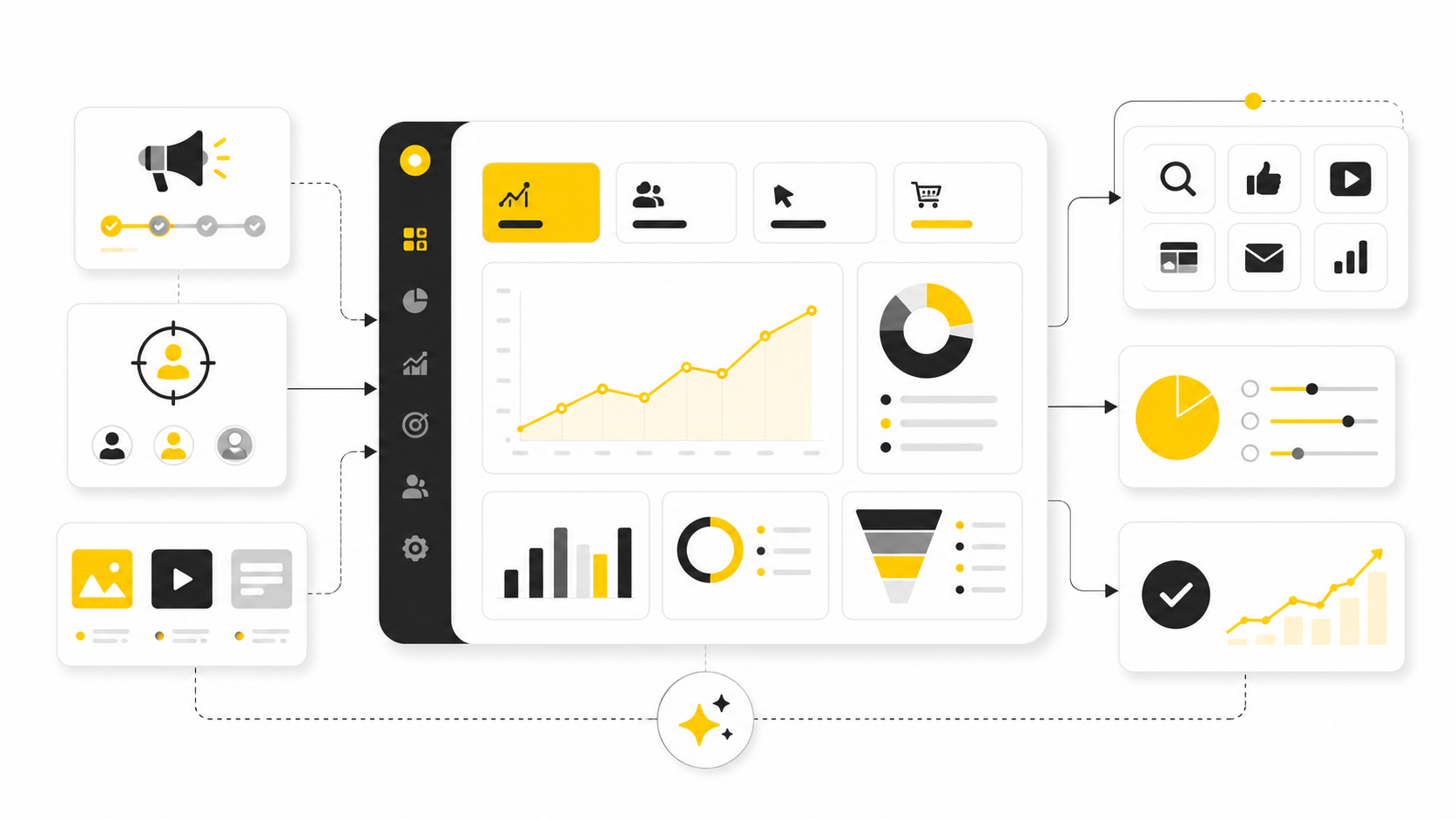
Digital media advertising is no longer just “running ads online.” It is the system a business uses to reach the right people across search, social, video, display, retail media, creator content, connected TV, email-adjacent journeys, and automated media buying. Done well, it connects attention to revenue. Done badly, it burns budget while dashboards make the campaign look busier than it really is.
The pressure is real because the market keeps getting bigger, more automated, and more fragmented at the same time. U.S. internet advertising revenue reached nearly $300 billion in 2025, while global ad spending was forecast to hit $1.17 trillion in 2025, with digital-first platforms capturing most of the incremental growth. That tells you something important: brands are not debating whether digital matters anymore. They are debating how to make it accountable.
The challenge is that digital media advertising can look deceptively simple from the outside. You pick a platform, upload creative, choose a budget, and wait for results. But the real work happens underneath that surface: audience strategy, offer positioning, channel fit, creative testing, tracking quality, attribution limits, privacy constraints, incrementality, and the operating rhythm that turns campaign data into better decisions.
That is why this guide uses a practical framework instead of a pile of tactics. Platforms change. Algorithms change. Cookie policies change. But the fundamentals of profitable media buying stay surprisingly stable: know the customer, match the message to the moment, measure what matters, and keep improving the system.
This six-part article will continue through the following sections:
Why Digital Media Advertising Matters Now
Digital media advertising matters because buying behavior has become digitally influenced even when the final purchase does not happen online. People discover products on social feeds, compare options through search, watch reviews on video platforms, click creator recommendations, revisit brands through retargeting, and then buy through ecommerce, retail stores, marketplaces, sales calls, or local service bookings. The ad may not always get the final click, but it often shapes the demand that makes the final click possible.
Budgets have followed that behavior. Gartner’s 2025 CMO Spend Survey found that digital channels account for 61.1% of total marketing spend, which means digital is now the center of the media plan for many companies, not a side channel. At the same time, marketing budgets have stayed tight, with Gartner reporting that 2025 marketing budgets remained flat at 7.7% of overall company revenue. That combination creates a clear mandate: digital campaigns need to work harder, not just spend faster.
The other reason this matters is measurement. Marketers have more dashboards than ever, but that does not mean they have more clarity. Nielsen’s 2025 marketing analysis highlighted that only 32% of marketers globally measure media spend across digital and traditional channels comprehensively. That gap is dangerous because a campaign can look efficient inside one platform while still failing to create profitable growth for the business.
Privacy changes make the job even more complex. Google’s Privacy Sandbox guidance still pushes advertisers to prepare for third-party cookie limitations and privacy-preserving alternatives, even as Chrome’s cookie direction has shifted toward user choice and existing privacy controls. The practical takeaway is simple: brands cannot build their entire media strategy around rented signals, fragile attribution, or one platform’s version of truth.
The Digital Media Advertising Framework
A useful digital media advertising framework starts with the business goal, not the ad platform. Before choosing Meta, Google, TikTok, YouTube, Amazon, LinkedIn, programmatic display, connected TV, or retail media, the team needs to define what the campaign is supposed to change. Is the goal to create new demand, capture existing demand, increase repeat purchases, improve lead quality, launch a product, defend market share, or lower customer acquisition cost?
Once the business goal is clear, the framework should connect four layers: audience, message, media, and measurement. Audience defines who the campaign is for and what problem they are trying to solve. Message defines why they should care now. Media defines where and when that message should appear. Measurement defines how the team will judge whether the spend created meaningful business value.
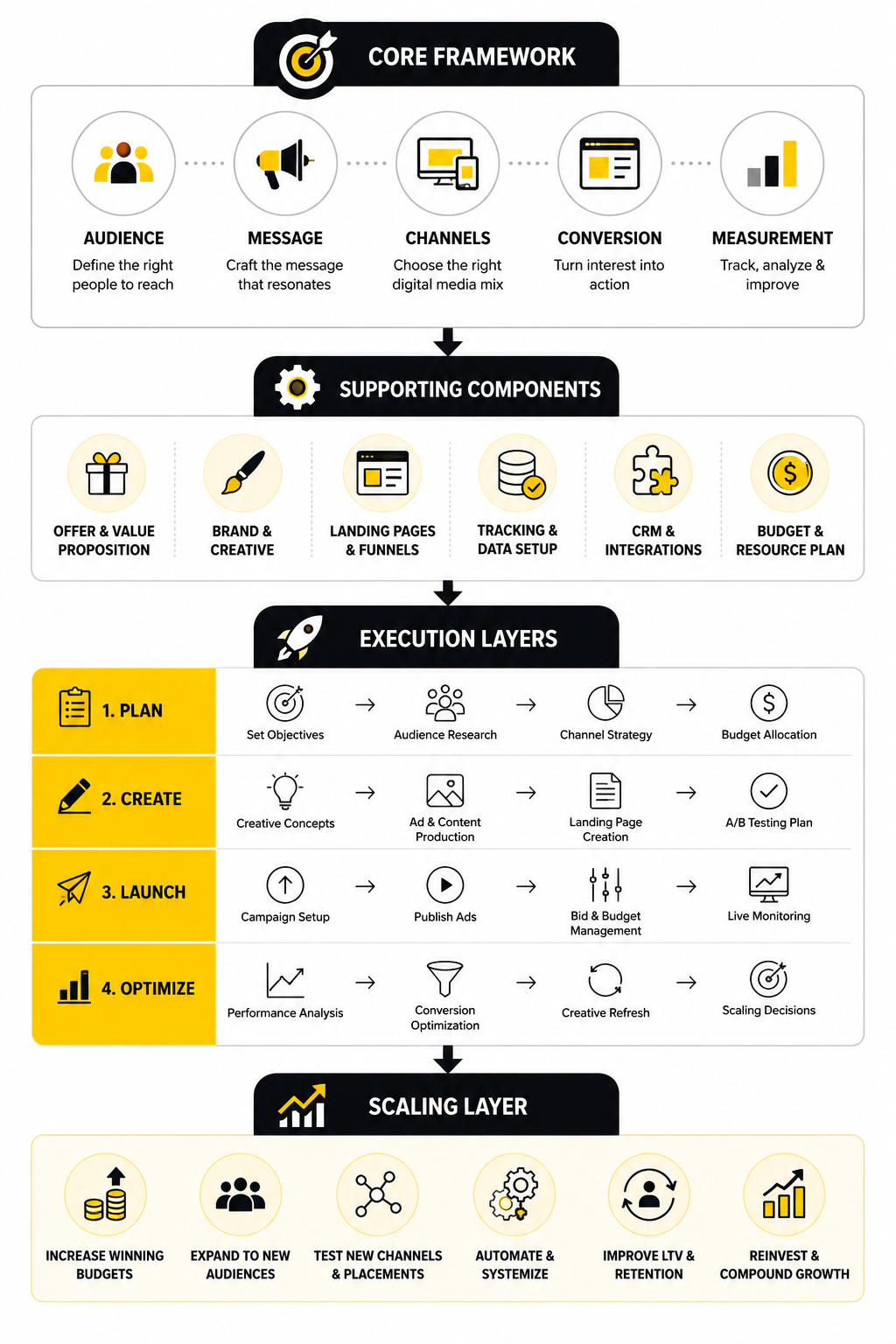
This matters because each layer affects the others. A weak offer will make even a good media plan look expensive. Poor tracking will make a strong campaign look uncertain. The wrong channel will put the right message in front of people at the wrong moment. A professional framework prevents those mistakes by forcing the strategy to work as a system.
Digital media advertising also needs a realistic view of channel roles. Paid search is usually strongest when people already have intent. Paid social is often better at creating demand, testing angles, and finding new audiences. Retail media works close to the purchase moment, especially for consumer brands. Connected TV and online video can build reach and memory, but they need disciplined measurement because they rarely behave like last-click channels.
The best media systems do not treat every channel as if it should produce the same result. They separate demand creation from demand capture. They separate prospecting from remarketing. They separate platform-reported conversions from business outcomes. That discipline makes scaling much easier because the team knows what each channel is responsible for.
Core Components Of A Strong Media System
A strong digital media advertising system has several core components working together. The first is positioning, because ads amplify what the market already understands or misunderstands about the offer. If the promise is vague, the audience is too broad, or the landing page does not match the ad, media spend becomes an expensive way to expose strategic weakness.
The second component is creative. Creative is not just the image, video, hook, headline, or call to action. It is the way the brand translates customer pain, desire, proof, urgency, and differentiation into something people can understand quickly. Kantar’s Media Reactions research notes that campaigns are seven times more impactful among receptive audiences, which is a strong reminder that context and audience mindset matter as much as reach.
The third component is the conversion path. Ads do not create revenue alone; they move people into a journey. That journey may include a landing page, quiz, checkout flow, booking page, webinar, email sequence, SMS follow-up, sales pipeline, or chatbot. For example, a business using automated conversations after paid social campaigns might use ManyChat when the campaign depends on fast replies and structured lead capture inside messaging channels.
The fourth component is measurement discipline. Platform metrics are useful, but they are not enough. A serious team looks at contribution margin, pipeline quality, qualified leads, repeat purchase behavior, incrementality, payback period, and customer lifetime value where the data is available. This is where digital media advertising becomes a business function, not just a marketing activity.
The fifth component is operations. Someone needs to decide what gets tested, how long tests run, what counts as a meaningful result, when budget moves, and when a campaign gets killed. Without that operating rhythm, teams either change campaigns too quickly or leave bad campaigns running because nobody wants to make the hard call. Strong execution is not glamorous, but it is often the difference between “ads do not work for us” and “we finally have a scalable acquisition system.”
Professional Implementation: Planning, Buying, Creative, And Measurement
Professional digital media advertising starts before a campaign goes live. The strongest teams do not open an ad account and “see what works.” They define the commercial target, map the customer journey, decide which channels deserve budget, prepare creative variations, confirm tracking, and agree on what success will look like before anyone spends a dollar.
That sounds basic, but it is where many campaigns break. The platform may optimize toward clicks, leads, purchases, store visits, app installs, or video views, but the business still has to decide which of those outcomes actually matters. A cheap lead is not useful if the sales team cannot close it. A high click-through rate is not useful if the traffic does not convert. A strong return on ad spend is not useful if the margin disappears after discounts, shipping, refunds, or fulfillment costs.
The practical goal is to build a campaign plan that can survive contact with reality. That means the plan should include the target audience, channel role, offer, creative hypothesis, conversion path, budget range, reporting cadence, and decision rules. When those pieces are written down, the team can improve the campaign instead of arguing about what the campaign was supposed to do.
Start With The Business Objective
The first implementation question is not “Which platform should we use?” It is “What business result are we trying to create?” Digital media advertising can support many goals, but each goal needs a different strategy. A local service business trying to book consultations should not measure success the same way as a software company driving demos or an ecommerce brand launching a new product.
The objective should be specific enough to guide tradeoffs. If the goal is efficient demand capture, paid search and high-intent retargeting may deserve more attention. If the goal is market awareness, video, creator partnerships, paid social, and connected TV may play a bigger role. If the goal is repeat purchase, lifecycle marketing and customer list activation become more important than simply chasing new cold audiences.
This is also where budget discipline starts. Gartner’s 2025 CMO Spend Survey showed marketing budgets sitting at 7.7% of company revenue, which means many teams are being asked to grow without much extra room for waste. A clear objective protects the budget because it stops the team from funding campaigns that look interesting but do not support the real growth target.
Match The Channel To The Buying Moment
Every channel has a different job. Search captures intent when people are already looking. Paid social interrupts attention and creates demand through hooks, angles, proof, and repeated exposure. YouTube and connected TV can build memory and trust, but they need a longer measurement window. Retail media can influence buyers close to the shelf, especially when the customer is already in shopping mode.
This is why copying another company’s media mix rarely works. Two brands can sell similar products and still need different channel strategies because their margins, awareness, purchase cycle, audience behavior, and sales process are different. A product with a short buying cycle may scale through direct-response creative. A complex B2B offer may need education, remarketing, sales enablement, and lead nurturing before the first serious conversation happens.
The best way to think about channel selection is simple: match the channel to the customer’s current level of intent. Cold audiences need a reason to care. Warm audiences need clarity and proof. High-intent audiences need friction removed. When the message matches the moment, digital media advertising becomes much easier to optimize.
Build The Offer Before Building The Campaign
A campaign cannot rescue a weak offer for long. It might generate early clicks because the creative is fresh, but performance usually fades when the market realizes the promise is unclear, the price feels wrong, or the next step is too hard. The offer is the bridge between attention and action, so it deserves serious work before media spend starts.
A good offer answers three questions quickly. What does the customer get? Why is it valuable now? What makes the next step feel safe enough to take? This could be a free consultation, product bundle, trial, demo, webinar, discount, diagnostic, lead magnet, or direct checkout, but the format matters less than the perceived value.
For funnel-based campaigns, tools like ClickFunnels, systeme.io, or Replo can fit naturally when the campaign needs a dedicated landing page, structured sales journey, or ecommerce page experience. The tool is not the strategy, though. The real win comes from matching the page, promise, proof, and call to action to the exact traffic source sending people there.
Create For The Platform, Not Just The Brand
Creative is where many media plans either become profitable or collapse. A polished brand asset does not automatically work as an ad. The creative has to fit the platform, the placement, the audience’s mindset, and the speed at which people consume the feed, search result, video, or display environment.
That means a creative system should include multiple angles, not just multiple versions of the same ad. One angle may focus on pain. Another may focus on speed. Another may focus on comparison. Another may focus on proof. Another may focus on a specific use case. This gives the platform more meaningful variation and gives the team better information about what the market actually responds to.
Creative testing should also be structured enough to learn from. If every ad changes the hook, visual, audience, landing page, and offer at the same time, the team will not know what caused the result. A cleaner approach is to test one major variable at a time when possible, then scale the winning pattern into new executions. This is not about being slow. It is about learning fast without fooling yourself.
Set Up Tracking Before Spending Serious Budget
Measurement should never be treated as something to fix after launch. By then, the campaign has already spent money, and the early learning period may be polluted with incomplete or misleading data. Tracking should be checked before launch across pixels, conversion APIs, UTM parameters, analytics events, CRM stages, ecommerce events, call tracking, and offline conversion imports where relevant.
This matters more now because privacy rules, browser changes, platform modeling, consent requirements, and fragmented customer journeys make perfect attribution unrealistic. IAB’s 2025 State of Data work highlights how AI is becoming more involved across audience segmentation, media buying, optimization, and performance measurement. That can help, but it also makes clean inputs more important because automated systems make decisions based on the signals they receive.
A practical measurement setup should separate platform reporting from business reporting. Platform data helps with optimization inside the ad account. Business data tells you whether the campaign is creating valuable customers, pipeline, revenue, or profit. You need both, but you should never confuse one for the other.
Connect Ads To Follow-Up
The conversion does not always happen on the first visit. In many markets, especially for services, B2B, education, high-ticket ecommerce, coaching, real estate, financial services, and local businesses, the follow-up system is where the money is made. Digital media advertising creates the opportunity, but follow-up converts the opportunity into revenue.
That follow-up can include email, SMS, retargeting, sales calls, booking reminders, chat automation, CRM pipelines, and personalized nurture sequences. For agencies and service businesses that need one system for lead capture, pipeline management, messaging, and automations, GoHighLevel can make sense when the campaign depends on speed-to-lead and structured follow-up. For newsletter-style nurturing or broader email campaigns, tools like Brevo, Moosend, or similar platforms can support the post-click journey.
The key is speed and relevance. If someone fills out a form and waits two days for a response, the campaign did its job but the system failed. If someone clicks an ad for one offer and receives generic follow-up about something else, the system creates friction. Paid media performance improves when every step after the click feels connected.
Use AI Carefully, Not Blindly
AI is now built into major ad platforms, creative workflows, bidding systems, reporting tools, and audience modeling. That is not a future trend anymore; it is already part of the operating environment. The 2025 IAB State of Data report described AI as moving across the media campaign lifecycle, from planning and segmentation to real-time optimization and analysis, which reflects how quickly the work is changing.
The opportunity is obvious. AI can help teams generate creative variations, identify patterns, summarize performance, automate bid decisions, and speed up testing. The risk is just as obvious. If the team cannot explain the campaign strategy, the AI will mostly accelerate random activity. Automation works best when humans define the objective, guardrails, data quality, and business constraints.
The rule is simple: use AI to increase execution speed, not to replace strategic judgment. Let automation help with variations, signals, and scale. Keep humans responsible for positioning, offer quality, brand risk, customer insight, and final budget decisions. That balance is where modern digital media advertising starts to feel less chaotic and more controllable.
Optimization, Governance, And Scaling Decisions
Once the campaign is live, the work shifts from setup to control. This is where digital media advertising becomes less about launching ads and more about running a repeatable decision system. You need enough structure to protect the budget, but enough flexibility to respond when the market gives you new information.
The mistake is treating optimization as constant tinkering. Changing bids, budgets, creative, audiences, placements, and landing pages every few hours usually creates noise instead of learning. A better process is to decide what the campaign is testing, let the test collect enough signal, then make one clear decision: keep, improve, scale, pause, or replace.
That rhythm matters because modern ad platforms use automated learning systems. If the team constantly resets the campaign before the system has enough conversion data, performance can look unstable even when the strategy is solid. The goal is not to touch the account as often as possible. The goal is to make better decisions when the data is strong enough to deserve action.
The Execution Process
A practical implementation process gives the team a shared operating system. It keeps the campaign from becoming a messy pile of ads, opinions, and platform recommendations. It also makes performance easier to diagnose because every stage has a specific job.
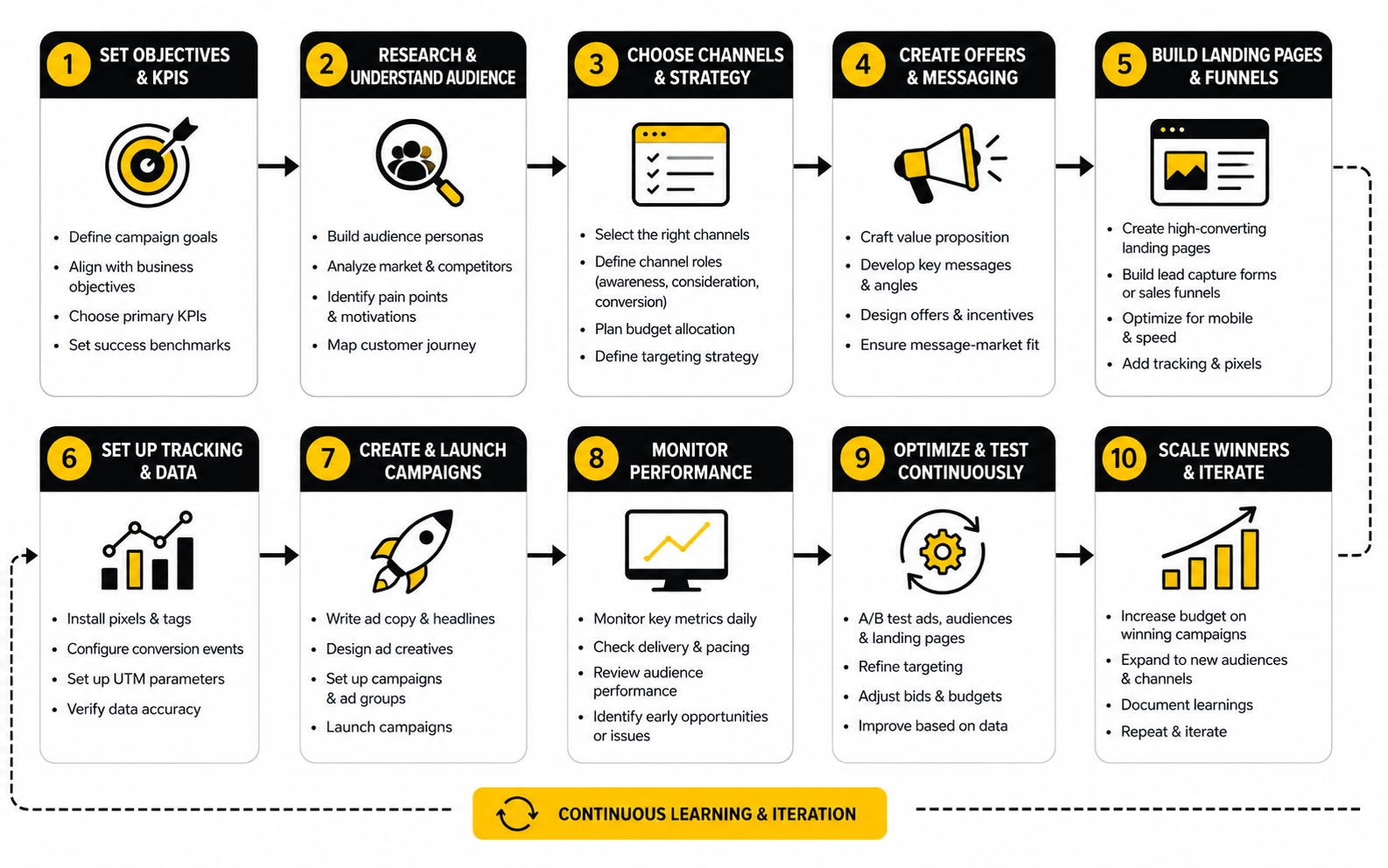
The process should move in this order:
This sequence looks simple, but it prevents expensive confusion. If the audience is unclear, creative testing becomes random. If the conversion path is weak, the media buyer gets blamed for a landing page problem. If tracking is broken, the team may scale the wrong campaign or kill the right one. Good execution reduces those errors before they become expensive.
The best teams also document what they learn. They do not just say, “This ad worked.” They record why it likely worked, which audience saw it, what promise it made, what objections it handled, and what happened after the click. That documentation becomes a creative and strategic asset over time.
Build A Testing Cadence
Testing is not the same as guessing. A proper testing cadence starts with a hypothesis that is specific enough to prove or disprove. For example, a team might test whether problem-aware messaging beats benefit-led messaging for a cold audience, or whether a shorter landing page improves conversion rate for high-intent traffic.
Each test needs a clean structure. The team should know the variable being tested, the minimum spend or time window, the primary metric, the secondary metric, and the decision rule. Without that, people tend to declare winners too early because they like an idea or because one ad had a lucky day.
Digital media advertising rewards patience and speed at the same time. You move fast by launching meaningful tests consistently. You stay patient by refusing to overreact to weak signals. That balance is hard, but it is where real optimization lives.
Separate Leading Indicators From Final Outcomes
Every campaign has leading indicators and final outcomes. Leading indicators include click-through rate, cost per click, video completion rate, landing page conversion rate, cost per lead, add-to-cart rate, and booked-call rate. Final outcomes include qualified pipeline, new customers, revenue, gross profit, retention, and payback period.
Leading indicators are useful because they show where the campaign may be breaking. If people do not click, the issue may be creative or audience fit. If they click but do not convert, the issue may be the page, offer, load speed, trust, or message match. If they convert but do not buy, the issue may be lead quality, sales process, pricing, or expectation mismatch.
Final outcomes matter because they stop the team from celebrating vanity metrics. A campaign can generate cheap leads and still lose money. A campaign can have a higher cost per acquisition and still be more profitable if the customers retain longer or buy more. The job is to connect the early signals to the business result without pretending they are the same thing.
Protect Media Quality
Media quality is a serious part of implementation, especially when budgets expand beyond closed platforms into programmatic display, video, connected TV, native, or commerce media networks. Advertisers need to care about viewability, invalid traffic, brand safety, placement quality, frequency, and whether the audience is real. Ignoring those details can make a campaign look active while quietly wasting spend.
The risk is not theoretical. Integral Ad Science reported in its 20th Media Quality Report that sophisticated ad fraud can produce 15 times higher fraud rates when no pre-bid fraud protection is in place. That does not mean every campaign needs an enterprise verification stack on day one, but it does mean serious advertisers should ask where impressions are served, how inventory is filtered, and what protections are active before scaling spend.
Brand safety also needs nuance. Overly strict exclusions can block legitimate inventory and reduce reach, while loose controls can put ads in places that damage trust. The practical answer is not panic. It is governance: define the risk tolerance, choose verification standards, review placements, and keep the media plan aligned with the brand’s actual boundaries.
Decide When To Scale
Scaling is not just increasing the budget. Scaling means increasing spend while maintaining enough efficiency, quality, and operational capacity to make the growth worthwhile. If the sales team cannot handle the extra leads, if fulfillment breaks, or if inventory cannot keep up, a successful campaign can create a new business problem.
The safest way to scale is in stages. First, increase budget on proven campaigns gradually. Then expand winning creative angles into new formats. Then test adjacent audiences or placements. Then add channels that serve a clear role in the journey. This keeps growth controlled instead of turning one good campaign into a reckless spending spree.
A campaign is usually ready for more budget when the offer is converting, the tracking is reliable, the creative has more than one winning variation, and the business economics still work after real costs are included. That last part matters. Digital media advertising should be scaled because it creates profitable growth, not because the platform dashboard looks exciting.
Know When To Stop
Stopping is part of optimization. Some ads should be paused. Some audiences should be retired. Some offers should be rebuilt. Some channels should be removed from the plan until the business has the budget, creative, or measurement maturity to use them properly.
The hard part is emotional. Teams often keep campaigns running because they already spent money, because the idea looked strong in the meeting, or because one metric still looks decent. That is how small leaks become major budget drains. A professional media process makes stopping easier by defining failure conditions before launch.
A campaign should be reviewed seriously when it misses the primary business goal after a fair test, when lead or customer quality is consistently weak, when creative fatigue appears across multiple variations, or when the channel cannot be measured well enough to justify more spend. Cutting weak spend is not a failure. It is how you free budget for better opportunities.
Make The Tech Stack Support The Process
The tools should support the media system, not complicate it. A simple ecommerce brand may only need a strong landing page builder, analytics, email, and platform tracking. A service business may need booking, CRM, pipeline stages, SMS, email, call tracking, and lead source reporting. A larger team may need data warehousing, marketing mix modeling, experimentation tools, and media verification.
The key is to avoid buying software as a substitute for strategy. Tools like Fillout can help when forms and lead qualification are part of the conversion path. Cal.com can fit when the campaign needs simple scheduling after a lead raises their hand. Chatbase can be useful when site visitors need fast answers before they are ready to submit a form.
But the same rule still applies: the tool is only valuable if it removes friction from a real campaign process. If it helps the right person take the next step faster, it belongs in the stack. If it creates another dashboard nobody uses, it is just more noise.
Statistics And Data
Measurement is where digital media advertising either becomes a growth engine or turns into expensive guessing. The problem is not a lack of numbers. Most campaigns produce too many numbers: impressions, clicks, reach, frequency, CPC, CPM, CTR, CVR, CPA, ROAS, assisted conversions, view-through conversions, engagement rates, quality scores, relevance diagnostics, form fills, booked calls, revenue, and retention.
The real skill is knowing which numbers deserve attention at each stage of the customer journey. A cold awareness campaign should not be judged the same way as a branded search campaign. A lead generation campaign should not be judged only by cost per lead if the sales team later discovers that most of those leads are unqualified. An ecommerce campaign should not be judged only by platform-reported ROAS if discounts, returns, shipping, and contribution margin tell a different story.
Digital media advertising data becomes useful when it answers a decision. Should we scale this campaign? Should we change the creative? Should we rebuild the landing page? Should we reduce spend on this audience? Should we move budget from one channel to another? If a metric does not help answer a decision like that, it may still be interesting, but it is not operationally important.
Market-Level Numbers Show The Size Of The Shift
The biggest picture is clear: digital advertising is still growing, and the money keeps moving toward channels that can be bought, optimized, and measured with more precision. The U.S. digital advertising market reached nearly $300 billion in 2025, with IAB and PwC reporting a 13.9% year-over-year increase. That matters because it shows that advertisers are not pulling away from digital media; they are demanding more from it.
This growth does not mean every advertiser is winning. It means competition is getting more serious. More brands are using automation, more platforms are selling performance products, and more teams are trying to prove that media spend creates business outcomes. When markets mature, weak execution gets punished faster.
The action is straightforward: do not use market growth as a reason to spend blindly. Use it as a reason to sharpen the system. Bigger markets attract more competition, so brands need better creative, cleaner measurement, stronger offers, and more disciplined budget decisions.
Benchmarks Are Useful, But Only With Context
Benchmarks can help you understand whether a campaign is wildly off track, but they should never replace your own economics. A search campaign with a $5 cost per click can be excellent for a high-margin legal, software, or B2B offer. The same cost per click can be painful for a low-margin product with weak repeat purchase behavior. The number only makes sense when it is connected to conversion rate, average order value, close rate, gross margin, and customer lifetime value.
Search advertising benchmarks from LocaliQ showed the average 2025 search advertising CPC across industries at $5.26, while WordStream reported an average Google Ads conversion rate of 7.52% in 2025. Those numbers are helpful as reference points, not as targets every business should copy. A campaign can beat the average and still lose money, or underperform the average and still be profitable because the customer value is much higher.
This is where marketers need to be mature. Benchmarks should trigger questions, not automatic conclusions. If your CPC is higher than average, ask whether the traffic is more qualified. If your conversion rate is lower than average, ask whether the offer, page, audience, or buying cycle explains it. If your CPA looks expensive, ask whether the customers are worth more after the first purchase.
Build A Measurement System, Not A Dashboard
A dashboard is only the surface. The measurement system underneath it is what matters. That system should connect media spend, traffic quality, conversion behavior, sales outcomes, revenue, margin, and customer quality into one decision flow.
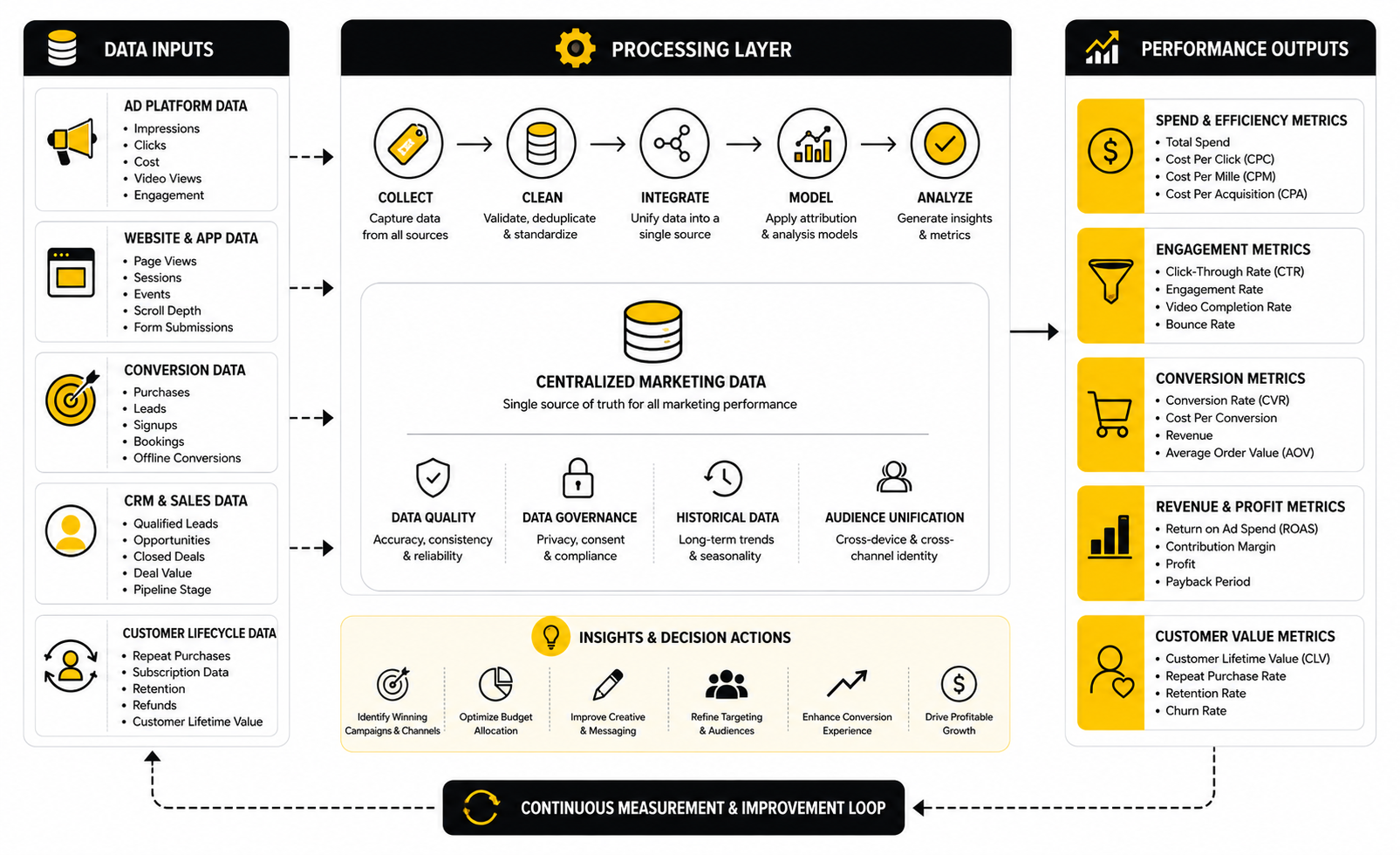
A practical measurement system has four layers:
These layers should not fight each other. They should explain each other. If the platform shows cheap clicks but analytics shows low engagement, the traffic may be poor. If analytics shows strong conversion but CRM data shows weak lead quality, the form may be too easy or the offer may be attracting the wrong people. If revenue looks strong but margin is weak, the campaign may be over-reliant on discounts or low-quality orders.
The Metrics That Actually Matter
The most useful metrics depend on the campaign goal, but some metrics deserve consistent attention. Cost per acquisition matters because it shows what it costs to create the desired action. Conversion rate matters because it reveals how well the offer and destination page turn attention into action. ROAS matters for ecommerce, but only when interpreted with margin and repeat purchase behavior. Customer lifetime value matters because it gives the team permission to spend more when the business model supports it.
For lead generation, cost per lead is only the beginning. You also need lead-to-appointment rate, show-up rate, close rate, sales cycle length, average contract value, and refund or churn risk. For ecommerce, you need add-to-cart rate, checkout completion rate, average order value, first-order margin, repeat purchase rate, and payback period. For subscription or SaaS, you need trial-to-paid conversion, activation rate, churn, expansion revenue, and CAC payback.
This is why digital media advertising should be measured as a chain, not a single event. Each stage tells you where money is being created or lost. When you see the full chain, optimization becomes more precise because you can fix the actual bottleneck instead of guessing.
Read CPC, CTR, And CPM The Right Way
CPC, CTR, and CPM are useful early indicators, but they are often misunderstood. A low CPC can mean efficient traffic, but it can also mean low-quality curiosity clicks. A high CTR can mean strong creative, but it can also mean clickbait if people bounce after landing. A low CPM can mean cheap reach, but it may also mean low-value inventory or a weak audience match.
The right move is to interpret these metrics together. If CPM is rising but conversion quality improves, the campaign may still be moving in the right direction. If CTR improves but qualified leads fall, the creative may be attracting the wrong people. If CPC rises while revenue per visitor rises faster, the campaign may be getting more expensive and more profitable at the same time.
This is where many advertisers make bad cuts. They pause campaigns because one efficiency metric got worse, even though the business outcome improved. The goal is not to buy the cheapest media. The goal is to buy media that creates profitable customer action.
Treat ROAS With Respect, But Do Not Worship It
ROAS is popular because it is simple. Spend one dollar, get several dollars back. That makes it useful for fast ecommerce reporting and budget conversations, but it can become misleading when it is treated as the only truth.
A high ROAS campaign may be capturing customers who would have bought anyway, especially in branded search, retargeting, or warm audience campaigns. A lower ROAS prospecting campaign may be creating new demand that later converts through another channel. A campaign with weaker first-purchase ROAS may still be valuable if those customers reorder, subscribe, refer others, or buy higher-margin products later.
The better approach is to use ROAS alongside contribution margin, new-customer rate, incrementality, blended CAC, and payback period. That gives the team a more honest view of performance. Digital media advertising should not just chase the cleanest-looking dashboard number; it should support the growth model of the business.
Understand Attribution Limits
Attribution is useful, but it is not reality. It is a model that assigns credit based on rules, tracking availability, platform assumptions, and user consent. That means attribution can guide decisions, but it should not be treated like a perfect recording of customer behavior.
This matters more as privacy changes reduce signal quality across browsers, devices, platforms, and apps. Research on privacy-preserving ad conversion measurement has shown the complex tradeoff between attribution and privacy in modern advertising systems, especially when conversion reporting needs mathematical privacy protections. The practical point is simple: the cleaner your first-party data and conversion setup, the better your decision-making will be.
A good measurement approach uses multiple views. Platform attribution helps optimize within platforms. Web analytics helps compare traffic and behavior. CRM or ecommerce data shows what actually happened after the conversion. Incrementality tests, geo tests, holdouts, and marketing mix modeling can help answer whether the media caused growth, not just whether it claimed credit.
Use Incrementality To Check The Real Lift
Incrementality asks a better question than attribution: what happened because of the advertising that would not have happened otherwise? That question is harder to answer, but it is much closer to the truth. It matters especially for retargeting, branded search, existing customer campaigns, and channels where platform-reported conversions can look stronger than the real business lift.
Not every business needs advanced testing immediately. Smaller teams can start with simple holdout tests, regional comparisons, time-based tests, or separating new-customer acquisition from existing-customer remarketing. Larger teams can use more structured experiments, media mix modeling, and clean room analysis where appropriate.
The action is to build incrementality thinking into budget reviews. If a campaign looks great in-platform but does not move total revenue, pipeline, or new-customer volume, investigate before scaling. If a campaign looks weaker in last-click reporting but consistently lifts blended business results, do not cut it too quickly.
Watch Frequency And Creative Fatigue
Frequency tells you how often the same people are seeing your ads. It is not automatically good or bad. Some offers need repeated exposure because the buying decision takes time. Other campaigns fatigue quickly because the audience is small, the creative is too narrow, or the message loses novelty.
Creative fatigue usually shows up as rising CPMs, falling CTR, weaker conversion rates, lower engagement quality, or declining revenue per visitor. The mistake is assuming the platform suddenly stopped working. Often, the market has simply seen the same angle too many times.
The fix is not always a new campaign structure. Sometimes it is a new hook, new proof, new format, new offer framing, new landing page section, or new audience segment. A strong creative pipeline is part of measurement because performance data should tell the team which angles to refresh next.
Connect Analytics To Action
The final test of measurement is whether it changes what the team does next. Reporting that only describes the past is not enough. Good analytics should make the next decision clearer.
A useful weekly review should answer five questions:
This keeps the team focused on action instead of drowning in charts. Digital media advertising improves when data becomes a decision tool, not a performance theater. The point is not to produce a prettier report. The point is to spend the next dollar better than the last one.
Advanced Strategy, Tradeoffs, And Risk Control
At a basic level, digital media advertising is about reaching people and driving action. At an advanced level, it is about managing tradeoffs. You are balancing short-term sales against long-term brand demand, automation against control, scale against quality, privacy against personalization, and channel expansion against operational complexity.
This is where experienced teams separate themselves. They do not just ask, “Did the campaign work?” They ask what kind of growth the campaign created, how durable that growth is, what risks came with it, and whether the business can repeat the result without relying on lucky timing or one platform’s algorithm. That is a much higher standard, and it is the standard worth aiming for.
The goal is not to make digital media advertising complicated for the sake of it. The goal is to make better decisions when the simple answers are not enough anymore. Once budgets grow, small strategic mistakes become expensive fast.
Balance Brand And Performance
The easiest trap in digital media advertising is over-optimizing for the fastest measurable conversion. Performance campaigns are attractive because they show numbers quickly. You can see clicks, leads, purchases, and ROAS in near real time. That speed is useful, but it can also pull the whole strategy toward bottom-funnel activity.
Brand-building works differently. It creates familiarity, trust, preference, and future demand that may not convert today. The challenge is that brand effects are harder to attribute to a single click, especially when people see an ad, remember it later, search for the brand, read reviews, and buy through another path. If the team only values what is immediately trackable, it can underfund the work that makes future performance cheaper.
The practical move is to give brand and performance different jobs. Performance campaigns should prove efficiency and convert demand. Brand and upper-funnel campaigns should increase qualified reach, improve memory, strengthen positioning, and make the market more likely to choose you later. A mature strategy needs both because demand capture gets harder when nobody is creating demand in the first place.
Avoid Platform Dependency
Platform dependency happens when too much revenue relies on one ad account, one algorithm, one audience source, or one tracking method. It feels efficient when things are working. Then a policy change, account restriction, auction shift, creative fatigue, privacy update, or new competitor can expose how fragile the system really is.
This does not mean every business needs to advertise everywhere. Spreading a small budget across too many channels can weaken learning and slow down results. The more carefully approach is staged diversification. Win one or two channels first, then expand into adjacent channels when the offer, creative system, tracking, and follow-up process can support the next layer.
Diversification should also include owned and first-party assets. Email lists, customer data, CRM records, community, organic content, direct traffic, search demand, and referral systems reduce the pressure on paid media. Paid ads can scale the engine, but the business should not become helpless without them.
Build Around First-Party Data
First-party data is becoming more important because rented targeting signals are less stable than they used to be. Browser controls, app tracking limits, consent requirements, privacy regulation, and platform modeling all affect how much advertisers can know about users across the open web. Google’s Chrome guidance still encourages advertisers to test experiences where third-party cookies are blocked by user choice, which is a practical reminder that signal loss is now part of the environment.
First-party data does not mean collecting everything possible. It means collecting useful, permission-based data that improves the customer experience and campaign decision-making. This can include purchase history, lead source, form answers, product interest, lifecycle stage, content engagement, email behavior, appointment status, and customer value.
The action is simple but important: make data capture part of the customer journey. Use forms that qualify without creating unnecessary friction. Use CRM stages that reflect real sales progress. Use post-purchase data to understand customer quality. If the business owns better data, digital media advertising becomes less dependent on whatever a platform can infer from partial signals.
Treat AI As Leverage, Not Magic
AI is changing campaign planning, media buying, creative production, audience modeling, and reporting. IAB’s 2025 State of Data work described AI as moving across the media campaign lifecycle, while IAB Europe’s 2025 research focused on how AI is being adopted and governed across the digital advertising ecosystem. The direction is obvious: more campaign work will become automated, assisted, or model-driven.
That creates leverage, but it does not remove responsibility. AI can generate creative variations, summarize reports, suggest audience patterns, write hooks, classify leads, and speed up analysis. But it can also amplify weak positioning, repeat generic messaging, misread data, or optimize toward a platform goal that is not the same as the business goal.
The right mindset is control plus speed. Let AI help with volume, pattern recognition, production, and workflow. Keep humans responsible for strategy, claims, compliance, brand voice, customer insight, and final interpretation. In other words, use AI to move faster without surrendering judgment.
Manage Creative Risk As You Scale
Creative is not just a performance lever. It is a brand risk area. As teams produce more ads faster, especially with AI-assisted workflows, the chance of off-brand claims, inconsistent messaging, weak proof, or compliance issues increases. That risk becomes bigger when campaigns run across multiple markets, platforms, creators, agencies, or franchise locations.
The solution is not to slow everything down with endless approvals. The solution is to create clear creative guardrails. Teams should define approved claims, banned claims, proof requirements, tone boundaries, visual rules, offer language, legal disclaimers, and escalation rules for sensitive categories. This lets marketers move quickly without turning the brand into a mess.
Creative governance also improves performance. When everyone understands the positioning, the testing gets cleaner. Instead of random variations, the team creates controlled creative experiments around real customer angles. That makes the learning more useful and easier to scale.
Think In Portfolios, Not Isolated Campaigns
A single campaign rarely explains the whole growth picture. One campaign may introduce the brand. Another may retarget visitors. Another may capture search demand. Another may reactivate past buyers. Another may support a product launch. Looking at each one in isolation can lead to bad decisions because the campaigns influence each other.
A portfolio view asks how the whole media system works together. Are prospecting campaigns creating enough new demand? Are remarketing campaigns taking too much credit for people who were already likely to buy? Are branded search campaigns protecting demand or simply harvesting what other channels created? Are retention campaigns improving customer value enough to justify more acquisition spend?
This is also where budget allocation becomes strategic. A mature team does not only move money toward the highest in-platform ROAS. It funds the mix that creates the strongest blended business result. Sometimes that means spending more on channels that look weaker in last-click reporting because they help the entire system grow.
Understand Retail Media And Commerce Media Carefully
Retail media has become one of the biggest shifts in digital media advertising because retailers control valuable shopping data and purchase environments. U.S. retail media spending is projected to rise from $58.79 billion in 2025 to $69.33 billion in 2026, which shows how much budget is moving toward commerce-connected inventory. That growth makes sense because advertisers want media closer to the transaction.
But retail media is not automatically efficient. Some campaigns may capture existing demand inside a retailer’s ecosystem rather than create truly incremental sales. Measurement standards can vary across networks. Inventory quality, reporting windows, attribution logic, and closed-platform data can make comparisons difficult. The channel has huge potential, but it needs scrutiny.
The practical approach is to separate sales capture from brand growth. Use retail media to defend shelf presence, support product launches, influence high-intent shoppers, and measure commerce outcomes. But do not assume every reported sale is incremental. Test, compare, and look for lift beyond what would likely have happened anyway.
Use Connected TV And Video With Realistic Expectations
Connected TV and digital video can be powerful because they combine sight, sound, motion, targeting, and expanding programmatic access. They are useful for reach, brand memory, product education, and full-funnel storytelling. IAB’s 2025 outlook highlighted double-digit growth expectations for retail media, CTV, and social, showing that advertisers continue to move budget into video-led digital formats.
The measurement challenge is that video often influences behavior before the final conversion path. Someone may see a CTV ad, search later, visit the site directly, or convert after seeing a different retargeting ad. If the team expects every video impression to behave like a search click, the channel will look disappointing even when it is doing valuable work.
The right way to use video is to define its job before launch. Is it building reach in a target market? Improving branded search demand? Supporting a launch? Educating cold audiences? Increasing retargeting pool quality? When the job is clear, the measurement becomes more honest.
Make Creator And Influencer Media Accountable
Creator media can give brands reach, trust, and cultural relevance that traditional ads struggle to earn. It can also waste money quickly when brands pay for audience size without understanding audience fit, content quality, usage rights, tracking, or distribution plans. The channel needs the same discipline as any other media investment.
The most valuable creator partnerships usually connect three things: audience relevance, message credibility, and distribution. A creator who understands the customer’s problem can explain the offer in a way that feels natural. But the brand still needs clear briefs, compliant claims, trackable links, paid usage rights, and a plan for repurposing strong content across paid channels.
Creator content should not be treated as a one-off post and forgotten. Strong assets can become paid social ads, landing page proof, email content, product page material, and retargeting creative. That is where creator media becomes more than influencer spend. It becomes part of the broader digital media advertising asset system.
Prepare For Compliance And Regulatory Pressure
Digital advertising sits inside a growing web of privacy, consumer protection, platform, and industry rules. This matters for consent, targeting, data storage, sensitive categories, testimonials, disclosures, claims, financial products, health-related offers, children’s advertising, and AI-generated content. The more aggressive the campaign, the more important compliance becomes.
The danger is not only legal risk. Compliance problems can also lead to rejected ads, disabled accounts, broken funnels, lost data access, payment issues, and brand damage. A campaign that cannot stay live is not scalable, no matter how good the creative looks.
Teams should build compliance into the workflow instead of treating it as a final check. Claims should be supported before ads are written. Testimonials should be used carefully. Landing pages should match platform policies. Data collection should be transparent. This is not bureaucracy; it is risk control.
Know When Complexity Is Worth It
Advanced digital media advertising can involve clean rooms, server-side tracking, conversion APIs, media mix modeling, incrementality tests, creative automation, data warehouses, customer data platforms, and multi-touch reporting. These can be valuable, but not every business needs all of them at once. Complexity has a cost.
The question is whether the added complexity improves decisions enough to justify the effort. A business spending a few thousand per month may get more value from better offers, cleaner tracking, and stronger creative. A business spending millions may need advanced measurement, experimentation, and governance because small percentage improvements can be worth a lot of money.
The best teams scale sophistication with spend and risk. They do not buy enterprise systems to avoid fixing basic strategy. They also do not run large budgets on messy data and gut feeling. The level of sophistication should match the size of the opportunity and the cost of being wrong.
Build A Learning Advantage
The strongest long-term advantage in digital media advertising is not one winning ad. Winning ads fatigue. Channels mature. Competitors copy. Costs rise. What lasts longer is the ability to learn faster and apply that learning across the business.
That learning should flow from campaigns into product, sales, content, landing pages, customer support, and positioning. If ads reveal that one pain point consistently gets attention, that insight can shape the homepage. If leads keep asking the same objection, that objection belongs in the creative and sales process. If one customer segment produces better retention, the acquisition strategy should shift toward that segment.
This is the part many businesses miss. Paid media is not just a traffic source. It is a feedback machine. When the team uses that feedback well, every campaign makes the next campaign more carefully.
A complete digital media advertising system is not just a set of campaigns. It is an ecosystem where strategy, creative, media, analytics, sales, lifecycle marketing, and operations all support the same growth objective. When those pieces are connected, the business can spend with more confidence because every part of the system has a job.
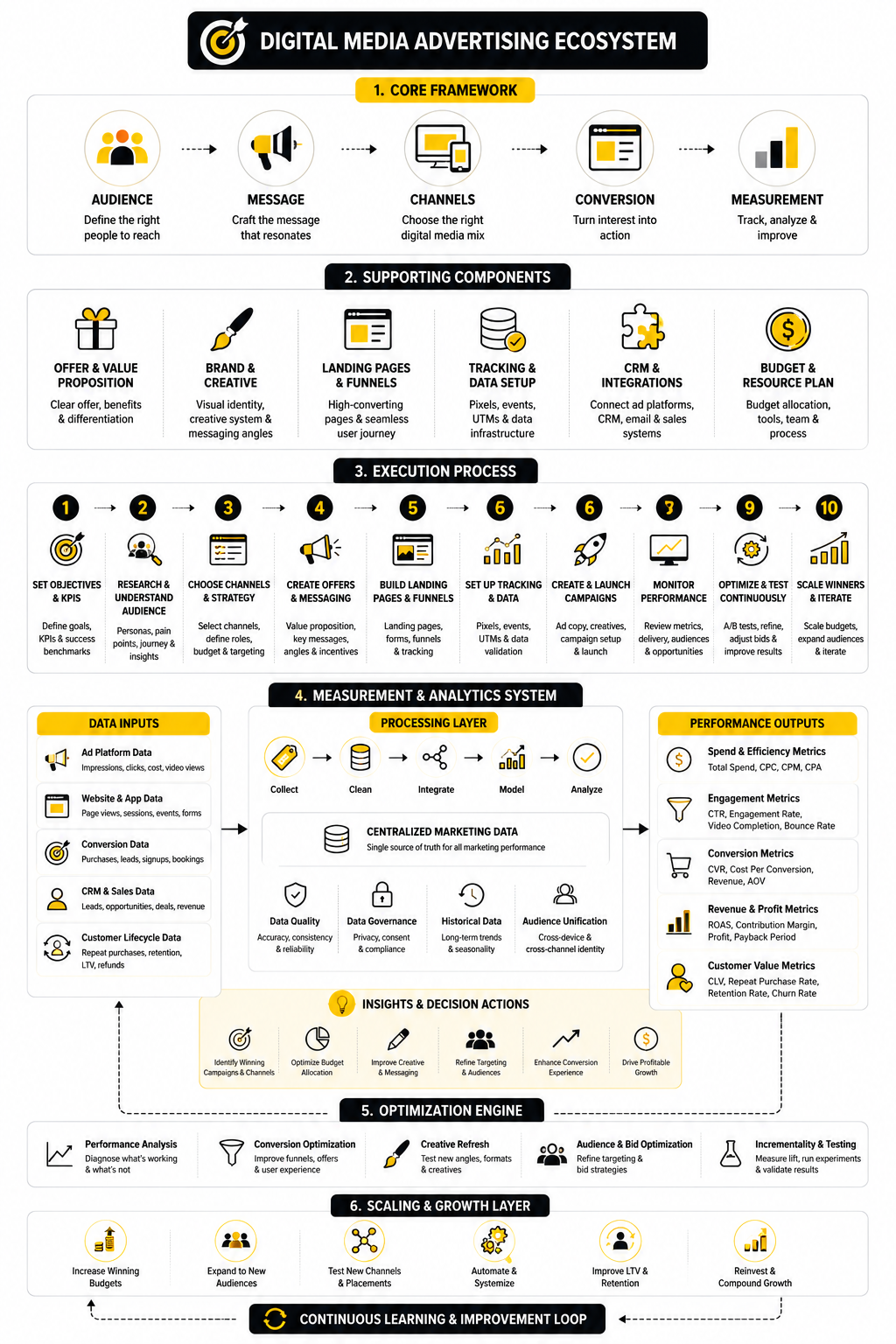
The final step is to simplify the whole topic into practical answers. These questions cover the decisions most teams face when they move from learning about digital media advertising to actually using it. The details will vary by business, but the principles are stable.
What Is Digital Media Advertising?
Digital media advertising is the practice of using paid digital channels to reach, influence, and convert target audiences. It can include search ads, social ads, display, online video, connected TV, retail media, creator partnerships, programmatic buying, native advertising, app campaigns, and other paid placements across digital environments. The common thread is that the advertiser pays to place a message in front of a defined audience or context.
The best way to understand it is as a system, not a single tactic. The ad creates attention, the offer creates interest, the landing page or sales path creates action, and the measurement setup tells the team what happened. When all of those parts work together, digital media advertising becomes much more predictable.
Why Is Digital Media Advertising Important?
Digital media advertising matters because people research, compare, discover, and buy through digital journeys every day. Even when a purchase happens offline, the decision is often shaped by search results, social proof, creator content, video, reviews, retargeting, and brand exposure. Paid digital channels let businesses show up during those moments instead of waiting to be found.
It also matters because marketing budgets are increasingly digital-first. Gartner reported that digital channels account for 61.1% of total marketing spend, which shows how central digital media has become to modern marketing plans. The opportunity is huge, but so is the competition, so execution quality matters.
Which Channels Are Included In Digital Media Advertising?
The main channels include paid search, paid social, display advertising, online video, connected TV, retail media, native ads, programmatic advertising, app install campaigns, influencer or creator media, and sponsored content. Some channels are better at capturing demand, while others are better at creating demand. That distinction matters because each channel should be judged by the role it plays.
Paid search usually works well when people already know what they want. Paid social and video can introduce new ideas, build desire, and test creative angles. Retail media is closer to the shopping moment, while creator media can add trust and cultural relevance. A good media plan does not treat every channel the same.
How Much Should A Business Spend On Digital Media Advertising?
There is no universal budget because spend depends on the business model, margins, audience size, sales cycle, competition, and growth goals. A small business may start with a focused test budget on one or two channels. A larger company may run a portfolio across search, social, video, retail media, remarketing, and lifecycle campaigns.
The more carefully question is not “How much should we spend?” It is “How much can we spend while learning safely and protecting unit economics?” Start with enough budget to generate useful signal, then increase spend when the offer converts, tracking is reliable, creative has proven patterns, and the customer economics support scaling. Budget should follow evidence, not excitement.
What Metrics Matter Most?
The most important metrics depend on the campaign goal. For ecommerce, the team should look at conversion rate, cost per acquisition, revenue, contribution margin, average order value, repeat purchase behavior, ROAS, and payback period. For lead generation, the team should look beyond cost per lead and track qualified lead rate, appointment rate, show-up rate, close rate, deal value, and customer quality.
Early indicators like CTR, CPC, CPM, and landing page conversion rate are useful for diagnosing problems. Final outcomes like revenue, profit, pipeline, retention, and lifetime value are what decide whether the campaign is truly working. The best teams connect both levels instead of obsessing over one dashboard number.
What Is A Good ROAS?
A good ROAS depends on margin, repeat purchases, operating costs, and growth strategy. A 3x ROAS might be excellent for one business and unprofitable for another. If margins are low, shipping is expensive, or refunds are high, the business may need a much higher ROAS to make the campaign work.
ROAS also needs context. Retargeting and branded search often show stronger ROAS because they reach people already close to buying. Prospecting campaigns may show weaker first-click ROAS while still creating valuable new demand. A serious media team looks at ROAS alongside margin, incrementality, new-customer rate, and payback period.
How Long Should A Campaign Run Before Making Decisions?
A campaign should run long enough to collect meaningful data, but not so long that obvious waste continues unchecked. The right window depends on traffic volume, conversion volume, budget, sales cycle, and the decision being made. A low-ticket ecommerce campaign may generate enough signal quickly, while a high-ticket B2B campaign may need weeks or months to understand lead quality and pipeline impact.
The key is to define decision rules before launch. Decide what metric matters, how much data is needed, and what action will happen if the result is strong, weak, or unclear. This prevents emotional decisions based on one good day or one bad day.
Why Do Digital Ads Stop Working Over Time?
Digital ads often stop working because of creative fatigue, audience saturation, rising competition, offer decay, tracking changes, or auction pressure. People may have seen the same message too many times, or competitors may be bidding more aggressively for the same audience. Sometimes the campaign is not broken; the market has simply moved past the original angle.
The solution is to build a creative pipeline and testing rhythm before performance drops. Refresh hooks, proof, visuals, formats, landing page sections, and offer framing. Strong digital media advertising depends on constant learning, not one permanent winning ad.
Should AI Be Used In Digital Media Advertising?
AI can be useful for creative ideation, reporting summaries, audience analysis, bid optimization, workflow automation, and performance pattern detection. IAB’s 2025 State of Data report described AI as affecting audience segmentation, media buying, optimization, and performance measurement, so the direction is clear. Teams that use AI well can often move faster.
But AI should not replace strategy. It cannot fully understand positioning, customer nuance, brand risk, margin reality, or long-term business tradeoffs without human direction. Use AI for speed and scale, but keep humans responsible for judgment.
How Does Privacy Affect Digital Media Advertising?
Privacy affects targeting, tracking, attribution, remarketing, reporting, and data sharing. Browser controls, app tracking limits, cookie restrictions, consent requirements, and privacy regulation all reduce the amount of user-level signal advertisers can rely on. This makes first-party data, clean conversion tracking, and strong measurement design more important.
The practical move is to collect useful permission-based data and connect it to the business process. Better forms, CRM hygiene, lifecycle tracking, customer lists, offline conversion imports, and server-side measurement can all improve decision quality. Privacy is not just a legal topic; it directly affects campaign performance.
What Is The Difference Between Attribution And Incrementality?
Attribution assigns credit for a conversion based on a model. That model may use last click, first click, data-driven rules, platform logic, or another reporting method. It is useful, but it is not perfect because it depends on available tracking and assumptions.
Incrementality asks whether the advertising created results that would not have happened otherwise. That is the more important business question. A campaign can claim conversions without creating much incremental lift, especially in retargeting or branded search. Mature teams use attribution for optimization and incrementality for bigger budget decisions.
How Should Small Businesses Start?
Small businesses should start narrow. Pick one clear offer, one primary audience, one or two channels, one conversion path, and a simple measurement setup. The first goal is not to build a complex media machine; it is to learn what message, offer, and audience combination creates real business value.
For service businesses, that might mean search ads or paid social leading to a booking page, then fast follow-up through a CRM. For ecommerce, it might mean testing a small set of product-focused creative angles and a dedicated landing page. Keep the system simple until the numbers justify more complexity.
When Should A Business Hire Help?
A business should consider hiring help when ad spend is high enough that mistakes are expensive, when tracking is unreliable, when creative testing has stalled, or when the team lacks channel expertise. It also makes sense when campaigns are generating leads or sales but the business cannot diagnose where performance is leaking. Expert help is most valuable when there is already enough activity to improve.
Hiring help too early can create dependency if the business has not defined its offer, customer, or sales process. Hiring too late can waste months of budget. The right moment is usually when the business has a clear goal, a real offer, and enough budget to test properly, but needs sharper execution to scale.
What Is The Biggest Mistake In Digital Media Advertising?
The biggest mistake is treating ads as the whole system. Ads are only one part of the journey. If the offer is weak, the landing page is confusing, follow-up is slow, tracking is broken, or the sales process is poor, the campaign will struggle even with good media buying.
The second major mistake is optimizing for platform metrics instead of business outcomes. A campaign can look good inside an ad account and still fail commercially. The real standard is profitable growth, qualified demand, and learning that makes the next decision better.
What Should The Final Digital Media Advertising System Include?
A complete system should include clear objectives, audience strategy, channel roles, creative testing, conversion paths, tracking, reporting, governance, follow-up, and budget decision rules. It should also include a learning process so every campaign improves the next one. Without that, the business keeps starting from zero.
The system does not need to be complicated at the beginning. It needs to be coherent. Start with the essentials, measure honestly, fix bottlenecks, and add sophistication only when it improves decisions. That is how digital media advertising becomes a durable growth channel instead of a constant guessing game.
Build a stronger local presence with BAAM AI
Turn your website, Google profile, social channels, and AI visibility into one growth engine
Most businesses do not need more random marketing activity. They need a consistent presence system that helps the right people find them, trust them, and take action. BAAM AI brings strategy, local SEO, website updates, Google Maps visibility, social content, AI-search readiness, media production, and reporting into one practical monthly engine.
If you want your marketing to keep working after the campaign ends, start with a free BAAM AI presence audit. See how your business shows up today and where the fastest visibility wins are at BAAM AI.