
BAAM AI Blog
Digital Marketing Subjects: The Practical Map For Building Skills That Actually Drive Growth
Digital marketing subjects are not just a list of channels like SEO, email, social media, ads, and analytics. That is the beginner mistake. The real value is understanding how these subjects work together as one...
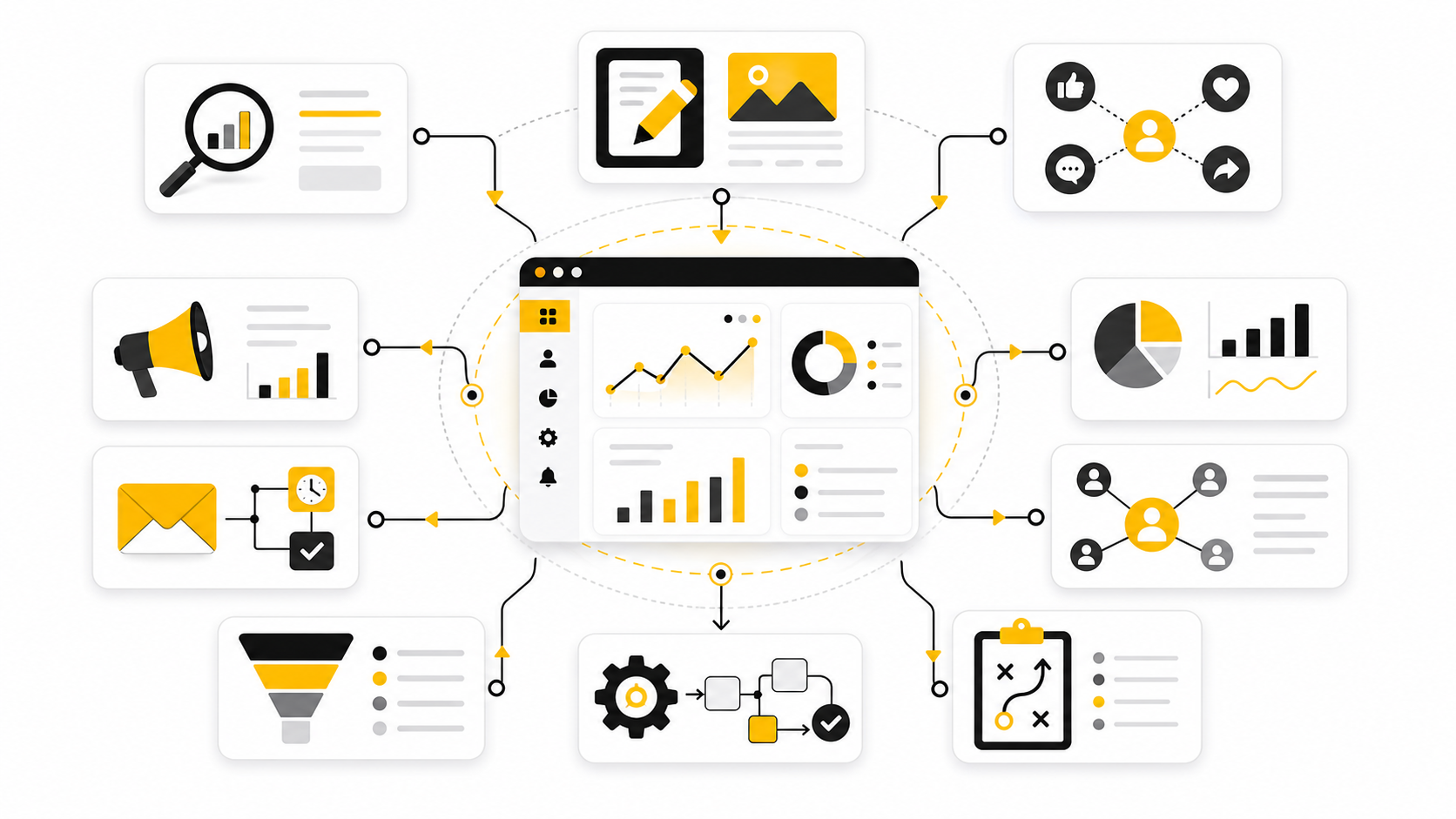
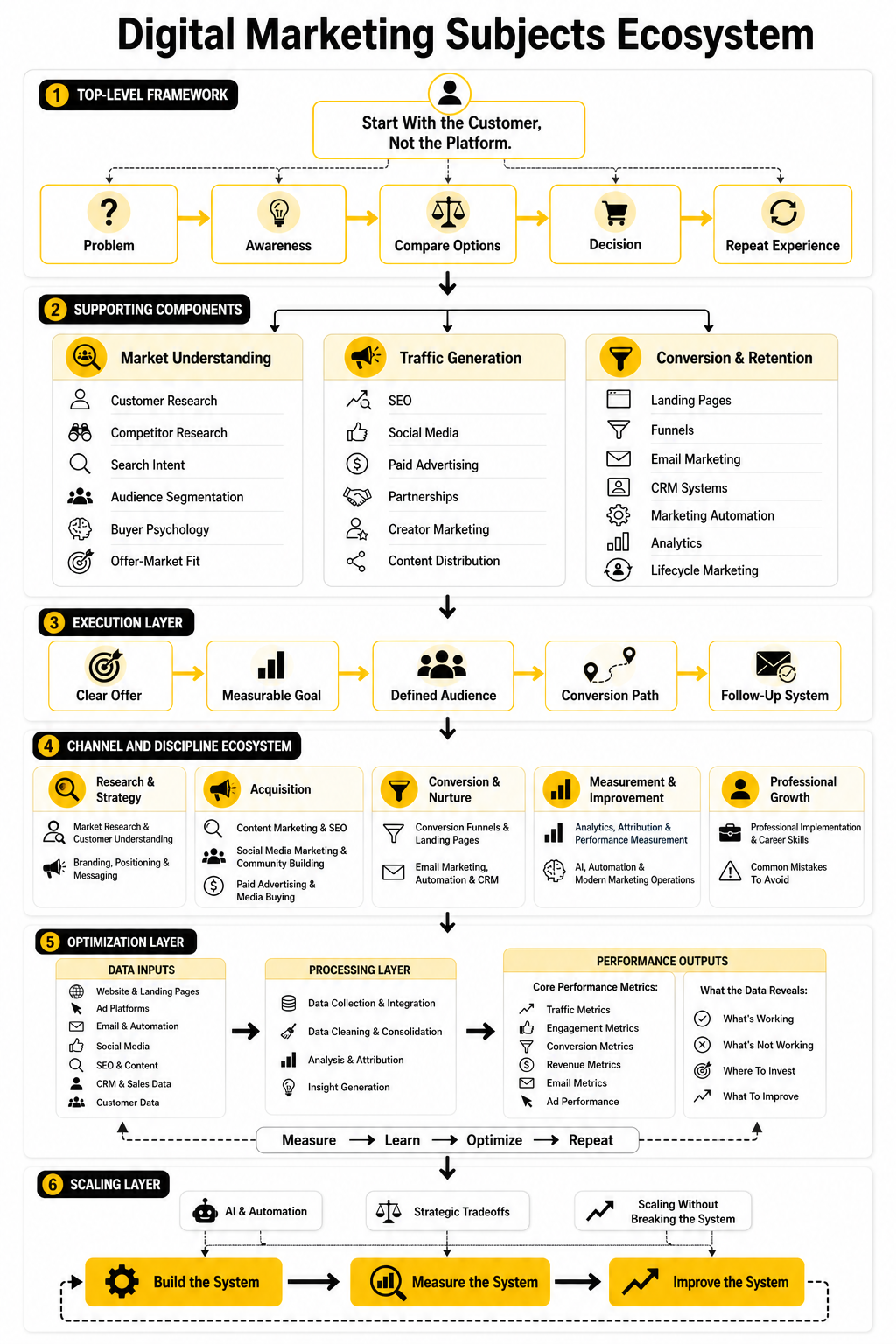
Digital marketing subjects are not just a list of channels like SEO, email, social media, ads, and analytics. That is the beginner mistake. The real value is understanding how these subjects work together as one system: attention, trust, conversion, retention, and measurement.
That matters because marketing has become more fragmented, more automated, and more accountable at the same time. U.S. internet advertising revenue reached nearly $294.6 billion in 2025, while Gartner reported that digital channels represented 61.1% of total marketing spend in 2025. In plain English: businesses are putting serious money into digital, but they need people who can connect the subjects instead of treating every channel like a separate task.
this guide breaks digital marketing subjects into a practical learning path. You will see what each subject does, where it fits in a real marketing system, and how professionals use these skills to create measurable business outcomes. The goal is not to memorize definitions. The goal is to understand the work well enough to plan, build, improve, and explain a digital marketing strategy with confidence.
Why Digital Marketing Subjects Matter
Digital marketing subjects matter because modern buyers rarely move in a straight line. Someone may discover a brand through a short video, compare it through search, read reviews, join an email list, leave the website, return through a retargeting ad, and finally buy after seeing a stronger offer. If you only understand one channel, you only understand one piece of that journey.
The market also expects marketers to be more commercially useful than ever. Gartner’s 2025 CMO Spend Survey found that marketing budgets stayed flat at 7.7% of company revenue, which means teams are being pushed to do more without endlessly increasing spend. That makes the fundamentals more important, not less important, because weak strategy gets expensive fast.
The other reason this matters is AI. Salesforce’s latest State of Marketing research is built around AI, data, and personalization, based on insights from nearly 4,500 marketers worldwide. But AI does not replace marketing judgment. It makes good judgment more scalable and bad judgment more dangerous.
The Digital Marketing Framework
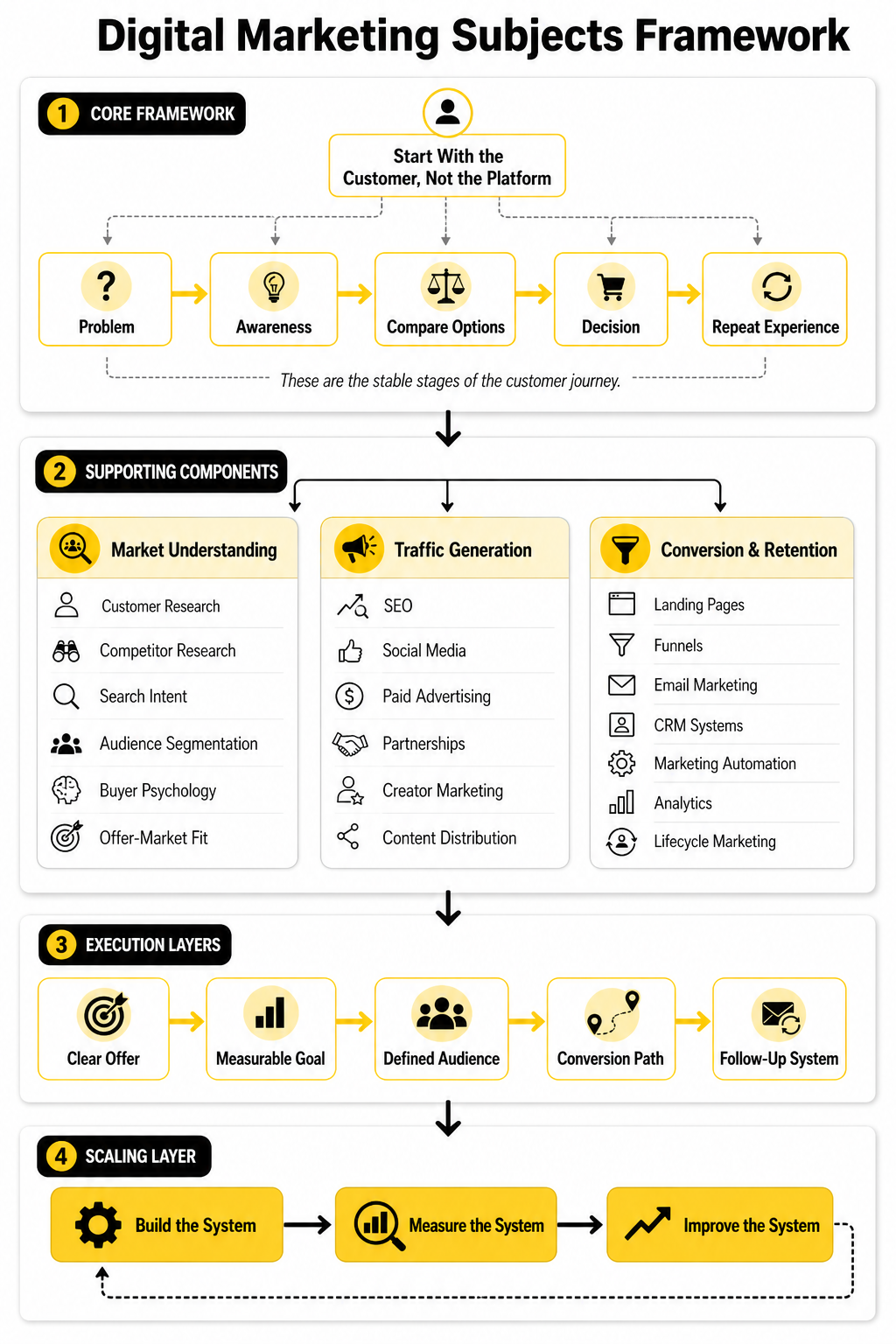
A useful framework for digital marketing starts with the customer, not the platform. Platforms change, algorithms shift, ad costs move, and tools come and go. The customer’s core journey is more stable: they have a problem, they become aware of possible solutions, they compare options, they make a decision, and they decide whether the experience was worth repeating.
That is why the main digital marketing subjects should be grouped by function. Research helps you understand the market. Brand and messaging help you explain why your offer is different. Content, SEO, social media, paid ads, email, automation, landing pages, and analytics each support a different part of the journey.
The best marketers do not ask, “Which platform should I post on today?” They ask, “Where is the bottleneck in the customer journey?” If people do not know you exist, the bottleneck is awareness. If people visit but do not buy, the bottleneck may be trust, offer clarity, landing page quality, or follow-up.
Core Components Of Digital Marketing Subjects
The first core component is market understanding. This includes customer research, competitor research, search intent, audience segmentation, buyer psychology, and offer-market fit. Without this subject, every other marketing activity becomes guesswork dressed up as execution.
The second core component is traffic generation. This includes SEO, social media, paid advertising, partnerships, creator marketing, and content distribution. These subjects help you earn or buy attention, but attention alone is not enough unless it moves the right people toward the right next step.
The third core component is conversion and retention. This includes landing pages, funnels, email marketing, CRM systems, marketing automation, analytics, and lifecycle marketing. Tools like GoHighLevel, ClickFunnels, and Systeme.io fit here when a business needs a practical way to manage leads, pages, follow-up, and sales workflows.
Professional Implementation
Professional implementation is where digital marketing subjects stop being theory. A beginner may learn SEO, email, and paid ads as separate topics. A professional connects them into a campaign with a clear offer, a measurable goal, a defined audience, a conversion path, and a follow-up system.
This is also where measurement becomes non-negotiable. DataReportal’s Digital 2025 advertising analysis reported that global ad spend was close to $1.1 trillion in 2024, with digital responsible for much of the growth since 2019. When that much money moves through digital channels, businesses need marketers who can explain what is working, what is wasting budget, and what should happen next.
The professional mindset is simple: build the system, measure the system, improve the system. That does not mean every campaign will win immediately. It means every campaign should teach you something useful enough to make the next decision sharper.
Market Research And Customer Understanding
Market research is the first serious subject in digital marketing because every campaign depends on the quality of the assumptions behind it. You need to know who the buyer is, what they already believe, what they are comparing, what language they use, and what would make them hesitate. Without that, you are not doing strategy; you are decorating guesses with content, ads, and automation.
The practical version starts with customer problems, not demographics. Age, location, income, and job title can help, but they rarely explain why someone clicks, subscribes, books a call, or buys. Strong research looks for buying triggers, objections, desired outcomes, frustrations with current alternatives, and the emotional gap between where the customer is now and where they want to be.
This matters even more because online behavior keeps spreading across more touchpoints. DataReportal’s 2026 global overview found that more than 6 billion people now use the internet, and more than 1 billion people use AI tools every month. That means your audience is not simply “online.” They are searching, scrolling, watching, comparing, asking AI tools, checking communities, reading reviews, and moving between channels quickly.
Search Intent And Buyer Intent
Search intent is one of the most useful digital marketing subjects because it shows what someone wants in the moment. A person searching “what is email marketing” needs education. A person searching “best email marketing software for ecommerce” is comparing options. A person searching “Brevo pricing” is much closer to a buying decision.
This is why keyword research should not be treated as a spreadsheet exercise. The keyword is only the surface. The real work is understanding whether the person wants information, comparison, validation, a tutorial, a product, or a shortcut to a decision.
For digital marketing subjects, this distinction is huge. Someone studying the field may need a learning roadmap, while a business owner may need to know which subject to prioritize first. The same keyword can attract different readers, so the content has to serve the strongest intent without becoming vague.
Audience Segmentation
Audience segmentation means grouping people by meaningful differences in needs, behavior, urgency, or value. It is not about creating cute personas that nobody uses after the strategy meeting. It is about making better decisions around messaging, offers, channels, and follow-up.
A good segment should change what you do. If two customer groups need the same message, same offer, same content, same budget, and same sales process, they may not need to be separate segments. But if one group needs education while another needs proof, or one group buys quickly while another needs nurturing, segmentation becomes very useful.
This is where many marketers overcomplicate things. Start with simple differences that affect revenue: new versus returning customers, problem-aware versus solution-aware buyers, low-ticket versus high-ticket prospects, urgent buyers versus researchers, and self-serve buyers versus people who need a sales conversation. Those segments are practical because they immediately affect the marketing system.
Competitor And Category Research
Competitor research is not copying what other brands are doing. It is understanding the expectations your audience already has because of the market they are in. Every category teaches customers what to expect, what to distrust, what prices feel normal, and what proof they need before taking action.
Look at competitor websites, ads, landing pages, email sequences, social content, reviews, comparison pages, and customer complaints. The goal is to find patterns. What promises are overused? What objections keep showing up? What language sounds generic? What angle could you own more clearly?
This research helps you avoid sounding like everyone else. In a crowded market, being clear is good, but being clear and distinct is better. HubSpot’s 2026 marketing research emphasizes that brand point of view has become more important as AI increases the amount of generic content online, with marketers focusing more on trust, relevance, and distinctiveness.
Branding, Positioning, And Messaging
Branding is often misunderstood as colors, logos, and fonts. Those things matter, but they are not the core. In digital marketing, branding is the memory structure people build around your business: what you stand for, who you help, why you are different, and why someone should trust you.
Positioning makes that brand useful in the market. It defines where you fit compared with alternatives and why your offer is the right choice for a specific type of buyer. Good positioning makes marketing easier because it gives every page, post, ad, email, and sales conversation a sharper direction.
Messaging turns positioning into words people can understand quickly. It takes the strategy and makes it visible in headlines, offers, calls to action, product descriptions, ad hooks, email subject lines, and sales arguments. This is one of the most underrated digital marketing subjects because weak messaging makes every channel look worse than it really is.
Value Proposition
A value proposition explains the specific value someone gets from choosing you. It should answer three questions fast: who is this for, what outcome does it help them achieve, and why is it better or different from the alternatives? If a visitor has to work too hard to understand the value, the marketing is already leaking attention.
A strong value proposition is not just a slogan. “Grow faster” is not enough because almost every business wants that. “Book more qualified sales calls from your existing website traffic” is stronger because it names a clearer outcome and a more specific mechanism.
This matters across every channel. Paid ads need sharp value propositions because attention is expensive. SEO pages need them because visitors compare multiple results. Email campaigns need them because people ignore vague messages quickly.
Messaging Hierarchy
A messaging hierarchy organizes what you say from most important to least important. The top message should be the clearest reason to care. Supporting messages should handle proof, objections, use cases, features, and urgency.
This keeps marketing from becoming a pile of disconnected claims. Without a hierarchy, a landing page might talk about speed, affordability, automation, customer support, integrations, and analytics with no clear priority. The reader gets information, but not direction.
A simple hierarchy usually works best. Lead with the main outcome, support it with the key mechanism, prove it with evidence, answer the biggest objection, and give the next step. That structure can work for homepages, product pages, sales pages, email sequences, and ads.
Brand Trust And Proof
Trust is now a core marketing asset because buyers are exposed to more claims than they can reasonably verify. Reviews, testimonials, case studies, transparent pricing, comparison content, founder credibility, guarantees, and clear policies all help reduce perceived risk. The point is not to overwhelm people with proof; the point is to give them the right proof at the right moment.
McKinsey’s 2025 consumer research highlights that modern consumers are shaped by changing trust patterns, value sensitivity, and shifting spending behavior across markets, based on surveys covering more than 25,000 consumers in 18 markets. That is not a small detail. When people are more selective, your marketing has to make the decision feel safer.
Proof should match the promise. If you promise speed, show time saved. If you promise revenue growth, show revenue-related evidence. If you promise simplicity, show the workflow clearly instead of hiding behind buzzwords.
Content Marketing And SEO
Content marketing and SEO are closely connected, but they are not the same subject. Content marketing is about creating useful material that attracts, educates, persuades, or retains an audience. SEO is about making content discoverable through search engines and, increasingly, search-like experiences in AI tools and answer engines.
The best content strategy starts with the customer journey. Early-stage content answers basic questions and builds trust. Middle-stage content compares options and explains trade-offs. Late-stage content supports buying decisions with proof, demos, pricing clarity, and objection handling.
For digital marketing subjects, content and SEO are especially important because they compound. A paid ad stops when the budget stops. A strong article, comparison page, tutorial, or resource can keep attracting qualified visitors for months or years when it is maintained properly. That does not make SEO free, but it can make it one of the most durable acquisition assets in the system.
Keyword Research
Keyword research helps you understand demand, language, and intent. It shows what people are actively trying to learn, solve, buy, or compare. But the mistake is treating keyword volume as the only signal that matters.
A low-volume keyword with strong buying intent can be more valuable than a high-volume keyword with weak intent. For example, “digital marketing subjects” may attract students, beginners, career switchers, and business owners who want a structured overview. The content should therefore explain the field clearly while also showing how the subjects connect to real implementation.
Good keyword research also looks at the search results themselves. If the top results are guides, the user probably wants education. If the top results are tools, pricing pages, and review sites, the user may be much closer to purchase. Search behavior tells you what format the market already expects.
Topical Authority
Topical authority means becoming meaningfully useful across a subject area, not publishing one isolated article and hoping it ranks. If your site covers digital marketing subjects, you would not stop at one overview. You would build supporting content around SEO, paid ads, email marketing, analytics, funnels, social media strategy, automation, AI tools, and campaign planning.
This approach helps both readers and search engines understand your expertise. Readers get a complete path instead of a dead end. Search engines get clearer signals that your site is not just mentioning a topic but covering it with depth.
The key is to avoid thin content. Ten shallow posts will not beat one well-structured resource supported by useful internal pages. Depth, clarity, and maintenance matter more than simply publishing more words.
Content Formats
Different content formats solve different problems. Articles and guides are strong for education and search. Short-form videos can create fast awareness and show personality. Webinars, demos, and comparison pages can help people make decisions when the offer is more complex.
The format should follow the job. If the audience needs to understand a process, a tutorial may work best. If they need confidence, a case study or product walkthrough may work better. If they need a quick reason to care, a short social post or video hook can open the door.
This is also where tools can help, but tools should not replace strategy. A social scheduling platform like Buffer can make content distribution easier, while a social planning tool like Flick Social can support hashtag research, scheduling, and content workflow. The tool is useful when the strategy is already clear; it will not fix weak positioning or boring content by itself.
Social Media Marketing And Community Building
Social media marketing is one of the most visible digital marketing subjects, but it is also one of the easiest to misunderstand. Posting more often is not the strategy. The real strategy is using social platforms to create familiarity, earn attention, test messaging, distribute content, build trust, and move the right people toward a stronger relationship with the brand.
That matters because social behavior is broad, messy, and platform-specific. DataReportal’s 2026 social media research shows that online adults now use an average of 6.75 different social media platforms each month. Nobody has a simple one-platform customer journey anymore, so the job is not to be everywhere; the job is to know where your audience pays attention and what kind of content they expect there.
The strongest social media strategies usually combine three things: reach, relationship, and response. Reach brings new people into the brand’s world. Relationship content gives them a reason to keep listening. Response systems turn interest into action through comments, direct messages, lead magnets, product pages, email capture, or sales conversations.
Platform Fit
Platform fit means choosing channels based on audience behavior and content strength, not personal preference. A B2B consultant may get more value from LinkedIn than TikTok because the context supports professional decision-making. A beauty brand, fitness creator, or lifestyle product may benefit more from visual platforms because the offer is easier to demonstrate through short-form video and social proof.
The right platform also depends on the content you can produce consistently. If you hate video and have no plan to improve, building the whole strategy around daily video will probably fail. If your team is strong at writing, visuals, webinars, or community management, the platform strategy should use those strengths instead of copying someone else’s playbook.
This is where marketers need discipline. Social platforms reward novelty, speed, and personality, but businesses still need clear positioning, offers, and measurement. A post that gets attention but attracts the wrong audience is not a win; it is just noise with better numbers.
Content Distribution
Content distribution is the part most people skip. They create one article, one video, or one lead magnet and hope the algorithm does the rest. That is weak implementation because a good idea should be repackaged, tested, and distributed across multiple useful touchpoints.
One strong guide can become several short posts, a newsletter section, a carousel, a short video script, a webinar talking point, and a sales enablement asset. This does not mean repeating the same thing mechanically. It means translating the same core idea into formats that fit different contexts.
Tools can make this easier when the workflow is already clear. A scheduling platform like Buffer can help organize publishing across channels, while Flick Social can support content planning and social workflow. The point is simple: if distribution is random, performance will be random too.
Community And Conversation
Community building is not just running a group or replying with emojis under posts. It is the discipline of creating ongoing interaction around a shared problem, identity, goal, or belief. In many markets, the community layer becomes a trust engine because people want to see how a brand behaves when it is not directly selling.
The best communities have clear expectations. Members know what the space is for, what kind of value they can expect, and how the brand participates. Without that clarity, communities turn into dead groups, support queues, or promotional dumping grounds.
Conversation is also where brands learn quickly. Comments, direct messages, poll responses, objections, and repeated questions reveal what people actually care about. That feedback should influence content, offers, landing pages, ads, and email sequences.
Paid Advertising And Media Buying
Paid advertising is the subject that forces clarity faster than almost anything else. When you pay for traffic, weak messaging, unclear offers, poor targeting, and bad landing pages become expensive very quickly. That is why paid media should never be treated as a magic traffic button.
The role of paid advertising is to buy attention from a defined audience and send that attention into a conversion path. That path may be a product page, a booking page, a webinar, a free trial, a lead magnet, a quiz, or a sales funnel. The ad is only one part of the system, and it cannot carry the whole business by itself.
Search advertising benchmarks from 2025 show why execution matters. WordStream’s 2025 Google Ads benchmark data reported an average cost per lead of $70.11 across industries, with wide variation by category. When leads cost real money, the rest of the funnel has to be strong enough to justify the spend.
Campaign Strategy
Campaign strategy starts with the business goal. Are you trying to generate leads, sell a product, book calls, fill a webinar, increase app installs, retarget warm visitors, or test a new offer? Different goals need different structures, budgets, creatives, landing pages, and success metrics.
A simple campaign plan should define the audience, offer, message angle, creative format, destination page, budget, tracking setup, and decision rules before launch. Decision rules matter because campaigns become emotional fast. If you do not know when to pause, scale, test, or rebuild, you will end up reacting to daily noise.
This is where many beginners get paid ads wrong. They obsess over targeting hacks before fixing the offer. In most cases, better positioning, a clearer promise, stronger proof, and a cleaner conversion path will do more than tiny audience tweaks.
Creative Testing
Creative testing is the practical process of finding which messages, visuals, hooks, and offers earn attention from the right people. It is not just testing colors or button text. It is testing the market’s response to different angles.
A useful test might compare pain-led messaging against outcome-led messaging. Another might test founder-led video against product demonstration. Another might test a direct offer against an educational lead magnet.
The key is to test meaningful differences. If every ad says the same thing with slightly different wording, you are not learning much. Strong testing creates information that can improve not only ads but also landing pages, email sequences, sales scripts, and content strategy.
Landing Page Alignment
Paid traffic needs landing page alignment. If the ad promises one thing and the page leads with something else, people feel friction immediately. That friction may not look dramatic in analytics, but it quietly lowers conversion rate and raises acquisition cost.
A good landing page continues the conversation started by the ad. The headline should match the promise, the proof should support the claim, the offer should be easy to understand, and the call to action should feel like the obvious next step. This is basic, but basic done well beats clever done badly.
For ecommerce teams that need fast landing page production, a tool like Replo can help build and test Shopify landing pages without turning every change into a developer bottleneck. For coaches, agencies, and service businesses, funnel builders like ClickFunnels or all-in-one platforms like GoHighLevel can be useful when the campaign needs pages, forms, follow-up, and CRM in one connected workflow.
Email Marketing, Automation, And CRM
Email marketing is still one of the most important digital marketing subjects because it gives businesses a direct relationship with people who have already shown interest. Social reach can change overnight. Ad costs can rise. Search rankings can move. But a healthy email list gives you a channel you can use repeatedly when you have earned permission properly.
Email is not just newsletters. It includes welcome sequences, lead nurture, product education, launch campaigns, abandoned cart flows, onboarding, customer retention, reactivation, and referral campaigns. The real power comes from sending the right message at the right stage instead of blasting everyone with the same promotion.
Litmus’s 2025 State of Email research found that many marketing leaders report strong returns from email, with a large share seeing between $10 and $36 returned for every $1 spent. That does not mean every email program automatically performs well. It means email rewards teams that understand segmentation, timing, relevance, copywriting, deliverability, and lifecycle strategy.
Lifecycle Email
Lifecycle email matches messages to the customer’s stage. A new subscriber needs orientation and trust. A product-aware lead needs proof and comparison support. A new customer needs onboarding. A past customer may need a reason to return.
This is more useful than thinking only in campaigns. Campaigns are temporary pushes. Lifecycle systems keep working in the background and improve the experience over time.
A basic lifecycle email system can include a welcome sequence, education sequence, offer sequence, post-purchase sequence, and reactivation sequence. That may sound simple, but simple systems often outperform complicated ones because they are easier to maintain and improve.
Automation Workflows
Automation workflows help marketers respond to behavior without manually chasing every lead. Someone downloads a guide, books a call, abandons a checkout, visits a pricing page, or clicks a specific email link. Each action can trigger a more relevant next step.
This is where digital marketing subjects start to connect. Research informs the message. Content creates the entry point. The form captures the lead. The CRM stores the data. Email and SMS follow up. Sales or checkout completes the conversion.
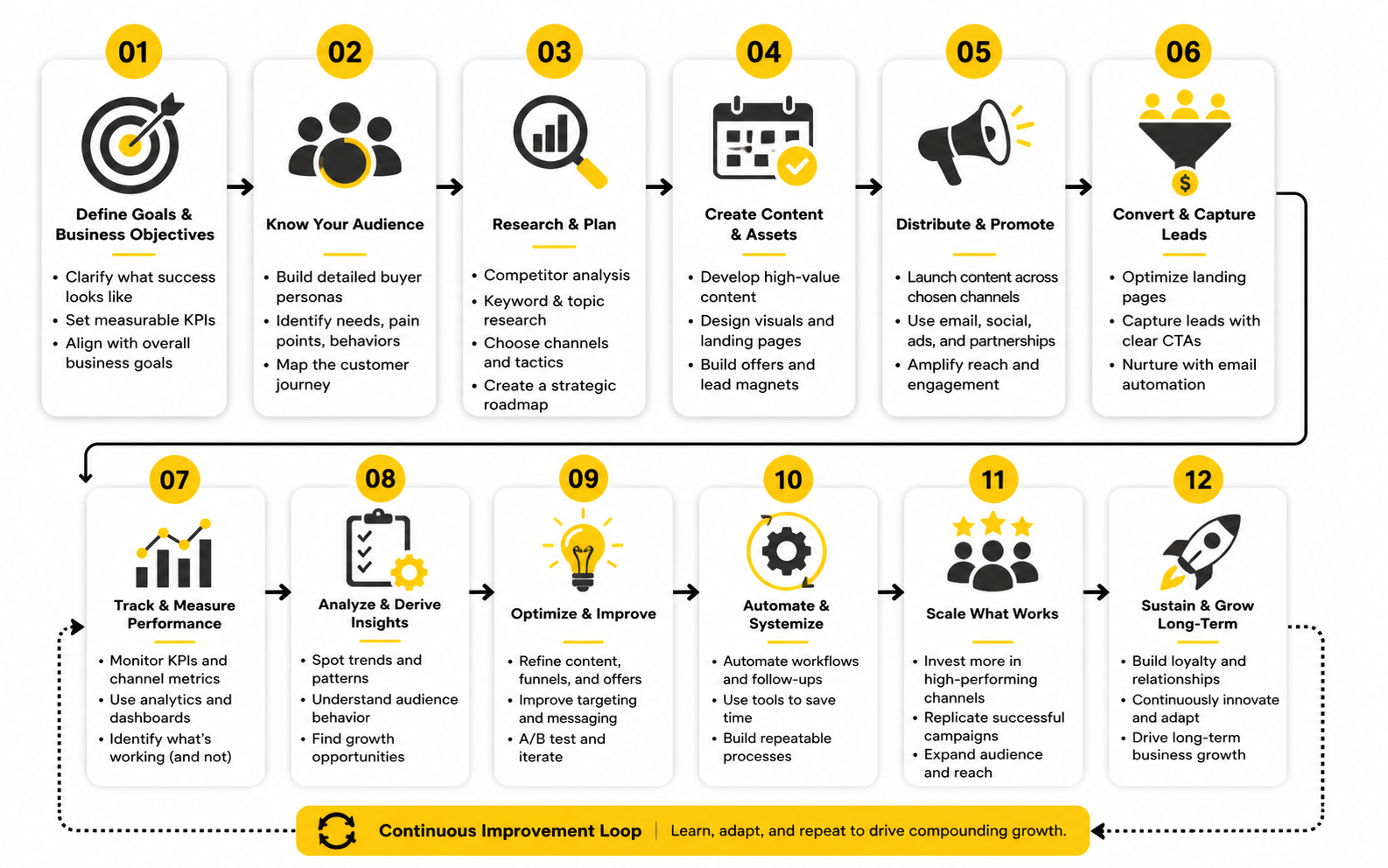
A practical implementation process usually looks like this:
This process is not glamorous, but it is what makes marketing work. The best teams do not win because they have more random ideas. They win because their ideas move through a repeatable system.
CRM And Lead Management
CRM is the operational layer that keeps leads, customers, conversations, and opportunities organized. Without it, marketing performance becomes harder to understand because contacts are scattered across forms, spreadsheets, inboxes, ad platforms, and payment tools. That creates missed follow-ups and messy reporting.
A CRM should help the business answer practical questions. Where did this lead come from? What did they ask for? What emails did they receive? Did sales follow up? Did they buy? If not, where did they stop?
For agencies, local businesses, and service-based teams, GoHighLevel can be useful because it combines CRM, pipelines, forms, calendars, automations, and client communication tools. For email-focused teams, platforms like Brevo, Moosend, and Systeme.io can fit different levels of automation, list management, and campaign complexity.
Conversion Funnels And Landing Pages
Conversion funnels are where digital marketing subjects become measurable. A funnel shows the path from first touch to next action, whether that action is a purchase, a booked call, a free trial, a lead form, a demo request, or a subscription. The point is not to force every buyer through a rigid path; the point is to design a clear route for people who are ready to move.
A good funnel reduces confusion. It gives the visitor one main promise, one clear next step, and enough proof to make that step feel safe. When a funnel is weak, traffic quality gets blamed too quickly, even though the real problem may be the offer, page structure, copy, proof, form friction, pricing clarity, or follow-up.
This is why landing pages deserve their own place in any serious discussion of digital marketing subjects. They are not just web pages. They are decision environments. Every headline, section, button, testimonial, comparison, guarantee, and form field either helps the visitor decide or gives them a reason to leave.
Funnel Stages
A practical funnel has three main stages: awareness, consideration, and conversion. Awareness content gets attention from people who may not know the brand yet. Consideration content helps people compare options, understand the offer, and build trust. Conversion assets remove final friction and make the next step obvious.
Each stage needs different measurement. Awareness should not be judged only by sales because many people are not ready to buy yet. Consideration should be judged by engagement quality, return visits, email signups, demo interest, and qualified actions. Conversion should be judged by cost per lead, cost per acquisition, conversion rate, close rate, average order value, and payback period.
The mistake is using one metric for every stage. A short video that creates reach has a different job from a sales page. A pricing page has a different job from a newsletter. A lead magnet has a different job from a checkout page.
Landing Page Signals
Landing page performance should be read like a diagnostic report. A low click-through rate from an ad usually points to a weak hook, poor audience fit, or an unclear promise. A high click-through rate with a low landing page conversion rate usually points to message mismatch, weak proof, slow loading, poor offer clarity, or too much friction.
A high form start rate with a low completion rate often means the form asks for too much too soon. A page with strong scroll depth but weak conversions may be interesting but not persuasive. A page with fast exits above the fold probably has a headline, layout, speed, or relevance problem.
This is where simple changes can create real money. Better message match, fewer distractions, clearer proof, stronger calls to action, and cleaner mobile layouts can improve the economics of every traffic source. For ecommerce teams that need to build and test Shopify pages faster, Replo can be useful. For lead generation and offer-based funnels, ClickFunnels, Systeme.io, and GoHighLevel can help connect pages, forms, automations, and follow-up.
Offer Quality
Offer quality is often more important than page design. A beautiful page cannot save an offer that nobody wants, does not understand, or does not believe. The offer has to make the next step feel worth the visitor’s time, money, attention, or contact information.
A strong offer usually has a clear outcome, a defined audience, a believable mechanism, a reason to act, and enough proof to lower risk. That applies whether the offer is a free checklist, a webinar, a product trial, a consultation, a subscription, or a full purchase. The stronger the ask, the stronger the proof needs to be.
Marketers should track offer performance separately from channel performance. If the same offer fails across paid search, email, organic social, and warm retargeting, the issue is probably not just traffic. It is the offer, the market, or the promise.
Analytics, Attribution, And Performance Measurement
Analytics is the subject that keeps marketing honest. Without measurement, every opinion sounds equally convincing. With measurement, you can see where attention comes from, what people do next, where they drop off, and which actions actually support revenue.
But analytics is not about staring at dashboards all day. It is about making better decisions. The numbers should tell you what to protect, what to improve, what to stop, and what to test next.
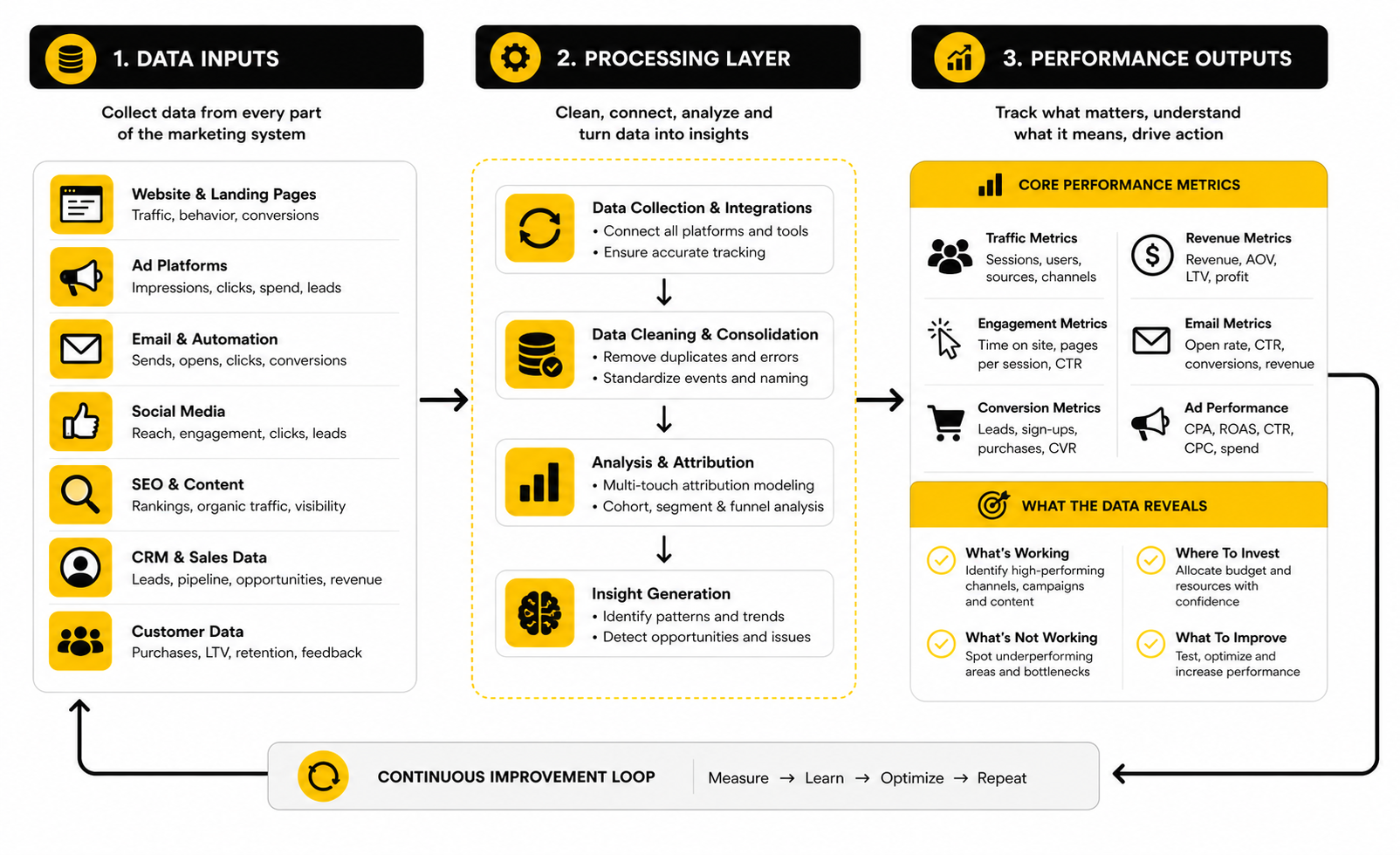
This is especially important because digital measurement is becoming less clean. Privacy changes, consent rules, platform reporting gaps, cross-device behavior, and walled gardens make attribution harder than it looked a few years ago. IAB’s 2025 State of Data report highlights how AI, privacy, and data quality are reshaping media campaign measurement and decision-making across the advertising industry in its latest State of Data research.
Statistics And Data
Statistics matter only when they help you make a decision. A benchmark can show whether your performance is unusually weak, unusually strong, or roughly normal. But benchmarks should never replace your own economics because every market, offer, price point, buying cycle, and traffic source behaves differently.
Paid search is a good example. WordStream’s 2025 Google Ads benchmark data reported an average search ad cost per click of $5.26 and an average cost per lead of $70.11. Those numbers are useful as a reference, but they do not tell you whether your campaign is profitable. A $150 lead can be excellent for a high-ticket service and terrible for a low-margin product.
Email benchmarks work the same way. Mailchimp’s benchmark data shows that open rate, click rate, bounce rate, and unsubscribe rate vary heavily by industry and list quality across email marketing categories. Open rate can help spot subject line or deliverability issues, but it is not the final goal. Clicks, conversions, revenue, replies, booked calls, and retained customers tell you much more about business impact.
Leading And Lagging Indicators
Leading indicators show whether momentum is building before revenue fully appears. These include impressions, reach, qualified traffic, search visibility, email signups, product page views, demo requests, booked calls, add-to-cart actions, and reply rates. They are useful because they help you see early whether the system is moving in the right direction.
Lagging indicators show the final business outcome. These include revenue, profit, customer acquisition cost, lifetime value, close rate, retention, churn, refund rate, and payback period. They matter because marketing is not just about activity; it has to support the business model.
The balance matters. If you only watch lagging indicators, you may react too late. If you only watch leading indicators, you may celebrate activity that never turns into money. A serious marketer connects both.
Attribution Models
Attribution is the process of deciding which touchpoints get credit for a conversion. Last-click attribution gives all credit to the final touch before conversion. First-click attribution gives all credit to the first known touch. Multi-touch attribution tries to distribute credit across the journey.
None of these models is perfect. Last-click can undervalue content, social, email, and brand activity because those often create demand before the final search or direct visit. First-click can overvalue discovery and ignore the work required to convert. Multi-touch can be useful, but it still depends on tracking quality and model assumptions.
The practical answer is to use attribution as a guide, not a religion. Compare platform data, website analytics, CRM records, sales feedback, and actual revenue. When those sources disagree, do not panic. Look for patterns strong enough to guide action.
Dashboard Design
A dashboard should make decisions easier, not make the team feel busy. If every metric is shown with equal importance, the dashboard becomes decoration. The best dashboards separate channel health, funnel movement, revenue impact, and operational follow-up.
A useful marketing dashboard might include:
The key is ownership. Every important metric should have someone responsible for reviewing it and deciding what happens next. If nobody acts on a number, it probably does not belong on the main dashboard.
What The Data Should Drive
Data should drive prioritization first. If paid traffic is expensive but landing page conversion is weak, the next move is probably not more budget. If email has strong clicks but weak sales, the offer or sales page needs attention. If social content gets engagement from the wrong audience, the content strategy needs repositioning.
Data should also drive testing. You do not test randomly. You test the bottleneck. If people do not click, test the hook. If they click but do not convert, test the page and offer. If they convert but do not buy later, test the follow-up, sales process, pricing, or qualification.
This is the professional difference. Beginners collect metrics. Professionals interpret them. The best marketers turn numbers into decisions, decisions into tests, and tests into a better system.
AI, Automation, And Modern Marketing Operations
AI and automation now sit across almost every serious digital marketing workflow. They can help with research, content planning, segmentation, ad variation, email personalization, chatbot flows, reporting, lead routing, and customer support. But they are not a replacement for understanding digital marketing subjects at the strategic level.
The danger is that AI makes low-quality execution faster. If the offer is unclear, AI can produce more unclear content. If the data is messy, automation can move bad leads through the system faster. If the brand voice is weak, AI can make the business sound like everyone else at scale.
That is why the real advantage is not “using AI.” The advantage is knowing where AI fits inside a clean marketing process. Jasper’s 2025 State of AI in Marketing research found that 63% of marketers already use generative AI, while another 27% were evaluating it within the next six months. That tells you the tool layer is becoming normal. The strategy layer is where the gap opens.
Where AI Actually Helps
AI is strongest when it improves speed, variation, organization, and analysis. It can summarize customer research, cluster objections, turn long-form content into smaller assets, create first drafts, generate ad angle variations, and help marketers explore data more quickly. Used well, it removes friction from the work without removing human judgment from the decision.
The best use cases usually have clear inputs and clear review standards. For example, AI can help draft email subject lines, but a marketer still needs to know the audience, promise, context, and compliance requirements. AI can help generate landing page copy, but it cannot magically know whether the offer is believable, differentiated, or profitable.
This matters because AI output is easy to publish before it is truly useful. A practical marketer treats AI like a production assistant, not a strategist with final authority. You still need to check accuracy, tone, claims, customer fit, and brand consistency before anything goes live.
Automation Without Losing The Human Touch
Marketing automation should make communication more relevant, not more robotic. A welcome sequence, abandoned cart flow, booking reminder, or lead nurture campaign can improve the customer experience when it responds to real behavior. It becomes a problem when every contact gets pushed through the same generic sequence regardless of what they need.
Good automation has logic. A cold lead should not receive the same message as someone who visited a pricing page three times. A repeat customer should not be treated like a first-time visitor. A booked-call prospect should not keep receiving emails asking them to book a call.
Tools can help build these systems, but the thinking comes first. GoHighLevel can support complex service-business automations, pipelines, and follow-up workflows. ManyChat can be useful when the customer journey includes social messaging and conversational lead capture. Chatbase can help create AI chat experiences when the business has enough quality source material to answer questions responsibly.
Data Quality And Privacy
Data quality is now a strategic issue, not just a technical issue. If your forms capture bad information, your CRM duplicates contacts, your tracking is inconsistent, or your source data is missing, your reporting will be weak. Weak reporting creates weak decisions.
Privacy also affects how marketers collect, store, and use data. Consent, retention, cookie behavior, unsubscribe handling, and customer preferences all shape what responsible marketing looks like. This is not just about avoiding legal trouble; it is about earning trust in a market where people are more aware of how their data is used.
The American Marketing Association’s 2025 skills research found that marketers face major capability gaps in digital marketing, data and analytics, proving ROI, and data privacy and compliance. That combination is important. The future marketer cannot just be creative. They need to understand systems, numbers, and responsibility.
Strategic Tradeoffs In Digital Marketing
Every digital marketing strategy involves tradeoffs. You cannot optimize for speed, quality, cost, reach, personalization, and control all at the same time. If you try, you usually end up with a bloated plan that looks impressive but does not execute well.
This is where digital marketing subjects become strategic instead of academic. SEO may compound over time, but it can be slower. Paid ads can create fast feedback, but they require budget and strong economics. Social media can build trust, but it can also become a distraction if it is not connected to a business goal.
The job is not to do everything. The job is to choose the right sequence. A small business with no clear offer should not start by building a complicated automation stack. A company with strong demand but weak conversion should not keep adding more traffic before fixing the page, offer, and follow-up.
Speed Versus Compounding
Paid advertising gives speed. You can test an offer, headline, audience, or landing page quickly if the budget is available. That speed is useful when you need market feedback, but it can become expensive if the funnel is not ready.
SEO, content, brand, and email are more compounding. They usually take longer to build, but they can reduce dependence on rented traffic over time. The payoff is not always immediate, which is why impatient teams often abandon them too early.
A smart strategy balances both. Use paid channels to test offers and learn faster. Use organic content, SEO, email, and brand assets to capture demand and build long-term leverage. That combination is stronger than treating every channel like a separate bet.
Specialization Versus Generalization
Digital marketing has become too broad for one person to master every subject deeply. SEO, paid media, analytics, copywriting, lifecycle marketing, CRO, social strategy, marketing operations, and AI automation can each become a full career path. So the real question is not whether to learn everything equally.
A good marketer should build a T-shaped skill set. The horizontal bar is broad understanding across the main digital marketing subjects. The vertical bar is deeper strength in one or two areas that create real business value.
This makes you more useful. A paid ads specialist who understands landing pages and email follow-up will make better campaign decisions. A content marketer who understands analytics and conversion will create assets that do more than attract traffic. A marketing operator who understands messaging will build automations that actually move people forward.
Brand Building Versus Direct Response
Direct response marketing is designed to create measurable action now. It uses clear offers, strong calls to action, urgency, proof, and conversion-focused messaging. It is powerful because it connects marketing activity to revenue more directly.
Brand building works differently. It creates memory, preference, trust, and familiarity before someone is ready to buy. It is harder to measure cleanly, but it can make every direct response campaign perform better because people are more likely to respond to brands they already recognize and trust.
The mistake is choosing one and mocking the other. Brand without conversion can become expensive art. Direct response without brand can become exhausting because every sale has to be pushed harder. The best digital marketing systems use both.
Scaling Digital Marketing Without Breaking The System
Scaling is not just spending more money or publishing more content. Scaling means increasing output, reach, or revenue without destroying quality, margins, customer experience, or team capacity. That is harder than it sounds.
Many teams break their marketing system by scaling the wrong thing. They increase ad spend before fixing lead quality. They publish more content before defining a stronger point of view. They add more tools before cleaning their data. They hire more people before documenting the process.
The better approach is to scale what already works. Find the strongest channel, strongest message, strongest offer, strongest audience, and strongest conversion path. Then increase volume carefully while watching the constraints.
Process Documentation
Process documentation sounds boring until the team grows. When work lives only inside one person’s head, every handoff becomes risky. Campaigns slow down, quality becomes inconsistent, and mistakes repeat because nobody can see the system clearly.
Documentation should explain how work gets done, what standards matter, and who owns each step. It can include campaign briefs, naming conventions, approval workflows, reporting templates, content guidelines, email QA checklists, and funnel launch checklists. This is not bureaucracy when it saves time and prevents expensive errors.
Good documentation also makes experimentation cleaner. If every campaign is built differently, it is hard to know what caused the result. When the process is consistent, the team can isolate variables and learn faster.
Tool Stack Discipline
The marketing technology market is massive, which creates both opportunity and chaos. The 2025 Marketing Technology Landscape identified 15,384 martech solutions, up 9% from the previous year. That does not mean you need more tools. It means you need better judgment.
A good tool stack should reduce friction, improve visibility, and support the customer journey. A bad tool stack creates duplicate data, unclear ownership, disconnected reporting, unused features, and monthly costs nobody questions. More software is not a strategy.
Before adding another platform, ask what problem it solves and what process will change because of it. If the team cannot answer that clearly, do not buy the tool yet. If the problem is real, choose the simplest tool that fits the workflow.
Team Roles And Ownership
Scaling requires clear ownership. Someone needs to own acquisition. Someone needs to own conversion. Someone needs to own retention. Someone needs to own reporting. In small teams, one person may cover several areas, but the responsibilities still need to be clear.
Unclear ownership creates slow decisions. Paid media blames landing pages. Content blames sales. Sales blames lead quality. Leadership blames the channel. Nobody fixes the system because nobody owns the handoff.
Strong teams define responsibilities around outcomes, not just tasks. The content person is not only responsible for publishing. They are responsible for content that supports search visibility, trust, education, or sales enablement. The email person is not only responsible for sending campaigns. They are responsible for improving lifecycle performance and customer movement.
Professional Implementation And Career Skills
Professional implementation is the bridge between learning digital marketing subjects and becoming valuable in the real world. It is one thing to know what SEO, email, paid ads, funnels, and analytics mean. It is another thing to choose the right move when budget, deadlines, imperfect data, and real business pressure are involved.
The best marketers are not just channel operators. They can diagnose problems, prioritize action, communicate clearly, and make tradeoffs. They understand that marketing is not judged by how busy it looks. It is judged by whether it helps the business grow in a way that can be sustained.
That is why career growth in digital marketing often comes from combining craft with commercial thinking. Craft gets the work done. Commercial thinking makes the work matter.
Strategic Thinking
Strategic thinking means understanding what matters most right now. A business with low awareness needs a different plan from a business with high traffic and poor conversion. A startup validating an offer needs a different plan from an established company improving retention.
This skill helps marketers avoid random execution. Instead of asking, “What should we post?” they ask, “What belief does the market need before this offer makes sense?” Instead of asking, “Should we run ads?” they ask, “Do we have a conversion path that can handle paid traffic profitably?”
Strategic thinking also protects the team from shiny object syndrome. New platforms, AI tools, tactics, and growth hacks will always appear. A serious marketer can evaluate them without losing focus.
Copywriting And Communication
Copywriting remains one of the highest-leverage digital marketing subjects because words shape action. Headlines affect attention. Offers affect desire. Calls to action affect movement. Email copy affects trust and timing.
Good copywriting is not hype. It is clear thinking in public. It shows the customer that you understand their problem, explains the value of the offer, answers the right objections, and makes the next step feel natural.
Communication also matters inside the company. Marketers need to explain strategy, report performance, defend priorities, and align with sales, product, finance, and leadership. If you cannot explain what the numbers mean and what should happen next, your work will be harder to trust.
Experimentation Mindset
An experimentation mindset means treating marketing as a learning system. You form a hypothesis, run a controlled test, review the result, and decide what to do next. This is different from randomly changing things whenever performance dips.
Good experiments are specific. They test one meaningful idea at a time, such as a new offer angle, audience segment, landing page structure, email sequence, or pricing presentation. The goal is not just to win the test. The goal is to learn something that improves future decisions.
This mindset also makes failure useful. A failed test can reveal that the audience is wrong, the promise is weak, the page is unclear, or the traffic source is not ready. That is not wasted work if the team captures the lesson and uses it.
Commercial Awareness
Commercial awareness is knowing how marketing connects to money. You need to understand margins, lifetime value, payback period, close rate, churn, average order value, sales cycle length, and capacity. Without that, you may optimize for metrics that look good but do not help the business.
For example, a campaign with cheap leads may be bad if the leads never buy. A campaign with expensive leads may be excellent if those leads close at a high rate and stay for years. A high open rate may mean very little if the emails do not move people toward a valuable action.
This is where professional marketers stand out. They do not hide behind vanity metrics. They connect activity to outcomes, and they understand the economic logic behind the strategy.
Common Mistakes To Avoid
The biggest mistake is treating digital marketing subjects like a checklist instead of a system. SEO, social media, paid ads, email, funnels, analytics, and automation are not separate trophies to collect. They are connected parts of a customer journey, and the weak point in that journey usually decides the result.
Another mistake is copying tactics without understanding the context behind them. A webinar funnel that works for a high-ticket coaching business may be completely wrong for a low-cost ecommerce product. A short-form video strategy that works for a creator-led brand may fail for a complex B2B service if the audience needs proof, education, and sales support before taking action.
The final mistake is confusing activity with progress. Publishing more, sending more emails, launching more ads, and adding more tools can make a team feel productive, but the market does not reward effort by itself. It rewards relevance, clarity, trust, timing, and execution.
Learning Tools Before Learning Strategy
Tools are useful, but they are not the foundation. A funnel builder will not fix a weak offer. A CRM will not fix poor follow-up discipline. An AI writer will not fix unclear positioning.
This is why beginners should learn the underlying principles before stacking software. Learn how customers decide. Learn how offers work. Learn how traffic, conversion, retention, and measurement connect. Then choose tools that support the process instead of letting the tool define the strategy.
The better question is not, “Which platform should I use?” The better question is, “What customer movement am I trying to create, and what tool helps me create it with less friction?” That one question prevents a lot of wasted money.
Chasing Channels Instead Of Solving Bottlenecks
Many teams jump channels when the real issue is not the channel. They stop SEO because leads are slow, then start paid ads without fixing the landing page. They abandon email because sales are weak, then post more on social while the offer still sounds vague.
A better approach is to diagnose the bottleneck. If people do not discover the brand, fix reach. If people visit but do not act, fix the page, offer, proof, or call to action. If people opt in but do not buy, fix the nurture sequence, sales process, or qualification.
This is the difference between busy marketing and useful marketing. Busy marketing asks, “What else can we do?” Useful marketing asks, “What is stopping the right person from taking the next step?”
Ignoring The Customer After The Sale
Digital marketing does not end when someone buys. In many businesses, the real profit comes from retention, repeat purchases, referrals, upgrades, and customer expansion. If the post-purchase experience is weak, acquisition has to work too hard forever.
Customer marketing includes onboarding, education, support communication, review requests, loyalty campaigns, win-back sequences, and referral programs. These are not glamorous subjects, but they directly affect lifetime value. Strong retention can make paid acquisition more profitable because each customer becomes worth more over time.
This is where marketing and operations meet. A great campaign can create the sale, but the customer experience determines whether people trust the brand enough to come back. That matters because no marketing channel can permanently outrun a disappointing product experience.
Building A Complete Digital Marketing System
A complete system connects strategy, execution, measurement, and improvement. It starts with a clear customer, a clear offer, and a clear reason the market should care. Then it uses the right channels to create attention, capture demand, nurture interest, convert buyers, and retain customers.
The system does not need to be complicated. In fact, simple systems are often better because they are easier to understand, manage, and improve. A clear landing page, a useful lead magnet, a focused email sequence, a reliable CRM, a small number of traffic channels, and a basic dashboard can outperform a messy stack of advanced tools.
The deeper lesson is that digital marketing subjects only become powerful when they work together. Research improves messaging. Messaging improves content and ads. Content and ads drive traffic. Funnels convert traffic. Email and CRM follow up. Analytics shows what to improve next.
The Practical Learning Path
The best way to learn digital marketing is to build in layers. Start with customer understanding and positioning because those shape everything else. Then learn content, SEO, social media, paid ads, funnels, email, CRM, and analytics as connected skills rather than isolated modules.
A practical learning path could look like this:
This order works because it builds from thinking to execution. You can learn tools at any stage, but the tools make more sense when you understand the job they are supposed to do. That is how you become useful, not just familiar with software.
Choosing What To Learn First
The right first subject depends on your goal. If you want to become employable quickly, learn a practical channel skill like paid ads, SEO, email marketing, analytics, or social content production. If you want to build your own business, start with offer creation, customer research, copywriting, funnels, and basic traffic.
If you are already working in marketing, look for the skill gap closest to revenue. A content marketer may need analytics and conversion skills. A paid ads specialist may need landing page and offer strategy. A social media manager may need email capture and reporting skills.
The American Marketing Association’s 2025 skills research highlights major gaps in digital marketing, data and analytics, proving ROI, and data privacy and compliance. That is a useful signal. If you can combine creative execution with measurement and responsible data use, you become harder to replace.
What Are The Main Digital Marketing Subjects?
The main digital marketing subjects include market research, branding, positioning, content marketing, SEO, social media, paid advertising, email marketing, funnels, landing pages, analytics, automation, CRM, and AI-assisted marketing operations. These subjects cover the full journey from audience understanding to customer retention. The important thing is learning how they connect instead of treating each one as a separate task.
Which Digital Marketing Subject Should I Learn First?
Start with customer research, positioning, and copywriting because those skills improve every other channel. After that, choose a practical execution skill based on your goal. SEO, paid ads, email marketing, analytics, and social media are all good options, but they work best when built on clear strategy.
Is SEO Still Important In Digital Marketing?
Yes, SEO is still important because people continue to search when they want answers, comparisons, products, services, and trusted explanations. SEO is also becoming broader because search behavior now includes classic search engines, video platforms, marketplaces, communities, and AI-assisted discovery. The core skill is still understanding intent and creating useful content that deserves visibility.
Is Social Media Marketing Enough By Itself?
Social media can create attention, trust, and community, but it is rarely enough by itself. You still need a conversion path, an offer, a way to capture leads, and a follow-up system. Social media works best when it connects to email, landing pages, content, sales, and retention instead of living alone.
Are Paid Ads Good For Beginners?
Paid ads can be useful for beginners, but they can also get expensive fast. The beginner should first understand offers, landing pages, tracking, budgeting, and basic funnel economics. If you run ads before the conversion path is ready, you may simply pay to learn that the system is broken.
Why Is Email Marketing Still A Core Subject?
Email marketing is core because it gives businesses a direct communication channel with people who have already shown interest. It supports education, nurturing, sales, onboarding, retention, and reactivation. Unlike social media reach, email performance is less dependent on public algorithm changes, although list quality and deliverability still matter.
What Is The Difference Between Analytics And Attribution?
Analytics shows what people do across your marketing system, such as visits, clicks, conversions, revenue, and drop-off points. Attribution tries to assign credit to the touchpoints that influenced a conversion. Analytics helps you understand behavior, while attribution helps you estimate which channels and campaigns contributed to outcomes.
How Does AI Change Digital Marketing Subjects?
AI changes how fast marketers can research, draft, analyze, personalize, and automate parts of the workflow. It does not remove the need for strategy, judgment, customer understanding, or brand voice. The marketers who benefit most from AI are usually the ones who already understand the fundamentals and use AI to execute faster.
What Skills Make A Digital Marketer More Valuable?
The most valuable marketers combine channel execution with commercial thinking. They understand copywriting, analytics, customer behavior, experimentation, reporting, and business economics. They can also explain what the data means and what the team should do next.
Do I Need To Master Every Digital Marketing Subject?
No, you do not need to master every subject deeply. You should understand the full system well enough to collaborate, diagnose problems, and make smart decisions. Then you can specialize in one or two areas where you can create clear value.
How Long Does It Take To Learn Digital Marketing?
You can learn the basics in a few months if you study consistently and apply what you learn. Becoming genuinely useful takes longer because you need practice with real offers, real audiences, real data, and real constraints. Digital marketing is a skill stack, so progress comes from building and improving over time.
What Is The Best Way To Practice Digital Marketing?
The best way to practice is to build something real. Create a simple website, publish content, build a landing page, set up an email sequence, run a small campaign, track the results, and improve the weak points. Theory helps, but real implementation teaches you what actually breaks.
Build a stronger local presence with BAAM AI
Turn your website, Google profile, social channels, and AI visibility into one growth engine
Most businesses do not need more random marketing activity. They need a consistent presence system that helps the right people find them, trust them, and take action. BAAM AI brings strategy, local SEO, website updates, Google Maps visibility, social content, AI-search readiness, media production, and reporting into one practical monthly engine.
If you want your marketing to keep working after the campaign ends, start with a free BAAM AI presence audit. See how your business shows up today and where the fastest visibility wins are at BAAM AI.