
BAAM AI Blog
Digital Marketing Strategy Consultant: A Practical Guide To Building Growth That Actually Compounds
A digital marketing strategy consultant is not just someone who tells you to post more, run ads, write blogs, or “fix your funnel.” The real job is to connect market positioning, customer behavior, channel economics...
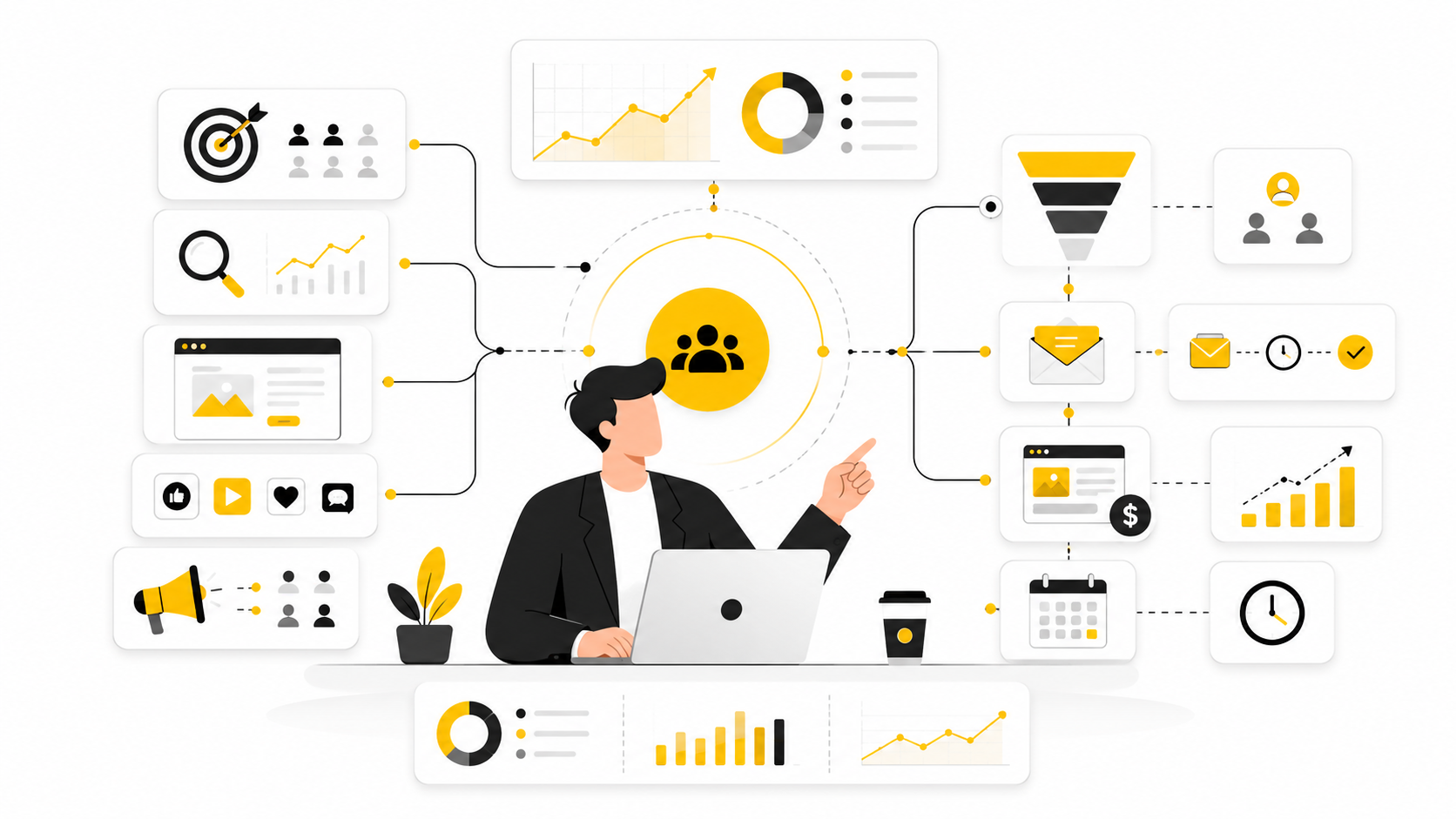
A digital marketing strategy consultant is not just someone who tells you to post more, run ads, write blogs, or “fix your funnel.” The real job is to connect market positioning, customer behavior, channel economics, conversion paths, analytics, and execution priorities into one clear growth system. That matters because most digital marketing problems are not isolated channel problems; they are usually strategy, sequencing, measurement, or offer problems showing up as weak performance.
This is especially true now because digital marketing has become more expensive, more automated, and more fragmented at the same time. Marketing leaders are still under budget pressure, with Gartner reporting that 2025 marketing budgets remain flat at 7.7% of overall company revenue, while teams are expected to do more with data, AI, personalization, content, lifecycle marketing, and performance channels. The companies that win are usually not the ones doing the most tactics; they are the ones making better strategic choices before they spend.
A strong consultant brings order to that mess. They help decide which audiences matter most, what problem the brand should own, which channels deserve investment, what conversion journey should exist, what numbers define progress, and what should be ignored for now. That last part is underrated, because strategy is not just choosing what to do; it is choosing what not to waste time and budget on.
The need for better strategy is obvious when you look at how modern marketing actually works. Personalization can lift revenue when it is executed well, but McKinsey has found that personalization often drives a 10% to 15% revenue lift only when companies can connect data, content, timing, and customer experience. That is not a single campaign task. It is a strategic operating model.
The same applies to AI, automation, paid acquisition, email, social, SEO, and conversion optimization. None of those channels performs well for long when the offer is unclear, the funnel is leaky, the audience is too broad, or reporting is built around vanity metrics. A good digital marketing strategy consultant helps turn those moving parts into a practical growth framework that a team can actually execute.
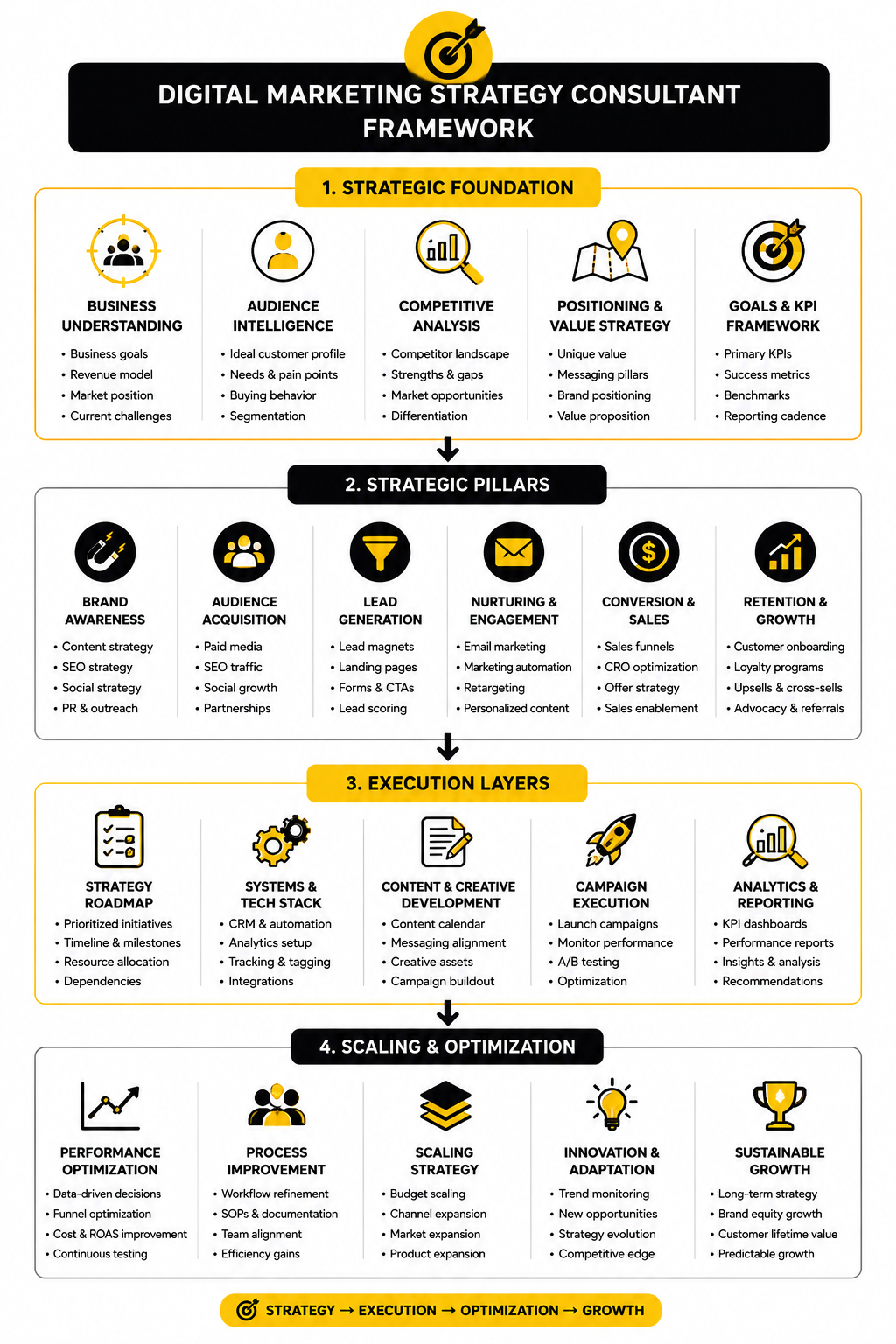
This guide is structured as a six-part article so each section builds on the previous one instead of jumping randomly between tactics.
The goal is not to make digital marketing sound more complicated than it is. The goal is to make it more usable. By the end, you should understand what a digital marketing strategy consultant actually does, where they create leverage, what a serious framework looks like, and how to tell the difference between strategic help and someone simply selling you another pile of tactics.
Why A Digital Marketing Strategy Consultant Matters Now
A digital marketing strategy consultant matters more when the easy wins disappear. A few years ago, many businesses could get away with a decent ad campaign, a basic lead magnet, a few automated emails, and some SEO content. That still works in pieces, but the margin for sloppy strategy is much smaller now.
The reason is simple: every channel has become more competitive, more expensive, and harder to measure cleanly. Paid traffic needs better economics. Organic content needs stronger authority. Email needs better segmentation. Social needs sharper positioning. AI makes production faster, but it also makes generic content easier to ignore.
This is where a digital marketing strategy consultant earns their place. They do not just ask, “What campaign should we launch?” They ask, “What should this business become known for, who is most likely to buy, what path will move them from attention to trust, and which numbers prove the strategy is working?” That is a much better starting point than throwing more activity at a weak foundation.
Marketing Budgets Are Under More Pressure
Marketing teams are being asked to produce growth without always receiving the budget increases that used to support expansion. Gartner’s 2025 CMO Spend Survey found that marketing budgets stayed flat at 7.7% of overall company revenue, which means many teams are trying to increase output while working within tighter limits. That creates a very practical problem: poor strategy becomes expensive fast.
When budgets are flat, random execution is dangerous. Running ads without a clear funnel burns money. Publishing content without a positioning strategy wastes time. Buying tools before defining the process creates more complexity instead of more growth. A consultant helps protect the budget by making the business more selective.
That selectivity is not about being cautious for the sake of it. It is about sequencing the work correctly. A business may not need five new channels; it may need one better offer, one clearer landing page, one stronger email follow-up, and one reporting view that shows what is actually driving revenue.
Buyers Are Harder To Win
Modern buyers compare more options, read more content, ask more questions, and move across more touchpoints before they commit. They may see a LinkedIn post, search the brand on Google, read reviews, watch a video, click an ad weeks later, and only then book a call or make a purchase. If the message changes at every step, trust breaks.
This is why strategy matters before tactics. A consultant looks at the full customer journey instead of treating every channel as a separate island. The question is not just whether a landing page converts; it is whether the landing page matches the promise made in the ad, the search result, the email, and the sales conversation.
The best strategy makes the buyer’s path feel obvious. People should quickly understand who the offer is for, what problem it solves, why it is different, what happens next, and why they should act now. That sounds basic, but plenty of businesses skip it and then wonder why traffic does not turn into revenue.
AI Has Made Strategy More Important, Not Less
AI has changed digital marketing, but not in the lazy way many people expected. It can help with research, content drafts, data analysis, customer support, campaign variations, and workflow automation. McKinsey’s 2025 AI research highlights that companies getting more value from AI are not just adding tools; they are redesigning workflows around clearer business goals.
That point matters. AI can multiply good strategy, but it can also multiply noise. If your positioning is weak, AI helps you publish weak messaging faster. If your funnel is confused, AI helps you automate confusion. If your reporting is messy, AI gives you more dashboards without better decisions.
A digital marketing strategy consultant helps decide where AI actually belongs. For example, using GoHighLevel AI can make sense when a business already understands its lead flow, follow-up process, and customer journey. Using Chatbase can be useful when customer questions are repetitive and the website already has enough quality information to support helpful answers. The tool is not the strategy; the tool supports the strategy.
Measurement Is Getting Messier
Marketing measurement used to feel more straightforward than it does now. A buyer clicked an ad, landed on a page, opted in, and bought. That still happens, but privacy changes, cookie restrictions, device switching, dark social, and longer consideration cycles have made attribution less clean.
This does not mean measurement is dead. It means businesses need better measurement discipline. Instead of obsessing over one perfect attribution model, a consultant helps combine channel data, CRM data, conversion tracking, customer interviews, sales feedback, and cohort performance into a more useful view of reality.
That shift is important because bad measurement creates bad decisions. A campaign may look weak because it assists sales instead of closing them directly. A content asset may look quiet in analytics while still helping buyers trust the brand before a call. A paid channel may look profitable until retention or refund data tells a different story.
Strategy Connects Channels Instead Of Letting Them Compete
One of the biggest reasons marketing underperforms is that every channel starts acting like its own department. The SEO person wants traffic. The ads person wants lower cost per lead. The email person wants opens and clicks. The social person wants engagement. None of those goals are wrong, but they can pull the business in different directions if there is no shared strategy.
A consultant creates the connection between those pieces. SEO should support the same positioning as paid campaigns. Paid campaigns should test messages that can later inform landing pages and email sequences. Email should move people through the same buying logic that sales uses on calls. Social should create demand, not just fill a calendar.
This is where the work becomes much more practical. A business using Buffer for social scheduling still needs a reason to post, a content angle, and a conversion path. A business using Brevo for email still needs segmentation, offers, and lifecycle logic. Strategy is what turns tools from disconnected activity into a system.
The Cost Of Guessing Is Too High
Guessing feels faster at the beginning, but it becomes expensive when the business starts scaling. A vague audience creates weak messaging. Weak messaging lowers conversion rates. Lower conversion rates make traffic more expensive. Expensive traffic forces the team to cut corners, chase hacks, or blame the channel.
A digital marketing strategy consultant helps stop that spiral by identifying the constraint before the business spends more. Sometimes the constraint is positioning. Sometimes it is the offer. Sometimes it is the funnel. Sometimes it is the sales handoff, retention path, or the lack of a clear analytics setup.
The important part is diagnosis. Without diagnosis, marketing becomes a list of disconnected actions. With diagnosis, every action has a reason, and every campaign teaches the business something useful even when it does not win immediately.
Growth Needs A System, Not Just More Campaigns
Campaigns are useful, but they are temporary by nature. They launch, run, get measured, and either scale or stop. A growth system is different because it keeps improving the business behind the campaigns: the positioning, offer, audience insight, content engine, conversion paths, follow-up, and reporting.
This is the real reason a consultant can create leverage. They help the business build assets that compound instead of constantly starting from zero. A better landing page can improve every paid campaign. A sharper offer can improve sales calls, email sequences, and website conversions. A clearer content strategy can make organic search, social, and retargeting work together.
That is the mindset shift. You are not hiring a digital marketing strategy consultant to add more noise. You are hiring them to make the important decisions clearer, the execution more focused, and the growth engine easier to improve over time.
A Practical Digital Marketing Strategy Framework
A digital marketing strategy consultant needs a framework because opinions are cheap and execution gets messy fast. Without a clear process, strategy turns into a workshop full of sticky notes, scattered recommendations, and a slide deck nobody uses after the first week. A real framework should help the business make better decisions, prioritize the right work, and connect every tactic to a measurable business outcome.
The framework does not need to be complicated. In fact, the best one is usually simple enough for the founder, marketing team, sales team, and operators to understand without translation. It should answer four practical questions: where are we now, where should we focus, what needs to change, and how will we know it is working?
That is where a consultant becomes useful. They are not there to admire the complexity of the business. They are there to turn complexity into a focused growth plan that can survive real execution.
Start With The Business Model
Every good marketing strategy starts with the business model, not the marketing channel. A SaaS company, local service business, ecommerce brand, agency, marketplace, and high-ticket consulting offer all need different acquisition economics. The mistake is treating digital marketing like a menu of tactics instead of a system built around how the company actually makes money.
A digital marketing strategy consultant should look at revenue sources, margins, sales cycle length, average order value, lifetime value, capacity limits, retention, and the real cost of acquiring customers. This is not finance theater. It tells you what kind of marketing the business can afford and what type of growth motion makes sense.
For example, a low-ticket ecommerce offer may need conversion rate improvements, repeat purchase flows, stronger bundles, and paid media discipline. A high-ticket service offer may need authority content, lead qualification, sales enablement, and better follow-up. The channel choice only makes sense after the economics are clear.
Diagnose The Current Growth Constraints
The next step is diagnosis. This is where the consultant looks for the bottleneck that is actually limiting growth instead of assuming the business needs more traffic. More traffic is often the lazy answer, and lazy answers are expensive.
The constraint could be unclear positioning, weak offer-market fit, low landing page conversion, poor sales follow-up, bad lead quality, missing nurture, slow website speed, thin content, weak retention, or disconnected reporting. These problems create different symptoms, but they all show up as the same frustration: marketing feels busy but revenue does not move enough. That is why diagnosis matters before execution.
A useful diagnosis combines analytics, customer research, channel performance, sales feedback, CRM data, and a direct review of the customer journey. Research from McKinsey’s 2025 AI work makes the same broader point about transformation: companies getting stronger results are not just adopting tools, they are redesigning workflows around clearer business outcomes. Marketing strategy works the same way.
Define The Strategic Focus
Once the constraint is clear, the next question is focus. This is where many businesses struggle because everything feels important. SEO matters, ads matter, email matters, social matters, partnerships matter, and conversion optimization matters, but doing everything at once usually creates average work everywhere.
A consultant should help the business choose the highest-leverage focus area for the next stage of growth. That might mean fixing conversion before increasing traffic. It might mean narrowing the audience before creating content. It might mean improving follow-up before scaling paid ads. The right focus depends on the diagnosis, not on whatever tactic is trending this month.
This step is also where strategy becomes uncomfortable in a useful way. Saying yes to one growth priority means saying no or not yet to others. That discipline is what keeps the business from spreading budget, attention, and creative energy too thin.
Turn The Strategy Into A Step-By-Step Execution Plan
The strategy becomes real when it turns into a sequence of work. A consultant should not simply deliver a recommendation like “improve the funnel” or “build a stronger content engine.” That sounds smart, but it is not actionable enough.
A practical execution plan should define the order of operations. It should show what gets built first, what gets tested next, who owns each piece, what assets are needed, what tools are involved, and what numbers will be reviewed. This is where the gap between a strategist and a vague advisor becomes obvious.
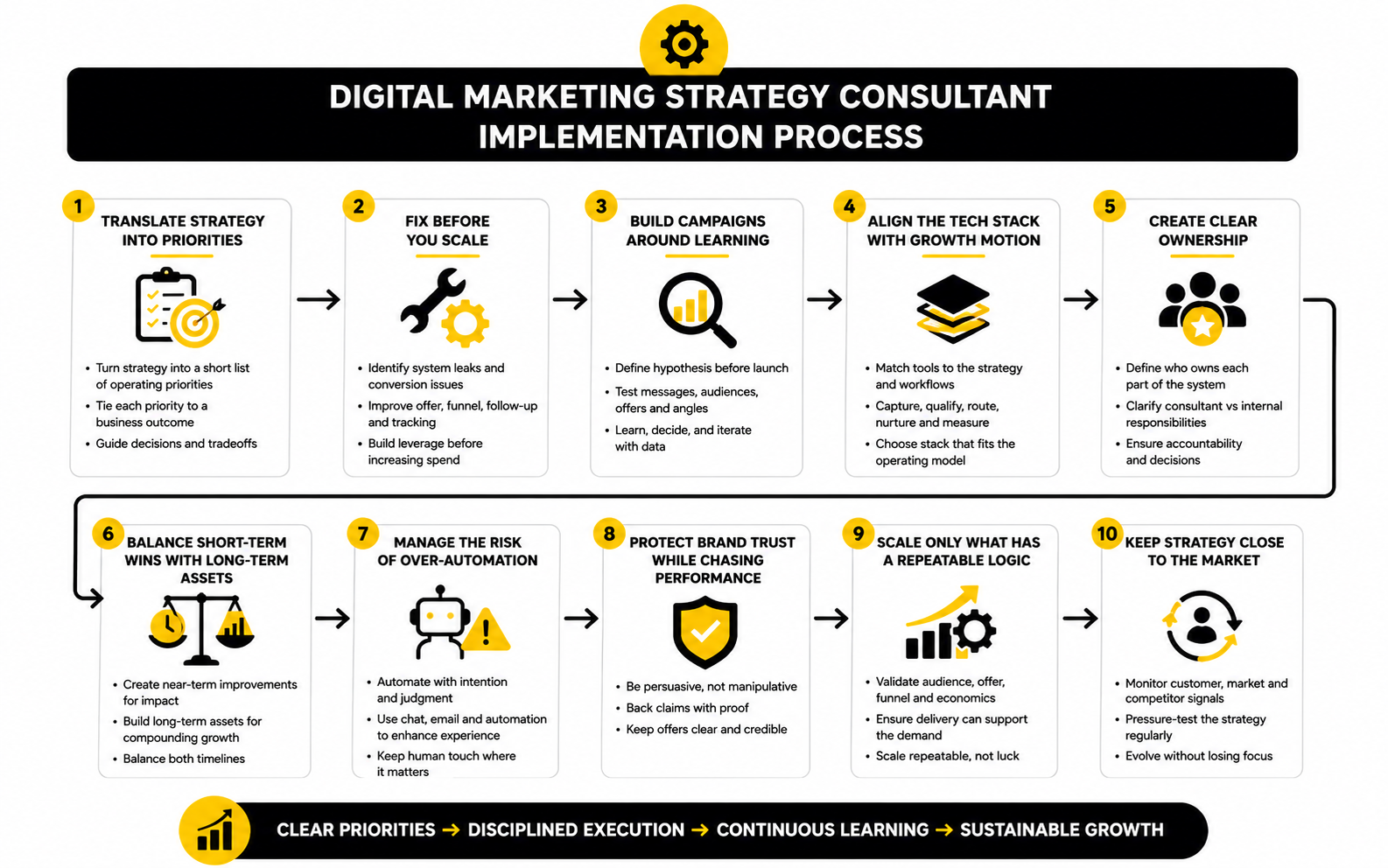
A simple process can look like this:
That sequence keeps the work grounded. It prevents the team from jumping into tool setup before the offer is clear. It also prevents content creation, ad testing, and automation from becoming disconnected projects that never form a proper growth system.
Build The Core Conversion Assets First
Before scaling traffic, the business needs conversion assets that can handle attention properly. This usually includes the website, landing pages, offer pages, lead magnets, booking flows, checkout flows, email sequences, sales scripts, retargeting audiences, and proof assets. These pieces do not need to be perfect, but they do need to be aligned.
This is where tools can help, as long as the strategy comes first. A business building campaign-specific landing pages might use Replo for ecommerce pages or ClickFunnels for funnel-based offers. A service business that needs CRM, pipelines, automation, and follow-up in one place might use GoHighLevel.
The tool choice should support the conversion path, not define it. If the offer is weak, the funnel builder will not save it. If the follow-up message is generic, the automation platform will only send generic messages faster. Strategy decides what the asset must do before software helps build it.
Map Channels To Jobs
Every channel needs a job. SEO may capture existing demand. Paid ads may test offers and scale proven acquisition paths. Email may nurture leads and increase repeat purchases. Social may build trust, create familiarity, and distribute point-of-view content. Partnerships may open access to audiences that are expensive to reach directly.
The problem starts when a business expects every channel to do everything. Social is blamed for not closing enough sales. SEO is judged too early. Paid ads are expected to fix weak positioning. Email is treated like a newsletter instead of a revenue and relationship channel.
A digital marketing strategy consultant should make the role of each channel explicit. That makes performance easier to judge fairly. It also helps the team create better content, better campaigns, and better expectations for each part of the customer journey.
Create A Measurement System That Supports Decisions
Measurement should help the team make decisions, not just produce reports. A good measurement system connects leading indicators, conversion metrics, revenue outcomes, and learning from tests. It should show what is happening clearly enough that the team can decide what to keep, improve, scale, or stop.
This is especially important because attribution is imperfect. A buyer may discover the brand through social, return through search, compare options through review content, join the email list, and convert after a sales call. If the business only credits the last click, it may underinvest in the channels that created trust.
The better approach is to combine multiple views. Look at source-level performance, CRM stages, conversion rates, pipeline quality, cohort behavior, customer acquisition cost, retention, and qualitative sales feedback. Salesforce’s marketing research continues to point toward the importance of connected data and personalization across the customer experience, based on insights from thousands of marketing leaders. The practical takeaway is simple: disconnected data creates disconnected decisions.
Review, Learn, And Tighten The System
The final part of the framework is the review loop. Marketing strategy is not something you define once and then frame on the wall. It has to be reviewed against real buyer behavior, campaign performance, sales feedback, and revenue quality.
A strong consultant helps the team interpret results without panicking. One failed test does not mean the strategy is wrong. One winning campaign does not mean the whole business is fixed. The goal is to build a rhythm where each campaign improves the system.
That rhythm usually includes weekly performance checks, monthly strategy reviews, and quarterly priority resets. Weekly checks keep execution moving. Monthly reviews look for patterns. Quarterly resets make sure the strategy still matches the market, budget, team capacity, and business goals.
The Framework Only Works When It Forces Choices
The value of a framework is not that it looks nice in a document. The value is that it forces better choices under pressure. When the team is busy, the budget is limited, and everyone has an opinion, the framework keeps the business focused on the next most useful move.
That is the difference between random marketing activity and strategic execution. Random activity asks, “What else can we do?” Strategic execution asks, “What is the constraint, what is the next move, and what will prove we are right or wrong?”
A digital marketing strategy consultant should leave the business with that kind of operating clarity. Not just a list of tactics. Not just a prettier funnel. A practical system for making marketing decisions that compound instead of constantly starting from scratch.
Statistics And Data That Actually Help Strategy
Data is only useful when it changes a decision. A dashboard full of clicks, impressions, open rates, rankings, and conversion percentages can look impressive, but it does not automatically make the business more carefully. A digital marketing strategy consultant should help the team separate performance signals from noise, then connect those signals to actions that improve revenue.
This matters because marketing data is easy to misread. A campaign can have a low cost per lead and still attract the wrong buyers. A page can have strong traffic and weak revenue impact. An email can get high opens because the subject line is clever, while the offer still fails to move people forward.
Good measurement starts with one question: what decision are we trying to make? If the answer is unclear, the metric probably is not ready for the dashboard yet. Strategy turns data into judgment, not decoration.
The Numbers Should Match The Business Model
The first mistake is comparing your numbers to the wrong business. A local service company, ecommerce store, B2B SaaS company, creator business, agency, and enterprise software firm do not need the same benchmarks. Their sales cycles, margins, conversion paths, retention patterns, and customer values are completely different.
That is why a consultant should start by defining the economics behind the strategy. The important numbers usually include average order value, customer lifetime value, gross margin, sales cycle length, lead-to-close rate, repeat purchase rate, refund rate, churn, and payback period. Without those numbers, channel performance is too easy to judge in isolation.
For example, a $40 lead may be expensive for a low-margin offer but excellent for a high-ticket service with strong close rates. A 2% landing page conversion rate may be weak for a simple lead magnet but acceptable for a complex enterprise demo request. The number only means something when it is interpreted through the business model.
Budget Pressure Makes Measurement More Important
When marketing budgets are tight, measurement discipline becomes a competitive advantage. Gartner’s 2025 CMO Spend Survey found that marketing budgets remained flat at 7.7% of overall company revenue, which means many teams are expected to improve performance without receiving much more room to waste money. That is exactly when shallow reporting becomes dangerous.
Flat budgets force harder choices. The business has to know which channels deserve more investment, which campaigns need fixing, which offers are underperforming, and which activities only look productive because they create visible activity. A digital marketing strategy consultant helps create a measurement system that supports those decisions.
The point is not to track everything. The point is to track the few things that tell the team where growth is being created, blocked, or diluted. When the budget is limited, clarity is not a luxury. It is protection.
Build An Analytics System Around The Customer Journey
A useful analytics system follows the customer journey from attention to revenue. It should show how people discover the business, what they engage with, where they convert, how qualified they are, how sales handles them, and whether they become profitable customers. If the dashboard stops at form fills or purchases, it may miss the real story.
The simplest way to structure the system is by journey stage. Awareness metrics show whether the market is noticing the brand. Engagement metrics show whether the message is relevant. Conversion metrics show whether the offer and page are working. Sales metrics show whether leads are qualified and moving. Retention metrics show whether the acquisition strategy is attracting customers worth keeping.
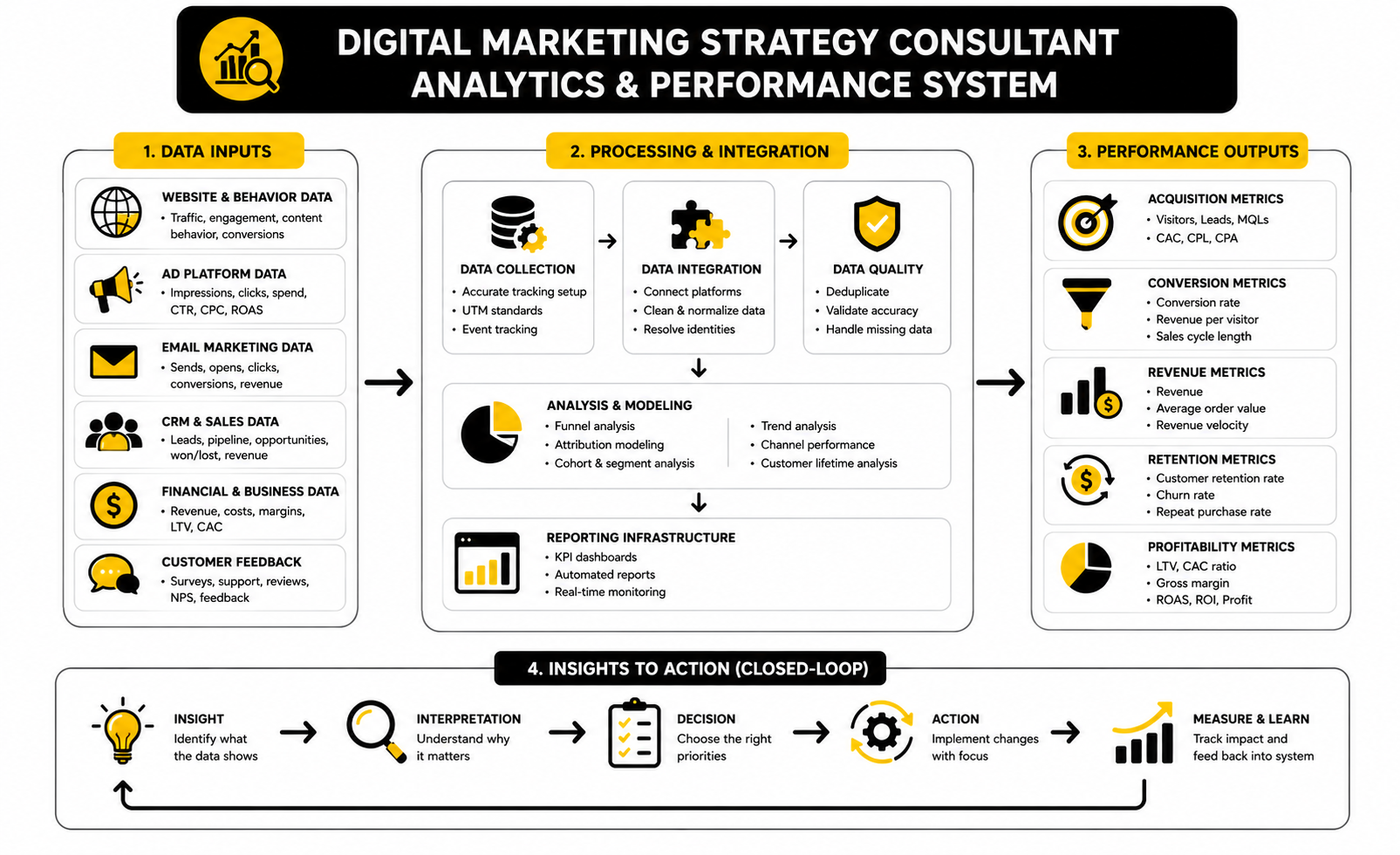
This structure helps prevent bad decisions. If traffic is rising but qualified leads are flat, the issue may be audience quality or message fit. If leads are rising but sales are flat, the issue may be qualification, follow-up, pricing, or trust. If first purchases are rising but repeat purchases are weak, the acquisition strategy may be creating short-term wins but poor long-term economics.
Track Leading And Lagging Indicators
Lagging indicators tell you what already happened. Revenue, profit, customer acquisition cost, lifetime value, churn, and close rate are critical, but they usually appear after the work has already been done. You need them, but you cannot manage the whole strategy by looking backward.
Leading indicators give earlier clues. Search visibility, qualified traffic, content engagement, landing page conversion rate, booked calls, email click behavior, pipeline movement, demo attendance, cart recovery, and sales response speed can all reveal whether the system is getting healthier before final revenue shows up. A consultant should define which leading indicators matter for the specific growth model.
The trick is not to treat every leading indicator as a goal. A higher click-through rate is useful only if it improves the next step. More traffic is useful only if it brings the right audience. More leads are useful only if the business can convert and serve them profitably.
Benchmarks Are Starting Points, Not Strategy
Benchmarks are helpful because they give context, but they should never replace diagnosis. If your conversion rate is below an industry average, that does not automatically tell you what to fix. The problem could be traffic quality, page speed, offer clarity, pricing, proof, form friction, sales alignment, or audience mismatch.
This is why serious measurement compares performance in layers. Look at your own baseline first. Then compare performance by channel, audience, offer, device, page type, and funnel stage. Only after that should outside benchmarks influence the conversation.
HubSpot’s 2025 ROI data found that customers using Campaign Assistant and Content Assistant had a 54% higher lead conversion rate than comparable customers who had not used those AI features. That is useful context, but the real lesson is not “use AI and expect the same lift.” The real lesson is that better campaign execution, faster iteration, and stronger content workflows can improve conversion when they are connected to a clear strategy.
Conversion Metrics Need Context
Conversion rate is one of the most abused metrics in digital marketing. Everyone wants it to go up, but not every increase is good. You can raise conversion rate by making the offer cheaper, lowering qualification standards, overpromising, or attracting people who are unlikely to become good customers.
A digital marketing strategy consultant should look beyond the surface number. The better question is whether the conversion rate is improving while lead quality, revenue quality, and customer fit stay strong. If conversion goes up but close rate drops, the funnel may be creating volume without value.
This is especially important for service businesses and high-ticket offers. A landing page that gets fewer leads but more qualified calls can be better than a page that produces a flood of weak inquiries. The goal is not maximum conversion at any cost. The goal is profitable conversion.
Channel Metrics Should Explain Channel Roles
Each channel needs its own performance logic. SEO should not be judged only by immediate conversions if it is also building demand capture and trust. Paid ads should not be judged only by cost per click if the real issue is lead quality or payback period. Email should not be judged only by open rate when clicks, replies, purchases, and lifecycle movement matter more.
A consultant should help the business assign the right metrics to each channel. For paid acquisition, that may include cost per qualified lead, cost per acquisition, return on ad spend, payback period, and creative fatigue. For SEO, it may include qualified organic traffic, ranking growth for commercial topics, assisted conversions, and content-to-pipeline influence. For email, it may include list growth quality, click rate, revenue per recipient, nurture progression, and unsubscribe patterns.
Tools can support the work, but they should not define the work. Brevo can help manage email campaigns and automation, ManyChat can support messaging flows, and GoHighLevel can connect CRM, pipelines, and follow-up. But the reporting logic still has to come from the strategy.
Attribution Should Be Useful, Not Perfect
Attribution is messy because buyers are messy. They do not move through your funnel in a clean straight line. They might discover you through social, search your brand later, read comparison content, join your email list, click a retargeting ad, and finally convert after a call.
That is why chasing perfect attribution can waste time. The better goal is useful attribution. You want enough visibility to understand which channels create demand, which capture demand, which assist trust, and which close revenue.
This usually requires combining platform data, analytics data, CRM data, call tracking, customer surveys, and sales notes. Salesforce’s State of Marketing research is based on insights from nearly 4,500 marketers worldwide and continues to emphasize AI, data, and personalization as connected priorities, not separate projects. That connection is the point: your attribution system should help the team see how the journey works together.
Watch For Signals That The Strategy Is Working
A good strategy does not always show up as instant revenue. Sometimes the first signs are smaller but still meaningful. The right audience starts engaging more. Sales calls become better qualified. Email replies improve. Paid ads need fewer extreme claims to get attention. Organic traffic starts moving toward commercial pages, not just generic blog posts.
Those signals matter because they show that the system is becoming more aligned. Positioning is landing. The offer is clearer. The buyer journey is easier to follow. The team is learning which messages create real intent instead of just activity.
Still, signals should lead to action. If a message works in paid ads, test it on landing pages and email subject lines. If one audience converts better, build more content and offers around that segment. If sales keeps hearing the same objection, create assets that handle it earlier in the journey.
Know When The Data Is Warning You
Data is not only there to confirm what is working. It should also warn you when the strategy is drifting. Rising traffic with falling conversion can mean the content strategy is attracting the wrong people. Lower ad costs with worse lead quality can mean the platform is optimizing for cheap actions instead of real buyers. Strong email opens with weak clicks can mean curiosity is high but intent is low.
The warning signs are often visible before revenue drops. Slower pipeline movement, weaker sales notes, higher refund rates, lower repeat purchase, declining branded search, and increasing dependence on discounts can all point to strategic problems. A consultant should know how to read those patterns early.
This is where data becomes practical. You do not need to panic every time a metric moves. You need to understand which movement matters, what it probably means, and what action should happen next.
The Best Measurement System Creates Better Decisions
The final test of a marketing analytics system is simple: does it make decisions easier? If the team still argues from opinions after looking at the dashboard, the dashboard is not doing its job. If reports are long but priorities remain unclear, the measurement system needs to be simplified.
A strong system shows what is working, what is blocked, what changed, and what the next decision should be. It does not bury the team in data. It gives the business enough clarity to focus budget, attention, creative work, and follow-up where they can create the most leverage.
That is what a digital marketing strategy consultant should bring to measurement. Not random statistics. Not vanity dashboards. A practical way to turn performance signals into better strategy, better execution, and better growth decisions.
How Professional Implementation Works
Professional implementation is where strategy stops being theory. This is the part where the digital marketing strategy consultant helps the business turn priorities into campaigns, assets, systems, meetings, owners, and review cycles. It is less glamorous than a big strategy presentation, but it is where most of the value is created.
The hard truth is that many marketing strategies fail after approval, not during planning. Everyone agrees with the direction, then daily work pulls the team back into old habits. The content calendar gets filled before the positioning is sharpened. Ads are launched before the funnel is fixed. Automation is built before the follow-up logic is clear.
A serious implementation process prevents that drift. It gives the team a way to move from insight to execution without losing the strategic thread.
Translate Strategy Into Operating Priorities
The first implementation step is turning the strategy into a short list of operating priorities. This should not be a giant backlog. It should be a focused set of decisions that tells the team what matters most right now.
A digital marketing strategy consultant may define priorities like improving lead quality, increasing landing page conversion, building a stronger organic acquisition base, tightening lifecycle marketing, or reducing sales leakage. Each priority should be tied to a business outcome, not just a channel metric. “Post more on LinkedIn” is not a strategic priority. “Build authority with enterprise buyers before sales outreach” is much closer.
This difference matters because priorities guide tradeoffs. When the team gets busy, the priority tells them what to protect. When a new idea appears, the priority tells them whether it belongs now or later.
Decide What To Fix Before You Scale
Scaling too early is one of the most expensive mistakes in digital marketing. If the offer is unclear, more traffic only exposes more people to confusion. If the sales follow-up is weak, more leads only create a bigger leak. If retention is poor, more acquisition can quietly make the business less healthy.
A consultant should help the business identify the parts of the system that need fixing before more budget is added. This usually means looking at the conversion path, lead quality, sales cycle, onboarding experience, retention, and the reliability of tracking. The question is not “Can we spend more?” The question is “Will spending more produce better customers at acceptable economics?”
That is why implementation often begins with repair work. It may not feel as exciting as a new campaign, but it creates leverage. A better offer page, cleaner CRM stages, stronger sales handoff, or improved nurture sequence can make every future campaign perform better.
Build Campaigns Around Learning, Not Guessing
Every campaign should teach the business something. It may teach which audience segment responds best, which promise creates intent, which objection blocks action, or which creative angle deserves more investment. If a campaign only produces a yes-or-no result, the team is not learning enough.
This is where expert implementation becomes more disciplined. A consultant should help define the hypothesis before the campaign launches. They should clarify what is being tested, what result would count as a win, what result would count as a warning, and what the next decision will be after the data comes in.
This approach is especially important now because AI has made it easier to produce more campaign variations. McKinsey’s 2025 AI research notes that many organizations use AI, but the companies seeing stronger value are more likely to redesign workflows instead of simply adding tools to existing processes through AI-driven workflow redesign. In marketing, that means AI should support faster learning loops, not just more output.
Align The Tech Stack With The Growth Motion
The tech stack should match the strategy. That sounds obvious, but many businesses do it backward. They buy software, then reshape their marketing around what the tool makes easy.
A digital marketing strategy consultant should look at what the business actually needs the stack to do. Does it need to capture leads, qualify them, route them to sales, automate follow-up, personalize content, recover abandoned carts, support booking, measure attribution, or manage customer lifecycle communication? The answer should define the tool requirements.
For service businesses, GoHighLevel can be useful when CRM, pipelines, appointment booking, email, SMS, and automation need to live closer together. For funnel-led offers, ClickFunnels can support structured sales paths. For lean operators who need simple funnels and email in one place, Systeme.io may fit better. The right choice depends on the operating model, not on which platform has the loudest marketing.
Create Clear Ownership
Implementation breaks when nobody owns the outcome. A team may have writers, designers, media buyers, developers, sales reps, automation specialists, and leadership involved, but that does not mean ownership is clear. Without ownership, tasks move but priorities stall.
A consultant should help define who owns each part of the growth system. One person may own offer messaging. Another may own landing page performance. Another may own paid testing. Another may own CRM hygiene and follow-up. Leadership should own the tradeoffs and approve the priorities, but daily execution needs clear accountability.
This also protects the consultant-client relationship. If the consultant is responsible for strategy but the internal team owns implementation, that needs to be explicit. If the consultant is expected to manage execution, that should be scoped properly. Ambiguity creates frustration on both sides.
Balance Short-Term Wins With Long-Term Assets
A good implementation plan usually has two timelines. The first timeline creates near-term improvement, such as better landing pages, stronger follow-up, cleaner offers, or more focused campaigns. The second timeline builds compounding assets, such as search visibility, brand authority, lifecycle automation, customer research, partnerships, and better data infrastructure.
The mistake is choosing only one. If the business focuses only on short-term wins, it becomes dependent on constant campaign pressure. If it focuses only on long-term assets, it may run out of patience, cash, or internal support before the strategy proves itself.
A digital marketing strategy consultant should balance both. For example, paid testing can reveal which messages convert now, while SEO content turns the winning insights into long-term demand capture. Email automation can improve immediate follow-up, while customer research improves the entire positioning system over time.
Manage The Risk Of Over-Automation
Automation is powerful, but it can damage trust when it is used without judgment. A bad automated sequence feels cold. A poorly timed chatbot creates friction. A generic AI response can make a brand look careless. The more automation you add, the more important the strategy becomes.
This is especially true in customer-facing communication. A tool like ManyChat can help manage conversational flows, and Chatbase can help answer repetitive website questions. But both need strong source material, clear escalation paths, and a real understanding of what customers are trying to do.
The risk is not automation itself. The risk is automating a bad experience. A consultant should help the business decide which touchpoints can be automated, which should stay human, and where automation should simply support a better handoff.
Protect Brand Trust While Chasing Performance
Performance marketing can become too aggressive when the only goal is short-term conversion. Discounts get overused. Claims get stretched. Scarcity gets manufactured. Creative becomes louder but less credible. That can work for a while, but it slowly trains the market not to trust the brand.
A digital marketing strategy consultant should protect the balance between performance and trust. The goal is not to make marketing soft. The goal is to make it persuasive without becoming desperate.
This is where messaging discipline matters. Strong claims need proof. Urgency needs a real reason. Offers need to be clear without being manipulative. The best marketing makes action feel obvious, not pressured.
Know When To Specialize And When To Simplify
As a business grows, the marketing system usually becomes more specialized. Paid search, paid social, SEO, lifecycle marketing, conversion optimization, analytics, partnerships, and creative may all need deeper expertise. The challenge is knowing when specialization helps and when it creates complexity.
Specialization helps when the business has enough volume, budget, and data to support expert optimization. It hurts when too many specialists work without one strategic direction. That is when teams become fragmented and every channel starts defending its own metrics.
A consultant can act as the connective layer. They do not need to personally execute every channel. But they should understand enough to keep the work aligned, challenge weak assumptions, and make sure each specialist is contributing to the same growth objective.
Scale Only What Has A Repeatable Logic
Scaling should not mean spending more because one campaign had a good week. It should mean the business has found a repeatable logic. The audience is clear. The offer is converting. The economics make sense. The follow-up is working. The delivery side can handle the demand.
That is the standard. Anything less is not scaling; it is gambling with a bigger budget. A digital marketing strategy consultant should be willing to slow the business down when the foundation is not ready, even if everyone wants growth faster.
Repeatability gives the team confidence. It tells them which message to expand, which channel to fund, which funnel to improve, and which audience to pursue next. Once that logic exists, scaling becomes less emotional and much more practical.
Keep Strategy Close To The Market
Markets move, competitors adjust, buyers change, and channels mature. A strategy that worked six months ago may still be directionally right, but the details need regular pressure-testing. That does not mean constantly reinventing the plan. It means keeping the plan close to reality.
The consultant should help the team stay connected to customer conversations, sales objections, search behavior, campaign data, social feedback, support questions, and competitive moves. Salesforce’s State of Marketing research highlights how AI, data, and personalization are becoming connected priorities for nearly 4,500 marketers worldwide, which makes market awareness even more important. Better tools do not remove the need to listen.
This is the expert-level habit most businesses miss. They build a strategy, then drift away from the market while executing it. The best teams keep learning from the market every week and use those signals to sharpen the system without losing focus.
The Consultant Should Leave The Business Stronger
The best implementation does not make the business dependent on the consultant forever. It improves the way the team thinks, decides, measures, and executes. That is a big difference.
A strong digital marketing strategy consultant leaves behind clearer positioning, better priorities, improved assets, cleaner reporting, sharper workflows, and a team that understands why the strategy works. The business should be able to make better decisions after the engagement than it could before.
That is the real standard. Not just more campaigns. Not just more tools. A stronger marketing operating system that can keep improving after the consultant steps out of the room.
How To Choose The Right Consultant And What To Ask Before Hiring
Choosing a digital marketing strategy consultant is not about finding the person with the loudest personal brand or the prettiest framework. It is about finding someone who can diagnose the real growth constraint, make practical tradeoffs, and help your team execute with more clarity. The wrong consultant gives you more ideas. The right consultant gives you better decisions.
This distinction matters because strategy work sits close to money, positioning, customer trust, sales performance, and team capacity. A weak recommendation can waste months. A strong recommendation can make every campaign, landing page, sales call, and follow-up sequence work harder.
The best consultants do not pretend that every business needs the same playbook. They ask sharp questions, challenge lazy assumptions, and explain the logic behind their priorities. You should feel more clear after speaking with them, not more impressed and confused.
Look For Diagnosis Before Recommendations
A good consultant should not prescribe the solution before understanding the problem. If someone immediately says you need paid ads, SEO, funnels, AI automation, email sequences, or a full rebrand without seeing the business model, customer journey, and current numbers, be careful. That is not strategy. That is selling a preferred tactic.
A proper diagnosis looks at the full growth system. It should include the offer, audience, positioning, channel performance, conversion path, sales follow-up, retention signals, and reporting quality. The consultant should be able to explain where growth is being blocked and why that issue matters more than the other problems competing for attention.
This is especially important when budgets are under pressure. Gartner’s 2025 CMO Spend Survey found that marketing budgets stayed flat at 7.7% of overall company revenue, so businesses cannot afford to treat marketing spend like a guessing game. Diagnosis protects the budget before execution begins.
Check Whether They Understand Revenue, Not Just Channels
A digital marketing strategy consultant should understand how marketing turns into revenue. That means they need to think beyond impressions, rankings, clicks, followers, and leads. Those numbers matter, but they are not the finish line.
Ask how they evaluate customer acquisition cost, payback period, lead quality, sales cycle length, lifetime value, retention, and margin. Ask how they decide whether a channel is underperforming or simply playing a different role in the journey. Ask how they would separate a traffic problem from a conversion problem or a conversion problem from a sales problem.
The answers should be practical. You are not looking for jargon. You are looking for someone who can explain the business impact of marketing decisions in plain language.
Ask How They Handle Tradeoffs
Strategy is tradeoffs. Any consultant can create a long list of things to improve. The real value is knowing what should happen first, what can wait, and what should be ignored completely.
This is where you learn how the consultant thinks. Ask them what they would cut if the budget were reduced by 30%. Ask what they would prioritize if the team only had one marketer and one developer. Ask what they would do if leadership wanted fast wins but the funnel clearly needed repair first.
Strong consultants have a point of view. They may not have the full answer before the audit, but they should have a decision-making logic. Weak consultants avoid tradeoffs because tradeoffs create accountability.
Make Sure They Can Work With Your Team
A strategy that your team cannot execute is not useful. Before hiring a consultant, look at your internal capacity honestly. Do you have someone who can write? Someone who can build pages? Someone who can manage campaigns? Someone who can clean up CRM data? Someone who can make decisions quickly?
The consultant should adapt the strategy to the team you actually have. A five-person startup does not need the same operating rhythm as a mature company with channel specialists. A service business with founder-led sales does not need the same execution plan as an ecommerce brand with daily paid media testing.
This is also where tools should be chosen carefully. If the team needs one place to manage CRM, pipelines, booking, and follow-up, GoHighLevel may support the operating model. If the team needs simpler campaign pages and offer flows, ClickFunnels or Systeme.io may make more sense. The consultant should match the stack to the workflow, not force the workflow into a favorite stack.
Watch For Red Flags
Some red flags are obvious. Guaranteed results, vague case studies, fake urgency, and one-size-fits-all packages should make you pause. The bigger red flags are more subtle.
Be careful when a consultant talks only about tactics and never about constraints. Be careful when they cannot explain how they measure success beyond channel metrics. Be careful when they recommend major software changes before understanding your process. Be careful when they avoid discussing sales quality, customer retention, or operational capacity.
A strong consultant will not make the work sound effortless. They will make it sound clearer. That is very different.
The Final System Should Be Easier To Run
By the end of a good engagement, the business should have a cleaner growth system. The audience should be clearer. The offer should be easier to explain. The channel roles should make sense. The reporting should support decisions. The team should know what to do next without needing another emergency brainstorm every week.
That is the final system you are trying to build. It is not a stack of disconnected tactics. It is not a pile of dashboards. It is not another strategy document sitting in a folder. It is a practical operating model for growth.
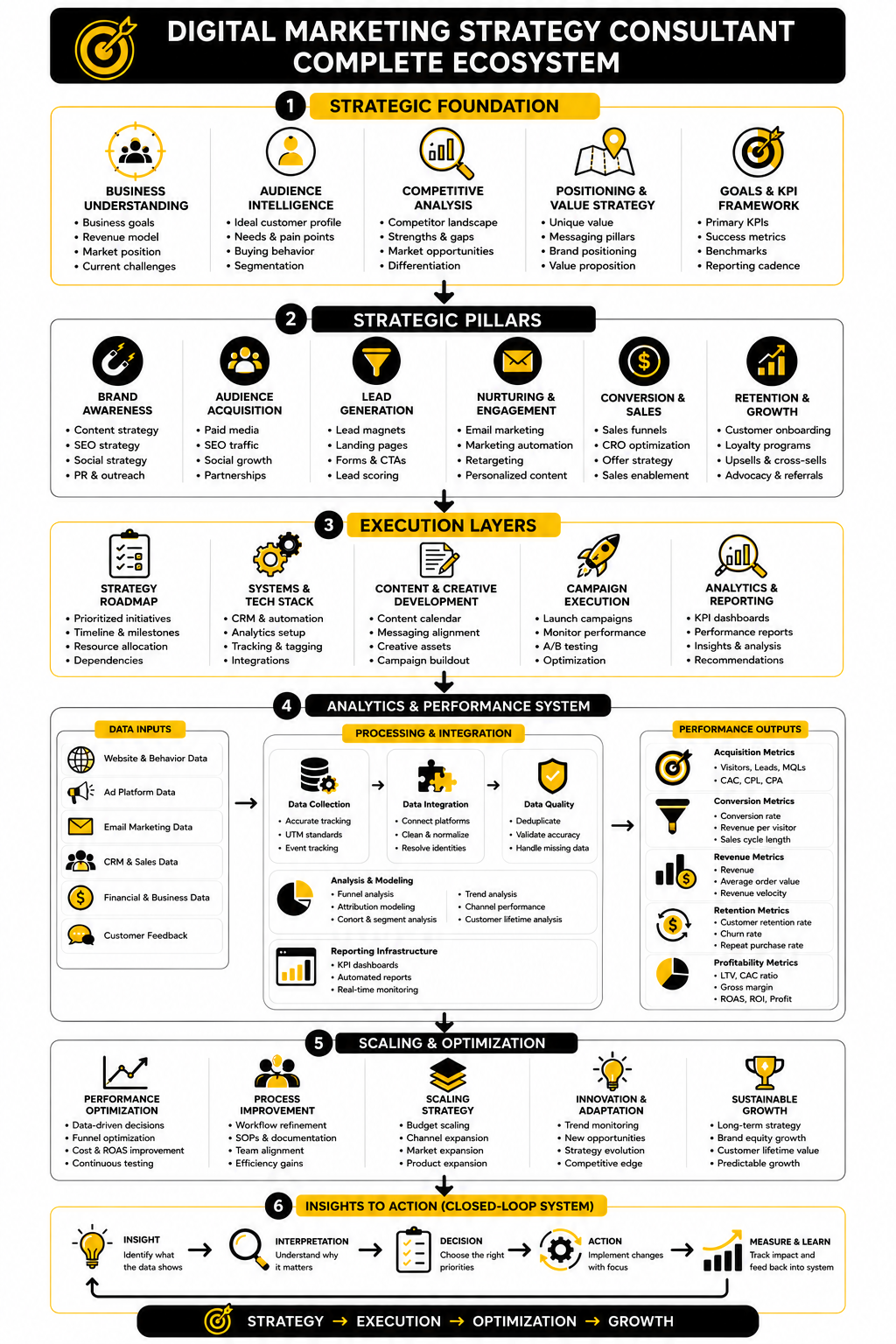
The right consultant helps create that system, then helps the business keep improving it. They should leave behind stronger thinking, better assets, cleaner execution, and a team that understands the logic behind the plan. That is what makes the investment worthwhile.
What does a digital marketing strategy consultant do?
A digital marketing strategy consultant helps a business decide how to use digital channels to create measurable growth. They usually work on positioning, audience strategy, offer clarity, channel planning, funnel structure, analytics, and execution priorities. The goal is not just more marketing activity, but a clearer system that turns attention into revenue.
When should a business hire a digital marketing strategy consultant?
A business should consider hiring one when marketing feels busy but revenue is not improving enough. This often happens when traffic is growing but conversions are weak, paid ads are expensive, leads are low quality, or the team is unsure what to prioritize next. A consultant is especially useful before scaling spend, launching a new offer, entering a new market, or rebuilding the marketing system.
How is a strategy consultant different from a marketing agency?
A marketing agency usually executes specific services, such as ads, SEO, content, email, or social media. A digital marketing strategy consultant focuses on direction, diagnosis, priorities, and the system behind the execution. Some consultants also manage implementation, but their main value is helping the business make better decisions before and during execution.
What should I ask before hiring a consultant?
Ask how they diagnose growth problems, how they define success, and how they choose priorities. You should also ask how they handle tradeoffs, what data they need, how they work with internal teams, and what they expect from leadership. Their answers should be clear, practical, and specific to your business model.
How long does digital marketing strategy work take?
The timeline depends on the scope. A focused audit may take less time than a full strategy and implementation engagement. What matters more than the calendar is whether the consultant has enough access to the right information, including analytics, CRM data, customer insight, sales feedback, current campaigns, and business goals.
What data should I prepare before working with a consultant?
Prepare website analytics, ad account data, CRM reports, email performance, sales conversion numbers, customer research, offer details, pricing, margins, and retention data where available. You do not need everything to be perfect before starting. A strong consultant can also help identify what is missing and build a cleaner measurement system.
Can a consultant help if my business has very little data?
Yes, but the strategy will rely more heavily on qualitative research, customer interviews, competitive review, offer analysis, and early testing. Lack of data is not a reason to avoid strategy. It just means the first phase should focus on learning quickly and building a measurement foundation.
Should a consultant choose our marketing tools?
They can advise on tools, but tool selection should come after strategy. The consultant should first understand the growth motion, team capacity, customer journey, and reporting needs. Only then should they recommend platforms for CRM, landing pages, automation, email, chat, analytics, or content operations.
What makes a digital marketing strategy successful?
A successful strategy creates sharper focus, better execution, and clearer learning. It should improve how the business chooses audiences, positions offers, assigns channel roles, measures performance, and decides what to scale or stop. The best sign is not just a better campaign; it is a team that makes better marketing decisions consistently.
What are the biggest mistakes businesses make with digital marketing strategy?
The biggest mistakes are scaling traffic before fixing conversion, buying tools before defining workflows, measuring vanity metrics, copying competitors, and trying to work on every channel at once. Another major mistake is treating strategy as a document instead of an operating system. Strategy only matters when it changes decisions and execution.
How much should I rely on benchmarks?
Benchmarks are useful for context, but they should not control the strategy. Your own economics, audience, offer, funnel, and sales process matter more than a generic industry average. A good consultant uses benchmarks as reference points, then interprets your actual performance against your business model.
Can AI replace a digital marketing strategy consultant?
AI can support research, drafting, analysis, automation, and testing, but it does not replace strategic judgment. McKinsey’s 2025 AI research shows stronger value when companies redesign workflows around outcomes rather than simply adding tools through workflow redesign and clearer business goals. A consultant helps decide what should be automated, what needs human judgment, and how AI fits into the growth system.
What should the final deliverable look like?
The final deliverable should be practical enough to use. It may include a growth diagnosis, strategic priorities, audience and positioning guidance, funnel recommendations, channel roles, campaign roadmap, measurement plan, and implementation workflow. The best deliverable is not the longest document; it is the one that makes the next decisions obvious.
Build a stronger local presence with BAAM AI
Turn your website, Google profile, social channels, and AI visibility into one growth engine
Most businesses do not need more random marketing activity. They need a consistent presence system that helps the right people find them, trust them, and take action. BAAM AI brings strategy, local SEO, website updates, Google Maps visibility, social content, AI-search readiness, media production, and reporting into one practical monthly engine.
If you want your marketing to keep working after the campaign ends, start with a free BAAM AI presence audit. See how your business shows up today and where the fastest visibility wins are at BAAM AI.