
BAAM AI Blog
Digital Marketing Solutions: A Practical Framework for Building a Revenue-Ready Growth System
Digital marketing solutions are no longer just a bundle of tools, ads, landing pages, emails, dashboards, and social posts. They are the operating system behind how a business gets discovered, earns trust, converts...
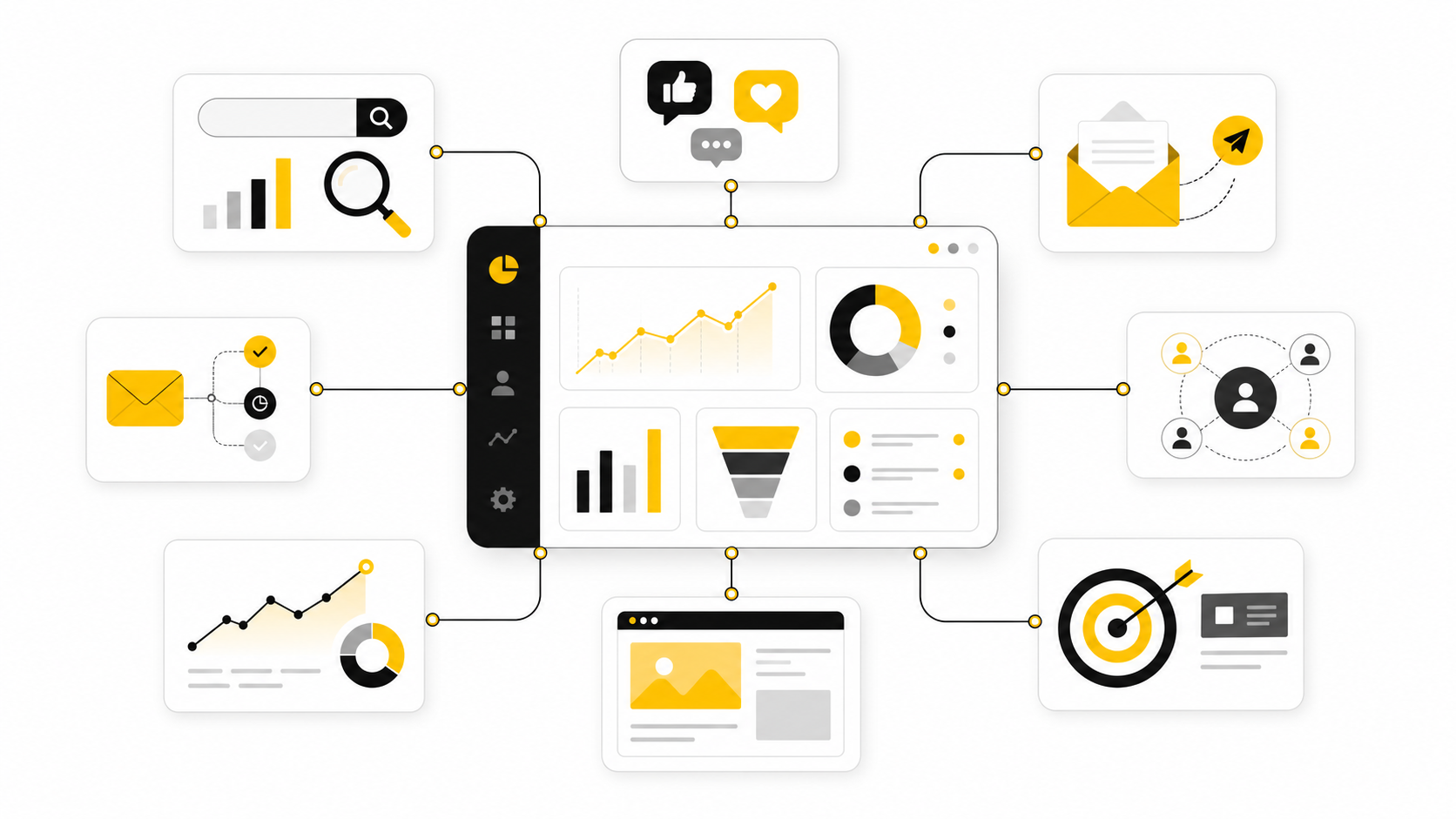
Digital marketing solutions are no longer just a bundle of tools, ads, landing pages, emails, dashboards, and social posts. They are the operating system behind how a business gets discovered, earns trust, converts demand, and keeps customers engaged after the first sale. When those pieces are disconnected, marketing becomes noisy, expensive, and difficult to scale.
That matters because the market has moved hard toward digital-first growth. U.S. internet advertising revenue reached nearly $294.6 billion in 2025, while digital channels now account for 61.1% of total marketing spend. At the same time, marketing budgets are not magically expanding, with Gartner reporting that average marketing budgets stayed flat at 7.7% of company revenue in 2025.
So the question is not whether a business needs digital marketing. The real question is whether its digital marketing solutions work together as one system or fight each other as disconnected tactics. this guide breaks that system down in a practical way, so you can understand what belongs where, what to prioritize, and how to build marketing that actually supports revenue.
this guide is split into six connected parts, and each part builds on the previous one. The goal is to move from strategy to execution without turning the topic into vague theory. By the end, you should have a clear view of what a modern digital marketing system needs and how the major components fit together.
Why Digital Marketing Solutions Matter Now
Digital marketing used to be easier to separate into neat boxes. SEO brought traffic, email nurtured leads, paid ads created volume, social media built awareness, and websites acted as digital brochures. That model is too simple now because buyers move across channels, compare options quickly, expect personalization, and often research long before they ever speak to a business.
The pressure is especially obvious when you look at customer expectations. Salesforce found that 73% of customers say companies treat them as individuals rather than numbers, but the same research also shows customers are becoming more protective of their personal information. That creates a serious challenge: businesses need to personalize without being careless, automate without sounding robotic, and measure performance without damaging trust.
This is why digital marketing solutions should be judged by how well they connect the full customer journey. A good solution does not simply launch campaigns. It helps a business attract the right audience, capture demand, qualify interest, deliver relevant follow-up, improve conversion, and measure what actually drives pipeline or sales.
The businesses that win are usually not the ones doing the most random activity. They are the ones with a clear growth system. That system might include content, paid media, CRM, email automation, chat, analytics, landing pages, social scheduling, lead scoring, and sales follow-up, but the value comes from how those pieces work together.
The Digital Marketing Solutions Framework
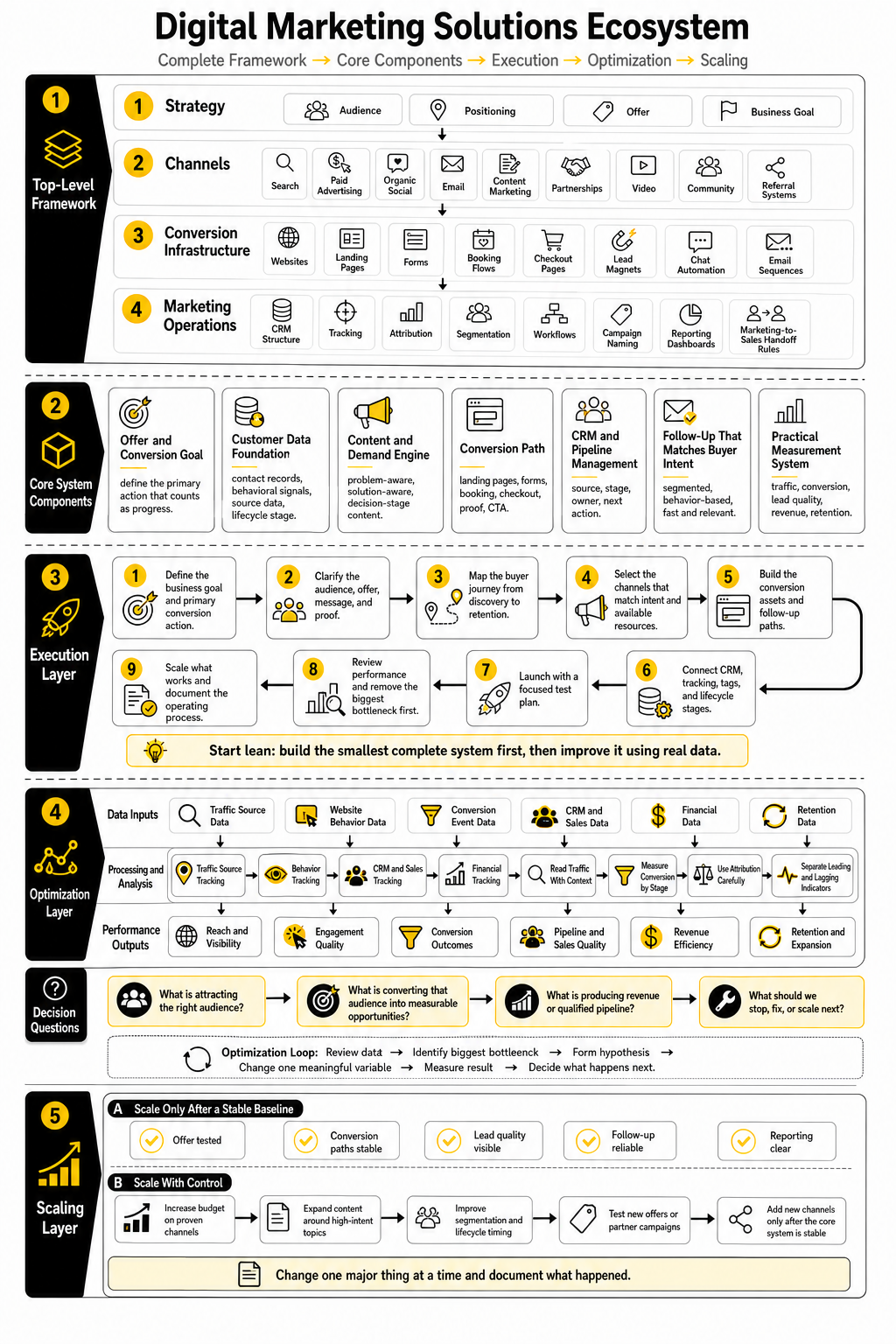
A practical framework for digital marketing solutions starts with four layers: strategy, channels, conversion, and operations. Strategy defines the audience, positioning, offer, and business goal. Channels create visibility, conversion assets turn attention into action, and operations make the system repeatable through data, automation, process, and reporting.
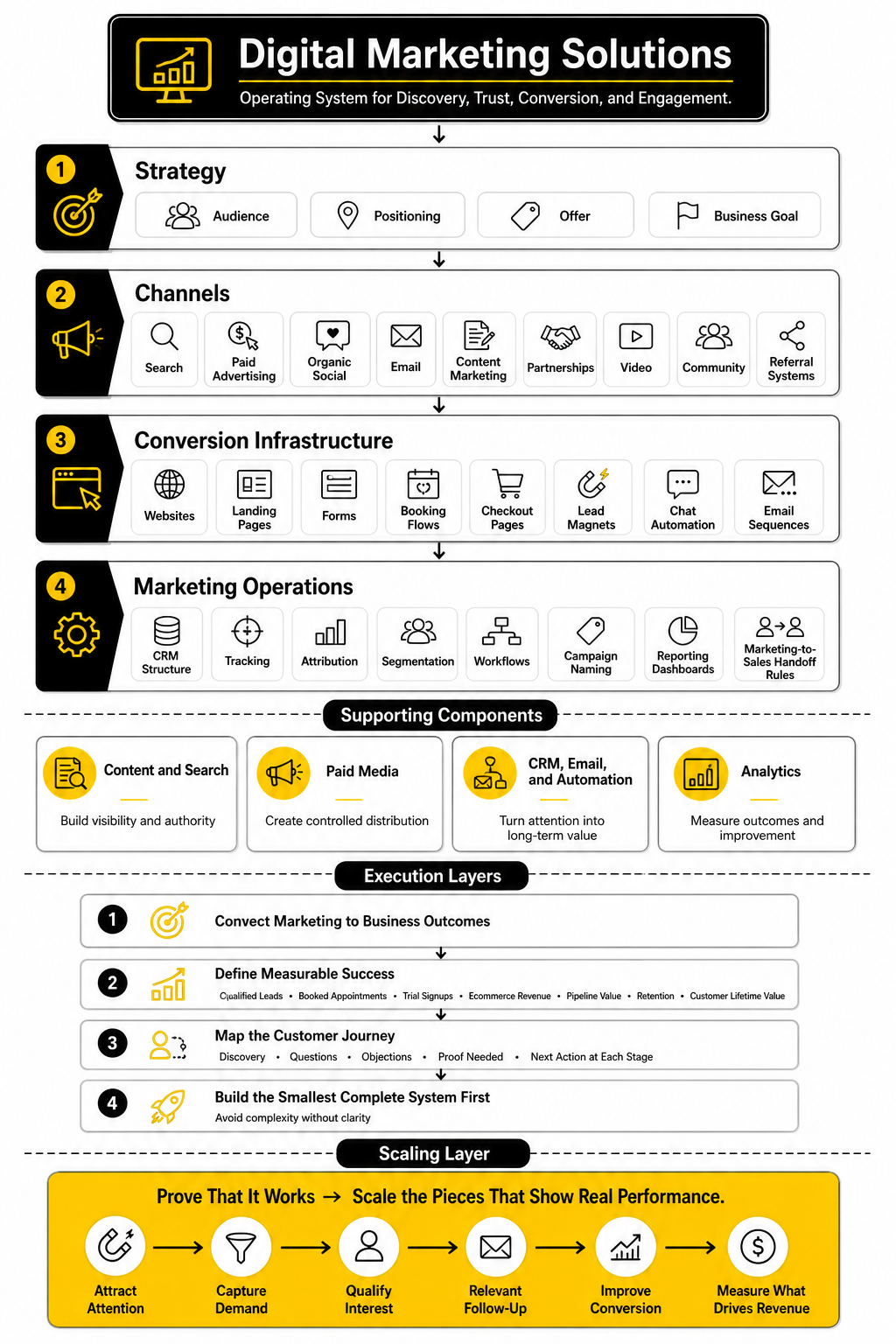
The first layer is strategy because every tool becomes expensive when the positioning is weak. A business needs to know who it is trying to reach, what problem it solves, why the offer matters, and what action the buyer should take next. Without that foundation, even strong platforms can produce weak results because the message, funnel, and follow-up are not aligned.
The second layer is channel execution. This includes search, paid advertising, organic social, email, content marketing, partnerships, video, community, and referral systems. The right channel mix depends on the buying journey, deal size, customer awareness, sales cycle, and available budget, not on whatever tactic is trending this month.
The third layer is conversion infrastructure. This is where websites, landing pages, forms, booking flows, checkout pages, lead magnets, chat automation, and email sequences do the heavy lifting. A business can have strong traffic and still underperform badly if its conversion path is confusing, slow, generic, or disconnected from what the buyer actually wants.
The fourth layer is marketing operations. This includes CRM structure, tracking, attribution, segmentation, workflows, campaign naming, reporting dashboards, and handoff rules between marketing and sales. It may sound less exciting than creative campaigns, but it is often where the money is won or lost because messy operations make good decisions almost impossible.
Core Components of Modern Digital Marketing Solutions
The core components of a strong digital marketing system are not just tools. They are capabilities. A business needs a way to attract attention, capture data ethically, convert interest, follow up consistently, measure outcomes, and improve campaigns based on evidence rather than guesswork.
Content and search are still central because buyers need useful information before they trust a brand. Forrester has warned that buyers are spending more of the journey inside AI answer engines and self-guided research environments, which means brands need to think beyond old SEO and build visibility where decisions are being shaped. That does not make websites or blogs irrelevant; it makes clarity, authority, and structured expertise more important.
Paid media remains important because it creates controlled distribution. The IAB/PwC report shows that social media ad revenue reached $117.7 billion in 2025, driven by commerce integration, creator activity, and performance improvements. But paid media should not be treated as a magic button, because ads amplify the quality of the offer, funnel, and follow-up already in place.
CRM, email, and automation are what turn short-term attention into long-term value. A lead who is not ready today may still become a customer later, but only if the business has a sensible follow-up system. This is where digital marketing solutions become more than campaign tools; they become a structured relationship engine.
Analytics ties everything together. Without tracking, marketers end up celebrating vanity metrics while missing the commercial truth. The point is not to drown in dashboards, but to understand which channels, messages, offers, and journeys are creating qualified leads, booked calls, purchases, retention, or repeat revenue.
Professional Implementation Starts With Alignment
Professional implementation begins by connecting marketing activity to business outcomes. Before choosing platforms, designing pages, or writing campaigns, the team needs to define what success means in measurable terms. That could be qualified leads, booked appointments, trial signups, ecommerce revenue, pipeline value, retention, customer lifetime value, or a mix of those depending on the business model.
The next step is mapping the customer journey from first touch to conversion and beyond. This map should show where buyers discover the brand, what questions they ask, what objections slow them down, what proof they need, and what action should happen at each stage. When this is clear, the role of each digital marketing solution becomes much easier to define.
Implementation also requires discipline. It is tempting to add more tools, more campaigns, more channels, and more dashboards, but complexity without clarity creates waste. The better approach is to build the smallest complete system first, prove that it works, and then scale the pieces that show real performance.
That is the mindset the rest of this guide will use. We are not going to treat digital marketing solutions as a shopping list of software. We are going to treat them as a connected growth system that must earn attention, build trust, convert demand, and improve over time.
The Digital Marketing Solutions Framework
A useful framework for digital marketing solutions has to do one thing clearly: connect business goals to customer behavior. That sounds obvious, but this is where many campaigns break. Teams pick tools first, build campaigns second, and only later ask whether the system supports the way people actually discover, compare, trust, and buy.
The better order is simple. Start with the business outcome, map the buying journey, then choose the channels, assets, automations, and reporting structure that support that journey. When digital marketing solutions are built this way, marketing becomes less reactive and much easier to improve.
This framework has five layers:
Each layer depends on the one before it. If the offer is weak, paid traffic will expose that weakness faster. If the journey is unclear, automation will only send people through a confusing system more efficiently. If measurement is poor, the team will keep guessing instead of making more carefully decisions.
Positioning Comes Before Promotion
Positioning is the first layer because buyers do not respond to marketing activity. They respond to relevance. A business must make it obvious who it helps, what problem it solves, why the solution is different, and what outcome the buyer can reasonably expect.
This is where many digital marketing solutions fail before the first campaign even launches. The team may have a website, email platform, ad account, CRM, funnel builder, social scheduler, and analytics dashboard, but the message still sounds generic. If the market cannot quickly understand the value, adding more channels will not fix the core problem.
Strong positioning answers practical questions. What pain is urgent enough for the buyer to act on? What alternative solutions are they already considering? What proof would make them believe the offer is credible? These answers shape everything that follows, from landing page copy to ad creative to sales follow-up.
This is also why a business should not blindly copy competitors. Competitor research is useful, but it should reveal gaps, patterns, and expectations rather than turn into imitation. The strongest marketing systems are built around a clear point of view, not a recycled list of features.
Map the Customer Journey Before Choosing Channels
The next layer is the customer journey. Before choosing whether to prioritize search, social, email, paid ads, webinars, chat, or outbound, the business needs to understand how buyers move from problem-aware to purchase-ready. Different buyers need different levels of education, proof, reassurance, and timing.
A low-cost ecommerce product may need fast product discovery, strong visuals, clear reviews, and a frictionless checkout. A B2B service with a longer sales cycle may need search content, comparison pages, lead magnets, nurture emails, case studies, consultation booking, and structured CRM follow-up. Both businesses use digital marketing solutions, but the system design should look very different.
Customer expectations also make journey mapping more important. Salesforce reports that 79% of customers expect consistent interactions across departments, while many still feel like they are dealing with disconnected teams. That gap is exactly where good marketing operations can create an advantage.
A practical journey map should identify five moments:
This keeps marketing focused on movement, not just activity. The goal is not to publish for the sake of publishing or automate for the sake of automating. The goal is to help the right people take the next logical step.
Choose Channels Based on Buyer Intent
Channel strategy should come after positioning and journey mapping because channels are not equal. Some channels capture existing demand, while others create awareness before the buyer is ready. Search, for example, often works well when people already know what problem they have. Social content can work earlier in the journey by shaping attention, trust, and familiarity before active buying intent exists.
Paid media sits somewhere in the middle depending on the offer and targeting. It can capture demand, create demand, retarget warm audiences, test offers, or scale proven funnels. But with U.S. digital advertising revenue reaching nearly $294.6 billion in 2025, competition is intense, and weak funnels get expensive quickly.
This is why the channel mix should be intentional. A business does not need to be everywhere. It needs to show up where its buyers already pay attention, where intent is strongest, and where the team can produce quality consistently.
A simple way to evaluate channels is to ask:
The best digital marketing solutions do not treat channels as separate islands. They connect them. A search visitor may enter through a blog post, join an email list, see a retargeting ad, book a call, receive reminders, and move into a CRM pipeline. That is not random marketing. That is a system.
Build Conversion Infrastructure That Removes Friction
Traffic does not pay the bills unless the conversion path works. Conversion infrastructure includes the pages, forms, funnels, booking flows, checkout processes, lead magnets, chat systems, and follow-up sequences that turn attention into action. This is where many businesses discover that their traffic problem is actually a conversion problem.
A strong conversion path makes the next step obvious. It explains the offer clearly, reduces uncertainty, answers common objections, shows proof, and removes unnecessary effort. Every extra click, confusing form field, slow-loading page, vague CTA, or disconnected follow-up can leak revenue.
For funnel-heavy businesses, tools like ClickFunnels can make sense when the priority is building sales pages, opt-in flows, and offer-driven funnels quickly. For agencies and service businesses that need CRM, pipeline management, automation, booking, messaging, and client follow-up in one place, GoHighLevel is often a more complete operational fit. For creators or smaller businesses that want a lighter all-in-one setup, Systeme.io may be enough to build simple funnels, email campaigns, and digital product flows.
The tool matters, but the logic matters more. A clean landing page connected to a clear offer and timely follow-up will usually outperform a bloated funnel with weak messaging. Professional digital marketing solutions make conversion feel simple for the buyer and manageable for the team.
Connect Automation to Human Intent
Automation should not replace human judgment. It should remove repetitive work, speed up follow-up, and make the customer journey more consistent. Used well, automation helps businesses respond faster, segment better, personalize communication, and avoid losing leads because someone forgot to follow up.
The mistake is treating automation like a magic layer that fixes unclear strategy. If the message is generic, automated emails will still feel generic. If the CRM is messy, automated workflows will move messy data around faster. If the buyer journey is not mapped, automation may create more noise instead of more revenue.
Good automation starts with triggers that reflect real buyer behavior. A person who downloads a guide should not receive the same follow-up as someone who booked a consultation, abandoned checkout, requested pricing, or replied to a sales email. Different actions show different levels of intent, and the follow-up should respect that.
This is where tools like ManyChat can fit naturally for businesses using chat-based lead capture and social messaging. Email platforms such as Brevo or Moosend can support structured email campaigns, segmentation, and follow-up. The point is not to automate everything; the point is to automate the moments where speed, relevance, and consistency actually improve the customer experience.
Make Measurement Part of the System From Day One
Measurement should not be added after campaigns are live. It should be part of the system from the beginning. If the business does not define what matters before launching, reporting usually turns into a pile of disconnected metrics that look impressive but do not explain performance.
The most useful measurement structure connects activity to outcomes. Impressions, clicks, views, open rates, and engagement can help diagnose performance, but they are not the final goal. A stronger reporting system tracks qualified leads, booked appointments, sales opportunities, revenue, acquisition cost, conversion rate, retention, and customer lifetime value where possible.
This matters even more because marketing teams are under pressure to do more with the same budget. Gartner reported that marketing budgets remained flat at 7.7% of company revenue in 2025, while digital channels now represent 61.1% of total marketing spend. In plain English, digital is taking the majority of the budget, but teams still need to prove what is working.
A practical dashboard should answer four questions:
That final question is the most important one. Reporting is not there to decorate meetings. It is there to improve decisions.
Keep the Framework Simple Enough to Use
The best framework is not the most complicated one. It is the one your team can actually use when planning campaigns, choosing tools, reviewing performance, and improving the customer journey. If the framework becomes too theoretical, it will sit in a document while the team goes back to random execution.
A simple operating rhythm works better. Review the offer, inspect the journey, check the channel mix, improve the conversion path, and use measurement to decide what happens next. That cycle turns digital marketing solutions into a living system rather than a one-time setup.
This also keeps teams from chasing every trend. AI, automation, short-form video, creator partnerships, search changes, and privacy shifts all matter, but they should plug into the framework instead of replacing it. The question stays the same: does this help the right buyer move toward the right action in a way we can measure and improve?
That is the foundation for the next section. Once the framework is clear, the next job is to break down the core components that make a high-performing digital marketing system work in practice.
Core Components of a High-Performing Digital Marketing System
A strong digital marketing system is not built from one magic platform. It is built from connected components that each serve a clear role in the customer journey. The business needs visibility, trust, conversion, follow-up, sales handoff, retention, and measurement working together instead of competing for attention.
This is where digital marketing solutions become practical. The strategy from the previous section gives the system direction, but the components turn that direction into daily execution. If one component is missing or weak, the whole system feels harder to manage because the buyer journey starts leaking attention, trust, or revenue.
The key is not to overbuild. A business does not need every channel, every automation, or every dashboard on day one. It needs the right core pieces installed in the right order, with enough discipline to improve them before adding more complexity.
Start With the Offer and Conversion Goal
Every implementation should begin with the offer and the conversion goal. The offer is what the business wants the buyer to act on, and the conversion goal defines the specific action that counts as progress. That might be a purchase, demo request, booked consultation, quote request, free trial, newsletter signup, webinar registration, or lead magnet download.
This sounds basic, but it is where many campaigns become messy. A business launches ads before the offer is clear, creates content without a next step, or builds an automation sequence without knowing what action the sequence is supposed to create. That creates activity, not momentum.
A good offer is specific enough to make the next step feel obvious. It should answer the buyer’s immediate question: “Why should I care now?” If the answer is vague, no funnel builder, CRM, email platform, or ad campaign will fully rescue the system.
The conversion goal also needs to match buyer intent. Someone comparing enterprise software may not be ready to buy instantly, but they may be ready to book a strategy call or download a comparison guide. Someone shopping for a simple product may not need a long nurture sequence, but they do need a fast page, strong proof, clear pricing, and a smooth checkout.
Build the Customer Data Foundation
Once the offer and goal are clear, the next component is customer data. This includes the contact records, behavioral signals, consent status, source data, lifecycle stage, purchase history, and engagement history that allow the business to communicate intelligently. Without a clean data foundation, digital marketing solutions become guesswork wrapped in software.
Data quality matters because personalization, segmentation, attribution, and automation all depend on it. If leads enter the CRM with missing source fields, duplicate records, inconsistent tags, or unclear lifecycle stages, the team cannot reliably see what is working. Worse, the follow-up experience becomes generic because the system does not know enough about the buyer.
This is especially important as privacy expectations rise. The customer experience research from Salesforce shows that trust, transparency, and relevant personalization now sit very close together in the buyer’s mind, which means businesses need to collect and use data carefully rather than aggressively. The practical goal is simple: collect what you need, explain why it matters, and use it to improve the experience.
A basic customer data foundation should include:
This is not glamorous work, but it is foundational. Clean data makes the rest of the system more carefully. Dirty data makes everything more expensive.
Create the Content and Demand Engine
The content and demand engine is the part of the system that brings the right people into the journey. It may include SEO content, social posts, paid ads, short-form video, newsletters, comparison pages, guides, webinars, podcasts, referral campaigns, or partner campaigns. The right mix depends on the buyer, the offer, and the sales cycle.
Content should not be created only to fill a calendar. It should answer real buyer questions, support objections, explain value, and create confidence before the buyer reaches out. This is becoming more important as buyers research across search engines, social platforms, review sites, AI answer engines, communities, and direct brand content before taking action.
Paid demand generation has to be handled with the same discipline. With internet advertising revenue reaching nearly $294.6 billion in 2025, competition for attention is not getting cheaper. Ads can accelerate learning and scale proven offers, but they will also expose weak messaging and poor conversion paths quickly.
A practical demand engine should separate three types of content:
This structure stops content from becoming random. It also helps the business see where the journey is thin. If there is plenty of awareness content but no decision-stage proof, the system may attract interest without creating enough conversion.
Design the Conversion Path
The conversion path is where attention turns into measurable action. It includes landing pages, forms, checkout pages, booking pages, lead magnets, demos, calls to action, chat flows, thank-you pages, and confirmation emails. This is one of the highest-leverage parts of implementation because small friction points can quietly drain a large amount of performance.
Baymard’s ecommerce checkout research shows that the average large ecommerce site still has 32 checkout improvements available, with meaningful conversion gains possible from better checkout UX. That matters beyond ecommerce because the principle is universal. Confusing forms, unclear steps, surprise friction, and weak reassurance reduce action in almost every digital journey.
A good conversion path should make the next step feel obvious and low-risk. The page should explain what the buyer gets, why it matters, who it is for, what happens next, and what proof supports the claim. It should also remove unnecessary fields, distractions, and vague language that make the buyer pause.
For ecommerce brands or landing-page-heavy campaigns, a dedicated builder like Replo can fit when the team needs high-quality storefront pages and conversion-focused layouts. For offer-led funnels, ClickFunnels can be useful when speed, page flow, and funnel structure matter more than building everything from scratch. The tool is only valuable if the offer, message, and follow-up are already clear.
Turn the Framework Into an Execution Process
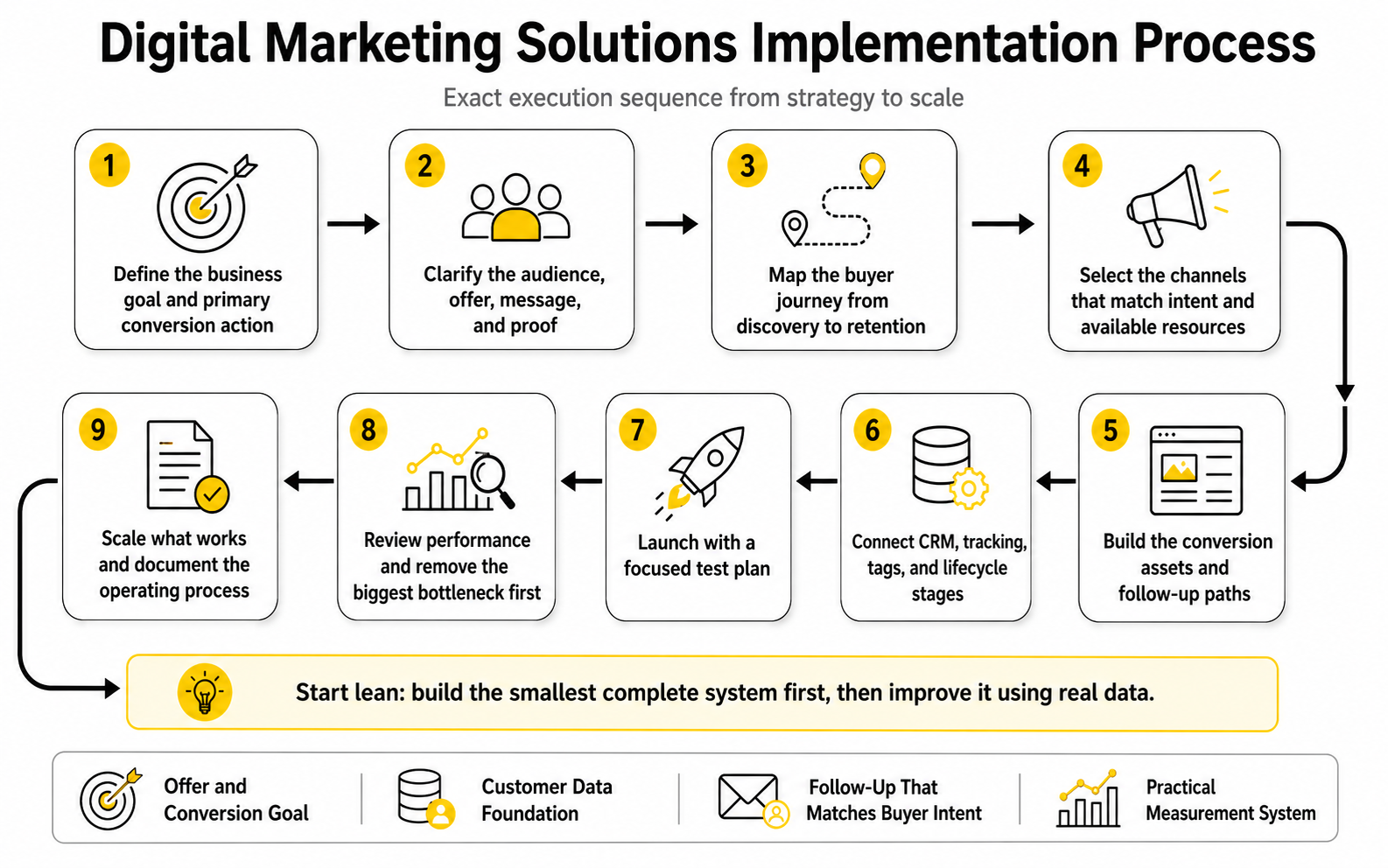
Once the core components are defined, implementation becomes a sequence instead of a guessing game. This matters because digital marketing solutions often fail when teams try to build everything at once. A better process creates a working version of the system first, then improves it based on real data.
The execution process should move in a clean order:
This order keeps the team focused. It also prevents the classic mistake of buying tools before knowing what process they need to support. Software should support the system, not become the system.
The first version should be intentionally lean. For many businesses, that may mean one primary offer, one landing page, one lead capture path, one follow-up sequence, one CRM pipeline, and one dashboard. Once that system is working, the team can add channels, segments, automations, and experiments with more confidence.
Set Up CRM and Pipeline Management
CRM is where marketing activity becomes operationally useful. It should show who entered the system, where they came from, what they are interested in, what stage they are in, who owns the relationship, and what should happen next. If the CRM does not answer those questions quickly, the team will struggle to convert leads consistently.
For service businesses, agencies, local businesses, consultants, and high-ticket offers, pipeline visibility is especially important. A lead is not just a contact record. It is a potential opportunity that needs timely follow-up, context, reminders, qualification, and a clear next step.
This is where an all-in-one platform like GoHighLevel can make sense because it combines CRM, pipelines, calendars, messaging, automations, forms, funnels, and client communication in one place. That can reduce tool sprawl when the business needs sales and marketing operations connected tightly. For relationship-heavy teams that want a more traditional CRM structure, Copper can fit well when contact management and pipeline organization are the priority.
The CRM setup should stay simple at first. Too many stages, tags, fields, and automations create confusion. Start with the stages the team actually uses, then add detail only when it improves reporting or follow-up.
Build Follow-Up That Matches Buyer Intent
Follow-up is where many digital marketing systems lose the most money. A buyer shows interest, fills out a form, clicks an email, books a call, abandons checkout, or asks a question, and then the business responds too slowly or with the wrong message. That is painful because the hardest part already happened: the buyer raised their hand.
Lead response research has consistently shown that speed matters, and newer benchmark analyses continue to highlight how many companies still respond slowly or fail to respond at all. The exact number varies by study and segment, so it is more carefully to treat the principle as operational rather than decorative: when someone shows clear intent, follow-up needs to be fast, relevant, and trackable.
Intent-based follow-up should separate people by behavior. A first-time guide download does not need the same response as a pricing-page visitor who requested a demo. A repeat customer does not need the same email as a cold lead. A booked appointment needs reminders and preparation, while an abandoned checkout needs reassurance and a clean return path.
Email tools such as Brevo and Moosend can support nurture sequences, newsletters, and segmented campaigns. Chat and messaging tools like ManyChat can help when the buyer journey happens through social messaging or conversational lead capture. The best follow-up feels timely and useful, not like a machine shouting into the inbox.
Create a Practical Measurement System
Measurement should be built before the launch, not after the results become confusing. The team needs to know what counts as a conversion, how leads are tagged, where source data is stored, what events are tracked, and which dashboard will be used to review performance. If that structure is missing, optimization becomes opinion-heavy.
The measurement system does not need to be complicated. In fact, it should be simple enough that the team can review it every week without needing a data analyst for every question. The goal is to spot what is moving, what is stuck, and what needs to be fixed next.
A practical reporting view should include:
This is where many businesses need to be honest. If a channel produces cheap leads that never buy, it is not a good channel. If a landing page produces fewer leads but better sales opportunities, it may be more valuable than it looks at the surface.
Document the System So It Can Scale
A digital marketing system becomes scalable only when the process is documented. That means campaign naming rules, offer details, funnel maps, automation logic, CRM stages, reporting definitions, and team responsibilities should not live only in someone’s head. If the process disappears when one person goes on holiday, the system is too fragile.
Documentation also makes optimization easier. When something changes, the team can identify what changed, why it changed, and whether performance improved. Without documentation, teams often repeat old tests, break working workflows, or make decisions based on memory instead of evidence.
This does not require a massive operations manual. A simple operating document is enough at first. It should explain what the system is supposed to do, how each component works, who owns each step, and which numbers are reviewed regularly.
That is the practical difference between random marketing and professional implementation. Random marketing depends on energy. Professional digital marketing solutions depend on systems, process, and feedback loops that keep improving over time.
Statistics and Data
Data only helps when it changes what you do next. A dashboard full of impressions, clicks, views, opens, and traffic charts can look professional while still hiding the truth. The real job of analytics is to show where attention becomes revenue, where the journey breaks, and which part of the system deserves your next hour or next dollar.
That is why measurement has to stay connected to the framework we have already built. Positioning tells you who should care, channels show where demand comes from, conversion assets show whether people act, automation shows whether follow-up is working, and CRM data shows whether leads turn into sales opportunities. If those layers are not connected, digital marketing solutions become difficult to judge because every tool reports success in its own language.
The smartest teams do not ask, “Did this campaign get engagement?” They ask, “Did this campaign move the right audience toward the right business outcome?” That shift sounds small, but it changes everything. It stops the team from optimizing for noise and forces the system to prove commercial value.
Why Benchmarks Are Useful but Dangerous
Benchmarks are useful because they give you a reference point. If your email click rate, landing page conversion rate, checkout completion rate, cost per lead, or sales qualification rate is far below a credible industry range, you know where to investigate first. But benchmarks become dangerous when teams treat them like universal targets.
A 3% conversion rate could be excellent for one business and weak for another. A high-ticket consulting funnel, a SaaS trial signup, a local service quote request, and a low-cost ecommerce product all have different buying behavior. Even inside the same industry, conversion rates change based on traffic source, offer strength, audience awareness, brand trust, device type, pricing, and how much friction exists before the next step.
So use benchmarks as diagnostic tools, not as final judgments. They should help you ask better questions. If performance is below the market range, ask what is creating friction. If performance is above the range, ask whether quality, sales conversion, or retention still hold up after the first metric looks good.
The practical rule is simple: compare externally to find suspicious gaps, then compare internally to improve your own trendline. Your best benchmark is often your last 90 days of clean data. That tells you whether your digital marketing solutions are actually improving under your own market conditions.
The Metrics That Actually Matter
Most marketing metrics fall into three groups: visibility metrics, conversion metrics, and business metrics. Visibility metrics show whether people are seeing and engaging with your campaigns. Conversion metrics show whether they are taking action. Business metrics show whether those actions produce revenue, pipeline, retention, or profit.
The problem is not that visibility metrics are useless. They are useful early signals. The problem starts when they are treated as the finish line instead of the first layer of the diagnostic system.
A practical measurement model should include:
The farther down this list you go, the closer you get to business truth. A campaign that creates cheap leads but poor sales opportunities may be worse than a campaign with a higher cost per lead and stronger close rate. That is why digital marketing solutions should be measured beyond surface-level campaign reports.
What Current Market Data Means
Digital channels are now the center of modern marketing budgets. Gartner reported that digital channels account for 61.1% of total marketing spend, while its separate CMO spend research found that marketing budgets remained flat at 7.7% of company revenue in 2025. That combination matters because it means digital is carrying more responsibility without unlimited budget growth.
The IAB and PwC also reported that U.S. internet advertising revenue reached $294.6 billion in 2025, with the industry growing 13.9% year over year. That is not just a big number. It means more brands are competing for the same digital attention, so poor tracking, weak conversion paths, and vague attribution become very expensive mistakes.
Social media ad revenue reached $117.7 billion in 2025, and programmatic advertising rose to $162.4 billion. The interpretation is clear: automation, targeting, creator ecosystems, and commerce-connected media are getting more sophisticated. But sophistication does not guarantee profitability. It only raises the standard for measurement.
Website experience data tells the same story from another angle. Contentsquare’s 2025 benchmark analysis, based on 90 billion user sessions, highlights rising acquisition pressure and the need to understand behavior across the full digital journey. When acquisition gets more expensive, the business cannot afford to waste visits through slow pages, unclear offers, weak mobile experiences, or disconnected follow-up.
Build an Analytics System That Follows the Buyer
The analytics system should follow the buyer from first touch to business outcome. That means campaign data, website behavior, form submissions, booking data, CRM stages, sales outcomes, email engagement, and retention signals need to connect as much as possible. You do not need perfect attribution to make better decisions, but you do need enough visibility to stop guessing.
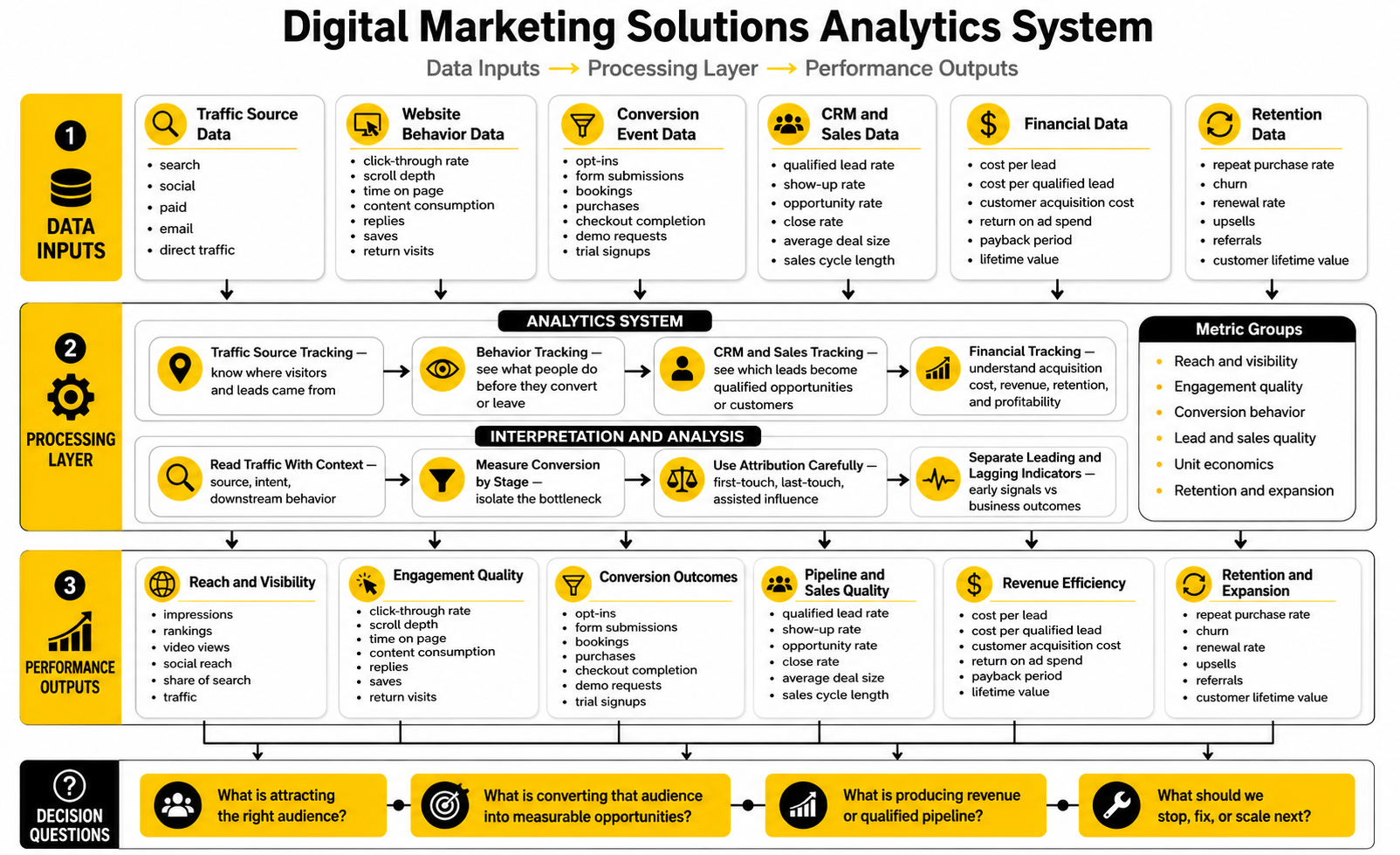
A clean analytics system has four layers. The first layer is traffic source tracking, so you know where visitors and leads came from. The second layer is behavior tracking, so you can see what people do before they convert or leave. The third layer is CRM and sales tracking, so you can see which leads become qualified opportunities or customers. The fourth layer is financial tracking, so you can understand acquisition cost, revenue, retention, and profitability.
This does not mean every small business needs enterprise analytics. It means every business needs a measurement setup that fits the decisions it must make. A local service business may need source tracking, call tracking, booking rates, show-up rates, and close rates. An ecommerce brand may need product page behavior, cart abandonment, checkout completion, average order value, repeat purchase rate, and contribution margin.
The most important point is that analytics should be designed around decisions. If nobody will act on a metric, it does not need to dominate the dashboard. If a metric directly changes budget, creative, offer structure, sales follow-up, or conversion testing, it deserves visibility.
Read Traffic Data With Context
Traffic is not automatically good. The right traffic creates qualified action. The wrong traffic creates pretty charts, low intent, poor conversion, and wasted follow-up.
A traffic increase should always be interpreted by source, intent, and downstream behavior. Organic search traffic from decision-stage keywords may be more valuable than a larger spike from low-intent social traffic. Paid traffic from a tightly matched offer may outperform broad awareness campaigns even if the broad campaign looks cheaper at the click level.
This is where teams need to separate volume from quality. A channel that creates fewer visitors but stronger bookings, higher order values, or better retention may deserve more budget than a channel that produces cheaper clicks. Digital marketing solutions should help reveal that difference instead of hiding it behind blended averages.
Look for patterns such as:
Those questions keep traffic analysis grounded. The goal is not more visits. The goal is more of the right visits.
Measure Conversion by Stage, Not Just Final Outcome
Final conversion matters, but it does not tell the whole story. If only 2% of visitors become leads, you need to know whether the problem is traffic quality, landing page clarity, form friction, offer strength, page speed, proof, pricing, or follow-up. Stage-by-stage measurement helps isolate the bottleneck.
For ecommerce, Baymard’s long-running checkout research puts the average cart abandonment rate at 70.19%. That number does not mean every store should panic equally. It means checkout friction is common enough that every store should inspect the steps between product interest and completed purchase.
For landing pages, Unbounce’s conversion benchmark analysis reviewed 41,000 landing pages, 464 million pageviews, and 57 million conversions and reported a median conversion rate of 6.6% across all industries. That number is useful as a reference, but the action is more important than the benchmark. If your page is below expectation, test the offer, message match, proof, CTA, page speed, form length, and traffic source before blaming the channel.
For email, Mailchimp’s benchmark data suggests an average open rate around 34.23%, but open rates are not as reliable as they once were because privacy changes can distort them. Clicks, replies, conversions, revenue, and unsubscribe behavior usually reveal more about whether the email is actually useful. A high open rate with weak clicks may mean the subject line worked but the message failed.
Use Attribution Without Worshipping It
Attribution is useful, but it is not perfect truth. Buyers rarely move in a straight line. They may see a social post, search the brand later, read reviews, click an email, return from retargeting, ask a colleague, and finally book a call from direct traffic. A single attribution model will almost always simplify that reality.
That does not make attribution useless. It means you should use it carefully. First-touch attribution can help you understand discovery. Last-touch attribution can help you see what closes the loop. Multi-touch views can show assisting channels, but they still depend on tracking quality, consent, cookies, device behavior, and CRM discipline.
The danger is making budget decisions from one attribution view alone. If paid search gets the last click but content built the trust, cutting content may damage future performance. If social rarely gets last-click credit but consistently warms audiences that later convert through search or email, it may still be valuable.
A better approach is to combine attribution with evidence from other places. Look at CRM source quality, branded search lift, direct traffic changes, assisted conversions, customer surveys, sales feedback, and retention by source. The decision becomes stronger when multiple signals point in the same direction.
Know the Difference Between Leading and Lagging Indicators
Leading indicators help you see whether performance is likely to improve. Lagging indicators tell you what already happened. You need both, but you should not confuse them.
Leading indicators include qualified traffic, click-through rate, landing page engagement, form starts, demo bookings, reply rates, pipeline creation, and sales meeting show-up rates. These are useful because they help teams react before the revenue number fully lands. If demo bookings improve this month, revenue may follow later depending on the sales cycle.
Lagging indicators include revenue, profit, customer acquisition cost, churn, repeat purchase rate, and lifetime value. These are stronger business metrics, but they may arrive too late to guide daily campaign decisions by themselves. If you only manage marketing from lagging indicators, you may discover problems after the budget has already been wasted.
The practical solution is to build a metric chain. For example, a B2B funnel might track visitor to lead, lead to qualified lead, qualified lead to booked call, booked call to attended call, attended call to opportunity, opportunity to customer, and customer to retained account. That chain shows exactly where to improve next.
Turn Data Into Actions
A measurement system is only valuable when it leads to action. If the dashboard says traffic is rising but qualified leads are flat, the action might be to tighten targeting or rewrite content around higher-intent topics. If leads are increasing but sales opportunities are not, the action might be better qualification, stronger proof, faster follow-up, or a different offer.
If paid campaigns have good click-through rates but weak landing page conversion, the issue may be message mismatch. If landing pages convert but sales calls do not close, the issue may be lead quality, pricing, sales process, or expectation setting. If email engagement is strong but revenue is weak, the sequence may need a clearer commercial bridge.
Use this decision flow:
This is where professional digital marketing solutions separate themselves from random tactics. They make performance visible, then turn that visibility into better execution. The data does not need to be perfect, but it does need to be honest enough to guide the next move.
Choosing the Right Channels, Tools, and Automation
At this stage, the question becomes more strategic: which digital marketing solutions deserve a place in the system, and which ones are just adding noise? This is where businesses often overcomplicate things. They see a new platform, a new AI feature, a new ad format, or a competitor using a shiny tool, and suddenly the stack grows without a clear reason.
The more carefully move is to evaluate every channel and tool against the same standard. Does it help the right buyer move through the journey with less friction, better timing, stronger relevance, or clearer measurement? If not, it is probably a distraction.
This matters more now because the marketing technology market is massive. The 2025 martech landscape grew to 15,384 solutions, which means the problem is no longer lack of choice. The problem is choosing too much, too quickly, with too little operational discipline.
Avoid Tool Sprawl Before It Slows You Down
Tool sprawl happens when a business keeps adding software without removing friction. One tool manages email, another handles forms, another builds landing pages, another stores CRM data, another schedules posts, another creates reports, and another manages automation. On paper, each tool may be useful, but the combined system becomes fragile.
The hidden cost is not just subscription fees. It is the time spent connecting tools, fixing broken integrations, reconciling data, training people, cleaning duplicate records, and explaining why two dashboards show different numbers. That operational drag gets worse as the business scales.
A better approach is to choose fewer tools that support the actual process. For an agency, consultant, local service business, or high-ticket offer, an all-in-one platform like GoHighLevel can make sense because CRM, pipelines, funnels, calendars, messaging, and automation live closer together. For a simpler creator or digital product business, Systeme.io may be enough to keep funnels, email, and product delivery lightweight.
The rule is simple. Every tool should have a job, an owner, and a measurable reason to exist. If nobody can explain what decision or workflow the tool improves, it probably should not be in the stack.
Decide Between Best-in-Class and All-in-One
One of the biggest strategic tradeoffs is whether to build a best-in-class stack or use an all-in-one platform. Best-in-class means choosing specialized tools for each function, such as a dedicated CRM, email platform, analytics tool, landing page builder, social scheduler, and automation platform. All-in-one means accepting a broader platform that handles more of the workflow in one place.
Neither option is automatically better. Best-in-class can create more power and flexibility, especially for teams with technical support and mature operations. The downside is that integration, governance, and reporting become more complex.
All-in-one can reduce friction, speed up implementation, and make the system easier to manage. The downside is that some features may be less advanced than dedicated tools. That tradeoff is often worth it for smaller teams, agencies, service businesses, and operators who care more about execution speed than perfect customization.
The right decision depends on five factors:
This is where honesty helps. A complex stack is not a status symbol. If the team cannot maintain it properly, it becomes a liability.
Match Channels to Economics, Not Ego
Channel selection should be based on economics, not preference. A founder may love short-form video, a marketer may prefer SEO, a sales team may want webinars, and an agency may recommend paid ads because that is what it sells. None of that matters unless the channel fits the buyer journey and unit economics.
Paid media can work beautifully when the offer is clear, the funnel converts, and the margin supports acquisition costs. But it can become brutal when the business depends on cheap clicks that no longer exist. With digital channels taking 61.1% of total marketing spend, competition is not going away.
Organic content can create durable visibility and trust, but it takes time and consistency. It also needs a strong conversion path, because traffic without a next step does not build a business. Social can build familiarity and demand, but it needs a clear bridge from attention to action.
Email and CRM follow-up often produce strong leverage because they improve conversion from traffic you already paid for or earned. That is why platforms such as Brevo and Moosend can be valuable when the business needs structured nurture, segmentation, and campaign follow-up. The question is not whether email is old or new. The question is whether it helps more buyers take the next step.
Treat AI as Leverage, Not Strategy
AI is now part of almost every serious marketing conversation. It can help with research, content drafting, audience segmentation, creative variation, workflow automation, chatbot support, reporting summaries, and sales enablement. Used well, it increases speed and removes repetitive work.
But AI is not a replacement for strategy. It cannot fix a weak offer, unclear positioning, poor customer understanding, bad data, or a broken sales process. In fact, AI can make those problems worse by helping a team produce more low-quality output faster.
The best use of AI inside digital marketing solutions is targeted and operational. Use it to summarize customer research, generate creative variations from a strong brief, identify patterns in campaign performance, personalize follow-up based on real behavior, and speed up internal workflows. Do not use it to flood channels with generic content that nobody asked for.
There is also a trust issue. Customers are becoming more sensitive to how companies use data, automation, and AI-driven communication. If automation makes the experience feel colder, more confusing, or less honest, it damages the brand instead of improving productivity.
Build Automation Around Moments of Intent
Automation should be built around intent signals. A buyer who visits a pricing page twice, starts a checkout, books a call, replies to an email, downloads a guide, or asks a question has given the business useful context. The follow-up should reflect that context.
Weak automation treats everyone the same. Strong automation changes based on behavior, stage, and need. It does not just send messages; it helps the buyer continue the journey without unnecessary delay.
For example, a lead who books a consultation should receive confirmation, reminders, preparation steps, and maybe a short piece of proof before the call. A person who downloads a beginner guide should receive educational follow-up that builds confidence before a stronger offer appears. A returning customer should not be treated like a cold stranger.
This is where chat automation can be useful when the journey begins inside social or messaging platforms. ManyChat can support conversational lead capture, simple qualification, and follow-up through messaging flows. For businesses where booking is central, Cal.com can help reduce scheduling friction and make the next step easier to complete.
Balance Personalization With Privacy
Personalization is powerful, but careless personalization feels invasive. A buyer appreciates relevance when it helps them solve a problem. They dislike it when the business appears to know too much, follows them too aggressively, or uses data in a way that feels unclear.
This is a serious strategic tradeoff. More data can improve targeting and automation, but more data also creates more responsibility. Businesses need consent, clear data practices, careful segmentation, and restraint in how they use behavioral signals.
The practical standard is simple. Use data to improve the customer experience, not to pressure the customer. That means recommending relevant next steps, reducing repeated questions, avoiding irrelevant campaigns, and respecting unsubscribes or suppression rules quickly.
Privacy changes have also made measurement harder. Cookies, consent banners, browser restrictions, platform limitations, and cross-device behavior all reduce tracking certainty. This is another reason digital marketing solutions need multiple evidence sources instead of blind faith in one attribution dashboard.
Scale the System Only After It Has a Stable Baseline
Scaling too early is one of the easiest ways to waste money. If the offer is not proven, the conversion path is weak, the CRM is messy, or the follow-up is inconsistent, scaling traffic will only scale the problem. More budget makes leaks more expensive.
A stable baseline means the business understands its current numbers. It knows approximate conversion rates, lead quality by source, sales acceptance rates, close rates, acquisition cost, average order value, retention patterns, and where the biggest bottlenecks are. The numbers do not need to be perfect, but they need to be reliable enough to guide decisions.
Once the baseline is clear, scaling becomes more controlled. The business can increase budget on proven channels, expand content around high-intent topics, launch retargeting, introduce partner campaigns, improve segmentation, test new offers, or add sales capacity. Each move should have a reason.
The best scaling plan usually follows this order:
This is not slow thinking. It is disciplined thinking. Scaling without discipline is just gambling with a dashboard.
Manage the Sales and Marketing Handoff
The handoff between marketing and sales is where many digital marketing solutions either prove their value or fall apart. Marketing may claim a campaign generated leads, while sales says the leads were poor. Sales may delay follow-up, while marketing blames the channel. Both teams may be partly right, but without clear rules, the argument never becomes useful.
A proper handoff defines what counts as a qualified lead, when sales should follow up, what context must be passed over, and what feedback sales must return. The CRM should show source, offer, form answers, engagement history, lifecycle stage, and next action. If sales only receives a name and email, the system is underpowered.
Service businesses and B2B teams should pay special attention here. A lead’s value often depends on speed, context, and qualification quality. If a high-intent lead waits too long or receives a generic response, the business may lose the opportunity even though the campaign technically worked.
The solution is operational clarity. Define lead stages, ownership rules, follow-up timing, disqualification reasons, and feedback loops. This makes marketing more carefully and sales more effective.
Prepare for Channel Volatility
Every digital channel changes. Search algorithms change. Paid media costs change. Social reach changes. Email deliverability changes. Tracking rules change. Buyer behavior changes.
That volatility is not a reason to avoid digital marketing. It is a reason to avoid depending on one fragile source of growth. A business that relies entirely on one ad platform, one social channel, one influencer, one search ranking, or one automation workflow is exposed.
Stronger systems spread risk intelligently. They build owned assets such as email lists, customer data, content libraries, brand search demand, referral systems, and direct relationships. They also keep testing new channels before the old ones decline.
This does not mean being everywhere. It means building enough diversity that one platform update does not destroy the pipeline. Digital marketing solutions should create resilience, not just short-term campaign wins.
Protect Deliverability and Reputation
Deliverability is one of the least glamorous parts of digital marketing, but it can quietly make or break performance. If emails land in spam, SMS messages feel intrusive, ads get rejected, domains lose trust, or social accounts get flagged, the system slows down fast. Reputation is infrastructure.
Email deliverability depends on list quality, consent, engagement, sending behavior, domain authentication, content quality, unsubscribe handling, and spam complaint rates. A business that buys lists, over-sends, or ignores engagement signals may damage its ability to reach people who actually want to hear from it.
The same principle applies across channels. Ad accounts need compliant claims and clean landing pages. Social accounts need authentic behavior instead of spammy automation. Chat flows need clear opt-ins and useful responses.
This is why aggressive short-term tactics often backfire. A campaign that squeezes a few extra leads while damaging trust, deliverability, or platform reputation is not a win. It is borrowed performance with interest.
Build for Retention, Not Just Acquisition
Acquisition gets most of the attention because it is visible. New leads, new sales, new campaigns, new launches, and new channels feel exciting. But the economics often improve dramatically when the business also focuses on retention, repeat purchases, referrals, renewals, and expansion.
Retention needs its own marketing system. Customers should receive onboarding, education, usage prompts, success content, milestone communication, renewal reminders, feedback requests, and relevant upgrade paths. This is not just customer support. It is lifecycle marketing.
A business that ignores retention has to keep replacing lost customers with more acquisition spend. That becomes painful when media costs rise or conversion rates fall. A business that improves retention can afford to acquire customers more confidently because each customer is worth more over time.
This is where digital marketing solutions become more mature. They stop treating the sale as the finish line. They support the full customer relationship.
Know When to Use Specialists
Not every business needs a full agency, consultant, or specialist team. But there are moments when expertise saves time and prevents expensive mistakes. Paid media, tracking setup, conversion rate optimization, CRM architecture, deliverability, SEO strategy, analytics, and lifecycle automation can all become technical quickly.
The mistake is hiring specialists before the business knows what problem it needs solved. A paid ads expert cannot fix a weak offer. A CRM consultant cannot fix a team that refuses to follow a process. A copywriter cannot fix a product that lacks market demand.
Specialists work best when the business has a clear goal, clean context, and a defined success metric. For example, “increase qualified demo bookings from paid search while maintaining a target cost per opportunity” is a much better brief than “make our ads better.” Clear briefs create better work.
The same applies to software. A platform does not remove the need for thinking. It gives the team a place to execute that thinking more consistently.
Make the System Easier to Operate Over Time
The final advanced consideration is operational simplicity. As a digital marketing system grows, it should not become harder to understand every month. More campaigns, audiences, workflows, dashboards, and tools should be balanced with stronger documentation and regular cleanup.
A quarterly cleanup rhythm can prevent chaos. Review unused tools, broken automations, outdated segments, weak campaigns, duplicate CRM fields, stale landing pages, old tags, and reports nobody reads. Remove what no longer supports the strategy.
This is also where naming conventions, ownership, and documentation matter. A clean system helps new team members understand what exists and why. A messy system forces everyone to rely on memory, which is not scalable.
Expert-level marketing is not about making everything complex. It is about knowing what matters, removing what does not, and building a system that can keep improving without collapsing under its own weight. That is the standard digital marketing solutions should meet before the final step: measuring, scaling, avoiding common mistakes, and answering the questions buyers and operators usually ask before they commit.
Measurement, Scaling, Mistakes to Avoid, and FAQ
The final layer of digital marketing solutions is not another tool. It is the operating discipline that keeps the whole system useful after launch. A business can build the right funnel, connect the right CRM, publish strong content, automate follow-up, and still lose momentum if nobody owns performance improvement.
The goal is not to create a perfect system once. The goal is to create a system that can keep learning. Markets shift, ad costs change, customer expectations evolve, platforms update their rules, and competitors react. A professional digital marketing system has to adapt without turning into chaos.
This is where the ecosystem view matters. Every channel, page, message, automation, CRM stage, dashboard, and sales process should support one connected customer journey. When the system is healthy, each part strengthens the next part instead of creating more work.
How to Scale Digital Marketing Solutions Without Breaking the System
Scaling should begin only after the business understands what is already working. That means the offer has been tested, conversion paths are stable, lead quality is visible, follow-up is reliable, and reporting is clear enough to guide decisions. Without that baseline, scaling simply gives the business a bigger version of the same problems.
A practical scaling plan usually starts with the highest-confidence channel. If paid search is producing qualified opportunities, increase budget gradually while watching cost per qualified lead and close rate. If organic content is producing high-intent traffic, expand the topic cluster and improve the conversion path. If email is producing repeat purchases, improve segmentation, lifecycle timing, and offer relevance.
The mistake is scaling every part of the system at once. That makes it hard to know what caused the result. Change one major thing at a time, track the right outcome, and document what happened so the team can repeat the win instead of relying on luck.
Common Mistakes That Hurt Performance
The first common mistake is starting with tools instead of strategy. With the martech market reaching 15,384 solutions in 2025, it is easy to confuse more software with more capability. But software only multiplies the quality of the process behind it.
The second mistake is optimizing for surface metrics. More traffic, more impressions, more followers, or more email opens can feel good, but they do not automatically mean the business is growing. Strong digital marketing solutions connect visibility to commercial outcomes such as qualified leads, booked calls, sales opportunities, revenue, repeat purchases, and retention.
The third mistake is ignoring follow-up. Many businesses spend heavily to generate demand, then respond slowly, send generic messages, or fail to route leads properly. That is painful because the business already paid for the attention, and then loses it in the operational handoff.
The fourth mistake is failing to clean the system. Old tags, unused automations, outdated landing pages, duplicate CRM records, weak campaigns, and forgotten tools create hidden drag. A system that is never cleaned eventually becomes hard to trust.
The Final Optimization Loop
A complete digital marketing system should run on a simple optimization loop. Review the data, identify the biggest bottleneck, form a clear hypothesis, change one meaningful variable, measure the result, and decide what happens next. That loop sounds basic because it is, but most teams do not follow it consistently.
The bottleneck might be weak traffic quality, poor landing page conversion, low lead qualification, slow sales response, poor show-up rate, low close rate, high churn, or weak repeat purchase behavior. The right action depends on where the leak exists. You do not fix a sales follow-up problem by publishing more blog posts, and you do not fix a weak offer by changing button colors.
This is where the earlier framework comes full circle. Strategy defines the audience and offer, channels create demand, conversion assets capture intent, automation improves timing, CRM shows pipeline movement, and analytics tells the team what to improve next. That is the real value of digital marketing solutions when they are built as one system.
What are digital marketing solutions?
Digital marketing solutions are the strategies, tools, channels, processes, and analytics a business uses to attract, convert, retain, and grow customers online. They can include SEO, paid ads, email marketing, CRM, social media, landing pages, automation, analytics, content marketing, chat, and sales follow-up. The important point is that these parts should work together as a system, not as disconnected tactics.
Why do businesses need digital marketing solutions?
Businesses need digital marketing solutions because buyers now research, compare, and make decisions across digital channels. Digital channels account for 61.1% of total marketing spend, so online visibility and conversion infrastructure are no longer optional. The right system helps a business reach the right people, follow up consistently, and measure what is actually driving growth.
What is the most important part of a digital marketing system?
The most important part is the connection between the offer, customer journey, and conversion goal. Tools and channels matter, but they work best when the business is clear about who it serves, what problem it solves, and what action the buyer should take next. Without that clarity, even expensive campaigns can produce weak results.
Which digital marketing channels should a business start with?
A business should start with the channels that match buyer intent and available resources. Search works well when people are already looking for a solution, paid ads can accelerate testing and demand capture, social can build familiarity, and email can improve follow-up from existing traffic. The best starting point is not the trendiest channel; it is the channel most likely to move the right buyer toward the next step.
How do digital marketing solutions improve lead generation?
They improve lead generation by creating a clearer path from attention to action. That usually means better targeting, stronger landing pages, useful content, relevant offers, simple forms, fast follow-up, and CRM tracking. Lead generation gets stronger when the system measures not just the number of leads, but also the quality of those leads.
What tools are useful for digital marketing solutions?
Useful tools depend on the business model. GoHighLevel can fit agencies, local businesses, and service teams that need CRM, funnels, automation, booking, and messaging in one place. ClickFunnels can fit offer-led funnels and sales page workflows, while Systeme.io can fit creators and smaller businesses that want a simpler all-in-one setup.
How should a business measure digital marketing performance?
A business should measure performance across the full journey, not just at the campaign level. That means tracking traffic source, conversion rate, cost per lead, qualified lead rate, booked calls, sales opportunities, revenue, acquisition cost, retention, and customer lifetime value where possible. The best dashboard is the one that helps the team decide what to stop, fix, or scale.
What is a good conversion rate for digital marketing?
There is no universal good conversion rate because it depends on the offer, industry, traffic source, price point, and buyer intent. Benchmarks can help identify obvious problems, but internal trend data is usually more useful for optimization. A business should focus on improving conversion quality, not just chasing a higher percentage.
How does automation fit into digital marketing solutions?
Automation helps with speed, consistency, segmentation, reminders, nurturing, and lead routing. It works best when it responds to real buyer behavior, such as a booking, form submission, pricing-page visit, abandoned checkout, or email reply. Automation should make the experience more relevant and timely, not colder or more robotic.
Are AI tools important for digital marketing?
AI tools are useful when they improve research, creative variation, reporting, personalization, workflow speed, and customer support. They are not a replacement for strategy, positioning, customer insight, or offer quality. AI should be treated as leverage inside the system, not the system itself.
How often should a digital marketing system be reviewed?
A live system should be reviewed weekly at the performance level and quarterly at the strategic level. Weekly reviews help spot campaign issues, conversion leaks, and follow-up problems. Quarterly reviews are better for tool cleanup, channel mix decisions, budget shifts, offer changes, and larger growth priorities.
What are the biggest risks when implementing digital marketing solutions?
The biggest risks are tool sprawl, poor tracking, weak positioning, slow follow-up, unclear ownership, and scaling before the system is ready. These issues create waste because they make the team work harder without improving the customer journey. A clean, focused system usually beats a complicated stack that nobody fully understands.
Should small businesses use all-in-one platforms or separate tools?
Small businesses often benefit from all-in-one platforms because they reduce integration work and make the system easier to operate. Separate tools can make sense when the team needs deeper specialization and has the technical ability to maintain the stack. The right choice depends on complexity, budget, team capacity, and reporting needs.
How do digital marketing solutions support retention?
They support retention by continuing the customer journey after the first sale. This can include onboarding emails, customer education, usage prompts, renewal reminders, feedback requests, loyalty campaigns, upsell paths, and referral systems. Retention matters because growth becomes much harder when every new customer has to replace one that left.
When should a business hire professionals to help?
A business should bring in professionals when the cost of guessing becomes higher than the cost of expert help. This is common with paid media, CRM architecture, analytics setup, SEO strategy, conversion optimization, lifecycle automation, and funnel development. The best time to hire is when the business has a clear goal, enough data to diagnose the problem, and a defined outcome for the specialist to improve.
Build a stronger local presence with BAAM AI
Turn your website, Google profile, social channels, and AI visibility into one growth engine
Most businesses do not need more random marketing activity. They need a consistent presence system that helps the right people find them, trust them, and take action. BAAM AI brings strategy, local SEO, website updates, Google Maps visibility, social content, AI-search readiness, media production, and reporting into one practical monthly engine.
If you want your marketing to keep working after the campaign ends, start with a free BAAM AI presence audit. See how your business shows up today and where the fastest visibility wins are at BAAM AI.