
BAAM AI Blog
Digital Marketing Market: Size, Trends & Strategic Framework
The digital marketing market continues to be one of the fastest‑growing sectors in the global economy, driven by increasing internet adoption, mobile usage, and the shift of brand budgets from traditional advertising...
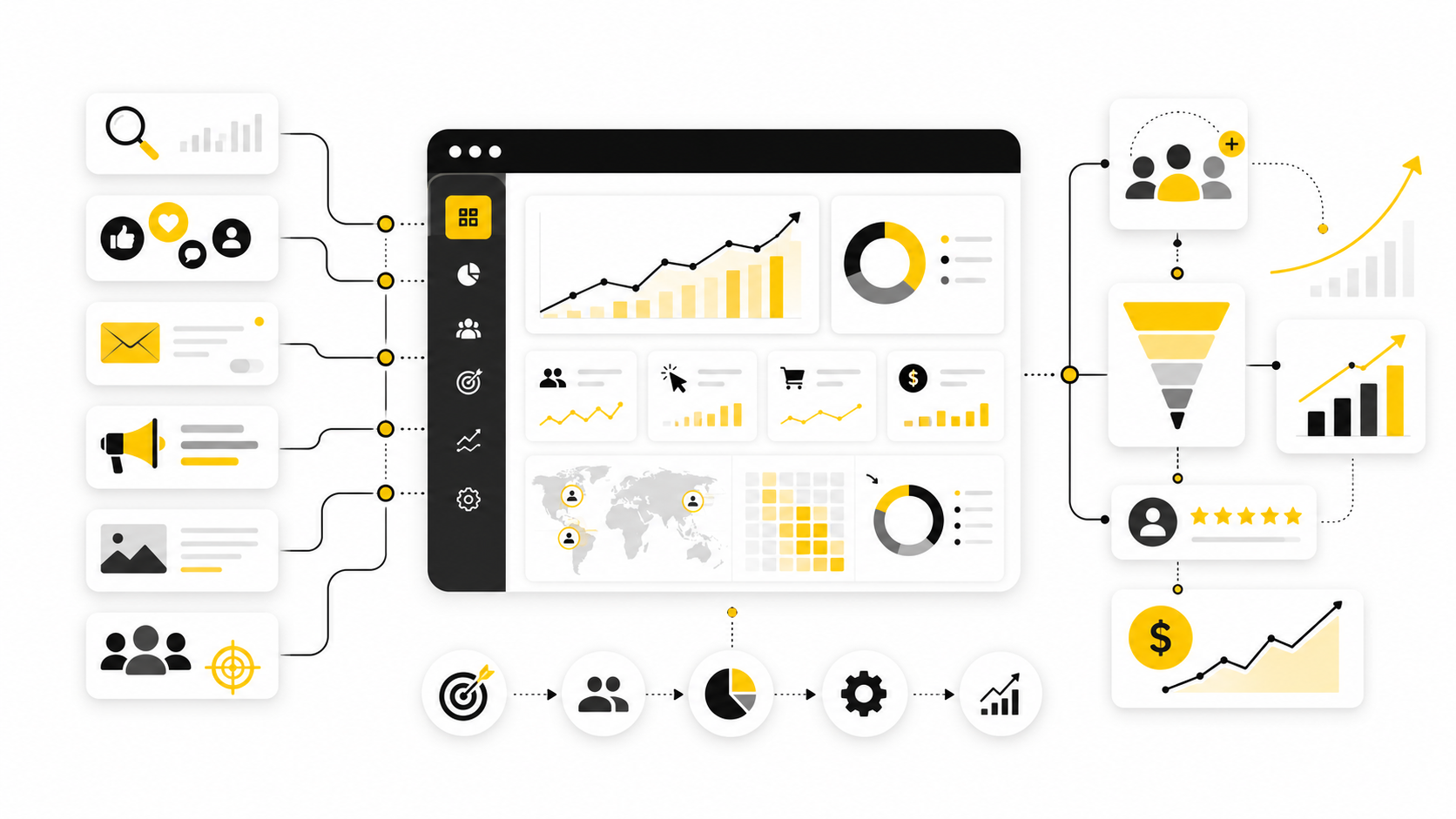
The digital marketing market continues to be one of the fastest‑growing sectors in the global economy, driven by increasing internet adoption, mobile usage, and the shift of brand budgets from traditional advertising to online channels. Recent industry reports show that the global digital marketing market was valued at approximately USD 456.7 billion in 2025 and is projected to reach USD 1,200 billion or more by 2034, reflecting sustained growth well into the future with a compound annual growth rate near 11 %.
This market doesn’t just refer to ad spending; it includes tools, services, software, strategy, creative production, and performance analytics. Brands of all sizes now depend on digital channels to connect with customers, measure performance in real time, and optimize campaigns for better return on investment.
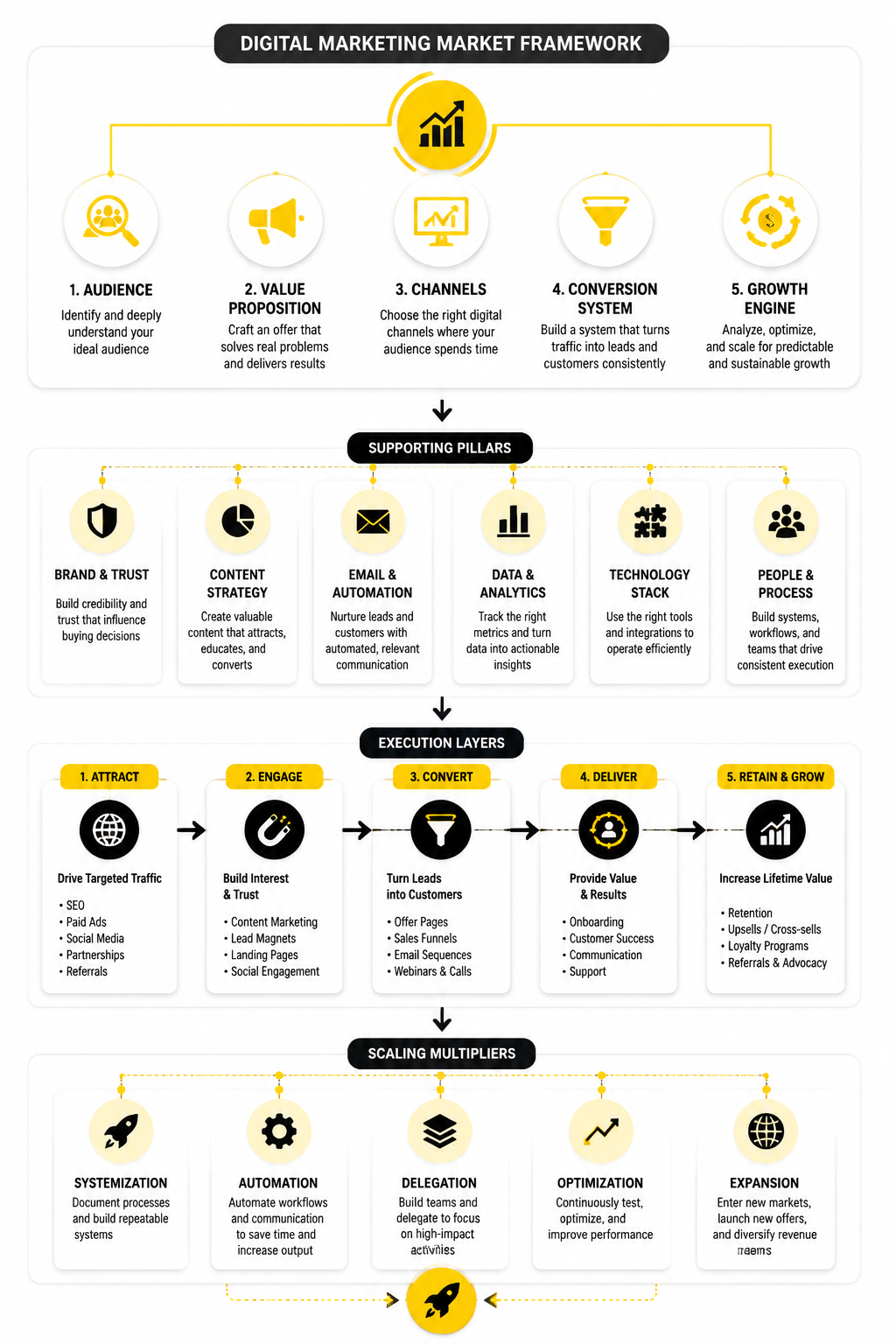
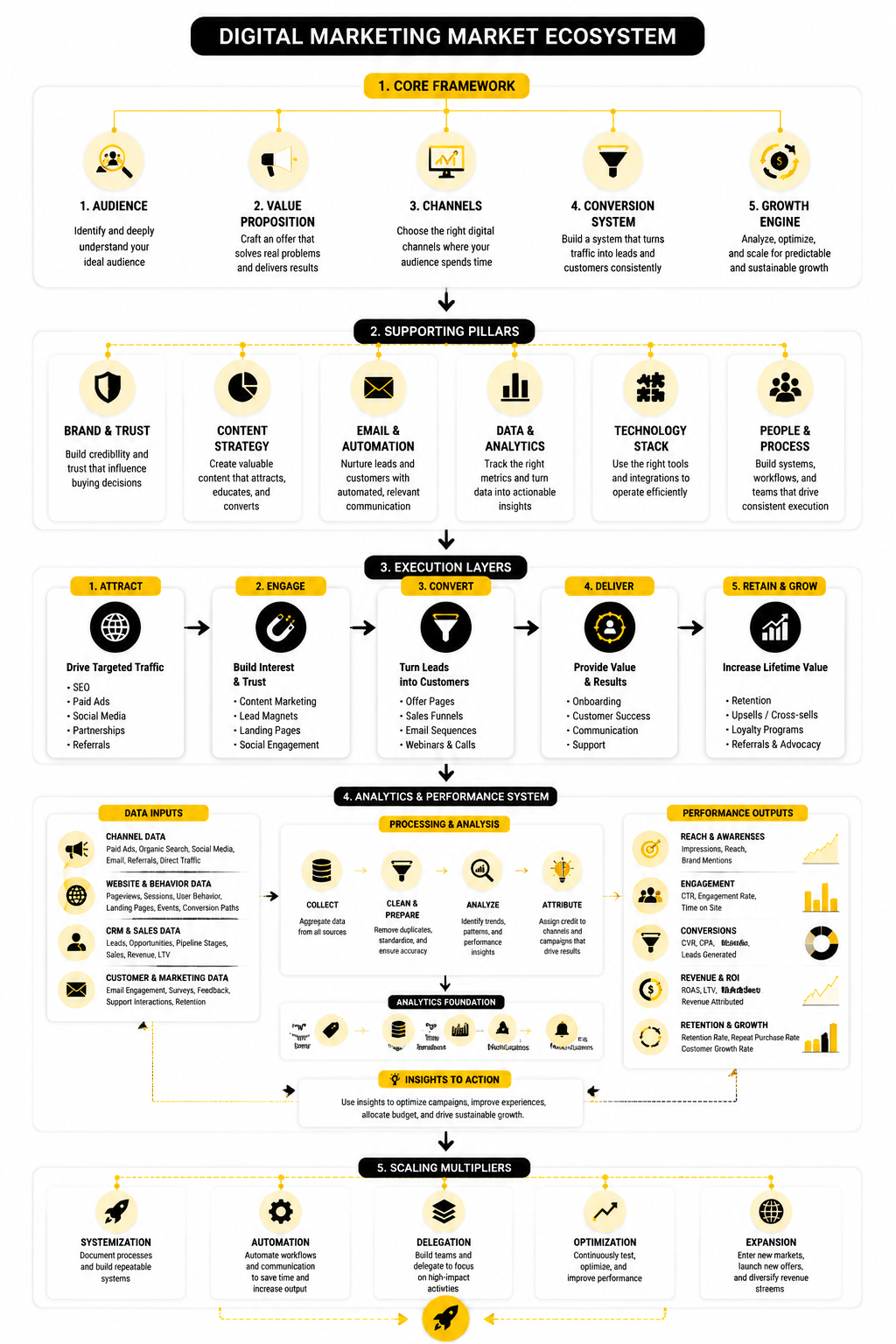
A clear strategic framework helps businesses navigate this complexity. At its core, digital marketing combines audience insight, media channels, content, data analytics, automation, and ongoing optimization into a unified growth engine. In 2026, the most successful marketers will be those who integrate channels rather than silo them, use data to adapt faster, and blend human creativity with machine efficiency.
Why It Matters in 2026
Digital marketing matters because attention has shifted online. More than 5 billion people now use the internet worldwide, with most consumer journeys beginning with search queries, social media interactions, or online recommendations. Unlike traditional marketing channels that are harder to measure or target precisely, digital marketing gives brands real‑time metrics, audience segmentation, and measurable conversion paths - powerful levers for growth across industries.
In 2026, major shifts like AI‑assisted automation, creator‑centric campaigns, and a renewed focus on long‑form storytelling are reshaping how digital channels deliver value.
Market Growth and Size
The digital marketing industry is not a static niche but a broad economic category spanning search, social, content, email, mobile, influencers, and paid media:
Growth is underpinned by rising internet penetration, more powerful data tracking, and increasing demand for personalized online experiences.
Framework Overview of Digital Marketing
A useful framework for understanding the digital marketing market breaks the discipline into interrelated layers:
These layers work together to increase visibility, drive engagement, and deliver conversions that generate revenue.
Core Components of the Digital Marketing Market
While frameworks can vary, most industry models highlight these essential components that drive modern digital marketing success:
Each component plays a unique role, but the highest‑performing strategies integrate them cohesively rather than using them in isolation.
Professional Implementation Strategies
Professional execution often involves blending strategic vision with tactical excellence - and increasingly, leveraging automation and AI where it amplifies insights and performance.
Future Outlook and Trends
Looking ahead, the digital marketing market is set to evolve along multiple fronts:
Understanding these trends will help businesses stay ahead in a market that thrives on innovation and audience connection.
Professional Implementation Strategies for Digital Marketing
Implementing the digital marketing market successfully is more than deploying individual tactics - it’s about building a structured system that drives measurable business outcomes. Professional implementation starts with thoughtful planning and extends into disciplined execution and ongoing measurement, ensuring every dollar spent contributes to growth rather than noise.
Foundation: Define Clear Goals and Metrics
Start by defining clear, measurable goals that are directly tied to business outcomes. Generic goals like “increase brand awareness” don’t provide enough focus to guide tactical decisions - what you want instead are precise targets such as improving conversion rates by a specific percentage or increasing qualified leads within a set time frame. Tools like the SMART framework (Specific, Measurable, Achievable, Relevant, Time‑bound) are widely recommended because they force this clarity and keep teams aligned around what success looks like.
Once goals are set, determine the key performance indicators (KPIs) that will meaningfully reflect whether those goals are being met. These typically include metrics such as customer acquisition cost (CAC), return on ad spend (ROAS), lifetime value (LTV), conversion rates, and channel‑specific engagement stats. Integrating these into dashboards early helps marketers measure progress consistently rather than retroactively.
Audience Insight and Persona Development
Professional implementation requires a deep understanding of your audience before launching campaigns. This goes beyond basic demographics to include where your audience spends time online, how they make purchase decisions, and what problems drive their search behavior. Conducting rigorous market and audience research informs not only messaging and creative but also which channels should be prioritized.
A well‑built buyer persona becomes a reference point for decisions across content creation, channel selection, and messaging frequency - reducing wasted effort on audiences that aren’t aligned with your ideal customer profile.
Strategic Channel Selection and Resource Planning
Not every digital channel delivers equal value for every business. A professional implementation strategy includes selecting channels based on audience behavior and strategic fit rather than jumping on every available platform. For example:
With channels selected, allocate budget and internal resources accordingly. This should factor in not just media spend but also creative production, analytics infrastructure, and staffing - ensuring you have the capacity to run, track, and optimize each initiative effectively rather than overextending your team.
Campaign Creation and Launch
With strategy and planning done, your next task is building campaigns that reflect your audience understanding, strategic goals, and chosen channels. This phase includes:
A crucial part of launching is starting small and testable. Especially in paid campaigns, using controlled budgets to test messaging, formats, and targeting allows you to identify what resonates before scaling.
Continuous Measurement and Optimization
Digital marketing is inherently iterative. Once campaigns are live, professional practice demands ongoing measurement and optimization. Mere reporting on metrics is not enough - teams must:
This ongoing optimization keeps campaigns aligned with evolving audience behavior and market conditions, which is especially important in a dynamic environment where trends and platforms change rapidly.
Collaboration and Communication
Finally, professional implementation hinges on effective internal communication and cross‑team collaboration. Sharing performance insights, wins, and learnings regularly across marketing, sales, and leadership ensures that digital strategies remain aligned with broader business priorities. Using shared dashboards, regular team updates, and documented insights promotes accountability and drives continuous improvement across the digital marketing system.
In practice, the brands that excel don’t treat digital marketing as a set of disconnected activities - they build a disciplined, data‑informed cycle that connects strategy to execution, measurement, and refinement. This systematic approach transforms market presence from random visibility into predictable business impact.
Implementation Process for the Digital Marketing Market
Turning strategy into action in the digital marketing market requires a step-by-step execution plan that bridges strategy with measurable results. Many brands struggle not because they lack ideas, but because they fail to operationalize campaigns in a repeatable, scalable way. This section focuses on how professional teams make digital marketing tangible and actionable.
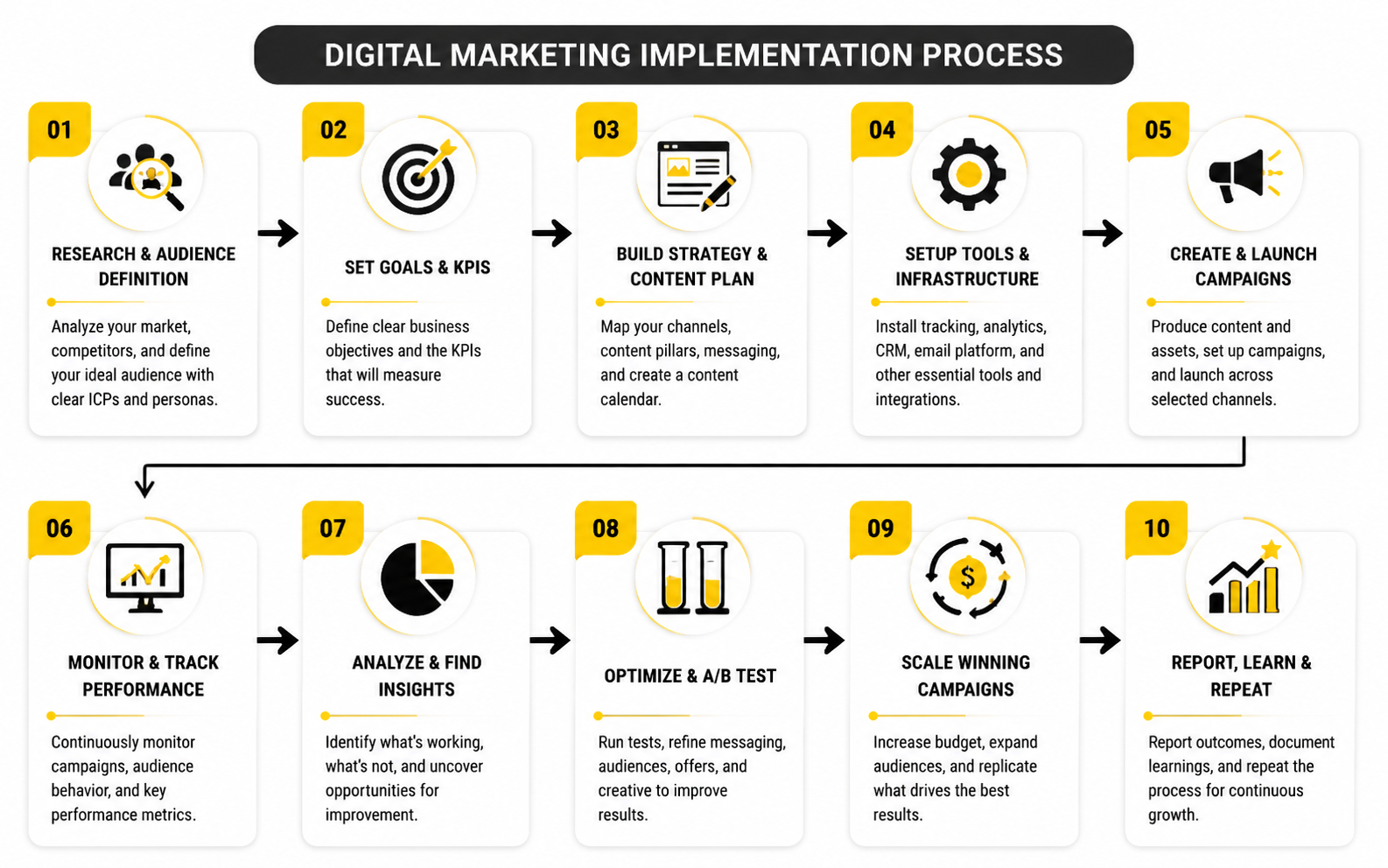
Step 1: Campaign Mapping and Funnel Design
Before any content or ads are created, the first step is mapping the customer journey. This involves identifying key touchpoints where potential customers interact with your brand online - from social media discovery to search engine queries and email engagement. Creating a visual funnel helps align content, messaging, and calls to action at each stage. (gohighlevel.com/297upgrade?affiliate_upgrade_credit_to_%24297=&fp_ref=h8wfn)
Professional marketers define micro-conversions at each stage to measure engagement before the final sale, ensuring the funnel remains optimized for efficiency and revenue impact.
Step 2: Content and Creative Execution
A critical insight from leading agencies is that content should solve a specific audience problem, not just promote products. This mindset drives higher engagement and improves long-term market positioning.
Step 3: Technology Integration and Automation
Digital marketing execution is impossible at scale without technology. Platforms like GoHighLevel provide automation for email sequences, SMS campaigns, and ad retargeting workflows, allowing teams to orchestrate complex campaigns efficiently. (www.gohighlevel.com/protrial?fp_ref=h8wfn)
Integration ensures that customer actions across channels are tracked, enabling automated triggers - for example, sending a personalized email after someone downloads a lead magnet - which increases conversion rates without adding manual labor.
Step 4: Paid Media Deployment and Targeting
For paid campaigns, professional teams segment audiences carefully and allocate budgets to maximize return on investment. This includes:
This precise targeting ensures that ad spend is focused on segments most likely to convert, reducing waste and improving campaign ROI.
Step 5: Monitoring, Testing, and Iteration
Professional implementation is never static. Campaigns are continuously monitored for performance, with testing cycles embedded into the process:
This iterative approach allows campaigns to improve over time, ensuring the digital marketing market investment translates into sustainable growth.
Step 6: Reporting and Optimization Loops
Finally, execution is reinforced by structured reporting and optimization loops. Dashboards track both high-level KPIs and granular metrics, providing insights for strategic decisions. By analyzing which channels, messages, and audience segments perform best, marketers can reallocate resources efficiently and refine the funnel for better conversion. (www.gohighlevel.com/viral-growth-workshop?fp_ref=h8wfn)
This step transforms execution from a series of actions into a working operating rhythm, where the digital marketing market strategy continuously evolves to meet business objectives.
Measurement, Analytics, and What the Data Means in the Digital Marketing Market
In the digital marketing market, data isn’t just a scoreboard; it’s the compass that tells you where to steer, what to double down on, and where to cut losses. Without measurement and analytics, even the most energetic execution plan becomes guesswork. Successful marketers build systems that not only collect numbers but also interpret what those numbers mean for strategy and actions. This turns dashboards into strategic decision engines instead of decorative reports.
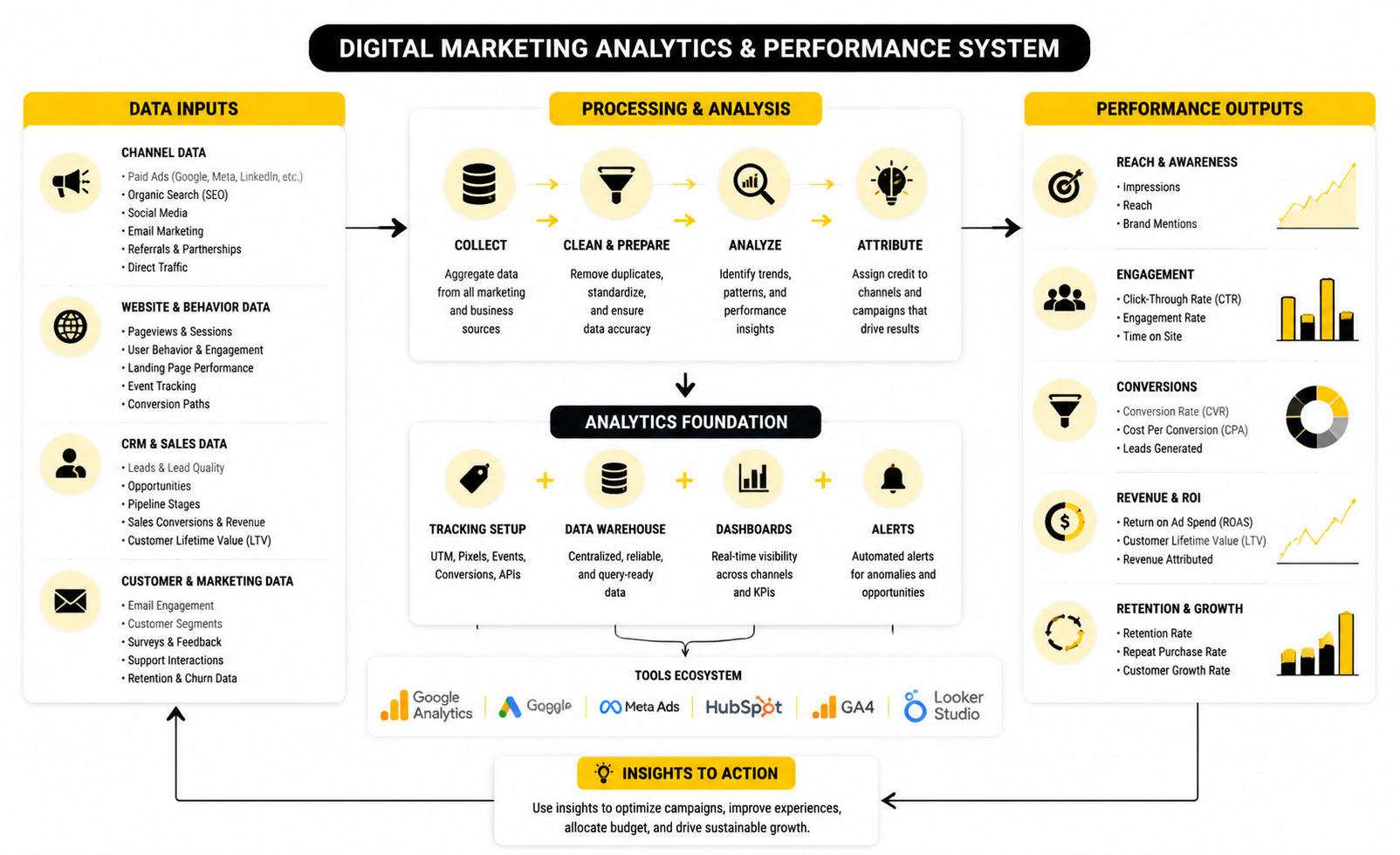
What Benchmarks Tell You and Why They Matter
Benchmarks provide context to your performance metrics - without them, raw numbers like a 3 % CTR or a $50 cost per acquisition (CPA) have no frame of reference. For example, a 6.11 % average CTR on Google Search ads in 2026 is considered strong performance across industries, and a median return on ad spend (ROAS) near 3.5:1 indicates efficient paid media investment. These benchmarks let you know whether your campaigns are above, below, or on par with peers - and what levers you might need to pull to improve.
Benchmarks matter because they reveal expectations for your vertical and channel, helping you prioritize optimization where it’s needed most and avoid misallocating budget to underperforming tactics.
Core Metrics and What They Actually Mean
Understanding key performance indicators (KPIs) - and interpreting them holistically - is critical. These metrics form the backbone of performance analysis in the digital marketing market:
If numbers are moving in the wrong direction - for example, rising CAC or declining conversion rates - marketers must ask why, not just that they changed. Metrics intersect. A high CAC with low conversion rate usually signals that audiences aren’t converting what you attract, instead of attracting the wrong audiences entirely.
Interpreting Data Holistically
Isolated figures can mislead. For instance, a CTR might be high, yet that alone doesn’t mean success - if traffic isn’t converting into leads or customers, the campaign has a structural issue. Likewise, tracking impressions without connecting them to conversions can keep teams busy but not effective. Metrics gain actionability when you connect cost, engagement, and conversion signals into a narrative that informs optimization.
Efficient digital marketing analytics ties:
Data Quality and Confidence
Data confidence is its own performance signal. While most marketers acknowledge that data‑driven decisions are critical, fewer than one in three feel confident their data quality supports those decisions. This gap means that measurement systems need intentional design, not just deployment. Ensuring clean data, consistent definitions, and reliable tracking is as important as the numbers themselves.
In the digital marketing market, measurement is not luxury - it’s a prerequisite for smart scaling. When you understand why metrics behave the way they do and interpret them across channels, you can turn dashboards into strategic roadmaps that influence budget allocation, content strategy, audience targeting, and creative development. That’s how analytics transforms from reporting into revenue intelligence.
Advanced Considerations in the Digital Marketing Market
As the digital marketing market matures, the gap between basic execution and strategic mastery becomes clearer. Simple campaign launches and surface‑level analytics are table stakes - real competitive advantage comes from understanding strategic trade‑offs, scaling risks, and how to make complex decisions that align with both short‑term performance and long‑term brand equity.
Balancing Short‑Term Performance With Long‑Term Brand Value
One of the most frequent debates among seasoned marketers is how to balance performance‑driven tactics (like paid acquisition) with brand‑building activities (such as content marketing and community engagement). Performance channels often deliver quicker ROI and easy measurability, but over‑reliance on them can erode brand strength and increase future acquisition costs as audiences get fatigued.
A strategic approach blends both:
This balance ensures that the digital marketing market strategy doesn’t sacrifice future growth for short‑term wins.
Scaling Challenges and Operational Constraints
Scaling digital marketing in a competitive market is not purely a budget exercise - it requires operational maturity. Many organizations hit scaling ceilings not because their creatives are weak but because their processes, tools, or teams are not equipped to handle complexity.
Key scaling constraints include:
To overcome these, advanced teams invest in integration and automation platforms that unify data across touchpoints and reduce friction between planning and execution. This focus ensures that scaling is not just bigger, but more carefully.
Risk Management and Regulatory Landscape
Data privacy regulations such as GDPR in Europe and evolving privacy frameworks in regions like the U.S. have fundamentally changed how the digital marketing market must operate. Tracking limitations (for example, the deprecation of third‑party cookies) require marketers to rethink audience targeting and measurement strategies.
Adaptive strategies include:
These changes are not hurdles to avoid; they are structural shifts that forward‑thinking teams can use to build trust‑based competitive advantage.
Attribution Complexity and Decision Accuracy
Attribution - understanding which touchpoints drive which conversions - becomes exponentially more complex as the digital marketing market grows across channels and devices. Simple last‑click models are no longer sufficient for accurate optimization. Modern attribution requires:
This depth of attribution enables better budget allocation, clearer performance insights, and more confident strategic decisions.
Talent and Skill Gaps
Advanced digital marketing execution demands diverse expertise - from data science to creative storytelling, from platform optimization to strategic planning. A common risk in scaling is the talent gap, where demand for specialists outpaces supply.
Mature teams mitigate this through:
Recognizing skill gaps early and addressing them proactively ensures that teams remain competitive in a market where innovation cycles have accelerated.
Strategic Flexibility and Market Responsiveness
Finally, the digital marketing market rewards strategic flexibility. Markets evolve, audience behaviors shift, and platforms change policies without notice. Organizations that embed flexibility into their planning - by holding budget reserves for experimentation, testing emerging channels, and regularly revisiting assumptions - are better positioned to capitalize on change rather than be disrupted by it.
This advanced framework - blending performance with brand growth, managing scaling complexity, navigating regulatory changes, refining attribution accuracy, building talent depth, and embracing strategic adaptability - equips marketers to not just participate in the digital marketing market but to lead it.
What is the digital marketing market?
The digital marketing market refers to the ecosystem of services, channels, technology, and analytics used by businesses to promote products and engage customers online. It includes everything from search and social advertising to SEO, email, content creation, and analytics platforms.
How big is the digital marketing market today?
The digital marketing market continues to grow rapidly, with forecasts showing expansion into the trillions of dollars over the next decade as brands increase online spending and invest in data‑driven customer engagement.
Why is data analytics critical in digital marketing?
Data analytics provides the evidence behind decisions - it tells marketers which campaigns are working, where conversions happen, and how much value each touchpoint contributes, enabling more carefully budgeting and more effective strategies.
What are the most effective channels in the digital marketing market right now?
Effectiveness varies by business, but search, social media, email, and content marketing consistently rank among top performers because they can be measured, optimized, and aligned with audience behavior.
How do I choose between paid and organic strategies?
Paid strategies are powerful for quick visibility and testing, while organic strategies build sustainable long‑term presence. A balanced approach prioritizes organic growth but uses paid media to accelerate results and fill gaps.
What metrics matter most for evaluating campaign success?
Key metrics include conversion rate, return on ad spend (ROAS), customer acquisition cost (CAC), click‑through rate (CTR), and engagement signals. The value of each metric depends on your campaign goals.
Can small businesses compete in the digital marketing market?
Absolutely. Smaller businesses can compete by focusing on niche audiences, creating high‑quality content, and using targeted paid strategies that deliver precise ROI rather than broad reach.
How does privacy regulation affect digital marketing?
Privacy laws like GDPR and changes in tracking technology require marketers to rely more on first‑party data, ethical consent practices, and privacy‑first analytics, shifting strategy toward transparent audience interaction.
What role does technology play in scaling digital marketing?
Technology enables automation, unified data tracking, campaign orchestration, and real‑time optimization. Without the right tools, scaling becomes inefficient and prone to errors.
Is the digital marketing market still evolving?
Yes - from AI‑assisted personalization to creator‑focused engagement and more sophisticated cross‑platform attribution, the market is evolving rapidly, rewarding teams that adapt quickly.
Build a stronger local presence with BAAM AI
Turn your website, Google profile, social channels, and AI visibility into one growth engine
Most businesses do not need more random marketing activity. They need a consistent presence system that helps the right people find them, trust them, and take action. BAAM AI brings strategy, local SEO, website updates, Google Maps visibility, social content, AI-search readiness, media production, and reporting into one practical monthly engine.
If you want your marketing to keep working after the campaign ends, start with a free BAAM AI presence audit. See how your business shows up today and where the fastest visibility wins are at BAAM AI.