
BAAM AI Blog
Digital Marketing For Manufacturers
is no longer just a nicer website, a few LinkedIn posts, and a brochure PDF hidden behind a contact form. It is the system that helps engineers, procurement teams, plant managers, distributors, and technical buyers...
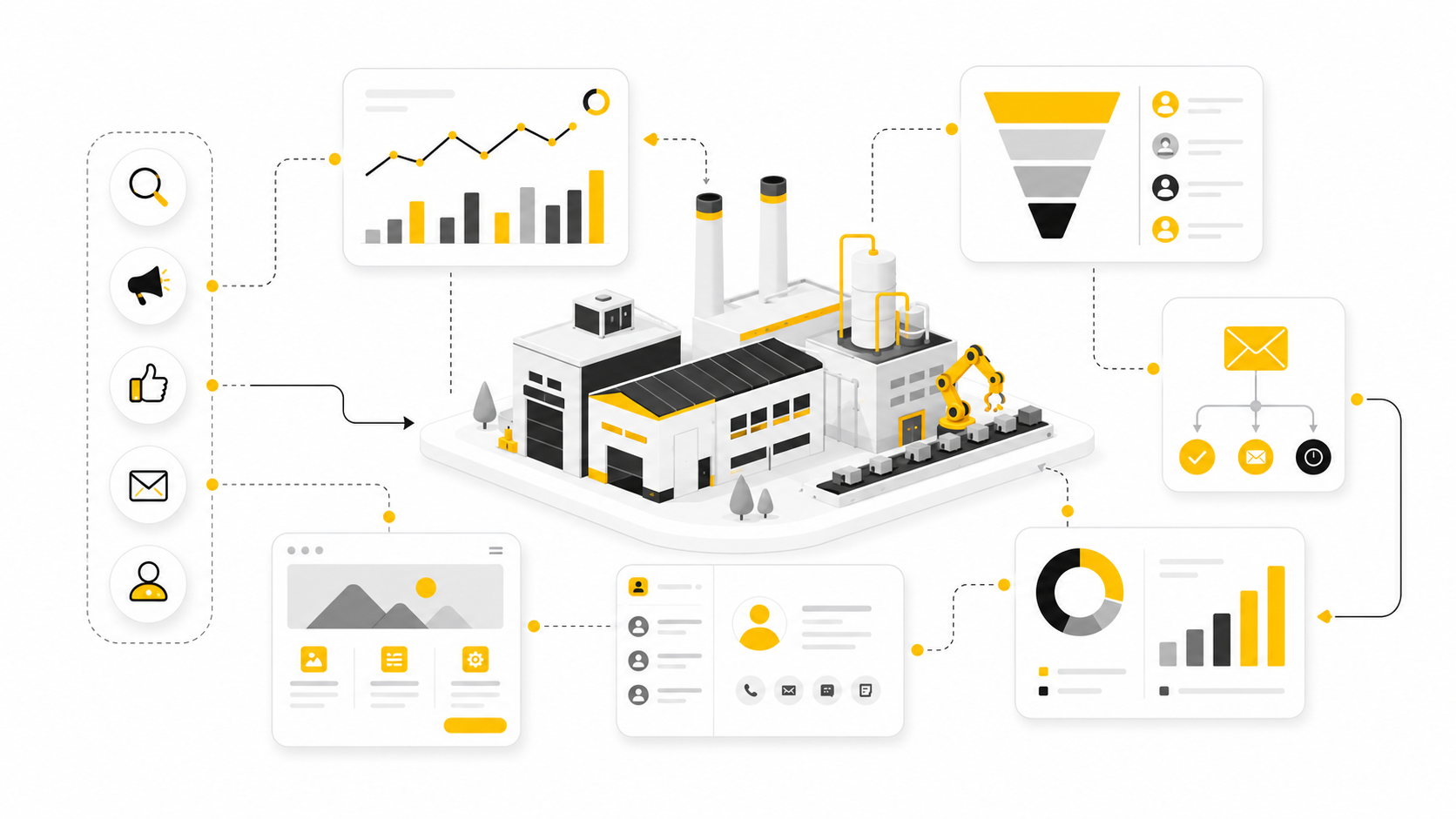
Digital marketing for manufacturers is no longer just a nicer website, a few LinkedIn posts, and a brochure PDF hidden behind a contact form. It is the system that helps engineers, procurement teams, plant managers, distributors, and technical buyers find you, trust you, compare you, and finally decide whether you belong on the shortlist.
That matters because industrial buying has changed faster than many manufacturers’ marketing systems have. A 2025 Gartner sales survey found that 61% of B2B buyers preferred a rep-free buying experience, while 73% actively avoided suppliers that sent irrelevant outreach Gartner reported in its 2025 B2B buyer survey. In plain English, buyers still need expertise, but they do not want to chase basic answers through a sales conversation before they are ready.
For manufacturers, this creates a very practical challenge. Your best prospects may be researching tolerances, certifications, materials, lead times, application fit, compliance requirements, replacement parts, integration limits, and supplier credibility long before they ever submit an RFQ. If your digital presence does not answer those questions clearly, a competitor can shape the buying criteria before your sales team even knows the opportunity exists.
The good news is that digital marketing for manufacturers does not need to feel flashy, vague, or disconnected from revenue. Done properly, it supports the way serious industrial buyers already make decisions. It turns your website into a technical sales asset, your content into a qualification engine, your search presence into a demand capture channel, and your CRM into a cleaner bridge between marketing, sales, distributors, and customer service.
this guide breaks the whole system into six connected parts. Each part builds on the last, so the full strategy moves from buyer behavior and positioning into execution, measurement, and improvement.
Why Digital Marketing Matters For Manufacturers
Manufacturing buyers are not casual shoppers, but they are still digital researchers. They compare suppliers quietly, involve multiple stakeholders, and often arrive at a conversation with strong opinions already formed. That means your digital presence has to do more than “generate awareness”; it has to help buyers reduce risk.
Risk is the real issue in most manufacturing purchases. A wrong supplier can create production delays, quality failures, compliance problems, warranty claims, angry customers, and expensive rework. So buyers look for proof before they look for a pitch.
That proof can come from many places: technical pages, application guides, CAD files, certifications, case studies, distributor information, product comparison pages, lead time clarity, service documentation, and a clean RFQ process. When these assets are missing, the buyer does not always ask for them. Many times, they simply move on.
The Manufacturer Marketing Framework
A strong manufacturer marketing system has four jobs. First, it must help the right buyers find you. Second, it must explain what you do in language that matches their real problem. Third, it must prove that you can deliver. Fourth, it must make the next step simple.
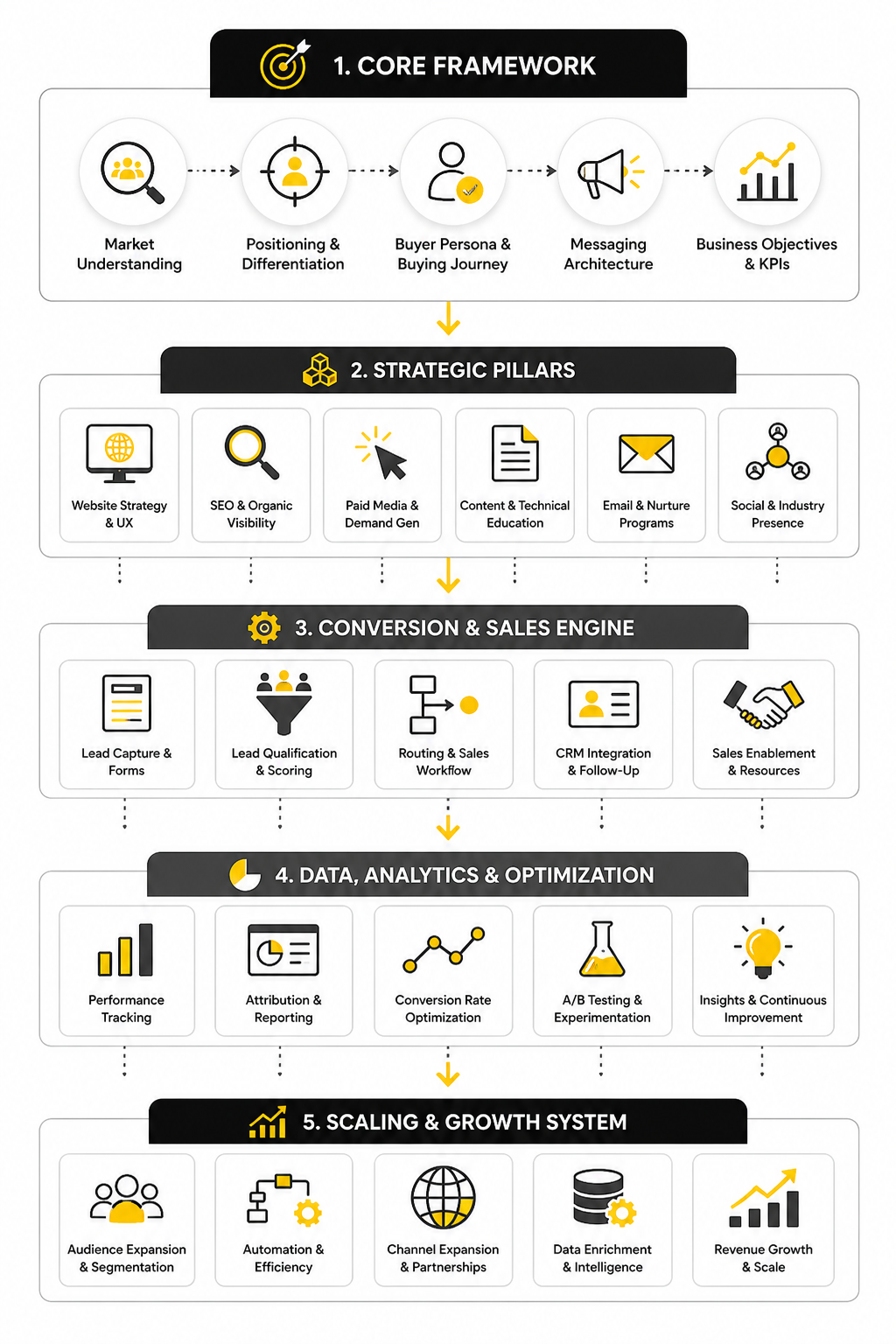
This is where many manufacturers make the mistake of treating marketing as a collection of disconnected tactics. They run ads without fixing the website. They publish blog posts without understanding search intent. They buy automation tools without defining the sales process. They post on social media without knowing which buyers, engineers, distributors, or partners they are trying to influence.
The better approach is to build the system around the buyer journey. A technical buyer might start with a problem, then search for a process, then compare materials, then shortlist suppliers, then request pricing, then involve procurement. Your marketing should support each of those moments instead of pushing every visitor toward the same generic contact form.
Core Components Of Digital Marketing For Manufacturers
The core components are simple, but they need to work together. Your website is the base. Search marketing captures existing demand. Content builds trust before the buyer is ready to talk. Paid media can accelerate visibility when the economics make sense. Email and automation help nurture long-cycle opportunities. CRM and reporting connect marketing activity to pipeline instead of vanity metrics.
For manufacturers with distributor networks, sales reps, or complex product lines, the system also needs clean routing. A high-intent RFQ should not sit in a shared inbox for three days. A distributor lead should not receive the same follow-up as an OEM engineering inquiry. A service request should not be treated like a new business opportunity.
This is where tools can help, but only after the process is clear. Platforms like GoHighLevel can be useful when a manufacturer needs landing pages, follow-up workflows, pipeline tracking, and lead routing in one place. The tool is not the strategy, though. The strategy is deciding what should happen when each type of buyer raises their hand.
Professional Implementation For Manufacturing Teams
Professional implementation starts with focus. A manufacturer does not need to market every capability equally, especially if some products have weak margins, limited capacity, or poor strategic fit. The strongest digital marketing programs usually begin by identifying the best-fit segments, the highest-value applications, and the buying questions that sales teams answer every week.
From there, the work becomes more concrete. Build the pages buyers actually need. Strengthen the proof around quality, delivery, engineering support, and application fit. Create content that helps buyers make decisions, not content that merely fills a calendar. Then connect every form, call, quote request, and campaign to a follow-up process the sales team will actually use.
That is the foundation for the rest of the article. The next sections will move from the big picture into the practical decisions that make digital marketing for manufacturers work in the real world: positioning, buyer intent, channel selection, implementation, measurement, and optimization.
Positioning, Markets, And Buyer Intent
Digital marketing for manufacturers gets a lot easier when the positioning is clear. Not clever. Not cute. Clear.
A buyer should understand what you make, who it is for, where it fits, and why your company is a safer choice within a few seconds of landing on an important page. That sounds basic, but it is where many manufacturing websites lose serious opportunities. They talk about “quality,” “innovation,” and “solutions” before explaining the actual products, applications, materials, industries, tolerances, certifications, or production capabilities that buyers came to evaluate.
Strong positioning gives the rest of the marketing system something solid to stand on. Without it, SEO becomes scattered, paid campaigns attract weak leads, content sounds generic, and sales teams keep explaining the same fundamentals over and over. With it, every page, campaign, email, quote form, and follow-up message can reinforce the same practical reason to choose you.
Start With The Right Market, Not The Loudest Channel
The first positioning decision is not whether to use SEO, LinkedIn, Google Ads, email, or automation. The first decision is which market you are trying to win. A manufacturer selling custom components to aerospace OEMs needs a very different message from a company selling replacement parts to maintenance teams, even if both technically operate in the same broad industry.
This is why “more traffic” is often the wrong goal at the start. A small number of qualified engineers, sourcing managers, distributors, or plant leaders can be more valuable than thousands of visitors who will never buy. Manufacturing marketing should be judged by the quality of opportunities it helps create, not by whether a dashboard looks busy.
A practical way to define the market is to answer five questions:
These questions keep the strategy grounded. They also stop the common mistake of marketing every capability equally. If a product line creates low-margin, difficult, one-off work, it should not receive the same digital priority as a strategic capability with strong fit, repeat demand, and clear differentiation.
Match Your Message To How Buyers Search
Industrial buyers rarely search in one neat way. One person may search by product category, another by application, another by material, another by certification, and another by the problem they are trying to solve. Good digital marketing for manufacturers recognizes these different entry points and builds pages around them.
For example, a buyer may not begin with your exact product name. They may search for a failure mode, a compatibility issue, a regulatory requirement, a production bottleneck, or a comparison between materials. If your website only targets branded product terms, you miss the research stage where the buyer is still forming the shortlist.
This matters because modern B2B decisions are often shaped before a supplier conversation begins. Research from 6sense found that 81% of B2B buyers had already selected a preferred vendor before contacting sales in its buyer experience research covering more than 2,500 recent B2B buyers. For manufacturers, that means the silent research phase is not just awareness. It is where the buying criteria are being built.
Separate Technical Intent From Commercial Intent
Not every visitor is ready to request a quote, and that is fine. The problem starts when every page treats every visitor as if they are at the same stage. A technical researcher may need specifications, drawings, material guidance, testing information, or application notes before they are willing to speak with sales.
Commercial intent looks different. These visitors are comparing suppliers, checking lead times, reviewing certifications, looking for distributor options, estimating cost, or preparing an RFQ. They need proof, clarity, and a simple path to action.
A strong manufacturing website supports both types of intent without forcing them into the same journey. Technical pages should help people understand fit. Commercial pages should help people evaluate risk and take the next step. When those paths are blended together carelessly, the site becomes harder to use for everyone.
Build Around Buying Committees
Manufacturing purchases often involve more than one decision-maker. Engineering may care about performance and fit. Procurement may care about price, terms, supplier risk, and documentation. Operations may care about lead times, maintenance impact, and delivery reliability. Leadership may care about strategic alignment, compliance, and total cost.
That means one generic value proposition will not carry the whole sale. Your digital presence needs to give each stakeholder the information they need without making the site feel fragmented. The same product may need technical proof for engineering, operational proof for plant teams, and business proof for procurement.
This is where clear page structure matters. Product and capability pages should not bury important details behind vague marketing copy. They should make the buying committee’s job easier by organizing information in a way that supports internal discussion, comparison, and approval.
Make Differentiation Specific
Most manufacturers say they offer quality, service, reliability, experience, and custom solutions. Those claims may be true, but they are not specific enough to influence a serious buyer. The buyer needs to know what those words mean in practice.
Specific differentiation can come from measurable capabilities, unusual expertise, documented process control, shorter production paths, stronger engineering support, better documentation, specialized equipment, certifications, industry experience, or a proven ability to solve a narrow type of problem. The point is not to sound bigger than you are. The point is to make the real advantage easier to believe.
A useful test is simple: could a competitor copy the sentence and use it on their own website without changing anything? If yes, it is not strong positioning yet. Good manufacturing positioning should feel hard for a weaker-fit competitor to imitate because it is tied to your actual process, history, equipment, standards, people, or customer base.
Turn Sales Knowledge Into Website Structure
Your sales team already knows many of the questions buyers ask before they trust you. Those questions should shape the website. If sales repeatedly explains the same materials, standards, timelines, minimums, design limits, or application tradeoffs, that is not just sales knowledge. It is marketing infrastructure waiting to be built.
This does not mean replacing the sales team with content. It means letting digital assets handle the repeatable education so sales can spend more time on fit, strategy, quoting, and relationship-building. Buyers still value expertise, but they increasingly expect basic evaluation information to be available before a meeting.
Start by collecting the questions that appear in real sales conversations:
These questions can become product pages, application pages, comparison pages, FAQ sections later in the article, quote guidance, sales enablement documents, and follow-up email content. More importantly, they make the marketing feel useful instead of promotional.
Positioning Before Promotion
Promotion amplifies whatever positioning already exists. If the positioning is sharp, promotion helps the right buyers understand the value faster. If the positioning is weak, promotion simply sends more people into confusion.
That is why manufacturers should not rush into campaigns before fixing the foundation. Paid ads cannot save unclear product pages. Automation cannot repair a vague offer. Social posting cannot compensate for a website that hides the information buyers need.
The order matters. Clarify the market. Define the buyer intent. Build pages around real decision points. Then use channels to bring the right people into a system that can actually help them move forward. That is how digital marketing for manufacturers becomes a revenue asset instead of another activity competing for attention.
Core Digital Marketing Channels For Manufacturers
Once positioning is clear, channel selection becomes much more practical. You are no longer asking, “Where should we post?” You are asking, “Which channels help the right buyers find, evaluate, trust, and contact us?”
That shift matters. Manufacturers often waste time copying B2C tactics or chasing whatever channel looks popular this quarter. A good channel strategy is not about being everywhere. It is about showing up where serious buyers already look for answers and making each interaction useful enough to move them forward.
Search Engine Optimization
SEO is usually one of the strongest long-term channels for manufacturers because industrial buyers often begin with a specific need. They may search for a product category, material, standard, application, problem, or supplier type. If your website has clear pages for those searches, SEO can capture demand that already exists.
The mistake is treating SEO like a blog-only activity. For manufacturers, the most valuable SEO work often happens on product pages, capability pages, application pages, comparison pages, technical resource pages, and location or distributor pages. These pages should not be thin descriptions with a few keywords sprinkled in. They should answer the practical questions a buyer would ask before trusting you with a quote request.
A strong SEO structure usually includes:
This is where digital marketing for manufacturers becomes genuinely useful. The goal is not to trick search engines. The goal is to make your expertise findable at the exact moment a buyer is trying to solve a real problem.
Technical Content And Sales Enablement
Content should not exist because someone said the company needs “thought leadership.” In manufacturing, content earns its place when it helps buyers make better decisions or helps sales teams explain value more efficiently. That could mean application guides, selection checklists, spec explanations, maintenance resources, installation guidance, or engineering notes.
The best content usually comes from the people closest to the customer. Sales, engineering, service, quality, and operations teams hear the same questions every week. Those questions are a goldmine. Turn them into useful content and you reduce friction before the buyer ever reaches out.
This also gives your sales team better assets to send after a conversation. Instead of writing a long custom explanation every time, they can share a focused page that explains the issue clearly. That makes the company look more organized, more credible, and easier to buy from.
Paid Search And Retargeting
Paid search can work well when the intent is commercial and the economics make sense. If buyers are searching for high-value products, urgent replacements, specialized services, or quote-ready supplier terms, paid campaigns can put your company in front of them quickly. The key is discipline.
Do not send paid traffic to a vague homepage and expect strong results. Paid campaigns need landing pages that match the search intent, explain the fit, establish credibility, and make the next step obvious. A buyer searching for a specific capability should not have to dig through ten menus to find out whether you can help.
Retargeting can also support longer buying cycles, but it should be handled carefully. The goal is to stay visible with useful reminders, not follow people around the internet with generic ads. Promote application content, comparison resources, quote guidance, or proof assets that help buyers continue evaluating you.
LinkedIn And Industry Visibility
LinkedIn is not magic, but it can be useful for manufacturers when the audience is specific. It works best for building credibility with engineers, executives, distributors, partners, recruiters, and industry decision-makers. It works poorly when companies post generic slogans and expect leads to appear.
The most useful LinkedIn content usually shows practical expertise. That can include lessons from production, quality insights, engineering considerations, application education, facility updates, team expertise, trade show preparation, or commentary on industry changes. The tone should feel human and specific, not like a press release chopped into social media posts.
For teams that need a simple way to keep social publishing organized, Buffer can help schedule posts and keep a consistent rhythm. The rhythm matters because sporadic posting makes it hard to build recognition. Still, consistency only helps when the content is worth reading.
Email Marketing And Lead Nurture
Email is useful when it respects timing. Manufacturing buyers may research for weeks or months before they are ready to act, especially when the purchase affects production, compliance, budgets, or supplier approval. A good email system keeps helpful information in front of them without pretending every subscriber is ready for a sales call.
The content should match the relationship. A buyer who downloaded a technical guide should not immediately receive five aggressive sales emails. A repeat customer looking at service resources should not receive a generic new-prospect sequence. Segmentation matters because relevance is the difference between helpful follow-up and inbox noise.
Email can support:
Tools like Brevo or Moosend can support this kind of nurturing when the segments and follow-up logic are thought through first. The software should make the process easier, not create a pile of automated messages nobody asked for.
The Execution Process
Channel strategy becomes real when it turns into a repeatable implementation process. This is the point where digital marketing stops being a discussion and becomes a workflow. You define priorities, build assets, connect systems, launch campaigns, and measure what happens.
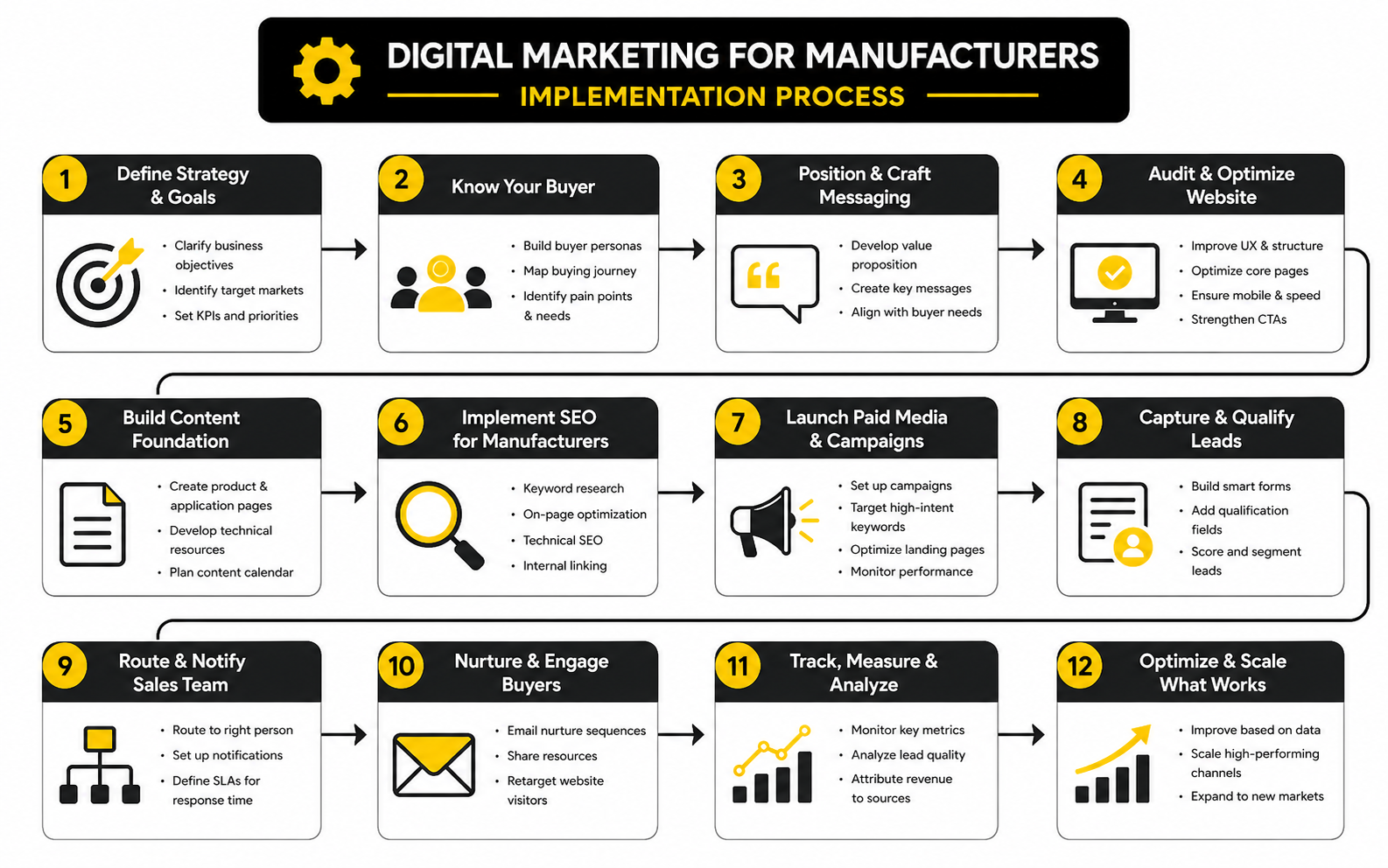
The process does not need to be complicated, but it does need to be sequenced. Manufacturers get into trouble when they jump straight to promotion before fixing the buyer experience. More traffic will not help much if the website does not explain the offer, the forms are hard to use, and the sales team has no clean follow-up process.
A practical execution process looks like this:
Build The Website Around Buyer Tasks
The website should be designed around what buyers need to do. Some visitors need to understand a product. Some need to check technical fit. Some need to compare supplier options. Some need to request a quote. Some need documentation after becoming a customer.
A task-based website is easier to navigate because it respects buyer intent. It does not force everyone through the same generic path. It gives technical researchers enough detail, commercial buyers enough proof, and ready-to-act visitors a clear next step.
This is especially important because industrial manufacturers often have complex offerings. If the navigation is built around internal departments instead of buyer needs, the site becomes confusing fast. Buyers should not need to understand your org chart to find the right capability.
Create Conversion Paths That Fit The Buying Stage
A quote request is not the only conversion that matters. It is usually the most valuable one, but it is not the only signal of intent. A buyer downloading a technical guide, viewing multiple application pages, using a configurator, requesting a sample, booking a consultation, or asking for documentation may also be moving toward a serious opportunity.
The key is to match the conversion path to the buying stage. Early-stage buyers may need low-pressure resources. Mid-stage buyers may need comparison tools or specification guidance. Late-stage buyers need RFQ forms, scheduling options, distributor contact, or direct sales routing.
For scheduling technical consultations or application reviews, Cal.com can be useful when the process requires a booked conversation instead of a generic contact form. The important part is not the calendar tool itself. The important part is reducing friction when a qualified buyer is ready to talk.
Connect Marketing To Sales Follow-Up
This is the part many manufacturers underestimate. A campaign can generate a strong inquiry, but the revenue is often won or lost in the handoff. If the lead is routed poorly, followed up late, or entered into the wrong system, the buyer experience breaks.
Sales follow-up should be specific to the inquiry type. A replacement-part request, custom engineering inquiry, distributor lead, OEM opportunity, and service question should not all receive the same response. Each one needs a clear owner, expected response time, qualification steps, and next action.
A CRM or automation platform can help manage this handoff. GoHighLevel can support pipelines, workflows, forms, follow-up reminders, and lead routing when a team wants those pieces in one system. But again, the tool only works if the process is defined. Automation makes a good process faster and a bad process louder.
Keep The First Build Focused
The first implementation should not try to fix everything at once. That usually creates delays, messy priorities, and half-finished assets. Start with the highest-value market or capability, then build the core pages, content, tracking, and follow-up around that focus.
This gives the team a working model. Once one segment is organized, the same structure can be adapted to other product lines, regions, applications, or customer types. That is much cleaner than trying to rebuild the entire marketing system in one massive push.
The goal is momentum with discipline. Build the first version well enough to launch, measure, and improve. Then keep tightening the system based on real buyer behavior, sales feedback, and pipeline quality.
Statistics And Data
Measurement is where digital marketing for manufacturers becomes honest. Strategy sounds good in a meeting, but the numbers show whether buyers can actually find the company, understand the offer, take the next step, and move through the sales process. The point is not to collect every possible metric. The point is to measure the few signals that explain revenue progress.
Manufacturers should be careful with generic marketing benchmarks. A website selling replacement parts online will behave differently from a company selling custom engineered systems with a nine-month buying cycle. A high conversion rate can still produce weak business if the leads are low quality, and a low conversion rate can still be acceptable if a small number of qualified opportunities create serious revenue.
The right question is not “Are our numbers good?” The better question is “What do these numbers tell us to fix next?” That mindset turns analytics from reporting into decision-making.
The Buyer Behavior Data That Matters
The biggest measurement mistake is treating every visitor as if they has the same intent. Some people are researching. Some are comparing. Some are checking whether you meet a requirement. Some are ready to request a quote. These behaviors should not be blended into one vague traffic number.
Modern B2B buying data makes this even more important. Gartner reported in 2026 that 67% of B2B buyers prefer a rep-free buying experience in its sales survey, which reinforces why manufacturers need strong digital self-service assets before the sales conversation begins Gartner’s 2026 B2B buyer survey. 6sense also found that the preferred vendor chosen before sales contact wins roughly 80% of the time, which means early digital influence can shape the deal before the supplier ever sees an RFQ 6sense 2025 buyer experience research.
Those numbers should change how a manufacturer reads its own analytics. If buyers are self-educating, then product pages, application pages, technical resources, comparison content, and quote guidance are not “top-of-funnel extras.” They are part of the sales process. When those pages underperform, the issue is not only marketing. It may be lost influence before the sales team gets a chance.
Build A Measurement System Around Buyer Progress
A useful analytics system connects four layers: visibility, engagement, conversion, and sales outcome. Visibility tells you whether buyers can find you. Engagement tells you whether the page answered enough of their question to keep them moving. Conversion tells you whether they took a meaningful action. Sales outcome tells you whether the action created business.
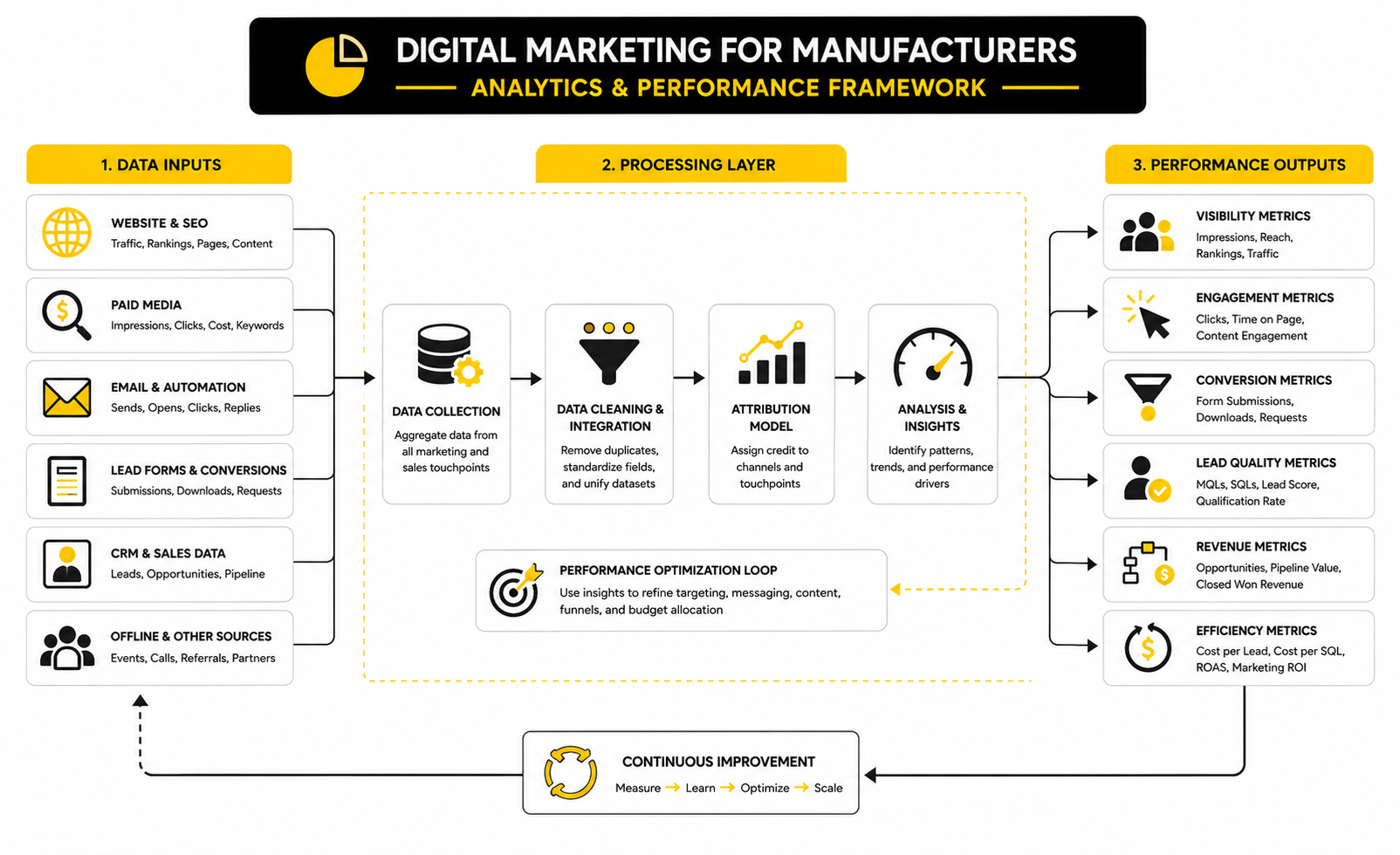
This is the simple version manufacturers should start with:
This structure keeps the team from obsessing over surface-level numbers. Traffic is useful only if it helps the right people move forward. Leads are useful only if they can become qualified opportunities. Revenue is the final proof, but the earlier signals help you find where the system is leaking.
What Website Metrics Actually Mean
Website metrics need context. A page with a high bounce rate is not automatically bad if it answers a simple question and sends the buyer to call directly. A page with long time-on-page is not automatically good if visitors are confused and searching for missing information. Analytics should trigger questions, not lazy conclusions.
For manufacturers, the most important website signals usually come from behavior around commercial pages. If product pages get traffic but no quote requests, the offer may be unclear, the proof may be weak, or the next step may feel risky. If application pages attract visitors but they do not continue to product or contact pages, the internal links may not guide the buyer naturally. If technical content performs well but never supports pipeline, the content may be educational without connecting to a business outcome.
The best pages usually do three things at once. They attract the right buyer through search or referral traffic. They answer enough technical and commercial questions to build confidence. Then they guide the visitor toward a sensible next action without forcing a premature sales conversation.
Lead Quality Beats Lead Volume
Manufacturers should not celebrate lead volume too quickly. A campaign that generates 200 weak inquiries can waste more time than a campaign that generates 12 serious opportunities. This is especially true when sales, engineering, or estimating teams have to spend time reviewing each request.
Lead quality should be scored using criteria that reflect the actual business. A good-fit inquiry might include the right industry, clear application, realistic volume, proper geography, enough technical detail, and a buying timeline that matches your sales process. A poor-fit inquiry might ask for unsupported materials, impossible timelines, tiny one-off work, consumer-grade pricing, or a product you do not manufacture.
This is where CRM discipline matters. If the sales team does not mark lead source, fit, quote value, stage, close reason, and lost reason, marketing cannot learn what is actually working. A clean pipeline gives the team evidence. A messy pipeline gives everyone opinions.
Benchmarks Are Useful, But Only After Segmentation
Benchmarks can help, but only when they are used carefully. A manufacturer with a long sales cycle should not compare itself directly to a software trial funnel or an ecommerce store. Even within manufacturing, benchmarks vary by product complexity, average order value, sales model, brand awareness, distributor involvement, and how much of the buying process happens offline.
Broad B2B research still gives useful direction. The Content Marketing Institute’s 2025 B2B research showed that 61% of B2B marketers expected increased investment in video, while 52% expected more investment in thought leadership content, which points to growing pressure for richer buyer education CMI’s 2025 B2B content marketing research. For manufacturers, that does not mean copying every trend. It means technical buyers increasingly expect stronger explanations, clearer expertise, and better proof before they engage.
A practical benchmark should compare performance by segment, not just sitewide averages. Look at product-line conversion, application-page assisted conversions, paid search lead quality, organic traffic by buyer intent, quote-to-close rate by source, and sales cycle length by channel. Those comparisons show where the marketing system is creating the right kind of demand.
Performance Signals Worth Watching Monthly
Monthly reporting should be tight. A bloated dashboard gets ignored. A focused dashboard creates better decisions.
The most useful monthly signals are:
These numbers should lead to action. If paid search produces leads but poor fit, tighten keywords, negative keywords, landing page language, and qualification fields. If organic traffic grows but RFQs do not, improve page structure, proof, calls to action, and internal links. If quote requests are strong but close rates are weak, the issue may be pricing, qualification, sales process, capacity, or expectation-setting.
Attribution Should Be Practical, Not Perfect
Attribution is messy in manufacturing. A buyer may find you through Google, return later from a LinkedIn post, send the site to engineering, attend a trade show, talk to a distributor, and submit an RFQ weeks later. Trying to assign all credit to one touchpoint can create bad decisions.
A better approach is practical attribution. Track first-touch source, last-touch source, key page interactions, campaign influence, and sales notes. Then look for patterns over time instead of pretending one report can explain every deal perfectly.
This is especially important for long-cycle opportunities. A technical guide may not create a quote request immediately, but it may help a buyer understand fit. A comparison page may not get the final click, but it may help procurement justify the supplier. A LinkedIn post may not be the conversion source, but it may make the company feel familiar when the buyer sees it again in search.
Turn Analytics Into Decisions
Data is only useful when it changes what the team does next. If a report does not lead to better pages, sharper campaigns, cleaner follow-up, improved qualification, or stronger sales conversations, it is just decoration. Manufacturers do not need decorative dashboards.
A strong monthly review should answer four questions. What created qualified opportunities? What attracted weak-fit inquiries? Where did serious buyers get stuck? What should we improve before spending more?
That is the practical standard. Digital marketing for manufacturers should not be measured by activity alone. It should be measured by whether the right buyers are moving through the system with less friction, more confidence, and a clearer reason to choose you.
Professional Implementation And Revenue Operations
The advanced stage of digital marketing for manufacturers is not about adding more channels. It is about making the whole system operate cleanly across marketing, sales, engineering, distributors, customer service, and leadership. That is where good strategy either becomes a revenue engine or collapses into scattered activity.
This is also where manufacturers need to be more honest than most companies. Some leads should be rejected quickly. Some product lines should not be promoted heavily. Some markets look attractive online but create quoting headaches, poor margins, or operational stress. Smart implementation is not just about growth. It is about controlled growth.
Align Marketing With Capacity And Margin
Marketing should not create demand the business does not want to fulfill. If a plant is already constrained in one area, pushing more leads into that capability may create delays, lower customer satisfaction, and frustrate the sales team. If a product line has weak margins, growing it may only make the company busier without making it healthier.
This is why manufacturers should connect marketing priorities to capacity planning and margin strategy. The highest priority campaigns should support the products, applications, and customer types the company actually wants more of. That can mean promoting higher-margin capabilities, better-fit industries, strategic replacement programs, recurring service opportunities, or customers with strong lifetime value.
This is not glamorous, but it is essential. Digital marketing for manufacturers should not be judged by whether it makes the phone ring more often. It should be judged by whether it helps the company win better-fit business at a pace the operation can support.
Design Lead Routing Before You Scale Traffic
Lead routing becomes more important as demand increases. A small team may manage inquiries manually for a while, but that breaks down when campaigns expand, distributors are involved, or multiple product lines need different owners. The buyer does not care that your internal process is complicated. They just expect the right person to respond with useful information.
The routing logic should be decided before traffic scales. A custom engineering request may need a technical salesperson. A replacement-part inquiry may need customer service. A distributor request may need a channel manager. A strategic OEM opportunity may need senior sales involvement. Treating all of these as identical “contact us” submissions creates unnecessary friction.
A clean routing setup usually defines:
This is where a CRM becomes more than a database. It becomes the operating layer that keeps demand from getting lost. A manufacturer using GoHighLevel can build forms, pipelines, notifications, and follow-up workflows around this logic, but the same principle applies to any serious CRM setup. Process first. Software second.
Protect Engineering And Estimating Time
Manufacturers often involve technical people in the sales process, and that can be a strength. Engineers, estimators, and application specialists can help buyers understand feasibility, tradeoffs, and fit. But if marketing creates too many poorly qualified inquiries, those same experts become trapped in low-value conversations.
This is one of the most expensive hidden risks in manufacturing marketing. Weak qualification does not only waste ad spend. It wastes the time of people who are needed for production, design, quoting, troubleshooting, and customer support. That cost rarely shows up in a simple marketing dashboard.
The fix is not to hide technical expertise. The fix is to protect it with better front-end filtering. Quote forms should ask for the information needed to evaluate fit. Technical content should answer basic questions before a conversation. Sales should screen for application, volume, timeline, and requirements before pulling engineering into the process.
Use Automation Carefully
Automation can improve speed and consistency, but it can also make a manufacturer sound careless. This is especially dangerous in industrial markets where trust, precision, and responsiveness matter. A buyer asking about a technical requirement should not receive a generic nurture sequence that ignores their actual question.
The best automation is usually simple. Confirm the inquiry. Route it to the right person. Notify the owner. Send helpful next-step information. Remind sales if no one follows up. Segment the contact based on what they asked for. Keep the record updated.
The worst automation tries to fake a relationship. It sends too many emails, assumes intent too aggressively, and treats every contact like a marketing lead. That may work in some low-stakes markets, but it is a poor fit for serious manufacturing buyers.
Handle Distributors Without Creating Channel Conflict
Distributor relationships can make digital marketing more complicated. The manufacturer may want more direct visibility, but distributors may own important customer relationships. If the digital strategy ignores that reality, it can create tension instead of growth.
The goal is to design a system that supports the channel instead of accidentally competing with it. That may include distributor locator pages, regional lead routing, co-branded resources, shared campaign assets, product education, and clear rules for which inquiries go direct versus through the channel. The buyer should not feel the internal complexity.
This also affects measurement. A campaign may influence revenue through a distributor even if the transaction does not happen directly on the manufacturer’s website. If that influence is not tracked in some form, leadership may undervalue digital activity that is actually helping the channel sell.
Decide What Should Be Gated
Gated content can be useful, but manufacturers often overuse it. If basic technical information is hidden behind a form, serious buyers may leave. They are not always trying to become a lead. Sometimes they are just trying to confirm whether you are worth considering.
A better approach is to keep essential evaluation information open and gate only assets where the exchange feels fair. Detailed design tools, advanced calculators, spec templates, sample requests, quote worksheets, and deeper technical guides may justify a form. Basic product details, certifications, capabilities, industries served, and application fit should usually be easy to access.
The decision should be based on buyer value, not marketing’s desire for email addresses. If gating creates friction at the wrong stage, it can reduce trust. If it helps qualify serious intent at the right stage, it can improve follow-up.
Balance Brand Trust With Performance Marketing
Performance marketing gets attention because it is measurable. Brand trust matters because it influences whether buyers believe the performance marketing in the first place. Manufacturers need both.
A buyer may click a search ad because the offer matches their need, but they still evaluate credibility once they land. They look for signs of competence: real capabilities, clear documentation, industry fit, proof of quality, facility information, team expertise, certifications, and a professional experience. If those signals are weak, the click does not matter much.
Brand trust is not about vague storytelling. It is about reducing perceived risk. In manufacturing, that often means showing operational seriousness, technical depth, quality discipline, delivery reliability, and customer fit. Those signals make every channel work harder.
Plan For Multi-Location And Multi-Product Complexity
As manufacturers grow, the marketing system can become harder to manage. Multiple facilities, product lines, regions, languages, distributors, and brands can create messy websites and inconsistent messaging. What worked for one focused capability may not scale automatically.
The solution is to create reusable structures. Product pages should follow a consistent logic. Application pages should answer similar categories of questions. Location pages should explain real regional capabilities, not duplicate generic copy. Campaigns should use shared naming conventions, tracking standards, and reporting views.
This is where governance matters. Someone needs to own page quality, CRM hygiene, campaign structure, tracking standards, brand consistency, and content accuracy. Without ownership, the system slowly becomes cluttered and unreliable.
Avoid The Common Scaling Mistakes
Scaling digital marketing too early can be expensive. If the foundation is weak, more activity simply creates more confusion. Manufacturers should fix the system before they multiply the spend.
Common scaling mistakes include:
These mistakes are avoidable. They usually come from moving too fast without a clear operating model. Speed is useful, but only when the direction is right.
Build A System The Team Can Actually Maintain
The best marketing system is not the most complex one. It is the one your team can maintain consistently. A manufacturer with a small marketing team should not build a content machine that requires ten approvals, weekly video production, advanced personalization, and constant campaign launches if nobody can support it properly.
Sustainable execution matters more than impressive plans. A focused SEO program, strong product pages, clear RFQ routing, monthly reporting, practical email follow-up, and useful sales enablement can outperform a bloated strategy that never gets maintained. Consistency wins.
This is the expert-level standard: build the system around real buyer behavior, real sales capacity, real operational constraints, and real follow-up discipline. That is how digital marketing for manufacturers becomes durable. Not just active. Durable.
Measurement, Optimization, And Frequently Asked Questions
At this stage, the system should feel connected. Positioning shapes the message. Channels bring the right buyers into the experience. Content answers real questions. Forms and routing turn interest into action. CRM and reporting show whether the work is producing qualified opportunities.
That connected system is the real advantage. Most manufacturers do not lose because they lack effort. They lose because the pieces are disconnected: the website says one thing, sales says another, distributors follow a different process, and reporting only shows traffic without explaining business impact.
Digital marketing for manufacturers works best when every piece supports the same buying journey. The buyer should be able to move from search to education, from education to comparison, from comparison to quote, and from quote to sales follow-up without confusion. That is the standard.
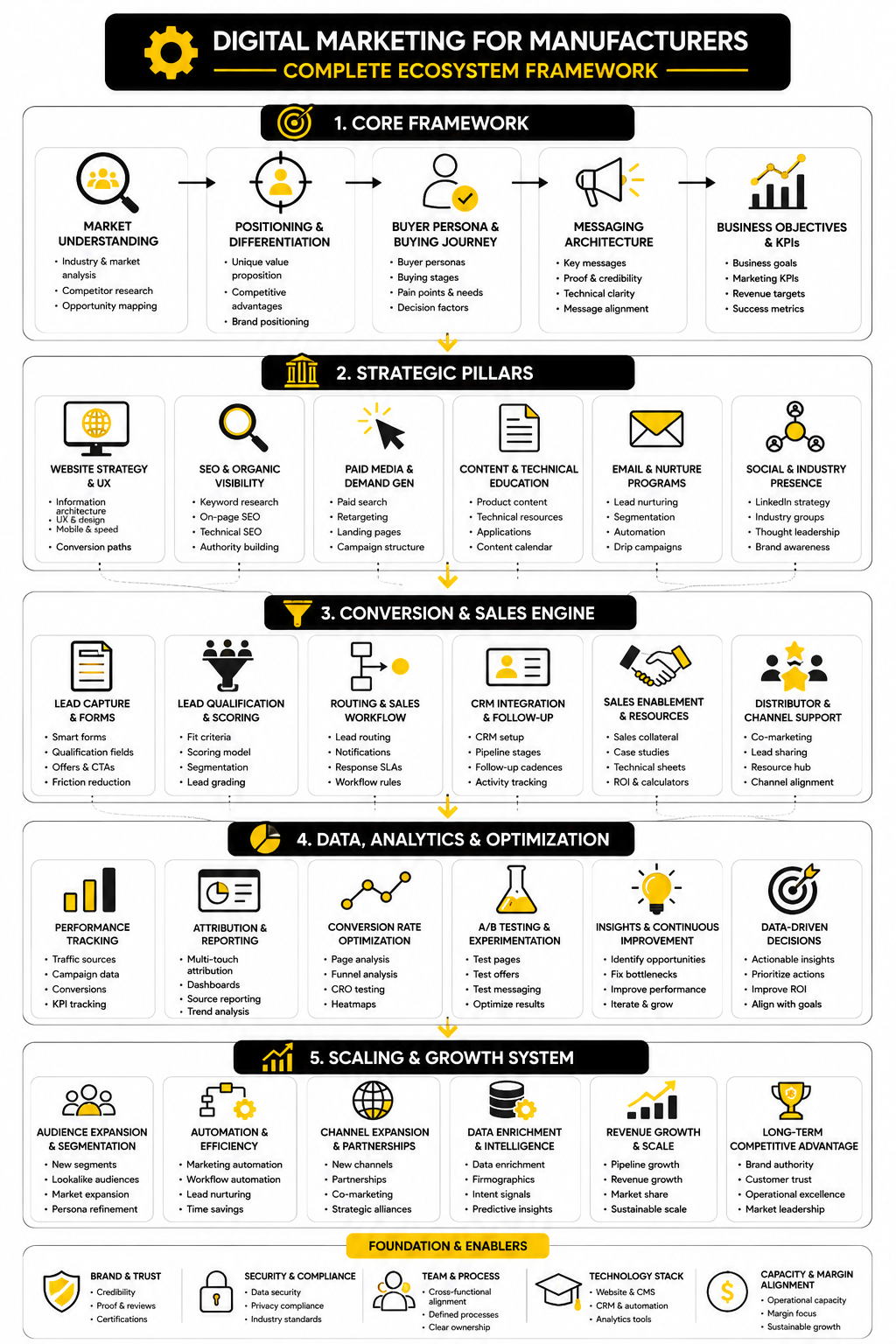
Optimization is not about changing everything every month. It is about improving the parts of the system where the data shows friction. If the wrong buyers are arriving, adjust positioning and targeting. If the right buyers are arriving but not converting, improve the page, proof, offer, and next step. If leads convert but do not close, improve qualification, routing, sales enablement, or expectation-setting.
The final goal is simple: make the company easier to find, easier to trust, and easier to buy from. That is what separates a serious manufacturing marketing system from random digital activity.
What Is Digital Marketing For Manufacturers?
Digital marketing for manufacturers is the process of using digital channels to attract, educate, qualify, and convert industrial buyers. It includes website strategy, SEO, paid search, technical content, email, CRM, analytics, and sales enablement. The goal is not just more visibility; the goal is better-fit opportunities that match the manufacturer’s products, capacity, margins, and sales process.
Why Is Digital Marketing Important For Manufacturers?
It matters because buyers now do much more research before speaking with sales. They compare suppliers, check technical details, evaluate proof, and narrow their options quietly. If your digital presence does not answer those questions, you may lose before the buyer ever sends an RFQ.
What Channels Work Best For Manufacturing Companies?
The strongest channels usually include SEO, product and application pages, technical content, paid search, email nurturing, LinkedIn, distributor support, and CRM-connected follow-up. The best mix depends on the product, market, buying cycle, and sales model. A custom engineered component manufacturer should not use the same channel mix as a replacement parts company with urgent search demand.
Should Manufacturers Invest In SEO?
Yes, but the SEO strategy must fit industrial buying behavior. Manufacturer SEO should focus on product pages, capability pages, application pages, materials, standards, technical questions, and supplier comparison intent. Blog posts can help, but they should support real buying journeys instead of chasing broad traffic that will never become revenue.
What Should A Manufacturing Website Include?
A strong manufacturing website should clearly explain products, capabilities, industries served, applications, materials, specifications, certifications, quality standards, documentation, and next steps. It should also make it easy to request a quote, contact the right team, find a distributor, or access technical resources. The website should behave like a sales asset, not a static brochure.
How Do Manufacturers Generate Better Leads Online?
Better leads come from sharper positioning, clearer pages, stronger qualification, and better conversion paths. The form should ask for enough information to understand fit without making the buyer work too hard. The content should attract the right buyer and discourage poor-fit inquiries before they consume sales or engineering time.
How Should Manufacturers Measure Marketing Success?
Manufacturers should measure visibility, engagement, conversions, lead quality, quote value, close rate, sales cycle length, and revenue influenced by source. Traffic alone is not enough. A campaign that produces fewer but better-qualified opportunities can be more valuable than one that creates a high volume of weak leads.
How Long Does Digital Marketing Take To Work For Manufacturers?
It depends on the channel and the sales cycle. Paid search can create visibility quickly if the offer and landing pages are strong. SEO and technical content usually take longer because authority, rankings, and buyer trust build over time. For manufacturers with long buying cycles, the real payoff often appears through better pipeline quality, stronger sales conversations, and more efficient follow-up.
Should Manufacturers Use Marketing Automation?
Manufacturers should use automation when it improves speed, routing, consistency, and follow-up quality. It should confirm inquiries, notify the right person, segment contacts, and support the sales process. It should not blast generic messages at technical buyers who asked a specific question.
What Is The Biggest Mistake Manufacturers Make With Digital Marketing?
The biggest mistake is promoting before the foundation is clear. If positioning is vague, product pages are weak, forms are confusing, and sales follow-up is inconsistent, more traffic will not solve the problem. Promotion amplifies the system you already have, so the system needs to be worth amplifying.
How Can Manufacturers Support Distributors With Digital Marketing?
Manufacturers can support distributors with clear product education, distributor locator pages, regional lead routing, co-branded resources, shared campaigns, and better documentation. The goal is to help buyers find the right purchasing path without creating channel conflict. Digital marketing should make the channel stronger, not more confusing.
What Role Does Content Play In Manufacturing Marketing?
Content helps buyers understand fit, reduce risk, and make internal decisions. Good manufacturing content can explain materials, standards, applications, installation, maintenance, process differences, and design tradeoffs. It also supports sales teams by giving them useful resources to send during conversations.
Should Manufacturers Gate Technical Content?
Some technical content should stay open because buyers need basic evaluation information before they trust the company. Gated content works better when the asset has clear value, such as a detailed guide, calculator, checklist, template, or sample request. If a form blocks basic product information, it can create friction and reduce trust.
Can Small Manufacturers Compete Online?
Yes, especially when they are specific. A smaller manufacturer can compete by focusing on strong-fit applications, niche expertise, technical clarity, and responsive follow-up. The goal is not to outspend larger competitors everywhere; it is to become the obvious choice for a specific type of buyer.
What Should Manufacturers Fix First?
Start with positioning, priority markets, core website pages, conversion paths, lead routing, and basic reporting. Those pieces affect everything else. Once the foundation is clean, SEO, paid search, email, social, and automation have a much better chance of producing business instead of noise.
Build a stronger local presence with BAAM AI
Turn your website, Google profile, social channels, and AI visibility into one growth engine
Most businesses do not need more random marketing activity. They need a consistent presence system that helps the right people find them, trust them, and take action. BAAM AI brings strategy, local SEO, website updates, Google Maps visibility, social content, AI-search readiness, media production, and reporting into one practical monthly engine.
If you want your marketing to keep working after the campaign ends, start with a free BAAM AI presence audit. See how your business shows up today and where the fastest visibility wins are at BAAM AI.