
BAAM AI Blog
Digital Marketing For Contractors: A Practical Growth System For Booked Jobs
Digital marketing for contractors is not about posting more, chasing every platform, or copying what some national brand is doing. It is about building a simple system that helps local homeowners find you, trust you...
Digital marketing for contractors is not about posting more, chasing every platform, or copying what some national brand is doing. It is about building a simple system that helps local homeowners find you, trust you, contact you, and choose you before a competitor gets the job. That matters because most contractor leads are not casual browsers; they usually come from people with a problem, a deadline, a budget, and a short list of companies they are willing to call.
The hard part is that the buyer journey is messy. Someone might search Google for a roofer, check reviews, visit your website, compare photos, ask a neighbor, click an ad, and then call from their phone without ever filling out a form. That is why a contractor’s marketing cannot rely on one channel alone. It needs search visibility, proof, fast follow-up, clear offers, and a way to track what actually turns into revenue.
Digital Marketing For Contractors Starts With A Lead System
The biggest mistake contractors make is treating marketing as a collection of random tactics. A few Facebook posts here, a boosted ad there, a website redesign when things feel slow, maybe some SEO when a competitor starts ranking above them. None of that is useless by itself, but it becomes expensive when it is not connected to a clear lead system.
A real contractor marketing system starts with one question: what has to happen before a stranger becomes a booked estimate, signed job, or repeat customer? For most contractors, the answer includes visibility, trust, a clear service offer, proof of work, a low-friction contact path, and fast follow-up. If one of those pieces is weak, the whole system leaks.
That is why this guide will treat digital marketing for contractors as a practical operating system, not a list of hacks. You will see where local SEO fits, where paid ads fit, where reviews fit, where automation fits, and where professional implementation becomes worth the investment. The goal is not to make your company “look active online.” The goal is to make marketing produce jobs you can actually track.
Why It Matters Right Now
Contractors are competing in a market where homeowners are more careful, more comparison-driven, and more digitally informed than they used to be. Angi’s 2024 home spending research found that total home project spending declined by 12% in 2024, while 93% of homeowners still planned projects for 2025 through maintenance, repairs, and improvements. That combination means demand exists, but homeowners are choosing more carefully before they hire.
At the same time, local search has become more demanding. Google says local rankings are shaped mainly by relevance, distance, and prominence, which means a contractor needs accurate service information, strong local signals, and a visible reputation to compete in the map results. Paid visibility is also changing because Local Services Ads require screening and verification in many categories, including checks that may involve licensing, insurance, business registration, background checks, and minimum review requirements.
This is good news for serious contractors. A sloppy competitor can still spend money on ads, but money alone does not fix weak reviews, slow response times, poor landing pages, unclear services, or no follow-up process. A contractor who builds the full system can win more of the jobs that already exist in the market instead of relying on luck, referrals, or seasonal demand.
The Contractor Marketing Framework
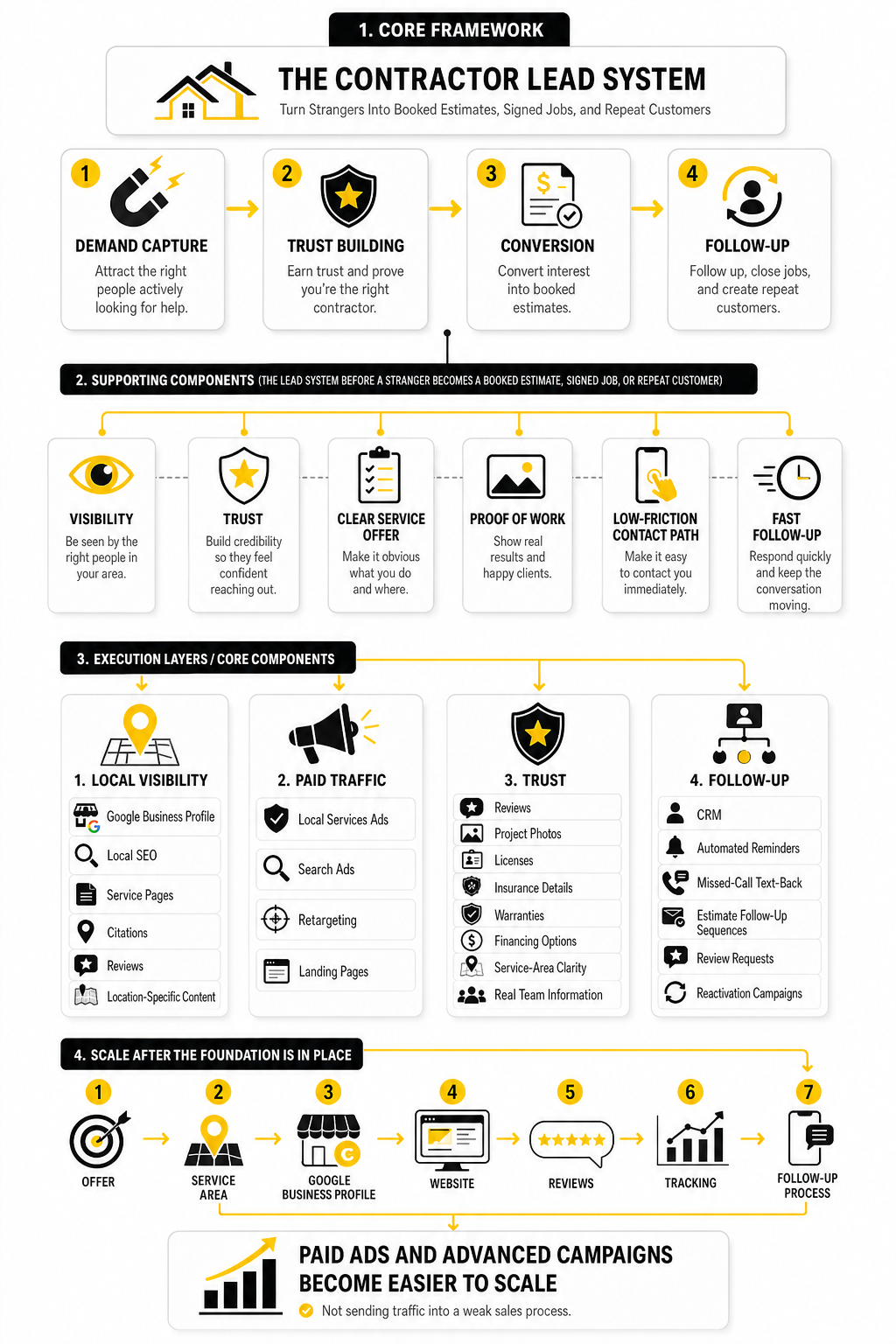
A strong contractor marketing framework has four layers: demand capture, trust building, conversion, and follow-up. Demand capture helps you show up when people are already searching for services like roofing, remodeling, HVAC, plumbing, landscaping, electrical work, concrete, painting, or general contracting. Trust building gives prospects enough confidence to believe you are legitimate, available, and capable of doing the work well.
Conversion is where attention turns into action. That includes your website, landing pages, phone experience, quote forms, calls to action, before-and-after photos, financing language when relevant, and the speed at which your team responds. Follow-up is what happens after the first contact, and this is where many contractors lose money because leads are not called back quickly, estimates are not nurtured, and old inquiries are never reactivated.
This framework matters because contractor leads are often high-intent but time-sensitive. A homeowner with a roof leak, broken furnace, failed inspection, storm damage, or urgent renovation deadline will not wait through a slow sales process. Your marketing has to make the next step obvious and make your company feel like the safest choice.
Core Components Of A Contractor Marketing System
The first core component is local visibility. That includes your Google Business Profile, local SEO, service pages, citations, reviews, and location-specific content. If people in your service area cannot find you when they search, everything else has to work harder.
The second component is paid traffic that sends prospects to the right place. Google Local Services Ads, search ads, retargeting, and carefully built landing pages can help contractors reach high-intent buyers faster, but only when the offer, tracking, and intake process are tight. Google’s own Local Services Ads documentation emphasizes that advertisers pay for valid leads rather than simple impressions, which is why call quality and lead handling matter as much as ad visibility.
The third component is trust. Contractors sell high-stakes services, so homeowners want proof before they call. Reviews, project photos, licenses, insurance details, warranties, financing options, service-area clarity, and real team information all reduce hesitation.
The fourth component is follow-up. A CRM, automated reminders, missed-call text-back, estimate follow-up sequences, review requests, and reactivation campaigns can turn more inquiries into revenue without increasing ad spend. For contractors who want a centralized system for leads, pipelines, texts, calls, reviews, and automation, GoHighLevel is one of the tools that fits naturally into this part of the stack.
Professional Implementation Comes Down To Discipline
Professional implementation does not mean making everything complicated. It means setting up the pieces in the right order, measuring the right numbers, and improving the system consistently. A contractor does not need ten disconnected marketing tools if the basics are broken.
The right order usually starts with your offer, service area, Google Business Profile, website, reviews, tracking, and follow-up process. After that, paid ads and advanced campaigns become easier to scale because you are not sending traffic into a weak sales process. This is where contractors can separate themselves from competitors who only think in terms of “more leads.”
The best version of digital marketing for contractors is boring in the best possible way. It produces consistent visibility, earns trust before the first call, captures leads cleanly, follows up fast, and shows which channels are actually profitable. That is the system the rest of this guide will build step by step.
Local Search, Google Business Profile, And Contractor SEO
Local search is the foundation of digital marketing for contractors because most homeowners do not start with your brand name. They search for the service, the problem, or the location. That means your company has to be visible for searches like roof repair near me, bathroom remodeler in your city, emergency plumber, HVAC installation, concrete patio contractor, or electrician near me.
This is where contractor marketing becomes very practical. You are not trying to win attention from everyone on the internet. You are trying to show up for the right people in the right service area at the exact moment they need help.
Google’s local results are shaped by relevance, distance, and prominence, which makes local visibility more than a website problem. Your Google Business Profile, reviews, service pages, photos, business information, and reputation all work together. If one piece is weak, you can still get found sometimes, but you will not have the same consistency as a contractor with a complete local search system.
Your Google Business Profile Is The Front Door
For many contractors, the Google Business Profile is more important than the homepage because it is often the first thing a homeowner sees. It shows your reviews, photos, hours, service area, phone number, directions, website link, and business category before the prospect ever lands on your site. That means it has to be treated like a conversion asset, not a quick directory listing.
The first job is accuracy. Your company name, phone number, website, address or service area, hours, business categories, and services should match the way customers actually search. Google’s own local ranking guidance says complete and accurate business information helps Google match a business to relevant searches, which is exactly what contractors need when competing in map results.
The second job is trust. A contractor profile with weak photos, missing services, old reviews, or vague descriptions gives homeowners a reason to keep scrolling. A strong profile makes the next step feel safe by showing real project work, recent customer feedback, clear service coverage, and a company that looks active.
Choose Categories And Services With Buyer Intent
Your primary business category tells Google what kind of contractor you are. This is not the place to be clever or overly broad. A roofing contractor should not hide behind a generic construction label if roofing is the main revenue driver, and an HVAC company should not rely on a vague home services description if installation, repair, and maintenance are what buyers search for.
Services should be written around real demand. A remodeler might include kitchen remodeling, bathroom remodeling, basement finishing, home additions, and design-build services. A concrete contractor might include driveway installation, stamped concrete, patio installation, slab repair, and concrete replacement.
This matters because local SEO is not just about ranking for one big keyword. A contractor can earn valuable visibility across dozens of service-specific searches when the profile, website pages, and customer reviews reinforce the same topics. That is how digital marketing for contractors becomes more durable than one campaign or one ad.
Build Service Pages That Match Real Searches
Your website needs dedicated pages for the services people actually buy. A single services page with a short bullet list is usually not enough because roofing repair, roof replacement, storm damage, and commercial roofing are different search intents. The same logic applies to plumbing, remodeling, landscaping, electrical, HVAC, flooring, painting, and other contractor categories.
Each service page should explain the problem, the service, the process, the location coverage, the proof, and the next step. It should answer the questions a homeowner is already thinking about: what do you do, where do you work, what kinds of projects do you handle, how do estimates work, and why should someone trust you? Google’s SEO Starter Guide is built around making content easier for search engines to crawl, index, and understand, but the bigger win is that clear pages are also easier for customers to act on.
The mistake is writing thin pages that sound almost identical except for the city or service name. That creates weak content and a weak user experience. A better page feels specific because it reflects real job types, common customer concerns, local conditions, materials, timelines, warranties, financing options when relevant, and what happens after someone requests an estimate.
Use Location Pages Without Making Them Spammy
Location pages can help contractors who serve multiple cities, towns, counties, or neighborhoods. They should not be copy-paste pages with one city name swapped out. That kind of content looks lazy, and more importantly, it does not help a homeowner decide whether you are the right company.
A useful location page explains your service availability in that area, the types of projects you handle there, nearby communities you serve, and any local details that genuinely matter. For example, a roofing company might discuss storm exposure, roof types, permitting considerations, or common materials in that service area. A remodeling company might talk about older housing stock, popular project types, or design constraints common in that market.
The goal is simple: make each page useful enough that a real customer would not feel like they landed on a doorway page. Local SEO is strongest when it helps the reader and the search engine at the same time. If the page only exists to manipulate rankings, it is probably not strong enough.
Reviews Strengthen Both Trust And Local Visibility
Reviews do two jobs at once. They help prospects decide whether to call, and they contribute to the prominence side of local visibility. BrightLocal’s 2025 review research shows that local business reviews still play a major role in consumer decision-making, which is especially important for contractors because the customer is often hiring someone for expensive, disruptive, or urgent work.
A strong review strategy does not mean begging for five stars. It means asking real customers at the right time, making the review process simple, and responding professionally. The best review profiles usually mention specific services, locations, team members, project types, timelines, communication, cleanup, and results.
Those details matter because they make your reputation more believable. A review that says “great company” is helpful, but a review that mentions a roof replacement, fast storm response, careful cleanup, and clear communication gives the next homeowner more confidence. Over time, specific reviews also reinforce the services and locations you want to be known for.
Photos Make The Business Feel Real
Contractors should not treat photos as decoration. Photos prove that the company does real work, has a real team, and understands the type of project the customer is considering. Before-and-after photos, jobsite photos, equipment photos, crew photos, completed project photos, and detail shots can all reduce doubt.
The key is consistency. A Google Business Profile with one old logo and a few blurry photos does not create the same confidence as a profile that gets updated with current work. Your website should also show project images in context, not just a random gallery with no explanation.
Good photos support conversion because they answer silent objections. Homeowners want to know whether you have handled work like theirs, whether the finished result looks professional, and whether your company feels legitimate. The more expensive the job, the more important that visual proof becomes.
Local Citations Still Need To Be Clean
Citations are mentions of your business information on directories, maps, industry sites, social profiles, and local platforms. They are not as exciting as ads or content, but they still matter because inconsistent business information creates friction. If your name, address, phone number, website, or service area is different across the web, you make it harder for platforms and customers to understand your business.
The basics are enough for most contractors. Make sure the major platforms are accurate, then fix obvious inconsistencies on industry directories and local business listings. Do not waste time chasing hundreds of low-quality directory links if your core profile, website, reviews, and service pages are still weak.
This is a discipline problem, not a glamour problem. Clean citations support the rest of your local search presence. They will not save a bad marketing system, but they help a good one become more reliable.
Contractor SEO Should Focus On Jobs, Not Traffic
Traffic alone is a bad goal for most contractors. A blog post that brings visitors from outside your service area does not help much if those people cannot hire you. Contractor SEO should focus on local, service-specific, high-intent visibility that can turn into calls, forms, consultations, estimates, and booked jobs.
That means the best keyword opportunities are usually tied to services, locations, problems, comparisons, costs, timelines, and trust questions. A roofing company might need content around roof replacement cost, roof repair after storm damage, metal roofing, asphalt shingles, insurance-related questions, and signs a roof needs replacement. A remodeler might need pages around kitchen remodel cost, bathroom renovation timelines, basement finishing, home additions, and design-build planning.
The point is not to publish content for the sake of publishing. The point is to create useful pages that meet prospects at different stages of the buying process. Some people are ready to call today, while others are researching price, scope, timing, and options before they contact anyone.
Technical SEO Keeps The System From Breaking
Technical SEO is not the most exciting part of digital marketing for contractors, but it can quietly block results. If your site is slow, difficult to crawl, poorly structured, not mobile-friendly, or full of broken pages, good content will not perform as well as it should. A contractor website needs to be simple, fast, clear, and easy to use on a phone.
The basics matter most. Each important service should have its own indexable page, the navigation should be obvious, the contact options should be visible, and the site should load quickly enough that mobile visitors do not bounce before calling. Forms should work, phone numbers should be tap-friendly, and tracking should not break the user experience.
You do not need to overcomplicate this. Most contractors are not losing because they failed to implement some obscure SEO trick. They are losing because the site is thin, slow, confusing, outdated, or disconnected from the services and locations they actually want to sell.
Local Search Works Best When It Connects To Sales
Local search is not finished when someone clicks. It is finished when that visitor becomes a qualified lead, gets followed up with, receives an estimate, and turns into revenue. That is why the next layer of the system has to connect visibility with conversion.
Your Google Business Profile, SEO pages, reviews, and photos create demand and trust. Your website then has to make action easy. The next part of the article will build on that by looking at paid ads, landing pages, and lead capture, because visibility without conversion is just expensive attention.
Paid Ads, Landing Pages, And Lead Capture
Paid ads are where digital marketing for contractors gets direct. SEO builds durable visibility, but paid traffic lets you reach homeowners who are already searching, comparing, or ready to book. The key is not just getting the click or the call; the key is building a path that turns paid attention into a qualified lead without wasting budget.
This is where many contractors get burned. They run ads to a generic homepage, send traffic to a page with too many options, forget to track calls properly, or treat every lead like it has the same value. Paid ads can work extremely well for contractors, but only when the campaign, landing page, offer, tracking, and follow-up process are built as one system.
Start With The Job You Actually Want
Before you launch ads, decide which jobs are worth buying. A contractor who wants full roof replacements should not build the same campaign as a contractor who wants small repairs. A remodeler who wants six-figure additions should not run the same message as someone promoting quick bathroom refreshes.
This matters because ad platforms will spend whatever budget you give them unless you guide the system carefully. Your campaign should be built around profitable services, realistic capacity, clear service areas, and the types of customers you can actually serve well. If you skip this step, you may get leads, but they will not necessarily be the leads your business needs.
The cleanest approach is to rank your services by margin, urgency, close rate, and operational fit. Emergency services, high-ticket replacements, seasonal maintenance, and specialized project types often need different campaigns because the buyer intent is different. Good contractor advertising starts with business strategy, not keyword lists.
Choose The Right Paid Channel For The Intent
Google Search Ads work well when homeowners are actively searching for a contractor, price estimate, emergency repair, or service near them. Local Services Ads can also fit many home service categories because Google charges for valid leads rather than simple clicks, and its own help documentation says advertisers are charged for each valid lead received through the platform. That pay-per-lead model is useful, but it still needs strong intake, review management, and lead qualification.
Meta ads can work differently. They are usually better for creating demand, promoting visual project offers, retargeting website visitors, or staying visible in a local market. A kitchen remodeler, landscaper, painter, pool builder, or deck contractor may benefit from visual campaigns because the finished result is easy to show.
The mistake is using every channel the same way. Search ads capture demand. Social ads can create interest and re-engage people. Retargeting reminds visitors who already showed intent. The channel should match the buyer’s mindset, not whatever platform is trending this month.
Build Campaigns Around Specific Services
A contractor ad campaign should be specific enough that the ad, keyword, landing page, and call to action all feel connected. If someone searches for emergency AC repair, the ad should not send them to a generic HVAC homepage. If someone clicks a bathroom remodeling ad, the page should not make them dig through a full list of every construction service you offer.
Specificity improves the user experience and makes tracking cleaner. You can see which service lines generate leads, which ones produce booked estimates, and which ones actually close. That is how digital marketing for contractors becomes a decision-making tool instead of a guessing game.
A strong campaign structure might separate emergency repair, installation, replacement, maintenance, and high-ticket project work. Each campaign can then have its own keywords, ads, landing page, lead form, call tracking number, and follow-up sequence. It takes more work upfront, but it prevents the common problem where all traffic gets dumped into one messy bucket.
Make The Landing Page Match The Ad
The landing page is where paid traffic either becomes valuable or gets wasted. Google’s landing page experience guidance focuses on relevance, usefulness, ease of navigation, and whether the page meets the expectations created by the ad. In plain English, the page has to deliver what the click promised.
For contractors, that means the landing page should be focused on one service, one market, and one clear action. It should explain the service, show proof, remove doubt, and make it easy to call or request an estimate. A homeowner should not have to hunt for the phone number, wonder whether you serve their area, or decode what happens after submitting the form.
A good landing page does not need to be fancy. It needs to be fast, clear, credible, and built around the next step. If you need a dedicated landing page builder for paid campaigns, ClickFunnels can make sense when you want focused funnels instead of sending every ad click to a broad website page.
The Contractor Landing Page Checklist
A contractor landing page should answer the practical questions in the customer’s head before they become objections. The visitor wants to know whether you do the job, whether you work in their area, whether you look trustworthy, and how quickly they can take the next step. That has to happen quickly, especially on mobile.
The best pages usually include:
This is not about making the page long for the sake of it. It is about giving a serious homeowner enough confidence to act. If the page feels thin, vague, or generic, the ad budget has to work much harder.
Turn The Process Into A Repeatable System
Paid ads become easier to manage when the execution process is visible. You should be able to look at the campaign and understand where the money goes, where the leads come from, what happens after contact, and which jobs turn into revenue. Without that structure, campaign management turns into opinion.
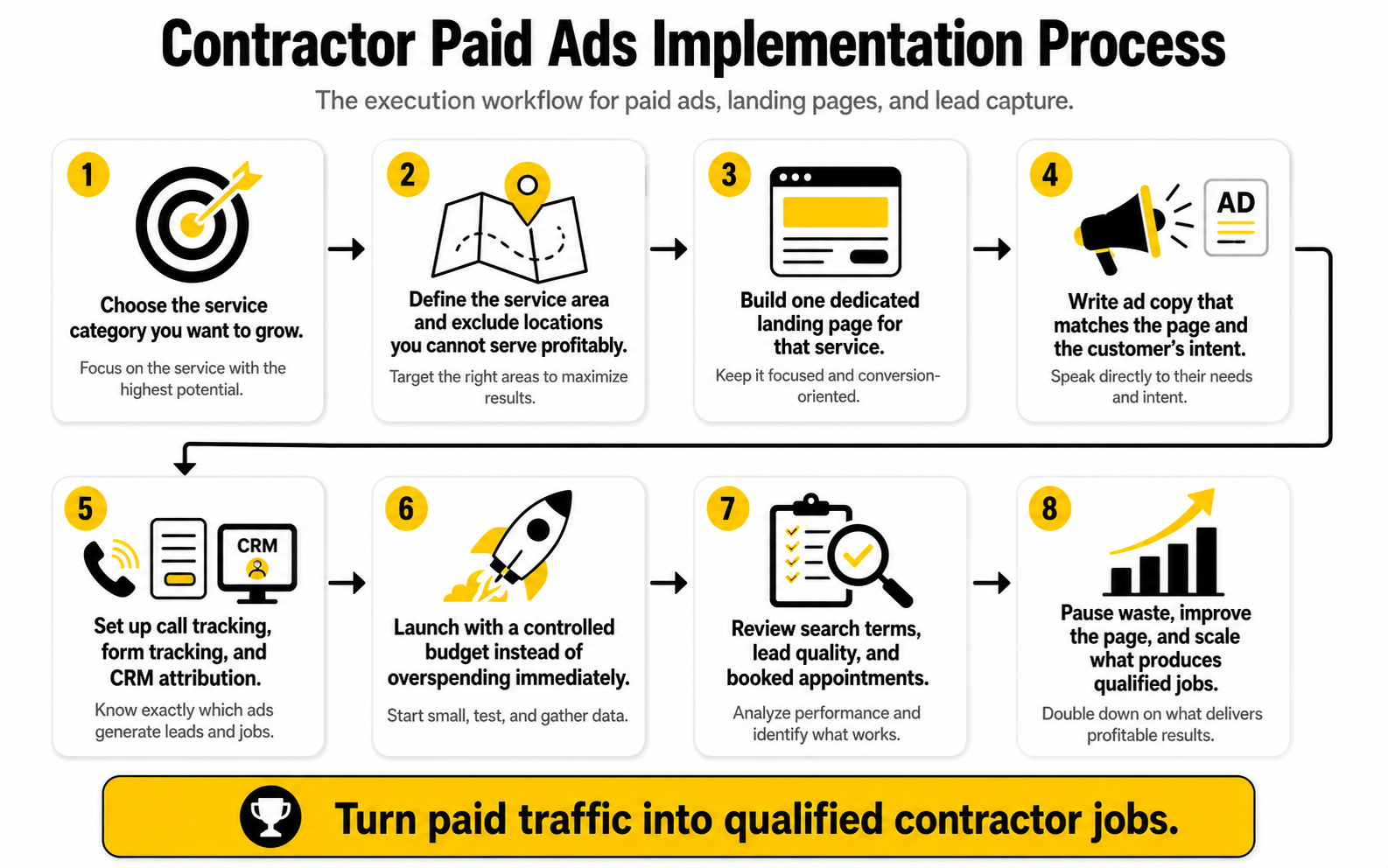
A practical implementation process looks like this:
This process keeps the campaign grounded. You are not asking whether ads “work” in a vague way. You are asking which service, message, area, landing page, and follow-up path creates profitable work.
Capture Leads Without Creating Friction
Lead capture should be simple. Contractors often ask for too much information too early, which can reduce form completions and make urgent buyers call someone else. A form should collect what your team needs to qualify and respond, not every detail that could be discussed later.
For most contractor campaigns, the essentials are name, phone number, service needed, location, and a short project description. Some services may need photos, preferred appointment times, or urgency level, but those fields should be used carefully. The more fields you add, the more you should be sure each one helps the sales process.
Phone calls still matter a lot for contractors because many homeowners want immediate reassurance. That means call tracking should be set up properly, calls should be answered professionally, and missed calls should trigger fast text follow-up. A missed call from a high-intent search ad is not a small mistake. It is paid demand walking away.
Speed To Lead Changes The Economics
The faster you respond, the more valuable your leads become. Lead response research has repeatedly shown that speed plays a major role in contact and qualification rates, and a widely cited lead management study found that responding within five minutes can dramatically outperform slower follow-up. For contractors, this matters because many prospects contact multiple companies in the same session.
A homeowner with an urgent repair, a storm-damaged roof, a broken furnace, or a time-sensitive remodel does not wait patiently. They call, submit forms, compare reviews, and move forward with the company that feels responsive and competent. If your ad system creates leads but your team responds hours later, the campaign will look worse than it really is.
This is why automation is not just a tech upgrade. It protects paid ad spend. Missed-call texts, instant form confirmations, appointment reminders, estimate follow-ups, and pipeline alerts can keep leads from slipping through the cracks when the office is busy or the crew is in the field.
Use Tracking That Connects Leads To Revenue
Clicks are not enough. Cost per lead is not enough either. A contractor needs to know which campaigns generate qualified leads, booked estimates, sold jobs, and profitable revenue. Otherwise, you may accidentally scale the campaign that looks cheap but closes poorly.
At minimum, track calls, forms, source, campaign, service requested, appointment status, estimate value, close status, and job value. This gives you the ability to compare not just ad performance, but business performance. A campaign with a higher cost per lead can still be the better investment if it produces larger jobs and better customers.
This is where a CRM becomes central. A tool like GoHighLevel can help contractors connect forms, calls, texts, pipelines, automations, and reporting in one place instead of scattering lead data across inboxes and spreadsheets. The tool does not replace strategy, but it can make the execution much cleaner.
Budget Based On Learning, Not Hope
A paid campaign needs enough budget to collect useful data, but it should not be treated like a slot machine. Start with a controlled test around one service and one clear offer. Then evaluate the quality of leads, response speed, booked estimate rate, close rate, and average job value.
The first budget should be built to learn. You are testing whether the targeting, message, landing page, and intake process can produce a qualified opportunity at a reasonable cost. Once that works, scaling becomes a lot less emotional because you have real numbers.
The dangerous move is launching too many campaigns at once with no tracking and no follow-up discipline. That spreads the budget too thin and makes it hard to know what is actually happening. A focused campaign with clean measurement beats a complicated campaign that nobody understands.
Paid Traffic Should Feed The Whole Marketing System
Paid ads should not sit in isolation. Search campaigns can reveal which services people are actively looking for, which questions show up before purchase, and which locations have stronger demand. Those insights can improve SEO pages, website copy, review requests, sales scripts, and future content.
Landing pages can also become testing grounds. If one headline, offer, proof point, or call to action improves conversion, you can use that learning across the website. If one service area produces stronger jobs, you can invest more deeply in local SEO and reputation building there.
That is the bigger point. Paid ads are not just a way to buy leads. When managed properly, they become a fast feedback loop for the entire contractor marketing system. The next layer is making that system more persuasive with reviews, reputation, content, and social proof.
Reviews, Reputation, Content, And Social Proof
Paid ads can create the opportunity, but proof is what makes the opportunity convert. A homeowner can click an ad, like the landing page, and still hesitate if the company does not look trustworthy. That hesitation matters because contractors are not selling a low-risk impulse purchase; they are asking someone to trust them with a home, a budget, a timeline, and sometimes an urgent problem.
This is why reviews, reputation, photos, project content, and proof of expertise belong in the same conversation as traffic and lead capture. They shape whether a prospect calls, whether they answer your follow-up, whether they book the estimate, and whether they feel confident choosing you over another contractor. Digital marketing for contractors becomes much stronger when every channel shows the same message: this company is real, capable, responsive, and safe to hire.
Reputation Is A Conversion Asset
A strong reputation lowers friction before the sales conversation starts. When a homeowner sees a contractor with recent reviews, specific project feedback, clear photos, and professional responses, they do not have to work as hard to trust the company. That makes every other marketing channel more efficient.
The opposite is also true. A contractor can spend heavily on ads and still lose leads if the review profile looks thin, old, or inconsistent. Prospects are already comparing you against other companies, and they can do it in seconds from a phone.
BrightLocal’s 2025 review research shows that consumers still rely heavily on local business reviews when deciding who to trust, and review recency has become especially important for credibility. That matters for contractors because a five-star profile from years ago does not feel as reassuring as a steady stream of current customers describing recent work.
Ask For Reviews At The Right Moment
The best time to ask for a review is when the customer has just experienced the win. That might be after the repair is complete, after the walkthrough, after the final cleanup, or after the customer confirms they are satisfied. Waiting too long makes the request feel random, and asking too early can feel careless.
The request should be simple, direct, and human. You do not need to pressure the customer or write the review for them. You just need to make it easy for a happy customer to share what happened.
A good review request process should be part of the job closeout. The office, estimator, technician, or project manager should know who asks, when they ask, what link they send, and how follow-up works. If the process depends on someone remembering when they are busy, it will break.
Specific Reviews Beat Generic Reviews
A generic review still helps, but a specific review is far more useful. “Great work” is fine. “They replaced our roof after storm damage, communicated clearly, finished on schedule, and cleaned up the yard” gives the next homeowner something concrete to believe.
Specific reviews also reinforce your most valuable services. If you want more bathroom remodels, roof replacements, HVAC installs, deck builds, or emergency repairs, your review profile should naturally contain those words because real customers mention the work you completed. That is not keyword stuffing; that is proof.
The simplest way to encourage better reviews is to ask the customer to mention what service they hired you for and what stood out about the experience. Do not script fake language. Just guide them toward details that help future customers understand the real outcome.
Responding To Reviews Shows How You Operate
Review responses are not only for the person who left the review. They are for every future customer reading quietly in the background. A professional response shows that your company pays attention, appreciates customers, and takes feedback seriously.
Positive reviews should get a warm, specific reply. Mention the service when natural, thank the customer, and avoid robotic copy-paste responses. A short response that sounds human is better than a polished paragraph that feels automated.
Negative reviews need more discipline. Do not argue in public, do not reveal private project details, and do not sound defensive. A calm response that acknowledges the concern and invites a direct conversation can protect trust even when the review itself is not ideal.
Statistics And Data That Actually Matter
The point of data is not to collect numbers. The point is to make better decisions. In contractor marketing, the most useful statistics are the ones that help you understand buyer behavior, channel performance, lead quality, and sales outcomes.
For example, ServiceTitan’s 2025 Consumer Trends in the Trades report highlights how heavily homeowners now rely on digital discovery and digital expectations when choosing trade businesses. That matters because it confirms something contractors already feel on the ground: your online presence is not separate from your sales process anymore. It is part of the sales process.
Search advertising benchmarks tell a similar story, but they should be interpreted carefully. LocaliQ’s 2025 home services search advertising benchmarks show how cost per click, click-through rate, conversion rate, and cost per lead vary across home service categories. The useful takeaway is not that your campaign should match one average exactly. The useful takeaway is that trade, location, urgency, landing page quality, and lead handling can dramatically change what “good” performance looks like.
Measure The Full Journey, Not Just The First Click
A click is not a lead. A lead is not a booked estimate. A booked estimate is not a sold job. A sold job is not automatically profitable.
That chain matters because contractors often optimize the wrong number. A campaign with a cheap cost per lead may look strong until you realize the leads are low-quality, outside the service area, or unlikely to close. Another campaign may look expensive at the lead level but produce larger projects, better customers, and stronger margins.
The right measurement system follows the lead from source to revenue. That means tracking the original channel, campaign, landing page, form or call, service requested, appointment status, estimate value, close status, and final job value. Without that full path, you are making budget decisions with half the story missing.
The Contractor Marketing Dashboard
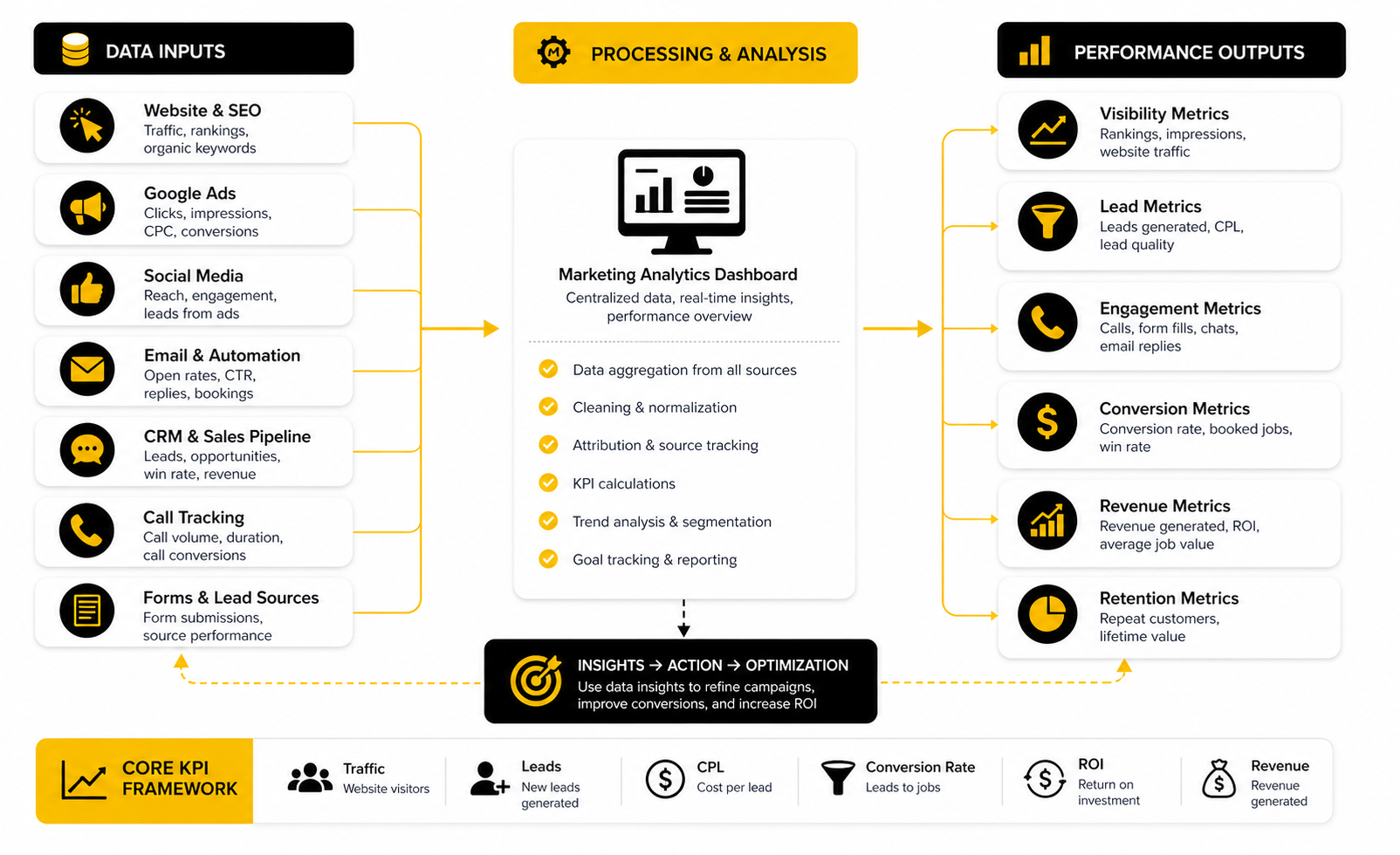
A useful contractor dashboard should be simple enough that the owner, office manager, or marketing partner can read it without needing a data analyst. It should show what is happening, where money is being spent, what is converting, and where leads are leaking. If a dashboard is impressive but nobody uses it, it is decoration.
At minimum, track these numbers:
The value is in the relationship between the numbers. If traffic is up but leads are flat, the website or offer may be weak. If leads are up but booked appointments are flat, the intake process may be the issue. If booked appointments are strong but sales are weak, the problem may be estimate quality, pricing, trust, or follow-up.
Benchmarks Are Starting Points, Not Verdicts
Benchmarks are useful because they give you context, but they should not run your business. A roofing company in a storm-heavy market, an emergency plumber in a dense metro area, and a design-build remodeler selling premium projects will not have the same numbers. Treating them the same creates bad decisions.
WordStream’s 2025 Google Ads benchmarks show that search advertising costs have continued rising across many industries, which makes efficiency more important than ever. For contractors, that does not mean ads are bad. It means weak tracking, weak landing pages, and slow follow-up are more expensive than they used to be.
A benchmark should trigger questions. Why is our cost per lead higher? Are we targeting a more expensive service? Are calls being missed? Is the landing page specific enough? Are we paying for poor-fit searches? The number is the signal, not the final answer.
Review Data Should Guide Reputation Work
Review metrics should be tracked the same way you track leads. Look at total reviews, average rating, review recency, review velocity, service-specific language, location mentions, and response rate. These signals tell you whether your reputation is actively supporting your marketing or slowly going stale.
A contractor with many old reviews and few recent ones may still look established, but the profile can feel less current to a cautious homeowner. A contractor with fewer reviews but a steady flow of detailed recent feedback may feel more active and responsive. That difference can affect both trust and conversion.
Do not measure reviews only as a vanity score. Look at what customers actually say. If reviews repeatedly praise communication, cleanliness, speed, craftsmanship, or professionalism, those themes should show up in your website copy, ads, landing pages, and sales conversations.
Content Performance Should Be Judged By Intent
Contractor content should not be judged only by pageviews. A cost guide, service page, project gallery, comparison article, or financing explainer may attract fewer visitors than a broad blog post, but the visitors may be far more valuable. Intent beats volume.
A useful content report should show which pages produce calls, forms, assisted conversions, and booked estimates. If a bathroom remodel cost page brings in fewer visitors but influences high-value consultations, it is doing its job. If a generic article brings traffic from outside your service area and produces no leads, it may not deserve more investment.
This is where digital marketing for contractors has to stay practical. Content exists to help prospects understand, trust, and act. If it does not support that journey, it is probably not a priority.
Call Tracking Reveals Hidden Waste
Phone calls are often the highest-intent leads in contractor marketing, but they are also easy to misread. If you only track form submissions, you may undervalue search, Google Business Profile, Local Services Ads, and landing pages that drive calls. If you track calls but never review quality, you may overvalue campaigns that produce poor-fit conversations.
Call tracking should answer basic questions. Which channel drove the call? Was it answered? Was the caller in the service area? What service did they need? Did they book an appointment? Did the job close?
Missed calls deserve special attention. A missed call from a paid campaign is not just a reporting issue; it is lost buying intent. If missed calls are common, the fix may not be more ads. The fix may be staffing, routing, after-hours handling, or automated text-back.
What Good Data Should Make You Do
Good analytics should lead to action. If a service page gets traffic but no leads, improve the page, offer, proof, or call to action. If ads produce leads but not estimates, review targeting, search terms, intake scripts, and response speed. If estimates are booked but not closing, look at pricing, sales process, financing, proposal clarity, and follow-up.
The best decisions usually come from patterns, not one-off numbers. One bad week does not mean a campaign failed. Three months of expensive unqualified leads probably does. One slow month may be seasonality. A steady decline in branded search, reviews, and direct leads may point to a reputation or awareness problem.
A tool like GoHighLevel can help centralize calls, forms, pipelines, SMS follow-up, and attribution so the data is easier to act on. The point is not to stare at dashboards all day. The point is to know where the money is working, where leads are leaking, and what to fix next.
Data Makes Creative Work Better
Measurement does not replace creativity. It makes creativity sharper. When you know which services convert, which reviews persuade, which locations perform, and which offers create booked estimates, your ads and content become more specific.
A contractor might discover that emergency repair calls convert quickly but produce smaller jobs, while replacement campaigns cost more per lead but generate better revenue. Another company might find that project galleries increase form completions because prospects want visual proof before booking. Those insights should shape future campaigns.
This is where the system starts to compound. SEO brings in search demand, ads create controlled tests, landing pages reveal what converts, reviews build trust, and analytics show what deserves more budget. The next step is using follow-up, automation, and CRM workflows to turn more of those measured opportunities into actual customers.
Follow-Up, Automation, CRM, And Sales Conversion
The next serious growth lever is not another ad campaign. It is what happens after someone raises their hand. By this point, the article has already covered local search, paid traffic, landing pages, reputation, proof, and measurement, but all of that work can still leak revenue if lead handling is slow, inconsistent, or impossible to track.
This is where digital marketing for contractors becomes an operations problem. The marketing system creates demand, but the sales process turns demand into booked work. If the office misses calls, estimators forget to follow up, proposals sit untouched, or old leads never get reactivated, the company does not have a traffic problem. It has a conversion system problem.
Speed Still Beats Sophistication
A fast, competent response can outperform a beautiful campaign with weak intake. Contractors often compete in moments when homeowners are stressed, comparing options, or trying to solve a problem quickly. If your team responds while the prospect is still thinking about the project, you have a real advantage.
This does not mean every lead needs a hard sales push. It means every inquiry should get a clear next step as quickly as possible. A homeowner should know that the message was received, that your company works in their area, and that someone can help them move forward.
The practical standard is simple: respond fast, route correctly, and keep the conversation alive. Home services consumer research keeps pointing toward higher digital expectations in the trades, which means slow follow-up feels worse than it used to. When buyers can message, book, compare, and review companies from their phone, silence creates doubt.
Build A CRM Around The Actual Sales Pipeline
A CRM should not be a digital junk drawer. It should mirror how your contractor business actually sells. That means every lead has a source, service need, contact status, appointment status, estimate status, proposal value, close status, and next action.
For most contractors, a simple pipeline is enough at first:
The point is not to make the pipeline look impressive. The point is to make it impossible for real opportunities to disappear. If a $20,000 remodel lead, $12,000 roof replacement lead, or $8,000 HVAC install lead can sit in someone’s inbox without a next step, the system is not serious yet.
Automate The Repetitive Parts, Not The Relationship
Automation works best when it removes friction without making the company feel robotic. It should confirm requests, send reminders, notify the team, follow up after estimates, request reviews, and revive old opportunities. It should not pretend to replace a thoughtful sales conversation for a high-trust project.
A good automation setup can send an instant text after a form submission, alert the right person internally, create a pipeline opportunity, and schedule a reminder if no contact happens. It can also follow up after an estimate with a polite message, send project preparation details, or ask for a review after the job is complete. These are not gimmicks. They are basic service consistency.
This is why tools matter, but only after the process is clear. GoHighLevel can be useful for contractors because it combines CRM, forms, pipelines, call tracking, text messaging, email, automations, and reputation workflows in one place. The value is not the software by itself. The value is using it to make follow-up consistent.
Match Follow-Up To The Type Of Lead
Not every lead deserves the same cadence. An emergency repair lead should be handled immediately because the need is urgent and the buyer may choose the first qualified contractor who responds. A large renovation lead may need more education, more trust-building, and a longer sales conversation.
That distinction matters. If you treat every lead like an emergency, you can sound pushy. If you treat every lead like a casual inquiry, you will lose urgent jobs. The follow-up should match the service, the timeline, the project value, and the level of trust required.
For emergency or high-intent repair leads, the goal is fast contact and booking. For replacement or installation leads, the goal is qualification, appointment setting, and proof. For remodeling or custom work, the goal is consultation, expectation-setting, and nurturing because the decision is more complex.
Use Missed-Call Text-Back Carefully
Missed-call text-back is one of the most practical automations for contractors. If someone calls and your team cannot answer, an immediate text can keep the conversation alive. It tells the prospect the company is active, reachable, and ready to help.
The message should be short and human. It should acknowledge the missed call and ask how you can help or whether they want to schedule a callback. Do not send a long promotional message when the person simply tried to reach you.
This becomes especially important during busy seasons, after storms, during heat waves, during cold snaps, or when crews are stretched. A missed call does not always mean a lost job, but a missed call with no response often does. Automation gives you a second chance.
Proposal Follow-Up Is Where Big Money Hides
Many contractors focus heavily on getting new leads while ignoring open proposals. That is backwards. A proposal already represents interest, trust, time, and a real project conversation. Letting it go cold without follow-up is expensive.
Proposal follow-up should be structured but not annoying. The first follow-up can confirm the customer received the estimate and ask whether they have questions. The next can clarify timeline, scope, financing, scheduling, or decision criteria. Later follow-up can stay helpful rather than desperate.
The key is to track proposal value by stage. If you have $300,000 in open estimates and no follow-up process, buying more leads may not be the smartest move. Tightening the proposal pipeline may produce revenue faster than increasing ad spend.
Segment Leads Before Scaling Spend
Scaling digital marketing for contractors gets risky when all leads are treated as equal. A form submission for a small repair, a call for an emergency service, and a consultation request for a major remodel should not be measured the same way. They have different economics.
Segmentation lets you see which services deserve more budget and which ones need better qualification. You might discover that one campaign produces cheap leads but low close rates, while another produces expensive leads that turn into high-margin jobs. Without segmentation, the cheaper campaign usually looks better than it really is.
Useful segments include service type, location, urgency, lead source, job size, customer type, and close reason. These details show where the business should lean in and where it should pull back. The goal is controlled growth, not lead volume for its own sake.
Know When To Use Funnels Instead Of Full Website Pages
A full website is important for credibility, SEO, and broad discovery. A funnel or dedicated landing page is better when you are driving traffic toward one specific action. The choice depends on intent.
For example, a homeowner researching a kitchen remodel may want depth, project examples, service details, and trust signals across the website. A homeowner clicking an ad for a seasonal HVAC tune-up may need a focused page with the offer, availability, proof, and booking form. Sending both people to the same generic page creates unnecessary friction.
Tools like ClickFunnels or systeme.io can fit when a contractor wants focused campaign pages, offer testing, or simple lead funnels without rebuilding the whole website. The strategic rule is straightforward: use the website for authority and coverage, use funnels for focused conversion.
Do Not Let AI Create A Trust Problem
AI can help with speed, organization, content drafts, call summaries, routing, and basic support. It can also create serious trust problems if it makes claims your company cannot support, gives incorrect pricing, mishandles sensitive customer details, or sounds fake. Contractors should use AI carefully because the sale depends heavily on credibility.
A useful AI workflow might summarize calls, draft follow-up messages, organize project notes, or help answer common pre-sale questions with approved information. A risky workflow lets an unreviewed chatbot promise timelines, quote prices, or make technical recommendations without guardrails. That is not efficiency. That is liability.
The standard should be clear. AI can assist the process, but your company’s expertise, policies, pricing, and promises need human control. For contractors exploring AI-driven lead handling or customer support, tools like Chatbase can be useful only when the knowledge base, escalation rules, and messaging are tightly managed.
Scaling Creates Operational Pressure
More leads are not always good. More of the wrong leads can slow the team down, frustrate estimators, increase admin work, and damage response time. Before scaling spend, make sure the business can handle the volume.
Capacity should guide marketing. If your crews are booked for weeks, your ads may need to shift from urgent low-margin work to higher-value projects with longer planning windows. If your estimators are overloaded, your qualification process needs to get stricter. If your office cannot answer calls during peak hours, budget increases may create waste.
This is one of the most important strategic tradeoffs. Marketing should not outrun operations. The best contractors scale demand in a way the business can actually fulfill.
Protect Margin While Growing
A full calendar is not the same as a profitable business. Contractors can grow revenue and still hurt margin if they attract poor-fit jobs, underprice projects, drive too far outside the service area, or spend too much to acquire low-value work. Marketing has to respect the economics of the company.
This is why average job value, gross margin, close rate, and capacity matter as much as lead volume. A campaign that creates fewer but better jobs may be healthier than a campaign that floods the business with small, chaotic requests. The right question is not “How do we get more leads?” The right question is “How do we get more of the work we actually want?”
That mindset changes the whole strategy. Service pages become more specific. Ads become more selective. Forms ask better questions. Follow-up prioritizes better opportunities. Reporting focuses on revenue and margin, not vanity metrics.
The Expert Move Is Saying No Faster
Strong marketing does not mean accepting every inquiry. It means attracting better-fit customers and disqualifying poor-fit ones earlier. That protects the team, the schedule, the customer experience, and the profit.
A contractor should be clear about service areas, project minimums, timelines, specialties, and what the company does not do. This may reduce raw lead count, but it often improves sales efficiency. A smaller number of qualified conversations can outperform a larger number of weak inquiries.
This is where expert-level digital marketing for contractors becomes more disciplined. You stop chasing every click. You stop treating all leads equally. You build a system that attracts, qualifies, follows up, and closes the right work with less chaos.
Tracking, Budgeting, Professional Implementation, And FAQ
By now, the pattern should be clear. Digital marketing for contractors is not one tactic. It is an ecosystem where local search, paid ads, landing pages, reviews, content, automation, sales follow-up, and reporting all support each other.
The final step is deciding how to manage that system without turning it into chaos. Some contractors can handle pieces in-house. Others need outside specialists. The right answer depends on budget, service complexity, market competition, internal capacity, and how much control the owner wants over the marketing engine.
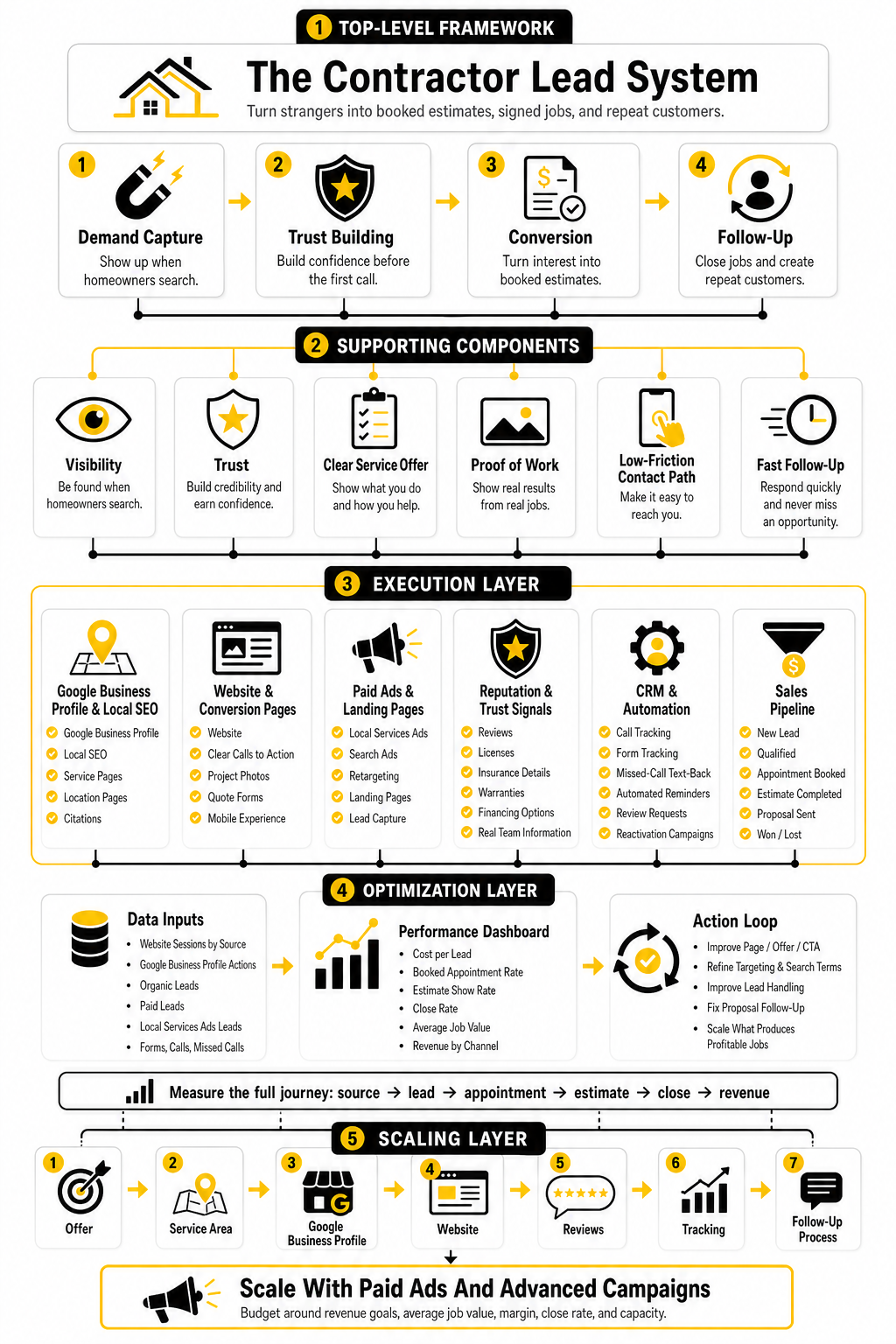
Build The Final Marketing Ecosystem
A complete contractor marketing ecosystem should make every lead easier to attract, easier to trust, easier to capture, easier to follow up with, and easier to measure. That does not happen by accident. It happens when each part of the system has a clear job.
The website should explain services, locations, proof, and next steps. Google Business Profile should support local discovery and trust. Paid ads should bring controlled demand into focused pages. Reviews should make prospects feel safe. CRM and automation should stop leads from disappearing. Reporting should show which channels deserve more investment.
This is where professional implementation becomes valuable. Not because contractors need more complexity, but because the pieces need to be connected correctly. A great ad campaign cannot fix a weak offer, a slow response process, or a website that does not convert.
Budget Around Revenue, Not Guesswork
Contractors should not budget for marketing by copying competitors or choosing a random monthly number. The budget should connect to revenue goals, job value, close rate, margin, capacity, and how quickly the company wants to grow. That is the only way the math stays grounded.
Start with the work you want. If a contractor wants more roof replacements, kitchen remodels, HVAC installs, electrical panel upgrades, or landscaping projects, the budget should be tied to the value of those jobs and the number of opportunities needed to close them. A high-ticket service can often support a higher cost per lead than a small repair because the revenue potential is different.
The mistake is treating all leads as equal. A $75 lead for a low-margin small job may be too expensive, while a $250 lead for a high-margin project may be a strong investment. The number only makes sense when it is connected to the business outcome.
Know What To Keep In-House
Some marketing tasks can stay in-house if the team has time and discipline. Review requests, jobsite photos, customer follow-up, basic social updates, and project notes are often better when they come from the company directly. Nobody understands the work, crews, customers, and service area better than the contractor’s own team.
The problem is consistency. Owners and office teams are busy, and marketing tasks are easy to push aside when jobs are active. That is why the in-house work needs a simple checklist, a clear owner, and a recurring schedule.
A practical in-house system might include taking photos on every completed job, asking satisfied customers for reviews, logging every lead source, updating service-area details, and sending follow-up messages after estimates. These small habits make every professional marketing effort stronger.
Know What To Outsource
Outsourcing makes sense when the work requires specialized skill, frequent optimization, or technical setup. SEO strategy, paid ads, landing page testing, call tracking, conversion analytics, CRM automation, and advanced reporting usually need experience. Mistakes in these areas can waste money quietly.
The right partner should understand contractor economics, not just marketing terminology. They should ask about job value, margins, service areas, close rates, scheduling capacity, and lead quality. If they only talk about impressions, clicks, or rankings, they may not be thinking deeply enough about revenue.
Good outsourcing still requires internal participation. The contractor has to provide project photos, service details, customer insights, pricing context, sales feedback, and operational constraints. Marketing partners can build the machine, but they need real business input to make it work.
Avoid The Most Expensive Mistakes
The most expensive contractor marketing mistakes are usually not dramatic. They are quiet leaks that repeat every week. Missed calls, weak landing pages, untracked campaigns, stale reviews, slow follow-up, poor qualification, and unclear service pages can drain revenue without looking obvious.
Another common mistake is scaling too early. If the business cannot answer calls, book estimates, follow up on proposals, or fulfill the work profitably, increasing ad spend creates pressure instead of growth. More leads expose weak operations.
The more carefully move is to fix the bottleneck first. Improve the offer, tighten the landing page, clean up the CRM, build the follow-up workflow, train the intake team, and measure closed revenue. Then scale what works.
What is digital marketing for contractors?
Digital marketing for contractors is the system used to attract, convert, and retain customers through online channels. It includes local SEO, Google Business Profile optimization, paid ads, landing pages, reviews, social proof, email, SMS, CRM workflows, and analytics. The goal is not just visibility; the goal is booked, profitable jobs.
Why is local SEO so important for contractors?
Local SEO matters because most contractor searches are tied to a service and location. Homeowners usually search for the problem they need solved, not a specific company name. If your business does not appear in local results, competitors get the first chance to earn the call.
How long does contractor SEO take to work?
Contractor SEO usually takes time because search engines need to crawl, understand, and trust your website and local signals. Service pages, reviews, Google Business Profile improvements, citations, and content can build momentum over months. Paid ads can create faster traffic, but SEO is what makes the system more durable over time.
Should contractors use Google Ads?
Google Ads can work well for contractors when the campaigns target profitable services, use focused landing pages, and track calls and forms properly. The risk is wasting money on broad keywords, weak pages, poor-fit locations, or leads that never get followed up with. Ads should be judged by qualified leads, booked estimates, sold jobs, and revenue, not clicks alone.
Are Local Services Ads worth it for contractors?
Local Services Ads can be worth testing for eligible contractor categories because they focus on lead generation and local trust signals. They still require strong review management, fast response, and lead quality tracking. A contractor should not assume the platform will solve sales or follow-up problems by itself.
What should a contractor website include?
A contractor website should include clear service pages, service-area information, real project photos, reviews, trust signals, a visible phone number, simple quote forms, and a clear explanation of what happens after contact. It should load quickly and work well on mobile. The website should make the next step obvious.
How many reviews does a contractor need?
There is no perfect number because competition varies by market and trade. What matters is review quality, recency, rating, service-specific detail, and whether competitors have stronger profiles. A contractor with steady recent reviews and specific customer feedback will usually look more trustworthy than one with old or generic reviews.
What is the best social media platform for contractors?
The best platform depends on the type of work. Visual trades like remodeling, landscaping, painting, decks, pools, flooring, and design-build services can often benefit from platforms where project photos and transformations perform well. Emergency and repair-heavy trades may get more direct value from search, reviews, and local ads, while social media supports awareness and retargeting.
How much should contractors spend on digital marketing?
The right budget depends on revenue goals, average job value, margin, close rate, market competition, and available capacity. A contractor selling high-ticket projects can usually justify a different budget than a company focused on small repairs. Budget should be based on the cost to acquire profitable jobs, not a random monthly amount.
What is the biggest mistake contractors make with marketing?
The biggest mistake is chasing more leads before fixing the conversion system. If calls are missed, reviews are weak, landing pages are vague, estimates are not followed up on, and reporting is incomplete, more traffic just creates more leakage. Fix the system first, then scale demand.
Do contractors need a CRM?
Most growing contractors need a CRM because leads, estimates, follow-ups, and revenue cannot stay organized inside inboxes and notebooks forever. A CRM helps track source, status, value, next action, and close outcome. For contractors who want CRM, SMS, forms, pipelines, and automations in one place, GoHighLevel is a practical option to evaluate.
Can automation replace a sales team?
Automation should support the sales process, not replace it. It can confirm inquiries, send reminders, trigger missed-call texts, follow up after estimates, and request reviews. The relationship, qualification, pricing conversation, and trust-building still need human judgment, especially for high-value projects.
What metrics should contractors track every month?
Contractors should track leads by source, calls, forms, missed calls, booked appointments, estimate show rate, close rate, average job value, revenue by channel, cost per lead, and cost per sold job. Review growth, Google Business Profile actions, and website conversions should also be monitored. The goal is to see where leads come from, where they leak, and what produces profitable work.
Should contractors use funnels or a full website?
Contractors usually need both. The full website supports trust, SEO, service coverage, project proof, and brand credibility. Funnels or dedicated landing pages work better for focused paid campaigns where one service, one offer, and one action matter most.
How do contractors know when to scale marketing?
A contractor is ready to scale when the current system can produce qualified leads, respond quickly, book appointments, follow up on estimates, close profitably, and track revenue. If those basics are not working, scaling can make problems worse. Growth should follow proof, not hope.
Build a stronger local presence with BAAM AI
Turn your website, Google profile, social channels, and AI visibility into one growth engine
Most businesses do not need more random marketing activity. They need a consistent presence system that helps the right people find them, trust them, and take action. BAAM AI brings strategy, local SEO, website updates, Google Maps visibility, social content, AI-search readiness, media production, and reporting into one practical monthly engine.
If you want your marketing to keep working after the campaign ends, start with a free BAAM AI presence audit. See how your business shows up today and where the fastest visibility wins are at BAAM AI.