
BAAM AI Blog
Digital Marketing Facebook Ads: A Practical Framework For Building Campaigns That Actually Convert
Digital marketing Facebook ads are no longer just about picking an audience, writing a headline, and hoping the algorithm finds buyers. Meta’s ad system has become more automated, more creative-driven, and more...
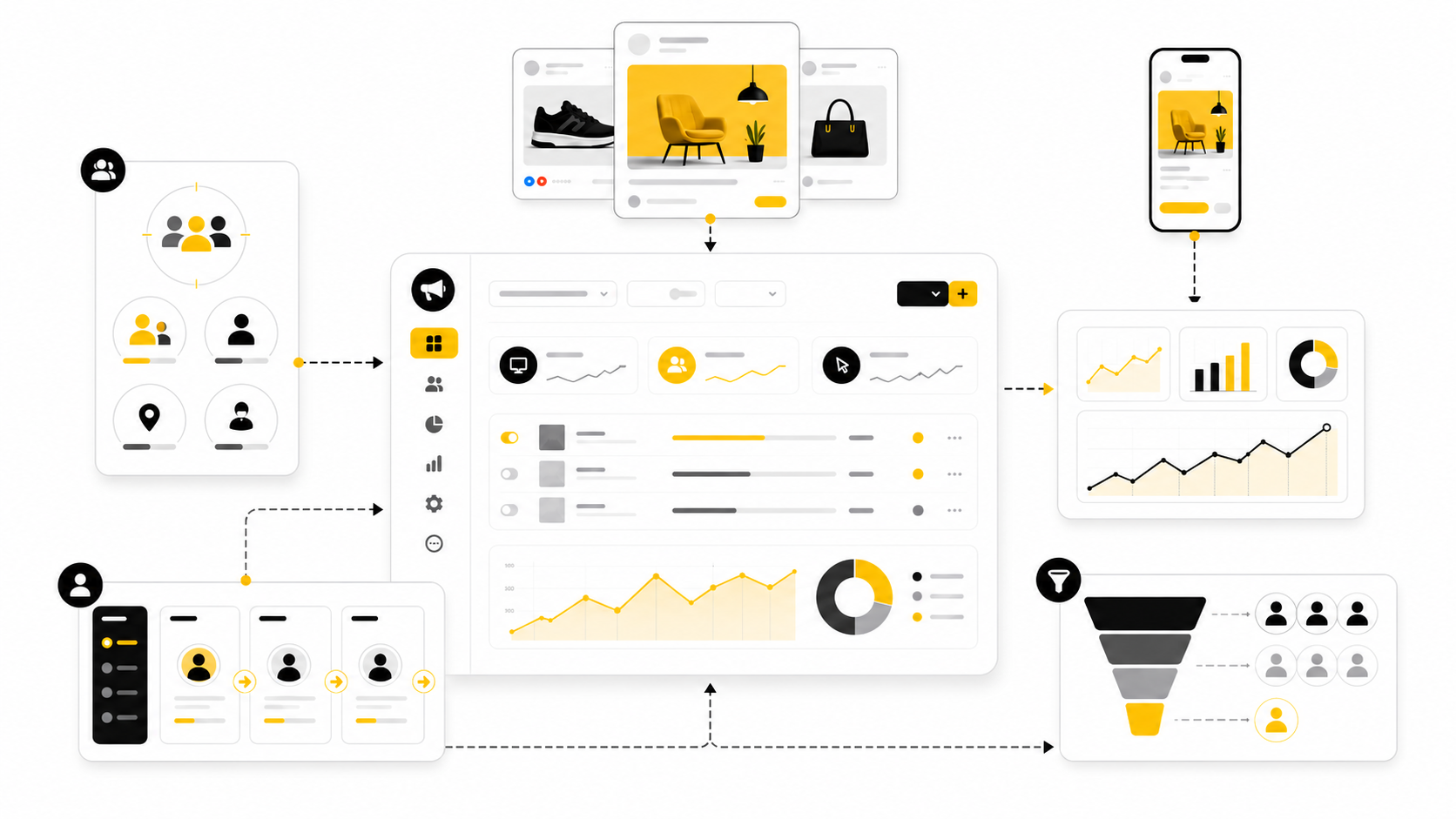
Digital marketing Facebook ads are no longer just about picking an audience, writing a headline, and hoping the algorithm finds buyers. Meta’s ad system has become more automated, more creative-driven, and more dependent on clean conversion signals. That is good news if you build campaigns the right way, but it is brutal if your strategy still depends on tiny interest stacks, random creative tests, and surface-level ROAS screenshots.
Facebook still matters because Meta’s ecosystem remains one of the biggest commercial attention networks in the world. Meta reported 3.56 billion daily active people across its family of apps in March 2026, while its advertising business generated $55.02 billion in Q1 2026 ad revenue. The bigger point is not that “everyone is on Facebook.” The bigger point is that Facebook ads now work best when they are treated as part of a complete digital marketing system: offer, funnel, creative, tracking, automation, testing, and sales follow-up.
The market around it is also still expanding. The IAB’s 2025 internet advertising report found that U.S. digital ad revenue reached $294.6 billion in 2025, with social media advertising revenue growing to $117.7 billion. That kind of spend attracts competition, which means casual campaigns get punished faster. If you want Facebook ads to work in 2026 and beyond, you need a system that helps Meta understand who converts, gives the algorithm enough creative variety, and connects every campaign to a real business outcome.
Why Digital Marketing Facebook Ads Still Matter
Facebook ads still matter because they sit at the intersection of attention, intent creation, and measurable action. Search ads often capture demand that already exists, while Facebook ads can create demand by putting the right offer in front of people before they actively search for it. That makes Facebook especially useful for ecommerce, local services, coaches, agencies, SaaS products, lead generation, webinars, and any business where education and trust matter before the sale.
The platform has also shifted from manual control to guided automation. Meta’s own Performance 5 training focuses on account simplification, automation, creative diversification, data quality, and results validation, which is a very different playbook from the old days of dozens of narrow ad sets. In practical terms, your job is not to micromanage every impression. Your job is to give Meta a strong offer, clean data, enough creative angles, and a conversion path that does not leak profit.
This is why digital marketing Facebook ads should not be judged only by Ads Manager metrics. Click-through rate, cost per lead, and platform ROAS are useful, but they do not tell the full story. A serious advertiser also looks at lead quality, sales conversion rate, customer acquisition cost, payback period, lifetime value, and whether campaigns are creating incremental sales that would not have happened anyway.
The Facebook Ads Framework For Digital Marketing
A strong Facebook ads framework starts with the business goal, not the campaign button. Before choosing an objective, you need to know whether the campaign is supposed to generate purchases, booked calls, webinar registrations, app installs, Messenger conversations, email subscribers, or qualified leads. That decision shapes the offer, landing page, follow-up sequence, tracking setup, creative strategy, and optimization event.
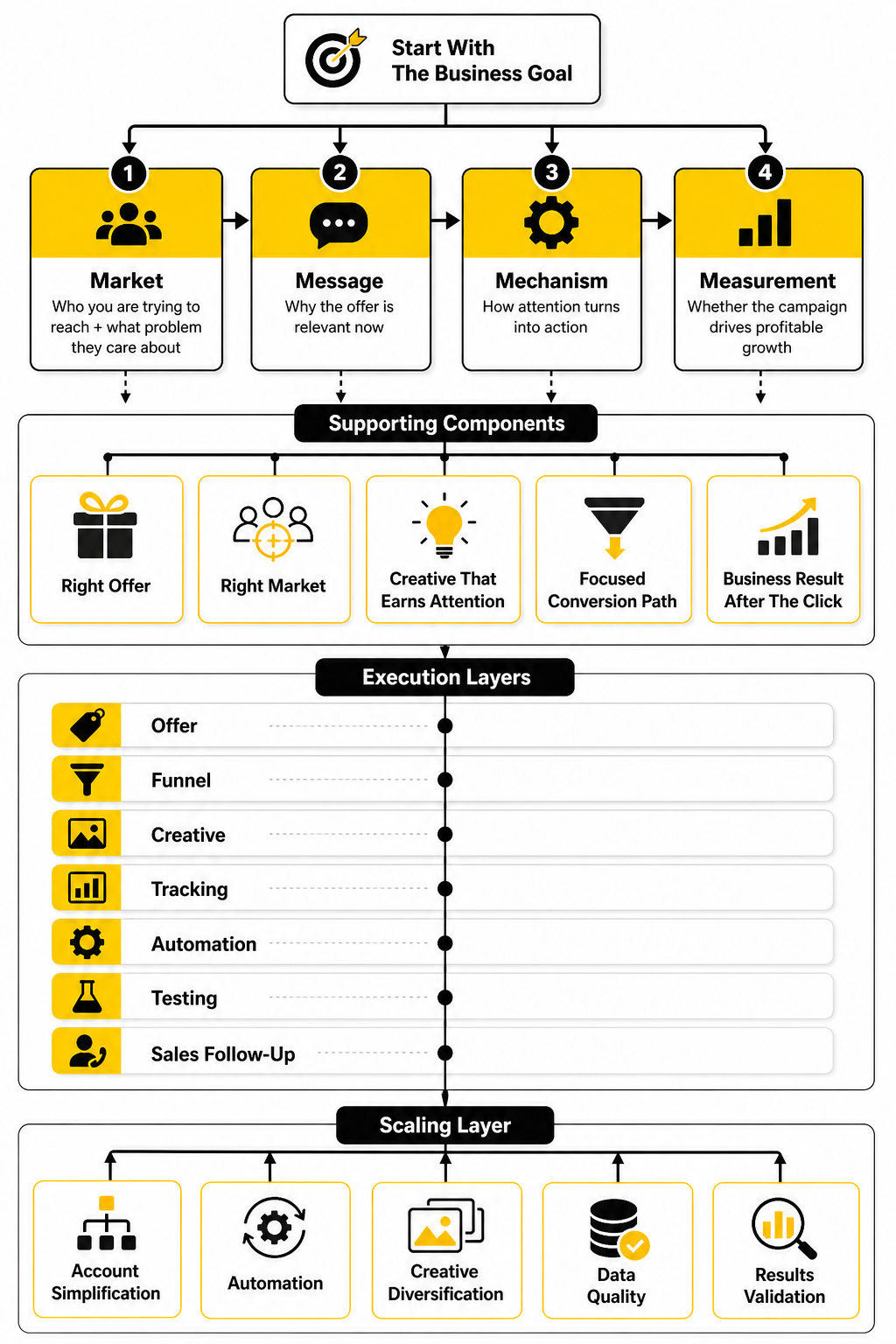
The framework is simple: match the right offer to the right market, package it into creative that earns attention, send traffic into a focused conversion path, and measure the business result after the click. For ecommerce, that might mean sending traffic to a product page or a custom landing page built with a tool like Replo. For service businesses, it might mean sending leads into a booking and CRM workflow using a platform like GoHighLevel. For chat-based lead capture, it may mean using ManyChat to turn comments, DMs, and Messenger conversations into measurable pipeline.
The framework also needs to respect how Meta’s machine learning works now. The algorithm performs better when campaigns are not fragmented beyond reason, when creative gives it multiple angles to test, and when conversion data is reliable. That means the best structure is usually not the most complicated structure. It is the structure that gives the system enough signal to learn while giving the business enough control to make smart budget decisions.
The Facebook Ads Framework For Digital Marketing
and when the conversion path gives people a clear next step after they click. That is where many advertisers lose money. They treat Facebook ads as the whole strategy, when the ad is really just the front door of a bigger digital marketing system.
A useful framework has four layers: market, message, mechanism, and measurement. The market defines who you are trying to reach and what problem they already care about. The message explains why your offer is relevant now, the mechanism turns attention into action, and measurement tells you whether the campaign is creating profitable growth or just cheap activity.
This matters because Meta’s algorithm can optimize only for the signals you give it. If the offer is weak, the landing page is confusing, or the follow-up is slow, better targeting will not save the campaign. Digital marketing Facebook ads work when every layer supports the next one.
Start With The Business Objective
The first mistake is choosing a campaign objective before defining the business objective. A purchase campaign, lead campaign, traffic campaign, and engagement campaign all teach the system to find different kinds of people. If you ask Meta for clicks, it will look for people likely to click; if you ask it for purchases, it will look for people likely to buy.
That sounds obvious, but it changes everything. A local service business that wants booked appointments should not celebrate cheap leads if those leads never answer the phone. An ecommerce brand should not chase low CPMs if the traffic has no buying intent. A creator selling a digital product should not optimize for engagement if the actual goal is checkout completion.
The business objective also decides what needs to happen after the ad. If the goal is a booked call, your funnel needs a strong form, calendar, reminders, and a fast follow-up process. Tools like GoHighLevel can make sense here because they connect ads, forms, pipelines, messages, and appointment workflows in one place instead of leaving leads scattered across spreadsheets and inboxes.
Match The Offer To The Buying Stage
Not every person who sees your ad is ready to buy today. Some people are problem-aware, some are solution-aware, and some are already comparing vendors. Your offer needs to match that stage, otherwise the campaign feels pushy, vague, or irrelevant.
A cold audience usually needs a lower-friction offer. That could be a useful guide, quiz, calculator, free consultation, product bundle, webinar, or demo depending on the business. A warm audience can usually handle a stronger sales message because they have already visited the site, watched content, engaged with the brand, or opened a previous conversation.
This is why “run ads to your homepage” is usually lazy advice. A homepage has too many jobs, while a campaign page has one job. For ecommerce and product-led campaigns, a dedicated landing page builder like Replo can help keep the page focused on the specific product, angle, proof, and call to action from the ad.
Build The Message Around One Clear Promise
A good Facebook ad does not try to explain the whole business. It makes one clear promise to one specific type of buyer. That promise should connect a real pain, desire, or outcome to the next step you want the person to take.
The strongest messages usually come from customer language, not brainstorming in a blank document. Look at reviews, sales calls, support tickets, objections, comments, and competitor complaints. Your best hooks are often hiding in the exact words people use when they describe what they want fixed.
The message also needs enough specificity to feel believable. “Grow your business” is too broad. “Book more qualified renovation consultations without chasing cold leads” is much stronger because it tells the reader who it is for, what outcome matters, and what pain is being removed.
Design The Funnel Before Scaling The Budget
The funnel is where attention becomes revenue. If the ad creates curiosity but the page creates confusion, performance drops. If the form creates leads but the sales team follows up two days later, the campaign gets blamed for a process problem.
A simple funnel can work beautifully when every step is intentional. The ad earns the click, the page reinforces the promise, the form collects the right information, the thank-you page sets expectations, and the follow-up moves fast. For funnel-heavy businesses, ClickFunnels or Systeme.io can be useful when the campaign needs a dedicated opt-in, sales page, checkout, upsell, or email sequence.
Do not overcomplicate this. A high-performing funnel is not always the prettiest funnel. It is the one that keeps the promise from the ad, removes friction, answers the buyer’s obvious questions, and makes the next action feel easy.
Core Components Of A High-Performing Facebook Ads System
A high-performing Facebook ads system is not built from one magic campaign. It is built from components that work together: offer, creative, audience, landing page, tracking, follow-up, and optimization. When one component is weak, the others have to work harder.
This is why experienced advertisers diagnose campaigns in layers. They do not instantly blame targeting when results dip. They check whether the offer is still compelling, whether creative has fatigued, whether tracking is clean, whether the page is converting, and whether the sales process is turning leads into customers.
The goal is not to create a fragile campaign that works only when conditions are perfect. The goal is to build a system that can learn, adapt, and keep producing useful data. That is the difference between running ads and building a digital marketing asset.
The Offer
The offer is the reason someone acts now. It includes the product or service, but it also includes the price, bonus, guarantee, urgency, positioning, delivery method, and perceived value. Two businesses can sell the same service and get completely different ad results because one offer feels obvious and the other feels forgettable.
A strong offer reduces hesitation. It answers the silent questions in the buyer’s head: Why this? Why now? Why you? What happens after I click? What risk am I taking? What do I get that I cannot easily get somewhere else?
For lead generation, the offer should filter for quality, not just volume. A free consultation can work, but only if the ad and form attract people with a real problem and enough intent to take action. For ecommerce, the offer should make the product easier to understand, compare, and buy without requiring the customer to do extra mental work.
The Creative
Creative is now one of the biggest levers in digital marketing Facebook ads. Targeting still matters, but the ad itself tells Meta who is responding. The hook, format, visuals, copy, voice, proof, and call to action all shape the audience the system finds.
A proper creative strategy tests angles, not random variations. One angle might focus on pain. Another might focus on speed, convenience, savings, status, simplicity, proof, comparison, or the cost of doing nothing. Each angle teaches you something about what the market actually cares about.
The mistake is launching five ads that are basically the same. Changing the background color or swapping one headline rarely creates meaningful learning. You want creative variations that are different enough to reveal which message has real pull.
The Landing Page
The landing page has to continue the conversation started by the ad. If the ad promises a specific outcome and the page opens with generic brand copy, the buyer feels a disconnect. That disconnect is expensive because every confused visitor wastes paid traffic.
A good landing page makes the next step feel obvious. It repeats the core promise, explains who the offer is for, shows proof, handles objections, and gives people a clear call to action. It should also load quickly, work cleanly on mobile, and avoid unnecessary distractions.
The page does not need to be long for the sake of being long. It needs to be complete enough for the decision being asked. A low-priced impulse product may need less explanation, while a high-ticket service or complex software offer needs more proof, more context, and a stronger reason to trust the next step.
The Follow-Up
The follow-up is where many Facebook ad campaigns quietly win or lose. A lead is not revenue. A booked call is not revenue. Even a checkout visit is not revenue until the person completes the purchase and the numbers work.
For lead campaigns, speed matters because intent fades quickly. The moment someone fills out a form, they are at peak attention. Automated SMS, email, voicemail drops, pipeline reminders, and calendar confirmations can turn the same ad spend into more real conversations.
For ecommerce, follow-up usually means abandoned cart emails, browse recovery, post-purchase flows, upsells, and remarketing audiences. For Messenger or Instagram DM campaigns, ManyChat can help automate the first response while the prospect still remembers why they engaged. That timing is not a small detail. It is often the difference between a lead that converts and a lead that disappears.
The Tracking Setup
Tracking is not the exciting part of digital marketing Facebook ads, but it is one of the parts that decides whether the campaign can actually improve. Meta needs reliable conversion signals to understand which clicks, leads, carts, purchases, and booked calls matter. If your pixel, events, CRM, and conversion API setup are messy, your campaign data becomes noisy before you even start optimizing.
At minimum, you need the Meta Pixel installed correctly, standard events mapped to the right actions, and your most valuable conversion event selected inside the campaign. For ecommerce, that usually means events like view content, add to cart, initiate checkout, and purchase. For lead generation, it may mean lead, complete registration, schedule, or a custom event that better reflects a qualified prospect.
The deeper point is simple: do not optimize for the easiest action if it is not the action that grows the business. A campaign optimized for form fills may produce cheap leads that never buy. A campaign optimized for booked calls, qualified leads, or purchases may cost more upfront, but it gives the system a better signal and gives you a cleaner path to profit.
The Audience Strategy
Audience strategy has changed because Meta now does more of the matching behind the scenes. That does not mean audience work is dead. It means the advertiser’s job has shifted from over-controlling targeting to giving the system strong inputs through creative, conversion data, and offer clarity.
Broad targeting can work well when the pixel has useful data and the creative speaks clearly to the right buyer. Lookalikes can still be useful when they are built from quality sources, such as customers, high-value purchasers, booked calls, or qualified leads. Retargeting remains important, but it should support the main campaign instead of becoming a dumping ground for weak ads and repetitive offers.
The best approach is usually simple enough to manage and structured enough to learn from. You do not need twenty ad sets fighting for the same audience. You need a setup that gives Meta room to optimize while still allowing you to understand which offer, angle, creative format, and funnel path are driving results.
Professional Implementation: From Campaign Setup To Optimization
Once the strategy is clear, implementation becomes much easier. You are not guessing your way through Ads Manager anymore. You are translating the business goal into a campaign structure, creative plan, landing page, tracking setup, and review rhythm.
This is where discipline matters. Most campaigns do not fail because one setting was slightly imperfect. They fail because the advertiser skipped the foundation, launched too many disconnected tests, changed the campaign too quickly, or judged performance before the system had useful data.
Professional implementation means building the campaign so every piece has a job. The campaign objective tells Meta what result you want. The ad set defines the budget, audience direction, placements, and optimization event. The ads test the message, creative format, and offer angle. The landing page and follow-up system then turn that attention into measurable business outcomes.
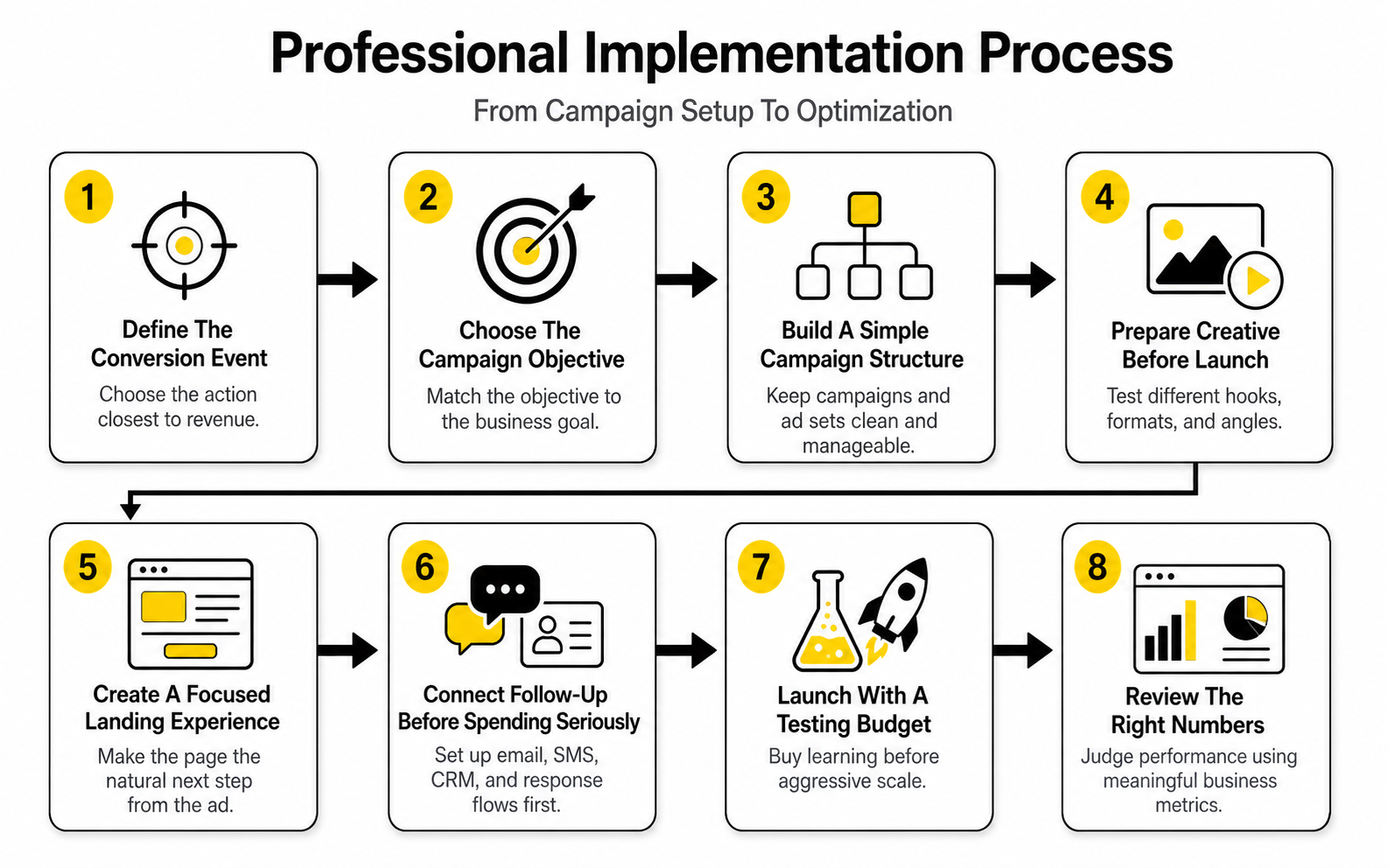
Step 1: Define The Conversion Event
The conversion event is the action you want Meta to find more of. This should be as close to revenue as your volume allows. If you have enough purchases, optimize for purchases. If you do not have enough purchases yet, you may need to start with initiate checkout, lead, booked call, or another event that still shows serious intent.
Do not choose a conversion event just because it looks good in reports. A cheap lead is not automatically a good lead. A page view is not automatically a buyer. If the event does not represent meaningful progress toward revenue, it can train the campaign in the wrong direction.
For service businesses, the best event may come from the CRM rather than the website alone. A form submission is useful, but a booked appointment or qualified opportunity is more valuable. When a platform like GoHighLevel is connected properly, it becomes easier to track what happens after the lead arrives instead of stopping the analysis at cost per lead.
Step 2: Choose The Campaign Objective
The campaign objective should match the conversion event and the commercial goal. If you want sales, use a sales-focused setup. If you want qualified leads, use a leads-focused setup that still filters for serious intent. If you want conversations, make sure the messaging flow can actually qualify and route people after they respond.
This is where many advertisers make the campaign easier to launch but harder to scale. They choose traffic because clicks are cheap. They choose engagement because reactions look encouraging. Then they wonder why the campaign is not producing customers.
Meta is very good at finding what you ask for, so ask for the right thing. If the business needs sales, build toward sales. If the business needs appointments, build toward appointments. If the business needs qualified pipeline, make sure the campaign and follow-up process are both designed around qualification.
Step 3: Build A Simple Campaign Structure
A clean structure gives the algorithm enough room to learn and gives you enough clarity to make decisions. Start with fewer campaigns and fewer ad sets than you think you need. Complexity feels professional, but it often creates fragmented data, budget overlap, and slow learning.
For many accounts, a practical structure includes one main prospecting campaign, one retargeting layer if there is enough traffic, and separate campaigns only when the goal, offer, market, or budget logic is meaningfully different. If two campaigns are trying to reach the same people with the same offer and same objective, they are probably competing with each other.
Inside the ad set, avoid stacking unnecessary restrictions unless there is a strong reason. Let placements, creative, and conversion data do more of the work. Your control should come from the strategy, the offer, and the feedback loop, not from trying to manually force the algorithm into a tiny corner.
Step 4: Prepare Creative Before Launch
Creative should be planned before the campaign goes live, not improvised after performance drops. You want enough variation to learn which message is pulling the market forward. That means testing different hooks, formats, proof points, objections, and calls to action.
A strong launch batch might include short-form video, static image ads, founder-style direct response, product demonstrations, testimonial-led creative where available, and simple offer-focused ads. The goal is not to look busy. The goal is to give the campaign several real ways to find demand.
Write the creative around the buyer’s problem, not your internal features. A SaaS tool is not just “an automation platform.” It saves time, reduces missed follow-ups, prevents lost leads, and gives the team a cleaner operating system. When the ad translates features into outcomes, the buyer has a reason to care.
Step 5: Create A Focused Landing Experience
The landing experience should feel like the next logical step from the ad. If the ad talks about a specific problem, the page should open with that problem and show the solution quickly. If the ad promotes a product bundle, the page should not force the visitor to hunt through a generic catalog.
For ecommerce, this may mean a product page that has been rebuilt for clarity, proof, urgency, and mobile conversion. A dedicated page builder like Replo can help when the standard product page does not give you enough control over the campaign story. For lead generation or digital products, a funnel tool like ClickFunnels or Systeme.io can make sense when you need opt-ins, checkouts, upsells, and email sequences connected in one path.
The page should also remove avoidable friction. Keep the call to action clear, make the page fast on mobile, use proof where it naturally belongs, and answer the questions a serious buyer would ask before moving forward. Do not make people work to understand why they clicked.
Step 6: Connect Follow-Up Before Spending Seriously
Follow-up should be ready before the campaign starts generating leads or carts. This is especially important for service businesses, agencies, local businesses, coaches, consultants, and high-ticket offers. If the campaign produces interest but the business responds slowly, the campaign gets blamed for a sales process failure.
A strong follow-up system confirms the action, sets expectations, reminds the prospect, and moves them toward the next step. That can include email, SMS, calendar reminders, pipeline tasks, retargeting audiences, and manual sales outreach where needed. For conversational funnels, ManyChat can help respond instantly when someone engages through Messenger, Instagram, or comment-based flows.
This is one of those boring operational details that makes a huge difference. The same Facebook ad campaign can look average with weak follow-up and excellent with fast, structured follow-up. Paid traffic exposes the strength of your process.
Step 7: Launch With A Testing Budget
The first budget should buy learning, not pretend certainty. You need enough spend to collect useful signals, but not so much that one weak launch burns through cash before you understand what is happening. The right amount depends on offer value, conversion volume, market size, and how much data already exists in the account.
At launch, resist the urge to judge every ad after a few clicks. Early results can swing heavily because the system is still exploring. Look for patterns across creative angles, landing page behavior, cost per meaningful action, and the quality of the leads or purchases coming through.
The first goal is to identify what deserves more budget. That may be one message angle, one landing page path, one audience direction, or one creative format. Scaling becomes much easier when you are amplifying something that has already shown real buyer response.
Step 8: Review The Right Numbers
Ads Manager is useful, but it is not the whole truth. You need to review platform metrics and business metrics together. That means looking at CPM, click-through rate, cost per click, conversion rate, cost per lead, cost per purchase, revenue, booked calls, show-up rate, close rate, refund rate, and customer value.
The right metric depends on the campaign goal. For ecommerce, a purchase campaign should eventually be judged by contribution margin, customer acquisition cost, average order value, and payback. For lead generation, the real question is not only cost per lead but cost per qualified opportunity and cost per customer.
This is where a lot of advertisers get fooled. A campaign can look expensive in Ads Manager and still be profitable if it brings high-quality buyers. Another campaign can look cheap and quietly waste budget because the leads never convert. Professional optimization means following the money, not just the dashboard.
Tracking, Testing, And Scaling Facebook Ads
Tracking, testing, and scaling are where digital marketing Facebook ads become measurable instead of emotional. Without this layer, every decision feels personal. One ad looks good, one ad looks bad, the budget feels uncomfortable, and nobody can explain what is actually happening.
The goal is not to stare at dashboards all day. The goal is to build a measurement system that tells you what to keep, what to fix, what to cut, and what deserves more money. That system has to connect Meta data with website data, CRM data, sales data, and customer value because Ads Manager alone does not know your margins, refunds, sales calls, or cash flow.
This is also where the difference between beginners and serious operators becomes obvious. Beginners ask, “Is this a good cost per lead?” Professionals ask, “What does this lead cost mean after qualification, show-up rate, close rate, fulfillment cost, and lifetime value?” That second question is less sexy, but it is the one that protects profit.
Statistics And Data That Actually Matter
The numbers around Facebook advertising are big, but big numbers are only useful when they change how you make decisions. Meta reported 3.56 billion daily active people across its family of apps in March 2026, with ad impressions across its family of apps up 19% year over year in Q1 2026. That tells you the platform still has massive reach, but it does not mean every campaign deserves more budget.
The digital ad market is also more competitive than ever. The IAB’s full-year 2025 report showed U.S. digital advertising revenue reached $294.6 billion, while social media advertising revenue reached $117.7 billion. That matters because rising investment usually brings more competition, more creative volume, and less room for lazy campaigns.
Benchmarks can help, but they should never become your strategy. WordStream’s 2025 Facebook ads benchmark report shows that performance varies heavily by industry, objective, and funnel type, while Triple Whale’s 2026 Meta ads benchmark analysis uses data from nearly 35,000 brands to compare ecommerce performance across industries. The lesson is straightforward: use benchmarks to spot obvious outliers, then use your own account economics to decide what is acceptable.
Reach Does Not Equal Demand
Large reach is useful only when your offer and message create action. A huge audience can make a weak campaign look busy because impressions, clicks, and reactions show up quickly. That does not mean the campaign is building pipeline or revenue.
This is why CPM should be interpreted carefully. A rising CPM can mean competition is increasing, but it can also mean Meta is entering a more valuable auction to reach people who are more likely to convert. A low CPM can look efficient while quietly sending cheap attention that never becomes a customer.
The action is simple: do not optimize for cheap reach unless reach is the actual business goal. For most businesses, reach is an input, not the outcome. If the campaign is supposed to produce sales, leads, or booked calls, those deeper metrics matter more than how cheap the impressions look.
Clicks Are Not The Same As Intent
Click-through rate is useful because it tells you whether the ad earns attention. If CTR is very low, the creative may be unclear, the hook may be weak, the offer may not feel relevant, or the audience may not understand why they should care. That is a creative and positioning problem before it is a scaling problem.
But a high CTR can also be misleading. Curiosity clicks, vague claims, and overly broad hooks can attract people who click but never convert. This is common when an ad is written to win attention instead of attracting the right buyer.
The action is to read CTR alongside conversion rate and lead or purchase quality. If CTR is low and conversion rate is low, the message probably needs a serious rethink. If CTR is high but conversion quality is poor, the ad may be attracting the wrong people or making a promise the landing page cannot support.
Cost Per Lead Can Be A Trap
Cost per lead is one of the most abused metrics in digital marketing Facebook ads. It is easy to understand, easy to report, and easy to celebrate. It is also dangerous when the leads are not qualified.
A $3 lead can be expensive if nobody answers, nobody qualifies, and nobody buys. A $40 lead can be excellent if it turns into booked calls, real opportunities, and profitable customers. The price of the lead means nothing without the quality of the lead.
The action is to track every stage after the lead form. You want to know cost per lead, cost per qualified lead, cost per booked call, cost per show, cost per customer, and revenue per customer. For service businesses, this is where a connected CRM like GoHighLevel becomes useful because it helps connect ad leads to pipeline stages instead of treating every form submission as equal.
The Analytics System
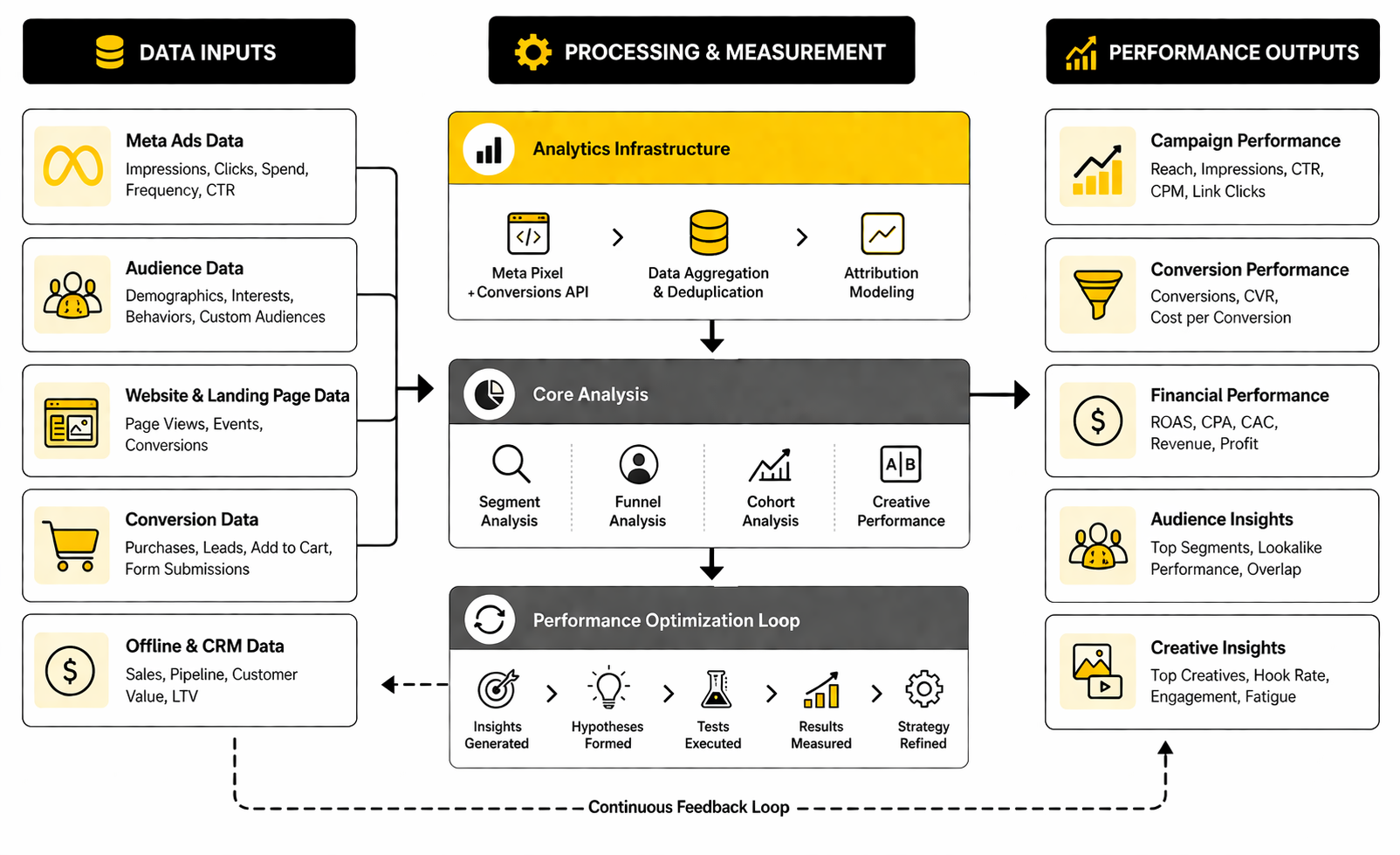
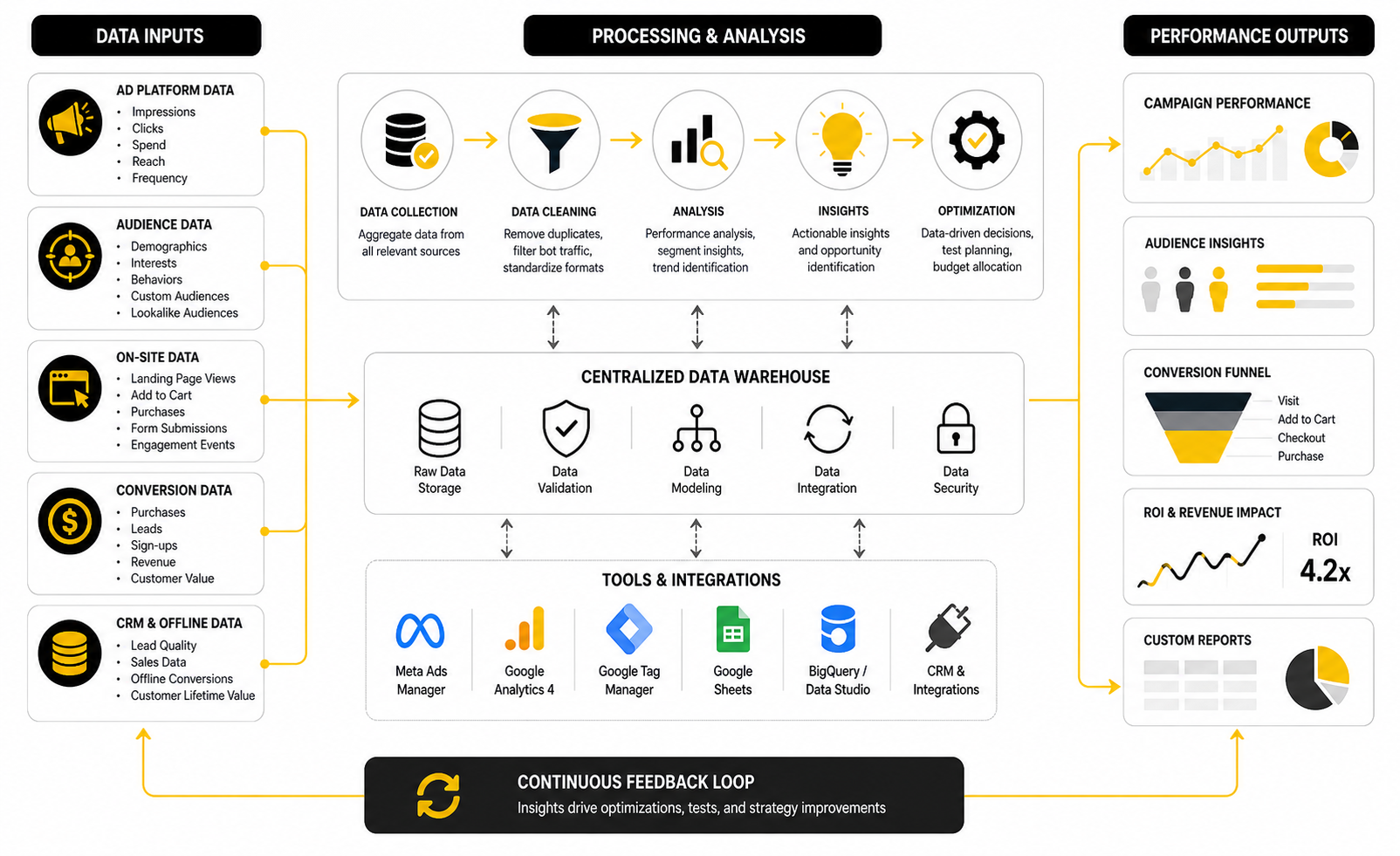
A practical analytics system should show the full path from impression to revenue. That path starts with Meta campaign data, continues through the landing page and conversion event, and ends with CRM or ecommerce data. If any part of that path is missing, you are making decisions with partial visibility.
The system does not need to be complicated at the beginning. You can start with Ads Manager, Google Analytics, a CRM, and a clean weekly reporting sheet. What matters is that the same core questions are answered every time: where did the money go, what happened after the click, which audience or creative created the best result, and what should change next?
The best dashboards are decision tools, not decoration. A dashboard that looks impressive but does not help you cut waste, improve offers, or scale winners is just a reporting toy. Keep the view focused on the metrics that drive action.
What To Measure Weekly
Weekly measurement should show whether the campaign is moving in the right direction without overreacting to daily noise. Meta’s delivery system can fluctuate, especially during learning, seasonal changes, creative tests, and auction shifts. A weekly view gives you enough data to see patterns without making emotional edits every morning.
Track the essentials first:
Each number should create a possible action. If spend is rising but revenue is flat, the issue may be scaling efficiency. If CTR is healthy but landing page conversion is weak, the page or offer may need work. If leads are cheap but close rate is poor, the problem may be qualification, sales follow-up, or message mismatch.
What To Measure Monthly
Monthly measurement should answer bigger business questions. A week can tell you what is changing inside the campaign. A month can tell you whether the campaign is helping the business grow.
Look at customer acquisition cost, payback period, blended ROAS, contribution margin, repeat purchase behavior, lead-to-customer rate, and channel mix. For ecommerce, blended performance matters because Meta may influence purchases that show up through other channels. For lead generation, pipeline quality matters because the true value often appears after the initial lead date.
Monthly reporting should also include creative learnings. Which hooks are still working? Which objections keep appearing? Which offers are producing better buyers? Those insights should feed the next month’s creative and landing page plan.
Benchmarks Should Guide, Not Control
Benchmarks are useful when you need context. If your CPC is dramatically higher than industry ranges, it may point to weak creative, poor relevance, or a competitive auction. If your conversion rate is far below typical ranges, it may point to the landing page, offer, pricing, or traffic quality.
But benchmarks can also make smart advertisers do dumb things. Your business may have higher margins, a longer sales cycle, a stronger backend, or a different buyer journey than the average account in a public report. A campaign that looks expensive against a generic benchmark can still be profitable if your customer value supports it.
Use benchmarks as a diagnostic tool, not a rulebook. Your own economics win. The only numbers that ultimately matter are the ones that show whether the campaign can acquire customers profitably and repeatedly.
Attribution Needs A Reality Check
Attribution is not perfect, and it never will be. Privacy changes, device switching, delayed purchases, offline sales, and multi-touch journeys all make it harder to assign every conversion cleanly. That does not mean measurement is useless. It means you need to avoid pretending one dashboard contains the entire truth.
Meta may claim credit for conversions based on its attribution settings, while your ecommerce platform, CRM, or analytics tool may show a different picture. This is normal. The job is not to force every system to match perfectly. The job is to understand the pattern well enough to make better decisions.
Use multiple views together: platform reporting, backend revenue, CRM stages, customer surveys, coupon codes where appropriate, and blended business performance. If Meta performance improves while total business revenue does not move, be careful. If platform attribution looks messy but total sales and qualified pipeline clearly rise with spend, the campaign may be working better than one report suggests.
Testing Should Answer One Clear Question
Testing fails when everything changes at once. If you change the audience, offer, landing page, creative, budget, and optimization event together, you may get a different result, but you will not know why. That creates motion without learning.
Every test should answer one clear question. Does this hook attract better buyers? Does this landing page convert paid traffic better? Does this offer increase booked calls? Does this video format reduce cost per purchase? The cleaner the question, the more useful the answer.
This does not mean you need academic perfection. Facebook ad accounts operate in the real world, where budgets, timelines, and competition are messy. But even in a messy environment, disciplined testing beats random changes.
Scaling Should Follow Proof
Scaling should happen after a campaign shows proof, not after one lucky day. A winning day can be noise. A winning pattern across enough spend, conversions, and business-quality checks is much more meaningful.
There are two basic ways to scale. You can increase budget on what is already working, or you can expand the system by adding new creative, offers, audiences, placements, or funnel paths. The safest scaling usually combines both: raise budget carefully while continuing to feed the campaign new creative and better conversion signals.
Do not scale a broken funnel. More budget will only expose the weakness faster. Fix the offer, page, tracking, follow-up, or creative first, then scale the part that has earned it.
Common Mistakes, Tool Stack, And Expert-Level Tradeoffs
Once tracking, testing, and scaling are in place, the next challenge is knowing what not to do. This is where digital marketing Facebook ads become more strategic. The beginner question is usually, “How do I get cheaper results?” The better question is, “What tradeoff am I making when I chase cheaper results?”
Every optimization choice has a cost. More automation can improve delivery, but it can also reduce manual visibility. More creative volume can build new audiences, but it can also create messy testing if the angles are not organized. More aggressive scaling can grow revenue, but it can expose weak margins, slow fulfillment, poor sales follow-up, or a product that is not ready for more demand.
This is why advanced Facebook ads management is not about tricks. It is about judgment. You need to understand what the data is saying, what the business can handle, and which constraint is actually limiting growth.
The Automation Tradeoff
Meta’s ad platform has moved heavily toward automation, and that is not going away. Advantage-based tools can help with placements, creative combinations, budget allocation, and delivery decisions. Meta’s own Q1 2026 results showed ad impressions across its family of apps increased 19% year over year, while the average price per ad increased 12% year over year, which points to a more competitive and more algorithm-driven auction environment.
The tradeoff is that automation rewards clear inputs. If the offer is weak, the data is messy, or the creative is generic, automation will not magically fix the campaign. It may simply spend faster across a broader set of placements and people.
The practical move is to automate delivery while staying strict on strategy. Let the system help find buyers, but do not outsource the fundamentals. You still own the offer, creative direction, conversion path, tracking quality, and profit math.
The Creative Volume Problem
Creative fatigue is one of the biggest scaling problems in Facebook advertising. The more you spend, the faster winning ads get exposed to the same audience pools. When performance drops, many advertisers panic and start changing budgets, audiences, and campaign structures instead of asking whether the market simply needs fresh angles.
The answer is not random creative volume. Uploading twenty weak ads does not create a strong testing system. You need structured variety: different hooks, different formats, different proof points, different objections, and different stages of awareness.
A strong creative pipeline treats ads like assets, not one-off posts. You can build ideas from customer reviews, sales objections, competitor gaps, product demonstrations, founder explanations, social proof, and frequently asked questions. If you publish organic content alongside paid campaigns, a scheduler like Buffer can help keep the content engine organized while paid media tests the strongest angles.
The Signal Quality Problem
Meta can optimize only toward the signals it receives. If every lead is counted the same, the system cannot tell the difference between a serious buyer and someone who filled out a form because the offer sounded free. If every purchase is counted the same, the system may chase low-value orders instead of better customers.
This becomes more important as accounts scale. Early on, any conversion data is useful because the campaign needs signal. Later, better signal matters more than more signal. You want Meta to learn from the actions that actually represent business value.
For lead generation, that may mean sending qualified lead, booked appointment, or closed-won data back into your reporting process. For ecommerce, it may mean paying attention to purchase value, repeat purchase behavior, subscription starts, refunds, and contribution margin. The closer your optimization and reporting get to real value, the less likely you are to scale the wrong thing.
The Funnel Complexity Trap
A funnel should make the buyer’s decision easier. It should not exist just because a marketer wanted to build something clever. Too many steps, too many upsells, too much copy, and too many distractions can reduce conversion even when each individual piece looks “strategic.”
That does not mean simple always wins. High-ticket offers, complex services, and unfamiliar products often need more education before the buyer is ready. The key is matching the funnel length to the decision being made.
For a simple product, a focused product page may be enough. For a webinar, challenge, consultation, or digital product, a dedicated funnel can make the journey clearer. Tools like ClickFunnels and Systeme.io make sense when the campaign needs a clear path from opt-in to sales page, checkout, upsell, and follow-up.
The Retargeting Reality
Retargeting is useful, but it is not a rescue plan for a weak offer. If cold traffic does not understand the promise, retargeting will not suddenly make the offer compelling. It may improve conversion from people who needed more time, but it cannot create strong demand from nothing.
Retargeting works best when it has a specific job. One ad can handle objections. Another can show proof. Another can remind visitors of the offer. Another can bring people back to an abandoned cart or incomplete booking.
The mistake is showing the same generic ad to everyone who visited the site. Someone who watched a video for three seconds is not the same as someone who started checkout. Someone who opened a lead form but did not submit it needs a different message from someone who booked a call but did not show up. Treat retargeting like a continuation of the conversation, not a second attempt to shout louder.
The Lead Quality Tradeoff
Lead campaigns can produce impressive-looking numbers fast. That is why they are dangerous. A campaign that generates low-cost leads can make everyone feel good until the sales team reports that the leads are unresponsive, unqualified, or not ready to buy.
Higher-friction forms can reduce lead volume but improve quality. Asking better qualifying questions can increase cost per lead but lower cost per customer. Sending people to a landing page before the form can reduce volume but create more informed prospects.
This is a real tradeoff, not a technical issue. If the business has a strong sales team and can handle volume, a lower-friction lead flow may work. If the business needs fewer but better prospects, the campaign should qualify harder before the lead reaches the pipeline.
The Sales Process Constraint
Many Facebook ad accounts are blamed for problems that happen after the lead arrives. Slow follow-up, weak scripts, missed calls, poor appointment reminders, and inconsistent pipeline management can make a good campaign look bad. Paid traffic does not hide operational gaps. It exposes them.
For service businesses, speed and structure matter a lot. The lead should receive confirmation immediately. The team should know who owns the follow-up. The CRM should show the next step clearly, and no serious prospect should disappear because someone forgot to send a message.
This is where a platform like GoHighLevel can be valuable for agencies, local businesses, and appointment-based offers. The real advantage is not just having forms or automations. It is having the ad lead, pipeline stage, follow-up sequence, calendar, and sales activity connected in one operating system.
The Scaling Ceiling
Every campaign has a scaling ceiling. Sometimes the ceiling is audience size. Sometimes it is creative fatigue. Sometimes it is conversion rate, margin, inventory, sales capacity, or customer support. The dangerous mistake is assuming the answer is always more budget.
When scaling stalls, diagnose the constraint before forcing spend. If CPMs rise but conversion rate holds, the market may still be healthy but more expensive. If CTR drops, creative may be tired. If leads stay cheap but close rate falls, the campaign may be reaching lower-quality prospects at higher volume.
The scaling question should be practical: what breaks first when we spend more? If fulfillment breaks, fix fulfillment. If sales follow-up breaks, fix sales. If creative breaks, build a stronger creative pipeline. Scaling is not just an ad account decision; it is a business capacity decision.
The Margin Problem
A campaign can generate revenue and still lose money. This is especially common when advertisers focus on ROAS without understanding gross margin, shipping, payment fees, refunds, discounts, labor, and software costs. Revenue is not profit.
For ecommerce, a 2x ROAS might be excellent for a high-margin product with strong repeat purchases. The same 2x ROAS might be terrible for a low-margin product with high fulfillment costs. For lead generation, a high cost per booked call might be fine if the close rate and average deal value support it.
This is why every advertiser needs a break-even model. Know your allowable cost per purchase, allowable cost per qualified lead, and allowable cost per customer. Once those numbers are clear, optimization becomes much calmer because you are not guessing what “good” means.
The Compliance And Trust Risk
Facebook ads also carry compliance risk. Claims, before-and-after language, financial promises, health-related statements, personal attributes, restricted categories, and landing page quality can all affect approval and account stability. Even if an ad gets approved, that does not mean the message is sustainable or brand-safe.
The solution is not to write boring ads. The solution is to write specific, believable ads that sell the outcome without making reckless promises. Strong proof, clear disclaimers, honest positioning, and careful wording can still convert without putting the account at unnecessary risk.
Trust also affects conversion beyond policy. If the ad feels exaggerated and the page feels thin, people hesitate. If the promise is clear, the proof is credible, and the next step feels safe, the campaign has a much better chance of turning attention into action.
The Tool Stack Should Support The Strategy
Tools should make the campaign easier to execute, measure, and improve. They should not become the strategy. A messy business with ten tools is still messy.
A practical tool stack usually covers five jobs:
For ecommerce landing pages, Replo can help create campaign-specific product experiences. For funnels and checkout paths, ClickFunnels or Systeme.io can work well. For chat-driven lead capture, ManyChat fits naturally when Messenger, Instagram, comments, and DMs are part of the conversion path.
The best stack is the one your team will actually use. If the tools are connected, the data is clean, and the workflow is simple, the campaign becomes easier to improve. If the tools create more confusion, they become another leak in the system.
When To Pause, Fix, Or Scale
Not every underperforming campaign should be killed immediately. Sometimes the campaign needs more data. Sometimes the creative needs a new angle. Sometimes the landing page is the real problem. Sometimes the offer is not strong enough for cold traffic.
Pause when the campaign has spent enough to prove the economics are not close and there is no clear fix inside the current setup. Fix when the data points to a specific bottleneck, such as poor CTR, weak conversion rate, bad lead quality, or slow follow-up. Scale when the campaign has shown repeatable performance across meaningful spend and the business can handle more demand.
That last part matters. Do not scale because the dashboard looks exciting for one day. Scale because the system is ready. The best digital marketing Facebook ads do not just generate traffic; they create demand the business can actually convert, fulfill, and profit from.
Bringing The Whole System Together
At this point, the job is no longer to “run Facebook ads.” The job is to build a digital marketing system where Facebook ads create demand, the funnel captures that demand, the follow-up converts it, and the data tells you what to improve next. That is the level where campaigns become repeatable instead of lucky.
The best digital marketing Facebook ads are not isolated from the rest of the business. They are connected to the offer, sales process, customer experience, creative pipeline, margin model, and reporting system. When those pieces work together, Meta has better signals, buyers have a smoother path, and the business can make calmer decisions.
This is also why the platform is still worth taking seriously. Meta’s ecosystem remains one of the largest advertising environments in the world, and the broader social ad market continues to grow as social commerce, creator content, video, and performance advertising become more connected. The opportunity is real, but only for advertisers who treat the system professionally.
Are Facebook Ads Still Worth It For Digital Marketing?
Yes, Facebook ads are still worth it when they are connected to a strong offer, clear funnel, clean tracking, and realistic economics. Meta’s ad platform still gives businesses access to massive reach across Facebook, Instagram, Messenger, and other placements, while recent market data shows social advertising remains one of the biggest segments of digital ad spend. The mistake is expecting the platform to fix weak positioning, poor follow-up, or a product that people do not clearly want.
What Is The Best Objective For Digital Marketing Facebook Ads?
The best objective depends on the business outcome you want. If you want purchases, use a sales objective and optimize as close to purchase value as possible. If you want leads, use a lead-focused setup but make sure the follow-up process tracks quality, booked calls, and customers instead of stopping at form submissions.
How Much Should I Spend On Facebook Ads At The Beginning?
Start with a budget that can generate enough data without putting the business under pressure. The right amount depends on your offer price, conversion rate, sales cycle, and how expensive your market is. A small local service campaign and a national ecommerce campaign should not use the same launch budget because they are buying very different types of learning.
How Long Should I Test A Facebook Ad Before Turning It Off?
You should test long enough to collect meaningful data, not just enough to confirm your mood that day. If an ad has barely spent anything, the results may be random and too early to judge. If it has spent enough to show weak click quality, poor conversion, or bad lead quality with no obvious fix, it is reasonable to pause it and move budget toward stronger angles.
What Metrics Matter Most In Facebook Ads?
The most important metrics are the ones closest to revenue. For ecommerce, that usually means cost per purchase, ROAS, contribution margin, average order value, repeat purchase behavior, and payback period. For lead generation, it means cost per qualified lead, booked call rate, show-up rate, close rate, cost per customer, and customer value.
Is Cost Per Lead A Good Metric?
Cost per lead is useful, but it is not enough by itself. A low-cost lead can still be bad if the person is unqualified, unresponsive, or never becomes a customer. The better move is to track cost per qualified lead and cost per customer so you know whether the campaign is creating real business value.
Should I Use Broad Targeting Or Interest Targeting?
Broad targeting can work well when the campaign has strong creative, enough conversion data, and a clear offer. Interest targeting can still be useful in some accounts, especially when the business is niche or the pixel has limited data. The more carefully approach is not to treat either one as a religion, but to test them against business outcomes instead of only surface-level ad metrics.
How Important Is Creative For Facebook Ads?
Creative is one of the most important parts of modern Facebook advertising. The ad itself gives Meta signals about who is responding, while also shaping how the buyer understands the offer. Strong creative is not just nice design; it is the combination of hook, message, proof, format, and call to action.
Do I Need A Landing Page For Facebook Ads?
You usually need a focused landing experience, but that does not always mean a long custom page. Some ecommerce campaigns can work well with a strong product page, while lead generation or high-ticket offers often need a dedicated page that explains the promise, proof, and next step. The key is that the page must continue the same conversation the ad started.
Why Are My Facebook Ads Getting Clicks But No Sales?
Clicks without sales usually mean there is a mismatch somewhere after the first moment of attention. The ad may be attracting curiosity instead of buyer intent, the landing page may be unclear, the offer may not feel valuable enough, or the checkout process may have too much friction. Review the full path from ad to page to conversion before assuming the audience is the only problem.
How Do I Know When To Scale A Facebook Ads Campaign?
Scale when the campaign has shown repeatable performance across enough spend and the business can handle more demand. Do not scale because one day looked good or because one ad had a lucky burst. Scale when the creative, funnel, tracking, follow-up, and margins all show that more budget has a realistic chance of producing more profitable outcomes.
What Is The Biggest Mistake Beginners Make With Facebook Ads?
The biggest mistake is treating Facebook ads like a traffic button instead of a business system. Beginners often launch ads before the offer is clear, before the page is ready, before tracking works, and before follow-up is built. Then they judge the platform instead of fixing the parts of the system that were never ready.
What Tools Help With Digital Marketing Facebook Ads?
The right tools depend on the campaign model. Ecommerce brands may need better landing pages, analytics, email flows, and creative operations, while service businesses often need CRM, calendar, SMS, pipeline, and sales follow-up. Tools like GoHighLevel, Replo, ClickFunnels, Systeme.io, and ManyChat can help when they support a clear strategy instead of replacing one.
Build a stronger local presence with BAAM AI
Turn your website, Google profile, social channels, and AI visibility into one growth engine
Most businesses do not need more random marketing activity. They need a consistent presence system that helps the right people find them, trust them, and take action. BAAM AI brings strategy, local SEO, website updates, Google Maps visibility, social content, AI-search readiness, media production, and reporting into one practical monthly engine.
If you want your marketing to keep working after the campaign ends, start with a free BAAM AI presence audit. See how your business shows up today and where the fastest visibility wins are at BAAM AI.