
BAAM AI Blog
Digital Marketing And SEO Services: A Practical Growth Framework For Businesses That Want Better Leads
Digital marketing and SEO services are not just about getting more traffic. That is the surface-level promise, and it is usually where bad strategy starts. The real job is to help the right people discover your...
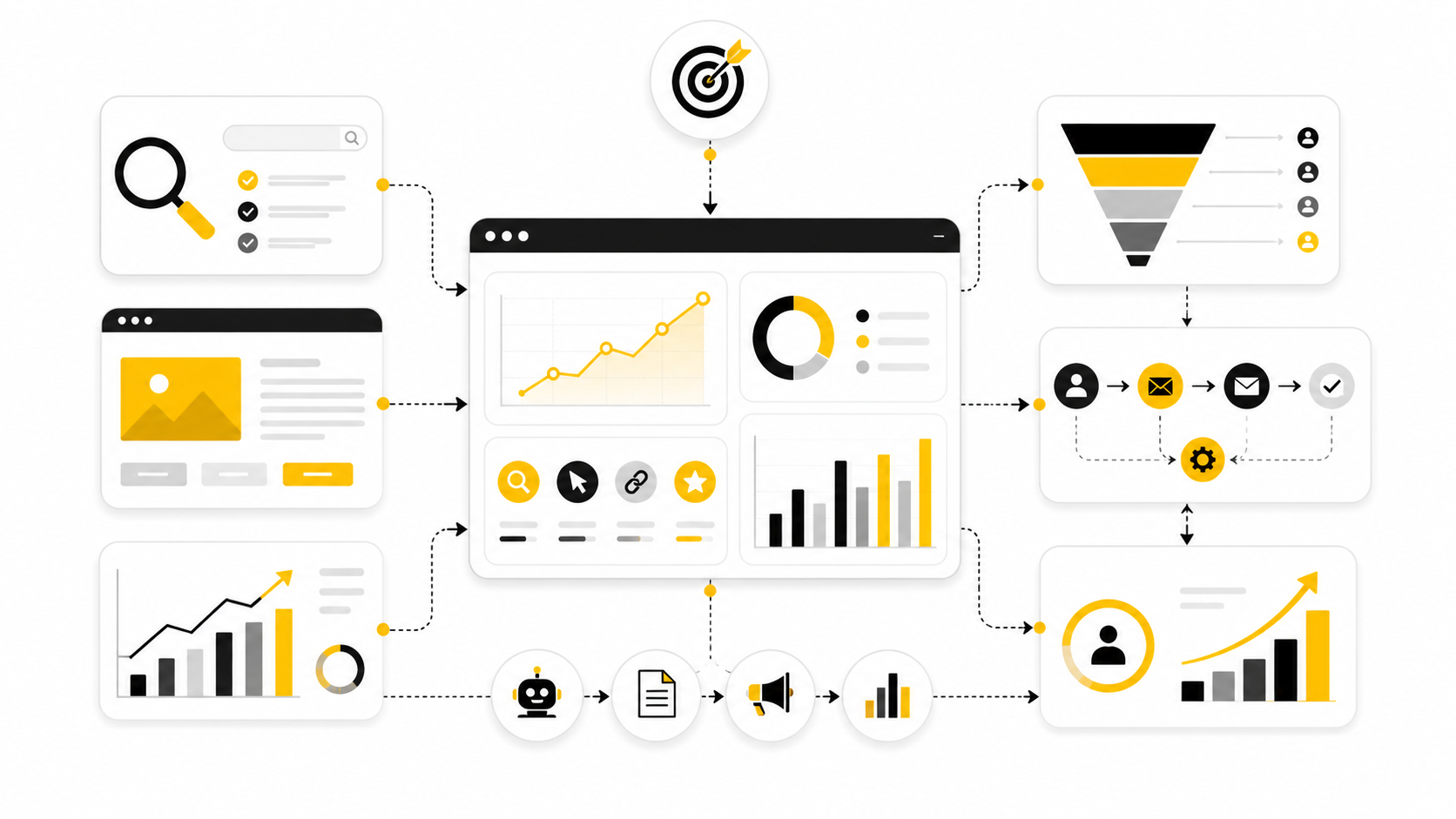
Digital marketing and SEO services are not just about getting more traffic. That is the surface-level promise, and it is usually where bad strategy starts. The real job is to help the right people discover your business, trust what they find, and take the next step without feeling pushed.
Search has changed, buying journeys have changed, and customers now compare options across Google, social platforms, review sites, email, video, communities, and AI-driven answer engines before they ever speak to a sales team. That means SEO cannot sit in a corner by itself. It needs to connect with content, conversion strategy, analytics, automation, and the way your brand shows up everywhere online.
Good digital marketing and SEO services give you a system instead of random activity. You are not publishing blog posts just because a keyword tool said so. You are building a repeatable engine that attracts demand, captures it, follows up with it, and turns it into measurable revenue.
Why Digital Marketing And SEO Services Matter Now
Businesses used to treat SEO as a traffic channel and digital marketing as a collection of separate tasks. One person handled blog posts, another ran ads, someone else managed email, and reporting often came last. That approach breaks down quickly because customers do not experience your business in separate channels.
A potential buyer might first find you through a Google search, compare you through a competitor page, check your LinkedIn activity, read reviews, download a guide, ignore three emails, and finally book a call after seeing a retargeting ad. If those touchpoints do not support each other, your marketing feels scattered. If they do support each other, the buyer feels like your business understands the problem before the first conversation starts.
That is why digital marketing and seo services matter more when markets get noisy. Google’s own SEO Starter Guide frames SEO around helping search engines crawl, index, and understand your content, but that is only the technical entry point. The larger goal is to make your website useful, findable, credible, and easy to act on.
The Growth Framework Behind Modern SEO
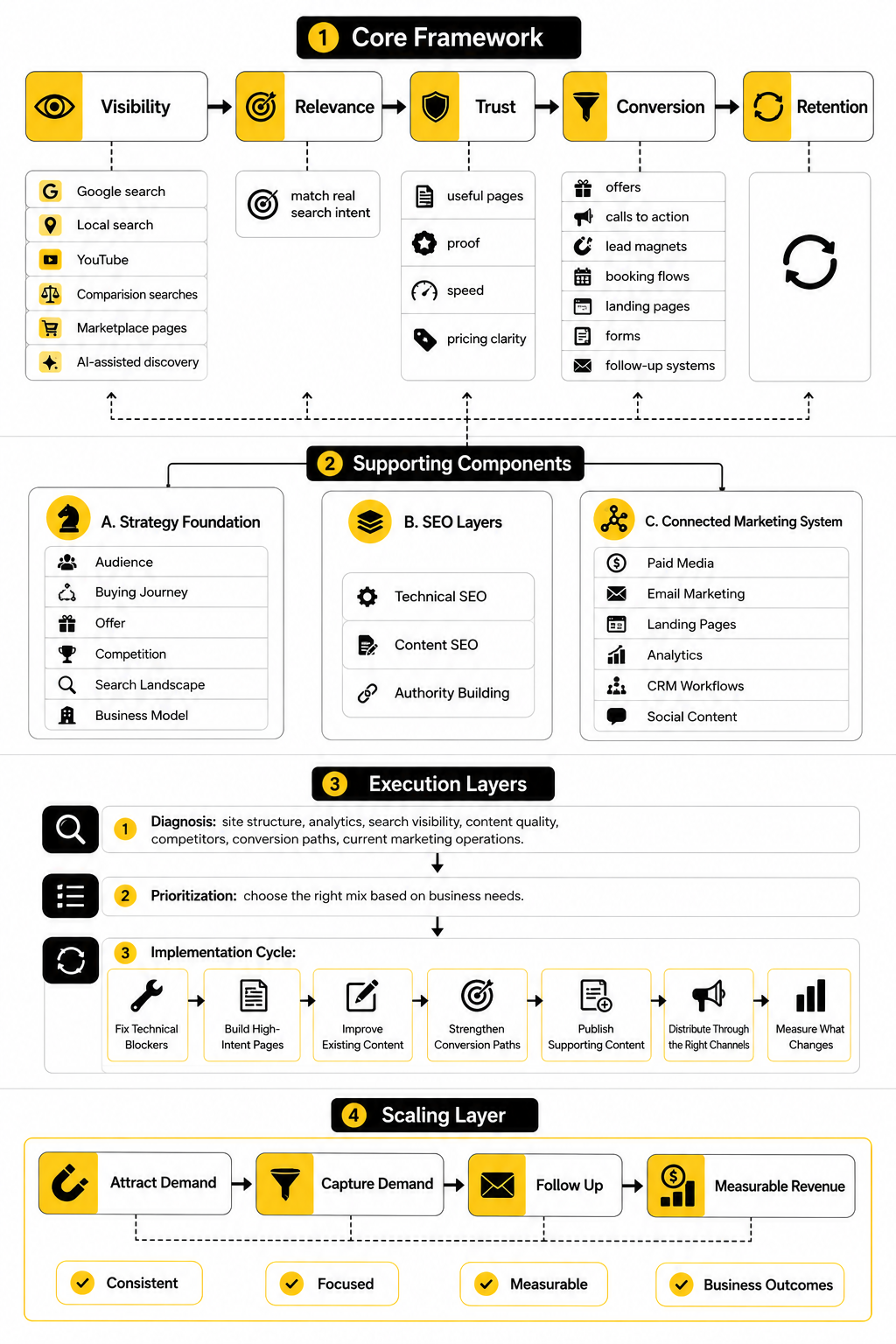
Modern SEO works best when it is treated as part of a broader growth framework. Ranking for keywords is valuable, but rankings alone do not pay invoices. The framework has to connect visibility, relevance, trust, conversion, and retention.
At the visibility stage, your job is to show up where buyers are already looking. That includes traditional Google results, local search, YouTube, comparison searches, marketplace pages, and increasingly AI-assisted discovery. At the relevance stage, your content needs to match the real intent behind the search instead of simply repeating the keyword.
Trust is where many campaigns fall apart. A page can rank and still fail if it sounds generic, lacks proof, loads slowly, avoids pricing clarity, or gives visitors no reason to believe the company can actually solve the problem. Conversion then turns attention into action through better offers, stronger calls to action, lead magnets, booking flows, landing pages, forms, and follow-up systems.
Core Components Of A Strong Digital Marketing System
A strong digital marketing system starts with strategy, not tools. Before choosing platforms, you need to understand the audience, the buying journey, the offer, the competition, the search landscape, and the business model. Without that foundation, even expensive software becomes a faster way to do the wrong work.
SEO is one core component, but it includes several layers. Technical SEO helps search engines access and understand the site. Content SEO turns buyer questions into useful pages. Authority building improves credibility through mentions, links, partnerships, and brand signals.
Paid media, email marketing, landing pages, analytics, CRM workflows, and social content support the same system from different angles. For example, a business using GoHighLevel might connect lead capture, pipeline tracking, SMS follow-up, email automation, and appointment booking so SEO leads do not disappear after the first visit. That matters because traffic only becomes valuable when the follow-up process is strong enough to convert it.
How Professional Implementation Actually Works
Professional implementation begins with diagnosis. A serious provider should review your site structure, analytics, search visibility, content quality, competitors, conversion paths, and current marketing operations before recommending a plan. If someone jumps straight into “we will write eight blog posts per month,” they are probably selling activity instead of strategy.
The next step is prioritization. Not every business needs the same mix of digital marketing and seo services. A local service business may need Google Business Profile optimization, local landing pages, reviews, and call tracking, while a SaaS company may need product-led content, comparison pages, onboarding emails, and lifecycle analytics.
Implementation should then move in cycles. Fix technical blockers, build high-intent pages, improve existing content, strengthen conversion paths, publish supporting content, distribute it through the right channels, and measure what actually changes. The best campaigns feel boring in the right way: consistent, focused, measurable, and tied to business outcomes rather than vanity metrics.
Tools, Automation, And Channel Integration
Once the strategy is clear, tools become useful. Not before. A tool cannot fix weak positioning, thin content, poor offers, or a sales process that leaks leads after the first contact.
The right stack should make your digital marketing and seo services easier to execute, easier to measure, and easier to improve. That usually means connecting your website, landing pages, CRM, email marketing, social publishing, forms, booking links, chat, analytics, and follow-up workflows into one practical system. The point is not to own every shiny platform; the point is to reduce friction between discovery and conversion.
This matters because SEO rarely produces instant buyers only. Some visitors are ready to book a call today, but many are comparing options, reading quietly, or checking whether your company feels credible. If your tools only capture the obvious hand-raisers, you miss the larger group that needs education, reminders, proof, and a clean next step.
Website And Landing Page Tools
Your website is still the center of the system. Social platforms can bring attention, ads can accelerate traffic, and email can bring people back, but your owned pages usually do the heavy lifting when someone is deciding whether to trust you. That is why page structure, page speed, copy quality, calls to action, and offer clarity matter so much.
For ecommerce brands, product-focused landing pages can make campaigns more specific and easier to test. A tool like Replo can fit when a Shopify team needs fast, polished landing pages without waiting on a full development cycle. The use case is simple: build pages around specific offers, campaigns, products, and customer objections instead of sending every visitor to a generic homepage.
For service businesses, coaches, agencies, and creators, funnel builders can help when the offer needs a guided path. ClickFunnels makes sense when the business wants opt-in pages, sales pages, checkout flows, upsells, and simple campaign paths in one place. Systeme.io can be a leaner option for email, funnels, courses, and basic automation when the team wants fewer moving parts.
CRM And Follow-Up Systems
A lead is not a win. It is a conversation that has started. If your follow-up is slow, inconsistent, or invisible, your SEO work is doing more than it should while the sales process quietly wastes the opportunity.
This is where CRM and automation tools become important. GoHighLevel is often useful for agencies, local businesses, and service teams that need pipelines, forms, calendars, email, SMS, missed-call follow-up, and simple automation under one roof. The practical benefit is that a form submission, phone call, chat inquiry, or booked appointment can trigger the next step without someone manually chasing every lead.
The best setup is not complicated. A visitor finds a useful SEO page, clicks a relevant call to action, fills out a form, books a call, or asks a question. From there, the CRM should tag the lead source, notify the right person, send a helpful confirmation, create a follow-up task, and keep the lead warm if they do not buy immediately.
Email, SMS, And Lead Nurturing
Email still matters because not every buyer is ready today. A strong SEO page can attract people early in the research process, but the business still needs a way to keep the relationship alive. That is why lead magnets, newsletters, product education, onboarding sequences, and reactivation campaigns belong inside a serious digital marketing system.
For email campaigns, tools like Brevo and Moosend can support newsletters, automations, segmentation, and promotional sequences. The key is to avoid dumping every subscriber into the same generic campaign. Someone who downloaded a beginner guide should not receive the same sequence as someone who requested pricing.
SMS and chat follow-up can be powerful, but only when used with restraint. If someone asks for a quote, appointment reminder, webinar link, or support response, timely messages are helpful. If the business blasts people with constant promotions, the channel quickly becomes noise.
Social Publishing And Content Distribution
SEO content should not sit quietly after publication. A strong article, guide, comparison page, or case study can often be repurposed into short posts, carousels, emails, video scripts, sales enablement notes, and follow-up resources. Distribution helps the same thinking reach people who are not searching at that exact moment.
For social scheduling and content operations, Buffer can help keep publishing consistent across channels. That does not mean every platform needs the same post. LinkedIn, Instagram, Facebook, TikTok, YouTube Shorts, and X all reward different formats, but the core insight can come from the same piece of research or customer question.
This is where many businesses overcomplicate things. You do not need to post everywhere just to feel active. You need to identify where your buyers actually pay attention, then show up with useful content often enough that your brand becomes familiar before they are ready to buy.
Chat, Forms, And Conversion Capture
Traffic is expensive, whether you earn it through SEO or buy it through ads. Once visitors arrive, the page should make the next step obvious. That can be a form, booking link, quiz, calculator, audit request, demo request, chat assistant, lead magnet, or checkout.
For better forms and intake flows, Fillout can work well when you need clean forms, surveys, application flows, or qualification steps. For appointment-based funnels, Cal.com can reduce the back-and-forth that kills momentum after a visitor decides they want to speak with someone.
AI chat can also help when the website has enough useful information to answer real questions. Chatbase can fit when a business wants a trained chatbot that answers common questions, routes visitors, and supports lead capture. The warning is simple: do not use chat as a bandage for unclear pages. Fix the page first, then use chat to make the experience smoother.
Data, Research, And Technical Workflows
Digital marketing gets much sharper when research and data collection are part of the workflow. You need to know what competitors are publishing, what customers are asking, which pages are indexed, which pages convert, and where technical issues are slowing growth. Guessing is expensive.
For web data collection and structured research workflows, Firecrawl can be useful when teams need to crawl pages, extract information, or support AI-powered research processes. This can help with content audits, competitor research, internal knowledge workflows, and technical discovery when used responsibly. It should not replace judgment, but it can speed up the work that informs better judgment.
The same principle applies across the entire marketing stack. Tools should help you see patterns faster, act with more consistency, and remove manual bottlenecks. If a tool adds complexity without improving decisions, execution, or measurement, it is not helping.
Integration Is The Real Advantage
The strongest advantage does not come from owning individual tools. It comes from connecting them. A search visitor should be able to move from page to form, from form to CRM, from CRM to follow-up, from follow-up to booking, and from booking to reporting without the whole process depending on memory and manual copying.
That is the difference between a campaign and a system. A campaign creates activity for a period of time. A system keeps learning, keeps capturing data, and keeps improving the way leads move through the business.
This is also where professional digital marketing and seo services become easier to judge. The work should not only produce pages, posts, links, or ads. It should leave the business with a cleaner, more carefully, more measurable growth machine than it had before.
The Implementation Process That Turns Strategy Into Results
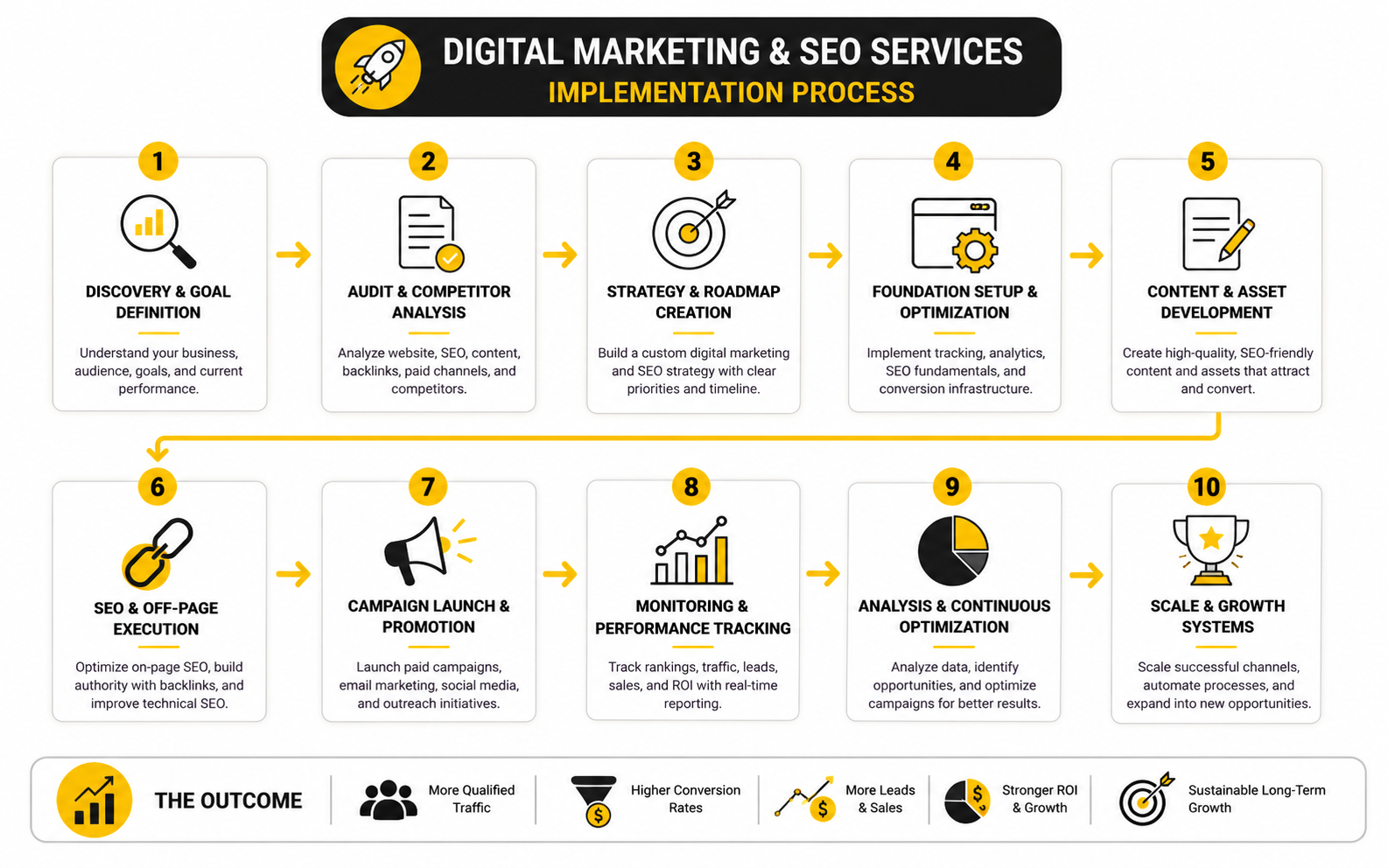
The implementation phase is where digital marketing and seo services either become valuable or become busywork. This is the part where plans turn into pages, systems, campaigns, workflows, reports, and actual business movement. It is also where weak thinking gets exposed fast.
A good process does not begin with “let’s publish content.” It begins with understanding what already exists, what is broken, what is missing, and what is most likely to create revenue impact. That sounds basic, but it is the difference between a campaign that compounds and one that burns months on random execution.
The goal is not to do everything at once. The goal is to build momentum in the right order. Fix what blocks growth, strengthen what already has traction, then create new assets that expand reach and conversion over time.
Step 1: Audit The Current Growth System
The first step is a proper audit. Not a surface-level SEO scan that spits out hundreds of warnings with no context. A real audit looks at your website, content, analytics, search visibility, conversion paths, lead handling, sales process, and current marketing channels together.
This matters because traffic problems are not always traffic problems. Sometimes the issue is weak landing page copy. Sometimes it is unclear positioning. Sometimes leads are coming in, but no one follows up quickly enough. Sometimes the site ranks for informational keywords but has no path from education to conversion.
A strong audit should answer practical questions:
This is where discipline matters. Many businesses want new campaigns because new feels productive. But improving an existing page that already gets traffic can often beat publishing another article that needs months to mature.
Step 2: Map Search Intent To The Buyer Journey
After the audit, the next step is mapping search intent to the buyer journey. This is where SEO becomes more strategic than keyword volume. You are not just asking what people search; you are asking what that search says about their level of awareness, urgency, and trust.
Some searches show early-stage curiosity. These people are trying to understand a problem, compare approaches, or learn terminology. Other searches show commercial intent, where the person is actively comparing providers, pricing, features, reviews, or services.
A serious strategy uses both, but it does not treat them the same. Educational content builds trust and captures demand early. Commercial pages capture buyers closer to action. Service pages, comparison pages, case-study pages, pricing pages, and consultation pages usually need much sharper copy because the visitor is already evaluating whether you are worth their time.
A simple intent map might include:
This prevents a common mistake: using blog content to do the job of a sales page. A helpful article can educate, but it should not be forced to close the deal on its own. The job of each page should match the intent of the visitor.
Step 3: Prioritize Pages By Business Impact
Not every page deserves equal effort. Some pages support visibility, some support trust, and some directly influence revenue. The implementation plan should make that distinction clear from the start.
For most businesses, the highest-impact pages are the ones closest to money. That includes core service pages, location pages, product pages, comparison pages, landing pages, demo pages, consultation pages, and pages that answer buying objections. These pages should be reviewed before the team spends weeks producing top-of-funnel content.
The prioritization should consider three things at the same time: search opportunity, conversion potential, and difficulty. A keyword with high volume but weak buying intent may not deserve immediate attention. A lower-volume keyword with strong commercial intent can be much more valuable if the page attracts serious buyers.
A practical page priority model looks like this:
This is where digital marketing and seo services become more than content production. The work becomes resource allocation. You decide where effort creates the highest probability of measurable progress.
Step 4: Build The Content And Conversion Plan Together
Content and conversion should not be planned separately. If your content brings in the right visitors but gives them no clear next step, you are leaving money on the table. If your landing pages are polished but no one finds them, the design work does not matter much either.
The content plan should define what needs to be created, what needs to be improved, and how each asset supports the buyer journey. The conversion plan should define what each page asks the visitor to do next. That next step may be booking a call, requesting a quote, downloading a guide, joining a newsletter, starting a trial, watching a demo, or answering a short qualification form.
For service businesses, a CRM-driven setup through GoHighLevel can help connect these next steps to follow-up workflows. For ecommerce or Shopify campaigns, Replo can help teams create campaign-specific landing pages that match the intent of the visitor. For funnels, offers, and guided selling paths, ClickFunnels or Systeme.io can fit when the business needs a simpler path from interest to action.
The key is alignment. The keyword, page angle, offer, call to action, and follow-up sequence should feel like one connected experience. When they do not match, visitors hesitate.
Step 5: Fix Technical Foundations Without Getting Lost In Them
Technical SEO is important, but it can also become a rabbit hole. The goal is not to chase every warning in a tool. The goal is to make sure search engines can access the right pages, understand them, and serve them to users without unnecessary friction.
The technical foundation usually includes crawlability, indexation, internal linking, page speed, mobile usability, structured data, canonical tags, redirects, duplicate content control, sitemap hygiene, and clean site architecture. These are not glamorous tasks, but they protect the rest of the campaign. If important pages are blocked, duplicated, slow, orphaned, or poorly structured, content quality alone may not be enough.
This stage should produce a clear fix list with priorities. Critical issues come first. Then come improvements that support scale, such as better templates, cleaner internal linking, stronger navigation, and repeatable on-page standards. Technical work should make the site easier to grow, not just cleaner on paper.
A practical technical checklist includes:
The best technical SEO work is almost invisible to the customer. They simply get a faster, clearer, easier website. Search engines get a cleaner structure to understand.
Step 6: Create Content That Deserves To Rank
Content creation is not about filling a calendar. It is about publishing pages that deserve attention because they answer the search better than the alternatives. That means the content needs depth, clarity, useful structure, real expertise, and a reason to trust it.
A strong content brief should define the search intent, audience, angle, required subtopics, internal links, conversion goal, proof points, and differentiation. Without that, writers often produce generic content that sounds fine but says nothing new. That kind of content is easy to publish and hard to rank.
The best content usually comes from the overlap of keyword research, customer questions, sales objections, support conversations, product knowledge, and competitive gaps. This is why businesses with real customer insight have an advantage. They can explain the problem in a way generic SEO content cannot.
Useful content should do at least one of these things well:
That is how content becomes an asset instead of a task. It helps the buyer think better, and because of that, it makes your business easier to trust.
Step 7: Connect Publishing With Distribution
Publishing is not the finish line. It is the beginning of distribution. Once a strong page goes live, the team should think about how to get more value from it across channels.
A detailed SEO guide can become a LinkedIn post series, a newsletter, a short video script, a sales follow-up resource, a webinar outline, and several internal links from related pages. A comparison page can support paid search, retargeting, email nurturing, and sales conversations. A case study can become proof inside landing pages, proposals, and onboarding flows.
This is where a tool like Buffer can help keep distribution consistent without turning content operations into chaos. The important part is not the scheduler itself. The important part is having a repeatable habit of turning good ideas into multiple useful touchpoints.
Distribution also gives you feedback. If a topic performs well in search, email, social, and sales conversations, that is a signal. If it gets ignored everywhere, the angle may be weak, the audience may be wrong, or the offer may not be clear enough.
Step 8: Build Follow-Up Into The Campaign
Follow-up should be designed before traffic arrives. This is non-negotiable. If people contact you and the next step feels slow, vague, or disconnected, your marketing is working harder than it needs to.
The follow-up plan should cover what happens after each meaningful action. What happens after someone downloads a guide? What happens after they book a call? What happens if they start filling out a form but do not finish? What happens if they ask a question through chat? What happens if they are qualified but not ready?
Email platforms like Brevo and Moosend can support nurturing sequences when the buying cycle is longer. ManyChat can fit when the business uses social messaging and wants structured conversations around lead capture or campaign engagement. The tool choice matters less than the behavior: respond quickly, stay relevant, and make the next step easy.
A simple follow-up system should include:
This is one of the most overlooked parts of digital marketing and seo services. Everyone wants more leads. Fewer businesses build the process that turns those leads into customers.
Step 9: Review, Learn, And Improve In Cycles
Implementation should run in cycles, not one-off tasks. Each cycle should include planning, execution, measurement, and improvement. That is how the system gets stronger instead of just bigger.
The review should look at rankings, traffic, conversions, lead quality, assisted conversions, page engagement, pipeline movement, and revenue where possible. But it should also look at qualitative signals. Sales calls, customer questions, form responses, chat logs, and objections can reveal what the numbers do not explain.
The strongest teams use those signals to refine the next cycle. They update pages, improve offers, add internal links, test calls to action, strengthen follow-up, build missing content, and remove friction. That is how SEO becomes a compounding asset instead of a monthly deliverable list.
The process is simple, but not easy:
That rhythm is what separates professional implementation from random marketing activity. It keeps the work grounded in outcomes, not opinions.
Statistics And Data
Measurement is where digital marketing and seo services become honest. Strategy can sound smart, content can look polished, and dashboards can be impressive, but the data should answer one simple question: is the system helping the business grow in a way that can be trusted? If the answer is vague, the measurement setup is not finished.
The mistake is treating every metric like it has the same value. Impressions, clicks, rankings, sessions, engagement, leads, pipeline, sales, retention, and revenue all matter in different ways. But they do not all tell the same story, and they should not drive the same decisions.
Good measurement separates signals from noise. A page gaining impressions but not clicks may need a stronger title, better search intent alignment, or a clearer angle. A page gaining traffic but not leads may need a better offer, stronger proof, or a simpler conversion path. A campaign producing leads that never close may need better qualification, not more traffic.
The Metrics That Actually Matter
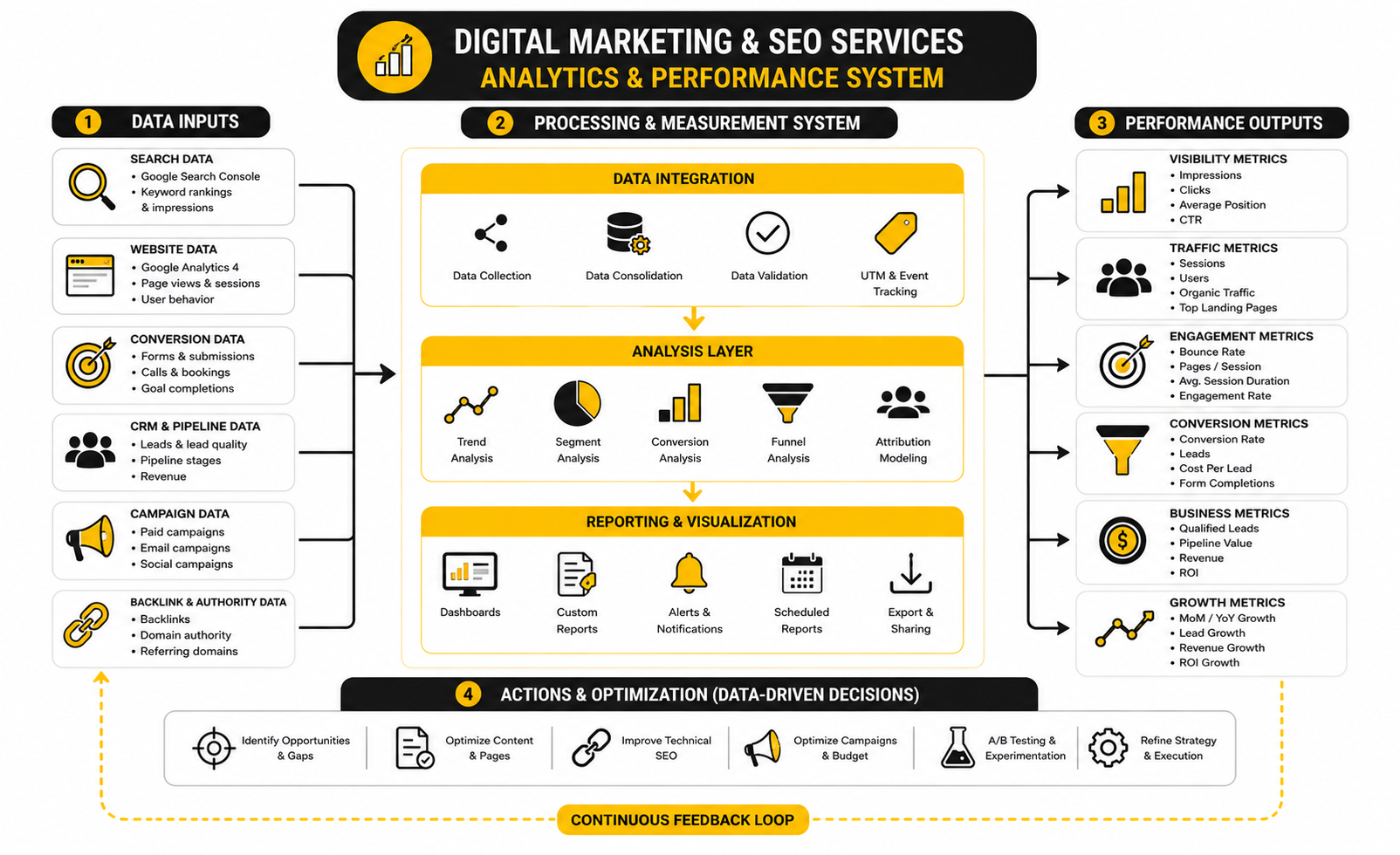
The first layer is visibility. In Google Search Console, clicks, impressions, click-through rate, and average position show how often your pages appear in search, how often people choose them, and which queries are driving discovery. Google’s own Search Console performance documentation makes these metrics useful because they can be filtered by query, page, country, device, and date range.
The second layer is behavior. Once someone lands on the site, analytics should show whether they stayed, explored, clicked, watched, submitted, booked, bought, or left. Google Analytics treats important business actions as key events, which is useful because a visit only matters if it helps move the buyer forward through an action that has business value.
The third layer is business impact. This is where many dashboards get weak. Leads should be connected to source, campaign, page, form, CRM stage, sales outcome, and revenue where possible. Without that connection, marketing teams optimize for what looks good instead of what grows the business.
Why Traffic Alone Is A Weak Goal
Traffic is not useless. It is just incomplete. A business can increase organic sessions and still make no meaningful progress if the traffic comes from the wrong intent, the wrong geography, the wrong audience, or pages with no clear next step.
This matters even more because search behavior is changing. SparkToro’s 2024 zero-click research found that for every 1,000 Google searches in the United States, only 374 clicks went to the open web, while in the European Union the figure was 360 clicks. That does not mean SEO is dead. It means the value of SEO has to be judged by qualified demand, brand visibility, assisted journeys, lead quality, and revenue influence instead of raw visits alone.
This is why a modern measurement model should include more than sessions. Track which pages attract search demand, which queries suggest commercial intent, which visits become leads, and which leads become opportunities. A smaller amount of qualified traffic can be worth far more than a larger amount of low-intent traffic.
Benchmarks Are Useful, But Context Wins
Benchmarks can help you spot problems, but they should not become the strategy. A conversion rate that looks low in one industry may be normal in another. A long buying cycle may be healthy for a high-ticket service, while the same delay could signal friction in a low-cost ecommerce funnel.
The better question is not “are we above average?” The better question is “are we improving the right number for this business model?” For an agency, that might mean consultation requests from qualified companies. For an ecommerce brand, it might mean revenue per visitor, cart completion, returning customer rate, and product page conversion. For a SaaS company, it might mean demo requests, trial activations, product-qualified leads, and expansion revenue.
Digital experience benchmarks still matter because they reveal pressure points. Contentsquare’s 2025 benchmark research reported that rising acquisition costs and poor digital experiences are squeezing performance, with frustrating experiences linked to lower conversion rates. The takeaway is practical: when traffic gets more expensive, the website experience has to work harder.
The Measurement Stack Should Match The Customer Journey
The analytics system should follow the same journey the buyer takes. Someone searches, lands on a page, reads or scans, clicks a call to action, fills out a form, books a meeting, enters a pipeline, receives follow-up, compares options, and eventually buys or disappears. Measurement should show where that journey moves smoothly and where it breaks.
For many businesses, that means combining several data sources instead of expecting one tool to explain everything. Search Console shows search visibility. Analytics shows on-site behavior and key events. A CRM shows lead quality, stage movement, and sales outcomes. Email and automation tools show nurture performance. Call tracking, booking tools, and form tools fill in the gaps that standard analytics often misses.
A practical measurement setup should track:
This is where tools like GoHighLevel can be useful for service businesses because lead capture, pipeline tracking, calendar booking, and automated follow-up can sit closer together. For form-heavy funnels, Fillout can help structure the intake data so leads are easier to qualify. The goal is not just to collect more data; it is to make the next decision clearer.
How To Interpret SEO Performance Signals
SEO data rarely moves in a straight line. Rankings shift, search demand changes, competitors update pages, seasonality affects demand, and Google changes how results appear. That is why interpretation matters more than staring at one metric in isolation.
If impressions are rising while clicks stay flat, the page may be appearing for more queries but not winning the click. That can point to weak titles, vague meta descriptions, poor intent match, or search results where users get the answer without clicking. The action is to inspect the query mix, improve the page angle, and make the search result more compelling without turning it into clickbait.
If clicks are rising but conversions are flat, the issue is probably not visibility. The page may attract informational traffic, the offer may not match the visitor’s intent, or the call to action may be too aggressive for where the visitor is in the journey. The action is to add a more natural next step, improve internal links to commercial pages, and make the page better at qualifying interest.
If conversions are rising but lead quality is weak, the campaign may be attracting the wrong segment. That can happen when content is too broad, pricing is hidden, forms are too easy, or messaging appeals to people who are not a fit. The action is to sharpen the positioning, add qualification questions, clarify who the service is for, and route leads properly.
Reporting Should Drive Decisions, Not Just Updates
A useful report does not simply say what happened. It explains what changed, why it probably changed, what it means, and what should happen next. That is the difference between reporting and decision support.
For digital marketing and seo services, monthly reporting should connect activity to outcomes. If the team updated service pages, the report should show how those pages changed in impressions, clicks, rankings, engagement, conversions, and lead quality. If the team added internal links, the report should show whether important pages gained visibility or better user paths. If the team launched a new lead magnet, the report should show whether it attracted qualified people or just collected low-intent emails.
A strong reporting rhythm usually includes:
This keeps the conversation practical. No one needs a 40-page report full of screenshots if it does not change what the team does next.
Attribution Needs Humility
Attribution is useful, but it is not perfect. Buyers do not move through neat paths, and many important touchpoints are hard to measure. A prospect may read your article, ask a colleague about you, see a LinkedIn post, return through branded search, and book a call from a direct visit.
That does not make analytics useless. It means the data needs to be interpreted with humility. Google’s modern measurement framework encourages using attribution, incrementality, and marketing mix modeling together because no single method explains the full picture on its own.
For most small and mid-sized businesses, the practical version is simpler. Use source and landing page data to understand what creates demand. Use CRM data to see what becomes pipeline. Use tests, holdouts, or controlled changes when possible to understand lift. Then combine the numbers with sales feedback so decisions are not based on dashboards alone.
The Best Data Leads To Better Actions
The purpose of measurement is not to admire the dashboard. It is to make better decisions faster. If a metric does not influence action, it should not dominate the conversation.
When the data shows a page is gaining impressions, improve the snippet and search intent fit. When a page gets traffic but no leads, improve the offer and conversion path. When leads arrive but do not close, improve qualification and follow-up. When a channel assists conversions but rarely gets last-click credit, stop judging it only by last-click revenue.
That is how measurement turns into growth. It gives digital marketing and seo services a feedback loop, and that feedback loop is where compounding happens. Each cycle should make the strategy sharper, the content more useful, the website easier to convert, and the business more confident about where to invest next.
Advanced Strategy: Tradeoffs, Risks, And Scaling Decisions
Once the foundation is working, the conversation changes. The question is no longer “can we get traffic?” The better question is “what kind of growth are we building, and what risks are we accepting to get it?”
This is where digital marketing and seo services become more strategic. Scaling is not just doing more content, more links, more ads, more automation, or more campaigns. Scaling means increasing output without lowering quality, confusing the customer, weakening trust, or making reporting impossible to understand.
The businesses that win here are usually not the ones chasing every new tactic. They are the ones that make clear tradeoffs, protect their brand, and build systems that can survive platform changes, competitor pressure, and shifting buyer behavior.
The Tradeoff Between Speed And Quality
Speed matters. If your team takes six months to publish one service page, competitors will move around you. But speed without quality creates another problem: pages go live before the offer is clear, content repeats what everyone else says, and campaigns generate attention without building trust.
This tradeoff shows up everywhere. AI can help with research, outlines, summaries, repurposing, and workflow speed, but Google’s guidance on helpful, reliable, people-first content still points back to usefulness, originality, expertise, and value for the reader. In practical terms, that means automation can support the work, but it should not replace thinking.
The better approach is to systemize the repeatable parts and protect the judgment-heavy parts. Use templates for briefs, page structures, reporting, internal linking checks, and content refresh workflows. Keep human review on positioning, claims, examples, proof, offer clarity, and anything that affects trust.
The Risk Of Scaling Thin Content
Thin content is not always short content. A long page can still be thin if it does not add anything useful. It can be 3,000 words of vague advice, recycled definitions, keyword stuffing, and generic tips that a buyer has already seen ten times.
This risk grows when businesses scale content too quickly. They build hundreds of pages around slight keyword variations, location combinations, AI-generated summaries, or shallow comparison posts. At first, it can feel productive because the publishing volume looks impressive. Over time, it often creates index bloat, weak engagement, poor conversion, and a brand that sounds like everyone else.
The safer scaling model is to build content around real decision points. Before publishing, ask whether the page helps a real buyer understand something better, choose more confidently, or take the next step. If the answer is no, the page probably should not exist yet.
AI Search Changes The Visibility Game
Search is no longer just a list of blue links. Google’s documentation on AI features in Search makes it clear that AI Overviews and AI Mode are now part of the search experience for site owners to understand. That changes how businesses should think about visibility, because some searches may lead to fewer clicks while still shaping buyer awareness.
This does not mean SEO is dead. That line gets repeated every few years, and it is usually wrong. What changes is the type of content that earns attention. Basic definitions, generic how-to answers, and shallow summaries are easier for AI systems and search features to compress, while original insight, clear experience, strong comparisons, proprietary data, useful tools, and trusted brand signals become more important.
The practical move is to create content that deserves to be referenced, remembered, and acted on. That means sharper opinions, stronger evidence, clearer explanations, better examples, expert input, and pages that help buyers make decisions instead of just answering a surface-level query.
Brand Demand Becomes A Defensive Advantage
A business that depends only on non-branded search is vulnerable. Competitors can copy topics, bid on keywords, publish similar guides, and build alternative pages. Brand demand is harder to copy because it comes from reputation, customer experience, partnerships, social proof, audience building, and repeated exposure.
This is why SEO should not be separated from brand. The goal is not only to rank for “best software for X” or “digital marketing and seo services.” The bigger goal is to make people search for your company, compare others against you, trust your name when it appears, and return directly when they are ready.
Brand demand also improves the performance of other channels. Paid search becomes more efficient when people already recognize the name. Email performs better when subscribers remember why they signed up. Sales calls become easier when prospects have already seen useful content before booking.
When Paid Media Should Support SEO
SEO and paid media should not fight for budget like separate departments. They should inform each other. Paid campaigns can test messaging quickly, while SEO can turn proven messaging into durable assets that keep working over time.
Paid search can help validate commercial intent before you invest heavily in organic pages. If a keyword converts well through ads, it may deserve a serious SEO page, comparison asset, or landing page. If a landing page fails under paid traffic, sending organic traffic there later will not magically fix it.
The reverse is also true. SEO data can reveal queries, objections, and content angles that paid campaigns can use. A blog post that consistently attracts qualified visitors may become a retargeting audience, lead magnet, webinar topic, or email sequence. That is channel integration in the real world.
Automation Should Improve Timing, Not Remove Context
Automation is powerful when it improves timing and consistency. It is dangerous when it removes context. A fast follow-up message is useful when someone requests a consultation. A generic sequence that ignores what the person actually wanted feels lazy.
This is why segmentation matters. Someone who reads a beginner guide should not be treated the same as someone who requests a proposal. Someone who compares pricing pages should not receive the same message as someone who downloaded an educational checklist six months ago.
A platform like GoHighLevel can help service businesses manage pipelines, reminders, and automated follow-up, but the strategy still needs to define what should happen and why. ManyChat can support social messaging flows when conversations start on platforms like Instagram or Facebook, but the messages still need to feel relevant. The tool can send the message; it cannot decide what your buyer needs to hear.
Expert Positioning Beats Generic Service Claims
Most service pages sound the same. They promise more traffic, better rankings, more leads, custom strategy, transparent reporting, and proven results. None of that is wrong, but none of it is enough by itself.
Expert positioning is more specific. It explains who the service is for, what problems it solves best, what tradeoffs it avoids, what process it uses, what it will not do, and how success will be measured. That clarity helps buyers self-qualify before they contact you.
This is especially important for digital marketing and seo services because the market is crowded. If your messaging could be copied onto a competitor’s website without changing much, it is too generic. Strong positioning makes the right buyer feel understood and the wrong buyer realize they are not the fit.
Link Building Needs Judgment
Authority still matters, but link building can become risky when it is treated like a numbers game. A few relevant, credible mentions can be more valuable than a pile of weak links from sites with no real audience. The wrong approach can also damage trust if the business gets associated with spammy placements or irrelevant content.
Good link acquisition usually comes from useful assets, relationships, digital PR, original research, partnerships, expert commentary, and content that deserves citation. It is slower than buying cheap links, but it is much more defensible. The goal is to build authority that makes sense to both search engines and humans.
A practical link strategy should ask:
If the answer is mostly no, the link probably is not worth chasing. Authority should support the brand, not embarrass it.
Scaling Content Operations Without Losing Voice
As content volume grows, voice usually gets weaker. Different writers, tools, editors, and agencies start producing pages that sound slightly disconnected. The site becomes bigger, but the brand becomes less recognizable.
The fix is not micromanaging every sentence. The fix is creating clear editorial standards. Define the audience, tone, claims policy, examples policy, formatting rules, internal linking standards, conversion goals, and review process. Then build briefs that force strategic thinking before writing starts.
A strong content operation should include:
This keeps scale from turning into noise. The site can grow without sounding like it was assembled from disconnected tasks.
When To Expand Into New Channels
New channels are tempting. There is always another platform, tactic, tool, or format that looks like the next big opportunity. But expanding too early can weaken the channels that are already close to working.
The right time to expand is when the current system has a clear foundation. You know which audiences matter, which offers convert, which pages support the journey, which follow-up works, and which metrics define success. Then a new channel becomes an extension of strategy, not a distraction.
For example, short-form social may make sense after the business has strong educational content to repurpose. Webinars may work after the team knows which objections block buyers. A newsletter may perform better after the site has useful guides worth sending. A chatbot may help after the pages already answer the core questions clearly.
The Biggest Risk Is Optimizing The Wrong Thing
The most dangerous mistake is not usually a technical SEO issue. It is optimizing the wrong thing with confidence. A team can improve rankings for keywords that do not produce buyers. They can increase leads that never close. They can automate follow-up that annoys people. They can publish content that grows traffic while weakening the brand.
This is why the strategy has to stay connected to business outcomes. Every major decision should come back to the same questions: who are we trying to reach, what do they need to believe, what action should they take, and how will we know if it worked? If those answers are unclear, more execution will not save the campaign.
Advanced digital marketing is not about making everything more complex. It is about knowing what to ignore, what to protect, what to measure, and where to push harder. That is the level where digital marketing and seo services stop being a checklist and become a serious growth function.
Bringing The System Together
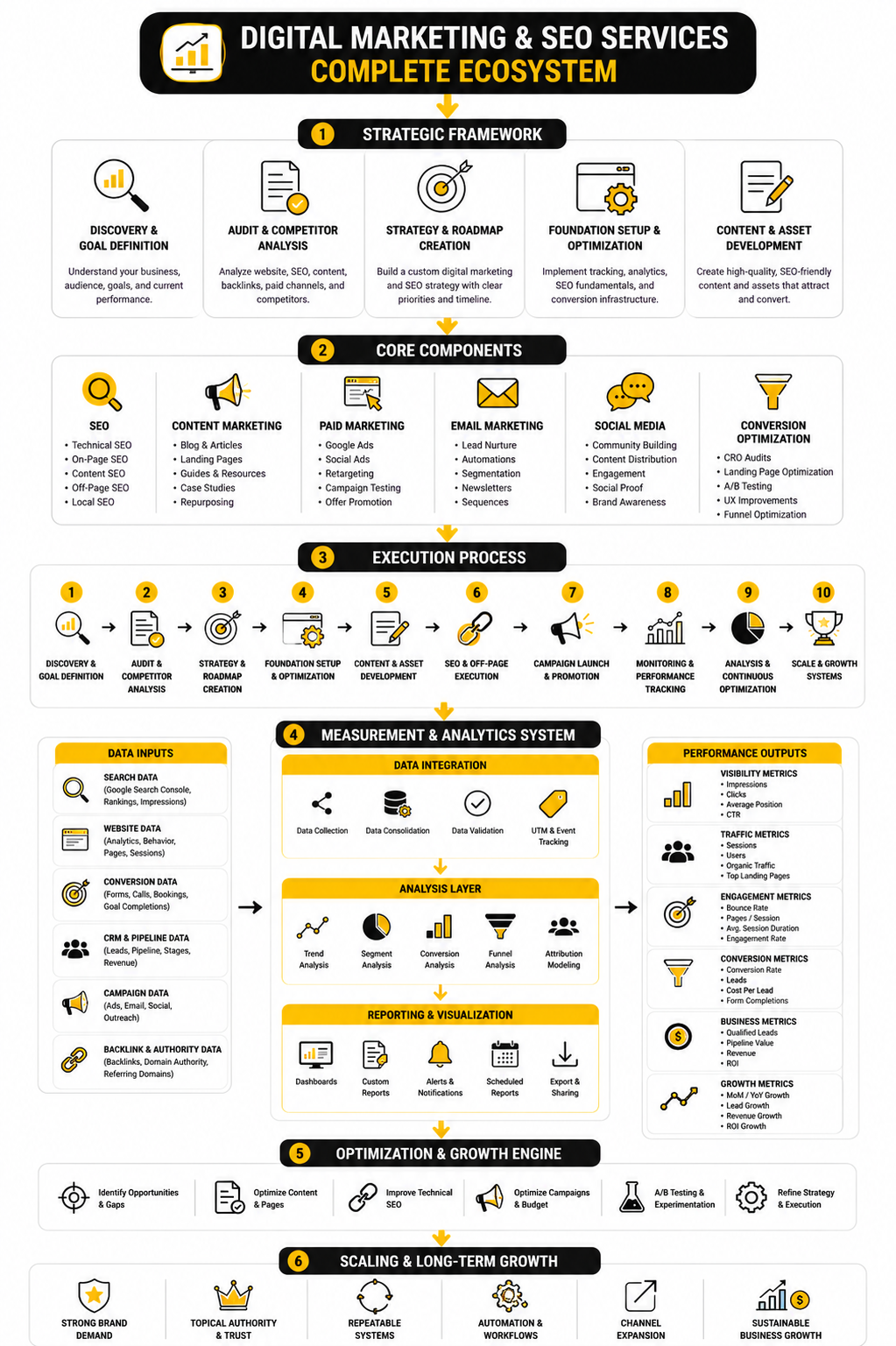
At this stage, digital marketing and seo services should no longer feel like separate deliverables. The pieces should connect into one operating system: research, positioning, content, technical SEO, landing pages, follow-up, analytics, optimization, and sales feedback. When those pieces work together, growth becomes easier to understand and easier to improve.
The final system is simple in concept. Search and content create discovery. Pages and offers create trust. Forms, calls, booking flows, chat, and email capture demand. CRM and automation keep the relationship moving. Measurement shows what is working, what is leaking, and what deserves the next investment.
That is the real advantage. Not more dashboards. Not more software. Not more random publishing. A better system gives every marketing action a job and every serious buyer a clearer path forward.
What Are Digital Marketing And SEO Services?
Digital marketing and SEO services help businesses attract, engage, convert, and retain customers through online channels. SEO focuses on improving visibility in search engines, while digital marketing also includes content, email, paid media, social media, landing pages, automation, analytics, and conversion strategy. The best results come when SEO is connected to the rest of the marketing system instead of being treated as a standalone task.
Why Do Businesses Need SEO If They Already Run Ads?
Ads can create fast visibility, but they stop when the budget stops. SEO builds assets that can continue attracting qualified visitors over time, especially when the content targets real buyer questions and commercial intent. A strong business often uses both: ads for speed and testing, SEO for compounding visibility and long-term trust.
How Long Do Digital Marketing And SEO Services Take To Work?
SEO usually takes time because search engines need to crawl, index, evaluate, and compare your pages against competitors. Some improvements, like fixing conversion paths or updating pages that already get traffic, can create faster movement. New content and authority-building work usually need months of consistent execution before the impact becomes clear.
What Should A Professional SEO Audit Include?
A professional SEO audit should review technical foundations, indexation, site structure, content quality, keyword intent, internal links, page speed, competitors, backlinks, conversion paths, and analytics setup. It should also explain which issues matter most instead of listing every minor warning from a tool. The output should be a prioritized action plan, not a confusing spreadsheet of problems.
How Do I Know If My SEO Traffic Is Valuable?
Valuable SEO traffic comes from the right audience, the right search intent, and pages that support a meaningful next step. Look at which queries and landing pages bring visitors, then connect that data to leads, bookings, purchases, pipeline, and revenue where possible. If traffic grows but qualified leads do not, the strategy probably needs sharper intent targeting or better conversion paths.
What Is The Difference Between Content Marketing And SEO?
SEO helps content become discoverable through search engines. Content marketing is broader because it includes the creation and distribution of useful material across search, email, social media, sales enablement, webinars, communities, and other channels. Strong content marketing can support SEO, but SEO also needs technical structure, internal linking, search intent mapping, and measurement.
Should Every Business Publish Blog Posts?
No. Blog posts are useful when they answer real buyer questions, support topical authority, and create paths toward conversion. But some businesses need better service pages, local pages, product pages, comparison pages, case studies, or landing pages before they need more blog content. Publishing without a strategy usually creates noise, not growth.
What Tools Are Needed For Digital Marketing And SEO Services?
Most businesses need tools for search data, analytics, content planning, website management, forms, CRM, email, scheduling, and reporting. The exact stack depends on the business model. A service business may prioritize CRM and follow-up tools like GoHighLevel, while an ecommerce team may care more about landing page testing with tools like Replo.
How Important Is Automation In Digital Marketing?
Automation is important when it improves timing, consistency, and follow-up. It can help with confirmations, reminders, nurture sequences, lead routing, abandoned form recovery, and customer communication. It becomes a problem when it sends generic messages that ignore context, intent, or where the buyer is in the journey.
Can AI Replace SEO Specialists Or Marketing Teams?
AI can speed up research, ideation, drafting, repurposing, analysis, and workflow automation. It should not replace strategy, judgment, customer insight, claim verification, positioning, or editorial review. Google’s guidance on helpful, reliable, people-first content still rewards content created to help people, so human quality control matters more as AI content becomes easier to produce.
How Do AI Overviews And AI Search Affect SEO?
AI features in search can change how users discover information and may reduce clicks for some simple queries. Google’s documentation on AI features in Search makes this part of the modern search environment, not a side issue. Businesses should respond by creating content with original insight, clear expertise, useful comparisons, strong brand signals, and pages that help people make decisions beyond basic definitions.
What Metrics Should I Track First?
Start with metrics that connect visibility to business outcomes. Track search impressions, clicks, ranking trends, organic landing pages, key events, conversion rates, lead source, lead quality, pipeline movement, and revenue where possible. Google Search Console’s performance report is useful for understanding search visibility, but it should be paired with analytics and CRM data to understand what traffic actually does.
What Is A Good SEO Conversion Rate?
There is no universal good SEO conversion rate because intent, industry, offer, price, market, device, and buying cycle all change the number. A high-ticket B2B service may convert fewer visitors but produce more revenue per lead. A low-cost ecommerce product may need a higher conversion rate and more volume to make the economics work.
How Often Should SEO Content Be Updated?
Important pages should be reviewed regularly, especially if they influence leads, sales, or core rankings. Updates may be needed when search intent shifts, competitors improve their pages, products change, pricing changes, data becomes outdated, or conversion performance drops. The most valuable refreshes usually improve accuracy, clarity, internal links, proof, calls to action, and alignment with buyer intent.
Are Backlinks Still Important?
Backlinks can still support authority, but quality matters more than raw quantity. Relevant mentions from credible sites are far more useful than low-quality placements from sites with no real audience. A good link strategy should strengthen trust and visibility at the same time, not create a footprint that looks artificial or embarrassing.
Should Small Businesses Hire An Agency Or Build In-House?
Small businesses should decide based on skill gaps, budget, speed, and complexity. An agency can bring process, tools, and experience quickly, but the business still needs internal clarity on the offer, audience, and sales process. In-house teams can build deep brand knowledge, but they may need outside specialists for technical SEO, analytics, content strategy, paid media, or automation.
What Makes Digital Marketing And SEO Services Worth Paying For?
They are worth paying for when they improve business outcomes, not just activity levels. A good provider should help clarify strategy, prioritize the highest-impact work, improve visibility, strengthen conversion paths, build useful assets, and connect marketing data to leads or revenue. If the work cannot be tied to a reasonable business goal, it needs a sharper plan.
What Is The Biggest Mistake Businesses Make With SEO?
The biggest mistake is treating SEO like a publishing checklist. More content does not automatically mean more growth. SEO works best when keyword research, search intent, technical structure, page quality, authority, conversion strategy, and follow-up all support one clear business objective.
How Should A Business Start If Everything Feels Messy?
Start with diagnosis. Review the website, analytics, search visibility, most important pages, current lead sources, conversion paths, and follow-up process. Then fix the highest-impact bottleneck first instead of trying to rebuild everything at once.
What Is The Final Goal Of Digital Marketing And SEO Services?
The final goal is not just traffic, rankings, followers, or leads. The goal is a reliable growth system that helps the right people find you, trust you, contact you, buy from you, and come back when they need more help. When that system improves over time, marketing becomes an asset instead of a monthly expense.
Build a stronger local presence with BAAM AI
Turn your website, Google profile, social channels, and AI visibility into one growth engine
Most businesses do not need more random marketing activity. They need a consistent presence system that helps the right people find them, trust them, and take action. BAAM AI brings strategy, local SEO, website updates, Google Maps visibility, social content, AI-search readiness, media production, and reporting into one practical monthly engine.
If you want your marketing to keep working after the campaign ends, start with a free BAAM AI presence audit. See how your business shows up today and where the fastest visibility wins are at BAAM AI.