
BAAM AI Blog
Digital Marketing And E Commerce: A Practical Growth Framework For Modern Online Brands
Digital marketing & e commerce used to feel like two separate jobs. One team drove traffic, another managed the store, and everyone hoped the numbers worked out at the end of the month. That setup does not hold up...
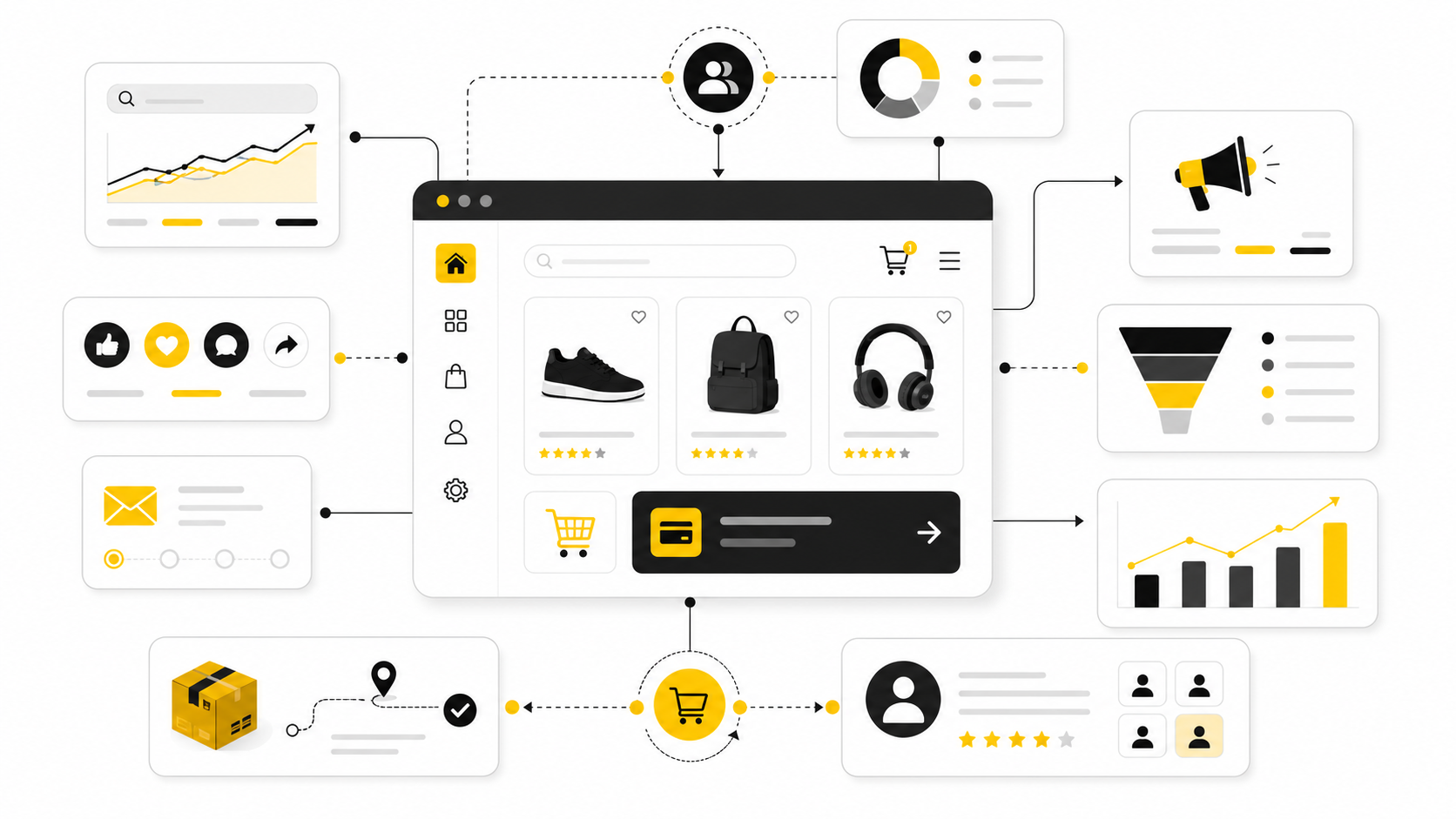
Digital marketing & e commerce used to feel like two separate jobs. One team drove traffic, another managed the store, and everyone hoped the numbers worked out at the end of the month. That setup does not hold up anymore because customers move too quickly, channels overlap too much, and buying decisions often happen long before someone reaches a product page.
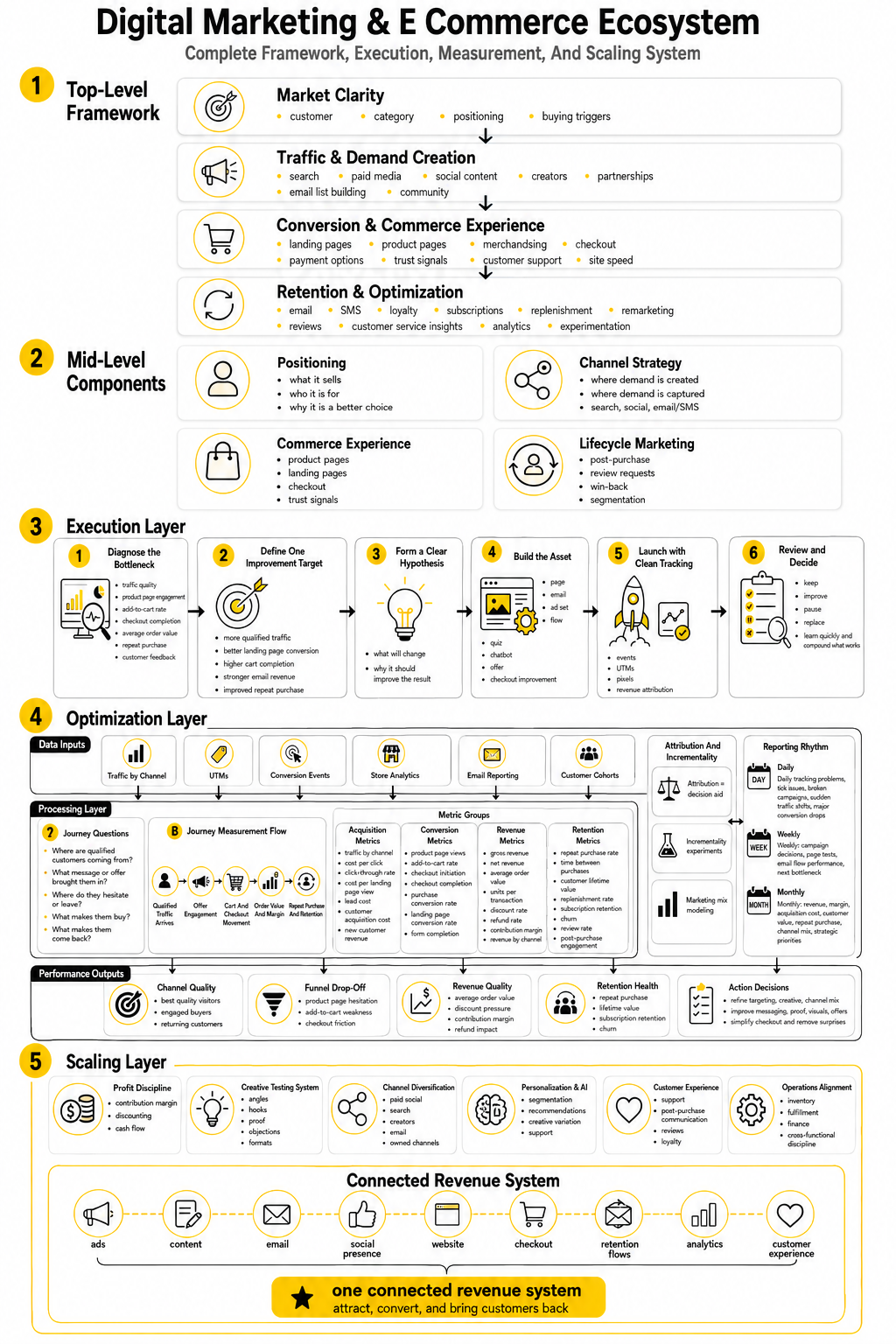
The better way to think about digital marketing & e commerce is as one connected revenue system. Your ads, content, email, social presence, website, checkout, retention flows, analytics, and customer experience all shape the same outcome: whether a person trusts you enough to buy, come back, and recommend you. When those pieces work together, growth becomes more predictable. When they do not, even a strong product can feel invisible.
this guide breaks the topic into a practical six-part structure. We will start with the big picture, then move into the framework, core components, implementation, measurement, and the long-term operating model. The goal is not to chase every trend. The goal is to understand what actually matters, build the right foundation, and make better decisions with less guesswork.
Why Digital Marketing And E Commerce Now Work As One System
Digital marketing & e commerce matter because online buying is no longer limited to the store itself. A customer may discover a product through a short video, compare reviews on search, join an email list for a discount, ask a chatbot a product question, abandon checkout, return through a retargeting ad, and finally buy after seeing a creator mention the brand. That is not a clean funnel. It is a messy journey, and brands need a system that can handle that reality.
The size of the opportunity is obvious, but so is the pressure. U.S. retail e-commerce sales reached $1.2337 trillion in 2025, with e-commerce accounting for 16.4% of total retail sales, based on the latest U.S. Census Bureau retail e-commerce report. That does not mean every brand automatically wins online. It means the market is large, competitive, and increasingly unforgiving toward weak positioning, slow websites, generic messaging, and disconnected follow-up.
The biggest shift is that marketing can no longer stop at attention. Clicks are not revenue. Impressions are not loyalty. A serious digital marketing & e commerce strategy has to connect demand generation with conversion, retention, customer data, and operational follow-through. That is where many businesses get stuck: they run campaigns, but they do not build the system behind the campaigns.
What Makes This Different From Traditional Online Marketing
Traditional online marketing often focuses on isolated activities. Run ads. Post content. Send emails. Improve SEO. Each activity can be useful, but none of them are enough alone. E-commerce growth comes from how those activities work together around the customer journey.
For example, paid traffic without a strong landing page usually gets expensive fast. Email marketing without segmentation becomes background noise. Social content without a product path may build awareness but fail to create sales. A beautiful store without a clear acquisition strategy simply waits for customers who may never arrive.
Modern digital marketing & e commerce require a connected approach. The brand message has to match the offer. The offer has to match the landing page. The landing page has to match the checkout experience. The checkout experience has to connect to post-purchase communication, support, loyalty, and repeat buying. That chain is where profit is either created or lost.
The Main Business Problem this guide Solves
Most online brands do not fail because they lack tactics. They fail because they collect tactics without a structure. One week they are testing TikTok ads, the next week they are rebuilding email flows, then they are changing product pages, then they are chasing AI tools, and none of it compounds because there is no clear operating framework.
this guide treats digital marketing & e commerce as a revenue architecture. That means every activity should have a role. Some activities create demand, some capture demand, some convert demand, some increase order value, and some bring customers back. Once you see the system this way, decisions become much easier.
The practical question becomes simple: where is the weakest part of the system right now? If people do not know you exist, the problem is visibility. If people visit but do not buy, the problem may be offer clarity, trust, product-market fit, page quality, pricing, or checkout friction. If people buy once and never return, the problem is retention, customer experience, product satisfaction, or lifecycle marketing.
Framework Overview
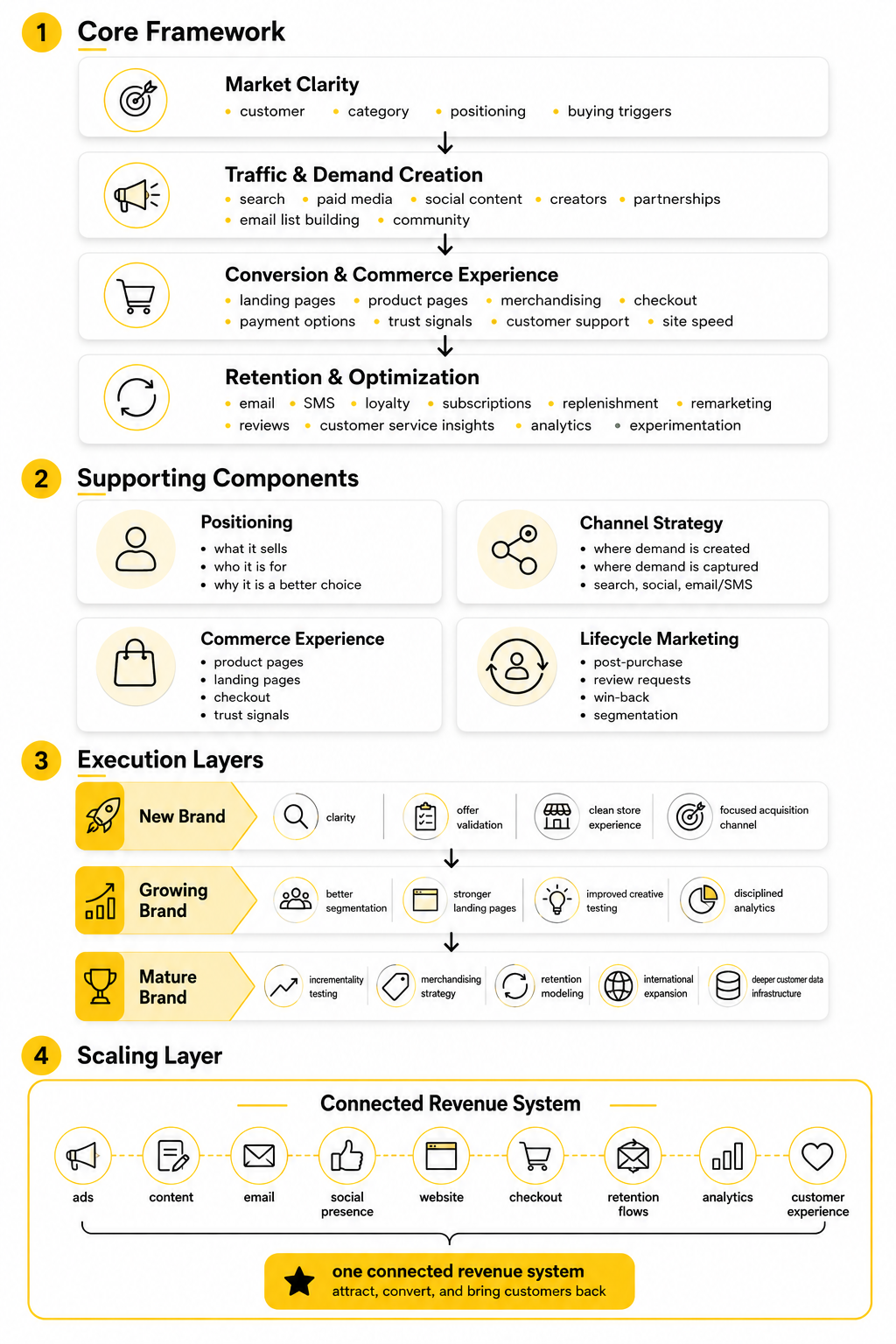
A strong digital marketing & e commerce framework has four layers. The first layer is market clarity, which defines the customer, category, positioning, and buying triggers. Without this layer, campaigns become vague because the brand does not know exactly who it is speaking to or why that person should care now.
The second layer is traffic and demand creation. This includes search, paid media, social content, creators, partnerships, email list building, community, and other channels that bring the right people into the brand ecosystem. The key phrase is “right people.” More traffic is not useful if it attracts visitors who do not understand the offer, cannot afford it, or have no buying intent.
The third layer is conversion and commerce experience. This includes landing pages, product pages, merchandising, checkout, payment options, trust signals, customer support, and site speed. Research from Salesforce’s State of Commerce shows how commerce teams are increasingly focused on AI, data, and customer experience because the store is no longer just a transaction point. It is a decision environment.
The fourth layer is retention and optimization. This includes email, SMS, loyalty, subscriptions, replenishment, remarketing, reviews, customer service insights, analytics, and experimentation. This layer is where profitable brands separate themselves from brands that constantly need fresh traffic to survive. Acquisition gets the customer in the door, but retention determines whether the business can scale sustainably.
Core Components Of A Digital Marketing And E Commerce System
The first core component is positioning. A brand needs to make it immediately clear what it sells, who it is for, and why it is a better choice than the alternatives. This sounds basic, but it is often the missing piece behind poor conversion rates. People do not buy when they are confused, even if the product is good.
The second component is channel strategy. A brand does not need to be everywhere, but it does need to understand where demand is created and where demand is captured. Search is often strong for existing intent. Social is often strong for discovery and education. Email and SMS are strong for nurturing, recovery, and repeat purchases. Tools such as ManyChat can fit naturally when a brand uses messaging automation for social commerce conversations, lead capture, and follow-up.
The third component is the commerce experience itself. Product pages need clear benefits, strong visuals, useful details, reviews, shipping information, and risk reducers. Landing pages need message match and a focused path to action. Platforms and page builders such as Replo can be useful when teams need to build higher-converting Shopify pages without waiting on a full development cycle.
The fourth component is lifecycle marketing. This is where email, SMS, post-purchase education, review requests, win-back campaigns, and customer segmentation become important. A buyer should not disappear into a generic newsletter list after purchase. They should enter a thoughtful customer journey that helps them get value, trust the brand more, and return when the timing is right.
Professional Implementation Starts With Sequence
Professional implementation is not about doing everything at once. That is how teams burn budget and confuse themselves. The more carefully approach is to fix the highest-leverage bottleneck first, then build outward.
A new e-commerce brand usually needs clarity, offer validation, a clean store experience, and a focused acquisition channel before it needs advanced automation. A growing brand may need better segmentation, stronger landing pages, improved creative testing, and more disciplined analytics. A mature brand may need incrementality testing, merchandising strategy, retention modeling, international expansion, or deeper customer data infrastructure.
This sequence matters because tools cannot compensate for a weak strategy. A funnel builder such as ClickFunnels, an all-in-one platform like GoHighLevel, or an email platform like Brevo can help, but only when the business knows what journey it is trying to create. The tool is not the strategy. The tool should make the strategy easier to execute.
The rest of this guide will stay practical. We will not treat digital marketing & e commerce as a pile of hacks, and we will not pretend that one channel solves everything. The real advantage comes from building a system that attracts the right people, helps them make confident buying decisions, and gives them a reason to come back.
This matters even more as AI changes how people discover, compare, and buy products. McKinsey’s work on personalized marketing and generative AI points toward a future where relevance, speed, and better customer data become more important, not less. But the foundation is still human: understand the buyer, make the offer clear, remove friction, and follow up intelligently.
Part 2 will turn this into a usable framework. We will map the customer journey, define the role of each channel, and show how digital marketing & e commerce connect from first touch to repeat purchase.
The Digital Marketing And E Commerce Framework
The framework starts with a simple idea: every online business needs a clear path from attention to revenue. That path does not need to be complicated, but it does need to be intentional. Digital marketing & e commerce work best when every channel, page, offer, and follow-up sequence has a specific job inside the customer journey.
A useful framework has five connected stages: market clarity, demand creation, conversion, retention, and optimization. These stages are not separate departments. They are parts of the same growth engine, and a weakness in one stage usually creates problems in the next one.
The mistake many brands make is starting in the middle. They launch ads before the offer is clear, rebuild the store before understanding the customer, or automate email before they know what message actually converts. The framework prevents that by putting strategy before activity.
Stage One: Market Clarity
Market clarity means knowing exactly who the business is selling to, what problem the product solves, and why the customer should choose it now. This is the foundation because every later decision depends on it. If this part is vague, the brand will spend too much money trying to convince the wrong people.
Good market clarity answers practical questions. Who is the customer? What are they already comparing? What objections stop them from buying? What emotional or practical outcome do they want after the purchase? These answers shape messaging, creative direction, landing pages, product bundles, pricing, and retention offers.
This stage also forces the brand to define its category position. A product can be premium, affordable, specialized, convenient, sustainable, performance-focused, design-led, or community-driven, but it cannot credibly be everything at once. Strong positioning makes digital marketing & e commerce easier because the customer understands the promise faster.
What To Define Before Running Campaigns
Before investing heavily in traffic, the brand should define the customer segment, primary offer, buying trigger, main objection, and proof points. These are not branding exercises for a slide deck. They directly affect conversion and profitability.
A customer segment should be specific enough to guide decisions. “Women aged 25 to 45” is not enough because it does not reveal intent, context, budget, or motivation. A better segment describes the situation the customer is in, the problem they are trying to solve, and what would make them trust the brand.
The primary offer should also be clear. The offer is not just the product. It includes the product, price, bundle, guarantee, delivery promise, bonus, financing option, trial, subscription logic, or any other reason the customer feels confident taking action today.
Stage Two: Demand Creation
Demand creation is the part most people think of when they hear digital marketing. It includes content, paid ads, search, social media, creators, partnerships, communities, and lead generation. The goal is not simply to get traffic. The goal is to create qualified attention from people who are likely to care about the product.
Different channels create different types of demand. Search usually captures people who already know what they want. Social content often creates interest before the customer is actively searching. Email and messaging help turn light interest into stronger intent over time.
This is why channel strategy matters. A brand selling a problem-aware product may do well with search and comparison content. A brand selling a visual or emotional product may need short-form video, creator content, and social proof. A brand with a longer buying cycle may need lead magnets, nurture emails, webinars, quizzes, or consultative follow-up.
Demand Creation Should Match Buying Intent
Not all traffic has the same value. Someone searching for a specific product type is usually closer to buying than someone casually watching a lifestyle video. That does not make one channel better than the other. It means the message and next step should match the customer’s level of intent.
Low-intent audiences usually need education, proof, and a reason to stay connected. Medium-intent audiences need comparison, use cases, and objection handling. High-intent audiences need clear offers, fast answers, trust signals, and a smooth path to checkout.
This is where many campaigns break. They treat every visitor as if they are ready to buy immediately. A better approach is to give each audience the next logical step, whether that is reading a guide, taking a quiz, joining a list, viewing a product page, booking a demo, or completing checkout.
Stage Three: Conversion
Conversion is where attention becomes action. In e commerce, that action may be a purchase, add-to-cart, email signup, quiz completion, consultation request, or subscription start. The key is to define the conversion that matters at each stage instead of obsessing over only the final purchase.
A strong conversion experience reduces confusion. The page should make the offer obvious, answer the customer’s main questions, show proof, explain the product clearly, and remove unnecessary friction. Design matters, but clarity matters more.
Conversion also depends on message match. If an ad promises one thing and the landing page leads with something else, the customer feels a disconnect. If social content creates excitement but the product page feels generic, the momentum disappears. The customer journey should feel like one continuous conversation.
Product Pages Need More Than Product Details
A product page is not just a catalog entry. It is a sales page, trust builder, comparison tool, and decision assistant all at once. The customer is silently asking whether the product fits their need, whether the brand is credible, whether the price feels fair, and whether there is any risk in buying.
Strong product pages usually include clear benefit-led copy, strong visuals, specific product information, customer reviews, delivery details, return information, and simple calls to action. They also handle objections before the customer has to search for answers. If the shopper has to work too hard, the page is leaking revenue.
For brands that rely on custom landing pages, tools like Replo can help teams build and test pages faster without turning every campaign into a development project. The bigger point is not the tool itself. The point is that conversion assets should be flexible enough to support new offers, campaigns, and customer segments.
Stage Four: Retention
Retention begins immediately after the first conversion. A customer who buys once is not automatically loyal. They need a good delivery experience, clear communication, helpful onboarding, useful education, and a reason to buy again.
This is where many e-commerce brands leave money on the table. They put most of their energy into acquisition and treat post-purchase communication as an afterthought. That creates a treadmill where the business constantly needs new customers just to maintain revenue.
Retention includes email, SMS, loyalty programs, subscriptions, replenishment reminders, product education, review requests, customer support, and win-back campaigns. The goal is not to spam customers until they unsubscribe. The goal is to make the relationship more useful after the purchase.
Lifecycle Marketing Turns Buyers Into Repeat Customers
Lifecycle marketing means sending the right message based on where the customer is in the relationship. A first-time buyer should not receive the same message as a loyal repeat customer. A cart abandoner should not receive the same message as someone who just left a five-star review.
This is where segmentation becomes practical. Customers can be grouped by purchase history, product interest, engagement level, average order value, time since last purchase, or likely next need. The more relevant the message, the less the brand has to rely on discounts.
Email and automation platforms such as Brevo or Moosend can support this stage when the business has a clear lifecycle strategy. The tool should help deliver better timing and relevance. It should not become a place where generic promotions are blasted to everyone.
Stage Five: Optimization
Optimization is the discipline of improving the system based on evidence. It includes analytics, testing, customer feedback, campaign reviews, merchandising insights, and financial measurement. Without optimization, the business guesses too much and learns too slowly.
The important part is knowing what to optimize first. A brand with weak traffic quality should not obsess over button colors. A brand with strong product-page engagement but weak checkout completion should look at payment options, shipping costs, checkout friction, and trust. A brand with healthy first purchases but poor repeat revenue should focus on customer experience and lifecycle marketing.
Optimization should also connect marketing metrics to business metrics. Click-through rate, cost per click, and open rate can be useful, but they do not tell the full story. The real questions are whether the brand is acquiring profitable customers, increasing lifetime value, improving contribution margin, and building a stronger customer base over time.
The Framework Works Best As A Loop
The five stages do not run once and stop. They form a loop. Customer data improves market clarity, market clarity improves demand creation, better demand improves conversion, stronger conversion creates more customers, and retention data feeds the next round of optimization.
This loop is what makes digital marketing & e commerce more predictable. Instead of chasing isolated tactics, the business learns from the full journey. Every campaign becomes a source of insight, not just a source of traffic.
The best teams keep this loop simple. They review what changed, what improved, what got worse, and what should be tested next. That rhythm creates steady progress without turning growth into chaos.
How To Use The Framework In Practice
Start by diagnosing the current bottleneck. If people are not visiting the store, the issue is likely demand creation. If people visit but leave quickly, the issue may be traffic quality, page clarity, product-market fit, or load experience. If people add to cart but do not buy, the issue may be checkout friction, shipping cost, payment options, trust, or urgency.
Once the bottleneck is clear, choose one primary improvement project. Do not try to fix every stage at the same time. A focused improvement usually beats ten scattered changes because it is easier to measure, easier to execute, and easier to learn from.
This is also where all-in-one systems can make sense for certain businesses. A service-based commerce brand, agency, local business, or high-ticket funnel may prefer a platform like GoHighLevel because CRM, funnels, automation, appointments, and follow-up can live in one place. A product-led Shopify brand may choose a different stack, but the principle stays the same: the technology should support the framework, not replace it.
The Customer Journey Is The Real Strategy
The strongest digital marketing & e commerce strategies are built around the customer journey, not around internal channel preferences. Customers do not care whether a message came from the paid media team, email team, social team, or web team. They only feel whether the experience makes sense.
That means the brand has to think from the customer’s point of view. What do they see first? What do they believe after that? What question comes next? What proof do they need? What might stop them? What would make buying feel safe and obvious?
When the journey is clear, the business becomes easier to manage. Campaigns have a purpose, pages have a role, emails have timing, and analytics have context. That is when digital marketing & e commerce stop feeling like random tasks and start working like a real growth system.
Core Growth Components That Drive Online Revenue
Once the framework is clear, the next job is execution. This is where digital marketing & e commerce become practical: not theory, not vague strategy, but the actual process of moving a customer from first contact to purchase and then into a stronger relationship with the brand. The business needs a repeatable way to build campaigns, improve pages, follow up with buyers, and learn from the numbers.
The core components are not random tasks. They work like connected parts of the same machine. If one part is weak, the others have to work harder, and that usually means higher acquisition costs, lower conversion rates, weaker retention, or slower growth.
The right implementation process keeps the team focused. It prevents the common trap of changing ads, emails, pages, offers, and pricing all at once without knowing what actually moved the result. In digital marketing & e commerce, speed matters, but disciplined speed matters more.
Component One: Offer Architecture
Offer architecture is the way the product, price, promise, incentive, and buying path are packaged together. It is not just “what do we sell?” It is “why should the customer choose this offer today instead of waiting, comparing, or leaving?”
A strong offer gives the customer a clear reason to act. That reason might be convenience, savings, speed, exclusivity, better quality, personalization, risk reversal, a bundle, a subscription advantage, or a specific outcome. The offer should make sense for the customer’s buying stage instead of forcing the same message on everyone.
This matters because traffic rarely fixes a weak offer. More visitors may expose the problem faster, but they will not magically make the promise more compelling. Before scaling campaigns, the brand should make sure the offer is easy to understand, easy to believe, and easy to buy.
How To Shape The Offer
Start with the customer’s main job-to-be-done. What are they trying to solve, improve, avoid, replace, or feel? The answer should shape the product page headline, ad angle, landing page structure, email sequence, and post-purchase education.
Next, define the risk reducer. Customers worry about wasting money, choosing the wrong size, waiting too long for delivery, dealing with bad support, or regretting the purchase. Clear returns, reviews, guarantees, comparison information, support access, and transparent shipping details can reduce that anxiety.
Finally, decide whether the offer needs a direct purchase path or a warmer step first. Some products can go straight to checkout. Others need a quiz, guide, consultation, demo, sample, or email sequence before the customer is ready. The right path depends on price, complexity, urgency, and trust.
Component Two: Traffic System
The traffic system is how the brand brings qualified people into the journey. This includes paid search, paid social, organic search, creator partnerships, organic social, referral programs, marketplaces, affiliates, email capture, and community channels. The goal is not to collect channels. The goal is to build a reliable mix of traffic sources that match how customers discover and evaluate the product.
A useful traffic system separates discovery from intent. Discovery channels introduce the brand to people who may not know they need the product yet. Intent channels capture people already looking for a solution. Both can work, but they require different creative, different landing pages, and different measurement expectations.
For example, a social campaign may need education and proof before asking for a sale. A search campaign may need a direct comparison page or product page because the buyer is already problem-aware. Treating these visitors the same is lazy implementation, and it usually shows up in the numbers.
Channel Roles Should Be Clear
Every channel should have a defined job. Paid social may test angles and create demand. Search may capture high-intent buyers. Email may recover abandoned carts and increase repeat purchases. Organic content may build trust and reduce reliance on ads.
This does not mean every business needs every channel. A small team should usually focus on one or two acquisition channels, one owned audience channel, and one conversion improvement process before expanding. Complexity feels exciting, but focus is what makes the machine measurable.
For social publishing and planning, a tool like Buffer can fit when the team needs a simple way to keep content consistent across channels. Consistency alone is not strategy, but inconsistency makes learning harder because the business never gathers enough signal from the market.
Component Three: Landing Pages And Store Experience
The store experience is where the customer decides whether the brand feels credible. A visitor can arrive with interest and still leave if the page is slow, unclear, generic, or full of unanswered questions. This is why implementation has to connect campaigns directly to the pages receiving the traffic.
A landing page should continue the conversation started by the ad, email, search result, or social post. If the campaign talks about a specific use case, the page should lead with that use case. If the campaign targets a comparison shopper, the page should make the comparison easier. If the campaign targets a first-time buyer, the page should build trust before pushing too hard for checkout.
Checkout matters just as much. The average documented cart abandonment rate sits around 70% in Baymard’s long-running cart abandonment research. That number should make every e-commerce team pay attention because cart abandonment is not just a “checkout problem.” It is often the result of unclear costs, weak trust, poor delivery expectations, limited payment options, or friction that appears too late in the journey.
What A Strong Page Must Do
A strong page answers the customer’s silent questions. What is this? Is it for me? Why should I trust it? What makes it different? What happens after I buy? What if it does not work for me?
The page should also guide attention. Strong visuals, clear hierarchy, benefit-led copy, proof, product details, and a visible next step help the customer move without feeling pushed. When a page tries to say everything at once, the important points disappear.
For Shopify brands that need fast landing page testing, Replo can be useful because campaign-specific pages can be created without slowing everything down through development queues. The bigger principle is speed of learning. The faster a team can test a page idea responsibly, the faster it can find what converts.
A Practical Execution Process
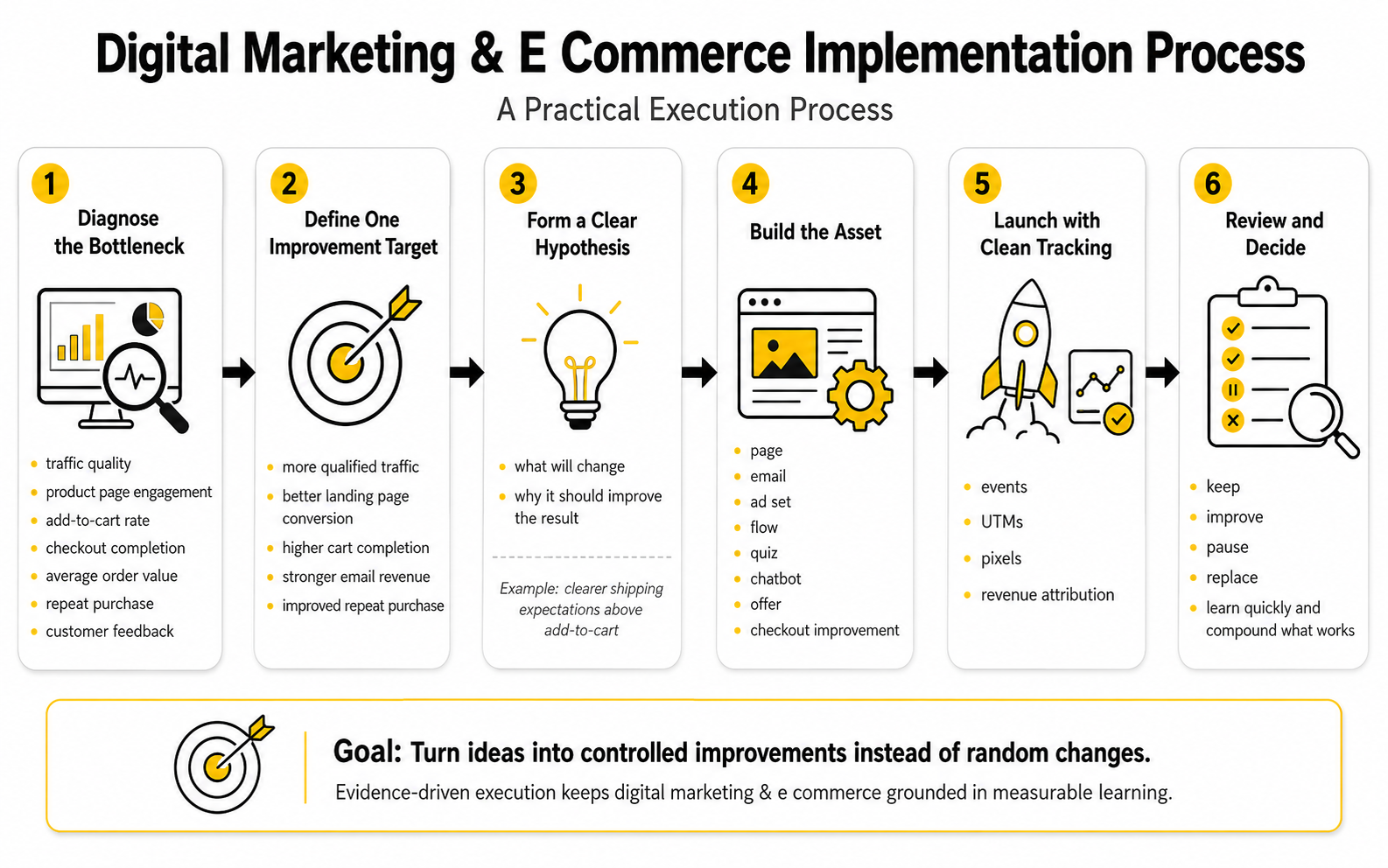
Implementation works best when it follows a repeatable process. This process does not need to be fancy, but it does need to be consistent. The goal is to turn ideas into controlled improvements instead of random changes.
This process keeps digital marketing & e commerce grounded in evidence. It also makes teamwork easier because everyone understands what is being tested, why it matters, and what decision will be made afterward. That kind of clarity is underrated.
Component Four: Messaging And Creative
Messaging is the bridge between the customer’s problem and the brand’s offer. Creative is how that message shows up in ads, videos, emails, landing pages, product images, and social content. Together, they determine whether the right person stops, pays attention, and believes the next step is worth taking.
Good creative is not just attractive. It is specific. It shows the product in context, explains the benefit quickly, handles an objection, demonstrates proof, or makes the customer feel understood. Pretty content that does not move the buyer closer to action is usually just decoration.
The best implementation teams treat messaging as a testing system. They test angles, hooks, proof points, objections, formats, and calls to action. Over time, the market tells them which messages create curiosity, which messages create clicks, and which messages actually create buyers.
Build Creative Around Buyer Awareness
A cold audience usually needs a stronger hook and more context. They may not know the product category, the problem, or the brand. The creative has to earn attention before it can ask for action.
A warm audience needs a different approach. They may have visited the site, watched content, joined the list, or added to cart. At that point, the creative can focus more on proof, urgency, comparison, use cases, reviews, or answering objections.
A customer audience needs something else again. They already know the brand, so the message can focus on replenishment, complementary products, loyalty, education, or early access. Treating these three audiences the same creates wasted impressions and weaker results.
Component Five: Automation And Follow-Up
Automation is where many brands either underuse the opportunity or overcomplicate it. The goal is not to build the most complex workflow possible. The goal is to follow up at the right moment with a message that makes sense based on customer behavior.
Core automation usually starts with welcome flows, abandoned cart flows, browse abandonment, post-purchase sequences, review requests, replenishment reminders, win-back campaigns, and customer segmentation. These flows should not feel robotic. They should feel like useful communication from a brand that understands what just happened.
Email and SMS automation can become a serious revenue layer when it is based on behavior rather than generic blasting. Omnisend’s 2025 reporting found that automated messages represented only a small share of sends but produced a disproportionate share of email-attributed revenue in its ecommerce marketing report. That is the point of automation: not more noise, but better timing.
Messaging Automation Should Support The Journey
For social commerce, messaging automation can help turn comments, DMs, and campaign engagement into measurable follow-up. A tool like ManyChat can be useful when a brand wants to capture leads from social interactions, answer common questions, or guide people toward a product, quiz, or offer. It works best when the flow is helpful, not when it feels like a trap.
For service-led, high-ticket, or appointment-driven commerce, follow-up may need a CRM, booking system, pipeline, and sales automation. In that situation, GoHighLevel can fit because the journey may include forms, calendars, calls, reminders, and nurture sequences rather than a simple add-to-cart flow. The process still follows the same principle: match the follow-up to the customer’s stage.
The common mistake is sending every contact into the same sequence. A buyer, cart abandoner, quiz lead, repeat customer, and inactive subscriber should not all receive identical messages. Better segmentation creates better relevance, and better relevance protects the relationship.
Component Six: Data And Decision Rhythm
Data is only useful when it changes decisions. A dashboard that nobody acts on is decoration. A weekly review that identifies bottlenecks, assigns actions, and checks results is much more valuable.
The decision rhythm should include a small number of core metrics. These usually include sessions, conversion rate, add-to-cart rate, checkout completion, average order value, customer acquisition cost, return on ad spend, contribution margin, repeat purchase rate, customer lifetime value, and revenue by channel. The exact list depends on the business model, but the principle is the same: measure the full journey, not only the top of the funnel.
This is where discipline matters. If a campaign drives cheap traffic but low-quality buyers, the top-line metric may look good while the business gets weaker. If a retention campaign increases revenue but trains customers to wait for discounts, the short-term win may create a long-term problem. Digital marketing & e commerce need both performance data and judgment.
Keep The Review Simple And Honest
A useful review asks four questions. What worked? What did not work? What did we learn? What will we change next? These questions keep the team focused on progress instead of blame.
The review should also separate signal from noise. Small sample sizes, seasonality, stock issues, promotion timing, and tracking problems can all distort the picture. A professional team does not overreact to every spike or dip.
The best rhythm is consistent enough to create momentum. Weekly reviews can handle campaign and conversion decisions. Monthly reviews can handle channel mix, offer performance, retention, and margin. Quarterly reviews can handle positioning, product strategy, customer segments, and bigger investment decisions.
Bringing The Components Together
The implementation process works because each component supports the next one. Offer architecture gives the customer a reason to act. Traffic brings the right people into the journey. Landing pages and store experience turn interest into action. Messaging and creative create relevance. Automation follows up intelligently. Data turns the whole system into something the team can improve.
This is how digital marketing & e commerce stop feeling scattered. The business is no longer asking, “What tactic should we try next?” It is asking, “Which part of the system is limiting growth right now?” That question leads to better decisions.
Part 4 will go deeper into professional implementation across channels, funnels, and customer journeys. That is where the system becomes more advanced, because channel execution only works when the journey behind it is clear.
Professional Implementation Across Channels, Funnels, And Customer Journeys
Professional implementation gets serious when the team starts measuring the full journey instead of celebrating isolated wins. A campaign can have a strong click-through rate and still bring poor buyers. A product page can look beautiful and still fail to answer the question that stops people from buying.
This is why digital marketing & e commerce need a measurement system, not just a dashboard. The goal is to understand what the numbers mean, what decision they should drive, and where the business should focus next. Data should make execution sharper, not slower.
The best teams do not drown in reports. They build a clean view of the journey, review the right signals at the right rhythm, and connect marketing performance to profit. That is the difference between “we got more traffic” and “we know which part of the system is creating profitable growth.”
Statistics And Data
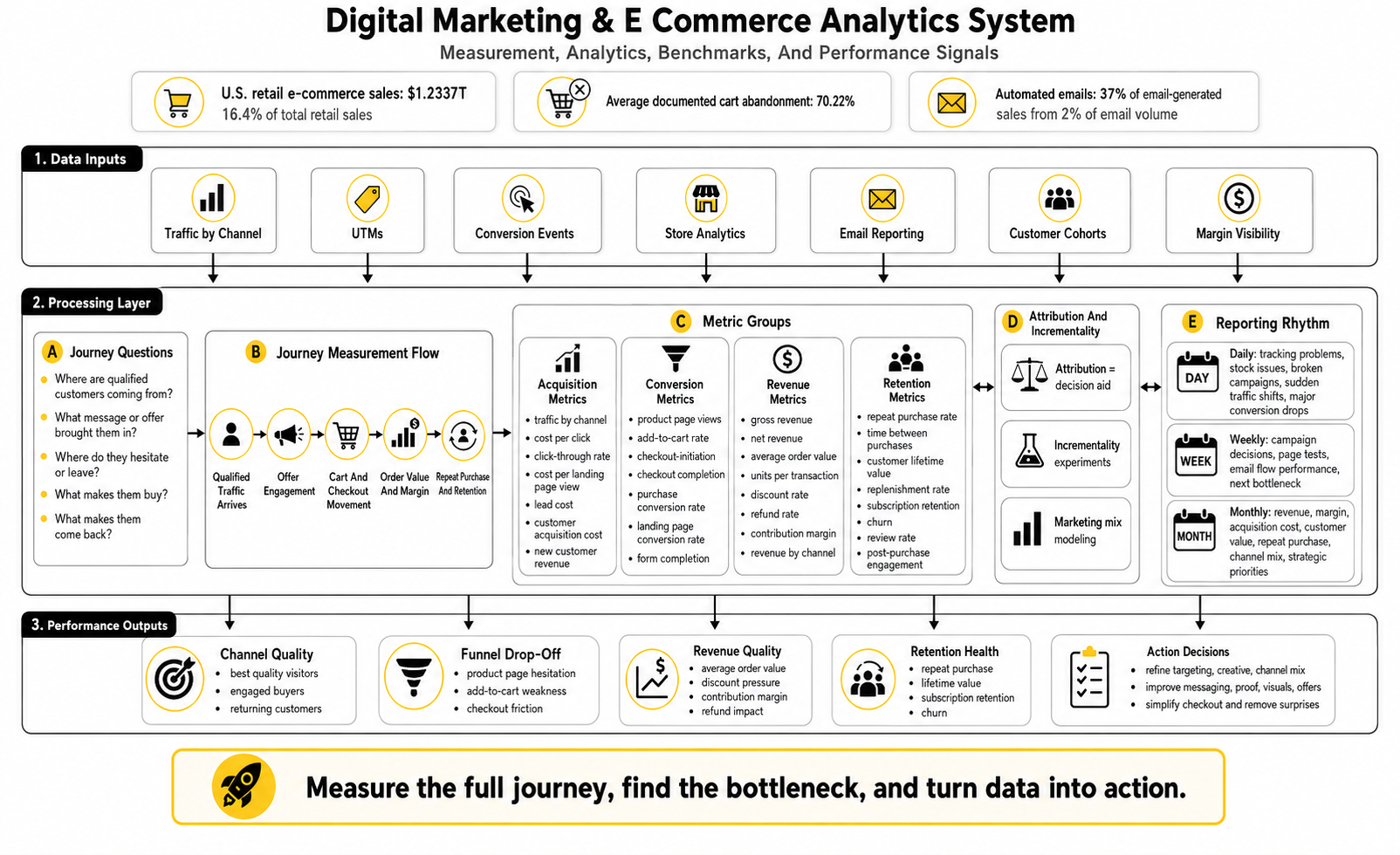
The market is large enough to reward strong operators, but the numbers also show how competitive the game has become. U.S. e-commerce sales reached $1.2337 trillion in 2025, and e-commerce represented 16.4% of total retail sales, based on the latest U.S. Census Bureau retail e-commerce release. That matters because online commerce is no longer a side channel. It is a major retail environment where brands compete on traffic quality, customer experience, pricing, trust, speed, and retention.
Cart abandonment is another number worth taking seriously. Baymard’s long-running checkout research calculates an average documented cart abandonment rate of 70.22% across studies in its cart abandonment benchmark. That number does not mean every store is doomed. It means checkout and pre-checkout trust are massive leverage points, especially when shipping costs, delivery clarity, payment options, returns, and account creation create friction.
Lifecycle marketing also deserves attention because it often produces revenue with less dependency on new traffic. Omnisend’s 2025 ecommerce report found that automated emails drove 37% of email-generated sales from 2% of email volume, with abandoned cart, welcome, and browse abandonment messages responsible for most automated orders in its 2025 ecommerce marketing report. The lesson is not “send more emails.” The lesson is that triggered messages based on behavior usually beat generic campaigns because timing and context matter.
What The Numbers Actually Mean
Benchmarks are useful only when they guide diagnosis. A low conversion rate does not automatically mean the website is bad. It might mean the traffic is too cold, the offer is unclear, the product is priced wrong, the page is attracting the wrong intent, or the customer needs more education before buying.
The same is true for cart abandonment. A high abandonment rate might point to checkout friction, but it can also reveal problems earlier in the journey. If customers reach checkout and then discover shipping costs, delivery delays, forced account creation, or limited payment options, the checkout is where the symptom appears, not necessarily where the problem began.
Email revenue also needs careful interpretation. If automated flows are producing strong revenue, that is good, but the next question is whether the brand is growing the list with the right people and protecting deliverability. If revenue depends too heavily on discounts, the metric may look healthy while customer behavior becomes weaker over time.
Build The Measurement System Around The Journey
The analytics system should follow the customer journey from first touch to repeat purchase. That means the business needs visibility into acquisition, engagement, conversion, order value, fulfillment experience, retention, and profitability. If the system only tracks ad platform numbers, it will miss what happens after the click.
A practical measurement system should answer five questions. Where are qualified customers coming from? What message or offer brought them in? Where do they hesitate or leave? What makes them buy? What makes them come back? These questions keep analytics tied to action instead of vanity reporting.
The system does not need to be complicated at the start. A clean setup with consistent UTMs, reliable conversion events, store analytics, email reporting, customer cohorts, and margin visibility is already enough to make better decisions. Complexity should be added only when the business has the discipline to use it.
The Metrics That Matter Most
The most useful metrics are the ones that reveal movement through the journey. Sessions tell you how much traffic arrived, but not whether it was useful. Conversion rate tells you how often visitors bought, but not whether those buyers were profitable. Average order value tells you how much people spent, but not whether they will return.
A practical digital marketing & e commerce scorecard should include acquisition, conversion, revenue, retention, and profit signals. This gives the team a balanced view instead of letting one metric dominate the conversation. Growth is healthier when the business can see both the marketing outcome and the commercial outcome.
The key is to review metrics in groups. Cost per click means little without conversion rate. Return on ad spend means little without margin. Repeat purchase rate means little without customer satisfaction and product experience. Numbers become useful when they explain each other.
Acquisition Metrics
Acquisition metrics show whether the brand is attracting the right people at a sustainable cost. Useful signals include traffic by channel, cost per click, click-through rate, cost per landing page view, lead cost, customer acquisition cost, and new customer revenue. These numbers help the team understand whether demand creation is efficient.
The danger is treating cheap traffic as good traffic. A campaign can produce low clicks and weak buyers, which makes the top of the funnel look efficient while the store struggles to convert. That is why acquisition metrics should always be read with downstream behavior.
A better question is simple: which channels bring visitors who engage, add to cart, buy, and return? If a channel looks expensive but creates higher-value customers, it may deserve more budget than a cheaper channel with poor retention. This is where digital marketing & e commerce decisions become more mature.
Conversion Metrics
Conversion metrics show where interest becomes action. Useful signals include product page views, add-to-cart rate, checkout initiation, checkout completion, purchase conversion rate, landing page conversion rate, and form completion. Each metric points to a different part of the buying path.
If product page views are strong but add-to-cart is weak, the issue may be offer clarity, product presentation, pricing, reviews, or trust. If add-to-cart is healthy but checkout completion is weak, the issue may be shipping cost, payment options, delivery expectations, or checkout friction. If checkout completion is healthy but total revenue is weak, the business may need to improve traffic volume, average order value, or repeat purchase.
This is why funnel visibility matters. A single overall conversion rate is too blunt. The team needs to see where the drop-off happens so the next improvement project is aimed at the right place.
Revenue Metrics
Revenue metrics show the commercial value of the journey. Useful signals include gross revenue, net revenue, average order value, units per transaction, discount rate, refund rate, contribution margin, and revenue by channel. These numbers prevent the team from confusing sales volume with business health.
Average order value is especially important because it changes what the brand can afford to spend on acquisition. A store with a higher AOV and healthy margin can often invest more aggressively in traffic. A store with low AOV and weak margin has less room for paid acquisition unless retention is strong.
Discount rate also needs attention. Promotions can increase short-term conversion, but they can train customers to wait if used carelessly. The better question is whether the discount creates profitable behavior or simply pulls forward revenue that would have happened anyway.
Retention Metrics
Retention metrics show whether customers continue buying after the first order. Useful signals include repeat purchase rate, time between purchases, customer lifetime value, replenishment rate, subscription retention, churn, review rate, and post-purchase engagement. These numbers reveal whether the business is building a customer base or renting attention from ad platforms.
Retention is not only an email problem. Product satisfaction, delivery experience, customer service, packaging, education, and expectation-setting all shape whether someone buys again. If retention is weak, sending more campaigns will not fix a disappointing customer experience.
Retention data should influence acquisition too. If one channel brings customers with higher repeat purchase rates, that channel may be more valuable than it looks from first-order return alone. This is one of the most important lessons in digital marketing & e commerce: the first sale is only part of the value.
Attribution Is Helpful, But It Is Not The Whole Truth
Attribution tries to assign credit to the channels and touchpoints that influenced a conversion. It is useful, but it is not perfect. Customers move across devices, platforms, content, search, email, reviews, and word of mouth in ways that no model can fully capture.
Ad platforms often over-credit themselves because they see only their part of the journey. Analytics platforms may under-credit channels that create awareness but do not capture the final click. This is why smart teams use attribution as a decision aid, not as an absolute truth.
Google’s current measurement guidance emphasizes combining attribution with incrementality experiments and marketing mix modeling for a more durable view of performance in its guidance on strengthening media measurement and ROI clarity. That matters because the real question is not “which platform claims the sale?” The real question is “what revenue would not have happened without this marketing activity?”
When To Use Incrementality Thinking
Incrementality asks whether a campaign created additional results or merely captured results that would have happened anyway. This is especially important for branded search, retargeting, heavy discount campaigns, and existing customer audiences. These campaigns may look great in platform reporting while adding less new revenue than they appear to.
A simple way to start is by comparing exposed and unexposed audiences, using geo tests, holdout groups, or platform experiments when available. The goal is not academic perfection. The goal is to avoid scaling campaigns that look efficient only because they are taking credit for demand already created elsewhere.
Incrementality thinking changes budget decisions. It helps the team protect spend that creates new demand and question spend that mostly harvests existing demand. That is a much stronger way to manage performance than blindly trusting last-click results.
Benchmarks Should Start Conversations, Not End Them
Benchmarks are useful for context, but they should not become excuses. A store below a benchmark should investigate why. A store above a benchmark should still ask whether it can improve profitably.
Industry averages can hide huge differences by product category, price point, device mix, brand strength, traffic source, geography, seasonality, and customer intent. A high-ticket product will usually behave differently from a low-cost impulse item. A replenishable product will usually behave differently from a one-time purchase.
Use benchmarks to spot unusual patterns, not to copy someone else’s strategy. If add-to-cart rate is far below category expectations, investigate the product page and traffic match. If cart abandonment is worse than expected, review checkout and cost transparency. If repeat purchase is weak, look beyond marketing and inspect the customer experience.
Reading Performance Signals Correctly
Good analysis starts by separating symptoms from causes. A drop in revenue may come from lower traffic, weaker conversion, lower AOV, stockouts, slower delivery, reduced email performance, seasonality, or a tracking issue. Jumping to conclusions wastes time and often leads to the wrong fix.
The clean way to read performance is to break the journey into stages. First, check whether enough qualified people arrived. Then check whether they engaged with the offer. Then check whether they moved through cart and checkout. Then check whether order value, margin, and retention stayed healthy.
This sequence makes the problem easier to find. It also prevents the team from blaming the wrong channel or changing too many things at once. Data is most useful when it narrows the decision.
Common Signal Patterns
If traffic rises but revenue does not, the brand may be attracting lower-intent visitors or sending people to the wrong page. The next action should be to compare traffic sources, landing pages, engagement, and add-to-cart behavior. Do not immediately rebuild the checkout if the problem starts before the cart.
If add-to-cart rate is strong but checkout completion drops, the brand should inspect shipping costs, delivery timing, payment methods, checkout errors, trust signals, and account requirements. This is a high-leverage area because the customer has already shown buying intent. Small improvements here can create meaningful revenue lift.
If first-order revenue is strong but repeat purchase is weak, the brand should review product satisfaction, post-purchase communication, customer support, expected usage cycle, and follow-up timing. This is not only a marketing automation issue. It may be a product, operations, or expectation-setting issue.
The Reporting Rhythm For Serious Teams
Daily reporting should be light and focused. It is useful for catching tracking problems, stock issues, broken campaigns, sudden traffic shifts, and major conversion drops. Daily reporting should not become emotional decision-making because short-term noise can mislead the team.
Weekly reporting should focus on active decisions. Which campaigns should be scaled, paused, or revised? Which page test needs more traffic? Which email flow is underperforming? Which bottleneck should be fixed next?
Monthly reporting should connect marketing performance to business health. This is where the team reviews revenue, margin, acquisition cost, customer value, repeat purchase, channel mix, and strategic priorities. A business that only reviews platform metrics will miss the bigger picture.
A Simple Weekly Review Structure
A useful weekly review can stay very simple. Start with what changed, then review the funnel, then decide what action matters most. The goal is not to admire the dashboard. The goal is to make better decisions.
A strong review includes these questions:
This structure keeps the team honest. It also creates a habit of looking at the whole system rather than arguing over isolated metrics. That habit compounds.
Tools Should Support Decisions, Not Create More Noise
Analytics tools are useful only when the business knows what it wants to measure. A dashboard with twenty charts is not automatically better than a dashboard with five clear signals. The best setup is the one the team actually uses to make decisions.
For content and social reporting, Buffer can help keep publishing and performance organized. For CRM-heavy funnels, lead follow-up, appointments, and pipeline visibility, GoHighLevel can be a practical option. For email and customer communication, Brevo can support campaigns and automation when the lifecycle strategy is already defined.
The tool stack should not become the strategy. A brand still needs clean naming conventions, consistent UTMs, reliable events, clear ownership, and a decision rhythm. Without those basics, even expensive software becomes a prettier way to stay confused.
Turning Data Into Action
The point of measurement is action. If the data shows weak traffic quality, refine targeting, creative, channel mix, or landing page match. If the data shows product page hesitation, improve messaging, proof, visuals, offers, and objection handling. If the data shows checkout friction, simplify the path and remove surprises.
Every metric should lead to a possible decision. If a number does not change what the team would do, it may not belong in the main scorecard. Keep the main view focused on the signals that drive revenue, profit, and customer experience.
This is where digital marketing & e commerce become more predictable. The team stops guessing, stops copying random tactics, and starts improving the system one bottleneck at a time. Part 5 will build on this by showing how optimization and scaling decisions should work once the measurement foundation is in place.
Measurement, Optimization, And Scaling Decisions
Once the business can see the full customer journey, the next challenge is deciding what to do with that visibility. Measurement by itself does not create growth. Growth happens when the team uses the data to make sharper tradeoffs, invest behind stronger signals, and stop wasting time on activity that only looks productive.
This is where digital marketing & e commerce become more strategic. Early execution is about getting the system working. Scaling is about knowing which parts deserve more budget, which parts need repair, and which parts should be left alone because they are already doing their job.
The dangerous moment is when a brand gets its first wins. A few campaigns work, a landing page converts, email starts producing revenue, and the team assumes the answer is simply “do more.” Sometimes that is true. Often, scaling exposes problems that were hidden at smaller volume.
Scaling Is Not Just Increasing Spend
Scaling is not the same as raising ad budgets. A brand can spend more and still become less profitable if the next layer of traffic is colder, less qualified, or harder to convert. The question is not whether the business can buy more attention. The question is whether the business can turn that attention into profitable customers without damaging margin or customer experience.
As spend increases, performance often changes. The best audiences get saturated, creative fatigue appears, conversion rates soften, and acquisition costs rise. This is normal, but it has to be managed with fresh creative, better segmentation, stronger offers, and more accurate measurement.
The more carefully approach is controlled scaling. Increase investment where the business sees strong contribution margin, healthy customer quality, and repeatable conversion patterns. Pull back when the numbers only look good inside the ad platform but fail to show up in profit, retention, or cash flow.
The Scaling Readiness Check
Before scaling a campaign, funnel, or channel, the team should confirm that the basics are strong. The offer should be clear, the landing page should match the promise, checkout should not create unnecessary friction, and tracking should be reliable enough to support decisions. Scaling a broken system just makes the leak more expensive.
The team should also check whether the campaign is creating new demand or only harvesting existing demand. Retargeting, branded search, and warm customer audiences may produce attractive returns, but they do not always create enough incremental growth by themselves. New customer acquisition usually requires a broader mix of creative, content, search, creators, and paid media.
Finally, the business should know the cash implications. A campaign can be profitable on lifetime value but painful on cash flow if payback takes too long. That matters a lot for inventory-heavy brands because stock, shipping, returns, and payment timing can create pressure even when the marketing looks efficient.
Profit Is The Real Constraint
Revenue growth feels good, but profit decides whether the growth is healthy. A business can increase sales while making the model weaker if acquisition costs rise, discounts expand, return rates increase, or fulfillment costs eat the margin. This is why digital marketing & e commerce teams need to think beyond top-line reporting.
Contribution margin is one of the most useful numbers here. It forces the team to look at revenue after product cost, discounts, payment fees, shipping subsidies, pick-and-pack costs, returns, and marketing spend. Once the business understands contribution margin, it can make much better decisions about budgets and offers.
This also changes how the team views average order value. A higher AOV is not automatically better if it comes from heavy discounting or low-margin bundles. A lower AOV is not automatically bad if the product has strong repeat purchase behavior and healthy margins. Context matters.
Discounting Can Quietly Break The Model
Discounts are easy to launch and hard to undo. They can improve conversion in the short term, but they can also train customers to wait. Once customers believe a discount is always coming, full-price buying becomes harder.
A better approach is to use incentives with purpose. Discounts can be useful for first purchases, bundles, seasonal campaigns, inventory movement, or reactivation. They become dangerous when they replace positioning, product value, or customer experience.
The team should track discount rate, margin after discount, repeat purchase behavior, and customer quality by promotion. If discount-driven buyers rarely return or only buy when prices drop again, the campaign may be buying weak revenue. That is not scaling. That is borrowing from future profit.
Creative Fatigue Is A Scaling Problem
Creative fatigue happens when the same message, visual, hook, or offer gets shown too often to the same audience. Performance starts strong, then slowly declines as people stop paying attention. This is one of the most common scaling issues in paid social and short-form content.
The solution is not endless random creative. The solution is a creative system. The brand should build repeatable angles around customer problems, outcomes, objections, proof, comparisons, demonstrations, founder perspective, creator content, and product use cases.
Strong creative systems separate the message from the format. One strong customer insight can become a short video, static ad, email hook, product page section, comparison post, and retargeting angle. That is how digital marketing & e commerce teams get more value from every insight.
Build A Creative Testing Rhythm
A useful creative rhythm includes research, production, launch, analysis, and iteration. Research identifies the customer language, objections, desires, and moments of hesitation. Production turns those ideas into assets. Launch gathers data. Analysis reveals which ideas deserve more investment.
The team should not judge creative only by click-through rate. Clicks matter, but the best creative is the creative that brings qualified buyers. A hook that attracts curiosity but not buying intent may look good at the top of the funnel and weak everywhere else.
This is why creative results should be read with downstream metrics. Look at landing page engagement, add-to-cart behavior, conversion rate, order value, and customer quality. The goal is not to win attention for its own sake. The goal is to win the right attention.
Channel Diversification Should Be Earned
Diversifying channels sounds smart, and eventually it usually is. But early diversification can create chaos if the business has not proven one channel, one offer, and one conversion path first. Spreading a small team across too many platforms often produces shallow execution everywhere.
The right time to diversify is when the current channel is becoming constrained or when the customer journey clearly needs another touchpoint. For example, paid social may create demand, but search content may be needed to capture comparison intent. Email may recover interest, but messaging automation may be needed to answer questions faster. Creator partnerships may increase trust, but landing pages may need to convert that trust into sales.
A diversified system is strongest when each channel has a role. The problem starts when every channel is expected to do everything. TikTok, Google, email, SEO, creators, and affiliates do not behave the same way, and they should not be measured with the exact same expectations.
Owned Channels Reduce Fragility
Owned channels give the brand more control. Email lists, SMS lists, customer communities, loyalty programs, content libraries, and direct relationships reduce dependence on rented platforms. They do not replace acquisition, but they make acquisition more valuable because the brand can continue the relationship after the first interaction.
This matters because paid media costs, platform rules, privacy changes, and algorithm shifts can change quickly. A brand that depends entirely on one platform is fragile. A brand with strong owned channels has more room to adapt.
For teams building a more consistent owned audience engine, platforms such as Brevo or Moosend can support email campaigns, segmentation, and automation. The tool choice matters less than the discipline behind it: collect the right permission, send relevant messages, and protect trust.
Personalization Needs Boundaries
Personalization can improve relevance, but it can also become creepy, messy, or operationally heavy. The best personalization does not feel like surveillance. It feels like the brand remembered what the customer actually cares about.
McKinsey’s 2025 work on personalized marketing emphasizes the role of AI and generative AI in scaling more relevant customer interactions. That is useful, but the strategy still has to be human. Personalization should make the experience clearer, faster, and more helpful.
The practical place to start is simple segmentation. First-time visitor, email subscriber, cart abandoner, first-time buyer, repeat buyer, VIP customer, inactive customer, and high-intent lead are different situations. Treating those situations differently usually creates more value than trying to build overly complex one-to-one personalization too early.
AI Should Improve Decisions, Not Replace Judgment
AI can help with research, segmentation, creative variations, product recommendations, support, content production, and customer journey analysis. It can speed up execution and reveal patterns faster than a manual process. That is valuable when the team has clear goals and good data.
The risk is using AI to create more volume without more insight. More ads, more emails, more landing page copy, and more chatbot responses do not automatically create better marketing. Bad inputs at higher speed still create bad outputs.
AI should be pointed at specific bottlenecks. Use it to improve product discovery, answer common questions, summarize customer feedback, generate testable creative angles, or personalize lifecycle messages. Keep humans responsible for positioning, ethics, customer empathy, offer strategy, and final decisions.
Customer Experience Becomes A Growth Lever
As a brand scales, customer experience becomes more important, not less. More orders mean more support tickets, more delivery questions, more returns, more reviews, and more public feedback. If the customer experience is weak, marketing will eventually amplify the weakness.
A good e-commerce experience is not only about fast checkout. It includes accurate product information, realistic delivery promises, responsive support, clear return policies, useful post-purchase communication, and honest expectation-setting. These details shape repeat purchase and word of mouth.
Support data is especially useful because it reveals what customers do not understand. If people keep asking the same question before buying, that question belongs on the product page or landing page. If people keep complaining after buying, the issue may be product education, fulfillment, sizing, quality, or expectation mismatch.
Support Should Feed Marketing
Customer support should not sit outside the growth system. It is one of the best sources of real customer language. Objections, frustrations, compliments, confusion, and feature requests all show up in support conversations.
Those insights can improve ads, landing pages, FAQs, email flows, product descriptions, onboarding, and retention campaigns. A repeated support question is often a conversion opportunity hiding in plain sight. Fixing it can reduce support load and increase sales at the same time.
Tools like Chatbase can help brands create AI-assisted support experiences when the knowledge base is strong and the use case is appropriate. The goal should be faster helpful answers, not replacing care with a wall of automation. Customers can feel the difference.
Inventory, Operations, And Marketing Must Stay Aligned
E-commerce marketing cannot be separated from operations. If marketing pushes products that are low in stock, customers get frustrated. If campaigns create demand faster than fulfillment can handle, delivery promises break. If returns spike after a promotion, the campaign may not be as profitable as it looked.
Inventory planning should inform campaign planning. High-margin products, replenishable products, overstocked products, seasonal items, and new launches all deserve different marketing treatment. A smart campaign calendar reflects what the business can actually deliver.
This is especially important for brands scaling paid media. A campaign that sells out inventory too quickly can create stockouts, delayed shipping, angry customers, and lost momentum. Growth should feel controlled, not chaotic.
Scaling Requires Cross-Functional Discipline
The marketing team needs input from operations, finance, support, product, and merchandising. This does not mean every decision needs a committee. It means the growth plan should reflect business reality.
Finance should define margin guardrails and payback expectations. Operations should flag fulfillment limits and stock risk. Support should share customer friction. Product should explain roadmap and quality concerns. Marketing should bring demand signals and customer insight.
When these teams work together, scaling becomes more carefully. The business stops treating growth as a campaign problem and starts treating it as a system problem. That is exactly how digital marketing & e commerce should be managed.
The Biggest Risks As Brands Scale
The first risk is over-reliance on one channel. A brand that depends too heavily on one ad platform, one creator, one marketplace, or one campaign type is exposed. The fix is not panic diversification. The fix is gradually building stronger owned channels, better creative systems, and more reliable demand capture.
The second risk is losing message clarity. As teams add products, audiences, and channels, the brand promise can get diluted. When everything becomes a priority, the customer no longer knows what the brand stands for. Strong positioning needs to be protected as the business grows.
The third risk is optimizing for platform metrics instead of business outcomes. ROAS, CTR, and conversion rate can all be useful, but they can also mislead. The business should keep asking whether the activity creates profitable customers, stronger retention, and a better brand.
Avoid The Complexity Trap
Complexity feels like progress. More tools, more reports, more automations, more campaigns, and more segments can make the team feel advanced. But complexity without clarity slows decisions and hides the real problem.
A better rule is to add complexity only when it creates a clear advantage. Add a new channel when there is a strong reason. Add a new segment when it changes the message. Add a new tool when it removes friction or improves decisions. Add a new report when someone will actually act on it.
The best operators are not the ones with the most complicated setup. They are the ones who can explain the system clearly, see the bottleneck quickly, and make the next decision with confidence.
Expert-Level Guidance For Better Scaling Decisions
The strongest scaling decisions usually come from combining customer insight, unit economics, and operational reality. That sounds obvious, but many teams still scale based on excitement. A campaign works for a week, so the budget jumps. A product sells fast, so the team assumes it has found the hero offer. A new channel gets attention, so everyone rushes in.
A more mature approach asks better questions. Is this growth incremental? Are these customers profitable after costs? Do they come back? Can we fulfill demand without damaging experience? Does this channel strengthen the brand or just create temporary revenue?
This kind of thinking may feel slower, but it creates stronger growth. The business avoids scaling weak signals, protects cash, and invests behind the parts of the system that can actually compound. That is the difference between momentum and noise.
A Practical Scaling Decision Filter
Before scaling any initiative, use a simple decision filter:
This filter keeps the team from chasing every positive-looking number. It also helps leadership compare very different opportunities without reducing everything to one platform metric. In digital marketing & e commerce, the right decision is often the one that protects the system while growing it.
Preparing For The Final Layer
At this point, the article has moved from the big picture to the framework, then into execution, measurement, and scaling. The next layer is the future operating model. That includes how trends, tools, AI, automation, and customer expectations should shape the way a modern online brand works.
The closing section should not be about chasing whatever is new. It should be about building a digital marketing & e commerce system that can adapt without losing discipline. Trends change, platforms change, and tools change, but the fundamentals remain clear: understand the customer, make the offer obvious, remove friction, follow up intelligently, and measure what actually matters.
Part 6 will bring that together with future trends, a practical tool stack, and FAQ.
Future Trends, Practical Tool Stack, And FAQ
The final layer is about building a system that can keep adapting. Digital marketing & e commerce will keep changing because customer behavior, AI, search, social platforms, privacy rules, and buying expectations keep moving. The brands that win are not the ones chasing every trend first. They are the ones that understand which trends actually improve the customer journey.
The future is not just “more automation.” It is more relevant discovery, faster decision-making, better product education, stronger owned channels, cleaner measurement, and more useful customer experiences. AI will speed up parts of the process, but it will not remove the need for positioning, judgment, trust, and operational discipline.
The practical goal is to build an ecosystem that can absorb change without falling apart. If the brand knows its customer, owns its audience, measures the right signals, and keeps improving the path from discovery to repeat purchase, it can handle new channels and tools without losing focus.
The Future Of Digital Marketing And E Commerce
AI-assisted shopping will become a bigger part of product discovery. Salesforce’s commerce research highlights how leaders are already using AI across commerce operations, personalization, search, service, and merchandising in its State of Commerce research. That matters because the store experience is no longer limited to a visitor typing keywords into a search bar and browsing categories manually.
Social commerce will also keep changing how people discover products. Customers increasingly expect to see products in context, watch them used by real people, ask quick questions, and move from interest to action with less friction. That does not mean every brand needs to become an entertainment company, but it does mean static product promotion is getting weaker.
Owned customer relationships will become even more valuable. As acquisition costs, privacy changes, and platform dependency create pressure, email lists, SMS audiences, communities, loyalty programs, and direct customer data become strategic assets. This is one reason automation continues to matter, especially when behavior-based messages outperform generic campaigns in reports like Omnisend’s 2025 ecommerce marketing report.
The Final System
A mature digital marketing & e commerce system has five moving parts working together. It creates demand, captures demand, converts demand, retains customers, and improves through measurement. None of those parts should operate in isolation.
The ecosystem should feel simple from the customer’s point of view. They discover the brand, understand the offer, find the right product, get their questions answered, buy with confidence, receive useful follow-up, and return when there is a good reason. Behind the scenes, the brand may have analytics, automation, landing pages, CRM, content workflows, ads, and support systems, but the customer should feel clarity, not complexity.
This is the standard to aim for. The best system is not the one with the most tools. It is the one where every tool, channel, page, and message has a clear purpose.
A Practical Tool Stack
A practical tool stack should match the business model. A Shopify brand selling physical products may need landing page testing, email automation, social scheduling, customer support, analytics, and product feed management. A service-led commerce business may need funnels, CRM, booking, lead follow-up, proposals, and pipeline automation.
For campaign landing pages, Replo can help e-commerce teams build more flexible Shopify pages. For funnels, checkout paths, and direct-response offers, ClickFunnels can fit when the business needs a focused sales journey outside a standard store layout. For all-in-one CRM, automation, booking, and follow-up, GoHighLevel can make sense for agencies, local businesses, consultants, and high-ticket funnels.
For lifecycle marketing, Brevo and Moosend can support campaigns, segmentation, and automation. For social publishing, Buffer can help teams stay consistent. For conversational flows, ManyChat can support messaging automation when social commerce, lead capture, or DM-based follow-up is part of the strategy.
How To Choose Tools Without Creating Chaos
Choose tools based on bottlenecks, not hype. If the biggest problem is unclear positioning, no software will fix it. If the biggest problem is slow landing page testing, then a page-building tool can create real leverage.
Start with the workflow before choosing the platform. What needs to happen when someone discovers the brand? What happens when they visit a page, abandon checkout, buy once, ask a question, or return after months of silence? Once that journey is clear, tool selection becomes much easier.
The stack should also be simple enough for the team to maintain. A tool nobody uses is not an asset. A tool that creates messy data, duplicate contacts, broken attribution, or disconnected customer records can quietly damage the system.
The Final Strategic Takeaway
Digital marketing & e commerce are no longer separate disciplines. The modern online brand needs one connected growth system that covers discovery, conversion, retention, measurement, and customer experience. When those pieces work together, the business becomes easier to improve.
The core principle is simple: every decision should help the customer move forward with more confidence. Better content should make the product easier to understand. Better pages should remove friction. Better automation should make follow-up more relevant. Better analytics should make the next decision clearer.
This is not about chasing perfection. It is about building a system that gets more carefully with every campaign, every customer conversation, every test, and every review cycle. That is how digital marketing & e commerce become a durable advantage instead of a never-ending list of tasks.
What Is Digital Marketing & E Commerce?
Digital marketing & e commerce is the connected system of promoting, selling, and retaining customers online. It includes traffic channels, content, ads, email, social media, landing pages, checkout, analytics, automation, and post-purchase communication. The key idea is that marketing and the online store should work together instead of operating as separate pieces.
Why Is Digital Marketing Important For E Commerce?
Digital marketing creates and captures the demand that brings customers into the store. Without it, even a strong product can sit unnoticed because people do not know it exists or do not understand why they should buy it. In e commerce, marketing also shapes trust, product education, comparison behavior, and repeat purchase.
What Is The Difference Between E Commerce Marketing And Digital Marketing?
Digital marketing is the broader discipline of reaching and converting people through online channels. E-commerce marketing is the part focused specifically on selling products or services through online commerce experiences. In practice, digital marketing & e commerce overlap because campaigns, product pages, checkout, email, and retention all affect revenue together.
What Are The Most Important Channels For E Commerce Growth?
The most important channels depend on the product, audience, price, and buying journey. Search can capture existing intent, paid social can create discovery, email can drive repeat purchases, and creators can build trust. A focused channel strategy usually beats trying to be everywhere at once.
How Do You Build A Digital Marketing & E Commerce Strategy?
Start by defining the customer, offer, buying trigger, and main objections. Then choose the channels that match the customer journey and build pages, emails, and follow-up around that journey. After launch, measure the full path from traffic to purchase to repeat revenue so each improvement is based on evidence.
What Metrics Should An E Commerce Brand Track?
A strong scorecard includes traffic quality, conversion rate, add-to-cart rate, checkout completion, average order value, customer acquisition cost, contribution margin, repeat purchase rate, and customer lifetime value. These metrics show how people move through the journey and whether growth is profitable. Platform metrics are useful, but they should not replace business metrics.
Why Do Many E Commerce Campaigns Fail?
Many campaigns fail because the offer, audience, message, and landing page do not match. A brand may drive traffic from the wrong channel, send visitors to a generic page, or ask cold audiences to buy before enough trust has been built. The fix is usually not more tactics, but better alignment across the journey.
How Important Is Email Marketing For E Commerce?
Email marketing is important because it gives the brand a direct relationship with customers and subscribers. It can support welcome sequences, abandoned cart recovery, post-purchase education, replenishment, reviews, and win-back campaigns. The best email programs are behavior-based and useful, not just constant promotions.
Should E Commerce Brands Use AI?
E-commerce brands should use AI where it improves speed, relevance, analysis, or customer experience. AI can help with creative testing, product recommendations, support, segmentation, research, and content workflows. It should not replace strategy, customer empathy, product judgment, or ethical decision-making.
What Is The Best Tool For Digital Marketing & E Commerce?
There is no single best tool for every business. A product-led store may need page testing, email automation, analytics, and customer support, while a high-ticket service funnel may need CRM, booking, and sales follow-up. The best tool is the one that supports the business model and removes a real bottleneck.
How Do You Know When To Scale?
A brand is ready to scale when the offer is proven, the conversion path is clear, tracking is reliable, and the economics still work after costs. Scaling should also consider inventory, fulfillment, customer support, cash flow, and repeat purchase behavior. Spending more before the system is stable usually makes problems more expensive.
What Is The Biggest Mistake In Digital Marketing & E Commerce?
The biggest mistake is treating growth as a collection of disconnected tactics. Ads, email, landing pages, social content, SEO, automation, and analytics all influence the same customer journey. When the system is disconnected, the business spends more effort and gets weaker learning.
How Can Small Teams Compete With Bigger Brands?
Small teams can compete by being sharper, faster, and more focused. They can choose a specific customer segment, build clearer offers, respond to feedback faster, and create more personal communication. Bigger brands often have more budget, but smaller teams can win with speed, relevance, and strong execution.
What Should A Beginner Fix First?
A beginner should first fix clarity. The customer should quickly understand what the brand sells, who it is for, why it is different, and what to do next. Once the offer and page are clear, traffic, email, automation, and testing become much more effective.
Build a stronger local presence with BAAM AI
Turn your website, Google profile, social channels, and AI visibility into one growth engine
Most businesses do not need more random marketing activity. They need a consistent presence system that helps the right people find them, trust them, and take action. BAAM AI brings strategy, local SEO, website updates, Google Maps visibility, social content, AI-search readiness, media production, and reporting into one practical monthly engine.
If you want your marketing to keep working after the campaign ends, start with a free BAAM AI presence audit. See how your business shows up today and where the fastest visibility wins are at BAAM AI.