
BAAM AI Blog
Digital Marketing Agency Pricing: A Practical Guide To What You Should Really Pay
Digital marketing agency pricing is confusing because agencies rarely sell the same thing. One proposal might include strategy, creative, media buying, landing pages, analytics, reporting, and CRM automation. Another...
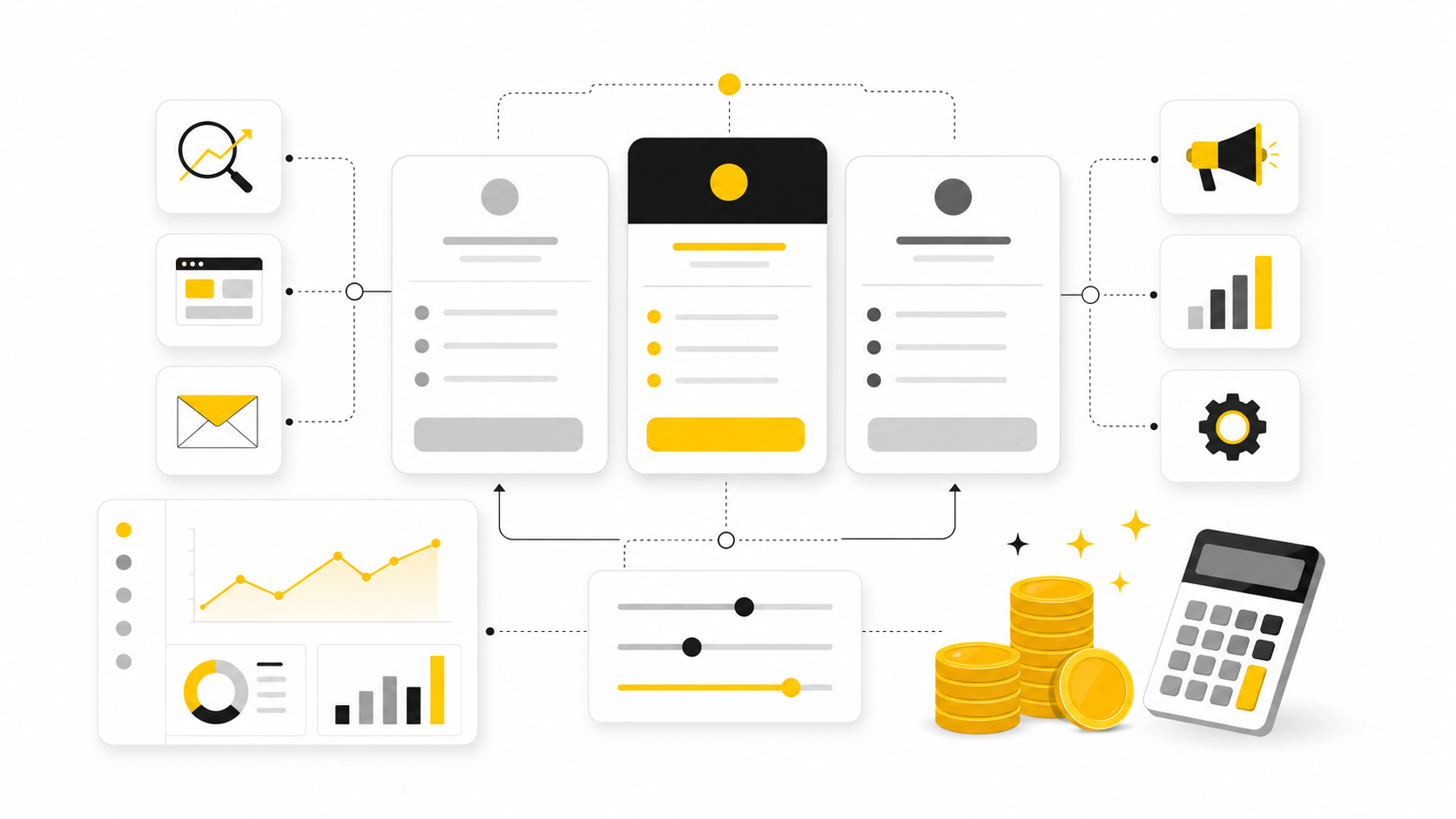
Digital marketing agency pricing is confusing because agencies rarely sell the same thing. One proposal might include strategy, creative, media buying, landing pages, analytics, reporting, and CRM automation. Another might use the same words but only include campaign setup and a monthly call.
That is why comparing agencies by price alone is a bad move. A $2,000 monthly retainer can be expensive if it buys scattered activity with no revenue connection. A $12,000 retainer can be reasonable if it covers senior strategy, execution, testing, reporting, and a clear path to profitable growth.
The goal of this guide is simple: help you understand what drives agency pricing, what different pricing models actually mean, and how to judge whether a quote is fair. You do not need to become an agency operator. You just need to know enough to avoid underbuying, overpaying, or signing a vague contract that creates problems later.
What Digital Marketing Agency Pricing Really Means
Digital marketing agency pricing is the way an agency charges for strategy, execution, management, creative work, reporting, technology, and performance improvement. It can show up as an hourly rate, a monthly retainer, a fixed project fee, a percentage of ad spend, a performance fee, or a hybrid of several models. The number on the proposal only makes sense when you understand what work is included, who is doing it, and what business outcome the agency is expected to support.
The market is wide because the work is wide. Current agency directories show digital marketing projects commonly landing in the $10,000 to $49,999 range, while many listed agencies charge hourly rates from $25 to $49 per hour for broad digital marketing work and $100 to $149 per hour for specialized services like content marketing, email marketing, social media, and PPC (Clutch digital marketing pricing). Other pricing guides put common monthly digital marketing costs anywhere from $50 to $6,000+ per month, depending on the service mix, business size, and campaign complexity (WebFX digital marketing pricing).
Those ranges are not contradictions. They are proof that “digital marketing” is not one product. SEO, paid search, paid social, lifecycle email, conversion rate optimization, landing page design, analytics, marketing automation, and content production all require different skill sets, timelines, and operating rhythms.
Why Pricing Matters More Than Most Businesses Think
Pricing matters because your agency budget is not just a cost line. It shapes the quality of talent assigned to your account, the amount of strategic thinking you receive, the speed of testing, the depth of reporting, and the level of accountability in the relationship. Cheap pricing often looks attractive at the start, but it can become expensive fast when campaigns launch slowly, tracking is broken, or the agency does not have enough time to think beyond basic execution.
Marketing teams are already under pressure to do more with less. Gartner’s 2025 CMO Spend Survey found that marketing budgets remained flat at 7.7% of overall company revenue, which means every dollar has to work harder (Gartner CMO Spend Survey). At the same time, digital advertising keeps getting more competitive, with U.S. internet advertising revenue reaching $294.6 billion in 2025, up 13.9% year over year (IAB Internet Advertising Revenue Report).
That combination creates a real problem. Businesses need better execution, cleaner measurement, stronger creative, and faster learning cycles, but they do not have unlimited budget to throw at the problem. Good pricing helps you buy the right amount of expertise without pretending every agency task has equal value.
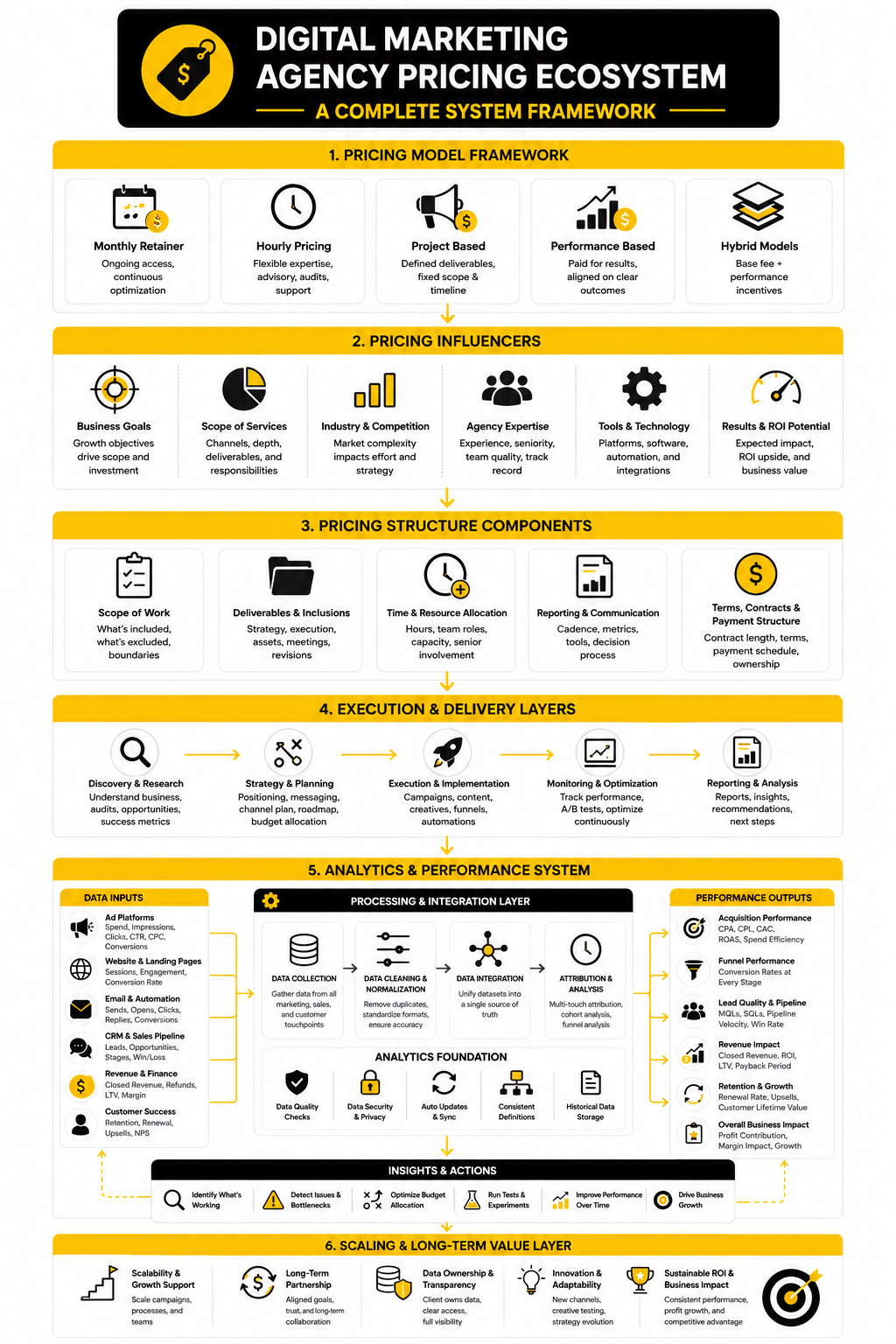
The Digital Marketing Agency Pricing Framework
A useful pricing conversation starts with four questions: what outcome do you want, what work is required to get there, what level of expertise does the work need, and how will performance be measured. If you skip those questions, you end up comparing retainers like grocery prices. That is where bad decisions happen.
The framework is simple. First, define the business goal, such as more qualified leads, lower acquisition cost, more ecommerce revenue, stronger retention, or better sales pipeline quality. Second, map the services required to support that goal, because a paid media account without landing pages, tracking, email follow-up, and sales handoff may look cheaper but perform worse.
Third, identify the operating model. Some businesses need a strategic partner that owns planning, execution, reporting, and optimization. Others only need a specialist for one channel, or a project team to build a funnel, landing page, or automation system using tools like GoHighLevel, ClickFunnels, or ManyChat.
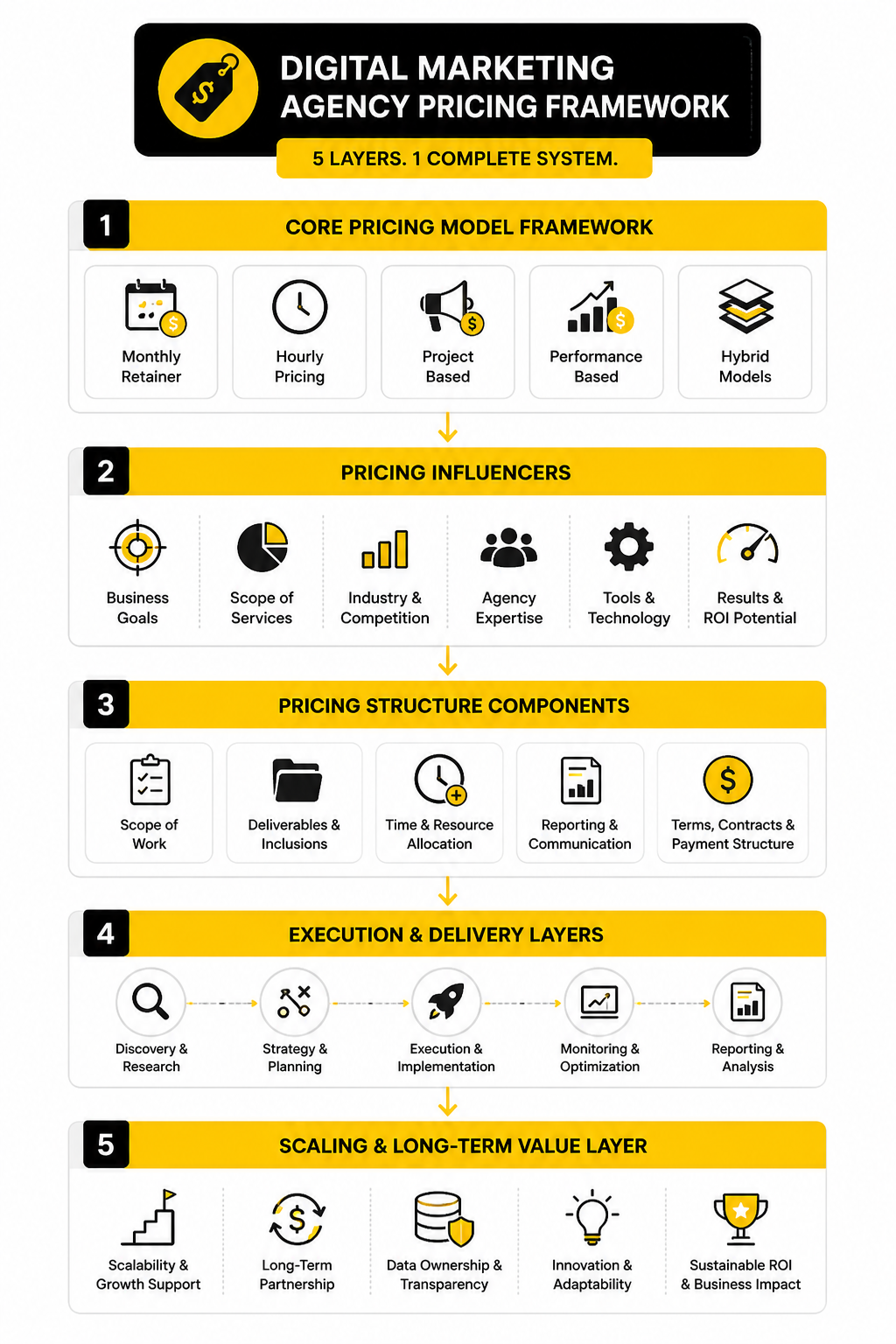
How To Use This Guide
Use this guide as a decision tool, not as a rigid price sheet. The right agency price depends on your business model, margins, sales cycle, current assets, team capacity, and how much risk you want the agency to carry. A local service business trying to generate booked calls should not evaluate pricing the same way a SaaS company, ecommerce brand, or B2B firm with a six-month sales cycle would.
The next parts will break down the pricing models in plain English. You will see where hourly pricing makes sense, when retainers are better, why project pricing can be useful, and where performance-based pricing becomes risky. The goal is not to find the cheapest agency.
The goal is to understand what you are buying before you sign. That means knowing the difference between activity and outcomes, deliverables and strategy, media spend and management fees, and a lean scope versus an underpowered one. Once you can see those differences, digital marketing agency pricing becomes much easier to judge.
Core Pricing Models Agencies Use
Most digital marketing agency pricing falls into a few models, even when the proposal looks complicated. Agencies may package them differently, but the money usually comes from retainers, hourly work, project fees, percentage-of-spend management, performance fees, or a hybrid structure. The model matters because it shapes incentives, not just payment terms.
A good pricing model should match the type of work being done. Ongoing optimization usually needs a different structure than a one-time funnel build or analytics cleanup. That is why the cheapest model on paper is not always the safest one, and the most expensive model is not automatically the most strategic.
Monthly Retainers
A monthly retainer is the most common model for ongoing digital marketing work. You pay a fixed monthly fee for a defined scope, such as SEO, paid media management, content production, email marketing, reporting, or a mix of services. This works well when the agency needs to stay close to the account, make continuous improvements, and keep campaigns moving every week.
Retainers are useful because they create predictable costs. They also give the agency room to plan, test, report, and optimize instead of treating every small task as a separate billable event. Current pricing guides commonly place ongoing digital marketing retainers from around $1,000 to $20,000+ per month, depending on company size, service mix, and campaign complexity (WebFX digital marketing pricing).
The risk is paying for capacity you do not actually use. A vague retainer can hide weak execution because the agency gets paid the same whether the account improves or drifts. Before signing, you want the retainer tied to clear deliverables, meeting cadence, reporting standards, ownership responsibilities, and a process for adjusting scope.
Project-Based Pricing
Project-based pricing is a fixed fee for a defined outcome. This might be a website redesign, funnel build, landing page package, campaign launch, email automation setup, tracking audit, or content strategy. It works best when the scope has a clear start, finish, and approval process.
Project fees are attractive because you know the cost upfront. They also make sense when you need a specific asset built before moving into monthly optimization. For example, a business might pay a one-time fee to build a sales funnel in ClickFunnels, set up a lead capture system in GoHighLevel, or launch a simple funnel with Systeme.io.
The danger is scope creep. If the brief says “landing page” but the business expects strategy, copywriting, design, development, tracking, CRM setup, email follow-up, and revision rounds, the project will get messy fast. Strong project pricing spells out deliverables, exclusions, timelines, revision limits, asset ownership, and what counts as a change request.
Hourly Pricing
Hourly pricing means the agency charges for time spent. This model is simple, flexible, and useful when the work is uncertain or advisory. It can make sense for audits, consulting, training, troubleshooting, small updates, analytics reviews, or overflow support for an internal team.
The upside is transparency. You can see how much time the work takes, and you are not locked into a large monthly commitment. Recent agency pricing guides often show hourly digital marketing rates anywhere from $50 to $250+ per hour, with senior specialists and consultants charging more depending on expertise (WebFX digital marketing pricing).
The downside is budget unpredictability. Hourly pricing can reward time spent instead of outcomes created, which is not always ideal for growth work. If you use hourly support, set a monthly cap, agree on priority tasks, and ask for short progress updates before the budget disappears into scattered requests.
Percentage Of Ad Spend
Percentage-of-spend pricing is common in PPC and paid social management. The agency charges a percentage of your media budget, often with a minimum monthly fee. This model is easy to understand because the management fee rises as the ad budget rises.
Many PPC pricing guides place percentage-of-spend fees around 10% to 20% of monthly media spend, while some paid social arrangements run higher when creative testing is included (AgencyAnalytics PPC pricing). That can be fair when larger budgets create more work, more campaigns, more reporting, and more optimization complexity. A $5,000 ad account and a $500,000 ad account should not require the same level of management.
But this model has a serious incentive problem. The agency earns more when you spend more, even if the next dollar of ad spend is less efficient. If you use this structure, pair it with efficiency targets like cost per qualified lead, return on ad spend, contribution margin, pipeline quality, or revenue generated.
Performance-Based Pricing
Performance-based pricing ties agency compensation to results. That might mean paying per qualified lead, booked call, sale, new customer, revenue milestone, or percentage of profit. It sounds perfect because the agency only wins when the business wins.
In reality, pure performance pricing is harder than it looks. Results depend on factors the agency may not control, including offer strength, sales follow-up, pricing, product quality, website speed, customer reviews, inventory, margins, and close rates. If those pieces are weak, a performance deal can create conflict instead of alignment.
This model works best when tracking is clean, the offer is proven, the sales process is reliable, and both sides agree on what counts as a valid result. It is usually better as part of a hybrid structure than as the entire agreement. That way the agency has enough base compensation to do the work properly, while still having upside for strong outcomes.
Hybrid Pricing
Hybrid pricing combines two or more models. A common setup is a base monthly retainer plus a performance bonus. Another is a project fee for setup followed by a monthly optimization retainer.
Hybrid pricing is often the most practical structure because digital marketing rarely fits into one clean box. A campaign may need an upfront strategy phase, a build phase, a launch phase, and an ongoing testing phase. Each phase has different risk, workload, and value.
This is also where tool choices can affect the commercial structure. If the agency is building CRM automations, lead routing, email workflows, and pipeline tracking inside GoHighLevel, the setup work may be priced as a project while ongoing campaign management stays on retainer. If the agency is building landing pages with Replo or list-building workflows with Brevo, the quote should separate build costs from ongoing optimization costs so you know exactly what you are paying for.
What Changes The Cost Of Digital Marketing Services
The price of digital marketing services changes because the work changes. Two businesses can ask for “more leads” and need completely different operating plans. One might only need better Google Ads management, while the other needs offer positioning, funnel copy, landing pages, CRM setup, sales tracking, retargeting, nurture emails, and reporting cleanup.
The main cost drivers are scope, complexity, talent level, speed, creative volume, channel mix, reporting depth, and business risk. A single-channel campaign with a proven offer is easier to price than a multi-channel growth system with weak tracking and no clear conversion data. The more uncertainty the agency has to solve, the more expensive the engagement becomes.
Scope Of Work
Scope is the first pricing driver. Managing one channel is not the same as owning the full customer acquisition system. If an agency is responsible for strategy, copywriting, design, media buying, landing pages, email follow-up, tracking, and weekly reporting, the price should be higher than basic campaign management.
This is where many businesses misunderstand digital marketing agency pricing. They compare one quote that includes full-funnel execution with another quote that only includes ad management, then assume the cheaper quote is better. It might be cheaper because it excludes the work that actually makes the campaign profitable.
A clear scope protects both sides. It should say what the agency does, what the client provides, what tools are used, how many deliverables are included, and how often optimization happens. Without that, pricing becomes a guessing game.
Channel Mix
Every channel has its own workload. SEO needs technical fixes, content planning, on-page work, authority building, and patience. Paid search needs keyword management, conversion tracking, ad testing, landing page alignment, and budget control.
Paid social adds another layer because creative fatigue is real. The agency may need new hooks, ad variations, short-form video concepts, static creatives, audience testing, and landing page iterations. Email marketing brings segmentation, copywriting, automation logic, deliverability, testing, and revenue reporting into the picture.
More channels can create more growth, but they also create more coordination. If the agency is managing Google Ads, Meta Ads, SEO, email, social content, and reporting, you are not just buying tasks. You are buying operating discipline.
Business Complexity
A simple business with one offer and one conversion goal is easier to manage. A business with multiple products, locations, audiences, sales teams, markets, or buyer journeys requires more planning. Complexity adds cost because the agency has to make more decisions and prevent more things from breaking.
B2B campaigns often cost more to manage well because lead quality matters more than lead volume. A cheap lead is useless if it never becomes pipeline. Ecommerce campaigns can also become complex when margins, inventory, average order value, repeat purchase rate, and creative testing all affect profitability.
This is why a proposal should never be judged by the monthly fee alone. A higher fee may be justified if the agency is solving a more difficult revenue problem. A lower fee may be fine if the business has a simple offer, clean tracking, and a narrow channel focus.
Speed And Urgency
Speed affects price because fast work requires more people, tighter coordination, and fewer delays. A campaign that needs to launch in six weeks can be planned calmly. A campaign that needs to launch next week usually requires priority scheduling, senior oversight, and quick decisions from both sides.
Urgency also increases the cost of mistakes. When there is no time to validate tracking, review creative, test landing pages, or clean up handoffs, performance risk goes up. Good agencies price that risk into the engagement.
If speed matters, be honest about it upfront. Do not ask for a normal quote and then expect emergency delivery. Fast, good, and cheap rarely live in the same room.
Existing Assets
Your existing assets can lower or raise the price. If you already have strong brand positioning, proven offers, high-converting landing pages, clean analytics, a working CRM, and reliable sales data, the agency can focus on optimization faster. That usually makes the engagement more efficient.
If those assets are missing, the agency has to build or repair the foundation first. That might mean rewriting offers, rebuilding pages, fixing tracking, creating nurture sequences, setting up dashboards, or connecting forms to a CRM like Copper. Those are not small details.
This is the part many businesses want to skip, but it matters. Media buying on top of weak infrastructure is expensive guesswork. A proper foundation can make the monthly agency fee work harder.
Typical Price Ranges By Service
Once you understand the pricing models and cost drivers, the next question is obvious: what should each service actually cost? The honest answer is that ranges vary a lot, but there are still useful benchmarks. Digital marketing agency pricing becomes much easier to evaluate when you separate each service instead of treating everything as one vague “marketing package.”
The numbers below are best used as directional ranges, not universal rules. A small local campaign, a national ecommerce brand, and a B2B company with a long sales cycle should not expect the same scope or fee. The goal is to understand what the price usually reflects so you can ask better questions before signing anything.
SEO Pricing
SEO pricing usually depends on the size of the website, competitiveness of the market, technical condition of the site, content needs, and whether the agency is also handling local SEO, link acquisition, or content production. Many SEO retainers sit in the low four figures per month, but complex campaigns can climb much higher when technical work, content strategy, and authority building are all included. Recent SEO pricing research shows monthly retainers remain the most common model, with many agencies clustering around $500 to $1,000 per month for smaller engagements and higher fees for more competitive campaigns (SE Ranking SEO pricing research).
The cheaper end usually covers basic keyword tracking, light on-page changes, simple reporting, and maybe a few recommendations. That can be enough for a small local business with a simple site and low competition. It is usually not enough for a serious content strategy, technical cleanup, conversion-focused landing pages, and consistent publishing.
The real question is not just “how much is SEO?” The better question is “what is the agency actually doing every month to improve search visibility and turn that visibility into revenue?” If the proposal does not explain technical priorities, content production, reporting, and ownership of implementation, the price is almost impossible to judge.
PPC Pricing
PPC pricing is usually split into two buckets: ad spend and agency management fees. Ad spend goes directly to platforms like Google, Meta, LinkedIn, TikTok, or Microsoft Ads. The agency fee pays for strategy, account structure, campaign setup, keyword research, creative testing, bid management, tracking, reporting, and optimization.
Many PPC agencies charge either a flat monthly retainer or a percentage of media spend. Percentage-based fees often sit around 10% to 20% of monthly ad spend, especially when budgets are large enough to justify more active management (Stackmatix PPC agency pricing). Smaller accounts may pay a flat management fee instead because 15% of a small budget would not cover the work required to manage the account properly.
This is where you need to be sharp. A $3,000 monthly PPC fee can be reasonable if the agency is managing multiple campaigns, testing landing pages, improving tracking, and reporting on qualified leads or revenue. The same fee can be expensive if the agency only changes bids, sends automated reports, and avoids the conversion problems that actually affect profit.
Social Media Management Pricing
Social media management pricing depends on whether the agency is posting content, building a strategy, producing creative, managing community engagement, running paid ads, or reporting on business outcomes. A basic posting package is not the same as a full social growth system. One is content scheduling, the other is creative direction, campaign planning, distribution, testing, and feedback loops.
Lower-cost social media packages often cover a limited number of posts per month and simple scheduling. Higher-cost packages may include short-form video concepts, design, captions, analytics, community management, creator coordination, and paid amplification. If paid social is included, the proposal should clearly separate organic content work from ad management.
A good agency will also be honest about what organic social can and cannot do. Organic posting can build trust, brand memory, and audience familiarity, but it is rarely a complete acquisition system by itself. If the agency promises predictable revenue from posting alone without explaining distribution, offer, funnel, and follow-up, be careful.
Content Marketing Pricing
Content marketing pricing depends on strategy depth, research quality, editorial planning, subject-matter expertise, writing standards, design support, and distribution. A single blog post written from a thin brief is not the same as a content program built around search intent, buyer objections, product positioning, and lead capture. That difference should show up in the quote.
Basic content production may be priced per article, per page, or as part of a monthly retainer. More advanced content marketing includes topic research, content briefs, expert interviews, editing, internal linking, conversion assets, and performance reporting. That kind of work costs more because it requires more than writing words on a page.
This matters because content without strategy becomes a publishing treadmill. You pay for assets, but the assets do not support search visibility, sales conversations, or lead generation. Strong content pricing should connect the deliverables to a real commercial purpose.
Email Marketing Pricing
Email marketing pricing depends on list size, segmentation, automation complexity, campaign volume, design requirements, and revenue reporting. A simple newsletter program costs less than lifecycle automation with welcome flows, abandoned cart recovery, lead nurturing, reactivation, and post-purchase sequences. The more logic and testing involved, the more the agency has to charge.
There are also software costs to consider. Email platforms often price by contacts, sends, features, or automation depth, so the agency fee is only one part of the total cost. Businesses comparing email tools might look at platforms like Brevo, Moosend, or Systeme.io depending on how much automation they need.
The best email pricing is tied to lifecycle value. You are not paying for “emails.” You are paying for better timing, better segmentation, better messaging, and better monetization of an audience you already have.
Landing Page And Funnel Pricing
Landing page and funnel pricing depends on strategy, copywriting, design, development, integrations, testing, and analytics. A simple landing page can be relatively affordable if the business already has the offer, copy direction, brand assets, and tracking in place. A conversion-focused funnel costs more because the agency has to think through the full journey from click to lead, lead to appointment, or visitor to customer.
This is where tools can change the project cost. A business might use Replo for ecommerce landing pages, ClickFunnels for funnel builds, GoHighLevel for lead capture and pipeline automation, or Fillout for forms and qualification flows. The agency fee should make clear whether the quote includes only page design or the full setup around the page.
Do not underestimate this category. A good landing page can make paid traffic cheaper because more visitors convert. A weak landing page can make even a strong ad account look broken.
Professional Implementation And Scope Control
Professional implementation is where pricing becomes real. The proposal is just the promise. The implementation process is where you find out whether the agency has a system, or whether they are improvising with your budget.
A good agency does not jump straight into random tactics. It starts by understanding the business model, auditing what exists, defining the scope, cleaning up measurement, building the first campaign plan, launching in controlled steps, and then optimizing from actual data. That process takes time, but it prevents expensive chaos.
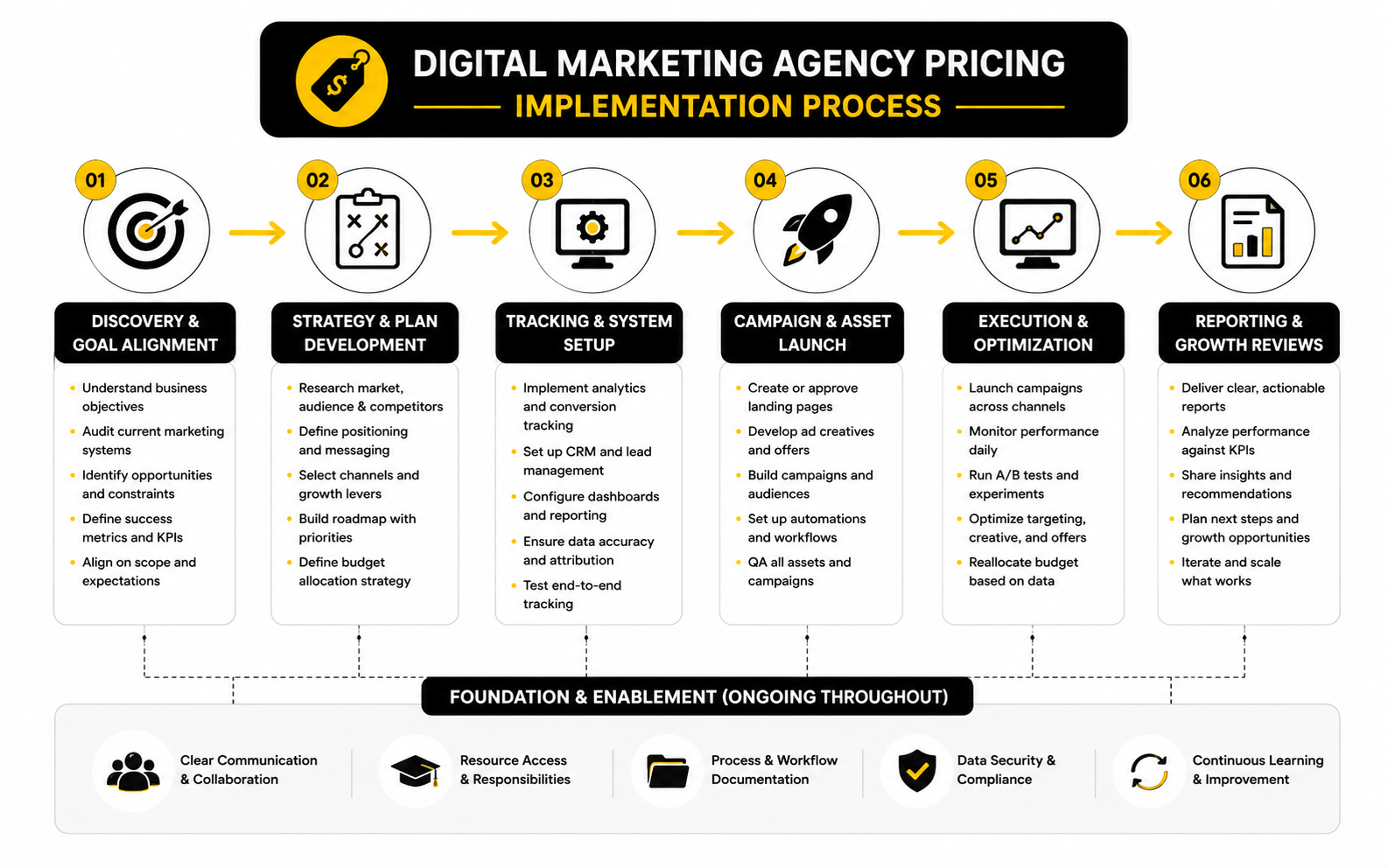
Step 1: Clarify The Business Goal
The first step is to define what the agency is being hired to improve. More traffic is not specific enough. More qualified sales calls, lower cost per booked appointment, higher ecommerce conversion rate, more pipeline from paid search, or better retention from email are much clearer goals.
This goal affects the entire pricing conversation. If the business only wants awareness, the agency may focus on content, reach, and engagement. If the business needs revenue, the agency has to care about conversion tracking, offer quality, follow-up speed, sales handoff, and customer acquisition cost.
The clearer the goal, the easier it is to price the work. Vague goals create vague scopes. Vague scopes create vague invoices.
Step 2: Audit The Current System
Before serious execution starts, the agency should review the current marketing system. That means looking at website performance, analytics, ad accounts, landing pages, CRM setup, email flows, content, search visibility, tracking, and sales data where available. The point is to find constraints before spending more money.
This audit does not need to become a 90-page document that nobody reads. It should identify the biggest leaks and the fastest opportunities. If tracking is broken, fixing that may matter more than launching another campaign.
This step also protects the client from paying for the wrong thing. You might think you need more traffic when the real issue is poor lead follow-up. You might think you need cheaper leads when the real issue is that the landing page attracts the wrong buyers.
Step 3: Define Scope And Ownership
Scope control is one of the biggest differences between a smooth agency relationship and a frustrating one. The agency should define what is included, what is excluded, who owns approvals, who provides assets, who handles technical implementation, and how requests are prioritized. This sounds boring until it is missing.
Ownership matters because digital marketing crosses departments. Ads may need landing pages. Landing pages may need developer support. Forms may need CRM access. Email follow-up may need sales input. If nobody owns those handoffs, execution slows down and the agency fee starts feeling wasteful.
A strong scope should include deliverables, timelines, review rounds, reporting cadence, response expectations, tool access, and change request rules. This is not bureaucracy. It is how you keep momentum without turning every week into a negotiation.
Step 4: Build The Measurement Layer
Measurement has to come before aggressive scaling. If the business cannot see where leads, purchases, calls, forms, or qualified opportunities come from, optimization becomes guesswork. Clean tracking is not optional when you are paying an agency to improve performance.
The measurement layer can include analytics setup, conversion events, CRM fields, call tracking, UTM standards, dashboarding, and sales pipeline visibility. For lead generation, the CRM is especially important because lead volume alone does not tell you whether campaigns are producing revenue. Tools like GoHighLevel, Copper, or Cal.com can become part of the system when booking, pipeline, and follow-up need to be connected.
This step is one of the easiest places to underpay and regret it later. A cheaper agency that skips measurement may look efficient in month one. By month three, nobody knows what is working.
Step 5: Launch In Controlled Phases
Good execution usually happens in phases. The agency might start with one core offer, one channel, one landing page, one audience segment, and one reporting dashboard. That is not slow; it is controlled.
Controlled launches reduce waste because the team can learn before expanding. If the first campaign reveals that the offer is unclear, the landing page is weak, or the follow-up sequence needs work, it is better to fix that before multiplying spend across every channel. Scaling a broken system only makes the problem louder.
This is also why implementation pricing often includes setup fees. The early phase requires planning, building, QA, tracking, copy, creative, and coordination. That workload is real, even before the first performance report arrives.
Step 6: Optimize From Real Data
Optimization is where the agency earns the ongoing fee. Once campaigns are live, the work shifts from setup to improvement. That can include changing creative, refining targeting, improving landing pages, adjusting bids, testing offers, rewriting emails, updating content, and reallocating budget.
The key is that optimization should be based on meaningful data. Clicks, impressions, and engagement can be useful, but they are not the final score. The agency should connect activity to conversion quality, pipeline, revenue, margin, or another metric that actually matters to the business.
This is where digital marketing agency pricing should feel connected to progress. You should be able to see what the agency learned, what changed because of that learning, and what the next priority is. If every report looks the same, something is off.
Step 7: Review Scope Before Expanding
Expansion should not happen automatically. Before adding new channels, campaigns, assets, or markets, the agency and client should review what is working, what is constrained, and what extra resources are needed. More activity is not always the answer.
Sometimes the right move is to deepen the current system. That might mean improving conversion rate, speeding up sales follow-up, adding email nurture, or testing a better offer. Other times, expanding into a new channel makes sense because the existing channel has reached a practical ceiling.
This review protects the budget. It keeps the agency from selling more work just because it can. It also helps the client invest in the next best move instead of spreading money thin across disconnected tactics.
Statistics And Data
Data should make digital marketing agency pricing easier to judge, not harder. The problem is that many reports show numbers without explaining what they mean for your business. A benchmark is useful only when it helps you decide whether to invest more, fix the funnel, change the offer, improve tracking, or challenge the agency’s scope.
The right way to use marketing data is to connect spend, activity, conversion quality, and business value. If an agency only reports clicks, impressions, open rates, and rankings, you are seeing surface-level movement. Those metrics can matter, but they do not prove that the pricing is justified.
Why Benchmarks Matter
Benchmarks give you a reference point. They help you see whether a campaign is wildly underperforming, reasonably healthy, or strong enough to scale. They also help prevent emotional decisions, because one bad week does not automatically mean the agency is failing.
For example, paid search benchmarks show that the average Google Ads conversion rate across industries is around 7.52%, with an average cost per lead of about $70.11 (WordStream PPC benchmarks). Those numbers are not a target for every business. A law firm, dentist, SaaS company, ecommerce store, and local contractor will all have different economics.
That is the point. Benchmarks are context, not commandments. Use them to ask sharper questions, then judge performance against your margins, sales cycle, lead quality, close rate, and customer lifetime value.
The Metrics That Actually Affect Pricing
The most useful metrics are the ones that connect marketing work to business outcomes. For lead generation, that usually means cost per qualified lead, cost per booked call, show rate, close rate, cost per acquisition, and pipeline value. For ecommerce, it usually means conversion rate, average order value, return on ad spend, contribution margin, repeat purchase rate, and customer acquisition cost.
This is where digital marketing agency pricing should become more concrete. If an agency charges a higher fee but improves conversion rate, reduces wasted spend, and increases qualified pipeline, the fee may be easy to justify. If the agency charges less but only reports activity, the lower price may hide weaker commercial impact.
You do not need a dashboard with 80 metrics. You need a small set of numbers that reveal whether the system is getting healthier. More data is not always better; clearer data is better.
Vanity Metrics Versus Decision Metrics
Vanity metrics make marketing look busy. They include impressions, reach, likes, followers, generic traffic, and sometimes even leads if lead quality is ignored. These numbers can be useful in the right context, but they become dangerous when they are treated like proof of growth.
Decision metrics guide action. They tell you whether the offer is resonating, whether traffic is qualified, whether the landing page is converting, whether sales follow-up is working, and whether paid acquisition is profitable. A campaign with fewer leads but higher close rates can be better than a campaign with more leads and no revenue.
This distinction matters when reviewing agency reports. A professional agency should explain what the data means, what changed, what was learned, and what happens next. If the report only shows charts without decisions, you are paying for reporting theater.
The Analytics System Behind Good Pricing Decisions
A proper analytics system connects the first click to the final business result. At minimum, that means clean traffic tagging, conversion tracking, CRM visibility, call or form attribution, and a reporting view that separates raw leads from qualified opportunities. Without that system, both the agency and the client are forced to argue from incomplete information.
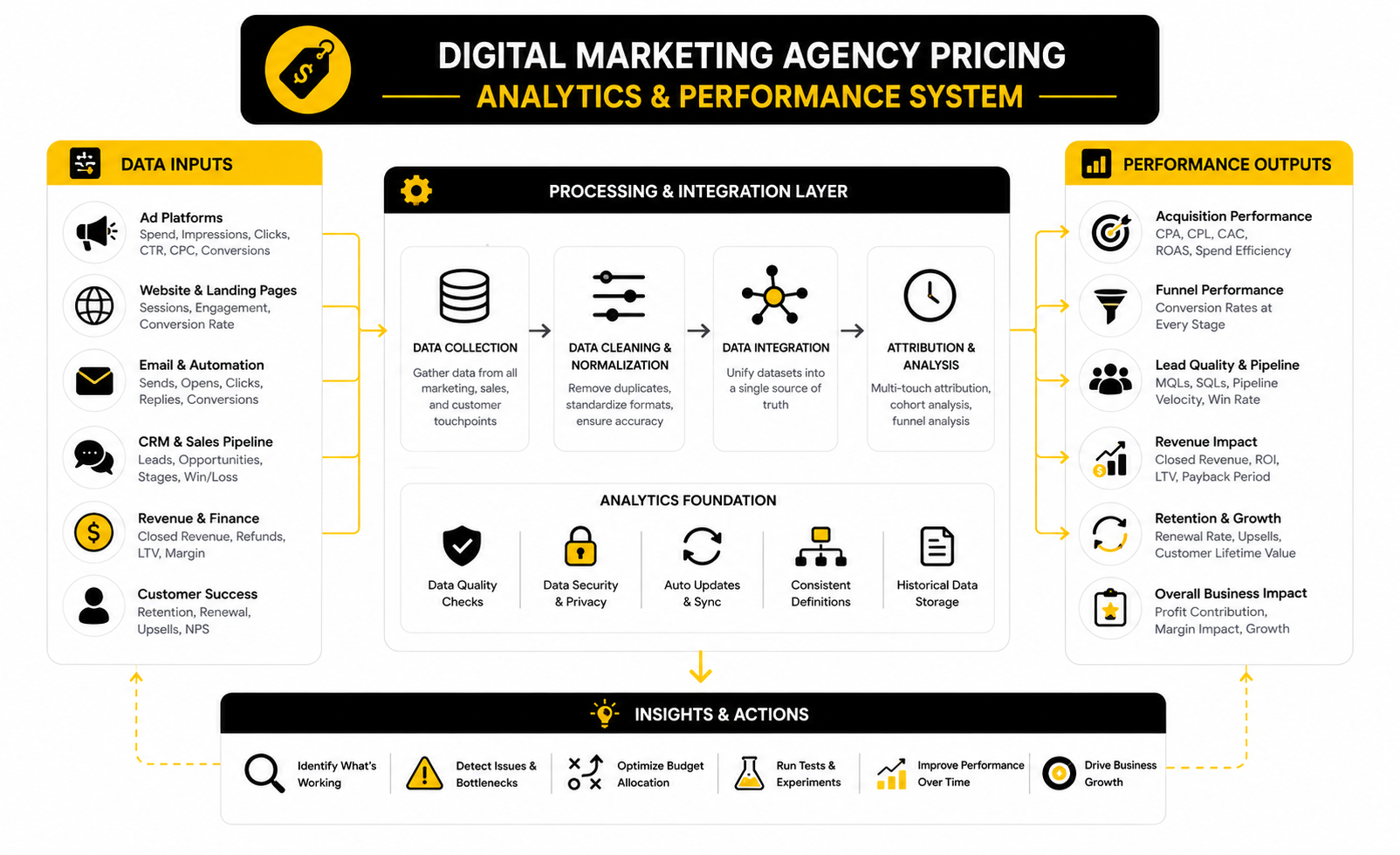
For a lead generation business, the flow should be simple. A visitor clicks an ad or finds you through search, lands on a page, submits a form or books a call, enters the CRM, gets qualified, moves through the pipeline, and eventually becomes revenue or does not. Each step should be visible enough to find the bottleneck.
For ecommerce, the system should connect traffic source, landing page, product views, add-to-cart behavior, checkout completion, revenue, margin, and repeat purchase. If your agency is managing ads but cannot see what happens after the click, optimization will be shallow. They can improve platform metrics, but they cannot properly manage business performance.
What Good Reporting Should Show
Good reporting should answer four questions. What happened? Why did it happen? What does it mean? What are we doing next? If the report does not answer those questions, it is probably not helping you make better pricing or budget decisions.
A strong monthly report should include performance against the main goal, channel-level results, conversion quality, budget movement, tests completed, lessons learned, and next priorities. It should also show problems clearly. Hiding bad news is worse than having bad news, because honest data gives you something to fix.
The best reports are not necessarily the prettiest. They are the ones that help you make decisions faster. If your agency can show which channel deserves more budget, which landing page needs work, which audience is wasting spend, and which offer is creating better leads, the reporting is doing its job.
How To Interpret Paid Media Data
Paid media data should be read in layers. Start with spend, impressions, clicks, click-through rate, cost per click, conversion rate, and cost per conversion. Then go deeper into lead quality, sales acceptance, revenue, margin, and payback period.
This is important because platform-level performance can look good while business performance is weak. A campaign can produce cheap leads that never answer the phone. Another campaign can produce more expensive leads that close at a higher rate and create better customers.
The action depends on where the problem appears. Low click-through rate may point to weak creative or poor targeting. Low conversion rate may point to landing page friction or offer mismatch. Low close rate may point to poor lead quality, weak sales follow-up, or a disconnect between the ad promise and the sales conversation.
How To Interpret SEO Data
SEO data takes longer to read because search performance compounds over time. You should look at organic traffic, rankings, impressions, click-through rate, indexed pages, technical health, content performance, assisted conversions, and revenue or lead contribution. Looking only at rankings is too narrow.
The most useful SEO reports connect visibility to intent. Ranking for informational keywords may help build awareness and trust, while ranking for high-intent service or product terms can drive direct leads or purchases. Both can matter, but they should not be priced or evaluated as if they do the same job.
The action should match the data. If impressions are rising but clicks are weak, titles and meta descriptions may need work. If traffic is rising but conversions are flat, the content may need stronger calls to action, better internal links, or better alignment with buyer intent. If rankings are not moving, the issue may be technical depth, content quality, authority, or competition.
How To Interpret Email Data
Email data should be evaluated beyond open rates. Opens are less reliable than they used to be because privacy changes can distort the number. Clicks, conversions, revenue per recipient, unsubscribe rate, spam complaints, list growth, deliverability, and segment performance are usually more useful.
Email benchmark reports still help, but they need context. Recent benchmark data from Spotler shows an average confirmed open rate of 32.40%, click-to-open rate of 7.62%, and click-through rate of 2.47% across its measured email campaigns (Spotler GDMA Email Benchmark 2025). Those numbers can help you spot weak engagement, but they should not replace revenue and retention analysis.
The action depends on the weak point. If people do not open, the issue may be list quality, sender reputation, subject lines, or timing. If people open but do not click, the message or offer may be weak. If people click but do not buy or book, the landing page, checkout, form, or sales process may be the bottleneck.
How To Interpret Funnel Data
Funnel data shows where attention turns into action, and where action breaks down. A simple funnel might track page visits, form starts, form completions, booked calls, attended calls, proposals sent, and deals won. That view is much more useful than only knowing how many leads came in.
This is especially important for service businesses, agencies, coaches, consultants, and B2B companies. A campaign with a high cost per lead might still be profitable if those leads are qualified and close into high-value deals. A campaign with a low cost per lead can be a disaster if the sales team rejects most of them.
A good funnel review should create specific next steps. If many visitors do not start the form, the offer or page may be weak. If many start but do not finish, the form may be too long or unclear. If many book but do not show, reminders, qualification, or calendar flow may need work through tools like Cal.com, Fillout, or GoHighLevel.
Budget Benchmarks And What They Mean
Budget benchmarks help you understand whether your marketing investment is realistic. Gartner’s 2025 CMO Spend Survey found that marketing budgets remained at 7.7% of overall company revenue, the same level reported the year before (Gartner 2025 CMO Spend Survey). That does not mean every business should spend exactly 7.7%, but it shows that marketing budgets are being scrutinized.
The bigger trend is that digital channels keep absorbing more money. U.S. internet advertising revenue reached $294.6 billion in 2025, up 13.9% year over year, which means competition for attention is still rising (IAB Internet Advertising Revenue Report). When competition increases, weak execution becomes more expensive because platforms punish unclear offers, poor creative, bad landing pages, and sloppy targeting.
This is why budget should be linked to readiness. Spending more does not fix a broken offer or a poor sales process. But underfunding a serious growth goal can also make the agency look bad because there is not enough budget to test, learn, and optimize properly.
How Data Should Change The Agency Relationship
Data should make the agency relationship more objective. Instead of debating opinions, both sides can look at the system and decide what needs to improve. That creates a healthier conversation about pricing, scope, and priorities.
If the data shows the agency is driving qualified opportunities and revenue, the business may choose to increase budget or expand scope. If the data shows traffic is fine but conversion is weak, the next investment may be landing pages, offer testing, or sales follow-up. If the data shows poor campaign quality, the agency needs to explain what is changing and why.
The worst move is to keep paying the same fee while reviewing the same unclear numbers every month. Digital marketing agency pricing only makes sense when reporting leads to action. Data should either justify the current investment, reveal where the scope needs to change, or show that it is time to challenge the relationship.
How To Compare Agency Proposals
Comparing agency proposals is where many businesses make the wrong call. They line up the monthly fees, pick the middle option, and hope the agency will figure it out. That is not buying strategy; that is guessing with a prettier PDF.
A proposal should make the agency’s thinking visible. You should be able to see what problem they believe they are solving, what work they will do, how success will be measured, what the client needs to provide, and what is not included. If two agencies quote different prices, the first job is to understand whether they are actually quoting the same job.
Compare Scope Before Price
The first comparison point is scope. One agency might include strategy, media buying, creative testing, landing page recommendations, tracking support, reporting, and weekly optimization. Another might only include campaign management and a monthly report.
Those are not the same service. A lower fee can be completely fair if the scope is narrow. It can also be dangerous if the agency has removed the exact work needed to make the campaign succeed.
Read the proposal line by line and ask what the agency is responsible for every month. Look for deliverables, cadence, ownership, and decision-making process. Digital marketing agency pricing only becomes comparable when scope is comparable.
Compare Seniority And Access
The person selling the work is not always the person doing the work. That matters. A proposal may sound strategic during the sales call, but the account may later be handled by a junior team with limited senior oversight.
This does not mean junior team members are bad. It means you should understand the delivery model. Who sets strategy? Who manages the account? Who reviews performance? Who joins calls? Who makes decisions when results are not improving?
Access to senior expertise usually costs more, but it can also reduce expensive mistakes. If the business model is complex, the channel is competitive, or the budget is meaningful, senior involvement is not a luxury. It is part of risk control.
Compare Setup Work Separately
Setup work should be separated from ongoing work. Launching a campaign, rebuilding tracking, creating landing pages, writing automation flows, and cleaning up a CRM are not the same as monthly optimization. When everything is bundled into one monthly number, you cannot tell what you are paying for.
A clean proposal will show what happens before launch and what happens after launch. The setup phase may include audits, strategy, tracking, copy, creative, landing pages, tool configuration, and QA. The ongoing phase should focus on testing, reporting, optimization, and growth decisions.
This distinction matters because implementation debt is real. If your current system is messy, the first month may require more build work than optimization. That is normal, but it should be priced and explained clearly.
Compare Reporting Quality
Reporting is not just a deliverable. It is how you know whether the agency relationship is working. Weak reporting makes even good work hard to trust.
A strong proposal should explain what metrics will be reported, how often reports will be shared, what tools will be used, and how decisions will be made from the data. It should also explain whether the agency will report only platform metrics or connect performance to leads, pipeline, sales, revenue, retention, or margin.
This matters because digital channels now account for 61.1% of total marketing spend, which makes measurement discipline more important than ever (Gartner digital channels marketing spend). If most of the budget is moving through digital channels, you need more than screenshots from ad platforms. You need a system that explains what the spend is doing.
Compare Contract Terms
Contract terms affect risk. A long contract can be reasonable when the agency is investing heavily upfront or when the strategy needs time to mature. It can also trap you if the scope is vague and the reporting is weak.
Look at the minimum term, cancellation period, payment timing, ownership of assets, access to accounts, confidentiality, non-compete language, and what happens if performance is poor. You should also confirm whether ad accounts, analytics accounts, landing pages, creative assets, and CRM data remain under your control. This is not a small detail.
Never sign an agreement where the agency owns the accounts that run your business growth. The agency can manage them. They should not hold them hostage.
Red Flags In Agency Pricing
Some pricing issues are obvious. Others are hidden in polished sales language. The biggest red flags usually appear when the agency avoids specifics, promises certainty, or prices the work in a way that disconnects effort from business reality.
A good agency can explain why the price is what it is. They may not guarantee outcomes, because serious marketers know the market does not work that way. But they should be able to explain the logic behind the scope, the pricing model, the timeline, and the measurement plan.
The Price Is Low Because The Scope Is Invisible
A very low price is not automatically bad. It may be a focused service with a narrow scope. The problem starts when the price is low and the agency still claims it will handle everything.
If an agency says it will do strategy, SEO, ads, content, social, email, reporting, landing pages, and optimization for a tiny monthly fee, something has to give. Usually it is strategy, senior attention, creative quality, reporting depth, or actual implementation. You may still receive activity, but activity is not the same as progress.
Ask what is not included. That question is more useful than asking for a discount. The answer will show whether the agency understands its own capacity.
The Agency Guarantees Results It Cannot Control
Guarantees sound reassuring, but many are not serious. An agency can control the quality of its work, the speed of execution, the structure of tests, and the clarity of reporting. It cannot fully control market demand, sales follow-up, product quality, pricing, inventory, customer reviews, competitor behavior, or buyer readiness.
Be careful with promises like guaranteed revenue, guaranteed rankings, guaranteed lead volume, or guaranteed return on ad spend without strict conditions. Those promises often ignore the parts of the system outside the agency’s control. If the guarantee is real, it should define the assumptions, exclusions, time period, and what happens if the target is missed.
Performance confidence is good. Unrealistic certainty is not. There is a difference.
The Proposal Hides Media Spend
Agency fees and media spend should be clearly separated. Media spend is the money paid to platforms. Agency fees are what you pay for management, strategy, creative, reporting, and optimization.
When these are blended together, it becomes hard to see what the agency earns and what actually goes into distribution. That makes budget planning messy and can hide weak efficiency. You should always know how much goes to platforms, how much goes to the agency, and how much goes to tools or production.
This is especially important as digital advertising keeps getting more expensive and competitive. U.S. internet advertising revenue reached nearly $300 billion in 2025, which shows how crowded the market has become (IAB Internet Advertising Revenue Report). In a crowded market, you need clean budget visibility, not blended numbers.
The Agency Charges For Tools Without Explaining Them
Marketing tools are normal. Agencies may use platforms for landing pages, CRM, email automation, reporting, chat, scheduling, forms, scraping, or workflow automation. The issue is not the tool cost; the issue is unclear value.
If a proposal includes software fees, ask what each tool does, who owns the account, whether you can keep the data, and whether the tool is required. For example, GoHighLevel may make sense for CRM, lead tracking, automations, and pipeline management. ManyChat may make sense for chat automation. Buffer may make sense for scheduling and managing social publishing.
The tool should support the strategy. It should not be a mystery line item that nobody explains. If the agency cannot explain why a tool is needed, you probably should not pay for it.
The Reporting Avoids Commercial Outcomes
A proposal that focuses only on activity is a warning sign. Deliverables matter, but they are not the final goal. You need to know how the agency will connect work to commercial movement.
This is especially important when average paid search costs continue to rise. Google Ads cost per lead across industries increased to $70.11 in 2025, which means poor lead quality and weak conversion paths become expensive quickly (WordStream Google Ads benchmarks). If the agency only reports clicks and leads, you may miss the deeper issue: whether those leads are worth buying.
A stronger agency will talk about lead quality, funnel steps, conversion rates, sales feedback, and revenue impact. They will not hide behind surface-level metrics when the real problem is further down the funnel.
How To Choose The Right Pricing Model
The right pricing model depends on your stage, goals, risk tolerance, internal team, and current marketing foundation. There is no universal best model. There is only the model that best matches the work you actually need done.
This is where you need to be honest with yourself. If your tracking is broken, do not pretend you only need ad management. If your offer is unproven, do not expect a performance-only agency deal to save you. If your internal team cannot execute, do not buy a strategy deck and hope the work magically happens.
Choose A Retainer When You Need Ongoing Improvement
A retainer makes sense when the work is continuous. SEO, paid media, content marketing, lifecycle email, conversion optimization, and full-funnel growth all benefit from consistent management. These channels do not improve because someone checks in once and disappears.
Use a retainer when the agency needs to monitor performance, run tests, respond to data, produce assets, and adjust priorities. This model is strongest when the scope is clear and the reporting cadence is consistent. It is weakest when the retainer becomes a vague bucket of hours with no connection to progress.
A good retainer should feel like a working operating system. You should know what the agency is doing, why it matters, what changed recently, and what the next priority is. If you cannot answer those questions after two or three months, the structure needs attention.
Choose Project Pricing When The Outcome Is Defined
Project pricing works when the deliverable is clear. A landing page build, funnel setup, analytics audit, email automation sequence, CRM cleanup, or campaign launch can often be scoped as a project. The cleaner the brief, the cleaner the price.
This is a good model when you need a foundation before ongoing marketing begins. A business might first build a funnel in ClickFunnels, create landing pages in Replo, set up forms in Fillout, and then move into a monthly optimization agreement once the system is live.
The key is to avoid pretending a project includes infinite strategy and unlimited revisions. Fixed pricing needs fixed boundaries. If the project changes, the price should change too.
Choose Hourly Consulting When You Need Expertise, Not Execution
Hourly consulting is useful when you need senior thinking without a full delivery team. This might include reviewing an agency proposal, auditing a campaign, advising an internal team, troubleshooting tracking, or pressure-testing a growth plan. It is also useful when you do not yet know what the full scope should be.
The advantage is flexibility. You can buy focused expertise without committing to a large retainer. The downside is that advice still needs implementation, and someone has to own that work.
Use hourly consulting when you already have operators in place or when you need a sharp second opinion. Do not use it as a substitute for execution if your team does not have the capacity to act on the advice.
Choose Performance-Based Pricing Carefully
Performance-based pricing can work, but only when the business has a proven offer, clean data, strong sales follow-up, and enough volume for the numbers to be meaningful. Without those pieces, performance pricing often creates arguments about attribution and lead quality. That wastes time and damages the relationship.
This model is strongest when both sides can agree on a clear result and track it reliably. For example, a qualified booked call may be easier to define than a vague “lead.” A closed deal may be more meaningful, but it also depends heavily on the client’s sales process.
Hybrid structures are usually safer. A base fee keeps the agency funded enough to do the work properly, while performance upside rewards strong outcomes. That balance is more realistic than asking an agency to carry all the risk while the client controls half the system.
Match Pricing To Your Growth Stage
Early-stage businesses usually need clarity before scale. That may mean a project, audit, funnel build, offer refinement, or small focused retainer. Spending heavily before the foundation is ready can burn cash fast.
Growing businesses usually need consistency. They may benefit from monthly retainers, better reporting, more creative testing, stronger conversion work, and tighter sales alignment. At this stage, the agency should not just run campaigns; it should help improve the system.
Mature businesses usually need specialization and efficiency. They may hire separate agencies or specialists for SEO, paid media, creative, analytics, lifecycle marketing, or conversion rate optimization. At this stage, digital marketing agency pricing should be judged by contribution, not convenience.
Decide What You Are Really Buying
At the end of the pricing decision, ask one practical question: what are we really buying? Are you buying hands to execute tasks, senior strategy, a complete acquisition system, channel specialization, creative production, analytics clarity, or revenue accountability? Each answer deserves a different price.
Do not buy a low-cost package when you need a strategic partner. Do not buy an expensive full-service retainer when you only need a specialist. Do not buy performance pricing when your sales process cannot support it.
The best pricing model is the one that matches the job, exposes the tradeoffs, and creates the right incentives. That is what you are looking for. Not the cheapest number. Not the fanciest proposal. The right structure for the outcome you actually want.
Digital Marketing Agency Pricing FAQs
How much does a digital marketing agency cost?
Digital marketing agency pricing can range from a few hundred dollars per month for a narrow service to tens of thousands per month for a full-service growth partnership. The price depends on scope, channel mix, business complexity, creative requirements, reporting depth, and the level of senior expertise involved. A useful quote should explain what is included, what is excluded, and how the agency’s work connects to the business goal.
What is the most common pricing model for digital marketing agencies?
Monthly retainers are one of the most common pricing models because most digital marketing work requires ongoing management. SEO, paid media, content, email, and conversion optimization all need consistent review, testing, and adjustment. Retainers work best when the scope is specific and the agency reports on progress clearly.
Is hourly pricing better than a monthly retainer?
Hourly pricing is better when you need flexible advice, troubleshooting, audits, or limited support. A monthly retainer is usually better when the agency is responsible for ongoing execution and performance improvement. The best choice depends on whether you need expertise for a defined problem or a team to keep the marketing system moving.
Should I pay a setup fee?
A setup fee is reasonable when the agency has to do real upfront work. That might include audits, tracking setup, CRM configuration, landing page planning, funnel building, copywriting, account restructuring, or automation work. The fee should be clearly explained, because setup work is different from monthly optimization.
What should be included in an agency retainer?
A strong agency retainer should define strategy, deliverables, communication rhythm, reporting, optimization work, and ownership responsibilities. It should also explain how many campaigns, assets, meetings, reports, revisions, or tests are included. If the retainer only says “digital marketing services,” it is too vague.
How do I know if an agency is too expensive?
An agency is too expensive when the cost is not supported by scope, seniority, process, reporting, or business impact. A high fee can be justified if the agency improves qualified pipeline, conversion rates, customer acquisition efficiency, or revenue. A low fee can still be expensive if it creates busywork without measurable progress.
How do I know if an agency is too cheap?
An agency may be too cheap if it promises full-service execution without enough budget to do the work properly. Watch for vague scopes, junior-only delivery, weak reporting, outsourced execution with no quality control, or promises that sound too clean. Cheap can work for narrow tasks, but it is risky for complex growth problems.
Should media spend be included in the agency fee?
Media spend should usually be separated from the agency management fee. You need to know how much money goes to ad platforms and how much goes to the agency. Blending the two can make performance harder to judge and can hide the real cost of campaign management.
What is a fair percentage of ad spend for PPC management?
Many PPC management fees are structured as a percentage of ad spend, often with a minimum monthly fee. The right percentage depends on budget size, campaign complexity, creative workload, tracking needs, and reporting depth. A percentage model should still be tied to efficiency, because the agency should not be rewarded only for increasing spend.
Is performance-based agency pricing a good idea?
Performance-based pricing can work when tracking is clean, the offer is proven, and the business has a reliable sales process. It becomes risky when results depend on factors the agency cannot control, such as close rate, product quality, pricing, or lead follow-up. A hybrid model with a base fee and performance upside is usually more practical than pure performance pricing.
What questions should I ask before signing an agency contract?
Ask what is included, what is excluded, who will work on the account, how performance will be reported, who owns the ad accounts and data, what tools are required, and how scope changes are handled. You should also ask what the agency needs from you to make the engagement successful. A good agency will welcome these questions because clear expectations protect both sides.
How long should I give an agency before judging results?
It depends on the channel and the starting point. Paid media can show early signals faster, but lead quality, sales conversion, and optimization still need enough data to evaluate properly. SEO, content, lifecycle email, and full-funnel work usually need more time because they rely on compounding improvements and better infrastructure.
What should I do if my agency reports look good but sales are not improving?
Start by checking whether the reports are focused on the right metrics. Traffic, clicks, impressions, and leads can look positive while sales stay flat. The next step is to review lead quality, landing page conversion, sales follow-up, show rates, close rates, offer fit, and attribution inside the CRM.
Do I need a full-service agency or a specialist?
Choose a full-service agency when you need connected strategy across multiple channels and do not have the internal team to coordinate everything. Choose a specialist when the problem is narrow, such as PPC, SEO, email automation, analytics, or landing page optimization. The more complex your growth system becomes, the more important coordination becomes.
What is the biggest mistake businesses make with agency pricing?
The biggest mistake is comparing prices without comparing scope. A cheaper proposal may exclude strategy, creative, landing pages, tracking, reporting, or senior oversight. A more expensive proposal may be the better deal if it includes the work required to produce a real business outcome.
Build a stronger local presence with BAAM AI
Turn your website, Google profile, social channels, and AI visibility into one growth engine
Most businesses do not need more random marketing activity. They need a consistent presence system that helps the right people find them, trust them, and take action. BAAM AI brings strategy, local SEO, website updates, Google Maps visibility, social content, AI-search readiness, media production, and reporting into one practical monthly engine.
If you want your marketing to keep working after the campaign ends, start with a free BAAM AI presence audit. See how your business shows up today and where the fastest visibility wins are at BAAM AI.