
BAAM AI Blog
Digital Creative Agency: The Practical Guide To Strategy, Content, Design, And Growth
A digital creative agency helps a brand turn attention into action across the channels where people now discover, compare, trust, and buy. That usually means strategy, positioning, creative direction, branding...
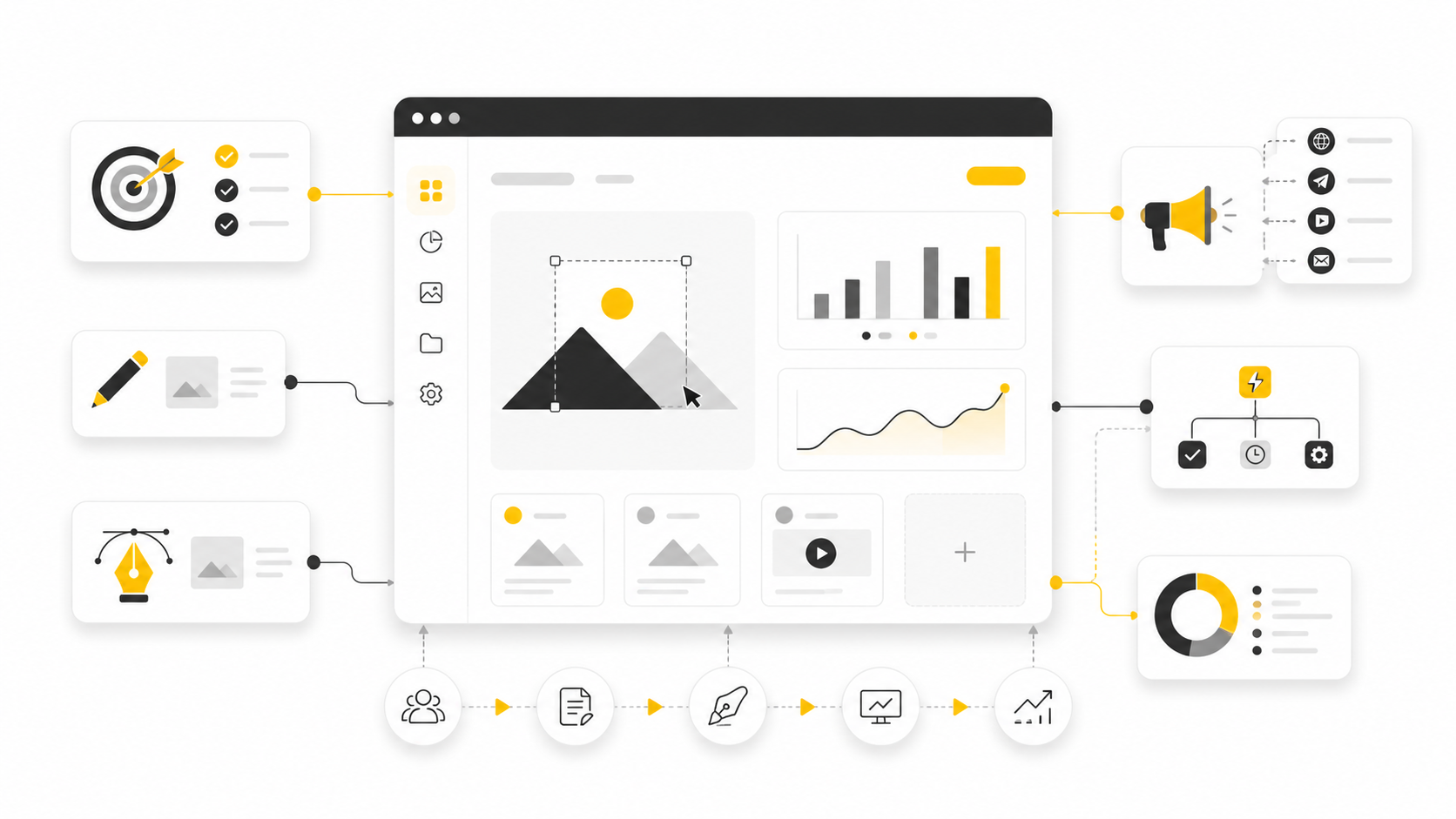
A digital creative agency helps a brand turn attention into action across the channels where people now discover, compare, trust, and buy. That usually means strategy, positioning, creative direction, branding, content, paid media, landing pages, funnels, social campaigns, email, automation, analytics, and conversion-focused design working together instead of living in separate silos.
That last part matters. A digital creative agency is not just a design studio with a social media calendar. It is not just a paid ads team with nicer graphics either. The best agencies connect the message, the visual system, the offer, the customer journey, and the performance data so every creative decision has a commercial reason behind it.
This is why the category has become more important. Digital advertising keeps taking a larger share of brand investment, with U.S. internet ad revenue reaching $294.6 billion in 2025. At the same time, marketing teams are under pressure to do more with tighter resources, with Gartner reporting that 2025 marketing budgets have flatlined at 7.7% of company revenue. That combination creates a simple reality: brands cannot afford random creative anymore.
A strong digital creative agency gives structure to that chaos. It helps a business decide what to say, who to say it to, where to show up, what assets to build, how to test them, and how to keep improving once campaigns go live. The output may look like videos, landing pages, ads, emails, brand systems, creator campaigns, or automated follow-up sequences, but the real product is momentum.
For founders, CMOs, ecommerce teams, SaaS companies, local service businesses, and creator-led brands, the question is no longer whether digital matters. It clearly does. The better question is how to build a creative operating system that can keep up with buyers, platforms, algorithms, and rising expectations without turning every campaign into a fire drill.
Why A Digital Creative Agency Matters Now
A digital creative agency matters because modern marketing is fragmented by default. A customer might discover a brand through a short video, check reviews, visit a landing page, compare competitors, join an email list, ask a chatbot a question, and only then decide whether to buy. If every touchpoint looks and sounds like it came from a different company, trust leaks out of the journey.
Consistency is not just a branding preference. Adobe’s 2025 digital trends research highlights that 78% of customers want consistent brand experiences, which is exactly where creative and performance need to meet. People do not separate “the ad” from “the website” from “the follow-up email” in their minds. They experience one brand, and they judge it fast.
The practical job of a digital creative agency is to make that experience coherent. It takes the brand promise and turns it into assets that work across paid, organic, owned, and automated channels. That might include a sharper offer, a clearer homepage, a better social content system, stronger email flows, better lead capture, more persuasive landing pages, or a campaign concept that can scale without becoming repetitive.
The Digital Creative Agency Framework
A useful way to understand a digital creative agency is to think in layers. Strategy sets the direction, creative turns the direction into messages and assets, technology distributes and automates the experience, and measurement shows what is actually working. When those layers are connected, the agency can move faster without guessing.
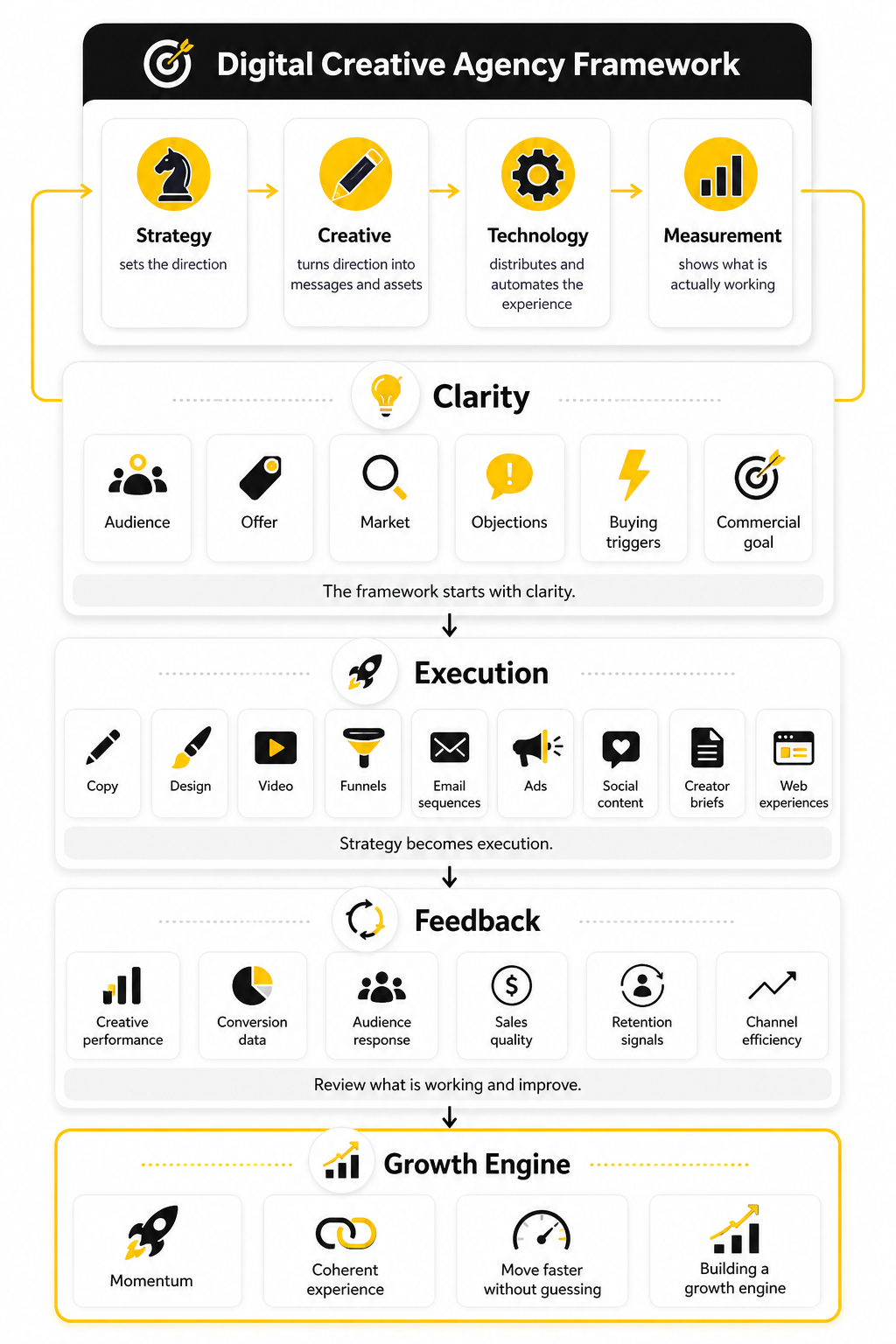
The framework starts with clarity. Before anyone designs a landing page or edits a campaign video, the agency needs to understand the audience, the offer, the market, the objections, the buying triggers, and the brand’s commercial goal. Without that foundation, even beautiful creative can become expensive decoration.
The second layer is execution. This is where the strategy becomes copy, design, video, funnels, email sequences, ads, social content, creator briefs, and web experiences. A digital creative agency may use tools like GoHighLevel for CRM and automation, ClickFunnels for funnel building, Replo for ecommerce landing pages, ManyChat for conversational automation, or Buffer for social publishing, but tools only matter when the underlying system is clear.
The third layer is feedback. Good agencies do not treat launch day as the finish line. They review creative performance, conversion data, audience response, sales quality, retention signals, and channel efficiency so the next version gets sharper. That is the difference between producing assets and building a growth engine.
Core Services A Digital Creative Agency Provides
A digital creative agency usually sits between brand strategy, content production, web experience, paid acquisition, and customer journey design. That position is powerful because creative decisions rarely live in one channel anymore. A landing page headline affects paid ads, the paid ads affect email signups, the email sequence affects sales calls, and the sales feedback should influence the next campaign.
The exact service mix depends on the agency. Some agencies are stronger in brand identity and campaign concepts, while others are built around performance creative, funnels, automation, and growth systems. The best fit is not always the biggest agency or the flashiest portfolio; it is the team that understands the business model and can turn creative work into measurable progress.
Brand Strategy And Positioning
Brand strategy is where the agency defines what the business should be known for. This includes the target audience, category positioning, value proposition, brand voice, key messages, proof points, and competitive angle. Without this layer, the rest of the creative work becomes guesswork with a nicer font.
Positioning is especially important when the market is crowded. A digital creative agency should help a brand answer simple but difficult questions: why should someone choose this, why now, and why from this company? Those answers shape everything from the homepage to the ad hooks to the sales deck.
This does not mean every business needs a massive brand workshop before it can publish anything. Sometimes the practical move is a focused positioning sprint that clarifies the offer, audience, promise, and objections. The goal is not to create a document that sits in a folder; the goal is to make every campaign easier to write, design, test, and sell.
Creative Direction And Campaign Concepts
Creative direction turns strategy into an idea people can feel. It defines the visual tone, messaging angle, campaign theme, content style, and emotional hook behind the work. This is where a digital creative agency earns its keep, because good creative direction makes the brand recognizable before the logo even appears.
Campaign concepts matter because platforms are noisy. People scroll fast, compare quickly, and ignore anything that feels generic. A strong concept gives the campaign a spine, so the same core idea can stretch across short-form video, landing pages, paid ads, email, creator content, and sales enablement without feeling copy-pasted.
This is also where discipline matters. Not every clever idea is a useful idea. The concept has to support the offer, match the audience’s stage of awareness, and create a clean path toward action.
Content Strategy And Production
Content is no longer just “posting more.” A serious content strategy decides which topics, formats, channels, angles, and calls to action deserve attention. The job is to create a repeatable system that helps the brand attract the right people, build trust, answer objections, and stay present between buying moments.
Production can include short-form video, founder-led content, product explainers, case study assets, social posts, newsletters, lead magnets, webinars, podcast clips, and educational articles. The important part is that each piece has a role. Some content earns attention, some builds authority, some captures demand, and some helps convert people who are already close to buying.
This is where AI has changed the workflow but not the responsibility. HubSpot’s 2026 marketing research reports that 80% of marketers use AI for content creation, which means speed is becoming normal. But faster output does not automatically mean better marketing, so a digital creative agency still needs editorial judgment, audience insight, and a clear brand voice.
Web Design And Conversion Experience
A website is not just a digital brochure. For many brands, it is the main place where attention turns into revenue, leads, demos, bookings, or purchases. A digital creative agency should treat the website as a conversion environment, not just a design canvas.
That means the agency needs to understand page structure, messaging hierarchy, user intent, mobile behavior, loading speed, trust signals, offer clarity, and calls to action. A beautiful page that confuses people is still a bad page. A simple page that makes the next step obvious can outperform a complex design with no commercial focus.
For ecommerce brands, landing page builders like Replo can help teams move faster when testing product pages, advertorials, campaign pages, and seasonal offers. For service businesses, coaches, consultants, and lead generation teams, funnel platforms like ClickFunnels or all-in-one systems like GoHighLevel can make it easier to connect pages, forms, calendars, follow-up, and pipeline tracking.
Paid Media Creative
Paid media creative is where messaging gets tested under pressure. The ad has to earn attention, qualify the viewer, communicate the offer, and create enough interest for the next click. That is a lot to ask from a few seconds of attention.
A digital creative agency should not only make ads look polished. It should create variations around different hooks, objections, formats, audiences, and stages of awareness. This gives the media buyer more useful tests and helps the brand learn what the market actually responds to.
The creative feedback loop matters here. If one angle gets cheaper clicks but poor leads, that is not a win. If another angle produces fewer clicks but better sales conversations, the agency needs to spot that pattern and adjust the next batch of creative accordingly.
Email, Automation, And Lead Nurturing
Most customers do not buy the first time they see a brand. That is why email, SMS, chat automation, and CRM follow-up are part of the creative system, not separate technical extras. The message after the opt-in can be just as important as the ad that created the opt-in.
A digital creative agency can build welcome sequences, abandoned cart flows, lead nurture campaigns, reactivation campaigns, booking reminders, post-purchase education, review requests, and upsell paths. These flows should sound human, answer real objections, and move people forward without feeling desperate. Automation works best when it feels timely and useful, not robotic.
Tools can help here when they match the customer journey. ManyChat can support conversational flows across social and messaging channels, while Brevo and Moosend can support email campaigns and marketing automation for teams that need practical execution without overcomplicating the stack.
Analytics And Creative Optimization
Analytics gives creative work a reality check. It shows which messages attract the right audience, which pages lose people, which offers convert, and which channels produce leads or customers worth pursuing. Without analytics, the agency and the client are mostly debating opinions.
The key is to measure the right things. Impressions, clicks, views, and likes can be useful, but they are not the full story. A digital creative agency should connect creative performance to deeper signals like conversion rate, cost per qualified lead, booked calls, revenue, retention, repeat purchase behavior, and customer quality.
This is where strong agencies become better over time. They do not just report what happened; they use the data to improve the next decision. That is how creative becomes an operating system instead of a collection of one-off assets.
How Professional Implementation Works
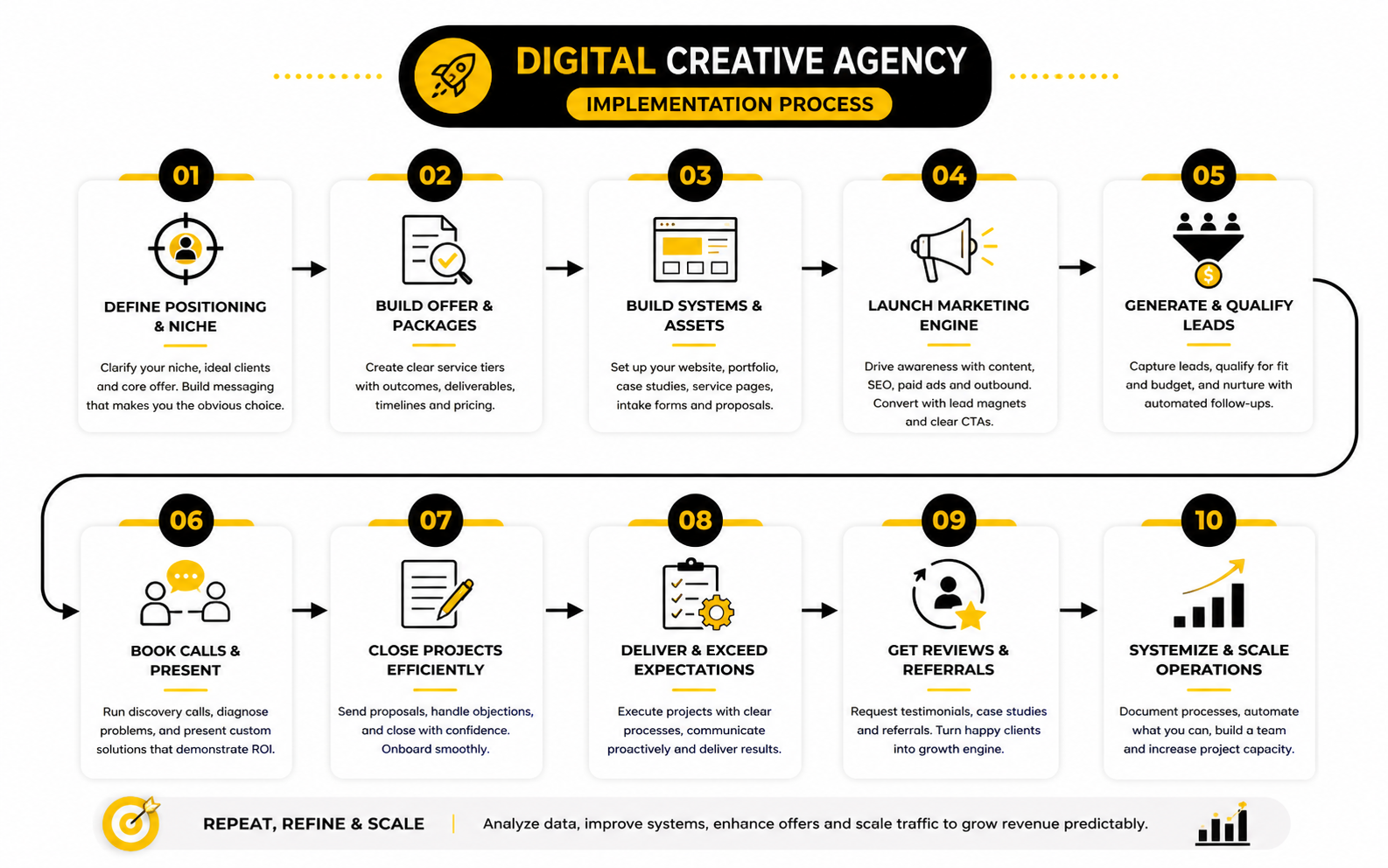
Professional implementation is where the digital creative agency moves from ideas into execution. This is the point where strategy becomes deadlines, owners, briefs, drafts, revisions, launches, and reporting. It is also where weak agencies get exposed fast, because a good-looking plan means nothing if the team cannot ship quality work on time.
The process should feel structured without becoming slow. You want enough discovery to avoid random creative, enough planning to keep everyone aligned, and enough speed to get campaigns into the market while the opportunity is still fresh. The goal is not perfection in a vacuum; the goal is a controlled system for creating, launching, learning, and improving.
Step 1: Discovery And Commercial Alignment
The first step is understanding what the business is actually trying to achieve. More sales is too vague. A useful goal might be more qualified demo bookings, lower acquisition costs, better ecommerce conversion, stronger retention, more local appointments, higher average order value, or a clearer path from content to revenue.
A digital creative agency should ask about the business model, sales process, margins, buying cycle, customer objections, current channels, best-performing offers, and existing assets. This is not busywork. It gives the creative team the commercial context they need to make decisions that actually matter.
Discovery should also expose constraints. Maybe the brand has a small team, limited production capacity, a short launch window, a messy CRM, weak tracking, or an offer that needs tightening before traffic scales. Good implementation starts by naming those realities instead of pretending everything can be solved by prettier creative.
Step 2: Audience And Message Research
Once the commercial goal is clear, the agency needs to understand the audience in practical detail. That means looking at how people describe their pain, what they compare, what they misunderstand, what they fear, and what they need to believe before they take action. Strong messaging usually comes from the market, not from a brainstorming session in isolation.
This research can include customer interviews, sales call reviews, support tickets, reviews, competitor pages, search behavior, social comments, survey responses, CRM notes, and analytics data. The point is to find language that feels familiar to the buyer. When messaging sounds like the customer’s real world, conversion gets easier.
This is also where personalization becomes useful instead of gimmicky. McKinsey has reported that companies with faster growth derive 40% more revenue from personalization than slower-growing peers, but the real takeaway is simple: relevance wins. A digital creative agency does not need to personalize everything; it needs to personalize the moments that change behavior.
Step 3: Creative Briefs And Production Planning
The creative brief turns research into instructions. It should define the objective, audience, offer, key message, emotional angle, proof points, required assets, channel requirements, success metrics, and approval process. Without a strong brief, production gets messy because every stakeholder starts judging the work from a different standard.
Production planning then breaks the campaign into actual deliverables. That may include ad variants, landing page sections, email flows, video scripts, design directions, social posts, creator briefs, chatbot flows, or sales enablement assets. Each asset should have a job, because vague deliverables create vague results.
This stage is also where the agency should decide what needs to be custom and what can be systemized. Not every asset needs a fresh reinvention. Templates, swipe files, brand components, reusable page sections, and automation workflows help the team move faster while still protecting quality.
Step 4: Build, Review, And Refine
Execution starts with the first real draft. Copy gets written, pages get built, visuals get designed, videos get edited, automations get mapped, and campaign assets start taking shape. This is where the strategy becomes visible, so the review process needs to stay focused on the goal rather than personal taste.
Feedback should be specific and tied to the brief. “Make it pop” is not useful. “The hero section needs to make the outcome clearer before the call to action” is useful because it points to a business problem.
A digital creative agency should expect refinement. First drafts create direction, but the best work usually improves through structured review, stronger proof, sharper hierarchy, better pacing, cleaner calls to action, and fewer distractions. The important thing is to avoid endless revision loops that drain momentum without improving performance.
Step 5: Launch Preparation
Launch preparation is where small details protect the entire campaign. Tracking links, forms, pixels, thank-you pages, CRM fields, email triggers, calendar connections, checkout flows, and mobile layouts all need to work before traffic arrives. A campaign can have strong creative and still lose money if the technical handoff is sloppy.
This is why implementation should include quality assurance. The agency should test the customer journey from first click to final conversion, including the confirmation messages and follow-up steps after someone takes action. If the path breaks, the campaign breaks.
For teams running lead generation, a platform like GoHighLevel can help connect landing pages, forms, calendars, pipelines, and automated follow-up in one place. For teams that need fast funnel deployment, Systeme.io can also fit when the priority is simplicity, speed, and keeping the core journey manageable.
Step 6: Measure, Learn, And Improve
After launch, the agency should move into active optimization. This does not mean changing everything after one bad day. It means watching the right signals, separating noise from patterns, and improving the work based on evidence.
The review should look beyond surface metrics. A high click-through rate might look good, but it does not matter if the traffic does not convert or the leads are poor quality. Strong implementation connects creative performance to landing page behavior, lead quality, sales feedback, purchase data, and retention signals.
This is where the digital creative agency becomes a long-term partner instead of a production vendor. Each campaign teaches the team something about the audience, the offer, and the market. When those lessons feed the next round of strategy and creative, the whole system gets sharper.
How To Choose The Right Digital Creative Agency
Choosing a digital creative agency is not about finding the team with the loudest website. It is about finding the team that can understand your business, make strong creative decisions, execute consistently, and improve based on what the market tells you. That sounds obvious, but this is where many companies make expensive mistakes.
The wrong agency will sell activity. More posts, more ads, more designs, more meetings, more reports. The right agency will build a system that connects creative work to buyer behavior, channel performance, sales feedback, and business outcomes.
Start With The Business Model
Before comparing portfolios, get clear on the business model. An ecommerce brand selling a visual product needs a different creative engine than a B2B SaaS company selling annual contracts. A local service business needs different follow-up logic than a creator selling courses or a consultant selling high-ticket strategy.
A digital creative agency should understand how the business makes money. They should ask about margins, sales cycles, customer value, fulfillment capacity, product mix, and lead quality. If they jump straight into deliverables before understanding those basics, that is a warning sign.
This matters because the same tactic can mean different things in different models. A quiz funnel might be useful for one ecommerce brand and completely unnecessary for another. A polished brand film might support enterprise trust, but it will not fix a weak offer or a broken booking process.
Look For Strategic Range, Not Random Services
A long list of services does not automatically mean the agency is strong. Some agencies list everything because they do not want to miss a sale. Better agencies can explain what they do, what they do not do, and how their services fit together.
Strategic range means the agency can connect the dots. They can see how a brand message affects ad performance, how a landing page affects lead quality, how email follow-up affects conversion, and how sales feedback should influence the next creative batch. That is very different from simply having separate departments for design, copy, video, and media buying.
Ask how they make decisions. If the answer is mostly taste, trends, or platform hacks, be careful. A serious digital creative agency should be able to explain the logic behind the work in plain language.
Check The Operating Rhythm
Creative quality matters, but operating rhythm is what keeps the relationship healthy. You need to know how the agency handles briefs, timelines, approvals, reporting, revisions, launch checks, and prioritization. A talented but chaotic agency can drain a team quickly.
The operating rhythm should match your internal capacity. If your team is small, you may need an agency that can own more of the process. If you have an internal marketing team, you may need a sharper specialist that plugs into your existing workflow without creating friction.
This is also where tools can either help or hurt. A CRM such as Copper can support relationship visibility for sales-led teams, while scheduling through Cal.com can reduce friction around calls, demos, and consultations. But tools do not replace ownership, and no platform can rescue a process nobody is managing.
Understand The Tradeoff Between Speed And Depth
Speed is valuable. Markets move fast, trends shift, competitors copy, and campaigns lose freshness. A digital creative agency that takes three months to ship basic assets may not fit a growth team that needs constant iteration.
But speed without depth creates shallow work. If the agency skips research, ignores positioning, avoids customer insight, and rushes straight into output, you may get fast assets that miss the point. That is not agility; that is motion without direction.
The best setup is usually a strong strategic foundation followed by fast production cycles. Do the thinking properly once, then build a repeatable creative system around it. That gives you speed without starting from zero every time.
Watch For The Biggest Red Flags
Some red flags show up before the contract is signed. If the agency guarantees results without understanding the offer, audience, budget, or sales process, be careful. If they blame every past failure on the client before they have heard the full context, be careful.
Other red flags appear in the way they talk about measurement. If they only report vanity metrics, avoid commercial accountability, or cannot explain how they learn from performance data, they may be more of a content vendor than a growth partner. That is not always bad, but it needs to match your expectations.
Also watch for overdependence on one platform. A digital creative agency should have preferences, but it should not force every business into the same stack. For some teams, GoHighLevel will make sense because it centralizes CRM, automation, funnels, and pipeline tracking. For others, a lighter stack with Buffer, Brevo, and a focused landing page builder may be more practical.
Know What To Keep In-House
Not everything should be outsourced. The client still owns the business context, customer relationships, product truth, sales feedback, and final strategic priorities. If a company expects a digital creative agency to magically understand all of that without access, the relationship will struggle.
The best agency relationships have clear ownership. The agency may lead strategy, creative, production, testing, and reporting, while the client provides fast feedback, customer insight, internal data, and decision-making authority. When that exchange works, the agency can move faster and make better calls.
This is especially important as AI becomes more common in creative workflows. HubSpot’s 2025 State of AI research notes that 55% of marketers named content creation as the most popular AI use case. That creates more output, but it also makes brand judgment, editorial control, and strategic taste more valuable, not less.
Scale The System Before You Scale The Spend
The most dangerous move is increasing spend before the system is ready. More traffic will not fix unclear positioning, weak landing pages, poor follow-up, bad lead handling, or slow sales response. It will just expose the leaks faster.
A digital creative agency should help strengthen the system before pushing harder on distribution. That may mean improving the offer, rebuilding the highest-impact landing page, tightening the sales handoff, creating better nurture sequences, or developing a stronger testing rhythm. These moves may feel less exciting than a big campaign launch, but they often create the foundation for profitable scale.
Scaling should happen in stages. Prove the message, prove the conversion path, prove the follow-up, prove the economics, then expand the volume. That is slower than hype, but it is much safer than throwing more budget at a machine that is not ready.
Tools, Workflows, Measurement, And FAQ
The final layer is the ecosystem around the work. A digital creative agency does not operate through strategy alone, and it does not scale through talent alone either. It needs a practical operating system where research, planning, production, approvals, publishing, automation, analytics, and optimization all connect.
This ecosystem should be simple enough for the client to understand and strong enough for the agency to repeat. If every campaign depends on heroic effort, the system will eventually break. If the workflow is clear, the agency can protect creative quality while still moving fast.
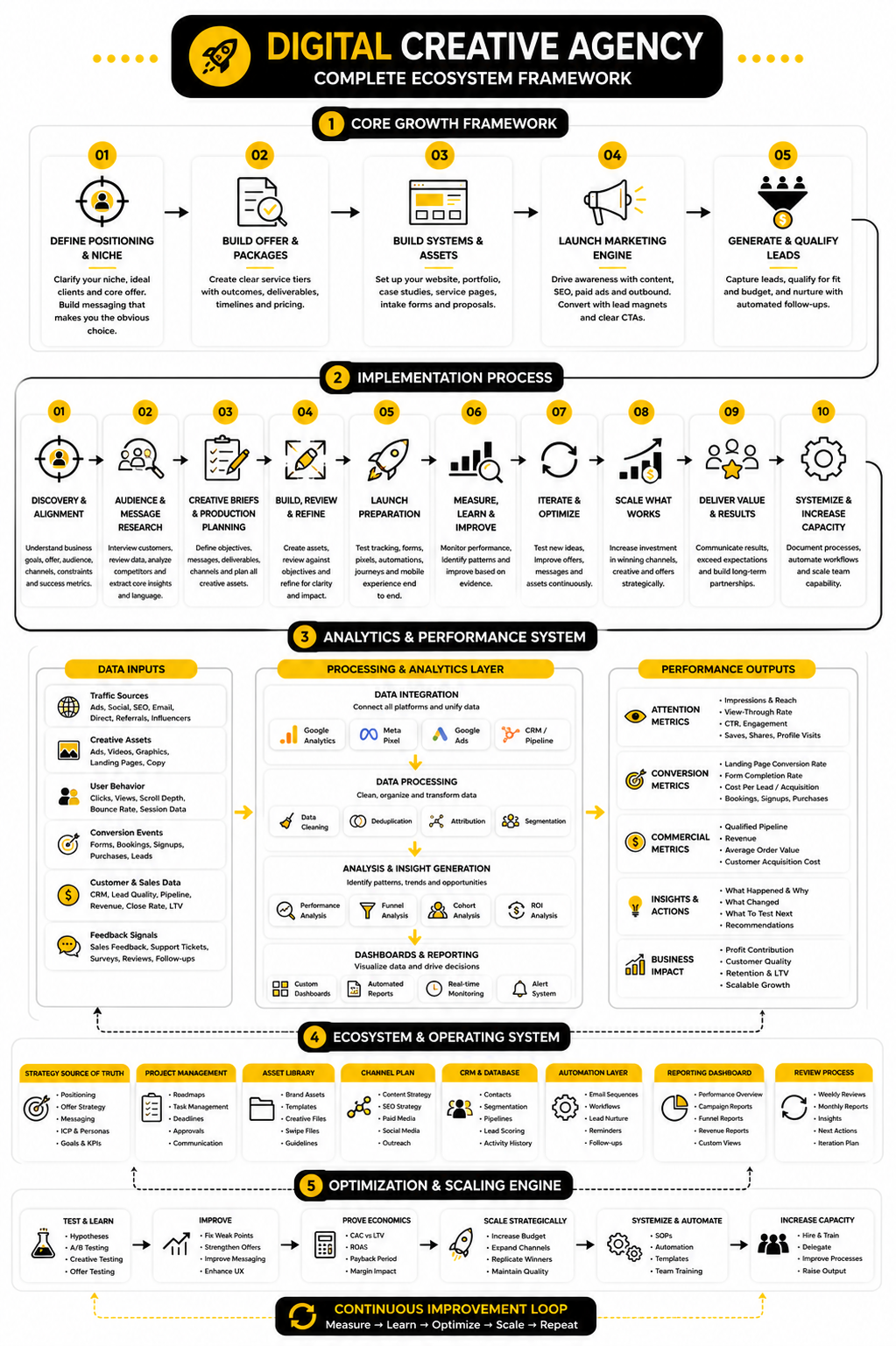
A healthy ecosystem usually includes a few core pieces: a strategy source of truth, a project management rhythm, a shared asset library, a channel plan, a CRM or customer database, an automation layer, a reporting dashboard, and a regular review process. The exact tools can change, but the logic should stay stable. The point is to make better decisions faster, not to build a bloated tech stack nobody uses.
For many teams, the smart move is to consolidate where it reduces friction and specialize where it improves performance. GoHighLevel can work well when the agency needs CRM, funnels, calendars, pipelines, and automation in one place. ClickFunnels can fit teams that want dedicated funnel building, while Replo is useful for ecommerce teams that need faster landing page testing.
The mistake is buying tools before defining the workflow. A new platform will not fix unclear ownership, weak briefs, slow approvals, poor tracking, or vague goals. A digital creative agency should help choose tools only after the strategy, process, and measurement logic are clear.
What Is A Digital Creative Agency?
A digital creative agency is a team that helps brands plan, create, launch, and improve marketing assets across digital channels. It can work on strategy, branding, content, websites, landing pages, paid media creative, email, automation, social campaigns, and analytics. The strongest agencies connect creative output to business outcomes instead of treating design and content as isolated tasks.
How Is A Digital Creative Agency Different From A Traditional Creative Agency?
A traditional creative agency often focuses more on brand campaigns, identity, messaging, and big creative concepts across broad media. A digital creative agency usually works closer to websites, social platforms, funnels, email, automation, performance creative, and measurable customer journeys. The difference is not just the channel; it is the speed, feedback loop, and need to optimize based on live digital behavior.
What Services Should A Digital Creative Agency Offer?
A strong digital creative agency should offer a practical mix of strategy, creative direction, copywriting, design, content production, landing pages, campaign development, automation, and reporting. It does not need to offer everything, but the services should connect logically. If the agency creates ads but ignores the landing page, or builds pages but ignores the offer, the system will have gaps.
When Should A Business Hire A Digital Creative Agency?
A business should consider hiring a digital creative agency when internal execution is too slow, the brand message is unclear, campaigns are inconsistent, or growth depends on better creative across multiple channels. It also makes sense when a company has traffic but poor conversion, content but no strategy, or a sales process that needs stronger digital support. The best time to hire is before the team is overwhelmed, not after months of scattered execution.
How Much Does A Digital Creative Agency Cost?
Costs vary widely based on scope, market, experience, deliverables, and whether the agency is handling strategy, production, media, automation, or full growth execution. A focused project may cost far less than an ongoing retainer with multiple channels and weekly production. The better question is not just price, but whether the agency can improve the economics of the business enough to justify the investment.
What Should I Ask Before Hiring A Digital Creative Agency?
Ask how the agency learns about customers, how it defines success, how it builds briefs, how it handles revisions, how it reports performance, and how it decides what to test next. Ask who will actually work on the account, not just who appears on the sales call. Also ask what the agency needs from your team, because strong implementation requires client-side access, feedback, and decision-making.
How Long Does It Take To See Results?
Some improvements can appear quickly, especially when the issue is a weak landing page, unclear offer, poor follow-up, or underdeveloped ad creative. Bigger brand, content, and funnel systems usually take longer because they need research, production, testing, and iteration. A digital creative agency should avoid promising instant transformation, but it should still show early progress through clearer assets, better tracking, faster execution, and stronger learning loops.
Should A Digital Creative Agency Handle Paid Ads Too?
It depends on the agency’s strengths and your internal team. Some agencies are excellent at creative and strategy but prefer to work alongside a dedicated media buyer. Others combine creative production, media buying, landing pages, and reporting under one roof.
The important thing is alignment. Paid ads and creative need to share data, because ad performance should influence the next creative batch. If the teams are separate, they need a clear feedback rhythm so insights do not get trapped in platform dashboards.
What Metrics Should A Digital Creative Agency Report?
A digital creative agency should report metrics that match the asset’s job. For awareness, that might include reach, retention, engagement, and click-through rate. For conversion, it might include landing page conversion rate, cost per lead, booking rate, checkout completion, or trial signup rate.
For business impact, the agency should connect campaign activity to qualified pipeline, revenue, customer quality, retention, or average order value where possible. The report should not just show numbers. It should explain what changed, what the team learned, and what action comes next.
Can A Digital Creative Agency Use AI Without Making The Brand Sound Generic?
Yes, but only if AI is treated as an assistant, not the strategist. AI can help with research organization, first drafts, content variations, repurposing, transcription, workflow speed, and production support. It should not replace customer insight, brand judgment, editorial taste, or final creative direction.
This matters more as AI becomes normal in marketing. HubSpot’s 2026 research reports that 80% of marketers use AI for content creation, so the advantage is no longer simply using AI. The advantage is using it with better taste, better data, and stronger brand control.
What Are The Biggest Risks When Working With A Digital Creative Agency?
The biggest risks are unclear goals, weak communication, slow approvals, vague ownership, poor tracking, and a mismatch between the agency’s strengths and the company’s real needs. Another common risk is hiring for style when the actual problem is strategy, offer clarity, or conversion. Beautiful creative cannot rescue a broken customer journey.
There is also a risk of overproduction. More assets are not always the answer. A good digital creative agency should know when to create, when to test, when to refine, and when to stop adding complexity.
Do Small Businesses Need A Digital Creative Agency?
Small businesses do not always need a large agency, but they do need clear creative and digital execution. A smaller business might work with a specialized digital creative agency, a compact freelance team, or a consultant-led production setup. The right choice depends on budget, urgency, internal skills, and how complex the customer journey is.
For small teams, simplicity matters. Start with the offer, website or landing page, lead capture, follow-up, and a manageable content or paid traffic system. Once those pieces work, scaling becomes much easier.
What Makes A Digital Creative Agency Worth Keeping Long Term?
A digital creative agency is worth keeping when it keeps making the business more carefully. It should improve the quality of creative output, reduce execution friction, find useful patterns in performance data, and bring better ideas as it learns the market. The relationship should become more efficient over time, not more confusing.
Long-term value comes from compounding insight. The agency learns which messages work, which objections matter, which channels produce quality customers, and which creative formats deserve more investment. That knowledge becomes a real asset.
Build a stronger local presence with BAAM AI
Turn your website, Google profile, social channels, and AI visibility into one growth engine
Most businesses do not need more random marketing activity. They need a consistent presence system that helps the right people find them, trust them, and take action. BAAM AI brings strategy, local SEO, website updates, Google Maps visibility, social content, AI-search readiness, media production, and reporting into one practical monthly engine.
If you want your marketing to keep working after the campaign ends, start with a free BAAM AI presence audit. See how your business shows up today and where the fastest visibility wins are at BAAM AI.