
BAAM AI Blog
Dental Social Media: A Practical Growth Framework For Modern Practices
Dental social media is not about posting random whitening photos, holiday graphics, and “call us today” captions until something works. It is the public-facing layer of your patient acquisition system. Done well, it...
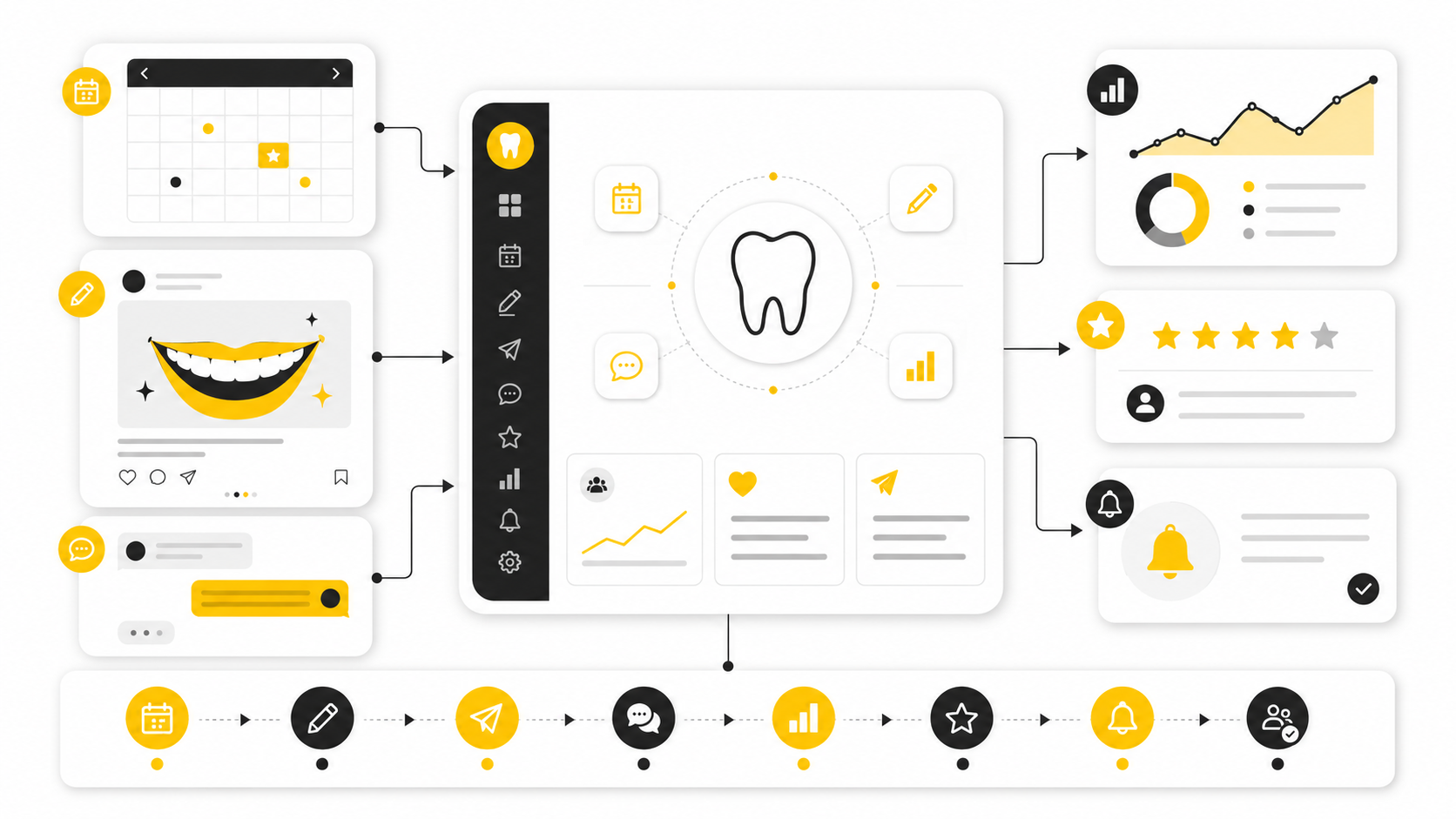
Dental social media is not about posting random whitening photos, holiday graphics, and “call us today” captions until something works. It is the public-facing layer of your patient acquisition system. Done well, it helps people recognize your practice, trust your clinical standards, understand treatment options, and take the next step without feeling pushed.
That matters because patients are already researching care online before they ever pick up the phone. In the United States, internet penetration reached 93.1% at the start of 2025, which means the first impression of a dental practice often happens on a screen, not at the front desk. Social platforms are part of that first impression, alongside Google reviews, the practice website, local search visibility, and the way the team follows up with inquiries.
The mistake is treating social media like decoration. A dental practice does not need more noise. It needs a repeatable content system that builds trust, protects compliance, shows the real patient experience responsibly, and turns attention into booked appointments.
this guide is structured as one complete dental social media playbook split across six parts. Each part builds on the previous one, so the strategy moves from why social media matters to how a practice can implement it professionally. The goal is not to chase trends, but to create a practical system a dental team can actually run.
Why Dental Social Media Matters Now
Dental social media matters because trust is now built before the consultation. People want to see the office, the dentist, the team, the patient experience, the tone of communication, and the quality of education before they decide whether a practice feels right. A polished website still matters, but social media adds the living, human layer that static pages often miss.
Patients also rely heavily on public proof when choosing local healthcare providers. A 2025 healthcare review survey found that 73.28% of patients consider reviews when choosing a provider, which makes reputation and social proof part of the same decision journey. Social media supports that journey when it reinforces what reviews, search results, and the website already promise.
This is where many practices get stuck. They either post clinical content that feels too technical for normal patients, or they post generic lifestyle content that does nothing to build dental trust. The better path is to make dental social media useful, specific, ethical, and connected to real patient questions.
The Dental Social Media Growth Framework
A strong dental social media strategy needs a framework because “post more often” is not a strategy. Frequency helps only when the content has a job. For dental practices, the job is usually one of four things: increase local awareness, build trust, educate patients, or move someone closer to booking.
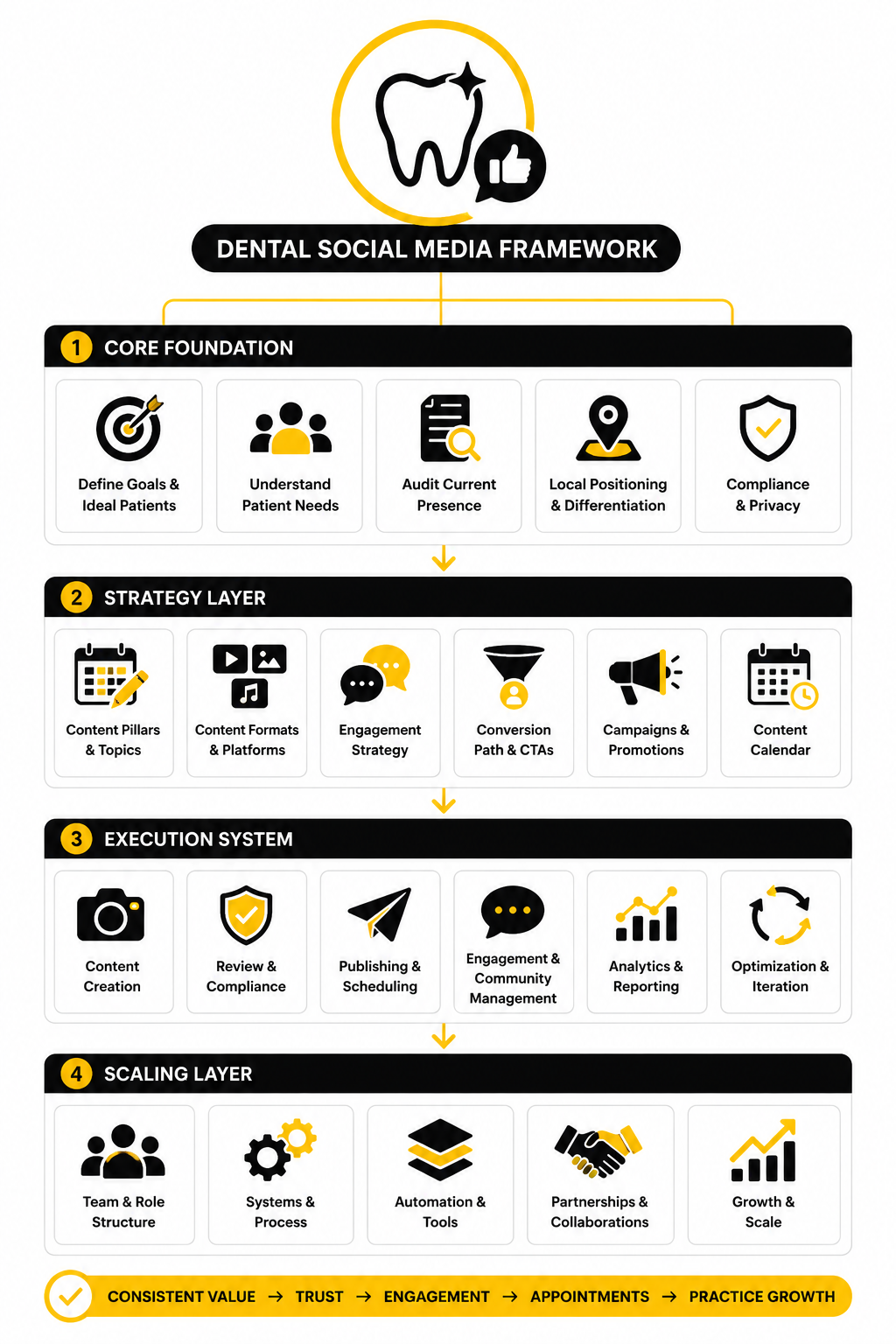
The framework starts with positioning. A family dental office, cosmetic practice, orthodontic office, implant-focused clinic, and multi-location DSO should not sound identical online. The content should reflect the practice’s services, patient base, clinical strengths, location, and capacity to handle new leads.
The next layer is conversion. Social media does not need to close the entire treatment decision inside a caption, but it should create a clear path to action. That can mean a website visit, a call, a direct message, an online booking form, or a structured follow-up workflow inside a CRM like GoHighLevel when the practice is ready to manage inquiries more systematically.
Core Components Of A Strong Dental Social Media Strategy
The first core component is educational content. Patients search for clarity around pain, cost, fear, treatment timelines, insurance, cosmetic options, and whether a symptom is urgent. When a practice explains these topics plainly, it becomes easier for patients to trust the provider before the first appointment.
The second component is credibility content. This includes team introductions, office walkthroughs, technology explanations, treatment process breakdowns, review-driven themes, and responsible before-and-after content when proper consent is in place. The American Dental Association warns dentists not to post patient information, testimonials, photographs, radiographs, or names without the proper written consent, which means credibility content must be planned carefully, not casually.
The third component is response and follow-up. Social media creates questions, comments, direct messages, and missed opportunities if nobody owns the workflow. Tools like ManyChat can help with structured conversation flows on supported channels, while scheduling platforms and CRM systems can help the team avoid letting interested patients disappear.
Professional Implementation For Dental Practices
Professional implementation starts by deciding who owns the system. A dental social media plan fails when everyone is vaguely responsible and nobody is specifically accountable. The practice needs clear ownership for content ideas, approvals, filming, posting, comment handling, lead follow-up, and compliance review.
The second implementation decision is the content cadence. Most practices do not need to post three times a day to win locally. They need a sustainable rhythm of useful content that the team can maintain without burning out or lowering quality.
The third decision is platform focus. YouTube, Facebook, Instagram, TikTok, and short-form video each have a role, but not every practice should treat every channel equally. DataReportal’s 2025 global platform analysis found that YouTube remained the most used social platform at the start of 2025, while Pew’s social platform research continues to show major differences by age group and platform behavior, so the right channel mix should match the patients the practice actually wants to reach.
Turning Attention Into Patient Trust
The biggest value of dental social media is not reach by itself. Reach is cheap when the content is vague, trendy, or disconnected from the actual patient journey. What matters is whether the right local people see enough useful content to feel safer taking the next step.
That trust gap is real because dental decisions are emotional. Patients may be worried about pain, cost, judgment, time away from work, or whether a treatment recommendation is truly necessary. A strong dental social media presence lowers that friction by showing how the practice communicates, explains care, and treats people before the patient ever sits in the chair.
This is also why social content should never feel like a wall of ads. People are more likely to engage when the content answers questions they already have. A post explaining when bleeding gums are urgent, what happens during a crown appointment, or why clear aligner timelines vary can do more for trust than a generic “book now” graphic ever will.
The Local Visibility Problem
Most dental practices are competing in a tight local market. The patient is not comparing every dentist in the country. They are comparing nearby options that appear in search, maps, reviews, social feeds, community groups, and recommendations from friends or family.
That creates a simple problem: if your practice is invisible or forgettable online, you are forcing patients to choose based on whoever is easier to find. A 2025 local review study found that consumers continue to use reviews to evaluate nearby businesses, with review content, recency, and credibility shaping how people compare options during local research. For dental practices, social media adds another layer to that comparison because it shows personality, consistency, and patient education in a way a star rating alone cannot.
The best practices use dental social media to support local visibility instead of treating it as a separate channel. A patient may see a short video on Instagram, check the Google Business Profile, read reviews, visit the website, and then call the office. Each touchpoint should make the same promise: this practice is clear, professional, helpful, and safe to contact.
Why Patient Education Wins
Education works because dentistry is full of uncertainty for patients. Most people do not know the difference between plaque and tartar, when a cracked tooth becomes urgent, why implants take multiple visits, or why a small cavity should not wait until it hurts. When the practice explains these topics in plain language, social media becomes a bridge between clinical expertise and patient confidence.
This is especially important because many people now encounter health information inside social platforms. A recent Pew Research Center report found that about four-in-ten U.S. adults get health and wellness information from social media at least sometimes, while trust in that information varies widely. That creates an opportunity for qualified dental professionals to publish clearer, more responsible content instead of leaving patients to sort through confident but unreliable advice.
The key is to educate without overwhelming. A good dental social media post should answer one question, reduce one fear, or clarify one decision. It should not try to turn a casual viewer into a dental student.
The Dental Social Media Growth Framework In Practice
The framework works best when the practice thinks in layers. First, content needs to attract attention from the right local audience. Then it needs to build trust by showing expertise, clarity, and a human tone. Finally, it needs to make the next step obvious without turning every post into a hard sell.
A practical framework has four working layers:
This structure keeps the content balanced. Without visibility, good content stays hidden. Without trust, attention does not become action. Without education, the practice sounds like every other local provider. Without conversion, social media becomes a nice-looking activity with no measurable business value.
Matching Content To Patient Readiness
Not every viewer is ready to book today. Some people are only becoming aware that they need a dentist. Others are comparing providers. Others have a specific problem and want to know whether they should call now.
That is why dental social media should include content for different levels of patient readiness. Early-stage content can focus on common questions, prevention, and myth-busting. Middle-stage content can explain treatment options, office experience, financing conversations, and what new patients can expect. High-intent content can make it easy to request an appointment, call the office, or send a direct message.
This is where systems matter. A practice can use a scheduler like Cal.com for cleaner appointment routing, a form tool like Fillout for structured intake questions, or a CRM like GoHighLevel when social inquiries need follow-up instead of being handled manually by whoever sees the notification first. The point is not to add software for the sake of it. The point is to make sure interested patients do not get lost.
Building Trust Without Crossing Compliance Lines
Dental social media has to be more careful than ordinary local business marketing. A restaurant can repost a customer photo with low risk. A dental practice is dealing with health information, patient identity, clinical images, testimonials, and privacy obligations.
The American Dental Association’s guidance on social media policies warns dentists not to post patient information, testimonials, photographs, radiographs, names, or other identifying material without proper written consent. That means every before-and-after image, patient quote, tagged post, treatment story, and behind-the-scenes clip needs a clear approval process before it goes live. This is not optional. It is the line between professional marketing and a preventable compliance problem.
The safer approach is to build content around education, team personality, office experience, and de-identified clinical explanations unless written authorization is already handled. Practices can still be human and persuasive without exposing private patient details. In fact, that kind of discipline often makes the content stronger because it forces the team to communicate clearly instead of relying on risky shortcuts.
Choosing Platforms With Intent
The right platform mix depends on the practice, the market, and the services being promoted. A cosmetic practice may benefit from highly visual Instagram and short-form video. A family dental office may get more value from Facebook, local community visibility, Google Business Profile activity, and educational video. A specialist may need deeper trust-building content that supports referrals and higher-consideration treatment decisions.
Platform behavior also changes by age group. Pew’s 2025 social media research found that YouTube and Facebook remain broadly used among U.S. adults, while Instagram, TikTok, Snapchat, and Reddit show stronger usage among younger adults. That matters because a practice trying to reach parents, retirees, young professionals, or implant patients should not use the same channel strategy for every audience.
The simple rule is this: choose platforms based on patient behavior, not personal preference. If your ideal patients spend time on Facebook, do not ignore Facebook because it feels less exciting. If short-form video is where your local competitors are building attention, learn how to use it professionally. Dental social media works better when channel selection is strategic, not emotional.
Content Planning For Dental Practices
Content planning is where dental social media becomes manageable. Without a plan, the practice ends up posting only when someone has time, when a holiday comes around, or when the team suddenly remembers the Instagram account exists. That is not a growth system. That is a guessing game with a logo on it.
A better plan starts with patient questions. Every front desk call, hygiene conversation, consultation, treatment objection, and insurance question can become content. The best dental content does not come from staring at a blank calendar. It comes from listening to what patients already ask every week.
This is also where the practice needs discipline. Social media should not become a dumping ground for every random idea. The content plan should support the practice’s actual goals, whether that is attracting new patients, promoting cosmetic cases, increasing hygiene reactivation, educating implant candidates, or improving local brand awareness.
Start With Service Priorities
A dental practice should not build its social calendar around trends first. It should build around the services it wants to grow. If the practice needs more new patient exams, the content should reduce anxiety around first visits, explain what happens during an exam, and show why prevention is easier than emergency treatment.
If the practice wants more cosmetic dentistry inquiries, the content should explain smile design, whitening expectations, veneer timelines, bonding limitations, and how consultations work. If implants are the priority, the content should cover candidacy, bone health, healing time, maintenance, and why treatment plans vary from patient to patient. Specific content attracts more qualified attention because it speaks to a real decision the patient is already trying to make.
This does not mean every post should sell a service. It means the calendar should have a clear business reason behind it. Dental social media works best when education and growth are connected instead of treated like separate worlds.
Build Content Pillars That Are Easy To Repeat
Content pillars help the team avoid starting from zero every week. A pillar is simply a repeatable category that supports the practice’s message. For dental social media, the strongest pillars usually combine education, trust, personality, and conversion.
A practical dental content plan can use five pillars:
These pillars keep the content balanced. If everything is educational, the practice may feel useful but faceless. If everything is team personality, the feed may feel friendly but weak on clinical authority. If everything is promotional, patients tune out fast.
Turn One Idea Into Multiple Formats
The easiest way to stay consistent is to stop treating every post as a brand-new idea. One patient question can become a short video, a carousel, a caption, an email topic, a website FAQ, and a talking point for the front desk. That is not repetition. That is smart distribution.
For example, “Why do my gums bleed when I brush?” can become a 30-second dentist video, a three-slide educational post, a short caption about gum inflammation, and a reminder for patients who are overdue for hygiene. The same topic can also support a blog post or follow-up email for patients who have not booked their cleaning. One good idea should work harder than one single post.
This is where a scheduling tool like Buffer can help a small practice stay organized without turning content management into a daily scramble. The tool is not the strategy, but it can protect the strategy from getting lost in a busy clinical week. Consistency becomes much easier when posts are planned, reviewed, and queued before the day gets chaotic.
The Execution Process
Once the content pillars are clear, the practice needs a simple execution process. The goal is not to create a massive production machine. The goal is to create a repeatable workflow that a real dental team can follow while still running a practice.
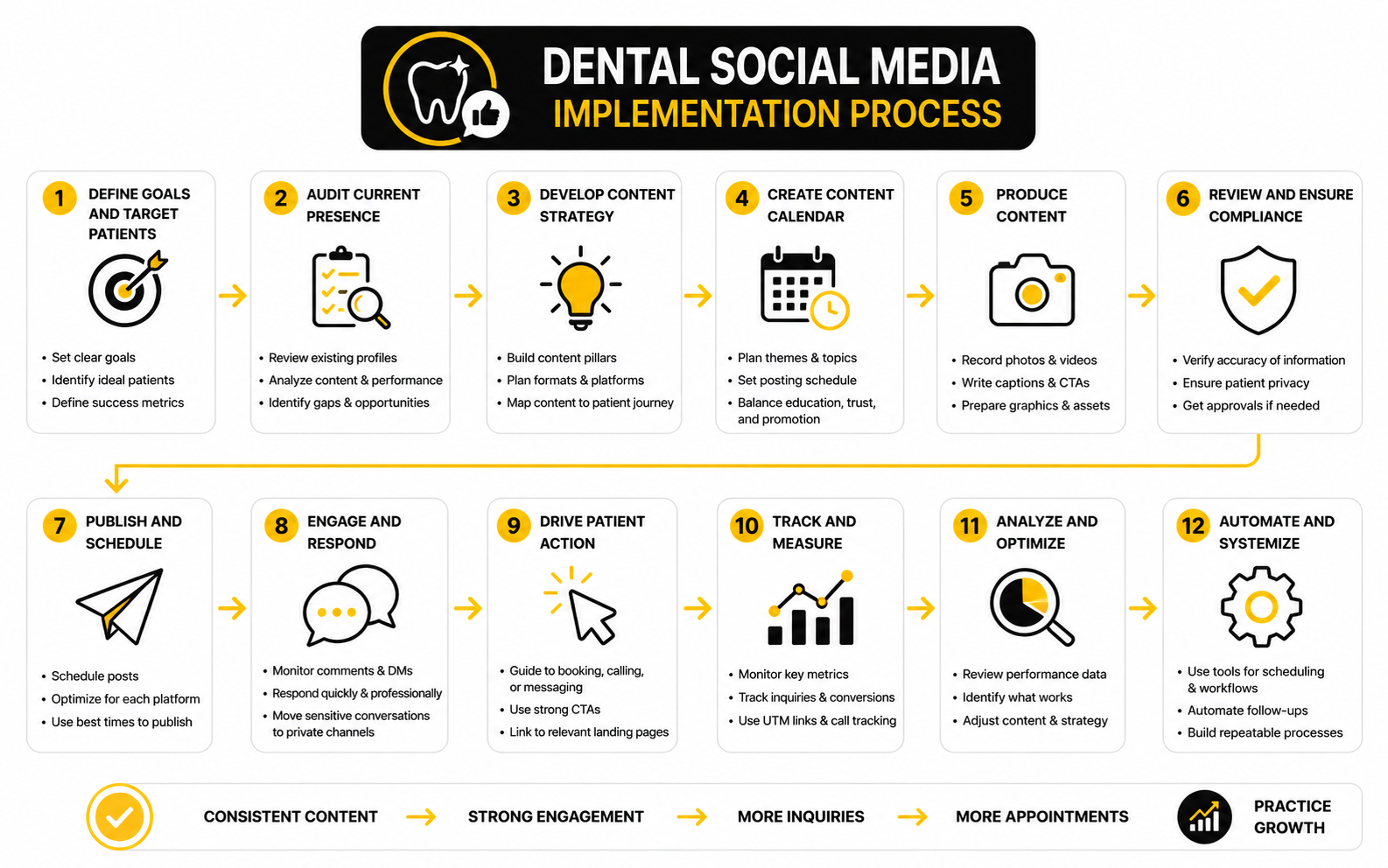
The process should move from planning to publishing to follow-up. Each step needs an owner, a deadline, and a clear standard for approval. When that structure is missing, posts get delayed, captions get rewritten endlessly, patient inquiries sit unanswered, and compliance review becomes an afterthought.
A practical dental social media workflow looks like this:
This process is intentionally simple. A dental practice does not need a Hollywood production schedule. It needs a reliable operating rhythm that protects quality, compliance, and follow-up.
Assign Clear Ownership
Someone has to own the dental social media process. That person does not need to do every task alone, but they do need to make sure the system keeps moving. Without ownership, content becomes everyone’s job and therefore nobody’s job.
In a small practice, the owner may be the office manager, treatment coordinator, or a marketing partner. In a larger group, it may be a dedicated marketing manager with input from doctors, hygienists, and location leaders. The important part is that responsibilities are explicit.
The practice should decide who approves clinical claims, who checks privacy concerns, who posts content, who responds to comments, and who handles appointment requests. This matters because a social media inquiry is not just engagement. It may be a potential patient asking for help.
Create A Monthly Production Rhythm
Monthly planning beats daily improvisation. A monthly rhythm gives the team enough structure to stay consistent without overcomplicating the work. It also allows the dentist or practice owner to review topics before content goes live.
A simple monthly rhythm can work like this:
This rhythm keeps dental social media out of panic mode. The team can still post timely updates when needed, but the core calendar is already handled. That is the difference between a system and a last-minute scramble.
Keep Filming Simple
Most dental practices overthink video. They imagine lights, scripts, perfect delivery, and heavy editing before they publish anything. That mindset kills momentum.
Simple video usually works better because it feels real. A dentist answering one patient question in clear language is more useful than an overproduced video that says very little. A hygienist explaining why bleeding gums should not be ignored can be more valuable than a generic stock graphic.
The team should aim for short, direct clips with clean audio, good lighting, and one clear point. The dentist does not need to sound like a professional creator. They need to sound like a trustworthy clinician who can explain dentistry without making patients feel stupid.
Build An Approval Checklist
Dental social media needs an approval checklist because small mistakes can become big problems. The checklist should be short enough that the team actually uses it. It should also catch the issues that matter most: accuracy, privacy, tone, and next-step clarity.
Before publishing, every post should pass these checks:
This protects both the practice and the patient. The American Dental Association’s social media policy guidance is clear that patient information, testimonials, photographs, radiographs, and names should not be posted without the appropriate written consent. That one rule alone should shape how every dental practice handles social content.
Manage Comments And Direct Messages Professionally
Publishing is only half the job. Once people start commenting or sending direct messages, the practice needs a response plan. A delayed or careless reply can make the practice look disorganized, even when the content itself is good.
The safest approach is to keep public replies general and move personal health questions into a private, appropriate channel. For example, if someone comments about pain, swelling, bleeding, or a failed restoration, the practice should avoid diagnosing in the comment thread. A better response invites the person to call the office or request an appointment so the team can help properly.
For practices that receive a meaningful volume of messages, structured automation can help route people without replacing professional judgment. A tool like ManyChat can support basic conversation flows, while a platform like GoHighLevel can help centralize follow-up when social inquiries need to become scheduled consultations. The key is to use automation for routing and speed, not for giving clinical advice.
Turning Content Into Appointments
Dental social media should make action easier. That does not mean every post needs a hard call to action. It means the overall system should remove friction for people who are ready to move forward.
The next step should match the intent of the content. A general education post may simply invite patients to save the post or ask a non-private question. A new patient post can point people toward online booking. A cosmetic consultation post can direct viewers to a form that collects basic goals before the team follows up.
This is where many practices lose money quietly. The content creates attention, but the appointment path is clunky. The patient clicks a bio link, lands on a confusing page, cannot find the right service, and disappears. A simple landing page, booking page, or intake form can turn that attention into a real conversation.
Use Landing Pages For Specific Campaigns
A general website homepage is not always the best destination for social traffic. If a post is about implants, the landing page should continue the implant conversation. If a post is about clear aligners, the page should answer clear aligner questions. If the post promotes a new patient visit, the page should make booking simple.
Specific landing pages work because they keep the message consistent. The patient does not have to hunt for the next step. They see the same topic, the same promise, and a clear way to continue.
For practices running focused campaigns, a funnel builder like ClickFunnels or a simpler page system like Systeme.io can help create campaign-specific pages without waiting on a full website rebuild. The tool choice matters less than the patient experience. The page needs to be clear, fast, and directly connected to the content that brought the patient there.
Track The Right Actions
Likes are not useless, but they are not the main goal. A dental practice should track the actions that show patient intent. That includes calls, booking clicks, form submissions, direct messages, consultation requests, and new patient appointments tied back to campaigns.
The numbers do not need to be complicated at first. The practice can start with a simple monthly scorecard that tracks content posted, reach, profile visits, website clicks, messages, calls, booked appointments, and the topics that generated the most response. Over time, patterns become obvious.
This is how dental social media becomes less emotional. Instead of arguing about whether a post “looked good,” the team can ask better questions. Did it educate the right audience? Did it create trust? Did it move anyone closer to booking? Did it produce a question the team should answer again in a better format?
Statistics And Data
Numbers are useful only when they change decisions. A dental practice does not need a dashboard full of vanity metrics. It needs a small set of signals that show whether dental social media is creating visibility, trust, patient intent, and booked opportunities.
This matters because social platforms are crowded and engagement is not as easy as it used to be. The 2025 Rival IQ benchmark report found that engagement rates declined across Facebook, Instagram, TikTok, and X, which means practices should not panic just because average engagement feels lower than it did a few years ago. The better question is whether the content is reaching the right local audience and producing the right next step.
The data should help the practice make practical choices. If educational videos get saves and profile visits, make more of them. If team content gets comments but no patient action, keep it for trust but do not let it dominate the calendar. If a service-focused post drives calls or form submissions, turn that topic into a campaign instead of treating it as a one-off win.
What To Measure First
The first layer is visibility. This includes reach, impressions, profile visits, follower growth, and local discovery. These numbers tell you whether the practice is showing up often enough for people to notice it.
The second layer is engagement quality. Likes are easy to understand, but saves, shares, comments, direct messages, and clicks usually tell you more. A post about whitening myths that gets saved may be more valuable than a funny office post that gets quick likes and then disappears.
The third layer is patient intent. This is where dental social media starts connecting to business outcomes. Calls, booking clicks, consultation form submissions, message inquiries, and new patient requests matter more than raw reach because they show that someone is moving from passive attention to active consideration.
The Core Dental Social Media Scorecard
A simple scorecard beats a complicated report nobody reads. The practice should review performance monthly, not obsess over every post after one hour. Social algorithms need time, and patient decisions often happen after multiple touchpoints.
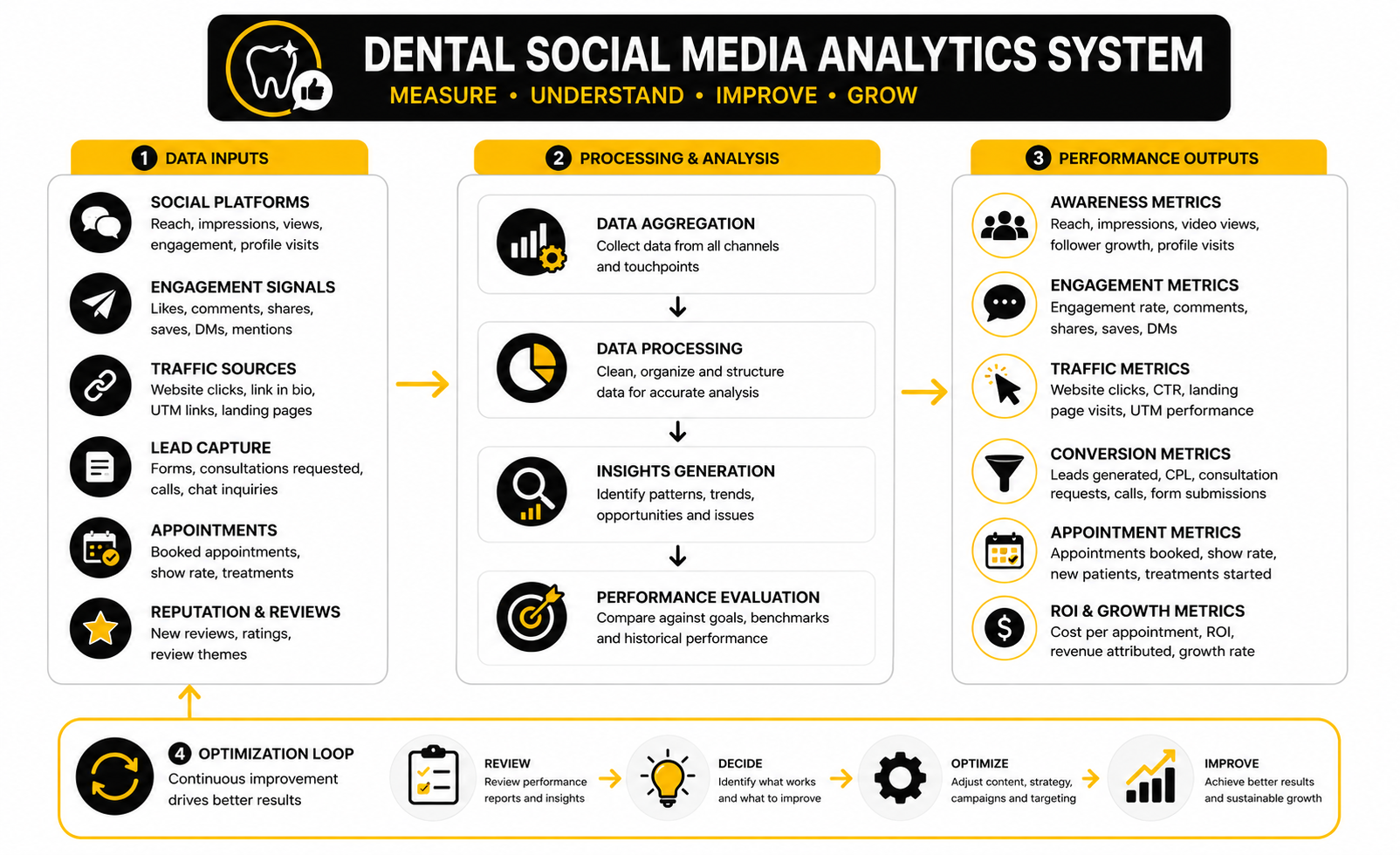
A clean monthly scorecard can track:
The point is not to make the team stare at spreadsheets. The point is to spot patterns. When a certain topic consistently produces saves, messages, or consultation requests, that topic deserves more content, a better landing page, and stronger follow-up.
How To Interpret Reach
Reach tells you how many people saw the content, but it does not tell you whether the content worked. High reach with no action may mean the hook was interesting but the message was too broad. Low reach with strong inquiries may mean the topic was narrow but commercially valuable.
For dental practices, local relevance matters more than raw audience size. A video seen by 800 people in the practice’s service area can be more useful than a video seen by 20,000 random viewers outside the market. This is especially true for general dentistry, where most patients are choosing based on convenience, trust, insurance fit, and local reputation.
Reach should guide distribution decisions. If Instagram Reels bring awareness but Facebook posts generate local comments from parents, both may deserve a role. If YouTube shorts create discovery but the website converts the patient later, the practice should not judge YouTube only by direct bookings.
How To Interpret Engagement
Engagement is a signal of interest, but not all engagement is equal. A like is a light signal. A save is stronger because the person found the content useful enough to keep. A share can be powerful because it means the content was relevant enough to pass to someone else.
Comments need careful interpretation. A post that attracts questions about treatment timing, pain, cost, or appointment availability is different from a post that only gets emojis. Both can be positive, but they do not mean the same thing for growth.
Dental social media should be judged by the type of engagement it creates. If people are asking thoughtful questions, the content is opening the door to patient conversations. If people are only reacting to surface-level posts, the practice may need stronger educational angles and clearer next steps.
How To Interpret Clicks And Inquiries
Clicks are where attention starts becoming intent. A profile visit shows curiosity. A website click shows stronger interest. A form submission, booking click, or call shows the person may be ready for help.
This is why every campaign should have a clear destination. If someone watches a video about dental implants and clicks through, they should not land on a generic homepage with no obvious implant path. The page should continue the same conversation and make it easy to book a consultation or ask a question.
Tools like Fillout can help structure inquiry forms, while GoHighLevel can help track leads, follow-up steps, and campaign sources in one place. That matters because dental social media often fails after the click, not before it. The patient shows interest, but the practice does not respond quickly or clearly enough.
Benchmarks Are Starting Points, Not Targets
Benchmarks are useful for context, but they should not become the scoreboard. A cosmetic dental practice in a competitive city, a rural family practice, and an implant-focused office will not have the same numbers. Different services, audiences, markets, and budgets create different performance patterns.
Industry benchmarks can still prevent overreaction. The 2025 Rival IQ healthcare live benchmark showed a recent healthcare engagement rate per post around 0.04%, which is a reminder that healthcare content often competes in a low-engagement environment compared with entertainment, sports, or creator content. That does not mean dental social media is failing. It means practices should measure deeper signals than likes alone.
The better benchmark is the practice’s own trend line. Is reach improving over three months? Are more people clicking through? Are direct messages becoming more qualified? Are appointment requests increasing from specific content themes? Internal improvement is more useful than chasing a generic industry average.
Response Time Is A Performance Metric
Fast follow-up is part of social media performance. A practice can publish excellent content and still lose the patient if nobody responds to the inquiry. People do not separate the marketing experience from the patient experience.
This is especially important because consumers increasingly expect brands to handle service through social channels. The 2025 Sprout Social customer care data found that 30% of consumers planned to use social media more in 2025, while 56% planned to maintain their current usage, which means social interaction is not going away as a support and inquiry channel. Dental practices should treat messages and comments as real front-desk opportunities, not as casual notifications.
A simple rule works well: public comments should get professional, general responses, while personal dental concerns should move into a private or direct channel. From there, the team should invite the person to call, schedule, or complete an inquiry form. The faster and cleaner that handoff is, the more valuable the content becomes.
Attribution Should Be Practical
Attribution does not need to be perfect to be useful. Many patients will see social content, check reviews, search the practice name, visit the website, and then call from Google. If the practice only credits the final click, social media may look less valuable than it really is.
A practical attribution system uses multiple clues. Ask new patients how they heard about the practice. Use trackable links for campaign pages. Add source fields to forms. Review spikes in branded search, direct messages, and appointment requests after specific content pushes.
A link management tool like Dub.co can help organize campaign links, and a scheduler like Cal.com can make appointment routing cleaner when a campaign needs a direct booking path. The practice still needs human review, but cleaner tracking makes better decisions possible.
What Good Performance Looks Like
Good performance is not always a viral post. In dental social media, good performance often looks quiet and practical. A post reaches the right local people, answers a real question, sends a few qualified visitors to the website, creates one or two direct messages, and helps a patient feel more confident calling the office.
That may not look dramatic on a dashboard, but it can be valuable. Dentistry is not impulse shopping. Many patients need repeated reassurance before they book, especially for higher-cost or fear-sensitive treatments.
The best signal is momentum across the full path. More local visibility, stronger engagement quality, more inquiry actions, faster response, and clearer appointment tracking all point in the right direction. When those signals improve together, dental social media is doing its job.
What To Do When The Numbers Are Weak
Weak numbers are not a reason to quit. They are a reason to diagnose. The practice should identify where the system is breaking instead of blaming the platform.
If reach is weak, the content may need stronger hooks, better posting consistency, more short-form video, or more platform-native formatting. If engagement is weak, the topics may be too generic or too promotional. If clicks are weak, the content may not create enough reason to continue. If inquiries are weak despite strong clicks, the landing page or call to action may be confusing.
Fix one bottleneck at a time. Do not change the entire strategy every week. Dental social media improves through clear testing, patient feedback, and disciplined review, not random posting swings.
Advanced Strategy And Scaling
Once the basics are working, dental social media becomes less about posting and more about making strategic tradeoffs. The practice has to decide which services deserve the most attention, which platforms deserve the most effort, which content should be boosted with paid distribution, and which workflows need tighter follow-up. This is where social media starts acting like a real growth channel instead of a side project.
Scaling also creates risk. More posts, more messages, more patient photos, more team members, and more campaigns mean more chances for inconsistent messaging or privacy mistakes. The more visible the practice becomes, the more important the operating standards become.
The smartest practices scale carefully. They do not just increase volume. They increase clarity, accountability, and measurement so the content system can grow without becoming sloppy.
Choose Depth Before Volume
More content is not always better. A practice posting daily weak content may look active, but it may not build trust or create appointments. A practice posting fewer, sharper pieces can often build a stronger presence because each post has a clearer purpose.
Depth means the content answers real questions with enough usefulness to change how a patient thinks. A shallow post says, “Dental implants can restore your smile.” A stronger post explains who may qualify for implants, why bone health matters, what the consultation checks, and why timelines vary. That second version gives the patient something they can actually use.
This matters even more for high-value treatments. Cosmetic dentistry, implants, orthodontics, sedation, and full-mouth rehabilitation usually need more education than a quick promotional post can provide. Patients making bigger decisions need more confidence, not more slogans.
Balance Brand Content And Service Campaigns
A healthy dental social media strategy needs both brand content and service campaigns. Brand content builds familiarity over time. Service campaigns create focused demand around specific treatments, offers, or patient needs.
Brand content includes team posts, office culture, patient education, community involvement, prevention tips, and general trust-building. It makes the practice feel real and familiar. Service campaigns are more targeted, with content built around one treatment category, one patient problem, or one conversion path.
The tradeoff is important. Too much brand content can make the practice likable but commercially vague. Too many service campaigns can make the feed feel transactional. The strongest strategy uses brand content to build trust and campaigns to give interested patients a clear reason to act.
Use Paid Promotion Carefully
Paid promotion can help dental social media reach the right local audience faster, but it should not be used to rescue weak content. If the message is unclear organically, paying for more impressions usually just spreads the confusion. Start by promoting content that already shows signs of relevance.
A good candidate for paid distribution is a post that generates saves, direct messages, profile visits, or meaningful comments. That kind of response suggests the topic is landing. Paid promotion can then put the same message in front of more people in the local service area.
The landing experience matters just as much as the ad. If the post promotes clear aligners, the click should go to a clear aligner page or consultation form. If the post promotes dental implants, the next step should keep that conversation going. A focused funnel built with a tool like ClickFunnels or Systeme.io can help when a practice wants campaign pages separate from the main website.
Protect The Practice From Compliance Drift
Compliance problems usually start small. Someone reposts a patient story without enough review. A team member replies publicly to a dental concern with too much detail. A before-and-after case gets published before written authorization is confirmed. Nobody intended harm, but intention is not enough.
The HHS HIPAA Privacy Rule protects individually identifiable health information, and the HHS guidance on marketing uses of protected health information explains that many marketing uses require individual authorization. For dental social media, the practical takeaway is simple: identifiable patient content needs a disciplined consent process before it is used.
There is also an advertising truth issue. The FTC’s guidance on endorsements, influencers, and reviews makes clear that endorsements must be truthful and not misleading, and the FTC’s health claims guidance emphasizes that health-related advertising claims need solid support. Dental practices should avoid exaggerated outcomes, unclear testimonial context, and claims that imply results are guaranteed.
Create A Social Media Risk Checklist
A risk checklist keeps the team from making decisions based on memory. It also makes approvals faster because everyone knows the standard. The checklist does not need to be complicated, but it should be used every time content touches patient identity, treatment outcomes, testimonials, or clinical claims.
A practical risk checklist should ask:
This is not about making dental social media boring. It is about making it professional. A practice can still be warm, persuasive, and human while refusing to play loose with patient privacy.
Scale Across Multiple Locations Without Losing Local Trust
Multi-location practices and DSOs have a different challenge. They need brand consistency, but each location still has to feel local. Patients are not choosing an abstract corporate brand. They are choosing the office they will actually visit, the dentist they may meet, and the team they will interact with.
The mistake is pushing identical content across every location with only the city name changed. That may be efficient, but it often feels generic. Local trust comes from location-specific proof: the team, the office, community context, local patient questions, and service availability at that location.
A better model uses shared strategy with local execution. The brand can define content pillars, approval rules, design standards, and campaign themes. Each location can contribute local video, team updates, specific service focus, and community relevance. This keeps the operation scalable without making every profile feel like a copy-and-paste template.
Decide What To Centralize And What To Localize
Scaling works best when the practice separates central control from local authenticity. Centralization protects quality. Localization protects relevance. You need both.
Centralize these pieces:
Localize these pieces:
This structure prevents chaos without flattening the human side of the practice. It gives the marketing team a system and gives each office enough room to sound real.
Integrate Social Media With Reputation Management
Dental social media and reviews should support each other. Reviews show patient sentiment after care. Social content helps shape expectations before care. Together, they create a stronger trust loop.
The practice should pay attention to the themes patients mention in reviews. If patients often praise gentle care, clear explanations, or friendly staff, those themes should appear in social content. If reviews mention confusion about billing or scheduling, that is a signal to improve both operations and communication.
This does not mean copying patient reviews into posts without proper review and permission. It means using review themes to understand what patients value. Social media should reinforce the real strengths patients already experience in the practice.
Use AI Without Losing The Human Voice
AI can help with dental social media, but it should not replace clinical judgment or the practice’s personality. It can help brainstorm content topics, turn patient questions into draft captions, repurpose long videos into short scripts, and organize a posting calendar. That is useful.
The risk is generic content. If every dental practice uses the same AI-generated captions, everyone starts sounding identical. Patients can feel that. The content becomes polished but empty.
Use AI for speed, not authority. A tool like Wispr Flow can help capture rough ideas quickly, and Chatbase can support structured website or FAQ experiences when configured carefully. But clinical content still needs human review, and patient-facing communication should sound like the practice, not a template.
Know When To Stop Chasing Trends
Trends can help with reach, but they can also pull a dental practice off strategy. Not every viral format fits healthcare. Not every meme belongs on a dental page. Not every audio trend is worth using just because competitors are using it.
The filter is simple: does the trend help the practice build trust, educate patients, or create relevant local attention? If yes, adapt it professionally. If no, skip it.
Dental social media should feel current, but it should not feel desperate. A confident practice does not need to jump on every trend. It needs to show up consistently with useful content, clear standards, and a patient experience that backs up the marketing.
Build A System The Team Can Sustain
The best social media strategy is the one the practice can actually maintain. A plan that requires daily filming, constant editing, and nonstop approvals will eventually break unless the team has the resources to support it. Sustainability matters.
A realistic system respects the clinical schedule. It uses batching, repeatable pillars, simple approvals, and monthly review. It gives the team enough structure to stay consistent without making marketing feel like another full-time job dumped on busy staff.
That is the expert-level move: simplify the system until it runs. Dental social media does not win because it is complicated. It wins because the practice keeps publishing useful content, responding professionally, learning from the data, and making it easy for the right patients to take the next step.
Final System For Dental Social Media
By this point, the strategy should feel less like a posting checklist and more like a complete patient communication system. Dental social media works best when content, compliance, follow-up, measurement, and local trust all support each other. One weak link can limit the whole channel.
The final system is simple on purpose. The practice identifies the patients it wants to reach, creates useful content around their real questions, protects privacy, gives people a clear next step, tracks what happens, and improves the process every month. That is the loop.
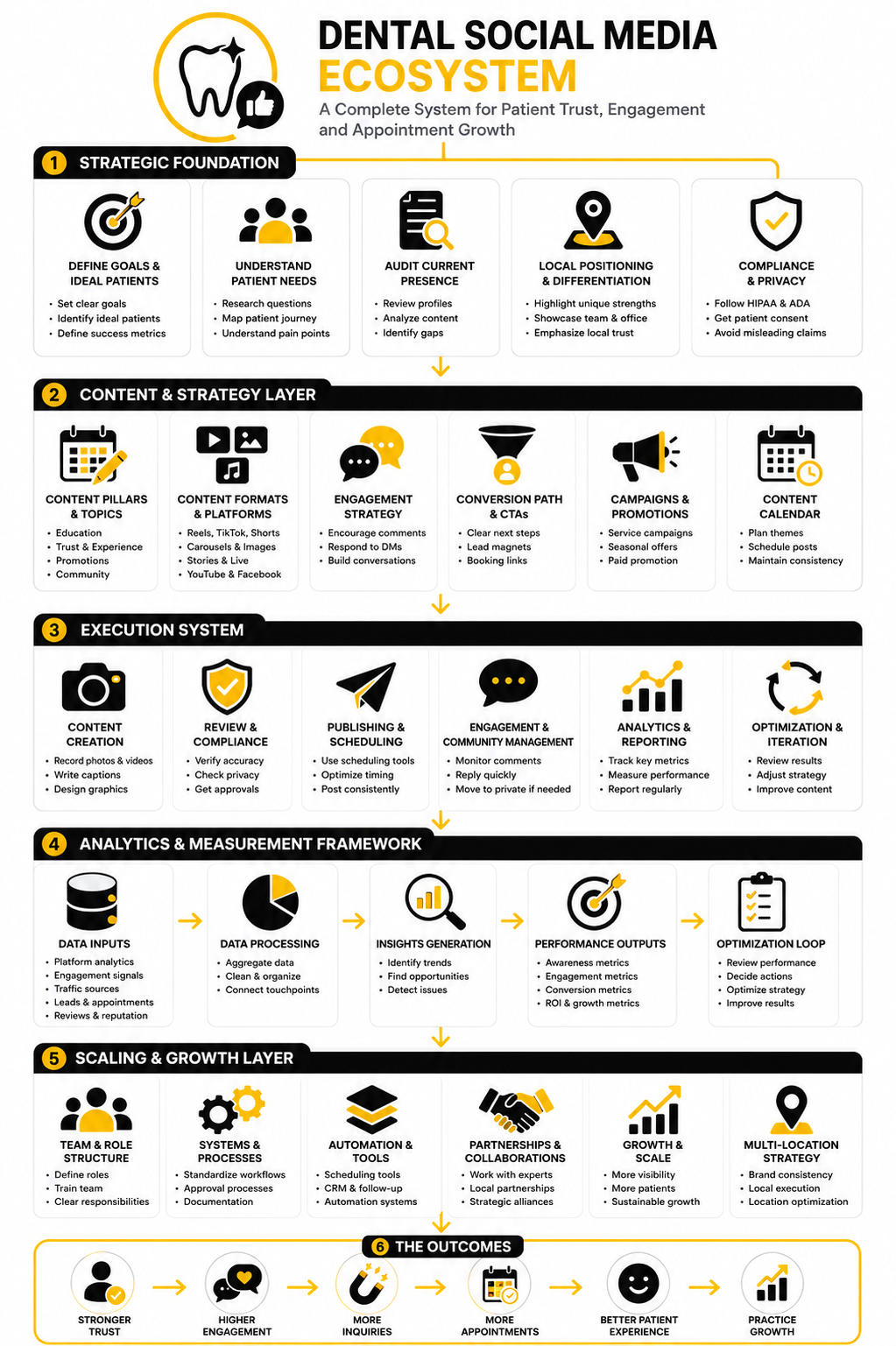
The most important thing is consistency with judgment. Social media rewards activity, but healthcare marketing also demands responsibility. A dental practice should be visible, helpful, and human without becoming careless, exaggerated, or overly promotional.
What Is Dental Social Media?
Dental social media is the use of platforms like Instagram, Facebook, TikTok, YouTube, and LinkedIn to educate patients, build trust, increase local visibility, and support appointment growth for a dental practice. It can include short videos, team posts, treatment education, office updates, patient experience content, and campaign-specific posts. The goal is not just to be active online, but to help patients feel more confident choosing and contacting the practice.
Why Is Dental Social Media Important For Dental Practices?
Dental social media matters because patients often research providers before they call. They want to understand the office, the dentist, the team, the patient experience, and the practice’s communication style. When the content is useful and professional, it reduces uncertainty and helps the practice stand out in a local market.
How Often Should A Dental Practice Post On Social Media?
Most dental practices should start with a sustainable schedule instead of chasing daily volume. Posting three to five strong pieces of content per week is usually better than posting every day with weak ideas. The right cadence depends on the team’s capacity, the platforms being used, and whether the practice can maintain quality and follow-up.
What Type Of Content Works Best For Dental Social Media?
The strongest dental social media content usually answers real patient questions. Topics like bleeding gums, tooth pain, whitening expectations, implant timelines, first-visit anxiety, clear aligners, insurance confusion, and preventive care tend to be useful because they match what patients already wonder about. Team content and office experience content also matter because they make the practice feel more familiar.
Should Dentists Use TikTok And Instagram Reels?
Short-form video can be useful when the dentist or team can explain one clear idea quickly. TikTok and Instagram Reels work especially well for patient education, myth-busting, office experience, and simple treatment explanations. The practice should still choose platforms based on patient behavior, not just because a format is popular.
Can Dental Practices Post Before-And-After Photos?
Dental practices can post before-and-after photos only when they have proper written authorization and the content is not misleading. Patient identity, clinical images, testimonials, and treatment outcomes require careful review before publication. The American Dental Association’s patient privacy guidance warns that photos or messages may violate privacy laws when they identify a patient or reveal enough detail to identify someone without authorization.
How Should A Dental Practice Handle Direct Messages?
Direct messages should be treated like real patient inquiries, not casual notifications. The team should respond quickly, avoid giving personal diagnosis inside social platforms, and move sensitive health questions into an appropriate private channel. If the practice gets frequent messages, ManyChat can help route basic conversations, while GoHighLevel can help manage follow-up when inquiries become leads.
What Metrics Matter Most For Dental Social Media?
The most useful metrics are reach, profile visits, website clicks, direct messages, calls, form submissions, consultation requests, and booked appointments. Likes can show light interest, but they should not be the main scoreboard. The practice should focus on whether social media is creating qualified local attention and patient action.
How Long Does Dental Social Media Take To Work?
Dental social media usually works through repeated exposure, not one post. Patients may see several educational posts, check reviews, visit the website, and then call later. That means the practice should measure trends over months, not judge the entire strategy from a single post or one quiet week.
Should A Dental Practice Hire A Social Media Agency?
A dental practice should consider hiring help when the team lacks time, consistency, strategy, or technical skill. The right partner should understand healthcare privacy, local marketing, patient education, content production, and lead follow-up. A generic social media agency that only posts graphics may not be enough for a practice that needs real patient acquisition support.
What Are The Biggest Mistakes In Dental Social Media?
The biggest mistakes are posting without a strategy, using generic content, ignoring comments and messages, overusing promotional posts, failing to track inquiries, and publishing patient-related content without proper consent. Another major mistake is making the content too clinical or too shallow. Patients need clear explanations, not jargon and not empty slogans.
How Can Dental Social Media Support SEO?
Dental social media does not replace SEO, but it can support brand demand and patient research. When people discover a practice on social media, they may search the practice name, visit the website, read reviews, or explore service pages. That behavior can strengthen the overall digital presence even when social posts themselves are not the main ranking factor.
Should Dentists Use AI For Social Media Content?
AI can help dentists brainstorm topics, organize calendars, draft captions, and repurpose long ideas into shorter posts. It should not replace clinical review, compliance checks, or the practice’s real voice. Tools like Wispr Flow can help capture ideas faster, but every clinical claim still needs human judgment.
What Is The Best First Step For A Dental Practice Starting From Zero?
Start with patient questions. Ask the front desk, hygienists, treatment coordinators, and dentists what patients ask most often. Turn those questions into short, clear posts, then build a simple monthly rhythm around education, trust, office experience, and appointment next steps.
Build a stronger local presence with BAAM AI
Turn your website, Google profile, social channels, and AI visibility into one growth engine
Most businesses do not need more random marketing activity. They need a consistent presence system that helps the right people find them, trust them, and take action. BAAM AI brings strategy, local SEO, website updates, Google Maps visibility, social content, AI-search readiness, media production, and reporting into one practical monthly engine.
If you want your marketing to keep working after the campaign ends, start with a free BAAM AI presence audit. See how your business shows up today and where the fastest visibility wins are at BAAM AI.