
BAAM AI Blog
Dental Internet Marketing: A Practical Overview for Dental Practices
Dental internet marketing refers to all the digital tactics and channels a dental practice uses to attract new patients, retain existing ones, and grow revenue online. It’s not limited to posting on social media -...
What Dental Internet Marketing Actually Means
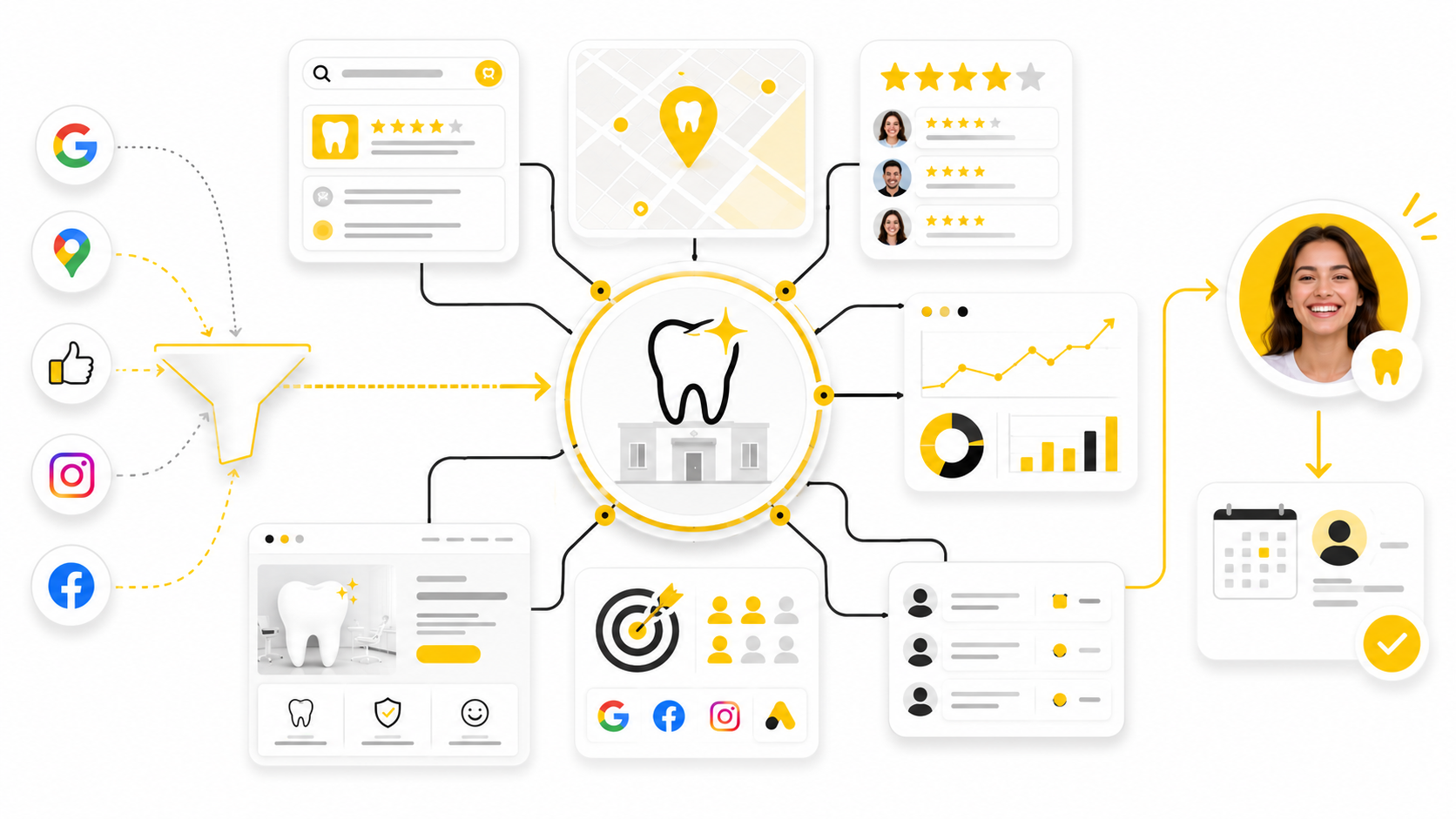
Dental internet marketing refers to all the digital tactics and channels a dental practice uses to attract new patients, retain existing ones, and grow revenue online. It’s not limited to posting on social media - it’s a coordinated system that helps people find your practice, learn about your services, and choose you over competitors when they search online. The goal is simple: turn digital visibility into scheduled appointments and long-term patient relationships. Modern patients don’t pick up the phone and call practices the way they used to - most start with a search engine, a social profile, or reviews before they even think about calling.
Dental internet marketing becomes the digital storefront and reputation engine for your practice. Everything from your website content to the way you respond to online reviews contributes to how potential patients perceive your brand before they get in the chair.
Why Internet Marketing Matters for Dentists
In today’s marketplace, digital behavior drives patient decisions. A significant portion of people searching for dental services rely on online search results, reviews, and social profiles to choose where to book appointments. Practices that don’t show up prominently when someone Googles “dentist near me” are essentially invisible to those potential patients.
Plus, online marketing delivers measurable outcomes that traditional methods like print or billboard advertising can’t match. Through digital channels you can track where patients come from, which messages prompt a booking, and how much revenue each marketing dollar produces. That visibility makes it easier to scale your practice consistently rather than relying on referrals or walk‑ins alone.
How Dental Internet Marketing Fits Into a Larger Framework
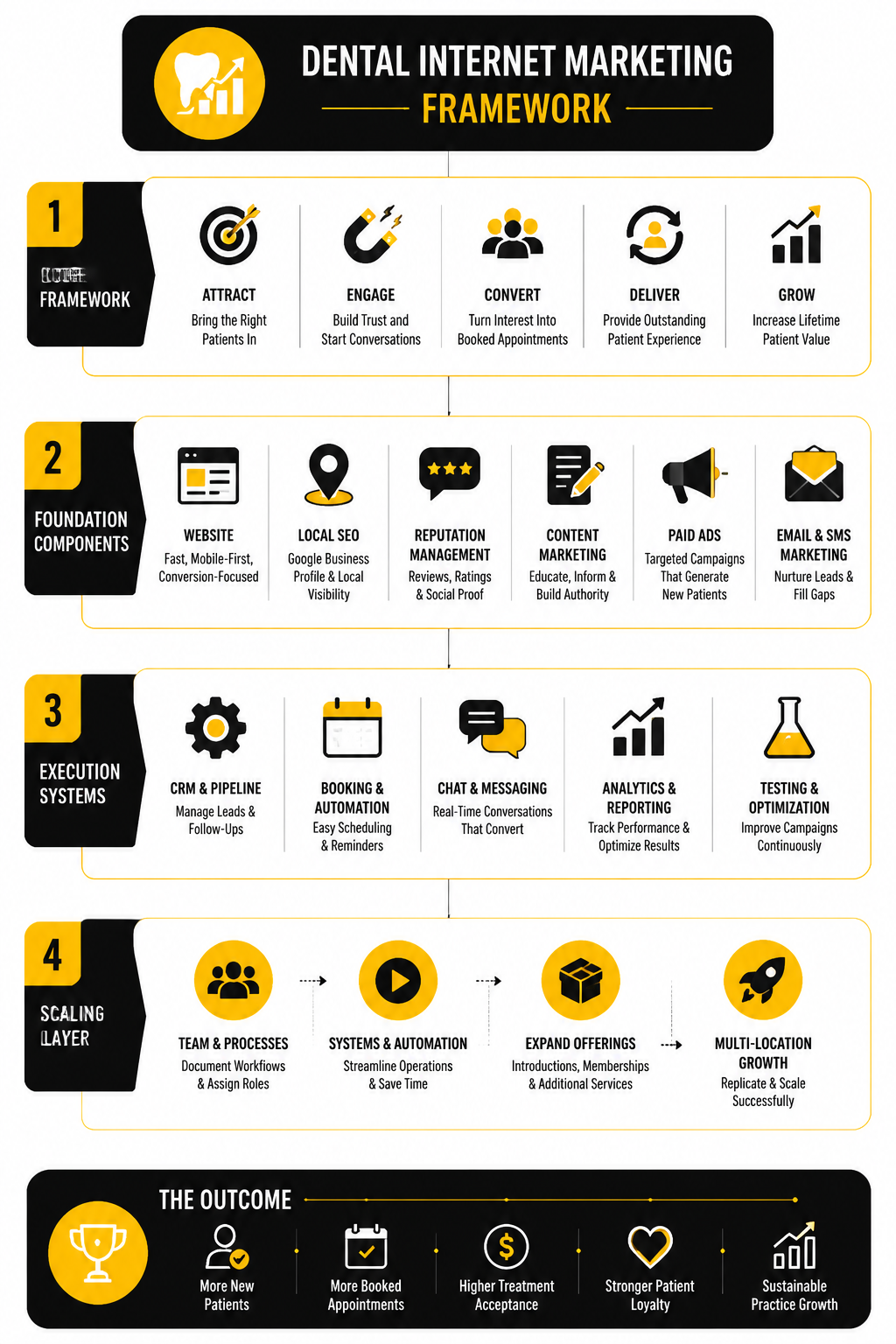
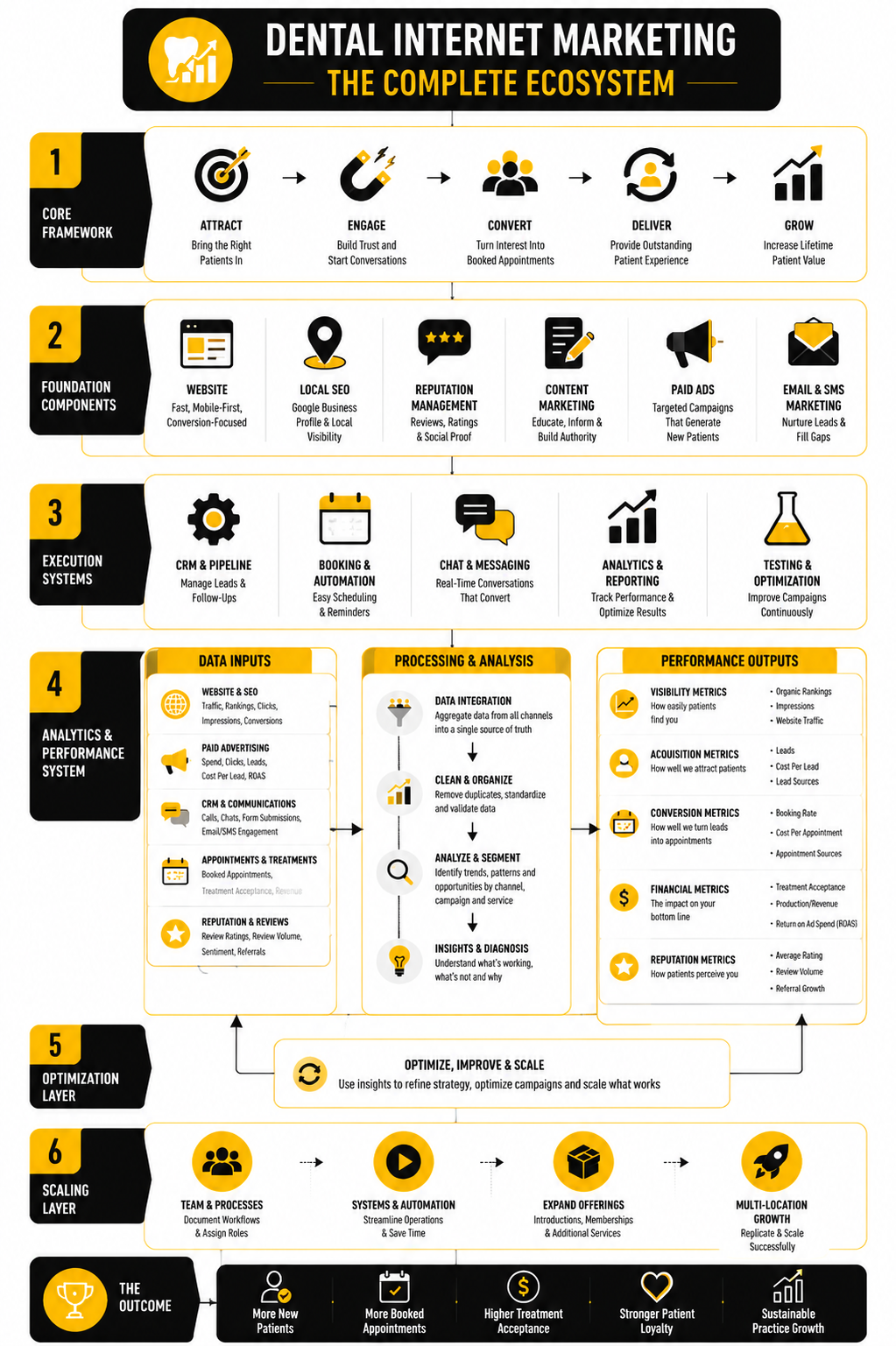
Successful dental internet marketing is built on a framework where each component reinforces the others instead of operating in isolation. At its core, it includes:
This system approach ensures your marketing isn’t just creating noise online - it’s generating measurable patient growth. Dental practices that run several of these components together see compounding results because each part feeds the others.
Who Needs a Dental Internet Marketing Strategy
Whether a small practice or a larger group, the same principles apply: your online presence should reflect your clinical excellence and make it easy for patients to choose you.
What to Expect in Each Article Part
this guide series will continue with:
Why Dental Internet Marketing Matters More Than Ever
Dental internet marketing isn’t a nice‑to‑have anymore - it’s become essential for practice growth because patient behavior has fundamentally changed. Most people no longer flip through a phone book, rely solely on referrals, or trust simply seeing your building from the street before they choose where to go. Instead, they interact with your practice online long before they ever walk through the door. Nearly three‑quarters of dental patients find a provider through organic search, not offline channels - and if your practice doesn’t show up where they look first, those patients are going to competitors who do.
It’s not just about visibility. Dental internet marketing ties directly to real business outcomes that impact your bottom line. When done right, digital channels help you attract patients who are already looking for care, keep you top‑of‑mind with existing patients, and build trust through reputation and engagement long before someone calls your office. Practices that invest strategically online can see measurable returns - from lower patient acquisition costs to higher treatment acceptance rates - and that means sustainable growth.
Digital Search Dominates the Patient Journey
In the past decade, the way patients find dental services has shifted strongly toward digital channels. Roughly 71% of people searching for a dentist run an online search before scheduling an appointment, making search engines the front door to your practice’s new patients. Those searches aren’t generic brand browsing - they’re high‑intent queries like “dentist near me,” “emergency dentist open now,” or “best dentist for implants,” which often trigger immediate booking decisions if the right practice appears.
This trend means that not ranking online - especially in local search results - is effectively being invisible to the majority of prospective patients. Appearing in search results isn’t just helpful; it’s fundamental to reaching the audiences most likely to schedule appointments.
Online Marketing Turns Visibility Into Patients
Having a website or social profile alone doesn’t automatically produce patients - what does matter is how well your marketing channels work together to convert online interest into real appointments and long‑term patient relationships. Practices that tie their digital efforts to key performance indicators - like patient acquisition cost, conversion rate, and lifetime patient value - can actually measure whether their spend is generating business results rather than just clicks or impressions.
Think of your digital presence as a patient acquisition engine. When it’s optimized - from search rankings to reviews to conversion pathways - it generates calls and bookings predictably and repeatedly. Practices that treat marketing like a strategic investment rather than a checkbox have a measurable advantage over competitors who rely solely on word‑of‑mouth or traditional advertising.
In the next part, we’ll explore the core components that make up high‑performing dental internet marketing systems and how each contributes to attracting and converting new patients.
Core Components That Drive Patient Growth
When you start implementing dental internet marketing, it helps to break the process into clear, actionable components that build on each other instead of random tactics. There’s a logical order to doing it right - and missing one step often weakens the rest. Practices that follow a thoughtful implementation roadmap consistently see patient growth because each piece of the strategy supports the others.
Starting With a Strategic Foundation
Before diving into ads or content creation, you need clarity on your goals and audience. That means defining:
A strategic foundation ensures your dental internet marketing efforts aren’t fragmented. With clear goals and audience insight, every piece of content, every ad, and every campaign contributes to measurable growth rather than shooting in the dark.
Getting the Technical Fundamentals Right
A strong digital presence needs technical groundwork first. That includes:
These foundational steps aren’t glamorous, but they create the infrastructure your ads, SEO, and content marketing depend on. If patients can’t find you easily or your website frustrates them, all the marketing in the world won’t turn site visitors into appointments.
Launching Patient‑Focused Content and SEO
With your foundation in place, it’s time to get visible in search and helpful to the people you want to attract. SEO and content marketing work hand‑in‑hand here:
Create a content calendar that maps topics to what patients are actually asking - not just generic industry terms. Each piece of content you publish should support both patient education and SEO goals, with clear steps that lead people toward booking.
Capturing Attention With Paid Advertising
Not every potential patient searches for a dentist every day - and that’s where paid advertising comes in. Google Ads and social media ads let you reach high‑intent audiences quickly while your organic SEO efforts mature:
Paid advertising shouldn’t be standalone; it should integrate with your SEO and content efforts so that people who click ads also find relevant information and trust your brand when they land on your website.
Executing Your Dental Internet Marketing Plan Step‑by‑Step
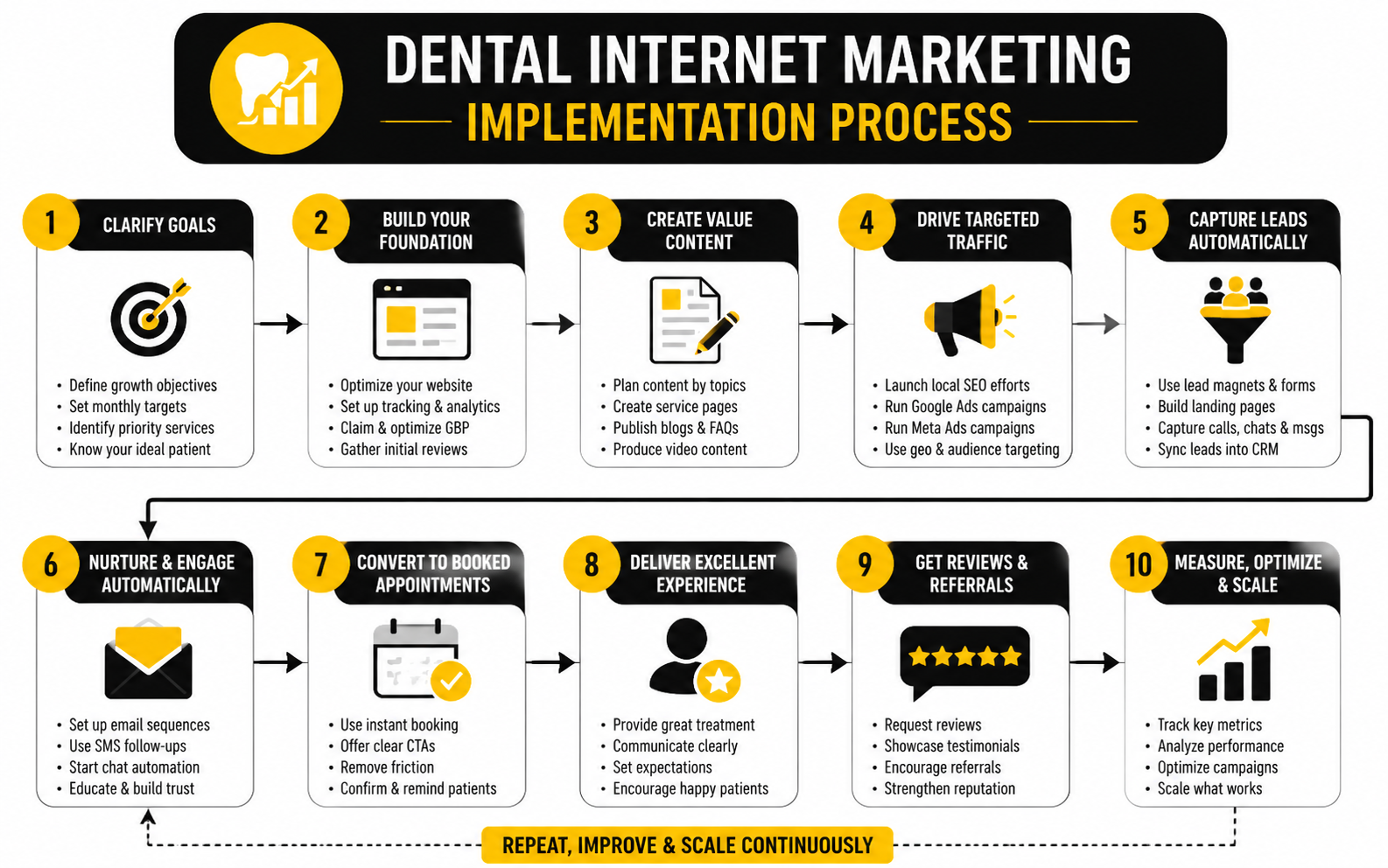
Now let’s make the implementation process tangible and systematic so you know what to do first, second, and next.
1. Build Your Digital Foundation (Weeks 1–4)
2. Launch SEO and Content Initiatives (Months 1–3)
3. Activate Paid Traffic and Patient Messaging (Months 3–6)
4. Analyze and Optimize Continuously (Ongoing)
By structuring dental internet marketing this way - with a clear sequence of steps - your practice won’t just do marketing, it will build a patient acquisition system that grows reliably over time.
In the next part, we’ll explore how to measure success and understand the metrics that show whether your efforts are paying off.
Measuring Success in Dental Internet Marketing
To understand whether your dental internet marketing efforts are actually working, numbers matter - but only the right numbers. It’s easy to get lost in graphs showing impressions or follower counts that look impressive but don’t influence appointments or revenue. What matters are the metrics that tie directly to patient acquisition, conversion, and financial performance. This section breaks down how to think about data, what benchmarks to use, and how to interpret performance signals so you take action that moves your practice forward.
Why Data Should Drive Your Marketing Decisions
Numbers are not just for dashboards - they’re signals that tell you what’s working, what’s broken, and what to prioritize next. When you measure the right metrics consistently, you stop guessing and start making strategic decisions, like where to invest more budget, whether your website is convincing visitors, and if your paid efforts are creating cost‑efficient new patient flow. Without a measurement mindset, well‑intentioned marketing can look productive when it’s actually leaking money.
The Core Marketing Metrics That Matter
Not all analytics are equal. Some numbers tell you what happened, and others tell you what to do next. Here are the most impactful metrics for dental practices:
These metrics give a balanced view of how well your digital presence attracts attention, converts interest into action, and ultimately drives profitable patient appointments.
Understanding What the Numbers Actually Mean
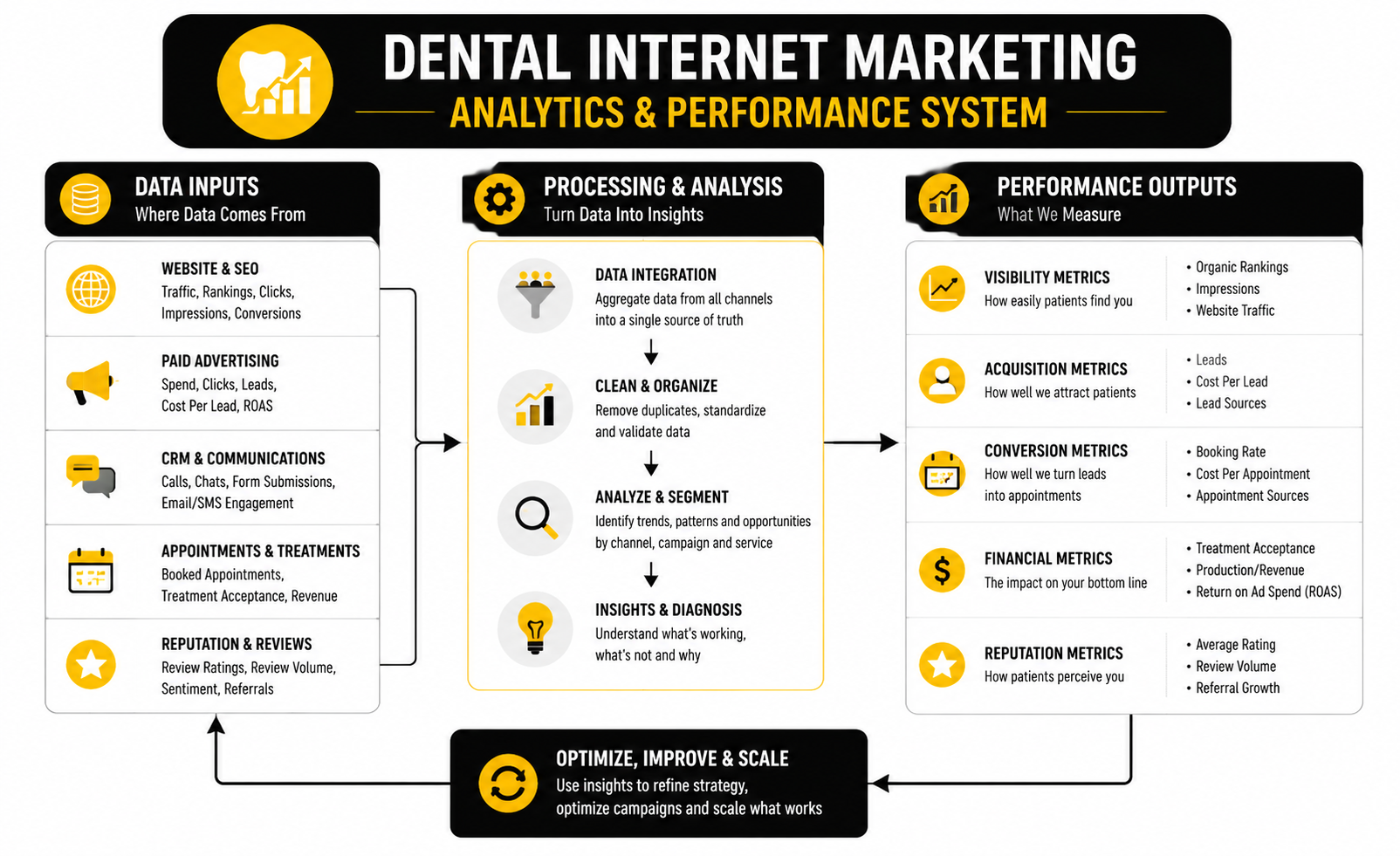
From Website Visits to New Patients
A rising number of visitors to your website is good - but conversion is what matters. A strong dental website typically converts 3–8% of visitors into leads or direct scheduling requests, depending on services and landing page quality. Web traffic that doesn’t convert is just noise; improving conversion rate often yields a bigger impact on patient growth than driving more traffic alone.
Cost Per Patient and Marketing ROI
If you’re spending significant budget but not tracking cost per patient, you’re flying blind. For many dental practices, a healthy CPA ranges from roughly $150 to $300 for general services - but this can vary by region and specialty. Practices that optimize conversion and retention see better ROI because each new patient produces more lifetime value. Top performers in digital dental marketing often see 5:1 to 10:1 ROI, meaning every dollar invested returns five to ten in production.
Local Search and Reviews: Trust in the Data
Google Business Profile analytics - such as clicks to call, direction requests, and profile views - tell you whether people intend to visit you. Practices with higher review counts and ratings generally convert search visits into calls and appointments at much higher rates than lower‑rated competitors. More reviews with positive ratings also improve local SEO, boosting visibility in competitive markets. This isn’t vanity - it’s trust and discoverability measured with data.
Actionable Benchmarks and Monthly Review
Benchmarks like new patients per month or CPA should be viewed as frameworks, not targets in isolation. Benchmarks vary by practice size, market competition, and specialty. For example, an established general practice might track 20–50 new patients per month as a realistic range, while a specialist’s volume may be lower but with higher per‑patient value. Use benchmarks to sanity‑check results and set context for your own goals, not as rigid goals themselves.
Turning Data Into Decisions
By focusing on these metrics with clarity and purpose, you move from guessing whether your dental internet marketing works to knowing exactly what’s working, why it matters, and what to do next. In the final two parts of this series, we’ll explore scaling your system and future trends that will shape practice growth.
Advanced Considerations in Dental Internet Marketing
By the time your dental internet marketing strategy is up and running - with data coming in, channels active, and early results measurable - you reach a point where simple execution isn’t enough. To scale effectively and sustainably, you need to think about strategic trade‑offs, risks that can quietly erode results, and the higher‑level decisions that separate average growth from exceptional performance. This section digs into those deeper considerations so you can future‑proof your digital patient acquisition and avoid common pitfalls.
Balancing Immediate Results With Long‑Term Growth
One of the biggest strategic trade‑offs in dental internet marketing is short‑term visibility versus long‑term return on investment. Paid channels like Google Ads can generate immediate visibility and new patients, whereas organic channels like SEO take time to compound but often deliver a lower cost per patient over the long haul. Data shows that SEO typically reduces acquisition cost steadily over time as rankings strengthen, while PPC stops producing results the moment the budget runs out. Deciding where your dollars go first should be tied to your practice’s current growth phase and urgency of new patient inflow.
For example, a practice in launch mode or one with a temporarily empty schedule might prioritize PPC to fill chairs quickly, then shift more resources to SEO and content as those paid efforts stabilize. Practices that distribute budget blindly between channels without planning for this shift often spend more without maximizing returns.
Scaling Without Losing Efficiency
As your digital marketing grows, efficiency can decline if you don’t adjust how you scale. Many practices make the mistake of increasing budget on the same tactics without refining the underlying systems - like tracking, attribution, and conversion optimization. When you pour more money into campaigns that aren’t being measured effectively, you amplify inefficiency. That’s why mature practices track channel‑specific metrics and patient lifetime value meticulously, rather than just aggregate spend. Understanding whether a new patient from SEO, PPC, or referrals brings higher long‑term value helps you allocate budget where it will compound returns.
Another dimension of scaling is internal process integration. As marketing drives more leads, your front desk, scheduling systems, and follow‑up processes must be tuned to handle the volume without leaking patients. A common scaling risk is conversion bottlenecks: even the best marketing can’t help if calls aren’t answered promptly or online booking is cumbersome. Practices that consider this frontline operational impact alongside marketing see substantially better overall results.
Trade‑offs Between Channels and Audience Targeting
Not all channels are created equal, and part of strategic maturity is realizing that different patient segments respond differently to various tactics. For example:
Balancing these requires not just running campaigns, but understanding the role each channel plays in your patient journey - and that balance needs reevaluation as your practice grows or priorities shift.
Avoiding Strategic Pitfalls
Advanced dental internet marketing is not just about doing more - it’s about doing more carefully. Some risks to watch for include:
Positioning for Long‑Term Competitive Advantage
As competition for digital attention increases, the practices that dominate online patient acquisition are those that view dental internet marketing as a long-term operating system rather than a set of one‑off campaigns. Strategic considerations include:
By thinking strategically about these trade‑offs and risks, your dental internet marketing becomes not just a department in your practice, but a predictable engine for sustained growth. In the final part, we’ll wrap up with answers to common questions and practical guidance you can apply immediately.
Q1: What exactly is dental internet marketing?
Dental internet marketing is the set of digital strategies a dental practice uses to attract patients online, from search visibility and web conversion to reputation and engagement. It’s designed to make your practice easy to find, compelling to choose, and efficient at converting interest into appointments.
Q2: How long does it take to see results from dental internet marketing?
The timeline varies by channel. Paid search can produce patient inquiries within days of launch, while organic search (SEO) and content efforts typically take several months to build momentum and sustained visibility.
Q3: Do I need a website for dental internet marketing?
Yes. A responsive, fast, and user‑friendly website is the central hub of digital marketing. Without it, other efforts like paid ads, SEO, and social engagement don’t have a reliable destination to convert visitors into booked patients.
Q4: How important are reviews in dental internet marketing?
Very important. Reviews on sources like Google impact local search rankings and influence trust. Practices with higher ratings and active review profiles tend to convert more search visitors into calls and bookings.
Q5: Can small practices compete with larger groups online?
Absolutely. Local SEO, targeted paid campaigns, and personalized content allow smaller practices to outperform larger competitors, especially in niche or geographic markets where trust and locality matter most.
Q6: How do I measure whether my dental internet marketing is working?
Focus on patient‑centric KPIs: new patients acquired, cost per new patient, conversion rates from your website, and return on investment. These tell you whether your spend is translating into real business outcomes.
Q7: What marketing channels should dentists prioritize?
Start with local search visibility (Google Business Profile and SEO), a conversion‑optimized website, and targeted paid search campaigns. Social media and email nurture complement these by building engagement and retention over time.
Q8: Are social media platforms necessary for dental internet marketing?
Yes - but not in isolation. Social media helps build awareness and trust; it supports broader digital efforts. Its true value is strongest when it’s integrated with SEO, reviews, and conversion pathways.
Q9: Should I handle dental internet marketing in‑house or hire experts?
That depends on your resources and goals. In‑house management can work for practices that have time and basic skills, but experts bring strategic experience, tools, and efficiency that speed up results and reduce trial‑and‑error costs.
Q10: How often should I review my marketing performance?
Review metrics monthly at a minimum, and more frequently for active campaigns like paid search. Regular reviews keep you attuned to trends, allow timely adjustments, and prevent budget waste on underperforming efforts.
Q11: Can dental internet marketing help with patient retention as well as acquisition?
Yes. Email and SMS follow‑ups, educational content, and reputation engagement help keep existing patients connected and reduce churn, increasing the lifetime value of your patient base.
Q12: How does local competition affect dental internet marketing?
In competitive markets, stronger SEO, reliable reviews, and targeted advertising differentiate your practice. Competing effectively means prioritizing channels that show local intent and trust signals over generic national tactics.
Build a stronger local presence with BAAM AI
Turn your website, Google profile, social channels, and AI visibility into one growth engine
Most businesses do not need more random marketing activity. They need a consistent presence system that helps the right people find them, trust them, and take action. BAAM AI brings strategy, local SEO, website updates, Google Maps visibility, social content, AI-search readiness, media production, and reporting into one practical monthly engine.
If you want your marketing to keep working after the campaign ends, start with a free BAAM AI presence audit. See how your business shows up today and where the fastest visibility wins are at BAAM AI.