
BAAM AI Blog
Customer Relationship Marketing: A Practical Guide To Building Relationships That Actually Drive Revenue
Customer relationship marketing is the work of turning one-time buyers, leads, subscribers, and users into people who trust your brand enough to keep engaging, buying, referring, and giving you useful feedback. It is...
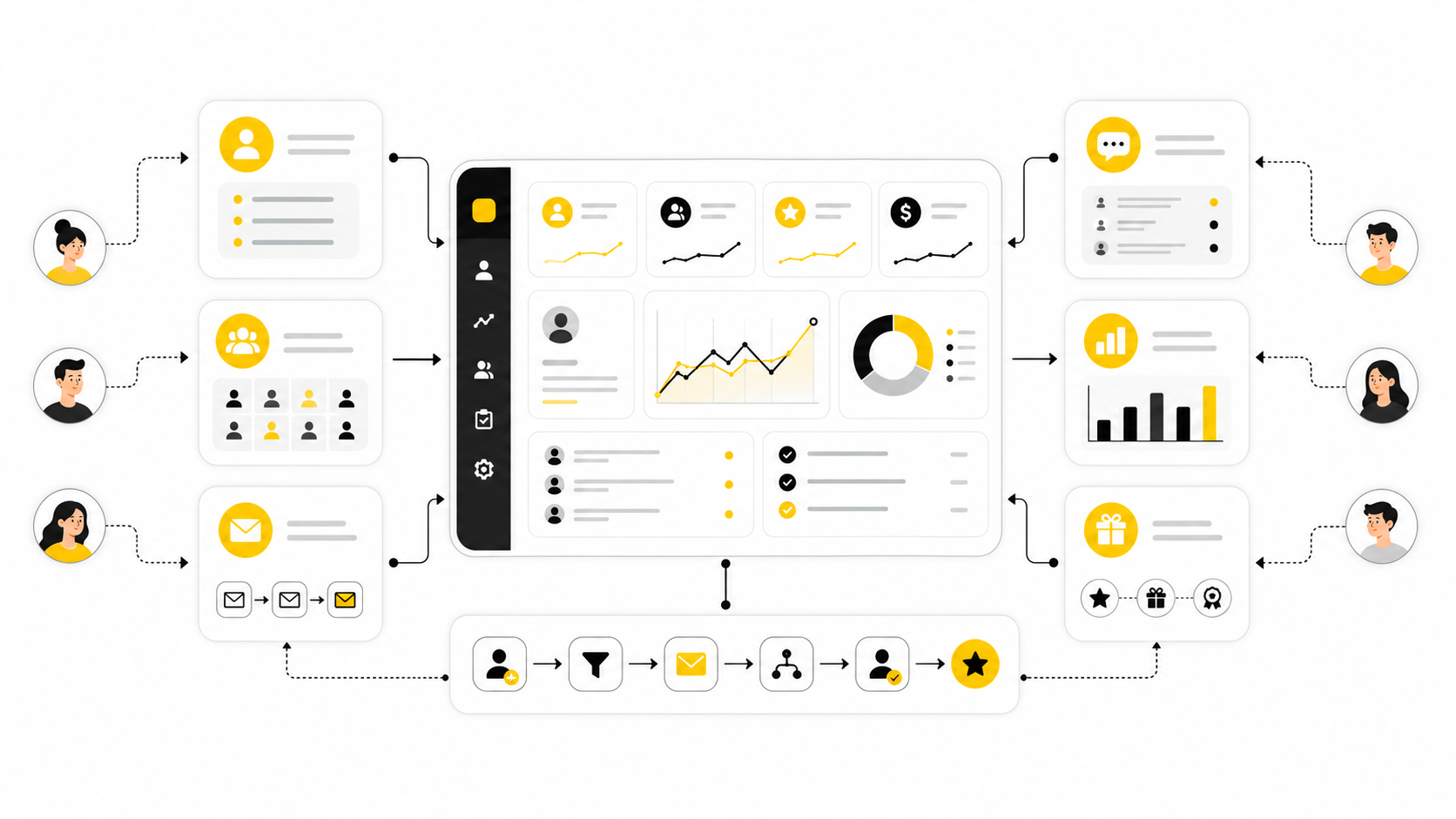
Customer relationship marketing is the work of turning one-time buyers, leads, subscribers, and users into people who trust your brand enough to keep engaging, buying, referring, and giving you useful feedback. It is not just email marketing. It is not just CRM software. It is the strategy behind how a business earns attention after the first click, protects trust after the first purchase, and creates more value over the full customer relationship.
The reason this matters is simple: most businesses spend too much energy chasing new leads while underbuilding the systems that make existing relationships more profitable. Acquisition still matters, of course. But when the customer journey is messy, follow-up is inconsistent, support feels disconnected, and every campaign sounds like it was written for a stranger, the business quietly leaks revenue it already worked hard to earn.
Good customer relationship marketing fixes that by connecting data, messaging, offers, service, and timing around the customer instead of around internal departments. A customer should not feel like marketing, sales, onboarding, support, and retention are five different companies. They should feel like every touchpoint understands where they are, what they need next, and why staying with the brand makes sense.
Customer Relationship Marketing Fundamentals
Customer relationship marketing is a long-term marketing approach focused on building trust, relevance, loyalty, and repeat value over time. Instead of treating the sale as the finish line, it treats the sale as one stage in a larger relationship. That shift changes the entire job of marketing because the goal becomes sustained customer value, not just campaign response.
At a practical level, customer relationship marketing includes the messages, automations, segmentation, personal touches, customer education, loyalty triggers, feedback loops, and retention plays that keep people engaged after they first interact with a brand. It can happen through email, SMS, social messaging, community, customer success, direct mail, live events, onboarding sequences, product usage nudges, and sales follow-up. The channel matters less than the quality of the relationship being built through it.
This is also where many teams get confused. A CRM stores customer information, but customer relationship marketing turns that information into better experiences. A loyalty program can support relationship marketing, but points and discounts alone do not create a relationship. Automation can scale the work, but automation without empathy just makes bad communication faster.
Why Customer Relationship Marketing Matters
Customer relationship marketing matters because modern buyers have more options, more skepticism, and less patience for generic communication. They expect brands to remember context, respect their attention, and make the next step easier. When a company fails at that, customers do not usually complain first; they just stop opening, stop replying, stop renewing, or buy from someone else.
The bigger problem is that weak relationships make every other marketing activity more expensive. Paid traffic has to work harder when trust is low. Sales teams need more calls when education is poor. Support gets overloaded when onboarding is unclear. Retention drops when customers only hear from the brand when there is another promotion to push.
A strong customer relationship marketing system creates a compounding effect. The first purchase leads into onboarding. Onboarding leads into product adoption or service confidence. Better outcomes lead into repeat purchases, referrals, testimonials, expansion, and cleaner customer data. That is why this topic belongs in the same conversation as revenue operations, lifecycle marketing, customer success, and brand strategy.
The Customer Relationship Marketing Framework
The simplest way to understand customer relationship marketing is to see it as a framework built around six connected stages: attract, capture, understand, nurture, retain, and expand. Each stage has a different job, but all of them support the same outcome: a stronger customer relationship that increases lifetime value. If one stage breaks, the whole relationship feels weaker.
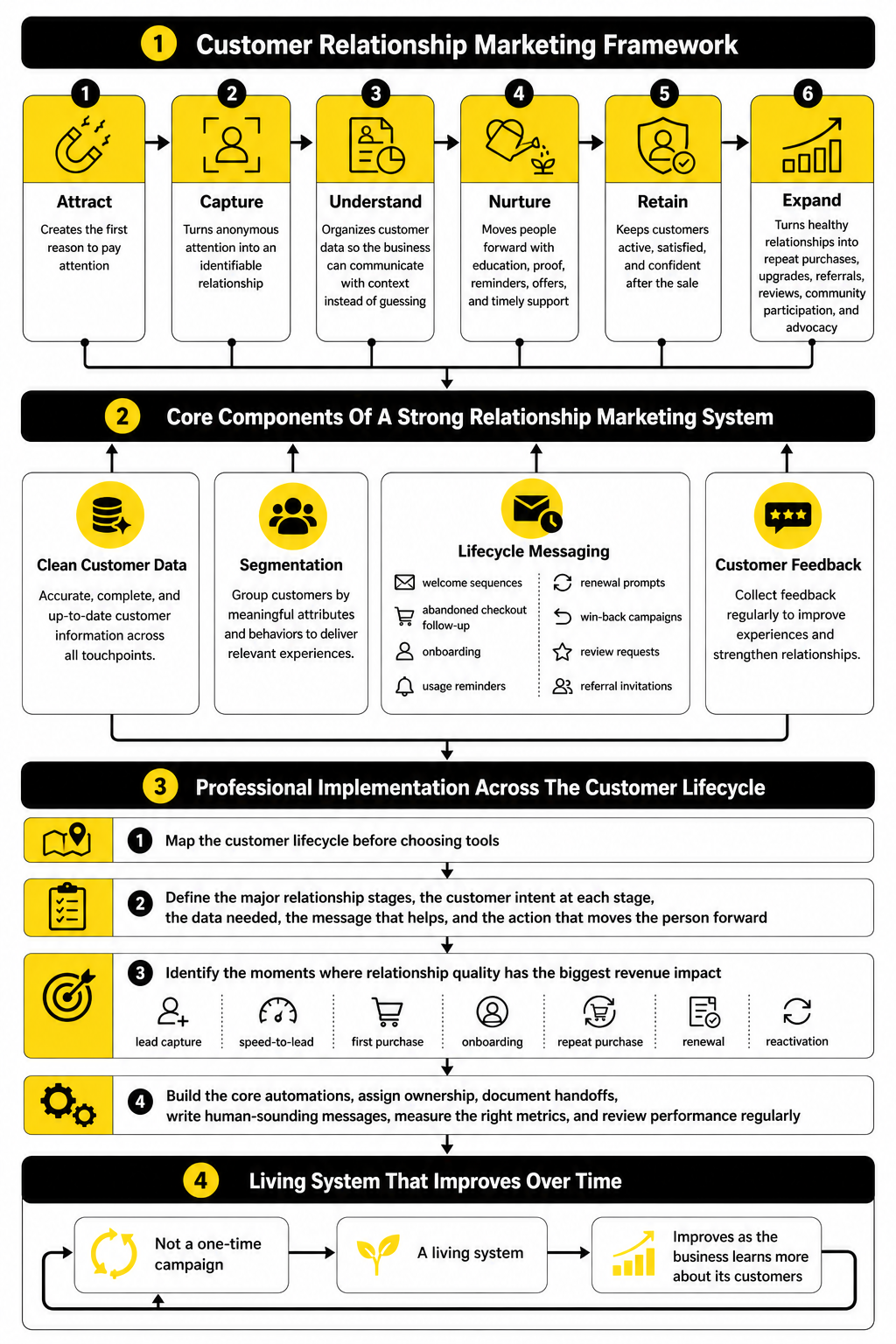
The attract stage creates the first reason to pay attention. The capture stage turns anonymous attention into an identifiable relationship, usually through a form, checkout, booking, opt-in, quiz, webinar registration, or conversation. The understand stage organizes customer data so the business can communicate with context instead of guessing.
The nurture stage moves people forward with education, proof, reminders, offers, and timely support. The retain stage keeps customers active, satisfied, and confident after the sale. The expand stage turns healthy relationships into repeat purchases, upgrades, referrals, reviews, community participation, and advocacy.
This framework works because it forces the business to stop thinking in isolated campaigns. A welcome email is not just a welcome email; it is the beginning of the nurture stage. A post-purchase survey is not just a feedback request; it is part of understanding and retention. A referral campaign is not just a growth tactic; it is the result of a relationship strong enough that the customer is willing to attach their name to the brand.
Core Components Of A Strong Relationship Marketing System
A strong customer relationship marketing system starts with clean customer data. You need to know who the person is, how they entered your world, what they bought or considered, what they care about, and what should happen next. Without that foundation, personalization becomes guesswork and automation becomes risky.
The second component is segmentation. Not every customer should receive the same message, offer, cadence, or call to action. New leads need trust. New customers need confidence. Loyal customers need recognition. At-risk customers need help before they disappear.
The third component is lifecycle messaging. This includes the practical communication flows that guide people from one stage to the next, such as welcome sequences, abandoned checkout follow-up, onboarding, usage reminders, renewal prompts, win-back campaigns, review requests, and referral invitations. Tools like ManyChat can fit naturally when conversational follow-up matters, while platforms like GoHighLevel are often used when a business needs CRM, automation, pipelines, and client communication in one place.
The fourth component is customer feedback. Relationship marketing becomes much stronger when customers can tell you what is confusing, what they value, what almost stopped them from buying, and what would make them stay longer. Feedback should not live in a forgotten spreadsheet; it should shape offers, onboarding, content, support, product improvements, and retention campaigns.
Professional Implementation Across The Customer Lifecycle
Professional implementation starts by mapping the customer lifecycle before choosing tools. The business should define the major relationship stages, the customer intent at each stage, the data needed, the message that helps, and the action that moves the person forward. This prevents the common mistake of buying software first and then forcing the customer journey to fit the tool.
The next step is to identify the moments where relationship quality has the biggest revenue impact. For many businesses, those moments are lead capture, speed-to-lead, first purchase, onboarding, repeat purchase, renewal, and reactivation. These are the points where timing, relevance, and trust matter most.
From there, the work becomes operational. Build the core automations, assign ownership, document handoffs, write human-sounding messages, measure the right metrics, and review performance regularly. Customer relationship marketing is not a one-time campaign; it is a living system that improves as the business learns more about its customers.
The Economics Of Customer Relationships
The financial case for customer relationship marketing starts with a blunt reality: most customer relationships are not equally valuable on day one. A new customer often costs money to acquire, needs education, asks more questions, and may not fully understand the product or service yet. The relationship becomes more profitable when the business helps that customer succeed, buy again, stay longer, and need less persuasion each time.
That is why retention deserves serious attention, not leftover budget. Bain’s long-running customer loyalty research found that a 5% increase in customer retention can increase profits by 25% to 95%, largely because loyal customers tend to buy more, cost less to serve, and refer others over time. The exact number will vary by business model, but the principle is hard to ignore: when relationships improve, revenue quality improves.
This does not mean acquisition becomes unimportant. It means acquisition and retention need to work together instead of competing for attention. A business with weak follow-up, poor onboarding, and generic communication has to keep replacing customers it should have kept, which turns marketing into a treadmill.
Trust Is Now A Revenue Constraint
Trust is no longer a soft brand metric that sits outside the revenue conversation. It affects whether people opt in, open messages, share data, try a product, renew a subscription, leave a review, or recommend the brand to someone else. In customer relationship marketing, trust is the asset that makes every next step easier.
That matters even more because customers are increasingly aware of how their data is collected and used. Salesforce’s 2024 research found that only 42% of customers trust companies, while only 49% feel brands use their personal information in a beneficial way. That gap is a warning: personalization can help relationships, but only when it feels useful, respectful, and earned.
The practical takeaway is simple. Do not collect data just because a tool lets you collect it. Collect the data that helps you serve customers better, explain why it matters when needed, and use it to make the experience more relevant instead of more invasive.
Better Relationships Make Acquisition More Efficient
Customer relationship marketing also makes acquisition more efficient because it improves what happens after the first conversion. A lead is not valuable just because they entered a funnel. A lead becomes valuable when the business can educate them, understand their intent, follow up at the right time, and make the buying decision feel less risky.
This is where many businesses lose money quietly. They pay for traffic, generate leads, send a few generic emails, and then complain that the channel does not work. The channel may not be the real problem. The relationship system after the click may be too weak to convert attention into trust.
A stronger relationship system gives paid ads, SEO, partnerships, webinars, referrals, and social content more room to perform. It gives new leads a reason to stay in the conversation. It gives warm prospects a better path toward a decision. And it gives customers a smoother path from first purchase to repeat value.
Consistent Experiences Reduce Customer Friction
Customers do not care how your internal teams are structured. They care whether the experience feels coherent. When marketing promises one thing, sales says another, onboarding explains something different, and support has no context, the customer feels the friction immediately.
Salesforce’s customer expectations research highlights this problem clearly: 79% of customers expect consistent interactions across departments, yet 55% say it often feels like they are communicating with separate departments instead of one company. That is exactly the kind of disconnect customer relationship marketing is supposed to fix. It turns scattered touchpoints into a connected journey.
The fix is not just “send more emails.” The fix is shared customer context, clear lifecycle stages, better handoffs, and messaging that reflects what the customer has already done. When a customer has to repeat themselves, the relationship gets weaker. When the business remembers context and acts on it, the relationship gets stronger.
Relationship Marketing Improves Customer Data
One underrated benefit of customer relationship marketing is that it improves the quality of customer data over time. When people trust the brand, they are more likely to answer questions, update preferences, complete surveys, reply to messages, join communities, and share useful feedback. That data helps the business make better decisions, but only if it is organized and used responsibly.
Deloitte’s 2024 loyalty research points to this broader shift, with loyalty programs increasingly becoming a way for brands to generate and use customer data for more tailored experiences. That does not mean every business needs a complex points program. It means customers are more willing to participate when they believe the value exchange is clear.
The important word is exchange. Customers should get something useful in return for their attention and information. That could be better recommendations, faster service, more relevant offers, early access, helpful education, or a smoother buying process.
Loyalty Is Built Before The Loyalty Program
A loyalty program can support customer relationship marketing, but it cannot rescue a weak relationship by itself. Points, discounts, and rewards may encourage repeat purchases, but they do not automatically create emotional loyalty. People stay loyal when the brand keeps proving that it understands them, respects them, and helps them get the outcome they wanted.
This is why the customer experience before and after the purchase matters so much. The product has to deliver. The onboarding has to reduce confusion. The communication has to feel relevant. The support experience has to protect trust when something goes wrong.
A good loyalty program works best when it sits on top of an already healthy relationship. Without that foundation, it can become just another promotion engine. With that foundation, it becomes a structured way to recognize, reward, and deepen the relationship customers already value.
Relationship Marketing Creates A Stronger Revenue Mix
The best businesses do not rely on one revenue motion. They combine new customer acquisition with repeat purchases, renewals, upgrades, referrals, partnerships, reviews, and customer advocacy. Customer relationship marketing supports all of those because it keeps the customer engaged beyond the first transaction.
This matters because revenue from existing customers is usually more predictable than revenue from cold audiences. You already have context. You already have permission to communicate. You already know something about what they bought, needed, ignored, clicked, or asked.
That does not make the work automatic. You still need thoughtful segmentation, useful messaging, strong offers, and a clear reason for the customer to take the next step. But the starting point is better because the relationship already exists.
The Real Goal Is Lifetime Value
The real goal of customer relationship marketing is not to make customers “feel good” in a vague way. The goal is to create enough trust, relevance, and value that the relationship becomes more useful to both sides over time. The customer gets a better experience, and the business earns higher lifetime value.
Lifetime value improves when customers stay longer, buy more often, choose higher-value offers, refer others, and require less persuasion to act. It also improves when unhappy or mismatched customers are identified earlier, because not every customer relationship should be forced. A mature relationship marketing system knows the difference between a customer who needs help and a customer who is simply not a fit.
That is the practical mindset. Customer relationship marketing is not about being nice for the sake of it. It is about designing a business that earns the next purchase instead of constantly begging for it.
Turning Strategy Into A Working System
Customer relationship marketing becomes useful when it leaves the strategy document and turns into a working operating system. That means every important customer moment has a defined purpose, a responsible owner, a clear message, and a measurable next step. Without that discipline, the business ends up with scattered campaigns instead of a relationship engine.
The implementation process should not start with software. It should start with the customer journey. Once you understand how people move from awareness to purchase to repeat value, it becomes much easier to choose the right tools, automations, content, and follow-up rules.
The best systems are built in layers. First, you define the lifecycle. Then you organize customer data. Then you build the core communication flows. Then you measure what works and tighten the gaps. Simple, but not casual.
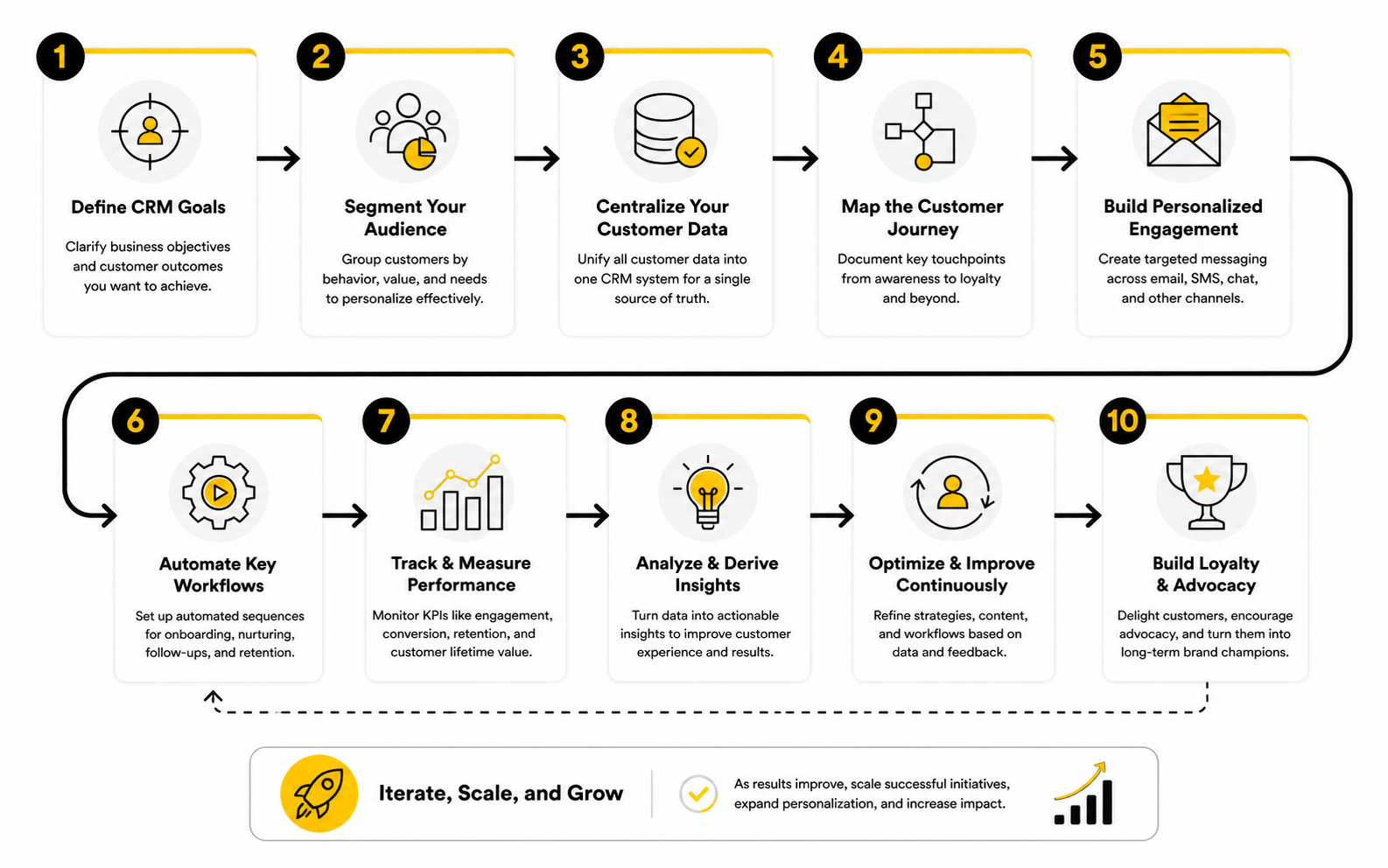
Step 1: Map The Customer Lifecycle
Start by mapping the actual lifecycle customers go through, not the idealized version your team wishes they followed. A typical customer relationship marketing lifecycle might include awareness, lead capture, consideration, purchase, onboarding, adoption, retention, expansion, referral, and reactivation. Your business may use different words, but the point is to make the journey visible.
For each stage, ask what the customer is trying to understand, what friction they are likely feeling, and what action should happen next. A new lead may need proof and education. A new customer may need confidence and clarity. A long-term customer may need recognition, fresh value, or a timely reason to upgrade.
This step matters because vague lifecycle stages create vague marketing. If your team cannot explain where a customer is in the relationship, it cannot communicate with useful context. And without context, even well-written messages can feel random.
Step 2: Define Relationship Goals For Each Stage
Every lifecycle stage needs a relationship goal. The goal is not always “sell now.” Sometimes the goal is to earn a reply, collect a preference, reduce uncertainty, encourage product usage, prevent churn, or help the customer reach their first meaningful outcome.
This is where many businesses damage trust without realizing it. They treat every customer interaction as an opportunity to push another offer. That may generate short-term clicks, but it trains people to ignore the brand when they are not ready to buy.
A stronger approach is to match the goal to the relationship stage. Early-stage prospects need clarity. New customers need momentum. Existing customers need relevance. At-risk customers need help before another discount.
Step 3: Build A Useful Customer Data Foundation
Customer data should help the business understand people better, not just fill fields inside a CRM. The most useful data usually includes source, intent, product interest, purchase history, lifecycle stage, engagement behavior, support history, stated preferences, and important dates. That gives the team enough context to send more carefully messages without overcomplicating the system.
You do not need to track everything from day one. In fact, tracking too much too early often creates messy data that nobody trusts. Start with the fields that change what you say, when you say it, or who should say it.
A practical data foundation also needs rules. Decide which fields are required, who updates them, how tags are used, when contacts move between stages, and what happens when data is missing. Clean customer relationship marketing depends on clean operational habits.
Step 4: Segment Customers By Behavior And Intent
Segmentation is where relationship marketing starts to feel personal without becoming creepy. Instead of grouping people only by broad demographics, segment them by what they did, what they showed interest in, what they bought, what they ignored, and where they are in the lifecycle. Behavior usually tells you more than assumptions.
For example, a lead who booked a call but did not show up needs a different follow-up from someone who downloaded a guide six months ago. A customer who bought once and disappeared needs a different message from someone who buys every month. A high-value customer should not be treated like a cold subscriber who barely remembers the brand.
Good segmentation also protects the customer experience. It stops irrelevant promotions from going to the wrong people. It prevents new customers from receiving beginner education forever. And it makes every campaign more focused because the message has a specific relationship context.
Step 5: Create Lifecycle Messaging Flows
Lifecycle messaging flows are the practical backbone of customer relationship marketing. These are the automated and manual sequences that help customers move from one stage to the next. Common flows include welcome, lead nurture, abandoned checkout, consultation follow-up, post-purchase onboarding, review request, renewal reminder, upsell, referral, win-back, and reactivation.
The key is to write these flows like a helpful human, not like a machine trying to maximize touchpoints. Each message should answer one clear question: what does this person need next to trust us, use the product, make progress, or take the next step? If a message cannot answer that, it probably does not belong in the flow.
Tools can help here, but the thinking still matters more than the platform. A business that needs landing pages and funnels might use ClickFunnels. A service business that needs CRM, pipelines, automations, missed-call text back, appointment flows, and client messaging in one place might look at GoHighLevel. The tool should support the journey, not dictate it.
Step 6: Connect Marketing, Sales, And Support
Customer relationship marketing gets much stronger when marketing, sales, and support operate from the same customer context. Marketing should know which leads are sales-ready. Sales should know what content and offers a lead has already seen. Support should know what the customer bought, what was promised, and what stage of the relationship they are in.
This does not require a huge team. Even a small business can define simple handoff rules. For example, a booked call can trigger a sales notification, a no-show can trigger a follow-up sequence, a completed purchase can trigger onboarding, and a support issue can pause promotional messaging until the problem is resolved.
That last point is important. Nothing feels more tone-deaf than receiving a sales promotion while waiting for help with an unresolved issue. Relationship marketing is not just about sending the right message. It is also about knowing when not to send one.
Step 7: Add Feedback Loops
A relationship marketing system without feedback is incomplete. Customers will tell you where the journey is confusing, where the offer is unclear, where expectations are mismatched, and where the experience creates unnecessary friction. The business has to make it easy for that information to surface.
Feedback can come from surveys, support tickets, review requests, sales call notes, cancellation forms, community conversations, chat transcripts, and direct replies. A form tool like Fillout can be useful for collecting structured feedback, preferences, onboarding answers, cancellation reasons, or post-purchase insights without making the process feel heavy.
The real value comes from closing the loop. If customers keep asking the same question, improve the onboarding. If buyers mention the same objection, improve the sales content. If churn reasons repeat, fix the experience instead of just sending another win-back email.
Step 8: Prioritize The First 90 Days
The first 90 days of implementation should focus on the relationship moments that carry the most immediate revenue impact. Do not try to automate everything at once. Build the flows and handoffs that protect the most valuable parts of the journey first.
For many businesses, that means improving lead capture, speed-to-lead, post-purchase onboarding, abandoned checkout recovery, review collection, and reactivation. These areas usually reveal obvious gaps because they sit close to revenue. When they improve, the business feels the impact quickly.
After that, expand carefully. Add deeper segmentation, more advanced personalization, referral campaigns, loyalty layers, and customer expansion plays once the basics are working. Complexity should be earned, not installed on day one.
Step 9: Document The System
Documentation sounds boring until the first campaign breaks, a team member leaves, or nobody remembers why a tag exists. A customer relationship marketing system needs basic documentation so the business can maintain it without guessing. This includes lifecycle stages, data fields, tags, automations, message flows, ownership rules, and reporting definitions.
Good documentation does not need to be fancy. It needs to be clear enough that someone can understand how the relationship system works and what each part is supposed to do. If a workflow exists, document its trigger, audience, goal, messages, exit rules, and success metric.
This is also how you avoid automation chaos. Without documentation, teams keep stacking new flows on top of old ones. Eventually customers receive overlapping messages, internal reports stop making sense, and nobody trusts the system anymore.
Step 10: Review And Improve Monthly
Customer relationship marketing is never finished. Customer behavior changes, offers change, acquisition channels change, product expectations change, and lifecycle gaps appear as the business grows. A monthly review keeps the system alive.
The review should look at performance and quality. Which flows are driving replies, sales, renewals, reviews, or referrals? Where are people dropping off? Which messages feel outdated? Which segments are over-contacted or under-served?
This is where the system compounds. Each month, you remove friction, improve timing, sharpen segmentation, and make the customer experience a little more relevant. Over time, those small improvements become a serious advantage.
Statistics And Data
Measurement is where customer relationship marketing becomes honest. A strategy can sound smart in a meeting, but the numbers will show whether customers are actually paying attention, moving forward, staying longer, and buying again. The goal is not to collect every possible metric; the goal is to understand which signals prove the relationship is getting stronger.
The best way to think about the data is in layers. Some metrics show attention, some show trust, some show behavior, and some show revenue impact. If you mix those together without context, you can easily make the wrong decision.
For example, a high email open rate does not automatically mean the relationship is healthy. It may only mean the subject line worked. A lower open rate with stronger repeat purchases, more booked calls, and better retention may be far more valuable.
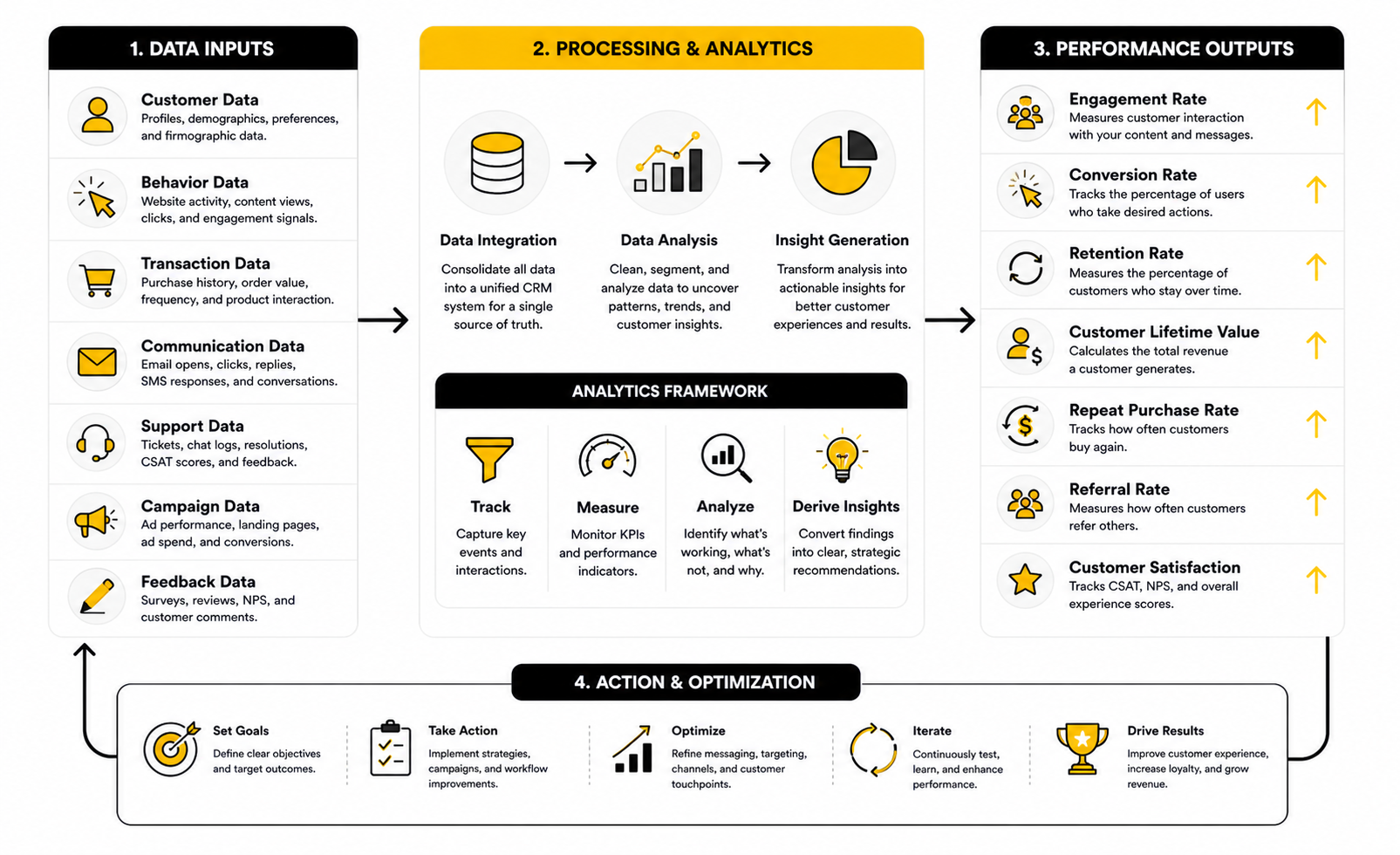
The Metrics That Actually Matter
Customer relationship marketing should be measured through a practical scorecard, not a bloated dashboard. The scorecard should show whether people are entering the relationship, engaging with the brand, becoming customers, staying active, and creating more value over time. That gives you a cleaner view of relationship quality.
The most useful metrics usually include:
These numbers should not be reviewed in isolation. A rising repeat purchase rate means more when customer support issues are stable or improving. A higher renewal rate means more when discounting is not quietly doing all the work. A strong referral rate means more when those referred customers also become profitable.
Attention Metrics Show Whether People Still Care
Attention metrics include email opens, click rates, SMS replies, social message responses, webinar attendance, landing page visits, and content engagement. They show whether customers and prospects are still willing to give the brand attention. That matters because attention is the first visible sign that the relationship is alive.
Email benchmarks are useful here, but only as a reference point. MailerLite’s 2026 benchmark report found that the average email open rate in 2025 was 43.46%, the average click rate was 2.09%, and the average unsubscribe rate was 0.22%. Those numbers can help you spot obvious problems, but they should not become your definition of success.
A customer relationship marketing email can have a modest click rate and still be valuable if it gets the right people to book calls, finish onboarding, renew, or reply with buying intent. The real question is not “Did people click?” The real question is “Did the message move the relationship forward?”
Conversion Metrics Show Whether Trust Is Turning Into Action
Conversion metrics show whether people are taking meaningful steps after they engage. This includes opt-ins, booked calls, checkout starts, purchases, onboarding milestones, demo requests, consultation completions, and upgrade actions. These metrics are where attention starts turning into business value.
If attention is strong but conversion is weak, the problem may be offer clarity, timing, proof, pricing, friction, or audience quality. Do not assume the message is the only issue. Sometimes the campaign is doing its job, but the next step feels too risky or too complicated.
This is where customer relationship marketing becomes practical. If people open the email but do not click, improve the promise and call to action. If they click but do not buy, improve the landing page, checkout, proof, guarantee, or follow-up. If they buy but do not use the product or service, fix onboarding before blaming acquisition.
Retention Metrics Show Whether The Relationship Has Substance
Retention metrics are the strongest test of whether the customer relationship has real value after the first transaction. They include repeat purchase rate, subscription renewal rate, churn rate, active customer rate, product usage, customer support patterns, and reactivation rate. If these numbers are weak, the business may be good at selling but poor at keeping trust.
Retention should be measured by cohort whenever possible. A monthly retention average can hide serious problems because older loyal customers may cover up weak performance from newer ones. Cohort analysis shows what happens to customers who joined during the same period, bought the same offer, or came from the same source.
This is important because not all acquisition channels create the same kind of customer relationship. One channel may bring cheaper leads but lower retention. Another may bring fewer customers but stronger lifetime value. Without retention data, you can easily scale the wrong traffic source.
Churn Data Shows Where The Relationship Breaks
Churn is not just a finance metric. It is relationship feedback. When customers cancel, stop buying, stop logging in, ignore messages, or disappear after one purchase, the business should treat that behavior as a signal that something in the relationship failed or became irrelevant.
Stripe’s churn benchmark resource separates churn into voluntary and involuntary categories, which is a useful distinction for any subscription business. Voluntary churn usually points to value, fit, expectations, onboarding, usage, or competitive pressure. Involuntary churn often points to failed payments, expired cards, billing friction, or recovery process gaps, and Stripe notes that its billing recovery features recovered more than US$6.5 billion for businesses in 2024.
Those two churn types need different actions. Voluntary churn needs better customer success, clearer outcomes, stronger onboarding, improved segmentation, or a better offer fit. Involuntary churn needs payment reminders, card update flows, retry logic, billing communication, and recovery automation.
Lifetime Value Connects Marketing To Profit
Customer lifetime value is the bridge between relationship quality and business economics. It helps answer a simple question: how much value does a customer create over the full relationship, not just the first sale? That question changes how you judge acquisition, retention, upsells, service quality, and customer experience.
A customer relationship marketing system should aim to increase lifetime value through better retention, repeat purchases, expansion, referrals, and lower service friction. That does not mean squeezing customers harder. It means helping the right customers get more value so buying again feels natural.
Lifetime value also helps you avoid bad growth. If a campaign brings cheap customers who churn fast, complain often, and never buy again, it may look efficient at the top of the funnel while damaging the business underneath. A slower, more relationship-driven channel can be more profitable if it brings customers who stay and expand.
Trust And Personalization Need Their Own Signals
Trust is harder to measure than clicks, but it still leaves clues. Direct replies, preference updates, survey completion, review quality, referral behavior, support tone, community participation, and consent rates all tell you whether people feel comfortable deepening the relationship. These signals matter because customer relationship marketing depends on voluntary participation.
Personalization should also be measured carefully. Salesforce’s connected customer research found that its study included 16,000+ consumers and business buyers worldwide, and the report centers heavily on the trust gap created by rising expectations, AI, and data use. That is a reminder that personalization is not automatically positive just because it is technically possible.
Qualtrics’ 2025 research on privacy and personalization, based on more than 23,000 consumers around the world, points to the same tension. Customers want relevance, but they also want control, respect, and confidence that their information is being handled responsibly. The action is clear: measure not only whether personalization lifts conversion, but also whether it protects trust.
Benchmarks Are Useful, But Your Baseline Matters More
Benchmarks can help you understand whether your performance is wildly off track, but they are not the finish line. Your own baseline is usually more useful because it reflects your offer, audience, price point, buying cycle, traffic quality, brand strength, and customer expectations. A luxury service, a local agency, a SaaS product, and a low-ticket ecommerce store should not judge relationship health the same way.
The more carefully move is to establish your current numbers and improve them over time. Track your baseline for 30 to 90 days, then look for patterns. Which source creates customers who stay? Which offer creates repeat purchases? Which onboarding step predicts long-term value? Which messages generate replies instead of just clicks?
That is where the money is. Customer relationship marketing gets stronger when benchmarks give context, but internal patterns drive decisions. External averages can tell you where to look; your customer data tells you what to fix.
Leading Indicators Help You Act Before Revenue Drops
Revenue is a lagging indicator. By the time revenue falls, the relationship may have been weakening for weeks or months. That is why leading indicators matter so much.
Useful leading indicators include lower engagement from active customers, missed onboarding steps, fewer support interactions from customers who usually ask questions, declining product usage, slower response rates, fewer repeat visits, and reduced community participation. These signals do not prove churn by themselves, but they show where attention is needed.
This is where a CRM or lifecycle platform becomes valuable. A tool like GoHighLevel can help centralize contact records, pipeline activity, automated follow-up, appointment behavior, and customer communication history. The point is not to admire the dashboard; the point is to spot relationship risk early enough to do something useful.
The Measurement System Should Drive Action
A customer relationship marketing dashboard should make decisions easier. If a metric changes, the team should know what action to consider. Otherwise, the dashboard becomes decoration.
A practical measurement system can follow this structure:
This makes reporting much more useful. Instead of asking “How did the campaign perform?” you ask “What did this campaign reveal about the customer relationship?” That question leads to better decisions.
Reporting Cadence Keeps The System Clean
Measurement should happen on a predictable rhythm. Weekly reporting is useful for campaign performance, lead flow, booking rate, and obvious issues. Monthly reporting is better for retention, lifecycle movement, customer feedback, and revenue patterns. Quarterly reporting is where you review bigger strategic questions like channel quality, customer lifetime value, loyalty, and expansion opportunities.
The cadence matters because different metrics move at different speeds. Email clicks can change overnight. Retention patterns need more time. Lifetime value needs even more time, especially in businesses with longer buying cycles.
Do not force every metric into the same reporting window. Fast metrics help you optimize execution. Slower metrics help you judge relationship strength. Both are useful, but they answer different questions.
What The Data Should Change
The point of customer relationship marketing analytics is not to prove that marketing is busy. The point is to change what the business does next. If the data does not lead to better segmentation, clearer messages, stronger onboarding, sharper offers, faster follow-up, or better retention plays, the system is not doing its job.
When engagement drops, review message relevance and cadence. When conversion drops, inspect the offer, proof, landing page, sales process, and timing. When churn rises, inspect onboarding, expectation setting, usage, support, billing, and customer fit. When lifetime value grows, identify what created that improvement and turn it into a repeatable process.
That is the practical standard. Measure the relationship, interpret the signal, and take action. Anything else is just reporting for the sake of reporting.
Advanced Customer Relationship Marketing Decisions
Once the basics are working, customer relationship marketing becomes less about adding more campaigns and more about making sharper decisions. The beginner mistake is undercommunication. The advanced mistake is overengineering the relationship until customers feel watched, pressured, or exhausted.
This is where strategy matters. A business needs to decide which relationships deserve more personalization, which automations should stay simple, which customer segments should receive more human attention, and which offers should not be pushed too aggressively. More capability does not automatically mean better marketing.
The goal is to build a relationship system that scales without losing judgment. That means using data, automation, and AI where they improve relevance, but keeping enough human oversight to protect trust. The system should make the customer feel understood, not processed.
Personalization Has A Point Of Diminishing Returns
Personalization is powerful when it removes friction or makes the next step more useful. It can also backfire when it feels intrusive, manipulative, or strangely specific. Gartner’s 2025 research found that personalized marketing created negative experiences for 53% of customers in the study, and those customers were 3.2 times more likely to regret a purchase and 44% less likely to buy again.
That is a big warning for customer relationship marketing. Personalization should not be measured only by short-term conversion lift. It should also be judged by whether it protects confidence, reduces regret, and makes customers more likely to continue the relationship.
A practical rule helps: personalize around helpful context, not hidden surveillance. Use behavior to reduce confusion, recommend the next logical step, or avoid irrelevant messaging. Do not use personalization to create pressure the customer did not ask for.
First-Party Data Becomes A Strategic Asset
As privacy expectations rise and third-party tracking becomes less dependable, first-party data becomes more important. That includes data customers share directly, behavior inside owned channels, purchase history, preferences, support interactions, survey answers, and product usage. This is the data that makes customer relationship marketing more durable.
But first-party data is not valuable just because you collect it. It becomes valuable when it is accurate, permission-based, organized, and connected to better customer experiences. If the customer gives you information and nothing improves, the value exchange breaks.
The better approach is privacy-led relationship building. Ask for data when it clearly helps the customer get a better result. Use it in ways that feel obvious and useful. Then keep the experience clean enough that customers do not regret sharing it.
Automation Should Support The Relationship, Not Replace It
Automation is essential when the business grows. It keeps follow-up consistent, prevents leads from slipping through cracks, supports onboarding, triggers reminders, and helps teams respond faster. But automation becomes dangerous when it replaces judgment.
A customer who just opened a support ticket may not need a promotional sequence. A lead who has already booked a call should not keep receiving generic “book a call” reminders. A loyal customer should not be treated like a stranger just because they clicked a top-of-funnel asset.
This is why customer relationship marketing automations need suppression rules, exit rules, ownership rules, and review cycles. The question is not only “What should this workflow send?” The better question is “When should this workflow stop?”
AI Can Improve Scale, But It Needs Boundaries
AI can help with customer relationship marketing by summarizing customer history, drafting follow-ups, routing support requests, scoring intent, generating content variations, and spotting patterns in feedback. That can save time and improve consistency when the system has good data behind it. Used carefully, it helps teams act faster without starting from a blank page.
The risk is that AI can also multiply weak judgment. If the customer data is messy, the segmentation is shallow, or the offer logic is poor, AI will simply help the business produce more irrelevant communication. That is not innovation. That is noise at scale.
Set boundaries before scaling AI. Define which messages require human approval, which customer situations should never be fully automated, which data can be used, and how outputs are reviewed. A tool like Chatbase can be useful when a business wants an AI assistant trained around its own support or knowledge content, but it still needs clear guardrails, accurate source material, and ongoing review.
Channel Expansion Creates Coordination Problems
Customer relationships now stretch across email, SMS, social messaging, chat, calls, communities, ads, landing pages, support desks, events, and product experiences. That gives businesses more ways to stay useful. It also gives them more ways to annoy people.
The strategic tradeoff is reach versus coherence. Adding another channel can improve response if the customer actually wants to use it. But if every channel pushes the same message without coordination, the experience feels aggressive and disjointed.
A good customer relationship marketing system defines the role of each channel. Email may handle education and longer-form nurturing. SMS may handle urgent reminders or time-sensitive updates. Social messaging may handle conversation. Calls may handle high-intent decisions. The channels should work together instead of competing for the same attention.
Segmentation Can Become Too Complicated
Segmentation improves relevance, but too much segmentation can slow the team down and make reporting messy. If every small behavior creates a new segment, the system eventually becomes hard to manage. Nobody knows which audience matters, which message is active, or which automation is responsible for the result.
Advanced segmentation should be tied to meaningful decisions. Create a segment only when it changes the message, offer, cadence, channel, sales action, or success metric. If the segment does not change what you do, it may not need to exist.
This is especially important for smaller teams. A simple lifecycle-based segmentation model that is used consistently will usually outperform a complex model that nobody maintains. In customer relationship marketing, useful beats impressive.
Scaling Requires Clear Ownership
Relationship systems break when nobody owns the whole customer journey. Marketing owns campaigns. Sales owns conversations. Support owns problems. Product owns usage. Finance owns billing. The customer, unfortunately, experiences all of it as one relationship.
As the business scales, ownership has to become explicit. Someone needs to own lifecycle strategy, someone needs to own data quality, someone needs to own messaging standards, and someone needs to review customer friction across teams. Without that, every department optimizes its own piece while the customer experience gets weaker.
This does not always require a new executive role. It does require a clear operating rhythm. Review the journey together, inspect handoffs, fix repeated friction, and make sure the customer is not paying the price for internal silos.
Revenue Pressure Can Damage The Relationship
One of the hardest tradeoffs in customer relationship marketing is balancing short-term revenue pressure with long-term trust. Aggressive promotions, countdowns, discounts, upsells, and urgency can work. They can also train customers to wait for deals, ignore regular communication, or question whether the brand is acting in their best interest.
This does not mean urgency is always bad. Real deadlines, limited capacity, seasonal windows, and legitimate price changes can be communicated clearly. The problem starts when urgency becomes fake, constant, or disconnected from customer value.
Protect the relationship by making offers relevant and honest. Sell when the timing makes sense. Educate when the customer needs clarity. Support when the customer is stuck. If every interaction tries to extract revenue immediately, the relationship eventually runs out of oxygen.
High-Value Customers Need A Different Experience
Not every customer relationship should receive the same level of attention. High-value customers, strategic accounts, long-term subscribers, referral sources, and strong advocates often deserve more personal care. Treating them exactly like everyone else can leave money and goodwill on the table.
That does not mean creating an elitist experience that ignores smaller customers. It means matching service depth to relationship value and potential. A high-value customer may justify personal check-ins, early access, priority support, custom onboarding, account reviews, or private invitations.
The important part is to make the experience feel earned and useful, not gimmicky. Recognition should help the customer get more value. If it only exists to flatter them before another upsell, they will notice.
Customer Fit Matters More As You Scale
Customer relationship marketing is not about retaining everyone at any cost. Some customers are a poor fit because they need something the business does not provide, expect outcomes the offer cannot realistically deliver, or require more support than the relationship can sustain. Trying to keep every customer can damage both profitability and team morale.
A mature system identifies fit early. It uses qualification, onboarding signals, support patterns, refund reasons, and churn feedback to understand which customers are most likely to succeed. Then the business can improve messaging, adjust offers, or set clearer expectations before the wrong people buy.
This is a hard but important shift. Better relationship marketing does not mean saying yes to everyone. It means building stronger relationships with the customers the business can genuinely serve well.
Compliance Is Part Of The Customer Experience
Compliance is often treated like a legal box to check, but customers experience it as trust. Consent, unsubscribe options, billing transparency, data handling, accessibility, and clear communication all shape how safe the relationship feels. If those basics are sloppy, the brand loses credibility.
Email deliverability rules are also getting stricter. Microsoft began requiring authentication standards for high-volume senders to Outlook.com, Hotmail.com, and Live.com in 2025, adding to the broader pressure around SPF, DKIM, and DMARC. That is not just a technical issue; if your messages do not reach the inbox, your relationship system cannot function.
The practical move is to build compliance into the operating system. Keep consent clean. Make preferences easy to manage. Authenticate sending domains. Avoid deceptive subject lines. Respect opt-outs quickly. This is not glamorous work, but it protects the relationship.
The Best Systems Stay Flexible
Customer behavior changes. Acquisition channels shift. AI changes expectations. Privacy rules evolve. Competitors adjust their offers. A customer relationship marketing system that is too rigid will slowly become outdated.
Flexibility does not mean constant reinvention. It means the system is documented, measurable, and easy enough to improve without breaking everything. You should be able to test a new onboarding flow, adjust a segment, change an offer sequence, update a channel rule, or pause a campaign when the customer context changes.
That is the expert-level view. Build the relationship system strong enough to scale, but simple enough to manage. Use automation, data, and AI to support better judgment, not replace it. And keep the customer’s trust as the constraint that shapes every growth decision.
Final System Check
By this point, customer relationship marketing should no longer feel like a vague idea about “building loyalty.” It should feel like a complete system: customer data, lifecycle stages, segmentation, messaging, human follow-up, automation, feedback, measurement, and governance all working together. That is the difference between random customer communication and a relationship engine.
The final system check is simple. Can your business identify where a customer is in the relationship, what they need next, what message they should receive, what channel makes sense, who owns the next step, and how success will be measured? If the answer is no, the relationship still depends too much on luck.
This is also where the business has to stay honest. A customer relationship marketing system is not successful because it has a lot of workflows, tags, dashboards, or AI prompts. It is successful when customers trust the brand more, move through the journey with less friction, stay longer, buy again, and recommend the business without being forced.
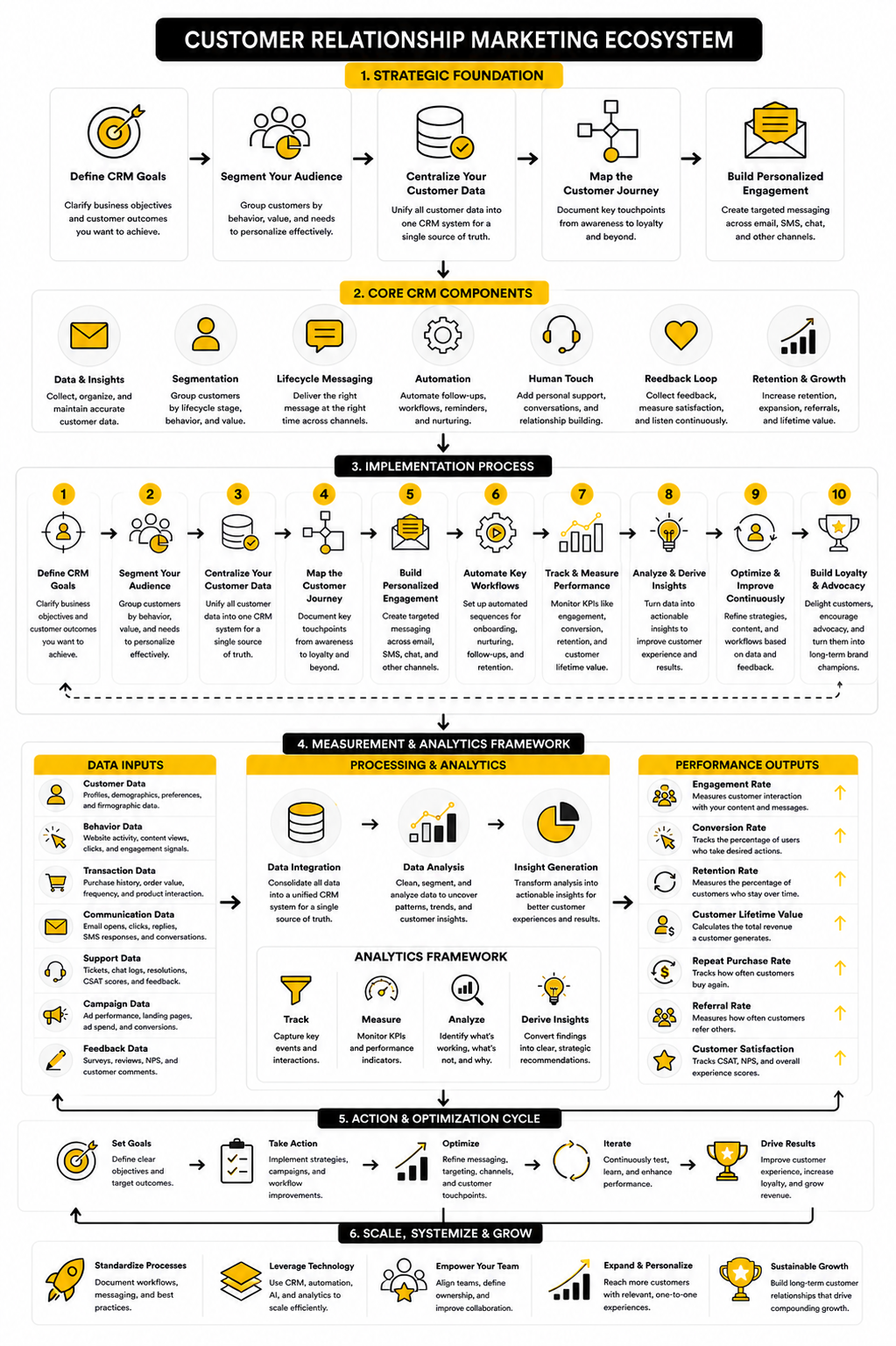
Common Mistakes To Avoid
The first major mistake is building around the tool instead of the customer. Software can organize and automate the relationship, but it cannot define the relationship for you. If the lifecycle, offer logic, data rules, and customer handoffs are unclear, the tool will only expose the confusion faster.
The second mistake is treating every contact as if they have the same intent. A new subscriber, a first-time buyer, a high-value repeat customer, and a churn-risk customer should not receive the same communication. When the message ignores context, the customer feels like the business is talking at them instead of speaking to them.
The third mistake is confusing more communication with better communication. More emails, more texts, more reminders, and more offers can easily reduce trust if they do not help the customer. Strong customer relationship marketing respects attention because attention is not guaranteed.
What To Fix First
If the current system feels messy, do not try to rebuild everything at once. Start with the highest-friction moments that affect revenue and trust most directly. These are usually lead response, post-purchase onboarding, abandoned checkout recovery, renewal communication, support handoffs, and reactivation.
The fastest wins usually come from tightening the basics. Make sure leads are captured properly. Make sure new customers know what happens next. Make sure support issues are visible before promotional messages keep firing. Make sure inactive customers receive useful reactivation instead of random discount blasts.
Once those moments are stable, improve segmentation and reporting. A clean, simple customer relationship marketing system that the team actually uses will beat a complex system nobody understands. Start practical, then scale deliberately.
What is customer relationship marketing?
Customer relationship marketing is a strategy for building long-term customer relationships that increase trust, retention, repeat purchases, referrals, and lifetime value. It focuses on what happens before, during, and after the sale. The goal is to create a customer experience that feels relevant, useful, and connected over time.
How is customer relationship marketing different from CRM?
CRM usually refers to the system that stores customer data, manages pipelines, tracks communication, and organizes customer records. Customer relationship marketing is the strategy that uses that data to build stronger relationships through messaging, segmentation, follow-up, onboarding, retention, and expansion. The CRM is the infrastructure; the marketing strategy is how you turn that infrastructure into customer value.
Why is customer relationship marketing important?
Customer relationship marketing matters because acquiring attention is expensive, but keeping trust is what creates compounding revenue. When customers stay longer, buy again, refer others, and need less persuasion, the business becomes healthier. It also improves the customer experience because communication becomes more relevant and less random.
What are the main components of customer relationship marketing?
The main components are customer data, lifecycle mapping, segmentation, lifecycle messaging, automation, human follow-up, feedback loops, retention plays, and performance measurement. Each part supports the others. Data without messaging does nothing, and automation without strategy usually creates noise.
What channels work best for customer relationship marketing?
The best channels depend on the customer, the offer, and the relationship stage. Email is strong for education, onboarding, and longer-form nurturing. SMS can work well for reminders and urgent updates. Social messaging can support direct conversations, while calls, demos, communities, and support channels are better for higher-trust moments.
Is customer relationship marketing only for big companies?
No. Small businesses often benefit from it faster because the relationship gaps are easier to see and fix. A small team can start with simple lifecycle stages, better follow-up, post-purchase onboarding, review requests, and reactivation messages. The system does not need to be complicated to be profitable.
How do you start customer relationship marketing?
Start by mapping the customer journey from first contact to repeat value. Then identify the most important moments where customers need education, confidence, support, or a reason to take the next step. After that, build the core messaging flows, define data rules, assign ownership, and measure whether customers are moving forward.
What metrics should customer relationship marketing track?
The most useful metrics include retention rate, churn rate, repeat purchase rate, customer lifetime value, renewal rate, referral rate, review rate, onboarding completion, reactivation rate, email click rate, SMS reply rate, and customer satisfaction. The point is not to track everything. The point is to understand whether the relationship is becoming stronger and more valuable.
How does customer relationship marketing improve retention?
It improves retention by reducing confusion, increasing relevance, supporting onboarding, identifying risk earlier, and giving customers a clear reason to keep engaging. Retention usually improves when customers feel successful, understood, and supported. If customers only hear from the business when there is another offer, retention becomes much harder.
What is the biggest risk in customer relationship marketing?
The biggest risk is losing trust through poor execution. That can happen through irrelevant automation, excessive messages, creepy personalization, weak data hygiene, unclear consent, or disconnected team handoffs. The strategy should make customers feel understood, not monitored or pressured.
How does personalization fit into customer relationship marketing?
Personalization helps when it uses customer context to make the experience more useful. That could mean better recommendations, more relevant education, more carefully timing, or fewer irrelevant offers. It becomes risky when it feels invasive, manipulative, or based on data the customer did not expect the business to use.
Can AI be used in customer relationship marketing?
AI can support customer relationship marketing by helping with message drafts, customer summaries, support routing, intent scoring, feedback analysis, and content variation. It should not replace judgment in sensitive customer moments. AI works best when the business already has clean data, clear rules, and human review where trust matters.
What tools are useful for customer relationship marketing?
Useful tools depend on the business model. A service business may need CRM, automations, pipelines, appointment booking, and follow-up in one place through something like GoHighLevel. A funnel-heavy business may prefer ClickFunnels, while conversational marketing may fit better with ManyChat. The tool should match the customer journey instead of forcing the journey to match the tool.
How often should customer relationship campaigns be reviewed?
Campaigns should be reviewed weekly for obvious performance issues and monthly for relationship health. Weekly reviews are useful for clicks, replies, bookings, conversions, and broken workflows. Monthly reviews are better for retention, churn patterns, onboarding completion, reactivation, and customer feedback.
What is the difference between loyalty marketing and customer relationship marketing?
Loyalty marketing usually focuses on encouraging repeat behavior through rewards, points, perks, status, or incentives. Customer relationship marketing is broader. It includes the full relationship strategy, from first contact to onboarding, retention, expansion, feedback, referral, and advocacy.
Does customer relationship marketing work for B2B?
Yes, and it is often even more important in B2B because the buying journey is longer, more considered, and more trust-dependent. B2B relationship marketing can include lead nurture, sales enablement, account-based communication, onboarding, customer success, renewal planning, executive check-ins, and expansion campaigns. The relationship has to support both the individual buyer and the broader account.
How do you know if customer relationship marketing is working?
You know it is working when more customers move through the lifecycle with less friction. You should see stronger engagement, better conversion quality, higher retention, more repeat purchases, more referrals, better reviews, cleaner handoffs, and higher lifetime value. The real proof is not a prettier dashboard; it is a stronger customer relationship that creates measurable business value.
Build a stronger local presence with BAAM AI
Turn your website, Google profile, social channels, and AI visibility into one growth engine
Most businesses do not need more random marketing activity. They need a consistent presence system that helps the right people find them, trust them, and take action. BAAM AI brings strategy, local SEO, website updates, Google Maps visibility, social content, AI-search readiness, media production, and reporting into one practical monthly engine.
If you want your marketing to keep working after the campaign ends, start with a free BAAM AI presence audit. See how your business shows up today and where the fastest visibility wins are at BAAM AI.