
BAAM AI Blog
Creative Digital Agency: A Practical Framework For Building Better Digital Growth
A creative digital agency is not just a design shop, a social media team, or a group of people who make websites look better. At its best, it is a partner that connects strategy, creative direction, content...
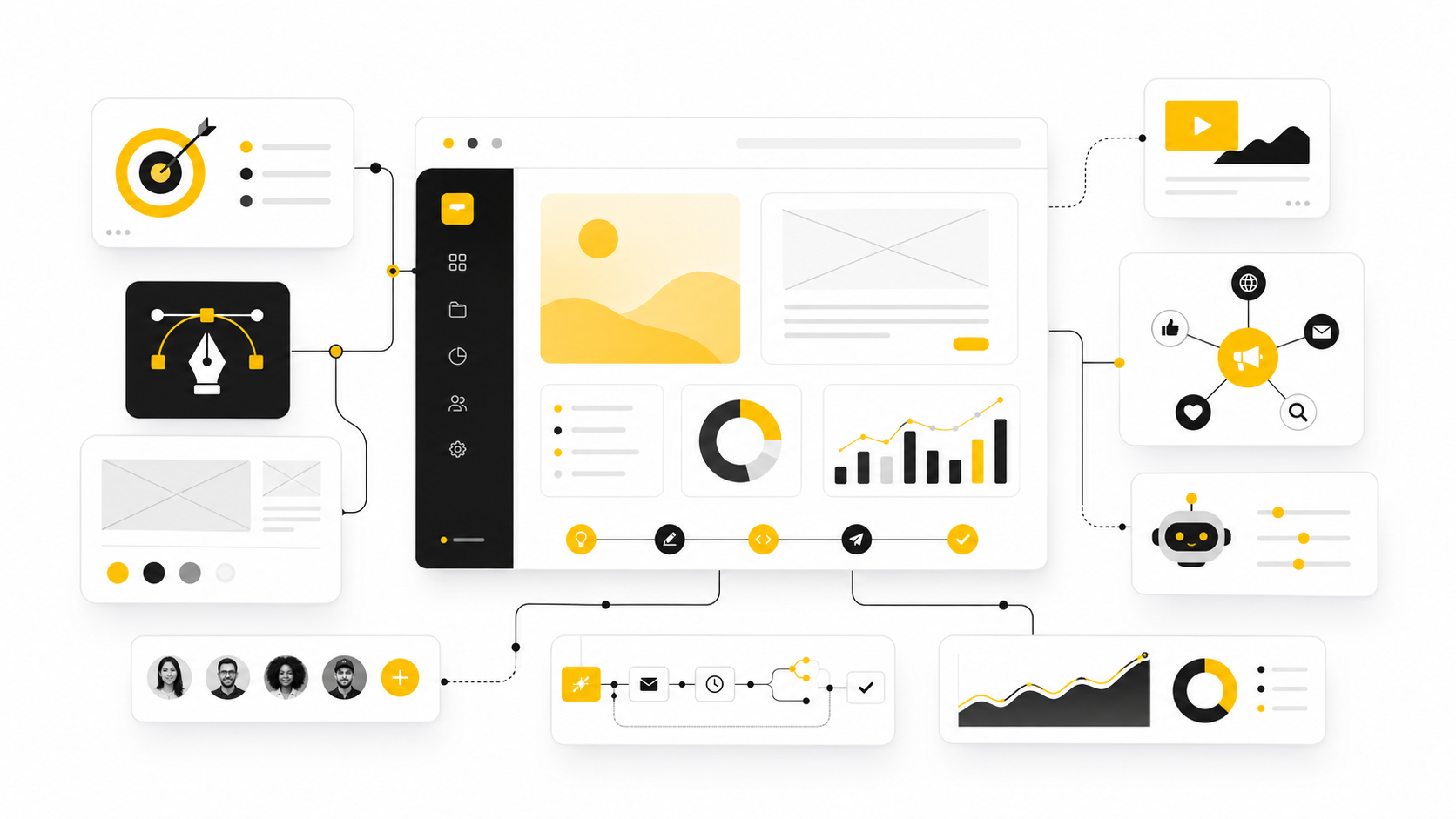
A creative digital agency is not just a design shop, a social media team, or a group of people who make websites look better. At its best, it is a partner that connects strategy, creative direction, content, technology, paid media, automation, analytics, and conversion work into one operating system for growth. That matters because digital marketing is no longer a side channel; digital channels now account for 61.1% of total marketing spend, while marketing budgets have stayed under pressure at 7.7% of company revenue.
That combination creates a simple problem for founders, marketing leaders, and ecommerce teams. You need stronger creative, faster execution, cleaner customer journeys, and better measurement, but you rarely get unlimited budget or unlimited time. A strong creative digital agency helps solve that tension by turning scattered marketing activity into a focused system.
The real value is not “more content” or “more campaigns.” The real value is better decisions, sharper positioning, stronger assets, faster testing, and a customer experience that feels consistent across every touchpoint. When AI, automation, and performance channels are changing quickly, the agency that wins is the one that can combine taste with data and strategy with execution.
this guide is split into six parts so each section can build naturally without rushing the topic. The structure starts with the big-picture role of a creative digital agency, then moves into the framework, components, implementation process, selection criteria, and final decision support. Each part uses the same practical lens: what actually helps a business grow, not what sounds impressive in a pitch deck.
Why a Creative Digital Agency Matters Now
A creative digital agency matters because customers now experience brands across many small moments instead of one clean buying journey. They may see a short-form video, click a paid ad, compare reviews, visit a landing page, receive an email, ask a chatbot a question, and return later from search. If those moments feel disconnected, the brand loses trust before the sales team or checkout page even gets a fair chance.
This is where creative and digital strategy have to work together. Strong visuals help, but visuals alone do not fix unclear positioning, weak offers, slow pages, poor tracking, or inconsistent messaging. A modern agency has to understand how the creative idea turns into traffic, how traffic turns into intent, and how intent turns into revenue.
The pressure is also increasing because personalization and AI are raising customer expectations. McKinsey’s research on personalization shows that companies are pushing toward more tailored digital interactions as AI makes relevance easier to scale through personalized marketing systems. That does not mean every brand needs a complicated enterprise setup, but it does mean generic campaigns are becoming easier to ignore.
The Framework Behind Effective Digital Agency Work
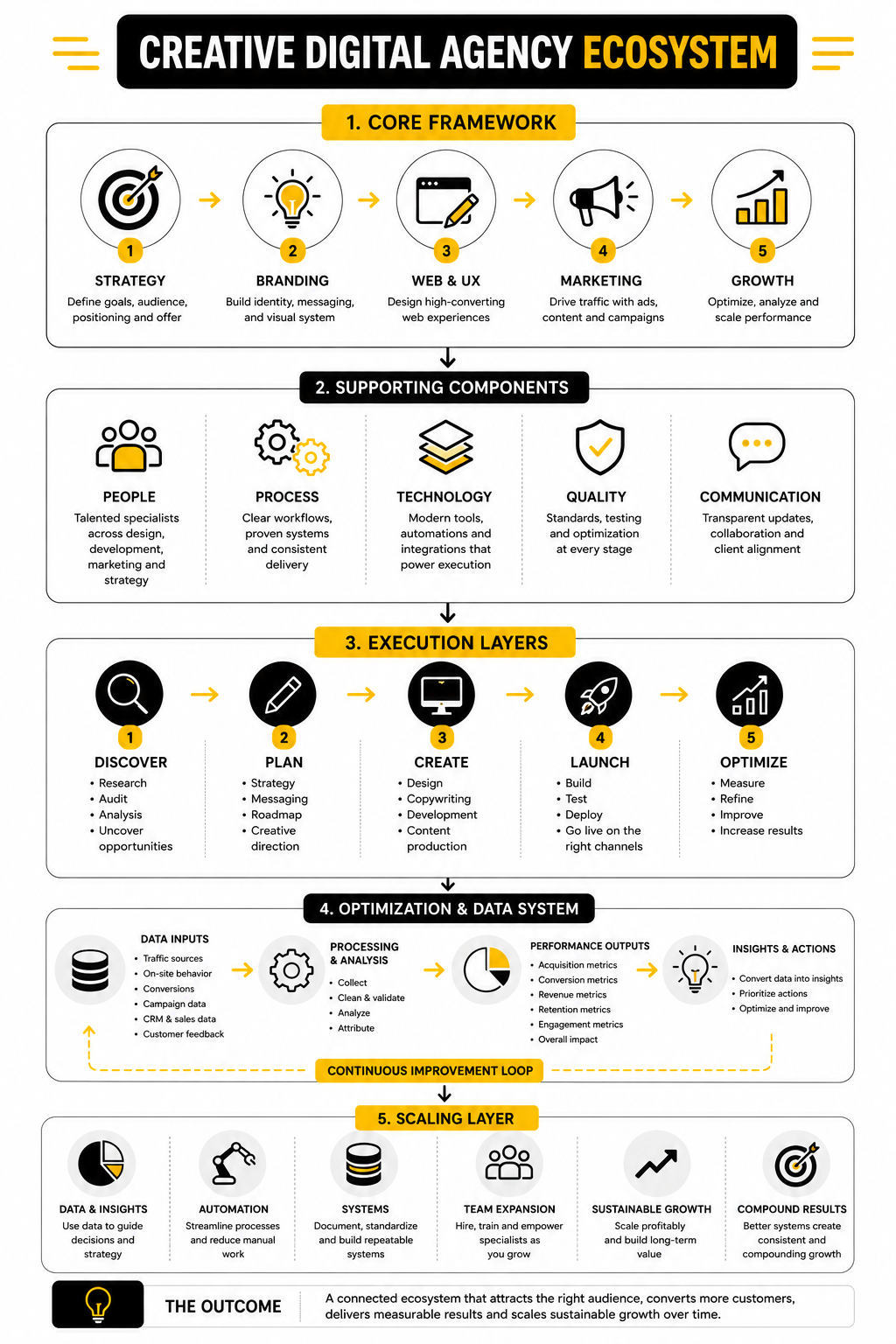
A useful way to understand a creative digital agency is to see it as a four-layer system. The first layer is strategy: positioning, audience research, offer clarity, and channel priorities. Without this layer, teams usually create more assets without knowing what those assets are supposed to change.
The second layer is creative production. This includes brand identity, campaign concepts, copywriting, video, landing pages, email creative, paid ad assets, and social content. Good production is not only about looking polished; it is about making the message easier to understand and easier to act on.
The third layer is distribution and conversion. This is where paid media, organic content, SEO, email, SMS, funnels, landing pages, automation, and CRM workflows turn creative assets into measurable movement. Tools such as GoHighLevel, ClickFunnels, or ManyChat can support this layer when the agency has a clear strategy behind them.
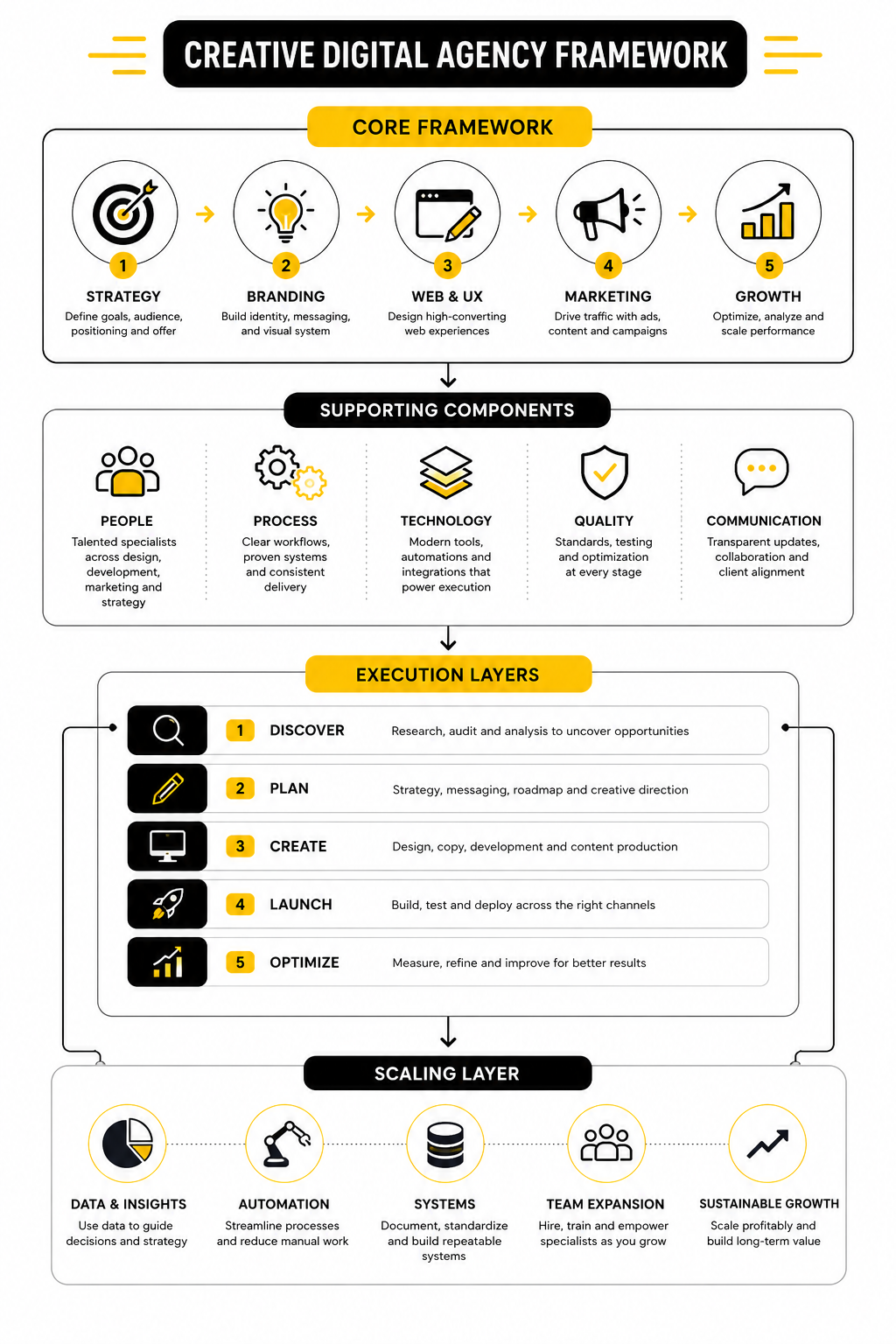
The fourth layer is optimization. This is where reporting, testing, customer feedback, conversion data, and creative performance reviews shape the next round of decisions. The best agencies do not treat reporting as a monthly screenshot; they use it to decide what to stop, what to improve, and what to scale.
Core Components of a Strong Creative Digital Agency
A strong creative digital agency is built around more than deliverables. The real difference is how the team thinks before anything gets designed, written, launched, or optimized. If the agency jumps straight into tactics, you usually get activity; if it starts with diagnosis, you have a much better chance of getting growth.
The first component is strategic clarity. This means the agency understands the market, the customer, the offer, the category, and the reason someone should choose the brand now. Without that clarity, every campaign becomes harder than it needs to be because the creative has to compensate for a weak message.
The second component is execution quality. Strategy that never turns into high-quality assets is just a nice document. A serious agency can translate the thinking into landing pages, ad concepts, email sequences, social content, sales materials, funnels, and brand systems that actually feel usable in the real world.
The third component is measurement. This is where many agencies look similar from the outside but operate very differently behind the scenes. The better ones care about creative performance, conversion rate, customer acquisition cost, retention signals, lead quality, and revenue impact, not just impressions or likes.
Brand Strategy And Positioning
Brand strategy is where the agency defines what the business should be known for. This is not only a logo conversation, and it is definitely not a mood board exercise by itself. It is the work of making the offer easier to understand, easier to trust, and easier to remember.
Positioning matters because most markets are crowded. A brand that says the same thing as everyone else forces customers to compare on price, convenience, or familiarity. A creative digital agency should help the brand choose a sharper angle so the customer can quickly understand why it exists and why it is relevant.
This work usually affects everything that follows. Paid ads become clearer, website copy becomes more direct, sales pages become more persuasive, and content becomes easier to plan. When positioning is weak, every channel needs more effort to create the same result.
Creative Direction And Content Production
Creative direction gives the brand a consistent point of view. It keeps the visuals, messaging, tone, and campaign ideas from feeling random. That consistency matters because people rarely convert after one touchpoint, so the brand needs to feel familiar each time they come back.
Content production is where that direction becomes practical. The agency may create short-form videos, static ads, website sections, product explainers, email graphics, social posts, sales page copy, and launch assets. The goal is not to produce content for the sake of filling a calendar; the goal is to create assets that move people closer to action.
This is also where speed matters. Marketing teams now need more creative variation because channels reward testing and audiences get tired quickly. Deloitte Digital’s research on content automation highlights how automation and generative AI are changing content supply chains, but it also points to real hurdles around governance, workflows, and change management through modern marketing content automation.
Website, Funnel, And Landing Page Systems
A creative digital agency should treat the website as a conversion system, not a digital brochure. The homepage, service pages, product pages, landing pages, forms, checkout flows, and thank-you pages all have a job to do. If one part is confusing, slow, or disconnected, performance drops quietly.
For ecommerce and direct-response campaigns, landing pages often need dedicated attention. A product page built for browsing is not always the same as a page built for a specific campaign, audience, or offer. Tools like Replo can be useful when a team needs to build focused ecommerce landing pages without turning every test into a slow development project.
Funnels matter for the same reason. A good funnel does not manipulate people; it removes friction. It helps the visitor understand the offer, answer key objections, choose the next step, and receive the right follow-up after they act.
Paid Media And Campaign Distribution
Creative work needs distribution. Even the best campaign can fail if it never reaches the right audience or if the media plan is too broad, too slow, or too expensive. A strong agency understands how paid search, paid social, creator partnerships, organic content, email, and retargeting fit together.
The important part is not choosing every channel at once. The important part is choosing the few channels that match the buyer journey and the budget. This is where an agency should be disciplined, because spreading spend across too many channels can make the reporting look busy while making the business impact harder to see.
Paid media also feeds creative learning. A campaign can reveal which message gets attention, which objection blocks action, and which audience segment responds with stronger intent. That feedback should move back into the creative process instead of sitting inside an ad account.
CRM, Automation, And Customer Follow-Up
A lot of revenue is lost after the first click. Someone fills out a form and receives a slow reply, joins a list and gets generic emails, books a call and receives no useful context, or abandons a checkout and never hears from the brand again. This is why CRM and automation are now part of serious digital agency work.
The agency does not need to overcomplicate this layer. It needs to map the customer journey, define the key moments, and build follow-up that feels timely and relevant. For service businesses and agencies managing leads, GoHighLevel can support pipelines, automations, messaging, and client follow-up in one system.
For content-led brands, ecommerce stores, and audience-based businesses, email and messaging tools can also play a major role. Platforms like Brevo, Moosend, and ManyChat can help when the strategy calls for email campaigns, marketing automation, or conversational flows. The tool is not the strategy, though. The tool only works when the message, timing, and offer are clear.
Analytics, Testing, And Decision Making
Analytics is where a creative digital agency proves that it is not guessing. The point is not to drown the client in dashboards. The point is to make better decisions faster.
Good reporting connects creative assets to business outcomes. It should show which messages are working, which pages are leaking attention, which channels are producing qualified demand, and which tests are worth continuing. If the reporting only shows surface metrics, it may look professional while still hiding the real problems.
Testing also needs discipline. Not every change deserves a test, and not every result deserves a dramatic conclusion. The best agencies build a rhythm: form a useful hypothesis, test one meaningful variable, review the result, and apply the learning to the next campaign.
How Professional Implementation Works
Professional implementation is where a creative digital agency stops sounding strategic and starts becoming useful. This is the point where ideas become assets, assets become campaigns, and campaigns become measurable customer journeys. The process should feel structured enough to create momentum, but flexible enough to respond when the market gives feedback.
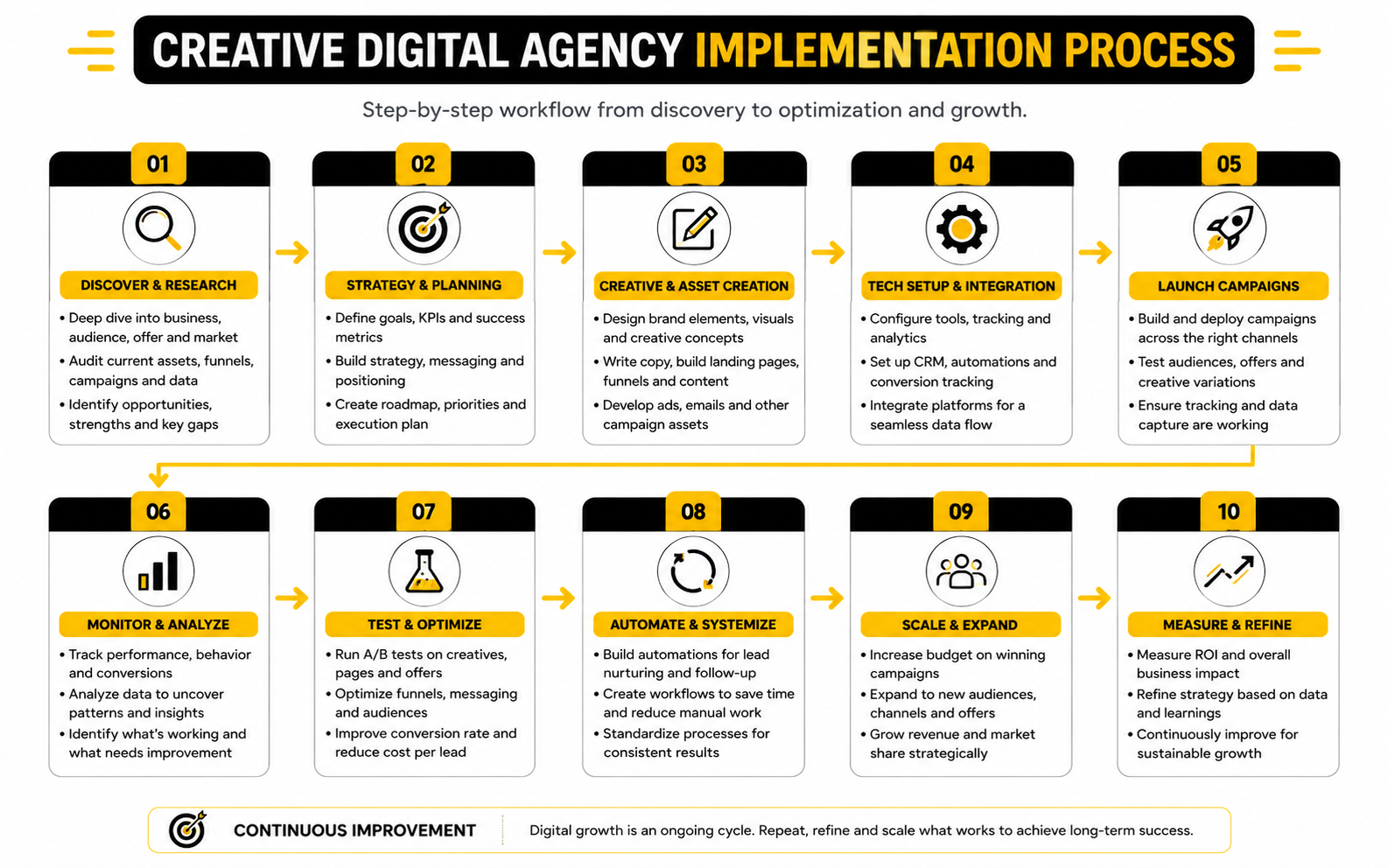
The best agency process is not a mystery. It usually moves from diagnosis to planning, then from production to launch, and finally into optimization. The mistake is treating those stages like separate departments instead of one connected workflow.
This matters even more now because creative and marketing production cycles are speeding up. Deloitte Digital’s research found that content demand nearly doubled between 2023 and 2024, which means brands need a cleaner system for producing and approving work through modern content automation. More demand does not automatically mean more impact, though. Without a strong process, it just means more noise.
Step 1: Diagnose The Real Growth Problem
The first step is diagnosis. A good creative digital agency does not begin by asking, “What assets do you want?” It begins by asking what is blocking growth, where the customer journey breaks, and which part of the marketing system needs the most attention.
This usually includes reviewing the website, offer, analytics, paid media accounts, email flows, sales process, customer research, and existing creative. The agency should look for friction, not just surface-level design issues. A weak landing page, unclear message, poor lead follow-up, slow checkout, or mismatched ad angle can all create different versions of the same problem: people arrive, but they do not move forward.
The output of this stage should be practical. You do not need a huge strategy deck full of abstract language. You need a clear diagnosis, a short list of priorities, and a shared understanding of what the agency will fix first.
Step 2: Define The Strategy And Success Metrics
Once the problem is clear, the agency needs to define the strategy. This is where the team decides which audience matters most, which offer should lead, which channels deserve focus, and what message should guide the campaign. Without this step, execution becomes a collection of random tasks.
Success metrics need to be decided at the same time. A brand awareness campaign, a lead generation campaign, and a conversion-focused ecommerce campaign should not be judged by the same scoreboard. The right metrics may include qualified leads, booked calls, trial starts, revenue, conversion rate, repeat purchase, cost per acquisition, or creative testing velocity.
This is also where expectations should become specific. “Improve our digital presence” is too vague. “Increase qualified demo requests from paid social and landing pages while reducing follow-up delays” gives the agency something real to build around.
Step 3: Build The Creative And Technical Plan
After the strategy is clear, the agency can turn it into a production plan. This plan should define what needs to be created, who owns each part, how feedback will work, and which assets are required before launch. The best plans remove confusion before it becomes expensive.
This stage often includes messaging frameworks, page wireframes, creative concepts, ad variations, email sequences, automation maps, tracking requirements, and launch timelines. For funnel-heavy campaigns, platforms like ClickFunnels can help teams turn campaign ideas into live customer journeys faster. For service businesses that need pipeline visibility and follow-up, GoHighLevel can support the operational side of implementation.
The technical plan should also include measurement before anything goes live. Tracking should not be treated as a last-minute task. If the agency cannot see what happens after the click, optimization becomes guesswork.
Step 4: Produce, Review, And Approve Assets
Production is where the agency creates the actual work. This may include landing pages, ad creative, video scripts, email copy, lead magnets, social content, website sections, chatbot flows, and CRM automations. The key is that production should follow the strategy, not drift away from it.
Review cycles need discipline. Too many stakeholders can turn a strong concept into a safe but forgettable asset. Too little review can create brand, legal, or technical problems that should have been caught earlier.
A good approval process is simple and firm. Review the work against the strategy, check whether it answers the customer’s real objections, confirm that the offer is clear, and make sure the next step is obvious. Personal taste can be useful, but it should not overrule the objective of the campaign.
Step 5: Launch With Clean Tracking And Clear Ownership
Launch is not just pressing publish. It is the moment where creative, media, website, automation, analytics, and sales follow-up all need to work together. If one part is missing, the campaign can look like it failed when the real issue was execution quality.
Before launch, the agency should confirm that pages work, forms submit correctly, emails fire properly, CRM stages are mapped, pixels or analytics events are active, and reporting views are ready. This is boring work, but it is exactly the kind of boring work that protects the campaign. Clean execution gives the creative a fair test.
Ownership should also be clear. Someone needs to watch the launch, review early signals, catch broken steps, and decide when changes are needed. A professional agency does not disappear after launch day.
Step 6: Learn, Optimize, And Scale What Works
Optimization is where the agency turns results into better decisions. The first round of data is rarely perfect, but it usually shows where attention is strong, where intent drops, and where the customer journey needs improvement. This is why the reporting rhythm matters.
The agency should review creative performance, page behavior, lead quality, sales feedback, email engagement, and conversion data together. Looking at one metric alone can mislead the team. A campaign with cheap leads may still fail if the leads are low quality, and a campaign with expensive clicks may still win if those clicks convert into strong revenue.
Scaling should only happen after the agency understands why something is working. That could mean increasing budget, creating more creative variations, expanding into a new audience, improving the landing page, or adding better follow-up. The goal is not constant change. The goal is intelligent iteration.
Statistics And Data
Measurement is where a creative digital agency separates real progress from marketing theatre. A campaign can look busy, generate reports, fill a content calendar, and still fail to move the business forward. The job of data is to show what is actually happening, what should change, and which decisions deserve more budget.
The mistake is using benchmarks as absolute rules. A “good” conversion rate, cost per lead, or engagement rate depends on the business model, price point, sales cycle, audience temperature, and channel mix. Benchmarks are useful because they create context, but they should never replace diagnosis.
The better question is not, “Are we above or below average?” The better question is, “What does this number tell us about the customer journey?” That shift matters because the same metric can mean very different things depending on where it appears in the funnel.
What Marketing Budget Data Really Tells You
Marketing budget data shows how competitive digital attention has become. Digital channels now represent 61.1% of total marketing spend, while overall marketing budgets are still sitting at 7.7% of company revenue. That means teams are not simply spending more because digital is trendy. They are reallocating pressure into channels where performance can be tracked, optimized, and tied more closely to revenue.
For a creative digital agency, this changes the standard of work. It is not enough to make campaigns that look premium. The work has to justify itself inside a budget environment where leaders want productivity, clearer attribution, and fewer wasted tools.
This is also why agency strategy should include prioritization. If the budget is limited, every campaign cannot be treated as equally important. The agency needs to decide which audience, offer, and channel combination has the strongest chance of producing meaningful movement.
The Metrics That Actually Matter
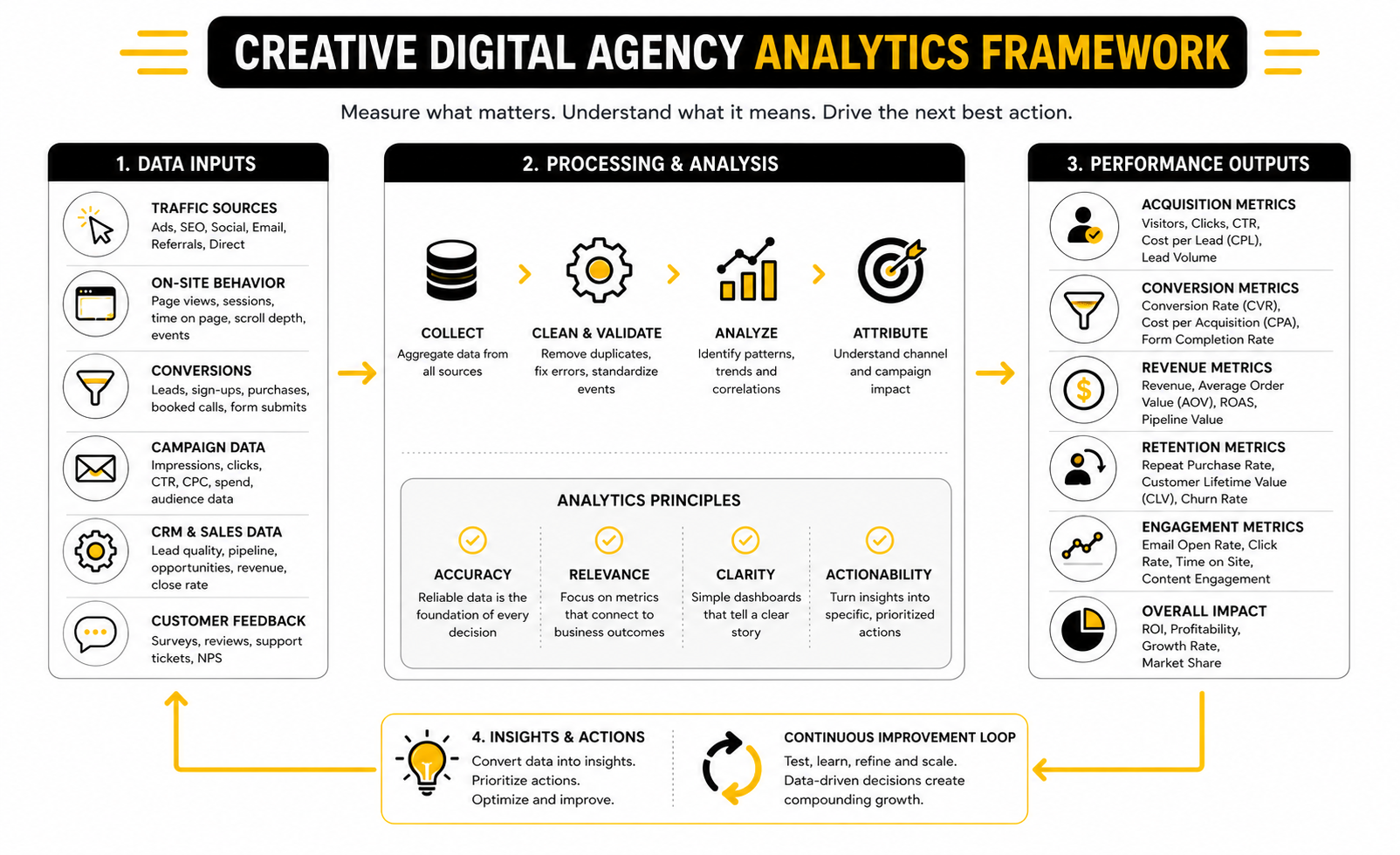
A clean analytics system should track the journey from attention to action. That does not mean every dashboard needs fifty charts. It means each stage of the funnel needs a small set of numbers that explain whether people are moving forward or dropping off.
At the attention stage, useful signals include reach, impressions, video hold rate, click-through rate, search visibility, and content engagement. These numbers show whether the message is earning enough interest to deserve deeper testing. They do not prove business impact by themselves.
At the conversion stage, the agency should focus on landing page conversion rate, cost per lead, form completion rate, checkout completion, booked calls, trial starts, qualified pipeline, and revenue. At the retention stage, email engagement, repeat purchase, churn, customer lifetime value, and referral behavior start to matter more. The point is simple: the metric should match the decision being made.
How To Read Conversion Benchmarks
Conversion benchmarks help you spot whether a page or funnel deserves closer attention. Unbounce’s conversion benchmark data, built from more than 41,000 landing pages, 464 million visitors, and 57 million conversions, found a 6.6% median conversion rate across industries. That number is useful, but only if you remember what it measures: landing pages, not every website visit in every possible context.
Ecommerce benchmarks usually sit lower because purchase intent, price, product type, device, and traffic source all change buyer behavior. Smart Insights’ 2025 ecommerce benchmark coverage points marketers toward sector-specific comparison because retail conversion rates vary heavily by device and industry through ecommerce conversion rate benchmarks. A brand selling low-ticket impulse products should not judge itself the same way as a brand selling high-consideration B2B software.
For a creative digital agency, the action is not to chase a universal average. The action is to segment the data. Compare cold traffic against warm traffic, mobile against desktop, product pages against campaign pages, and new visitors against returning visitors. That is where the useful answers appear.
Cost Per Lead Needs Lead Quality Beside It
Cost per lead is one of the most misunderstood performance metrics. WordStream’s 2025 Google Ads benchmarks put average cost per lead at $70.11 across industries, but that number is not automatically good or bad. A $20 lead can be terrible if it never buys, and a $300 lead can be excellent if it regularly turns into high-value revenue.
This is why a creative digital agency should connect ad reporting with CRM and sales feedback. The media team needs to know which campaigns produce qualified conversations, not just cheap form fills. The creative team needs to know which message attracts serious buyers, not just curious clickers.
Lead value tracking changes the conversation. Instead of asking only how to lower cost per lead, the team can ask how to increase qualified lead rate, improve sales acceptance, and raise revenue per lead. That is a much healthier way to optimize.
Attribution Should Guide Decisions, Not Create False Certainty
Attribution is useful, but it is not perfect. Customers move across devices, channels, sessions, and time windows, so no model captures every influence with total accuracy. A smart agency treats attribution as a decision tool, not a courtroom verdict.
The practical approach is to combine platform data, website analytics, CRM data, customer surveys, and sales insights. If paid social claims conversions, search traffic is rising, direct traffic is converting, and sales calls mention the same campaign message, the pattern matters. You do not need perfect certainty to make a better decision.
This is especially important as AI search, zero-click behavior, and fragmented discovery change how people find brands. Salesforce’s State of Marketing research focuses heavily on AI, data, and personalization based on nearly 4,500 marketers worldwide, which points to the same underlying issue: teams need cleaner data foundations before they can make more carefully automated decisions. Bad data does not become good strategy just because AI touches it.
Performance Signals That Should Trigger Action
Data is only valuable when it changes behavior. If a campaign has a strong click-through rate but poor landing page conversion, the offer, page structure, or audience expectation may be misaligned. If the page converts well but lead quality is weak, the campaign may be attracting the wrong intent.
If cost per lead rises while lead quality also improves, the campaign may still be worth scaling. If cost per lead falls but sales acceptance drops, the agency should not celebrate too early. Cheap acquisition can quietly become expensive when the follow-up team wastes time on poor-fit leads.
A useful performance review should end with decisions. Keep what is clearly working, cut what is clearly wasting spend, and test the uncertain middle with a specific hypothesis. That is how analytics becomes a growth system instead of a monthly reporting ritual.
How To Choose The Right Creative Digital Agency
Choosing a creative digital agency is not about finding the most impressive portfolio. A portfolio shows taste, but it does not always show how the agency thinks, how it handles constraints, or whether it can connect creative work to business outcomes. The better decision is to judge the agency by fit, process, commercial understanding, and the quality of its questions.
A strong agency should be able to explain what it would do first, what it would not touch yet, and why. That last part matters. If every idea sounds urgent, the agency may be selling capacity instead of judgment.
The right partner should also understand your current stage. A startup trying to validate positioning does not need the same support as a mature ecommerce brand trying to scale acquisition. A local service business with inconsistent follow-up does not need the same system as a SaaS company optimizing product-led onboarding.
Strategy Partner Or Execution Partner
One of the first tradeoffs is whether you need a strategy partner, an execution partner, or both. A strategy partner helps clarify positioning, offers, messaging, channel focus, and customer journey design. An execution partner turns already-clear direction into assets, campaigns, pages, automations, and reporting.
Many problems happen when a business hires the wrong type of agency for the real job. If the strategy is weak, hiring a production-heavy team usually creates more output without solving the core issue. If the strategy is already strong, hiring a strategy-heavy agency may slow down momentum with workshops that do not add enough practical value.
The honest answer is that most growing businesses need a hybrid, but not always at the same intensity. Early in the relationship, strategy may need more attention. Once the direction is clear, the agency should shift more energy toward production, testing, and optimization.
Specialist Agency Or Full-Service Agency
A specialist agency is usually stronger in a narrow area. That could be paid media, landing pages, ecommerce creative, SEO, lifecycle marketing, conversion optimization, brand identity, or marketing automation. Specialists can be powerful when you already know the exact gap in your system.
A full-service creative digital agency can be better when the problem crosses multiple parts of the journey. If ads, landing pages, email follow-up, brand messaging, and analytics all need to work together, a fragmented vendor setup can create handoff problems. Full-service does not automatically mean better, but it can reduce coordination drag when the team is genuinely integrated.
The risk is that some full-service agencies are broad but shallow. They offer everything, but only a few services are actually strong. Before choosing one, ask where the agency has real depth, what work is done in-house, and where external specialists may be involved.
The AI Tradeoff
AI is now part of modern agency work, but it should not become a shortcut for weak thinking. Used well, AI can speed up research, content variation, concept development, reporting, customer support flows, and production workflows. Used badly, it creates generic output faster and makes every brand sound the same.
This is one of the biggest agency selection issues right now. IAB Europe’s 2025 research on AI in digital advertising shows that the industry is actively working through adoption, governance, and operational impact across advertisers, agencies, ad tech companies, and publishers through AI in digital advertising. That means a serious agency should be able to explain not only which AI tools it uses, but how it protects quality, brand voice, data, and approvals.
AI also creates risk when teams automate decisions without enough oversight. A 2025 analysis of more than 30,000 SEC 10-K filings found that companies mentioning AI risk increased from 4% in 2020 to over 43% in 2024 through AI risk disclosures in public filings. For clients, the lesson is simple: speed is useful, but governance is not optional.
Tool Stack Decisions
The agency’s tool stack should support the strategy, not become the strategy. A tool can make execution faster, but it cannot fix an unclear offer, weak creative angle, or broken customer journey. Before adopting anything new, ask what problem the tool solves and what process will own it.
For funnel building, ClickFunnels can make sense when the business needs focused sales flows, lead magnets, webinar funnels, or campaign-specific pages. For agencies, service businesses, and lead-driven teams, GoHighLevel can make sense when CRM, pipeline management, automations, and follow-up need to live closer together. For ecommerce landing pages, Replo can be useful when speed, testing, and Shopify-focused page creation matter.
The danger is stacking tools without simplifying operations. Every platform adds setup, training, maintenance, reporting, and decision-making complexity. A good creative digital agency should help you reduce friction, not bury your team in software.
Creative Risk Versus Brand Safety
Creative work needs some risk. If every campaign sounds like it was approved by five committees trying to avoid discomfort, it will probably be ignored. The market is too noisy for bland messaging to carry weak ideas.
That does not mean the agency should be reckless. Regulated industries, enterprise brands, healthcare, finance, and public companies need stronger review systems. Brand safety, legal accuracy, claims review, accessibility, and data privacy should be built into the process instead of patched on at the end.
The practical goal is controlled boldness. The agency should create work that is distinct enough to earn attention, but disciplined enough to avoid unnecessary reputational, legal, or customer trust problems. That balance is where experienced creative leadership matters.
Scaling Without Breaking The System
Scaling is not only about increasing ad spend. It often means producing more creative, expanding campaigns, improving follow-up, launching new offers, entering new segments, and making reporting more reliable. Each layer adds complexity.
The first scaling risk is creative fatigue. Audiences get used to messages quickly, especially in paid social and short-form content environments. A strong agency should have a pipeline for new angles, hooks, formats, and landing page tests before performance starts dropping.
The second scaling risk is operational lag. More leads do not help if the sales team cannot respond quickly, the CRM is messy, or the onboarding experience feels disconnected. If scaling creates a worse customer experience, the business may win more attention while losing more trust.
Red Flags Before You Sign
The biggest red flag is certainty without diagnosis. If an agency promises a result before understanding the offer, margins, funnel, sales process, customer behavior, and current data, that confidence is not a strength. It is a warning.
Another red flag is reporting that focuses only on activity. More posts, more ads, more clicks, and more meetings do not automatically mean the business is moving forward. The agency should be comfortable discussing revenue, pipeline, conversion quality, and what is not working.
You should also be careful with agencies that cannot explain tradeoffs. Every recommendation has a cost, whether that cost is money, time, complexity, opportunity, or focus. A serious agency will tell you what you gain, what you give up, and what needs to be true for the plan to work.
Questions To Ask Before Hiring
The best questions force the agency to reveal how it thinks. You are not looking for rehearsed answers. You are looking for clarity, honesty, and evidence that the team understands both creative work and business reality.
Ask questions like these before signing:
Good answers should feel specific. If the agency gives vague replies, hides behind jargon, or keeps pulling the conversation back to packages, that tells you something. You want a partner that can think with you, challenge weak assumptions, and still execute without drama.
Costs, Tools, FAQs, And Final Recommendations
A creative digital agency should leave the business with a stronger system than it had before. That system includes the strategy, the assets, the channels, the tracking, the automation, the reporting rhythm, and the decision-making process around all of it. When those pieces work together, marketing becomes easier to manage and easier to improve.
The final decision is not whether agencies are good or bad. The real decision is whether the agency can help your business solve the right problem at the right level of depth. Sometimes that means a full rebuild of the digital growth system, and sometimes it means one focused improvement that removes a major bottleneck.
The strongest setup usually combines experienced people with simple systems. You need creative judgment, clear analytics, fast execution, clean follow-up, and enough strategic discipline to avoid chasing every trend. That is the ecosystem worth building.
The Practical Cost Question
Agency pricing depends on scope, seniority, market, complexity, speed, and how much implementation support is included. A small project may focus on a landing page, campaign concept, audit, or funnel build. A larger engagement may include strategy, creative production, paid media, automation, analytics, and ongoing optimization.
The key is to compare cost against the value of the problem being solved. If a weak funnel is wasting paid traffic every month, fixing that funnel may be more valuable than producing more content. If the CRM follow-up is broken, cheaper leads will not solve the real issue.
A good agency should explain what the budget buys and what it does not buy. That protects both sides. It keeps the client from expecting everything at once, and it keeps the agency accountable to the work that actually matters.
The Final System To Build
The best creative digital agency relationship creates a system that becomes more valuable over time. Each campaign should teach the business something about its audience, offer, creative angles, conversion points, and follow-up. Those lessons should compound.
The system should include these core pieces:
This is the difference between hiring an agency for deliverables and hiring one for growth infrastructure. Deliverables end when the file is sent or the campaign is launched. Infrastructure keeps improving how the business attracts, converts, and retains customers.
What does a creative digital agency do?
A creative digital agency helps businesses plan, create, launch, and optimize digital marketing systems. That can include brand strategy, campaign concepts, websites, landing pages, paid ads, email marketing, content production, automation, analytics, and conversion optimization. The best agencies connect these pieces so the brand does not feel fragmented across channels.
How is a creative digital agency different from a traditional agency?
A traditional agency may focus more on brand, advertising, print, media, or broad campaign development. A creative digital agency usually works closer to digital channels, performance data, websites, funnels, automation, and ongoing optimization. The difference is not just the output; it is the operating rhythm around testing, tracking, and improving digital customer journeys.
When should a business hire a creative digital agency?
A business should consider hiring one when growth depends on better messaging, stronger creative, cleaner digital systems, or more reliable campaign execution. It also makes sense when the internal team has too many disconnected tasks and not enough strategic capacity. If traffic, leads, content, follow-up, and reporting all feel messy, an agency can help organize the system.
What should I prepare before contacting an agency?
You should prepare your current website, analytics access, ad account context, customer insights, sales process, offer details, previous campaign results, and main business goals. You do not need everything perfectly documented, but you should understand what problem you want solved. The more honest you are about constraints, the better the agency can recommend a realistic plan.
How long does it take to see results?
It depends on the scope and the starting point. Some improvements, such as fixing a landing page, follow-up sequence, or campaign message, can show useful signals quickly. Bigger changes involving positioning, website structure, creative systems, and sales processes usually take longer because they require deeper alignment and cleaner implementation.
What metrics should I use to judge an agency?
Judge the agency by metrics that match the business goal. For lead generation, look at qualified leads, booked calls, sales acceptance, pipeline value, and revenue quality. For ecommerce, look at conversion rate, average order value, repeat purchase, customer acquisition cost, and contribution margin. Surface metrics can support the story, but they should not become the whole story.
Is a full-service agency better than a specialist agency?
A full-service agency is better when the problem crosses strategy, creative, media, website, automation, and analytics. A specialist agency is better when the business already knows the exact issue and needs deep expertise in one area. The right choice depends on whether you need integration or precision.
How much should a creative digital agency cost?
There is no universal price because the scope can vary dramatically. A focused audit, campaign build, or landing page project may be very different from a full ongoing growth partnership. The better way to evaluate cost is to ask what problem the agency is solving, how valuable that problem is, and what level of implementation is included.
What are the biggest red flags when hiring an agency?
The biggest red flags are vague strategy, guaranteed results without diagnosis, reporting focused only on activity, unclear ownership, and poor questions during the sales process. Another warning sign is when the agency pushes tools before understanding the business. Tools can help, but they should never replace strategy.
Can AI replace a creative digital agency?
AI can support research, content variation, reporting, brainstorming, workflow automation, and customer journey personalization. It cannot fully replace creative judgment, positioning decisions, brand taste, customer empathy, or strategic tradeoff thinking. The better model is not AI instead of an agency; it is a sharper agency using AI responsibly.
What tools should a creative digital agency use?
The tools should match the strategy. For funnel and sales page workflows, ClickFunnels can be useful. For CRM, pipeline, automation, and lead follow-up, GoHighLevel is worth considering. For email marketing and automation, platforms like Brevo or Moosend can fit depending on the business model and workflow.
What should happen in the first 90 days with an agency?
The first 90 days should create clarity, not chaos. The agency should diagnose the current system, define priorities, improve the most important customer journey points, launch focused work, and establish a reporting rhythm. By the end of that period, you should have better visibility into what is working, what is not, and where the next round of effort should go.
Should small businesses work with a creative digital agency?
Small businesses can benefit from agency support when the agency is practical and scope is controlled. The mistake is buying a large, complex system before the offer, follow-up, and basic conversion path are clear. A smaller business usually gets better value from focused work: better positioning, a stronger landing page, cleaner lead capture, and simple automation.
How do I know if an agency understands my brand?
You know by the quality of the questions and the way the agency reflects your business back to you. A good agency should understand the customer, the offer, the buying hesitation, the market context, and the tone that fits the brand. If the agency jumps straight into generic ideas, it probably has not understood the brand deeply enough.
Build a stronger local presence with BAAM AI
Turn your website, Google profile, social channels, and AI visibility into one growth engine
Most businesses do not need more random marketing activity. They need a consistent presence system that helps the right people find them, trust them, and take action. BAAM AI brings strategy, local SEO, website updates, Google Maps visibility, social content, AI-search readiness, media production, and reporting into one practical monthly engine.
If you want your marketing to keep working after the campaign ends, start with a free BAAM AI presence audit. See how your business shows up today and where the fastest visibility wins are at BAAM AI.