
BAAM AI Blog
CPA Marketing Meaning: A Practical Guide To Cost Per Action Marketing
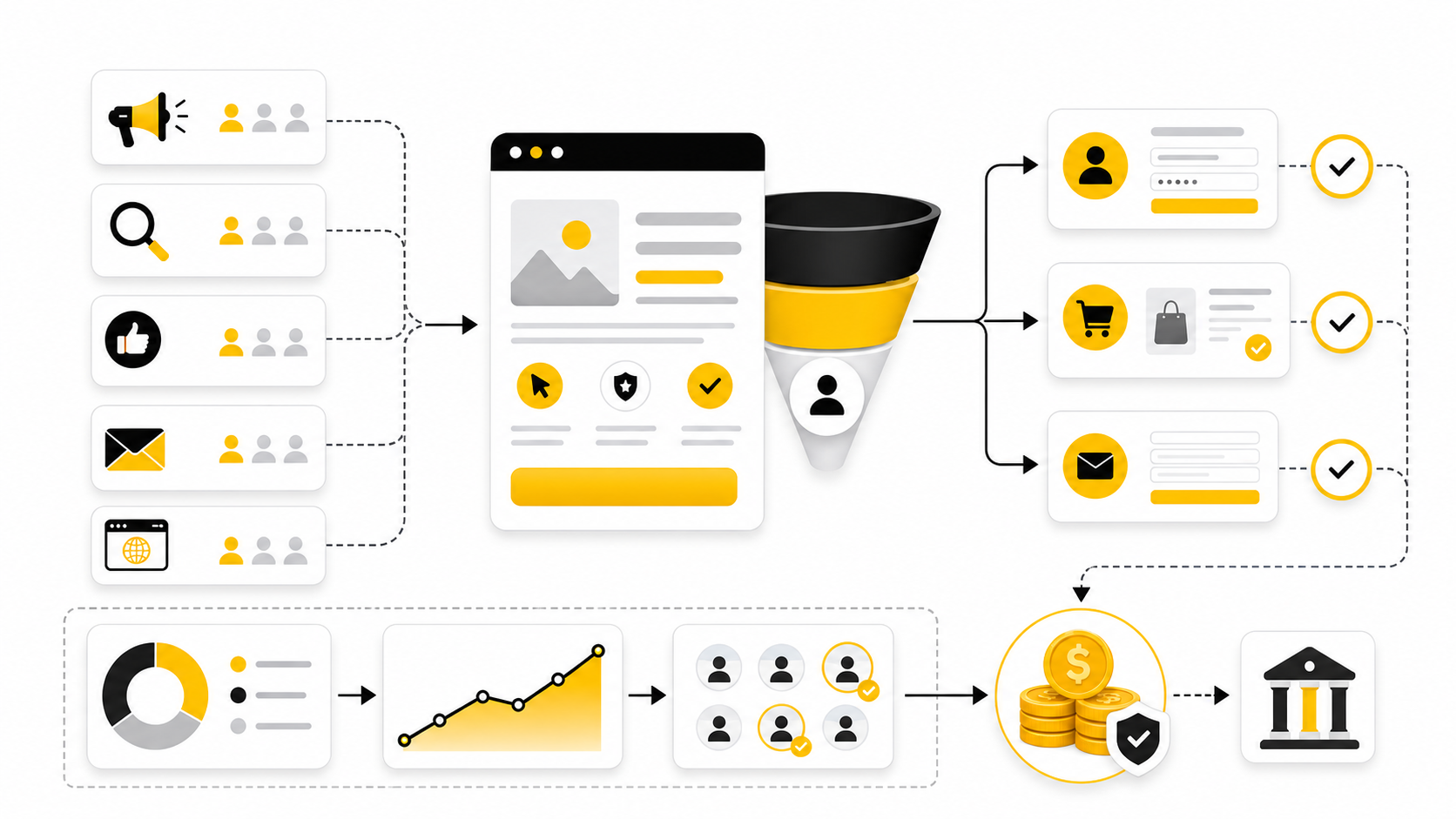
CPA marketing means cost per action marketing. In simple terms, an advertiser pays only when a specific action happens, such as a sale, lead, signup, app install, booked call, trial registration, or form submission...
Affiliate disclosure: this article may include compensated links. Recommendations should still be evaluated against your use case, budget, and current provider terms.
Should you choose this tool?
this tool is worth considering when the use case, budget, and implementation effort match what you actually need to do next.
teams that want a practical tool decision without reading another generic feature list
Check this toolCPA marketing means cost per action marketing. In simple terms, an advertiser pays only when a specific action happens, such as a sale, lead, signup, app install, booked call, trial registration, or form submission. That makes CPA different from CPM, where you pay for impressions, and CPC, where you pay for clicks before knowing whether the visitor actually converts.
This is why CPA marketing attracts so much attention from businesses, affiliates, agencies, and creators. It connects marketing spend to measurable outcomes instead of vague exposure. When a campaign is set up properly, CPA gives both sides a clearer deal: the advertiser pays for results, and the publisher, affiliate, or media buyer gets rewarded for producing those results.
The catch is that CPA marketing is not “free money” or a shortcut. The model works only when the offer, traffic source, tracking, conversion event, payout, compliance, and follow-up system all make economic sense together. Google describes cost per action as the total cost spent to receive required customer actions such as purchases, registrations, or signups, and its Target CPA bidding system uses conversion data to help advertisers get conversions at a desired average cost per action through Google Ads Help.
CPA Marketing Meaning
CPA marketing is a performance-based marketing model where payment is tied to a completed action. The “action” is defined before the campaign starts, so everyone involved knows what counts as a conversion. That action might be a purchase, but it can also be a lead form, a free trial, an appointment booking, a quote request, an app install, or a newsletter signup.
This is where many beginners get confused. CPA can mean cost per action or cost per acquisition, depending on the context. In paid advertising dashboards, CPA often means the average cost to generate a conversion, while in affiliate marketing it usually describes a payout model where affiliates are paid when a qualified action occurs.
The practical meaning is the same: CPA marketing shifts the focus from traffic to outcomes. A click is not enough. A view is not enough. The campaign has to produce the action that the advertiser is willing to pay for.
Why CPA Marketing Matters
CPA marketing matters because digital advertising has become more expensive, more competitive, and more accountable. Businesses do not want to spend endlessly on impressions that never turn into pipeline or revenue. They want to know what it costs to generate a lead, acquire a customer, book a call, or create another business outcome that can be measured.
That pressure is visible across the wider ad market. U.S. internet advertising revenue reached $258.6 billion in 2024, growing 14.9% year over year, based on the IAB Internet Advertising Revenue Report. When more money moves into digital channels, the tolerance for unclear performance drops. CPA gives teams a cleaner way to compare campaigns, offers, funnels, and traffic sources.
It also matters because CPA marketing can protect advertisers from paying for weak traffic. If a partner sends visitors who never convert, the advertiser does not pay in the same way they would under a pure CPM or CPC model. That does not remove risk completely, but it does force the conversation toward conversion quality, tracking accuracy, and economics.
The CPA Marketing Framework
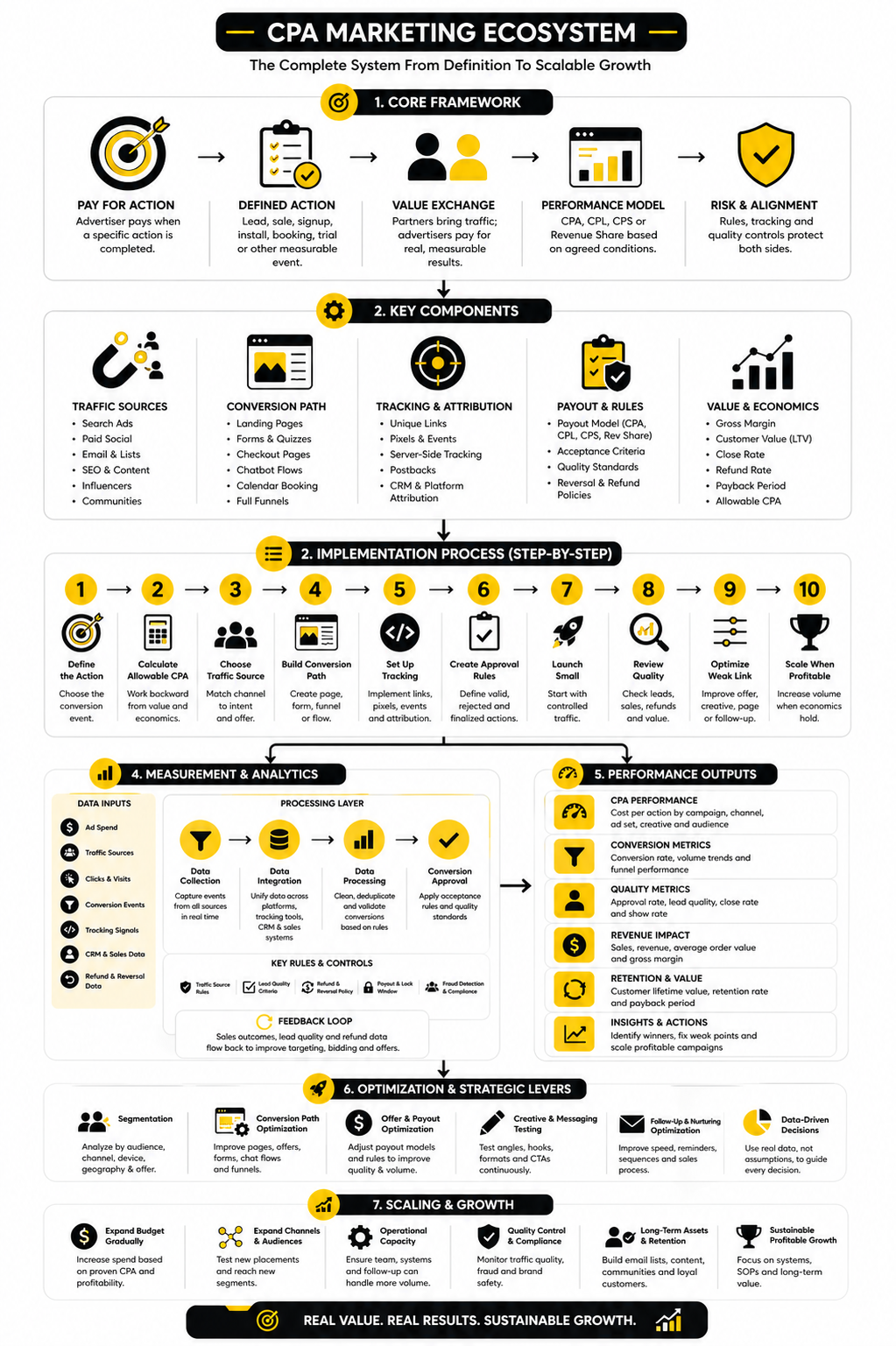
A CPA campaign is not just an ad with a payout attached. It is a system made of four connected layers: the offer, the traffic, the conversion path, and the economics. If one layer breaks, the whole campaign usually becomes unprofitable.
The offer defines what the user gets and what action counts as a valid conversion. The traffic source determines who sees the offer and how much it costs to reach them. The conversion path turns attention into action through a landing page, form, checkout, calendar, chatbot, or sales flow. The economics decide whether the payout, margin, refund risk, lead quality, and lifetime value justify scaling the campaign.
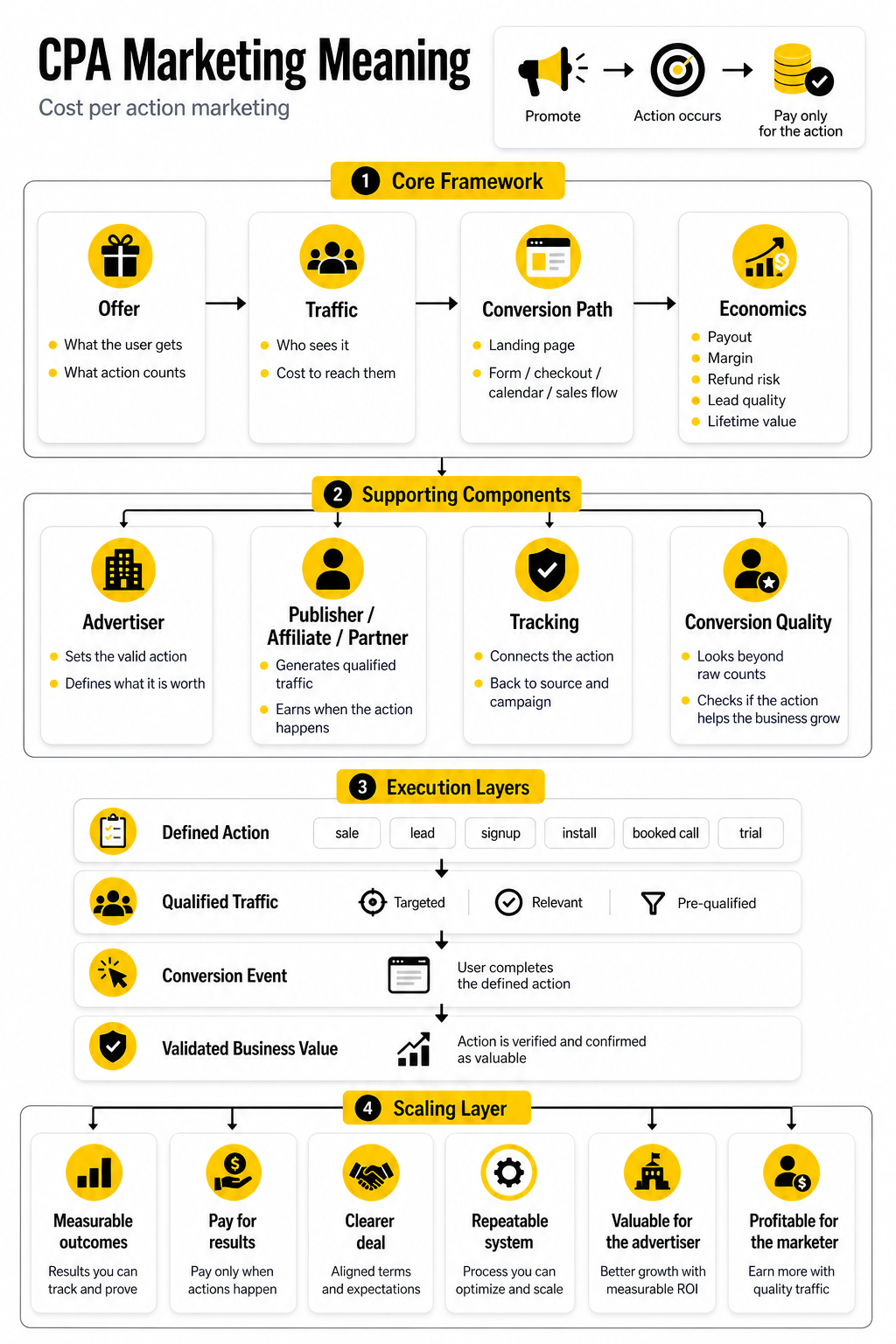
The reason this framework matters is simple. Many people explain CPA marketing as “get paid when someone completes an action,” but that definition is too shallow to be useful. The real skill is building a repeatable system where the action is valuable enough for the advertiser and profitable enough for the marketer generating it.
Core Components Of A CPA Campaign
Every CPA campaign starts with an advertiser. This is the company or offer owner that wants more customers, leads, installs, signups, or another measurable result. The advertiser sets the rules for what counts as a valid action and how much that action is worth.
The next component is the publisher, affiliate, creator, media buyer, agency, or partner promoting the offer. This side of the equation is responsible for generating qualified traffic and persuading the right people to take the desired action. In affiliate-style CPA marketing, the promoter usually earns a fixed payout or commission for each approved conversion.
Then comes tracking. Tracking is what connects the user’s action back to the campaign, channel, partner, creative, keyword, audience, or link that produced it. Without reliable tracking, CPA marketing falls apart because nobody can confidently answer the most important question: which actions were real, valid, and worth paying for?
The final component is conversion quality. A lead is not automatically valuable just because a form was submitted. A purchase is not automatically profitable if refunds, chargebacks, discounts, or fulfillment costs destroy the margin. Professional CPA marketing always looks beyond the raw conversion count and asks whether the action actually helps the business grow.
How CPA Marketing Works In Practice
In practice, CPA marketing starts with a clear conversion event. The advertiser decides what action is worth paying for, then defines the conditions that make that action valid. A simple email submit may have a low payout because it is easy to complete, while a qualified booked call, funded account, paid subscription, or confirmed purchase usually carries a higher payout because it is closer to revenue.
Once the action is defined, the campaign needs a traffic source. That traffic might come from search ads, paid social, email, SEO content, influencer placements, comparison pages, communities, short-form video, native ads, or affiliate partners. The traffic source matters because the same CPA offer can perform very differently depending on intent, audience temperature, and how much education the buyer needs before converting.
Then the visitor lands somewhere designed to complete the action. That might be a landing page, quiz, checkout page, application form, calendar page, chatbot flow, or full funnel. For creators, agencies, and small teams, tools like ClickFunnels, systeme.io, or GoHighLevel can make sense when the goal is to build pages, follow-up, forms, and sales workflows without stitching together too many separate tools.
CPA Marketing Channels And Traffic Sources
Search traffic is one of the cleanest channels for CPA marketing because intent is already visible. Someone searching for a mortgage quote, CRM software, online course platform, or insurance comparison is often closer to action than someone casually scrolling social media. The downside is that high-intent keywords are competitive, so the economics have to be tight before scaling.
Paid social works differently. The audience may not be actively searching, so the creative has to create attention, frame the problem, and move the person into a conversion path. This can work extremely well for quiz funnels, lead magnets, webinars, local services, ecommerce trials, and creator-led offers, but it also creates more room for weak leads if targeting and qualification are lazy.
Email and owned audiences can be powerful because the relationship already exists. A newsletter, community, YouTube audience, or customer list can send warmer traffic into a CPA offer than a cold ad campaign can. That is also why disclosure and trust matter so much: if the audience believes every recommendation is just a payout play, conversions may rise briefly but credibility drops fast.
SEO is slower, but it can be one of the most durable CPA marketing channels. Review pages, comparison articles, tutorials, calculators, templates, and “best tool for X” content can keep producing qualified clicks long after the content is published. For this route, the key is not stuffing “cpa marketing meaning” into every paragraph; it is matching the article to the real decision the reader is trying to make.
Tracking, Attribution, And Payout Logic
Tracking is where CPA marketing becomes serious. A campaign needs to know which partner, ad, keyword, post, email, or landing page created the conversion. Without that, the advertiser cannot approve commissions confidently, and the marketer cannot improve the campaign with any real precision.
The most common tracking setup uses a unique link, tracking parameters, pixels, server-side events, or affiliate network reporting. When the user completes the required action, the system records the conversion and assigns credit to the correct source. Modern platforms increasingly rely on conversion data and modeled signals, especially as privacy changes make simple browser-based tracking less reliable.
Payout logic should be defined before traffic starts. A valid conversion might require a real email address, a unique phone number, a minimum order value, a completed onboarding step, a non-refunded purchase, or approval by a sales team. This sounds boring, but it is not optional. If the payout rules are vague, both sides eventually argue about lead quality, reversals, fraud, and whether the campaign is actually profitable.
CPA, CPL, CPS, And Revenue Share
CPA is often used as an umbrella term, but there are several payout models inside the performance marketing world. CPL means cost per lead, so the action is usually a form submission, quote request, signup, or booked appointment. CPS means cost per sale, so the payout happens only after a purchase.
Revenue share is different because the partner earns a percentage of customer revenue instead of a fixed payout per action. This is common in software, subscriptions, financial products, education, and some creator-led offers. It can be attractive when the product has strong retention, but it also requires more patience because earnings may build over time rather than arrive as one fixed CPA commission.
The right model depends on risk. Advertisers usually prefer paying closer to revenue because it protects cash flow. Affiliates and publishers often prefer earlier actions because they do not control the advertiser’s sales team, onboarding, retention, or refund process. Good CPA marketing balances those interests instead of pretending one side should carry all the risk.
Professional Implementation
Professional CPA marketing starts before the first ad goes live. The implementation process should answer three questions clearly: what action is being paid for, why that action is valuable, and how the campaign will prove that the action happened. When those answers are fuzzy, the campaign may still generate conversions, but it will be hard to know whether those conversions are worth scaling.
The first practical step is to choose the conversion event. For a low-ticket offer, that might be a completed purchase. For a service business, it might be a qualified appointment. For software, it might be a trial signup, demo request, or activated user instead of a casual free account that never logs in again.
The second step is to define the acceptance rules. A lead might need a business email, a real phone number, a specific location, or a minimum company size. A sale might need to survive a refund window before commission is approved. This is where a CPA campaign becomes much more than a payout number on a dashboard.
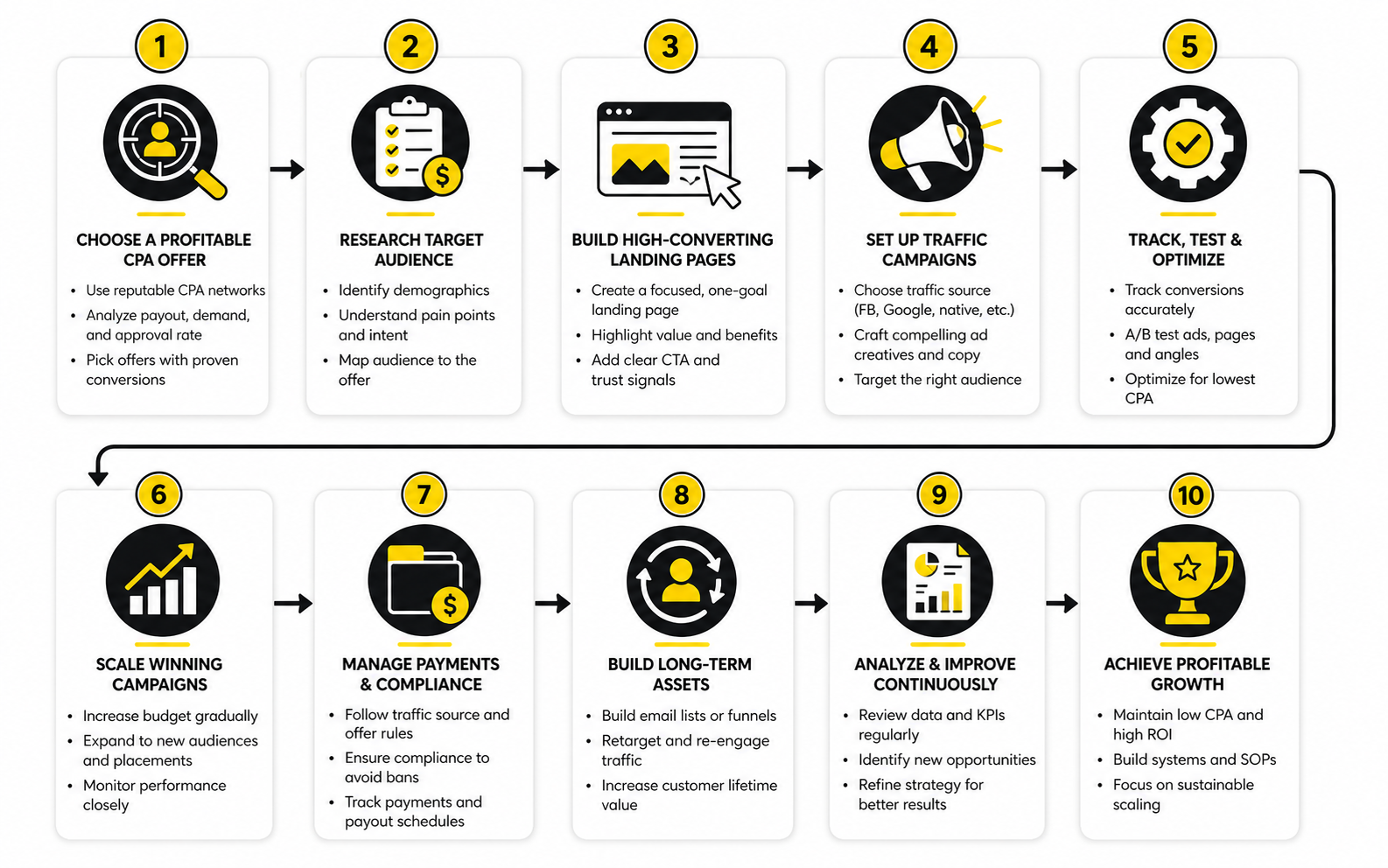
The CPA Implementation Process
A strong CPA implementation follows a simple sequence. It does not need to be complicated, but it does need to be disciplined. The goal is to remove guesswork before the campaign starts spending real money or sending real traffic.
This process matters because CPA marketing can look profitable on the surface while quietly failing underneath. A campaign can generate cheap leads that never answer the phone. It can produce sales that refund after commission is paid. It can also send high-volume traffic that technically converts but damages the advertiser’s brand because the promise was too aggressive.
Building The Conversion Path
The conversion path is the bridge between traffic and the paid action. For a simple affiliate offer, that path may be a review article leading to a merchant page. For a service business, it may be an ad, landing page, form, qualification step, calendar booking, reminder sequence, and sales call.
The best conversion paths reduce friction without removing qualification. That distinction matters. If the form is too hard, good prospects drop off. If the form is too easy, bad leads flood the system and the advertiser stops trusting the campaign.
For landing pages and funnels, the tool stack should match the offer. A creator promoting a simple digital product might use systeme.io because speed and simplicity matter. A business that needs lead routing, follow-up, pipeline visibility, and appointment workflows may prefer GoHighLevel. An ecommerce team testing product landing pages may use Replo when the page experience needs more control than a basic product template.
Follow-Up And Lead Nurturing
Many CPA campaigns fail after the conversion, not before it. A lead submits a form, but nobody follows up fast enough. A trial user signs up, but no onboarding sequence pushes them toward activation. A booked appointment is created, but reminders are weak, so the prospect never shows up.
This is why follow-up is part of implementation, not a separate afterthought. For lead-based CPA marketing, the value of a conversion depends heavily on what happens in the first few minutes and hours after the action. A faster response, cleaner qualification flow, and better reminder system can change the real economics without changing the traffic source at all.
Automation helps here when it supports the buyer instead of spamming them. A chatbot can answer basic questions, segment intent, and move users toward the next step. Email and SMS can confirm appointments, deliver promised assets, and keep the prospect engaged. Tools like ManyChat can be useful when the conversion path depends on conversational flows across social and messaging channels.
Offer Economics
The meaning of CPA marketing becomes much clearer when you look at the math. If a business earns $100 gross profit from a customer and pays $90 to acquire that customer, the campaign is fragile. It might still work if repeat purchases are strong, but the business needs proof before treating that CPA as acceptable.
A better way to think about CPA is as a ceiling, not a wish. The advertiser should know the maximum cost it can afford for the action before margin disappears. That ceiling changes depending on close rate, average order value, churn, refund behavior, support costs, and the time it takes to recover the acquisition cost.
This is also where affiliates and advertisers need alignment. A high payout can attract better partners, but it can also attract aggressive promotion if rules are loose. A low payout can protect the advertiser, but it may fail to attract serious traffic sources. The strongest CPA programs usually find the middle: enough upside for partners, enough protection for the advertiser, and enough tracking discipline to keep both sides honest.
Statistics And Data
CPA marketing data is useful only when it helps you make a decision. A lower CPA is not automatically better. A higher CPA is not automatically bad. The real question is whether the action being purchased creates enough downstream value to justify the cost.
That is why benchmarks should be treated as directional, not universal. A $20 CPA might be expensive for a low-margin ebook and unbelievably cheap for a qualified B2B demo. A 2% conversion rate might be weak for a warm email list and strong for cold paid traffic to a complex offer. Context decides what the number means.
The bigger market is clearly moving toward measurable performance. U.S. digital advertising revenue reached $294.6 billion in 2025, up 13.9% year over year, and the market commentary around that growth points to more budget flowing into performance-oriented channels through the IAB full-year 2025 report. That matters because more competition usually means higher media costs, stricter tracking expectations, and less room for sloppy CPA math.
The Metrics That Actually Matter
The most important CPA metric is not the CPA itself. It is the relationship between CPA and value. If the campaign produces customers at $60 and each customer is worth $300 in gross profit over a realistic payback window, the number may be healthy. If the same $60 CPA produces leads that never answer, never buy, or refund quickly, the campaign is broken.
You should watch these numbers together, not separately:
This is where the cpa marketing meaning becomes practical. CPA is not just a label for a payment model. It is a control number that tells you whether the campaign can keep buying actions without burning margin.
Building A CPA Analytics System
A proper analytics system connects spend, traffic, conversion events, approval rules, and revenue. It should show which campaigns create actions, which actions become real business outcomes, and which traffic sources produce volume without quality. Without that chain, you are optimizing the visible part of the funnel while ignoring the part that pays the bills.
The cleanest setup uses campaign tracking parameters, platform conversion tracking, CRM fields, and final revenue or lead-quality feedback. Google’s Target CPA bidding uses conversion tracking data to set bids around a desired average cost per action through Google Ads Help. That is useful, but it is only as good as the conversion events being fed into the system.
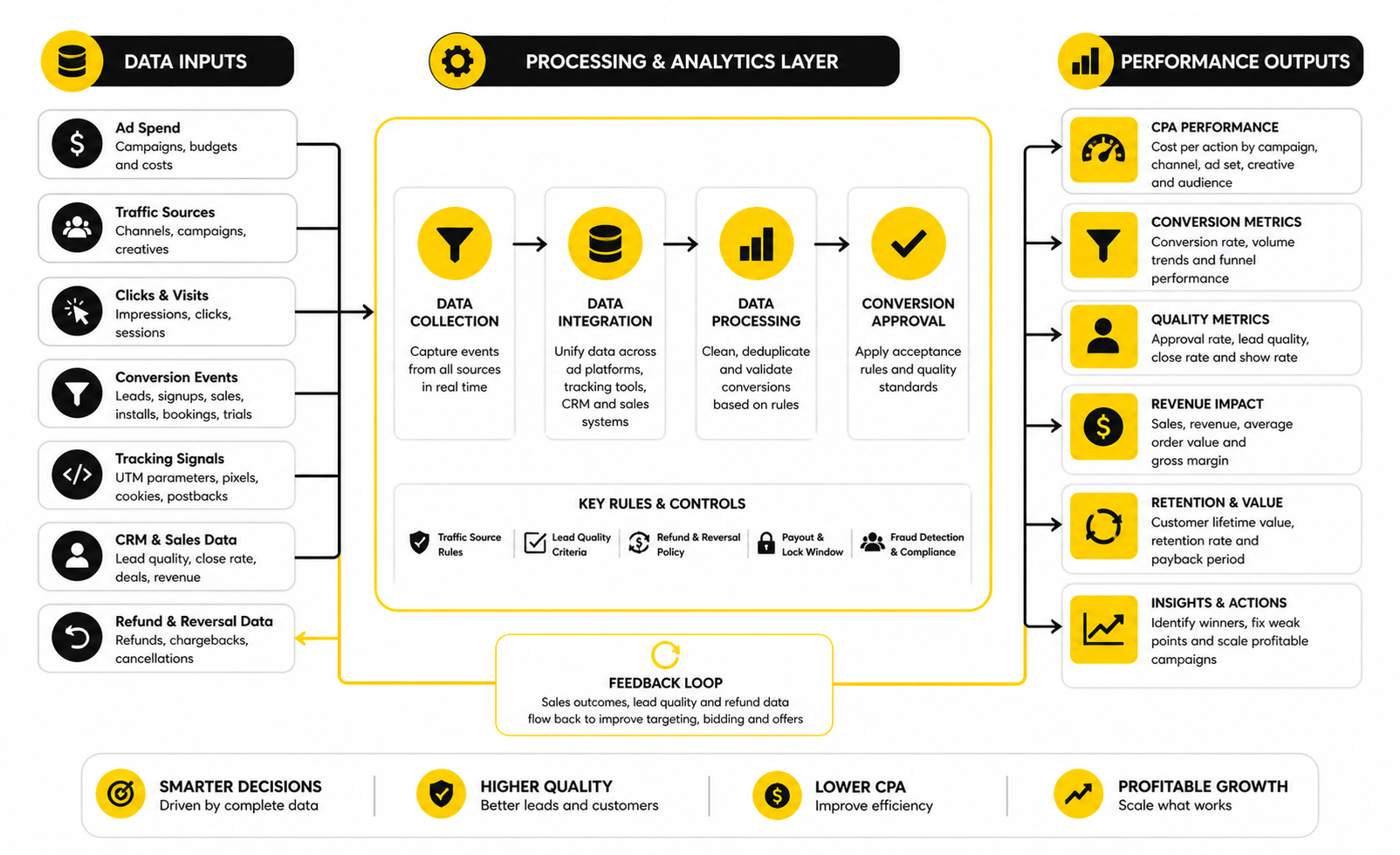
The mistake is optimizing for the easiest event instead of the most meaningful one. A platform can quickly learn how to get cheap form fills if that is the only signal you give it. But if sales quality is poor, the campaign may look efficient inside the ad account while failing inside the business. Serious CPA measurement pushes feedback from the CRM, checkout, calendar, or sales process back into campaign decisions.
How To Read CPA Benchmarks
Benchmarks are helpful when they stop you from flying blind. They are dangerous when you copy them without understanding the offer. Ecommerce, local services, SaaS, insurance, finance, education, and affiliate content all have different margins, sales cycles, and buyer behavior.
A public benchmark might tell you that ecommerce conversion rates often sit in the low single digits, with HubSpot’s 2026 marketing statistics page citing Statista data that the average conversion rate across ecommerce sites is under 2% through HubSpot marketing statistics. That does not mean your offer should accept a weak page. It means you should interpret conversion rate alongside traffic intent, price point, product category, trust level, and how much pre-selling happened before the visit.
For lead generation, the same logic applies. A low cost per lead can be meaningless if the leads are unqualified. A higher cost per lead may be better if the sales team accepts more of them, books more calls, closes more deals, and sees fewer no-shows. The number that looks ugly at the top of the funnel can be the one that wins at the bottom.
Performance Signals To Watch
Good CPA campaigns usually reveal themselves through consistency. The CPA does not have to be perfect every day, but the campaign should show stable conversion quality, predictable approval rates, and a clear path to profitability. If performance swings wildly, you need to look for tracking issues, audience fatigue, creative mismatch, budget changes, or weak conversion volume.
Bad campaigns also show patterns. You may see a sudden spike in conversions with no matching increase in qualified leads. You may see strong click-through rates but poor conversion rates, which usually means the creative created curiosity but the landing page or offer failed to convert intent. You may see good lead volume with low sales acceptance, which often points to loose qualification or misleading ad promises.
The best action is to diagnose the constraint before changing everything. If traffic is weak, fix targeting or creative. If clicks are strong but conversions are low, fix the page, offer, proof, or form. If conversions are strong but revenue is weak, fix qualification, pricing, follow-up, or approval rules. CPA marketing rewards focused optimization, not random tweaking.
What The Numbers Should Make You Do
Data should drive specific decisions. If CPA is rising but conversion quality is stable, you may need better creative, broader testing, or a higher-value offer. If CPA is falling but refund rates are rising, the campaign is not improving; it is attracting the wrong buyers more efficiently. If lead volume is growing but close rate is dropping, the qualification gate is probably too loose.
For advertisers, the key decision is whether to raise, lower, or restructure the payout. A higher payout can attract better partners and allow more competitive traffic buying. A lower payout can protect margin, but it may also reduce volume or push serious affiliates elsewhere. Sometimes the answer is not one payout, but tiered payouts based on lead quality, sale value, activation, or retention.
For affiliates and media buyers, the decision is whether to scale, pause, or rebuild. Scale only when the campaign has enough conversion volume, stable tracking, and clear economics. Pause when the data is too noisy or the advertiser keeps reversing conversions without transparent rules. Rebuild when the offer is strong but the message, page, audience, or follow-up system is clearly the weak link.
Risks, Compliance, And Quality Control
CPA marketing gets risky when the campaign rewards volume without protecting quality. If a payout is tied to a simple action, some partners will naturally optimize for the easiest version of that action. That can produce fake leads, duplicate submissions, misleading traffic, low-intent users, refund-heavy buyers, or prospects who never understood what they signed up for.
This is why quality control has to be designed into the campaign from the beginning. The advertiser should define allowed traffic sources, prohibited claims, brand rules, lead validation standards, refund policies, and reversal conditions before anyone starts promoting. The affiliate or media buyer should understand those rules clearly, because vague terms usually lead to rejected commissions and damaged relationships later.
Compliance matters just as much as tracking. The FTC’s Endorsement Guides were updated in 2023 to reflect how endorsements, reviews, influencers, and social media promotions work today through the FTC endorsement guidance. For CPA affiliates, the practical lesson is simple: if there is a material connection, incentive, commission, or paid relationship behind a recommendation, the disclosure should be clear, visible, and hard to miss.
Common CPA Marketing Risks
The biggest risk for advertisers is paying for actions that look good in a report but do not create real value. That might mean leads with fake contact details, app installs that never activate, free trials that churn immediately, or purchases that refund after the commission is locked. If the campaign is judged only by raw CPA, those problems stay hidden until the economics break.
The biggest risk for affiliates is promoting an offer without understanding approval rules. A campaign can show dozens of conversions in the dashboard, then later reverse many of them because the traffic source, geography, device type, customer quality, or post-conversion behavior did not meet the advertiser’s terms. That is frustrating, but it is also predictable when partners chase payout size before reading the rules.
There is also brand risk. Overpromising, fake urgency, exaggerated income claims, hidden fees, and misleading comparisons can create short-term conversions while harming trust. CPA marketing is performance-based, but performance does not excuse weak ethics. If the campaign needs deception to convert, it is not a scalable campaign. It is a liability.
How To Evaluate A CPA Offer
A good CPA offer is not just the one with the highest payout. A high payout can hide poor conversion rates, strict approval rules, long payment delays, weak landing pages, or a product people do not actually want. A lower payout can outperform it if the offer converts cleanly, has fair rules, and matches the audience.
Start by looking at the action itself. A paid purchase is usually more valuable than a free signup, but it may also be harder to generate. A booked call can be valuable for a high-ticket service, but only if the advertiser has a real sales process behind it. A trial signup can work well for software, but the campaign should eventually care about activation and retention, not just account creation.
Then look at the offer assets. The landing page should be clear, fast, and believable. The call to action should match the promise made in the ad or content. If you are building your own CPA-style funnel, tools like ClickFunnels, systeme.io, and GoHighLevel are useful only when the strategy is already clear. Software will not rescue a bad offer, weak economics, or lazy positioning.
Scaling CPA Campaigns
Scaling CPA marketing is not just increasing the budget. More spend usually changes the traffic mix, raises competition, exposes weak tracking, and pushes the campaign into colder audiences. A CPA that looks stable at small volume can become expensive quickly once the easiest conversions are gone.
The safer way to scale is to expand one variable at a time. Test new creative before opening new channels. Test a new audience before changing the offer. Test a new landing page before rewriting the entire funnel. When too many changes happen at once, you may get more data, but you lose the ability to know what caused the result.
Scaling also requires operational capacity. More leads require faster follow-up. More sales require better onboarding and support. More affiliates require approval workflows, monitoring, communication, and fraud checks. If the back end cannot handle the volume, the front-end CPA number becomes meaningless.
Strategic Tradeoffs In CPA Marketing
CPA marketing always involves tradeoffs. Paying only for final sales protects the advertiser, but it may discourage partners who can generate quality awareness and consideration earlier in the funnel. Paying for easy leads creates volume, but it can attract poor traffic if qualification is weak. The best payout model depends on where the advertiser has control and where the partner creates real value.
There is also a tradeoff between automation and judgment. Automated bidding systems can optimize toward conversion events, and Google’s Target CPA bidding sets bids based on the likelihood of conversion around a desired average cost per action through Google Ads Help. But the machine still needs the right signal. If you feed it a shallow event, it will chase shallow conversions very efficiently.
Another tradeoff is speed versus proof. Beginners often want to scale after a few conversions because the dashboard looks exciting. Professionals wait for enough data to understand approval rates, conversion lag, refund behavior, sales quality, and payback. That patience is not hesitation. It is how you avoid scaling a campaign that only looked profitable because the expensive problems had not shown up yet.
Advanced Optimization
Advanced CPA optimization starts with segmentation. Do not judge every conversion as equal if different campaigns, audiences, devices, geographies, creatives, and landing pages produce different downstream value. The average CPA can hide the fact that one segment is highly profitable while another is quietly draining the budget.
Next, separate front-end conversion performance from back-end business performance. A landing page with a higher conversion rate is not automatically better if it lowers lead quality. A stricter form is not automatically worse if it reduces junk submissions and raises close rate. The winning path is the one that creates more profitable outcomes, not the one that creates the prettiest top-of-funnel report.
Finally, build feedback loops. Pass sales outcomes, lead quality, refund data, customer status, and retention signals back into your reporting process. That feedback helps advertisers make more carefully payout decisions and helps affiliates focus on the traffic that actually works. This is where CPA marketing becomes a serious growth system instead of a simple commission model.
How To Start With CPA Marketing
The easiest way to start with CPA marketing is to pick one clear audience, one clear offer, and one clear action. Do not begin by joining every network, testing every traffic source, or copying random campaigns from screenshots. That creates noise before you have a working baseline.
If you are an advertiser, start by choosing the action that best predicts business value. For a simple ecommerce offer, that may be a paid purchase. For a service company, it may be a qualified appointment. For a SaaS company, it may be an activated trial user rather than a casual signup that never reaches the product.
If you are an affiliate, start by choosing offers that match the audience you already understand. A smaller payout with a strong offer, clear rules, and clean conversion path is usually better than a huge payout attached to a weak funnel. When the audience, message, and action line up, the campaign has a real chance to work.
CPA Marketing Examples Without The Hype
A local agency might run a CPA-style campaign where the desired action is a booked consultation for a dentist, roofer, lawyer, or med spa. The campaign is not judged only by form fills. It is judged by whether the appointments are real, whether people show up, and whether the business can turn those appointments into paying customers.
A software company might pay partners for qualified trial signups. The first conversion is the signup, but the real signal is activation. If one partner sends fewer signups but more users who complete onboarding, invite teammates, and become paid customers, that partner may be more valuable than the one sending cheap volume.
A content site might publish comparison pages that send readers to relevant tools. The action could be a trial, paid account, demo request, or purchase. This is where understanding cpa marketing meaning helps because the publisher is not just “placing affiliate links”; they are building intent-based paths that connect readers with actions advertisers care about.
What does CPA marketing mean?
CPA marketing means cost per action marketing. It is a performance model where an advertiser pays when a defined action happens, such as a sale, signup, lead, app install, booked call, quote request, or trial registration. The key idea is simple: payment is tied to a measurable result, not just exposure or traffic.
Is CPA marketing the same as affiliate marketing?
CPA marketing can be part of affiliate marketing, but the two are not identical. Affiliate marketing is the broader relationship where a partner promotes an advertiser’s product or offer. CPA is one payout structure inside that world, where the partner earns money after a specific action is completed.
What is the difference between CPA and CPL?
CPL means cost per lead, so the advertiser pays for a lead action such as a form submission, quote request, consultation request, or signup. CPA is broader because the action can be a lead, sale, install, registration, booking, or another defined event. In practice, CPL is one type of CPA campaign.
What is the difference between CPA and CPS?
CPS means cost per sale. The advertiser pays only when a sale happens, which usually makes it closer to revenue than a basic lead action. CPA can include sales, but it can also include earlier actions like trials, applications, installs, or appointments.
Is a low CPA always good?
No, and this is a big mistake. A low CPA is good only if the action creates enough downstream value. Cheap leads that never answer, refund-heavy buyers, or low-quality signups can make a campaign look efficient while quietly losing money.
How do advertisers decide the right CPA?
Advertisers usually work backward from customer value, gross margin, close rate, refund rate, and payback period. If a customer is worth a lot and the sales process is strong, the business may afford a higher CPA. If margins are thin or the action is far from revenue, the acceptable CPA is usually lower.
Can beginners make money with CPA marketing?
Beginners can make money with CPA marketing, but it is not automatic. The hard part is not understanding the definition; it is finding the right offer, traffic source, conversion path, and economics. A beginner who treats CPA like a testing process has a better chance than someone chasing the highest payout with no strategy.
What traffic sources work best for CPA marketing?
The best traffic source depends on the offer and action. Search works well when people already have intent. Paid social can work when the creative explains the problem and moves people into a simple conversion path. SEO, email, creators, communities, and comparison content can also work when the audience and offer fit naturally.
Do CPA campaigns need landing pages?
Many CPA campaigns need landing pages, but not all of them. Some affiliate links go directly to an advertiser’s page, while others perform better with a bridge page, review article, quiz, chatbot, or funnel. The landing experience should help the user make a better decision, not add unnecessary friction.
What tools help with CPA marketing?
The right tools depend on the campaign. Funnel builders like ClickFunnels and systeme.io can help with pages, offers, and simple sales flows. GoHighLevel can help when the campaign needs CRM, pipelines, appointments, follow-up, and agency-style client management.
How is CPA tracked?
CPA is usually tracked through affiliate links, tracking parameters, pixels, server-side events, postback URLs, cookies, platform reporting, or CRM attribution. The goal is to connect the completed action back to the source that produced it. If tracking is weak, both the advertiser and promoter lose confidence in the numbers.
What makes a CPA offer good?
A good CPA offer has clear demand, fair payout rules, strong conversion assets, reliable tracking, and an action that creates real business value. It should also match the promoter’s audience. A high payout alone does not make an offer good.
What are the biggest CPA marketing mistakes?
The biggest mistakes are chasing payouts instead of economics, ignoring approval rules, using misleading claims, optimizing for cheap conversions instead of quality, and scaling before the campaign has enough proof. Another common mistake is changing too many variables at once. That makes it hard to know what actually improved or damaged performance.
Is CPA marketing still worth it?
CPA marketing is still worth it when the campaign is built around real value, clean tracking, and honest promotion. It is not worth it when the goal is to force low-quality actions through weak offers. The model is powerful because it rewards outcomes, but it only works long term when those outcomes matter.
Build a stronger local presence with BAAM AI
Turn your website, Google profile, social channels, and AI visibility into one growth engine
Most businesses do not need more random marketing activity. They need a consistent presence system that helps the right people find them, trust them, and take action. BAAM AI brings strategy, local SEO, website updates, Google Maps visibility, social content, AI-search readiness, media production, and reporting into one practical monthly engine.
If you want your marketing to keep working after the campaign ends, start with a free BAAM AI presence audit. See how your business shows up today and where the fastest visibility wins are at BAAM AI.