
BAAM AI Blog
Core Skills Every Strong Email Marketing Course Should Teach
The best email marketing courses are not built around hacks. They are built around skills you can reuse across tools, industries, and business models. That is the difference between learning email marketing and...
The best email marketing courses are not built around hacks. They are built around skills you can reuse across tools, industries, and business models. That is the difference between learning email marketing and learning one dashboard.
A strong course should help you understand the full customer journey before it asks you to write campaigns. Email works differently for a SaaS trial user, a Shopify customer, a coaching lead, and a cold CRM contact. If the training treats every subscriber the same, it is already teaching you the wrong habit.
The course should also make you practice, not just watch. Passive learning feels productive, but email marketing is a doing skill. You need to build segments, write emails, map flows, review performance, and improve the system based on what the data tells you.
Strategy Before Software
Software matters, but it should never be the starting point. A good course teaches you to define the audience, offer, lifecycle stage, buying intent, and success metric before choosing the campaign format. That is why broad certifications like HubSpot’s Email Marketing Certification can be useful early on, because they frame email as a strategic channel rather than a collection of templates.
This is also where beginners often get trapped. They sign up for a tool, copy a few automations, and wonder why nothing converts. The missing piece is usually not a better subject line; it is a weak reason for the email to exist.
When you evaluate the best email marketing courses, look for lessons on lifecycle planning, permission-based list growth, segmentation logic, and offer-message fit. Those topics are less exciting than “AI subject line formulas,” but they make everything else work better. Without them, the course may help you send more emails, but not better emails.
Copywriting That Respects The Reader
Email copywriting is not about shouting harder in someone’s inbox. It is about earning attention fast, making the next action obvious, and keeping the message aligned with the promise that got the person onto the list in the first place. A useful course should teach subject lines, preview text, opening hooks, body structure, calls to action, and plain-language editing.
The best training also separates newsletter writing from promotional writing. A useful newsletter builds trust over time, while a sales email has to move the reader toward a specific decision. Mixing those jobs creates vague emails that sound friendly but do not do anything.
Look for courses that show how to critique copy, not just generate it. You want to learn why a message feels unclear, why the CTA is buried, why the offer feels premature, or why the email is trying to say five things at once. That editorial judgment is what turns templates into actual marketing skill.
Segmentation And Personalization
Segmentation is where email starts becoming relevant instead of noisy. A beginner course should teach basic audience groups like new subscribers, active customers, inactive contacts, high-intent leads, and repeat buyers. A stronger course should go further into behavior, purchase history, engagement level, lead source, lifecycle stage, and content preferences.
This matters because modern inbox providers reward messages people actually want. The Mailgun State of Email Deliverability 2025 highlights how Gmail and Yahoo’s sender rules raised the bar on complaint rates, with 0.3% treated as a serious danger point and below 0.1% as the safer target. That is not just a technical warning; it is a relevance warning.
Personalization should also be taught responsibly. Adding a first name is not a strategy. A better course shows how to personalize by intent, timing, product interest, and previous behavior without making the email feel creepy or over-engineered.
Automation And Lifecycle Flows
Automation is one of the clearest reasons to take a course instead of only reading blog posts. A proper course should teach welcome sequences, lead nurture flows, abandoned cart emails, post-purchase follow-ups, reactivation campaigns, onboarding emails, and sales pipeline follow-ups. These are the systems that keep working after the campaign calendar gets busy.
The tool can vary depending on your use case. Ecommerce marketers may care more about product-triggered flows, while service businesses may need CRM-driven follow-up and appointment reminders. If you are building funnels or client systems, platforms like GoHighLevel, ClickFunnels, or Systeme.io can fit naturally into the implementation side.
The course should still teach the logic behind the flow before it teaches the build steps. Who enters the automation? What changes their path? What should stop the sequence? What does success look like? These questions matter more than the platform screenshot.
Deliverability And Compliance
Deliverability is not optional anymore. A course that ignores authentication, consent, list hygiene, unsubscribe handling, and complaint rates is incomplete. You do not need to become a full technical email engineer, but you do need to understand the rules well enough to avoid damaging a sender reputation.
Yahoo’s sender guidance says enforcement of its updated standards began in February 2024, which means this is not some distant best practice. It is now part of professional email marketing. A good course should explain SPF, DKIM, DMARC, one-click unsubscribe, bounce management, and why bought lists are a bad idea.
Compliance should also include privacy and consent basics. The Brevo email marketing certification is useful here because it includes deliverability, A/B testing, and GDPR in the course scope. That combination matters because strong email marketing is not only persuasive; it is permission-based and operationally clean.
Statistics And Performance Data
Email marketing data is useful only when it helps you make better decisions. Benchmarks can show whether your program is healthy, but they cannot tell you what your audience wants, why a flow is underperforming, or whether a campaign is driving profitable behavior. That is why the best email marketing courses should teach you how to interpret numbers, not just collect them.
A benchmark is a comparison point, not a commandment. The DMA Email Benchmarking Report 2025 reported 98% delivery rates in 2024, 35.9% open rates, and 2.3% unique click rates. Those numbers are helpful because they show the channel is still active, but your own performance depends on list quality, industry, offer strength, sending frequency, brand trust, and how recently subscribers engaged.
The danger is treating one metric like the whole story. A high open rate can look impressive while revenue stays flat. A lower click rate can still be healthy if the audience is small, qualified, and buying. A smart course teaches you to read the whole system instead of celebrating isolated wins.
The Metrics That Actually Matter
Open rate is still worth watching, but it should not be your main decision-maker. Privacy changes, image loading behavior, and inbox filtering can make opens less reliable than they used to be. Use open rate as a directional signal for subject lines, sender trust, and audience warmth, not as proof that the campaign made money.
Click rate is usually more useful because it shows action. If people click, the email created enough interest for them to leave the inbox and move toward the next step. The MailerLite 2026 benchmark report found an average 2025 click rate of 2.09%, which is close enough to the DMA’s 2.3% unique click rate to reinforce the same practical point: clicks are valuable because they are harder to fake than opens.
Revenue, pipeline, booked calls, trial activations, repeat purchases, and customer retention are stronger business metrics. They connect email to outcomes the business actually cares about. When comparing the best email marketing courses, prioritize training that teaches you to connect campaign activity to these deeper results.
What Benchmarks Should Change In Your Strategy
Benchmarks should trigger questions, not panic. If your click rate is far below your category average, the issue might be weak positioning, poor segmentation, unclear CTAs, bad timing, or a mismatch between the subject line and the email body. The number tells you where to look; it does not diagnose the problem by itself.
If your unsubscribe rate rises after a campaign, do not automatically assume the campaign failed. Sometimes unsubscribes clean the list and remove people who were never going to buy. The real concern is when unsubscribes rise alongside spam complaints, falling clicks, or declining revenue from active subscribers.
If delivery rate drops, treat it as urgent. Deliverability problems can quietly destroy every other metric because people cannot engage with emails they never receive. The Mailgun State of Email Deliverability 2025 highlights reputation damage, missed information, upset contacts, reduced revenue, and wasted marketing resources as major consequences of landing in spam.
Building A Simple Analytics System
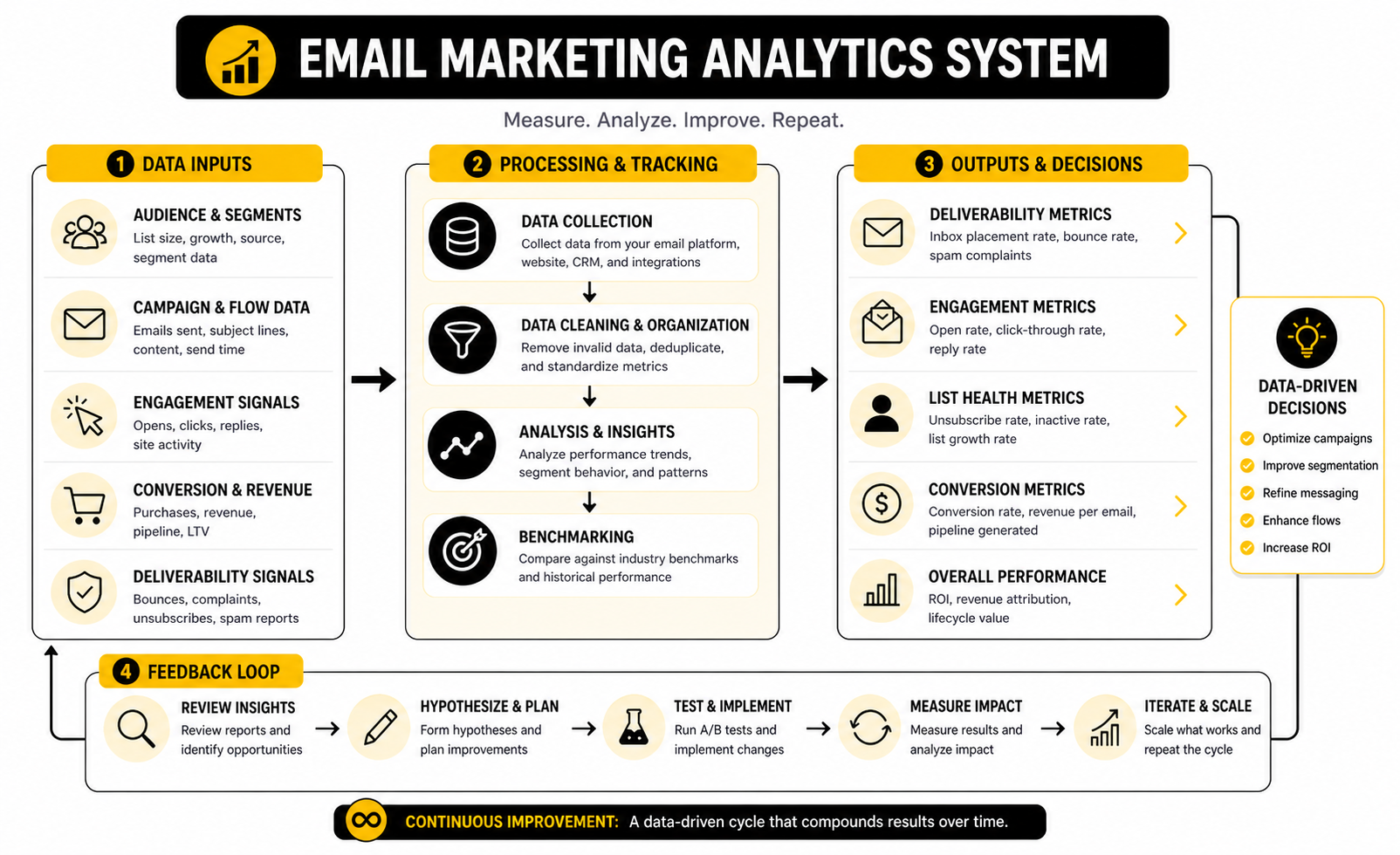
A useful analytics system does not need to be complicated. Start with four layers: list health, campaign engagement, automation performance, and business outcomes. This gives you enough structure to see whether the problem is audience quality, message quality, flow design, or commercial conversion.
List health includes delivery rate, bounce rate, unsubscribe rate, spam complaints, engagement decay, and inactive subscribers. Campaign engagement includes opens, clicks, click-to-open rate, replies, conversions, and performance by segment. Automation performance includes entry volume, completion rate, drop-off points, revenue per recipient, and how each email contributes to the journey.
Business outcomes are where the reporting becomes serious. Track booked calls, sales, repeat purchases, average order value, trial-to-paid conversion, churn reduction, or customer lifetime value depending on the business model. If a course stops at open and click reporting, it is not enough for professional work.
Reading ROI Without Fooling Yourself
Email ROI is attractive because the channel can be relatively inexpensive compared with paid acquisition. The Litmus State of Email 2025 ROI analysis found that 35% of marketing leaders reported $10 to $36 back for every $1 spent, while 30% reported $36 to $50 back. That range is powerful, but it also proves why measurement discipline matters.
ROI can be inflated when teams ignore labor costs, discounts, creative time, software fees, list acquisition costs, or attribution overlap with paid ads and organic traffic. A campaign might look profitable in the email platform while the finance view tells a more modest story. Better training teaches you to separate attributed revenue from incremental revenue.
The practical move is simple: define the attribution model before judging performance. Decide whether you are measuring last-click revenue, influenced revenue, direct replies, pipeline created, or retained customers. Then use the same method consistently, because messy measurement creates fake confidence.
Using Data To Improve Courses, Campaigns, And Skills
Measurement should also change how you learn. When you take one of the best email marketing courses, do not just finish the lessons and collect the certificate. Apply each major lesson to one campaign or flow, then review what changed.
If a copywriting module improves clicks but not conversions, the email may be stronger while the landing page or offer still needs work. If a segmentation module reduces unsubscribes and improves replies, the list was probably getting more relevant messages. If a deliverability module improves inbox placement, every campaign after that has a better chance of working.
This is the difference between course consumption and skill building. You are not learning email marketing to sound more carefully in meetings. You are learning it to make cleaner decisions, build stronger systems, and create email programs that keep improving after the course ends.
Build a stronger local presence with BAAM AI
Turn your website, Google profile, social channels, and AI visibility into one growth engine
Most businesses do not need more random marketing activity. They need a consistent presence system that helps the right people find them, trust them, and take action. BAAM AI brings strategy, local SEO, website updates, Google Maps visibility, social content, AI-search readiness, media production, and reporting into one practical monthly engine.
If you want your marketing to keep working after the campaign ends, start with a free BAAM AI presence audit. See how your business shows up today and where the fastest visibility wins are at BAAM AI.