
BAAM AI Blog
Copywriting for Tech Companies: What It Is and Why It’s Essential
Tech companies create advanced products and services, but the smartest technology in the world doesn’t sell itself. Copywriting for tech companies bridges the gap between innovation and understanding - turning...

Tech companies create advanced products and services, but the smartest technology in the world doesn’t sell itself. Copywriting for tech companies bridges the gap between innovation and understanding - turning complex, jargon‑heavy concepts into clear, persuasive language that drives action and builds trust. In an industry where buyers range from engineers to executives, great copy makes the difference between confusion and conversion.
At its core, copywriting in tech isn’t just about putting words on a page - it’s about making complex ideas comprehensible and compelling to the right audience, whether you’re marketing a SaaS platform, an AI service, or an enterprise solution. Clear messaging helps your buyers understand both what your product does and why it matters to them, which boosts engagement, accelerates purchase decisions, and reinforces brand authority.
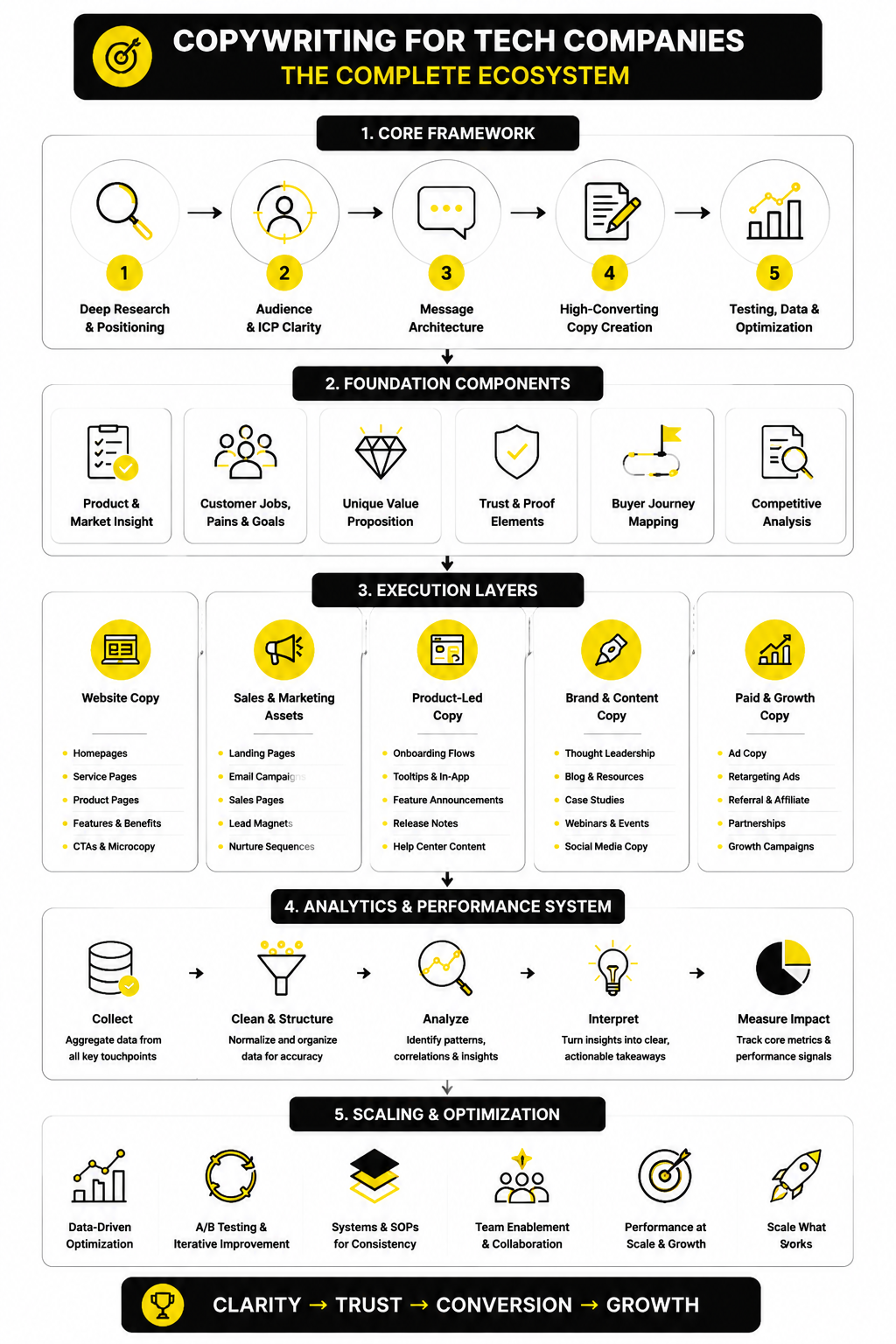
Below is an outline of how this guide will walk you through the strategic role of tech copywriting and provide actionable frameworks you can apply right now:
This structure ensures you’ll not only understand the why behind strong copy but also the how - with concrete frameworks and real implementation tips backed by industry best practices.
Why Copywriting Matters for Tech Brands
In today’s crowded tech landscape, even the most innovative products struggle to gain traction without clear communication. Good copywriting does more than inform - it persuades, educates, and motivates potential customers to act. For B2B technology companies especially, buyers often aren’t technical experts themselves, which means your messaging must translate complexity into value without dumbing down the product.
This matters for three key reasons:
Strong copywriting also ensures your messaging aligns across all channels - from homepage hero sections and feature pages to email campaigns and ads - creating a unified voice that resonates with diverse tech audiences.
Overview of a Tech Copywriting Framework
Creating effective tech copy doesn’t happen haphazardly. It’s built on frameworks that give structure to your messaging so that every word serves a purpose. A good framework helps you:
In tech contexts, popular structures include models like AIDA (Attention‑Interest‑Desire‑Action), PAS (Problem‑Agitate‑Solution), and FAB (Feature‑Advantage‑Benefit). These frameworks serve as templates for storytelling, ensuring your copy moves readers logically and emotionally toward a decision.
By mastering a few core frameworks, you reduce guesswork, sharpen your messaging, and improve the performance of landing pages, emails, product pages, and ads alike.
In the next section we’ll break deeper into the core components of effective tech copy - from audience analysis to value articulation and storytelling. Each part connects back to why great copy is indispensable for tech brands that want to grow.
Core Components of Effective Tech Copywriting
To write great copywriting for tech companies, you need more than grammar skills - you need a structured approach that helps your audience get it quickly and feel compelled to act. At an essential level, effective tech copy combines audience insight, clarity, value articulation, and strategic messaging that transcends mere technical description.
Know Your Audience Deeply
Understanding who you’re writing for sets the foundation for every subsequent choice you make. This isn’t just a surface demographic - it’s about their technical literacy, goals, pain points, and what motivates them to take action. Creating detailed audience personas forces you to ask questions like:
When your messaging speaks to their understanding and needs, your copy builds credibility and keeps readers engaged instead of lost in jargon.
Translate Features Into Benefits
Tech products often have rich technical specifications, but features alone don’t sell. What truly matters to your audience is what those features do for them - the tangible benefits in their day‑to‑day work, efficiency gains, cost savings, or competitive edge.
A core principle in tech copy is to lead with benefits that answer the reader’s question: “What’s in it for me?” Once that value is clear, you can support your statements with technical attributes - but always with context that ties the feature to meaningful outcomes.
Clear Value Propositions and Hooks
Your opening lines - especially headlines and subheads - should convey your highest‑value promise within seconds. Software buyers often decide in under three seconds whether to stay on a page, so your message must immediately communicate relevant value rather than industry jargon or internal accolades.
This means writing headlines that are:
Balanced Technicality and Accessibility
A hallmark of effective tech copywriting is balancing technical accuracy with accessibility. Some readers want depth; others just need the bottom‑line impact. The most successful tech copywriters structure content so that readers can:
This layered approach ensures your messaging resonates with both technical and non‑technical stakeholders, preventing either group from feeling alienated.
Strategic Calls to Action (CTAs)
Every piece of tech copy should guide readers toward a next step. A compelling CTA is not generic (“Submit” or “Learn More”) - it reflects the value you’ve just articulated and makes the next action irresistible to someone already convinced of the benefit.
Examples include actions like:
Clear, action‑aligned CTAs improve conversions because they align with the reader’s motivation.
These core components - audience insight, benefits orientation, compelling value propositions, accessible technical clarity, and strategic CTAs - form the building blocks of copywriting that truly converts for tech companies. Each piece fits into your larger messaging strategy to ensure clarity, relevance, and impact across channels.
How to Implement Copywriting Like a Pro
Implementing effective copywriting in tech companies starts with a repeatable process that turns strategic thinking into actionable messaging. A professional approach ensures that every piece of content supports your broader brand story and business goals.
The first step is thorough audience research. Tools like user feedback, customer interviews, and voice‑of‑customer data reveal real language your prospects use to describe their problems and desired outcomes. With this insight, you can create audience personas that guide tone, vocabulary, and structural decisions in your copy.
Next, adopt structured frameworks such as AIDA or PAS to shape your messaging flow. These models help you move readers logically from awareness to interest, desire, and action, reducing guesswork and improving consistency across your landing pages, emails, and ads.
Effective tech copywriters also rely on iterative testing. Headlines, benefit statements, and CTAs should be A/B tested to determine which versions resonate best with your audience. Over time, this data‑driven refinement increases engagement, improves conversion rates, and enhances overall messaging effectiveness.
Finally, collaboration with product, design, and SEO teams ensures your copy aligns with UX flows and search intent. Technical accuracy, readability, and discoverability are critical for both user trust and search performance, so integrating copywriting into your broader content strategy improves results across channels.
By following a professional implementation process, you ensure that every piece of copywriting for tech companies is strategic, audience‑focused, and optimized for real business outcomes.
Step‑by‑Step Process for Implementing Tech Copywriting
To make copywriting for tech companies tangible and repeatable, it’s essential to follow a structured execution process that teams and individual writers can use project after project. This process transforms high‑level strategy into clear actions you can implement on your marketing pages, emails, ads, and product messaging. Research from best‑practice guides shows that structured methods dramatically improve clarity, relevance, and conversion performance.
The goal here is simple: move from understanding to delivery in a way that ensures your copy resonates with target users, reflects real benefits, and drives measurable action.
1. Define the Project Scope and Objectives
Before any words are written, clarify what success looks like for this piece of copy. Are you trying to generate demo requests? Encourage trial sign‑ups? Educate and nurture leads? Clarifying the goal upfront informs tone, format, metrics, and distribution channels.
Start by answering key questions with stakeholders:
Document these goals in a brief that guides every subsequent step.
2. Conduct Audience & Product Research
Good tech copy is rooted in a deep understanding of your audience and your product’s value proposition - not assumptions. This means aligning with what your target users care about and how they talk about their challenges.
Use techniques like:
This step ensures your messaging speaks the right language and tackles real problems instead of surface‑level descriptions.
3. Select a Messaging Framework
With research in hand, choose a proven messaging framework that will structure your copy logically and persuasively. Common frameworks that perform well for tech companies include:
Using these models helps you balance emotional engagement with rational clarity, ensuring the copy has both compelling hooks and clear conversions.
4. Draft Messaging with Clear Benefit Translation
Once your framework is selected, begin drafting the copy by prioritizing benefits over features. Your audience needs to understand what your technology does for them before they’ll care about how it works.
A practical drafting approach includes:
This keeps your language rooted in reader value and avoids overly technical explanations that slow comprehension.
IMAGE 3
5. Review, Edit, and Clarify
With a full draft complete, shift into revision mode. This stage is where clarity is sharpened, complexity is pared back, and the language becomes more purposeful. Professional editors often use checklists to verify that:
Editing isn’t just about grammar - it’s about tightening logic and removing friction so your audience can move smoothly from awareness to action.
6. Test, Measure, and Iterate
Even the best copy should evolve based on real audience behavior. Once your piece launches, measure key performance indicators (KPIs) such as engagement rates, click‑throughs, demo requests, or trial sign‑ups. Use A/B testing to compare different headlines, benefit statements, or CTA placements and iterate based on what resonates best.
Regular iteration keeps your messaging aligned with changing audience needs and market conditions, turning feedback into continuous improvement.
Following this process gives your team a repeatable roadmap for implementing copywriting that is clear, strategic, and conversion‑focused - tailored specifically to the needs of tech audiences and buyers.
Interpreting Performance: Metrics That Show What Your Tech Copy Is Actually Doing
Effective copywriting for tech companies isn’t just about crafting persuasive words - it’s about understanding whether those words move the needle on measurable business outcomes. The right metrics don’t just tell you what happened; they tell you why it happened and what you should do next with your messaging. No copy should ever be judged in isolation - you need context, benchmarks, and clear definitions of success before you interpret any number.
Why Measurement Matters in Tech Copywriting
Numbers alone rarely tell the full story. A metric like pageviews might look good, but it doesn’t reveal whether anyone actually engaged with or acted on your messaging - that’s why some metrics are considered vanity metrics (interesting but not actionable) and others are value metrics (inform decisions). The best measurement frameworks focus on metrics that relate directly to audience engagement, persuasion, and conversion - the outcomes your tech copy is meant to influence. Identifying what truly matters stops a lot of guesswork and keeps your content strategy aligned with broader business goals.
Core KPIs to Track for Tech Copy Performance
When you’re measuring how well your messaging works, prioritize indicators that connect reader behavior with decision signals across your funnel. These KPIs are relevant whether you’re optimizing a landing page, a product feature page, email copy, or ad creatives:
All of these metrics become meaningful only when interpreted against specific goals and benchmarks instead of viewed in isolation.
Benchmarking and What Good Looks Like
Benchmarks offer a reference point so you know whether your tech copy is underperforming or leading within your category. For example:
Rather than applying the same expectation to every page, compare like with like. Establish internal baselines over time, and use industry benchmarks to contextualize your results rather than treating them as absolute truths.(5)
Making Numbers Actionable
Tracking is only useful when it informs actions you take next. Here’s how good measurement matters:
Good analytics shouldn’t just report data - it should challenge assumptions and pinpoint where your messaging loses its persuasive edge. IMAGE 4
What the Data Actually Means
Metrics tell you behavior patterns, not intent. For example:
Combine quantitative data (like conversion rates and CTR) with qualitative feedback (user surveys, session recordings, customer interviews) to understand why your copy performed a certain way. This dual lens turns metrics into strategic insights that improve future copy iterations and align them more closely with user needs and business outcomes.
Done well, performance analysis turns guesswork into a data‑driven process that scales persuasive messaging across your tech company’s content ecosystem, letting your copy influence real decision‑making and growth.
Advanced Considerations for Scaling Tech Copywriting
As your tech company grows and your content ecosystem expands, copywriting evolves from standalone pages into a strategic asset that must scale consistently with quality and impact. This shift reveals deeper challenges that go beyond basic frameworks and measurement - including governance, personalization trade‑offs, and organizational alignment.
One of the first scaling challenges is governance. As teams, products, and audiences diversify, ensuring that everyone adheres to consistent messaging standards becomes harder. Without clear style guidelines and a shared messaging playbook, different writers can produce copy that sends mixed signals to your audience. Creating a central messaging hub - a source of truth for voice, tone, value propositions, and key benefits - helps maintain coherence without bottlenecking every piece through a single editor.
Another advanced issue is personalization vs. consistency. Tech companies increasingly use personalization to tailor messaging to specific segments - whether by industry, company size, job role, or buyer intent. But hyper‑tailored messages can fracture your brand voice if not managed carefully. The solution is to build modular messaging blocks that can be customized without deviating from core brand narratives. This approach lets teams reuse verified copy assets while still meeting audience expectations at a deeper level.
Strategic trade‑offs also emerge around technical depth. Deep technical detail can engage highly specialized buyers but can alienate broader audiences if not structured well. One way to balance this is through layered content - using top‑level layers that express value in business outcomes and deeper sections or linked resources for those who want technical proofs and specifics. This tiered architecture prevents cognitive overload while satisfying diverse reader needs.
Integrating Copy with Cross‑Functional Teams
To scale copywriting effectively, tech companies must embed copy and messaging into product, marketing, and sales teams. This helps align written communication with product roadmaps, customer feedback loops, and real usage data. When copywriters collaborate early with product and customer success teams, they gain insights that improve positioning and preempt potential objections before messages go live.
For example, involving copywriters in product planning cycles ensures that new features are introduced with the right context and customer relevance rather than as a list of technical specs. Close alignment with sales teams helps refine value statements that resonate with real buyer objections, sharpen qualifying language, and improve conversion outcomes.
Risk Management and Legal Considerations
At scale, tech copywriting also intersects with legal and compliance risks - particularly around claims about product capabilities and performance. Overstating outcomes or implying guarantees can lead to regulatory scrutiny or breach contracts. Workflows that include review by legal and compliance teams help prevent issues before publication and protect both your brand and customer trust.
In regulated industries (like healthcare or finance), this review process isn’t optional - it’s necessary to ensure copy doesn’t inadvertently make claims that could trigger enforcement actions. Collaborative systems where legal guidelines are integrated into the messaging playbook reduce friction and keep quality high without slowing down production cycles unnecessarily.
Future‑Proofing Your Messaging Strategy
Finally, expert‑level tech copywriting requires a forward‑looking mindset. As products evolve, so must your messaging. This means implementing processes for periodic content audits, sunset policies for outdated pages or claims, and mechanisms for capturing ongoing audience insights.
Machine‑assisted tools can help with scaling by suggesting headline variants, semantic improvements for SEO, or even draft personalization based on audience data. But human judgment remains essential to ensure strategic alignment, ethical messaging, and customer empathy - aspects no algorithm can fully replicate.
Balancing governance, personalization, cross‑functional alignment, legal safety, and future readiness isn’t simple. But when these advanced considerations are integrated into your approach to copywriting for tech companies, your messaging becomes not just effective but strategic, defensible, and resilient as your business grows.
Frequently Asked Questions About Copywriting for Tech Companies
What makes copywriting for tech companies different from other industries?
Copywriting for tech companies must translate complex technical concepts into language that both technical and non‑technical audiences can understand. It balances clarity with credibility, ensuring messaging is accurate without alienating readers with jargon. In contrast, other industries often focus more on emotional appeal or lifestyle benefits rather than explaining technical value.
How do you write value‑driven copy for a software product?
Start by identifying the outcomes your audience cares about - what problems the software solves. Emphasize those outcomes in headlines and opening sentences, then support them with features framed as benefits. This approach helps readers see why they should care before diving into technical specifics.
Is technical accuracy more important than simplicity?
Both matter, but simplicity should come first in initial messaging. Once you’ve captured attention with clear value, you can layer in technical accuracy for audiences who need depth. This keeps your copy accessible while still satisfying informed readers.
How do you measure whether tech copy is effective?
Effectiveness is typically measured with outcome‑oriented KPIs like conversion rate, click‑through rate on CTAs, lead quality, and engagement metrics such as time on page. These indicators show whether your messaging resonates with the right audience and drives action.
Can storytelling work in tech copywriting?
Yes - when it’s grounded in real user scenarios or customer journeys. Stories that illustrate challenges, adoption decisions, and outcomes make abstract technology relatable. The key is connecting narrative elements to actual user experiences, not hypothetical situations.
How often should tech copy be updated?
Regularly, especially as products evolve or markets shift. Quarterly reviews of key pages and campaigns help ensure messaging stays aligned with current features, customer feedback, and competitive positioning. Outdated copy can mislead readers or damage credibility.
What’s a common mistake tech companies make with their copy?
A frequent error is leading with features instead of benefits. Technical specs have their place, but buyers first need to understand how the product impacts their work or goals. Copy that flips that order tends to perform better.
Should different buyer personas see different copy?
Yes. Tailoring messaging to specific personas - such as developers, business decision‑makers, or IT operators - improves relevance. This can be done with modular copy blocks or segmented landing pages that speak directly to each audience’s priorities and pain points.
Does SEO matter in tech copywriting?
SEO is important because it helps your target audience find your content in the first place. Balancing keyword relevance with natural language and user intent ensures search engines and humans both understand your value proposition.
When should a tech company hire a professional copywriter?
When your messaging feels unclear, inconsistent, or fails to convert visitors into leads, it’s time to bring in expertise. Professional copywriters have experience aligning technical detail with persuasive narratives, saving time and improving outcomes.
Build a stronger local presence with BAAM AI
Turn your website, Google profile, social channels, and AI visibility into one growth engine
Most businesses do not need more random marketing activity. They need a consistent presence system that helps the right people find them, trust them, and take action. BAAM AI brings strategy, local SEO, website updates, Google Maps visibility, social content, AI-search readiness, media production, and reporting into one practical monthly engine.
If you want your marketing to keep working after the campaign ends, start with a free BAAM AI presence audit. See how your business shows up today and where the fastest visibility wins are at BAAM AI.