
BAAM AI Blog
Copywriting Cold Email
is not about writing a clever message and hoping someone replies. It is the discipline of turning a stranger’s limited attention into a relevant conversation, without pretending the relationship is warmer than it is...
Copywriting cold email is not about writing a clever message and hoping someone replies. It is the discipline of turning a stranger’s limited attention into a relevant conversation, without pretending the relationship is warmer than it is. That matters because inboxes are more filtered, buyers are more skeptical, and weak outreach now fails before the prospect even reads the first line.
Cold email still works, but only when the copy respects the buyer’s context. Gartner reported that 73% of B2B buyers actively avoid suppliers who send irrelevant outreach, which is the real warning sign for anyone treating volume as the strategy: relevance is not decoration, it is the entry fee. Google’s sender guidance also makes the same point from a deliverability angle, requiring bulk senders to authenticate mail, make unsubscribing easy, and keep spam complaints low through better sending practices and recipient trust.
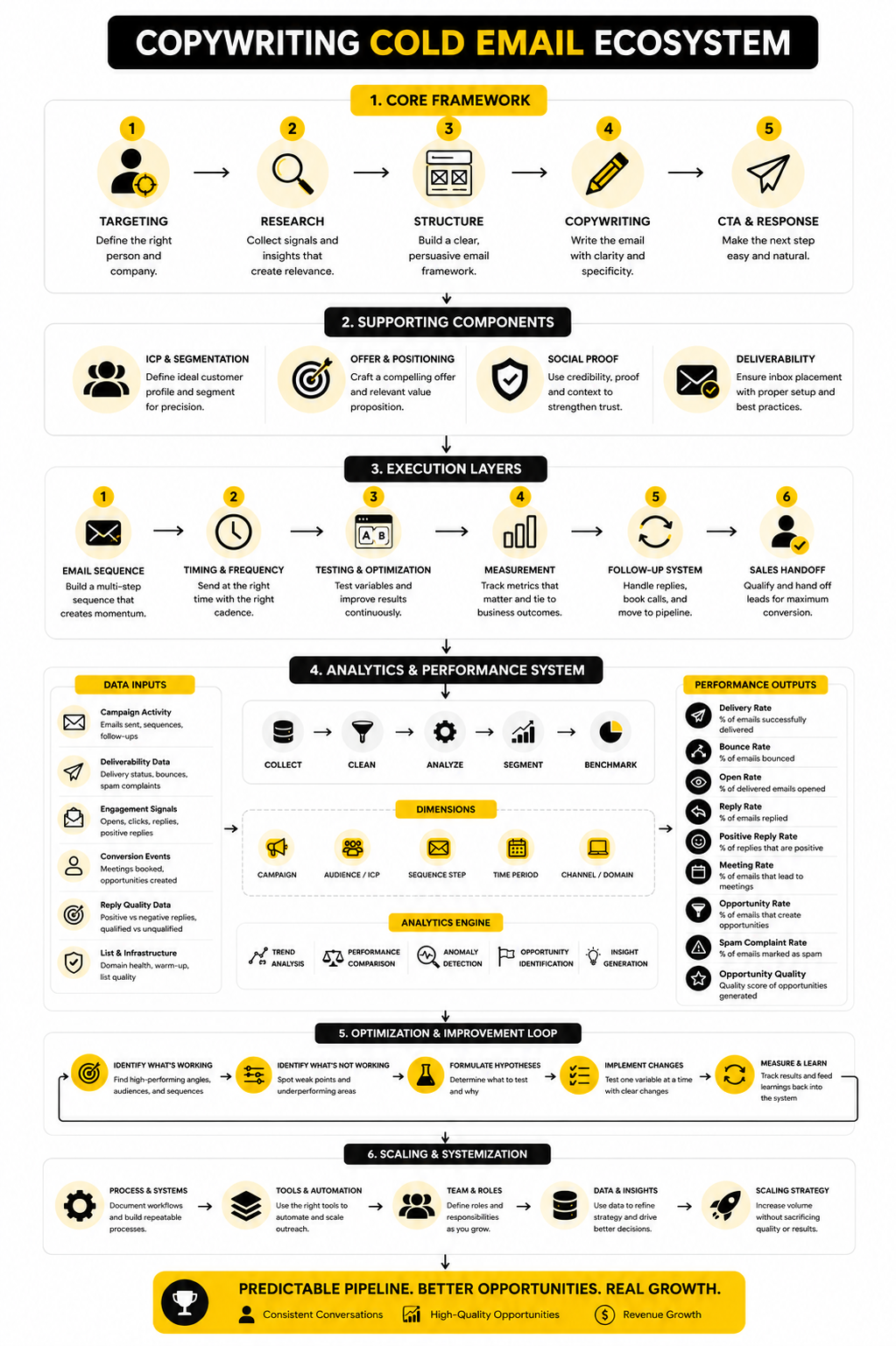
The practical goal of this guide is simple: build a complete copywriting cold email system that can survive modern inboxes and modern buyers. Not a pile of templates. Not fake personalization. A repeatable way to research, structure, write, test, and improve cold emails so they sound human, earn attention, and create real sales conversations.
this guide is split into six connected parts so each layer builds on the previous one. The first part gives you the map and the operating logic behind effective cold email copywriting. The later parts move from strategy into execution, then into testing, compliance, and improvement.
Why Copywriting Cold Email Still Matters
Cold email matters because most buying conversations do not begin with someone filling out a form. Many buyers are already researching, comparing options, and forming opinions before they ever speak to a seller. Gartner’s more recent buyer research found that 67% of B2B buyers prefer a rep-free experience, which means your first email has to feel more like useful buyer support than a sales interruption.
That does not mean cold email should become timid. It means the copy has to be sharper, more specific, and more respectful of timing. The prospect does not owe you attention, so every sentence has to earn its place by proving you understand the business situation, the likely problem, and the reason the message belongs in their inbox.
This is why copywriting cold email is different from general email marketing. A newsletter can rely on familiarity, brand memory, and a subscribed audience. A cold email starts at zero, so the copy has to quickly answer four unspoken questions: why me, why now, why you, and what happens next.
The Cold Email Copywriting Framework
The best cold emails usually feel simple, but they are rarely random. Under the surface, strong outreach follows a clear framework: identify the right person, connect to a relevant trigger, name a specific problem, offer a credible path forward, and ask for a low-friction next step. When any one of those pieces is missing, the email often becomes vague, pushy, or easy to ignore.
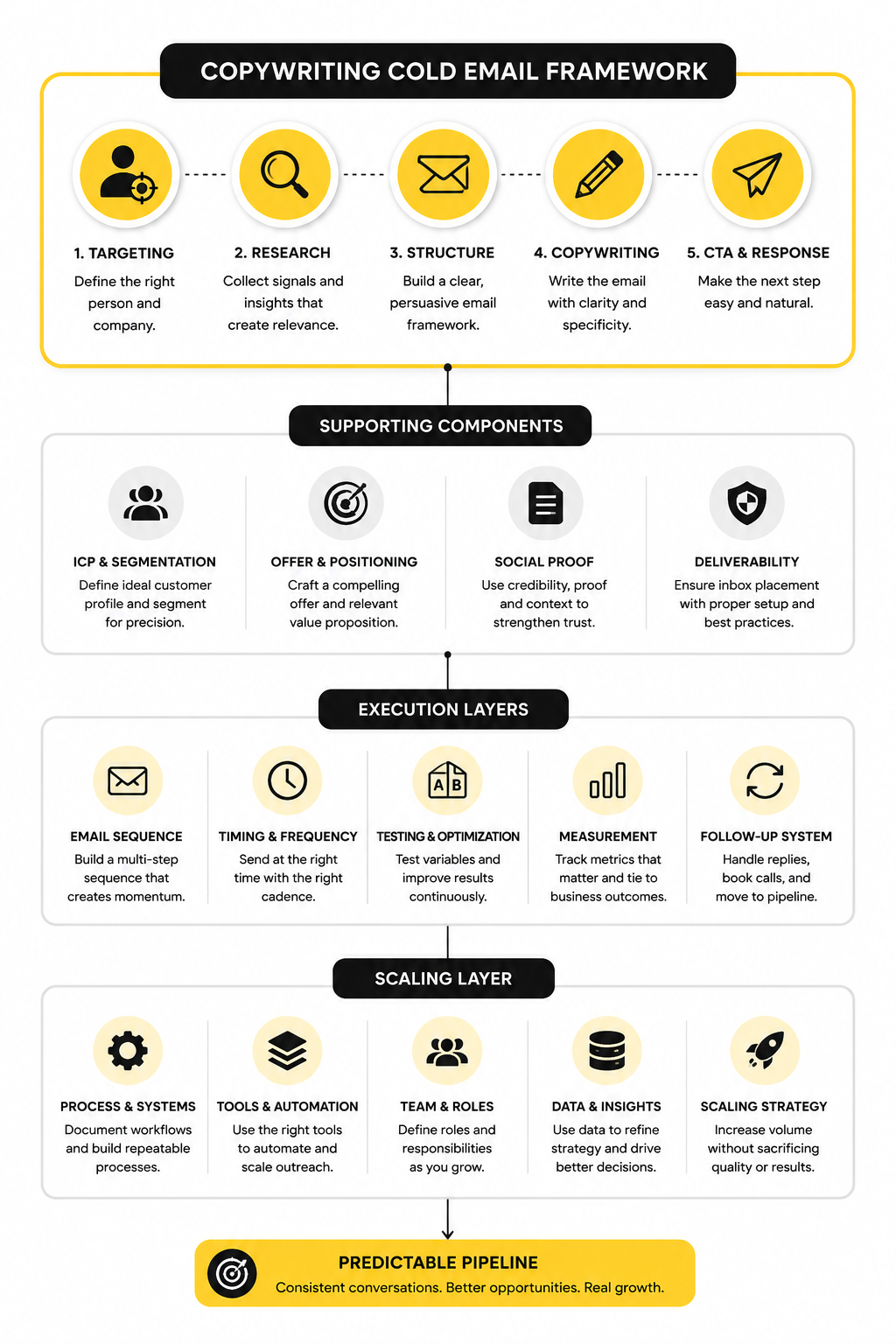
Think of the framework as a filter, not a script. It should stop you from sending lazy copy before it leaves your inbox. A good framework forces you to check whether the message is specific enough, whether the offer is obvious enough, and whether the call to action matches the level of trust you have earned.
The framework also protects you from the biggest mistake in cold email: writing from your own agenda instead of the buyer’s reality. You may want a demo, a call, a signup, or a reply. The prospect wants to know whether the interruption is worth their attention, and your copy has to prove that before asking for anything.
Research Before You Write
The quality of a cold email is usually decided before the first sentence is written. If the research is shallow, the copy becomes vague. If the copy is vague, the prospect feels like they were pulled from a list instead of chosen for a reason.
This is where many teams get copywriting cold email wrong. They treat research as a personalization garnish, then paste one custom sentence on top of a generic pitch. Real research should shape the entire message: who you contact, what you mention, what problem you lead with, what proof you use, and what next step feels reasonable.
Good research does not mean spending twenty minutes on every prospect. That is not practical at scale. It means knowing exactly what to look for, collecting the few details that actually change the message, and ignoring the trivia that makes emails sound “personalized” but not relevant.
Start With the Right Market Segment
Before you research individual prospects, define the segment clearly enough that the email almost writes itself. A segment is not “SaaS companies” or “agency owners.” That is too broad. A useful segment has a shared business model, a shared pressure, and a shared reason to care now.
For example, a stronger segment would be bootstrapped B2B SaaS companies hiring their first sales team, ecommerce brands spending heavily on paid traffic but struggling with conversion, or local service businesses expanding into multiple locations. Each group has different priorities, so each group needs different copy. When the segment is tight, your email can speak directly to a situation instead of floating around in generic business language.
This matters because prospects do not reply to categories. They reply when the message touches a real commercial tension. If the segment is too loose, you end up writing safe sentences that could apply to anyone, and safe sentences are easy to delete.
Find the Trigger That Makes the Email Timely
A trigger is the reason your email makes sense today. It can be a hiring push, a funding event, a new product launch, a new market, a visible operational bottleneck, a leadership change, a recent content theme, or a public signal that the company is investing in something your offer supports. Without a trigger, the email feels random.
The trigger should not be forced. “I saw your LinkedIn post” is not a strong trigger unless the post connects directly to the problem you solve. “I noticed you are hiring three outbound reps while your current demo flow still routes all leads through one generic form” is stronger because it connects a public signal to a business implication.
This is the difference between personalization and relevance. Personalization says, “I noticed something about you.” Relevance says, “I noticed something that may affect a business outcome you care about.” For cold email, relevance wins.
Separate Useful Research From Decorative Research
Decorative research makes the sender feel prepared but does not help the buyer. Mentioning the prospect’s podcast appearance, university, city, or favorite hobby can work in rare cases, but it often feels performative when it has no connection to the offer. It adds words without adding value.
Useful research helps you make a sharper business point. It identifies a gap, risk, opportunity, inefficiency, or timing signal. It also helps you avoid awkward assumptions, which is crucial because nothing kills trust faster than confidently diagnosing a problem the prospect does not have.
A simple test works well: if removing the researched detail would not change the logic of the email, it probably does not belong. Cold email has very little room. Every detail should either prove relevance, clarify the problem, strengthen credibility, or make the next step easier.
Build a Prospect Research Checklist
A practical research workflow keeps the process consistent without turning it into busywork. The point is not to collect everything you can find. The point is to collect only the details that improve the message.
Use a short checklist before writing:
This checklist keeps the copy grounded. It also prevents the most common failure: pitching a solution before you have earned the right to name the problem. When you know the buyer’s role, timing, and likely pressure, your email can be short without feeling thin.
Research the Buyer, Not Just the Company
Company research tells you what is happening in the business. Buyer research tells you why the person receiving the email might care. Both matter, but the buyer’s incentives decide whether the email gets a response.
A VP of Sales, founder, marketing lead, RevOps manager, and agency owner can all work at similar companies and still care about completely different angles. The founder may care about growth and cash efficiency. The VP of Sales may care about pipeline quality. The RevOps manager may care about routing, attribution, and broken processes. If you send all of them the same message, at least part of the email will feel off.
This is why the best cold email copy often sounds specific without being long. The writer understands the person behind the inbox. They know what that role is measured on, what problems create internal pressure, and what kind of offer is worth a reply.
The Core Components of a High-Reply Cold Email
Once the research is clear, the email needs structure. Not a rigid template that makes every message sound the same. A structure that gives the email momentum and removes everything that slows the reader down.
A strong cold email usually has five core components: a specific subject line, a relevant opening, a clear problem, a credible value statement, and a simple call to action. Each part has a job. If one part tries to do too much, the email becomes bloated.
This is where copywriting cold email becomes a practical craft. You are not trying to impress the prospect with cleverness. You are trying to reduce the effort required to understand why the message matters.
The Subject Line Should Create Recognition
The subject line does not need to sell the whole offer. It needs to feel relevant enough to open. Overly polished subject lines often look like campaigns, and campaign-looking emails are easy to ignore.
A good subject line usually points to a familiar business topic, a specific operational area, or a simple reason for the message. It should sound like something a real person would write. Short is usually better, but clarity matters more than length.
Avoid subject lines that overpromise, fake familiarity, or manufacture urgency. The subject line sets the trust level for the whole email. If it feels manipulative, the body copy starts at a disadvantage.
The Opening Line Must Prove the Email Belongs
The opening line is where most cold emails lose the reader. Generic compliments, fake enthusiasm, and obvious scraping signals make the message feel automated. The prospect does not need flattery; they need a reason to keep reading.
A strong opening connects directly to the research. It can mention a trigger, a role-specific observation, or a business situation that frames the rest of the email. The key is to make the reader feel, “This was meant for someone like me.”
The opening should also be economical. Do not spend half the email proving you looked them up. One precise sentence is stronger than three sentences of forced personalization.
The Problem Should Be Specific and Believable
The problem statement is the bridge between research and offer. It should name a pain, friction, missed opportunity, or risk the prospect can recognize. The mistake is making the problem too dramatic.
Cold email copy works better when the problem feels believable from the outside. “You are probably losing millions because your funnel is broken” sounds reckless unless you have the data to prove it. “Teams hiring outbound reps often find their reply quality drops when the messaging is still built for a broader ICP” is more credible because it describes a realistic pattern.
Specific does not mean certain. You can write with confidence while leaving room for the prospect’s reality. Phrases like “often,” “usually,” and “one thing we see” can keep the tone grounded without making the copy weak.
The Value Statement Should Be Easy to Understand
The value statement explains what you help with and why it matters. This is not the place for a full product tour. It is the place to connect your work to an outcome the buyer already cares about.
Bad value statements list features. Better value statements explain business movement. Instead of saying you offer email automation, CRM workflows, landing pages, or AI agents, explain the practical result: cleaner follow-up, faster lead response, better routing, fewer lost opportunities, or more qualified conversations.
The best version is clear enough that the prospect can repeat it internally. If they would need to translate your sentence before sharing it with a colleague, the copy is too complicated. Cold email should make the value obvious without making the reader work.
The Call to Action Should Match the Relationship
The first email should not ask for too much too soon. A hard request can work when the pain is urgent and the offer is obvious, but most cold emails perform better when the next step feels easy. The ask should match the trust you have earned in the message.
For early outreach, a soft question often works better than a calendar link. Asking whether a problem is relevant, whether they are responsible for that area, or whether they want a quick idea gives the prospect a lower-friction way to respond. It also makes the email feel like the beginning of a conversation instead of a demand for time.
This is especially important when the sender has no existing relationship with the buyer. The job of the first email is not always to book the meeting immediately. Often, the job is to earn the first reply, because the reply gives you context, permission, and a real conversation to work with.
Professional Implementation and Workflow
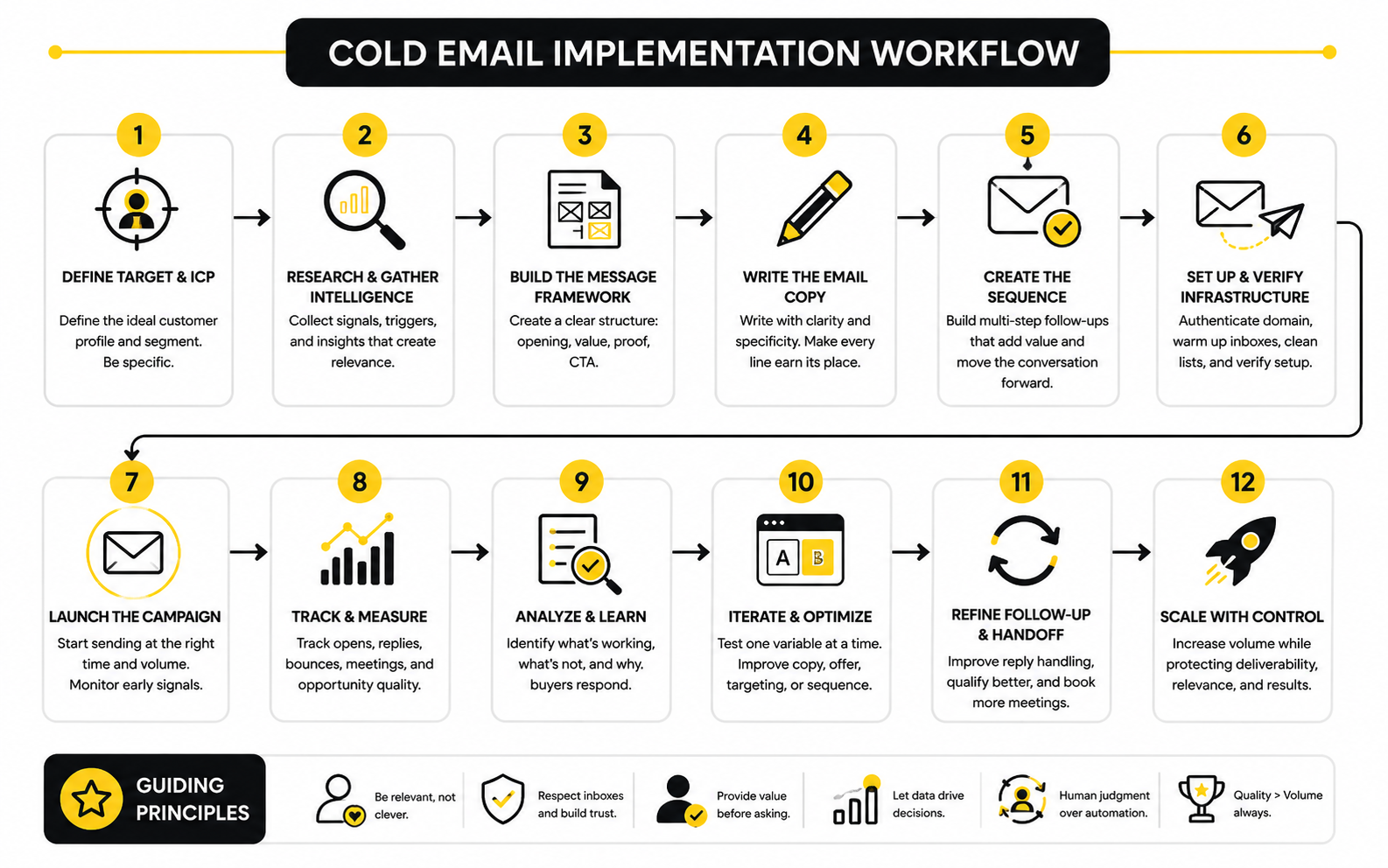
Good cold email copy does not live in a document forever. It has to move through a real workflow: prospecting, research, writing, review, sending, follow-up, tracking, and improvement. If that workflow is messy, even strong copy becomes inconsistent.
This is the implementation layer where copywriting cold email becomes operational. You are no longer asking, “Is this email well written?” You are asking, “Can this message be produced, checked, sent, measured, and improved without the whole system falling apart?”
That distinction matters. A founder writing ten handcrafted emails can rely on memory and instinct. A team sending structured outbound needs process, because one unclear handoff can lead to bad targeting, broken personalization, weak follow-ups, or emails that sound nothing like the brand.
Step 1: Define the Campaign Goal
Every campaign needs one primary goal before anyone writes a line of copy. The goal might be booked calls, replies from a specific persona, reactivation of old leads, partner conversations, webinar attendance, or discovery around a new offer. If the goal is vague, the email becomes vague too.
The goal decides the tone and the ask. A cold email meant to book sales calls needs more direct commercial clarity than a cold email meant to start market research conversations. A reactivation email can lean on prior context, while true cold outreach has to earn attention from scratch.
Do not skip this step because it feels obvious. Many bad cold email campaigns fail because the copy is trying to do three jobs at once. Pick one job, then make every sentence support it.
Step 2: Build the Right List Before Writing
The list shapes the copy more than most people admit. If the list is full of mixed industries, mixed company sizes, and mixed buyer roles, the writer has to produce generic copy to cover everyone. That is how cold email becomes bland.
A better list gives the writer sharper inputs. The companies should share enough context that the same core message feels relevant across the segment. The people on the list should have a similar responsibility, budget influence, or operational pain.
This is also where quality control starts. Bad data creates bounced emails, wrong names, wrong roles, and awkward messaging. You cannot copywrite your way out of a poor list, so treat list building as part of the writing process, not a separate admin task.
Step 3: Create Message Angles Before Templates
Before writing templates, write angles. An angle is the strategic reason the prospect should care. It connects the segment, trigger, problem, and offer into one clear direction.
For example, one campaign could focus on missed speed-to-lead opportunities. Another could focus on low-quality outbound replies. Another could focus on conversion leaks after paid traffic. These are different angles, even if the service behind them is similar.
This step prevents the common mistake of opening a blank document and trying to write “a cold email.” You are not writing one universal cold email. You are writing a specific message for a specific buyer situation, and the angle keeps that situation visible.
Step 4: Write the First Version Fast
The first version should be written quickly once the research and angle are clear. Do not polish too early. The first draft is there to expose the logic of the message, not to become the final send.
A practical first draft should include the subject line, opening line, problem, value statement, proof point if available, and call to action. Keep it plain. If the email needs clever phrasing to work, the underlying angle is probably weak.
After the first draft, read it like a busy prospect. Ask whether the email makes sense in five seconds. If the reader has to decode what you do, why you are writing, or what you want, the copy is not ready.
Step 5: Edit for Clarity, Friction, and Trust
Editing cold email is mostly subtraction. Remove throat-clearing, long explanations, filler compliments, inflated claims, and anything that sounds like it was written for a brochure. The email should feel like a direct note from one professional to another.
Clarity comes first. The prospect should understand the message without rereading it. Friction comes second. The email should not demand too much time, context, or commitment from someone who does not know you yet.
Trust is the final check. Avoid claims you cannot support, fake urgency, manipulative subject lines, and over-personalized lines that feel invasive. Professional cold email should feel confident, not desperate.
Step 6: Build Follow-Ups From the Same Logic
Follow-ups should not be random nudges. They should continue the same argument from a slightly different angle. If the first email introduced the problem, the second might clarify the cost of ignoring it, and the third might offer a useful next step or ask whether the timing is wrong.
This is where many sequences become annoying. “Just bumping this” does not add value. A better follow-up gives the prospect another reason to respond without pretending they missed something urgent.
Keep the sequence tight. Each follow-up should have a clear purpose, a slightly different point, and an easy exit. Respect matters because the inbox is not a place to wear people down.
Step 7: Connect Copy to the Sales System
Cold email should not end at the send button. Replies need routing, follow-up, notes, reminders, and tracking. If that system is manual, good opportunities can disappear quickly.
This is where a CRM or sales workflow tool becomes useful. A platform like GoHighLevel can help teams connect lead capture, pipeline tracking, follow-up automation, and appointment workflows in one place. For teams that want a simpler relationship management layer, Copper can make it easier to keep conversations organized around contacts and deals.
The tool does not fix weak copy. But once the copy is working, the system keeps the opportunity from leaking. That is the point of implementation: make the good work repeatable.
Turning the Process Into a Repeatable SOP
A cold email SOP should be simple enough that someone can actually use it. If it becomes a giant internal manual, the team will ignore it. The goal is to standardize the decisions that matter without killing judgment.
A useful SOP should explain who the campaign targets, what signals qualify a prospect, what research fields matter, how the email is structured, what claims are allowed, what follow-up logic to use, and how results are reviewed. It should also include quality checks before launch. Those checks protect the brand.
The SOP should evolve as the campaign teaches you what buyers care about. Treat it as a living operating system, not a one-time document. Cold email changes because markets change, offers change, inbox rules change, and buyer expectations change.
Create a Campaign Brief
The campaign brief is the source of truth for the whole outreach effort. It should be short, but it needs to answer the questions that affect copy. Who are we contacting, why now, what problem are we pointing at, what outcome are we offering, and what next step are we asking for?
A campaign brief also helps prevent internal confusion. Without it, one person writes from a sales angle, another reviews from a brand angle, and someone else edits based on personal taste. That slows everything down.
The best brief makes the campaign easier to judge. If the email does not match the segment, trigger, problem, offer, and ask in the brief, it needs revision. This keeps feedback objective instead of turning every review into a style debate.
Build a Message Library
A message library is not a folder of templates to copy blindly. It is a collection of proven angles, openings, problem statements, proof points, calls to action, and follow-up ideas. The purpose is to make strong patterns easier to reuse.
This helps teams move faster without becoming robotic. Writers can pull from tested components, then adapt them to the current segment and trigger. That is much better than starting from zero every time or recycling one tired template across every campaign.
Keep the library organized by persona, industry, problem, and funnel stage. Over time, it becomes a strategic asset. You start to see which angles consistently create replies and which ones only sound good in theory.
Add a Pre-Send Quality Checklist
Before a campaign goes live, run a simple pre-send checklist. This catches issues that are easy to miss when everyone is rushing. It also protects deliverability, brand perception, and conversion quality.
Use checks like these:
This checklist does not need to be complicated. It needs to be used. A basic quality control habit will prevent more mistakes than another clever template ever will.
Review Replies, Not Just Metrics
Metrics matter, but replies tell you why the campaign is working or failing. A low reply rate is useful information, but the actual replies show the buyer’s language, objections, timing issues, and misunderstandings. That is where the copy improves.
Look for patterns. Are people confused about what you offer? Are they saying timing is bad? Are they forwarding the message to someone else? Are they objecting to relevance, budget, authority, or trust?
This review should feed back into the next version of the campaign. Strong copywriting cold email is not a one-shot task. It is a loop: research, write, send, learn, and sharpen.
Statistics and Data
Measurement is where cold email stops being opinion-based. Without data, people argue about subject lines, tone, length, and calls to action based on taste. With data, the campaign tells you where the real constraint is.
The important part is not collecting every possible metric. It is understanding what each number actually means. A weak campaign can have a beautiful dashboard, but if nobody knows what action each signal should trigger, the reporting is just decoration.
For copywriting cold email, the goal is to read the numbers in sequence. Deliverability comes first, engagement comes second, replies come third, and commercial outcomes come last. If you jump straight to meetings booked without checking the earlier signals, you will often blame the wrong part of the system.
Start With Deliverability Before Judging Copy
Deliverability is the floor. If the email does not reach the inbox, the copy never gets a fair test. That is why bounce rate, spam complaints, authentication, domain health, and sending consistency should be reviewed before anyone rewrites the message.
Google’s sender requirements make this especially clear. Bulk senders need authentication, easy unsubscribe, and low spam complaints, with Gmail’s FAQ stating that senders with a user-reported spam rate above 0.3% become ineligible for mitigation. That number matters because it turns “don’t annoy people” into an operational threshold.
The action is simple: if spam complaints rise, stop blaming the subject line first. Check targeting, consent expectations, sending volume, unsubscribe visibility, and whether the message feels relevant enough to belong in the inbox. Bad copy can damage deliverability, but bad targeting usually creates the conditions for that damage.
Know Which Metrics Actually Matter
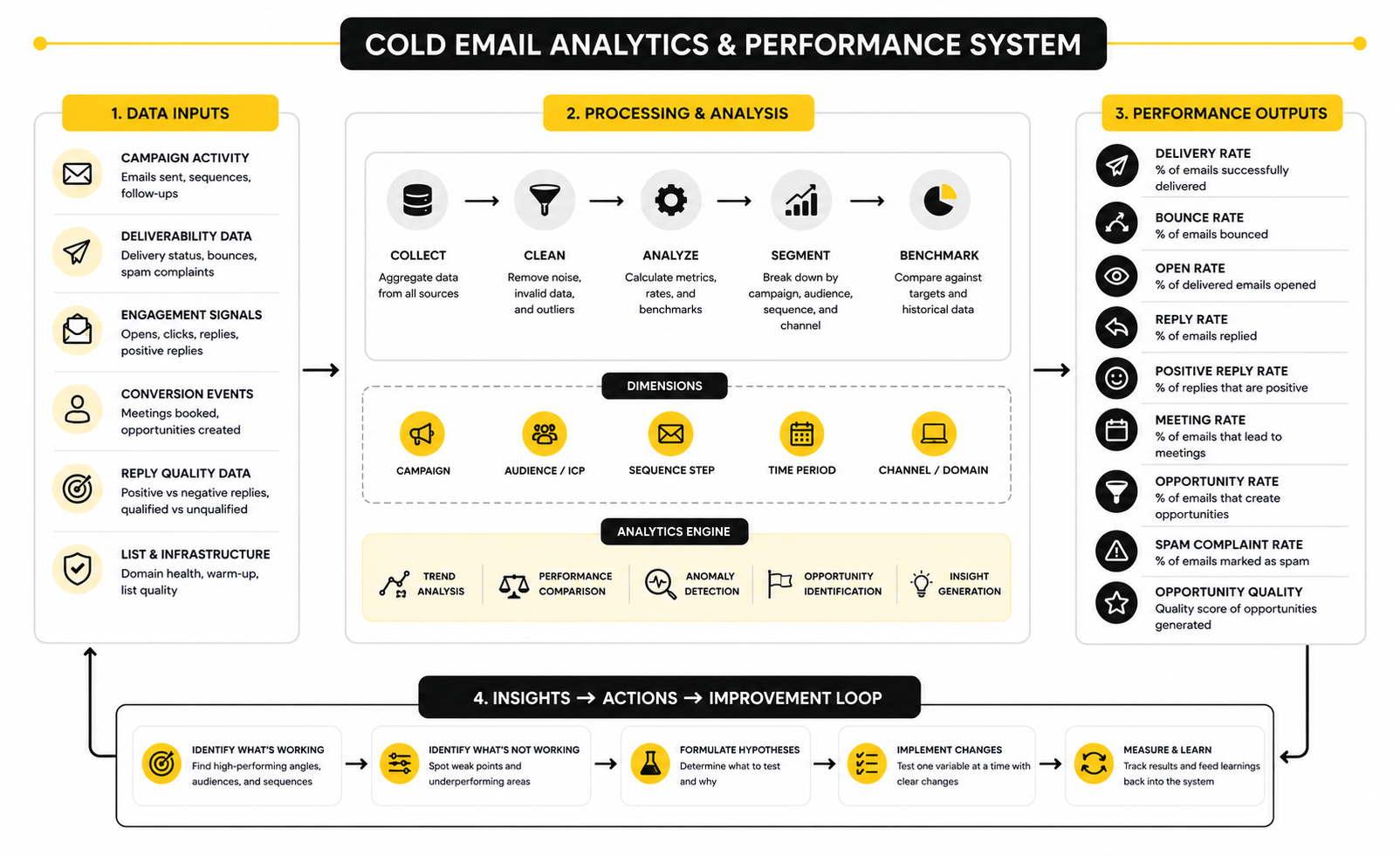
Cold email analytics should be read like a funnel, not a scoreboard. Each metric answers a different question. When you know the question, the next action becomes much clearer.
Use these core metrics:
This order matters. A low meeting rate with a healthy positive reply rate points to follow-up or qualification issues. A low reply rate with strong deliverability points to targeting, angle, or copy. A high open rate with no replies usually means the subject line created attention that the body copy failed to justify.
Treat Open Rate Carefully
Open rate is useful, but it is not the truth. Privacy changes, image loading behavior, security tools, and inbox scanning can all distort open tracking. That means open rate should guide investigation, not final judgment.
If open rate is extremely low, check deliverability, sender reputation, subject line clarity, and whether the email is landing in spam or promotions-style folders. If open rate looks healthy but replies are weak, the issue is probably not the subject line. The body copy, relevance, offer, or call to action needs attention.
Do not optimize cold email around opens alone. That is how teams end up writing curiosity-driven subject lines that get attention but weaken trust. The subject line should create recognition, not trick the prospect into opening.
Reply Rate Is the First Real Copy Signal
Reply rate is usually the first metric that tells you whether the message is doing its job. It does not tell the whole story, but it shows whether the email created enough relevance for someone to respond. That makes it more meaningful than opens.
Benchmarks vary by source, segment, and methodology, but recent cold email benchmark discussions commonly place normal B2B reply rates in the mid-single digits, with stronger focused campaigns reaching higher ranges; one 2026 benchmark summary describes 5% to 10% as a good B2B cold email reply range. The exact number is less important than the pattern inside your own segment.
A 4% reply rate from CFOs at enterprise companies may be stronger than a 10% reply rate from tiny businesses with no buying power. Context matters. Measure reply quality, not just reply volume.
Positive Replies Matter More Than Total Replies
Total replies can be misleading. A campaign can generate responses because people are annoyed, confused, or asking to be removed. That is not success. Positive replies are the real signal.
A positive reply does not always mean “yes, book me now.” It can mean curiosity, a referral to the right person, a request for more context, or confirmation that the problem is relevant but timing is not right. These replies show that the email reached the right mental territory.
Track positive replies separately from neutral and negative replies. If total replies are high but positive replies are low, the message may be too provocative, too broad, or too unclear. If positive replies are high but meetings are low, the next problem is likely the follow-up process, not the initial email.
Benchmarks Are Useful, but They Are Not the Strategy
Benchmarks help you spot obvious problems. They do not tell you what your campaign should achieve in your market. A narrow campaign to senior enterprise buyers will not behave like a broad campaign to small business owners, and comparing them too directly creates bad decisions.
Use benchmarks as guardrails. If bounce rates are high, list quality needs work. If spam complaints are rising, relevance and targeting need immediate attention. If replies are far below market expectations, the issue is probably not one clever subject line away from being fixed.
The real benchmark is your own historical performance by segment, persona, offer, and angle. Once you have enough data, compare campaigns against similar campaigns. That is how you avoid chasing generic averages that do not match your actual buyer.
Measure the Message Angle Separately From the Template
A cold email campaign can fail because the writing is weak, but it can also fail because the angle is wrong. Those are different problems. If you only test templates, you may keep polishing a message the market does not care about.
Track performance by angle. For example, one campaign might focus on speed-to-lead, another on pipeline quality, and another on conversion waste after paid traffic. If one angle consistently earns better positive replies from the same type of buyer, that is strategic information.
This is where measurement improves copywriting cold email at the root. You stop asking, “Which wording sounds better?” and start asking, “Which business problem does this buyer actually respond to?” That is a much more valuable question.
Use Small Tests Before Scaling Volume
Scaling a cold email campaign too early is expensive. If the list is wrong, the offer is unclear, or the copy is weak, more volume just spreads the mistake faster. Test first, then scale what shows promise.
A practical test should isolate one meaningful variable at a time. You might test two message angles, two calls to action, or two opening approaches. Do not change the segment, subject line, offer, and CTA all at once, because then you will not know what caused the difference.
Once a test produces enough replies to show a pattern, improve the strongest version. Then scale gradually while watching deliverability and reply quality. Volume should follow evidence, not hope.
Turn Metrics Into Decisions
Every metric should have a decision attached to it. If there is no decision, the metric is noise. A useful analytics system tells the team what to fix next.
Use this decision logic:
This sequence keeps the team from overreacting. It also protects the copy from being blamed for problems that belong elsewhere. Good measurement does not just report performance; it points to the next intelligent move.
Track Learning, Not Just Outcomes
The best outbound teams build a learning record. They note which segments responded, which triggers worked, which objections appeared, which subject lines damaged trust, and which CTAs created real conversations. Over time, that learning becomes more valuable than any single campaign result.
This is especially important when markets shift. Buyer priorities change, inbox rules change, and competitors copy what used to work. A campaign that performed well six months ago may need a different angle today.
Treat every campaign as a research loop. The send is not the end of the work. It is how the market gives you feedback on your targeting, positioning, offer, and copy.
Advanced Tradeoffs When Scaling Cold Email
Scaling cold email is not just sending more messages. It is increasing volume while protecting relevance, deliverability, brand trust, and sales quality. That is harder than it sounds because the things that make a small campaign work often break when the campaign gets bigger.
The biggest tradeoff is speed versus precision. More volume can create more opportunities, but only if the list, message, and offer stay tight. If volume grows faster than quality control, copywriting cold email turns into noise, and noise gets ignored, reported, or filtered.
The right question is not, “How many emails can we send?” The better question is, “How much volume can we support while still making each message feel commercially relevant?” That question keeps the strategy honest.
Personalization Does Not Scale Unless the Inputs Are Structured
Personalization at scale fails when every rep is asked to invent custom lines from scratch. It creates inconsistency, slows down execution, and often produces fake-sounding openers. The solution is not to remove personalization; it is to structure the inputs.
A scalable personalization system uses repeatable fields: industry, role, trigger, business model, growth signal, recent hiring pattern, tech stack clue, or visible funnel issue. These inputs make the message feel specific without requiring the writer to become a private investigator. The copy still sounds human because the relevance comes from business context, not trivia.
This is where teams need discipline. A personalized cold email should not say something merely because it can be scraped. It should say something because that detail changes the reason the email is being sent.
Automation Should Support Judgment, Not Replace It
Automation is useful when it removes repetitive work. It becomes dangerous when it removes judgment. Cold email systems can help with sequencing, routing, reminders, and follow-up timing, but they should not be allowed to push weak messaging to weak lists at scale.
This is especially true now that AI writing tools make it easy to produce endless variations. More variations do not automatically mean better outreach. If the underlying angle is poor, AI simply creates more polished versions of the wrong message.
Use automation for operational consistency. Use human judgment for market understanding, offer clarity, objection patterns, and quality control. That split matters because buyers can feel the difference between useful automation and careless automation.
Compliance Is a Strategy Issue, Not a Legal Footnote
Compliance is often treated as something to check after the campaign is written. That is backward. The legal and platform rules should shape how the campaign is built from the beginning.
The FTC’s CAN-SPAM guidance says commercial email must avoid misleading header information and deceptive subject lines, include a valid physical postal address, provide a clear opt-out method, and honor opt-out requests within the required window through its business compliance guide. Google also expects senders to authenticate mail and keep complaint rates low, with its sender FAQ advising bulk senders to keep user-reported spam below 0.1% and prevent it from reaching 0.3% or higher.
The practical takeaway is simple. Do not write copy that wins a click by damaging trust. A subject line that tricks someone into opening may create a short-term metric bump, but it can hurt replies, complaints, brand reputation, and inbox placement.
Bigger Lists Require Narrower Messaging
It sounds counterintuitive, but larger campaigns often need narrower messaging. When volume increases, small weaknesses multiply. A vague offer sent to twenty people is forgettable; the same vague offer sent to twenty thousand people becomes a reputation problem.
Narrow messaging does not mean tiny markets forever. It means each campaign should be built around a clear segment and a clear reason to care. You can run multiple campaigns for multiple segments, but each one should feel like it was written for a specific buyer situation.
This is how you scale without flattening the message. Instead of one broad campaign, build several focused campaigns. The work is more deliberate, but the copy gets stronger because each message has a sharper job.
The Offer Must Become More Specific as Buyers Become More Skeptical
A weak offer creates weak copy. If the offer is “we help you grow,” the email has nowhere useful to go. If the offer is specific, the copy can be specific too.
Modern buyers are not short on tools, agencies, consultants, or software promises. Gartner’s 2026 sales research found that 67% of B2B buyers prefer a rep-free experience, which means cold outreach has to respect the fact that many buyers would rather evaluate independently before speaking to sales. A specific offer gives them something concrete to evaluate.
This does not mean the email needs to explain every detail. It means the prospect should quickly understand what problem you help solve, who it is for, and why it matters now. If that is unclear, the campaign is not ready to scale.
Multi-Channel Follow-Up Should Feel Coordinated
Cold email does not have to operate alone. LinkedIn, calls, retargeting, content, webinars, and landing pages can all support the same outbound motion. The mistake is treating every channel as a separate interruption.
A coordinated approach keeps the message consistent across touchpoints. The email introduces the problem. The LinkedIn touch reinforces the person behind the message. The landing page or resource expands the idea for prospects who want more context before replying.
Tools can help here when the workflow becomes too hard to manage manually. For example, GoHighLevel can support follow-up workflows, pipelines, and appointment systems when cold email is part of a broader sales process. If the campaign also uses forms for qualification or routing, Fillout can help turn interest into cleaner next-step data without making the email itself too heavy.
Brand Risk Increases With Every Send
Every cold email is a brand impression. That sounds obvious, but teams forget it when they start chasing reply rates. The prospect may not reply, but they still form an opinion about the company.
Brand risk shows up in subtle ways. A careless email can make a premium brand look cheap. An overfamiliar opener can make a serious business look unserious. A pushy follow-up can make a legitimate offer feel desperate.
This is why brand voice belongs in the review process. Cold email should be direct, but it should still sound like the company. If the outreach would embarrass the team if posted publicly, it should not be sent privately.
Negative Replies Are Useful, but Only If You Classify Them Properly
Negative replies are not all the same. Some mean the prospect is not a fit. Some mean the timing is wrong. Some mean the copy created friction. Some mean the offer was unclear. Treating all negative replies as failure hides useful information.
A strong review process separates negative replies into categories. “Not relevant” points to targeting or segmentation. “Already solved” points to positioning or differentiation. “Not now” may suggest timing or nurture. “Remove me” may indicate poor fit, poor targeting, or too much pressure.
This classification turns uncomfortable feedback into strategic learning. Do not get emotional about negative replies. Read them, categorize them, and use them to make the next campaign sharper.
Cold Email Should Not Carry the Whole Sales Argument
A cold email is not a landing page, pitch deck, case study, demo script, and proposal in miniature. It cannot carry the entire sales argument. Its job is to create enough relevance for the next step.
This is an important discipline for advanced copywriting cold email. When teams feel pressure to prove everything in the first message, the email gets long, defensive, and overloaded. The reader does not need every detail yet; they need a reason to believe the conversation might be worth having.
Put the heavy proof where it belongs. Use the email to open the door. Use the follow-up, sales page, call, or resource to handle deeper evaluation once interest exists.
The Best Campaigns Protect the Buyer’s Control
Buyers want control over the process. They want to research, compare, ask peers, and decide when a conversation is worth their time. Cold email works better when it respects that instead of trying to force urgency.
This changes the tone of the call to action. A good CTA does not corner the reader. It gives them an easy way to respond, redirect, say no, or ask for more context.
That confidence matters. When your offer is strong, you do not need to pressure people. You can make a relevant point, ask a clean question, and let the right buyers step forward.
Common Strategic Mistakes to Avoid
Advanced cold email is less about secret tactics and more about avoiding expensive mistakes. Most campaigns do not fail because the sender forgot one magic phrase. They fail because the strategy underneath the copy was weak.
The mistakes are usually visible early. The list is too broad. The problem is too generic. The offer is too hard to understand. The CTA asks for too much. The follow-up repeats instead of progressing.
Fixing these issues requires honesty. If the campaign is not working, do not just rewrite the subject line ten times. Look at the full system and find the constraint.
Mistake 1: Writing Before Positioning Is Clear
If the positioning is unclear, the cold email will expose it immediately. The writer will struggle to explain the offer in plain language. The reader will struggle to understand why it matters.
Strong positioning answers who the offer is for, what problem it solves, why it is different, and why the timing matters. Without those answers, the copy becomes a set of pleasant but forgettable sentences. That is not enough in a crowded inbox.
Before scaling outreach, pressure-test the positioning. Explain the offer in one sentence. If that sentence sounds generic, the campaign needs strategic work before copy work.
Mistake 2: Confusing Activity With Pipeline
Sending emails is activity. Creating qualified conversations is pipeline. The two are related, but they are not the same.
A team can send thousands of emails and still create very little commercial value if the replies are from the wrong people. That is why opportunity quality matters more than vanity volume. The goal is not to prove the team is busy; the goal is to create sales conversations that can realistically convert.
Track outcomes beyond the inbox. Look at meetings held, qualified opportunities, pipeline created, sales cycle quality, and closed revenue where possible. That is how you know whether the cold email system is actually helping the business.
Mistake 3: Over-Optimizing Templates While Ignoring the Market
Template testing can help, but it has limits. If the market does not care about the problem, no subject line will save the campaign. If the offer is not differentiated, better wording only improves the surface.
The deeper question is always market response. Which pain points create energy? Which roles respond with urgency? Which segments understand the value fastest? Which objections keep appearing?
When you answer those questions, the copy improves naturally. You are no longer guessing at words. You are writing from market evidence.
Mistake 4: Scaling Before the Sales Team Is Ready
Cold email can create demand faster than the sales process can handle it. That sounds like a good problem, but it can waste opportunities if replies are slow, handoffs are messy, or discovery calls are weak. The campaign then gets blamed for poor conversion even though the leak happens after the reply.
Before increasing volume, make sure the response workflow is ready. Who replies to interested prospects? How fast do they respond? What happens when someone asks for pricing, details, or a referral to another decision-maker?
The email is only the first move. If the next move is slow or unclear, the campaign loses momentum. Scaling should happen only when the downstream process can support the attention you are creating.
Mistake 5: Letting AI Flatten the Voice
AI can help with drafts, variants, summaries, and research organization. It can also make every email sound like the same polished internet paragraph. That is a real risk.
The fix is to use AI for leverage, not final judgment. Give it strong inputs, then edit for human specificity, commercial clarity, and brand voice. Remove phrases that sound impressive but do not say anything.
The best AI-assisted cold email still feels like it came from a person who understands the buyer. If the final version sounds like it could be sent by anyone to anyone, it is not ready.
Testing, Optimization, Compliance, and FAQs
By this point, the cold email system has moved from strategy into execution. You have the segment, the research process, the core message components, the workflow, the measurement logic, and the advanced tradeoffs. The final layer is making the system durable.
Durable matters because cold email is never static. Buyer expectations change. Inbox rules change. Competitors copy good tactics. Your own offer changes as you learn more from the market.
The teams that keep winning do not treat copywriting cold email as a one-time campaign asset. They treat it as a living system that combines positioning, buyer research, compliance, analytics, sales follow-up, and continuous improvement.
Optimize the System, Not Just the Words
Optimization usually gets reduced to small copy tweaks. People test subject lines, swap CTAs, shorten sentences, and rewrite openers. Those changes can help, but they are not always the highest-leverage moves.
Sometimes the real problem is the offer. Sometimes the ICP is too broad. Sometimes the email is getting replies from the wrong buyers because the positioning attracts curiosity but not budget. If you only edit the template, you can miss the deeper issue.
A mature cold email system optimizes from the outside in. Start with the market and the buyer. Then review the offer, angle, list, message, follow-up, and handoff. The words matter, but the words sit inside a bigger commercial machine.
Build a Testing Rhythm
Cold email testing should be consistent enough to create learning, but not so chaotic that every campaign becomes an experiment with no clear result. Pick a rhythm and stick to it. Weekly reviews often work well for active campaigns, while smaller campaigns may need more time before the data means anything.
The key is to test one meaningful thing at a time. If you change the audience, subject line, opening, CTA, and follow-up sequence all at once, you may get a different result, but you will not know why. That makes the test hard to use.
Document the result in plain language. Do not just write “Version B won.” Write why it likely won, what buyer signal it revealed, and what the next test should explore. That turns testing into institutional knowledge instead of random experimentation.
Keep Compliance Inside the Workflow
Compliance should be visible in the workflow, not buried in someone’s legal folder. The team should know what claims are allowed, how opt-outs are handled, how suppression lists are maintained, and what sending practices are off limits. This protects the company and improves the quality of the outreach.
Commercial email rules are not just technicalities. The FTC requires commercial senders to avoid deceptive subject lines, include a valid physical postal address, provide a clear opt-out method, and honor opt-out requests within 10 business days. Google also tells senders to keep spam rates below 0.10% and avoid ever reaching 0.30% or higher, which makes complaint control a practical deliverability requirement.
The best approach is simple. Be clear about who you are, why you are writing, and how someone can opt out. If the email needs deception to perform, it is not a good email.
Use Tools Without Letting Tools Drive the Strategy
Tools can make a cold email system easier to run, but they should not define the strategy. A platform can help you manage workflows, forms, CRM records, calendars, or landing pages. It cannot decide whether your offer is compelling or whether your message deserves a reply.
If you need sales workflow, pipeline, and follow-up infrastructure, GoHighLevel can be useful for connecting the operational pieces after the first response. If your campaign needs simple scheduling once someone shows interest, Cal.com can help reduce friction between reply and meeting. If you want qualification forms before a call, Fillout can make the next step cleaner.
Just remember the order. Strategy first. Copy second. Tools third. When teams reverse that order, they automate confusion.
Know When to Stop a Campaign
Not every campaign should be optimized forever. Some campaigns deserve more testing. Others should be stopped because the market signal is clear enough. Knowing the difference saves time, money, and domain reputation.
Pause a campaign when spam complaints rise, bounce rates show list quality problems, negative replies suggest poor fit, or positive replies stay weak after testing multiple angles. Do not keep pushing volume because the team already built the campaign. Sunk cost is not a strategy.
A stopped campaign is not always a failure. It may teach you that the segment is wrong, the timing is weak, the problem is not urgent, or the offer needs sharper positioning. That is useful information if you actually use it.
What is copywriting cold email?
Copywriting cold email is the process of writing outreach messages to people who do not already have a relationship with you. The goal is to earn attention, create relevance, and start a business conversation without sounding generic or pushy. It combines sales strategy, buyer research, positioning, concise writing, and follow-up logic.
Is cold email still effective?
Yes, cold email can still be effective when it is targeted, relevant, and professionally executed. It fails when teams rely on broad lists, generic templates, fake personalization, and aggressive follow-ups. The channel is not dead; lazy execution is.
What makes a cold email good?
A good cold email quickly explains why the message is relevant to that specific buyer. It has a clear reason for reaching out, a believable problem, a simple value statement, and an easy next step. It also respects the reader’s time and avoids exaggeration.
How long should a cold email be?
Most cold emails should be short enough to understand quickly, but not so short that they become vague. The right length depends on the buyer, offer, and context. A useful rule is to keep only the sentences that help the reader understand why the email matters and what to do next.
What is the best subject line for a cold email?
The best subject line creates recognition without tricking the reader. It should feel relevant, simple, and natural. Avoid fake urgency, clickbait, and subject lines that pretend there is already an existing relationship when there is not.
How much personalization should I use?
Use enough personalization to prove relevance, not so much that the email feels creepy or overloaded. Business-context personalization usually works better than random personal details. A strong trigger or role-specific observation is more useful than mentioning something that has no connection to the offer.
How many follow-ups should a cold email sequence include?
There is no universal number, but every follow-up should add a reason to respond. If the follow-ups only repeat the same message, the sequence will quickly become annoying. A good sequence progresses the conversation by clarifying the problem, adding context, offering a useful next step, or politely closing the loop.
Should I include a calendar link in the first cold email?
A calendar link can work, but it can also feel like too much too soon. For many cold campaigns, a simple question creates less friction than asking a stranger to book time immediately. Use a calendar link when the offer is clear, the buyer intent is likely high, and the CTA feels natural.
What metrics should I track for cold email?
Track delivery rate, bounce rate, spam complaints, open rate, reply rate, positive reply rate, meeting rate, and opportunity quality. Do not judge the campaign from one metric alone. Each number tells you where to investigate next.
What is a good cold email reply rate?
Reply rates vary heavily by segment, offer, list quality, and message relevance. A focused campaign to a narrow, well-researched audience can outperform a broad campaign even at lower volume. Positive replies and qualified opportunities matter more than total replies.
How do I know if the copy is the problem?
The copy may be the problem when deliverability is healthy, the list is accurate, the audience is relevant, and the campaign still gets weak or low-quality replies. But do not assume copy is always the bottleneck. The issue could be targeting, offer clarity, timing, sales handoff, or market demand.
Can AI write cold emails?
AI can help draft variations, summarize research, organize angles, and speed up editing. It should not replace strategy, judgment, or final quality control. The best AI-assisted cold email still needs human understanding of the buyer, market, offer, and brand voice.
What should I avoid in cold email copy?
Avoid fake familiarity, misleading subject lines, exaggerated claims, irrelevant personalization, long feature dumps, and aggressive follow-ups. Also avoid writing emails that are technically personalized but commercially meaningless. The reader should feel the message belongs in their inbox.
How does cold email fit into a bigger sales system?
Cold email should create qualified conversations, not carry the entire sales process by itself. It works best when connected to CRM workflows, fast follow-up, clear qualification, useful sales assets, and a strong handoff process. The email opens the door; the system turns interest into pipeline.
What is the biggest mistake beginners make with cold email?
The biggest mistake is writing before the strategy is clear. If the audience, trigger, problem, offer, and CTA are vague, the email will be vague too. Strong cold email starts with clear thinking before it becomes clear writing.
Build a stronger local presence with BAAM AI
Turn your website, Google profile, social channels, and AI visibility into one growth engine
Most businesses do not need more random marketing activity. They need a consistent presence system that helps the right people find them, trust them, and take action. BAAM AI brings strategy, local SEO, website updates, Google Maps visibility, social content, AI-search readiness, media production, and reporting into one practical monthly engine.
If you want your marketing to keep working after the campaign ends, start with a free BAAM AI presence audit. See how your business shows up today and where the fastest visibility wins are at BAAM AI.