
BAAM AI Blog
Copywriting At Qureos: A Practical Guide To Building Career-Ready Writing Skills
Copywriting at Qureos is not just about learning how to write cleaner sentences. It is about understanding how words move people through real decisions: clicking a job post, trusting a brand, signing up for a...

Copywriting at Qureos is not just about learning how to write cleaner sentences. It is about understanding how words move people through real decisions: clicking a job post, trusting a brand, signing up for a product, replying to an outreach email, or choosing one service over another. That matters because modern copywriters are no longer judged only by creativity. They are judged by clarity, commercial thinking, audience insight, and the ability to work with AI without sounding like everyone else.
The timing is important. Marketing teams are being pushed to produce more content across more channels, while hiring managers are also looking for people who can combine writing, strategy, analytics, and AI fluency. The 2025 AMA Marketing Skills Report points to a broader shift in marketing work, where technical fluency, customer understanding, and strategic communication are becoming harder to separate. For anyone using Qureos to build job-ready skills or explore marketing roles, copywriting is one of the most practical places to start.
This guide treats copywriting as a professional operating system, not a random list of tips. You will see how the skill works, why it matters, what strong copy is built from, and how to apply it in real workflows without becoming dependent on templates. The goal is simple: help you understand what copywriting at Qureos should prepare you to do in the market.
Why Copywriting Matters Now
Copywriting matters because attention has become expensive. Most people do not read patiently, compare every detail, or give brands unlimited chances to explain themselves. Good copy helps a message survive that reality by making the next step obvious, relevant, and worth taking.
This is especially important for learners exploring copywriting at Qureos because the hiring market rewards applied communication. A copywriter who can write a social caption is useful, but a copywriter who understands customer pain, conversion logic, positioning, and offer clarity is far more valuable. That is the difference between “writing content” and helping a business grow.
AI has made this even more urgent, not less. Tools can produce drafts quickly, but they do not automatically understand strategy, emotional nuance, market context, or brand judgment. The 2025 State of Marketing AI Report shows how deeply AI is entering marketing workflows, which means copywriters need to become better thinkers, not just faster writers.
The Copywriting Framework
A useful way to understand copywriting is to see it as a sequence of decisions. Before you write, you need to know who the message is for, what they already believe, what they need to understand, and what action should happen next. Without that structure, copy becomes decoration.
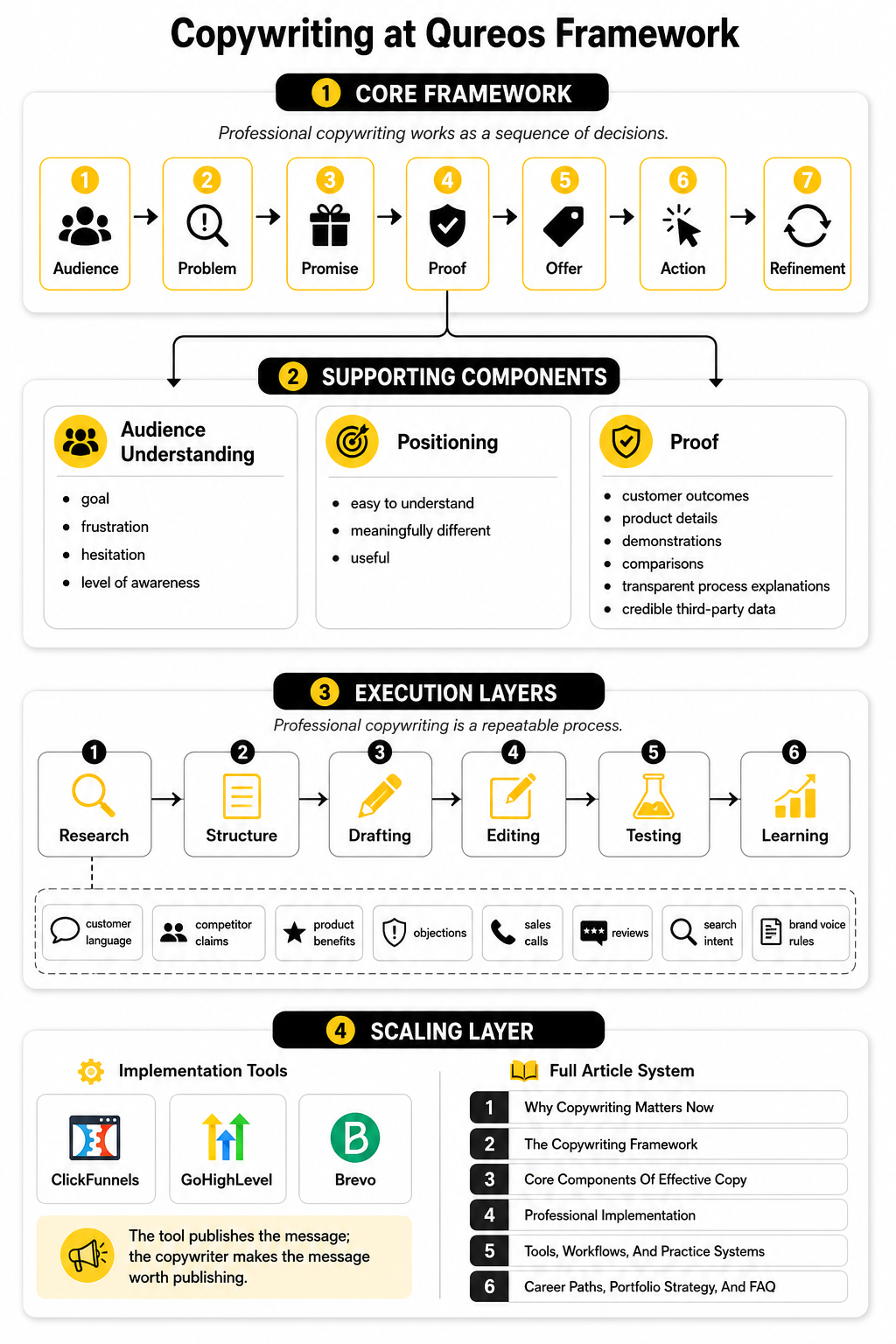
The framework this guide will use is simple: audience, problem, promise, proof, offer, action, and refinement. Each part plays a different role. Audience defines relevance, problem creates urgency, promise gives direction, proof reduces doubt, offer clarifies value, action gives the reader a next step, and refinement improves performance over time.
This framework also keeps copywriting practical for job seekers. Whether you are writing a landing page, email, LinkedIn post, product description, ad, or outreach message, the same questions keep showing up. Who is this for, why should they care, what do they need to believe, and what should they do next?
Core Components Of Effective Copy
Strong copy starts with audience understanding. You need to know the reader’s goal, frustration, hesitation, and level of awareness before you decide what to say. A beginner often starts with the product, but a professional starts with the person reading the message.
The second component is positioning. This is where you make the offer easy to understand and meaningfully different from alternatives. If the reader cannot quickly explain what makes the offer useful, the copy has already lost momentum.
The third component is proof. Claims without proof feel weak, especially in crowded markets where every brand says it is faster, easier, more carefully, or better. Proof can come from customer outcomes, product details, demonstrations, comparisons, transparent process explanations, or credible third-party data, but it must support the message instead of interrupting it.
Professional Implementation
Professional copywriting is not about waiting for inspiration. It is a repeatable process that starts with research, moves into structure, and then becomes drafting, editing, testing, and learning. That process matters because most weak copy is not weak because the writer lacks talent; it is weak because the thinking before the writing was shallow.
In practice, this means a copywriter should collect raw inputs before writing anything important. Those inputs include customer language, competitor claims, product benefits, objections, sales calls, reviews, search intent, and brand voice rules. The more specific the inputs, the less generic the final copy becomes.
This is where tools can help, as long as they do not replace judgment. A landing page builder like ClickFunnels, an automation platform like GoHighLevel, or an email platform like Brevo can support implementation, but the copy still needs a clear strategy behind it. The tool publishes the message; the copywriter makes the message worth publishing.
The Copywriting Framework
The easiest mistake in copywriting is starting with the sentence instead of the strategy. A sentence can sound clever and still fail if it is aimed at the wrong person, makes the wrong promise, or asks for action before trust has been built. That is why copywriting at Qureos should be practiced as a framework first and a writing exercise second.
The framework is not complicated, but it does require discipline. You move from audience research to problem clarity, then from promise to proof, then from offer to action, and finally into revision based on feedback or performance. This gives your writing a spine, which matters because professional copy is rarely judged by how much the writer enjoyed writing it.
Start With The Reader’s Situation
The reader is never arriving as a blank page. They already have a goal, a frustration, a level of awareness, and a reason to hesitate. Copywriting becomes stronger when you identify that situation before you write the first line.
For example, someone reading about a career platform is not only looking for features. They may be trying to get hired faster, understand which skills employers want, or prove that they are ready for a role despite limited experience. That changes the tone completely, because the copy should speak to progress, confidence, and practical next steps instead of simply describing a platform.
This is where research protects you from generic writing. Job seekers, founders, marketers, and hiring managers all respond to different triggers. If you write one vague message for all of them, you usually end up with copy that feels polished but forgettable.
Clarify The Problem Before The Promise
A strong promise only works when the problem is clear. If the reader does not feel the gap between where they are and where they want to be, the benefit will sound like decoration. This is why experienced copywriters spend so much time sharpening the problem before presenting the solution.
In the context of copywriting at Qureos, the problem is not “people need writing tips.” The deeper problem is that many beginners can write, but they cannot yet connect writing to business outcomes, customer psychology, or hiring expectations. That is a very different problem, and it leads to a stronger promise.
The promise should be specific enough to feel useful but not so exaggerated that it loses trust. “Learn copywriting” is weak because it is too broad. “Build the practical copywriting skills needed for campaigns, portfolios, and entry-level marketing work” is stronger because it gives the reader a clearer reason to keep going.
Build Proof Into The Message
Proof is what stops copy from sounding like opinion. It can come from data, product details, credible research, examples of process, customer language, or a visible demonstration of how something works. The important part is that proof should answer the reader’s natural doubt at the exact moment that doubt appears.
This matters more now because readers are surrounded by inflated claims. They have seen too many “ultimate” guides, “important” platforms, and “secret” frameworks. Serious copywriting has to earn belief instead of demanding it.
The market also supports this need for stronger proof. The American Marketing Association’s 2025 skills research highlights how quickly marketing skills are shifting around AI, search, privacy, and channel change, with generative AI standing out as a major future skill area. For copywriters, that means surface-level writing is not enough; the work has to show judgment, adaptability, and commercial understanding.
Make The Offer Easy To Understand
The offer is not just the product or platform. It is the practical exchange the reader is considering. They are asking, “What do I get, why does it matter, and is it worth my time?”
Good copy answers those questions without making the reader work too hard. If the offer is a course, the copy should explain the skill outcome. If the offer is a tool, the copy should explain the workflow improvement. If the offer is a career platform, the copy should connect features to momentum, clarity, and employability.
This is also where copywriters need restraint. Adding more benefits does not automatically make an offer more persuasive. Often, the better move is to remove weaker points so the strongest value is easier to see.
Give The Reader A Natural Next Step
Every piece of copy needs a next step, even if that step is small. It might be signing up, reading another page, booking a call, joining a waitlist, saving a checklist, or comparing options. Without a clear next step, even interested readers can drift away.
The call to action should match the reader’s stage of awareness. A cold reader may need a low-friction step, while a warmer reader may be ready for a demo, application, or purchase. This is why the same CTA does not belong everywhere.
For learners practicing copywriting at Qureos, this is a useful habit to build early. Do not only ask, “Does this sound good?” Ask, “What should the reader do after this, and have I made that action feel logical?” That one question improves emails, landing pages, ads, social posts, and portfolio projects.
Why The Framework Works Across Channels
A good framework matters because channels keep changing. Search behavior changes, social platforms change, inboxes get crowded, and AI tools keep raising the volume of average content. But the reader’s decision process still needs relevance, clarity, trust, and a reason to act.
That is why the same copywriting logic can work across different formats. A landing page may need more proof and structure, while a social post may need a sharper hook and faster emotional relevance. An email may need a stronger subject line and a more personal reason to click, while a chatbot flow may need short, clear prompts that reduce friction.
This is also where tool choice should support the strategy instead of replacing it. A business may use ManyChat for conversational flows, Buffer for social scheduling, or Moosend for email campaigns, but the copy still has to guide the reader through a real decision. The tool can distribute the message, but the framework makes the message work.
Landing Pages Need Sequencing
Landing page copy has to control the order of information. The headline should create relevance, the opening section should confirm the reader is in the right place, and the body should build trust before asking for action. If the page jumps too quickly into features, the reader may not understand why those features matter.
This is why landing pages often expose weak thinking. If the audience is unclear, the headline becomes vague. If the offer is unclear, the page becomes bloated. If proof is missing, the CTA feels premature.
For implementation, tools like Replo or ClickFunnels can help teams build pages faster, but they do not decide the argument for you. The copywriter still needs to choose what the reader sees first, what doubt gets handled next, and what final push makes the action feel reasonable.
Email Copy Needs Momentum
Email copy has less room for waste. The subject line earns the open, the first line earns the second line, and the body has to move quickly toward a useful point. That does not mean every email should be short, but it does mean every part needs a job.
The best email copy usually feels personal without pretending to be intimate. It respects the reader’s time, makes the reason for the message clear, and avoids sounding like a mass blast when the situation calls for relevance. This is especially important in outreach, onboarding, newsletters, and lead nurturing.
When email platforms make sending easier, the quality bar should go up, not down. A platform like Brevo can support segmentation and campaign execution, but segmentation only helps if the copy actually reflects the segment. Better targeting with lazy copy is still lazy copy.
Social Copy Needs A Clear Point Of View
Social copy is not only about posting frequently. It is about saying something specific enough to make the right people stop and think. That requires a point of view, not just a caption.
For a learner, this is one of the best ways to practice because feedback is visible. You can test hooks, angles, formats, and calls to action without needing a large campaign budget. Over time, you start seeing which ideas create interest and which ones only sounded good in your notes.
The danger is chasing engagement at the expense of credibility. Strong social copy should still connect to a real insight, useful lesson, or relevant offer. If the post gets attention but damages trust, it did not really work.
Core Components Of Effective Copy
Strong copy is built from parts that work together. You cannot fix weak positioning with a better adjective, and you cannot fix a vague offer by adding a louder call to action. Copywriting at Qureos should train you to see the whole system, not just the final paragraph.
The core components are audience insight, message angle, value clarity, proof, structure, voice, and conversion intent. Each one has a job. When one is missing, the copy may still sound acceptable, but it usually becomes harder to trust, harder to understand, or easier to ignore.
Audience Insight
Audience insight is the difference between writing what you want to say and writing what the reader is ready to hear. A beginner often writes from the brand’s perspective: “We offer this, we help with that, we are different.” A stronger copywriter writes from the reader’s pressure point: “You are trying to solve this, avoid that, achieve this, and make a confident decision.”
This does not mean guessing emotions or forcing drama into the copy. It means listening closely to the language people already use when they describe their problems. Reviews, community posts, support tickets, sales calls, job descriptions, and search queries can all reveal what the reader actually cares about.
For digital copy, this matters because people scan before they commit. The Nielsen Norman Group’s long-running research on how people read online shows that users often scan pages instead of reading every word, which makes clear audience relevance even more important. If the first few lines do not feel connected to the reader’s situation, the rest of the copy may never get a chance.
Message Angle
The message angle is the main way you choose to make the offer matter. Two copywriters can promote the same product and write completely different copy because they choose different angles. One may lead with speed, another with confidence, another with cost savings, and another with reduced complexity.
Choosing the right angle depends on awareness. A reader who already understands the problem may need proof and comparison. A reader who is still uncertain may need education and context before the offer feels relevant.
This is where copywriting becomes strategic. You are not just asking, “What sounds persuasive?” You are asking, “Which argument fits this reader, this channel, and this stage of the decision?” That question is the difference between random creativity and professional execution.
Value Clarity
Value clarity means the reader can quickly understand what they get and why it matters. This sounds basic, but it is where a lot of copy fails. Brands often explain features because features are easy to list, while readers are trying to understand the practical outcome.
For example, “AI-powered writing feedback” is a feature. “See where your message is unclear before you publish it” is closer to value. The second version gives the reader a reason to care because it connects the capability to a real writing problem.
Good value clarity also avoids overpromising. You do not need to make every benefit sound life-changing. In many cases, direct and believable copy performs better because it feels more grounded.
Proof And Believability
Proof gives the reader permission to believe the promise. It can be data, a demonstration, a testimonial, a portfolio sample, a product walkthrough, a comparison, or a transparent explanation of the process. The format matters less than the timing.
Weak copy stacks claims without support. Strong copy introduces proof right when the reader may begin to doubt. If you claim something is easier, show what becomes easier. If you claim something saves time, explain where the time is saved. If you claim something improves outcomes, be specific about the mechanism.
This is especially important in an AI-heavy marketing environment. The 2025 State of Marketing AI Report shows that marketers are actively using and evaluating AI in their workflows, but adoption alone does not prove quality. A copywriter still needs to show why a message is true, not just produce it faster.
Professional Implementation
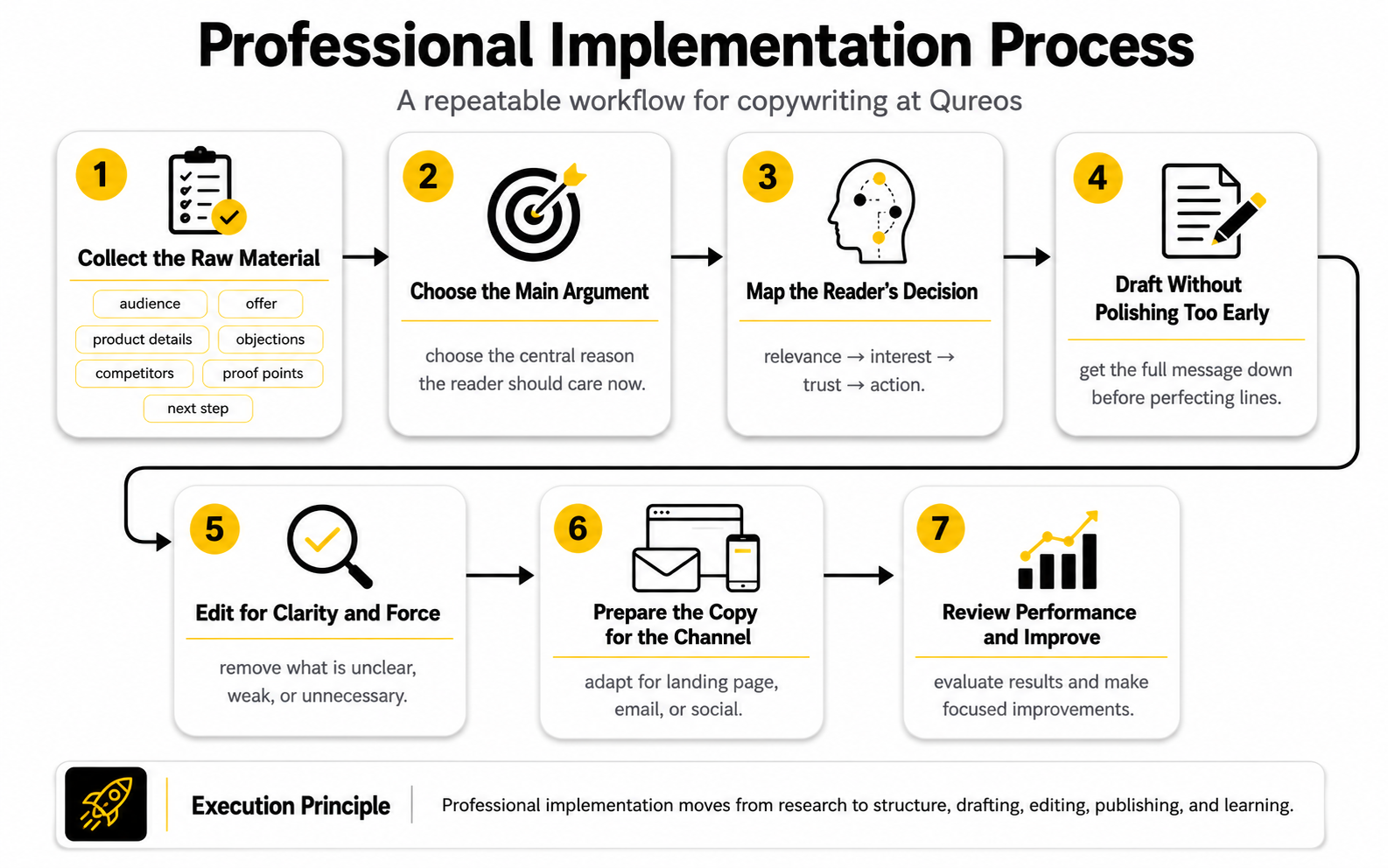
Professional implementation is where the framework becomes real work. You move from research to a draft, from a draft to a sharper version, and from a sharper version to something that can be published, tested, or used in a portfolio. This is the part most beginners skip because they want the finished copy too quickly.
But speed without process creates fragile work. You may get one decent headline, but you will struggle to repeat the result on another offer, channel, or audience. A reliable process gives you consistency, which is exactly what employers and clients care about.
Step 1: Collect The Raw Material
Before writing, collect the information that will shape the message. This includes the audience, offer, product details, objections, competitors, proof points, and the action you want the reader to take. You are looking for useful inputs, not random inspiration.
A simple research checklist can include:
This step keeps your copy from becoming generic. If your research is thin, your writing will usually lean on vague claims like “save time,” “grow faster,” or “build your potential.” Those phrases can work only when they are supported by sharper context.
Step 2: Choose The Main Argument
Once the raw material is clear, choose the main argument. This is the central reason the reader should care now. It should be simple enough to guide the whole piece of copy.
For a landing page, the argument may be that the product helps the reader launch faster without technical complexity. For an email, it may be that the reader is missing a practical next step they can solve in minutes. For a career-focused article about copywriting at Qureos, the argument may be that copywriting is not just a creative skill; it is a career-ready marketing skill when practiced with structure.
This argument becomes the filter for what stays and what gets removed. If a line does not support the argument, it probably does not belong. That kind of editing is not glamorous, but it is where good copy gets tighter.
Step 3: Map The Reader’s Decision
Copy should follow the reader’s decision path. That path usually starts with relevance, moves into interest, then trust, then action. If the copy asks for action before the reader understands the value, the message feels pushy.
For a landing page, this might mean opening with the problem, clarifying the outcome, showing how it works, handling objections, and then presenting the call to action. For an email, it may mean using the first line to create context, the middle to build the reason, and the final line to make the next step obvious. For social copy, it may mean opening with a sharp observation before expanding into a useful takeaway.
This is why structure matters as much as wording. A strong sentence in the wrong place can still fail. The reader needs to receive the right information at the right moment.
Step 4: Draft Without Polishing Too Early
The first draft should get the argument onto the page. Do not try to make every sentence perfect immediately. Early polishing can trap you inside weak structure because you become attached to lines before you know whether they belong.
A practical first draft should focus on completeness. Get the headline, opening, main points, proof, objections, and call to action down first. Then you can evaluate whether the message actually flows.
This approach is useful when working with AI too. AI can help produce variations, reorganize sections, or test different tones, but the copywriter should still control the argument. If the draft sounds smooth but the logic is weak, it is not ready.
Step 5: Edit For Clarity And Force
Editing is where copy becomes sharper. Start by removing anything that does not help the reader understand, believe, or act. Then improve the order, tighten the language, and replace vague benefits with specific value.
A good editing pass asks:
This is also where voice matters. Professional copy should not sound robotic, inflated, or desperate. It should sound clear, confident, and appropriate for the brand.
Step 6: Prepare The Copy For The Channel
Implementation changes by channel. A landing page needs visual hierarchy, section flow, and scannable blocks. An email needs a subject line, preview text, readable pacing, and a clean action. A social post needs a strong opening and a point worth remembering.
Tools can help at this stage, but they should serve the message. A funnel builder like ClickFunnels can help publish sales pages, while GoHighLevel can support campaigns, CRM workflows, and automation. Those tools are useful when the copy is already clear; they are not a substitute for the thinking that makes the page or campaign persuasive.
For social execution, Buffer can help organize posting, while Flick Social can support social planning and content workflows. The point is not to use every tool. The point is to understand the channel well enough that the tool makes execution smoother.
Step 7: Review Performance And Improve
Copywriting does not end when the draft is published. Real implementation includes review. You look at opens, clicks, replies, scroll depth, conversions, qualitative feedback, or whatever signal matches the channel.
This is where beginners can grow quickly. Instead of treating performance as judgment, treat it as information. If people open but do not click, the body or offer may be weak. If people click but do not convert, the landing page may not support the promise. If people do not open, the subject line or audience match may need work.
The professional habit is to make one clear improvement at a time. Random changes create noise. Focused changes teach you what actually moved the result.
Statistics And Performance Data
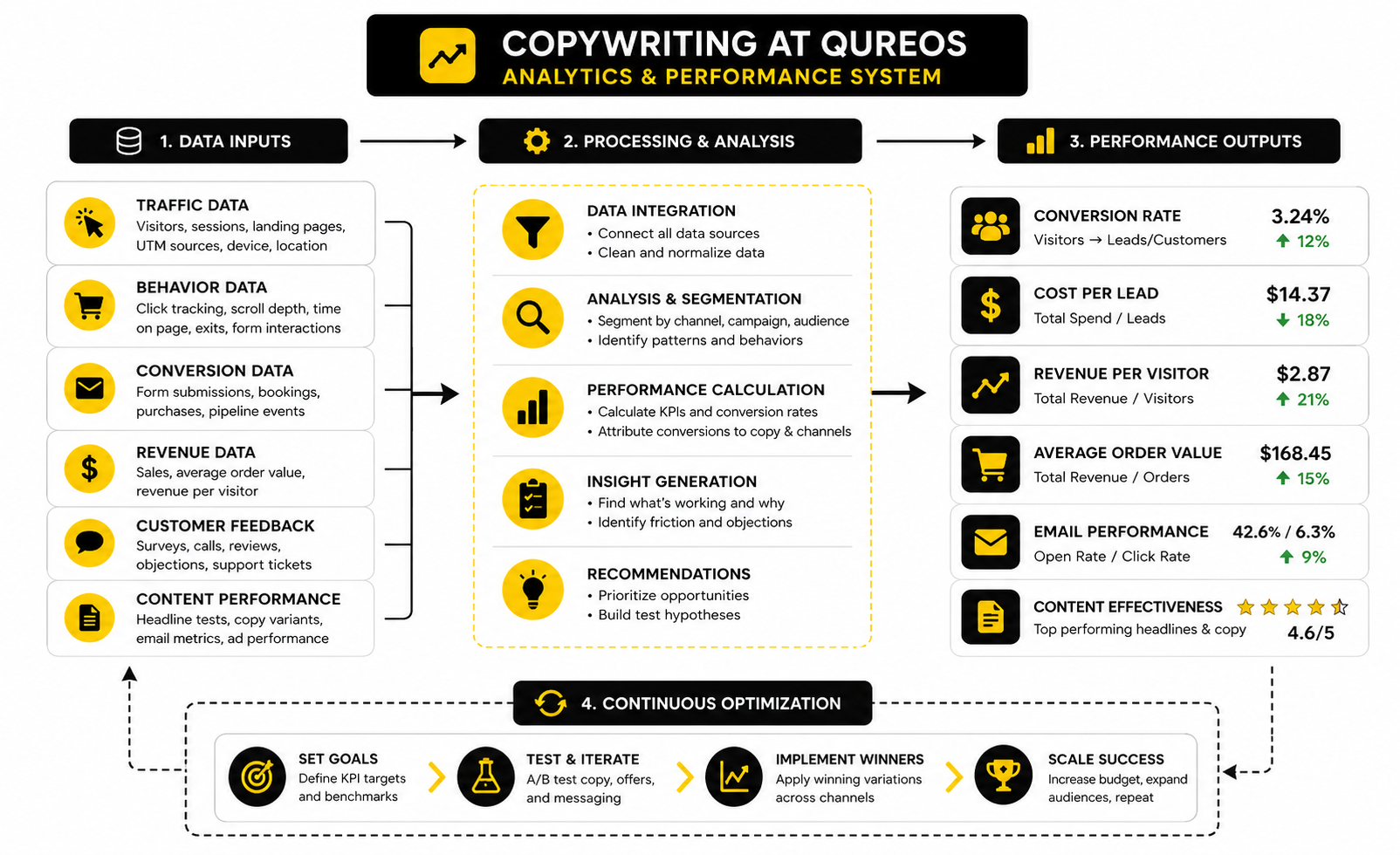
Good copywriters do not treat numbers as decoration. They use data to understand where the message is working, where the reader is hesitating, and what needs to change next. This matters for anyone learning copywriting at Qureos because professional copy is not finished when it sounds good; it is finished when it can be evaluated against a real goal.
The point is not to chase one universal benchmark. A 3% click-through rate can be excellent in one context and weak in another, depending on the audience, channel, offer, traffic quality, and stage of the funnel. Data only becomes useful when it is connected to the decision the copy was supposed to influence.
What Benchmarks Can And Cannot Tell You
Benchmarks are useful because they give you a rough sense of what is normal. They can help you avoid panic when a metric looks lower than expected, and they can also show when a campaign is obviously underperforming. But benchmarks are not a verdict.
For landing pages, the Unbounce Conversion Benchmark Report found a median conversion rate of 6.6% across a large dataset of landing pages, pageviews, and conversions. That number is helpful because it gives copywriters a reference point, but it does not mean every page below 6.6% is bad or every page above it is strong. A cold traffic page for a high-ticket B2B offer and a warm traffic page for a free checklist should not be judged the same way.
Email has the same issue. The Brevo email marketing benchmarks show that performance varies heavily by industry, channel, and audience relationship. That means the copywriter’s job is not to memorize one “good” number, but to understand what the number is saying about relevance, timing, trust, and offer strength.
The Metrics That Actually Matter
The most useful copywriting metrics are tied to reader behavior. Open rate shows whether the subject line and sender relationship earned attention. Click-through rate shows whether the body created enough interest to move forward. Conversion rate shows whether the full message and offer made the action feel worth taking.
A simple measurement system can track:
This is where copywriting becomes practical. If an email gets opened but nobody clicks, the subject line may be doing its job while the body copy or offer is weak. If a landing page gets clicks from an ad but no form submissions, the problem may be message mismatch, unclear proof, poor page structure, or an ask that feels too big for the reader’s level of trust.
Reading Performance Signals Without Overreacting
One of the biggest mistakes beginners make is changing everything after one weak result. That makes learning almost impossible because you no longer know what caused the improvement or decline. Professional copywriters isolate variables.
If a headline underperforms, test a clearer angle before rewriting the whole page. If a call to action feels weak, test a more specific next step before changing the entire offer. If an email has low clicks, compare the promise in the subject line with the promise in the body before assuming the audience is wrong.
You also need enough data before making a confident decision. A landing page with 30 visits has not told you much. An email sent to a tiny list can point to a possible issue, but it should not be treated like a statistically reliable conclusion. Data should guide judgment, not replace it.
What Copywriters Should Measure By Channel
Each channel has its own performance signals. A social post may be judged by saves, comments, profile visits, or clicks, depending on the goal. A landing page may be judged by conversion rate, scroll depth, form completion rate, or lead quality. An email may be judged by opens, clicks, replies, unsubscribes, and downstream conversions.
For content and SEO, the picture is broader. The Content Marketing Institute’s 2025 B2B research shows how content teams are thinking about AI, effectiveness, strategy, budgets, and formats, but the important lesson for copywriters is simple: content performance depends on more than publishing volume. The copy has to help the right audience move from attention to trust.
For AI-assisted workflows, measurement becomes even more important because output can increase quickly. The 2025 State of Marketing AI Report is based on nearly 1,900 marketing and business leaders, which makes it useful context for how widely AI is being considered inside marketing teams. The action point for copywriters is not “use AI more.” The action point is to measure whether AI-assisted copy is actually improving speed, quality, relevance, or conversion.
How To Turn Data Into Better Copy
Data should lead to a copy decision. If people are not clicking the CTA, the action may be unclear, too demanding, or disconnected from the promise. If people click but do not convert, the landing page may need stronger proof, better objection handling, or a more believable offer.
A practical improvement process looks like this:
This is the kind of thinking that makes copywriting at Qureos more career-relevant. You are not only writing lines; you are learning how to diagnose communication problems. That skill transfers into landing pages, ads, emails, onboarding flows, sales enablement, social content, and portfolio projects.
The Difference Between Vanity Metrics And Business Metrics
Vanity metrics are not useless, but they can be misleading. A post with many likes may not generate qualified leads. An email with a high open rate may not create clicks. A landing page with a lot of traffic may still fail if the visitors are not the right people.
Business metrics are closer to the outcome that matters. These include qualified leads, booked calls, purchases, trial starts, applications, revenue, retention, and customer quality. A copywriter does not always control all of those outcomes, but strong copy should support them.
This is why measurement has to stay connected to intent. If the goal is awareness, engagement signals may matter more. If the goal is sales, conversion and lead quality matter more. If the goal is trust, replies, saves, return visits, and assisted conversions may tell a more honest story than raw traffic.
Tools Can Track Data, But They Cannot Interpret It For You
Analytics tools can show what happened, but they do not automatically explain why it happened. A dashboard may show that conversions dropped, but it cannot always tell whether the issue was the headline, offer, traffic source, proof, audience fit, page speed, or timing. That interpretation is where the copywriter needs judgment.
Platforms like GoHighLevel, ClickFunnels, and Brevo can help track campaigns, funnels, forms, automations, and email performance. They are useful because they make the feedback loop easier to see. But the tool only gives you signals; the copywriter still has to decide what those signals mean.
This is the professional shift. Instead of asking, “Did the copy work?” ask, “Where did the reader stop moving, and what needs to be clearer, stronger, or more believable?” That question turns analytics from a reporting task into a writing advantage.
Tools, Workflows, And Practice Systems
Once the basics are clear, the next challenge is consistency. Anyone can write one good draft when the topic is familiar and the deadline is comfortable. Professional copywriters need a workflow that still works when the offer is complex, the audience is skeptical, the deadline is tight, and the first draft is not good enough.
That is where copywriting at Qureos should become more than lesson consumption. The goal is to build a practice system that helps you research faster, think sharper, draft cleaner, and improve based on feedback. The copywriter who can repeat a reliable process will always have an advantage over the writer who depends on mood.
Build A Repeatable Copywriting Workflow
A repeatable workflow gives you control. It stops every project from feeling like a fresh emergency. You know what to research, what to decide, what to draft, what to edit, and what to measure.
A practical workflow can look like this:
This system does not make the work boring. It gives creativity a container. When the process is clear, you can spend more energy on the real strategic decisions instead of wasting time wondering where to start.
Use AI Without Letting It Flatten Your Thinking
AI can help copywriters move faster, but it can also make weak thinking look polished. That is the risk. A smooth draft can hide a vague audience, a generic promise, or an offer that still does not make sense.
The more carefully move is to use AI for support tasks, not blind authorship. Use it to summarize research, generate headline variations, pressure-test objections, reorganize messy notes, or compare different angles. Then use your own judgment to decide what is true, useful, persuasive, and appropriate for the brand.
This matters because AI adoption is no longer a fringe topic in marketing. The 2025 State of Marketing AI Report is based on nearly 1,900 marketing and business leaders, which shows how seriously teams are now evaluating AI usage, outcomes, and barriers. For copywriters, the winning skill is not typing prompts; it is knowing what good copy should do before AI helps produce a draft.
Create A Swipe File That Trains Judgment
A swipe file is not a folder of copy to steal. It is a training library for your eye. You collect ads, emails, landing pages, hooks, sales pages, onboarding flows, and CTAs so you can study why they work.
The key is to annotate the examples. Do not only save a page because it looks good. Write down the audience, promise, proof, offer, objection handling, tone, structure, and call to action. That turns a swipe file from inspiration into education.
Over time, patterns become easier to see. You notice how strong landing pages sequence proof. You notice how good emails create momentum without forcing hype. You notice how the best social posts often make one clear point instead of trying to say everything.
Practice With Constraints
Practice gets sharper when it has constraints. Writing “a landing page” is too broad. Writing a landing page for a cold audience, with one proof point, one objection, and one CTA is much better because it forces decisions.
Useful constraints include:
This kind of practice builds professional flexibility. You stop thinking of copywriting as one format and start seeing it as communication under conditions. That is exactly how real work feels.
Know When Templates Help And When They Hurt
Templates are useful when they teach structure. They can help a beginner understand how a landing page flows, how an email sequence builds trust, or how a product description moves from feature to outcome. Used well, templates reduce confusion.
The problem starts when templates replace thinking. If every headline follows the same pattern, every email has the same rhythm, and every CTA uses the same pressure, the copy becomes predictable. Readers can feel when a message was squeezed into a formula.
Use templates as scaffolding, then remove the scaffolding when the idea is strong enough. The finished copy should feel natural for the offer, audience, and channel. If the reader notices the formula more than the message, the formula is in the way.
Balance Conversion With Brand Trust
Conversion matters, but trust matters longer. A copywriter can sometimes increase short-term clicks with exaggeration, urgency, or emotional pressure. That does not mean the copy is good.
Strong copy should make the next action feel clear and worthwhile without damaging the relationship. This is especially important for education, career, software, finance, health, and B2B offers, where credibility is part of the product experience. If the copy promises too much, the disappointment shows up later in refunds, churn, complaints, or poor-fit leads.
This is a serious strategic tradeoff. The best copywriters understand that persuasion is not manipulation. The job is to help the right reader make a confident decision, not push the wrong reader into a weak one.
Design The Workflow Around Feedback Loops
A workflow without feedback becomes guesswork. You need signals from real readers, editors, clients, hiring managers, analytics, and your own review process. Otherwise, you may keep improving the wrong thing.
Feedback loops can be simple. Save before-and-after versions of your copy. Track what changed and why. Note which headlines got more clicks, which emails got replies, which landing page sections caused confusion, and which portfolio pieces received the strongest response.
For learners, this is where growth compounds. Every draft becomes a source of learning instead of a one-off assignment. Every revision teaches you how to see the message more clearly.
Advanced Strategic Tradeoffs
Advanced copywriting is mostly about tradeoffs. You are deciding what to emphasize, what to leave out, how direct to be, how much proof to use, how much emotion is appropriate, and how hard to push the action. There is rarely one perfect answer.
This is where copywriting at Qureos can become genuinely career-building. Beginners often want rules. Professionals learn judgment. The more you understand the tradeoffs, the better your copy becomes under real business pressure.
Clarity Versus Curiosity
Curiosity can earn attention, but clarity earns trust. A mysterious headline may get someone to keep reading, but if the reader still does not understand the point after a few seconds, curiosity turns into friction. That is why clever copy can fail even when it sounds impressive.
The right balance depends on the channel. Social posts can often use more curiosity because the commitment is small. Landing pages usually need more clarity because the reader is evaluating an offer. Emails sit somewhere in the middle, depending on the relationship and purpose.
A useful rule is simple: curiosity should open the loop, not hide the value. The reader should feel pulled forward, not confused. If the copy makes people ask “What does this mean?” instead of “Tell me more,” it needs work.
Specificity Versus Simplicity
Specificity makes copy believable. Simplicity makes copy understandable. The challenge is using enough detail to create trust without turning the message into a technical explanation nobody wants to finish.
For example, a feature explanation may need specific details when the reader is comparing tools. But an above-the-fold landing page section may need a simpler version first, with details introduced later. The same fact can be useful or overwhelming depending on where it appears.
This is why structure matters. You do not need to remove depth. You need to place depth where the reader is ready for it. A good copywriter controls the pace of information.
Speed Versus Quality
Modern marketing teams need speed. Campaigns move fast, channels multiply, and AI has raised expectations for output volume. But speed becomes dangerous when teams publish more copy without improving the quality of the thinking behind it.
The Content Marketing Institute’s 2025 B2B research shows how content teams are navigating AI, strategy, budgets, formats, and effectiveness. The useful takeaway for copywriters is that more production does not automatically create more impact. A faster workflow still needs a strong message, a clear audience, and a useful reason to publish.
The practical answer is not to slow everything down. It is to separate low-risk copy from high-risk copy. A social caption may move quickly, but a core sales page, onboarding sequence, or high-value email campaign deserves deeper research and more careful review.
Personalization Versus Privacy
Personalization can make copy more relevant, but it has to be handled carefully. Readers like relevance. They do not like feeling watched.
This is especially important in email, automation, and CRM-driven campaigns. Segmenting by role, behavior, or interest can help the message feel more useful, but overly specific personalization can feel invasive. The copy should make the reader feel understood, not tracked.
The safer approach is to personalize around context and intent rather than sensitive assumptions. Use what the reader has clearly shown interest in. Avoid pretending to know more than you do. Trust is hard to build and very easy to lose.
Automation Versus Human Judgment
Automation is powerful when it removes repetitive work. It can route leads, trigger follow-ups, send reminders, personalize paths, and make campaigns more consistent. But automation can also scale bad copy quickly.
This is where platforms like GoHighLevel, ManyChat, and Brevo can be useful when the strategy is already clear. They help deliver messages at the right time, but they cannot guarantee that the message deserves attention.
Before automating copy, review the sequence manually. Read it like a real person receiving the messages. Check whether the timing feels natural, the transitions make sense, and the CTA matches the reader’s level of trust.
Short-Term Wins Versus Long-Term Positioning
Some copy is designed to create immediate action. Some copy is designed to build market memory. Both matter, but they should not be confused.
A launch email may need urgency. A brand manifesto may need conviction. A product page may need clarity and proof. A thought leadership post may need a strong point of view that builds recognition over time.
The danger is using short-term tactics everywhere. If every message pushes urgency, urgency loses power. If every post tries to sell, the audience stops listening. Strong copywriters know when to push, when to teach, when to clarify, and when to simply reinforce the brand’s position.
Scaling Copywriting Skill Into Real Work
Scaling copywriting is not only about writing more. It is about building reusable thinking, better systems, sharper review habits, and a portfolio that proves you can solve real communication problems. That is what separates casual practice from career preparation.
The copywriter who can explain their decisions is easier to trust. They can say why a headline works, why a section was moved, why the CTA changed, and what metric should be watched next. That makes them more valuable in teams because they bring reasoning, not just drafts.
Turn Practice Into Portfolio Assets
A portfolio should show thinking, not just finished copy. A polished landing page screenshot is nice, but it becomes stronger when paired with the audience, goal, message angle, structure, and reasoning behind the choices. Employers and clients want to see how you approach problems.
You can build portfolio assets around practical formats:
Do not fake results. If you do not have performance data, say the piece is speculative or practice-based and explain the strategy. Honesty is better than pretending a sample is a case study when it is not.
Learn To Give And Receive Copy Feedback
Copy feedback can get messy because everyone has opinions about words. A professional process keeps the discussion focused. Instead of asking, “Do you like it?” ask, “Is the audience clear, is the promise believable, and does the next step make sense?”
When giving feedback, separate preference from performance. “I do not like this phrase” is less useful than “This phrase may be unclear because the reader does not yet know what the product does.” That kind of feedback helps improve the copy without turning the review into personal taste.
When receiving feedback, look for the problem behind the comment. A client may ask for a bigger headline when the real issue is that the value is unclear. A manager may ask for shorter copy when the real issue is weak structure. Your job is to diagnose, not just obey edits blindly.
Build A Personal Quality Checklist
A quality checklist helps you catch issues before someone else does. It also makes your work more consistent. The checklist should be simple enough that you actually use it.
Before publishing or submitting copy, ask:
This checklist is not glamorous, but it works. Good copy often comes from removing friction that weaker writers leave in place. The cleaner the message, the easier it is for the reader to move forward.
Keep The Skill Connected To Business Outcomes
Copywriting is creative work, but it lives inside business reality. The copy may need to increase signups, improve lead quality, reduce confusion, support sales, explain a product, educate a market, or strengthen a brand position. The business context changes the writing.
This is why the best copywriters keep asking what the copy is for. Not every asset should sell directly. Not every page should be short. Not every email should push a click. The right copy depends on the job it is hired to do.
For anyone studying copywriting at Qureos, this is the advanced mindset to develop. Do not only become a better writer. Become someone who can use writing to solve a specific marketing problem with clarity, evidence, and judgment.
Career Paths, Portfolio Strategy, And Professional Growth
The final step is turning copywriting knowledge into visible professional value. It is not enough to understand hooks, headlines, landing pages, email sequences, or analytics in isolation. You need a system that shows how your writing can support real marketing work.
That is why copywriting at Qureos should connect learning with career evidence. A recruiter, client, or marketing lead does not only want to know that you completed lessons. They want to see that you can think through an audience, structure a message, make the value clear, and explain why your copy should work.
Where Copywriting Skills Fit In Marketing Careers
Copywriting can lead into several practical career paths. Some people stay close to direct response and work on landing pages, ads, funnels, and email campaigns. Others move into content strategy, brand messaging, product marketing, social media, lifecycle marketing, or sales enablement.
The skill is flexible because almost every marketing role needs clear communication. A social media marketer needs hooks and concise positioning. A product marketer needs messaging and differentiation. A lifecycle marketer needs onboarding, retention, and reactivation copy. A founder or freelancer needs offer clarity and persuasive client communication.
The market is also asking for more hybrid marketers. The 2025 AMA Marketing Skills Report highlights growing pressure around digital marketing, analytics, ROI, AI, search, social, and privacy. Copywriters who understand those adjacent areas become easier to hire because they can connect writing to the bigger marketing system.
What A Strong Copywriting Portfolio Should Show
A strong portfolio should not be a random gallery of polished writing. It should show how you think. The best samples make it easy for someone to understand the goal, audience, channel, constraints, and reasoning behind the copy.
A portfolio can include:
Keep it honest. Do not invent client results or pretend practice work is a real case study. If a piece is speculative, label it as a portfolio exercise and make the strategy strong enough that the sample still proves your judgment.
How To Position Yourself As A Beginner
Beginners often make the mistake of positioning themselves as “copywriters for everyone.” That sounds flexible, but it usually makes the offer weaker. A clearer position makes it easier for the right person to understand when to hire you.
You can position around a channel, audience, industry, or problem. For example, you might focus on email copy for SaaS startups, landing page rewrites for coaches, social content for B2B founders, or onboarding copy for digital products. The position can evolve, but starting with a clear angle helps you build proof faster.
This does not mean you must lock yourself into one niche forever. It simply means your first market-facing message should be specific enough to be remembered. Generalists can win later, but beginners usually need sharper edges.
How To Keep Improving After The Course
Copywriting growth comes from deliberate practice, feedback, and exposure to real constraints. Reading examples helps, but writing and revising is where the skill develops. The fastest improvement usually comes from comparing your draft against a clear goal and asking what is still unclear, unbelievable, or unnecessary.
A simple weekly practice routine can work well:
This keeps improvement practical. You are not just consuming advice. You are building judgment through repetition.
What Is Copywriting At Qureos?
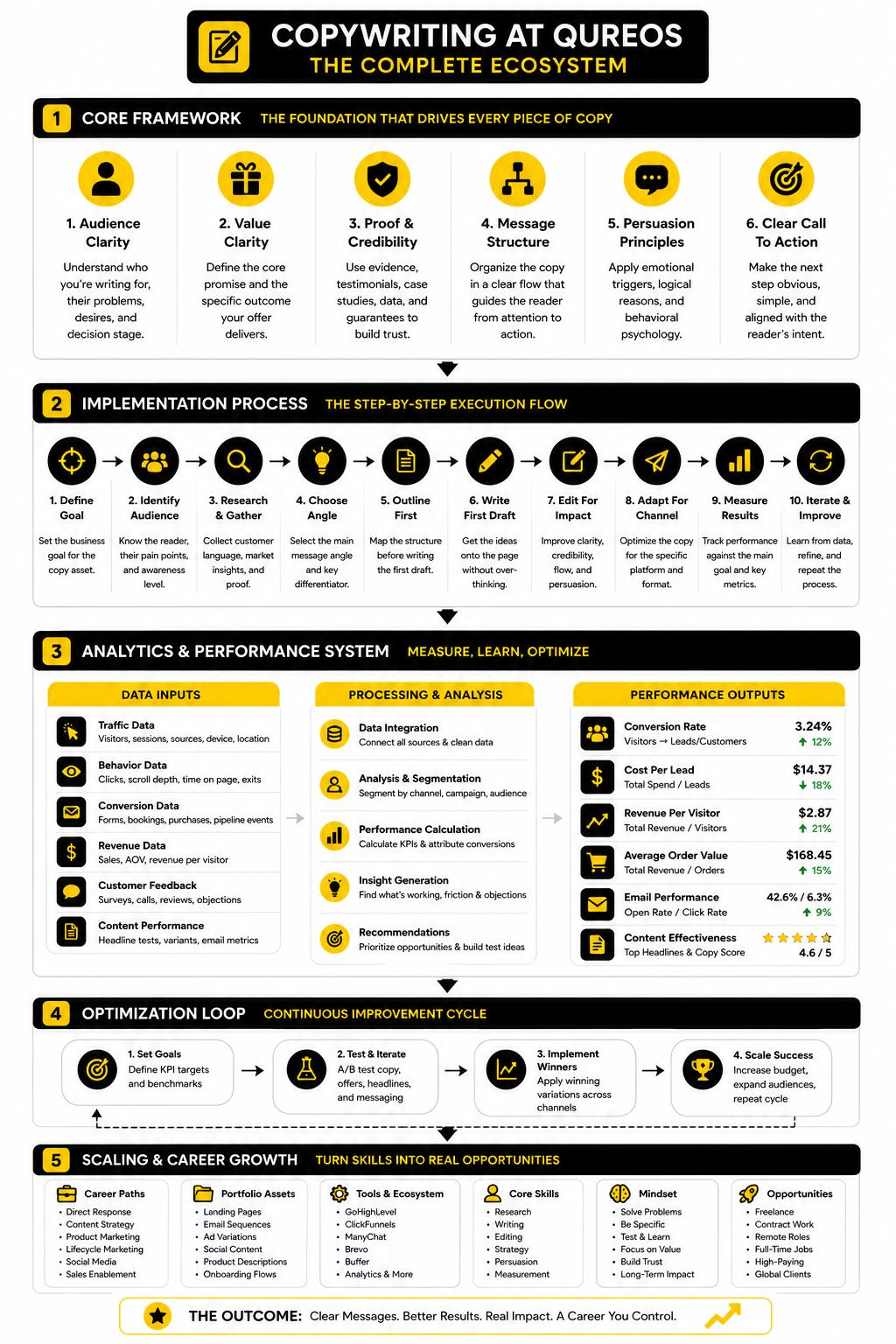
Copywriting at Qureos refers to learning and practicing copywriting as a career-ready marketing skill, not just as a writing exercise. The focus should be on understanding audiences, writing persuasive messages, building portfolio assets, and connecting copy to business outcomes. The strongest approach is to treat copywriting as a system that includes research, structure, proof, editing, and measurement.
Is Copywriting Still Worth Learning With AI Tools Everywhere?
Yes, but the skill has changed. AI can produce drafts quickly, but it cannot automatically choose the best strategy, understand brand risk, judge market nuance, or know what a specific reader needs to believe before acting. The 2025 State of Marketing AI Report shows how seriously marketing teams are adopting AI, which makes human judgment more important, not less.
What Should A Beginner Learn First?
Start with audience research, value clarity, and structure. Those three skills improve almost every type of copy because they help you avoid vague, generic writing. Once those are solid, you can move into headlines, landing pages, email sequences, ads, social posts, and conversion optimization.
How Long Does It Take To Become Good At Copywriting?
It depends on how deliberately you practice. Someone who writes casually for six months may improve less than someone who writes, edits, gets feedback, and studies performance every week for two months. The key is not just time spent; it is the quality of repetition.
What Types Of Copy Should I Practice First?
Start with short assets that force clear thinking. Good beginner formats include headlines, email subject lines, product descriptions, ad variations, landing page hero sections, and short outreach messages. These formats are useful because they make weak positioning obvious quickly.
Do I Need A Niche To Start Copywriting?
You do not need a perfect niche on day one, but you do need some direction. A niche helps you understand the audience better, collect more relevant examples, and build a portfolio that feels coherent. You can choose a channel niche, such as email or landing pages, or a market niche, such as SaaS, ecommerce, education, coaches, agencies, or local businesses.
What Makes Copywriting Different From Content Writing?
Copywriting is usually more focused on action. It aims to get the reader to click, sign up, buy, reply, book, download, or move to the next step. Content writing often focuses more on education, trust, search visibility, or long-term audience building, although the two skills overlap heavily in modern marketing.
How Do I Know If My Copy Is Good?
Good copy is clear, relevant, believable, and connected to a goal. It should make the reader understand what is being offered, why it matters, why they can trust it, and what to do next. Performance data helps, but even before data, you can evaluate whether the copy removes confusion and supports a real decision.
Should I Use Templates?
Templates are useful for learning structure, especially when you are new. They can help you understand how sales pages, emails, ads, and outreach messages are commonly organized. The risk is becoming dependent on formulas, so use templates as training wheels and then adapt the copy to the specific audience, offer, and channel.
What Should I Put In A Copywriting Portfolio?
Your portfolio should show both the finished copy and the thinking behind it. Include the audience, goal, channel, message angle, proof used, and why you structured the piece the way you did. Even practice projects can be valuable if they are clearly labeled and strategically explained.
Can Copywriting Help Me Get Remote Marketing Work?
Yes, because copywriting connects directly to business communication. Remote marketing teams often need help with landing pages, email campaigns, social content, ads, funnels, onboarding flows, and product messaging. If your portfolio shows that you can write clearly and think commercially, copywriting can support freelance, contract, and full-time opportunities.
What Tools Should A Copywriter Learn?
Start with writing, research, and editing before worrying about too many tools. Once the fundamentals are solid, it can help to understand tools for funnels, email, social scheduling, CRM workflows, forms, and analytics. Platforms like GoHighLevel, ClickFunnels, Buffer, and ManyChat can support execution, but they should not replace copywriting judgment.
What Is The Biggest Mistake New Copywriters Make?
The biggest mistake is writing before thinking. Beginners often jump into headlines and hooks before they understand the reader, the offer, the proof, and the desired action. Better copy usually starts with better diagnosis.
How Should I Practice Copywriting At Qureos If I Want Real Results?
Treat every exercise like a professional assignment. Define the reader, choose the goal, write the copy, explain your reasoning, revise it, and save the final version in a portfolio. Over time, this gives you proof of skill instead of just notes from a course.
Build a stronger local presence with BAAM AI
Turn your website, Google profile, social channels, and AI visibility into one growth engine
Most businesses do not need more random marketing activity. They need a consistent presence system that helps the right people find them, trust them, and take action. BAAM AI brings strategy, local SEO, website updates, Google Maps visibility, social content, AI-search readiness, media production, and reporting into one practical monthly engine.
If you want your marketing to keep working after the campaign ends, start with a free BAAM AI presence audit. See how your business shows up today and where the fastest visibility wins are at BAAM AI.