
BAAM AI Blog
Copywriter Needed: How To Hire The Right Writer For Growth, Not Just Words
When a business says “copywriter needed,” it usually sounds simple. You need someone to write a landing page, sales email, website section, ad, product page, or launch sequence. But the real problem is rarely just...
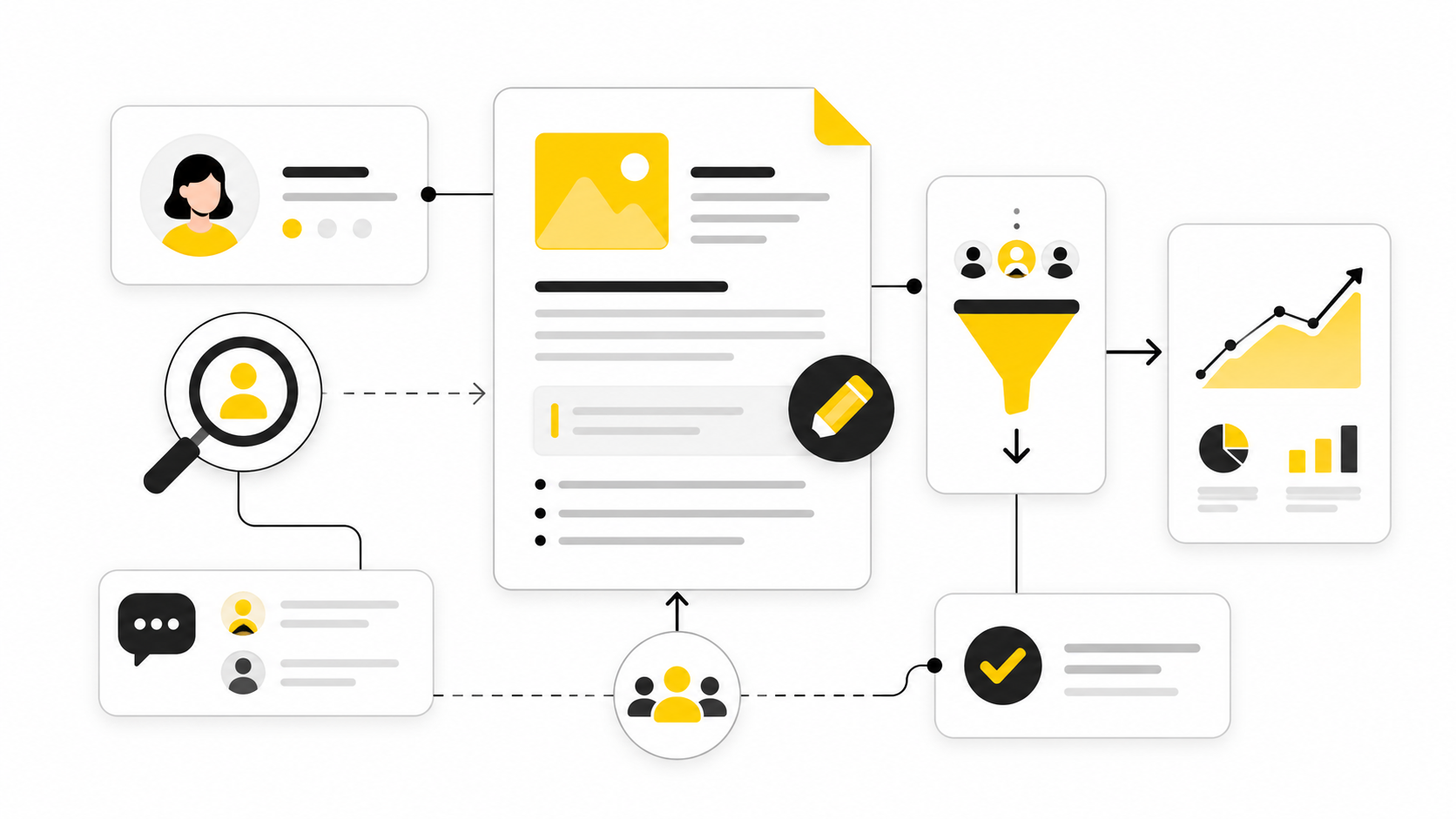
When a business says “copywriter needed,” it usually sounds simple. You need someone to write a landing page, sales email, website section, ad, product page, or launch sequence. But the real problem is rarely just “we need words.”
The real problem is that something in the business is not converting clearly enough. Maybe visitors do not understand the offer. Maybe leads are not booking calls. Maybe ads are getting clicks but not buyers. Maybe the founder can explain the product perfectly on a sales call, but the website makes it sound generic.
That is where a good copywriter becomes useful. Not because they make sentences prettier, but because they turn positioning, customer insight, proof, and offer structure into language that moves people toward action. The demand is still real: the U.S. Bureau of Labor Statistics projects employment for writers and authors to grow about as fast as average from 2024 to 2034, with roughly 13,400 openings each year, while B2B marketers continue investing in thought leadership, video, paid advertising, AI-assisted content, and performance-focused assets in the 2025 B2B content marketing benchmarks.
But hiring the wrong copywriter can be expensive in a quiet way. You may get polished copy that does not sell. You may get SEO content that attracts the wrong traffic. You may get brand messaging that sounds clever internally but means nothing to a buyer. So before you post “copywriter needed” and start reviewing portfolios, you need a better way to define the role.
this guide breaks that down across six parts. The goal is practical: help you understand what kind of copywriter you actually need, how to evaluate them, what to prepare before hiring, and how to make the engagement produce business results instead of another folder full of unused drafts.
Why Hiring A Copywriter Matters More Than Most Businesses Think
A copywriter sits at the point where strategy becomes visible. Your positioning, customer research, offer, pricing, objections, proof, and brand voice all show up in the copy whether you planned them carefully or not. If those inputs are weak, the copy exposes the weakness.
This is why hiring a copywriter is not the same as hiring a general writer. A general writer may explain information clearly, which is valuable. A copywriter has to do that while also shaping desire, reducing friction, handling objections, and guiding the reader toward a specific next step.
That difference matters even more now because buyers are surrounded by more content than ever. AI tools have made it easier to produce words, but they have also made generic content easier to ignore. The practical advantage goes to businesses that can combine speed with sharper insight, stronger proof, and messaging that feels specific to the buyer’s real situation.
When you search for “copywriter needed,” you are probably not just looking for writing capacity. You are looking for leverage. A strong copywriter can help turn existing traffic into more leads, improve the clarity of an offer, make sales conversations easier, and create reusable messaging that your ads, emails, website, and sales team can all pull from.
The Copywriter Hiring Framework
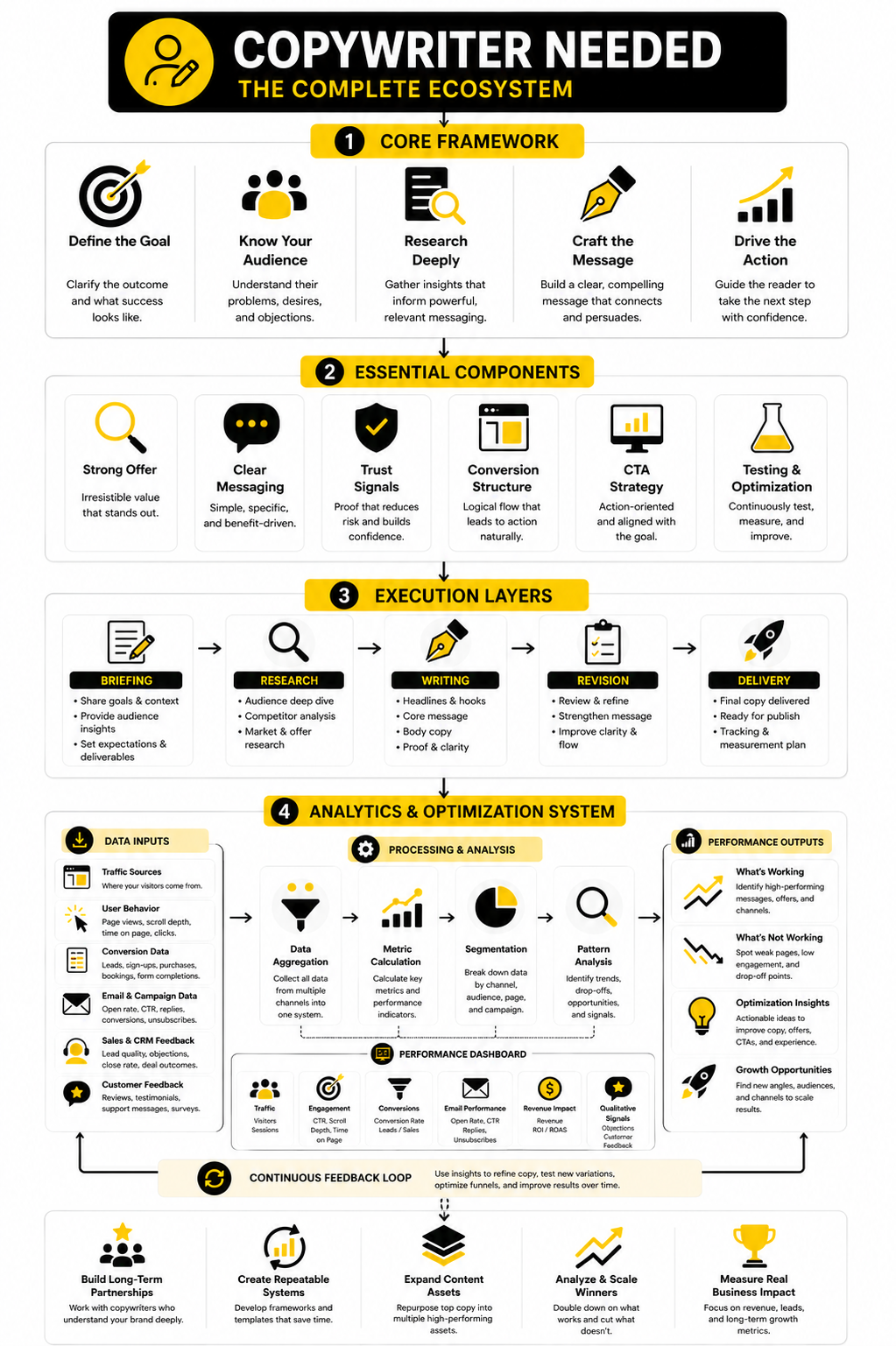
Before you hire, separate the project into four questions: what needs to change, who needs to be persuaded, where the copy will live, and how success will be measured. These questions sound basic, but they prevent most bad hires. Without them, you end up judging copywriters by taste instead of fit.
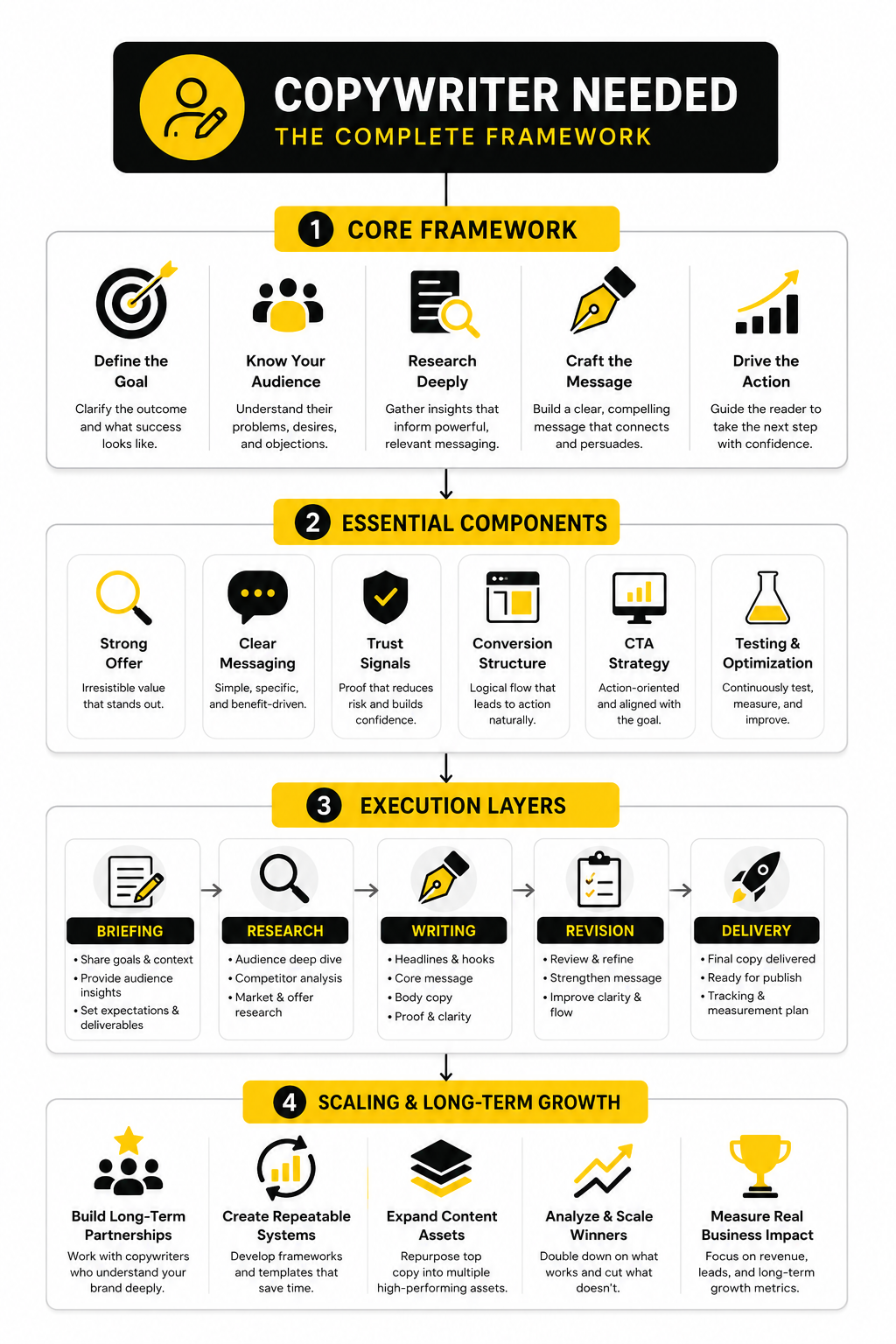
The first question is about the business problem. “We need a homepage” is not specific enough. “We need a homepage that explains our offer clearly enough for qualified visitors to book a demo” is much better because it gives the writer a real job to do.
The second question is about the audience. A copywriter writing for startup founders needs different inputs than one writing for ecommerce buyers, local service leads, enterprise procurement teams, or newsletter subscribers. Good copy depends on knowing what the reader already believes, what they are skeptical about, what they have tried before, and what would make the next step feel worth it.
The third question is about the channel. Landing page copy, email copy, ad copy, SEO copy, sales enablement copy, and social content all have different constraints. A copywriter can be excellent in one environment and average in another, so the channel should shape your shortlist.
The fourth question is measurement. For direct response work, you may look at conversion rate, booked calls, click-through rate, revenue per email, or cost per acquisition. For brand and positioning work, the signals may include sales-team adoption, clearer buyer feedback, better demo quality, or stronger consistency across assets.
Why “Any Good Writer” Is Not Enough
A good writer can make your business sound professional. A good copywriter should make your offer easier to understand, easier to trust, and easier to act on. Those are related skills, but they are not the same skill.
This distinction becomes obvious when the copy has to do commercial work. A blog post may need structure, accuracy, and readability. A landing page also needs a clear promise, a logical argument, relevant proof, risk reduction, and a call to action that fits the reader’s level of intent.
That does not mean every project needs an aggressive sales writer. Some businesses need a calm, consultative tone. Others need technical clarity, founder-led authority, customer research, or better offer framing. The point is that “copywriter needed” should lead to a specific hiring decision, not a vague search for someone who writes well.
The Core Types Of Copywriters And When To Use Each One
Not every copywriter solves the same problem. This is the part people often miss when they post “copywriter needed” and expect one person to handle everything from ads to long-form SEO to launch emails. Some writers can cover multiple formats, but the strongest results usually come from matching the writer to the business goal.
Think of copywriters by the job their copy has to perform. Some copy needs to capture demand that already exists. Some copy needs to create desire before the buyer is ready. Some copy needs to clarify a complicated offer so the sales process gets easier. Those are different problems, and they require different strengths.
A smart hire starts with the asset that matters most right now. If your ads are working but your landing page is weak, do not start with a brand copywriter. If your website sounds generic and buyers keep misunderstanding the offer, do not start with an email specialist. Start where the bottleneck is.
Website Copywriters
A website copywriter helps turn your site into a clearer sales asset. Their work usually includes homepage copy, service pages, product pages, about pages, comparison pages, and call-to-action sections. The best ones do not just write nice headlines; they organize the page so visitors understand what you do, who it is for, why it matters, and what to do next.
This type of copywriter is especially useful when your business has grown faster than your messaging. That happens a lot. The offer changes, the customer base matures, the team adds new services, and suddenly the website no longer explains the business accurately.
A good website copywriter will ask about customer objections, sales calls, competitors, proof points, pricing friction, and conversion goals. They should care about page structure as much as wording. If they only talk about tone and not buyer intent, they may be a decent writer but not the right hire for a conversion-focused website project.
Landing Page Copywriters
A landing page copywriter is the right fit when one page has one clear job. That job might be booking a call, selling a product, getting a trial signup, collecting an email, or moving paid traffic into a funnel. The copy has to be focused because every extra idea can dilute the action you want the reader to take.
This matters most when traffic costs money. If you are sending paid traffic from ads, creators, newsletters, or partnerships, weak copy wastes budget quietly. You may think the campaign is the issue when the real problem is that the page does not make the offer feel obvious, credible, and worth acting on.
For ecommerce and direct-response pages, tools like Replo can help teams build and test landing pages faster once the copy direction is clear. For funnels that combine pages, checkout flows, upsells, and follow-up sequences, ClickFunnels or Systeme.io can make sense if the business needs an all-in-one funnel setup. The tool does not replace the copywriter, but it does affect how the copy is structured and deployed.
Email Copywriters
An email copywriter helps you turn attention into action over time. This can include welcome sequences, launch campaigns, abandoned cart emails, newsletters, reactivation campaigns, sales sequences, and post-purchase flows. The skill is not just writing catchy subject lines; it is knowing how to build trust across multiple messages without sounding repetitive or desperate.
Email is where copywriting becomes a relationship game. One email can make a sale, but a strong sequence can educate, segment, warm up objections, and create momentum before the offer appears. That is why email copywriters need to understand timing, buyer awareness, list quality, and the difference between nurturing and pushing.
For businesses building email campaigns, platforms like Brevo, Moosend, and GoHighLevel can support the automation side. The copywriter still needs a clear brief, strong offer logic, and access to real customer insight. Automation only works when the message inside it is worth reading.
Ad Copywriters
An ad copywriter works under pressure because the message has very little time to earn attention. They need to understand hooks, angles, audience awareness, creative testing, and the offer behind the click. Good ad copy is not just clever; it gives the right person a reason to stop, care, and continue.
This type of copywriter is useful when you already have a traffic channel or plan to test paid acquisition seriously. They may write Meta ads, Google ads, TikTok scripts, YouTube ad scripts, LinkedIn ads, native ads, or creator briefs. The format changes, but the core job stays the same: turn a sharp angle into a message that makes the next step feel relevant.
The danger with ad copy is chasing novelty without strategy. A funny hook can get attention and still attract the wrong audience. A strong ad copywriter should be able to explain why an angle fits the market, what belief it is targeting, and what page or funnel the click will land on.
SEO Copywriters
An SEO copywriter helps you capture search demand without turning the article into a keyword-stuffed mess. Their job is to understand search intent, structure the page clearly, answer the reader’s real questions, and still make the business relevant. That last part matters because traffic without commercial direction is just noise.
This is a good hire when people are already searching for problems, comparisons, solutions, or buying criteria in your market. The best SEO copywriters know when a page should educate, when it should compare, when it should sell, and when it should move the reader deeper into the site. They also know that ranking is not the only win; the page has to help the reader trust the business.
For SEO-driven content, the brief is everything. You should define the search intent, the reader’s situation, the product or service connection, the proof available, and the next action you want from the article. Without that, you may get a well-optimized page that ranks but does not support the business.
Brand Copywriters
A brand copywriter helps define how the business sounds and what it stands for in the market. They may work on messaging foundations, voice guidelines, taglines, campaign concepts, manifestos, product narratives, and high-level positioning language. This type of copy can shape everything else, but it is not always the first hire you need.
Brand copywriting is useful when your business lacks consistency. Maybe your sales deck says one thing, your website says another, your ads sound like a different company, and your emails have no recognizable voice. A brand copywriter can create a shared language that makes the business feel more coherent.
The key is to avoid confusing brand voice with decoration. A useful brand voice makes the message easier to recognize, remember, and trust. It should not make the copy harder to understand just so the company sounds different.
Sales Enablement Copywriters
A sales enablement copywriter supports the sales process directly. They may create pitch decks, one-pagers, proposal copy, case study narratives, objection-handling documents, follow-up email templates, and comparison materials. This is especially valuable for B2B, agencies, consultants, SaaS companies, and high-ticket service providers.
This writer needs to understand what happens after a lead enters the pipeline. They should care about the questions prospects ask, the objections that slow deals down, the internal approvals buyers need, and the proof that helps a champion sell the decision internally. The copy is not always public-facing, but it can have a serious impact on revenue.
If your sales team keeps rewriting the same explanations manually, this may be the copywriter you need. Strong enablement copy creates consistency without making sales conversations feel scripted. It gives the team better language, not robotic language.
How To Choose The Right Copywriter For Your Situation
The easiest way to choose is to look at the point of friction. If people do not understand the offer, hire for positioning and website clarity. If people understand the offer but do not convert from traffic, hire for landing pages or funnels. If leads go cold after opting in, hire for email.
You should also consider the maturity of your business. Early-stage businesses often need messaging clarity before they need complex automation. More mature businesses may already have traffic, proof, and offers, so the copywriter’s job becomes optimization and scaling what works.
Budget should follow leverage. Spending heavily on copy before the offer is clear can be wasteful. But underinvesting in copy when you already have traffic, sales calls, or a strong product can cost far more because every weak message compounds across the funnel.
How To Evaluate A Copywriter Before You Hire
By this stage, you should know what kind of copywriter you need. The next step is choosing one without getting distracted by personality, slick portfolios, or vague promises. A good hiring process does not need to be complicated, but it does need to reveal how the writer thinks.
The best copywriters usually ask uncomfortable but useful questions. They want to know what the offer is, who buys it, why people hesitate, what proof exists, where traffic comes from, what has already been tested, and what success looks like. If someone jumps straight into writing without understanding those inputs, be careful.
This is especially important now because AI has made surface-level writing easier to produce. Recent marketing research shows that teams are investing more in AI for content creation, optimization, and performance, but the harder work is still strategy, judgment, buyer insight, and editing. A copywriter needed for serious commercial work should bring those human layers, not just faster output.
The Practical Copywriter Evaluation Process
The hiring process should make the invisible parts of copywriting visible. You are not only evaluating finished samples. You are evaluating how the writer diagnoses problems, uses research, handles constraints, and turns messy business information into clear messaging.
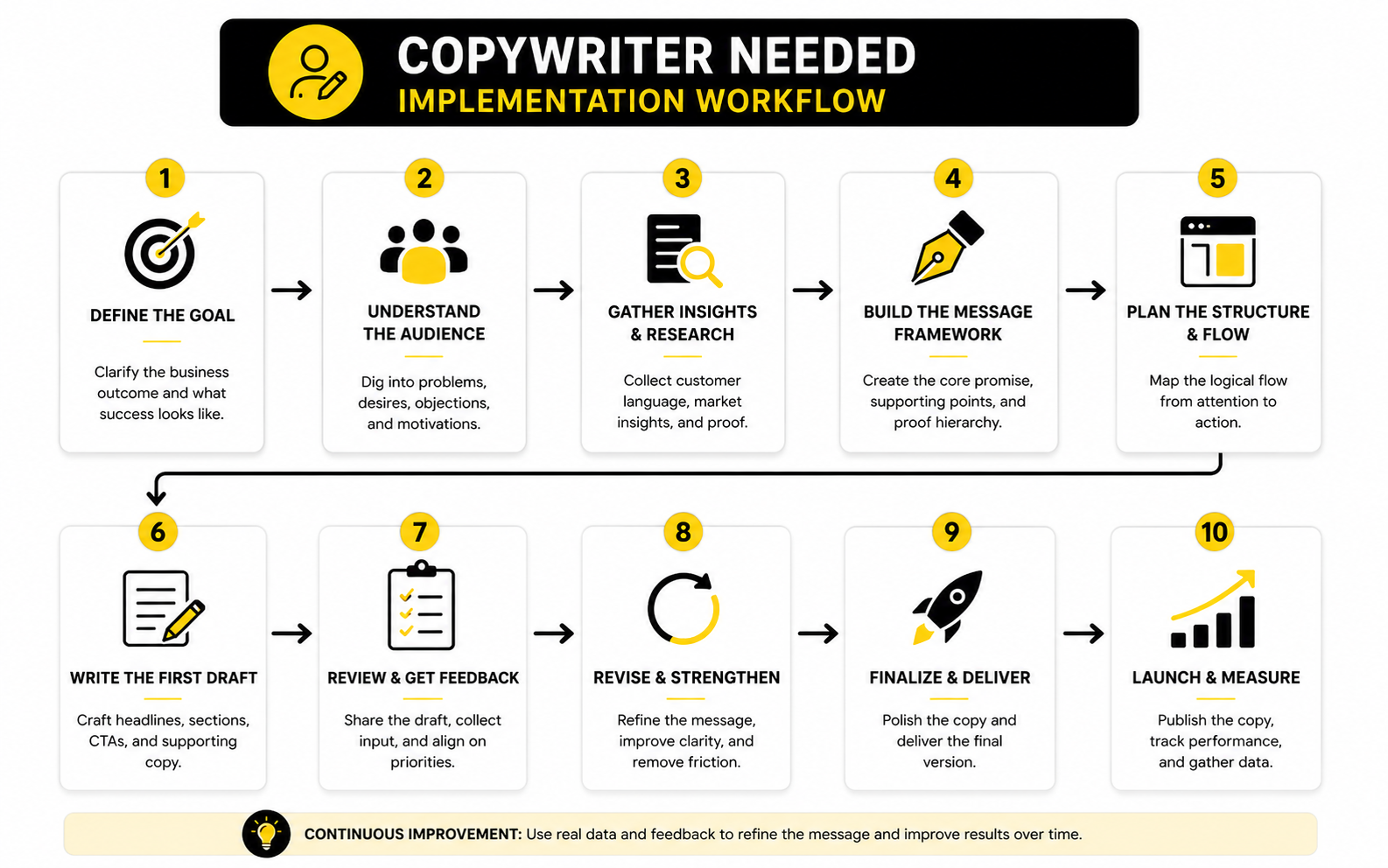
A practical evaluation process looks like this:
This process protects both sides. The business gets a clearer view of whether the copywriter can solve the real problem. The writer gets enough context to decide whether they can actually help instead of guessing from a vague brief.
Review Relevant Samples
A portfolio is useful, but only if you read it correctly. Do not just ask whether the writing sounds good. Ask whether the sample matches the type of project you need, the complexity of your offer, the level of buyer awareness, and the action the copy was supposed to drive.
If you need a sales page, blog samples are not enough. If you need SEO content, witty ad headlines are not enough. If you need B2B website messaging, consumer product copy may show skill, but it may not prove the writer can handle buying committees, technical details, and longer decision cycles.
Ask the writer to explain one or two samples in plain English. What was the business problem? What research did they use? What changed between the first draft and the final version? Strong copywriters can usually explain their thinking without hiding behind jargon.
Look For Research Ability
Copywriting starts before writing. The writer needs to understand the market, the buyer, the offer, and the objections before shaping the message. That does not mean every project needs a massive research phase, but it does mean the writer should have a clear way to gather insight.
Good research can come from customer interviews, sales call recordings, reviews, surveys, support tickets, competitor pages, analytics, search data, and internal team conversations. The point is not to collect information for the sake of it. The point is to find the language, friction, proof, and emotional context that should shape the copy.
This is where many cheap copy projects fail. The writer gets a short brief, fills in the gaps with assumptions, and produces something that sounds fine but misses the real buyer. If the copywriter needed for your project will touch revenue-critical pages or campaigns, research is not optional.
Test Their Understanding Of Buyer Intent
Buyer intent is the difference between writing what you want to say and writing what the reader is ready to hear. Someone landing on a pricing page has different questions than someone reading an educational article. Someone clicking a retargeting ad has different awareness than someone discovering the brand for the first time.
A strong copywriter should be able to explain the reader’s likely state of mind. They should know whether the copy needs to educate, reassure, compare, challenge, simplify, or convert. That judgment affects the headline, the proof, the structure, the length, the CTA, and even the tone.
This is one reason old web writing research still matters. Users often scan pages instead of reading every line, and concise, scannable writing has been shown to improve usability in Nielsen Norman Group’s long-running web usability work. For copywriting, the takeaway is simple: the message must be clear even when the reader is impatient.
Ask About Their Revision Process
Revisions are part of professional copywriting. The question is not whether revisions happen. The question is whether the revision process makes the copy stronger or turns into endless subjective tweaking.
A good copywriter will usually separate strategic feedback from taste-based feedback. Strategic feedback sounds like “this objection is missing,” “this proof point is outdated,” or “this CTA does not match our sales process.” Taste-based feedback sounds like “make it punchier” or “can this feel more premium” without explaining what that means.
You can avoid confusion by agreeing on the review process before the project starts. Decide who gives feedback, how many stakeholders are involved, what business goals the copy should serve, and how comments should be delivered. The fewer mystery opinions in the middle of the project, the better the final copy will be.
Use A Paid Test When The Stakes Are High
A paid test can be useful when the project is large, strategic, or ongoing. Keep it focused. Ask for a homepage hero section, one email, a landing page outline, a product page rewrite, or a messaging audit instead of asking for a full campaign.
The test should reveal thinking, not just effort. Give enough context for the writer to make smart choices, then ask them to explain what they changed and why. This gives you a much better signal than asking for unpaid speculative work, which often attracts rushed responses and creates a bad first impression with serious professionals.
Paying for the test also changes the dynamic. It shows that you respect the work and expect professional thinking. That matters because strong copywriters usually have options, and they are evaluating you too.
What To Prepare Before The Copywriter Starts
Once you choose the writer, the next risk is giving them weak inputs. Even a great copywriter cannot magically extract a sharp message from silence. They need access to the raw material that already exists inside the business.
Prepare the basics before kickoff. This includes your offer details, target customers, current website or funnel, analytics if relevant, customer reviews, testimonials, sales call notes, competitor links, brand guidelines, previous copy, and any known objections. If you use forms to collect leads, tools like Fillout can also help structure intake questions so future projects begin with cleaner information.
You do not need perfect documentation. You need useful truth. The copywriter needs to know what customers actually care about, what the business can genuinely prove, and where the current message is failing.
Build A Clear Creative Brief
A creative brief is not paperwork. It is the bridge between strategy and execution. It keeps the copywriter, founder, marketer, designer, and sales team from solving different problems at the same time.
A useful brief should include:
The brief does not need to be long. In fact, a tight brief is often better because it forces decisions. If the team cannot agree on the promise, audience, or CTA before writing starts, the copy draft will become the battlefield for unresolved strategy.
Give Access To Real Customer Language
Customer language is gold. Reviews, emails, sales calls, support tickets, community comments, and survey responses reveal how buyers describe the problem before your company puts polished language around it. That raw language often contains the phrases that make copy feel specific.
This does not mean copying customers word for word without judgment. It means paying attention to patterns. What frustrations repeat? What outcomes do people want most? What do they compare you against? What fears show up right before the buying decision?
A copywriter who understands customer language can make the message feel more direct without making it louder. That is the sweet spot. The reader feels understood, and the business sounds clearer.
Align Copy With The Tools That Will Deliver It
Copy does not live in a vacuum. A landing page has to work with the page builder. An email sequence has to fit the automation platform. A booking CTA has to connect to a calendar flow. A chatbot script has to match the way prospects ask questions.
If your business uses a broader CRM or funnel system, GoHighLevel can connect pages, forms, automations, booking, pipelines, and follow-up in one place. If your conversion path depends on conversations, ManyChat can be useful for social and messaging flows, while Chatbase can support AI chat experiences when the knowledge base and messaging are carefully prepared.
The practical point is simple: tell the copywriter where the copy will actually go. Character limits, page sections, form steps, automation delays, CRM fields, and design constraints all affect the final work. The earlier those constraints are known, the fewer painful rewrites you need later.
Statistics And Data That Actually Matter
Measurement is where copywriting stops being a taste debate. Without numbers, everyone argues from opinion. With the right numbers, you can see whether the copy is helping the reader move forward or creating friction in the path.
The mistake is treating every metric as equally important. Open rates, scroll depth, click-through rates, conversion rates, booked calls, sales-qualified leads, average order value, and revenue per visitor can all be useful, but they do not answer the same question. A copywriter needed for a serious growth project should know which metric matters for the asset they are writing.
Benchmarks are useful for context, not as a final scorecard. A landing page converting below an industry median may still be profitable if the order value is high. An email with a lower click rate may still win if it sends better-qualified buyers to the offer. Data matters most when it tells you what to improve next.
Start With The Business Outcome
The first measurement question is not “did the copy sound good?” It is “what business action was this copy supposed to create?” That action might be a purchase, a booked call, a trial signup, a demo request, an email opt-in, a reply, or a qualified sales conversation.
Once the outcome is clear, you can work backward. If the goal is booked calls, measure page visits, CTA clicks, form starts, form completions, booking completion rate, show-up rate, and close rate. If the goal is ecommerce sales, measure product page conversion, add-to-cart rate, checkout completion, revenue per visitor, and return customer behavior.
This is where copy gets more strategic. A weak headline may reduce scroll depth. A confusing offer section may reduce CTA clicks. A risky or unclear form may reduce completions. The number tells you where the reader hesitated, and the copywriter’s job is to understand why.
Use Benchmarks Without Becoming A Slave To Them
Benchmarks help you avoid flying blind. The Unbounce conversion benchmark report is useful because it is based on more than 41,000 landing pages, 464 million visitors, and 57 million conversions. That kind of dataset gives you a practical reference point when you are judging landing page performance.
But benchmarks can mislead you if you use them lazily. A lead magnet page, paid webinar page, SaaS demo page, ecommerce product page, and high-ticket consulting application page should not be judged by the same standard. The reader’s intent, price point, traffic source, brand trust, and offer complexity all change what a “good” conversion rate means.
So use benchmarks as a diagnostic tool, not a verdict. If your page is far below similar pages, investigate the message, offer, proof, traffic quality, and technical friction. If your page is above average but revenue is still weak, the issue may be lead quality, pricing, follow-up, or sales process rather than copy alone.
Track The Full Conversion Path
Copy rarely works in isolation. A visitor may see an ad, click to a landing page, read proof, submit a form, receive an email, book a call, and then speak with sales before buying. If you only measure the first click, you may reward copy that creates curiosity but does not create customers.
That is why the analytics system should follow the whole path. You want to see how attention turns into action, how action turns into qualified interest, and how qualified interest turns into revenue. This gives the copywriter better feedback than “we liked the tone” or “the page feels stronger.”
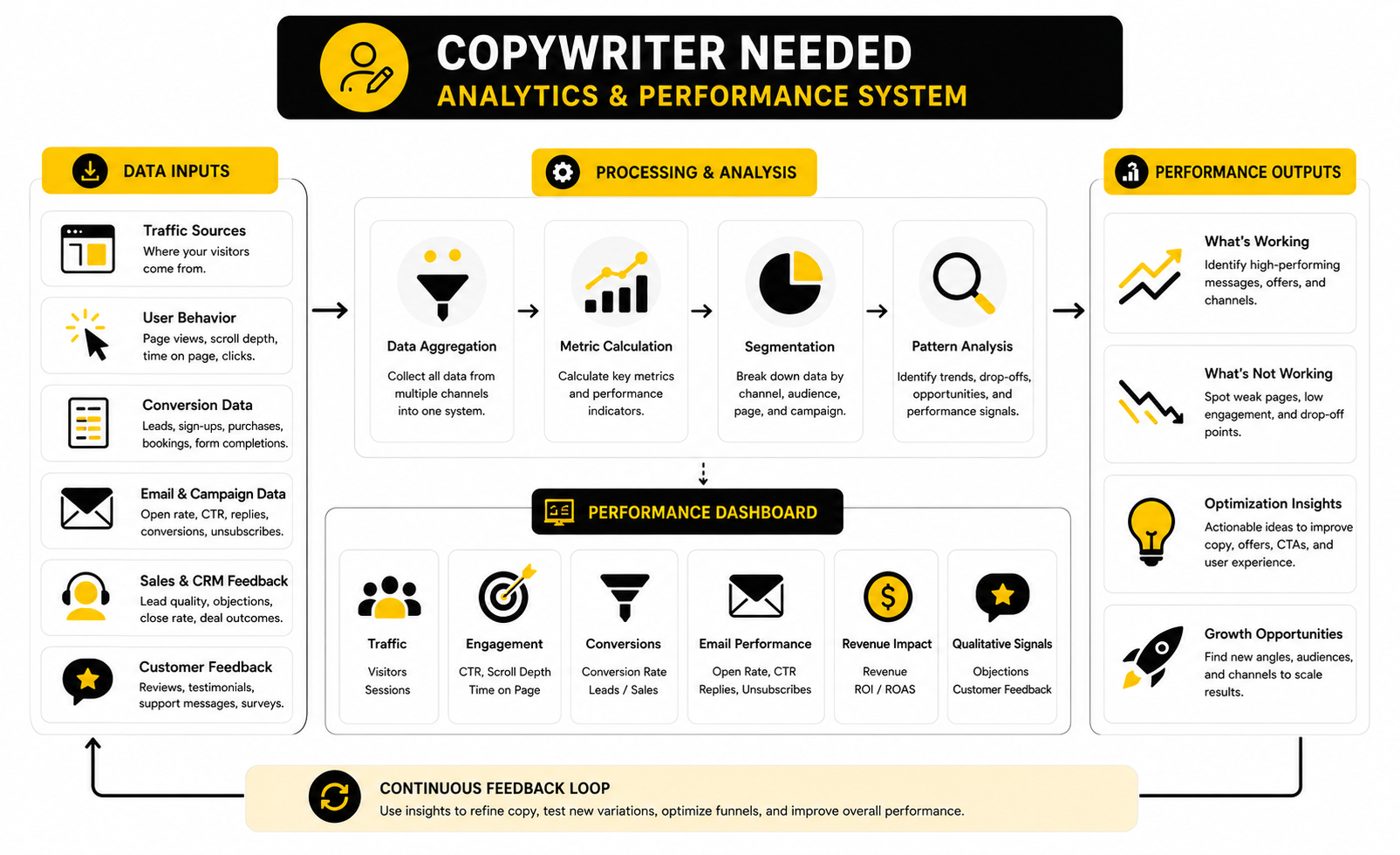
A simple measurement system can track:
This does not need to be overly complicated. The point is to connect copy decisions to buyer behavior. Once you can see where people drop off, you can make sharper changes instead of rewriting everything blindly.
Read Email Metrics In Context
Email copy has its own measurement trap. Many teams obsess over opens, but opens are not the whole story. Privacy changes, inbox behavior, subject-line curiosity, list quality, and sender reputation can all affect open data, so the more useful question is what people do after opening.
Click rate, reply rate, conversion rate, unsubscribe rate, spam complaints, and revenue per send usually tell you more. The 2025 MailerLite email benchmark data shows average open rates above 40% and average click rates near 2%, but those numbers vary heavily by industry and audience. That gap between opens and clicks is the point: attention does not automatically mean intent.
For copywriting, the action is clear. If opens are low, test the subject line, sender name, timing, and promise. If opens are fine but clicks are weak, improve the body copy, offer relevance, CTA clarity, and link placement. If clicks are strong but conversions are weak, the problem may be the landing page or the offer, not the email.
Measure Landing Pages By Friction, Not Just Conversion Rate
Landing page conversion rate matters, but it is not enough by itself. A page can have a low conversion rate because the copy is unclear, but it can also be low because the traffic is cold, the offer is expensive, the page loads slowly, or the ask is too large for the reader’s current awareness. You need to separate copy friction from offer friction and traffic friction.
The useful signals are often layered. Scroll depth can show whether people reach the proof section. CTA click rate can show whether the offer is compelling enough to act on. Form abandonment can show whether the next step feels too demanding. Heatmaps and session recordings can add context, but they should support judgment rather than replace it.
If the page gets traffic but few clicks, the problem may be the promise, relevance, or proof. If clicks are strong but form completions are low, the problem may be the form, the perceived risk, or the qualification process. If completions are strong but sales quality is poor, the copy may be attracting the wrong people.
Measure SEO Copy Beyond Rankings
SEO copy should not be judged only by keyword position. Rankings matter because they create visibility, but visibility is not the finish line. A page that ranks and attracts the wrong visitor is not doing its job.
The better SEO measurement stack includes impressions, clicks, click-through rate, engaged sessions, scroll depth, assisted conversions, internal link clicks, email signups, demo requests, and revenue contribution. The 2025 B2B content marketing benchmark research shows that B2B teams still rely heavily on content, but many continue struggling with resources, measurement, and proving impact. That makes copy quality and performance tracking more important, not less.
For a copywriter, this changes the assignment. The page should answer search intent, but it should also guide the right reader toward the next useful step. That could be a comparison page, product demo, checklist, email signup, case study, or consultation.
Watch For Quality Signals, Not Just Volume
More leads are not always better. If copy increases conversions by attracting people who cannot afford the offer, do not match the ideal customer, or waste the sales team’s time, the numbers are lying to you. This is why copy should be measured against quality as well as quantity.
For service businesses and B2B companies, quality signals include sales-qualified lead rate, booked-call show rate, deal size, sales cycle length, close rate, and reasons for disqualification. For ecommerce, quality may show up in average order value, refund rate, repeat purchase rate, support volume, and product fit. The better the copy qualifies the reader, the less cleanup the rest of the business has to do.
This is also where sales feedback becomes data. If prospects repeat the same misunderstanding, the copy is probably unclear. If they arrive already understanding the value, the copy is doing useful pre-selling. If they ask more carefully questions, the message is educating before the sales conversation starts.
Know When The Data Is Too Thin
Not every copy test produces a clean answer. If you only have a few hundred visitors, one or two conversions can swing the numbers dramatically. Acting too fast on weak data can make the copy worse because you start optimizing around noise.
This matters when testing headlines, CTAs, page sections, pricing language, or email sequences. A small list or low-traffic page may still provide directional insight, but you should be careful about declaring a winner. Look for patterns across behavior, feedback, and sales outcomes instead of pretending every small change is statistically meaningful.
When data is thin, qualitative evidence becomes more valuable. Sales call notes, customer interviews, form responses, chat transcripts, and support questions can show what the numbers cannot. A strong copywriter knows how to combine both: numbers to find the friction, customer language to understand it, and copy changes to reduce it.
Turn Measurement Into Better Copy Decisions
The point of analytics is action. If the data does not change what you do next, it is just dashboard decoration. Every metric should lead to a copywriting question.
Low CTA clicks ask whether the promise is strong enough. High bounce asks whether the page matches the traffic source. Weak form completion asks whether the next step feels too risky or too long. Poor lead quality asks whether the copy is qualifying the right people. Low email clicks ask whether the message creates enough reason to move from inbox to page.
This is why measurement should be part of the copywriting workflow, not an afterthought. Review the numbers before the project, define the target behavior during the brief, and analyze performance after launch. That creates a loop where each round of copy gets sharper instead of starting from scratch every time.
How To Brief, Manage, And Measure Copywriting Work
Hiring the copywriter is only one part of the job. The next part is building a working relationship that produces strong copy without chaos. This is where many businesses lose momentum because they treat copywriting like a handoff instead of a process.
A copywriter needed for growth work should not be left guessing. They need strategic inputs, fast access to decision-makers, clear feedback, and enough room to challenge weak assumptions. If the process is messy, the copy becomes messy too.
The goal is not to overmanage the writer. The goal is to create enough structure that the writer can make sharper decisions. That means clear ownership, clean inputs, realistic expectations, and a review process that does not turn every sentence into a committee debate.
Decide Whether You Need A Freelancer, Agency, Or In-House Copywriter
The right hiring model depends on the volume, complexity, and strategic importance of the work. A freelancer is often the best fit for focused projects like a landing page, email sequence, website rewrite, sales page, or messaging audit. You get specialist thinking without adding a permanent role.
An agency can make sense when copy is part of a larger execution system. If you also need design, funnel buildout, paid ads, automation, analytics, or creative testing, an agency may reduce coordination friction. The tradeoff is that you need to evaluate who is actually doing the copy, not just who sells the engagement.
An in-house copywriter is useful when your business needs constant messaging support across teams. This works best when the company already has enough demand for copy across product, marketing, sales, lifecycle, and brand. The risk is hiring one generalist and expecting them to perform like five specialists.
Understand The Strategic Tradeoff Between Speed And Depth
Fast copy can be useful. Sometimes you need an ad variation, a quick email, a revised CTA, or a cleaner product description. Not every task needs a deep research phase.
But strategic copy needs depth. A homepage rewrite, positioning project, launch sequence, high-ticket funnel, or sales enablement system requires more thinking because the copy has to carry more business weight. Rushing that work usually creates a polished draft built on shallow assumptions.
The practical rule is simple. Move fast on execution once the strategy is clear. Slow down when the audience, offer, promise, proof, or conversion path is still unclear. Speed is powerful only when it is pointed in the right direction.
Protect The Copywriter From Too Many Stakeholders
Copy dies when too many people edit it from different agendas. Sales wants more detail. The founder wants it bolder. Product wants technical precision. Brand wants it softer. Legal wants less risk. Everyone may have a valid perspective, but not everyone should rewrite the message.
You need one decision-maker and a small group of reviewers with defined roles. Sales can flag objections. Product can check accuracy. Legal can check risk. Brand can check consistency. But one person should decide which feedback serves the business goal.
This matters because copy is a sequence of decisions. When every line tries to satisfy every stakeholder equally, the result often becomes safe, vague, and forgettable. Strong copy needs alignment, not endless compromise.
Build A Messaging System, Not One-Off Assets
A copywriter can write a single landing page, but the bigger win is often the messaging system behind it. That system includes the main promise, audience segments, objections, proof points, differentiators, tone rules, CTAs, and approved language for recurring ideas. Once those pieces are clear, every future asset becomes easier.
This is where copy starts compounding. Your ads become more consistent with your landing pages. Your emails reinforce the same promise. Your sales team uses language that matches the website. Your onboarding and follow-up stop feeling disconnected from the first touchpoint.
A simple messaging system can include:
This does not need to become a massive brand bible. It just needs to be practical enough that future copy is faster, clearer, and more consistent. For teams managing multiple channels, a CRM and automation platform like GoHighLevel can help keep follow-up, pipelines, forms, and campaigns connected once the message is defined.
Use AI Without Outsourcing Judgment
AI has changed copywriting workflows, but it has not removed the need for copywriting judgment. It can help with idea generation, summarizing research, outlining, variation testing, repurposing, and first-pass drafting. It can also produce confident nonsense, generic claims, and copy that sounds acceptable until you compare it to real customer language.
This is why the copywriter’s role becomes more important, not less. The value shifts toward asking better questions, choosing sharper angles, editing ruthlessly, checking claims, protecting brand trust, and connecting copy to business strategy. The machine can produce options. The professional decides what is true, useful, differentiated, and worth publishing.
Marketing teams are clearly moving in this direction. The 2025 B2B content marketing research shows increased investment in AI for content optimization, performance, and creation, but it also shows continued focus on thought leadership, video, paid distribution, and human-led content strategy. That mix is the point: AI can support the system, but it should not become the strategy.
Avoid The Biggest Copywriting Risks
Bad copy is not always obvious. Sometimes it sounds professional while creating the wrong expectations. Sometimes it gets clicks from people who will never buy. Sometimes it makes bold claims that the business cannot prove. Sometimes it explains everything except why the reader should care.
The biggest risks usually fall into a few categories:
These problems are fixable, but only if you name them clearly. Do not tell the copywriter to “make it better.” Tell them what business friction you are seeing and what needs to change in the buyer journey.
Know When Copy Is Not The Real Problem
This is important. Sometimes you do not have a copy problem. You have an offer problem, pricing problem, traffic problem, product problem, trust problem, or sales problem.
Copy can make a strong offer clearer, more compelling, and easier to act on. It cannot permanently hide weak product-market fit. It cannot save a page if the traffic is completely wrong. It cannot make a confusing business model feel simple without the business making real strategic choices.
A strong copywriter should be honest about this. If the offer is unclear, they should help clarify it before writing. If proof is missing, they should ask for it. If the conversion path is broken, they should flag it. That is the difference between a vendor who fills a document and a professional who protects the outcome.
Scale Copy Without Losing Voice
As the business grows, copy production usually spreads across more people. Founders write LinkedIn posts. Marketers write emails. Sales writes follow-ups. Support writes help content. AI tools generate drafts. Agencies create campaigns. Without a shared system, the brand starts sounding like a group chat.
Scaling copy requires reusable standards. You need clear messaging, examples of strong copy, examples of what to avoid, approved claims, customer language, and a simple review process. The goal is not to make every sentence identical. The goal is to make every asset feel like it came from the same business.
Tools can help here, especially when content has to move across social, email, pages, and sales workflows. Buffer can help organize social publishing, Cal.com can simplify booking flows, and Copper can support relationship tracking for sales-led teams. The tool stack should support the message, not bury it under more process.
Create A Feedback Loop Between Copy, Sales, And Customers
The best copy gets better after launch. Real buyers will show you what they understand, what they ignore, what they question, and what makes them act. Your job is to capture that feedback and feed it back into the messaging.
Sales teams should share recurring objections and phrases prospects use. Support teams should share confusion points. Marketing should share performance data. Customers should be interviewed when possible. The copywriter can then turn those signals into stronger headlines, clearer sections, better proof, sharper emails, and more useful sales assets.
This feedback loop is where the phrase “copywriter needed” becomes something more mature. You are no longer hiring someone to write isolated assets. You are building a system that learns from the market and turns that learning into clearer communication.
Copywriter Needed: Final Checklist, FAQs, And Next Steps
By now, the decision should feel more concrete. You are not just hiring someone who can “write better.” You are hiring someone who can understand the buyer, sharpen the message, support the funnel, and help the business communicate with more precision.
The best copywriting engagements usually have a clear business goal, a defined audience, useful proof, strong collaboration, and a feedback loop after launch. The weakest ones start with a vague request, skip research, rush the brief, and judge the final copy by personal preference. That difference matters.
If you remember one thing, make it this: copywriting is not decoration. It is the language layer of your strategy. When the strategy is strong and the copywriter has the right inputs, the work can improve how people understand, trust, and act on your offer.
The Final Hiring Checklist
Use this checklist before you hire. It keeps the decision grounded and prevents you from choosing a copywriter based only on confidence, style, or price. You do not need every box perfectly checked, but the more clarity you have, the better the engagement will go.
This checklist is not meant to slow you down. It is meant to stop wasted motion. The clearer you are before the project begins, the more useful the copywriter can be.
When To Hire Now And When To Wait
Hire now if you already have traffic, leads, sales conversations, or a working offer that needs clearer communication. That is usually where copy has the most immediate leverage. The copywriter can improve how the market understands what is already valuable.
Wait if the business cannot yet explain the offer, audience, pricing, or delivery model. A copywriter can help clarify those things, but that becomes a positioning or strategy project, not a simple writing project. That is fine, but you need to price, scope, and manage it accordingly.
You should also wait if no one on the team is available to give input. Copywriting requires access to knowledge. If the writer cannot speak with the founder, marketer, sales team, or someone close to the customer, the project becomes guesswork.
What does a copywriter actually do?
A copywriter writes persuasive business content designed to move a reader toward a specific action. That action might be buying, booking a call, signing up, clicking, replying, requesting a demo, or understanding an offer more clearly. The work often includes research, messaging strategy, structure, writing, editing, and revision.
A good copywriter does more than make sentences sound polished. They study the audience, organize the argument, handle objections, and make the next step feel natural. That is why hiring a copywriter is usually a business decision, not just a content decision.
When is a copywriter needed?
A copywriter is needed when your message affects revenue, leads, trust, or buyer understanding. That includes websites, landing pages, ads, email sequences, product pages, sales pages, launch campaigns, and sales enablement assets. If people are seeing your offer but not taking the next step, copy may be part of the problem.
You may also need a copywriter when your business has changed but your messaging has not. Many companies grow into new offers, new audiences, or new pricing without updating the language around them. That creates confusion, and confusion kills momentum.
What kind of copywriter should I hire first?
Start with the bottleneck. If your website is unclear, hire a website or positioning copywriter. If paid traffic is not converting, hire a landing page or funnel copywriter. If leads go cold after opting in, hire an email copywriter.
Do not hire based on the broad label alone. Ask what kind of projects the writer has handled, what channels they understand, and how they think through buyer intent. The right specialist will usually outperform a generalist on a high-stakes project.
How much should I pay a copywriter?
Copywriter pricing depends on experience, scope, research depth, business complexity, and the value of the asset. A simple email rewrite is not the same as a full website messaging project or a high-ticket sales funnel. Pricing can also vary by whether you hire a freelancer, agency, or in-house writer.
The better question is what the copy is expected to influence. If the copy supports a major offer, paid traffic campaign, sales process, or recurring revenue channel, cheap work can become expensive quickly. Pay for the level of thinking the project requires.
Should I hire a freelance copywriter or an agency?
A freelance copywriter is usually best for focused writing, messaging, email, landing page, website, or sales asset projects. You get direct access to the person doing the thinking and writing. This can be fast, practical, and cost-effective when the scope is clear.
An agency may be better when copy is only one part of a larger system. If you also need design, funnel building, automation, paid ads, analytics, and project management, an agency can reduce coordination. The key is making sure the actual copywriter on the project has the experience you need.
How do I know if a copywriter is good?
A good copywriter asks sharp questions before writing. They want to understand the offer, audience, objections, proof, channel, goal, and measurement plan. They can also explain the thinking behind their samples instead of only showing finished work.
Look for clarity, strategic thinking, relevant experience, and process. A strong writer should be able to discuss why a headline works, why a section belongs where it does, and how the copy supports the buyer journey. If everything is based on vibes, keep looking.
Should I give a copywriter a test project?
A paid test project can be useful when the engagement is large or ongoing. Keep it focused so it reveals thinking without wasting time. A homepage hero section, email, page outline, messaging audit, or short landing page section can tell you a lot.
Avoid unpaid speculative work. Serious professionals may decline it, and rushed free samples rarely show the real quality of the process. If the project matters, pay for a small diagnostic or test and evaluate both the copy and the reasoning behind it.
What should I prepare before hiring a copywriter?
Prepare your offer details, target audience, current copy, customer reviews, testimonials, sales notes, objections, competitor examples, analytics, and any brand guidelines. The copywriter does not need perfect documentation, but they do need real inputs. Better inputs usually produce better copy.
You should also define the goal of the project. “Make the website better” is too vague. “Help qualified visitors understand the offer and book a sales call” gives the writer something useful to work toward.
Can AI replace a copywriter?
AI can help with drafts, outlines, variations, summaries, and repurposing. It can speed up parts of the workflow. But it does not automatically understand your customers, your positioning, your proof, your risk tolerance, or your business model.
The best use of AI is support, not blind delegation. A skilled copywriter can use AI to move faster while still applying judgment, research, strategy, and editing. Without that judgment, AI-generated copy often becomes generic, overconfident, or disconnected from the real buyer.
How long does a copywriting project take?
The timeline depends on the scope. A single email or ad set may be quick, while a website, sales page, launch sequence, or messaging strategy project needs more time for discovery, drafting, feedback, and revisions. The bigger the business impact, the more important the thinking phase becomes.
Do not judge the project only by writing time. Research, interviews, structure, proof gathering, and review are part of the work. Rushing those steps can make the final copy weaker even if the words arrive faster.
How do I measure copywriting success?
Measure success based on the job the copy was hired to do. For a landing page, look at CTA clicks, form completions, conversion rate, lead quality, and revenue per visitor. For email, look at clicks, replies, conversions, unsubscribes, and revenue per send.
For website or positioning copy, the signals may be more mixed. You may look at demo quality, sales feedback, time on key pages, internal adoption, buyer understanding, and conversion improvements. The important thing is to define success before the copy is written.
What are the red flags when hiring a copywriter?
Be careful if a copywriter promises results without understanding your offer, audience, traffic, proof, or sales process. Also watch for writers who cannot explain their work, avoid research, rely only on templates, or treat every project the same. Copywriting should be specific to the business and buyer.
Another red flag is resistance to feedback or complete dependence on feedback. You want someone who can listen, challenge weak assumptions, and make informed decisions. The best copywriters are collaborative, but they are not passive order-takers.
What if I need copy for a full funnel?
A full funnel needs message consistency from the first touch to the final conversion. That may include ads, landing pages, forms, booking flows, emails, checkout pages, sales follow-ups, and retargeting messages. A copywriter can help build the narrative so each step feels connected.
This is where tools can support execution. ClickFunnels, Systeme.io, and GoHighLevel can help deploy pages, automations, and follow-up once the message is clear. Just remember: the funnel software is the container, not the strategy.
What should a copywriter ask me before starting?
They should ask about the business goal, audience, offer, competitors, customer objections, proof, traffic source, funnel stage, brand voice, and approval process. They should also ask what has already been tried and what did or did not work. Those questions show that they are thinking beyond the document.
If they are writing for a revenue-critical asset, they should also ask how performance will be measured. The copy cannot be judged properly without knowing the desired action. Clear goals create better writing and better feedback.
Build a stronger local presence with BAAM AI
Turn your website, Google profile, social channels, and AI visibility into one growth engine
Most businesses do not need more random marketing activity. They need a consistent presence system that helps the right people find them, trust them, and take action. BAAM AI brings strategy, local SEO, website updates, Google Maps visibility, social content, AI-search readiness, media production, and reporting into one practical monthly engine.
If you want your marketing to keep working after the campaign ends, start with a free BAAM AI presence audit. See how your business shows up today and where the fastest visibility wins are at BAAM AI.