
BAAM AI Blog
Copy Writing Agency: How To Choose, Brief, And Scale The Right Partner
A copy writing agency is not just a vendor that “writes words.” At its best, it is a revenue partner that turns positioning, offers, customer research, and conversion strategy into messages people actually act on...
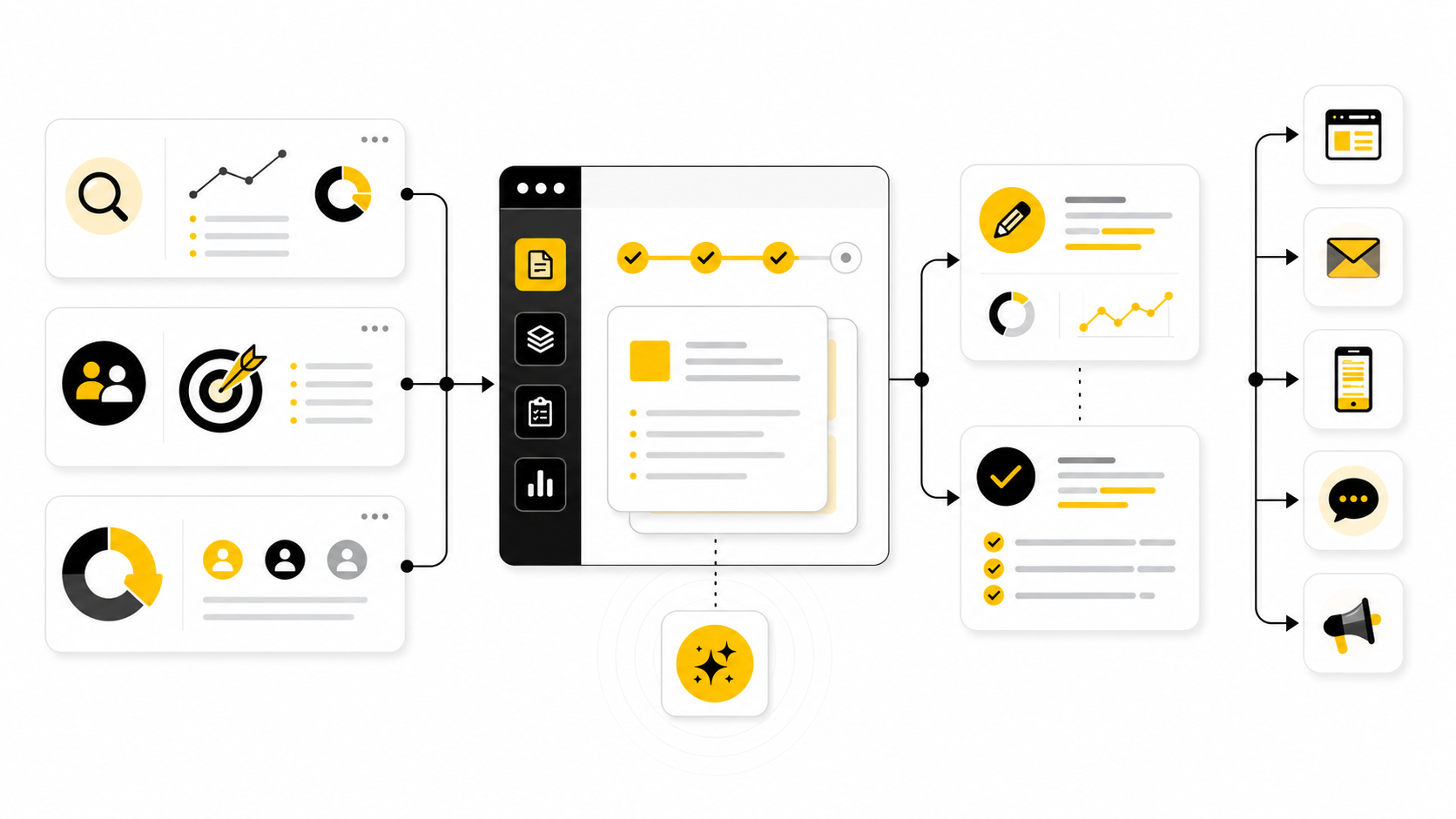
A copy writing agency is not just a vendor that “writes words.” At its best, it is a revenue partner that turns positioning, offers, customer research, and conversion strategy into messages people actually act on. That matters because most businesses do not have a copy problem in isolation. They have a clarity problem, a trust problem, a funnel problem, or a “we sound like everyone else” problem.
The market has made this harder, not easier. Buyers compare more options, consume more content before speaking to sales, and expect messaging to feel specific to their situation. The 2025 B2B Buyer Behavior Report shows how deeply research-driven modern buying has become, while the Content Marketing Institute’s 2025 B2B research points to rising investment in video, thought leadership, AI-supported optimization, and content performance. In plain English: better copy now has to work across more channels, more formats, and more buyer moments.
That is why hiring a copy writing agency should never start with “we need blog posts” or “we need better emails.” It should start with a sharper question: what business outcome should the writing support? More qualified leads, stronger landing page conversion, clearer sales enablement, better retention emails, higher ad relevance, or a full messaging system that makes every campaign easier to launch.
this guide breaks the decision down practically. You will see what a copy writing agency actually does, when it makes sense to hire one, what separates strong agencies from average ones, how to brief them properly, and how to measure whether the partnership is producing real business value. No fluff. No generic “content is king” talk. Just the framework you need before you spend money.
Why A Copy Writing Agency Matters Now
A good copy writing agency helps a business say the right thing to the right person at the right point in the buying journey. That sounds simple until you try to do it consistently across ads, landing pages, emails, website pages, sales decks, product pages, onboarding flows, and retention campaigns. Each asset has a different job, but the message still needs to feel like it comes from one clear brand.
This is where many teams struggle. Founders often know the product too well, so they explain features before the customer feels the pain. Internal marketers are usually buried in campaigns, reporting, meetings, and urgent requests. Freelancers can be excellent, but one person may not cover research, strategy, conversion copy, SEO, email, funnel messaging, and editing at the same level.
A copy writing agency gives you structure. The stronger ones bring research habits, tested messaging frameworks, editorial control, and performance thinking. Instead of producing random assets, they build a system where the homepage, nurture emails, sales pages, lead magnets, and ads support the same commercial argument.
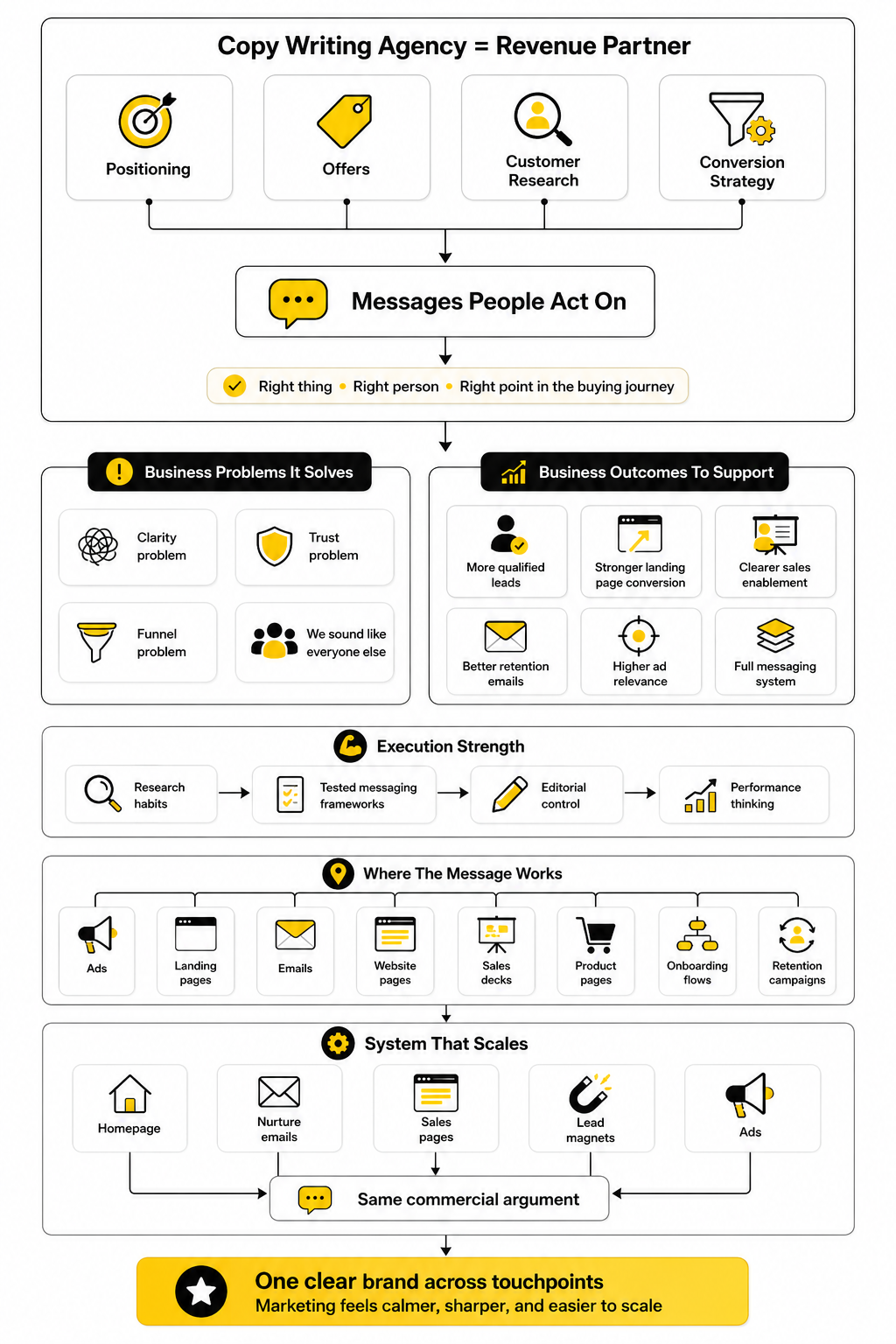
The value is not only in writing more. Often, the bigger win is cutting noise. Clear copy removes weak claims, vague benefits, bloated paragraphs, and clever lines that do not help the buyer decide. That is why the right agency can make marketing feel calmer, sharper, and easier to scale.
The Copy Writing Agency Framework
A copy writing agency should not begin with copy. That sounds backwards, but it is the difference between polished words and profitable messaging. The real work starts with understanding the market, the buyer, the offer, and the decision path.
Think of the framework as four connected layers: research, strategy, assets, and optimization. Research finds what the audience actually cares about. Strategy decides what needs to be said, in what order, and for what commercial goal. Assets turn that strategy into landing pages, emails, ads, scripts, product pages, and sales material. Optimization then checks whether the writing is doing its job.
This matters because buyers rarely move in a straight line. Recent Gartner research found that 61% of B2B buyers prefer a rep-free buying experience, but that does not mean they want less information. It means they want clearer information before they speak to sales. A strong copy writing agency builds copy for that reality.
Research Comes Before Messaging
Good copy starts with evidence, not opinions. The agency should look at customer interviews, reviews, sales calls, support tickets, competitor pages, product documentation, analytics, and actual conversion data. Without that, the copy usually becomes a prettier version of the company’s internal assumptions.
This is where weak agencies expose themselves quickly. They ask for a short brief, write in a confident tone, and deliver something that sounds acceptable on the surface. But the message does not land because it was never built from the buyer’s language, objections, urgency, or decision criteria.
A serious copy writing agency will try to understand what customers already believe before trying to persuade them. They will look for repeated phrases, emotional triggers, buying anxieties, comparison points, and proof gaps. That research becomes the raw material for stronger headlines, sharper value propositions, better email angles, and more credible calls to action.
Strategy Connects Copy To Revenue
Copy strategy is the bridge between business goals and written assets. It defines who the copy is for, what action it should support, what belief must change, and what proof is needed to make the message credible. Without strategy, you get isolated deliverables that may sound good but do not build momentum.
For example, a landing page is not just a page. It has to make a promise, qualify the right visitor, handle objections, explain the offer, reduce perceived risk, and move the person toward the next step. An email sequence is not just a batch of messages. It has to create context, sustain attention, answer friction, and make the offer feel timely.
This is why the best copy writing agency relationships feel strategic from the beginning. The agency is not simply waiting for tasks. It is helping decide which copy assets matter most, which messages need testing, and where the funnel is leaking attention or trust.
Assets Must Match The Buyer Journey
Different copy assets should do different jobs. Top-of-funnel content earns attention and frames the problem. Middle-of-funnel copy builds trust, explains options, and helps the buyer compare. Bottom-of-funnel copy makes the offer clear, reduces risk, and pushes toward action.
This is one reason a single “brand voice” document is not enough. A homepage, sales page, paid ad, case study, abandoned cart email, webinar invite, and onboarding sequence all need different levels of urgency and detail. The voice should stay consistent, but the structure should change based on the buyer’s stage.
Modern marketing also makes this more complex. The G2 2025 Buyer Behavior Report shows how much buyers rely on independent research, peer input, software marketplaces, and online validation before making decisions. So the agency’s job is not only to write persuasive copy. It is to make every key touchpoint easier to understand and easier to trust.
Optimization Turns Copy Into A Learning System
The first version of copy is rarely the final version. Smart teams treat copy as a performance asset, not a one-time creative file. They watch how people respond, where attention drops, what questions keep coming up, and which messages move the right metrics.
Optimization can include A/B testing headlines, rewriting calls to action, simplifying page structure, tightening email sequences, improving offer clarity, or changing proof placement. It can also mean removing copy that creates friction. More words are not always better. Sometimes conversion improves because the page stops making the buyer work so hard.
A copy writing agency that understands optimization will care about inputs and outcomes. It will not hide behind subjective taste. It will ask what changed after the copy went live, what the data suggests, and what should be improved next.
Core Services A Copy Writing Agency Can Handle
Most copy writing agency services fall into a few practical categories. Some agencies specialize in one channel, while others cover the full customer journey. Neither model is automatically better. The right choice depends on the problem you need solved.
The mistake is hiring a generalist agency when you need deep conversion work, or hiring a niche conversion agency when you really need a complete messaging refresh. Before you compare proposals, decide whether your biggest gap is strategy, execution, scale, or performance improvement. That one decision will save you a lot of wasted calls.
A good agency will also be honest about what it does not do. That matters. Copy touches SEO, design, paid media, CRM, automation, sales enablement, and brand strategy, but not every agency can handle all of those areas well.
Website And Landing Page Copy
Website copy explains who you help, what you offer, why it matters, and what the visitor should do next. It has to create clarity fast because people do not read websites like books. They scan, compare, doubt, and decide whether to keep going.
Landing page copy is even more focused. It usually supports one campaign, one audience, one offer, and one conversion goal. That could be booking a demo, starting a trial, downloading a lead magnet, joining a webinar, or buying a product.
A skilled copy writing agency will not only write headings and body copy. It will think about page hierarchy, objection handling, proof placement, call-to-action timing, and message match between the ad, email, or search result that brought the visitor there. That is where copy starts to influence conversion instead of simply filling space.
Email And Lifecycle Copy
Email copy is still one of the most important places where words directly affect revenue. Welcome sequences, nurture emails, launch campaigns, cart recovery, reactivation flows, onboarding messages, and retention emails all shape how people move through the relationship. Done well, email feels helpful and timely. Done badly, it feels like pressure.
Lifecycle copy is especially valuable because it meets people after the first click. A buyer may need education before purchase, reassurance after purchase, guidance during onboarding, and reminders before renewal. Each stage needs a different message.
A copy writing agency can help map these moments and turn them into sequences that feel intentional. The goal is not to “send more email.” The goal is to send the right message when it can actually change behavior.
Ad Copy And Campaign Messaging
Ad copy has to earn attention quickly, but it also has to attract the right people. A clever ad that brings low-quality clicks is not a win. A clear ad that pre-qualifies the audience and prepares them for the next step is usually far more useful.
Campaign messaging includes the core angle, promise, hook, offer framing, objections, and proof points used across ads, landing pages, emails, and follow-up assets. This is where consistency matters. If the ad promises one thing and the landing page talks about something else, the buyer feels friction immediately.
A copy writing agency can support paid campaigns by creating multiple angles for testing. One angle may focus on pain, another on speed, another on risk reduction, and another on a desired outcome. The point is not to guess the perfect line. The point is to build a controlled set of messages that can be tested and improved.
How Professional Implementation Actually Works
Once the strategy is clear, implementation becomes the real test. This is where a copy writing agency proves whether it can move from smart thinking to finished assets without creating chaos for your team. Good implementation feels structured, but not stiff. Everyone knows what is happening, why it matters, and what needs to be reviewed.
The process should reduce uncertainty. You should not be wondering what the agency is doing for three weeks and then receive a surprise draft that misses the mark. A professional agency gives you a clear workflow, defined checkpoints, and enough collaboration to catch problems early.
This is especially important now because copy often touches multiple tools and teams. A landing page might involve paid media, design, analytics, legal review, CRM tracking, and sales follow-up. A campaign sequence might need email automation, segmentation, calendar timing, and a clear handoff into your pipeline. If the process is sloppy, even good copy can get stuck before it ever reaches the market.
The Discovery Phase
Discovery is where the agency collects the context it needs to write with precision. This usually includes your offer, positioning, audience segments, competitors, customer objections, proof points, analytics, previous campaigns, and sales feedback. The goal is not to create paperwork. The goal is to prevent expensive guessing.
A strong copy writing agency will ask sharper questions than “what tone do you want?” It will want to know what buyers misunderstand, what slows deals down, which claims need proof, which competitors appear in sales conversations, and where current messaging underperforms. Those answers shape the copy far more than a generic brand adjective like friendly, bold, or premium.
Discovery should also clarify what success means. If the project is a homepage rewrite, success may involve clearer positioning, more qualified demo requests, or better alignment between marketing and sales. If the project is an email sequence, success may involve more replies, higher activation, stronger retention, or better movement into the next step.
The Messaging Strategy Phase
After discovery, the agency should turn research into a practical messaging strategy. This is the point where the scattered inputs become a clear argument. The agency decides what the buyer needs to believe, what order the message should follow, and which proof points should support each claim.
This phase may include positioning statements, value propositions, audience pain points, message pillars, objections, offer framing, and calls to action. It should feel usable, not academic. If the messaging strategy cannot guide a landing page, email sequence, sales deck, or campaign brief, it is probably too vague.
This is also where AI can help, but it should not replace judgment. Marketing teams are already using AI heavily for writing and testing, with one recent marketer survey showing copywriting as the most common AI use case at 68% of respondents. That does not make human strategy less important. It makes the agency’s editorial judgment, customer understanding, and ability to separate useful patterns from generic output even more valuable.
The Drafting And Review Phase
Drafting should happen after the agency has enough strategic direction to make confident decisions. The first draft is not just a writing sample. It is the first complete attempt to turn research and strategy into a working asset.
The review process should be focused. Instead of vague feedback like “make it punchier,” your team should respond to specific questions: is the offer accurate, is the audience right, is the proof strong enough, are there compliance concerns, and does the message match how customers actually buy? That keeps revisions useful instead of subjective.
A professional copy writing agency will usually explain the thinking behind major decisions. It may point out why a headline leads with a pain point, why a section handles objections early, or why a call to action appears before all details are explained. This matters because effective copy is often simpler than internal teams expect, and simplicity can feel uncomfortable until the reasoning is clear.
The Execution Workflow
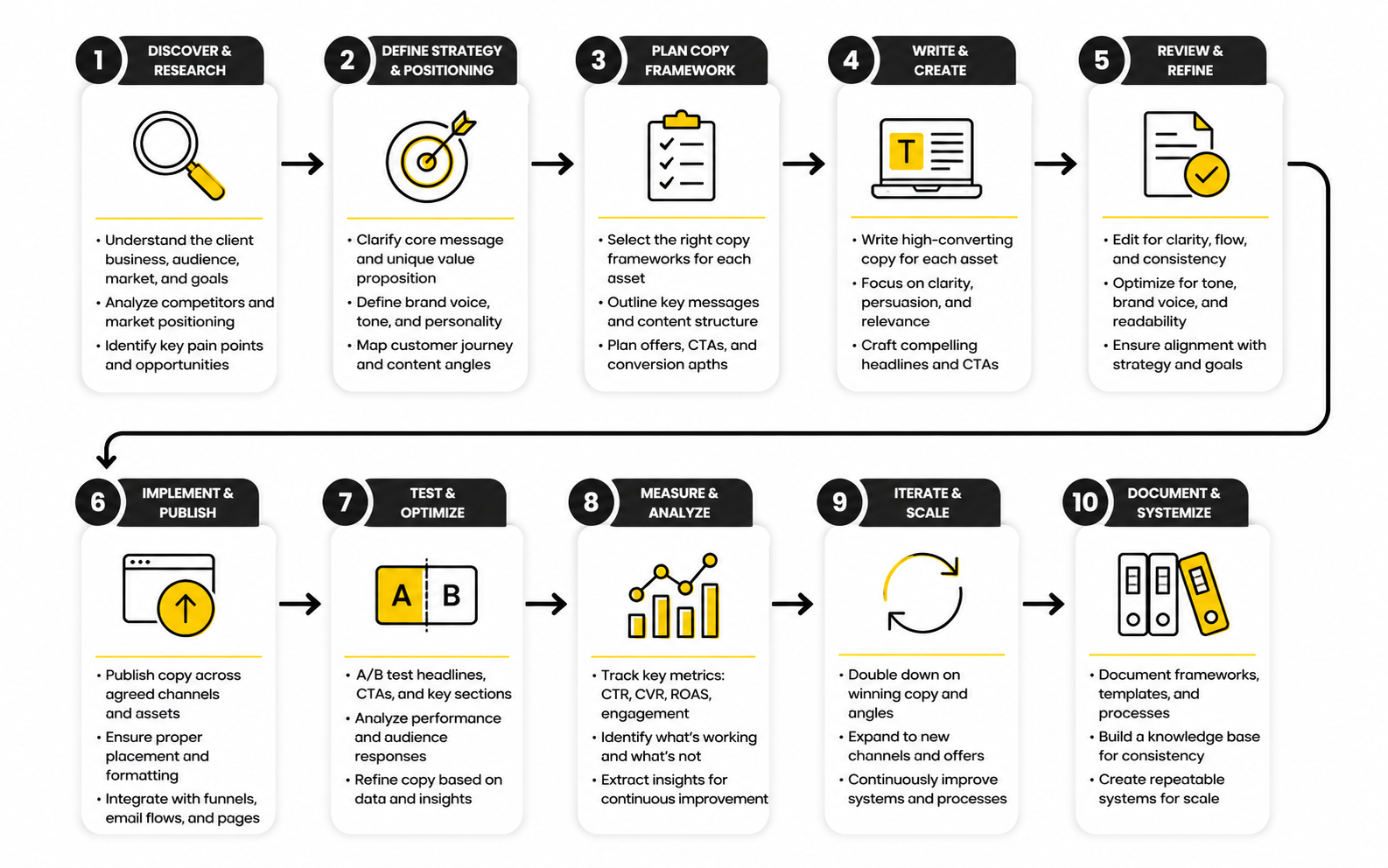
A clean workflow turns copy from a creative mystery into a manageable production system. You do not need a complicated process, but you do need a visible one. The best workflows make ownership, deadlines, and review points obvious.
A practical implementation workflow usually looks like this:
This workflow is simple on purpose. Overcomplicated agency processes slow everything down and make teams avoid the work. The point is to create enough structure that copy moves forward without losing quality.
The Tool Stack And Handoff
Copy does not live in a document forever. At some point, it has to move into a page builder, email platform, funnel system, CRM, chatbot, ad account, or sales enablement tool. That handoff is where many projects quietly break.
For landing pages and funnels, tools like ClickFunnels, Systeme.io, GoHighLevel, and Replo can help teams get copy into live campaigns faster. The tool is not the strategy, though. A weak offer with confusing copy will still underperform inside a beautiful funnel builder.
For email and lifecycle messaging, platforms like Brevo, Moosend, and ManyChat can support segmentation, follow-up, and automation. A copy writing agency does not always need to manage these tools directly, but it should understand how the copy will behave once it is inside them. Subject lines, preview text, button copy, personalization, timing, and branching logic all affect how the final message performs.
For scheduling, forms, research, and sales flow, tools like Cal.com, Fillout, Chatbase, and Copper can make the buyer journey smoother. Again, the agency’s job is not to throw software at the problem. It is to make sure every step says the right thing and moves the person forward.
Quality Control Before Launch
Before anything goes live, the agency should run a quality check that goes beyond spelling and grammar. The copy needs to be checked for accuracy, claims, links, tracking assumptions, calls to action, offer consistency, and basic readability. Small errors can create big trust problems.
This is especially true for performance copy. If an ad promises one outcome, the landing page must continue that same promise. If an email points to a booking page, the booking page needs to match the same offer and expectation. If the copy mentions a guarantee, discount, feature, or deadline, that detail must be correct everywhere.
A copy writing agency that cares about implementation will treat launch as part of the work, not someone else’s problem. It will help protect the message from being diluted during design, development, automation, and internal review. That is how the finished campaign stays sharp from first click to final conversion.
Statistics And Data That Actually Matter
Measurement is where a copy writing agency stops being judged by taste and starts being judged by business impact. The point is not to collect every possible number. The point is to understand whether the copy is helping the right people move forward with less friction.
Good copy measurement starts with context. A low conversion rate may be a copy problem, but it may also be a targeting problem, an offer problem, a pricing problem, a traffic-quality problem, or a technical problem. A high click-through rate may look good, but it can still be useless if those clicks come from the wrong people.
This is why benchmarks are useful, but dangerous when treated like universal truth. A SaaS demo page, ecommerce product page, coaching funnel, legal landing page, and B2B service website should not be measured with the same expectations. The better question is not “are we above average?” The better question is “what does this number reveal about buyer intent, message clarity, and the next improvement?”
The Core Metrics To Track
A copy writing agency should help you define the few metrics that actually connect to the asset’s job. A homepage should not be judged the same way as a cold email sequence. A nurture email should not be judged the same way as a checkout page. Every asset needs a clear role before the data can mean anything.
For website and landing page copy, the core metrics usually include:
For email and lifecycle copy, the core metrics usually include:
The key is to connect these numbers in sequence. If people open but do not click, the email body or offer may be weak. If people click but do not convert, the landing page may not match the promise. If people convert but are not qualified, the copy may be attracting curiosity instead of serious intent.
Benchmarks Need Interpretation
Benchmarks help you spot whether performance is wildly off, but they should not become the strategy. Unbounce’s conversion benchmark data is useful because it is based on 57 million-plus conversions and 41,000-plus landing pages, but even that kind of dataset does not replace your own funnel data. Industry, traffic source, offer type, brand awareness, and price all change what “good” looks like.
For example, Unbounce’s recent landing page benchmark commentary placed the broad average landing page conversion rate around 6.6% across industries as of Q4 2024. That number can help you sanity-check performance, but it should not become a lazy target. A cold-traffic B2B demo page may perform below that and still be profitable. A warm-audience lead magnet may need to beat that easily.
Search Engine Land’s summary of Unbounce’s benchmark data also highlighted how wide the gap can be between sectors, with industry medians ranging from 3.8% for SaaS to 12.3% for legal. That range is the important lesson. You do not optimize copy against a generic average. You optimize against the economics and intent level of your specific funnel.
Build A Copy Performance Dashboard
A useful dashboard should show the relationship between message, behavior, and revenue. It should not be a wall of numbers that nobody uses. The best dashboard helps your team decide what to fix next.
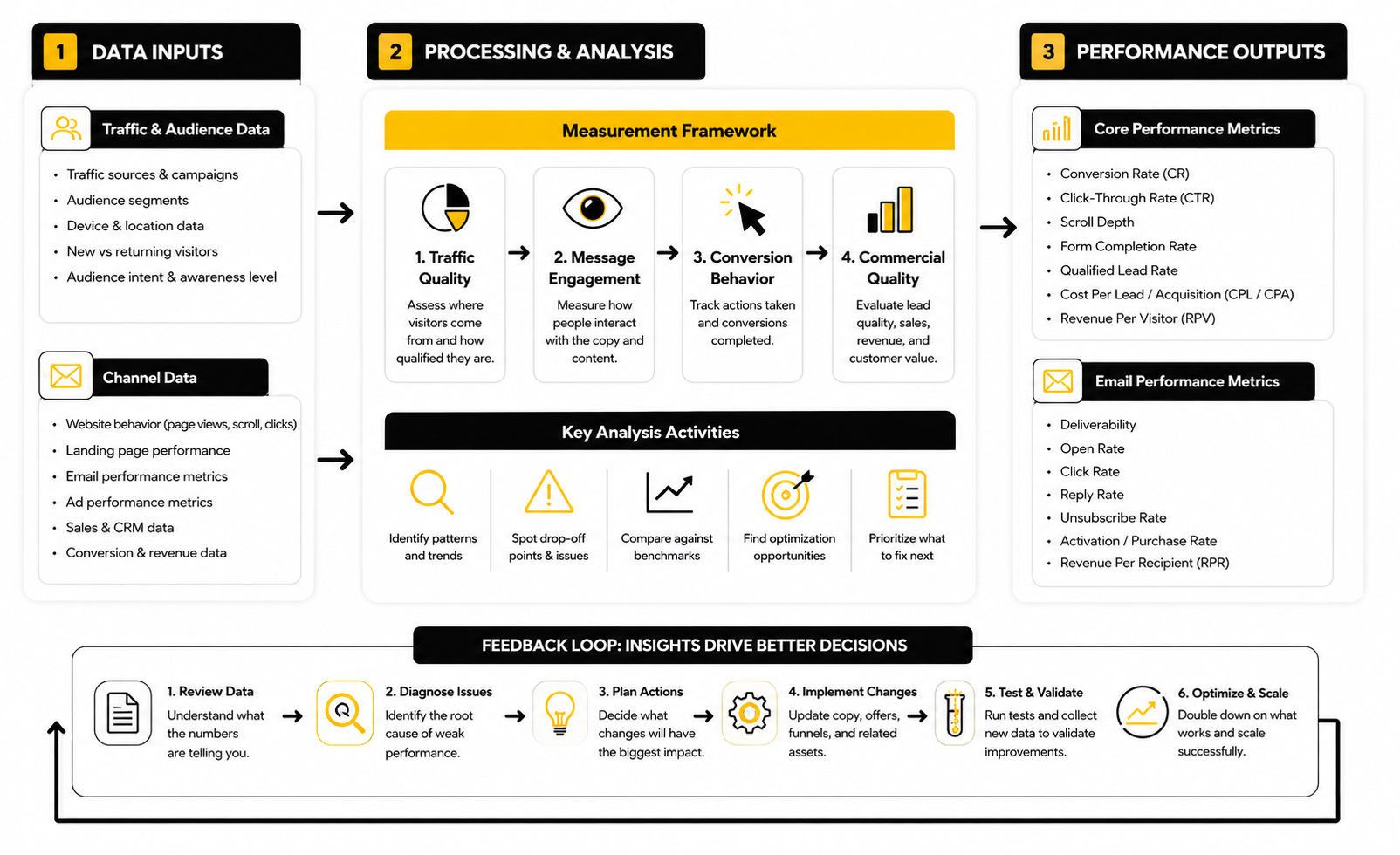
A practical copy performance dashboard can be built around four layers:
This structure prevents bad decisions. If conversion rate drops, you do not instantly blame the copy. You first check whether traffic quality changed, whether the offer changed, whether the page still matches the campaign promise, and whether the right audience is arriving.
A copy writing agency should be comfortable working inside this kind of measurement system. It does not need to own every analytics tool, but it should understand the story the numbers are telling. Otherwise, revisions become guesswork dressed up as optimization.
What Email Numbers Really Tell You
Email metrics are easy to misread. Open rate can be affected by privacy changes, inbox behavior, sender reputation, list quality, and subject lines. It is useful, but it is not enough. Clicks, replies, conversions, and revenue tell you far more about whether the message created action.
The 2025 email benchmark report from Efficy makes this point clearly by noting that open and click rates are common, but they are not the main KPIs for campaign success. That is exactly how a copy writing agency should think. A subject line that gets attention but leads to weak conversions is not a win. It is a broken promise.
Email measurement should also include deliverability. A 2026 Sinch Mailgun report, based on more than 400 billion emails sent in 2025, found that fewer than half of organizations can reliably track email ROI. That is a massive blind spot. If you cannot connect email copy to revenue, you cannot confidently improve it.
What Website Behavior Reveals
Website analytics show where the copy creates momentum and where it loses people. High bounce rates on a landing page may suggest weak message match, slow load speed, poor targeting, or a confusing opening section. Low scroll depth may suggest the page fails to earn attention early. Strong button clicks but weak form completions may point to friction in the offer, form, or perceived risk.
This is why a copy writing agency should look beyond the words on the page. Copy interacts with layout, page speed, design hierarchy, form length, pricing visibility, and proof placement. Sometimes the headline is fine, but the proof appears too late. Sometimes the call to action is clear, but the visitor does not yet trust the claim.
Buyer behavior makes this even more important. Gartner’s 2026 sales research found that 67% of B2B buyers prefer a rep-free experience, which means your copy often has to answer questions before a seller ever gets involved. If the page does not explain the value clearly, buyers may disappear without telling you what was missing.
How To Read Performance Signals
Copy performance signals usually fall into three categories: attention, trust, and action. Attention tells you whether people noticed the message. Trust tells you whether they believed enough to keep going. Action tells you whether they were ready to take the next step.
A copy writing agency should use those categories to diagnose problems. If attention is weak, you may need a better hook, clearer relevance, stronger message match, or a sharper opening claim. If trust is weak, you may need better proof, clearer specificity, stronger testimonials, more transparent pricing, or better objection handling. If action is weak, you may need a more compelling offer, lower friction, clearer urgency, or a better call to action.
This keeps optimization practical. You are not rewriting everything because one number moved. You are identifying the part of the decision path where the copy is failing and improving that specific section.
The Numbers Should Drive Better Decisions
Data only matters when it changes what you do next. If a landing page gets traffic but few qualified leads, the next action may be to tighten the audience language, qualify harder in the copy, or adjust the offer. If an email gets clicks but weak purchases, the next action may be to improve the sales page, add proof, or reduce friction at checkout.
If a page converts well but customers churn quickly, the copy may be overselling the outcome or attracting the wrong expectations. That is a serious issue. Strong copy should persuade, but it should not create a gap between what people expect and what the product or service can actually deliver.
The best measurement system gives your copy writing agency a feedback loop. Research informs copy, copy launches into the market, data reveals behavior, and the next version gets sharper. That cycle is where copy becomes a growth asset instead of a one-time deliverable.
How To Choose The Right Copy Writing Agency
Choosing a copy writing agency is not about finding the agency with the prettiest website or the most confident sales call. It is about finding the team that can understand your market, translate that understanding into clear messaging, and work inside your commercial reality. That means you need to evaluate strategy, process, specialization, collaboration, and measurement.
The hard part is that many agencies sound similar from the outside. They all talk about conversions, storytelling, brand voice, customer psychology, and growth. Those words are easy to say. The difference shows up when you ask how they research, how they make decisions, how they handle feedback, and how they prove the copy is working.
You do not need to turn the selection process into a six-month procurement project. You do need enough due diligence to avoid hiring a team that writes nicely but cannot think commercially. The goal is to find a partner that makes your message sharper, your campaigns easier to launch, and your buyer journey easier to understand.
Specialization Versus Generalist Support
The first strategic tradeoff is specialization. A specialized copy writing agency may focus on SaaS, ecommerce, coaches, agencies, local services, B2B technology, direct response funnels, or conversion-focused landing pages. That focus can be valuable because the agency already understands common objections, sales cycles, offer structures, and buyer expectations in that category.
A generalist agency can still be useful when your needs are broad. If you need website copy, email, social content, SEO articles, sales collateral, and internal messaging support, a wider team may be easier to manage. The risk is that generalists sometimes produce acceptable copy across many formats without going deep enough on the assets that actually drive revenue.
The smart move is to match the agency type to the business problem. If your funnel is leaking paid traffic, hire for conversion and offer clarity. If your sales team keeps explaining the same basic positioning problem, hire for messaging strategy. If your team is drowning in content production, hire for process, editorial systems, and consistent execution.
Portfolio Quality Is Not Enough
A portfolio can show whether the agency writes cleanly, but it rarely tells the full story. You need to understand the constraint behind the work. A beautiful landing page may have been driven by a strong designer, a famous brand, a large ad budget, or an internal strategy team the agency did not control.
When reviewing portfolio samples, look for the thinking behind the copy. Does the page make a clear promise? Does it speak to a specific buyer? Does it handle objections? Does it use proof naturally? Does it make the next step obvious without sounding desperate?
Ask the agency to walk you through one or two projects in detail. You are listening for decision-making, not a highlight reel. A strong agency should be able to explain what the original problem was, what they changed, why they made those choices, what constraints they worked under, and what happened after launch if performance data was available.
The Brief Reveals The Partnership
The way an agency handles the brief tells you a lot. Weak agencies want a quick summary and a deadline. Strong agencies help you clarify the real problem before they start writing. That difference matters because unclear inputs almost always create expensive revisions later.
A good brief should define the audience, offer, desired action, traffic source, customer awareness level, proof points, objections, brand constraints, compliance needs, and success metric. It should also clarify who has approval authority. Too many copy projects get messy because five stakeholders give conflicting feedback with no final decision-maker.
This is where your own responsibility matters. A copy writing agency cannot fix hidden priorities, internal disagreement, or missing offer details by magic. The better your team is at giving clear access, feedback, and approvals, the better the agency can perform.
Pricing Models And What They Signal
Copy writing agency pricing can be project-based, retainer-based, performance-based, hourly, or a hybrid. None of these models is automatically best. Each creates different incentives and works better for different types of work.
Project pricing works well for defined deliverables like a landing page, homepage rewrite, sales page, or email sequence. Retainers work better when you need ongoing campaigns, testing, lifecycle optimization, and monthly support. Hourly pricing can be fine for consulting or audits, but it often becomes fuzzy when the project needs creative ownership.
Be careful with performance-based pricing. It sounds attractive because the agency shares risk, but copy is rarely the only variable affecting revenue. Traffic quality, offer strength, sales follow-up, pricing, tracking, product-market fit, and customer experience all influence outcomes. If performance pricing is used, the attribution rules need to be extremely clear.
Scope Creep Is A Real Risk
Scope creep is one of the most common reasons agency relationships go bad. It usually starts innocently. One more revision. One more email. One more landing page section. One more stakeholder round. One more “quick” funnel adjustment.
The problem is not the extra request itself. The problem is that untracked changes destroy timelines, dilute accountability, and create resentment on both sides. A professional copy writing agency should define what is included, what counts as a revision, how feedback should be delivered, and what triggers an additional fee.
You should want that clarity too. A tight scope protects the project. It makes sure the agency focuses on the highest-value work instead of reacting to every new idea that appears halfway through the process.
AI Changes The Workflow, Not The Standard
AI has changed how copy gets produced, researched, repurposed, and tested. That is not controversial anymore. The Content Marketing Institute’s 2025 B2B research found that marketers expected increased investment in AI for content optimization and performance, as well as AI for content creation. The direction is obvious: faster workflows are becoming normal.
But speed is not the same as quality. Recent academic research on marketing creativity found that large language models can produce useful creative output, but human evaluation still matters because automated judging showed weak and inconsistent correlations with human rankings. That is the point most people miss. AI can help generate, organize, summarize, and vary copy, but it cannot replace commercial judgment.
A serious copy writing agency should be transparent about how it uses AI. It should have quality control, fact-checking, editorial review, brand safeguards, and a clear process for protecting sensitive business information. The question is not “do you use AI?” The better question is “where does AI help your process, and where do experienced humans make the final call?”
Scaling Copy Without Losing Quality
Scaling copy is not just writing more. It is creating a system that keeps messages consistent while still adapting them to different audiences, campaigns, and channels. That requires shared positioning, reusable research, approved proof points, templates, voice guidelines, and a review process that does not slow everything down.
This is where many growing teams hit a wall. One person knows the product deeply, another owns campaigns, another owns sales enablement, another owns lifecycle emails, and another controls website updates. Without a messaging system, every asset starts from scratch and every campaign sounds slightly different.
A copy writing agency can help build that system. It can create message libraries, campaign angle banks, email frameworks, landing page structures, objection handling documents, and reusable proof assets. The win is not only faster output. The bigger win is that every new asset becomes easier to create because the strategic foundation is already in place.
Red Flags To Watch For
Some agencies are easy to spot as a bad fit. Others look professional but reveal problems during the sales process. Pay attention to how they think before you pay attention to how they pitch.
Watch for these red flags:
A copy writing agency does not need to be perfect. It does need to be honest, structured, and commercially aware. If the sales process already feels vague, reactive, or overpromised, the project will probably feel the same.
When Not To Hire A Copy Writing Agency
Sometimes hiring an agency is premature. If your offer is still changing every week, your audience is not defined, or you have no clear sales process, an agency may struggle to create copy that lasts. In that case, you may need positioning work, customer research, product validation, or sales process clarity before full execution.
You also may not need an agency if you only need a few small edits. A strong freelancer, internal marketer, or editor may be more efficient for isolated tasks. Agencies make the most sense when the work requires strategy, multiple assets, speed, collaboration, or ongoing improvement.
The worst time to hire a copy writing agency is when you are trying to outsource responsibility for unclear business decisions. The best time is when you have a real offer, a real audience, and enough evidence from the market to build sharper messaging around what already has potential.
Copy Writing Agency FAQs And Final Decision Checklist
The final decision is not really “should we hire a copy writing agency?” The better question is whether your business has enough clarity, traffic, offer strength, and implementation support to make the agency’s work useful. Copy can amplify a strong commercial foundation, but it cannot permanently rescue a weak one.
Before you make the call, look at the full ecosystem. Your research, positioning, offer, funnel, analytics, sales process, email follow-up, and customer experience all affect whether copy performs. When those pieces connect, a copy writing agency can become one of the highest-leverage partners in your marketing system.
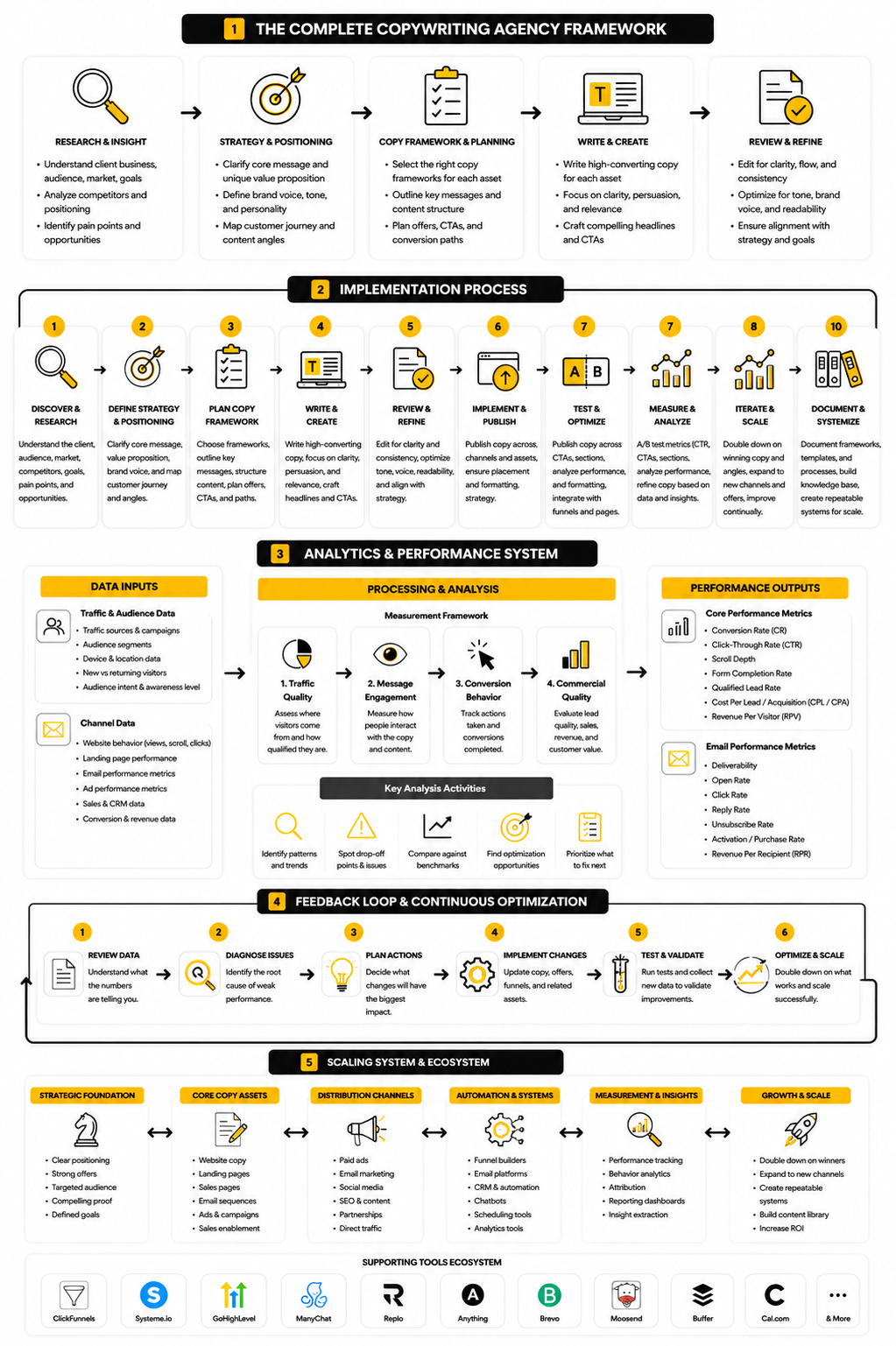
A strong final checklist should answer these questions:
If too many of those answers are unclear, slow down before you sign a big contract. You may need a messaging audit, a smaller test project, or a research phase first. If most answers are clear, then you are in a much better position to hire well and get useful work from the partnership.
What Does A Copy Writing Agency Do?
A copy writing agency helps businesses create persuasive written assets that support marketing, sales, and customer communication. That can include website copy, landing pages, email sequences, ads, sales pages, product pages, video scripts, lead magnets, and campaign messaging. The best agencies also help with research, positioning, offer clarity, and conversion strategy.
The important thing is that the agency should not only “write nicer words.” It should help you communicate more clearly so the right people understand why your offer matters. That is the difference between content production and real copy strategy.
How Is A Copy Writing Agency Different From A Freelancer?
A freelancer is usually one individual, while a copy writing agency may include strategists, writers, editors, project managers, researchers, and sometimes conversion specialists. A freelancer can be the better choice for a focused task, especially when you already know exactly what you need. An agency can be stronger when the project needs research, multiple assets, faster production, or a more complete workflow.
The tradeoff is cost and complexity. Agencies usually charge more because they bring a broader process and more people. That can be worth it when the copy touches several parts of the buyer journey.
When Should A Business Hire A Copy Writing Agency?
You should consider hiring a copy writing agency when unclear messaging is slowing down growth. Common signs include low landing page conversion, weak email performance, poor sales call quality, inconsistent campaign messaging, confusing website copy, or a sales team that keeps explaining the same basic points manually.
It also makes sense when your internal team is overloaded. If your marketers are handling strategy, reporting, design feedback, campaign launches, stakeholder meetings, and copy at the same time, quality usually suffers. A good agency gives the team sharper execution and more breathing room.
How Much Does A Copy Writing Agency Cost?
Pricing depends on scope, specialization, market, and deliverables. A simple page rewrite may cost far less than a full messaging strategy, funnel buildout, email system, and ongoing optimization retainer. Agency pricing also varies depending on whether the work is billed as a fixed project, monthly retainer, hourly consulting, or performance-based agreement.
Do not compare agencies only by price. Compare what is included: research depth, strategy, revisions, project management, implementation support, and measurement. Cheap copy that misses the buyer is expensive in the long run.
What Should I Prepare Before Hiring A Copy Writing Agency?
Prepare your offer details, audience information, customer research, analytics, testimonials, competitor examples, sales objections, previous campaigns, and current copy assets. The agency does not need everything to be perfect, but it does need enough context to make informed decisions. Better inputs usually lead to better copy.
You should also decide who owns approvals. This sounds boring, but it matters. Copy projects slow down fast when every stakeholder gives feedback but nobody has final decision authority.
How Long Does A Copywriting Project Usually Take?
A small project can move quickly if the brief is clear and feedback is fast. A larger project involving research, strategy, multiple assets, design handoff, and implementation naturally takes longer. The more stakeholders, compliance needs, and technical dependencies involved, the more important the workflow becomes.
Timeline should never be judged only by writing time. Research, strategy, feedback, revision, approval, and publishing all affect the real project length. A professional copy writing agency will map those steps before the work begins.
Should A Copy Writing Agency Understand SEO?
Yes, but SEO should not be treated as keyword stuffing. A strong agency should understand search intent, page structure, headings, internal linking, readability, topical relevance, and conversion intent. It should be able to write for humans while still helping the page make sense to search engines.
That said, not every copy writing agency is a technical SEO agency. If organic search is a major growth channel, make sure the agency can either handle SEO properly or collaborate with your SEO specialist. Bad SEO copy is easy to spot because it sounds like it was written for a robot that might buy something someday.
Should A Copy Writing Agency Use AI?
AI can be useful for research organization, draft variation, repurposing, outlining, summarizing customer language, and speeding up production. Marketers are already investing more in AI-supported content workflows, with CMI’s 2025 research showing planned increases in AI for content optimization and content creation. The issue is not whether AI is used. The issue is whether the final work is accurate, specific, strategic, and edited by someone who understands the business.
A serious agency should have human review, fact-checking, brand controls, and a clear policy for sensitive information. AI should support judgment, not replace it. Generic AI copy is not a strategy.
How Do I Know If The Copy Is Working?
Start by matching the metric to the asset. A landing page may be judged by qualified conversion rate, cost per acquisition, form completion, and revenue per visitor. An email sequence may be judged by click rate, reply rate, purchase rate, activation, retention, or revenue per recipient.
Do not overreact to one number in isolation. If clicks are strong but sales are weak, the problem may be the offer, landing page, pricing, or sales process. If traffic is poor, even excellent copy may not have enough qualified visitors to prove itself.
What Is The Biggest Mistake Businesses Make With Agencies?
The biggest mistake is outsourcing unclear thinking. Many businesses hire a copy writing agency before they have a defined audience, a stable offer, useful proof, or a clear conversion goal. Then they expect the agency to somehow create revenue from confusion.
The better approach is collaborative. Bring the agency into the business problem, share the real context, and let it challenge weak assumptions. The best work usually happens when the client brings market knowledge and the agency brings messaging discipline.
Can A Copy Writing Agency Help With Funnels?
Yes, especially if the agency understands conversion strategy and not just page copy. Funnels rely on message flow across ads, landing pages, opt-in pages, sales pages, emails, booking pages, checkout pages, and follow-up sequences. One weak step can reduce the performance of everything after it.
For funnel execution, platforms like ClickFunnels, Systeme.io, and GoHighLevel can support publishing and automation. The tool helps with delivery, but the strategy still comes from understanding the buyer, the offer, and the action you want them to take.
What Should Be Included In A Copywriting Brief?
A useful brief should include the target audience, offer, goal, traffic source, current problem, desired action, objections, proof points, brand voice, competitors, compliance limits, and success metrics. It should also include examples of copy you like or dislike, but those examples should not replace strategic input.
The brief should make the agency’s job clearer, not narrower. Give enough direction to prevent guessing, but leave room for the agency to recommend stronger angles. You are hiring expertise, not just hands on a keyboard.
How Many Revisions Should A Copy Writing Agency Offer?
Most agencies include one or two structured revision rounds. That is usually enough when the brief is clear and feedback is specific. Unlimited revisions may sound attractive, but it can also signal an unclear process.
The better question is how revisions are handled. Feedback should be consolidated, tied to business goals, and given by the right decision-maker. Random preference-based comments from too many people can weaken the copy fast.
What Makes A Copy Writing Agency Worth The Investment?
A copy writing agency is worth it when it improves clarity, speed, consistency, and measurable performance. The work should make your offer easier to understand, your campaigns easier to launch, and your buyer journey easier to trust. It should also create reusable messaging assets that make future marketing easier.
The value is not only in the first deliverable. A strong agency leaves you with sharper positioning, better language, clearer proof, and a stronger understanding of what your buyers respond to. That knowledge compounds.
Build a stronger local presence with BAAM AI
Turn your website, Google profile, social channels, and AI visibility into one growth engine
Most businesses do not need more random marketing activity. They need a consistent presence system that helps the right people find them, trust them, and take action. BAAM AI brings strategy, local SEO, website updates, Google Maps visibility, social content, AI-search readiness, media production, and reporting into one practical monthly engine.
If you want your marketing to keep working after the campaign ends, start with a free BAAM AI presence audit. See how your business shows up today and where the fastest visibility wins are at BAAM AI.