
BAAM AI Blog
Conversion Marketing: The Practical Guide To Turning Attention Into Revenue
Conversion marketing is the discipline of turning interest into action. It is not just conversion rate optimization, landing pages, copywriting, email automation, or paid ads. It is the system that connects all of...
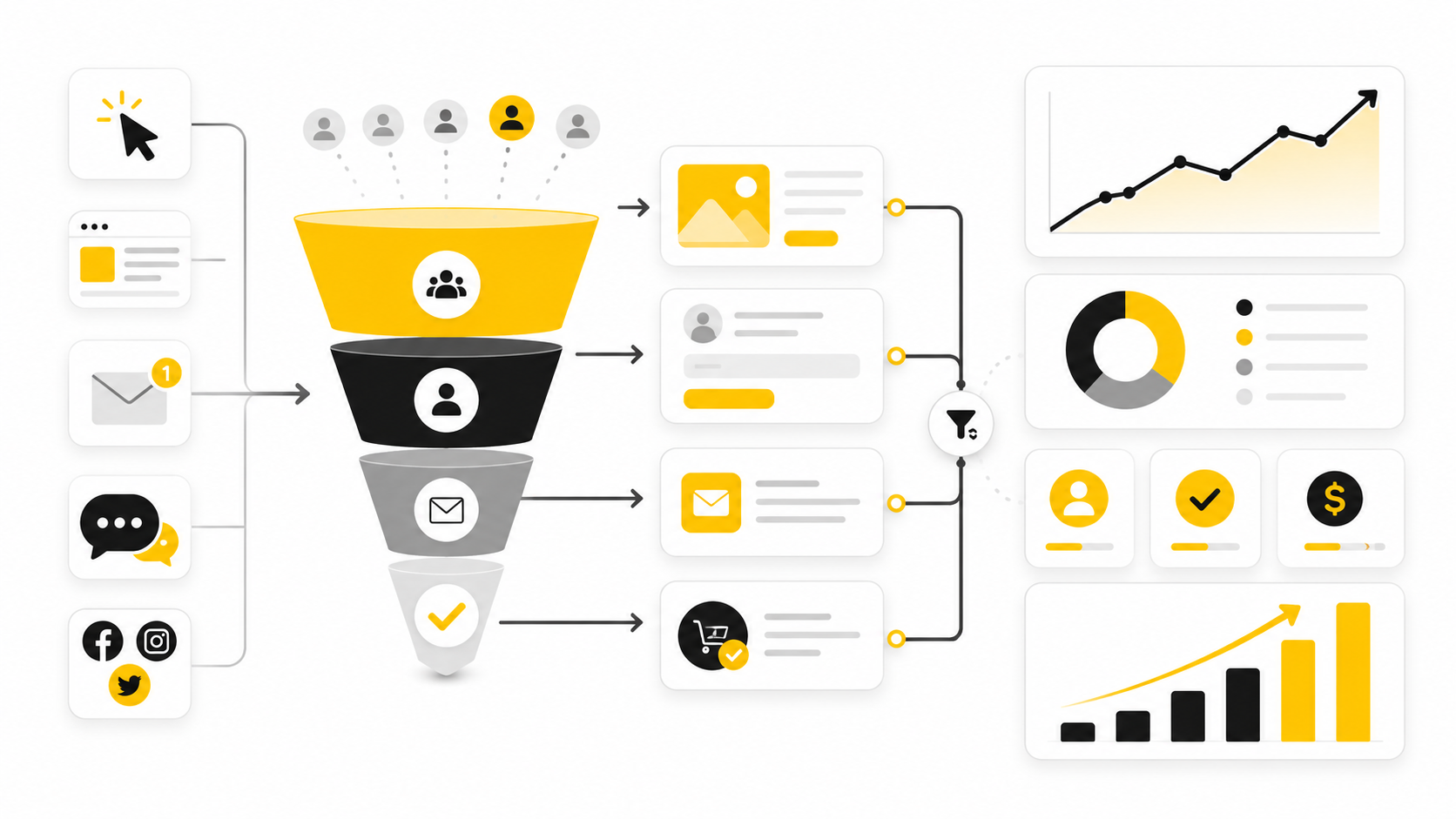
Conversion marketing is the discipline of turning interest into action. It is not just conversion rate optimization, landing pages, copywriting, email automation, or paid ads. It is the system that connects all of those pieces so more of the right people move from first touch to next step, from next step to customer, and from customer to repeat buyer.
That matters because traffic is no longer cheap enough to waste. Contentsquare’s 2025 benchmark research found that digital conversion rates fell while acquisition pressure kept rising, with its analysis covering more than 90 billion sessions and 389 billion page views across over 6,000 websites. When visits cost more and attention is harder to earn, better conversion marketing becomes one of the fastest ways to improve revenue without simply spending more.
The mistake many teams make is treating conversion as a page-level problem. They tweak a headline, change a button color, or add urgency without fixing the deeper journey. Real conversion marketing looks at the full path: who arrives, what they believe, what they need next, what friction blocks them, and what follow-up turns hesitation into commitment.
For ecommerce, the gap is obvious. Baymard’s long-running checkout research places the average cart abandonment rate at 70.19%, which means most shoppers who show buying intent still leave before completing the order. For service businesses, creators, SaaS companies, agencies, and B2B teams, the pattern is similar: people engage, compare, hesitate, disappear, and often never receive the right next message.
This guide breaks conversion marketing into a practical operating system. The goal is not to make marketing more complicated. The goal is to help you build a conversion journey that feels natural to the buyer and measurable to the business.
What Conversion Marketing Really Means
Conversion marketing is the strategy of improving the percentage of people who take a meaningful action after interacting with your brand. That action can be a purchase, booked call, form submission, free trial signup, webinar registration, quote request, app install, or repeat order. The point is not only to get clicks; the point is to create movement toward a business outcome.
This is why conversion marketing is broader than a landing page. A landing page can help, and a well-built page using a tool like Replo can remove design and testing bottlenecks for ecommerce teams. But the page is only one moment in a larger decision process.
The same is true for funnels. A funnel builder such as ClickFunnels can help you package an offer, capture leads, and guide people through a sequence. Still, the funnel only works when the offer, message, audience, proof, timing, and follow-up all match.
At its best, conversion marketing answers one simple question: what does this person need to believe, feel, understand, or receive before they are ready to act? That question keeps the work grounded in buyer psychology instead of random tactics. It also stops teams from blaming the wrong thing when performance drops.
Why Conversion Marketing Matters
Conversion marketing matters because growth gets expensive when every solution depends on more traffic. If a campaign brings in visitors but the journey leaks at every step, the business pays for attention it does not convert. That creates pressure on ad budgets, sales teams, content production, and customer acquisition costs.
This is especially important because conversion problems often hide behind vanity metrics. A campaign can have strong impressions, healthy click-through rates, and decent engagement while still producing weak revenue. The real question is whether people are taking the next action that creates value.
Modern buyers also need more trust before they act. They compare alternatives, read reviews, ask peers, watch short-form content, check pricing, abandon carts, and come back later on another device. Conversion marketing respects that behavior instead of pretending every visitor is ready to buy immediately.
This is where follow-up becomes critical. For example, a chat and automation platform like ManyChat can support conversion when the buyer has shown intent but is not ready to complete the action yet. The key is to use automation to continue the conversation, not to spam people with disconnected messages.
The Conversion Marketing Framework At A Glance
A strong conversion marketing system has four layers: intent, message, experience, and follow-up. Intent tells you what the person is trying to do. Message gives them a reason to continue. Experience removes friction from the next step. Follow-up brings back people who were interested but not ready.
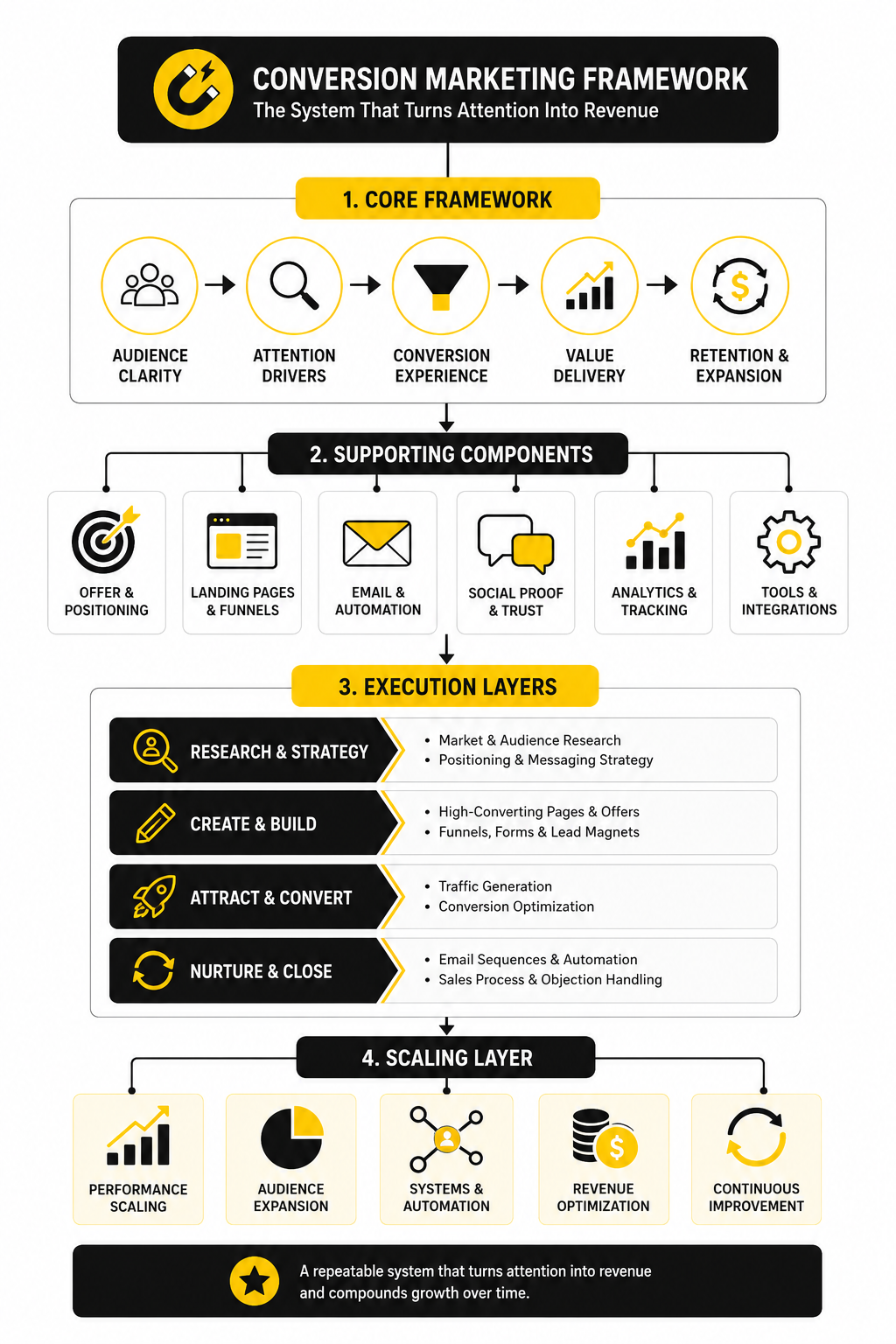
The framework starts before someone lands on your page. The source of traffic shapes expectations, which means a visitor from a comparison search behaves differently from someone coming from a social post. If the promise in the ad, post, email, or search result does not match the page experience, conversion drops before the visitor even evaluates the offer.
The second layer is the message. This includes the headline, offer, proof, objections, pricing context, risk reversal, and call to action. Good conversion marketing does not pressure people blindly; it makes the next step feel logical.
The third layer is the experience. This includes page speed, layout, mobile usability, form length, checkout flow, booking flow, payment options, and clarity. Friction is expensive because it punishes people who were already close to acting.
The fourth layer is follow-up. Most people will not convert on the first visit, even when they are genuinely interested. A professional conversion system uses email, SMS, retargeting, CRM workflows, sales reminders, and conversational automation to continue the journey with relevance.
Core Components Of Conversion Marketing
The first core component is the offer. If the offer is weak, unclear, or poorly matched to the audience, no amount of design polish will save it. A good offer makes the value obvious, the next step low-friction, and the outcome specific enough to feel real.
The second component is audience-message fit. This is where many campaigns fail quietly. They speak to everyone in generic language, then wonder why the right people do not act.
The third component is proof. Buyers need evidence that the promise can be trusted. Proof can come from reviews, demos, product data, customer outcomes, recognizable customers, guarantees, transparent policies, or a clear explanation of how the result is created.
The fourth component is friction removal. This includes everything that makes the next step harder than it needs to be. Long forms, vague pricing, slow pages, unclear buttons, surprise fees, forced account creation, and weak mobile experiences all reduce momentum.
The fifth component is measurement. Conversion marketing without measurement becomes guesswork. You need to know where people enter, where they continue, where they hesitate, where they leave, and which changes actually improve the business outcome.
Professional Implementation Starts With The Journey
Professional conversion marketing starts by mapping the buyer journey instead of immediately editing pages. That means identifying the main traffic sources, the intent behind each source, the conversion goal for each stage, and the points where people drop off. Once you see the journey clearly, the right fixes become much easier to prioritize.
A simple implementation map usually includes acquisition, landing experience, lead capture or checkout, nurture, sales handoff, purchase, onboarding, and retention. Not every business needs all of those steps in the same way. But every business needs to know which steps matter most to its revenue.
For agencies, coaches, local businesses, and service providers, an all-in-one platform like GoHighLevel can make implementation easier because CRM, funnels, automations, calendars, forms, and follow-up can live closer together. That matters when conversion depends on speed-to-lead, appointment reminders, pipeline visibility, and consistent follow-up. The tool is not the strategy, but the right system makes the strategy easier to execute.
The most important principle is this: optimize the constraint, not the decoration. If the biggest leak is poor offer clarity, redesigning the footer will not help much. If the biggest leak is no follow-up after lead capture, rewriting one headline will not fix the revenue problem.
Why Conversion Marketing Matters More Than More Traffic
More traffic feels like the obvious answer when revenue is flat. It is visible, easy to report, and simple to explain: more visitors should mean more customers. But that logic breaks fast when the journey is leaking attention, trust, and intent before people reach the point of action.
This is where conversion marketing becomes more valuable than simply buying more reach. If the same campaign budget sends people into a weak experience, the business is not scaling growth. It is scaling waste.
The more carefully move is to improve the percentage of qualified visitors who take the next meaningful step. That does not mean traffic is unimportant. It means traffic only becomes valuable when the conversion system is strong enough to turn attention into revenue.
Traffic Without Conversion Creates Expensive Growth
A business can grow traffic and still lose efficiency. Paid channels can bring more visitors, content can bring more readers, and social can bring more clicks, but none of that guarantees better revenue. If the offer is unclear or the next step feels risky, people leave.
This is not a small problem. Contentsquare’s 2025 digital benchmark found that brands increased digital ad spend by 13.2%, while the cost of an online visit rose 9% and conversion rates dropped 6.1% year over year in its analysis of more than 90 billion sessions across 6,000 websites. That is the exact pressure conversion marketing is designed to solve.
The takeaway is simple: when acquisition gets more expensive, conversion leaks become more painful. A weak page, slow follow-up, confusing pricing, or unclear call to action does not just hurt performance. It makes every paid click more expensive than it needs to be.
Better Conversion Improves Every Channel
Conversion marketing compounds because it improves the return from work you are already doing. If your paid ads, organic content, email campaigns, social posts, partnerships, and referrals all send people into a stronger journey, every channel benefits. You are not starting from zero each time.
That is why conversion work should not sit in a separate box from acquisition. The message in the ad should match the page. The page should match the offer. The offer should match the follow-up. The follow-up should match the buyer’s level of intent.
This is also why tools should support the full journey, not just one isolated touchpoint. A funnel platform like ClickFunnels can help when you need a clear path from opt-in to offer to purchase. But the real win comes from building that path around buyer intent, not just adding more pages.
Conversion Marketing Protects Profit Margins
Revenue can look healthy while profit quietly gets weaker. If acquisition costs rise faster than conversion rate, average order value, retention, or lifetime value, growth becomes fragile. The business may be making more sales while keeping less of the money.
Conversion marketing protects margins by improving the economics of each visitor, lead, and customer. A higher percentage of buyers from the same traffic can reduce pressure on ad spend. A better lead capture process can give sales teams more qualified conversations without hiring more reps.
This matters even more for businesses with lower margins or longer sales cycles. In those cases, a small improvement in conversion quality can matter more than a large increase in raw traffic. You do not need everyone to act; you need the right people to move forward with enough trust and clarity.
Buyer Intent Is Not The Same As Buyer Readiness
One of the biggest mistakes in marketing is treating every interested person like they are ready to buy now. Some visitors are comparing options. Some are checking price. Some are trying to understand the category. Some want proof before they talk to sales.
Conversion marketing works because it respects those different levels of readiness. It gives people the right next step instead of forcing one universal action. A cold visitor might need a useful guide, a comparison page, a quiz, a calculator, or a demo before they are ready for a sales call.
This is especially important in B2B. 6sense’s 2025 buyer research describes how buyers often complete a large share of the journey before talking to sellers, which means the website, content, proof, and self-service experience must do more of the heavy lifting. If your conversion path only works after a salesperson gets involved, you are losing buyers who wanted to evaluate quietly first.
Friction Is A Revenue Problem
Friction is anything that makes action harder than it should be. It can be a slow page, a confusing form, vague button text, weak product detail, hidden pricing, too many checkout steps, or a booking process that asks for too much too soon. None of these issues feel dramatic on their own, but together they drain revenue.
Ecommerce makes this painfully clear. Baymard’s checkout research places the average documented cart abandonment rate at 70.22%, based on 50 different studies. That means a huge amount of buying intent is created, then lost, before payment is completed.
The same pattern shows up outside ecommerce. Leads fill out half a form and leave. Prospects open the pricing page and do nothing. Trial users activate once and disappear. Conversion marketing looks for those moments and asks a practical question: what is stopping a motivated person from taking the next step?
Follow-Up Turns Missed Moments Into Second Chances
Most people will not convert the first time they see an offer. That is normal. The problem is when a business has no useful follow-up system for people who showed intent but did not act.
A good follow-up system is not aggressive. It is relevant, timely, and based on what the person already did. Someone who abandoned a checkout needs a different message than someone who downloaded a guide, watched a demo, or booked a call and missed it.
This is where email, SMS, chat, CRM tasks, retargeting, and sales reminders become part of conversion marketing instead of disconnected tactics. Platforms like GoHighLevel can help service businesses and agencies connect forms, calendars, pipelines, and automations so leads are not left sitting untouched. That matters because speed and consistency often decide whether a warm lead becomes revenue or disappears.
More Traffic Can Hide The Real Problem
More traffic can make a broken system look busy. Dashboards move, reports look active, and the team feels productive. But if conversion quality does not improve, the business is just feeding more people into the same weak path.
This is why conversion marketing starts with diagnosis before tactics. You look at where people come from, what they expect, where they land, what they click, where they stop, and what happens after they leave. Then you fix the highest-impact constraint first.
That is the difference between professional optimization and random tweaking. Professional conversion work does not ask, “What can we change?” It asks, “Where is the buyer losing momentum, and what would help them confidently continue?”
The Conversion Marketing Framework
A conversion marketing framework gives your team a repeatable way to improve results without guessing. Instead of changing random page elements, you move through the journey in order: audience, intent, offer, page, action, follow-up, and measurement. That order matters because a beautiful page cannot fix the wrong offer, and a clever automation cannot rescue a journey that never earned enough trust.
The framework also keeps the work practical. You are not trying to optimize everything at once. You are finding the biggest constraint in the buyer journey, improving it, and then moving to the next constraint.
That is the difference between busy marketing and useful marketing. Busy marketing creates more assets. Useful conversion marketing creates more completed actions from the attention you already earned.
Step 1: Clarify The Conversion Goal
The first step is deciding what conversion actually means for the specific page, campaign, or journey. A conversion is not always a sale. It might be a booked call, quote request, trial signup, quiz completion, demo request, product add-to-cart, email opt-in, or reply to a sales message.
This sounds obvious, but many campaigns underperform because they have too many goals at once. The page asks people to book a call, download a guide, follow on social, watch a video, browse the blog, and contact support. When every action looks equally important, the buyer has to decide what matters.
A strong conversion goal gives the page and follow-up sequence a job. For example, a cold traffic campaign might aim for a low-friction lead capture, while a retargeting campaign might aim for a booked consultation. The goal should match the buyer’s awareness level, not the marketer’s impatience.
Step 2: Match The Offer To Buyer Intent
Once the goal is clear, the next step is matching the offer to the person’s intent. Someone searching for pricing is not in the same mindset as someone reading an educational post. Someone clicking from a warm email is not evaluating you the same way as someone arriving from a short-form video.
This is where conversion marketing becomes more precise. You are not creating one generic pitch and forcing it everywhere. You are shaping the next step around what the buyer is likely trying to solve at that moment.
For ecommerce, that might mean different landing pages for product discovery, comparison, bundle offers, and returning shoppers. For service businesses, it might mean separate paths for people who want education, pricing, proof, or a direct call. If the intent is different, the conversion path should usually be different too.
Step 3: Build The Message Around The Decision
The message should help the buyer make a decision, not just describe the business. That means the headline, subhead, proof, offer explanation, objections, and call to action all need to work together. Each piece should reduce uncertainty and make the next step feel reasonable.
A useful message usually answers five questions. What is this? Who is it for? Why should I care now? Why should I trust it? What should I do next? If the page does not answer those questions quickly, the buyer has to work too hard.
This is where many conversion problems come from. The business understands the value, but the page explains it from the inside out. Strong conversion marketing flips the message around and explains the offer from the buyer’s point of view.
Step 4: Design The Path Of Least Resistance
Once the message is clear, the experience has to make action easy. The page layout should guide attention toward the main decision. The form, checkout, calendar, or signup flow should ask only for what is needed at that stage.
This does not mean every page must be short. Some offers need more explanation, especially when the price is higher, the risk feels bigger, or the buyer needs internal approval. The real rule is not “short is better.” The real rule is “remove anything that does not help the buyer continue.”
For ecommerce teams, a landing page builder like Replo can be useful when you need faster product page tests, campaign-specific pages, and cleaner offer presentation without waiting on a full development cycle. For service businesses, a form tool like Fillout can help create cleaner intake flows that collect the right information without making the first step feel heavy.
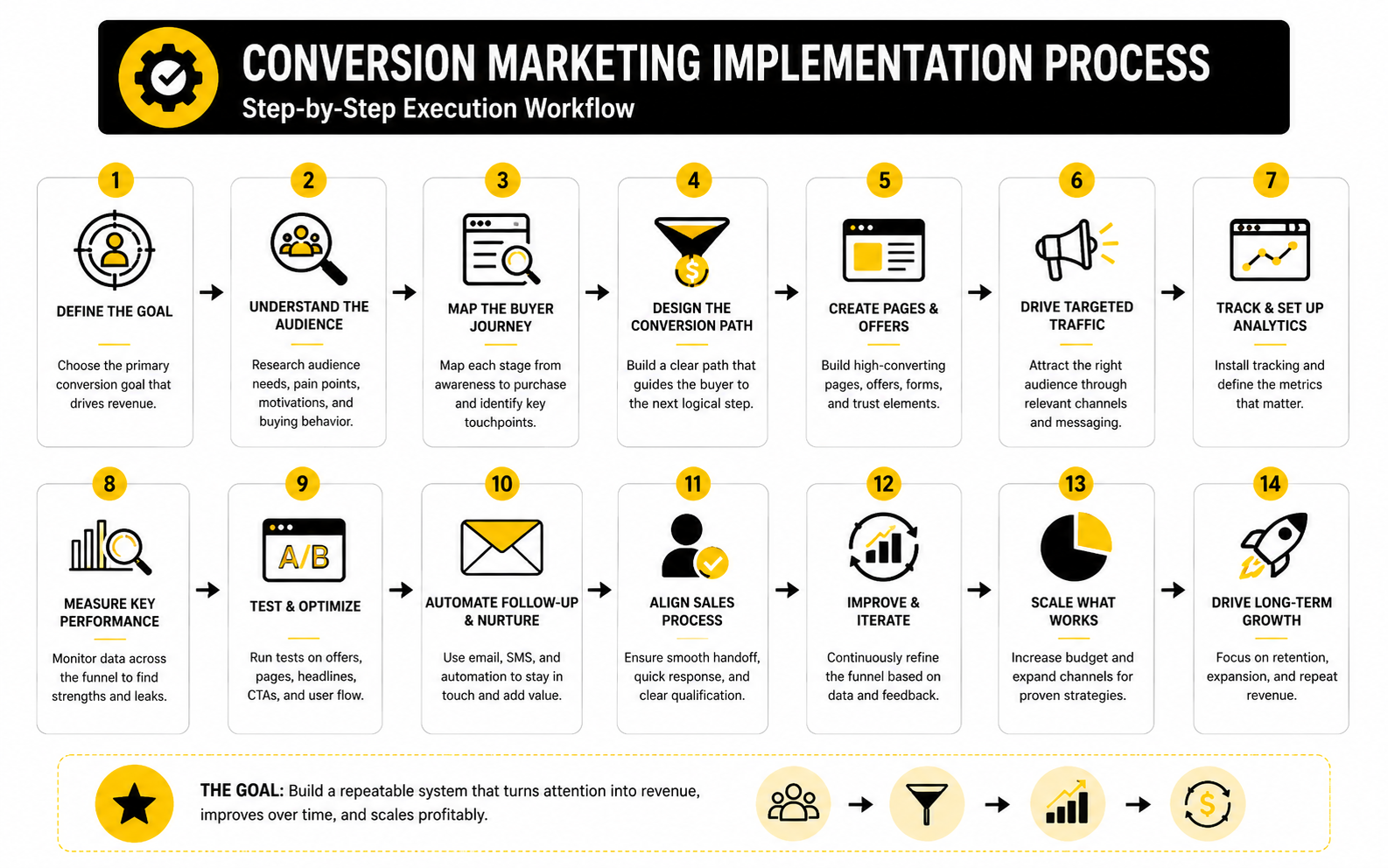
Step 5: Connect Follow-Up Before You Drive Traffic
Follow-up should be built before the campaign goes live. This is non-negotiable. If someone opts in, abandons a booking, starts a checkout, requests information, or opens a sales conversation, the next message should already be planned.
The best follow-up feels connected to the action the person already took. A visitor who downloaded a guide should not immediately receive the same message as someone who abandoned a checkout. A lead who booked a call needs confirmation, reminders, and context that helps them show up prepared.
This is where your CRM and automation stack matters. A platform like GoHighLevel can help connect lead capture, calendars, pipelines, SMS, email, and sales workflows in one place. Email tools like Brevo or Moosend can also support nurture sequences when email is the main follow-up channel.
Step 6: Measure The Journey, Not Just The Final Sale
A conversion marketing framework needs measurement at each meaningful step. If you only measure final sales, you will know that something is wrong, but you will not know where the problem started. You need to see the journey in smaller pieces.
That means tracking traffic source, landing page engagement, form starts, form completions, checkout starts, checkout completions, booked calls, show rates, reply rates, sales opportunities, close rates, and repeat purchases where relevant. Not every business needs every metric. But every business needs enough visibility to diagnose the leak.
The point is not to drown in dashboards. The point is to make better decisions. When you can see where people lose momentum, you can fix the right part of the journey instead of changing whatever is easiest to edit.
Step 7: Prioritize The Highest-Impact Constraint
After the journey is mapped and measured, you need to decide what to fix first. Do not start with the prettiest idea. Start with the constraint that has the biggest likely impact on revenue.
If many qualified visitors reach the page but few click the call to action, the problem may be message clarity or offer relevance. If many people start the form but few finish, the problem may be friction. If many people book calls but few show up, the problem may be confirmation, reminders, qualification, or perceived value.
This is where conversion marketing becomes disciplined. You make one focused improvement, measure the result, and then decide the next move. That rhythm beats random redesigns almost every time.
Step 8: Turn Improvements Into A Repeatable System
The final step is turning what works into a system. When a headline, offer angle, form structure, follow-up sequence, or sales handoff improves results, document it. Your goal is to build a conversion playbook the team can reuse.
This is how conversion marketing gets stronger over time. Each test teaches you something about buyer intent, objections, language, friction, and timing. Those lessons should not disappear after one campaign ends.
A repeatable system also makes scaling safer. When you increase traffic, launch new offers, or add new channels, you are not starting from a blank page. You are applying a proven framework to the next conversion path.
Core Components Of A High-Converting System
A high-converting system is not built from one metric. It is built from a clear view of the whole journey. You need to know who arrived, what they expected, what they did, where they hesitated, and what happened after they left.
That is why conversion marketing needs both strategy and measurement. The strategy tells you what should happen next. The data tells you whether people are actually moving that way.
The goal is not to collect every possible number. The goal is to find the numbers that explain buyer momentum. When you understand momentum, optimization becomes much more practical.
Statistics And Data
Benchmarks are useful, but only when you treat them as context rather than commandments. A store with a low-ticket impulse product should not judge itself the same way as a B2B company selling a six-month implementation. A cold traffic landing page should not be measured the same way as a warm email campaign.
The broader market data still matters because it shows the pressure businesses are operating under. Contentsquare’s 2025 benchmark reported a 6.1% drop in conversion rate, a 9% increase in cost per visit, and a 13.2% increase in digital ad spend across its large digital experience dataset. That combination is brutal because it means brands are paying more to bring people into journeys that are converting worse.
Ecommerce data tells the same story from a different angle. Baymard’s research places the average documented cart abandonment rate at 70.22%, based on 50 studies. That number should not make every store panic, but it should make every store inspect the checkout path, delivery expectations, payment options, trust signals, and surprise costs.
Industry benchmarks also show why averages can be misleading. Dynamic Yield’s benchmark data shows meaningful variation by category, with Food and Beverage performing much differently from Luxury and Jewelry. Littledata’s Shopify benchmark data also shows wide gaps between average stores and top-performing stores, which means the real opportunity is not “hit the average”; it is to understand what your best segments, sources, and journeys are already proving.
What Conversion Rate Actually Tells You
Conversion rate tells you the percentage of visitors who completed a defined action. That sounds simple, but the meaning changes depending on the action. A purchase conversion rate, lead conversion rate, demo request rate, trial signup rate, checkout completion rate, and booked-call rate all explain different parts of the journey.
This is why one blended conversion rate can hide more than it reveals. If mobile traffic is underperforming, but desktop is strong, the average will make the problem look smaller than it is. If paid search converts well but paid social does not, a single sitewide number will not tell you which channel needs a different offer.
A useful conversion marketing dashboard separates performance by source, device, audience, page, offer, and stage. That gives you a clearer picture of where intent is strong and where the experience is breaking. The more specific the metric, the more useful the decision.
The Metrics That Actually Matter
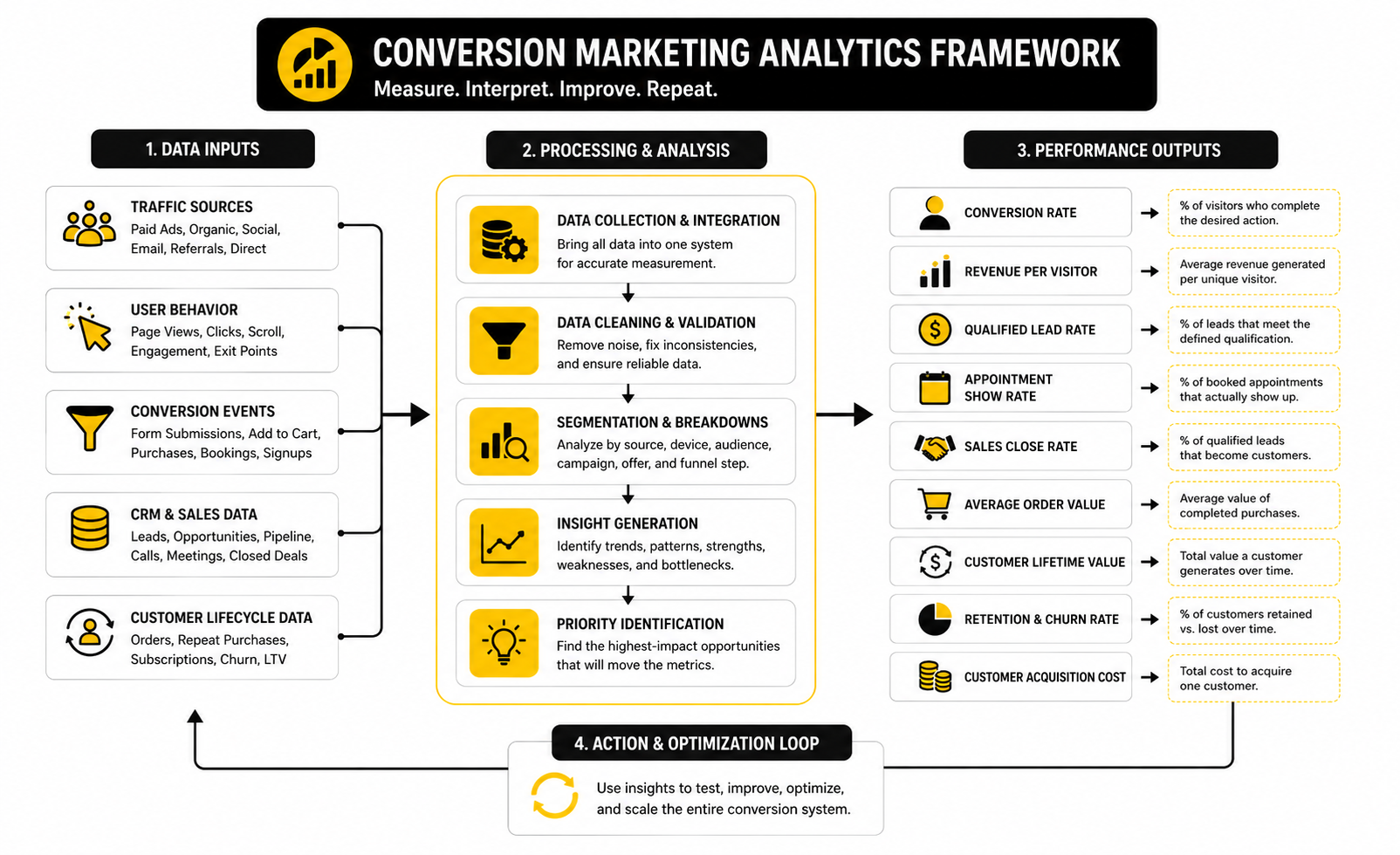
The best conversion metrics depend on the business model, but most teams should watch a few core signals. These metrics show whether people are moving from attention to action with enough clarity and confidence. They also help you avoid overreacting to one number in isolation.
Useful conversion marketing metrics include:
The important part is not the list itself. The important part is how the metrics connect. If landing page conversion improves but lead quality collapses, the system did not really improve. If add-to-cart rate rises but checkout completion falls, the product page may be doing its job while the checkout is creating friction.
How To Read The Analytics System
Your analytics system should show the buyer journey as a sequence, not as a pile of disconnected reports. Start with traffic source, then landing page behavior, then action intent, then completion, then follow-up, then revenue. This structure makes the data easier to interpret because each step has a clear job.
For example, if traffic volume is healthy but engagement is weak, the problem may be targeting or message match. If engagement is strong but action is weak, the problem may be offer clarity, proof, or call-to-action relevance. If action starts are strong but completions are weak, the problem is usually friction.
This is where conversion marketing becomes operational. The data should tell you what to inspect next. It should not just tell you whether the month was good or bad.
Benchmarks Should Start Questions, Not End Them
Benchmarks are most useful when they trigger better questions. If your cart abandonment rate is near the Baymard average, that does not automatically mean the checkout is fine. It means you need to compare your abandonment rate by device, traffic source, product type, new versus returning visitors, and shipping region.
The same applies to conversion rate. If your store converts below a published ecommerce benchmark, the next question is not “How do we copy the average?” The next question is “Which segments are pulling the average down, and what are those visitors experiencing?”
This is especially important for B2B and high-ticket offers. A lower conversion rate can still be profitable if the leads are qualified, the deal size is strong, and the sales process converts well. A higher conversion rate can still be bad if it fills the pipeline with people who never buy.
The Difference Between Leading And Lagging Signals
Lagging signals tell you what already happened. Revenue, closed deals, purchases, and customer acquisition cost are lagging indicators. They matter a lot, but they usually arrive too late to explain the exact cause of the problem.
Leading signals show whether people are moving in the right direction before revenue is final. These include scroll depth, product detail engagement, call-to-action clicks, form starts, pricing page visits, demo video views, replies, cart starts, calendar views, and checkout progress. They are not the final goal, but they help you diagnose momentum earlier.
The danger is treating leading signals like success by themselves. A pricing page visit is not revenue. A form start is not a customer. But if those signals rise or fall sharply, they can help you find the issue before the revenue report confirms it.
Measurement Must Match The Buyer Journey
Different journeys need different measurement systems. Ecommerce teams need product page performance, cart behavior, checkout completion, revenue per visitor, average order value, and retention signals. Service businesses need lead source quality, form completion, speed-to-lead, appointment booking, show rate, close rate, and pipeline value.
SaaS companies usually need activation metrics, trial-to-paid conversion, feature adoption, churn, and expansion revenue. Creators and course sellers often need opt-in rate, webinar registration, attendance, offer click rate, purchase rate, refund rate, and repeat buyer behavior. The framework is the same, but the scorecard changes.
This is why copying another company’s dashboard rarely works. Their journey, price point, traffic mix, sales motion, and customer behavior may be completely different from yours. A good conversion marketing system measures the path your buyers actually take.
Attribution Is Helpful, But It Is Not Perfect
Attribution tries to explain which channels and touchpoints influenced a conversion. It is useful, but it is never a perfect record of reality. Buyers use multiple devices, clear cookies, talk to people offline, return through direct traffic, and make decisions after several invisible interactions.
That does not mean attribution is useless. It means you should use it as directional evidence, not absolute truth. If paid search, email, and retargeting all appear in the path, the buyer journey is probably more complex than one “winning” channel.
A practical approach is to combine attribution data with behavior data and sales feedback. Analytics can show what people did. Sales calls and customer conversations can explain what people believed, doubted, or misunderstood. Together, those inputs make conversion marketing much sharper.
Use Data To Decide What To Fix First
The point of measurement is prioritization. If your data does not help you decide what to fix next, the dashboard is too noisy. Every metric should connect to a possible action.
If paid traffic is expensive and landing page conversion is weak, work on message match, offer clarity, and page relevance before increasing spend. If leads are coming in but sales conversations are poor, inspect qualification, expectations, and the handoff from marketing to sales. If people reach checkout but disappear, focus on trust, fees, payment options, delivery clarity, and checkout friction.
This is where the strongest teams stay disciplined. They do not chase every minor metric movement. They look for the highest-impact constraint, fix it, and measure whether the fix actually improved the journey.
Professional Implementation Across Funnels, Follow-Up, And Testing
Once the measurement system is clear, the next step is professional implementation. This is where conversion marketing moves from “we should improve the funnel” to a real operating rhythm. The work becomes less about opinions and more about controlled decisions.
At this level, you are not just fixing pages. You are coordinating the offer, funnel, CRM, content, sales process, automation, and testing plan so the buyer gets a consistent experience. That consistency matters because buyers notice when the journey feels disconnected.
The practical goal is simple: make every stage easier to understand, easier to trust, and easier to complete. That sounds basic, but it is where most conversion gains come from.
Build Around The Main Conversion Path First
Do not start by optimizing every possible path. Start with the path that has the clearest connection to revenue. For an ecommerce brand, that might be product page to cart to checkout to post-purchase. For a service business, it might be landing page to form to booked call to sales close.
This matters because teams often spread their effort too thin. They improve the homepage, rewrite a blog CTA, test a new popup, update a nurture email, and redesign a thank-you page all at once. The result is motion, but not enough signal.
A better approach is to choose one primary conversion path and make it strong end to end. Once that path works, you can expand into supporting paths. Focus creates clarity, and clarity creates better decisions.
Choose The Right Funnel Depth
Not every offer needs a long funnel. Low-risk offers often work better with a short, direct path. Higher-risk offers usually need more education, proof, comparison, and follow-up before the buyer is ready.
The strategic tradeoff is speed versus confidence. A short funnel reduces steps, but it may not give hesitant buyers enough information. A longer funnel can build trust, but it can also create unnecessary friction if the buyer was already ready to act.
This is why funnel depth should match buyer risk. A simple product, low price, or familiar category can usually move faster. A high-ticket service, complex SaaS platform, or business-critical purchase usually needs a more thoughtful sequence.
Segment The Journey Without Overcomplicating It
Segmentation improves conversion when it changes the experience in a useful way. A returning visitor may need a different message than a first-time visitor. A warm lead from email may need a different call to action than a cold visitor from paid social.
But segmentation can also become a trap. If every tiny audience gets its own page, automation, offer, and dashboard, the system becomes hard to maintain. Complexity starts eating the benefit.
The best version is practical segmentation. Separate the journey where intent, awareness, pain point, or buying stage clearly changes the next step. Ignore segmentation that only makes the marketing team feel sophisticated but does not improve the buyer’s experience.
Personalization Needs Restraint
Personalization can improve relevance, but it should not feel creepy or chaotic. The buyer should feel understood, not watched. This is especially important as privacy expectations continue to shape digital advertising, measurement, and customer trust.
Useful personalization is usually based on context the buyer already expects you to know. Their traffic source, viewed product, selected interest, business type, cart contents, or form answer can help shape the next message. That is very different from overusing invisible data in a way that makes the experience feel invasive.
For conversion marketing, the best question is not “How much can we personalize?” The better question is “What would make the next step clearer for this person?” If personalization does not improve clarity, trust, or timing, it is probably noise.
Align Marketing And Sales Before Scaling
For lead generation businesses, marketing and sales alignment is not optional. Marketing can generate demand, but sales often determines whether that demand becomes revenue. If those teams define quality differently, the conversion system will always leak.
The handoff should be specific. What information should the lead provide? How fast should sales respond? What should happen when the lead does not answer? What makes a lead qualified? What objections keep showing up on calls?
A CRM like Copper can help teams keep relationship data, pipeline stages, and follow-up activity organized. For agencies and local service businesses that need forms, calendars, automations, SMS, email, and pipeline management closer together, GoHighLevel can support the full conversion workflow. The tool choice matters less than the discipline of making sure no qualified lead falls into a gap.
Automate The Repetitive Parts, Not The Judgment
Automation is powerful when it handles repetitive actions that should happen consistently. Confirmation emails, appointment reminders, lead routing, abandoned checkout sequences, post-purchase follow-up, and reactivation campaigns are good examples. These are moments where speed and consistency matter.
But automation should not replace judgment where context matters. A high-value lead with a specific objection may need a personal response. A churn-risk customer may need a conversation, not another generic campaign. A sales opportunity may need a custom proposal, not a prewritten sequence.
The best conversion marketing systems use automation to protect the basics. Then humans spend more time on the moments where judgment, empathy, and strategy actually move the deal forward.
Test Big Enough To Learn Something
Small tests are easy to run, but they often teach very little. Changing button colors, moving icons, or rewriting one minor phrase may not create enough difference to matter. A useful test should be tied to a real hypothesis about buyer behavior.
Strong tests usually focus on offer, message, proof, friction, or timing. For example, you might test a demo request against a self-serve trial, a shorter form against a qualified application, or a direct product page against an educational pre-sell page. These tests are more meaningful because they change the buyer’s decision context.
This does not mean every test must be dramatic. It means every test should have a reason. Before you run it, you should be able to say what you believe, why you believe it, and what decision you will make if the result is clear.
Protect The Customer Experience While Optimizing
Conversion pressure can push teams into bad habits. They add fake urgency, hide costs, overload pages with popups, make cancellation hard, or use aggressive messaging that creates short-term action at the expense of long-term trust. That is not smart optimization.
Good conversion marketing protects the buyer while improving business results. It makes the value clearer, the proof stronger, the path smoother, and the follow-up more useful. It does not trick people into taking actions they will regret.
This matters because conversion quality affects retention, refunds, complaints, reviews, referrals, and brand reputation. A conversion that creates a bad customer is not a win. It is a delayed problem.
Scale Only After The Unit Economics Make Sense
Scaling traffic before the conversion system works is expensive. Scaling after the numbers make sense is much safer. You want to know that the core journey can turn attention into profitable revenue before you pour more money into acquisition.
This is where unit economics matter. Look at cost per qualified lead, customer acquisition cost, average order value, gross margin, payback period, lifetime value, close rate, and refund rate. A campaign is not truly healthy just because the front-end conversion rate looks good.
When the economics are clear, scaling becomes more controlled. You can increase spend, add channels, launch new funnels, expand audiences, or build partner campaigns with more confidence. Without that clarity, scaling is just a louder version of guessing.
Keep The System Simple Enough To Maintain
A conversion system should be powerful, but it should not be fragile. If only one person understands the funnel, automation logic, tracking setup, offer structure, and testing roadmap, the business has an operational risk. Complexity should earn its place.
Document the core flows. Name campaigns clearly. Keep automations readable. Track the most important metrics before adding advanced dashboards. Review the system regularly so old offers, outdated emails, broken links, and irrelevant messages do not keep running in the background.
This is the unsexy part that separates serious operators from dabblers. Conversion marketing is not a one-time project. It is a system you maintain, improve, and protect as the business grows.
Measurement, Optimization, Mistakes, And FAQ
The final layer of conversion marketing is the operating rhythm. You build the journey, measure the right signals, improve the biggest constraint, and keep the system clean enough to maintain. That is how conversion stops being a one-off project and becomes part of how the business grows.
The biggest mistake is treating optimization as a bag of tricks. Better buttons, sharper headlines, shorter forms, stronger proof, faster follow-up, and cleaner checkout flows can all help. But they only work when they solve a real problem in the buyer journey.
Think of the whole system like an ecosystem. Traffic creates attention. Messaging turns attention into interest. Experience turns interest into action. Follow-up turns missed moments into second chances. Measurement tells you where the ecosystem is healthy and where it is breaking.
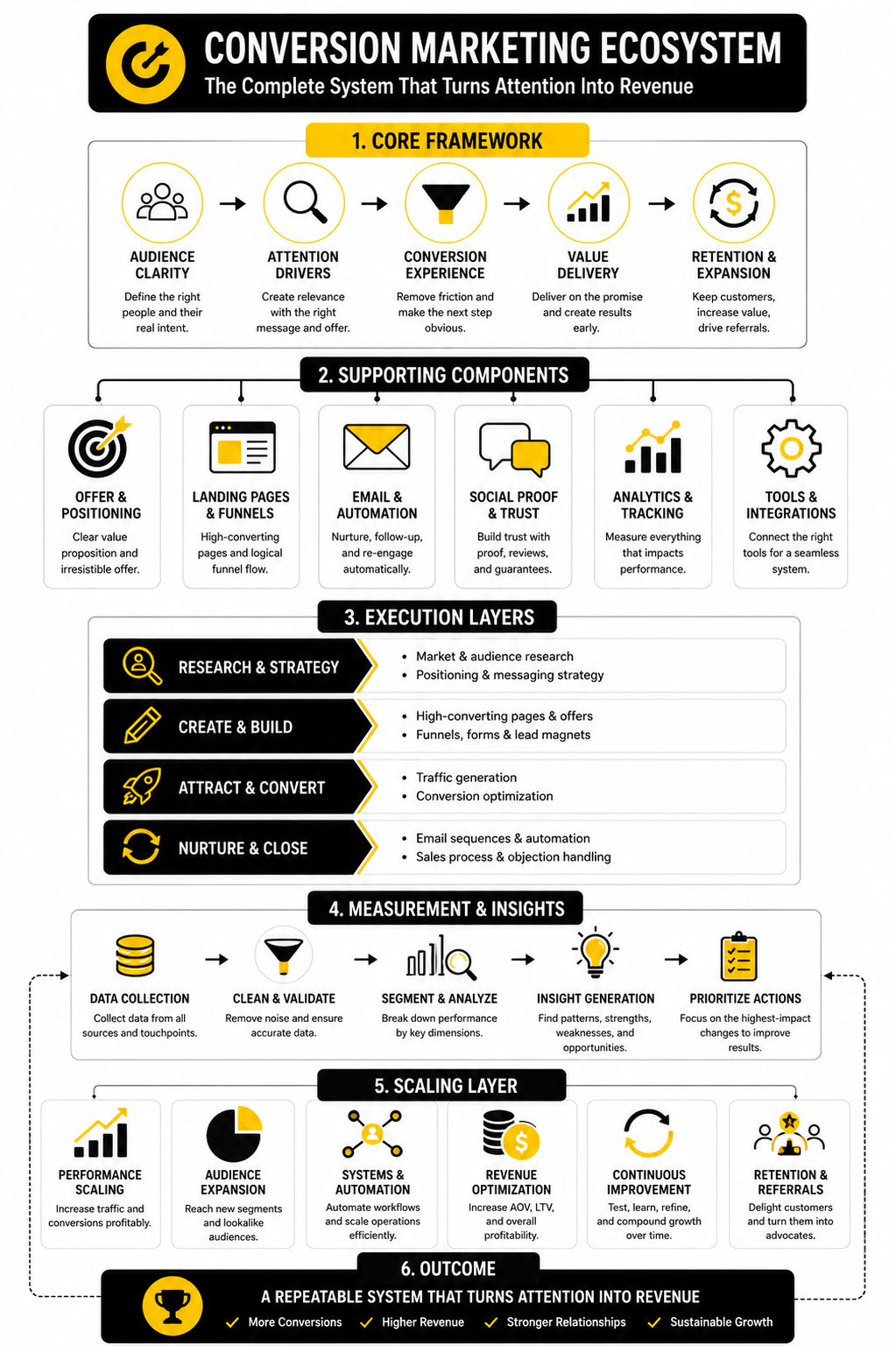
Common Conversion Marketing Mistakes
The first common mistake is optimizing before understanding the buyer. Teams change copy, design, and automation without knowing what the visitor expected when they arrived. That leads to surface-level improvements that do not fix the real issue.
The second mistake is chasing a higher conversion rate at the expense of quality. A page can generate more leads by lowering friction too much, but those leads may be less qualified and harder to close. Conversion marketing should improve profitable action, not just inflate a metric.
The third mistake is ignoring follow-up. Many businesses spend heavily to earn attention, then let interested people disappear after one visit, one form, or one abandoned checkout. That is painful because follow-up is often where warm intent turns into actual revenue.
The fourth mistake is testing too many things at once. If the headline, offer, layout, form, pricing, and follow-up all change together, you may see a result but learn very little. Good optimization isolates the most important constraint so the next decision is clearer.
The fifth mistake is letting old journeys run forever. Offers change, pricing changes, buyer objections change, and old automations can quietly become inaccurate. A conversion system needs regular maintenance, or it becomes a hidden source of friction.
How To Keep Improving Over Time
Start with a monthly conversion review. Look at the main journey, the biggest traffic sources, the highest-intent pages, and the points where people stop moving forward. Do not try to fix everything in one meeting.
Choose one priority constraint for the next cycle. That could be a weak landing page, low form completion, poor appointment show rate, abandoned carts, low email recovery, or a sales handoff problem. Then decide what evidence you need, what change you will make, and what result would count as meaningful.
Keep a simple optimization log. Track the problem, hypothesis, change, date, result, and next action. This creates institutional memory, which is important because conversion marketing gets stronger when lessons compound instead of disappearing after every campaign.
When To Bring In Specialists
You can handle a lot of conversion work internally if the team has time, discipline, and enough data. But there are moments when a specialist is worth it. If paid traffic is scaling, checkout performance is weak, lead quality is unclear, or sales and marketing are misaligned, outside expertise can shorten the learning curve.
A conversion specialist can help diagnose the journey without being attached to internal assumptions. A funnel builder can help package the offer and structure the path. A CRM or automation expert can fix the follow-up system so leads, appointments, and opportunities stop slipping through the cracks.
The key is hiring for the actual constraint. Do not hire a designer if the real issue is offer positioning. Do not hire an ads expert if the real issue is a broken sales handoff. Get specific, or you will spend money on the wrong fix.
What Is Conversion Marketing?
Conversion marketing is the process of turning attention into a meaningful action. That action might be a sale, lead, booked call, signup, trial, form submission, demo request, or repeat purchase. It focuses on the full buyer journey instead of one isolated page or tactic.
Is Conversion Marketing The Same As Conversion Rate Optimization?
They overlap, but they are not identical. Conversion rate optimization usually focuses on improving the percentage of users who complete an action, often through testing and page improvements. Conversion marketing is broader because it includes offer strategy, message match, traffic intent, follow-up, sales handoff, customer experience, and measurement.
Why Is Conversion Marketing Important?
Conversion marketing matters because traffic is expensive and attention is limited. If your funnel leaks, buying more traffic only sends more people into a weak system. Better conversion helps you get more value from the traffic, leads, and buyers you already have.
What Is A Good Conversion Rate?
A good conversion rate depends on the business model, traffic source, offer, price point, buying stage, and customer intent. A low-ticket ecommerce product, a high-ticket consulting offer, and a B2B demo request should not be judged by the same number. The better question is whether your conversion rate is improving among qualified visitors while revenue quality stays strong.
What Should I Optimize First?
Start with the highest-impact constraint in the main revenue path. If people are not clicking the call to action, inspect the message and offer. If they start but do not complete a form or checkout, inspect friction. If leads convert but do not buy, inspect qualification, expectations, follow-up, and sales handoff.
How Do I Know If My Landing Page Has A Conversion Problem?
A landing page may have a conversion problem if the traffic is relevant but few visitors take the intended next step. Warning signs include weak CTA clicks, low form starts, high bounce or exit behavior on high-intent pages, poor mobile performance, and strong engagement without action. The key is comparing behavior by traffic source and device instead of relying on one blended average.
How Does Follow-Up Fit Into Conversion Marketing?
Follow-up is one of the most important parts of conversion marketing because many people are interested before they are ready. Email, SMS, retargeting, sales reminders, chat automation, and CRM workflows can bring people back with relevant next steps. The goal is not to pressure everyone; it is to continue the journey based on what the person already showed interest in.
Which Tools Help With Conversion Marketing?
The right tools depend on the business model. Funnel builders like ClickFunnels can help package offers and guide buyers through a focused path. CRM and automation platforms like GoHighLevel can help service businesses manage forms, calendars, pipelines, messages, and follow-up. Ecommerce teams may use tools like Replo to build and test landing pages faster.
How Often Should I Test My Conversion Journey?
You should review the journey regularly, but you do not need to run random tests every week. Testing should happen when you have a clear hypothesis, enough traffic or signal to learn something, and a meaningful decision attached to the result. A disciplined monthly review is usually better than constant small changes with no learning.
Can Conversion Marketing Work Without Paid Ads?
Yes. Conversion marketing applies to organic traffic, email lists, referrals, partnerships, social content, direct traffic, SEO, webinars, communities, and sales outreach. Paid ads make leaks more expensive, but unpaid channels still need a clear conversion journey. Any source of attention can perform better when the next step is clear and relevant.
What Is The Biggest Conversion Marketing Mistake?
The biggest mistake is trying to optimize tactics before diagnosing the journey. Teams jump into page edits, popups, automation, discounts, and new tools without knowing where buyers actually lose momentum. Better conversion starts with understanding the path, identifying the constraint, and fixing the issue that most directly affects revenue.
How Long Does Conversion Marketing Take To Work?
Some fixes can improve results quickly, especially when the problem is obvious, like a broken form, unclear call to action, slow follow-up, or hidden checkout friction. Bigger improvements take longer because they involve offer strategy, audience-message fit, sales alignment, and testing. The useful way to think about it is not “how long until it works,” but “which constraint can we remove next?”
Should I Use Discounts To Improve Conversions?
Discounts can work, but they are not always the best answer. If people are hesitating because the value is unclear, a discount may reduce revenue without fixing the real objection. Use discounts carefully, and test whether stronger proof, better bundles, clearer guarantees, or improved follow-up can create action without training buyers to wait for a lower price.
How Do I Measure Conversion Marketing Success?
Measure success by looking at both action and quality. Track conversion rate, revenue per visitor, qualified lead rate, appointment show rate, close rate, customer acquisition cost, average order value, retention, and lifetime value where relevant. A conversion marketing system is working when more of the right people move forward and the business economics improve.
Build a stronger local presence with BAAM AI
Turn your website, Google profile, social channels, and AI visibility into one growth engine
Most businesses do not need more random marketing activity. They need a consistent presence system that helps the right people find them, trust them, and take action. BAAM AI brings strategy, local SEO, website updates, Google Maps visibility, social content, AI-search readiness, media production, and reporting into one practical monthly engine.
If you want your marketing to keep working after the campaign ends, start with a free BAAM AI presence audit. See how your business shows up today and where the fastest visibility wins are at BAAM AI.