
BAAM AI Blog
Completely Peel Digital Marketing: A Practical Six-Part Framework
Digital marketing gets messy when people treat it like a pile of tactics. One week it is SEO. The next week it is paid ads. Then it becomes email, AI, funnels, creators, landing pages, analytics, automation, and a...
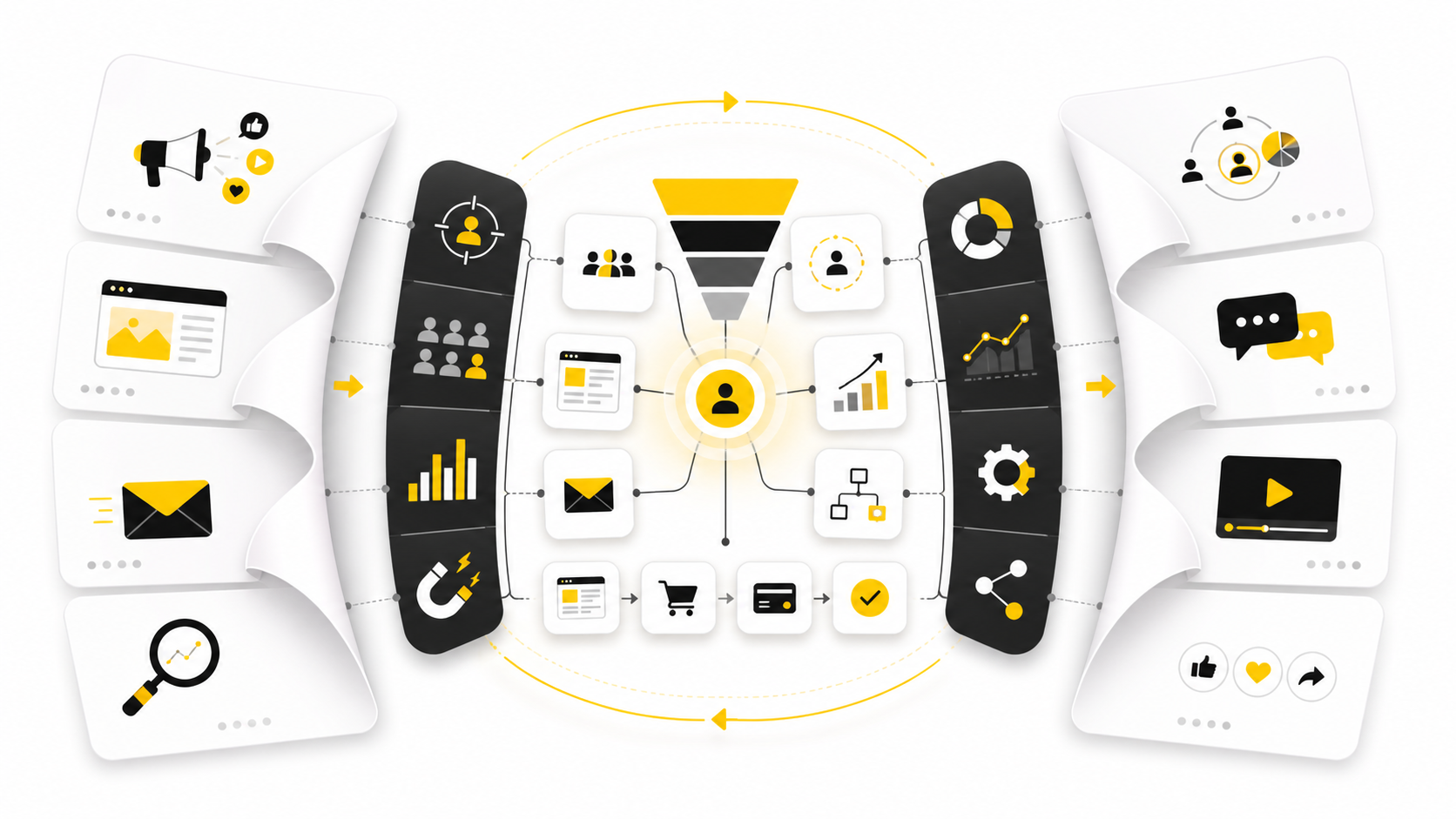
Digital marketing gets messy when people treat it like a pile of tactics. One week it is SEO. The next week it is paid ads. Then it becomes email, AI, funnels, creators, landing pages, analytics, automation, and a dozen tools nobody has fully connected.
The more carefully move is to completely peel digital marketing back to the operating system underneath it. Not the hacks. Not the trend of the week. The system: who you are trying to reach, what they need to believe, where they meet you, how they move forward, and what data tells you whether the whole thing is working.
This full article is split into six parts so the strategy builds in the right order. The point is not to memorize every digital marketing channel. The point is to understand how the pieces connect, so you can make better decisions faster.
Each part will use the same practical structure: what the concept means, why it matters, how it works in the real world, and what to do next. That matters because digital marketing is not one channel. It is a connected growth system.
Why Completely Peeling Digital Marketing Matters
Most businesses do not fail at digital marketing because they lack effort. They fail because they confuse activity with progress. Posting more, launching more ads, sending more emails, or rebuilding a website will not fix a weak offer, unclear positioning, poor tracking, or a broken follow-up system.
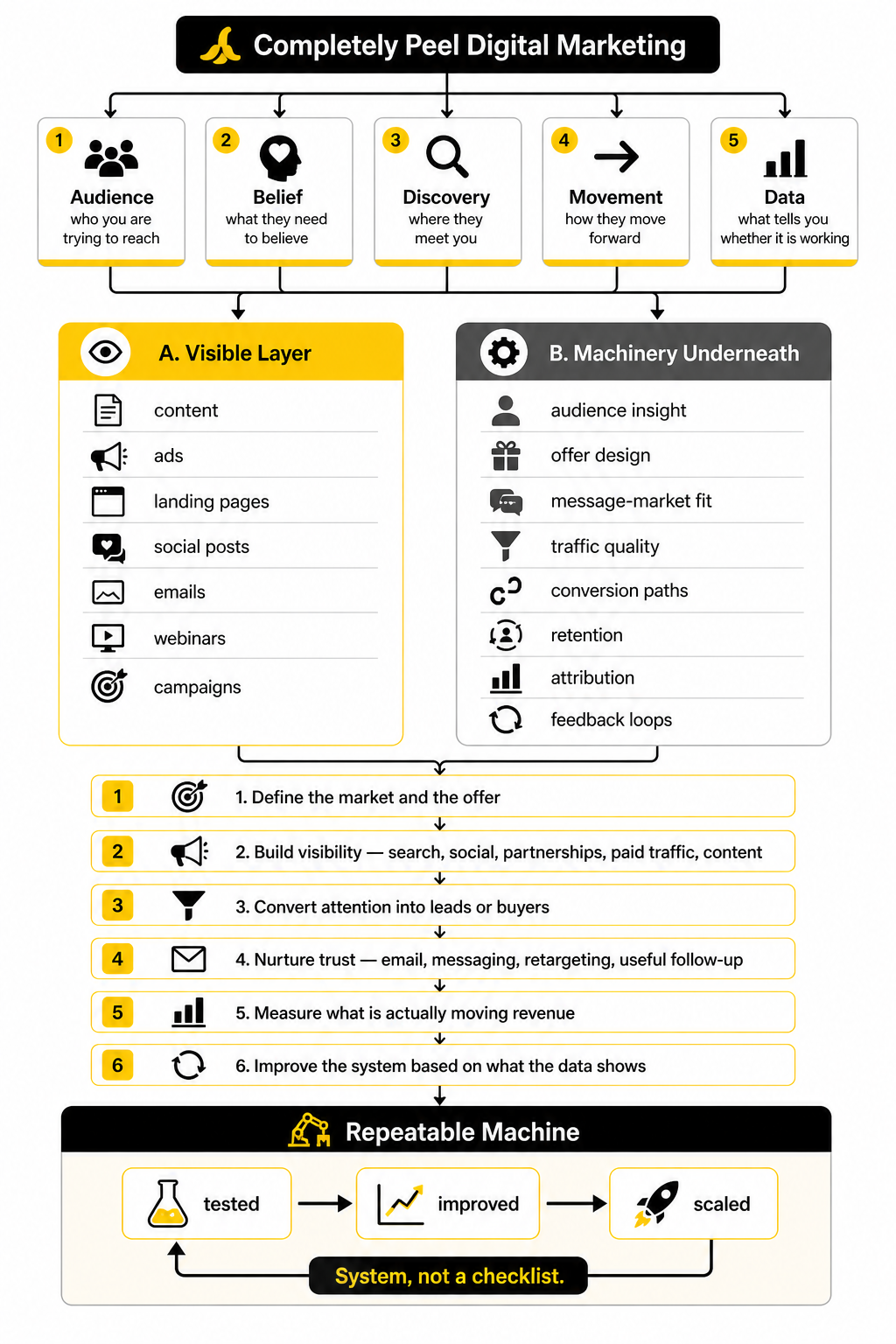
To completely peel digital marketing, you have to separate the visible layer from the real machinery underneath. The visible layer is content, ads, landing pages, social posts, emails, webinars, and campaigns. The machinery is audience insight, offer design, message-market fit, traffic quality, conversion paths, retention, attribution, and feedback loops.
That distinction is important because digital marketing rewards alignment. A strong campaign with a weak landing page leaks money. A great lead magnet with no nurture sequence wastes attention. A smart content strategy with no conversion path builds an audience but not a business.
The Digital Marketing Framework Overview
A useful framework starts with the customer journey, not with the channel. People do not wake up wanting to be “in a funnel.” They notice a problem, look for better options, compare trust signals, take action, and then decide whether the experience was good enough to continue.
That journey can be simplified into six connected layers. First, you define the market and the offer. Second, you build visibility through search, social, partnerships, paid traffic, and content. Third, you convert attention into leads or buyers. Fourth, you nurture trust with email, messaging, retargeting, and useful follow-up. Fifth, you measure what is actually moving revenue. Sixth, you improve the system based on what the data shows.
This is where tools can help, but only after the strategy is clear. A platform like GoHighLevel can support funnels, CRM, automation, and follow-up in one place. A tool like ManyChat can help turn social conversations into structured messaging flows when that fits the customer journey. The tool is not the strategy, but the right tool can make the strategy easier to execute.
The Core Idea Behind The Six-Part System
The entire article comes back to one idea: digital marketing should be built like a system, not a checklist. A checklist asks whether you are doing SEO, ads, email, social, analytics, and automation. A system asks whether those pieces create a clear path from stranger to customer to repeat buyer.
That shift changes how you make decisions. Instead of asking, “Should we post more on social?” you ask, “Which audience segment are we trying to reach, what belief are we trying to build, and what next step should the content create?” Instead of asking, “Should we run ads?” you ask, “Do we have an offer, page, follow-up sequence, and tracking setup strong enough to buy traffic responsibly?”
This is the difference between random marketing and professional implementation. Random marketing creates noise. Professional implementation creates a repeatable machine that can be tested, improved, and scaled.
The Digital Marketing Framework Overview
The framework starts with a simple rule: do not choose channels before you understand the journey. Search, social, email, paid ads, landing pages, chat, SMS, webinars, and retargeting are not separate games. They are touchpoints inside one decision path.
That is why the old linear funnel is too limited for most modern buyers. People move between search results, social proof, creator content, reviews, comparison pages, email reminders, and direct conversations before they act. A recent BCG analysis on moving beyond the linear funnel makes the same point: marketers need to understand which touchpoints influence specific journeys instead of treating awareness, consideration, and conversion as clean separate boxes in a slide deck.
When you completely peel digital marketing, the framework becomes easier to see. Every serious system needs five layers: positioning, traffic, conversion, nurture, and optimization. Miss one layer and the rest of the machine has to compensate, usually with more budget, more content, or more pressure on a sales team.
Layer 1: Positioning
Positioning is the foundation because it tells the market why your offer deserves attention. It defines who the offer is for, what problem it solves, why the timing matters, and why the buyer should trust you over every other option. Without this, every channel becomes harder because the message is too vague to travel.
Strong positioning does not mean sounding clever. It means being clear enough that the right person understands the value quickly. If someone lands on your page, reads your ad, watches your video, or opens your email, they should know what you do, who it helps, and what outcome they can reasonably expect.
This is also where many businesses accidentally weaken their marketing. They try to speak to everyone, so the message becomes generic. Then they blame the channel when the real problem is that the market cannot immediately see why the offer matters.
Layer 2: Traffic
Traffic is attention with a source attached to it. Organic search, paid search, social media, short-form video, partnerships, newsletters, communities, affiliates, and creator collaborations can all work. The question is not which traffic source is “best.” The question is which traffic source matches the buyer’s intent, problem awareness, and decision stage.
Search traffic often works well when people already know what they want or are actively comparing options. Social traffic can work when education, trust, repetition, or desire-building matters more than immediate intent. Paid traffic can speed up testing, but only when the offer, page, and follow-up are strong enough to turn bought attention into measurable outcomes.
This is why traffic strategy should never be separated from conversion strategy. More visitors do not automatically mean more revenue. More qualified visitors moving into a clear next step is what actually matters.
Layer 3: Conversion
Conversion is where attention becomes action. That action might be a purchase, booked call, email signup, quiz completion, demo request, trial start, webinar registration, or direct message. The exact conversion goal depends on the business model, but the principle stays the same: the next step must feel obvious, useful, and low-friction.
A conversion path needs three things. It needs a strong promise, enough proof to reduce doubt, and a clear action that matches the visitor’s level of readiness. When those pieces are missing, people hesitate, bounce, or tell themselves they will come back later.
Landing page builders and funnel tools are useful here when they help you test fast without turning every change into a development project. For example, ClickFunnels can make sense for direct-response funnels, while Replo fits brands that need ecommerce landing pages with more design control. The tool choice should follow the conversion goal, not the other way around.
Layer 4: Nurture
Nurture is the part most businesses underbuild. Someone shows interest, but they are not ready today. If the only plan is “hope they remember us,” the business is leaving money on the table.
Good nurture creates useful repetition. It answers objections, builds trust, shows proof, explains the offer, and gives people a reason to take the next step when the timing becomes right. This can happen through email, SMS, retargeting, community, chat automation, sales follow-up, or a mix of those channels.
Email still matters because it gives you a direct relationship that is not fully controlled by an algorithm. Messaging can also be powerful when the journey starts on social or when quick replies matter. A platform like ManyChat is useful when conversations from Instagram, Messenger, or WhatsApp need to become structured follow-up instead of disappearing into a busy inbox.
Layer 5: Optimization
Optimization is where digital marketing becomes a professional system instead of a creative guessing game. You look at what people saw, clicked, ignored, joined, bought, abandoned, replied to, and repeated. Then you improve the weakest constraint.
This is not just about dashboards. A dashboard can show a drop in conversion rate, but it will not automatically explain whether the issue is traffic quality, page clarity, offer strength, proof, pricing, speed, follow-up, or sales handling. The marketer’s job is to connect the numbers to real buyer behavior.
Modern marketing teams are also under more pressure to use customer data intelligently. Salesforce’s State of Marketing research is based on insights from nearly 4,500 marketers worldwide, and its core theme is clear: AI, data, and personalization are becoming central to how teams plan and execute marketing. That does not mean every business needs a complicated AI stack. It means your data should help you make better decisions, not just decorate reports.
How The Framework Works In Practice
The clean version looks like this: positioning creates clarity, traffic creates attention, conversion captures demand, nurture builds trust, and optimization improves the whole loop. That is the framework. Simple does not mean easy, but it does mean you can diagnose problems without panicking.
If traffic is low, you look at visibility and distribution. If traffic is strong but conversions are weak, you inspect the page, offer, proof, and call to action. If leads are coming in but sales are slow, you look at nurture, qualification, speed to lead, and sales follow-up. If sales happen once but customers do not come back, you look at onboarding, retention, upsells, experience, and lifecycle communication.
This is the real value of learning to completely peel digital marketing. You stop treating every problem like a content problem or an ad problem. You start asking which layer is underperforming and what evidence proves it.
Why The Customer Journey Comes First
Customer journey research has grown because buying behavior is fragmented. A 2024 systematic review on customer journey research mapped the field from 2001 to 2023 and highlighted how broad, multi-stage, and cross-touchpoint the topic has become. In plain English: customers do not experience your marketing in neat departments.
A buyer might discover you through a short video, search your brand two days later, read a comparison article, check reviews, join your email list, ignore three messages, click the fourth, visit a landing page, leave, see retargeting, and finally buy after a direct recommendation. If your marketing plan only measures the final click, you miss most of the journey that created the sale. If your plan only focuses on awareness, you miss the moment when the buyer needed a stronger reason to act.
That is why the framework has to stay customer-led. The business can decide what it wants to sell, but the market decides how trust is built. Better marketing comes from respecting that journey and designing each touchpoint to move the buyer one step closer.
The Role Of Tools In The Framework
Tools matter, but they should never be the starting point. A CRM will not fix unclear positioning. A funnel builder will not save a weak offer. An email platform will not help much if the list is full of the wrong people.
The right tool should support a specific job inside the framework. GoHighLevel can be useful when a business needs CRM, funnels, appointments, automation, and follow-up under one roof. Systeme.io can fit simpler funnel, email, and course setups where speed and affordability matter. Brevo can make sense when email and customer communication are the main operational need.
The practical rule is simple. Pick tools after you define the journey, not before. Otherwise, you end up building around software features instead of buyer behavior.
The Framework Checklist
A useful framework should make decisions easier, so here is the stripped-down version. Use it before launching a campaign, rebuilding a website, hiring an agency, or buying another tool.
This is the point where digital marketing starts to feel less chaotic. You are not chasing every trend. You are building a system where every channel has a job, every tool has a reason, and every campaign connects back to the buyer’s next decision.
The Core Components Of Digital Marketing
Once the framework is clear, the next step is execution. This is where most teams either build momentum or create a mess. A strategy only becomes useful when it turns into repeatable actions that move the right people from attention to trust to conversion.
To completely peel digital marketing at the implementation level, you need to work through the core components in the right order. That order matters because each component depends on the one before it. If the offer is unclear, the landing page struggles. If the landing page is weak, paid traffic becomes expensive. If follow-up is missing, even good leads cool down before they buy.
The practical process is not complicated. You define the offer, map the journey, build the conversion path, create the content and traffic plan, connect follow-up, then measure the results. That gives every campaign a job instead of letting channels compete for attention.
Start With The Offer
The offer is not just the product or service. It is the specific outcome, promise, package, price, proof, risk reduction, and next step you put in front of the market. If this part is weak, everything downstream has to work harder than it should.
A strong offer answers the buyer’s private questions before they ask them. Why should I care? Why now? Why this solution? Why this company? What happens after I click, book, buy, or reply? These questions shape the copy, the page structure, the lead magnet, the follow-up sequence, and the sales conversation.
This is why offer work should happen before channel work. You can have a clean ad account, a beautiful landing page, and a smart email sequence, but none of it fixes an offer people do not understand. The offer is the thing the whole system is trying to move.
Map The Buyer Journey Before Building Assets
The buyer journey turns your marketing from a pile of assets into a connected path. It shows what the customer needs to believe at each stage and what touchpoint should help them move forward. Without this map, teams often create content, ads, emails, and pages that look busy but do not connect.
A practical buyer journey has four moments. First, the buyer notices the problem. Second, they start comparing possible solutions. Third, they need proof that your offer is credible. Fourth, they need a clear reason to act now instead of postponing the decision.
Customer journey research has become more important because people move across many touchpoints before making decisions. A 2024 research review on customer journeys describes the field as fragmented across stages, channels, and touchpoints, which is exactly why marketers need a clear operating map instead of relying on one isolated campaign.
Build The Conversion Path
The conversion path is the route from attention to action. It might be an ad to a landing page, a search visit to a lead form, a social post to a direct message, a webinar to a checkout, or a newsletter to a booked call. The channel can change, but the job stays the same: reduce confusion and make the next step feel obvious.
This path needs a page or interaction that does three things well. It must restate the promise clearly, prove that the promise is believable, and make the next action easy. If the visitor has to work too hard to understand the offer, the page is not doing its job.
The execution tool should match the path. A direct-response campaign may fit ClickFunnels, while ecommerce teams that need sharper landing page control may prefer Replo. If the conversion path starts with a quiz, form, or application, Fillout can be useful because the form itself becomes part of the qualification process.
Turn The Process Into A Repeatable Build
This is where the work becomes tangible. You are no longer talking about “doing digital marketing.” You are building a sequence of assets and actions that can be launched, measured, and improved.
A clean implementation process looks like this:
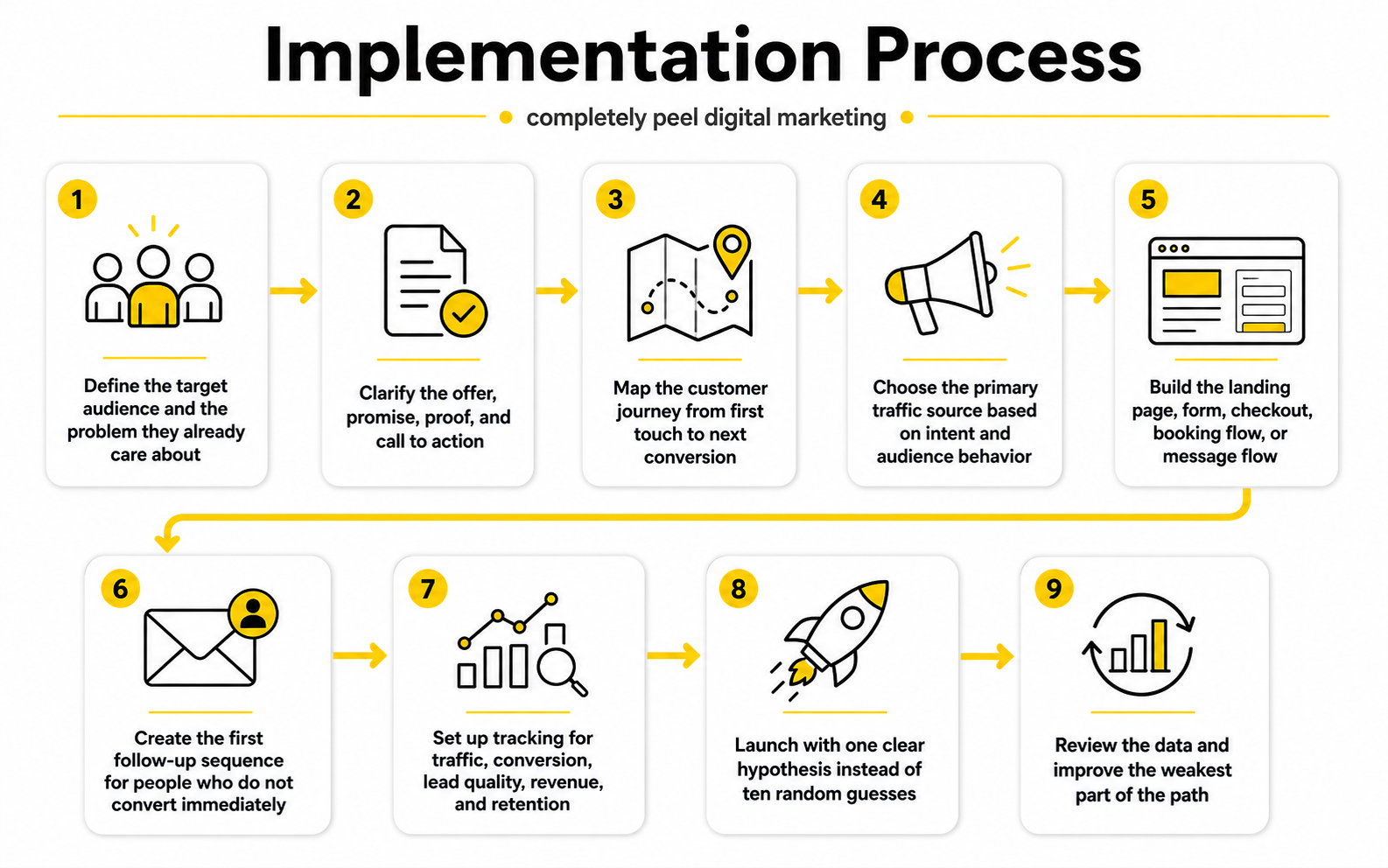
This process keeps the team focused. Instead of debating channels in the abstract, you can see exactly where the campaign is strong and where it is fragile. That is how you completely peel digital marketing without getting trapped in theory.
Create The Content And Traffic Plan
Content and traffic should be built around buyer intent. Some people are searching because they already want a solution. Others need education before they trust the category. Others know the problem but do not yet believe your approach is the right one.
This means content needs different jobs. Search content can capture demand. Social content can create familiarity and shape beliefs. Email content can deepen trust. Retargeting can bring people back when they showed interest but did not act. None of these pieces should exist just because a content calendar needed another post.
A simple traffic plan chooses one primary acquisition channel and one support channel first. For example, a service business might start with search and email. An ecommerce brand might use paid social and landing pages. A creator-led business might use short-form content and automated messaging. Tools like Buffer can help organize publishing, but the strategy still has to decide what each piece of content is supposed to move.
Connect Follow-Up Before You Launch
Follow-up should be built before traffic starts. This sounds obvious, but many campaigns launch with a page and no real plan for what happens after someone opts in, books, abandons checkout, replies, or goes quiet. That is a painful way to waste attention.
The first follow-up sequence does not need to be complicated. It should confirm the action, deliver what was promised, answer the most likely objection, show proof, and guide the person toward the next logical step. If the offer has a longer decision cycle, the sequence should also include education, comparison, and timing-based reminders.
This is where marketing automation becomes useful. GoHighLevel can help connect CRM, pipelines, appointments, forms, and follow-up when the business needs one system for leads and sales activity. Brevo can work well when email and customer communication are the main focus. The point is not to automate everything. The point is to make sure interested people do not disappear because nobody followed up properly.
Set Up Measurement Before The Campaign Goes Live
Measurement should not be added after launch. It should be part of the build. You need to know what counts as success before traffic, content, email, and sales activity start producing noise.
The basic measurement setup should track the path, not just the final result. That means source, page visit, opt-in, booking, checkout, reply, qualified lead, sale, revenue, refund, and repeat purchase where relevant. A campaign with low sales might still have strong lead quality but weak sales follow-up. Another campaign might have high opt-ins but poor qualification. You only see the difference when the measurement follows the journey.
This matters even more as acquisition costs and conversion pressure rise. Contentsquare’s 2025 digital experience benchmark data reported a 6.1 percent drop in conversions while businesses were paying more for online customers. That is the exact environment where sloppy tracking gets expensive fast.
Use AI And Automation Where They Remove Friction
AI is useful when it speeds up research, drafting, segmentation, testing, analysis, support, or personalization. It becomes dangerous when it replaces judgment. The best use of AI in digital marketing is not to produce more random content. It is to help the team make the system faster, sharper, and easier to maintain.
For implementation, AI can help summarize customer research, generate first-draft page angles, turn sales calls into objection lists, create email variations, score lead quality, and identify patterns in campaign data. Salesforce’s State of Marketing research is based on nearly 4,500 marketers worldwide and highlights AI, data, and personalization as major priorities, which reflects where professional teams are putting their attention.
The practical rule is simple. Use AI where the input is clear and the output can be reviewed. Do not let it invent strategy, proof, claims, testimonials, or results. That keeps the work faster without making the marketing less trustworthy.
Build The First Version, Then Improve The Constraint
The first version of a campaign should be clean, measurable, and focused. It does not need to be perfect. It needs to be good enough to test one serious hypothesis about the audience, offer, traffic source, and conversion path.
After launch, the job is to find the constraint. If the right people are not arriving, fix traffic. If they arrive but do not act, fix the offer or page. If they opt in but do not buy, fix nurture, qualification, or sales follow-up. If they buy once but do not return, fix onboarding, retention, and lifecycle communication.
This is the implementation mindset that separates professionals from dabblers. You are not constantly rebuilding everything. You are improving the part of the system that is currently limiting growth.
Statistics And Data
Measurement is where digital marketing stops being opinion-based. A campaign can feel strong, look polished, and still fail quietly because the wrong people are clicking, the page is not converting, the follow-up is too slow, or the economics do not work. Data does not replace judgment, but it does stop you from lying to yourself.
The mistake is treating statistics like decorations. A benchmark only matters when it helps you make a decision. If your conversion rate is below a useful range, the action is not to panic. The action is to inspect the audience, offer, page, proof, friction, and follow-up in that order.
This is why you need to completely peel digital marketing down to performance signals. Do not ask, “Are the numbers good?” Ask, “What are the numbers telling us to fix next?” That one question changes the entire conversation.
The Numbers That Actually Matter
Most dashboards show too much and explain too little. Impressions, clicks, likes, views, opens, bounce rate, cost per click, conversion rate, lead quality, revenue, and lifetime value can all be useful. But they are not equally important at every stage.
At the top of the journey, reach and click-through rate can show whether the message is getting attention. In the middle, landing page conversion, form completion, replies, booked calls, and email engagement show whether people are taking the next step. At the bottom, close rate, average order value, cost per acquisition, payback period, refund rate, and repeat purchase rate show whether the business model is healthy.
The key is to connect each metric to a decision. A low click-through rate may mean the hook is weak or the audience is wrong. A high click-through rate with poor conversion may mean the promise attracts curiosity but not qualified demand. A strong opt-in rate with weak sales may mean the lead magnet is too broad, the offer is misaligned, or the nurture sequence is not doing enough work.
Benchmarks Are Context, Not Targets
Benchmarks are useful because they stop you from working in a vacuum. They give you a rough sense of what other teams are seeing across channels, customer journeys, and digital experiences. But benchmarks should never become the strategy.
The same conversion rate can mean different things in different businesses. A low-ticket ecommerce offer, a high-ticket consulting call, a local service booking, and a B2B demo request should not be judged by the same number. Intent, price, traffic source, sales cycle, trust level, and urgency all change what “good” looks like.
Use benchmarks as a diagnostic tool, not a scoreboard. If your numbers are far below the market, investigate the obvious constraints. If they are above average but the business is still not profitable, the problem may be economics, retention, fulfillment, or customer quality rather than front-end conversion.
Build A Measurement System Before You Optimize
The best analytics setup follows the customer journey. It does not just track isolated events. It shows how people move from first touch to meaningful outcome.
A practical measurement system should answer five questions. Where did the visitor come from? What did they see? What action did they take? Did that action become a qualified opportunity or sale? Did the customer create enough value to justify the cost of acquisition?
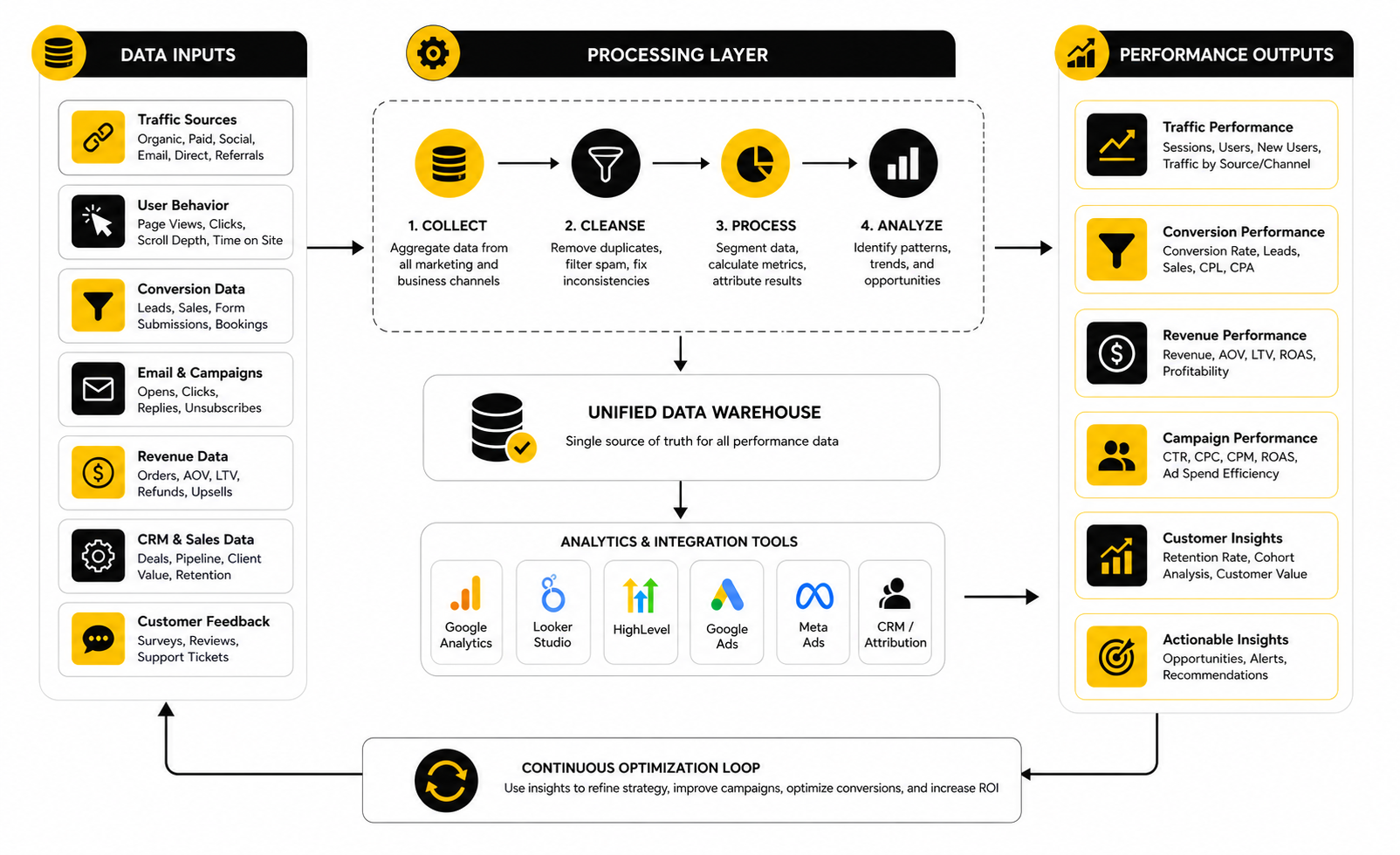
This is where tools and process need to work together. If your traffic platform, landing page, CRM, email system, and sales pipeline do not share enough context, you end up with disconnected numbers. A platform like GoHighLevel can help when a business needs forms, funnels, calendars, CRM, pipelines, automation, and follow-up in one connected place. That matters because measurement becomes much cleaner when the journey is not scattered across five systems with no shared view.
Track Leading And Lagging Indicators
Lagging indicators tell you what already happened. Revenue, profit, sales, refunds, churn, and repeat purchases are lagging indicators. They matter most, but they arrive after the customer has already moved through the system.
Leading indicators show whether the system is likely to produce results before the final numbers arrive. Click-through rate, landing page engagement, form completion, email replies, booked calls, show-up rate, qualified lead rate, and pipeline movement can all reveal problems earlier. They are not the final scoreboard, but they help you avoid waiting too long to act.
A good marketer watches both. If leading indicators are healthy but sales are weak, the sales process or offer economics may need attention. If leading indicators are weak from the start, the problem is probably higher in the journey: audience, message, creative, traffic source, or conversion path.
Read Conversion Rate With Caution
Conversion rate is one of the most misunderstood metrics in digital marketing. It looks simple, but it can hide quality problems. A page can convert well and still produce poor customers if the promise is too broad or the qualification is too loose.
The better question is not just “What percentage converted?” The better question is “Who converted, why did they convert, and what happened after?” A form that captures fewer but better leads may outperform a form that captures everyone. A checkout that filters out poor-fit buyers may protect support costs, refund rates, and customer satisfaction.
This is why conversion rate should be paired with quality metrics. For lead generation, that means qualified lead rate, booked call rate, show-up rate, close rate, and revenue per lead. For ecommerce, that means average order value, refund rate, repeat purchase rate, contribution margin, and customer lifetime value.
Measure Traffic Quality, Not Just Traffic Volume
Traffic volume can create false confidence. A spike in visitors looks exciting until you realize the visitors are not staying, clicking, opting in, buying, or returning. More traffic only matters when it brings more of the right people into the journey.
Traffic quality shows up in behavior. Look at scroll depth, engaged sessions, product views, form starts, form completions, add-to-cart rate, checkout starts, replies, bookings, and downstream sales quality. If one source has cheaper clicks but weaker leads, it may cost more in the end. If another source has expensive clicks but better conversion and retention, it may be the stronger channel.
This is where completely peel digital marketing becomes more than a phrase. You are peeling away vanity metrics until you see the economics underneath. The goal is not cheaper attention. The goal is profitable attention.
What Performance Signals Mean
Every metric is a signal, not a verdict. A weak number tells you where to look. It does not automatically tell you what to change.
If impressions are high but clicks are low, the market is seeing the message but not feeling enough reason to act. That points to creative, headline, offer angle, audience targeting, or channel mismatch. The first action is to test a sharper promise or a more specific audience segment before rebuilding the whole funnel.
If clicks are strong but conversions are weak, the issue is probably after the click. The page may not match the ad, the promise may be unclear, the proof may be thin, or the next step may feel too risky. The action is to compare message match, page structure, call to action, friction, and trust signals.
If leads are strong but sales are weak, the issue is usually qualification, nurture, or sales follow-up. Maybe the lead magnet attracts curious people instead of buyers. Maybe the follow-up waits too long. Maybe the sales conversation does not connect the original promise to the buyer’s actual problem.
The Analytics Review Rhythm
A good analytics rhythm keeps you from overreacting. Daily checks are useful for spotting tracking errors, spend spikes, broken pages, or sudden drops. Weekly reviews are better for diagnosing campaign performance. Monthly reviews are better for understanding strategy, economics, and channel direction.
For active campaigns, weekly review is usually the sweet spot. You can compare traffic, conversion, lead quality, cost, and revenue without making dramatic changes based on one weird day. That rhythm also helps the team learn faster because every test has a clear hypothesis, result, and next action.
The review should be practical. What changed? What improved? What got worse? What is the current constraint? What is the next test? If a dashboard does not help answer those questions, it is probably too noisy.
Use Data To Decide What To Fix First
The fastest way to improve a campaign is to fix the biggest constraint, not the easiest task. Teams often redesign graphics, rewrite small pieces of copy, or switch tools because those changes feel productive. But if the real constraint is offer clarity, lead quality, or follow-up speed, those surface changes will not move much.
A simple priority model helps. Start with the metric closest to revenue that is clearly underperforming. Then move backward through the journey until you find the first major leak. If sales are weak, inspect close rate and lead quality before blaming traffic. If qualified leads are weak, inspect the offer, page, form, and source. If visitors are weak, inspect channel choice, creative, and distribution.
This keeps optimization grounded. You are not trying to improve everything at once. You are improving the one part of the system that can build the next level of performance.
When A Metric Should Trigger Action
Not every movement deserves a reaction. A small change in click-through rate over a tiny sample is not a crisis. A sudden tracking break, a major conversion drop, or a consistent quality decline deserves attention.
Use action thresholds. For example, if cost per qualified lead rises beyond the target range for two review cycles, inspect traffic quality and conversion path. If booked calls increase but show-up rate drops, inspect reminders, qualification, and calendar friction. If email opens look fine but clicks and replies are weak, inspect the offer, timing, and call to action.
This is also where automation can help. A CRM or email platform can trigger follow-up, reminders, pipeline updates, and re-engagement sequences when people take or miss key actions. Brevo can support email and customer communication workflows, while ManyChat can help when the key action starts in social messaging. The point is to turn important signals into timely responses.
The Data Stack Should Stay Simple
You do not need a huge analytics stack to make better decisions. You need clean tracking, a reliable source of truth, and a regular review process. Complexity becomes a problem when the team spends more time maintaining reports than improving the customer journey.
For many businesses, the basic stack is enough. Use analytics to understand site behavior, ad platforms to understand traffic costs, a CRM to understand lead and sales quality, and email or messaging tools to understand nurture performance. Then bring the numbers together in a simple weekly view.
A simple data stack works because the goal is clarity. You want to know where attention comes from, where people drop off, which leads are worth pursuing, which offers produce revenue, and which customers stay. Everything else is secondary until the core system is reliable.
Data Without Interpretation Is Just Noise
The real skill is not collecting more numbers. The real skill is interpreting them correctly. That means understanding the difference between attention, intent, trust, demand, qualification, and revenue.
A high-performing digital marketing system does not optimize every metric equally. It protects the metrics that matter most to the business model. A campaign that creates fewer but better customers may be stronger than one that creates more leads with weak intent. A slower funnel with higher average order value and stronger retention may be better than a fast funnel that attracts refund-prone buyers.
This is why measurement belongs at the center of the article, not at the end. When you completely peel digital marketing, the data tells you whether the strategy is becoming a real growth system. More importantly, it tells you what to do next.
Scaling Without Breaking The System
Scaling digital marketing is not just spending more money or publishing more content. Scaling means increasing volume while protecting quality, economics, trust, and operational control. If the system is fragile at a small size, scale usually makes the weakness louder.
This is why the earlier layers matter so much. Positioning, traffic, conversion, nurture, and measurement are not beginner steps you leave behind once things work. They become the guardrails that stop growth from turning into chaos.
When you completely peel digital marketing at the scaling stage, you are looking for leverage and risk at the same time. You want to know which parts can handle more volume, which parts need automation, which parts need human judgment, and which parts should not be scaled yet.
Scale The Constraint, Not The Noise
The wrong way to scale is to push every channel at once. More ads, more emails, more posts, more landing pages, more automations, and more offers can make the business feel active, but activity is not the same as control. If the team cannot explain what is driving results, scaling only creates a bigger guessing game.
The better move is to identify the current constraint and scale the thing that relieves it. If demand is strong but sales capacity is limited, the constraint may be qualification, scheduling, or sales follow-up. If traffic is strong but conversion is weak, the constraint may be offer clarity or page friction. If conversion is strong but retention is weak, the constraint may be onboarding or customer success.
This keeps growth practical. You are not trying to “do more marketing.” You are increasing the capacity of the part of the system that is already proving it can create value.
Advanced Channel Tradeoffs
Every channel has a tradeoff. Paid traffic gives speed, but it can expose weak economics fast. Organic search compounds over time, but it usually takes longer to build. Social content can create demand and trust, but it can also reward entertainment over buying intent.
The right channel depends on the business model. A high-ticket service often needs trust, qualification, and speed to lead. A low-ticket digital product may need volume, clear funnels, and tight checkout flow. An ecommerce brand may need creative testing, product-page strength, repeat purchase strategy, and better post-purchase communication.
This is where expert-level marketing becomes less emotional. You do not choose a channel because it is popular. You choose it because the channel matches the buyer’s intent, the offer’s complexity, the sales cycle, and the company’s ability to execute consistently.
Paid Traffic Gives Speed But Demands Discipline
Paid traffic is useful when you need faster feedback. It can test offers, angles, landing pages, audiences, and creative much faster than waiting for organic distribution. But paid traffic is also brutally honest because weak conversion and poor retention become expensive quickly.
Before increasing spend, the business should know its acceptable cost per lead, cost per acquisition, payback period, average order value, and customer lifetime value. Without those numbers, ad scaling becomes gambling with dashboards. You might see sales coming in and still be losing money once refunds, fulfillment, support, and churn are included.
Paid traffic also needs creative depth. One winning ad rarely stays strong forever. The more serious the scale, the more the team needs a process for testing angles, hooks, proof, landing pages, and follow-up sequences without changing everything randomly.
Organic Channels Build Trust But Need Patience
Organic marketing is slower, but it can create durable advantage. Search content, YouTube, newsletters, social content, communities, partnerships, and founder-led content can build trust before someone is ready to buy. That trust often makes conversion easier later.
The risk is that organic work can become unfocused. A team can spend months publishing content that attracts the wrong audience, answers low-value questions, or never connects to an offer. That is not brand building. That is unpaid content production with no commercial spine.
The fix is to connect every organic effort to buyer intent. Some content should capture existing demand. Some should create belief. Some should handle objections. Some should compare options. Some should move people into email, a booking flow, a product page, or a direct conversation.
Automation Should Protect The Human Experience
Automation is powerful when it removes friction. It can send reminders, segment leads, deliver resources, trigger follow-up, update pipelines, route inquiries, and recover abandoned journeys. Used well, it makes the customer experience feel faster and more consistent.
The danger is automating before the journey is understood. A bad sequence sent automatically is still a bad sequence. A chatbot that blocks people from getting help is not efficiency. A CRM full of messy fields, duplicate contacts, and unclear statuses creates confusion faster than a spreadsheet ever could.
Automation should support the buyer’s next best step. If someone books a call, send useful preparation and reminders. If someone downloads a guide, follow up with context and a relevant offer. If someone starts a checkout and stops, make it easy to return. Platforms like GoHighLevel, ManyChat, and Brevo can help, but the workflow still needs a real strategy behind it.
Segment Before You Personalize
Personalization is not just adding a first name to an email. Real personalization means changing the message, timing, offer, or next step based on what the person has shown you. That only works when segmentation is clean.
Start with simple segments. Separate new leads from active opportunities. Separate buyers from non-buyers. Separate high-intent actions from casual engagement. Separate customers by offer, problem, lifecycle stage, or purchase behavior when the data supports it.
This matters because different people need different communication. A new subscriber may need education. A booked lead may need confidence and reminders. A customer may need onboarding, usage help, and expansion offers. A past buyer may need reactivation instead of another generic promotion.
The Risk Of Tool-Driven Strategy
Tools can make execution easier, but they can also create strategic laziness. It is tempting to buy a platform and assume the system will appear. It will not. Software gives you capabilities, not clarity.
A funnel builder does not decide the offer. A CRM does not define qualification. An email tool does not know your buyer’s objections. An AI assistant does not understand your proof unless you give it accurate inputs. The marketer still has to define the logic.
The best tool stack is boring in the right way. It helps the team capture demand, follow up quickly, understand performance, and improve the customer journey without creating unnecessary complexity. If a tool adds more maintenance than momentum, it may not belong in the stack yet.
Avoid Stack Creep
Stack creep happens when every new problem gets a new software subscription. One tool for forms. One for pages. One for email. One for SMS. One for analytics. One for scheduling. One for CRM. One for automation. Soon nobody knows where the truth lives.
This creates hidden costs. Data gets scattered. Reporting gets messy. Customers receive inconsistent messages. Team members waste time moving information between systems instead of improving the journey.
The fix is not always an all-in-one platform, but the system needs a clear source of truth. For some teams, GoHighLevel makes sense because it combines several operational pieces. For others, a leaner setup with Systeme.io, Fillout, and a dedicated email platform may be enough. The right answer is the one that supports the journey without slowing the team down.
Privacy, Trust, And First-Party Data
Digital marketing is becoming more privacy-sensitive, and that is not a temporary trend. Buyers expect relevance, but they also expect control. Platforms are changing tracking rules, regulators are paying attention, and users are more aware of how their data is used.
That means first-party data matters more. Email subscribers, customers, booked calls, quiz answers, purchase history, product usage, survey responses, and direct conversations are more valuable than rented targeting alone. This does not mean you should collect everything. It means you should collect useful data with a clear reason.
Trust is part of the conversion system. If people feel tricked, over-tracked, or pushed into unclear consent, the brand pays for it later. Better marketing makes the value exchange obvious: here is what you get, here is what we collect, and here is why it improves your experience.
Data Quality Beats Data Volume
More data is not automatically better. Bad data creates bad segmentation, bad automation, bad reporting, and bad decisions. A database full of unqualified leads can look impressive while quietly hurting deliverability, sales focus, and campaign analysis.
Data quality starts at the capture point. Forms should ask for what the business actually uses. Tags and pipeline stages should mean something. Lead sources should be consistent. Purchase and conversion events should be tracked in a way the team can trust.
This becomes more important as AI enters the stack. AI tools can summarize, segment, draft, score, and recommend, but they are only as useful as the data they receive. If the inputs are messy, the output will be confident and wrong.
AI As A Strategic Multiplier
AI can speed up digital marketing, but it should not replace thinking. It is strong at pattern recognition, drafting, summarizing, repurposing, organizing research, and creating variations. It is weaker when asked to invent proof, understand nuance without context, or make strategic calls without business constraints.
The best use of AI is to reduce manual drag inside an already clear system. Use it to turn customer interviews into themes. Use it to create first drafts of email sequences that a human edits. Use it to summarize sales objections. Use it to compare landing page angles. Use it to help analyze campaign notes and spot recurring friction.
The risk is volume without judgment. AI makes it easy to produce more content, more emails, more ads, and more pages. But if the positioning is weak, more output only spreads weak thinking faster.
Keep Human Review In The Loop
Human review is not optional when claims, offers, proof, compliance, pricing, or customer expectations are involved. A marketer needs to check whether the message is true, specific, useful, and aligned with the brand. This matters even more in regulated industries or high-trust categories.
AI can assist with speed, but accountability stays with the business. If a campaign overpromises, the customer does not blame the tool. They blame the brand. That is why the final review should always ask whether the message is accurate, clear, and fair.
A good workflow is simple. Let AI help generate options. Let the strategist choose the angle. Let the editor sharpen the message. Let performance data show what the market actually responds to.
Scaling Content Without Losing Quality
Content scale is one of the biggest traps in digital marketing. More content can create more reach, more search visibility, and more touchpoints. But it can also create thin, repetitive, forgettable material that adds no trust.
The solution is not to slow everything down forever. The solution is to scale from a strong point of view. The business should know its core beliefs, customer problems, proof points, objections, comparisons, and offer angles before producing at volume.
A practical content system uses pillars, not random topics. One pillar may educate the market. Another may compare solutions. Another may address objections. Another may show proof. Another may move people toward the offer. This gives content a strategic role instead of turning it into a publishing treadmill.
Repurpose Intelligently
Repurposing is not copying and pasting the same message everywhere. A search article, LinkedIn post, email, short video, and landing page all need different framing. The idea can stay the same, but the format should match the channel.
A strong long-form article can become social posts, email angles, video scripts, comparison sections, sales enablement notes, and retargeting ideas. A sales call objection can become an FAQ answer, a nurture email, a landing page proof block, and a short-form content hook. That is efficient because it starts from real buyer friction.
Tools can support this workflow. Buffer can help organize social publishing, while Wispr Flow can speed up drafting when ideas are easier to speak than type. The goal is not to publish everywhere. The goal is to turn strong insights into useful assets without watering them down.
When To Expand The Offer
Offer expansion is a scaling lever, but it can also create confusion. Adding services, upsells, subscriptions, templates, courses, audits, retainers, memberships, or premium packages can increase revenue. It can also split focus and make the main offer harder to understand.
The right time to expand is when the core offer is already converting and the customer journey reveals a natural next need. Customers may need implementation after buying strategy. They may need training after buying software. They may need support after buying a product. The expansion should feel like the next logical step, not a random add-on.
This is where lifecycle marketing becomes important. Instead of thinking only about the first conversion, think about the full customer relationship. What does the buyer need before purchase, during onboarding, after the first result, and when they are ready for a bigger outcome?
Protect The Main Conversion Path
Every new offer creates another decision. That can help revenue, but it can also create hesitation. If the buyer sees too many options too early, they may delay action because the path no longer feels obvious.
Keep the main conversion path clean. Use upsells, cross-sells, and expansions where they support the buyer’s momentum. Do not interrupt the first purchase with unnecessary complexity. A clear first yes is often more valuable than a crowded page trying to sell everything at once.
For funnel-heavy businesses, tools like ClickFunnels can support structured upsell paths. For simpler setups, Systeme.io may be enough to test offers, emails, and checkout flows without overcomplicating the stack.
Team Roles And Operational Ownership
As marketing grows, ownership becomes as important as strategy. Someone needs to own the offer. Someone needs to own traffic. Someone needs to own conversion. Someone needs to own nurture. Someone needs to own reporting. If nobody owns a layer, that layer slowly decays.
Small teams often have one person wearing several hats. That is fine as long as responsibilities are clear. The problem starts when everyone assumes someone else is checking tracking, fixing forms, reviewing campaigns, qualifying leads, or updating follow-up sequences.
A professional system needs operating discipline. Campaigns should have launch checklists, naming conventions, source tracking, page QA, follow-up QA, sales handoff rules, and review rhythms. This is not bureaucracy. It is how you stop growth from depending on memory and luck.
Document The System
Documentation sounds boring until something breaks. Then it becomes priceless. A clear marketing operating document can explain the funnel, channels, offers, target segments, tools, automations, tracking events, review cadence, and decision rules.
This helps new team members move faster. It helps agencies understand the business. It helps founders stop repeating the same explanation. It also makes optimization easier because the team can see what changed and why.
Documentation should stay practical. Do not create a giant manual nobody reads. Create a living system map that shows how leads enter, how they are handled, how customers buy, and how performance is reviewed.
The Expert Mindset
The advanced stage of digital marketing is not about knowing every tactic. It is about knowing what not to do yet. That is harder than it sounds because there is always another channel, tool, trend, or campaign idea asking for attention.
Experts protect focus. They know when a campaign needs more traffic and when it needs a better offer. They know when automation will help and when it will make the experience colder. They know when a benchmark is useful and when it is irrelevant. They know when to scale and when to fix the foundation first.
That is the deeper meaning of learning to completely peel digital marketing. You are not just learning how the parts work. You are learning how to make tradeoffs without losing the system.
Final Checklist And System Closeout
By this point, the message should be clear: digital marketing works best when every piece has a job. The offer creates the reason to care. The traffic source creates the first touch. The conversion path turns attention into action. The follow-up system builds trust. The measurement layer shows what to improve next.
That is the full ecosystem. Not a bag of tactics. Not a random set of tools. Not another content calendar with no connection to revenue.
When you completely peel digital marketing, the final picture becomes practical. You can see where the customer enters, what they need to believe, what action they should take, what happens if they hesitate, and how the business learns from every step.
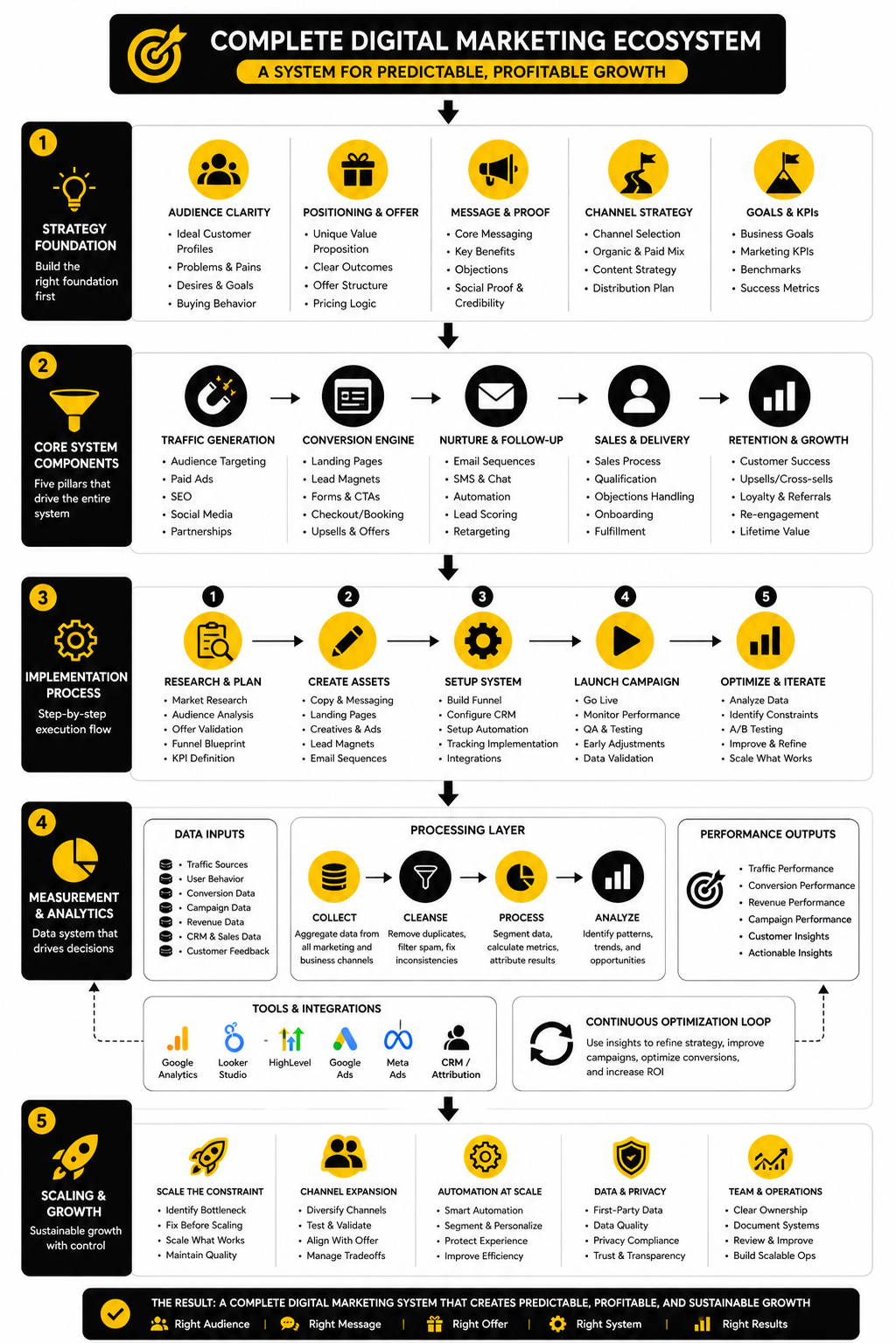
The Practical Checklist
Use this checklist before launching a campaign, rebuilding a funnel, hiring a marketer, or scaling a working channel. It keeps the system grounded and stops the team from solving the wrong problem. It also makes the next action easier because every layer is visible.
This checklist is simple on purpose. Complex marketing systems usually fail because the basics are unclear, not because the team lacked another tactic. Start with the path, then improve the path.
Common Mistakes To Avoid
One common mistake is chasing traffic before fixing the offer. This makes the business feel like it has a visibility problem when it really has a clarity problem. More people seeing a weak message does not make the message stronger.
Another mistake is treating automation like a replacement for customer understanding. Automation can help people move faster through the journey, but it cannot make a bad journey feel good. If the message is wrong, the sequence is confusing, or the offer is poorly timed, automation only spreads the problem faster.
A third mistake is judging channels too quickly. A channel may look weak because the audience is wrong, the creative is vague, the landing page does not match the promise, or the follow-up is missing. Before abandoning a channel, inspect the full path and identify the real constraint.
The Biggest Mistake
The biggest mistake is thinking digital marketing is only about acquisition. Acquisition matters, but it is only one part of the system. If buyers do not trust the brand, understand the offer, complete the next step, receive useful follow-up, or come back after purchase, the business will keep paying to replace lost attention.
That is why the full system matters. Better marketing is not just more leads. It is better-fit attention, clearer conversion, stronger relationships, cleaner measurement, and more carefully improvement.
This is also why professionals think in journeys instead of isolated campaigns. A campaign can win a click. A system wins the customer.
What does it mean to completely peel digital marketing?
To completely peel digital marketing means breaking it down past surface-level tactics and looking at the full system underneath. Instead of only thinking about ads, SEO, social media, or email, you look at positioning, offer clarity, traffic, conversion, nurture, analytics, and retention together. The goal is to understand how each part affects the buyer’s journey and the business result.
Why is digital marketing so confusing for beginners?
Digital marketing feels confusing because most advice starts with channels instead of strategy. One expert says to focus on SEO, another says paid ads, another says short-form video, and another says email automation. Those channels can all work, but they only make sense after you know the audience, offer, journey, and conversion goal.
What is the most important part of digital marketing?
The most important part is offer clarity because everything else depends on it. If the market does not understand who the offer is for, what problem it solves, and why it matters now, traffic and automation will not save the campaign. A clear offer makes ads, content, landing pages, emails, and sales conversations easier to execute.
Should I start with SEO, paid ads, or social media?
Start with the channel that best matches your buyer’s behavior and your offer’s decision cycle. SEO can work well when people are already searching for solutions. Paid ads can work when you need faster testing and have a conversion path ready. Social media can work when trust, education, personality, and repeated exposure matter before someone buys.
How do I know if my digital marketing system is working?
A digital marketing system is working when the right people are entering the journey, taking meaningful actions, becoming qualified leads or customers, and creating enough revenue to justify the effort. Do not judge the system only by impressions, clicks, likes, or email opens. Those numbers can be useful signals, but the real test is whether they connect to qualified demand and profitable outcomes.
What metrics should I track first?
Track the path from source to outcome. Start with traffic source, landing page conversion, lead quality, booked calls or checkout starts, sales, revenue, refund rate, and repeat purchase where relevant. Once those are visible, you can add supporting metrics like click-through rate, email engagement, form completion, and show-up rate.
How often should I review marketing performance?
Review active campaigns weekly, check basic health daily, and step back for a broader strategy review monthly. Daily checks are useful for spotting broken tracking, spend issues, or sudden drops. Weekly reviews are better for deciding what to test next because they reduce the chance of overreacting to one unusual day.
Where does AI fit into digital marketing?
AI fits best as a multiplier for research, drafting, analysis, segmentation, repurposing, and workflow speed. It can help summarize customer feedback, create campaign variations, draft email sequences, and spot patterns in performance data. It should not be trusted to invent proof, make unsupported claims, or replace strategic judgment.
Do small businesses need marketing automation?
Small businesses do not need complicated automation, but they do need reliable follow-up. If someone opts in, books a call, starts checkout, asks a question, or downloads a resource, the next step should not depend on memory. Simple automations for confirmation, reminders, nurture, and reactivation can protect revenue without making the experience feel robotic.
What tools are useful for building the system?
The right tool depends on the job. GoHighLevel can fit businesses that need CRM, funnels, calendars, automation, and pipeline management together. ClickFunnels can fit direct-response funnel building. ManyChat can help when social messaging is part of the journey. The tool should support the strategy, not replace it.
How do I avoid wasting money on marketing tools?
Avoid buying tools before mapping the customer journey. First define the offer, conversion path, follow-up needs, tracking requirements, and team workflow. Then choose the simplest stack that can support those requirements without creating extra maintenance.
What is the difference between a funnel and a digital marketing system?
A funnel is usually one structured path toward a specific conversion. A digital marketing system is broader because it includes the market, offer, channels, content, funnel, follow-up, measurement, retention, and optimization rhythm. Funnels are useful, but they are only one part of the system.
How do I improve a campaign that is not converting?
Start by finding the first serious leak. If the right people are not arriving, inspect the traffic source, creative, and targeting. If people arrive but do not act, inspect the offer, message match, page clarity, proof, and call to action. If leads come in but sales are weak, inspect qualification, nurture, speed to lead, and the sales process.
Can digital marketing work without paid ads?
Yes, digital marketing can work without paid ads if the business has a strong organic acquisition path. Search content, social content, partnerships, newsletters, communities, referrals, and direct outreach can all drive results. Paid ads are useful for speed and testing, but they are not mandatory for every business.
What should I do before scaling a campaign?
Before scaling, confirm that the offer converts, the leads are qualified, the economics work, the follow-up system is reliable, and the team can handle more volume. Scaling a weak system usually increases waste. Scaling a proven system can create leverage.
What is the simplest way to completely peel digital marketing for my own business?
Write down the full path from stranger to customer. Identify where people first discover you, what they need to understand, what step they should take, what happens after they show interest, and how you measure whether the journey creates revenue. Then improve the weakest layer first instead of trying to fix everything at once.
Build a stronger local presence with BAAM AI
Turn your website, Google profile, social channels, and AI visibility into one growth engine
Most businesses do not need more random marketing activity. They need a consistent presence system that helps the right people find them, trust them, and take action. BAAM AI brings strategy, local SEO, website updates, Google Maps visibility, social content, AI-search readiness, media production, and reporting into one practical monthly engine.
If you want your marketing to keep working after the campaign ends, start with a free BAAM AI presence audit. See how your business shows up today and where the fastest visibility wins are at BAAM AI.