
BAAM AI Blog
Company Social Media Strategy: A Practical Framework for Turning Attention Into Business Growth
A company social media strategy is not a posting calendar. It is the operating system that decides who your company should speak to, what it should say, where it should show up, how it should respond, and how social...
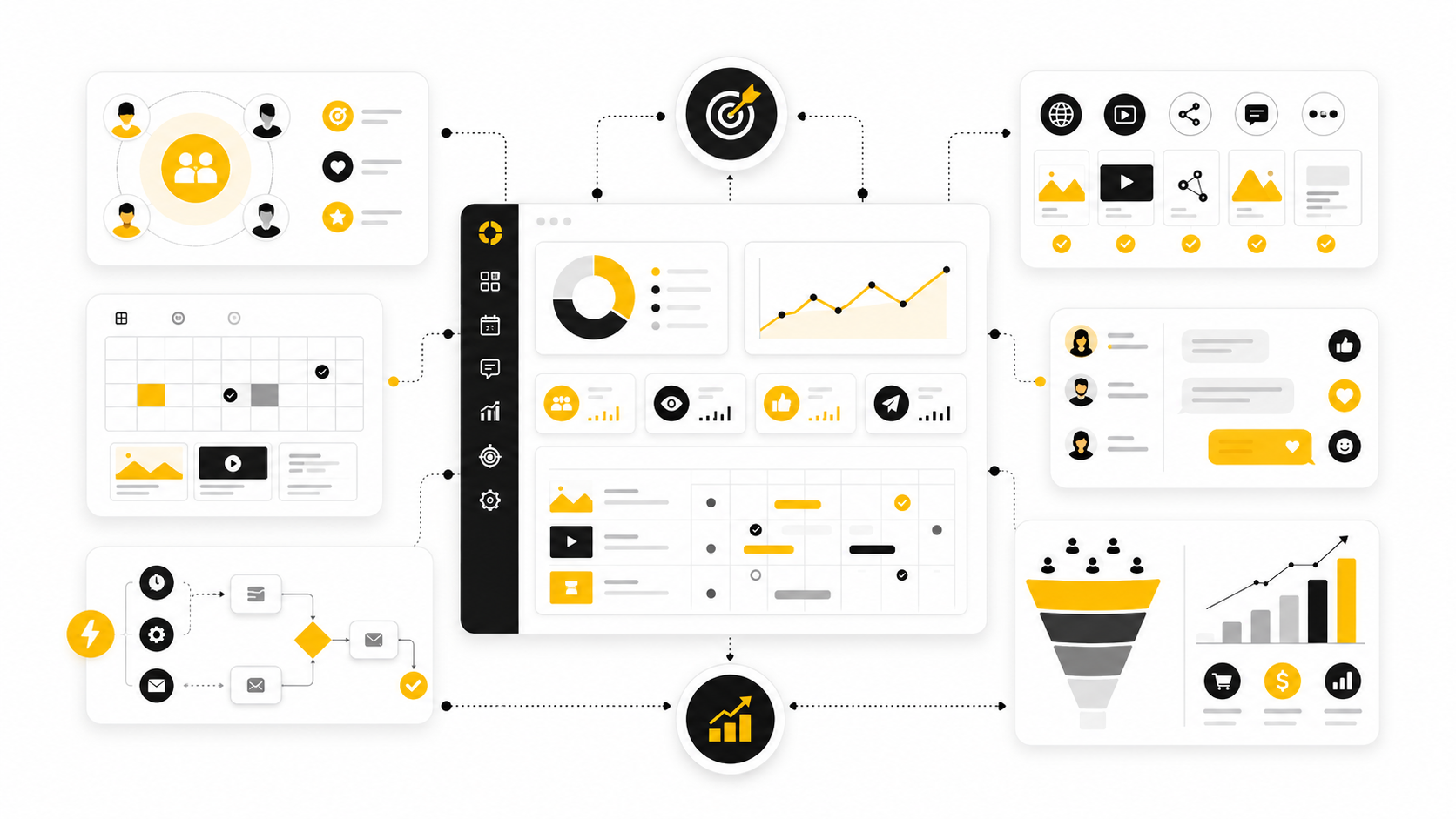
A company social media strategy is not a posting calendar. It is the operating system that decides who your company should speak to, what it should say, where it should show up, how it should respond, and how social activity connects back to business results.
That distinction matters because social media is no longer a side channel run by whoever has time. It touches brand awareness, hiring, customer support, product education, community, demand generation, executive visibility, and customer retention. The companies that win with social do not simply post more. They make sharper choices.
The pressure is real. Social platforms are fragmented, content formats change constantly, and audiences expect brands to be useful, fast, human, and entertaining at the same time. Recent research shows the scale of the opportunity: Sprout Social’s 2025 Index is based on surveys of more than 4,000 consumers and 1,200 marketers, while Pew Research Center’s 2025 social media research shows that platform usage continues to vary heavily by age, behavior, and channel. In plain English, your audience is probably active on social, but they are not all active in the same way.
That is why this guide treats company social media strategy as a business discipline, not a content hobby. The goal is to build a strategy that gives your team focus, helps leadership understand the value of social, and turns daily publishing into a measurable growth system.
This full guide is split into six parts:
Why Company Social Media Strategy Matters
A strong company social media strategy matters because attention is now scattered across many platforms, formats, and communities. Your buyers may discover you through a LinkedIn post, compare you after watching a YouTube video, check your credibility on Instagram, ask peers about you in a private community, and only later visit your website. Social media often sits near the beginning of that journey, but it also influences what happens in the middle and at the end.
That is exactly why random posting creates such weak results. A company can publish every day and still fail if the content does not match the audience, the platform, or the business goal. More activity is not automatically more strategy. Sometimes it is just more noise.
The business case is also getting harder to ignore. Gartner’s 2025 CMO Spend Survey reported that marketing budgets remained flat at 7.7% of company revenue, which means teams are being pushed to prove impact without endless new resources. Social strategy helps because it forces prioritization. It makes the team decide what deserves effort, what should be ignored, and what should be measured.
A practical strategy also protects the brand. Without clear positioning, voice, escalation rules, and approval workflows, social teams end up making high-speed decisions in public with low context. That is risky. A good strategy gives people enough structure to move quickly without sounding robotic or creating avoidable problems.
What a Company Social Media Strategy Actually Includes
A company social media strategy defines how social media supports the business. It should connect business goals, audience insight, messaging, channels, content, workflow, measurement, and optimization into one usable plan. If the document only lists platforms and posting frequency, it is incomplete.
At minimum, the strategy should answer four simple questions. Who are we trying to reach? Why should they care? Where should we show up? What business outcome are we trying to influence? When those answers are clear, the content calendar becomes easier because every post has a job.
This is also where many companies overcomplicate things. They try to build separate strategies for brand, performance, community, executives, influencers, and customer support before they have one shared foundation. The better approach is to build one core strategy first, then adapt it for each function.
Framework Overview
A useful company social media strategy has five layers: business goals, audience insight, positioning, content systems, and measurement. Each layer supports the next. If the business goal is unclear, the audience choices become vague. If the audience is vague, the messaging becomes generic. If the messaging is generic, the content becomes forgettable.
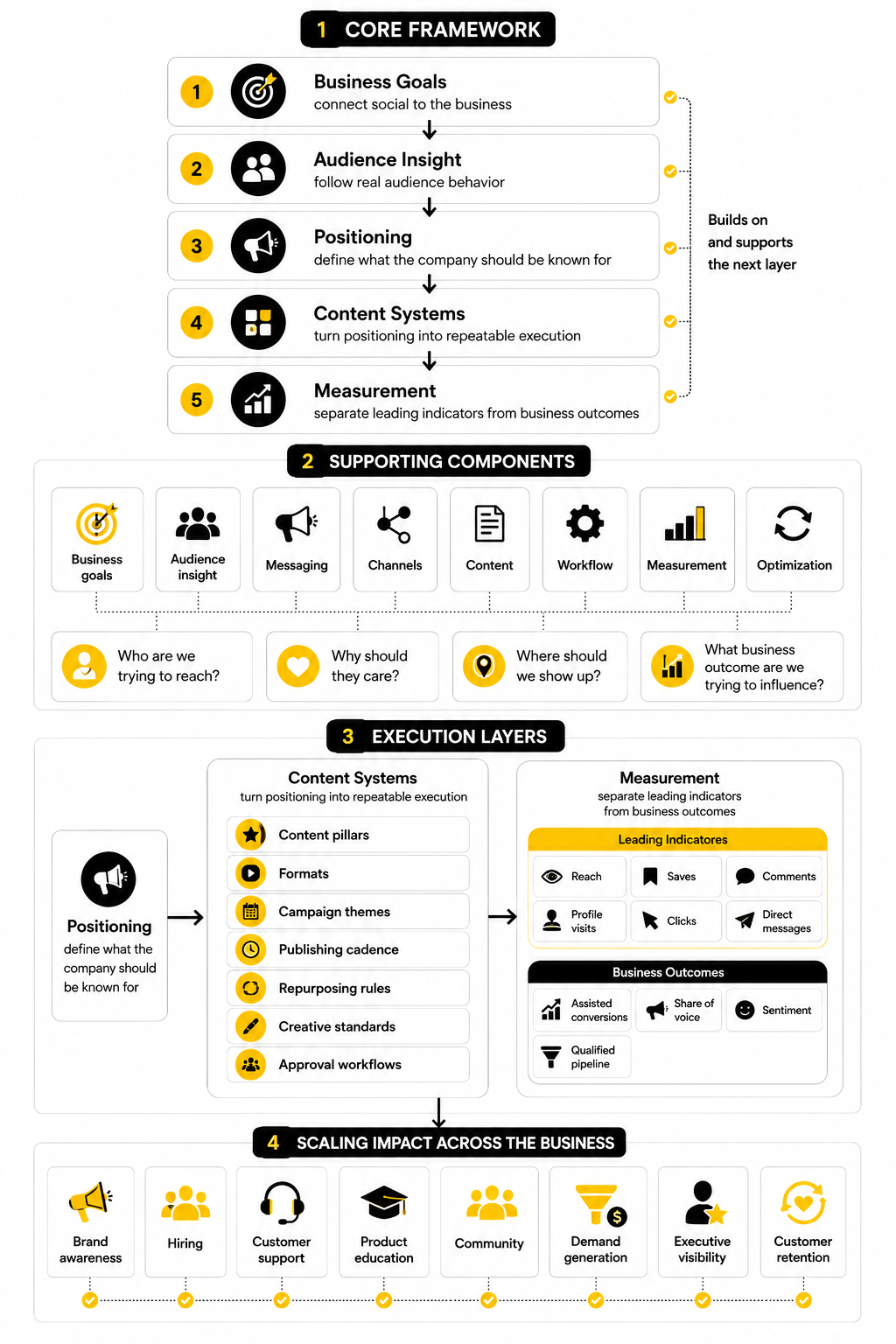
The framework starts with business goals because social should not live in a separate universe from the rest of the company. A B2B software company may care about pipeline influence, category authority, and executive trust. A consumer brand may care more about reach, product education, community participation, and repeat purchase. A local service company may care about reviews, referrals, inbound messages, and geographic visibility.
Audience insight comes next because the best social strategy is built around real behavior, not assumptions. Pew’s 2025 platform data shows why this matters: YouTube and Facebook remain broadly used across U.S. adults, while platforms like Instagram, TikTok, Snapchat, and Reddit skew differently by age and behavior. That does not mean every company needs every platform. It means platform choice should follow the audience, not the trend.
Positioning then turns audience insight into a clear point of view. Your company needs to know what it wants to be known for before it can decide what to publish. This is where most bland corporate social media breaks down. The team posts updates, event photos, product snippets, and generic tips, but nothing compounds because the market never learns what the company stands for.
Content systems turn positioning into repeatable execution. This includes content pillars, formats, campaign themes, publishing cadence, repurposing rules, creative standards, and approval workflows. Tools can help here, especially when a team needs one place to plan and schedule content; for example, Buffer can fit companies that want a straightforward publishing workflow without making the process heavier than it needs to be.
Measurement closes the loop. Social media performance should not be judged only by likes, but it also should not pretend engagement means nothing. A serious strategy separates leading indicators from business outcomes. Reach, saves, comments, profile visits, clicks, direct messages, assisted conversions, share of voice, sentiment, and qualified pipeline can all matter, but they do not all matter equally for every company.
The Strategic Shift Companies Need to Make
The biggest shift is moving from “What should we post this week?” to “What should our market believe, understand, trust, or do because of our social presence?” That question changes everything. It pushes the company away from filler content and toward intentional communication.
This is especially important because social teams are now expected to do more than publish. Deloitte Digital’s 2025 State of Social research highlights the growing importance of community, content, and conversion in social-first organizations. That mix is exactly where modern company social media strategy is heading. Social is not just media distribution anymore. It is customer intelligence, brand building, public conversation, and revenue support.
The companies that adapt will have a real advantage. They will know which conversations to enter, which formats to invest in, which metrics to ignore, and which signals deserve action. They will also avoid the exhausting cycle of chasing every new trend without knowing whether it actually supports the business.
Part 2 continues with the full company social media strategy framework and shows how to turn these ideas into a working plan.
The Company Social Media Strategy Framework
The framework for a company social media strategy should be simple enough to use every week, but strong enough to guide serious decisions. It should help your team choose platforms, shape messaging, prioritize content, and measure whether the work is moving the business forward. A strategy that looks impressive in a slide deck but does not change day-to-day execution is not a strategy; it is decoration.
The best way to build it is in layers. Start with the business outcome, then define the audience, then clarify the message, then build the channel plan, then create the content system, then measure and improve. That order matters because most social media problems are not posting problems. They are usually goal problems, audience problems, or positioning problems hiding underneath the calendar.
This is where discipline pays off. Social platforms move fast, but your company does not need to rebuild its entire strategy every time a platform changes a feature. You need a stable framework that can absorb change without making the team start from zero every quarter.
Step 1: Define the Business Role of Social Media
Before choosing platforms or content formats, decide what social media is supposed to do for the company. It might support brand awareness, demand generation, customer education, hiring, investor confidence, partner relationships, community building, or customer support. It can support more than one goal, but it should not be expected to do everything equally at the same time.
This is where many companies get vague. They say they want “growth” or “engagement,” but those words are too loose to guide decisions. Growth could mean more qualified leads, more product trials, more retail demand, more booked calls, more newsletter subscribers, more app installs, or more share of voice in the category.
A sharper business role gives the team a sharper operating model. If social is mainly for trust and authority, the content should lean into expertise, proof, founder perspective, customer education, and category insight. If social is mainly for pipeline support, the strategy needs stronger conversion paths, lead capture, retargeting audiences, and follow-up systems, which is where tools like GoHighLevel can fit for companies that need CRM, automation, and campaign workflows in one place.
Step 2: Identify the Audience That Actually Matters
A company social media strategy should not target “everyone who might buy from us.” That sounds broad and ambitious, but it usually produces weak content. The better move is to identify the audience segments that have the strongest connection to your business goals.
For example, a B2B company may need to separate economic buyers, technical evaluators, end users, partners, candidates, and industry influencers. A consumer company may need to separate first-time buyers, repeat customers, gift buyers, loyal fans, and skeptical comparison shoppers. These groups do not all need the same message, and they may not use social platforms in the same way.
This is why audience research should combine data and judgment. Broad platform research, such as the Digital 2025 brand discovery report, can show how people discover brands across channels, but your company still needs to understand its own buyers. Look at sales calls, support tickets, reviews, community comments, search queries, CRM notes, and social conversations. The best audience insight is usually hiding in plain sight.
Step 3: Choose a Clear Strategic Position
Once the audience is defined, the company needs a clear position. This means deciding what your brand wants to be known for in the market and what perspective it brings to the conversation. Without that, the social team ends up publishing generic tips, company updates, and trend reactions that could come from almost anyone.
A strong position does not have to be loud or controversial. It just has to be specific. Your company might stand for practical education, technical depth, category disruption, customer intimacy, creative taste, operational excellence, affordability, speed, trust, or simplicity. The point is to create a recognizable angle that compounds over time.
This matters because social media rewards memory. People rarely buy after seeing one post from a company they barely know. They buy after repeated exposure to a message that feels relevant, credible, and consistent enough to remember. Your strategic position is what makes that repetition useful instead of annoying.
Step 4: Translate Positioning Into Content Pillars
Content pillars turn strategy into repeatable publishing themes. They help the team avoid starting from a blank page every week. More importantly, they make sure the company is not drifting away from the ideas it wants to own.
A practical strategy usually needs three to six content pillars. For a software company, those might include product education, customer problems, industry trends, team expertise, proof points, and founder perspective. For a service company, they might include problem awareness, process education, client decision criteria, behind-the-scenes credibility, and local or niche authority.
The key is to make each pillar useful, not decorative. “Thought leadership” is not a content pillar unless the team knows what topics it covers, what point of view it expresses, and what formats it uses. “Customer stories” is not a pillar unless the company has a clear way to capture proof, protect privacy, and turn outcomes into useful lessons.
Step 5: Match Platforms to Behavior, Not Hype
Platform choice should follow audience behavior and content fit. A company does not need to be everywhere to have a strong social presence. In fact, trying to cover every platform often weakens execution because the team spreads creative energy too thin.
The better question is not “Which platforms are popular?” The better question is “Where does our audience already spend attention in a way that matches our message?” LinkedIn may be the right place for executive trust, B2B education, hiring, and industry commentary. TikTok or Instagram may be stronger for visual storytelling, creator-led discovery, lifestyle content, and product demonstration. YouTube may work better for deeper education, search-driven discovery, and long-term content assets.
The format also matters. The Hootsuite 2025 Social Media Trends report highlights how brands are experimenting more with entertainment, tone, and platform-native creativity. That does not mean every company should chase jokes or memes. It means the company must respect how each platform works instead of posting the same corporate message everywhere.
Step 6: Build a Content Operating System
A content operating system is the practical workflow behind the strategy. It defines how ideas are collected, approved, produced, published, repurposed, and measured. Without this system, even a smart strategy will fall apart under daily pressure.
The system should answer basic operational questions. Who owns the calendar? Who approves sensitive posts? How are customer questions handled? What happens when a post performs unusually well? How does the team turn webinars, podcasts, sales calls, product updates, and customer insights into social content?
This is where companies can save a lot of time. A scheduling tool such as Buffer can help smaller teams plan and publish consistently, while a messaging automation tool such as ManyChat can support brands that use Instagram, Facebook, or chat-based flows to turn social engagement into conversations. The tool is not the strategy, but the right tool can make the strategy easier to execute.
Step 7: Connect Social Activity to the Customer Journey
Social media should not sit outside the customer journey. It should support each stage with the right message and the right level of commitment. A person who has never heard of the company does not need the same content as someone comparing solutions or waiting for a reason to trust you.
At the awareness stage, the job is to earn attention and make the problem visible. At the consideration stage, the job is to educate, differentiate, and reduce confusion. At the conversion stage, the job is to create confidence, answer objections, and make the next step easy. After purchase, social can support onboarding, retention, advocacy, and community.
This is why a company social media strategy should include conversion paths, not just content ideas. A useful post can send someone to a landing page, webinar, calculator, newsletter, product demo, booking page, or direct message flow. For companies building campaign pages around social traffic, a tool like ClickFunnels or Systeme.io can make sense when the goal is to move attention into a structured funnel.
Step 8: Create Measurement Before You Scale
Measurement should be designed before the team increases posting volume. Otherwise, the company ends up with more data but not more clarity. A good measurement plan separates platform metrics from business metrics and explains how each one should be interpreted.
Platform metrics include reach, impressions, engagement rate, saves, shares, comments, follower growth, video retention, click-through rate, and direct messages. Business metrics include leads, trials, booked calls, assisted revenue, customer acquisition cost, retention signals, candidate applications, support deflection, or sales cycle influence. Both types can matter, but they do different jobs.
The mistake is treating all metrics as equal. A viral post that reaches the wrong audience may have little business value. A smaller post that attracts qualified buyers, creates direct conversations, and supports sales can be far more valuable. Measurement should help the company make better decisions, not just celebrate bigger numbers.
Step 9: Build Feedback Loops Into the Strategy
A strategy should be stable, but it should not be frozen. The company needs feedback loops that turn performance data and audience response into better decisions. Social media is one of the fastest research channels a business has, but only if the team actually listens.
Feedback can come from comments, saves, shares, replies, DMs, polls, creator feedback, sales team notes, support questions, and content performance patterns. If the same objection keeps appearing in comments, that is not just a social issue. It may be a positioning issue, a product education issue, or a landing page issue.
This is where social becomes more valuable than a publishing channel. It becomes a signal system. The company can learn what language customers use, which problems feel urgent, which claims create skepticism, and which ideas earn trust. That insight should feed back into content, sales enablement, product marketing, and customer experience.
Step 10: Decide What Not to Do
A mature company social media strategy includes constraints. It should make clear which platforms, formats, trends, audiences, and topics are not priorities right now. This is not negative thinking. It is how the team protects focus.
Without constraints, social teams get pulled into everything. A new platform appears, a competitor posts something clever, leadership asks for a campaign push, sales wants more leads, HR wants hiring content, and customer support wants faster responses. All of those requests may be valid, but they cannot all be the top priority.
The best strategies create confident trade-offs. They help the team say, “This matters, but not this quarter,” or “This platform is interesting, but our audience behavior does not justify it yet.” That clarity is what turns social from a reactive task list into a real business function.
Core Components of a Strong Social Media Strategy
Once the framework is clear, the next step is turning it into components your team can actually use. This is where a company social media strategy becomes more than a high-level plan. It becomes a practical system for deciding what to create, how to publish, how to respond, and how to improve.
The core components should be specific enough that a new team member can understand how the company shows up online. They should also be flexible enough to handle platform changes, product updates, campaigns, and unexpected conversations. Social media moves quickly, but the strategy should keep the team grounded.
A strong strategy usually includes audience definitions, platform roles, messaging pillars, content formats, publishing rhythm, engagement rules, conversion paths, governance, and measurement. That may sound like a lot, but each piece removes confusion. The goal is not to create bureaucracy. The goal is to make good decisions easier.
Audience Definitions
Audience definitions should go deeper than basic demographics. Age, location, industry, and job title can be useful, but they rarely explain why someone pays attention. A better audience definition includes problems, motivations, objections, buying triggers, preferred content formats, and the level of awareness the person already has.
For example, one audience may already know the problem and simply need proof that your company is credible. Another may not even realize the problem is costing them money, time, or reputation. Those two audiences need different content, even if they technically fit the same buyer persona.
This matters because social content is consumed quickly. If the message does not match the audience’s current state of mind, they scroll past it. A useful company social media strategy helps the team create content that feels relevant immediately, not after five paragraphs of explanation.
Platform Roles
Every platform in the strategy should have a role. LinkedIn might be used for authority, recruiting, and B2B education. Instagram might be used for visual proof, culture, community, and product storytelling. YouTube might be used for deeper education, search discovery, and evergreen trust building.
The mistake is treating every platform as a dumping ground for the same content. Repurposing is smart, but copying and pasting is lazy. A post that works as a sharp LinkedIn opinion may need to become a short video, carousel, tutorial, or community prompt somewhere else.
Platform roles also help protect the team from trend chasing. When a new feature or platform gets attention, the company can ask whether it supports an existing audience, message, or business goal. If it does, test it. If it does not, ignore it for now.
Messaging Pillars
Messaging pillars define the ideas your company repeats until the market remembers them. These are not slogans. They are the strategic themes that shape your posts, campaigns, videos, replies, and executive content.
Good messaging pillars usually connect three things: what the audience cares about, what the company can credibly speak about, and what the business wants to be known for. If a pillar only serves the company, it will sound promotional. If it only serves the audience but has no connection to the business, it may earn attention without creating value.
This is where companies need to be honest. If your content pillars could be used by ten competitors without changing a word, they are too generic. Strong messaging has a point of view, a clear angle, and enough repetition to become recognizable.
Content Formats
Content formats are the repeatable shapes your ideas take. They can include short posts, carousels, short-form videos, long-form videos, livestreams, polls, founder posts, employee posts, customer education, product demos, behind-the-scenes updates, community prompts, and campaign assets.
The right formats depend on the team’s strengths and the audience’s behavior. A company with strong subject-matter experts may do well with educational clips, LinkedIn posts, webinars, and technical explainers. A visual consumer brand may get more value from short-form video, creator collaborations, product demonstrations, and user-generated content.
The point is to build a format mix that can be produced consistently. Consistency beats occasional brilliance. If the team can only produce a complex video series once every three months, that may not be the best core format unless it is supported by simpler content that keeps the strategy moving.
Publishing Rhythm
Publishing rhythm is not just frequency. It is the pattern of communication your audience learns to expect from your company. That includes how often you publish, which topics appear regularly, when campaigns get extra support, and how the content mix changes across the month.
A company does not need to post five times a day to be strategic. It needs a rhythm it can sustain without sacrificing quality. For many teams, that means fewer platforms, stronger ideas, and better repurposing.
A practical rhythm might include weekly educational posts, monthly campaign themes, regular customer proof, executive commentary, product updates, and a consistent engagement routine. A tool like Buffer can help organize that rhythm when the team needs a simpler way to plan, approve, and schedule content across channels.
Engagement Rules
Engagement rules define how the company responds when people comment, complain, ask questions, praise the brand, challenge a claim, or request help. This part of the strategy is often ignored until something goes wrong. That is a mistake.
Social media is public, fast, and emotional. A slow or awkward response can make a small issue look bigger than it is. A clear response system helps the team act quickly without guessing what tone, authority, or next step is appropriate.
The strategy should define which comments get replies, which issues move to private messages, which questions go to support, and which topics need legal or leadership review. For brands that rely heavily on direct messages, ManyChat can help turn common social interactions into structured conversations without making every reply manual.
Conversion Paths
A company social media strategy should make the next step obvious. Attention is useful, but attention without a path usually leaks away. The path might be a newsletter signup, product demo, booking page, trial, webinar, calculator, community, direct message flow, or landing page.
Not every post needs a direct call to action. In fact, if every post pushes for a click, the account starts to feel needy. But the overall strategy should make it easy for interested people to move from social attention into a deeper relationship with the company.
This is where campaign infrastructure matters. If social content is sending people into a weak page, confusing offer, or slow follow-up process, the social team gets blamed for a problem it did not create. For companies building campaign funnels from social traffic, ClickFunnels or Systeme.io can support the conversion layer when the offer needs a structured journey.
The Implementation Process
Implementation is where the strategy becomes real. This is the point where the team moves from planning to execution, and the work needs to become tangible. Without a clear process, social media turns into a messy mix of last-minute requests, scattered ideas, and inconsistent publishing.
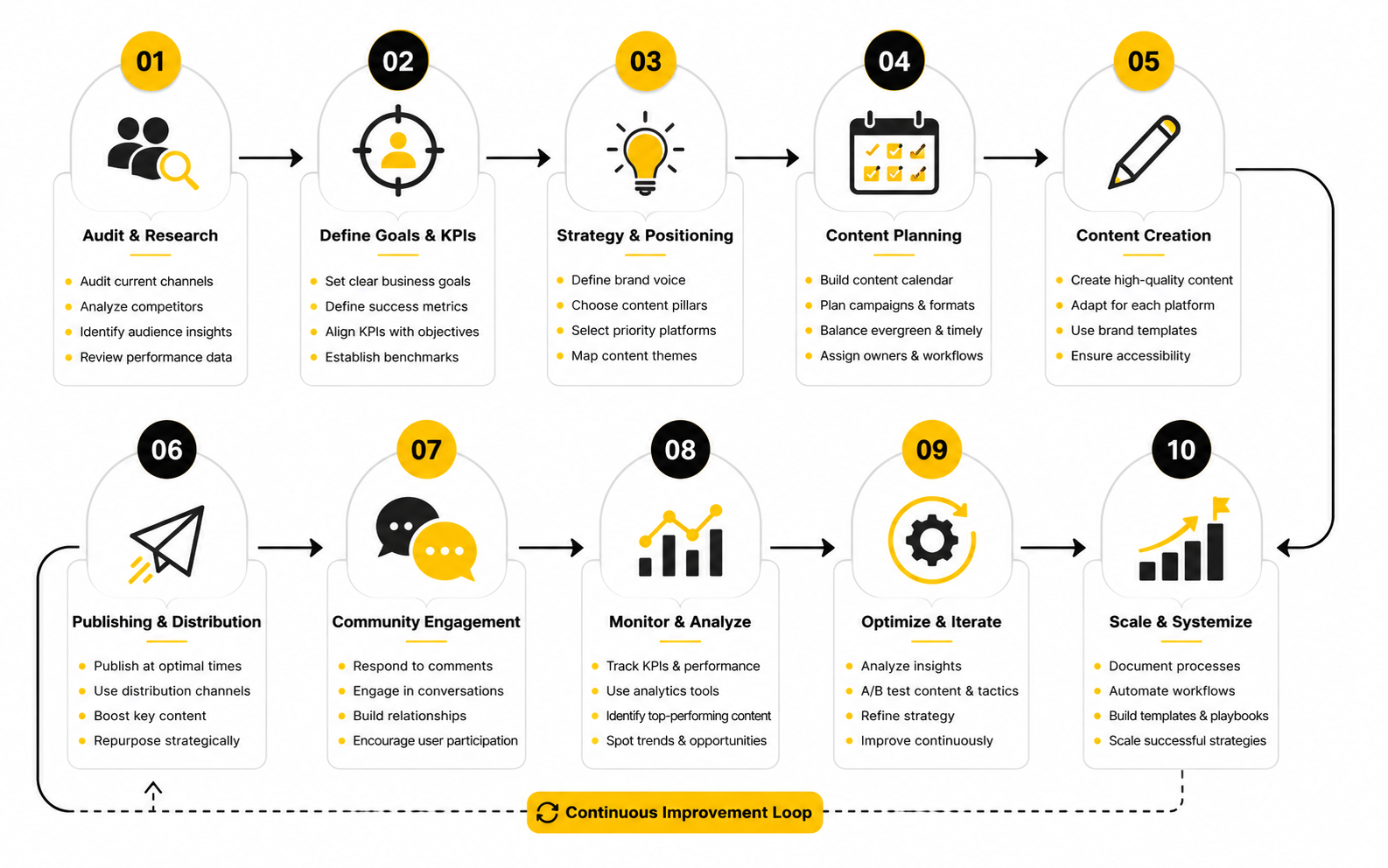
The process should be simple enough to follow every week. A company does not need a complicated operating model to do good social media. It needs a clear sequence that turns business priorities into audience-relevant content, then turns performance feedback into better decisions.
A practical implementation process looks like this:
Step 1: Collect Inputs From the Business
Social strategy should not be built in isolation. The social team needs input from sales, support, product, customer success, leadership, recruiting, and marketing. Each team sees a different part of the audience’s reality.
Sales hears objections. Support hears confusion. Product sees roadmap priorities. Customer success sees what makes people stay. Leadership sees where the company is trying to go. When those inputs flow into the content process, the company’s social presence becomes more useful and more connected to the business.
This does not mean every department gets to dictate the calendar. It means the social team should have a structured way to capture useful signals. Otherwise, the account becomes disconnected from the real conversations happening around customers and prospects.
Step 2: Choose Priority Themes
Priority themes turn scattered inputs into focus. A theme might be tied to a launch, seasonal buying behavior, a category conversation, a customer pain point, a recruiting push, or a strategic message the company wants to reinforce. The theme gives the team a clear center of gravity.
Without themes, the calendar often becomes a random collection of disconnected posts. One day the company shares a product update, the next day it posts a generic tip, then a holiday graphic, then a culture photo. None of those pieces are automatically bad, but they do not build momentum if they never connect.
A strong theme gives content a reason to exist. It lets the team approach the same strategic idea from different angles without sounding repetitive. That is how a company becomes known for something.
Step 3: Turn Themes Into Content Ideas
Once the theme is chosen, the team can turn it into specific content ideas. This is where quality improves because the ideas are no longer pulled from nowhere. They come from a defined audience, message, and business priority.
A single theme can produce many useful angles. The team can create educational posts, myth-busting posts, product explainers, customer questions, objection-handling content, founder commentary, short videos, carousels, polls, and direct response assets. The key is to make each idea serve a clear purpose.
This step also helps avoid repetition. Repetition of the core message is good. Repetition of the same post format and wording is boring. The team should repeat the strategic idea while varying the angle, format, and depth.
Step 4: Match Ideas to Platforms and Formats
Not every idea belongs everywhere. A tactical checklist may work as a carousel, a LinkedIn post, a downloadable asset, or a short video. A founder opinion may work best on LinkedIn or X. A product demonstration may need video. A customer support answer may work as a short post, help content, or direct message automation.
This step matters because platform-native content usually performs better than content that feels imported. People can tell when a brand is posting something because it fits the platform versus because it was convenient for the team. The difference is obvious.
The company should also be realistic about production capacity. If every idea requires filming, editing, approval, and design, the system may collapse. A healthy strategy mixes high-effort assets with simpler formats that can be produced quickly and consistently.
Step 5: Produce, Review, and Publish
Production should have clear ownership. Someone needs to own copy, creative, subject-matter accuracy, approvals, scheduling, and community response. If everyone owns it, nobody owns it.
Review should protect quality without killing speed. Legal, compliance, or leadership review may be necessary for sensitive industries or high-risk topics, but not every post should require a committee. The strategy should define which posts need deeper review and which can move through a lighter process.
Publishing is not the finish line. The team should be ready to engage after content goes live. Comments, replies, and direct messages often create the real value, especially when a post opens a conversation with the right people.
Step 6: Measure and Improve
Measurement should happen on a regular cycle, not only when leadership asks for results. The team should review what performed, what attracted the right audience, what generated useful conversations, what drove traffic or leads, and what created signs of trust. The goal is to learn, not just report.
A useful review separates content performance from strategic performance. A post can get strong engagement because it was entertaining, but still fail to attract the right audience. Another post can get modest reach but produce qualified conversations, sales feedback, or content ideas that matter more.
The best teams use measurement to make sharper choices. They do not just ask, “What got the most likes?” They ask, “What should we do more of, what should we stop doing, and what did we learn about the market?” That is where a company social media strategy starts to compound.
Governance and Ownership
Governance sounds boring, but it is one of the reasons social media either scales or becomes chaotic. The company needs to know who owns the strategy, who approves content, who responds to customers, who handles sensitive issues, and who reports performance. Without those roles, execution slows down and accountability disappears.
Ownership should be clear at both the strategic and tactical levels. A marketing leader may own the business direction, while a social media manager owns the calendar and publishing process. Product marketers, sales leaders, executives, designers, and customer support teams may contribute, but contribution is not the same as ownership.
The strategy should also include escalation rules. If someone posts a serious complaint, a legal concern, a security issue, or a reputational threat, the team should not be deciding from scratch in the moment. Clear governance helps the company respond with speed, judgment, and consistency.
Documentation That Keeps the Team Aligned
A company social media strategy should be documented in a way people actually use. A 70-page document that nobody opens is not helpful. A concise strategy guide, content playbook, approval checklist, and reporting template are usually more useful.
The documentation should capture the essentials: audience, positioning, messaging pillars, platform roles, content formats, tone of voice, approval rules, response guidelines, campaign process, and measurement model. It should be updated as the company learns, but not rewritten every time a trend changes.
This is also useful when hiring or working with freelancers, agencies, creators, or internal subject-matter experts. Clear documentation shortens onboarding and reduces messy feedback. It gives everyone the same standard to work from, which makes execution faster and more consistent.
Statistics and Data
Measurement is where a company social media strategy either becomes credible or falls apart. The problem is not a lack of data. Most teams have too much data, spread across platform dashboards, scheduling tools, analytics tools, CRM reports, ad accounts, and spreadsheets.
The real issue is interpretation. A post with high reach can still be useless if it reaches the wrong people. A post with low engagement can still be valuable if it creates qualified conversations, supports sales, or answers a question that repeatedly blocks buyers.
Good measurement turns social media from “we posted and hoped” into a learning system. It helps the company understand what earns attention, what builds trust, what drives action, and what should change next.
Start With the Numbers That Actually Matter
The first measurement mistake is treating every metric as equally important. They are not. Some metrics tell you whether people saw the content. Some tell you whether they cared. Some tell you whether they acted. Some tell you whether the activity had business value.
A useful company social media strategy separates metrics into four levels:
This separation matters because each level answers a different question. Visibility tells you whether the content entered the market. Engagement tells you whether it created a response. Action tells you whether people moved closer to the business. Business metrics tell you whether the work is worth scaling.
Benchmarks Are Useful, But They Are Not the Strategy
Benchmarks help you understand whether your numbers are unusually weak, average, or strong for your space. They are helpful context, especially when leadership wants to know whether performance is “good.” But benchmarks should never replace your own baseline.
Industry benchmark reports can be useful because platform performance varies heavily by industry, format, and audience. The 2025 Sprout Social benchmarks research analyzed billions of messages across public profiles, while the 2025 Rival IQ benchmark report compares engagement across major industries and platforms. Those reports are useful for orientation, but they cannot tell you what your company should prioritize next.
Your best benchmark is your own recent performance. Compare this month against last month, this campaign against the previous campaign, and this content pillar against your other pillars. A company with a small but highly qualified audience may outperform a larger account in business impact even if its public engagement looks modest.
Why Reach Does Not Always Mean Growth
Reach is easy to celebrate because big numbers look good in reports. But reach alone does not prove strategic progress. It only proves that the content was distributed.
The key question is who the content reached. If your company sells enterprise software and a post reaches thousands of people outside your market, the number may look impressive while doing little for the business. If a smaller post reaches buyers, partners, analysts, candidates, or existing customers, it may be more valuable.
This does not mean reach is bad. Reach matters when the company is building awareness, entering a new market, hiring, launching a product, or trying to influence category conversation. It just needs to be paired with relevance signals, such as qualified comments, saves, profile visits, direct messages, website traffic, branded search lift, or sales team feedback.
Engagement Needs Context
Engagement is often misunderstood. A high engagement rate can show that the content resonated, but it can also show that the content was broad, emotional, controversial, or entertaining in a way that does not support the company’s goals. A low engagement rate can mean the content missed, but it can also mean the topic was niche, technical, or intended for a smaller decision-making audience.
The better question is not “Did people engage?” The better question is “What kind of people engaged, and what did their engagement signal?” A comment from a target buyer is not the same as a reaction from a random account. A save on an educational post may signal deeper value than a quick like.
This is why qualitative review matters. Read the comments. Track the questions. Watch which posts get shared internally by sales or customer success. The meaning behind the engagement often matters more than the raw count.
Watch Time and Retention Tell You Whether the Content Holds Attention
For video, views are only the beginning. A view does not always mean someone paid attention. Watch time, completion rate, retention curves, rewatches, and drop-off points tell you much more about whether the content actually held interest.
This matters because short-form and long-form video behave differently. A short video may need a strong opening in the first few seconds. A longer educational video may succeed if it attracts fewer viewers but keeps the right viewers watching longer. The format changes the meaning of the metric.
A company should use video analytics to improve creative decisions. If viewers consistently drop off before the product explanation, the opening may be too slow. If viewers rewatch a specific section, that part may deserve its own post, clip, or sales enablement asset. Measurement should lead to better content, not just better reporting.
Traffic Metrics Show Whether Attention Is Moving
Traffic metrics show whether social attention is turning into deeper action. These include profile visits, website sessions, link clicks, landing page views, newsletter signups, booked calls, product trials, and form submissions. They are especially important when social is expected to support demand generation or sales.
The catch is that social traffic is often undercounted. People may see a post, search the brand later, visit directly, ask a colleague, or convert after multiple touches. That does not mean social had no impact. It means attribution needs to be interpreted carefully.
A practical company social media strategy should use tracking links, UTMs, landing pages, CRM source fields, and campaign naming conventions. If the company is sending social traffic into funnels, tools like ClickFunnels or Systeme.io can help create clearer paths from post to page to conversion.
The Analytics System
The analytics system should connect social activity to decision-making. It should show what happened, why it probably happened, and what the team should do next. A dashboard that only lists numbers is not enough.
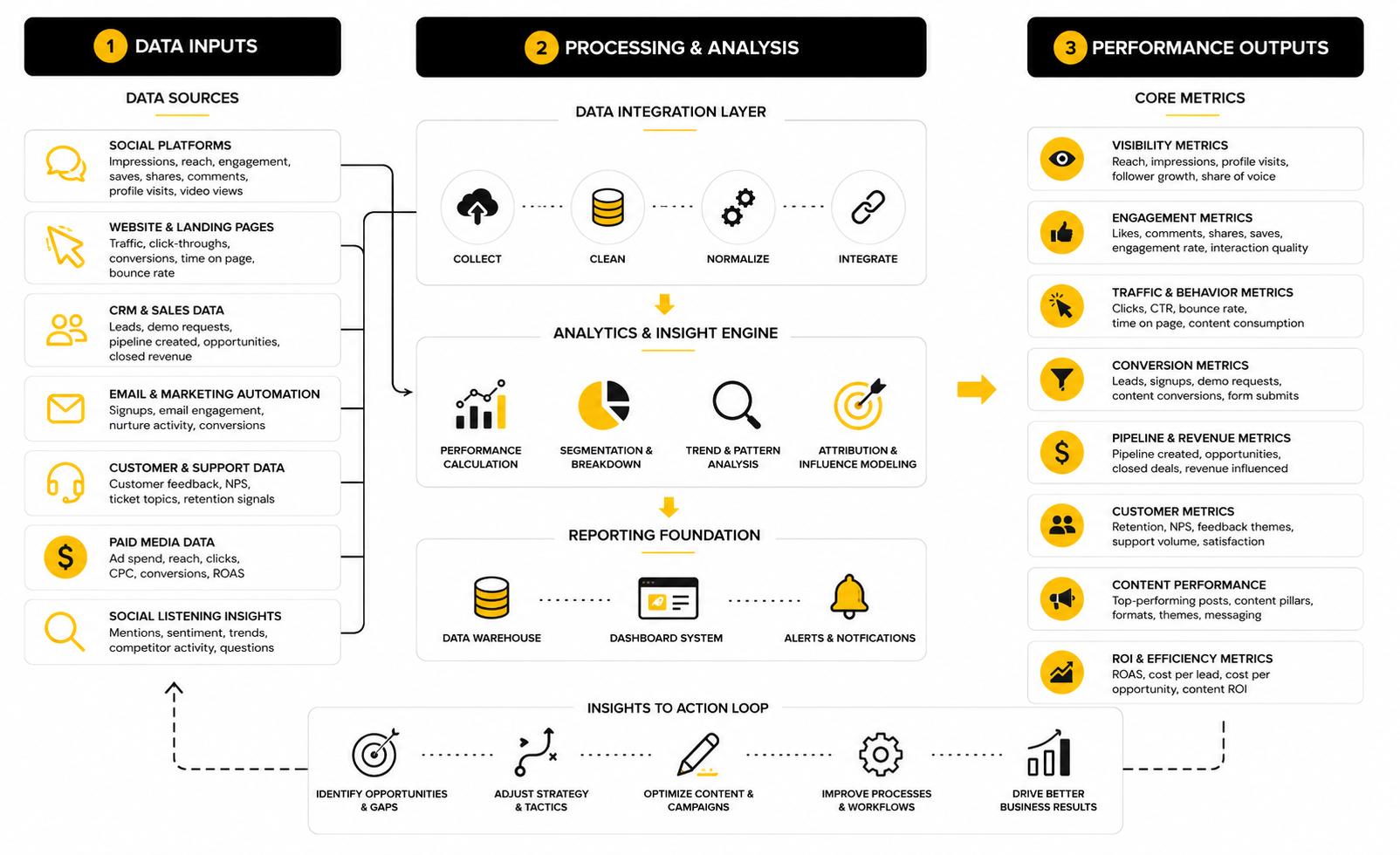
A useful analytics system has four parts:
Input tracking records what the team published. This includes the platform, format, topic, content pillar, campaign, creative angle, posting date, CTA, and target audience. Without input tracking, the team cannot explain why some posts perform better than others.
Performance tracking records what the market did in response. This includes reach, engagement, video retention, clicks, direct messages, conversions, and any business signals connected to the content. The point is not to track everything forever. The point is to track enough to see patterns.
Insight review turns data into judgment. The team should ask what worked, what failed, what surprised them, what the audience asked for, what sales can use, and what should be tested next. Then action planning turns those insights into content changes, campaign changes, channel changes, or workflow changes.
Build a Reporting Rhythm That People Will Actually Use
Reporting should happen on a rhythm that matches the pace of decisions. Weekly reporting is useful for tactical adjustments. Monthly reporting is better for content pillars, platform performance, and campaign review. Quarterly reporting is better for strategy, resourcing, and leadership-level decisions.
The weekly review should be lightweight. It can focus on top posts, weak posts, audience questions, comments worth noting, and immediate opportunities. The goal is to keep the team close to the market without creating reporting busywork.
The monthly review should be more strategic. It should compare content pillars, formats, platforms, campaigns, traffic, conversions, and qualitative signals. This is where the team decides what to repeat, what to refine, and what to stop doing.
Use Three Types of Benchmarks
A company should use three benchmark types: internal benchmarks, competitive benchmarks, and industry benchmarks. Each one answers a different question. Using only one gives an incomplete picture.
Internal benchmarks show whether your own strategy is improving. These are usually the most important because they reflect your audience, your content, your market, and your resources. If your saves, qualified comments, website clicks, or demo requests are improving over time, that matters even if your public engagement rate is below a broad industry average.
Competitive benchmarks show how your company compares with direct and indirect competitors. This does not mean copying competitors. It means studying what topics they own, which formats they use, how often they post, what engagement they attract, and where they leave gaps your company can fill.
Industry benchmarks provide context. They help leadership understand that performance norms differ by platform and sector. A B2B company, a university, a beauty brand, a nonprofit, and a local service business should not judge social performance using the same expectations.
Measure Content Pillars Separately
Content pillars should be measured separately because each pillar has a different job. Product education may drive clicks and conversions. Founder commentary may build authority. Customer proof may help sales. Culture content may support hiring and retention.
If all content is measured together, the team may draw the wrong conclusions. A pillar designed to drive trust may not generate the most reach, but it may create stronger sales conversations. A pillar designed for discovery may generate reach without immediate conversions, but still support awareness.
The strategy should define success for each pillar before judging performance. For example, a customer proof pillar might be measured by saves, shares, sales team usage, landing page visits, and assisted opportunities. A community pillar might be measured by comments, replies, direct messages, repeat participation, and sentiment.
Track Quality of Engagement, Not Just Quantity
Quantity is easy to count. Quality is harder, but it is often more useful. A company should know whether engagement is coming from target buyers, existing customers, partners, creators, employees, job candidates, or irrelevant audiences.
This is especially important for B2B companies. Ten thoughtful comments from the right industry can be more valuable than hundreds of low-intent reactions. The same logic applies to direct messages, webinar signups, demo requests, and newsletter subscribers.
The team can track quality through manual review, CRM notes, social listening, lead source fields, and sales feedback. It does not need to be perfect to be useful. Even a simple monthly review of “best interactions from social” can reveal whether the strategy is attracting the right people.
Connect Social Data With Sales and Customer Data
Social data becomes much more powerful when it is connected to sales and customer data. This does not mean every post needs perfect revenue attribution. It means the company should look for relationships between social activity and pipeline, retention, support, referrals, and brand demand.
For example, if a specific content theme repeatedly creates demo requests, it deserves more investment. If a common objection appears in comments and sales calls, it should become a content series. If customer education posts reduce repeated support questions, that is a real business benefit.
This is where a CRM or marketing automation system helps. A platform like GoHighLevel can be useful when the company wants social leads, forms, booked calls, follow-up messages, and pipeline tracking in one operating system. The main point is not the software. The main point is making sure social signals do not disappear after someone clicks.
Interpret Paid and Organic Social Differently
Paid and organic social should be measured differently because they do different jobs. Organic social is usually strongest for trust, education, community, authority, retention, and repeated exposure. Paid social is usually stronger for controlled distribution, retargeting, testing offers, and scaling proven messages.
Organic performance can reveal what the market cares about before the company spends money. If a post earns strong saves, shares, comments, or qualified direct messages, it may be worth turning into an ad, landing page, email, webinar, or sales asset. Paid media should not be used only to rescue weak ideas. It should also scale strong ones.
Paid performance needs stricter commercial analysis. Click-through rate, cost per click, cost per lead, conversion rate, acquisition cost, and payback period matter more when money is being spent directly. Organic social can influence those numbers by warming the market before paid campaigns ask for action.
Do Not Let Vanity Metrics Drive the Strategy
Vanity metrics are not always worthless. Followers, likes, impressions, and views can matter in the right context. They become dangerous when the team treats them as proof of business impact without looking deeper.
A follower count means little if the audience is not relevant. A viral video means little if it creates no memory, trust, traffic, conversation, or demand. A high engagement rate means little if it comes from controversy the company does not want to own.
The safest approach is to pair every surface metric with a deeper question. If reach increased, did the right audience see the content? If engagement increased, did it signal trust or just reaction? If clicks increased, did people take the next step? If leads increased, were they qualified?
Turn Analytics Into Decisions
The point of analytics is action. If reporting does not change what the company does next, the reporting process is too passive. Every review should end with decisions.
Useful decisions might include:
This is how measurement makes the company social media strategy stronger over time. The team does not need perfect attribution to make better decisions. It needs consistent signals, honest interpretation, and the discipline to act on what the data is showing.
Professional Implementation and Team Execution
At this stage, the company social media strategy has the main pieces: audience, positioning, platform roles, content pillars, workflow, and measurement. The next challenge is making it work inside a real company. That is usually harder than writing the plan.
Real companies have competing priorities. Sales wants leads now. Leadership wants brand visibility. Product wants launches promoted. HR wants recruiting content. Customer support wants fewer repeated questions. If the strategy does not create a clear operating model, social becomes the place where every department drops requests and expects magic.
Professional implementation means turning social media into a managed business function. It needs priorities, roles, review rules, tools, feedback loops, and the confidence to say no. That is what separates a serious company social media strategy from a busy content calendar.
Decide Who Social Media Is Really For
The first advanced tradeoff is audience priority. Many companies say their social media is for buyers, customers, candidates, partners, investors, employees, creators, journalists, and the general public. That may be technically true, but it is not useful enough to guide execution.
A strong strategy defines primary, secondary, and occasional audiences. The primary audience should get the most strategic attention because it is tied directly to the company’s most important business goal. Secondary audiences still matter, but they should not constantly interrupt the core message.
This does not mean the company ignores everyone else. It means the content system has a hierarchy. If the main goal is pipeline influence, buyer education and trust-building should not be crowded out by internal announcements. If the main goal is employer brand, employee stories and workplace credibility should not be treated as random filler between product posts.
Balance Brand Building and Demand Generation
Social media creates tension because some work builds memory while other work asks for action. Brand building is slower, broader, and harder to attribute. Demand generation is more direct, easier to track, and often more attractive to leadership because the numbers look closer to revenue.
The mistake is choosing only one. A company that only posts conversion-focused content will usually sound needy and repetitive. A company that only posts broad brand content may earn attention without creating enough commercial movement.
A useful company social media strategy creates room for both. Brand content builds recognition, trust, category relevance, and emotional familiarity. Demand content gives interested people a clear next step. The blend depends on the company’s stage, sales cycle, market awareness, and growth goals.
Protect the Brand Voice as the Team Scales
Brand voice often gets weaker as more people become involved. At first, one strong marketer or founder may know exactly how the company should sound. Later, agencies, freelancers, executives, product teams, designers, and regional teams all start creating content. Without standards, the voice fragments.
This is where a voice guide becomes practical, not decorative. It should explain how the company sounds, what it avoids, how it handles humor, how technical it gets, how direct it can be, and how it responds under pressure. The guide should include examples of strong and weak posts so people can see the difference.
The goal is not to make every post sound identical. That would feel stiff. The goal is to create a recognizable range so the company can have different voices across executives, product experts, support teams, and brand channels without losing coherence.
Use AI Without Losing Judgment
AI can make social teams faster, but it can also make company content painfully generic. That is the tradeoff. Used well, AI can help with research organization, repurposing, first drafts, content variations, transcript cleanup, idea expansion, and workflow speed. Used badly, it floods the calendar with polished emptiness.
This matters because audiences are becoming more sensitive to synthetic content. The 2026 Hootsuite Social Trends research points to growing consumer caution around AI-generated brand content, especially when it feels too polished or detached from real human perspective. That does not mean companies should avoid AI completely. It means AI should support human judgment, not replace it.
A practical rule works well: let AI help with structure, speed, and variations, but keep the point of view human. The strongest social content still needs lived experience, real customer insight, specific language, original opinion, and taste. AI can assist the process, but it cannot decide what your company should stand for.
Manage Risk Before It Becomes Public
Risk management belongs inside the company social media strategy, not in a separate crisis document nobody reads. Social media is public, searchable, screenshot-friendly, and fast. A small mistake can spread quickly if the company responds slowly, defensively, or inconsistently.
The strategy should define risk levels. Low-risk content might include evergreen education, general tips, community prompts, and approved product explanations. Medium-risk content might include competitive commentary, customer claims, statistics, founder opinions, or industry criticism. High-risk content might include legal topics, regulatory claims, financial information, layoffs, social issues, security incidents, customer disputes, or sensitive news.
Each risk level should have a different approval path. Low-risk posts should move quickly. High-risk posts need the right review before publishing. The point is not to slow everything down. The point is to prevent the team from treating every post like a crisis while still catching the posts that actually need careful handling.
Build an Executive Social Layer
Executive social can be powerful because people often trust people more than logos. A company page can educate and announce, but a founder, CEO, sales leader, product leader, or subject-matter expert can add perspective, conviction, and credibility. That is especially useful in B2B, professional services, recruiting, and category-building markets.
The mistake is turning executives into repost machines. If every executive post sounds like it was written by the same corporate marketing person, the advantage disappears. Executive content should have a real point of view, clear expertise, and enough personal texture to feel credible.
The company should support executives with research, drafts, prompts, editing, and scheduling help, but the ideas need to stay close to the person. A strong executive social program usually starts small. Choose one or two leaders, define their themes, build a realistic cadence, and measure whether the content creates trust, conversations, hiring interest, media opportunities, or sales support.
Treat Employees as Distribution Partners, Not Billboards
Employee advocacy can extend reach, but it becomes awkward when companies treat employees like unpaid media inventory. People can tell when posts are forced. Employees can feel it too.
A healthier approach is to make content easy to share, but not mandatory. Give employees useful assets, clear context, optional post prompts, and permission to add their own voice. Celebrate participation, but do not turn it into pressure.
This works best when the company already has something worth sharing. Strong culture, useful insights, customer wins, product improvements, events, and industry perspectives give employees a reason to participate. If the only available content is corporate self-promotion, advocacy will feel fake.
Decide When to Centralize or Decentralize Social
As a company grows, social media ownership becomes more complex. A small company may have one person managing everything. A larger company may have regional teams, product lines, brand teams, employer brand teams, executives, customer support, agencies, and creators all involved.
Centralized social gives the company more control. It protects voice, governance, measurement, and brand consistency. The downside is that it can become slow, distant from local markets, and overloaded with requests.
Decentralized social gives teams more speed and relevance. Regional teams, product teams, and subject-matter experts can respond faster and create more specific content. The downside is that quality, voice, compliance, and reporting can become inconsistent.
The best model is often hybrid. A central team owns strategy, standards, governance, reporting, templates, and major campaigns. Distributed teams contribute ideas, local insights, expert content, community responses, and platform-specific execution within clear rules.
Know When to Add More Channels
Adding a new channel sounds like growth, but it is often just complexity. Every additional platform creates new work: content adaptation, creative production, community management, reporting, approvals, and platform learning. If the team is already stretched, adding channels can weaken everything.
A company should add a channel only when there is a clear strategic reason. The audience must be there, the format must fit, the company must have something useful to say, and the team must have enough capacity to execute properly. Curiosity alone is not enough.
Testing is still valuable. The smart move is to run controlled experiments before committing. Define the purpose, test period, content types, success signals, and resource limit. If the channel shows relevant traction, keep building. If it does not, stop without guilt.
Choose Tools Around Workflow, Not Hype
Tools should support the strategy, not define it. Many teams buy software hoping it will fix unclear positioning, weak content, slow approvals, or poor follow-up. It will not. A tool can speed up a working system, but it cannot replace the system.
The right tool depends on the bottleneck. If the team struggles with planning and publishing, a scheduler like Buffer may help. If the company needs social conversations to connect with CRM, booking, automation, and follow-up, GoHighLevel may be a better fit. If the problem is turning engagement into direct message flows, ManyChat can support that layer.
The company should avoid building a bloated stack too early. Start with the workflow, then choose tools that remove friction. If the team cannot explain exactly what problem a tool solves, it is probably not needed yet.
Prepare for Platform Volatility
A serious company social media strategy should assume that platforms will change. Algorithms shift. Formats rise and fade. Organic reach changes. Ad costs move. Account access can break. Features disappear. New competitors enter the market.
The answer is not panic. The answer is resilience. The company should avoid building its entire social presence around one platform, one format, one creator, one traffic source, or one algorithmic trick.
The safest strategy builds owned and semi-owned assets alongside social reach. That can include an email list, community, website, podcast, YouTube library, CRM database, customer education hub, or event series. Social can drive attention, but the company should not let all audience relationships live only on rented platforms.
Handle Creator and Influencer Partnerships Carefully
Creator partnerships can help companies reach audiences with more trust and cultural relevance. They can also create brand risk if the company chooses creators only by follower count. Influence is not the same as fit.
The company should evaluate creators by audience relevance, content quality, values alignment, comment quality, past partnerships, creative style, and ability to explain the product or category. A smaller creator with a trusted niche audience can outperform a larger creator whose audience is broad but low-intent.
The strategy should also define approval rules without destroying authenticity. Over-controlling creator content usually makes it weaker. Under-controlling it can create accuracy, compliance, or reputation issues. The right balance is a clear brief, approved claims, key messages, usage rights, disclosure requirements, and enough creative freedom for the creator to sound like themselves.
Build Social Listening Into Strategic Planning
Social listening should not be limited to tracking brand mentions. It should help the company understand the market. What are customers frustrated by? What language do they use? Which competitor claims are gaining traction? What questions keep appearing? What misconceptions block demand?
This is where social becomes more than marketing output. It becomes market intelligence. The team can feed insights into product marketing, sales enablement, customer success, content strategy, product development, and leadership planning.
The process does not have to be complicated. A monthly listening review can capture recurring questions, objections, competitor patterns, customer praise, complaints, creator conversations, and emerging topics. Over time, those signals can shape more carefully campaigns and sharper positioning.
Avoid the Trap of Endless Content Production
Scaling social media does not always mean producing more. Sometimes it means producing less, but with more strategy, better repurposing, stronger distribution, and clearer follow-up. More content can create more noise if the ideas are weak.
The real goal is content leverage. One strong webinar can become short clips, executive posts, carousels, sales snippets, newsletter sections, blog content, customer education, and paid ads. One strong customer question can become a post, video, FAQ entry, sales enablement slide, and product onboarding improvement.
This is how teams avoid burnout. They stop treating every post as a brand-new invention and start building a system around durable ideas. Better ideas, reused intelligently, beat constant low-value production.
Know What to Stop Doing
Advanced strategy is not only about adding sophistication. It is also about cutting waste. If a platform is not reaching the right audience, stop pretending consistency will fix it. If a content pillar never produces useful signals, rewrite it or remove it. If a review process slows everything down without reducing real risk, simplify it.
The ability to stop is underrated. Social teams often keep doing things because they were in last quarter’s plan, because leadership expects them, or because competitors are doing them. That is not strategy. That is inertia.
A company social media strategy should include periodic pruning. Every quarter, the team should ask what should be reduced, paused, consolidated, automated, delegated, or killed. Focus is not created only by choosing priorities. It is created by removing distractions.
Make the Strategy Strong Enough to Survive Real Life
The final test of implementation is whether the strategy survives pressure. Can it handle a product launch? A negative comment thread? A leadership request? A competitor campaign? A platform change? A sudden trend? A quiet month with no obvious news?
A weak strategy collapses into reaction. A strong strategy gives the team a way to decide. It does not remove uncertainty, but it reduces chaos.
That is the point of all this work. A company social media strategy should help the business show up with clarity, usefulness, and consistency even when the market is noisy. When that happens, social media stops being a random marketing task and starts becoming a real growth asset.
Optimization and Long-Term Improvement
A company social media strategy is never truly finished. It should mature as the company learns more about its audience, market, competitors, content performance, and sales cycle. The strategy gives the team a starting point, but the market gives the feedback that makes it sharper.
The best teams do not treat optimization as a random reaction to whatever performed well last week. They look for patterns across platforms, pillars, formats, campaigns, and customer conversations. One strong post can be useful, but a repeated pattern is far more valuable.
This is where social media becomes a compound asset. Every post, comment, campaign, reply, and report teaches the company something. When those lessons are captured and used, the strategy gets stronger instead of simply getting busier.
Build the Final Social Media Ecosystem
The full system should connect social content, community response, landing pages, CRM activity, paid amplification, email follow-up, sales conversations, customer education, and performance reporting. That is the ecosystem view. It stops social from being treated as a separate marketing island.
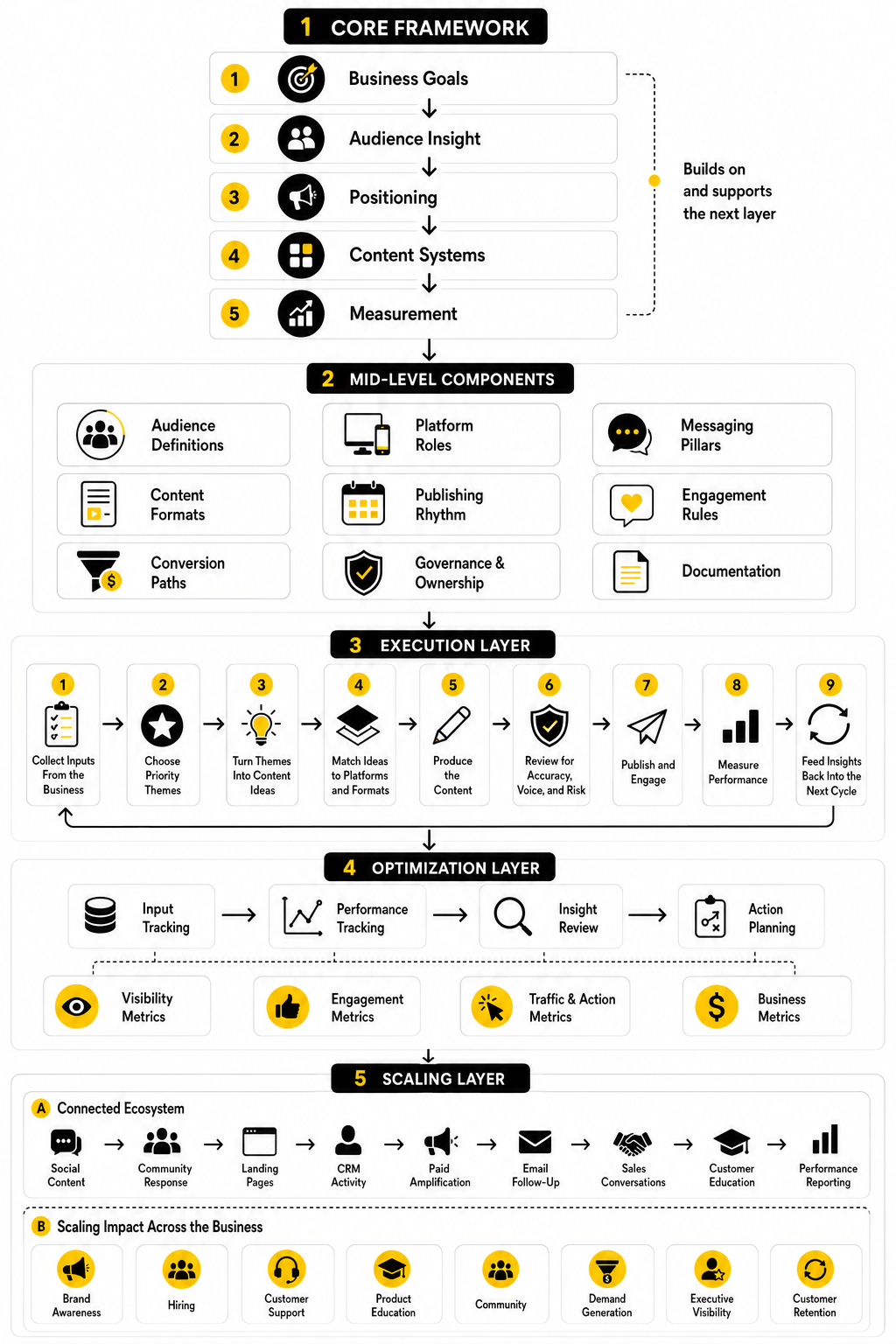
In a mature ecosystem, content creates attention, engagement creates signals, landing pages capture intent, CRM workflows organize follow-up, sales conversations reveal objections, customer success reveals retention drivers, and analytics show what deserves more investment. Each part strengthens the next. When one part is weak, the whole system leaks value.
This is why the final version of your company social media strategy should not end with a publishing calendar. It should show how social connects to the rest of the business. That connection is what turns attention into trust, trust into action, and action into growth.
Review the Strategy Quarterly
A quarterly review gives the company enough time to see meaningful patterns without waiting too long to adjust. Weekly performance can be noisy. Monthly results are better, but they can still be influenced by campaigns, seasonality, platform changes, and unusual posts. Quarterly review creates a better strategic rhythm.
The review should look at what changed in the business, what changed in the market, and what changed in the audience’s behavior. It should also evaluate whether the current platforms, pillars, formats, workflows, and measurement model still fit. If they do, keep building. If they do not, adjust with purpose.
The goal is not to reinvent the strategy every quarter. That creates chaos. The goal is to improve the parts that are not working while protecting the strategic choices that are still right.
Keep the Strategy Practical
The best social media strategy is the one the team actually uses. If the document is too long, too vague, or too disconnected from daily work, people will ignore it. That is not a team problem. That is a strategy design problem.
A practical strategy should fit into daily decisions. It should help someone decide whether a post is worth making, which platform it belongs on, what message it should carry, what risk level it has, what next step it supports, and how success will be judged. If it cannot do that, it needs to be simplified.
This is also where leadership discipline matters. A strategy cannot work if every urgent request overrides it. The company needs enough alignment to protect the plan, even when new ideas, trends, and internal priorities compete for attention.
What is a company social media strategy?
A company social media strategy is a plan that defines how a business uses social media to support specific goals. It covers the target audience, platform choices, messaging, content pillars, publishing workflow, engagement rules, conversion paths, and measurement. It is not just a content calendar, although the calendar should come from the strategy.
Why does a company need a social media strategy?
A company needs a social media strategy because random posting rarely creates consistent business value. A strategy helps the team focus on the right audience, say the right things, choose the right platforms, and measure the right outcomes. It also prevents social media from becoming a reactive task list driven by internal requests and platform trends.
What should be included in a company social media strategy?
A strong strategy should include business goals, audience definitions, brand positioning, platform roles, content pillars, format choices, publishing rhythm, community response rules, conversion paths, governance, reporting, and optimization. The exact details depend on the company’s size, industry, audience, and growth model. The important thing is that each section helps the team make better decisions.
How often should a company post on social media?
The right posting frequency depends on the platform, audience, resources, and content quality. A company should post often enough to stay visible and learn from the market, but not so often that quality drops. Consistent, useful content usually beats high-volume posting that feels generic or rushed.
Which social media platforms should a company use?
A company should use the platforms where its audience already pays attention and where its message fits naturally. LinkedIn may work well for B2B trust, hiring, and executive visibility. Instagram, TikTok, YouTube, Facebook, Reddit, or X may fit different use cases depending on the audience and content format. The smart move is to choose platforms based on behavior, not hype.
How do you measure social media strategy success?
Success should be measured with a mix of visibility, engagement, action, and business metrics. Reach, impressions, comments, saves, shares, clicks, direct messages, signups, demo requests, pipeline influence, customer feedback, and hiring interest can all matter. The right metrics depend on the role social media plays in the business.
Are likes and followers important?
Likes and followers can be useful signals, but they are not enough on their own. A follower count matters only if the audience is relevant. Likes matter more when they come from the right people and support a broader pattern of trust, engagement, or demand.
How long does it take for a company social media strategy to work?
A strategy can improve focus quickly, but business results usually take time. Some signals, like comments, saves, clicks, and direct messages, can appear early. Deeper results, such as brand memory, pipeline influence, community trust, and customer retention, usually compound over months.
Should companies use AI for social media content?
Companies can use AI to support research, repurposing, drafting, editing, and workflow speed. They should not rely on AI to replace strategic judgment, customer insight, or original point of view. The strongest content still needs human experience, taste, specificity, and credibility.
What is the biggest mistake companies make with social media strategy?
The biggest mistake is treating social media as a posting problem instead of a strategy problem. If the audience is unclear, the positioning is weak, or the business role is vague, more posts will not fix the issue. Better execution starts with sharper strategic choices.
How should a company handle negative comments?
A company should handle negative comments with clear rules before a problem happens. Some comments deserve a helpful public reply, some should move to private support, and some require escalation to leadership, legal, or security teams. The team should respond quickly, stay calm, and avoid defensive language.
Should social media be managed internally or outsourced?
It depends on the company’s needs and resources. Internal teams usually understand the brand, product, and customer context better. External specialists can add speed, creative skill, strategy, or production capacity. Many companies use a hybrid model where internal teams own strategy and external partners support execution.
How does social media connect to sales?
Social media connects to sales by building trust, educating buyers, answering objections, creating demand, driving traffic, starting conversations, and supporting follow-up. It may not always get full credit in attribution reports because buyers often see content before they convert later through another channel. That is why social data should be reviewed alongside CRM, sales, and customer insights.
What tools help with company social media strategy?
The right tools depend on the bottleneck. A scheduler like Buffer can help with planning and publishing. ManyChat can help with direct message automation. GoHighLevel can help when the company needs CRM, booking, automation, and follow-up connected to social activity.
How can a company improve its social media strategy over time?
A company can improve by reviewing performance regularly, listening to audience feedback, tracking content pillars separately, studying customer questions, and connecting social insights with sales and customer data. The team should keep what works, improve what is close, and stop what creates noise without value. Strategy gets stronger when learning becomes part of the operating system.
Build a stronger local presence with BAAM AI
Turn your website, Google profile, social channels, and AI visibility into one growth engine
Most businesses do not need more random marketing activity. They need a consistent presence system that helps the right people find them, trust them, and take action. BAAM AI brings strategy, local SEO, website updates, Google Maps visibility, social content, AI-search readiness, media production, and reporting into one practical monthly engine.
If you want your marketing to keep working after the campaign ends, start with a free BAAM AI presence audit. See how your business shows up today and where the fastest visibility wins are at BAAM AI.