
BAAM AI Blog
Cold Email For Digital Marketing Agency Growth: A Practical Six-Part Playbook
Cold email for digital marketing agency growth still works, but only when it is treated like a business development system instead of a copywriting trick. The agencies that struggle usually send vague pitches to...
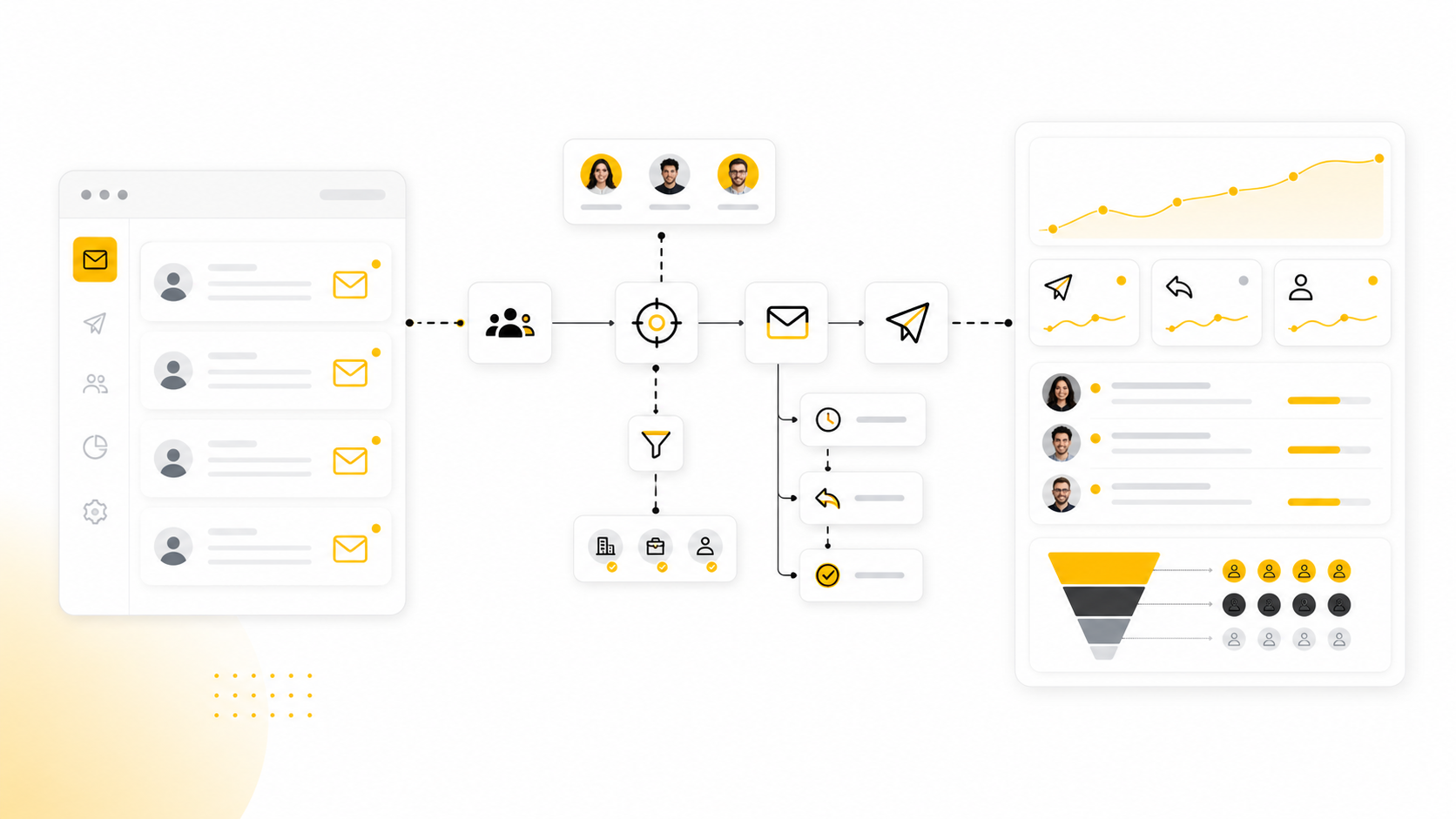
Cold email for digital marketing agency growth still works, but only when it is treated like a business development system instead of a copywriting trick. The agencies that struggle usually send vague pitches to broad lists, then blame the channel when nobody replies. The agencies that win build a tighter machine: clear targeting, relevant offers, clean deliverability, short messaging, disciplined follow-up, and a way to turn replies into booked conversations.
That matters more now because buyers are less tolerant of lazy outreach. A 2025 Gartner sales survey found that 73% of B2B buyers actively avoid suppliers who send irrelevant outreach, which is exactly why “just checking in” emails and generic agency pitches are getting ignored. At the same time, Gmail’s sender rules have made authentication, spam-rate control, and easy unsubscribe handling part of the baseline, not optional technical housekeeping.
So this guide is not going to be a pile of templates. Templates can help, but they cannot fix weak positioning, a bad list, or an offer that sounds like every other agency. Instead, this six-part guide will show how to build a cold email system that helps a digital marketing agency start better conversations with the right businesses.
this guide is split into six parts so each layer of the system gets enough room. The goal is to move from strategy to implementation without skipping the boring parts that actually decide whether campaigns land, get opened, earn replies, and turn into clients. The same section names below will continue throughout the full article.
Why Cold Email Still Matters For Digital Marketing Agencies
Cold email matters because agencies need a controllable way to start conversations before referrals, SEO, ads, or social content become predictable. A new or growing agency cannot always wait for inbound demand, especially when its best-fit clients may not be actively searching for help yet. Cold email gives you a direct path to the people who already have the problem your agency solves.
But that does not mean blasting thousands of founders with “we help companies grow” is a strategy. The FTC’s CAN-SPAM guidance makes clear that commercial email needs honest identification, clear opt-out handling, and compliant sender behavior, while UK B2B marketing guidance from the ICO also emphasizes privacy rules, lawful basis, and the right to object. In plain English: outreach has to be relevant, transparent, and easy to decline.
For a digital marketing agency, the advantage is that your service is usually tied to visible business signals. You can often see when a company is running ads, hiring marketers, launching new locations, publishing content, changing platforms, or underperforming in a channel you understand. That gives you a real reason to reach out, which is the difference between a cold email that feels useful and a cold email that feels like spam.
The Framework Behind A Good Agency Cold Email System
A good cold email system has four moving parts: market, offer, message, and operations. If one of them is weak, the campaign usually becomes expensive noise. If all four are aligned, the email feels timely because it connects a specific business problem to a specific next step.
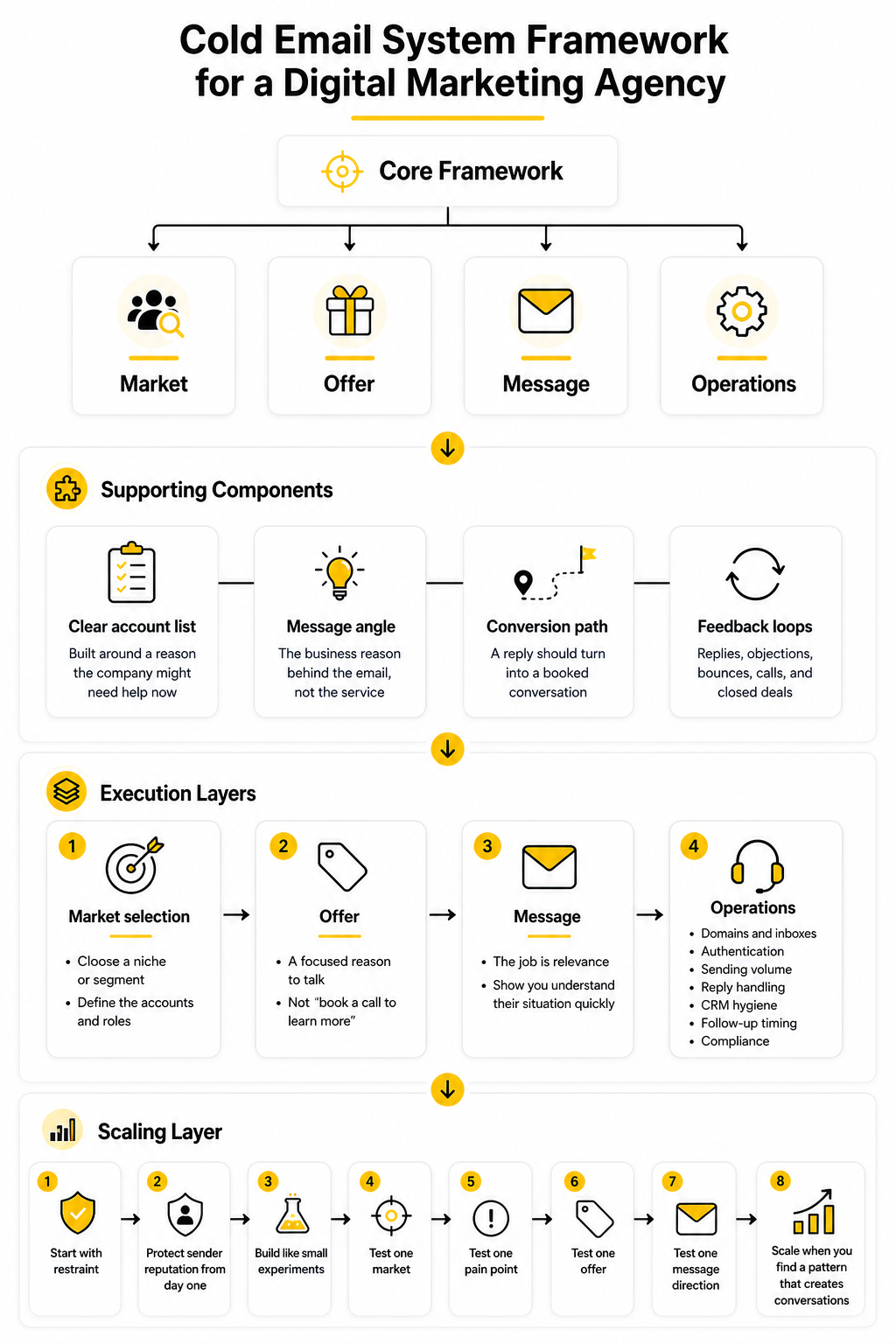
The first layer is market selection. You choose a niche or segment where your agency can make a believable impact, then you define the accounts and roles that are most likely to care. This keeps you from writing generic emails to everyone and helps every sentence feel sharper.
The second layer is the offer. A strong cold email offer is not “book a call to learn more about our agency.” It is a focused reason to talk, such as finding wasted ad spend, improving conversion paths, fixing lifecycle gaps, or building a clearer acquisition system.
The third layer is the message. This is where most people obsess over subject lines, but the real job is relevance. The email should make the recipient feel like you understand their situation quickly, without pretending you know more than you do.
The fourth layer is operations. This includes domains, inboxes, authentication, sending volume, reply handling, CRM hygiene, follow-up timing, and compliance. Tools like GoHighLevel can help agencies centralize pipeline, follow-up, and client communication, but the tool only works if the strategy underneath it is clean.
Core Components Of A Cold Email Campaign
Every campaign needs a clear account list. That list should be built around a reason the company might need your agency now, not just around industry and company size. “Ecommerce brands doing $2M to $10M” is a start, but “ecommerce brands running paid social to weak product pages with no visible post-click testing” is much stronger.
Every campaign also needs a message angle. The angle is the business reason behind the email, not the service you want to sell. For example, “your landing page may be leaking paid traffic” is usually more compelling than “we offer CRO services.”
Then the campaign needs a conversion path. A reply should not vanish into someone’s inbox, and a booked call should not depend on manual back-and-forth forever. For agencies that want a cleaner scheduling layer, Cal.com can make the handoff from interested reply to booked conversation simpler.
Finally, every campaign needs feedback loops. Replies, objections, bounces, spam complaints, call outcomes, and closed deals all tell you what to change. Without that loop, cold email becomes guessing with a sending tool attached.
Professional Implementation Starts Before The First Email
Professional implementation starts with restraint. You do not need to send massive volume to learn whether an angle works. You need enough clean data to see whether the right people understand the offer and care enough to respond.
You also need to protect sender reputation from day one. Google’s email sender guidelines tell senders to authenticate mail, keep spam rates low, and avoid behavior that causes rejection or spam placement. That means setup, monitoring, and list quality are part of the campaign, not technical chores you handle after things break.
The best agency campaigns are built like small experiments. You test one market, one pain point, one offer, and one message direction before scaling. That makes the work slower at the start, but much faster once you find a pattern that actually creates conversations.
Choosing The Right Market, ICP, And Offer
The next mistake most agencies make is jumping straight from “we need clients” to “let’s send cold emails.” That skips the part where the campaign actually becomes worth replying to. Before you write a single subject line, you need to know exactly who you are targeting, why they should care now, and what kind of conversation your email is trying to start.
Cold email for digital marketing agency growth depends on precision. A small, well-chosen market with a clear pain point will almost always beat a huge list with weak assumptions. When your targeting is sharp, your copy gets simpler because you no longer have to explain everything from scratch.
This is also where your agency stops sounding like a vendor and starts sounding like a specialist. A general agency says, “We help businesses grow online.” A focused agency says, “We help multi-location clinics turn paid search traffic into booked appointments without wasting budget on low-intent clicks.” That second sentence is not just clearer. It gives the buyer a reason to keep reading.
Start With A Market You Can Understand Deeply
A market is not just an industry label. “SaaS,” “ecommerce,” “real estate,” and “local businesses” are still too broad if you want your cold email to feel relevant. You need a market where the business model, buying trigger, pain point, and potential outcome are specific enough to talk about naturally.
For example, “ecommerce brands” becomes much more useful when you narrow it to funded DTC skincare brands spending on paid social but sending traffic to weak product pages. “Local service businesses” becomes stronger when you narrow it to roofing companies in competitive cities that depend on paid search leads. The narrower version gives you better list criteria, better personalization angles, and a more believable offer.
This does not mean you must niche forever. It means each campaign should behave like it has a niche. You can test multiple markets over time, but each outbound motion should be built around one clear segment so the message does not collapse into generic agency language.
Define The ICP Before You Define The Email
Your ICP is the type of company most likely to have the problem you solve, the money to solve it, and the urgency to take action. It is not just a demographic profile. It should tell you which accounts are worth contacting and which ones should be ignored, even if they technically fit the industry.
A useful ICP for agency cold email usually includes these details:
That last point is important. Cold email works better when there is a trigger. A company hiring a paid media manager, launching new locations, rebuilding its website, expanding into a new market, or running aggressive ads gives you more context than a company that simply exists in your target industry.
Separate Good-Fit Companies From Easy-To-Find Companies
A lot of bad outbound starts with easy data. Agencies scrape a big list from a database, filter by industry, and assume they have a market. What they usually have is a collection of companies that are easy to find, not companies that are ready for a specific conversation.
A good-fit company has a visible reason to care about your offer. If you sell landing page optimization, you should be able to see traffic sources, ad activity, product pages, funnel friction, or conversion gaps. If you sell lifecycle email, you should look for brands with repeat purchase potential, active promotions, and signs that retention matters.
This is where research quality turns into reply quality. You do not need to write a custom essay for every prospect, but you do need a real reason the person is on the list. If you cannot explain why a company belongs in the campaign, it probably does not belong there.
Choose A Pain Point That The Buyer Already Feels
The best cold email offers do not create demand from nothing. They connect to a pain the buyer already understands, even if they have not named it clearly yet. That is why “we do digital marketing” is weak and “your paid traffic may be leaking before visitors reach the booking step” is stronger.
For a digital marketing agency, strong pain points usually sit close to money. Wasted ad spend, low-quality leads, poor conversion rates, slow follow-up, weak retention, and unclear attribution are easier to care about than vague brand awareness. Buyers may value brand, content, or creative, but cold outreach usually needs a sharper commercial hook to earn the first reply.
The pain point should also match the role. A founder may care about pipeline and cash flow. A CMO may care about channel efficiency and growth targets. A marketing manager may care about execution bottlenecks, reporting, or campaign performance. Same company, different pressure.
Build The Offer Around A Specific Business Outcome
Your offer is not your service menu. It is the reason someone should take the next step with you. In cold email, that reason has to be narrow enough to understand quickly and credible enough to believe.
A weak offer sounds like this:
A stronger offer sounds like this:
The second group is better because each offer points to a concrete business problem. It gives the prospect a useful reason to reply, even if they are not ready to buy immediately.
Make The First Step Low-Friction
Most cold emails ask for too much too early. A stranger does not owe you a 30-minute meeting just because you found their website. The first step should feel easy, relevant, and proportional to the value you have shown.
That might be a short call, but it could also be permission to send over a few observations, a quick teardown, a benchmark, or a simple question about whether the issue is a priority. The point is to reduce pressure while keeping the conversation moving. You are not trying to close the whole deal in the inbox.
This is where simple infrastructure helps. If your offer naturally leads to a booking, a clean scheduling flow through Cal.com can remove friction once someone shows interest. If your agency needs the reply, booking, pipeline, and follow-up process in one place, GoHighLevel can be a practical fit because the campaign does not end when someone replies.
Match The Offer To Your Actual Delivery Strength
Do not sell an offer your agency cannot deliver repeatedly. Cold email can create demand, but it will also expose weak operations fast. If you promise a funnel audit, your team needs a clear audit process. If you promise better lead follow-up, you need the CRM, automation, and client-side implementation discipline to make that real.
This is especially important for newer agencies. A narrow offer is easier to deliver, easier to explain, and easier to improve. You can always expand the relationship later, but the first promise should be something you can execute with confidence.
A good test is simple: could you deliver the same core outcome for ten similar clients without reinventing the process every time? If yes, you probably have the start of an outbound-ready offer. If no, keep refining before you scale the campaign.
Use Positioning To Make The Email Feel Obvious
Positioning is what makes the recipient think, “This is for companies like ours.” It is not just branding. It is the connection between who you serve, what problem you solve, and why your approach is different enough to deserve attention.
For cold email, positioning should show up in plain language. You do not need clever slogans. You need a sentence that makes the market, pain point, and outcome easy to understand.
A practical positioning line can follow this structure:
For a digital marketing agency, that might become: “We help home service companies turn paid search leads into booked jobs by fixing landing pages, tracking, and follow-up.” That is not flashy, but it is clear. Clear wins.
Validate The Market Before Scaling
The goal of the first campaign is not to prove that cold email works forever. The goal is to learn whether one market, one pain point, and one offer can create real conversations. That means you should judge early results carefully instead of panicking after one small send.
Look at replies, not just opens. Look at the quality of objections, not just the number of positive responses. If people are saying “not a priority,” “we already have someone,” or “send more details,” those are different signals and they should lead to different changes.
A simple validation cycle looks like this:
This is the practical way to build a cold email system. You are not trying to guess the perfect message in one attempt. You are building a repeatable path from market insight to sales conversation.
Building A Cold Email List That Is Worth Sending To
Once the market, ICP, and offer are clear, the next job is building a list that deserves the message. This is where many campaigns quietly fail. The copy might look fine, the sending setup might be clean, and the offer might even be decent, but if the list is lazy, the campaign will still feel irrelevant.
A good cold email list is not just a spreadsheet of names and emails. It is a filtered group of companies with a real reason to hear from your agency. For cold email for digital marketing agency growth, the list is the strategy made visible.
This matters because the recipient does not judge your campaign by your internal effort. They judge it by one simple question: “Why are you emailing me?” If the list was built around a weak reason, the email will feel weak before they even finish the first paragraph.
Start With Account Criteria, Not Contact Data
Do not start by collecting emails. Start by defining what a good account looks like. Contact data comes later, after you know which companies are worth reaching.
A useful account filter should include both firmographic and behavioral criteria. Firmographic data tells you what kind of company it is. Behavioral data tells you why the company might need help now. The second part is where the campaign becomes interesting.
For a digital marketing agency, account criteria might include:
The goal is not to collect every possible detail. The goal is to find enough evidence that your offer fits the account. If you cannot connect the company to the problem your agency solves, remove it from the list.
Use Buying Triggers To Prioritize The List
A buying trigger is a signal that a company may be more open to solving a problem now than it was three months ago. This is incredibly useful for agency outreach because timing often matters as much as fit. A company with the right problem but no urgency may ignore you, while a company in motion may reply quickly because the pain is already active.
Common buying triggers for agency cold email include new ad campaigns, new job posts, new locations, new product launches, website rebuilds, funding announcements, leadership changes, event promotions, and visible channel expansion. These signals do not guarantee interest. They simply give you a stronger reason to reach out.
The best triggers are connected to your offer. If you help ecommerce brands improve landing pages, ad activity plus weak product pages is a strong signal. If you help local businesses improve lead response, paid search activity plus poor booking flow is more useful than a generic industry filter.
Build The List In Layers
A strong list is built in layers, not dumped from one source. One source might help you find companies. Another might help you verify that they match your ICP. Another might help you find the right person. Another might help you validate the email address before sending.
That layered approach takes more time, but it prevents the campaign from becoming a volume game too early. You want fewer bad-fit contacts entering the system. You also want enough context to write a message that sounds like it belongs in their inbox.
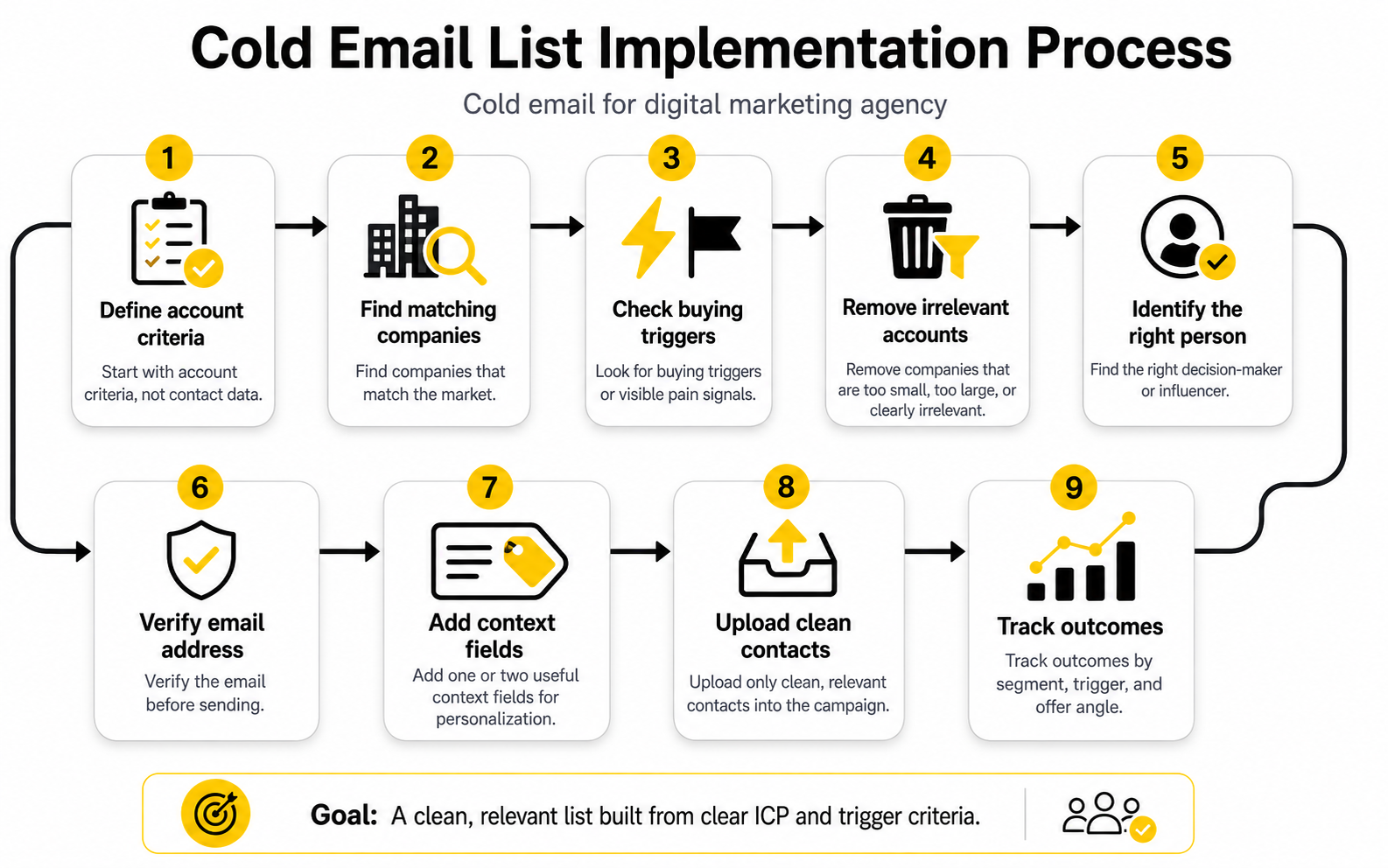
A simple list-building process looks like this:
This process is not glamorous. That is why it works. Most agencies want to skip straight to sending, but the real leverage is in deciding who should not receive the email.
Find The Right Person Inside The Account
The right company is only half the list. You also need the right person. If your email lands with someone who cannot understand the problem, influence the decision, or pass it to the right owner, even a good message may go nowhere.
For small businesses, the right person may be the founder, owner, or general manager. For mid-sized companies, it might be a head of marketing, growth lead, ecommerce manager, demand generation manager, revenue leader, or operations owner. For larger companies, the best first contact may be someone closer to the pain rather than the most senior executive.
Match the role to the offer. If your agency improves paid media efficiency, marketing leadership usually makes sense. If you fix booking flows for local service companies, operations or ownership may be closer to the revenue problem. If you build automated follow-up systems, the right buyer might sit between marketing, sales, and customer operations.
Add Context Without Over-Personalizing
Personalization is useful, but it is often misunderstood. You do not need to pretend you spent an hour researching every prospect. You need enough context to prove the email is not random.
Good context is tied to the business problem. A recent ad, a hiring signal, a landing page issue, a missing booking step, a weak follow-up path, or a channel gap is more useful than saying you liked their podcast or saw their LinkedIn post. Compliments can feel fake when they are disconnected from the reason for outreach.
Keep personalization practical. One strong sentence is enough if it connects the account to the offer. The email should feel specific, not theatrical.
Clean The Data Before It Touches Your Sending System
Bad data creates two problems. First, it wastes sending capacity on people who are not relevant. Second, it can damage deliverability through bounces, spam complaints, and low engagement.
Before uploading a campaign, clean the list carefully. Remove personal emails when they are not appropriate, generic inboxes unless they make sense for the market, duplicate contacts, irrelevant job titles, old companies, invalid domains, and accounts that clearly do not match the ICP. This is basic, but basic is where a lot of outbound campaigns break.
You should also maintain suppression lists. If someone opts out, objects, says they are not interested, or should not be contacted again, that needs to be respected across future campaigns. Compliance is not just a legal concern. It is part of protecting the agency’s reputation.
Keep The CRM Simple At The Start
A cold email list becomes more valuable when it feeds a clean pipeline. You need to know who was contacted, what angle was used, who replied, what objection came up, who booked, who no-showed, and who became an opportunity. Without that, every campaign teaches you less than it should.
At the beginning, keep the CRM structure simple. Track the account, contact, segment, trigger, offer angle, campaign status, reply type, next step, and deal outcome. You can always add complexity later, but you need the core fields from day one.
For agencies that want outreach replies, booked calls, follow-up workflows, and pipeline stages in one place, GoHighLevel can be useful because cold email does not stop at the reply. If the agency already has separate tools, that is fine too. The important thing is that every interested reply has an owner and a next action.
Segment Before You Scale
Scaling one cold email campaign into a bigger campaign should not mean throwing more contacts into the same sequence. It should mean identifying which segment is responding, then building more of that segment. That is how you scale signal instead of noise.
Segment by market, trigger, role, pain point, and offer angle. A campaign sent to ecommerce founders with weak paid social landing pages should not be judged together with a campaign sent to local service owners with poor lead follow-up. Different segments behave differently, and mixing them makes the data harder to trust.
This is also how you improve faster. If one segment gives you positive replies and another gives you silence, you know where to spend the next round of effort. You do not need to guess whether cold email works. You need to know where it works for your agency.
Build A List You Would Be Comfortable Explaining
This is the simplest quality test. Pick any company from the list and ask, “Why are we emailing them?” If the answer is vague, the list is not ready.
A strong answer sounds like this: “They are a multi-location dental group running paid search, their booking path adds friction, and our offer is about turning paid traffic into more booked appointments.” That is specific enough to support a real email. It also gives the sales conversation a natural starting point.
A weak answer sounds like this: “They are in healthcare and we work with healthcare companies.” That may be technically true, but it is not enough. Cold email rewards relevance, and relevance starts with the list.
Statistics And Data That Actually Matter
Measurement is where cold email becomes useful instead of emotional. Without data, every campaign feels personal: one bad reply feels like failure, one good reply feels like proof, and silence feels impossible to interpret. With data, you can see where the system is breaking and what to fix next.
For a cold email for digital marketing agency campaign, the point is not to chase vanity metrics. Open rates, reply rates, bounce rates, booked calls, and close rates all matter, but they do not matter equally. The only useful metric is the one that tells you what action to take.
That means you should avoid comparing your campaign to random benchmarks without context. A campaign to 200 highly qualified ecommerce founders will behave differently from a campaign to 5,000 generic local businesses. Benchmarks can give you guardrails, but your own segment-level data is what tells you whether your offer, list, and message are working.
Start With Deliverability Signals
Deliverability comes before performance. If emails are not landing properly, every other number becomes distorted. You might think your subject line is weak or your offer is wrong when the real issue is that too many messages are bouncing, getting filtered, or being ignored by inbox providers.
The most important deliverability signals are bounce rate, spam complaints, authentication status, and reply quality. Google’s sender guidance says senders should keep spam rates below 0.1% and avoid ever reaching 0.3% or higher, which gives agencies a clear ceiling for complaint risk. That number matters because spam complaints are not just feedback; they are a warning that your targeting, list quality, or message relevance is off.
A high bounce rate usually points to bad data or weak verification. A low open rate can point to inbox placement, subject lines, sender reputation, or poor market fit. A healthy reply rate with bad-fit replies often means the email is getting attention but the ICP or offer is not tight enough.
Understand What Open Rates Can And Cannot Tell You
Open rates are useful, but they are not the truth. Apple Mail Privacy Protection, image loading behavior, and inbox tracking limitations can inflate or blur open data. So an open rate should be treated as a directional signal, not a final verdict.
Recent email benchmark data shows that many business categories still see open rates in the 30% to 40% range, with HubSpot’s benchmark roundup listing 39.48% average open rate for B2B services based on Klaviyo data. That is helpful as a rough reference, but cold outbound is not the same as opted-in email marketing. A cold campaign can have lower opens and still work if the replies are qualified.
Use open rates to diagnose top-of-inbox issues. If opens are extremely low across a clean list, review deliverability, sender reputation, subject lines, and targeting. If opens are decent but replies are weak, the problem is probably not the subject line; it is the relevance, offer, or call to action.
Prioritize Replies Over Opens
Replies are more valuable than opens because they show actual buyer reaction. A reply tells you whether the person understood the message, cared enough to respond, objected to the offer, asked for details, or wanted to talk. That is much better data than knowing a tracking pixel fired.
Do not measure reply rate as one big number only. Separate positive replies, referral replies, objections, not-now replies, unsubscribe requests, and negative replies. Each category tells you something different.
Positive replies suggest the segment and offer may be aligned. Referral replies often mean the account fit is good but the contact selection needs improvement. Negative replies can be useful if they show the email feels irrelevant, too broad, too aggressive, or poorly timed.
Track The Full Cold Email Funnel
A cold email campaign should be measured like a funnel, not a single send. The goal is not to “get replies” in isolation. The goal is to turn the right accounts into conversations, opportunities, and eventually revenue.
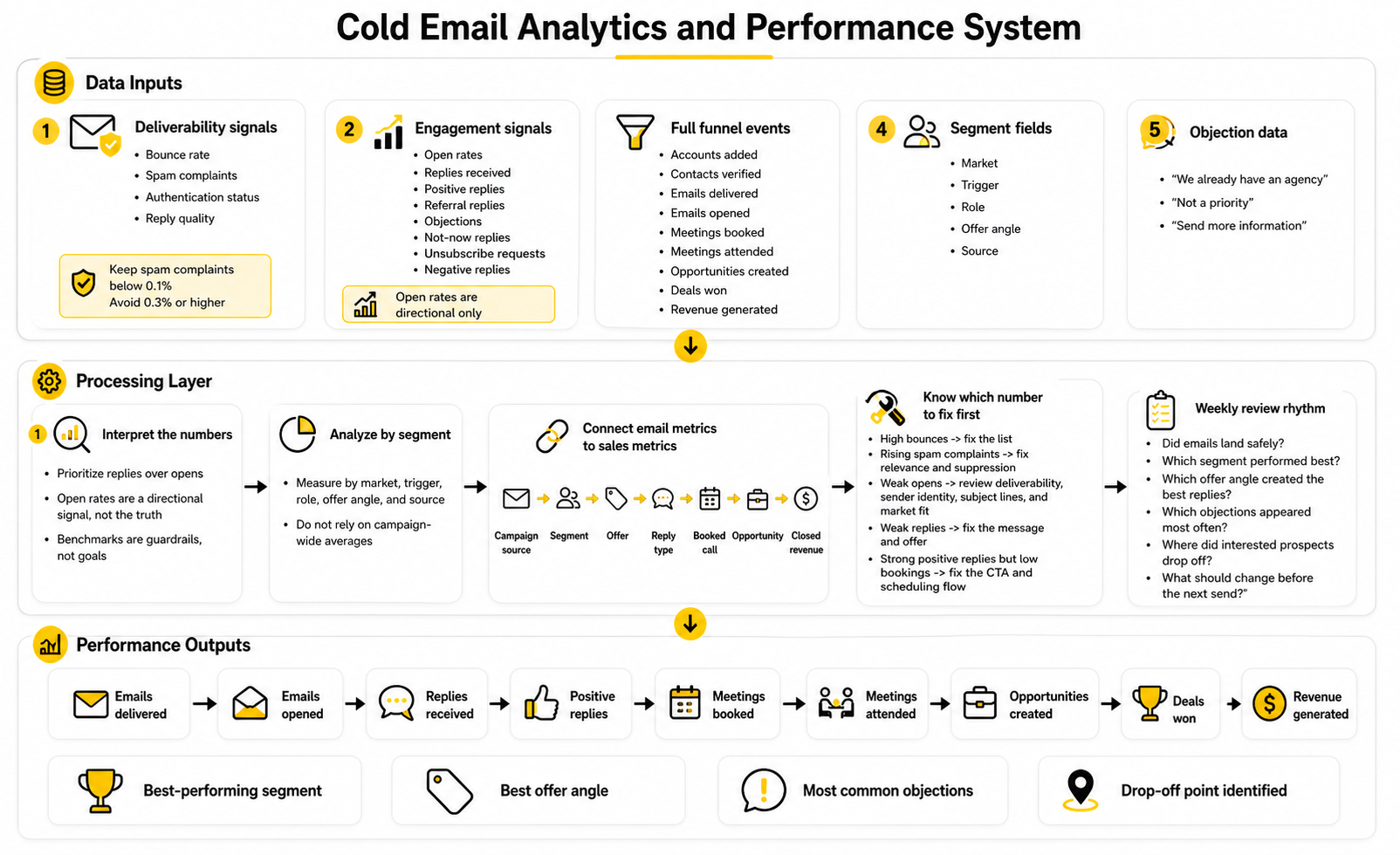
A simple analytics system should track:
This structure keeps the agency honest. If delivered emails are low, fix data and deliverability. If replies are low, fix targeting and messaging. If meetings are low despite positive replies, fix the handoff. If meetings happen but deals do not move, fix qualification, sales process, or offer-market fit.
Measure By Segment, Not Just Campaign
A campaign-wide average can hide the only insight that matters. One segment may be producing strong replies while another segment produces silence, but the average makes both look mediocre. This is why serious outbound teams measure by market, trigger, role, offer angle, and source.
For example, a campaign might perform poorly overall but reveal that founder-led ecommerce brands running paid social reply at a much higher rate than broader retail companies. That is not failure. That is useful signal.
Segment-level measurement also prevents bad decisions. Without it, you might rewrite a good email because the wrong list ignored it. Or you might scale a weak list because one lucky reply made the campaign look better than it really was.
Read Objections Like Market Research
Objections are not just sales resistance. They are data. The exact words people use when they decline, delay, or redirect you can show whether your cold email angle is landing.
If prospects say “we already have an agency,” your message may need to focus on a gap their current agency may not cover. If they say “not a priority,” your pain point may not be urgent enough or your trigger may be weak. If they say “send more information,” your email may have created curiosity but not enough reason to book.
This is where cold email becomes sharper over time. The inbox gives you market feedback quickly. You just have to organize it instead of treating every reply as a one-off reaction.
Use Benchmarks As Guardrails, Not Goals
Benchmarks are useful for spotting obvious problems, but they should not become the target. A benchmark cannot tell you whether your agency is speaking to the right buyer with the right offer. It only gives you a rough idea of what normal performance might look like in a broad category.
MailerLite’s 2025 benchmark report compares open rate, click rate, click-to-open rate, and unsubscribe rate across industries and regions, which can help you sanity-check general email performance. But cold agency outreach has a different job than newsletter marketing. The metric that matters most is not whether people clicked; it is whether qualified prospects moved closer to a sales conversation.
Use benchmarks to ask better questions. If your bounce rate is high, check data quality. If your unsubscribe rate or complaints are high, check relevance and consent handling. If your opens are healthy but replies are poor, stop obsessing over subject lines and fix the offer.
Connect Email Metrics To Sales Metrics
The biggest measurement mistake is stopping at the inbox. Cold email is only useful if it creates pipeline. That means the analytics need to connect outreach performance with sales outcomes.
Track which campaigns produce meetings, which meetings create opportunities, and which opportunities turn into clients. A campaign with a modest reply rate can be extremely profitable if the replies come from high-value accounts. A campaign with lots of replies can still be weak if the prospects are too small, unqualified, or unlikely to buy.
This is where a CRM matters. The agency needs a simple way to connect campaign source, segment, offer, reply type, booked call, proposal, and closed revenue. A platform like GoHighLevel can help agencies manage that pipeline and follow-up layer, especially when outbound, appointments, and client communication need to stay connected.
Know Which Number To Fix First
Do not try to optimize everything at once. That creates noise. Start with the earliest broken point in the funnel and fix that before moving downstream.
If emails are bouncing, fix the list. If spam complaints are rising, fix relevance and suppression. If opens are weak, review deliverability, sender identity, subject lines, and market fit. If replies are weak, fix the message and offer. If positive replies are strong but bookings are low, fix the call to action and scheduling flow.
A clean booking process matters more than people admit. When a prospect shows interest, make the next step obvious and easy. For agencies that want a simple scheduling handoff, Cal.com can reduce back-and-forth and keep interested replies from going cold.
Build A Weekly Review Rhythm
Measurement only works if someone looks at the data consistently. A weekly review is enough for most agency campaigns at the start. The goal is to make one or two clear decisions, not to drown in dashboards.
A practical weekly review should answer these questions:
This rhythm turns cold email into a learning system. Each week should make the next batch sharper. That is how you stop guessing and start building a repeatable outbound channel.
Follow-Up, Deliverability, And Campaign Operations
At this stage, the campaign is no longer just about writing emails. The list is built, the offer is defined, and the measurement system is in place. Now the real question is whether the agency can operate the campaign without damaging trust, burning sender reputation, or letting good replies slip through the cracks.
This is where cold email for digital marketing agency growth becomes more operational than creative. The best copy in the world will not save a campaign with messy follow-up, poor inbox management, weak compliance, or inconsistent sales handoff. Advanced outbound is not about sending harder. It is about controlling more of the system.
That also means the agency has to make tradeoffs. More volume can create more opportunities, but it can also create more risk. More personalization can improve relevance, but it can also slow production. More automation can protect consistency, but it can make the outreach feel robotic if the logic underneath it is weak.
Follow-Up Should Add Context, Not Pressure
Most follow-up emails are bad because they repeat the first email with slightly different words. That is not follow-up. That is inbox tapping.
A good follow-up gives the prospect another reason to respond. It might clarify the problem, add a relevant observation, reframe the offer, ask a simpler question, or give the recipient an easy way to say no. The goal is not to guilt someone into replying. The goal is to make the conversation easier to enter.
For an agency, follow-up should stay close to the business issue. If the first email mentioned wasted ad spend, the follow-up can focus on where that waste usually appears. If the first email mentioned poor lead response, the follow-up can ask whether speed-to-lead is already being tracked. Each message should move the thinking forward.
Build A Sequence Around Decision Friction
People do not ignore cold email only because they are uninterested. They ignore it because they are busy, unsure, skeptical, already working with someone, or not convinced the problem is urgent. A strong sequence accounts for those forms of friction.
The first email should introduce the reason for outreach. The second can make the problem more concrete. The third can reduce the ask. The fourth can check whether the timing or ownership is wrong. The final email can close the loop respectfully.
A practical agency sequence might follow this shape:
That structure is better than sending five versions of “just following up.” It respects the recipient while still giving the campaign enough chances to be seen. It also creates more useful reply data because each step tests a slightly different angle.
Protect Sender Reputation Before Scaling Volume
Scaling outbound too early is one of the fastest ways to ruin a working campaign. When a small batch performs well, the temptation is to multiply the list, raise sending volume, and push harder. That can work only if the infrastructure, data quality, and reply handling are ready.
Sender reputation is fragile because inbox providers judge patterns. Authentication, spam complaints, bounces, engagement, sending consistency, and user behavior all matter. Google’s sender guidance says senders should keep spam rates below 0.1% and avoid ever reaching 0.3% or higher, which is a very clear reminder that relevance is not just a copywriting concern.
The safest scaling path is gradual. Increase volume only after the segment, offer, and reply quality are proven. If complaints rise, bounces increase, or positive replies drop, slow down and fix the cause instead of trying to overpower the problem with more sending.
Treat Compliance As Part Of The Sales Experience
Compliance is not just legal protection. It affects how professional your agency feels. A prospect who cannot tell who emailed them, why they were contacted, or how to opt out is not going to trust you with their marketing.
For U.S. commercial email, the FTC’s CAN-SPAM compliance guide highlights requirements around truthful headers, non-deceptive subject lines, clear identification, a valid physical postal address, and honoring opt-out requests. For UK and European outreach, the ICO’s direct marketing guidance makes the privacy and electronic marketing layer more nuanced, especially around business contacts, lawful basis, and objection rights. The practical takeaway is simple: do not build an outbound system that depends on hiding, misleading, or making refusal difficult.
Good compliance also improves operations. Suppression lists stay clean. Unsubscribes are handled properly. The team knows who should not be contacted again. That discipline protects the agency long before there is ever a legal problem.
Decide What Should Be Automated And What Should Stay Human
Automation is useful when it removes repetitive work. It becomes dangerous when it removes judgment. The difference matters.
Automate list enrichment, email verification, campaign scheduling, CRM updates, reminders, and basic routing where possible. Keep human review for offer strategy, segment selection, sensitive personalization, positive replies, objections, and sales conversations. The more valuable the account, the more human attention it deserves.
This is especially important for agencies selling high-trust services. If you are asking a company to trust you with paid media, funnels, CRM, email marketing, or lead generation, your own outreach should demonstrate control. A messy automated sequence sends the opposite signal.
Manage Replies Like Pipeline, Not Inbox Noise
A reply is not the finish line. It is the start of the next process. If replies sit unread, get answered inconsistently, or depend on one person remembering to follow up, the agency is leaking opportunity.
Every reply should be categorized quickly. Positive interest, referral, objection, not now, already have a vendor, unsubscribe, wrong person, and negative response should each trigger a different next step. That keeps the process calm and prevents the team from treating every reply the same.
This is where pipeline infrastructure becomes valuable. A platform like GoHighLevel can help agencies connect replies, appointments, follow-up tasks, and deal stages so interested prospects do not disappear. The tool is not the strategy, but it can support the strategy when the agency has clear rules for what happens after someone responds.
Know When To Personalize More And When To Segment Better
Personalization and segmentation are not the same thing. Personalization changes the message for one prospect. Segmentation changes the campaign for a group of similar prospects. Both can help, but they solve different problems.
If replies suggest that prospects understand the problem but do not feel the timing is right, better trigger-based segmentation may help. If replies suggest the message feels generic or disconnected from the company, more personalization may help. If replies suggest the offer itself is unclear, neither personalization nor segmentation will fix it until the offer is sharpened.
The mistake is using heavy personalization to compensate for weak targeting. That creates expensive outreach that still does not convert. It is better to build a tighter segment first, then personalize only where it adds real context.
Avoid Scaling A Campaign That Only Works Because Of Luck
One good client from a campaign does not always mean the campaign is ready to scale. It might mean the campaign worked. It might also mean the agency got lucky. The difference shows up in the pattern.
A scalable campaign produces consistent signs of market fit. That means multiple relevant replies, similar objections, repeatable call quality, and a clear relationship between the segment and the offer. If the only win came from one unusual account, study it, but do not assume the entire market is validated.
This is where discipline matters. Agencies often want certainty after one result because outbound can feel uncomfortable. But cold email gets more predictable only when the same type of account responds to the same type of message for the same type of reason.
Use Risk Controls Before You Add More Volume
Before increasing volume, check the campaign for risk. This is not overthinking. It is how you protect the channel.
A useful pre-scale checklist includes:
If the answer is no, scaling will create more mess, not more growth. Fix the weak point first. More volume amplifies whatever is already happening.
Prepare For The Sales Conversation Before The Reply Comes
A cold email campaign should be connected to a sales process before it launches. Otherwise, the agency may generate interest and then waste it with a weak call, vague proposal, or slow follow-up. That is painful because the hardest part already happened: the right person responded.
The sales conversation should continue the same logic as the email. If the email promised to look at lead response, do not turn the call into a generic agency pitch. If the email focused on landing page conversion, make the call about traffic quality, page friction, testing, and revenue impact.
The next step should also be easy to book. A scheduling tool like Cal.com can help once someone is ready to talk, but speed still matters. Interested replies cool down fast when the handoff is unclear.
Scale The Learning Before You Scale The Sending
The best outbound teams scale learning first. They improve the segment, sharpen the offer, refine the message, clean the data, and tighten the follow-up process. Then they increase volume.
That order matters because cold email is unforgiving when the foundation is weak. If your list is messy, more sending creates more bounces. If your offer is vague, more sending creates more silence. If your handoff is slow, more replies create more missed opportunities.
The mature approach is simple: find the signal, protect the reputation, improve the process, then scale. That is how cold email becomes a durable agency growth channel instead of a short burst of activity that burns out.
Turning Replies Into Sales Conversations And Long-Term Pipeline
The final layer is where the campaign either becomes revenue or becomes another folder of “interesting replies.” A positive reply is valuable, but it is not a client. A booked call is useful, but it is not pipeline until the problem, buyer, timing, budget, and next step are clear.
This is why cold email for digital marketing agency growth has to connect outreach with sales. The email opens the door. The sales process decides whether the door leads to a real opportunity.
The goal is not to pressure every interested person into a proposal. The goal is to sort replies properly, move qualified prospects forward, and keep future-fit accounts warm without annoying them. That is how cold email stops being a one-off campaign and becomes part of the agency’s growth engine.
Turn Reply Types Into Clear Next Steps
Every reply should trigger a specific action. If someone says they are interested, they should get a fast, relevant response and a simple path to a conversation. If someone says they already have an agency, the next message should not argue; it should clarify whether there is a gap their current partner is not covering.
This is where many agencies lose money. They treat replies like messages instead of pipeline events. The better approach is to categorize them and move each one into the right path.
A practical reply system can look like this:
This keeps the team calm. Not every reply is a lead, and not every objection is bad. The inbox is simply showing you where each account belongs next.
Make The First Sales Call Specific
The first call should not become a generic agency pitch. If the email was about wasted ad spend, the call should explore paid traffic quality, funnel friction, conversion tracking, and what happens after the lead arrives. If the email was about lifecycle gaps, the call should explore repeat purchase behavior, segmentation, retention, and revenue lost after the first sale.
Specificity creates trust because it proves the outreach was not random. The prospect replied because one issue felt relevant. Stay there long enough to understand whether the issue is real, expensive, and worth solving now.
A simple discovery flow works well:
This protects both sides. The buyer does not feel dragged into a canned pitch, and the agency does not waste time writing proposals for weak-fit opportunities.
Build A Pipeline That Remembers Timing
Many cold email opportunities are not ready immediately. That does not make them useless. It means the agency needs a follow-up system that remembers timing better than a human inbox does.
A company might be interested after a website launch, budget reset, agency contract review, seasonal campaign, hiring change, or underperforming quarter. If you do not capture that timing, you will forget. If you follow up randomly, you will feel annoying.
This is where pipeline discipline matters. Add the reason for the future follow-up, the timing, the pain point, and the last meaningful interaction. A CRM like GoHighLevel can help agencies keep those reminders, pipeline stages, and follow-up actions connected, especially when multiple campaigns are running at once.
Create A Simple Ecosystem Around Cold Email
Cold email works better when it is not isolated. A prospect may receive your email, check your website, look at your LinkedIn profile, search your agency, read a case study, or ask someone internally whether the problem is real. The email starts the motion, but the surrounding ecosystem supports the decision.
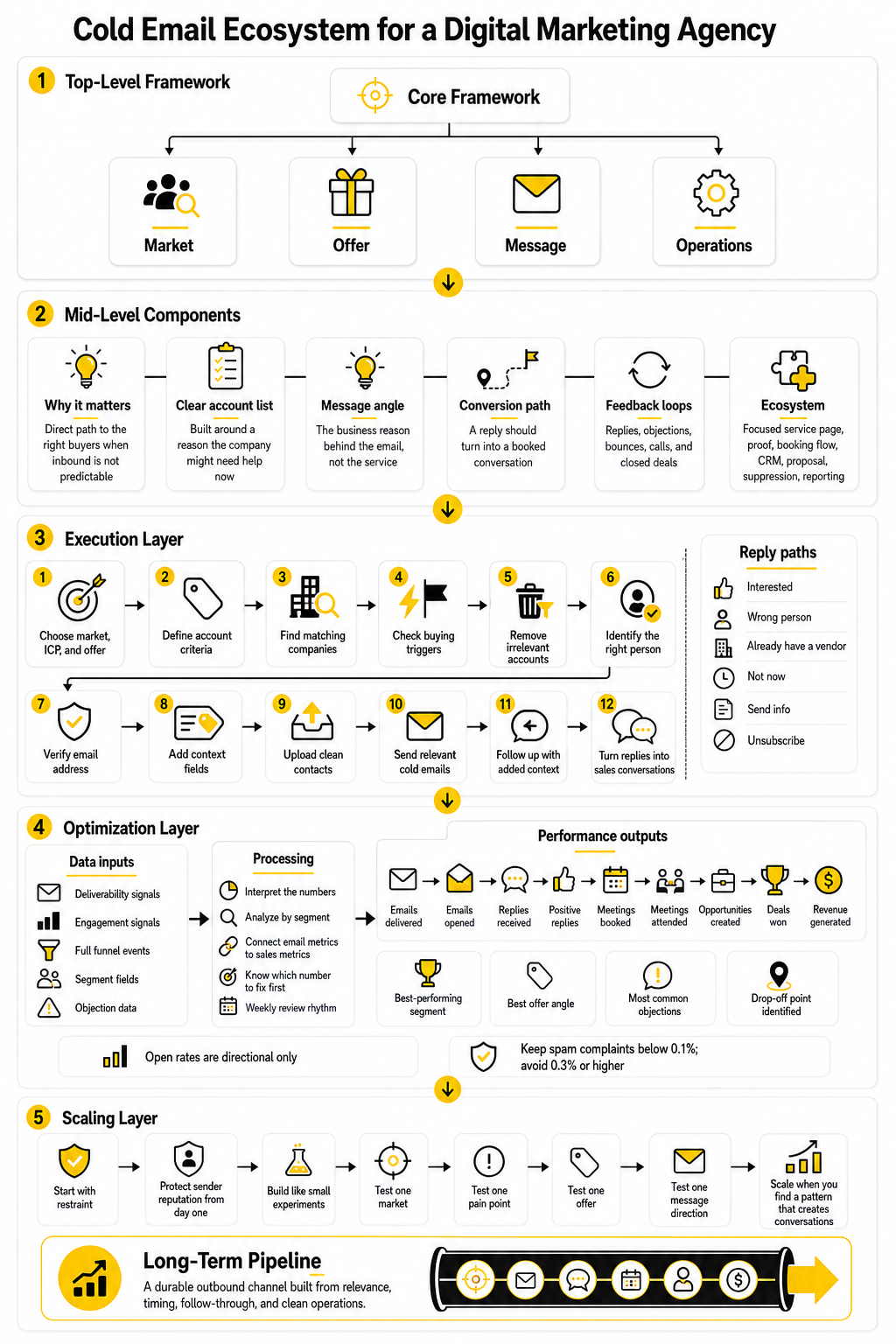
That ecosystem does not need to be complicated. It should make the agency look clear, credible, and easy to evaluate. At minimum, the prospect should be able to understand who you help, what problem you solve, what outcomes you focus on, and what the next step looks like.
A strong ecosystem might include:
This is the difference between “we send cold emails” and “we have an outbound acquisition system.” One is a tactic. The other can become a channel.
Keep The Relationship Alive After The First Conversation
Not every good-fit prospect buys quickly. Some need internal buy-in. Some need budget. Some need to finish a current contract. Some need the pain to become more urgent before they act.
The mistake is either disappearing completely or following up with empty reminders. Both are weak. A better approach is to stay relevant with occasional, useful follow-up tied to the same business problem.
That might mean sending a short observation, a relevant benchmark, a checklist, a teardown, or a note about a change in their market. Keep it practical. The goal is not to “nurture” them with fluffy content; the goal is to remain the obvious person to talk to when the problem becomes active.
Know When Cold Email Is Not The Right Channel
Cold email is powerful, but it is not magic. It is not the best channel for every agency, every service, or every market. If the offer is unclear, the delivery is weak, the target market is too broad, or the buyer cannot understand the value quickly, cold email will expose those problems fast.
That is not a bad thing. It gives you feedback. Silence, objections, and poor call quality can show you that the market is wrong, the pain is too weak, the list is too shallow, or the agency’s positioning is not sharp enough yet.
The mature move is to diagnose the issue instead of blaming the channel. Cold email rewards relevance, timing, and follow-through. If those are missing, fix the system before sending more.
Is cold email still effective for digital marketing agencies?
Yes, cold email can still be effective for digital marketing agencies when it is targeted, compliant, and tied to a specific business problem. It works best when the agency reaches companies that already show signs of needing the service. It works poorly when the agency sends generic pitches to broad lists and hopes volume fixes relevance.
What is the best cold email strategy for a digital marketing agency?
The best strategy is to start with a narrow market, define a clear ICP, identify a painful business problem, and build an offer around that problem. Then build a clean list, write short relevant emails, follow up with context, and track the full funnel from delivery to closed revenue. The strategy should feel like business development, not mass promotion.
How many cold emails should an agency send per day?
There is no universal number because safe volume depends on domain reputation, list quality, inbox setup, engagement, and complaint rates. Agencies should start smaller, monitor deliverability, and scale gradually only after the segment and offer are producing qualified replies. Google’s guidance to keep spam rates below 0.1% and avoid 0.3% or higher is a useful reminder that volume without relevance is risky.
What should a digital marketing agency offer in a cold email?
The offer should focus on a specific business outcome, not a long service list. Instead of saying “we do SEO, ads, email, and funnels,” the agency should connect one visible problem to one useful next step. Examples include finding paid traffic leaks, improving booking flow, fixing lifecycle gaps, or identifying where lead follow-up is slowing revenue.
Should cold email include a booking link?
A booking link can help after someone shows interest, but it should not be the only call to action in the first email. Many prospects are not ready to book with a stranger immediately. A softer question often works better first, and then a clean scheduling link through a tool like Cal.com can reduce friction once the prospect is ready.
How long should a cold email be?
A cold email should usually be short enough to understand in a few seconds. The buyer should quickly see why you are reaching out, what problem you noticed, why it matters, and what the next step is. If the email needs several long paragraphs to make sense, the offer or targeting probably needs work.
How many follow-ups should an agency send?
A practical sequence often includes three to five total touches, depending on the market and the offer. Each follow-up should add context, reduce friction, or ask a clearer question. Sending repeated “just following up” messages is weak because it adds pressure without adding value.
What metrics matter most in agency cold email?
The most useful metrics are bounce rate, spam complaints, reply rate, positive reply rate, booked calls, attended calls, opportunities created, deals won, and revenue generated. Open rates can help diagnose visibility, but they are not enough to judge performance. The best campaigns connect inbox activity to pipeline outcomes.
Why are my cold emails getting replies but no clients?
This usually means the campaign is creating interest but not qualified pipeline. The issue may be weak qualification, wrong buyer role, unclear sales process, low urgency, poor offer fit, or bad call handling. Track what happens after the reply so you can see whether the problem is before the call, during the call, or after the proposal.
Why are my cold emails not getting replies?
Low replies can come from several issues: poor list quality, weak market fit, vague offer, bad timing, deliverability problems, or copy that sounds too generic. Start by checking whether emails are landing safely and whether the list truly matches the pain point. Then review whether the message gives the prospect a clear reason to care now.
Is personalization necessary for cold email?
Personalization helps when it proves relevance. It does not help when it is shallow or fake. A useful personalized sentence should connect the company to the business problem, such as an ad, hiring signal, landing page issue, expansion trigger, or funnel gap.
Can a new agency use cold email without case studies?
Yes, but the agency needs a believable offer and a low-friction first step. Without case studies, the email should not overclaim. It can focus on a useful audit, diagnosis, teardown, or observation that demonstrates thinking before asking for trust.
What tools does an agency need for cold email?
At minimum, an agency needs list research, email verification, sending infrastructure, reply management, CRM tracking, scheduling, and reporting. The exact stack can vary. Agencies that want pipeline, follow-up, and client communication in one place may use GoHighLevel, while teams that need a simple booking layer may use Cal.com.
How do you scale cold email safely?
Scale only after the campaign shows consistent signal from a specific segment. That means qualified replies, manageable complaints, clean delivery, booked calls, and real sales opportunities. If you scale before those signals appear, you will usually amplify the weakest part of the system.
What is the biggest cold email mistake agencies make?
The biggest mistake is treating cold email like a copywriting problem when it is really a strategy and operations problem. Copy matters, but it cannot rescue a bad list, vague offer, weak follow-up, or poor sales process. Strong cold email starts before the first sentence is written and continues long after the first reply.
Build a stronger local presence with BAAM AI
Turn your website, Google profile, social channels, and AI visibility into one growth engine
Most businesses do not need more random marketing activity. They need a consistent presence system that helps the right people find them, trust them, and take action. BAAM AI brings strategy, local SEO, website updates, Google Maps visibility, social content, AI-search readiness, media production, and reporting into one practical monthly engine.
If you want your marketing to keep working after the campaign ends, start with a free BAAM AI presence audit. See how your business shows up today and where the fastest visibility wins are at BAAM AI.