
BAAM AI Blog
Business To Business Email Marketing: A Practical Framework For Turning Inbox Attention Into Pipeline
Business to business email marketing is not just “sending newsletters to companies.” It is the system of using email to build trust with professional buyers, educate buying committees, create demand, move...
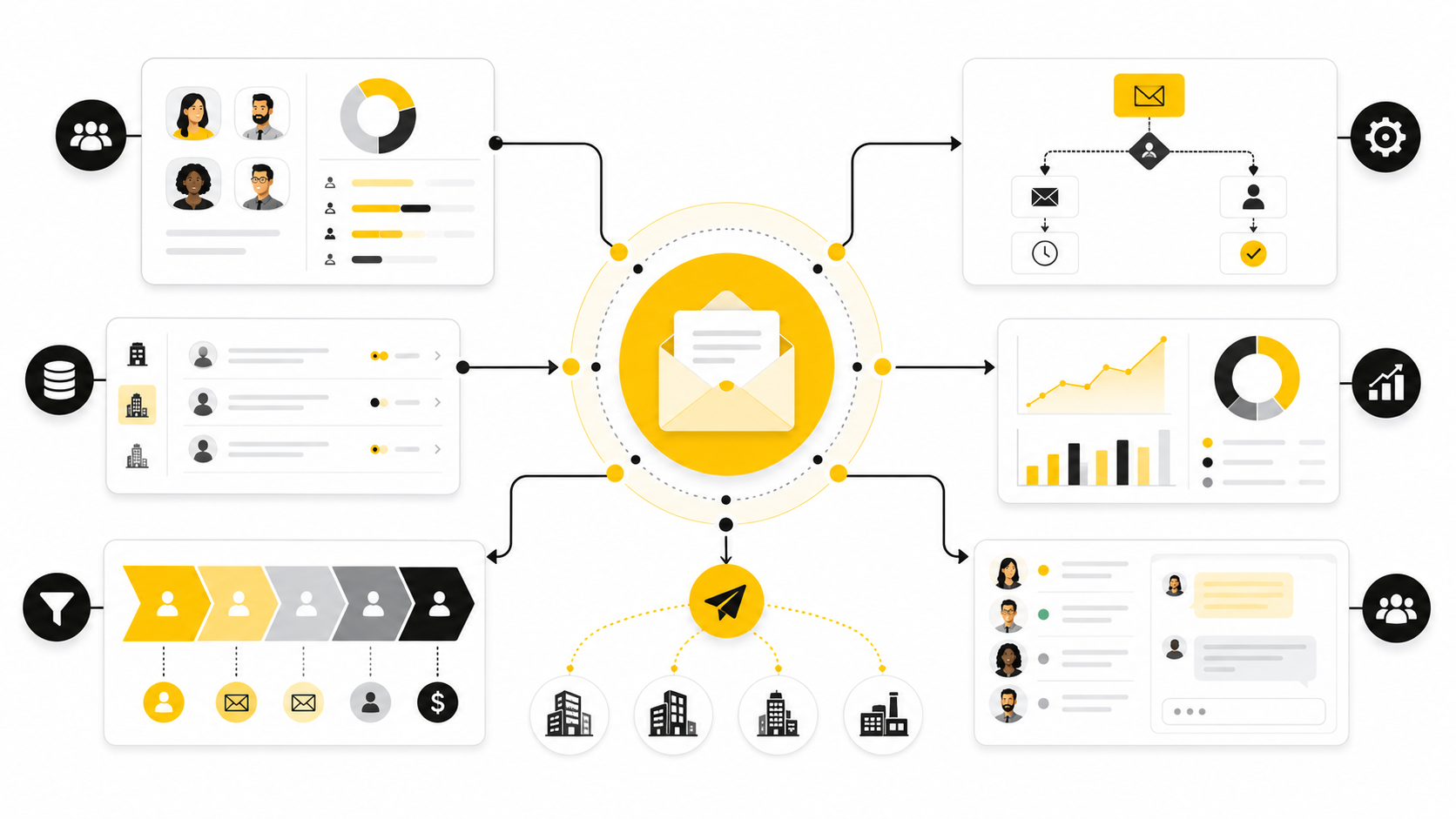
Business to business email marketing is not just “sending newsletters to companies.” It is the system of using email to build trust with professional buyers, educate buying committees, create demand, move opportunities forward, and stay present until the timing is right. Done well, it supports the full revenue journey: first touch, nurture, sales follow-up, onboarding, retention, expansion, and reactivation.
That matters because B2B buying is slower, more political, and more committee-driven than consumer buying. A buyer might like your offer today, but still need finance approval, technical validation, legal review, internal consensus, and budget timing before anything moves. Email gives you a direct channel to keep helping that buyer without relying on algorithms, ad costs, or one-off sales calls.
The problem is that most B2B email programs are still built like batch-and-blast campaigns. They push generic updates, chase opens, and treat every lead as if they are ready to book a demo right now. That approach is especially risky when 73% of B2B buyers actively avoid suppliers who send irrelevant outreach, and when buying journeys are already full of delays, stalled decisions, and internal friction.
The better approach is simple but not lazy: send the right message, to the right segment, at the right buying moment, with a clear reason to care. That is where business to business email marketing becomes a serious growth asset instead of another marketing chore. It gives your company a repeatable way to create demand, educate buyers, support sales, and measure what is actually moving revenue.
this guide is split into six parts so each section can build naturally on the last. Part 1 sets the strategy, defines the structure, and gives you the framework. The next parts go deeper into execution, measurement, and optimization without repeating the same ideas.
Why Business To Business Email Marketing Still Matters
Email still matters because B2B buyers do not make decisions in a straight line. They research quietly, compare vendors, talk internally, disappear, return, ask for proof, and often delay the purchase even when the need is real. A strong email program keeps your company useful during that messy middle instead of only showing up when a salesperson wants a meeting.
This is also why email is more than a promotional channel. It can deliver product education, industry analysis, customer proof, event follow-up, objection handling, implementation guidance, renewal reminders, and executive-level business cases. When your emails help buyers make a safer decision, you become part of their internal buying process.
The channel is also measurable in a way many brand activities are not. Recent email research shows strong returns when teams track properly, with the Litmus State of Email reporting that many marketing leaders see meaningful return for every $1 spent. The catch is that ROI does not come from “more email.” It comes from better targeting, cleaner data, stronger offers, and messages that match the buyer’s stage.
Business to business email marketing is especially powerful because you can combine owned data with intent signals. A prospect who downloads a comparison guide should not receive the same message as a customer who just completed onboarding. A CFO evaluating cost should not receive the same email as a technical buyer checking integration requirements. The more specific the context, the more useful the message becomes.
That usefulness is the real advantage. B2B inboxes are crowded, but decision-makers still pay attention when the message is relevant to a real priority. A practical email system earns that attention by being timely, specific, and helpful before it asks for anything.
The Big Shift: From Campaigns To Buyer Enablement
Old-school B2B email marketing was campaign-centered. Marketing built a campaign, selected a list, wrote a few emails, launched, reported opens and clicks, then moved on. That model can still work for announcements, but it is too shallow for modern buying behavior.
Modern B2B email needs to be buyer-centered. The question is not “What do we want to send this month?” The better question is “What does this buyer need to believe, understand, prove, or share internally before they can move forward?” That shift changes the entire strategy.
This is why educational content often outperforms hard selling in B2B. Buyers are not only evaluating features; they are managing risk. They need to understand the business case, the cost of inaction, the implementation path, the proof behind your claims, and the internal story they can take to leadership.
Research on business buying keeps pointing in the same direction: buyers want control, clarity, and useful digital experiences. Forrester’s 2024 business buying research found that 86% of B2B purchases stall during the buying process, which means the job of email is not only to create interest. It is to reduce uncertainty.
That is an important distinction. A weak email asks for the meeting too early and too often. A strong email gives the buyer a reason to trust the next step.
Framework Overview
A strong business to business email marketing framework has four layers: audience, message, journey, and measurement. Audience decides who should receive the email. Message decides what they need to hear. Journey decides when they need to hear it. Measurement decides whether the system is creating real business progress.
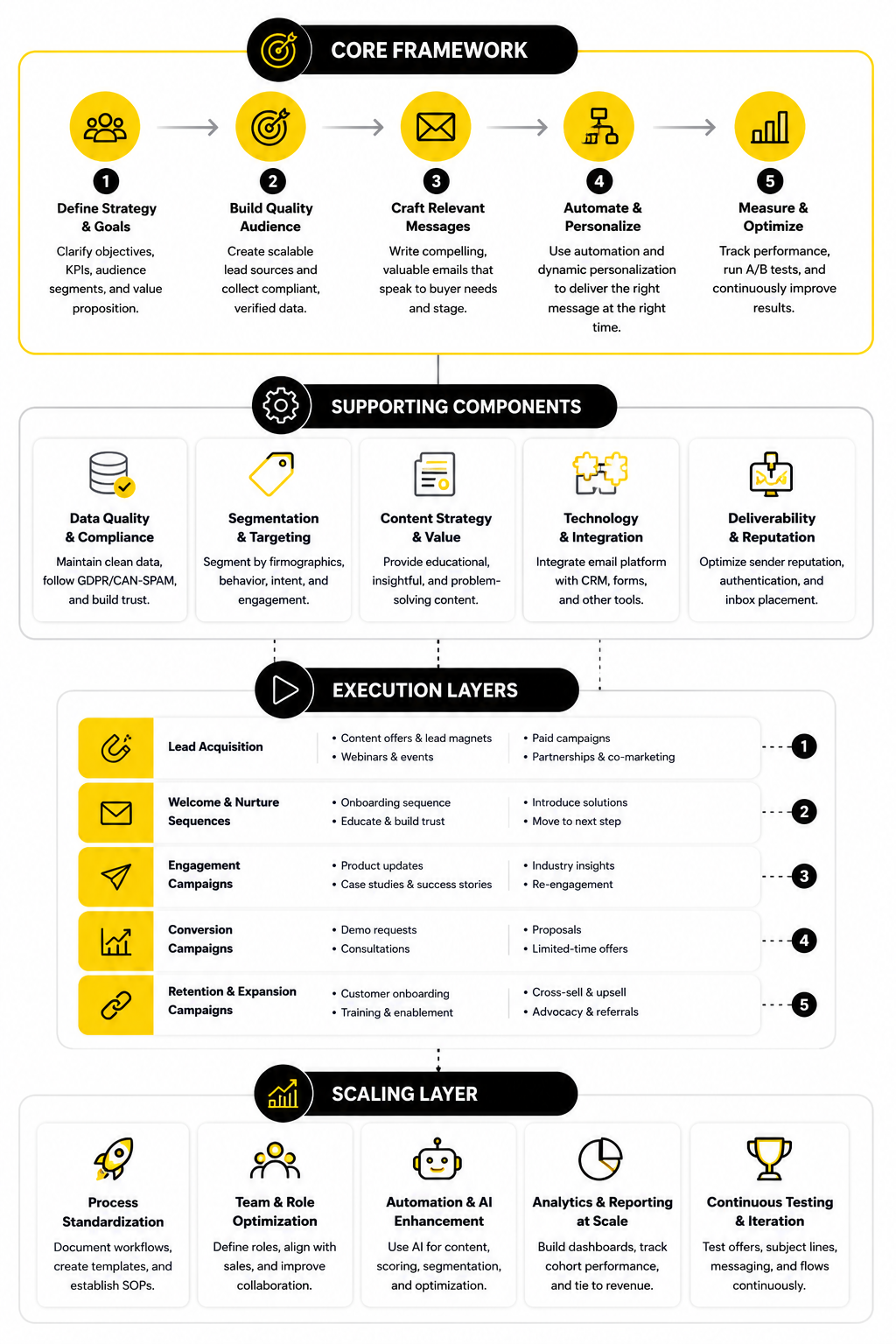
The audience layer starts with segmentation. You need to separate customers from prospects, executives from practitioners, high-intent leads from early-stage subscribers, and active opportunities from cold contacts. Without segmentation, personalization becomes cosmetic instead of useful.
The message layer connects your offer to the buyer’s problem. This is where you turn vague marketing claims into clear business value. A good B2B email does not simply say your product is powerful; it explains what problem it solves, why that problem matters now, and what the reader can do next.
The journey layer turns isolated emails into a system. Welcome sequences, lead nurture, webinar follow-up, sales enablement, customer onboarding, renewal campaigns, and reactivation flows all serve different purposes. If you use a platform like Brevo or GoHighLevel, the tool is only valuable when the journey logic is clear first.
The measurement layer keeps the program honest. Opens can be useful directionally, but they are not the goal. For B2B, the stronger signals are qualified replies, content engagement, meeting conversion, pipeline influence, opportunity progression, sales cycle movement, expansion revenue, and unsubscribes from the wrong audience.
The Role Of Email Across The B2B Buying Journey
Email plays a different role at each stage of the buying journey. At the awareness stage, it helps prospects understand the cost of the problem and gives them language for issues they may already feel but have not fully defined. At this stage, the best emails are educational, sharp, and easy to forward.
In the consideration stage, email helps buyers compare approaches. This is where guides, checklists, comparison content, webinars, technical explainers, ROI breakdowns, and customer proof become useful. The buyer is not only asking “Is this interesting?” They are asking “Can I defend this choice internally?”
In the decision stage, email supports urgency and confidence. Case studies, implementation plans, security documentation, stakeholder-specific summaries, and direct sales follow-up can all reduce friction. The goal is not to pressure the buyer; the goal is to remove the reasons they are hesitating.
After purchase, email becomes part of retention and expansion. Onboarding sequences help customers reach value faster. Product education increases adoption. Renewal and expansion emails make the relationship feel managed instead of neglected.
This is where many companies leave money on the table. They obsess over lead generation but underuse email after the deal is won. In B2B, the customer list is often the highest-intent audience you own.
What Makes B2B Email Different From B2C Email
B2B email has a different emotional context than B2C email. A consumer might buy a product because it looks good, solves an immediate personal need, or feels exciting in the moment. A B2B buyer is usually making a decision that affects their team, budget, reputation, workload, and performance.
That means your emails need more substance. You can still write conversationally, but the message must respect the reader’s professional reality. They need clarity, proof, relevance, and a next step that makes sense.
The buying committee also changes the job of email. One subscriber may not be the final decision-maker, but they might be the internal champion who shares your content with leadership. That is why strong B2B emails are often built to be forwarded, summarized, and reused inside the buyer’s company.
This also affects content format. A short email can introduce a problem, but the linked asset may need to support deeper evaluation. A practical checklist, calculator, product walkthrough, benchmark report, or implementation guide can give the reader something useful to take into the next internal conversation.
The best B2B email marketers understand this balance. They write like humans, but they sell with structure. They make the buyer’s job easier, not louder.
The Foundation For The Rest Of this guide
Before getting tactical, one principle needs to be clear: business to business email marketing works when it is treated as a revenue system, not a content dumping ground. Every email should have a reason to exist. Every sequence should match a real buyer or customer moment.
That does not mean every email needs to sell directly. Some emails should educate, some should qualify, some should invite, some should reassure, and some should simply keep the relationship warm. The important part is that each message has a clear job.
In the next part, the article will move from the “why” into the actual framework. We will break down the strategic model behind a B2B email program that can support acquisition, nurture, sales, onboarding, retention, and expansion without turning into a messy pile of disconnected campaigns.
The B2B Email Marketing Framework
A serious business to business email marketing program needs a framework before it needs more campaigns. Without a framework, every email becomes a one-off decision: What should we send? Who should get it? When should it go out? What should happen after someone clicks?
The framework solves that by giving your email program a repeatable operating system. It connects your audience, offer, content, automation, sales process, and measurement into one flow. That matters because modern B2B buyers are doing more research independently, with 67% of buyers now saying they prefer a rep-free buying experience, so your emails have to do more of the education before a sales conversation ever happens.
The framework is not complicated. It has six moving parts: audience, intent, message, sequence, handoff, and measurement. When those parts work together, email becomes a revenue engine instead of a random content distribution channel.
Start With The Audience, Not The Campaign
The first mistake is starting with the email idea. That sounds productive, but it usually leads to generic messaging because the team is focused on what they want to say instead of who needs to hear it. A better starting point is the audience segment.
In B2B, your audience is rarely one person. One account can include an executive sponsor, a department leader, a technical evaluator, a finance reviewer, an operations user, and a legal or procurement contact. Each person has a different reason to care, a different fear, and a different definition of value.
This is why segmentation matters so much. A founder comparing tools does not need the same email as an enterprise operations manager trying to reduce implementation risk. A cold subscriber does not need the same message as a high-intent lead who has visited the pricing page twice and attended a product demo.
At minimum, segment your database by relationship and buying stage. Separate prospects from customers, active opportunities from inactive leads, new subscribers from long-term contacts, and strategic accounts from low-fit contacts. Once that foundation is clean, you can add more useful layers like industry, company size, role, product interest, engagement level, and sales status.
The goal is not to create endless tiny segments that your team cannot maintain. The goal is to stop treating clearly different people as if they all need the same email. That one shift immediately makes business to business email marketing feel more relevant.
Map Intent Before You Write
After the audience comes intent. Intent tells you what the person’s behavior suggests about their current level of interest, awareness, or urgency. This is where email becomes much more carefully than a simple calendar-based newsletter.
A low-intent contact might have joined your list through a general resource. They need education, context, and reasons to keep paying attention. A medium-intent contact might have attended a webinar, downloaded a comparison guide, or returned to your site several times. They need sharper buying guidance and proof.
A high-intent contact behaves differently. They might visit pricing, request product information, compare integrations, reply to a sales email, or engage with multiple decision-stage assets. At that point, the email strategy should become more direct because the buyer is showing signs of active evaluation.
Intent should influence both message and timing. If someone reads an early-stage educational article, do not immediately push a demo as if they are ready to buy. If someone requests a product walkthrough, do not send them a beginner-level awareness email that ignores the action they just took.
This is also where your CRM and automation setup matters. Tools like GoHighLevel can help manage pipelines, follow-up flows, and lead actions, but the platform will not fix unclear strategy. You still need to define what each behavior means before automation can respond intelligently.
Build Messages Around Buyer Questions
Good B2B emails answer the questions buyers are already asking. The mistake is writing around company updates, product features, or promotional angles before you understand the buyer’s real uncertainty. In B2B, uncertainty is often what slows deals down.
Early in the journey, buyers ask questions like: Why does this problem matter now? What are other companies doing about it? What happens if we keep doing things the same way? Your emails at this stage should create clarity without forcing a premature sales conversation.
In the middle of the journey, the questions become more practical. Buyers want to know which approach makes sense, what tradeoffs exist, how different solutions compare, and what proof supports your claims. This is where educational sequences, comparison content, webinar follow-ups, and stakeholder-specific emails become valuable.
Late in the journey, the questions become risk-focused. Buyers want to know what implementation looks like, how long results might take, what internal resources are needed, how pricing works, and whether the vendor can be trusted. Contentful’s 2025 B2B buyer research found that 84% of B2B buyers consider self-service tools critical when choosing a vendor, which reinforces the same point: buyers want useful answers before they want pressure.
This is why email copy should be direct and specific. Do not hide behind vague claims like “streamline your workflow” or “build growth.” Say what problem you solve, who it matters for, what changes when it is fixed, and what the reader should do next.
Design Sequences Around Moments
A sequence is not just a bunch of emails sent over several days. A strong sequence is a guided path from one buyer moment to the next. Each email should have a job, and the order should make sense.
For example, a new lead sequence might start with the promised resource, then clarify the problem, then share a practical framework, then introduce proof, then invite a deeper next step. A webinar follow-up sequence might send the replay, summarize the key takeaways, answer common objections, share a related asset, then offer a conversation only when the buyer has enough context.
A sales-nurture sequence should feel different from a newsletter. It should support an active commercial conversation, not distract from it. That means the emails should help the buyer build internal consensus, compare options, and reduce perceived risk.
A customer onboarding sequence should feel different again. The goal is not persuasion. The goal is activation, adoption, and early value. If customers do not understand what to do after they buy, your email program should help close that gap.
This is where a clean marketing automation platform helps. A tool like Brevo can support newsletters, segmentation, automation, and transactional-style communication, but sequence design still has to come from the buyer journey. Software sends the email; strategy decides why the email exists.
Connect Email To Sales Handoff
Business to business email marketing breaks down when marketing and sales operate from different realities. Marketing might score a lead as qualified because they clicked three emails. Sales might see the same lead as unready because there is no budget, no urgency, and no clear pain. Both sides can be technically right, which is why the handoff needs rules.
A good handoff defines when sales should act. That can include behaviors like a demo request, pricing-page visits, repeated engagement with decision-stage content, direct replies, attendance at high-intent events, or activity from multiple people inside the same target account. The trigger should be based on meaningful buying signals, not vanity activity.
The handoff also defines what sales should know. If a rep receives a lead with no context, they are forced to start cold. If the CRM shows the contact’s segment, recent content engagement, stated interest, company fit, and previous email behavior, the conversation becomes much more relevant.
The best email programs support the sales team instead of competing with it. They warm up accounts, educate stakeholders, surface timing signals, and give reps better reasons to reach out. That is the whole point.
This also works in reverse. Sales conversations should inform marketing emails. If reps keep hearing the same objection, marketing should turn that objection into a useful email, guide, checklist, or comparison asset.
Measure Progress, Not Just Activity
Measurement is where many B2B email programs fool themselves. Opens are easy to report, but they are not enough to prove impact. Clicks are better, but even clicks can be misleading if they do not connect to pipeline, sales conversations, or customer movement.
A stronger measurement model separates engagement metrics from business metrics. Engagement metrics include opens, clicks, replies, unsubscribes, spam complaints, and content consumption. Business metrics include qualified meetings, sales-accepted leads, opportunity creation, pipeline influenced, deal velocity, win rate, customer activation, renewal, and expansion.
You need both views. Engagement tells you whether the message is getting attention. Business impact tells you whether that attention is worth anything.
Benchmarks can help, but they should not become the strategy. MailerLite’s 2025 benchmark data showed an average email click rate of 2.09% and unsubscribe rate of 0.22%, which gives useful context, but your own list quality, audience, offer, and buying cycle will matter more. A smaller list of high-fit buyers can outperform a huge list of passive contacts.
The most important question is simple: did this email help the buyer move forward? If the answer is no, the metric dashboard is just decoration.
The Six-Part Operating Model
Once the framework is clear, the operating model becomes much easier to manage. You do not need to reinvent the strategy every month. You need a repeatable system that your team can use to plan, build, launch, and improve.
The model works like this:
This model keeps your team focused. It also makes the article’s next sections easier to apply because every tactic will fit somewhere inside this structure. Segmentation, automation, content, sales alignment, deliverability, and reporting all become stronger when the foundation is already in place.
The next step is to break down the core components of a high-performing B2B email program. That means getting practical about lists, offers, subject lines, copy, calls to action, landing pages, automation logic, and the customer data that holds everything together.
Core Components Of A High-Performing B2B Email Program
The framework from the last section gives you the logic. Now the question becomes practical: what actually needs to exist for business to business email marketing to work day after day? The answer is not “more emails.” It is a set of components that make every campaign easier to plan, easier to launch, and easier to improve.
A strong program needs six core components: a clean list, clear segments, useful offers, strong copy, relevant landing pages, and reliable automation. If one of those pieces is weak, the entire system feels weaker. A brilliant email sent to the wrong segment still underperforms, and a great offer connected to a confusing landing page still wastes buyer attention.
This is where execution becomes real. Strategy only matters if it turns into messages, workflows, and buyer experiences that people can actually engage with. The goal is to build a system where every email has a clear audience, a clear purpose, and a clear next step.
Build The List Around Quality, Not Volume
A bigger list is not automatically a better list. In B2B, a bloated list can hurt deliverability, dilute reporting, waste sales time, and make your marketing look less relevant than it really is. A smaller list of qualified contacts with clean data is usually more valuable than a large list filled with stale, mismatched, or disengaged people.
List quality starts with permission and source clarity. You should know where contacts came from, what they opted into, what they care about, and whether they are still a good fit. If your database cannot answer those questions, segmentation and personalization will always be limited.
This matters even more because mailbox providers are stricter than they used to be. Google’s sender rules for bulk senders require authentication, easy unsubscribe, and low complaint rates, with senders at risk when spam complaints rise above 0.3% in Google Postmaster Tools. That is not a small technical detail. It means irrelevant email can become a deliverability problem, not just a copywriting problem.
A practical list process should include regular cleaning, suppression rules, engagement tracking, and clear source tagging. Remove hard bounces quickly. Suppress contacts who never engage after a reasonable reactivation attempt. Keep customers, prospects, partners, job applicants, and vendors out of the same generic marketing pool.
The point is simple: email performance starts before the email is written. If the list is messy, the campaign has to fight uphill from the first send.
Create Segments That Match Real Buying Differences
Segmentation should reflect real differences in buyer needs, not just whatever fields happen to exist in your CRM. Job title, industry, company size, lifecycle stage, product interest, region, and engagement level can all be useful. But the best segments are the ones that change what you would actually say.
For example, company size often changes the message. A small business may care about speed, simplicity, and cost control. A mid-market company may care about process, integrations, and team adoption. An enterprise buyer may care about governance, security, procurement, and implementation risk.
Role also changes the message. An executive wants business impact. A manager wants team performance and operational clarity. A technical evaluator wants integration details. A finance stakeholder wants budget logic and risk control.
The mistake is pretending personalization means using a first name in the subject line. Real personalization means the email reflects the reader’s situation. It shows that you understand their constraints, not just their name.
Use segmentation sparingly at first. Start with the differences that affect buying behavior most, then expand only when your team can maintain the segments properly. Over-segmentation sounds advanced, but it becomes useless when nobody trusts the data.
Turn Offers Into Decision Support
A B2B email offer is not always a discount, trial, or demo. Often, the best offer is a useful next step that helps the buyer make sense of the problem. That could be a checklist, benchmark report, buyer guide, calculator, webinar, comparison page, product tour, case study, or implementation plan.
The offer should match the buyer’s stage. Early-stage contacts need education and problem framing. Middle-stage contacts need comparison and evaluation support. Late-stage contacts need proof, implementation clarity, and confidence.
This is why “book a call” cannot be the only call to action. Some buyers are not ready for a call yet, but they are ready to learn. If every email pushes the same high-commitment action, you lose the chance to build trust with people who need more context first.
Decision support is especially important because B2B buying is often collective. Forrester’s 2025 research on digital-native buyers found that 64% of business buyers at manager level or above were Millennials or Gen Zers, and these buyers bring higher expectations for self-guided research. They do not want to chase basic answers through a sales process if your email could point them to the right resource immediately.
A strong offer should be useful even if the reader does not buy today. That is the standard. If the offer helps the buyer think more clearly, compare options, or explain the issue internally, it earns its place in the email.
Write Emails With One Job
Every email should have one main job. Not five. Not a newsletter stuffed with seven unrelated announcements. One clear job.
That job might be to welcome a new subscriber, explain a problem, invite someone to a webinar, send a useful resource, reactivate a dormant lead, support an open opportunity, or help a customer adopt a feature. Once the job is clear, the copy becomes much easier to write. You are no longer trying to say everything.
Good B2B email copy usually follows a simple path: open with relevance, explain the problem or opportunity, provide useful context, then give one logical next step. The tone should feel human and direct. The reader should never have to decode what you are trying to say.
Subject lines should also serve the email’s job. They do not need to be clever if clarity would work better. A subject line that signals a specific business issue often beats one that sounds like a vague marketing tease.
The body copy should respect the reader’s time. B2B buyers are busy, but that does not mean every email must be tiny. It means every sentence has to earn its place. Short is good when the decision is simple; more detail is useful when the buyer needs context to act.
Match The Landing Page To The Email Promise
The email does not finish the job by itself. If the reader clicks, the landing page needs to continue the same conversation. This is where many campaigns lose momentum.
If the email promises a practical guide, the landing page should make that guide obvious. If the email invites someone to a webinar, the page should explain who it is for, what they will learn, when it happens, and why it is worth attending. If the email offers a demo, the page should reduce anxiety by setting clear expectations.
Message match matters because the buyer is making tiny trust decisions at every step. If the email says one thing and the page says something else, friction increases. That friction may not show up as a dramatic failure, but it quietly lowers conversion.
For campaign-specific pages, tools like ClickFunnels, Systeme.io, and Replo can help teams build pages faster. The tool is not the strategy, though. The page still needs a strong headline, clear proof, a focused call to action, and a reason for the buyer to continue.
Do not make every page a hard sell. Sometimes the right landing page is an ungated resource. Sometimes it is a product walkthrough. Sometimes it is a short form. The right choice depends on the buyer’s intent and the value of the next step.
Make Automation Feel Timely, Not Robotic
Automation should make your email program more relevant, not more mechanical. The best automations respond to real buyer moments. The worst automations blast people through rigid sequences that ignore what they just did.
A good automation has a clear trigger, goal, delay logic, exit rule, and next step. The trigger might be a form submission, event registration, content download, page visit, product action, lifecycle stage change, or sales status update. The goal should be specific enough that you can measure whether the workflow worked.
For example, a webinar registration workflow should not only send reminder emails. It should also handle no-shows, attendees, high-engagement attendees, and people who asked questions. Those are different behaviors, so they deserve different follow-ups.
A nurture workflow should not keep pushing the same call to action after someone has already converted. A customer onboarding workflow should not send beginner setup emails to a user who has already completed the key action. These details matter because automation that ignores context trains people to ignore your emails.
A platform like Moosend, Brevo, or GoHighLevel can support the technical side of automation. The real win comes from designing the workflow around buyer behavior instead of internal convenience.
The Practical Implementation Process
This is where the program becomes tangible. Instead of thinking about email as a set of random campaigns, build it like a process. Start with one journey, make it work, then expand.
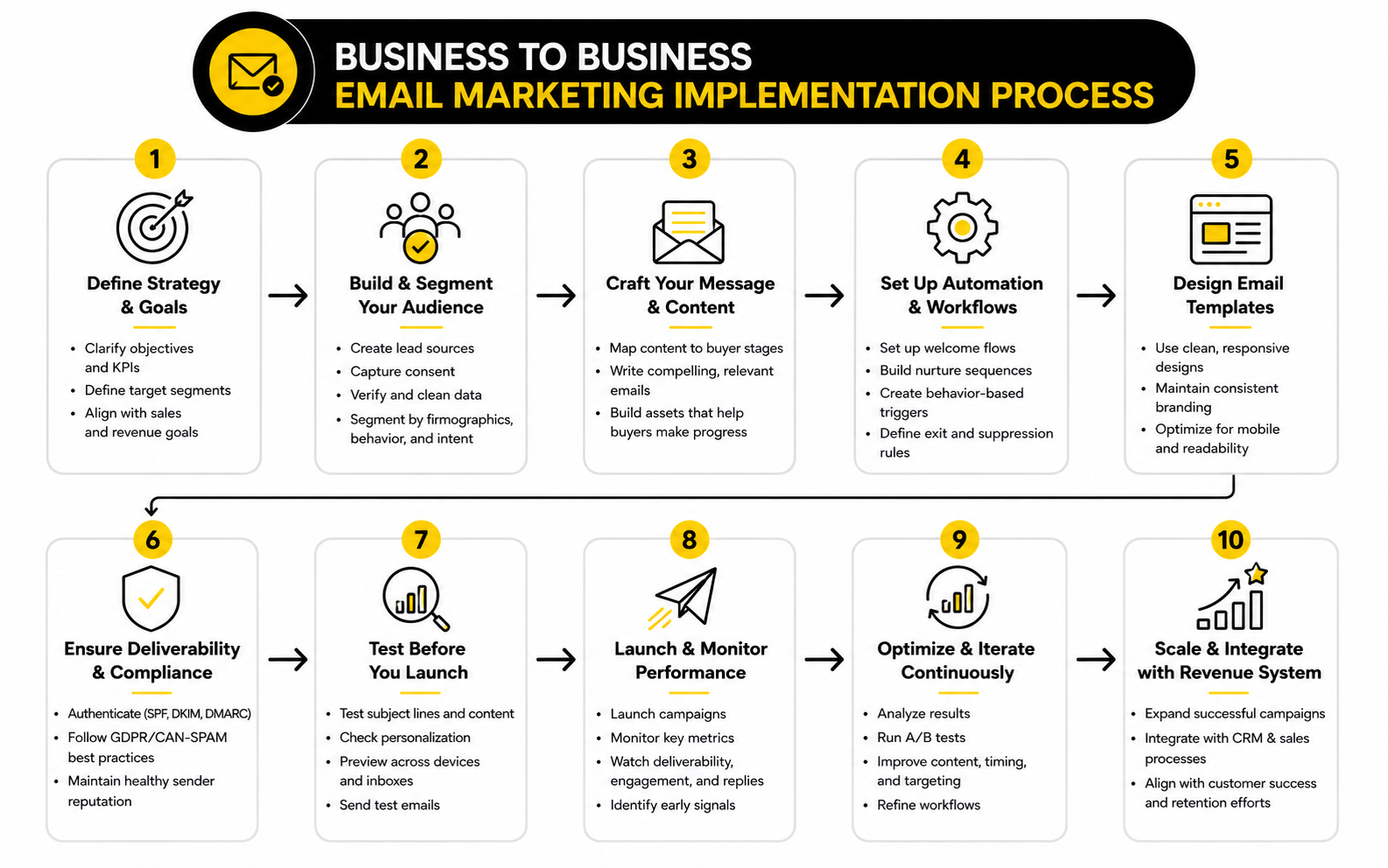
The first journey should usually be the one closest to revenue. For many B2B companies, that means lead nurture after a high-intent conversion, webinar follow-up, demo-request follow-up, or customer onboarding. Pick the journey where better email would create the clearest business impact.
Once you choose the journey, map the buyer’s state before writing anything. What do they already know? What action did they just take? What are they likely uncertain about? What would make the next step feel safer, clearer, or more useful?
Then build the sequence in a practical order:
This process keeps execution calm. You are not guessing what to send next because the journey tells you. You are not overloading sales because the trigger rules are clear. You are not relying on one perfect email because the sequence builds momentum step by step.
Build A Content Library For Reuse
A good B2B email program needs a content library. Not a random folder of PDFs. A useful library organized by buyer stage, persona, industry, problem, objection, and product area.
This makes planning faster because your team can match emails to assets without starting from scratch every time. A pricing-objection email can point to ROI content. A technical-evaluation email can point to integration documentation. A leadership-focused email can point to a business case or executive summary.
The library should include more than polished thought leadership. Sales call recordings, customer questions, onboarding issues, support tickets, webinar questions, and product usage patterns can all reveal what buyers and customers actually need to understand. Those inputs often create better email ideas than a blank content calendar.
You can also repurpose one strong asset across multiple formats. A webinar can become a follow-up sequence, a checklist, a sales enablement email, a customer education email, and a short newsletter. That is not lazy. That is how you get more value from the work you already did.
The key is to avoid repeating the same angle to the same audience. Reuse the idea, but adapt the message to the buyer’s stage and context. That is what makes repurposing feel useful instead of stale.
Use Forms And Data Collection Carefully
Forms are where your email strategy and data strategy meet. Ask for too little and your follow-up may be generic. Ask for too much and the buyer may never convert. The balance depends on the value of the offer.
For early-stage resources, a lighter form often makes sense. Name, email, company, and one useful qualifying field may be enough. For high-intent requests, you can ask more because the buyer expects a more involved next step.
Tools like Fillout can help create forms that route contacts, collect structured answers, and feed better data into your email workflows. That data becomes useful when it changes the follow-up. If you ask about company size, role, use case, or timeline, use that information in segmentation and sales context.
Do not collect data just because you can. Every field should either improve the buyer experience, qualify the lead, route the contact, or help the team personalize follow-up. Otherwise, it is just friction.
Progressive profiling can also help. Instead of demanding every detail upfront, collect information over time as the relationship deepens. That approach usually feels more natural and gives you cleaner data because the questions match the moment.
Keep Sales And Marketing Working From The Same Signals
The implementation process is not complete unless sales can see and use the email signals. If marketing owns the automation but sales owns the conversation, both teams need shared visibility. Otherwise, the buyer gets a disjointed experience.
Sales should know which emails a contact received, which links they clicked, which assets they viewed, and what action triggered the workflow. That context helps reps start better conversations. It also prevents awkward outreach that ignores what the buyer already did.
Marketing should know which email signals actually led to useful sales conversations. A click on a broad blog post may not mean much. A click on pricing, implementation, or comparison content may mean a lot. Sales feedback helps separate curiosity from buying intent.
This is where a CRM like Copper can help teams keep relationship context visible. But again, the process matters more than the tool. If your team does not agree on what signals matter, the CRM becomes a place where data sits instead of a system that guides action.
The best implementation is practical. Marketing creates the right journeys. Sales acts on the right signals. The buyer feels like the company understands where they are, instead of being pushed through disconnected touchpoints.
Measurement, Optimization, And Deliverability
Once the core components are in place, the next challenge is making the system better without breaking what already works. This is where business to business email marketing becomes more strategic. You are no longer asking, “Did people open the email?” You are asking, “Did this email help the right buyer move forward?”
That shift matters because B2B email performance can look healthy on the surface while still failing commercially. A campaign can generate clicks from the wrong audience, replies from poor-fit accounts, or engagement that never becomes pipeline. The only way to scale intelligently is to measure email as part of the revenue system, not as an isolated marketing activity.
Optimization also gets harder as volume increases. More segments, more automations, more stakeholders, and more campaigns create more chances for overlap, fatigue, data errors, and deliverability issues. The job is to grow the program without turning the inbox experience into noise.
Separate Channel Metrics From Revenue Metrics
Channel metrics tell you how the email performed as an email. Revenue metrics tell you whether the email helped the business. You need both, but they should not be confused.
Channel metrics include delivery rate, bounce rate, open rate, click rate, click-to-open rate, reply rate, unsubscribe rate, spam complaint rate, and conversion rate on the immediate call to action. These are useful because they reveal whether the message, list, and technical setup are healthy. If clicks drop, complaints rise, or unsubscribes spike, you need to investigate quickly.
Revenue metrics go deeper. They include qualified meetings, sales-accepted leads, opportunity creation, pipeline influenced, deal velocity, win rate, expansion revenue, renewal risk reduction, and customer activation. These metrics take longer to show up, but they are much more meaningful in B2B.
The tradeoff is speed versus accuracy. Channel metrics give fast feedback, but they can be shallow. Revenue metrics give better truth, but they lag behind the campaign. Smart teams review both so they can make short-term improvements without losing sight of commercial impact.
Build A Practical Attribution Model
Attribution is messy in B2B because one email rarely creates a deal by itself. A buyer might read three emails, attend a webinar, compare vendors, talk to a peer, visit the pricing page, ignore sales twice, then finally book a call weeks later. Giving all credit to one touchpoint is usually too neat to be true.
A practical attribution model does not need to be perfect. It needs to be useful enough to guide decisions. Start by tracking which email programs influence important milestones: new qualified leads, demo requests, opportunity creation, late-stage acceleration, onboarding completion, renewal engagement, and expansion conversations.
First-touch attribution can show which campaigns introduce new buyers. Last-touch attribution can show what happened right before a conversion. Multi-touch attribution can show the broader pattern, especially when several email sequences support the same account over time.
The danger is pretending the model is more precise than it is. B2B buying committees, dark social, forwarded emails, private Slack conversations, and internal meetings will always hide part of the journey. Treat attribution as decision support, not courtroom evidence.
Watch Account-Level Engagement
Individual engagement is useful, but account-level engagement is often more important in B2B. A single contact clicking an email may be interesting. Three people from the same company engaging with buying-stage content is a stronger signal.
This matters because business purchases are usually made by groups. One person may be the researcher, another may be the budget holder, another may be the technical reviewer, and another may be the final approver. If your email reporting only looks at individual contacts, you can miss account momentum.
Account-level reporting helps you see which companies are warming up, which accounts are re-engaging, and which opportunities may need sales attention. It also helps sales prioritize outreach based on collective behavior instead of one isolated click.
This does not mean every account signal deserves immediate sales action. Some engagement is educational and early-stage. The useful question is whether the pattern suggests real evaluation, not just casual interest.
Protect Deliverability Before You Scale
Deliverability is not a technical afterthought. It is the foundation of business to business email marketing because even the best message fails if it does not reach the inbox. As sending volume grows, deliverability risk grows with it.
Google’s sender guidance makes this very clear. Bulk senders must authenticate email, support easy unsubscribe, and keep spam complaint rates low, with Google specifically advising senders to keep reported spam rates below 0.10% and avoid ever reaching 0.30% or higher. That means relevance is now part of your technical infrastructure.
Authentication is the baseline. SPF, DKIM, and DMARC should be correctly configured before serious sending begins. These records help mailbox providers verify that your emails are legitimate and reduce the risk of spoofing or rejection.
But authentication alone is not enough. Inbox placement also depends on recipient behavior. If people ignore, delete, mark as spam, or never engage with your messages, mailbox providers learn from that pattern. The safest deliverability strategy is still the oldest one: send wanted email to the right people.
Manage Frequency Like A Revenue Risk
Frequency is one of the easiest things to abuse. When teams are under pressure, the instinct is often to send more. More webinar reminders, more nurture emails, more product announcements, more sales pushes, more newsletters.
Sometimes more email is justified. A high-intent buyer who requested a demo should receive timely follow-up. A customer going through onboarding may need several practical reminders. A live event may require a tighter communication window.
The risk is when frequency is driven by internal urgency instead of buyer context. If a contact is in three workflows, subscribed to the newsletter, receiving sales outreach, and getting product updates, the experience can become overwhelming fast. That is how good contacts quietly become disengaged.
Use frequency caps, suppression rules, and priority logic. Decide which messages win when a contact qualifies for multiple sends. A late-stage opportunity email should usually take priority over a generic newsletter. A customer onboarding message should not get buried under broad promotional campaigns.
Test What Actually Changes Buyer Behavior
Testing is useful only when it teaches you something you can act on. Subject line tests are easy, but they are not always the highest-leverage place to start. In B2B, the bigger wins often come from testing the offer, audience, timing, message angle, or call to action.
For example, testing “book a demo” against “see the implementation checklist” may reveal how ready the audience really is. Testing a finance-focused angle against an operations-focused angle may show which stakeholder pain is stronger. Testing a short direct email against a more educational email may show how much context the buyer needs before acting.
Do not test tiny details when the core strategy is uncertain. Button wording will not save a weak offer. A clever subject line will not fix poor segmentation. A new template will not overcome unclear positioning.
A good testing rhythm is simple. Choose one meaningful variable, define the learning goal, run the test on a large enough audience to matter, and document the result. Then apply the learning to future campaigns instead of treating every test like a one-time experiment.
Use AI Carefully Inside The Email Workflow
AI can speed up parts of the email workflow, but it should not replace strategic judgment. It can help summarize customer research, draft variations, organize campaign ideas, repurpose webinar transcripts, create first-draft subject lines, or analyze common objections. That is useful.
The risk is generic output at scale. If every company uses AI to write average emails faster, inboxes get filled with more polished sameness. Buyers do not need more smooth copy. They need more relevant thinking.
Use AI where it reduces manual work, not where it removes buyer understanding. A tool like GoHighLevel AI can be useful inside a broader automation and follow-up system, but the inputs still matter. Bad segmentation plus fast AI copy is just faster noise.
The strongest use case is usually augmentation. Let AI help with drafting, summarizing, and variation. Let humans own positioning, proof, offer strategy, compliance, and the final judgment on whether the email is actually worth sending.
Balance Personalization With Privacy
Personalization can improve relevance, but it can also become uncomfortable. B2B buyers expect you to understand their role, company context, and recent actions. They do not want an email that feels like surveillance.
The line is usually crossed when the message overstates how much you know or references behavior too aggressively. “I saw you visited our pricing page three times” may be technically true, but it can feel intrusive. “Here is a practical pricing guide for teams comparing options” uses the same signal in a more helpful way.
Privacy rules also matter. Consent, unsubscribe handling, data retention, regional regulations, and internal governance should be part of the program from the start. The bigger your list and the more regions you serve, the more important this becomes.
The strategic point is simple: personalization should make the buyer feel understood, not watched. Use data to improve relevance, timing, and routing. Do not use it to show off how much tracking you have.
Plan For Scaling Problems Early
Small email programs can survive with informal processes. Large programs cannot. Once multiple teams start sending to the same database, you need governance.
Governance does not mean slowing everything down with bureaucracy. It means creating rules that protect the buyer experience. Who can send to which segments? Which campaigns require approval? What suppressions are mandatory? How are conflicts between workflows handled? What happens when a contact becomes an opportunity or customer?
A shared campaign calendar helps prevent collisions. Naming conventions help reporting stay readable. UTM rules help attribution stay consistent. Template standards help emails feel like one brand instead of ten disconnected teams.
This is especially important when agencies, sales teams, customer success, product marketing, and demand generation all touch the same contacts. Without rules, the buyer gets the chaos. With rules, the company can scale without burning trust.
Treat Unsubscribes As Feedback, Not Failure
Unsubscribes are not always bad. Sometimes they remove people who were never going to buy, clean up your list, and protect deliverability. A healthy email program should not panic every time someone leaves.
The problem is the pattern. If unsubscribes rise after a specific campaign, segment, or workflow, something is off. The message may be irrelevant, the frequency may be too high, the offer may be weak, or the audience may not match the topic.
Spam complaints are more serious. An unsubscribe is someone using the proper exit. A spam complaint is someone telling the mailbox provider they did not want the message. That can damage sender reputation faster than most teams expect.
Make unsubscribing easy. It sounds counterintuitive, but hiding the exit creates worse outcomes. If someone no longer wants your emails, let them leave cleanly before they mark you as spam.
Know When Not To Send
One of the most underrated email skills is restraint. Just because you can send an email does not mean you should. Sometimes the best optimization is removing weak campaigns from the calendar.
Do not send when the audience is unclear. Do not send when the offer is not useful. Do not send when the only reason is “we have not emailed in a while.” Do not send when the message would interrupt a more important customer or sales workflow.
This is especially true in B2B, where trust compounds slowly and can erode quickly. A buyer may forgive one irrelevant email. They are less likely to forgive a pattern of lazy outreach.
A strong email program is not measured by how many campaigns it ships. It is measured by how reliably it creates useful buyer moments. That standard forces better decisions.
Build A Review Loop With Sales And Customer Success
Optimization should not happen only inside the marketing team. Sales and customer success hear buyer language every day. They know which objections are real, which claims create confusion, which competitors come up, and which promises need stronger proof.
A monthly review loop can make email sharper. Marketing brings campaign performance, content engagement, and workflow data. Sales brings conversation quality, lead relevance, and objections. Customer success brings onboarding friction, adoption gaps, renewal risks, and expansion opportunities.
This keeps email connected to reality. It also prevents marketing from optimizing toward clicks that sales does not value or content that customers do not need. The closer the feedback loop, the more useful the email program becomes.
Use that feedback to improve sequences, not just individual sends. If sales keeps answering the same implementation question, add that explanation earlier in the nurture path. If customer success keeps seeing the same onboarding delay, build a better activation email. If buyers keep misunderstanding pricing, clarify the decision-stage content.
Use Technology To Support The System
The tech stack should make the system easier to run, not harder to understand. Email platforms, CRMs, landing page builders, analytics tools, form tools, scheduling tools, and AI assistants can all help. But more tools do not automatically create better execution.
Choose technology based on the workflow you actually need. If your main challenge is pipeline follow-up, a platform like GoHighLevel may fit because it combines CRM, automation, funnels, and communication tools. If your focus is email campaigns and automation, Brevo or Moosend may be more natural.
If your bottleneck is building campaign pages quickly, ClickFunnels, Systeme.io, or Replo can support faster execution. If your bottleneck is CRM visibility, a relationship-focused platform like Copper can help keep sales context closer to the inbox.
The key is integration. If tools do not pass clean data to each other, your team ends up stitching together reports manually and making decisions from incomplete information. Before adding another tool, ask whether it improves segmentation, execution, measurement, or buyer experience. If it does not, it may only add complexity.
Prepare For The Final Layer
At this point, the article has covered the strategy, framework, core components, implementation process, and the measurement discipline needed to scale. The final layer is where the practical judgment comes in. That means knowing which advanced plays are worth using, which mistakes quietly damage performance, and which questions teams usually ask before committing to a serious business to business email marketing program.
The close should not introduce a completely new system. It should sharpen the one already built. Advanced tactics only work when the basics are strong: clean data, clear segments, useful offers, strong workflows, aligned sales follow-up, and deliverability discipline.
That is the standard to keep in mind. If an advanced tactic improves relevance, trust, speed, or buyer clarity, it may belong in the program. If it only adds noise, it does not.
Advanced Plays, Common Mistakes, And FAQ
Advanced business to business email marketing is not about making the system more complicated. It is about making it more precise. Once your list, segmentation, automation, measurement, and deliverability are solid, the next level is orchestration across the full customer journey.
That means email should not behave like a separate channel. It should connect with sales outreach, retargeting, landing pages, webinars, product usage, customer success, and account-based marketing. The buyer should feel one coherent experience, not a pile of disconnected campaigns.
The best advanced plays are not flashy. They are usually simple ideas executed with discipline: better account signals, cleaner lifecycle logic, stronger stakeholder content, more carefully reactivation, and tighter post-sale education. That is where mature email programs separate themselves.
Use Account-Based Email Without Making It Weird
Account-based email works when it respects the buying committee. Instead of sending one generic nurture sequence to every contact, you shape messages around the account, role, and stage. That matters because B2B decisions often involve several people who care about different risks.
For an executive, the email might focus on strategic impact and commercial upside. For an operations lead, it might focus on process improvement and team adoption. For a technical evaluator, it might focus on integrations, security, reliability, and implementation.
The key is subtlety. Do not write emails that make the buyer feel tracked across every click. Use account data to improve relevance, timing, and follow-up, but keep the copy helpful and natural.
Build Stakeholder-Specific Assets
A mature email system needs assets that help different stakeholders say yes. One person may need a business case. Another may need a technical checklist. Another may need a cost comparison or implementation plan.
This is where email becomes internal enablement for your buyer. You are not just trying to persuade the person reading the message. You are giving that person something useful to share with the rest of the buying group.
Create assets for the objections that repeatedly slow deals down. If procurement delays are common, build a procurement-friendly summary. If implementation anxiety blocks momentum, build a rollout guide. If leadership needs proof, build executive-level evidence that is concise and easy to forward.
Add Reactivation Without Damaging Trust
Reactivation is useful, but only when it is handled carefully. A dormant contact is not an enemy; they may simply be busy, out of market, or no longer in the right role. Treating inactivity like rejection leads to aggressive emails that hurt trust.
A good reactivation sequence gives the reader a clear reason to stay. It can offer a useful new resource, ask whether their priorities changed, or let them choose a more relevant topic. It should also make leaving easy.
Do not run reactivation forever. If someone ignores multiple well-written attempts, suppress them from regular marketing. Keeping inactive contacts on the list may feel like preserving reach, but it often weakens deliverability and reporting.
Use Event And Webinar Follow-Up More Strategically
Webinars, workshops, and live events create some of the best email opportunities in B2B. The mistake is treating every registrant the same after the event. Someone who attended live, stayed until the end, and asked a question is not the same as someone who registered and never showed up.
Segment event follow-up by behavior. Attendees should receive the replay, key takeaways, related resources, and a logical next step. No-shows should receive a shorter recap and a reason to watch the most useful part. High-intent attendees should trigger sales context, not just another generic nurture email.
This is also where scheduling friction matters. When the next step is a strategy call, assessment, or product consultation, tools like Cal.com can make the handoff easier. The less effort required to take the next step, the more likely serious buyers are to continue.
Connect Email With Conversational Follow-Up
Email is strong, but it does not have to work alone. Some buyers prefer chat, SMS, social messaging, or a quick guided experience after they click. The channel should match the buyer’s context and the urgency of the action.
For example, a webinar reminder can stay in email, but a high-intent form submission may deserve faster follow-up. A product question may be better handled by a chatbot or guided support flow. A lead who clicks a decision-stage page may need a more direct path than another educational email.
Tools like ManyChat and Chatbase can support conversational paths around campaigns, FAQs, and lead capture. The point is not to add channels for the sake of it. The point is to reduce friction when the buyer is already showing interest.
Avoid The Mistakes That Quietly Kill Performance
Most email programs do not fail because of one dramatic mistake. They fail because of small issues that compound. The list gets messy, segments become outdated, campaigns overlap, sales stops trusting the leads, and buyers stop paying attention.
One common mistake is sending every campaign to the largest possible audience. That feels efficient, but it teaches people that your emails are only sometimes relevant. Over time, lower engagement becomes normal.
Another mistake is using automation without exit logic. If a buyer books a demo, becomes a customer, or enters an active sales process, the email experience should change. Nothing feels more careless than receiving beginner nurture emails after taking a serious buying action.
A third mistake is optimizing for internal activity instead of buyer progress. A full campaign calendar can look productive while creating very little value. A leaner program with better timing, stronger assets, and cleaner handoffs usually wins.
Think In Systems, Not Campaigns
The final version of the email program should feel like an ecosystem. Each part supports the next. Lead capture feeds nurture, nurture feeds sales readiness, sales signals feed follow-up, customer behavior feeds onboarding, and lifecycle data feeds retention and expansion.
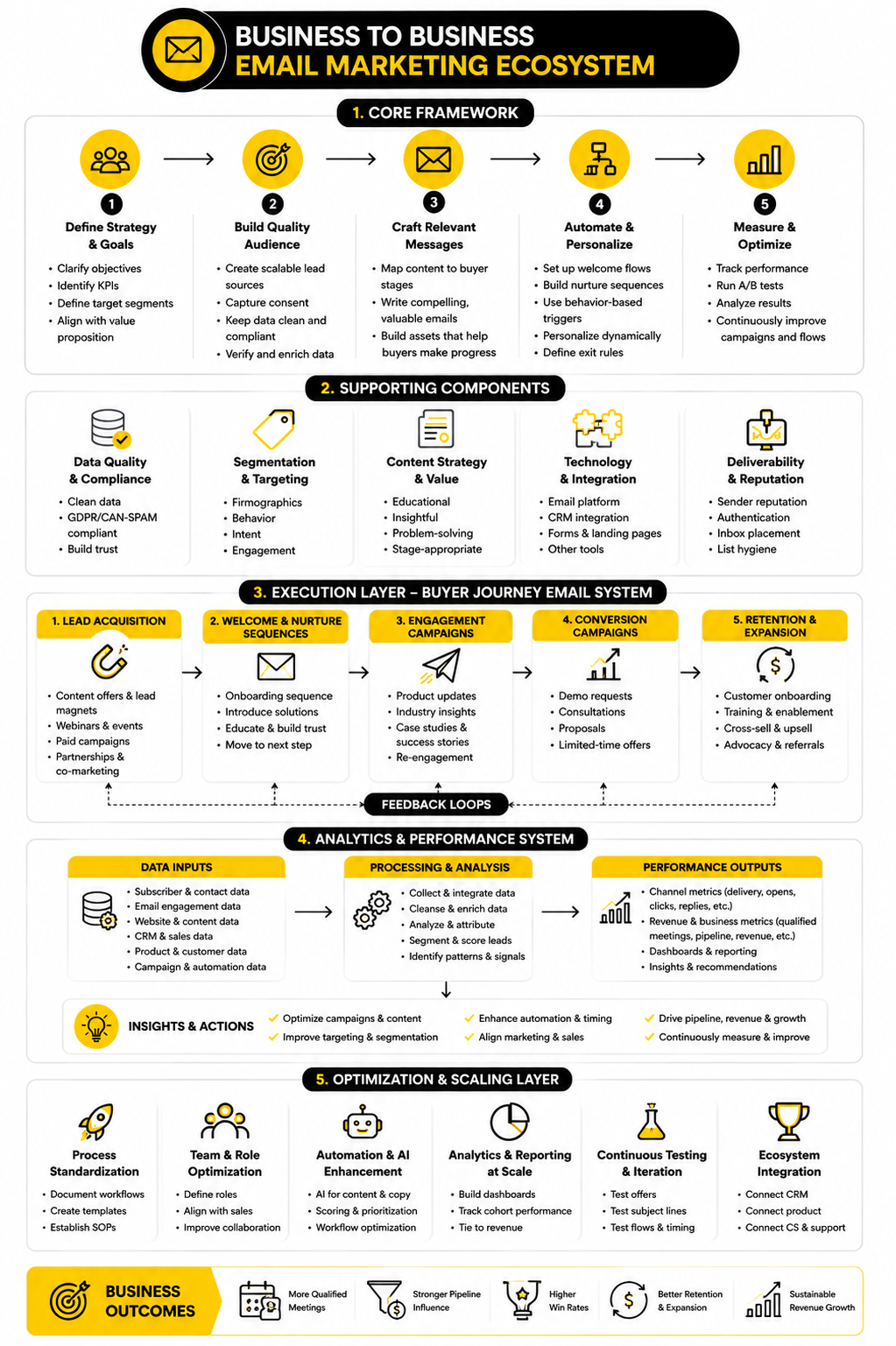
This is the real endgame. Business to business email marketing should not depend on heroic one-off campaigns. It should become a system that keeps helping buyers, customers, and sales teams at the right moments.
The system will never be finished. Markets change, offers change, buyer expectations change, and deliverability rules keep tightening. But if the foundation is strong, the program can keep improving without needing to be rebuilt from scratch.
What is business to business email marketing?
Business to business email marketing is the use of email to communicate with prospects, buyers, customers, partners, and stakeholders in a professional buying environment. It can support lead generation, nurture, sales follow-up, onboarding, retention, reactivation, and expansion. The goal is not just to send campaigns; the goal is to move the right people toward the right next step.
How is B2B email marketing different from B2C email marketing?
B2B email marketing usually involves longer buying cycles, more stakeholders, higher risk, and more internal decision-making. A B2C buyer may act quickly based on personal preference, while a B2B buyer often needs budget approval, technical validation, legal review, and team alignment. That means B2B emails need more clarity, proof, and usefulness.
Does email still work for B2B companies?
Yes, email still works when it is relevant, permission-based, and connected to the buyer journey. Buyers may avoid unwanted sales pressure, but they still engage with useful resources, clear follow-up, and timely guidance. The weak version of email is mass blasting; the strong version is targeted communication that helps buyers make progress.
What types of emails should a B2B company send?
A strong B2B program can include welcome emails, newsletters, nurture sequences, webinar follow-ups, product education, sales-support emails, customer onboarding, renewal reminders, reactivation emails, and expansion campaigns. The right mix depends on the business model and sales cycle. Start with the emails closest to revenue impact, then expand.
How often should B2B companies email their list?
There is no universal frequency that works for every list. A weekly newsletter may work for one audience, while another list may need fewer but more targeted emails. The best rule is to match frequency to buyer context, engagement, and value. If the email does not have a clear reason to exist, do not send it.
What is the best subject line for B2B email marketing?
The best subject line is specific, relevant, and honest. It should tell the reader why the email matters without exaggerating or tricking them. In B2B, clarity often beats cleverness because buyers are scanning for useful information, not entertainment.
Should B2B emails be short or long?
They should be as long as they need to be and no longer. A simple reminder or direct sales follow-up can be short. A more educational email may need more context to be useful. The real standard is not word count; it is whether the email helps the reader understand something or take the next step.
What metrics matter most in B2B email marketing?
Delivery rate, bounce rate, click rate, reply rate, unsubscribe rate, spam complaint rate, and conversion rate are important channel metrics. For business impact, track qualified meetings, sales-accepted leads, opportunity creation, pipeline influence, customer activation, renewal engagement, and expansion revenue. Opens can be useful directionally, but they should not be treated as the main proof of success.
How do you improve B2B email deliverability?
Start with clean permission-based lists, proper authentication, low spam complaints, and useful segmentation. Make sure SPF, DKIM, and DMARC are configured correctly, and keep unsubscribe easy. Google’s sender guidance tells senders to keep spam rates below 0.10% and avoid reaching 0.30% or higher, so relevance and list hygiene are not optional.
What is a good B2B email automation to build first?
Build the automation closest to a meaningful business outcome. For many companies, that is a demo-request follow-up, webinar follow-up, lead nurture after a high-intent download, or customer onboarding sequence. Choose one journey, make it work, then expand.
Should B2B companies use AI for email marketing?
Yes, but carefully. AI can help draft, summarize, repurpose, analyze, and create variations faster. It should not replace strategy, positioning, proof, or human judgment. The risk is producing more generic emails faster, which helps nobody.
What is the biggest mistake in business to business email marketing?
The biggest mistake is treating every contact the same. Different roles, industries, intent levels, and lifecycle stages need different messages. When companies ignore those differences, email becomes noise instead of support for the buying process.
How do sales and marketing teams align around email?
They align by agreeing on lead stages, handoff triggers, sales alerts, suppression rules, and the meaning of engagement signals. Marketing should know which emails create useful sales conversations. Sales should know which emails and assets a buyer has engaged with before outreach.
How long does it take to see results from B2B email marketing?
Some results show quickly, such as clicks, replies, and meeting requests. Deeper results like pipeline influence, deal velocity, retention, and expansion take longer because B2B buying cycles are usually slower. The right expectation is to improve both short-term engagement and long-term revenue movement.
What tools are useful for B2B email marketing?
Useful tools depend on the workflow. Brevo, Moosend, and GoHighLevel can support email, automation, CRM, and follow-up workflows in different ways. Landing page builders, form tools, chat tools, and scheduling tools can also help when they connect cleanly to the buyer journey.
Build a stronger local presence with BAAM AI
Turn your website, Google profile, social channels, and AI visibility into one growth engine
Most businesses do not need more random marketing activity. They need a consistent presence system that helps the right people find them, trust them, and take action. BAAM AI brings strategy, local SEO, website updates, Google Maps visibility, social content, AI-search readiness, media production, and reporting into one practical monthly engine.
If you want your marketing to keep working after the campaign ends, start with a free BAAM AI presence audit. See how your business shows up today and where the fastest visibility wins are at BAAM AI.