
BAAM AI Blog
Branding Materials: The Practical Guide To Building A Consistent Brand System
Branding materials are the practical assets that make your brand recognizable, repeatable, and trusted across every customer touchpoint. They include your logo files, colors, typography, image style, messaging...
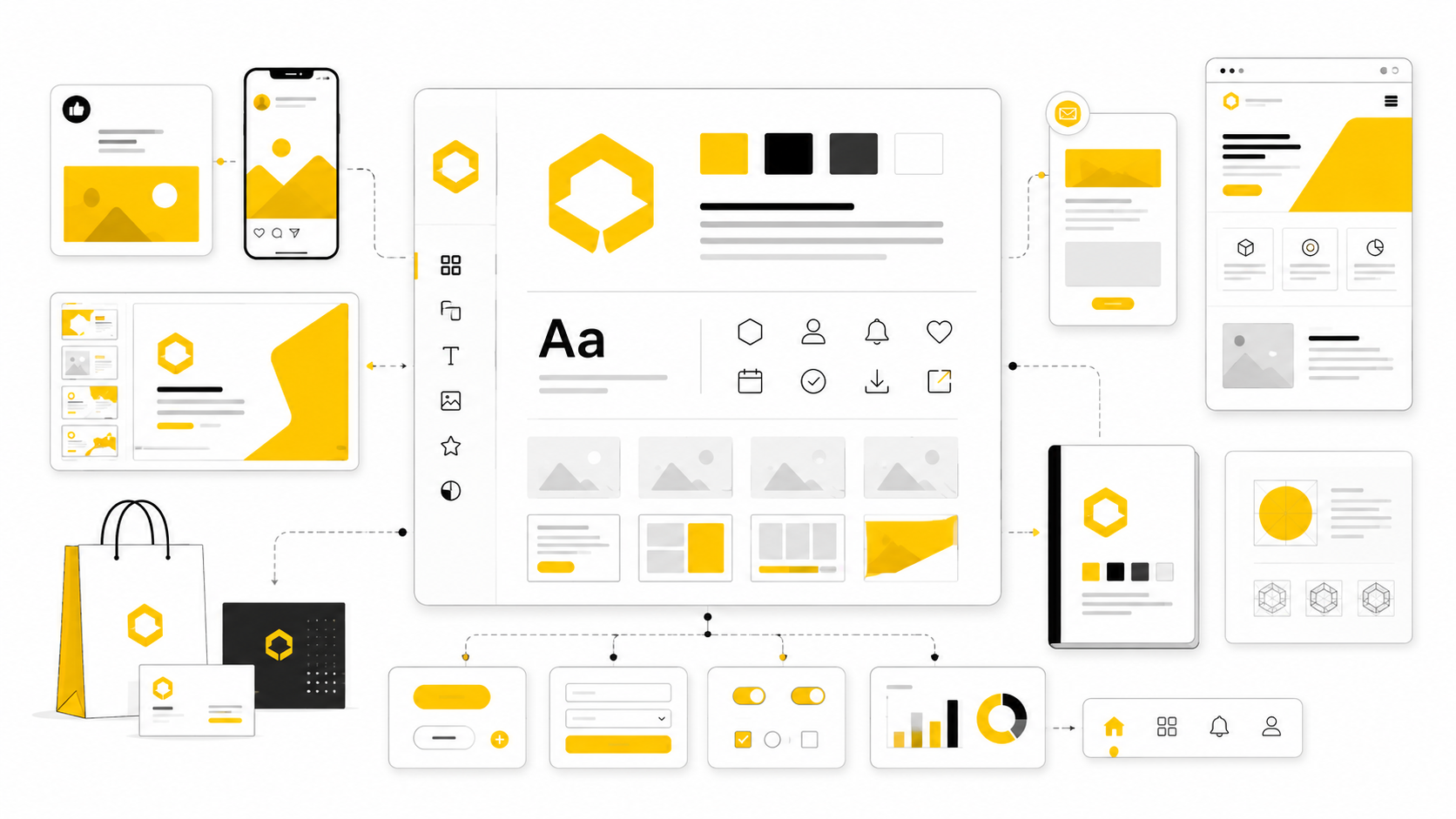
Branding materials are the practical assets that make your brand recognizable, repeatable, and trusted across every customer touchpoint. They include your logo files, colors, typography, image style, messaging, templates, sales assets, social graphics, packaging, presentations, landing pages, email designs, and the rules that keep all of those pieces working together. In other words, they are not just “design files.” They are the operating system for how your business shows up.
This matters because people rarely experience a brand in one clean moment. They see a social post, skim a landing page, open an email, watch a short video, compare competitors, talk to sales, and maybe come back weeks later. If each touchpoint feels disconnected, the brand has to rebuild trust from zero every time.
That is why strong branding materials do two jobs at once. Externally, they help customers recognize you faster and understand what you stand for. Internally, they help your team create campaigns, content, proposals, product pages, and customer communications without reinventing the brand every time.
The business case is not fluffy. Research on brand consistency has found that consistent branding can be linked to meaningful revenue lift, with one widely cited State of Brand Consistency report finding that consistent brand presentation can increase revenue by up to 33%. Design quality also matters commercially, with McKinsey’s research showing that companies with stronger design performance grew revenue and shareholder returns at nearly twice the rate of their industry peers in its multi-year design study, The Business Value of Design.
this guide breaks branding materials down into a practical system you can actually use. Not a vague brand theory exercise. Not a folder full of random Canva files. A real structure for deciding what to create, how to keep it consistent, and how to use it across marketing, sales, product, and customer experience.
The full article will continue across six parts using this structure:
What Branding Materials Are And Why They Matter
Branding materials are every repeatable asset that helps your audience identify, understand, and remember your business. Some are visual, like your logo, color palette, type system, icons, photography, and layout templates. Others are verbal, like your tagline, value proposition, tone of voice, product messaging, email snippets, sales scripts, and customer-facing explanations.
The mistake many businesses make is treating branding materials as decoration. They get a logo, pick a few colors, make a homepage, and call the brand finished. But the real value comes when those assets become usable across the entire business, so every team member can create something that still feels like the same company.
That consistency is especially important because modern brands move fast. Teams publish on social, launch landing pages, run email campaigns, build funnels, produce videos, create proposals, host webinars, and update product experiences constantly. Without clear materials, every new asset becomes a tiny brand risk.
For a small business, branding materials help you look more established before you have a large team. For a growing company, they prevent your brand from becoming messy as more people create content. For an agency, SaaS company, ecommerce brand, creator business, or local service provider, they give your marketing a shared language instead of a scattered pile of one-off designs.
Why Branding Materials Matter More Than Most Teams Think
Branding materials matter because customers make judgments quickly, and those judgments are shaped by repetition. When your website, emails, social posts, proposals, ads, and checkout experience all feel connected, the brand becomes easier to remember. When they feel unrelated, customers may still like individual pieces, but the business itself feels less clear.
Trust is a major part of this. The 2025 Edelman brand trust research found that people continue to place high value on brands they use and trust, with trust shaping whether they buy, advocate, and stay loyal to a brand over time in the Edelman Trust Barometer Special Report. That does not mean a logo alone creates trust. It means every visible and verbal detail either supports trust or weakens it.
There is also an internal cost to weak branding materials. If every campaign requires people to ask which logo to use, what color is correct, how a headline should sound, or whether a page feels “on brand,” production slows down. Canva’s 2025 Visual Economy Report points to the operational side of this problem, noting that poor visual communication can cause delays and confusion for teams in the modern visual workplace.
Strong branding materials reduce that friction. They make decisions faster because people are not starting from a blank page. They also protect quality because the brand is not dependent on one designer, one founder, or one marketing manager remembering every detail.
The Branding Materials Framework
A useful branding materials system has four layers: identity, rules, templates, and distribution. Identity defines what the brand looks and sounds like. Rules explain how to use that identity correctly. Templates make the brand easy to apply. Distribution ensures the right people can actually find and use the materials.
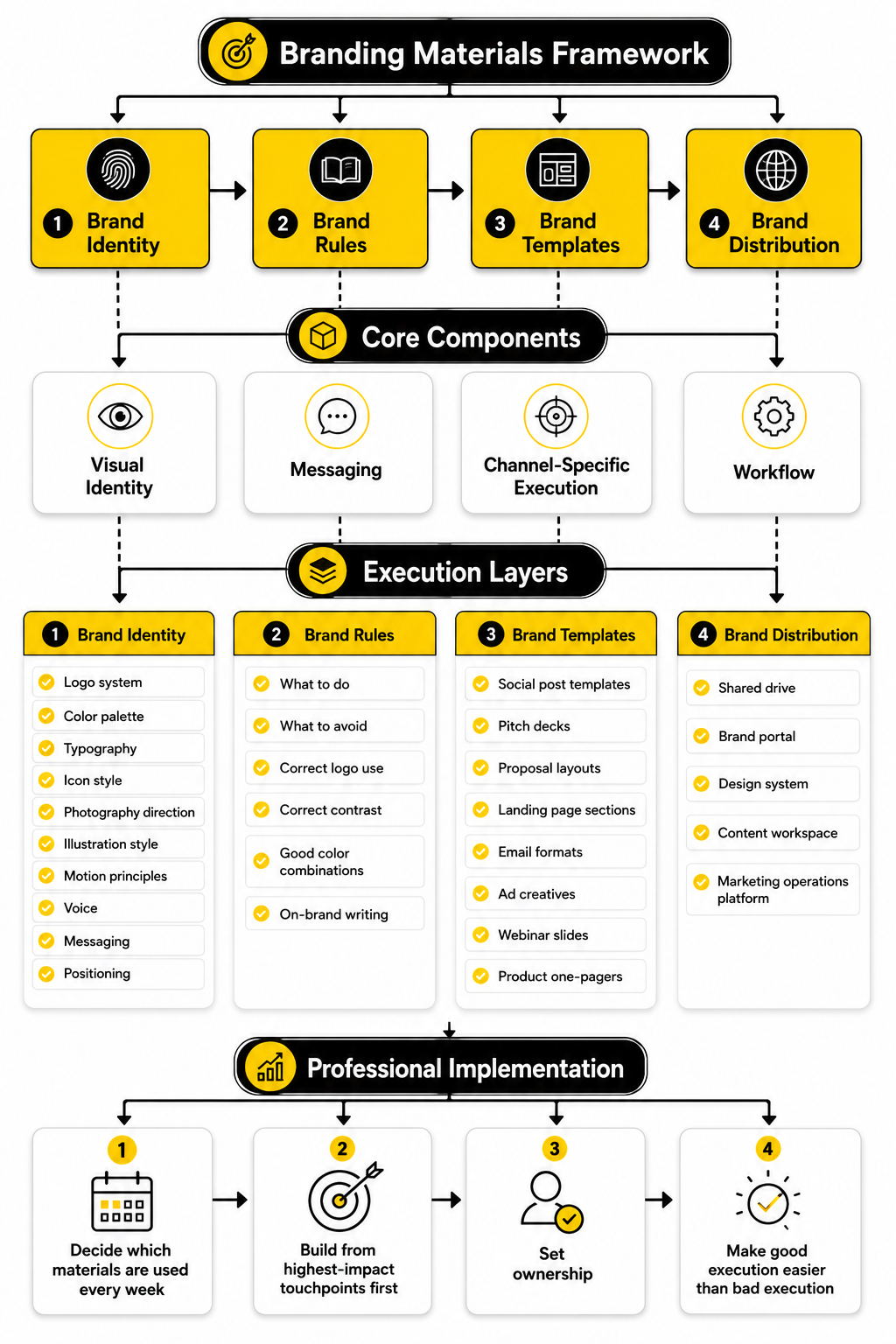
The first layer is brand identity. This includes the logo system, color palette, typography, icon style, photography direction, illustration style, motion principles, voice, messaging, and positioning. These are the core ingredients that make your brand recognizable.
The second layer is brand rules. These are the guidelines that explain what to do and what to avoid. A logo folder without rules can still create chaos, because people may stretch the logo, use the wrong contrast, combine colors badly, or write in a tone that does not fit the brand.
The third layer is brand templates. This is where your branding materials become operational. Social post templates, pitch decks, proposal layouts, landing page sections, email formats, ad creatives, webinar slides, and product one-pagers help teams move quickly while staying consistent.
The fourth layer is brand distribution. This is the part many teams forget. If your best assets live in a designer’s desktop folder, they are not really a system. They need to live somewhere accessible, organized, and maintained, whether that is a shared drive, brand portal, design system, content workspace, or marketing operations platform.
Core Components Of Branding Materials
The core components of branding materials begin with visual identity. Your logo, colors, fonts, spacing, imagery, icons, and layouts create the first layer of recognition. These elements should be flexible enough to work across a website, presentation, social profile, email header, product screen, print asset, and sales document.
The second component is messaging. A brand can look polished and still feel confusing if the words are inconsistent. Your positioning statement, value proposition, headline formulas, product descriptions, proof points, calls to action, and tone of voice help people understand why your brand exists and why they should care.
The third component is channel-specific execution. A LinkedIn carousel, sales deck, ecommerce landing page, onboarding email, and event banner do not need to look identical. They need to feel related. That is the difference between consistency and copy-paste design.
The fourth component is workflow. Branding materials only work when they fit the way your team actually creates content. If your team builds landing pages often, tools like Replo can help turn brand direction into reusable ecommerce page sections. If your team relies on funnels, tools like ClickFunnels or GoHighLevel may fit naturally into the implementation layer, as long as your templates and messaging stay aligned.
Professional Implementation Starts With Practical Decisions
Professional implementation does not start with a 90-page brand book. It starts with deciding which branding materials your business actually uses every week. A SaaS company may need product screenshots, onboarding emails, demo decks, comparison pages, and help center visuals. A service business may need proposals, case study templates, sales scripts, appointment reminders, landing pages, and local ads.
The right approach is to build from the highest-impact touchpoints first. If most leads come from social and landing pages, those materials need to be clear before you spend time polishing obscure internal documents. If sales calls close the business, then your pitch deck, proposal, follow-up email, and proof assets deserve priority.
Professional implementation also means setting ownership. Someone has to decide what is current, what is retired, who can edit templates, and how new materials get approved. Without ownership, brand systems slowly decay into duplicate files, outdated logos, conflicting messages, and “final-final-v7” folders.
The goal is not perfection. The goal is a brand system that makes good execution easier than bad execution. When branding materials are clear, accessible, and useful, your team does not need to guess what “on brand” means. They can create with confidence, move faster, and give customers a more consistent experience at every step.
The Branding Materials Framework
A strong branding materials system is not built by collecting more files. It is built by deciding how your brand should move from strategy to execution without losing clarity along the way. The framework is simple: define the brand, turn it into rules, convert those rules into assets, and then make those assets easy to use.
This is where a lot of teams get stuck. They have a logo, a color palette, a few social templates, and maybe a brand guide PDF, but those pieces do not behave like a system. The real goal is to create a repeatable workflow where every new page, post, deck, ad, email, and customer touchpoint feels connected without needing endless review.
Think of branding materials as four working layers:
Each layer has a different job. If one layer is weak, the whole system becomes harder to use.
Brand Foundation
The brand foundation answers the most important question first: what should people understand, feel, and remember about the business? Before you design anything, you need to be clear on the positioning, audience, promise, values, personality, and point of difference. Otherwise, the visual identity may look polished but still fail to communicate anything specific.
This foundation should not be complicated. A practical brand foundation usually includes a short positioning statement, a clear value proposition, a few audience segments, a tone of voice summary, and the key messages the brand needs to repeat consistently. These pieces guide every branding material that comes later.
The foundation also protects the brand from random creative decisions. Without it, people choose colors because they “look nice,” write headlines because they sound trendy, and build pages based on whatever competitors are doing. With it, every asset has a reason behind it.
Positioning
Positioning defines where your brand sits in the customer’s mind compared with alternatives. It explains who you serve, what problem you solve, why your solution is different, and why that difference matters. This matters because branding materials are not just supposed to look consistent; they are supposed to reinforce the same strategic idea again and again.
A clear positioning statement helps your team make faster choices. If the brand is built around simplicity, your layouts, copy, pricing pages, onboarding emails, and sales decks should reduce friction. If the brand is built around expertise, your materials need to show proof, clarity, and authority without becoming stiff.
Good positioning also prevents the brand from becoming too broad. When you try to speak to everyone, the branding materials become generic. The stronger move is to define the customer clearly enough that your messaging and visuals feel made for them.
Brand Promise
The brand promise is the practical commitment customers should expect from you. It is not a slogan. It is the standard your product, service, content, and customer experience must keep proving.
This promise should influence the materials people see before and after they buy. A brand that promises speed should not have slow, confusing landing pages. A brand that promises premium service should not send sloppy proposals, inconsistent emails, or poorly formatted onboarding documents.
The promise also helps your team decide what not to create. If a campaign idea gets attention but weakens the promise, it is not a brand asset. It is noise.
Voice And Messaging
Voice is how the brand sounds when it speaks. Messaging is what the brand says repeatedly. You need both, because a brand can have a friendly tone and still communicate an unclear offer.
Useful messaging materials include headline formulas, product descriptions, short elevator pitches, objection responses, proof points, calls to action, and customer-facing explanations. These assets are especially important for teams that publish often, because weak messaging creates inconsistency faster than weak design. One person writes in a polished corporate tone, another writes like a meme account, and suddenly the brand feels confused.
The best voice guidelines are practical, not poetic. Instead of saying “we sound bold,” show what bold means in real sentences. Give examples of approved phrases, banned phrases, before-and-after rewrites, and channel-specific guidance for emails, landing pages, social posts, ads, support replies, and sales follow-ups.
Brand Identity
Brand identity turns the foundation into recognizable visual and verbal signals. This is the layer most people think of first when they hear branding materials: logos, colors, fonts, icons, photography, graphics, motion, and layout systems. These pieces matter because they help customers recognize the brand before they read every word.
The key is to build identity assets for real-world use, not just presentation slides. Your logo needs versions that work on light backgrounds, dark backgrounds, small screens, profile images, invoices, presentations, email footers, and partner pages. Your color palette needs enough flexibility for buttons, backgrounds, alerts, charts, highlights, and accessibility.
Brand identity should create consistency without making everything look identical. A landing page, social graphic, webinar deck, and sales proposal can have different layouts while still clearly coming from the same brand. That is the difference between a flexible identity system and a rigid template pack.
Logo System
A logo system includes more than one main logo file. At minimum, it should include a primary logo, secondary logo, icon or mark, monochrome version, reversed version, favicon, social profile version, and clear spacing rules. These assets should be exported in the formats your team actually needs, including SVG, PNG, and PDF where relevant.
The logo rules should be direct. Show the minimum size, clear space, approved color combinations, and incorrect uses. People should not have to guess whether they can rotate it, stretch it, add shadows, place it on busy photos, or change the color.
This is also where file naming matters. A logo folder full of vague names like “logo final new transparent” creates avoidable confusion. Use clean names that describe the format, color, and use case so the right file is obvious.
Color And Typography
Color and typography shape the emotional feel of your branding materials. Colors help create recognition and hierarchy, while typography controls readability, personality, and perceived quality. Together, they set the visual rhythm of the brand.
A useful color system includes primary, secondary, neutral, background, text, border, success, warning, and error colors. It should also explain how colors pair together, not just list hex codes. A palette without usage guidance often leads to materials that technically use the right colors but still feel wrong.
Typography needs the same practical treatment. Define heading styles, body text, captions, buttons, pull quotes, and presentation use. Also include fallback fonts, especially if your team works across tools where your primary font may not always be available.
Imagery And Graphic Style
Imagery is one of the fastest ways to make branding materials feel consistent or completely disconnected. Photography, illustrations, icons, screenshots, mockups, and background patterns all need a shared direction. Without that direction, the brand can look premium on the homepage, playful on Instagram, corporate in the sales deck, and generic in ads.
The image style should explain subject matter, lighting, composition, color treatment, level of polish, and what to avoid. If the brand uses product screenshots, define how they should be cropped, framed, annotated, and placed into layouts. If the brand uses people-focused imagery, define what kind of moments feel authentic to the brand.
Graphic elements need rules too. Icons should share stroke weight, corner radius, visual density, and metaphor style. Patterns, shapes, gradients, and decorative elements should support the message rather than distract from it.
Brand Application
Brand application is where strategy and identity become usable assets. This is the layer that turns branding materials into templates, campaigns, pages, sales documents, and customer communications. It is also where the brand either becomes scalable or stays trapped inside a design file.
The most important question is simple: what does your business create repeatedly? If your team publishes social content every week, you need social templates. If you run paid campaigns, you need ad creative systems. If you sell through calls, you need sales decks, proposals, follow-up emails, and proof assets.
Application materials should reduce friction. A good template does not just look nice; it helps someone produce a better asset faster. That means layouts, example copy, image rules, CTA options, and guidance for when to use each format.
Website And Landing Page Materials
Website and landing page materials are often the highest-leverage part of the brand system because they directly shape conversion. These assets can include hero sections, feature blocks, testimonial layouts, comparison sections, pricing tables, FAQ blocks, lead capture forms, and checkout flows. Each one should carry the brand identity while making the offer clear.
For ecommerce teams, reusable page sections can make brand consistency much easier when campaigns change quickly. A tool like Replo can fit naturally here because the goal is not just to design one good page. The goal is to create branded page systems that can be reused across launches, promotions, product pages, and seasonal campaigns.
For funnel-led businesses, the same idea applies. If you build opt-in pages, webinar pages, sales pages, order forms, and upsell flows, platforms like ClickFunnels can help operationalize the brand when the templates are built with consistent messaging, spacing, typography, and calls to action.
Social And Content Materials
Social branding materials need more flexibility than most teams expect. A brand may need educational posts, short-form video covers, quote graphics, carousels, story templates, announcement posts, launch graphics, profile banners, and community updates. These assets should feel consistent, but they also need enough variety to avoid looking repetitive.
This is where modular design helps. Instead of creating one template for everything, build a small system of repeatable formats. For example, one format for teaching, one for proof, one for announcements, one for behind-the-scenes content, and one for promotional posts.
Distribution also matters here. If your team schedules content regularly, a tool like Buffer can support the workflow around social publishing. The branding materials still need to be created thoughtfully, but the publishing process becomes easier when the team has an organized content rhythm.
Email And Automation Materials
Email branding materials are easy to overlook because email feels more functional than visual. That is a mistake. Welcome emails, newsletters, abandoned cart emails, appointment reminders, onboarding sequences, launch emails, and customer updates all shape how the brand is perceived.
Email materials should include templates for layout, subject line style, button language, signature blocks, product images, footer rules, and plain-text fallback structure. The goal is not to make every email heavily designed. The goal is to make every email feel intentional, clear, and recognizably from the brand.
For businesses that rely on email campaigns and customer journeys, tools like Brevo, Moosend, or GoHighLevel can support implementation. The tool does not create the brand discipline by itself, but it can help keep customer communication more structured when the templates and messaging are already defined.
Brand Governance
Brand governance is the layer that keeps branding materials from getting messy over time. It defines who owns the brand system, who can edit assets, where the latest versions live, how updates are approved, and how outdated materials are retired. Without governance, even a beautiful brand system eventually turns into scattered folders and inconsistent execution.
This does not need to be bureaucratic. Small teams can keep governance simple with one owner, one source of truth, and a clear review process for major assets. Larger teams may need roles for brand, design, content, product marketing, sales enablement, and regional teams.
Governance matters because brands are living systems. Campaigns change, products evolve, offers shift, platforms update, and teams grow. The branding materials need to evolve too, but in a controlled way.
Ownership
Every brand system needs a clear owner. That person or team is responsible for maintaining the materials, approving major changes, and making sure people know where to find the latest assets. Without ownership, the brand becomes everyone’s responsibility in theory and no one’s responsibility in practice.
Ownership also prevents endless subjective debates. When a new landing page, presentation, or campaign does not feel right, the brand owner can evaluate it against the system instead of relying on personal taste. This keeps feedback focused and useful.
For smaller businesses, the owner might be the founder, marketing lead, or designer. For larger companies, ownership may sit with brand marketing, creative operations, or a dedicated brand team. The structure matters less than the accountability.
Access And Version Control
Access is where many branding materials systems quietly fail. If people cannot find the right files quickly, they will reuse old assets, screenshot logos, copy outdated slides, or make their own versions. That is how inconsistency spreads.
A clean system should separate current assets from archived materials. It should also label files clearly, group assets by use case, and make the most common materials easy to reach. The more often an asset is used, the easier it should be to find.
Version control is especially important when working with freelancers, agencies, contractors, partners, or distributed teams. Everyone should know which files are approved, which templates are current, and which materials should no longer be used. This sounds basic, but it saves a lot of brand damage.
Review And Improvement
Branding materials should be reviewed regularly, but not obsessively. A practical review rhythm could be quarterly for fast-moving marketing assets and annually for the broader brand system. The goal is to keep the system useful, not to redesign everything every few months.
Reviews should focus on real usage. Which templates are people actually using? Which assets cause confusion? Where do teams keep going off-brand? Which customer touchpoints look outdated or inconsistent?
This is how the brand system improves without becoming bloated. You remove what is not used, refine what causes friction, and add materials where the team keeps creating from scratch. That is the practical path from a basic brand kit to a professional branding materials system.
Core Brand Identity Materials
Once the framework is clear, the next step is implementation. This is where branding materials stop being abstract and become files, rules, templates, and workflows your team can actually use. The goal is not to create a beautiful brand system that only makes sense to a designer. The goal is to create a practical identity system that helps everyone produce better work faster.
Core brand identity materials are the assets that define how your brand looks, sounds, and behaves before they get adapted into campaigns. They are the source files. Everything else flows from them. If these materials are weak, every landing page, ad, email, proposal, social post, and presentation becomes harder to control.
This part is about building that core system in the right order. You do not need to create every possible asset on day one. You need to create the assets that remove confusion, protect consistency, and give your team a clear starting point.
Start With A Brand Materials Audit
Before creating new branding materials, review what already exists. Most businesses have more assets than they realize, but they are usually scattered across folders, old campaigns, design tools, website files, email platforms, social accounts, sales decks, and contractor handoffs. The audit shows what is usable, what is outdated, what is missing, and what is actively hurting consistency.
A practical audit should look at both quality and usage. Some assets may look good but rarely get used. Others may look basic but drive important customer touchpoints, like proposal templates, onboarding emails, booking pages, or lead capture forms. Do not judge the brand only by its prettiest assets. Judge it by what customers actually see.
The audit should also identify where confusion happens. If people keep asking for the latest logo, rebuilding the same slide, rewriting the same offer explanation, or using different button styles across pages, those are not small annoyances. They are signals that the branding materials system needs clearer structure.
What To Collect First
Start by collecting every active customer-facing asset. This includes the website, landing pages, social profiles, ad creatives, email templates, sales decks, proposals, lead magnets, product screenshots, packaging, invoices, onboarding documents, and customer support messages. Internal files matter too, but the first priority is anything that shapes customer perception.
Then collect the source files behind those assets. You need editable design files, logo exports, font files or font references, image libraries, copy documents, presentation templates, and page builder templates. A screenshot of a finished asset is useful for review, but it is not enough for implementation.
Finally, collect performance context where available. You do not need to turn this into a complex analytics project, but it helps to know which pages, campaigns, emails, and sales materials are most important. High-impact assets should get fixed before low-impact assets.
What To Remove
A brand audit is not just about gathering files. It is also about removing clutter. Old logos, retired taglines, outdated offers, expired promotions, off-brand images, duplicate templates, abandoned color variations, and unused campaign files should not sit beside approved materials.
This matters because people often grab whatever is easiest to find. If outdated assets are still visible, someone will eventually use them. That is how brand inconsistency spreads quietly.
Create a simple archive instead of deleting everything permanently. The current brand materials should be easy to access, while old materials should be clearly separated. This keeps your working system clean without losing useful historical context.
Build The Identity Kit
The identity kit is the compact version of your brand system. It should contain the essential branding materials someone needs to create an on-brand asset without guessing. For a small business, this may be enough to operate for months. For a larger team, it becomes the foundation for deeper guidelines and templates.
A good identity kit is specific but not overwhelming. It should include logo files, color values, typography rules, image direction, graphic elements, voice guidance, and a few examples of correct usage. The point is to make the brand easy to apply, not to bury people in theory.
This kit should be built around real use cases. A founder making a pitch deck, a marketer creating an email, a contractor designing an ad, and a sales rep updating a proposal should all be able to use it. If the kit only works for one person, it is not finished.
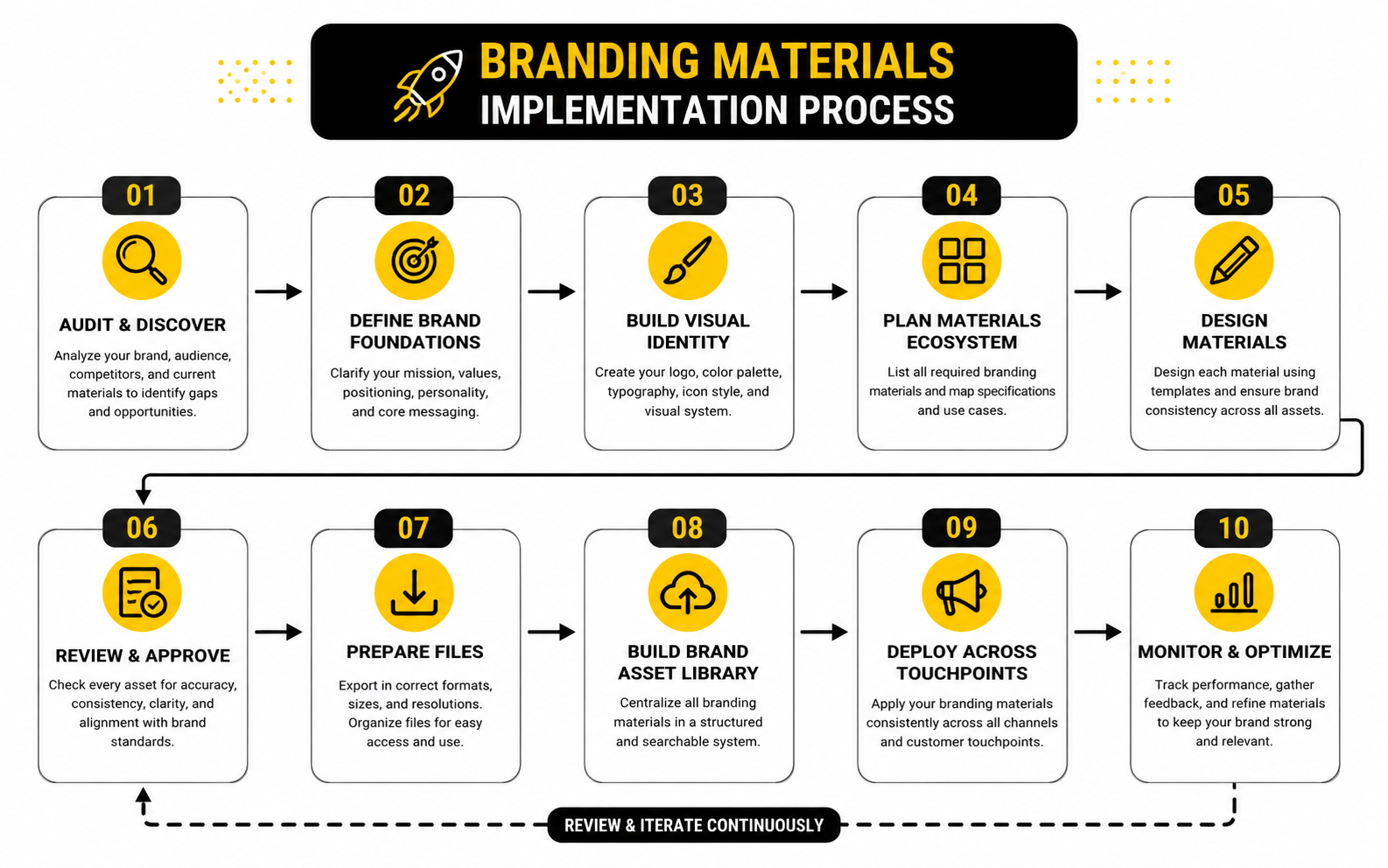
Step 1: Define The Minimum Viable System
The first implementation step is defining the minimum viable brand system. This is the smallest complete set of branding materials needed to create consistent work across your most important channels. It usually includes logo rules, colors, typography, messaging, image style, and two or three core templates.
This keeps the process focused. Instead of trying to build every asset at once, you start with what the team actually needs to operate. A business that sells through webinars needs different materials than an ecommerce brand launching product pages every week.
The minimum viable system should still be professional. “Minimum” does not mean messy or incomplete. It means the brand has enough structure to be used correctly today, while leaving room to expand later.
Step 2: Create The Source Assets
Source assets are the master files behind your branding materials. These include editable logo files, approved color palettes, font specifications, icon libraries, illustration elements, image treatments, presentation masters, page sections, and copy blocks. They are the assets people should build from, not assets they should rebuild manually.
Every source asset should be created with real production in mind. If the logo will be used on social profiles, export it for square and circular crops. If the colors will be used on websites, include accessible text and background combinations. If the typography will be used in email platforms, provide fallback options.
This is also where naming and organization matter. Use file names that describe the asset clearly, such as primary-logo-dark-svg, proposal-template-sales, or landing-page-hero-v1. Boring names beat clever names because they reduce mistakes.
Step 3: Document The Rules
Rules turn assets into a system. Without rules, branding materials become a loose collection of nice files. With rules, people understand how to use the files correctly across different situations.
The rules should cover logo spacing, color combinations, font hierarchy, image style, layout principles, tone of voice, CTA language, and common mistakes. Keep the guidance practical. Show examples of what to do and what not to do.
This is also the right place to define flexibility. Not every asset needs to look identical, and not every channel needs the same layout. The rules should explain where the brand can stretch and where it cannot.
Step 4: Turn Rules Into Templates
Templates make the brand usable at speed. They translate the identity kit into formats your team creates repeatedly, such as social posts, landing pages, email campaigns, sales decks, proposals, reports, one-pagers, and onboarding documents. This is where branding materials become part of daily execution.
The best templates include structure, not just design. A landing page template should guide the offer flow. A sales deck should show how to introduce the problem, explain the solution, prove credibility, and ask for the next step. An email template should make the message easier to read, not just add a logo at the top.
For service businesses and agencies, an all-in-one platform like GoHighLevel can support this implementation layer when the brand system needs to connect landing pages, forms, calendars, automations, pipelines, and client communication. For simpler funnel builds, Systeme.io can also fit when the priority is getting branded pages and email sequences live without adding too much operational weight.
Step 5: Centralize Access
Centralized access is what keeps your branding materials from turning into another scattered folder problem. The approved assets need to live in one place, with clear categories and simple instructions. People should know where to go, what to use, and what not to touch.
This central location can be a shared drive, digital asset manager, brand portal, project workspace, or internal documentation hub. The tool matters less than the discipline. If people cannot find the correct file in under a minute, the system needs improvement.
Access should also be role-aware. A designer may need editable source files, while a sales rep may only need finished templates. A contractor may need campaign assets but not internal strategy documents. Good access reduces mistakes without slowing everyone down.
Create A Brand Guidelines Document
A brand guidelines document explains how the identity system should be applied. It does not need to be massive, but it does need to be useful. If someone opens it and still has to ask five basic questions, the document is not doing its job.
The best guidelines combine clarity, examples, and practical limits. They show what the brand looks like, how it sounds, how assets should be used, and how decisions should be made when a new format appears. This is especially important because marketing channels change faster than brand systems.
A useful guideline document should be easy to update. Static PDFs can work for small teams, but growing teams often benefit from living documentation that can evolve as campaigns, products, and customer touchpoints change. The format should support the way your team works.
Visual Guidelines
Visual guidelines define how the brand should appear across channels. They should include logo usage, color rules, typography hierarchy, layout principles, spacing, icons, image style, and graphic treatments. Each rule should be shown with examples, because visual decisions are easier to understand when people can see them.
The goal is not to control every pixel. The goal is to create enough consistency that customers recognize the brand immediately, even when the format changes. A social post, landing page, email header, and sales slide can all use different layouts while still sharing the same visual language.
Visual guidelines should also include common misuse. Show the logo stretched, the wrong color pairing, poor contrast, inconsistent font usage, and off-brand imagery. People often learn faster from clear “don’t do this” examples than from abstract rules.
Verbal Guidelines
Verbal guidelines define how the brand communicates. They should include tone of voice, messaging pillars, headline style, product descriptions, calls to action, proof language, objection handling, and words to avoid. This is where the brand becomes consistent in conversation, not just design.
The voice should be practical enough for real writing. If the guideline says the brand is “human, clear, and confident,” show what that means in a homepage headline, email intro, social caption, support reply, and sales follow-up. Otherwise, people will interpret the words differently.
Verbal branding materials are especially important when multiple people write for the business. A founder, designer, copywriter, salesperson, support rep, and automation specialist may all touch customer communication. The guidelines help them sound like one brand without forcing everyone into robotic sameness.
Channel Guidelines
Channel guidelines explain how the brand adapts to different environments. A homepage has more space than a social ad. A proposal needs more proof than an Instagram story. An onboarding email needs more clarity than a brand awareness post.
These differences should be defined intentionally. Otherwise, teams either make everything too identical or let each channel drift into its own style. Neither approach works well.
A good channel guideline explains the purpose of each format, the tone it should use, the visual rules that matter most, and the assets that should be used. This makes execution faster because people are not guessing how the brand should behave in each place.
Build Templates For Repeated Work
Templates are where implementation becomes visible. They turn the identity kit and guidelines into practical tools for daily output. This is the point where your branding materials start saving time instead of just looking organized.
Start with the formats your business uses most often. For many teams, that means social content, landing pages, email campaigns, sales decks, proposals, lead magnets, and customer onboarding materials. For ecommerce, it may also include product page sections, promo banners, collection graphics, and post-purchase emails.
Do not overbuild templates too early. A smaller set of strong templates is better than a large library nobody uses. Once the team starts working with them, you can see what needs to be added, simplified, or removed.
Marketing Templates
Marketing templates help your team publish campaigns without rebuilding the brand from scratch. These may include ad creatives, landing pages, lead magnet layouts, webinar pages, email headers, newsletter formats, social carousels, short-form video covers, and campaign briefs. Each template should make the intended message clearer.
For landing pages, the structure should support conversion. The template should guide the headline, offer explanation, proof, benefits, objections, CTA, and next step. If your brand uses ecommerce landing pages heavily, Replo can help turn those branded sections into reusable page assets.
For content teams, social templates should provide variety without losing identity. A practical set may include educational posts, proof posts, announcement posts, comparison posts, and promotional posts. That gives the brand flexibility while still keeping production consistent.
Sales Templates
Sales templates are often where branding materials make the fastest internal impact. A strong pitch deck, proposal, one-page offer summary, case study layout, follow-up email, and pricing explanation can make the sales process feel more credible and easier to repeat. These assets help prospects understand the offer without relying only on live explanation.
Sales materials should be clear, not overly designed. The prospect should quickly understand the problem, the outcome, the process, the proof, and the next step. Design should support trust and comprehension, not distract from the decision.
This is also where messaging consistency matters. If the sales deck says one thing, the website says another, and the follow-up email uses a third version of the offer, the brand feels uncertain. Sales templates help keep the commercial story aligned.
Customer Experience Templates
Customer experience templates shape what happens after someone converts. These include onboarding emails, welcome guides, support replies, product education, appointment reminders, account updates, feedback requests, and renewal messages. They are branding materials because they shape trust after the sale.
A customer should not feel like they bought from one brand and then got handed off to a completely different company. The tone, clarity, and visual quality should carry through. This is one of the easiest places to create a better brand experience because many competitors neglect it.
Automation can help, but only if the message is built well. Tools like ManyChat, Brevo, and GoHighLevel can support customer communication workflows when the templates are already clear, useful, and on brand.
Test The System Before Scaling It
A brand system should be tested before it is rolled out widely. Give the branding materials to someone who did not create them and ask them to build a real asset. If they produce something consistent without heavy guidance, the system is working.
If they get stuck, that is useful feedback. Maybe the rules are too vague, the templates are too rigid, the files are hard to find, or the messaging examples are not practical enough. Fix those issues before expanding the system.
Testing also keeps the brand grounded in reality. A system can look impressive in a presentation and still fail during production. The only test that really matters is whether people can use it to create better work with less friction.
Review Real Outputs
Review actual outputs created from the system. Look at a new social post, landing page, deck, email, proposal, or support message and ask whether it feels connected to the brand. Do not review only the source files. Review the work they produce.
The review should focus on patterns, not isolated mistakes. If one person uses the wrong image, that may be a training issue. If everyone uses the wrong image style, the guideline is probably unclear.
This is where the system becomes stronger. You refine based on actual usage, not assumptions. That is how branding materials become more useful over time.
Train The Team
Training does not need to be formal or complicated, but it does need to happen. A brand system is not fully implemented until the people using it understand why it exists and how to apply it. Sending a folder link is not training.
A practical training session should walk through the foundation, the identity kit, the templates, the rules, and the approval process. It should show common mistakes and explain how to avoid them. It should also make clear where people can ask questions.
The tone matters here. Brand training should not feel like creative policing. It should feel like enablement. The message is simple: these materials help you create faster, make fewer mistakes, and protect the quality of the customer experience.
Improve In Small Cycles
Branding materials should improve in small cycles instead of massive redesigns. After launch, watch where people struggle, what assets get requested repeatedly, and which templates are ignored. Those signals show what to update.
Small improvements are easier to manage and easier for teams to adopt. Add one missing template. Rewrite one unclear rule. Archive one outdated folder. Update one page section. Over time, those changes make the system stronger without overwhelming everyone.
This is how professional brand implementation actually works. You build the core system, turn it into usable assets, test it through real work, and keep improving it. Not glamorous, but very effective.
Marketing And Sales Branding Materials
Marketing and sales materials are where branding materials meet real pressure. This is where the brand has to attract attention, explain the offer, build trust, handle objections, and move someone toward a decision. A beautiful identity system is useful, but it only becomes commercially valuable when it improves the assets people actually see before they buy.
This part is also where measurement becomes non-negotiable. You cannot judge branding materials only by whether they look polished. You need to understand whether they improve recognition, clarity, engagement, conversion, sales efficiency, and customer trust.
The key is not to drown in dashboards. The key is to connect the right performance signals to the right brand decisions. When the data is interpreted properly, it tells you where the brand is helping, where it is creating friction, and where the materials need to be improved.
Statistics And Data
The most useful branding data does not sit in one place. It comes from marketing analytics, sales conversations, customer feedback, brand research, content performance, website behavior, email metrics, and retention signals. Each source shows a different part of the customer experience.
This matters because brand performance is not measured by one magic number. A higher click-through rate may show that a message is more appealing, but it does not prove the brand is stronger. A stronger close rate may show that sales materials are clearer, but it does not prove the visual identity is memorable. Good measurement looks at patterns across the journey.
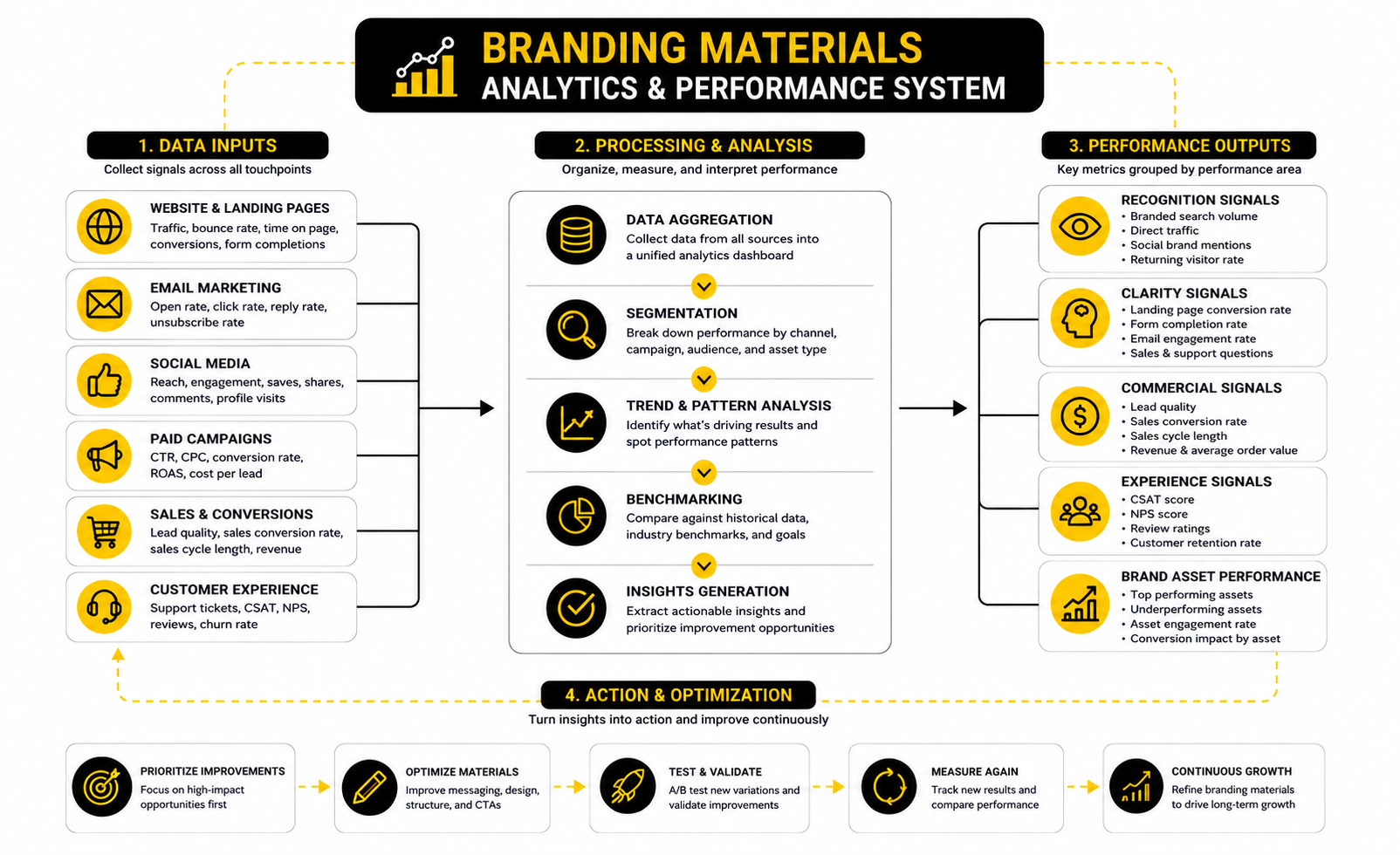
Branding materials should be measured through three lenses:
Recognition signals show whether people remember and identify the brand. Clarity signals show whether they understand the offer and next step. Commercial signals show whether the materials help turn attention into revenue.
Why Brand Data Needs Context
Numbers are only useful when they answer a decision. If a landing page converts at 3%, that number means nothing until you know the traffic source, offer type, audience intent, page quality, sales cycle, and benchmark. The same conversion rate could be excellent for one business and weak for another.
This is why random statistic dumping is dangerous. It makes teams chase averages instead of diagnosing their own customer journey. Branding materials should be judged against your baseline first, then compared with industry context second.
The best question is not “is this number good?” The better question is “what should this number make us do?” If the data does not lead to a practical action, it is probably noise.
What The Bigger Research Tells Us
The broader research supports one clear idea: consistent, well-designed brand experiences are tied to better business outcomes. A widely cited brand consistency study found that consistent brand presentation was linked to revenue increases of up to 33%. That does not mean changing your fonts will magically grow revenue by a third. It means consistency can reduce confusion, improve recognition, and make the business easier to trust across touchpoints.
Design quality also has measurable business relevance. McKinsey’s multi-year study of 300 companies found that top design performers grew revenue and shareholder returns at nearly twice the rate of their industry peers in The Business Value of Design. The practical takeaway is not “spend more on design.” It is that design needs to be treated as a business capability, measured and improved like any other growth lever.
Visual communication also affects internal speed and clarity. Canva’s 2025 report found that 84% of respondents said poor visual communication causes delays and confusion. That matters because branding materials are not just customer-facing assets. They are also tools that help teams explain, present, sell, and ship faster.
Recognition Signals
Recognition signals tell you whether the brand is becoming easier to identify over time. These are especially important when you run content, ads, social campaigns, events, partnerships, or repeat email communication. If people keep seeing your materials but do not remember the brand, your execution may be visible without being distinctive.
Useful recognition signals include branded search volume, direct traffic, returning visitors, social profile visits, branded mentions, email sender recognition, ad recall surveys, and customer comments that reference the brand by name. None of these should be interpreted alone. Together, they show whether the market is starting to remember you.
Recognition is slow to build, so do not panic after one campaign. Look for trends over several weeks or months. If branded search, direct traffic, and returning visitors are growing while your content output stays consistent, your branding materials may be doing their job.
Branded Search
Branded search is one of the cleanest signals that people remember your name. If more people search for your brand, product, founder, service name, or branded offer, it usually means your external materials are creating memory. This is especially useful when you run awareness campaigns that do not convert immediately.
The action is simple. Track branded queries over time and compare them with campaign activity. If a social campaign, podcast appearance, YouTube push, influencer collaboration, or paid campaign increases branded search later, your materials may be creating delayed demand.
But be careful with interpretation. A spike in branded search can come from positive attention, controversy, hiring activity, press coverage, or customer support issues. Always look at the surrounding context before celebrating the number.
Direct And Returning Traffic
Direct traffic and returning visitors can show whether people come back after the first touch. This matters because most customers do not buy the first time they see you. Strong branding materials make that second or third visit more likely because the brand feels familiar enough to revisit.
The action here is to compare returning visitor behavior against new visitor behavior. If returning visitors spend more time, view more pages, or convert better, your brand experience may be creating useful familiarity. If returning visitors bounce quickly, they may remember you but still feel unclear about the offer.
Look at the pages they return to. If people come back to pricing, case studies, comparison pages, product pages, or booking pages, that shows decision intent. Those pages need especially strong branding materials because they influence serious evaluation.
Social Recall And Engagement Quality
Social metrics are often misunderstood. Likes and impressions can be useful, but they do not automatically mean the brand is getting stronger. What matters more is whether people recognize the brand, remember the message, and associate it with a specific value.
Engagement quality matters more than raw volume. Comments that repeat your core idea, ask relevant buying questions, mention your product category, or tag the right audience are stronger signals than generic reactions. Saved posts, profile clicks, shares, and link clicks can also indicate that the material created useful memory.
For social workflows, scheduling tools like Buffer can help maintain a consistent publishing rhythm. The tool is not the strategy, but consistency in distribution gives your branding materials more chances to compound.
Clarity Signals
Clarity signals show whether people understand what you offer, who it is for, and what to do next. This is where many brands lose money without realizing it. The design may look professional, but the message is vague, the page flow is confusing, or the call to action is not obvious.
Useful clarity signals include scroll depth, time on key sections, form completion rate, email click behavior, sales call objections, support questions, heatmap patterns, and user testing feedback. These signals help you identify where the brand story breaks down. They also show whether your branding materials are helping people move forward or making them work too hard.
Clarity should be measured closest to the point of decision. Homepage impressions are useful, but pricing page behavior, demo page behavior, checkout behavior, and proposal engagement often tell you more. The closer someone is to buying, the less tolerance they have for confusion.
Landing Page Behavior
Landing pages are one of the best places to measure branding materials because they combine design, copy, offer structure, proof, and conversion. If visitors reach the page but leave quickly, the first screen may not be clear or relevant. If they scroll but do not click, the page may be interesting but not persuasive.
Look at where people stop. If they drop before the proof section, your hero may not create enough reason to continue. If they spend time on features but ignore the CTA, the benefit may not be strong enough. If they click but do not complete the form, the friction may be in the form, offer, or trust signals.
For ecommerce landing pages, reusable branded sections can make testing cleaner because you are not rebuilding from scratch every time. A platform like Replo can support this by helping teams create page sections that keep the brand consistent while still allowing offer, proof, and layout tests.
Email Engagement
Email engagement shows whether your message stays clear after someone joins your list, books a call, starts a trial, or becomes a customer. Open rates are affected by subject lines and sender trust, but click behavior usually tells you more about whether the content was relevant. Replies, conversions, unsubscribes, and spam complaints add even more context.
The action is to measure each email by its job. A welcome email should create orientation. A launch email should create urgency and clarity. An onboarding email should reduce confusion. A sales follow-up should move the conversation forward.
Email branding materials should not make emails heavier just for the sake of design. Sometimes the best branded email is mostly text with a clear structure, consistent tone, recognizable sender, and one obvious next step. Tools like Brevo or Moosend can help manage the delivery and automation layer when the message system is already strong.
Sales Questions And Objections
Sales calls are a goldmine for measuring brand clarity. If prospects keep asking the same basic questions, your website, emails, ads, or sales materials are probably not explaining something clearly enough. That is not a sales problem. It is a branding materials problem showing up late in the journey.
Track repeated objections and questions. Do people misunderstand the offer? Do they compare you with the wrong alternatives? Do they struggle to explain the value internally? Do they ask for proof that should already be visible?
The action is to turn those patterns into better materials. Add a comparison section, rewrite the offer summary, improve the proposal template, create a stronger one-pager, or add proof where doubt appears. Sales feedback should directly improve marketing assets.
Commercial Signals
Commercial signals show whether branding materials support revenue. These include conversion rate, lead quality, cost per lead, demo booked rate, show-up rate, proposal close rate, average deal size, sales cycle length, customer acquisition cost, retention, and referral rate. These metrics matter because a brand system should eventually make growth easier.
The danger is expecting every branding change to create immediate revenue movement. Some improvements affect trust and recognition before they affect conversion. Others improve internal speed rather than front-end performance. That is why commercial signals should be viewed alongside recognition and clarity signals.
Still, the brand has to earn its keep. If your materials look better but do not improve comprehension, speed, trust, or conversion over time, something is missing. Pretty is not enough.
Conversion Rate
Conversion rate tells you whether people take the intended action. That action might be joining a list, booking a call, starting a trial, buying a product, submitting a form, downloading a resource, or clicking through to the next step. It is one of the most direct ways to measure whether branding materials are helping.
But conversion rate needs segmentation. A cold ad visitor, returning email subscriber, referral visitor, and warm sales prospect should not be judged the same way. Their intent is different, so their expected behavior is different.
The action is to compare conversion rates by source, audience, page type, and offer. If warm traffic converts poorly, the issue may be clarity or trust. If cold traffic bounces quickly, the issue may be message-market fit or first-screen relevance. If mobile converts much worse than desktop, the brand experience may be breaking on small screens.
Lead Quality
Lead quality is often more important than lead volume. A campaign can generate more leads while attracting the wrong people. That looks good in a dashboard and bad in a sales pipeline.
Branding materials influence lead quality because they set expectations. The language, visuals, proof, pricing signals, and positioning all tell people whether the offer is for them. If those signals are too broad, you may attract people who are curious but not qualified.
The action is to compare lead source and campaign materials against downstream quality. Look at booked calls, show-up rate, qualification rate, close rate, and customer fit. If one campaign has fewer leads but better close rates, its branding materials may be doing a better job of filtering.
Sales Cycle And Close Rate
Sales cycle length and close rate show whether prospects feel confident enough to move forward. Strong branding materials can help by explaining the offer clearly, providing proof earlier, and giving buyers assets they can share with partners, teams, or decision-makers. This is especially important in B2B and high-ticket services.
If the sales cycle is long because prospects keep asking for clarification, the materials are not carrying enough weight. If proposals require heavy customization every time, the sales template may not be structured well enough. If close rates vary wildly by salesperson, the brand story may not be standardized.
The action is to strengthen the assets that sit between interest and decision. That may include the pitch deck, case study template, proposal, comparison page, pricing explanation, proof library, onboarding preview, or follow-up sequence. Platforms like GoHighLevel can support this workflow when you need branded funnels, automations, CRM stages, reminders, and follow-up systems in one place.
Benchmarks That Actually Help
Benchmarks are useful only when they guide better decisions. They should not become a scoreboard that makes your team feel good or bad without context. The best benchmark is always your own previous performance under similar conditions.
Start with internal baselines. Measure your current homepage conversion, landing page conversion, email click-through, sales deck close rate, proposal acceptance rate, branded search trend, and customer onboarding completion. Then improve one part of the system and compare the change.
External benchmarks can help you sanity-check performance, but they should not control strategy. Industries, offers, price points, audience intent, traffic sources, and funnel structures vary too much. A benchmark can show that something may be unusual, but your own data tells you what is actually happening.
Build A Simple Brand Performance Dashboard
A brand performance dashboard should not be bloated. It should connect recognition, clarity, and commercial signals in one view so the team can spot patterns. The goal is to make brand performance easier to discuss, not to create another reporting chore.
A practical dashboard can include:
This dashboard should be reviewed with action in mind. If branded search is rising but conversions are flat, improve decision-stage materials. If conversion is improving but lead quality is dropping, sharpen positioning. If sales objections repeat, update the website, deck, and follow-up assets.
Measure Asset Usage Internally
Internal usage is an underrated signal. If your team does not use the branding materials, the system is either hard to find, hard to apply, or not useful enough. That is a practical problem, not a people problem.
Track which templates are used, which files get requested repeatedly, and which assets people keep recreating. These patterns show where the system needs clearer access, better naming, stronger templates, or more training. A brand system that sits unused is not a system. It is storage.
The action is to remove friction. Put common assets closer to the team’s workflow. Simplify templates. Archive outdated files. Add examples where people hesitate. Brand governance improves when the system becomes easier to use than improvising.
Separate Brand Problems From Offer Problems
Not every weak metric is a brand problem. A landing page may fail because the offer is weak. An email may underperform because the list is cold. A sales deck may not close because the pricing model does not match buyer expectations. Branding materials can improve communication, but they cannot fix every strategic issue.
This distinction matters because otherwise teams redesign when they should reposition, rewrite when they should change the offer, or change colors when they should improve proof. Measurement should help diagnose the real constraint. Guessing is expensive.
Use the data to locate the bottleneck. If people do not click, the first message may be weak. If they click but do not convert, the page may lack clarity or trust. If they convert but do not buy, qualification or sales materials may be the issue. If customers buy but churn quickly, the brand promise and customer experience may be misaligned.
Turning Measurement Into Better Branding Materials
Measurement only matters if it improves the next version of your branding materials. The point is not to prove that branding is valuable in a vague way. The point is to make the website clearer, the sales deck sharper, the emails more useful, the social content more recognizable, and the customer experience more consistent.
Use a simple improvement loop:
This turns brand improvement into a repeatable process. Instead of redesigning everything when performance feels off, you improve the part of the system that the data points to. That is how branding materials become a growth asset rather than a design expense.
What To Improve First
Start with the materials closest to revenue. For most businesses, that means landing pages, offer pages, pricing pages, sales decks, proposals, email sequences, booking pages, and onboarding materials. These assets have direct impact on decisions, so improvements are easier to measure.
Next, improve high-frequency visibility assets. Social templates, ad creatives, newsletters, profile graphics, lead magnets, and video covers help build recognition over time. They may not convert instantly, but they shape memory and trust.
Finally, improve internal enablement materials. Brand guidelines, asset libraries, template folders, messaging docs, and approval workflows may not show up directly in customer analytics, but they affect the speed and quality of every customer-facing asset. When the team works faster with fewer mistakes, the brand system is doing its job.
What The Data Should Never Do
Data should never flatten the brand into whatever gets the quickest click. Some tactics improve short-term metrics while damaging long-term trust. Clickbait headlines, exaggerated claims, generic urgency, overdesigned popups, and inconsistent visuals can create temporary lifts while weakening the brand.
This is why measurement needs judgment. A test winner is only a real winner if it improves performance while staying aligned with the brand promise. If a version converts better but attracts worse leads, increases refunds, creates confusion, or feels off-brand, it is not actually better.
The strongest branding materials balance performance with consistency. They help people understand faster, trust sooner, and act with more confidence. That is the data that matters.
Digital, Social, And Customer Experience Materials
By this point, the brand system has the core identity, implementation process, templates, and measurement logic. The next challenge is scale. This is where branding materials have to work across more channels, more formats, more people, more tools, and more customer expectations without turning into a rigid rulebook nobody wants to use.
Scaling a brand is not just “make more assets.” It is deciding where consistency matters most, where flexibility is allowed, and where the brand needs stronger control. That balance is the difference between a system that grows with the business and a system that slows everything down.
Digital, social, and customer experience materials are especially tricky because they change fast. Platforms update formats, campaigns move quickly, customers expect faster responses, and teams often need to publish before everything feels perfect. The brand system has to support speed without letting quality collapse.
The Tradeoff Between Consistency And Flexibility
Brand consistency matters, but too much rigidity can make the brand feel lifeless. If every post, email, ad, page, and slide uses the exact same structure, the brand becomes predictable in a bad way. Customers stop noticing it because nothing feels fresh.
Flexibility matters too, but too much freedom creates fragmentation. If every team, campaign, or creator interprets the brand differently, customers experience a scattered company. The logo may be the same, but the feeling is not.
The practical answer is controlled flexibility. Keep the brand foundation stable while allowing format, layout, emphasis, and creative treatment to adapt by channel. Your branding materials should define the non-negotiables and the flexible zones clearly enough that people can move fast without guessing.
Non-Negotiables
Non-negotiables are the parts of the brand that should rarely change. These usually include the logo rules, core colors, typography hierarchy, tone boundaries, value proposition, product naming, claims, compliance language, and key proof points. These elements protect recognition and trust.
The mistake is making everything non-negotiable. When teams feel trapped by the system, they either produce dull work or work around the rules. Neither outcome is good.
Keep the non-negotiables focused on the things that would confuse customers if they changed. If a change weakens recognition, misrepresents the offer, breaks trust, or creates legal risk, it should be controlled. If it simply gives a campaign more life while staying true to the brand, it may belong in the flexible zone.
Flexible Zones
Flexible zones are where campaigns can adapt without damaging the brand. These may include layout variations, image crops, content formats, campaign themes, seasonal treatments, short-form hooks, social post structures, and landing page section order. Flexibility gives the brand room to respond to context.
The key is to define the boundaries. A launch campaign might use more urgency than evergreen content, but it should not sound desperate. A social video might be more casual than a sales proposal, but it should not contradict the brand voice.
Flexible zones are especially useful for fast-moving content teams. They allow experimentation while keeping the customer experience coherent. This is where branding materials become a creative operating system instead of a restrictive checklist.
Brand Architecture And Scaling Complexity
As a business grows, the brand often becomes more complex. You may add new products, service tiers, markets, audience segments, creators, regions, partnerships, events, or sub-brands. At that stage, the original branding materials may not answer enough questions.
Brand architecture helps decide how all of those pieces relate to each other. It defines whether everything should live under one master brand, whether products need their own identities, or whether certain offers need a lighter sub-brand treatment. This is not just a design decision. It affects customer understanding, marketing efficiency, sales clarity, and long-term brand equity.
The wrong architecture creates confusion. Customers may not understand which product is right for them, teams may build separate materials for every offer, and the business may lose the compounding benefit of one recognizable brand. The right architecture makes growth easier to navigate.
One Brand Or Multiple Brands
A single-brand system is usually easier to manage. It concentrates recognition, reduces duplicated design work, and keeps marketing cleaner. For many small and mid-sized businesses, this is the strongest path because every campaign builds the same brand memory.
A multi-brand system can make sense when different products serve very different audiences, price points, categories, or emotional needs. But it is more expensive to maintain. Each brand needs its own identity rules, templates, messaging, assets, and governance.
The decision should be practical. Do customers need separate brands to understand the offer, or does the team just want a fresh look for every new idea? If the second answer is true, stay disciplined. New branding materials should solve real customer confusion, not internal boredom.
Product And Offer Naming
Naming becomes a scaling issue faster than most teams expect. One course becomes three programs. One service becomes multiple packages. One software product becomes modules, add-ons, plans, and features. If naming is not controlled, the brand becomes harder to explain.
Your branding materials should include naming rules. Define how product names are created, how feature names should sound, when something deserves a branded name, and when plain descriptive language is better. Not everything needs a clever name.
Clear naming helps customers make decisions faster. It also helps sales, support, and marketing stay aligned. If the same offer has three names across a landing page, proposal, and invoice, the brand feels less trustworthy.
Digital Experience Materials
Digital experience materials include the assets and rules that shape how the brand behaves online. This goes beyond web design. It includes landing pages, forms, chat flows, booking pages, product interfaces, account screens, help centers, onboarding flows, checkout experiences, and confirmation pages.
These touchpoints matter because customers judge the brand by the whole experience, not just the homepage. A polished ad followed by a confusing form creates friction. A beautiful landing page followed by a generic confirmation email weakens momentum. A strong sales page followed by messy onboarding creates doubt.
The brand should feel connected from first click to customer success. That does not mean every screen needs heavy design. It means every touchpoint should feel intentional, clear, and aligned with the promise.
Forms, Quizzes, And Lead Capture
Forms are branding materials because they shape the first serious interaction many prospects have with your business. A form can feel simple, respectful, and professional, or it can feel intrusive and confusing. That experience affects trust before the sales process even begins.
Good forms ask only what they need, explain why certain information matters, and match the tone of the brand. A premium service should not use clumsy form language. A friendly consumer brand should not make the form feel like legal paperwork.
Tools like Fillout can fit into this layer when you need branded intake forms, quizzes, applications, or feedback flows. The tool choice matters less than the experience design, but flexible form tools make it easier to keep lead capture aligned with the brand.
Scheduling And Booking
Booking pages are often treated as functional utilities, but they are part of the brand experience. The wording, availability rules, confirmation message, reminders, and follow-up flow all affect how professional the business feels. If the customer is ready to take action, the booking experience should not create doubt.
A good booking flow sets expectations clearly. It explains what the meeting is for, how long it takes, what the customer should prepare, and what happens next. This reduces no-shows and improves the quality of the conversation.
For businesses that rely on calls, consultations, demos, or appointments, Cal.com can support a branded scheduling workflow. The important part is to treat the booking experience as part of your branding materials, not as a disconnected utility.
Chat And Conversational Touchpoints
Chatbots, live chat, and automated messages can either strengthen or weaken the brand quickly. They sit close to customer intent, which means mistakes feel more personal. A confusing chatbot does not just create friction; it makes the brand feel careless.
Conversational branding materials should include greeting language, routing logic, escalation rules, tone guidelines, fallback responses, qualification questions, and handoff messages. The customer should always understand what is happening and how to reach a human when needed.
Tools like Chatbase can support AI-powered customer interaction, but the brand rules still matter. Automation should make the experience clearer and faster. It should not hide behind vague responses or force customers through loops.
Social Scaling Without Losing The Brand
Social media creates a unique scaling problem because it rewards speed, frequency, and adaptation. A brand that is too slow gets ignored. A brand that chases every trend loses itself. The challenge is building social branding materials that are fast enough for the platform and stable enough for the brand.
This requires a different mindset from traditional brand guidelines. Social assets need reusable formats, strong hooks, consistent visual cues, and flexible tone ranges. They also need rules for what the brand should not comment on, imitate, or amplify.
The best social systems are modular. They give creators building blocks instead of forcing every post into one template. That keeps the brand recognizable without making the feed feel mechanical.
Creator And Team Guidelines
If multiple people create content for the brand, the guidelines need to be clearer than “use our voice.” Creators need examples of strong hooks, approved claims, common phrases, visual treatments, editing style, caption structure, and boundaries. They also need to know when a post requires review.
This is especially important when a founder, agency, freelancer, employee, or influencer all contribute to the same brand presence. Different voices can work, but they need a shared center. Otherwise, the brand becomes a collection of personalities instead of a coherent business.
The guidelines should also define risk areas. Claims about results, pricing, guarantees, competitors, customer stories, and regulated topics should be handled carefully. Fast content is not an excuse for sloppy communication.
Repurposing Content
Repurposing is one of the smartest ways to scale branding materials. A webinar can become short clips, social posts, email lessons, sales enablement snippets, FAQ answers, blog sections, and onboarding content. This multiplies output without forcing the team to start from zero each time.
But repurposing only works well when the brand system is clear. Each format needs to be adapted, not copied blindly. A long-form insight may need a sharper hook on social, a clearer structure in email, and more proof in a sales asset.
The brand should feel consistent across those formats, but the content should respect the channel. That is the whole point. Scale the idea, not the exact asset.
Customer Experience And Retention Materials
Branding does not stop when someone buys. In many businesses, the strongest brand impression happens after the purchase, during onboarding, delivery, support, renewal, or repeat use. This is where the brand promise either becomes real or falls apart.
Customer experience materials include welcome emails, onboarding guides, help center articles, product education, invoices, renewal reminders, feedback requests, community messages, and support macros. These assets may not feel glamorous, but they heavily shape trust. Customers remember whether the experience feels clear and cared for.
The strategic risk is overinvesting in acquisition materials while underinvesting in customer materials. That creates a gap between the promise and the experience. If the brand says “simple,” onboarding needs to feel simple. If the brand says “premium,” support needs to feel premium.
Onboarding Materials
Onboarding materials should reduce uncertainty. A new customer should know what happens next, how to get value, what to expect, where to go, and who to contact. Confusion during onboarding weakens confidence at the exact moment trust should be increasing.
Good onboarding materials are clear, sequenced, and realistic. They do not dump everything on the customer at once. They guide the customer through the next best step.
This is a brand function, not just an operations function. The tone, structure, pacing, visuals, and support experience all reinforce what the brand stands for. Strong onboarding makes the promise believable.
Support Materials
Support materials are often the most honest expression of a brand. When something goes wrong, customers pay close attention. A well-written support reply can protect trust, while a cold or confusing reply can damage it quickly.
Support branding materials should include tone rules, response templates, escalation language, apology guidelines, refund or cancellation language, and explanation formats. These materials should help the team respond faster without sounding robotic.
The best support templates leave room for human judgment. They provide structure, but they do not force every situation into the same script. Customers can feel the difference.
Renewal And Referral Materials
Renewal and referral materials help turn a good experience into ongoing value. These may include progress summaries, account reviews, loyalty messages, renewal reminders, referral prompts, testimonial requests, and upgrade explanations. They should feel earned, not forced.
The timing matters. A referral request sent after a strong outcome feels natural. A renewal message sent without showing value can feel transactional. Branding materials should support the relationship, not just extract another action.
This is where customer experience and growth meet. When customers understand the value they received, feel supported, and trust the brand, referrals and renewals become more natural. The materials simply make that value easier to see and share.
Common Scaling Risks
As branding materials scale, the risks become less obvious. The brand may still look consistent on the surface while slowly becoming harder to manage underneath. Files multiply, templates age, messaging drifts, and teams make small exceptions that eventually become the new normal.
The danger is not one off-brand post. The danger is a system where nobody can tell what the current standard is. Once that happens, quality depends on individual taste instead of shared rules.
Scaling requires regular cleanup. Not dramatic rebrands. Just disciplined maintenance. The brand system should get lighter, clearer, and more useful over time.
Template Bloat
Template bloat happens when every request turns into a new template. At first, this feels helpful. Over time, the system becomes harder to navigate because there are too many similar options.
The fix is to build fewer, more flexible templates. Instead of ten slightly different social templates, create a modular system that can handle different content types. Instead of five proposal versions, create one strong proposal framework with optional sections.
Templates should earn their place. If a template is not used, not useful, or too similar to another asset, archive it. A lean system is easier to trust.
Message Drift
Message drift happens when the brand slowly starts saying different things in different places. The website uses one value proposition, ads use another, sales calls use another, and onboarding uses another. Each version may sound fine alone, but together they weaken clarity.
This usually happens because teams solve communication problems locally. Sales changes the pitch to close deals. Marketing changes hooks to get clicks. Support changes explanations to reduce tickets. Those changes may be reasonable, but they need to feed back into the central messaging system.
The fix is a regular message review. Look at the highest-impact touchpoints and make sure the core promise, audience, offer, proof, and next step still align. If one team has found a better way to explain the value, update the system instead of letting parallel versions spread.
Over-Automation
Automation can make branding materials easier to deliver, but it can also make the brand feel impersonal. This risk grows when teams automate messages without reviewing tone, timing, relevance, and customer context. Fast communication is not automatically good communication.
A reminder, chatbot, email sequence, or follow-up message should feel helpful. If it feels pushy, generic, or disconnected from the customer’s situation, it weakens trust. Automation should remove friction, not remove care.
The fix is to review automated touchpoints like customer-facing brand assets. Read the full sequence. Test the timing. Check the handoffs. Make sure the language still sounds like a human brand speaking to a real person.
Advanced Guidance For Stronger Brand Systems
A mature branding materials system is not just a library. It is a decision system. It helps the team decide what to create, what to avoid, what to update, what to measure, and how to keep the customer experience coherent as the business changes.
The strongest systems share a few patterns. They are simple enough for daily use, specific enough to prevent confusion, flexible enough for creative work, and governed enough to protect the brand. They also connect brand decisions to business outcomes instead of treating branding as a separate creative layer.
That is the level to aim for. Not more assets for the sake of more assets. Better decisions, better execution, and a more consistent customer experience.
Build For The Next Stage, Not Every Possible Future
Your branding materials should support where the business is going next, not every theoretical future. A startup does not need the same brand governance system as a global enterprise. A solo creator does not need a complex brand architecture model. An agency with multiple clients needs a different setup than a product-led SaaS company.
Build the system one stage ahead. If you are hiring your first marketer, create materials that make delegation easier. If you are adding paid acquisition, strengthen landing pages, ad templates, and offer messaging. If you are expanding into customer success, improve onboarding and support assets.
This keeps the system practical. Overbuilding creates drag. Underbuilding creates chaos. The sweet spot is enough structure for the next level of growth.
Protect Distinctiveness
Branding materials should not make you look like everyone else in your category. Consistency is important, but distinctiveness is what helps people remember you. If your templates, copy, colors, and imagery all follow the same category clichés, the brand may look professional and still be forgettable.
Protecting distinctiveness means knowing which parts of the brand are uniquely yours. It may be a visual device, a tone pattern, a naming style, a point of view, a founder voice, a product demonstration style, or a specific way of explaining the problem. Whatever it is, document it and use it deliberately.
Do not sand off every edge in the name of consistency. A brand without edges is easy to approve and easy to ignore. Strong branding materials should make the brand easier to recognize, not just harder to misuse.
Keep The System Human
The final advanced point is simple: keep the brand human. Guidelines, templates, automations, dashboards, and workflows are useful, but they should not make communication feel mechanical. Customers are not experiencing your asset library. They are experiencing moments.
A human brand explains clearly, respects attention, admits complexity when needed, and does not hide behind polished language. It uses branding materials to make the experience better, not to create a perfect-looking mask.
This is especially important as teams use more automation and AI-assisted workflows. Tools can help produce, organize, and distribute materials faster. But judgment still matters. The brand should feel like a real business run by people who understand the customer, not a content machine with a logo attached.
Professional Implementation, Governance, And FAQ
The final stage is turning branding materials into a durable business system. Not a one-time design project. Not a folder dump. Not a brand guide nobody opens after launch. A real system that stays useful as the business grows, campaigns change, and more people touch the customer experience.
Professional implementation is where strategy, assets, workflow, measurement, and ownership come together. The brand needs a clear source of truth, but it also needs a practical way to evolve. If the system is too loose, the brand drifts. If it is too rigid, the team avoids it.
The strongest branding materials ecosystem has five connected parts: approved assets, clear guidelines, reusable templates, performance feedback, and accountable ownership. When those parts work together, the brand becomes easier to manage and easier to scale.
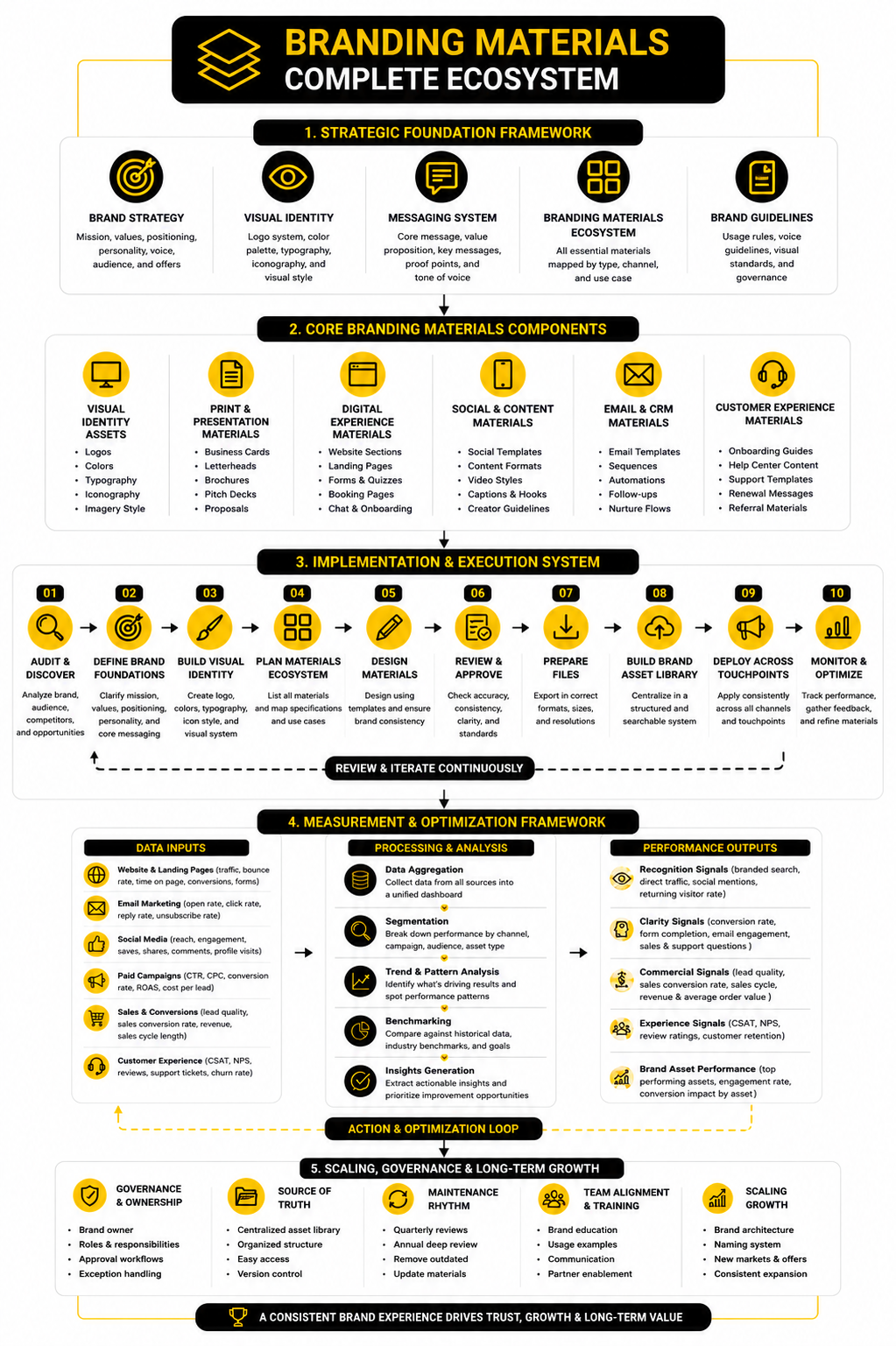
Building The Final Brand Ecosystem
A mature brand ecosystem is not just a library of files. It is a working environment where people can find the right materials, understand how to use them, create new assets faster, and improve the system based on real feedback. This is the point where branding materials become part of operations.
The ecosystem should support both creativity and control. Designers need enough flexibility to create strong work. Marketers need speed. Sales teams need clarity. Customer support needs consistency. Leadership needs confidence that the brand is not being diluted every time a new asset goes live.
This is why the final system should be built around decision-making, not storage. The question is not “where do we keep the logo?” The better question is “how does someone create something on-brand without asking five people or guessing?”
The Source Of Truth
Every brand needs one source of truth. This can be a brand portal, shared workspace, digital asset library, internal wiki, project management hub, or structured cloud folder. The format matters less than the behavior it creates.
The source of truth should clearly separate approved assets from drafts, experiments, and archived materials. It should include the current logo files, color rules, typography guidance, messaging documents, templates, image direction, channel guidance, and approval process. If people have to search through old campaign folders to find the right asset, the system is already too hard.
The source of truth should also be easy to maintain. A complicated system may look impressive during setup, but if nobody updates it, it becomes stale quickly. Keep it simple enough that the brand owner can actually manage it.
The Approval System
Approval should protect the brand without slowing everything down. Not every social post needs the same review as a new homepage, sales deck, or product launch campaign. The approval system should match the risk level of the asset.
Low-risk assets can often be created from approved templates with light review or no review. Medium-risk assets may need a brand or marketing check. High-risk assets, such as major campaigns, pricing pages, legal claims, partnership materials, and public brand changes, should get deeper review.
The goal is not to create bottlenecks. The goal is to prevent expensive mistakes. Clear approval rules help people move faster because they know what requires review and what does not.
The Maintenance Rhythm
Brand systems decay when nobody maintains them. Templates become outdated, screenshots age, offers change, product names shift, campaigns end, and old files keep circulating. This is normal, but it needs a rhythm.
A practical maintenance rhythm can be simple. Review key branding materials quarterly, check major templates after important campaigns, and do a deeper annual review of the full system. The goal is to keep the brand current without constantly redesigning it.
During each review, remove outdated assets, update messaging, refresh screenshots, improve templates, and document what the team learned. This small discipline prevents the system from becoming bloated and unreliable.
Governance Without Killing Speed
Governance sounds heavy, but it does not have to be. Good governance simply means the brand has clear rules, clear ownership, and clear update paths. It keeps the system healthy without making every creative decision feel political.
The best governance model depends on team size. A small business may only need one brand owner and a shared asset library. A growing company may need separate owners for visual identity, messaging, website templates, sales materials, and customer communication. A larger organization may need formal brand operations.
Governance should always serve execution. If the rules make it harder to publish good work, simplify them. If the lack of rules creates inconsistency, tighten them. The goal is balance.
Who Should Own Branding Materials
Someone must own the branding materials system. This does not mean one person creates every asset. It means one person or team is accountable for quality, consistency, updates, and access.
For small businesses, this may be the founder, head of marketing, designer, or operations lead. For agencies, it may be the creative director or brand strategist. For growing companies, brand ownership may sit with marketing while design, sales, and customer success contribute to their own asset areas.
Ownership should be visible. Everyone should know who approves changes, who updates templates, who archives old materials, and who answers brand questions. Without visible ownership, people create their own workarounds.
How To Handle Exceptions
Every brand system needs room for exceptions. A partnership may require co-branded materials. A paid campaign may need a different layout. A product launch may need a sharper tone. A local market may need adapted language.
The problem is not exceptions. The problem is unmanaged exceptions. If exceptions are not documented, they become precedents, and soon the system loses shape.
A good rule is simple: allow exceptions when there is a clear business reason, but document what changed and why. If the exception works repeatedly, update the system. If it was a one-off, archive it properly so it does not become the new standard by accident.
How To Keep Teams Aligned
Alignment does not happen because a brand guide exists. It happens because people understand the brand, use the materials, and see the value of consistency. That requires communication.
Hold short brand reviews when major assets launch. Share examples of strong on-brand work. Explain why certain decisions were made. Update people when templates change. Make the system feel alive, not hidden.
This matters even more when external partners are involved. Freelancers, agencies, contractors, affiliates, creators, and sales partners need the same clarity as internal teams. If they represent the brand, they need access to the right materials and boundaries.
What are branding materials?
Branding materials are the visual, verbal, and practical assets that help a business present itself consistently. They include logos, colors, typography, messaging, templates, sales decks, landing pages, social graphics, email designs, packaging, proposals, and customer communication assets. They are the tools that make the brand recognizable and repeatable.
The most useful branding materials are not just attractive. They help customers understand the business faster and help teams create better assets with less guesswork. That is why they should be treated as a system, not a random collection of design files.
What is included in a basic branding materials package?
A basic package usually includes logo files, color palette, typography rules, brand voice guidance, key messaging, image direction, and a small set of templates. The exact package depends on the business model. A service business may need proposals and sales decks, while an ecommerce brand may need product page sections, packaging rules, and promotional graphics.
The package should match real usage. If your team creates emails every week, email templates matter more than a decorative poster design. Start with the assets that influence customers most often.
Why are branding materials important?
Branding materials are important because they create consistency across customer touchpoints. Customers may see your brand on social media, a landing page, an email, a sales deck, a booking page, and a support message before they make a decision. If those touchpoints feel connected, the brand becomes easier to recognize and trust.
They also help teams move faster. Clear materials reduce repeated decisions about colors, fonts, messaging, layouts, and tone. That saves time and improves quality.
How often should branding materials be updated?
Branding materials should be reviewed regularly, but not constantly redesigned. A practical rhythm is to review high-use templates quarterly and review the broader system annually. Fast-moving assets, such as campaign graphics, landing page sections, screenshots, and offer messaging, may need updates more often.
The goal is to keep the system current without creating brand instability. If the business strategy, audience, offer, or product experience changes significantly, the branding materials should be updated to match.
What is the difference between brand guidelines and branding materials?
Brand guidelines explain how the brand should be used. Branding materials are the actual assets used to express the brand. The guidelines might define logo spacing, color usage, tone of voice, and image style, while the materials include the logo files, templates, page sections, decks, emails, and graphics.
You need both. Materials without guidelines become inconsistent. Guidelines without usable materials become theory.
How do branding materials help sales?
Branding materials help sales by making the offer easier to understand and easier to trust. A strong sales deck, proposal template, one-page summary, comparison page, case study layout, and follow-up email can reduce confusion during the decision process. They also help sales teams tell the same story consistently.
This matters because prospects often share materials with other decision-makers. If those materials are clear and professional, the brand keeps selling even when the salesperson is not in the room.
How do branding materials help marketing?
Branding materials help marketing by making campaigns faster to create and easier to recognize. Social templates, ad creative systems, landing page sections, email formats, lead magnet layouts, and messaging blocks all reduce the need to start from scratch. They also help different campaigns feel connected to the same business.
Marketing performance improves when people understand the offer and remember the brand. Strong materials support both. They give campaigns structure without forcing every asset to look identical.
What branding materials does a small business need first?
A small business should start with the highest-impact materials. Usually, that means a logo system, color palette, typography rules, homepage or landing page structure, core messaging, social templates, email templates, and a simple sales or proposal document. The exact priority depends on how the business gets customers.
Do not build a huge brand system too early. Build the materials that support your next stage of growth. If leads come through calls, fix your booking page, proposal, and follow-up emails before worrying about advanced brand architecture.
What are the biggest mistakes businesses make with branding materials?
The biggest mistake is treating branding materials as decoration instead of infrastructure. Many businesses focus on the logo and colors but ignore messaging, templates, customer experience, and governance. That creates a brand that looks fine in isolated moments but feels inconsistent across the full journey.
Another common mistake is keeping too many outdated assets visible. If old logos, retired offers, expired templates, and inconsistent copy are still easy to access, someone will use them. Clean organization matters more than most teams think.
How do you measure whether branding materials are working?
Measure branding materials through recognition, clarity, and commercial signals. Recognition signals include branded search, direct traffic, returning visitors, and social recall. Clarity signals include landing page behavior, form completion, email clicks, sales questions, and support patterns. Commercial signals include conversion rate, lead quality, close rate, sales cycle length, retention, and referrals.
The point is not to chase random benchmarks. The point is to compare performance against your own baseline and improve the assets that create friction. Measurement should lead to action.
Should branding materials be strict or flexible?
They should be strict where inconsistency would create confusion and flexible where adaptation improves execution. Logo usage, core colors, naming, key claims, positioning, and brand promise usually need tighter control. Layout variations, campaign formats, social hooks, and channel-specific creative can have more flexibility.
The best systems define both zones clearly. Teams should know what they can change and what they should protect. That clarity keeps the brand consistent without making it boring.
How do branding materials support customer experience?
Branding materials support customer experience by making every touchpoint feel intentional. Welcome emails, onboarding guides, support replies, booking pages, forms, renewal messages, and feedback requests all shape how customers feel after they buy. These assets prove whether the brand promise is real.
A strong customer experience system reduces uncertainty. Customers know what happens next, where to go, and how to get value. That builds trust more effectively than polished marketing alone.
Do branding materials matter for personal brands?
Yes, but they should be lighter and more flexible. A personal brand still needs recognizable visuals, consistent messaging, content formats, profile assets, offer pages, email templates, and a clear tone of voice. The difference is that the person’s voice and point of view often carry more weight than a complex design system.
Personal brands should avoid becoming too polished if that removes personality. The goal is recognition and trust, not corporate stiffness. Good branding materials make the personal brand easier to remember while keeping it human.
Can AI help create branding materials?
AI can help with drafts, variations, summaries, naming ideas, message options, content repurposing, customer support structures, and internal documentation. It can speed up production, especially when the brand rules are already clear. But AI should not replace brand judgment.
The risk is generic output. If the system does not have a strong foundation, AI will often produce materials that sound polished but feel interchangeable. Use AI to support execution, not to decide what the brand stands for.
When should a business hire professionals for branding materials?
Hire professionals when inconsistency is costing time, trust, or revenue. That may show up as weak conversion, confusing messaging, poor sales materials, scattered templates, inconsistent customer communication, or a brand that no longer fits the business. Professional help is especially valuable when the brand needs strategy, not just design cleanup.
A strong professional can turn scattered assets into a clear system. They can define the foundation, improve the identity, build usable templates, organize the asset library, and create guidelines the team can actually follow. That is usually faster and cleaner than trying to patch the system forever.
Build a stronger local presence with BAAM AI
Turn your website, Google profile, social channels, and AI visibility into one growth engine
Most businesses do not need more random marketing activity. They need a consistent presence system that helps the right people find them, trust them, and take action. BAAM AI brings strategy, local SEO, website updates, Google Maps visibility, social content, AI-search readiness, media production, and reporting into one practical monthly engine.
If you want your marketing to keep working after the campaign ends, start with a free BAAM AI presence audit. See how your business shows up today and where the fastest visibility wins are at BAAM AI.