
BAAM AI Blog
Black Friday Email Marketing Examples That Actually Help You Sell
Black Friday email marketing examples are useful only when you know what to look for. A good email is not just a clever subject line, a discount code, or a pretty product grid. It works because the offer, audience...
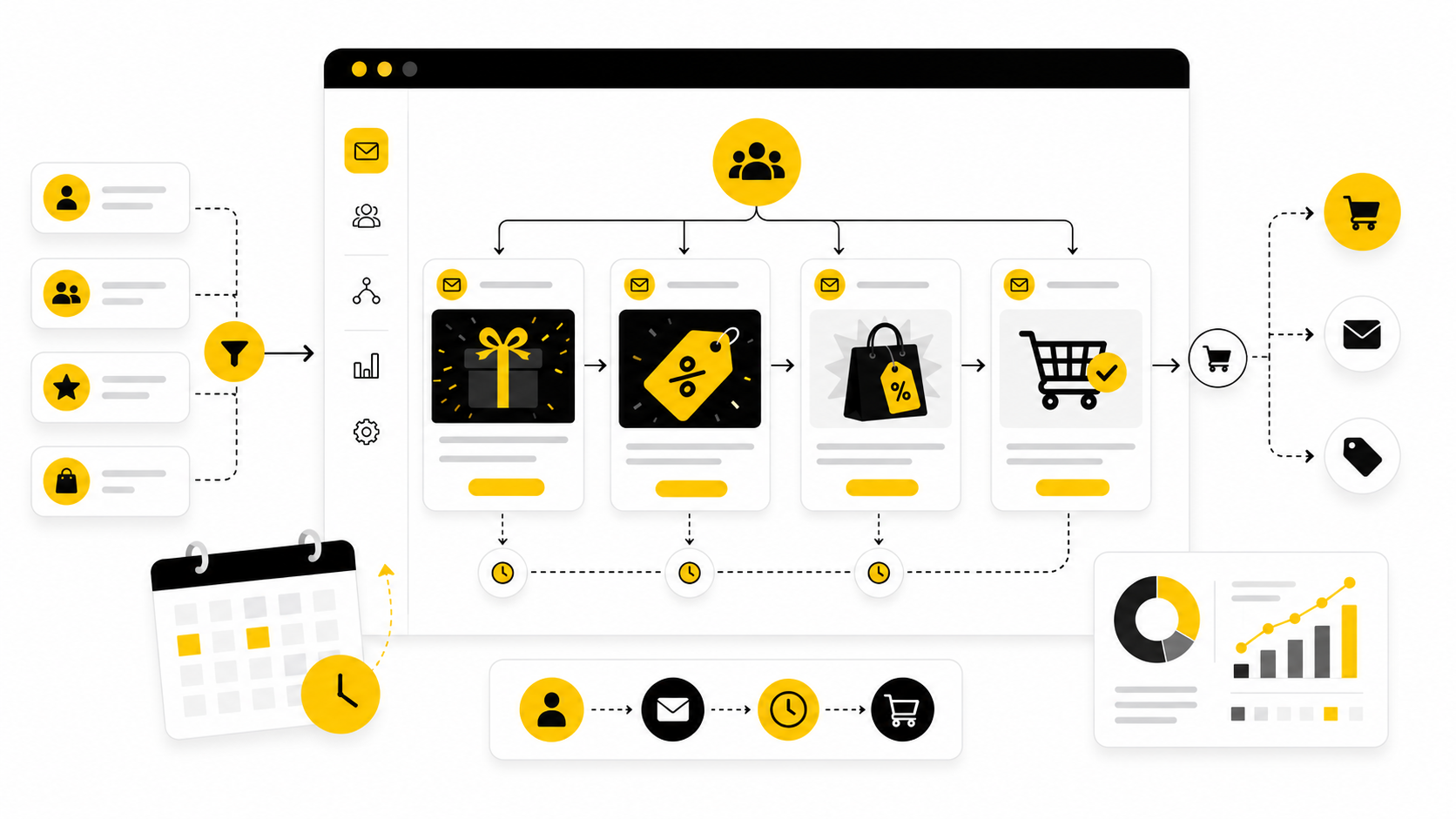
Black Friday email marketing examples are useful only when you know what to look for. A good email is not just a clever subject line, a discount code, or a pretty product grid. It works because the offer, audience, timing, creative, and follow-up sequence all support one job: getting the right customer to act before the buying window closes.
That matters because Black Friday is no longer a single-day promotion. In 2025, Adobe reported that U.S. shoppers spent $14.25 billion online on Cyber Monday, while Black Friday itself reached $11.8 billion in U.S. online sales. The opportunity is huge, but the inbox is also more crowded, more automated, and more competitive than it used to be.
this guide breaks down real Black Friday email marketing examples by the strategy behind them, not just how they look. You will see how strong campaigns build anticipation, segment buyers, frame urgency, recover abandoned carts, and turn seasonal buyers into repeat customers. The goal is not to copy another brand’s email word for word. The goal is to understand the pattern so you can build a Black Friday campaign that fits your offer, list, margins, and customer behavior.
Why Black Friday Email Marketing Examples Matter
Black Friday email examples matter because they show how brands translate strategy into actual messages people receive. A campaign plan can sound smart in a spreadsheet, but the email itself has to survive the real inbox: small screens, short attention spans, competing promotions, and customers comparing deals across multiple tabs. That is where examples become practical, because they reveal the decisions behind the send.
The strongest examples usually do one thing very clearly. They might announce early access, explain a limited bundle, remind a shopper about a cart, reward VIP customers, or extend Cyber Monday with a sharper reason than “sale ends soon.” Weak emails try to do everything at once, which often makes the offer harder to understand.
Email still earns its place in the Black Friday stack because it is owned, direct, and measurable. Shopify’s enterprise guidance notes that email is one of the most influential channels for holiday purchase decisions, which is exactly why ecommerce teams keep investing in better segmentation, creative, and automation around BFCM. For a lean team, even a simple setup using a platform like Brevo can outperform a rushed batch-and-blast campaign when the message is planned properly.
The Framework Behind High-Converting Black Friday Emails
Great Black Friday emails are built around a sequence, not a single send. The usual flow starts with anticipation, moves into launch, reinforces the offer with proof or scarcity, recovers shoppers who showed intent, and then closes with a final reason to buy. That structure matters because different subscribers need different levels of persuasion before they act.
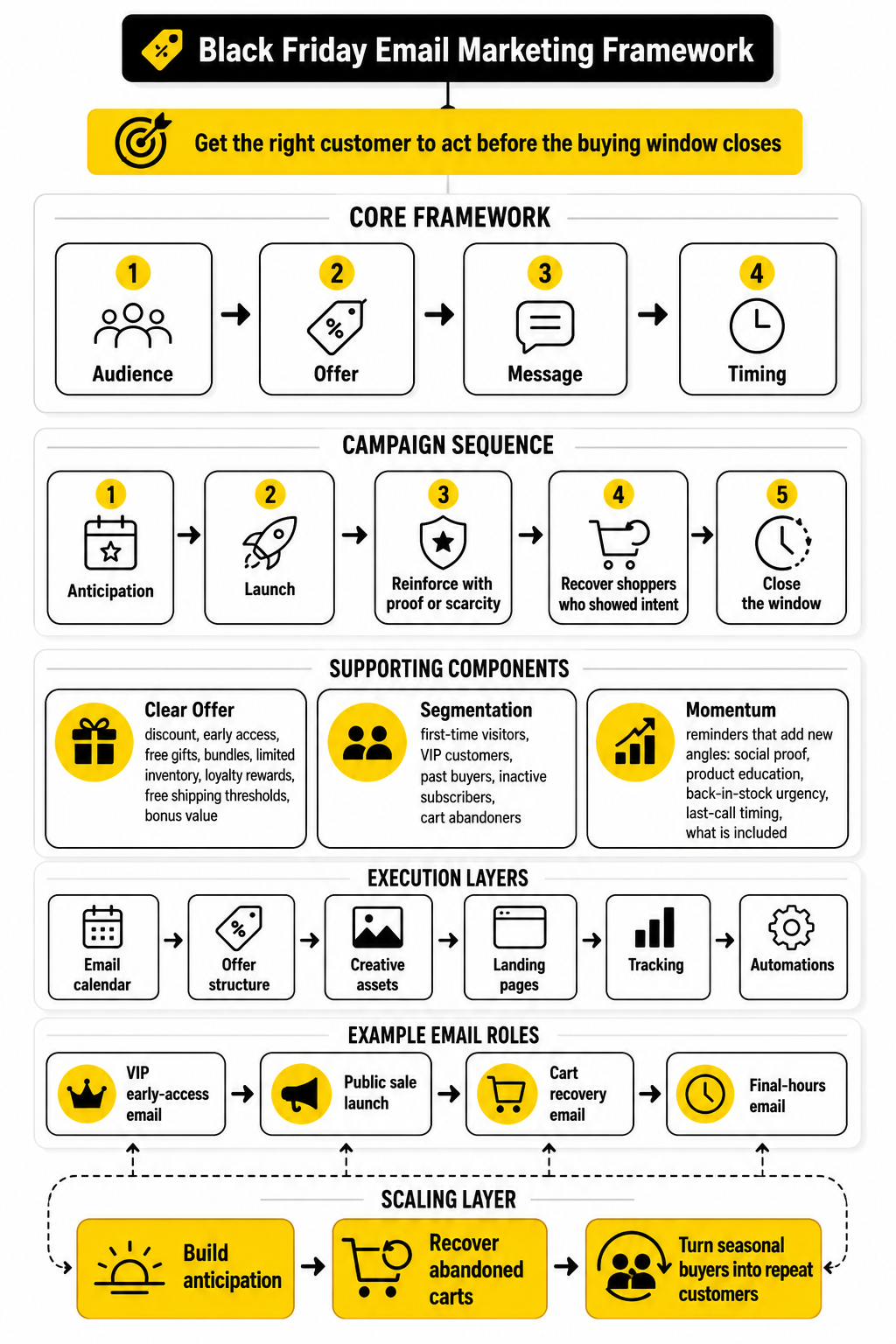
A practical framework has four layers: audience, offer, message, and timing. Audience decides who should receive the email. Offer decides what makes the promotion worth acting on. Message decides how clearly the customer understands the value. Timing decides whether the email arrives when the customer is actually ready to buy.
This is also where many Black Friday campaigns break. Brands often spend too much energy on subject lines and not enough on segmentation, landing pages, inventory constraints, or post-purchase follow-up. A sharp campaign connects email to the rest of the funnel, whether that means a dedicated offer page built in a tool like Replo, cart recovery automation, or a simple SMS reminder for subscribers who asked for early access.
Core Components of Strong Black Friday Email Campaigns
A strong Black Friday email campaign starts with a clear offer. That does not always mean the biggest discount. It can be early access, free gifts, bundles, limited inventory, loyalty rewards, free shipping thresholds, or a bonus that makes the deal feel more valuable without destroying margin.
The second component is segmentation. First-time visitors, VIP customers, past buyers, inactive subscribers, and cart abandoners should not always receive the same message. The more specific the segment, the easier it becomes to write an email that feels relevant instead of generic.
The third component is momentum. Black Friday campaigns need a rhythm that builds pressure without sounding desperate. A good sequence gives subscribers enough reminders to act, but each email should add a new angle, such as social proof, product education, back-in-stock urgency, last-call timing, or a reminder of what is included in the offer.
Professional Implementation for Ecommerce Teams
Professional implementation means planning the campaign before the discount goes live. The email calendar, offer structure, creative assets, landing pages, tracking, and automations should be mapped together. That is how you avoid the classic Black Friday problem where the email gets clicks, but the landing page, stock levels, or checkout experience cannot support the traffic.
For most teams, the biggest upgrade is not adding more emails. It is making each email more intentional. A VIP early-access email should feel different from a public sale launch. A cart recovery email should focus on the product and the objection. A final-hours email should be direct, specific, and honest about what ends.
The next parts of this guide will move from framework into execution. We will break down the core campaign pieces, then look at Black Friday email marketing examples by type so you can see how each message works inside the larger promotion.
The Framework Behind High-Converting Black Friday Emails
A strong Black Friday campaign is not a pile of random sends. It is a controlled sequence that moves subscribers from awareness to action with as little friction as possible. When you study black friday email marketing examples from serious ecommerce brands, the best ones usually follow the same hidden structure: warm up the list, launch the offer, handle hesitation, recover intent, and close the window.
The mistake is treating every subscriber like they are ready to buy right now. Some people need early access because they already trust the brand. Some need product education because they are still comparing options. Some only need a reminder because they abandoned a cart with high intent. Your campaign gets stronger when each email has a specific job instead of trying to squeeze the entire sale into one message.
Black Friday also rewards preparation because customer behavior is compressed. People are browsing more, comparing faster, and making decisions under pressure. That does not mean your emails should become louder. It means they need to become clearer.
Start With the Buying Moment
Before writing subject lines or designing templates, define the exact buying moment you are trying to create. A buying moment is the point where the customer understands the offer, believes the value, and feels enough urgency to act. Without that moment, even a big discount can feel like noise.
For example, an early-access email should make loyal customers feel like insiders. A launch email should make the offer instantly obvious. A final-hours email should remove ambiguity and make the deadline unmistakable. These emails can share the same promotion, but they should not sound the same because they are solving different customer problems.
This is why the best Black Friday sequences feel intentional. They do not just repeat “sale ends soon” five times. They give the reader a reason to pay attention at each stage of the campaign.
Build the Campaign Around Segments, Not Sends
Segmentation is where Black Friday email marketing starts becoming profitable instead of just busy. A past buyer who purchased three times this year should not receive the same opening email as a cold subscriber who joined through a giveaway. They have different trust levels, different purchase intent, and different reasons to act.
Useful Black Friday segments often include VIP customers, recent buyers, high-intent browsers, cart abandoners, inactive subscribers, gift shoppers, and customers who previously bought specific categories. These groups do not need completely different campaigns from scratch. They need different angles, different offer framing, and sometimes different timing.
For smaller teams, this does not need to become complicated. Even basic segmentation by purchase history and engagement can make the campaign feel more relevant. If your email platform supports automation, a tool like Moosend can help structure these paths without turning the campaign into a technical mess.
Match the Offer to the Customer’s Intent
Not every customer needs the same incentive. A loyal buyer may respond to early access, limited bundles, or first choice on inventory. A hesitant shopper may need a stronger discount, free shipping threshold, or reassurance around returns. A cart abandoner may simply need the product reminder, delivery cutoff, and a clear reason to complete checkout.
This is where many brands leave money on the table. They build one blanket offer because it feels simple, but simplicity on the backend can create vagueness on the frontend. The customer should immediately understand why this offer matters to them.
A clean way to think about it is this: reward loyalty, reduce hesitation, and recover intent. Those are three different jobs. When your campaign separates them, your emails become easier to write and easier to measure.
Use Timing as a Strategic Lever
Black Friday timing is not just about sending more emails during Cyber Week. It is about matching the message to the stage of demand. Early November can work well for list warming, gift guides, and VIP access. Black Friday itself is better for clear launch messaging, deal reminders, and category-specific pushes.
The final phase needs more discipline. If every email screams urgency from the first day, the real deadline loses power. Save your strongest urgency for the moments when it is actually true: last day, last hours, low stock, shipping cutoff, bonus ending, or price returning to normal.
Your timing should also account for operational reality. If inventory is limited, your campaign should not promise endless availability. If your fulfillment cutoff matters, say it clearly. Black Friday email marketing examples are most useful when they show this kind of practical alignment between marketing and operations.
Connect Email to the Landing Page
The email gets the click, but the landing page gets the sale. That means the promise in the email must match what the customer sees after clicking. If the email promotes a bundle, the landing page should not drop people onto a generic collection page and make them hunt for it.
This is especially important during Black Friday because shoppers are impatient. They are comparing offers, checking prices, and moving quickly. Any mismatch between email and landing page creates friction at the worst possible moment.
For ecommerce teams that want more control over campaign pages, Replo can be useful for building focused landing pages around specific offers, bundles, or seasonal collections. The point is not the tool itself. The point is making the journey from inbox to checkout feel obvious.
Plan the Follow-Up Before Launch
A Black Friday launch email is only the beginning. The follow-up is where a lot of the revenue is recovered. People click without buying, add products without checking out, browse categories without deciding, and wait until the last moment to compare alternatives.
That behavior should shape your sequence. Browse abandonment emails can bring shoppers back to products they viewed. Cart recovery emails can remind them what they nearly bought. Post-purchase emails can recommend complementary products while the buying mindset is still active.
This is why automation matters so much during Black Friday. Manual sends are useful, but triggered emails respond to behavior in real time. When someone shows intent, the campaign should react while that intent is still warm.
Keep the Message Simple Enough to Act On
The best Black Friday emails are not always the most creative. Often, they are the clearest. They make the offer obvious, show the product or category, remove a key objection, and give the reader one primary action.
This does not mean the copy has to be boring. It means the email should not make the customer decode what is happening. If the discount has conditions, explain them. If the sale has a deadline, state it plainly. If the offer is limited to selected products, do not make it sound storewide.
Clarity is what makes urgency believable. When people understand the deal quickly, they can decide quickly. That is exactly what your campaign needs during the most competitive shopping window of the year.
Core Components of Strong Black Friday Email Campaigns
Once the strategy is clear, the campaign needs a build process. This is where black friday email marketing examples become more than inspiration. You can reverse-engineer what each email is doing, then turn that into a repeatable system for your own promotion.
A strong implementation process keeps the campaign grounded in the customer journey. The shopper should move from interest to confidence to action without feeling confused, tricked, or overwhelmed. That sounds simple, but during Black Friday, many brands lose discipline because they are trying to squeeze every possible angle into every possible send.
The better approach is to build the campaign in layers. Start with the offer. Then shape the audience segments. Then write the message for each stage. Then connect every email to the correct page, automation, and follow-up path.
Step 1: Lock the Offer Before You Write Anything
The offer is the foundation of the campaign. If the offer is weak, unclear, or hard to explain, better copy will not save it. Before writing the first email, decide exactly what the customer gets, when the offer starts, when it ends, which products are included, and what conditions apply.
This is also where margin discipline matters. A storewide discount might be easy to promote, but it can train customers to wait for markdowns and damage profitability if the numbers are not modeled properly. A bundle, gift-with-purchase, tiered discount, or limited-edition drop can sometimes create stronger perceived value without simply cutting deeper.
Write the offer in one plain sentence before you build the campaign. If you cannot explain it clearly in one sentence, the customer probably will not understand it quickly in the inbox. That one sentence becomes the anchor for your launch email, landing page, cart recovery message, and final reminder.
Step 2: Map the Campaign Calendar
A campaign calendar turns the promotion into a sequence instead of a panic. It should show when each email goes out, who receives it, what job the email performs, and where the click sends the customer. During Black Friday, this prevents overlap, message fatigue, and last-minute improvisation.
A simple calendar can include five phases: warm-up, early access, public launch, urgency, and post-purchase follow-up. Each phase should have a different purpose. The warm-up phase prepares attention, early access rewards high-value customers, launch explains the main offer, urgency drives action, and post-purchase follow-up increases customer value after the first order.
This planning step is especially important because peak shopping behavior is concentrated. Shopify merchants generated a record $14.6 billion in sales during Black Friday Cyber Monday 2025, which shows how much demand can compress into a short buying window. The brands that win are usually not the ones improvising at midnight.
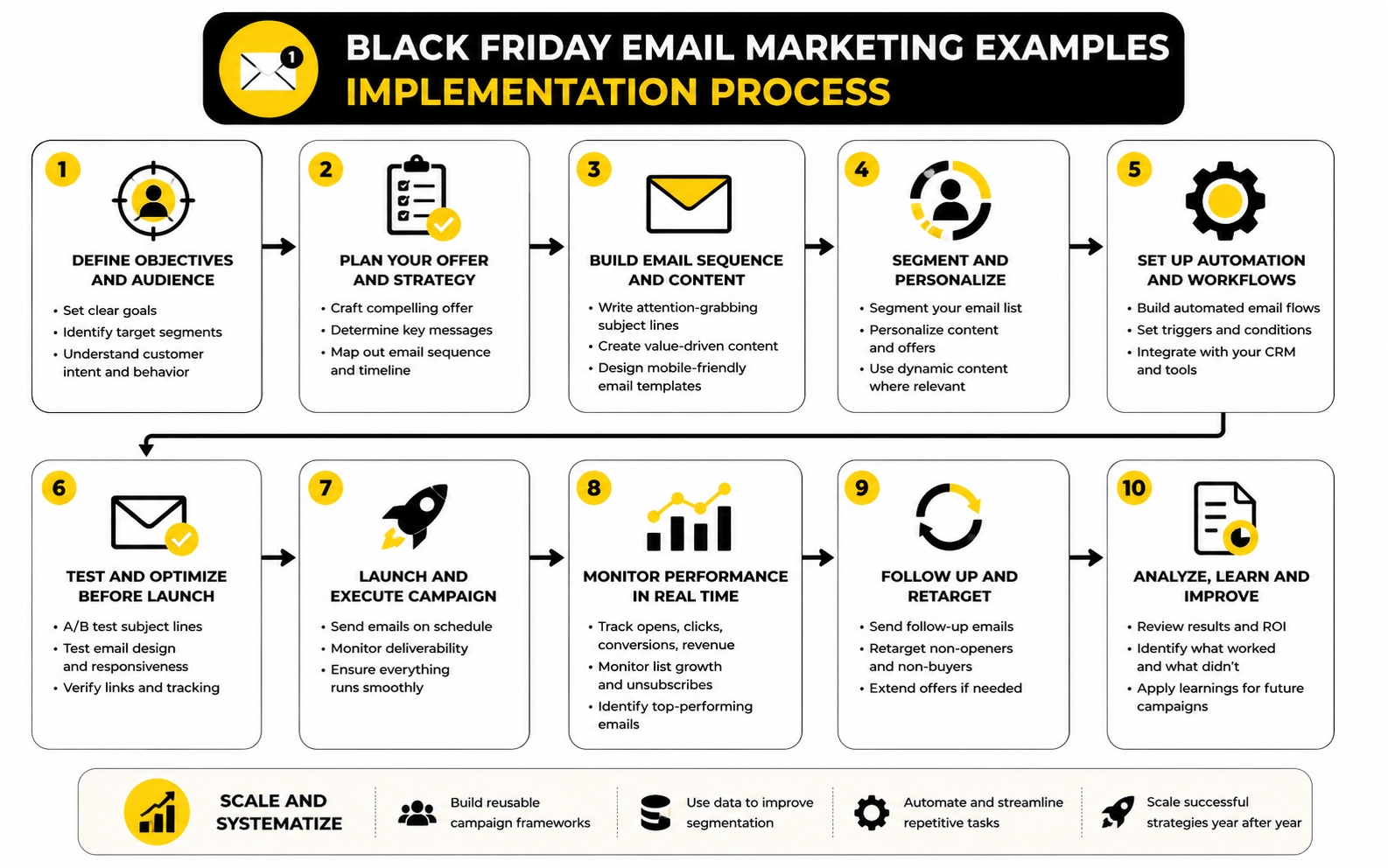
Step 3: Build Segments Around Behavior
The next step is building audience segments that reflect intent. Start with the obvious groups: recent buyers, VIP customers, engaged subscribers, inactive subscribers, cart abandoners, and product-category browsers. These groups give you enough flexibility to personalize the campaign without making it unmanageable.
Behavioral segmentation works because it changes the reason for the email. A VIP customer can receive an insider message. A cart abandoner can receive a reminder tied to the exact product they considered. An inactive subscriber may need a stronger hook or a cleaner reactivation angle before they care about the sale.
Do not overcomplicate this if your list is small. A clean split between buyers, non-buyers, engaged subscribers, and abandoners is already useful. If your email tool supports both email and SMS, platforms like Brevo or Moosend can help keep those paths organized.
Step 4: Write Each Email Around One Job
Every email in the sequence needs one primary job. The job might be to announce early access, explain the best-selling bundle, recover an abandoned cart, remind shoppers about the deadline, or thank customers after purchase. When one email tries to do too many jobs, the call to action gets weaker.
This is the easiest way to evaluate Black Friday email marketing examples. Ask what the email wants the reader to do next. If the answer is obvious within a few seconds, the email is probably well-structured. If the email has multiple competing offers, unclear conditions, and several unrelated buttons, it is probably doing too much.
A strong email usually follows a simple pattern. Lead with the reason to care, clarify the offer, show the relevant product or category, remove one objection, and end with one direct action. That structure is not flashy, but it works because it respects how quickly people scan promotional emails.
Step 5: Match the Email to the Page
The click should never feel like a reset. If the email promotes early access to a specific collection, the landing page should show that collection immediately. If the email promotes a bundle, the click should take the shopper directly to the bundle or a landing page built around it.
This alignment matters even more during Black Friday because the customer is comparing options quickly. Any extra hunting, confusing navigation, or mismatch between promise and page can cost the sale. A polished email cannot compensate for a page that makes the customer work too hard.
For brands that build dedicated promotional pages, Replo can help create focused Black Friday pages for bundles, gift guides, and category-specific offers. The practical goal is simple: keep the message consistent from subject line to checkout.
Step 6: Prepare Automations Before Traffic Spikes
Manual campaign emails create the main momentum, but automations capture the revenue that would otherwise slip away. Cart abandonment, browse abandonment, price-drop reminders, back-in-stock alerts, welcome flows, and post-purchase flows can all matter during Black Friday. They respond to behavior while the shopper still has intent.
This is also where timing and suppression rules become important. Someone who just purchased should not keep receiving the same abandoned-cart push. A VIP buyer should not be treated like a cold subscriber. A customer who clicked a specific category should not be dropped into a generic follow-up if you have better data available.
The automation layer does not need to be complicated, but it does need to be tested. Check triggers, delays, discount codes, dynamic product blocks, exclusions, and mobile rendering before the sale starts. Black Friday is not the moment to discover that your recovery flow points to last year’s offer.
Step 7: Test the Customer Experience End to End
Before launch, walk through the campaign like a customer. Sign up, receive the email, click the button, land on the page, add the product to cart, apply the discount, check shipping information, and complete checkout. This reveals problems that dashboard planning will miss.
Look for friction in the places where shoppers make decisions. Is the offer visible above the fold? Is the discount automatically applied or clearly explained? Are shipping deadlines obvious? Does the checkout work cleanly on mobile? These details are not glamorous, but they decide whether demand turns into revenue.
This is also the point where you should test tracking. UTM parameters, conversion events, email revenue attribution, SMS attribution, and landing page analytics should be checked before traffic arrives. If the campaign performs well but the reporting is broken, you will struggle to learn from it.
Step 8: Create a Real-Time Monitoring Plan
A professional Black Friday campaign needs monitoring, not micromanaging. Decide which metrics you will watch during the sale and what action you will take if something changes. Open rate alone is not enough because it does not tell you whether the offer is converting.
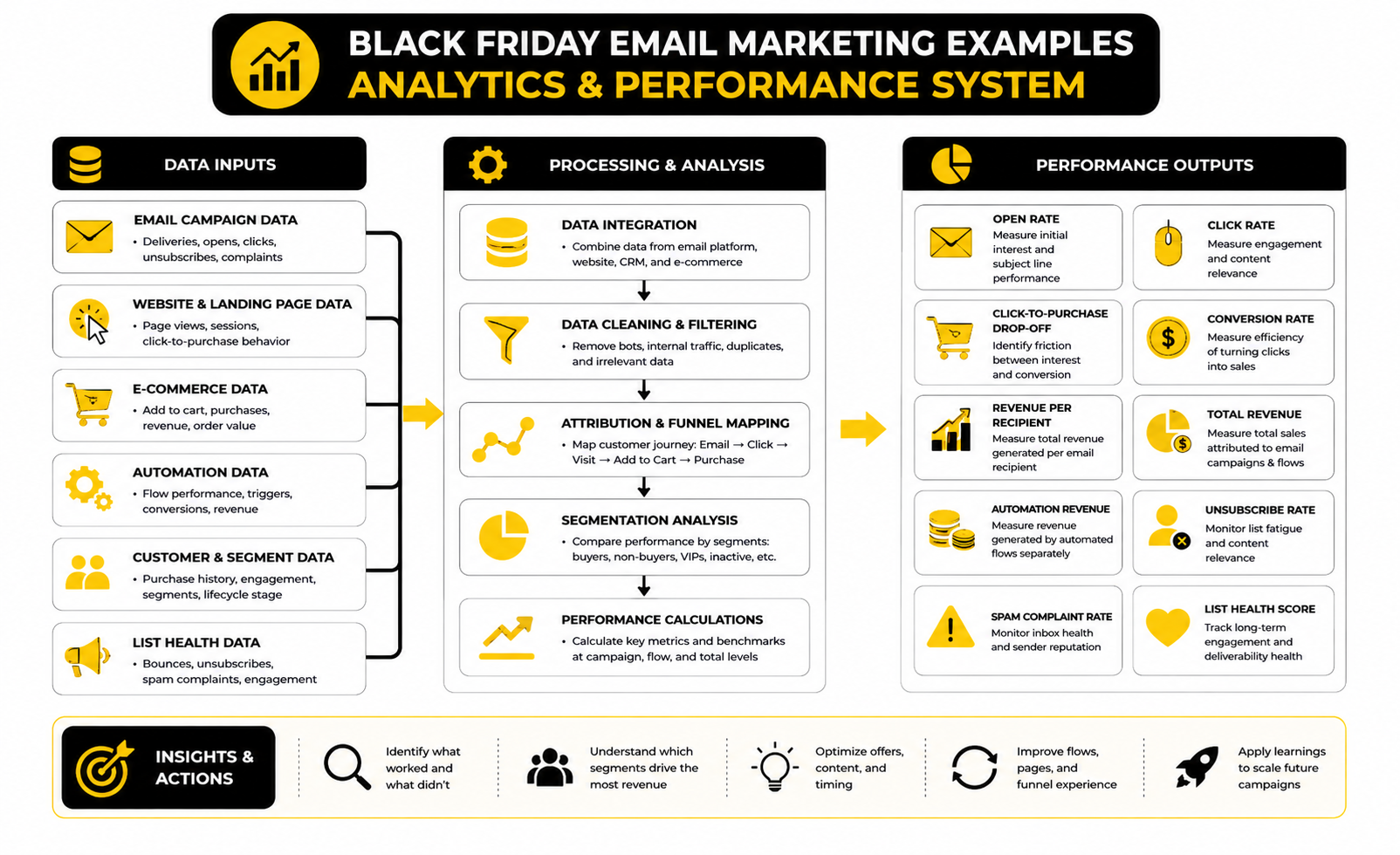
Useful live metrics include revenue per recipient, click rate, conversion rate, cart abandonment rate, unsubscribe rate, spam complaint rate, product sell-through, and landing page conversion rate. If a product sells faster than expected, shift the email angle. If a segment underperforms, adjust the offer or suppress low-intent sends.
This is where discipline matters. Do not change everything because one email underperforms for an hour. Watch patterns, compare segments, and act when the data points to a clear problem. Black Friday moves fast, but random changes still create random results.
Statistics and Data
Black Friday measurement is not about collecting as many numbers as possible. It is about knowing which numbers explain customer intent, which numbers expose friction, and which numbers should trigger action while the campaign is still live. The best black friday email marketing examples are useful because you can connect the creative to the performance signal behind it.
Start with the market context, then narrow down to your own campaign. U.S. shoppers spent a record $11.8 billion online on Black Friday 2025, and Cyber Monday reached $14.25 billion in online spending. Those numbers do not mean every brand should expect automatic growth. They mean demand exists, but attention is expensive and customers are actively comparing offers.
The job of analytics is to show where your campaign is winning or leaking. A high open rate with weak clicks points to curiosity without enough motivation. Strong clicks with weak conversion usually means the email created interest, but the landing page, price, offer, product availability, or checkout experience failed to finish the job. High revenue with rising unsubscribe or complaint rates may still be profitable short term, but it can damage list quality if the campaign gets too aggressive.
Measure the Funnel, Not Just the Email
Email performance should be measured as a funnel: delivered, opened, clicked, added to cart, purchased, and retained. Each step tells a different part of the story. If you only look at opens or clicks, you may optimize for attention instead of revenue.
Open rate can still be useful, but it is not the clean signal it used to be because privacy features can inflate or obscure engagement. Click rate is usually more useful because it shows active interest. Conversion rate and revenue per recipient are even more useful because they connect the email to business outcomes.
The most practical view is simple. Ask how many people received the message, how many clicked, how many bought, how much revenue the send produced, and whether that revenue was profitable after discounts, shipping, product cost, and ad spend. That last part matters. A campaign can look impressive in top-line revenue while quietly eating margin.
Track Revenue Per Recipient
Revenue per recipient is one of the cleanest Black Friday email metrics because it combines audience quality, offer strength, and conversion performance. It tells you how much revenue each email generated for every person who received it. This makes it easier to compare sends with different audience sizes.
For example, a VIP early-access email may have fewer recipients than a public launch email but produce higher revenue per recipient. That does not mean the public launch failed. It means the VIP segment had stronger intent and may deserve earlier access, better bundles, or more personalized follow-up next year.
Revenue per recipient also helps you avoid vanity metrics. A huge campaign to the full list can create more total sales but perform worse per subscriber. A smaller segment can produce less total revenue but reveal a more profitable audience. Both insights matter, but they answer different questions.
Separate Campaign Revenue From Automation Revenue
Campaign emails and automated emails should not be judged the same way. Campaign emails create broad momentum. Automations capture behavior after someone shows intent. Mixing them together can make it hard to understand what actually worked.
A launch email might drive traffic to the site, while cart recovery, browse abandonment, and post-purchase flows collect revenue later. If your reporting only credits the last touch, the automation may look like the hero and the launch email may look weaker than it really was. If your reporting credits every touch too generously, the campaign may look better than reality.
Use attribution as a guide, not a religion. Look at campaign-level revenue, flow revenue, total site revenue, conversion rate, and blended margin together. Tools like Brevo and Moosend can help organize campaign and automation reporting, but you still need to interpret the numbers with common sense.
Watch Click-to-Purchase Drop-Off
Click-to-purchase drop-off is one of the fastest ways to diagnose a broken Black Friday campaign. If clicks are strong but purchases are weak, the issue is probably not the email subject line. The problem is usually what happens after the click.
Common causes include a landing page that does not match the email, confusing discount rules, weak product merchandising, unexpected shipping costs, slow page speed, sold-out items, or a checkout experience that feels risky. During peak season, shoppers do not tolerate friction for long. They leave and compare another offer.
This is why your email metrics should be reviewed alongside landing page data. A campaign page with strong traffic but poor conversion needs immediate attention. Fixing the page can be more valuable than sending another reminder.
Compare Segments Before You Compare Subject Lines
Subject lines are easy to test, so teams often overfocus on them. They matter, but segmentation usually explains more performance variation than one phrase in the inbox. A loyal customer segment will often beat a cold segment even with a less clever subject line.
When reviewing campaign results, compare buyers versus non-buyers, VIPs versus standard customers, engaged subscribers versus inactive subscribers, and cart abandoners versus general subscribers. These comparisons show where your real leverage is. If one segment performs dramatically better, build more specific campaigns for that segment next year.
This also protects you from misleading conclusions. A subject line may appear to win because it was sent to a stronger audience. A discount may appear weak because it was sent to low-intent subscribers. Always check who received the email before deciding why it performed the way it did.
Use Benchmarks Carefully
Benchmarks are useful for orientation, not for judgment. They can tell you whether your numbers are wildly outside normal ranges, but they cannot tell you whether your campaign was right for your audience, margins, or category. A luxury skincare brand, a consumer electronics store, and a digital product business should not evaluate Black Friday performance with the exact same expectations.
Klaviyo’s benchmark resources emphasize how strongly performance can vary by industry, list quality, segmentation, and automation maturity, which is why broad averages should be treated as context rather than a target. A low click rate might be acceptable if the campaign sells a high-ticket product profitably. A high click rate might be disappointing if it comes from bargain hunters who do not convert.
The better benchmark is your own history. Compare this year’s campaign against last year’s Black Friday, your recent promotional campaigns, your normal monthly email performance, and your strongest automated flows. That gives you a more honest view of progress.
Measure List Health After the Sale
Black Friday can grow revenue and damage your list at the same time. That is why performance analysis should continue after the final sale email. Watch unsubscribes, spam complaints, bounce rate, inactive subscriber growth, and post-sale engagement.
A temporary rise in unsubscribes is not always a disaster because promotional intensity is higher. The problem is when complaints rise, engagement collapses, or your future deliverability gets weaker. That means the campaign pushed too hard, targeted too broadly, or failed to respect subscriber intent.
List health is a long-term asset. You can always send one more aggressive email, but you cannot easily rebuild trust after training subscribers to ignore or distrust your messages. Strong Black Friday analytics should protect future revenue, not just celebrate this week’s sales.
Turn the Data Into Next Year’s Plan
The final measurement step is turning results into decisions. Do not just save screenshots of dashboards. Write down what worked, what failed, what surprised you, and what you would change while the details are still fresh.
Your post-campaign review should answer practical questions. Which segment produced the highest revenue per recipient? Which offer protected margin best? Which email created the strongest click-to-purchase rate? Which landing page converted best? Which automation recovered the most revenue without annoying customers?
This is where data becomes strategy. Next year’s campaign should not start from a blank page. It should start from the evidence you already earned.
Black Friday Email Marketing Examples by Campaign Type
At this stage, the campaign has a strategy, a build process, and a measurement system. Now the question becomes more advanced: which Black Friday email types should you actually use, and what tradeoffs come with each one? This is where black friday email marketing examples become more strategic, because the right email type depends on your audience, margin, inventory, and sales cycle.
A small brand with limited stock should not copy a massive retailer running endless sitewide discounts. A premium brand should be careful with aggressive markdown language if it wants to protect perceived value. A high-volume store may need more automation and suppression rules because one poorly targeted send can create thousands of irrelevant impressions.
The best campaign is not the loudest campaign. It is the one that matches the commercial reality behind the promotion.
Early Access Emails
Early access emails work best when the subscriber has a reason to feel chosen. That can be based on loyalty, purchase history, waitlist signup, SMS opt-in, membership, or previous engagement. The point is to make the customer feel like they are getting priority, not just another generic discount.
The tradeoff is that early access can weaken the main launch if everyone receives it. If every subscriber gets early access, it is not really early access anymore. Keep this campaign type reserved for a clear group, and make the reason obvious in the copy.
A strong early access email should answer three questions quickly. Why am I getting this now? What can I access before everyone else? How long does this advantage last? When those answers are clear, the email feels valuable instead of manipulative.
VIP and Loyalty Emails
VIP emails are different from early access because they should recognize customer value, not just timing. A VIP customer has already shown trust through purchases, order value, referrals, or repeat engagement. Treating that person like a random discount hunter is a mistake.
The offer does not always need to be deeper. It can be more exclusive, more convenient, or more personal. First pick of limited inventory, a private bundle, a bonus gift, or a stronger shipping perk can feel more premium than another percentage off.
The risk is over-rewarding customers who would have purchased anyway. That is why the offer should protect margin while still making the customer feel appreciated. Use VIP emails to strengthen retention, not just to discount people who already love the brand.
Launch Emails
The launch email has one job: make the main offer unmistakable. It should not bury the deal under clever copy, vague teaser language, or too many competing messages. During Black Friday, people are scanning fast, so the launch email needs to make the value obvious immediately.
The strategic tradeoff is breadth versus focus. A storewide launch is easy to understand, but it may not highlight the products that matter most. A category-specific launch can drive better intent, but it needs sharper segmentation and better landing page alignment.
For most brands, the launch email should lead with the strongest offer and then guide people toward the most relevant buying path. That might be best sellers, bundles, gifts under a certain price, limited drops, or product categories with strong inventory. The reader should know what to do next without thinking too hard.
Bundle and Gift Guide Emails
Bundle emails are powerful because they can increase perceived value and average order value at the same time. Instead of asking the customer to evaluate one discounted product, the email frames a complete solution. This works especially well for skincare routines, apparel sets, accessories, home goods, supplements, and giftable products.
Gift guide emails solve a different problem. They help shoppers who want to buy but do not know what to choose. Instead of pushing one deal, the email organizes options by recipient, use case, price point, or product type.
The risk is clutter. A bundle or gift guide email can easily become a crowded catalog with too many choices. Keep the structure tight, use clear categories, and make each section feel useful rather than decorative.
Cart Recovery Emails
Cart recovery emails are usually some of the highest-intent Black Friday messages because the shopper already took action. They found a product, considered it seriously, and left before completing checkout. The job of the email is not to reintroduce the whole brand. The job is to bring the customer back to the decision they almost made.
The best cart recovery emails focus on the product, the remaining offer window, and the objection that may have stopped the purchase. That objection might be shipping cost, delivery timing, sizing, return policy, payment flexibility, or simply distraction. Do not overload the message with unrelated products unless the original item is unavailable.
The risk is discount stacking. If customers learn that abandoning a cart always adds a better offer, you train them to wait. During Black Friday, it is often better to remind them of the current deal, deadline, or stock pressure before adding another incentive.
Browse Abandonment Emails
Browse abandonment emails are softer than cart recovery emails because intent is lower. The person viewed a product or category but did not add anything to cart. That means the message should feel helpful, not pushy.
A good browse abandonment email can bring the shopper back with product benefits, best sellers, reviews, comparison points, or a reminder that the Black Friday offer applies to the items they viewed. It should not pretend the customer has made a commitment they have not made. Keep the tone light and useful.
The tradeoff is volume. Browse behavior can create many triggers, especially during peak sale traffic. Use frequency caps and exclusions so subscribers do not receive a flood of emails after casual browsing.
Last-Chance Emails
Last-chance emails work because deadlines help people decide. But they only work when the deadline is real. If the brand sends “final hours” and then extends the exact same deal the next morning, customers notice.
The strongest last-chance emails are direct. They say what is ending, when it ends, and what the customer loses by waiting. This is not the place for long explanations or abstract branding.
The risk is urgency fatigue. If the entire campaign has screamed urgency from the beginning, the real final reminder has less impact. Save the most forceful language for the point where the customer genuinely has little time left.
Extended Sale Emails
Extended sale emails can work, but they need a reason. “We extended the sale” often feels weak because shoppers know many brands planned the extension anyway. A better angle is to tie the extension to inventory, shipping deadlines, Cyber Monday, customer demand, or a new bonus.
The extension should not make earlier urgency look fake. If the Black Friday offer truly ended, the extension can be framed as a different Cyber Monday offer, a limited restock, or a final chance on selected products. Keep the logic clean.
The tradeoff is trust. Short-term revenue from an extension may be useful, but repeated fake endings can train subscribers to ignore deadlines. Use extensions carefully and make them believable.
Post-Purchase Emails
Post-purchase emails are often underused during Black Friday because teams focus so heavily on acquisition. That is a missed opportunity. A customer who just bought during Black Friday may still be in shopping mode, especially if the product naturally pairs with another item.
The first post-purchase email should confirm confidence. Thank the customer, clarify what happens next, and reduce buyer anxiety around shipping, delivery, or account details. After that, you can introduce complementary products, care instructions, loyalty programs, referrals, or content that helps the customer get more value from the purchase.
The risk is being too aggressive immediately after checkout. Do not make the customer feel like the first purchase was not enough. Lead with reassurance, then introduce the next step when it makes sense.
Winback Emails
Winback emails can be useful before or during Black Friday, but they need a clear angle. An inactive subscriber is not automatically a bad lead. They may have stopped engaging because the timing, offer, or product relevance was not strong enough.
A Black Friday winback email should be simple. Acknowledge the major offer, make the value clear, and give the subscriber an easy path back into the brand. This is not the time for a long brand manifesto.
The tradeoff is deliverability. Sending aggressively to inactive subscribers during peak season can hurt inbox placement if engagement is poor. Use tighter suppression rules, send to the most recently inactive first, and avoid blasting your coldest contacts just because the calendar says Black Friday.
SMS and Messenger Support Emails
Email does not have to carry the whole campaign alone. SMS and messaging channels can support the most time-sensitive parts of Black Friday, especially early access, cart recovery, shipping cutoffs, and final hours. The key is to use them carefully because they feel more personal than email.
A platform like ManyChat can help brands build conversational flows around opt-ins, reminders, and campaign follow-up. This can be useful when the message is genuinely timely and the customer has given permission. It becomes annoying fast when used as a second inbox for the same generic blast.
The strategic rule is simple. Use email for explanation and merchandising. Use SMS or messaging for immediacy. When each channel has a different job, the campaign feels coordinated instead of repetitive.
Scaling Without Breaking Trust
Scaling a Black Friday campaign is not just about sending more messages to more people. It is about maintaining relevance as volume increases. The bigger the list, the more important suppression rules, segment logic, deliverability checks, and offer clarity become.
This is where brands need to be careful with aggressive tactics. Fake scarcity, hidden conditions, misleading countdowns, and endless extensions can create short-term clicks while damaging long-term trust. Customers may still buy once, but they become harder to persuade later.
The expert move is to use pressure honestly. Limited stock should mean limited stock. Deadlines should mean deadlines. Discounts should be easy to understand. Black Friday gives you permission to be direct, but it does not give you permission to be sloppy.
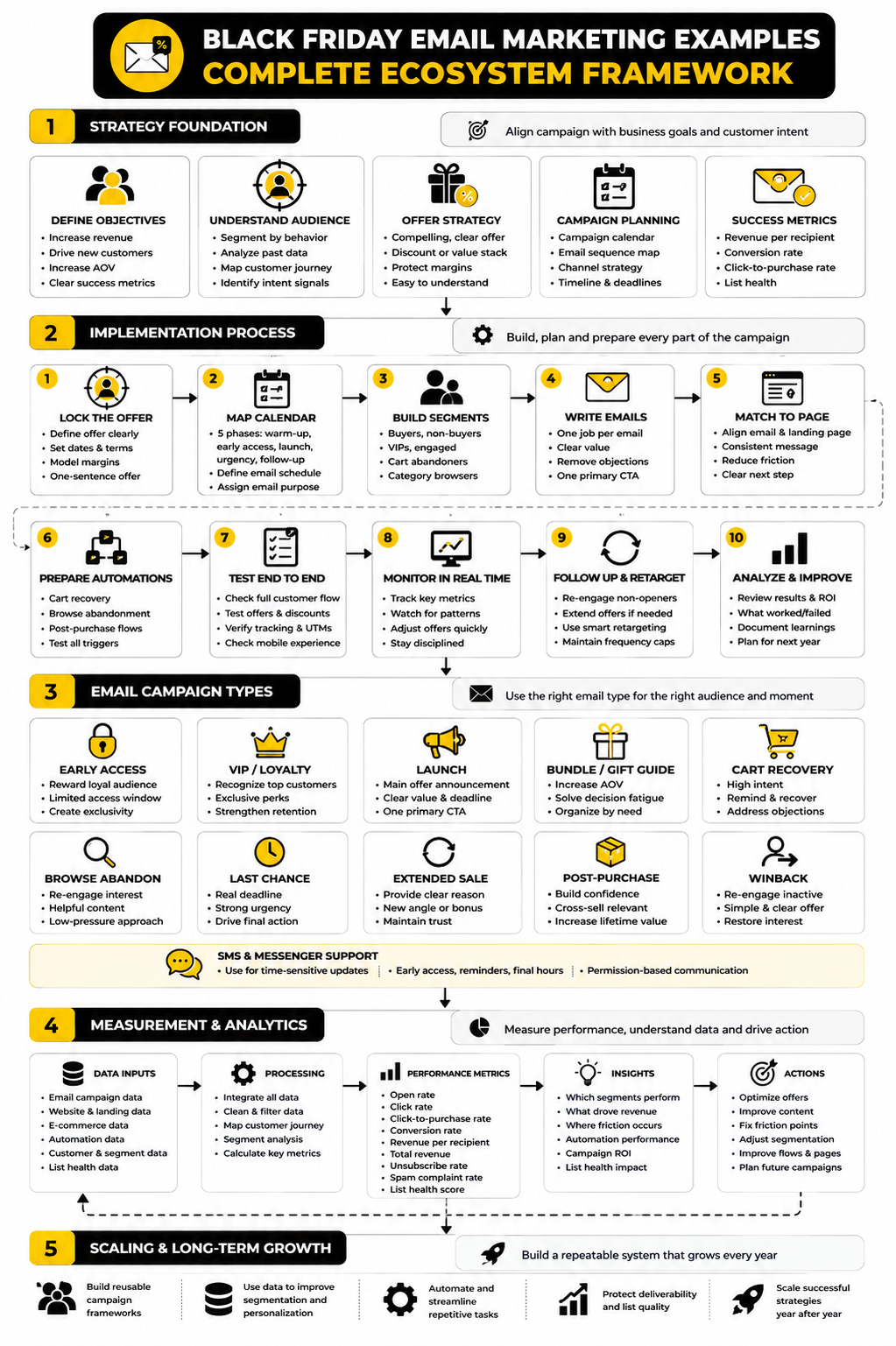
Black Friday Email Marketing FAQ and Final Checklist
The final layer is making the campaign easy to review before it goes live. A strong Black Friday system connects strategy, creative, segmentation, landing pages, automations, measurement, and post-sale follow-up. When those pieces work together, the examples you studied become a practical operating system instead of a swipe file.
Use the questions below to pressure-test your campaign before launch. They are designed to catch the issues that usually hurt performance: unclear offers, weak segmentation, broken automation, poor deliverability, and misleading urgency. This is where the details matter, because Black Friday does not leave much room for slow fixes.
What makes a Black Friday email marketing example worth studying?
A good example is worth studying when you can identify the strategy behind it. Look for the audience, offer, timing, call to action, landing page match, and follow-up path. If you only copy the design or subject line, you miss the part that actually makes the campaign work.
How many Black Friday emails should a brand send?
There is no perfect number because the right volume depends on list engagement, buying cycle, offer strength, and campaign length. A practical campaign often includes warm-up, early access, launch, reminder, final-hours, cart recovery, and post-purchase emails. The key is that each email needs a clear reason to exist, not just another chance to repeat the same discount.
When should Black Friday email marketing start?
Many brands start warming up subscribers in early November, then move into early access and launch messaging closer to Black Friday week. The exact timing depends on your product category, shipping deadlines, and whether customers need time to compare or plan purchases. Do not wait until the day of the sale to re-engage a list that has been cold for months.
What is the best subject line for a Black Friday email?
The best subject line is the one that matches the offer and the customer’s intent. Clear subject lines often beat clever ones because shoppers are scanning quickly and comparing many promotions at once. Use urgency, exclusivity, or value only when the email actually delivers on that promise.
Should every subscriber get the same Black Friday offer?
Usually, no. VIP customers, cart abandoners, recent buyers, inactive subscribers, and first-time shoppers often need different angles. The offer can stay similar, but the framing, timing, and follow-up should reflect what the customer has already done.
What should a Black Friday launch email include?
A launch email should include the main offer, the products or categories included, the deadline, and one primary call to action. It should also remove any obvious confusion around discount codes, exclusions, shipping, or availability. If the reader cannot understand the deal in a few seconds, the email is working too hard.
Are discounts always necessary for Black Friday?
Discounts are common, but they are not the only option. Bundles, gifts with purchase, early access, free shipping thresholds, limited drops, and loyalty perks can also create strong value. The right choice depends on your margins, inventory, brand positioning, and how price-sensitive your customers are.
How should abandoned carts be handled during Black Friday?
Cart recovery should focus on the product the customer already considered, the current offer, and the deadline. Avoid immediately training shoppers to abandon carts in exchange for a better discount. Start with clarity and urgency, then add incentives only when they make commercial sense.
What metrics matter most for Black Friday email marketing?
Revenue per recipient, click rate, conversion rate, click-to-purchase drop-off, unsubscribe rate, spam complaint rate, and total profit are more useful than opens alone. Open rate can help diagnose subject line performance, but it does not prove the campaign made money. The best reporting connects email behavior to checkout behavior and margin.
How do you avoid damaging deliverability during Black Friday?
Send to engaged segments first, authenticate your sending domain, keep unsubscribe easy, and avoid blasting cold subscribers just because the sale is important. Gmail’s sender guidance makes authentication, low spam complaints, and easy unsubscribing central to inbox placement, so deliverability cannot be treated as an afterthought. A profitable campaign that hurts future inbox placement is not a clean win.
Should Black Friday emails use urgency?
Yes, but only when the urgency is real. Deadlines, limited inventory, shipping cutoffs, and ending bonuses can all work well when they are honest. Fake countdowns and endless “final chance” extensions may create short-term clicks, but they weaken trust over time.
What is the biggest mistake brands make with Black Friday email marketing?
The biggest mistake is sending more emails without making the system more carefully. More volume can help only when the offer, segmentation, landing page, automation, and measurement are already solid. If the fundamentals are weak, more emails just create more noise.
How can small teams run a strong Black Friday campaign without overcomplicating it?
Small teams should keep the campaign simple and disciplined. Build one strong offer, segment buyers from non-buyers, create a focused landing page, prepare cart recovery, and send a clear launch and final reminder sequence. A clean campaign executed well will beat a complicated campaign that breaks under pressure.
What should happen after Black Friday ends?
After the sale, review performance while the details are still fresh. Document which segments converted, which emails drove revenue, which pages created friction, and which automations recovered sales. Then use post-purchase emails to support new customers, recommend relevant next products, and turn seasonal buyers into repeat buyers.
Build a stronger local presence with BAAM AI
Turn your website, Google profile, social channels, and AI visibility into one growth engine
Most businesses do not need more random marketing activity. They need a consistent presence system that helps the right people find them, trust them, and take action. BAAM AI brings strategy, local SEO, website updates, Google Maps visibility, social content, AI-search readiness, media production, and reporting into one practical monthly engine.
If you want your marketing to keep working after the campaign ends, start with a free BAAM AI presence audit. See how your business shows up today and where the fastest visibility wins are at BAAM AI.