
BAAM AI Blog
Black Friday Email Marketing: A Practical Six-Part Playbook for Campaigns That Actually Convert
Black Friday email marketing is not just about sending louder discounts to a bigger list. It is the system behind how you build demand before the sale, guide shoppers during peak buying windows, protect margin when...
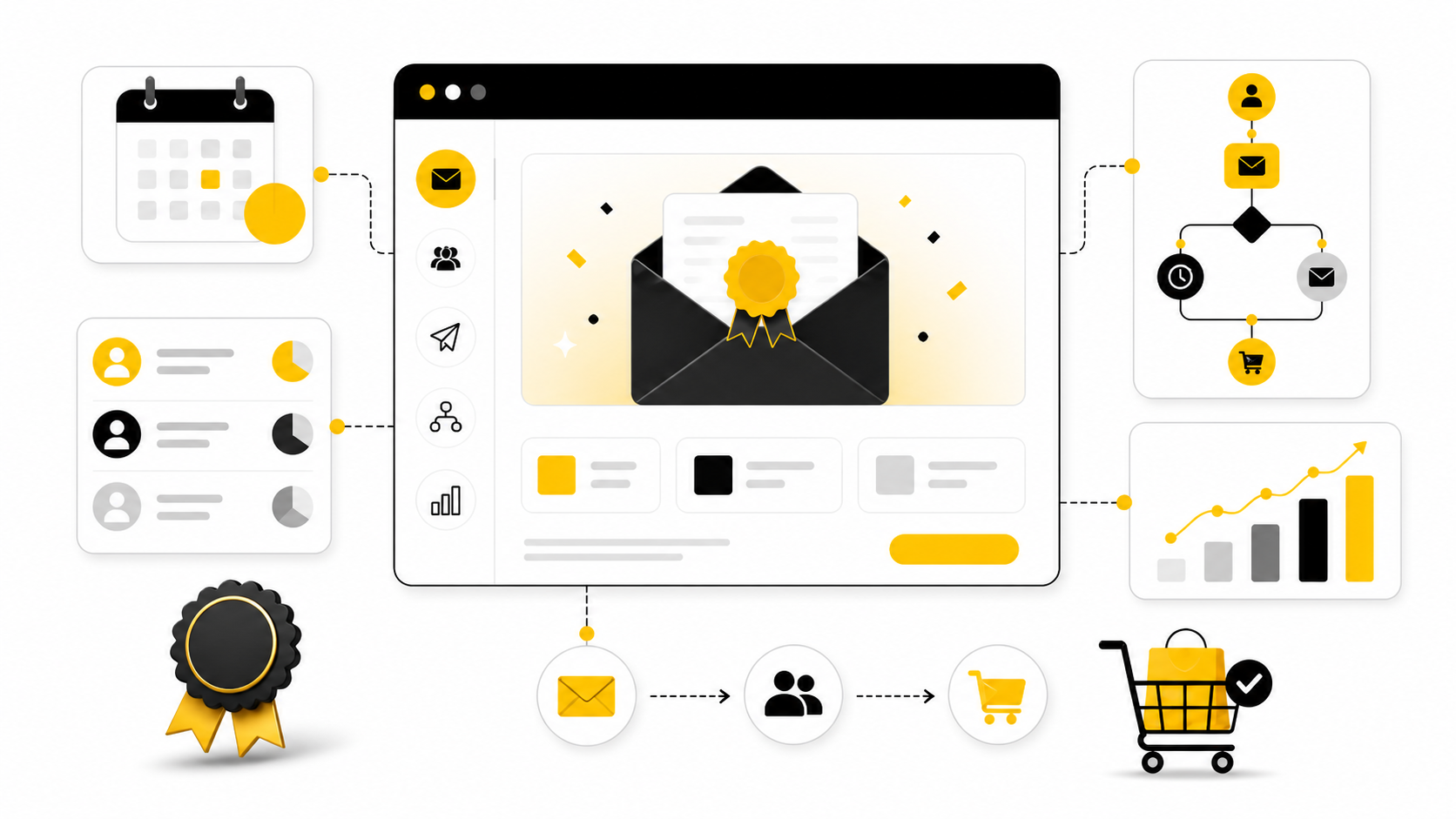
Black Friday email marketing is not just about sending louder discounts to a bigger list. It is the system behind how you build demand before the sale, guide shoppers during peak buying windows, protect margin when everyone else is racing to the bottom, and turn one chaotic weekend into long-term customer value.
That matters because Black Friday has become bigger, longer, and more competitive. Shopify merchants generated $11.5 billion in sales over Black Friday Cyber Monday 2024, while Adobe reported that Cyber Monday 2024 alone reached $13.3 billion in U.S. online spending. The opportunity is obvious, but so is the problem: inboxes are crowded, shoppers compare aggressively, and weak campaigns get ignored fast.
Email still earns its place because it is one of the few channels where brands can control the message, timing, segmentation, and follow-up without depending entirely on paid media algorithms. Klaviyo reported that its customers delivered more than 18 billion messages over BFCM 2024 and generated more than $3 billion in Klaviyo-attributed value. That does not mean every brand should blast more emails. It means the brands that win usually have a sharper system before the rush starts.
this guide breaks that system into six connected parts. Each part builds on the previous one, so the final strategy feels like one operating model instead of a pile of random campaign ideas.
Why Black Friday Email Marketing Matters
Black Friday is no longer a single-day promotion. Many shoppers now research early, compare across brands, wait for better deals, and move between email, SMS, search, social, and retargeting before they buy. Deloitte’s 2025 holiday survey found that 82% of surveyed consumers planned to shop during Black Friday Cyber Monday, which shows how central the period has become to holiday buying behavior.
That creates a real strategic tension. You need enough urgency to drive action, but not so much pressure that subscribers stop trusting you. You need strong offers, but you also need a reason for customers to choose you when competitors are offering similar discounts.
This is where email becomes more than a broadcast channel. Done properly, it gives you a way to warm up demand, segment based on intent, personalize product recommendations, recover abandoned carts, and communicate deadlines clearly. Done badly, it becomes noise at the exact moment shoppers are most selective.
The Black Friday Email Marketing System
A strong Black Friday email marketing plan has four layers: positioning, timing, segmentation, and execution. Positioning defines why the offer is worth caring about. Timing decides when each message should land. Segmentation makes sure different subscribers receive the right version of the campaign. Execution turns the strategy into subject lines, copy, design, landing pages, automations, and reporting.
The mistake many brands make is starting with the email copy. Copy matters, but it cannot rescue a weak offer, a confusing buying path, or a campaign calendar that trains subscribers to wait for a bigger discount. The best campaigns usually start earlier, with a clear promotion architecture and a reason to believe the deal is worth acting on now.
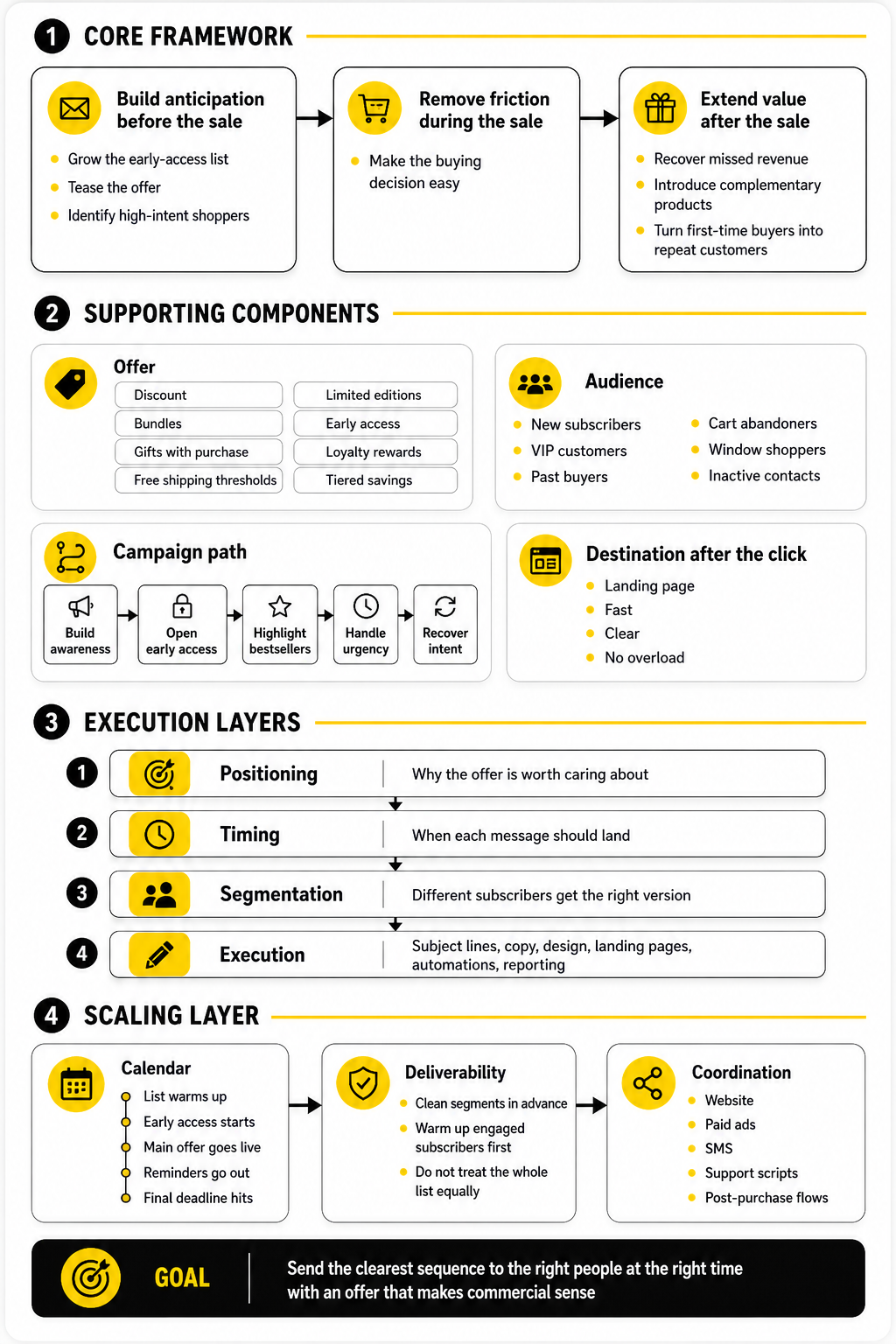
A useful framework is simple: build anticipation before the sale, remove friction during the sale, and extend value after the sale. Before Black Friday, your emails should grow the early-access list, tease the offer, and identify high-intent shoppers. During the sale, your emails should make the buying decision easy. After the sale, your emails should recover missed revenue, introduce complementary products, and turn first-time buyers into repeat customers.
Core Components of a Strong Black Friday Email Campaign
The first component is the offer. A discount can work, but it is not the only lever. Bundles, gifts with purchase, free shipping thresholds, limited editions, early access, loyalty rewards, and tiered savings can all create urgency without making the brand feel desperate.
The second component is the audience. New subscribers, VIP customers, past buyers, cart abandoners, window shoppers, and inactive contacts should not all receive the same message. A first-time visitor may need trust and clarity, while a loyal customer may respond better to exclusivity, early access, or a better bundle.
The third component is the campaign path. Black Friday email marketing works best when every message has a job. One email builds awareness, another opens early access, another highlights bestsellers, another handles urgency, and another recovers people who showed buying intent but did not complete checkout.
The fourth component is the destination after the click. If the email promises a clean deal but the landing page is slow, vague, or overloaded, the campaign leaks revenue. This is why brands using dedicated landing pages often pair email campaigns with tools like Replo for Shopify page building, or broader funnel systems like ClickFunnels when the Black Friday offer needs a more guided sales flow.
Professional Implementation Starts Before the Promo
Professional implementation begins with the calendar, not the campaign send button. You need to know when the list warms up, when early access starts, when the main offer goes live, when reminders go out, and when the final deadline hits. Without that structure, teams usually over-send near the end because they under-prepared at the beginning.
The next layer is deliverability. Sending a sudden spike of promotional emails to cold or inactive contacts can hurt performance when you need reach the most. A more carefully approach is to clean segments in advance, warm up engaged subscribers first, and avoid treating the entire list as equally valuable.
Then comes coordination. Email should match the offer on the website, paid ads, SMS, customer support scripts, and post-purchase flows. If email says “ends tonight” but the website says “extended,” shoppers notice. That kind of inconsistency weakens urgency and makes the brand look improvised.
The goal is not to send the most emails. The goal is to send the clearest sequence to the right people at the right time, with an offer that makes commercial sense. That is the foundation the rest of this guide will build on.
Planning the Offer, Calendar, and Audience Strategy
A profitable Black Friday email marketing campaign starts with the decision most brands avoid until too late: what are you actually trying to sell, to whom, and why should they buy now? The answer cannot be “because it is Black Friday.” Shoppers already expect deals, so your campaign needs a clear commercial angle before you write a single subject line.
The planning stage is where you protect margin, reduce last-minute panic, and avoid sending random discounts to the same list over and over. In 2024, U.S. Cyber Week digital sales reached $76 billion, up 7% year over year, which shows how much buying intent concentrates in a very short window. But higher demand does not automatically mean higher profit. If the offer is poorly structured, Black Friday can create a revenue spike that leaves the business with weak margins, stressed operations, and customers who only come back for discounts.
Choose the Commercial Goal First
Before choosing the discount, define the business goal. Some brands need cash flow. Some need to clear inventory. Some want new customer acquisition. Some want to reactivate old buyers. Some want to increase average order value before the holiday shipping cutoff.
Each goal leads to a different email strategy. If the goal is inventory clearance, the campaign can emphasize limited stock, category-specific markdowns, and fast decision-making. If the goal is customer acquisition, the campaign needs stronger trust-building, clear product education, and a low-friction first purchase offer. If the goal is higher average order value, the offer should probably use bundles, thresholds, or tiered savings instead of one flat discount.
This matters because a generic discount often creates generic behavior. People buy the cheapest item, abandon when shipping feels too high, or wait because they assume a better deal is coming. A sharper goal gives every email a sharper job.
Build an Offer That Does More Than Cut Price
The strongest Black Friday offer is not always the biggest discount. A 40% discount can look exciting, but it can also train customers to ignore full-price buying for the rest of the year. A smaller discount with better framing, better bundling, and better urgency can often be healthier.
Good offer structures usually fall into a few practical categories:
The offer should be easy to explain in one sentence. If customers need to calculate too much, compare too many options, or hunt for the terms, the email is doing too much work. Black Friday shoppers move quickly, and confusion kills momentum.
Match the Offer to Buyer Intent
Not every subscriber is equally ready to buy. Someone who purchased three times this year does not need the same message as someone who joined the list last week. Someone who abandoned a cart yesterday is in a different mental state from someone who has not opened an email in six months.
A practical Black Friday email marketing plan should separate at least five audience groups:
Segmentation does not need to be complicated to be useful. Even basic differences in timing, subject lines, product recommendations, and offer framing can make the campaign feel more relevant. The point is not to create 40 versions of every email. The point is to stop treating every subscriber like the same person.
Plan the Calendar Around Buying Behavior
Black Friday planning should not begin on Black Friday week. Shoppers research earlier, brands launch earlier, and inbox competition builds before the main weekend. Adobe’s 2024 holiday data showed that Cyber Monday reached a record $13.3 billion in U.S. online spending, but that peak was part of a longer shopping rhythm, not an isolated event.
A clean campaign calendar usually has four phases. The first phase is list building and teaser messaging. The second phase is early access. The third phase is the main promotional window. The fourth phase is closeout, recovery, and post-purchase follow-up.
That structure helps you avoid the classic mistake: waiting until the final 48 hours and then sending too many urgency emails because nothing was warmed up earlier. When the campaign has a real calendar, urgency feels natural. When it does not, urgency feels forced.
Use Early Access Carefully
Early access works because it gives people a reason to engage before the inbox becomes a war zone. It can also help you identify which subscribers are most interested before the main sale starts. That makes later segmentation easier because clicks, visits, wishlists, and early purchases give you behavioral signals.
But early access should feel real. If everyone gets the same deal five minutes later, the “VIP” message loses meaning. Give early-access subscribers a genuine advantage, whether that means first access to limited inventory, a better bundle, a longer shopping window, or a private code.
This is especially useful for brands with strong repeat purchase behavior. Klaviyo’s 2024 BFCM analysis emphasized that brands performed well when they leaned into early, personalized, and multi-channel strategies, not just blanket discounting. The practical takeaway is simple: reward attention before you ask for action.
Decide the Sending Cadence Before the Pressure Hits
A Black Friday email calendar should define the send cadence before the team is under pressure. This does not mean locking every send forever. It means creating a sane baseline so you are not making emotional decisions when sales are moving fast.
A balanced cadence might look like this:
The right cadence depends on list size, engagement, product category, and buying cycle. A fashion brand with daily inventory movement can often send more frequently than a B2B software company with a longer decision process. The rule is not “send less” or “send more.” The rule is to send when the message has a clear purpose.
Prepare the Landing Experience Early
Email can create the click, but the landing page closes the gap between attention and purchase. If the page is slow, unclear, or inconsistent with the email, performance drops. This becomes more painful during Black Friday because customers are comparing quickly and patience is low.
The landing page should repeat the offer clearly, show the products or bundles without friction, answer obvious objections, and make the next step easy. If you are building dedicated campaign pages, tools like Replo can help Shopify teams move faster without waiting on a full development cycle. For brands that need a more guided funnel with upsells, order bumps, and a focused checkout path, ClickFunnels can fit better than a standard collection page.
The key is consistency. The subject line, email body, landing page, discount code, checkout experience, and post-purchase confirmation should all tell the same story. When those pieces do not match, customers hesitate. And during Black Friday, hesitation usually means they leave.
Set the Measurement Plan Before Launch
You need to decide what success looks like before the campaign starts. Revenue matters, obviously, but it is not the only number worth watching. A campaign can generate strong revenue while quietly damaging deliverability, margin, or customer quality.
Track the metrics that explain the full picture:
This is where planning becomes powerful. If VIPs respond better to early access, next year’s campaign should lean harder into loyalty. If new subscribers click but do not convert, the offer or landing page may need more trust-building. If average order value drops, the next campaign may need better bundles or thresholds.
Keep the Strategy Simple Enough to Execute
The best Black Friday email marketing plan is not the most complex plan. It is the plan your team can actually execute well under pressure. A clean offer, a realistic calendar, a few meaningful segments, and a consistent landing experience will beat an overbuilt campaign that nobody can manage properly.
This is also where tool choice matters. If your team needs email and SMS in one place, a platform like Brevo can make sense for leaner teams. If the campaign needs broader CRM, pipeline, automation, and client management features, GoHighLevel may be a stronger fit.
The planning stage should end with a clear answer to four questions: what is the offer, who gets it, when do they get it, and what happens after they click? Once those answers are locked, the next step is building the pre-launch and early-access campaigns that warm up demand before the biggest buying days arrive.
Building the Pre-Launch and Early Access Campaigns
Once the offer, audience, and calendar are clear, the next job is to turn the plan into momentum. This is where many Black Friday email marketing campaigns either become organized revenue machines or messy last-minute blasts. The difference usually comes down to what happens before the main sale goes live.
Pre-launch is not about teasing for the sake of teasing. It is about preparing subscribers to pay attention, helping them understand what is coming, and giving your most valuable audience a reason to engage early. By the time the main Black Friday email lands, the best prospects should already know why the offer matters and what they want to buy.
This matters more now because shoppers do not behave like they are waiting for one single deal day. Adobe’s 2024 holiday forecast expected the season to be heavily mobile-driven, with $128.1 billion in U.S. online spending projected through mobile devices. That makes the pre-launch experience especially important, because people are discovering, comparing, saving, and returning from smaller screens long before checkout.
Start With the Pre-Launch Promise
The first pre-launch email should not reveal every detail. It should give subscribers a clear reason to stay close. That reason could be early access, first pick of limited inventory, a private bundle, a gift-with-purchase window, or a simple reminder that your biggest offer of the year is coming.
The key is specificity. “Something big is coming” is weak because every brand says it. “VIP subscribers get first access to our Black Friday bundles before they go public” is stronger because the reader understands the benefit immediately.
This is also where you can collect useful intent signals. Ask subscribers what they are shopping for, which category they care about, or whether they want early access. Even a simple click-based preference can help you send better emails later.
Build the Early Access List
Early access works best when it feels earned. You can invite existing customers first, then engaged subscribers, then new leads from paid traffic or social. The point is not to make the list artificially exclusive. The point is to make the experience feel more valuable than a standard promotional blast.
Your early access list can come from several sources:
If you use a waitlist, keep the page simple. Explain what people get, when access opens, and why joining early is useful. A focused landing page built in a tool like Replo can be useful for Shopify brands that want a dedicated Black Friday signup page without rebuilding the whole store.
Create the Campaign Execution Map
This is the point where the campaign should become tangible. You are no longer thinking in vague ideas like “send some teasers” or “announce the sale.” You are mapping the exact sequence a subscriber will experience before, during, and after early access.
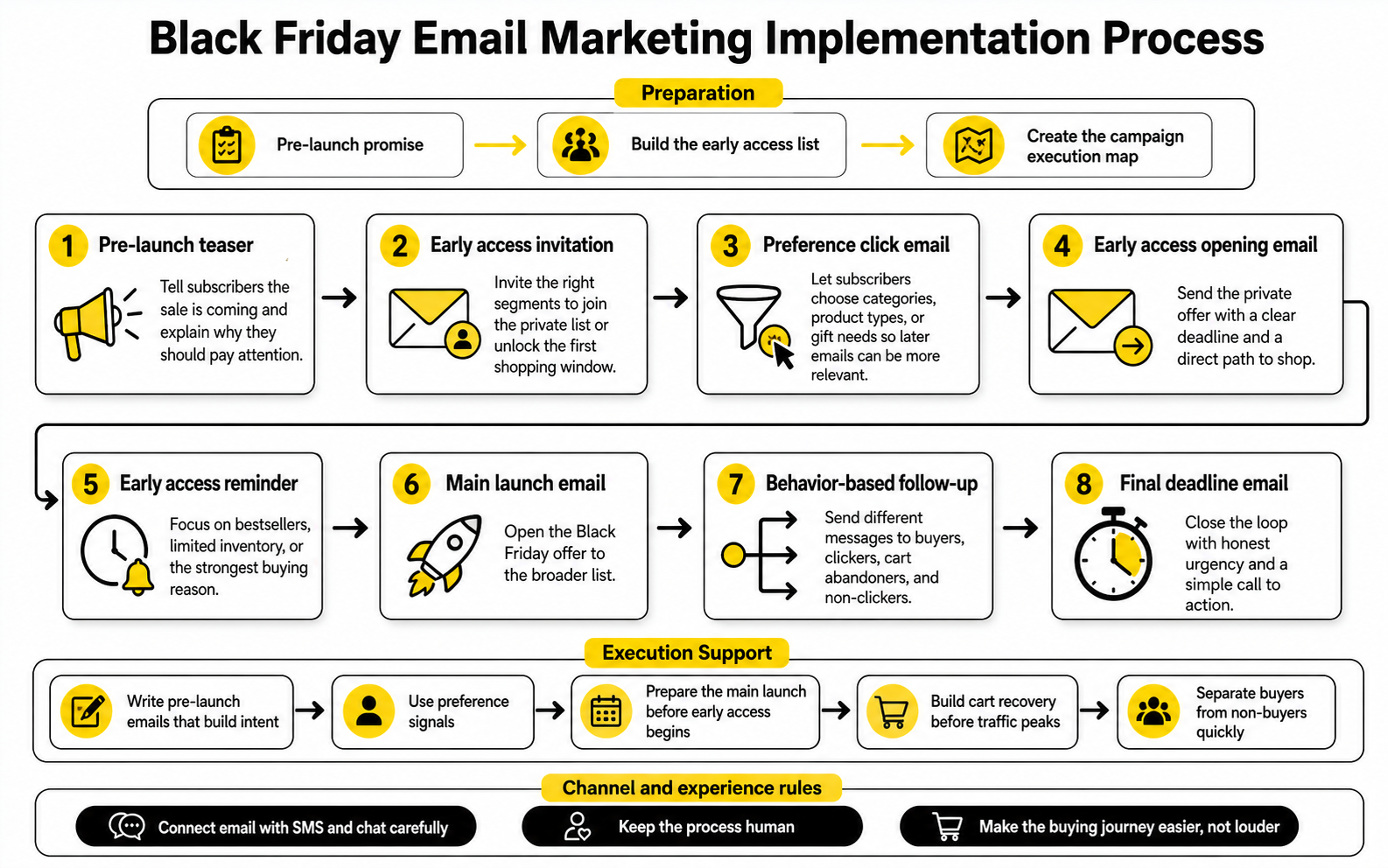
A practical execution map can look like this:
This process prevents the campaign from depending on one huge launch email. It gives you multiple moments to create intent, observe behavior, and respond with better messaging. That is how Black Friday email marketing starts feeling like a system instead of a panic button.
Write Pre-Launch Emails That Build Intent
Pre-launch copy should not feel like a hard sell too early. The job is to increase attention and make the next email easier to act on. That means the message should be short, useful, and clear about what happens next.
A strong pre-launch email usually answers three questions. What is coming? Who is it for? What should the reader do now? If the email cannot answer those questions quickly, it probably needs to be simplified.
For example, a product-based brand might use pre-launch emails to highlight gift-worthy categories, explain bundle value, or show how to choose between bestsellers. A service or software brand might use the same phase to explain the problem the offer solves, what is included, and why the timing matters. The style changes, but the job stays the same: make the buyer more ready before the discount appears.
Use Preference Signals Without Overcomplicating Segmentation
Preference collection is underrated because it sounds too simple. But during Black Friday, simple signals are useful. A subscriber who clicks “gifts under $50” is telling you something different from a subscriber who clicks “premium bundles.”
You can collect those signals through normal email links. You do not always need a complicated survey. A gift guide email can include three or four category links, and each click can place the subscriber into a more useful follow-up segment.
This works because the campaign becomes responsive. If someone clicks a category but does not buy, you can send them a product-focused reminder. If someone clicks the early access link but does not visit checkout, you can send a stronger urgency message. If someone buys early, you can remove them from the hard-sell sequence and move them into post-purchase emails.
Prepare the Main Launch Before Early Access Begins
The main Black Friday launch email should be ready before early access starts. That sounds obvious, but it is where many teams lose control. If the early access period teaches you something useful, you can adjust the main launch message, but you should not still be building the core campaign from scratch.
At minimum, prepare the subject line options, preview text, hero message, product blocks, offer terms, links, exclusions, and fallback content. Test the discount code. Test the mobile layout. Test the checkout path from email click to payment.
This is not busywork. Mobile behavior is too important to ignore, and Adobe’s holiday data showed that mobile shopping was expected to represent more than half of U.S. online holiday spending in 2024. Your email might look polished on desktop and still fail where many shoppers actually open it.
Connect Email With SMS and Chat Carefully
Email should usually carry the full campaign story. SMS and chat should support the moments where speed matters. That includes early access opening, cart abandonment, final deadline reminders, and customer questions during peak buying hours.
The mistake is duplicating every email as a text message. That quickly feels aggressive. A better approach is to use SMS for short, high-intent moments and keep the deeper explanation inside email or on the landing page.
For brands that use conversational marketing, ManyChat can help turn social traffic into opt-ins and automated follow-ups before the sale. If you need a broader CRM and multi-channel automation setup, GoHighLevel can make sense when email, SMS, pipeline tracking, and customer conversations need to live closer together.
Build Cart Recovery Before Traffic Peaks
Cart recovery should be set up before the campaign goes live. During Black Friday, people abandon carts for normal reasons: comparison shopping, shipping cost checks, distractions, stock uncertainty, and waiting for a better deal. If the recovery flow is not ready, you lose some of the highest-intent traffic of the whole season.
A good Black Friday cart recovery flow should be direct. Remind the shopper what they left, restate the deadline, clarify the offer, and remove obvious friction. Do not bury the call to action under a long brand story.
You should also adjust timing for the sale period. A standard abandoned cart delay may be too slow when the offer expires quickly or inventory is limited. Shorter delays can work during peak windows, as long as the message is genuinely helpful and not manipulative.
Separate Buyers From Non-Buyers Quickly
Once early access opens, your list starts splitting into different realities. Some people buy immediately. Some click and wait. Some ignore the offer. Some abandon checkout. Treating all of them the same creates wasted sends and weaker relevance.
Buyers should usually leave the main sales pressure sequence. They can move into post-purchase emails, complementary product suggestions, shipping expectation updates, or loyalty messaging. This protects the customer experience and opens the door for a second purchase without making the brand feel careless.
Non-buyers need more context, not just more urgency. One segment may need product education. Another may need social proof. Another may need a clearer reminder of the deadline. The more behavior you capture during pre-launch and early access, the more carefully these follow-ups become.
Keep the Process Human
Automation does not mean the campaign should feel robotic. Black Friday is noisy, and human clarity stands out. Tell people what the offer is, who it is best for, how long it lasts, and what to do next.
Do not manufacture urgency you cannot support. Do not claim scarcity if inventory is not actually limited. Do not extend the “final deadline” three times unless you want subscribers to stop believing future deadlines.
The implementation process should make the buying journey easier, not just louder. When pre-launch, early access, main launch, cart recovery, and post-purchase emails work together, your Black Friday email marketing campaign feels intentional from the first teaser to the final reminder. That is the foundation for the next step: writing emails that get opened, clicked, and acted on without sounding like every other brand in the inbox.
Statistics and Data
Black Friday email marketing data is only useful when it changes what you do next. A high open rate can look impressive and still produce weak revenue. A lower click rate can be acceptable if the audience is smaller, more qualified, and buying at a higher average order value.
The job is not to collect every possible number. The job is to understand which signals explain performance, which signals predict revenue, and which signals warn you that the campaign is damaging the list. During a high-pressure sales window, the wrong dashboard can make a team optimize the wrong thing fast.
Start With Revenue, Then Work Backward
The cleanest way to measure a Black Friday campaign is to start with revenue and work backward through the funnel. Total revenue matters, but it is too broad on its own. You need to know which segments, emails, offers, landing pages, and automations actually created the result.
A practical performance review should separate campaign revenue from flow revenue. Campaign revenue comes from scheduled sends such as early access, launch, reminder, and deadline emails. Flow revenue comes from behavior-based automations such as abandoned cart, browse abandonment, welcome sequences, and post-purchase follow-ups.
That distinction matters because campaigns show how well your promotional messaging worked, while flows show how well your system captured intent. If campaign revenue is strong but cart recovery is weak, the problem may be checkout friction or urgency timing. If automations perform well but campaign sends underperform, the offer or list targeting may be the issue.
Measure the Full Funnel, Not Just Opens
Open rates are easy to watch, but they are not enough. Privacy changes, image loading behavior, and inbox differences can make opens less reliable as a single success metric. They are still useful as a directional signal, but they should not be treated as the final truth.
The better funnel view is simple: delivered, opened, clicked, visited, added to cart, started checkout, purchased, and returned after purchase. Each step shows where momentum is being created or lost. If clicks are strong but purchases are weak, the email probably did its job and the landing page, product page, offer clarity, shipping cost, or checkout experience needs attention.
This is why Black Friday reporting should include both email platform data and store analytics. Klaviyo’s 2024 benchmark report is based on more than 325 billion emails, which makes it useful for broad comparison, but your own funnel data matters more than any outside average. Benchmarks tell you whether your numbers are unusual. Your funnel tells you what to fix.
Build a Black Friday Analytics System
A strong analytics setup connects email activity to commercial outcomes. You should be able to look at one campaign and answer what happened, why it happened, and what action should come next. If the dashboard only tells you that revenue went up or down, it is not detailed enough.
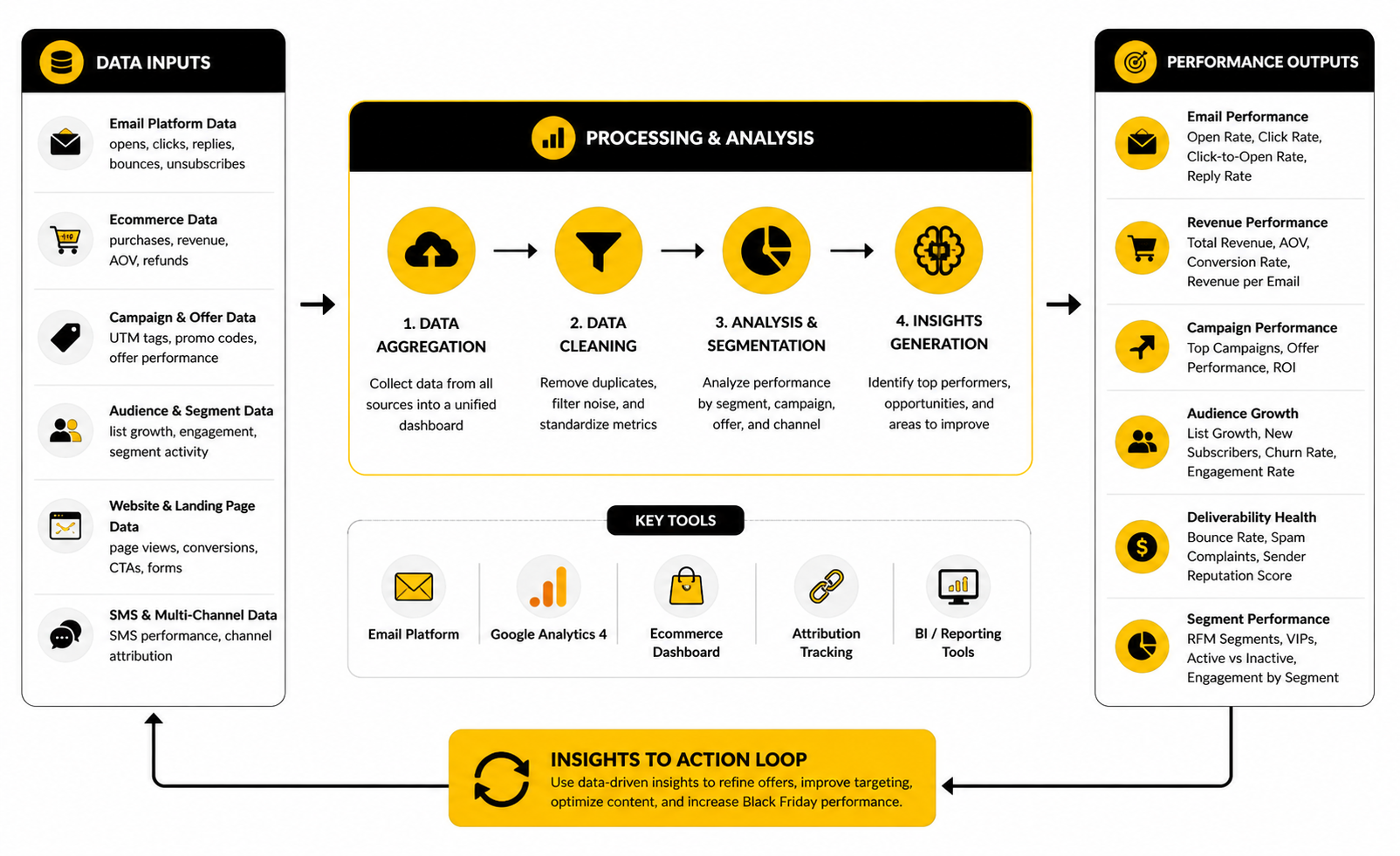
The system should track performance at four levels:
Each layer answers a different question. List health tells you whether the campaign is reaching people without harming sender reputation. Message performance tells you whether the email created action. Offer performance tells you whether the sale made commercial sense. Customer behavior tells you what to do after the promotion ends.
Know Which Benchmarks Actually Matter
Benchmarks are useful when they give context, not when they become a scoreboard. A beauty brand, a supplement brand, a fashion store, and a SaaS company should not expect identical Black Friday email metrics. Product category, price point, list quality, purchase frequency, and brand awareness all affect the numbers.
For ecommerce brands, revenue per recipient is often more useful than open rate because it combines audience quality, offer strength, click behavior, and conversion into one practical metric. Conversion rate matters too, but it should be read alongside average order value and margin. A campaign with lower conversion but much higher average order value may be healthier than a campaign that drives cheap, low-margin purchases.
Cyber Week also compresses behavior. Salesforce reported that during Cyber Week 2024, more than 80% of ecommerce traffic came from mobile devices and mobile orders drove 70% of sales. That means mobile click behavior is not a side detail. If your email, landing page, cart, and checkout are not easy on mobile, the benchmark problem is probably not the subject line.
Read Engagement Metrics in Context
Open rate can help you judge subject line appeal, sender recognition, and general list attention. But a strong open rate with weak clicks usually means the message did not deliver on the promise or the offer was not compelling enough. It can also mean the creative made the next step unclear.
Click rate shows whether people cared enough to act. Click-to-open rate helps isolate how persuasive the email body was after someone opened it. If open rate is average but click-to-open rate is high, the email content may be strong and the subject line may need work. If open rate is high and click-to-open rate is low, the subject line may be attracting curiosity that the email fails to convert.
Unsubscribes and complaints deserve special attention during Black Friday. A small increase is normal during heavier promotional periods, but spikes can reveal poor targeting, too many sends, misleading subject lines, or irrelevant offers. Do not ignore those signals just because revenue looks good for one weekend.
Track Revenue Quality, Not Only Revenue Volume
Revenue volume can be misleading during Black Friday. A brand can generate a record sales day while quietly lowering profit, attracting low-quality buyers, and creating a customer support backlog. That is why revenue quality matters.
Look at gross margin, discount depth, refund rate, shipping cost, payment method mix, and product-level profitability. Adobe reported that the 2024 U.S. holiday season produced $241.4 billion in online spending from November 1 through December 31, but the broader market number does not tell you whether your campaign was profitable. Your margin and customer mix do.
You should also separate new customers from returning customers. New customer acquisition during Black Friday can be valuable, but only if those buyers have a path to come back. Returning customers may need less persuasion, convert faster, and respond better to early access or loyalty-based offers.
Use Attribution Without Letting It Fool You
Attribution gets messy during Black Friday because shoppers touch several channels before buying. They may see a paid ad, click an email, compare on mobile, return through search, and buy after an abandoned cart message. If you give full credit to only the last click, you may undervalue the emails that created demand earlier.
Email platform attribution is still useful, but it should be treated as a lens, not absolute truth. Compare it with store analytics, paid media reporting, and post-purchase survey data when possible. The goal is not to find one perfect number. The goal is to understand which messages influenced demand and which messages closed it.
This is especially important for early access and pre-launch campaigns. Those emails may not always drive immediate purchases, but they can increase later conversion by warming up the audience. If you only measure same-session sales, you may cut the very emails that made the launch stronger.
Turn Data Into Campaign Decisions
Data should drive specific decisions. If VIP customers buy early and at higher order values, next year’s early access window should become more important. If new subscribers click but do not buy, the campaign may need stronger trust signals, clearer product education, or a lower-friction entry offer.
If cart abandonment spikes after shoppers see shipping costs, the fix is not another subject line test. It may be a free shipping threshold, clearer shipping messaging, or a bundle that makes the order value feel worthwhile. If mobile checkout completion is weak, the fix may be page speed, payment options, or fewer distractions in the checkout path.
This is where tools matter, but only after the measurement logic is clear. Email platforms like Brevo can help centralize campaign and automation reporting for lean teams. Broader systems like GoHighLevel can make sense when email, SMS, CRM activity, and pipeline outcomes need to be reviewed together.
Review Performance in Three Time Windows
Do not wait until the whole promotion ends to look at the data. Black Friday email marketing moves too quickly for that. You need a live view, a daily view, and a post-campaign view.
The live view helps catch broken links, discount code problems, checkout issues, abnormal unsubscribe spikes, or underperforming sends while there is still time to fix them. The daily view helps you decide whether to adjust reminders, feature different products, change segmentation, or shift emphasis toward stronger categories. The post-campaign view helps you make bigger decisions for next year.
The post-campaign review should be honest. Which segment was most profitable? Which email created the most revenue per recipient? Which offer protected margin best? Which automation recovered the most revenue? Which subscribers should be suppressed or re-engaged before the next major promotion?
Make the Data Useful for the Next Campaign
The biggest waste is running a major Black Friday campaign and learning nothing durable from it. Every campaign should leave behind a clearer understanding of what your audience wants, what your list can tolerate, and which offers create profitable action. That knowledge should improve your holiday campaigns, New Year campaigns, and the next Black Friday cycle.
Create a simple performance summary after the sale. Keep the winning subject lines, strongest segments, best-performing products, highest-converting landing pages, and biggest friction points. Also record what did not work, because failed tests are useful when they prevent repeated mistakes.
Good analytics makes the next creative phase sharper. Once you know what the data is saying, you can write better emails, choose better angles, and avoid guessing under pressure. That is where the next part of the strategy begins: turning the campaign insights into Black Friday email copy that earns attention and drives action without sounding like everyone else in the inbox.
Automation, Segmentation, and Omnichannel Follow-Up
By this point, the campaign has a clear offer, a planned launch path, and a measurement system. The next challenge is scale. When Black Friday traffic rises, manual follow-up breaks quickly, and generic automation starts showing its limits.
Advanced Black Friday email marketing is about making the campaign responsive without making it chaotic. You want the system to react to behavior, protect customer experience, and capture more revenue, but you do not want to build so many branches that nobody understands what is happening. The best setup is usually simple on the surface and smart underneath.
Use Automation to Respond, Not Just Remind
Automation should not exist only to send more reminders. It should respond to what the shopper did or did not do. A subscriber who clicked the early access email but never viewed a product needs a different message from someone who added a bundle to cart and abandoned checkout.
This is where the campaign becomes more precise. Instead of pushing everyone through the same sequence, you can create behavior-based paths for high-intent shoppers, recent buyers, cart abandoners, VIPs, and inactive subscribers. The emails still feel simple to the customer, but the logic behind them is doing real work.
A good automation setup should include clear exits. If someone buys, they should leave the hard-sell sequence. If someone ignores multiple sale emails, you may slow down the cadence. If someone abandons checkout, you can move them into a tighter recovery path while the sale window is still active.
Protect Deliverability Before You Scale Sending
Scaling email volume during Black Friday is risky if the list is not healthy. Gmail and Yahoo’s bulk sender requirements pushed marketers toward stronger authentication, one-click unsubscribe support, and lower complaint rates, with Google’s published threshold requiring senders to keep spam complaints below 0.3% in Postmaster Tools. That is not a nice-to-have detail. It directly affects whether your peak-season emails reach the inbox.
This means deliverability work should happen before the campaign rush. Authenticate the sending domain, suppress hard bounces, avoid sending to long-term inactive contacts, and watch complaint behavior closely during the sale. A short-term revenue grab is not worth weakening sender reputation right before the highest-value days of the year.
The tradeoff is real. Sending to more people can create more top-line revenue, but it can also lower engagement and increase complaints. The more carefully move is to prioritize engaged and high-intent segments first, then make careful decisions about whether inactive subscribers deserve a lighter reactivation path or should be left out of the main pressure sequence.
Segment by Intent, Value, and Risk
Segmentation gets more useful when it combines three questions: how likely is this person to buy, how valuable could they be, and how risky is it to keep sending to them? That creates a more practical model than simple labels like “customer” and “non-customer.” Black Friday is too competitive for that kind of blunt targeting.
High-intent subscribers deserve faster and more specific follow-up. They clicked, browsed, added to cart, viewed a product several times, or joined early access. High-value customers deserve a more respectful experience, especially if they have already bought from you repeatedly. High-risk contacts need restraint because low engagement and complaints can hurt the whole campaign.
A useful segmentation model can include:
This structure keeps the campaign focused. You are not just segmenting because it sounds sophisticated. You are deciding who deserves urgency, who needs reassurance, who needs support, and who should receive fewer messages.
Balance Personalization With Privacy
Personalization can improve relevance, but it can also feel invasive when handled badly. During Black Friday, shoppers already expect more promotional pressure, so careless personalization can make the brand feel pushy. The goal is to be useful, not creepy.
Good personalization uses signals the shopper understands. Product category interest, cart contents, loyalty status, previous purchase category, and stated preferences all make sense. Overly specific tracking language or sudden references to behavior that feels hidden can reduce trust.
This matters because privacy expectations are rising alongside promotional volume. Reports about Black Friday inbox volume and tracking have highlighted how heavily retailers rely on email behavior data during peak season. The practical lesson is not to avoid personalization. The lesson is to use it in ways that clearly improve the customer experience.
Coordinate Email, SMS, Social, and Paid Retargeting
Black Friday follow-up should not live in email alone. Shoppers move between channels constantly, and the campaign should feel consistent wherever they encounter it. That does not mean every channel should repeat the same message word for word.
Email is best for fuller explanations, product detail, bundles, gift guides, and deadline logic. SMS is best for short, timely reminders when consent is clear and the message is genuinely urgent. Paid retargeting is useful for staying visible to visitors who clicked but did not buy. Social is useful for proof, product discovery, and real-time updates.
The risk is channel overload. If someone receives three emails, two texts, a retargeting ad, and a social DM in one day, the brand can feel desperate. Use channel suppression where possible. If a shopper buys through email, do not keep chasing them with the same product ad. If they unsubscribe from SMS, do not try to replace that pressure with even more email.
Use AI Carefully Where It Actually Helps
AI can speed up Black Friday execution, but it should not own the strategy. It is useful for drafting subject line variations, summarizing campaign results, generating product description angles, clustering customer feedback, and creating first-pass segmentation ideas. It is less reliable when asked to invent offers, make unsupported claims, or replace actual customer insight.
Salesforce reported that during Cyber Week 2024, AI and agents influenced $60 billion in global online sales, which shows how quickly AI-assisted shopping and marketing workflows are moving into the mainstream. But that does not mean brands should flood their campaigns with generic AI-written emails. Shoppers still respond to clarity, relevance, and trust.
Use AI to remove production bottlenecks, not judgment. Let it help create variants, clean up reporting, and find patterns faster. Keep the offer, customer promise, compliance checks, and final messaging under human control.
Manage Discount Fatigue and Brand Trust
Black Friday can create a dangerous habit: the more the team feels pressure, the deeper the discount gets. That might rescue a short-term revenue target, but it can train customers to wait for future markdowns. Once that behavior becomes normal, full-price selling gets harder.
Discount fatigue shows up in subtle ways. Subscribers stop clicking because they assume another sale is coming. Customers abandon carts because they expect a better code tomorrow. VIP buyers feel less valued because new customers receive equal or better offers.
The solution is not to avoid discounts completely. The solution is to make the offer architecture more carefully. Use bundles, thresholds, loyalty access, limited product drops, and value-added bonuses when they fit. Keep the discount tied to a real reason, not panic.
Plan for Inventory, Support, and Fulfillment Constraints
Email can create demand faster than operations can handle it. That is good only if the rest of the business is ready. If inventory runs out unexpectedly, shipping estimates slip, customer support gets buried, or return policies are unclear, the campaign can create frustration instead of loyalty.
Advanced planning means linking email timing to operational reality. Do not promote products with weak inventory unless scarcity is part of the plan and the landing page is clear. Do not promise delivery dates the fulfillment team cannot support. Do not hide exclusions and terms where customers will only find them after getting annoyed.
Operational clarity belongs inside the marketing system. If shipping cutoffs matter, include them. If bundles are limited, say so plainly. If support hours change during the sale, make that easy to find. Black Friday trust is built in the details.
Scale Without Losing the Customer Experience
As campaigns get more advanced, complexity can quietly become the enemy. More segments, more automations, more channels, and more tests can produce better results, but only if the customer experience still feels coherent. If subscribers receive conflicting messages, repeated offers after purchasing, or unclear deadlines, the system is too messy.
A scalable Black Friday email marketing setup needs rules. Buyers exit sales pressure. VIPs get priority treatment. Cart abandoners get fast help. Inactive contacts do not receive the same send frequency as engaged buyers. Every channel uses the same offer terms.
Platforms can help here, especially when the campaign involves several channels and customer paths. GoHighLevel can work for teams that need CRM, automation, SMS, and pipeline visibility in one system. ManyChat can support social and chat-based opt-ins when the campaign relies on conversational entry points. The tool choice matters less than whether the system keeps the customer journey clean.
Build Post-Purchase Follow-Up Into the Campaign
The sale does not end when the order is placed. For new customers, the post-purchase experience is the beginning of the relationship. For returning customers, it is a chance to reinforce why they chose the brand again.
Post-purchase emails should confirm the order, set expectations, reduce support questions, and help the customer get value from what they bought. After that, you can introduce complementary products, loyalty benefits, referral prompts, or content that helps them use the purchase better. Do not jump straight into another hard sell without giving the customer confidence first.
Returns also deserve attention. Holiday ecommerce often comes with more gifting, sizing uncertainty, and delivery pressure. Clear policies and helpful follow-up can reduce support friction and protect trust, even when a customer needs to exchange or return something.
Know When Not to Send
Expert-level Black Friday strategy includes restraint. Not every segment needs every email. Not every slow hour needs another blast. Not every missed revenue target should trigger a deeper discount.
You should avoid sending when the offer is no longer accurate, the segment is too cold, the customer already purchased, the message adds nothing new, or the operational team cannot support the demand. That restraint is not weakness. It is how you keep the list healthy enough to keep producing revenue after the weekend ends.
The best brands do not treat Black Friday as a one-time extraction event. They use it to acquire better customers, reward loyal buyers, learn from real behavior, and strengthen the system for the next campaign. That sets up the final part: turning the whole strategy into practical optimization steps, post-campaign decisions, and answers to the questions marketers ask most often.
Optimization, Recovery, and Long-Term Value
The final stage of Black Friday email marketing is not just asking whether the campaign worked. It is deciding what to keep, what to cut, and what to improve before the next major promotion. The brands that get better every year are not guessing. They are turning campaign behavior into a repeatable system.
This is where the full ecosystem comes together: offer strategy, segmentation, automation, deliverability, mobile experience, landing pages, support, analytics, and post-purchase follow-up. If one piece breaks, the campaign can still generate revenue, but it will leave money and trust on the table. If the pieces work together, Black Friday becomes more than a temporary sales spike.
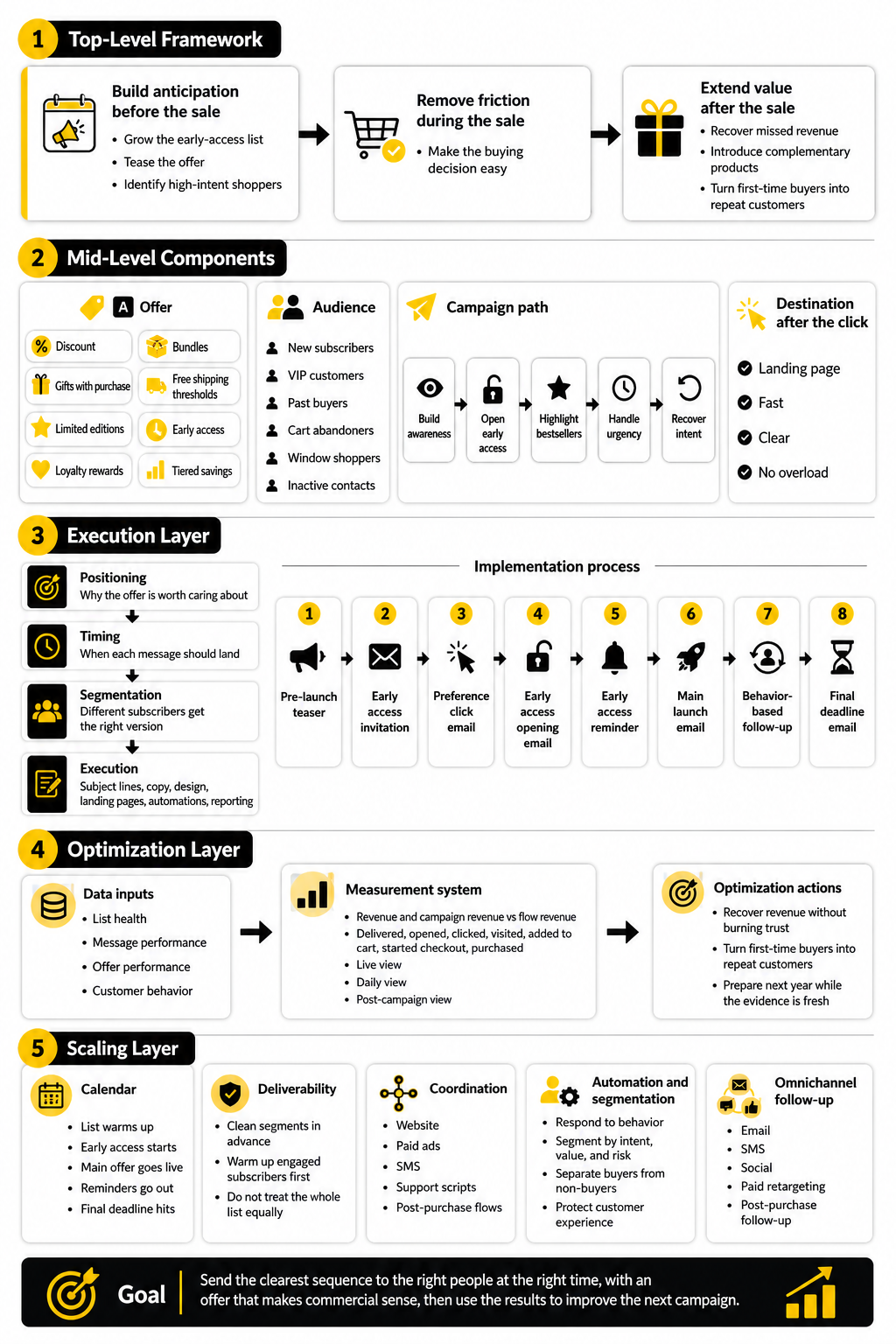
The smartest move after the sale is to separate results into three groups. First, identify what directly drove revenue. Second, identify what protected the list and customer experience. Third, identify what created useful learning for future campaigns. That last group matters more than most teams realize, because a single Black Friday campaign can reveal months of customer intent in just a few days.
Build the Post-Campaign Review
A proper review should happen while the campaign is still fresh. Do not wait until January when the team has forgotten the small decisions that shaped the results. Capture the numbers, the creative, the offer logic, the operational issues, and the customer feedback while the details are still clear.
The review should answer practical questions. Which segment created the most revenue per recipient? Which offer produced the healthiest margin? Which email caused the most unsubscribes? Which landing page converted best on mobile? Which customer objections showed up repeatedly in support messages?
This is also where you compare expectations against reality. Deloitte’s 2025 BFCM survey found that participation was expected to rise, with 82% of respondents planning to shop during the Black Friday Cyber Monday period, while average planned spend fell to $622. That kind of tension explains why many campaigns need both strong reach and careful value framing. People are shopping, but they are still judging whether each purchase feels worth it.
Recover Revenue Without Burning Trust
Post-sale recovery is not the same as endless extension emails. A genuine last-chance message can work. A fake deadline repeated three times teaches customers to stop believing you. That is a bad trade.
Recovery should focus on real behavior. Cart abandoners may need a clearer reminder of the offer, product availability, or shipping cutoff. Clickers who did not buy may need a product comparison, a smaller entry offer, or a stronger reason to choose now. Buyers may need complementary recommendations, but only after the order experience feels stable.
If you extend the sale, be honest about why. Maybe inventory remains on selected products. Maybe Cyber Monday has a separate offer. Maybe loyal subscribers get one final private window. The explanation does not need to be long, but it should be credible.
Turn First-Time Buyers Into Better Customers
Black Friday often brings in first-time buyers who are less familiar with the brand. That is a good thing only if the post-purchase journey earns the second purchase. If the relationship ends at the discount, acquisition costs can look better than they really are.
The first post-purchase emails should build confidence. Confirm the order, explain shipping expectations, show how to use the product, answer likely questions, and reduce support friction. After that, you can introduce education, loyalty benefits, referrals, replenishment reminders, or complementary products.
Shopify reported that merchants generated $14.6 billion in Black Friday Cyber Monday 2025 sales, up 27% year over year. That scale is exciting, but the real business question is what happens after those orders. One-time promotional buyers are less valuable than customers who understand the product, trust the brand, and return without needing the deepest discount every time.
Prepare Next Year While the Evidence Is Fresh
The best time to plan the next Black Friday campaign is right after this one ends. Not the full campaign, obviously, but the strategic notes. You should document what worked before opinions replace evidence.
Save the winning angles, subject lines, audience segments, product bundles, landing page structures, and automation paths. Also save the mistakes. Broken links, confusing codes, slow pages, understocked products, delayed support responses, weak mobile layouts, and over-sending patterns all become expensive if they repeat.
This creates an internal playbook. Next year, you are not starting from a blank page. You are improving a tested system.
What is Black Friday email marketing?
Black Friday email marketing is the strategy of using email campaigns and automations to promote offers before, during, and after the Black Friday Cyber Monday shopping period. It includes pre-launch emails, early access campaigns, product recommendations, cart recovery, deadline reminders, and post-purchase follow-up. The goal is not just to send discounts, but to guide shoppers through a clear buying journey.
When should I start Black Friday email marketing?
Most brands should start planning several months ahead and begin customer-facing pre-launch activity a few weeks before Black Friday. The exact timeline depends on your product, buying cycle, list size, and offer complexity. If you wait until the week of Black Friday, you can still sell, but you lose the chance to build anticipation and collect useful intent signals.
How many Black Friday emails should I send?
There is no universal number because list quality, brand relationship, and offer strength matter. A simple campaign might include a teaser, early access email, main launch email, reminder, final deadline email, and post-sale follow-up. More advanced campaigns can send more, but only when each email has a clear purpose and the audience is segmented properly.
What should a Black Friday email sequence include?
A strong sequence usually includes pre-launch awareness, early access, main offer launch, product-focused reminders, cart recovery, final urgency, and post-purchase follow-up. The sequence should not feel like the same discount repeated with different subject lines. Each message should move the shopper closer to a decision or help them after purchase.
What is the best Black Friday email subject line?
The best subject line is specific, believable, and connected to the offer. Clear subject lines often beat vague hype because shoppers are scanning crowded inboxes quickly. Strong angles include early access, limited bundles, deadline reminders, gift ideas, bestsellers, and clear savings, but the subject line should always match the email content.
Should I use discounts for Black Friday?
Discounts can work, but they are not the only option. Bundles, gifts with purchase, free shipping thresholds, loyalty rewards, limited product drops, and tiered savings can protect margin while still creating urgency. The right offer depends on your goal, inventory position, customer behavior, and how much discounting your brand can support long term.
How do I segment my Black Friday email list?
Start with practical segments: VIP customers, recent buyers, engaged subscribers, cart abandoners, new subscribers, inactive contacts, and post-purchase customers. These groups have different intent levels and should not receive identical messaging. Segmentation does not need to be overly complex; even a few meaningful groups can improve relevance and reduce wasted sends.
How important is mobile optimization for Black Friday emails?
Mobile optimization is critical because shoppers increasingly discover, compare, and buy from phones. Salesforce reported that Cyber Week 2024 saw more than 80% of ecommerce traffic from mobile devices, which means mobile experience directly affects revenue. Your email, landing page, product page, cart, and checkout all need to work cleanly on small screens.
What metrics should I track for Black Friday email marketing?
Track revenue per recipient, conversion rate, click rate, average order value, gross margin, unsubscribe rate, spam complaint rate, cart recovery revenue, and performance by segment. Open rate can still be useful, but it should not be the main success metric. The real question is whether the campaign created profitable revenue without damaging the list.
How do I avoid hurting deliverability during Black Friday?
Avoid sending heavy promotional volume to cold or unengaged subscribers without a plan. Keep authentication in place, suppress bad addresses, monitor complaints, and make unsubscribing easy. Google’s sender guidance tells bulk senders to keep spam complaint rates below 0.3%, which makes list quality and relevance especially important during high-volume campaigns.
Should I combine email with SMS for Black Friday?
Yes, but carefully. Email is better for detailed storytelling, product explanation, gift guides, and offer structure. SMS is better for timely reminders, early access alerts, cart recovery, and final deadlines when customers have clearly opted in. The mistake is duplicating every email as a text message, because that can quickly feel intrusive.
What tools help with Black Friday email marketing?
The right tool depends on your workflow. Lean teams may want email and SMS platforms like Brevo, while teams that need CRM, automation, SMS, and pipeline visibility may prefer GoHighLevel. Shopify brands building dedicated sale pages may benefit from Replo, while funnel-heavy offers may fit ClickFunnels better.
How do I improve Black Friday results after the campaign ends?
Review the campaign by segment, offer, message, landing page, automation, and margin. Save what worked and document what failed. Then turn first-time buyers into repeat customers with post-purchase education, clear shipping communication, complementary offers, loyalty messaging, and better customer support.
What is the biggest Black Friday email marketing mistake?
The biggest mistake is treating Black Friday as a one-week discount blast instead of a full customer journey. That leads to rushed planning, weak segmentation, over-sending, unclear offers, and poor follow-up. The brands that win usually build demand before the sale, respond to behavior during the sale, and continue the relationship after the sale.
Build a stronger local presence with BAAM AI
Turn your website, Google profile, social channels, and AI visibility into one growth engine
Most businesses do not need more random marketing activity. They need a consistent presence system that helps the right people find them, trust them, and take action. BAAM AI brings strategy, local SEO, website updates, Google Maps visibility, social content, AI-search readiness, media production, and reporting into one practical monthly engine.
If you want your marketing to keep working after the campaign ends, start with a free BAAM AI presence audit. See how your business shows up today and where the fastest visibility wins are at BAAM AI.