
BAAM AI Blog
Best Way To Advertise On Social Media
The best way to advertise on social media is not to boost random posts, chase every platform, or copy whatever your competitors are doing this week. It is to build a simple system: choose the right audience, match...
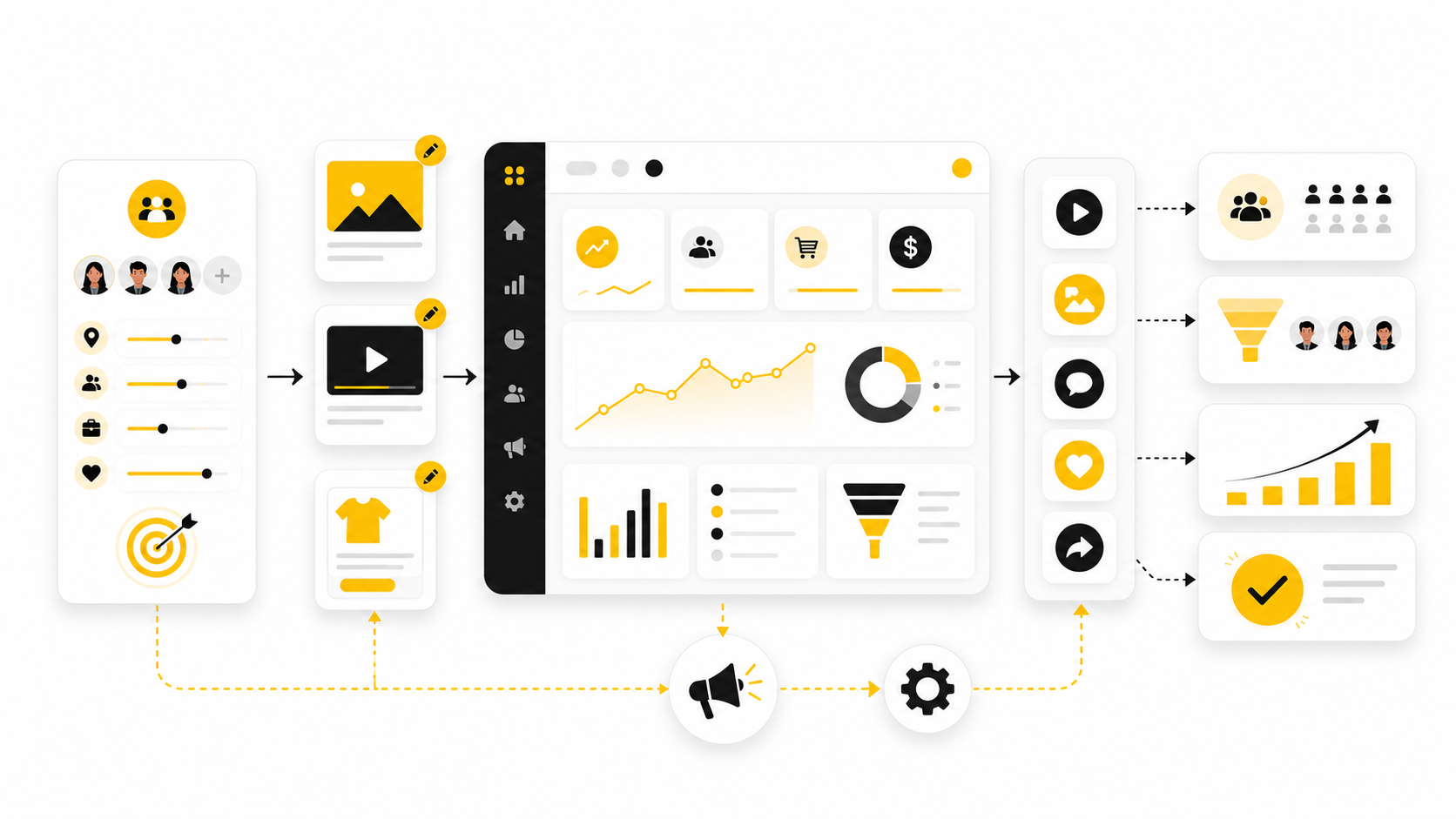
The best way to advertise on social media is not to boost random posts, chase every platform, or copy whatever your competitors are doing this week. It is to build a simple system: choose the right audience, match the offer to the buyer’s intent, create platform-native ads, send people into a focused conversion path, and improve the campaign with real data instead of opinions.
That sounds obvious until money is involved. Social media ads can make a small business look much bigger than it is, but they can also burn through budget fast when the message, targeting, creative, and follow-up are disconnected. The difference is rarely one magic ad. It is the way the whole advertising machine is built.
this guide breaks that machine into six practical parts. By the end, you will have a clear framework for planning, launching, measuring, and improving paid social campaigns without turning the process into a complicated mess.
Why Social Media Advertising Still Matters
Social media advertising still matters because attention is fragmented, search demand is expensive, and most buyers do not wake up already looking for your product. Paid social lets you reach people before they search, while they are discovering problems, comparing options, or noticing what others are using. That makes it especially powerful for brands that need to create demand, not just capture it.
The best way to advertise on social media is to respect how people use each platform. Someone scrolling Instagram Reels is not behaving the same way as someone reading LinkedIn posts or watching TikTok videos. Your ad has to feel native to the environment while still leading toward a clear business outcome.
This is where many campaigns fail. They treat social media like a cheaper version of Google Ads, then wonder why direct-response copy pasted into a feed does not perform. Social advertising works best when it combines interruption, relevance, trust, and follow-up into one connected journey.
The Core Idea Behind A Strong Paid Social Strategy
A strong paid social strategy starts with the offer, not the ad account. The platform can find people, the algorithm can test placements, and automation can help distribute spend, but none of that fixes a weak promise. If the offer is unclear, too generic, or too hard to act on, the campaign will struggle no matter how polished the creative looks.
The next layer is message-market fit. Your ad should make the right person feel like the message was built for their situation, not blasted at a vague demographic. That means the best campaigns usually focus less on broad claims and more on specific pains, desires, objections, and moments of intent.
Then comes the conversion path. A click is not a win unless the next step makes sense. For lead generation, that might mean a short form, a quiz, a booking page, or a message automation flow through a tool like ManyChat. For sales, it might mean a product page, landing page, funnel, or checkout experience designed to continue the exact promise made in the ad.
Framework Overview
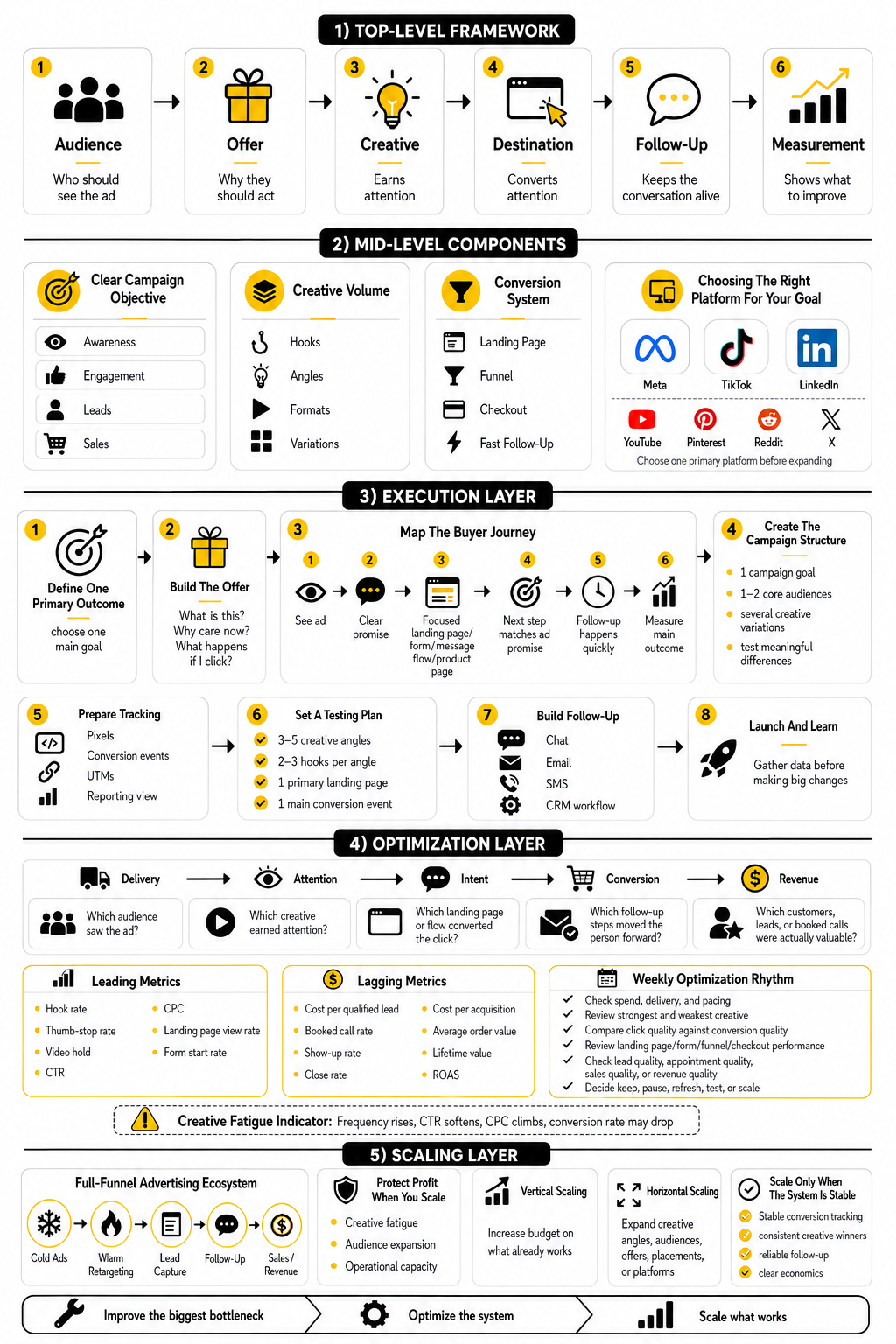
The practical framework is simple: audience, offer, creative, destination, follow-up, and measurement. Each part supports the others. When one piece is weak, the campaign becomes harder and more expensive to run.
Audience defines who should see the ad and why they are likely to care. Offer defines what action you want them to take and what value they receive in return. Creative earns attention, destination converts that attention, follow-up keeps the conversation alive, and measurement tells you what to improve next.
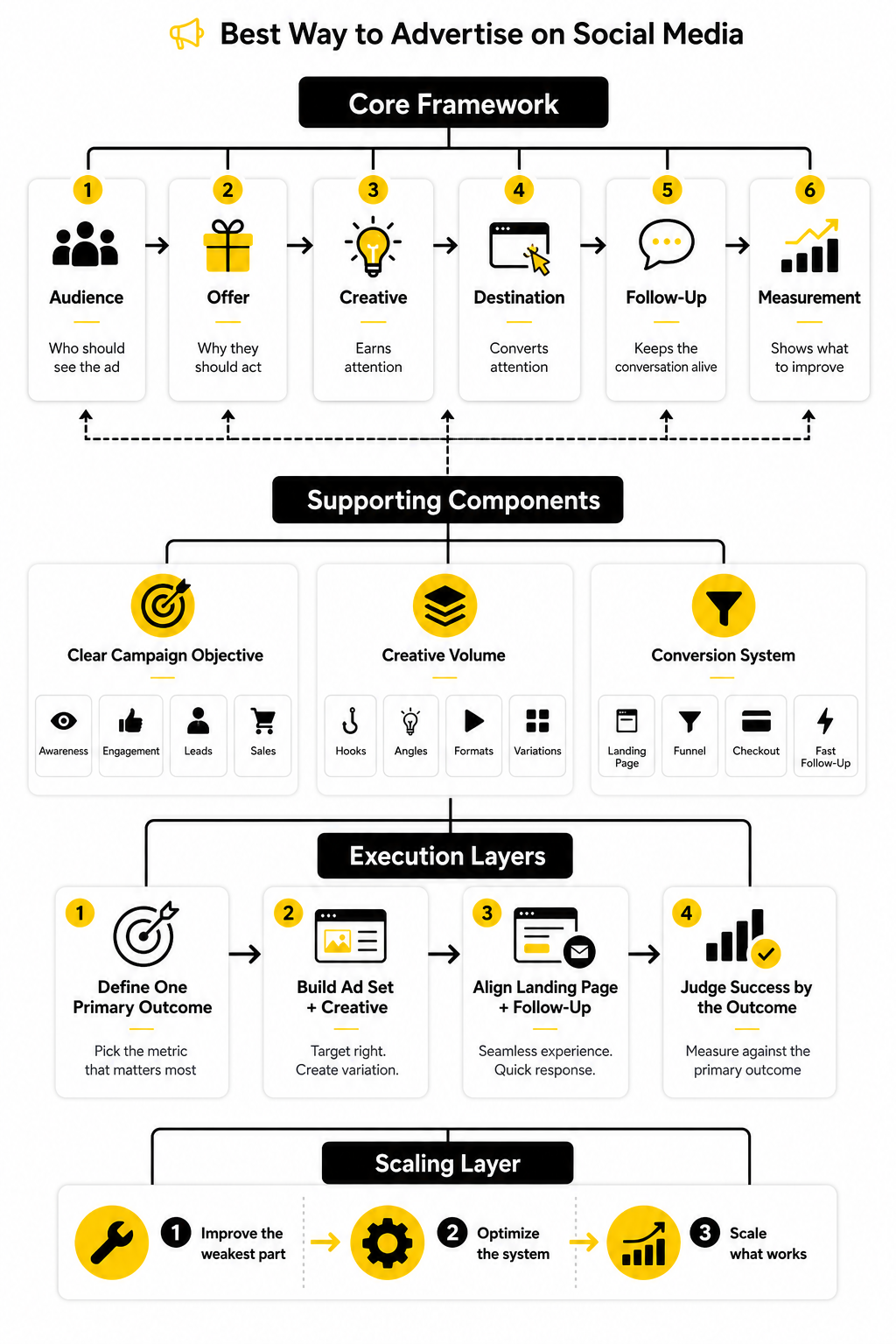
This framework also protects you from random testing. Instead of launching ten unrelated ads and hoping one works, you make controlled improvements to one part of the system at a time. That is how social media advertising becomes a process instead of a gamble.
Core Components Of The Best Way To Advertise On Social Media
The first core component is a clear campaign objective. Awareness, engagement, leads, and sales are different goals, so they need different creative, budgets, timelines, and success metrics. A campaign built for purchases should not be judged the same way as a campaign built to warm up a cold audience.
The second component is creative volume. Social ads fatigue quickly because people scroll fast and platforms reward fresh, relevant content. You do not need Hollywood production, but you do need multiple hooks, angles, formats, and variations so the campaign has enough material to learn from.
The third component is a conversion system. This is where many advertisers underinvest. If you are collecting leads, you need a fast follow-up process, which can include email, SMS, chat, or a CRM workflow through a platform like GoHighLevel. If you are selling online, you need a landing page or funnel that removes friction and makes the next step obvious, which is where tools like ClickFunnels can fit naturally.
Professional Implementation Starts With Discipline
Professional implementation does not mean making the campaign more complicated. It means being disciplined about what you test, what you measure, and what you change. A messy campaign with constant edits rarely gives you clean answers.
Start by defining one primary outcome for each campaign. Then build the ad set, creative, landing page, and follow-up around that outcome. If the goal is booked calls, do not optimize the whole process around cheap clicks. If the goal is purchases, do not celebrate engagement unless it contributes to revenue.
The best advertisers are not emotionally attached to individual ads. They are attached to the system. They look at performance, identify the weakest part of the journey, improve it, and keep going. That mindset is what separates casual boosting from real social media advertising.
Choosing The Right Platform For Your Goal
Choosing the right platform is where the campaign starts to become real. You are not choosing where you personally like to scroll. You are choosing where your buyer pays attention, what kind of intent exists there, and how naturally your offer can fit into the feed.
This matters because every platform has a different job. Meta is still one of the strongest all-around choices for local services, ecommerce, lead generation, retargeting, and broad consumer demand. TikTok is powerful when the product or idea can be shown quickly through video, creators, demos, reactions, or strong hooks. LinkedIn makes more sense when the buyer is defined by role, industry, company size, seniority, or professional context.
The best way to advertise on social media is not to ask, “Which platform is best?” The better question is, “Which platform gives this offer the clearest path from attention to action?” That small shift saves a lot of wasted budget.
Start With The Buyer, Not The Platform
Most advertisers pick platforms backwards. They hear that TikTok is hot, LinkedIn is expensive, Instagram is visual, or Facebook is old, and they turn those generalizations into strategy. That is lazy thinking, and it usually leads to campaigns that look active but do not produce enough business.
Start with the buyer’s situation instead. Are they actively comparing solutions, casually discovering ideas, trying to solve an urgent problem, or being reminded of something they already considered? A cold audience needs a different message than a retargeting audience, and a B2B decision-maker needs a different buying path than someone buying a skincare product after watching a short video.
The platform only matters after that context is clear. If your buyer needs education and trust before taking action, your campaign may need video, retargeting, and lead nurturing before asking for the sale. If your buyer already understands the category, your ads can move faster toward a demo, quote, product page, or checkout.
Match Platform Strength To Campaign Objective
Meta works well when you need a flexible advertising system with large reach, strong retargeting, and multiple campaign objectives. Meta reported 3.58 billion Family daily active people in December 2025, which shows why Facebook, Instagram, Messenger, and WhatsApp remain hard to ignore for advertisers that need scale. That does not mean every campaign belongs on Meta, but it does mean most brands should at least consider how Meta fits into their acquisition system.
TikTok is different. It is built around entertainment, discovery, and fast creative testing, so the ads need to feel alive quickly. TikTok’s own ad research has shown that the early seconds carry a huge share of ad impact, which means slow openings, generic brand intros, and polished-but-empty creative usually lose before the offer even has a chance.
LinkedIn is usually not the cheapest place to advertise, but cheap is not always the goal. If you sell to founders, executives, HR teams, agencies, finance leaders, software buyers, or other professional audiences, LinkedIn can give you targeting that broad consumer platforms cannot match as cleanly. The tradeoff is that the offer, creative, and landing page must be strong enough to justify higher media costs.
When Meta Makes The Most Sense
Meta is often the most practical starting point when you need a balanced mix of reach, targeting, creative testing, and conversion tracking. It is especially useful for ecommerce brands, local businesses, coaches, consultants, creators, online education, home services, events, and lead generation campaigns. The platform gives advertisers enough flexibility to test awareness content, lead forms, landing pages, retargeting, and direct sales in one ecosystem.
The mistake is treating Meta like one platform with one type of user. Facebook feed, Instagram Reels, Stories, Marketplace, Messenger, and WhatsApp placements create different moments of attention. A video that works in Reels may not work as a static feed ad, and a lead form campaign may need a completely different follow-up process than a purchase campaign.
If your campaign depends on speed to lead, Meta can pair naturally with automation. A lead form or message ad can send prospects into a fast chat sequence using ManyChat, or into a CRM workflow using GoHighLevel. That is where Meta becomes more than an ad platform. It becomes the front door to a full acquisition process.
When TikTok Makes The Most Sense
TikTok makes the most sense when the product, problem, or transformation can be understood visually. This can include ecommerce products, apps, beauty, fitness, food, fashion, personal finance education, home improvement, travel, entertainment, and simple B2B tools with a clear use case. The platform rewards creative that feels native, direct, and emotionally clear.
TikTok is not the place to hide behind corporate language. The best ads often look closer to strong organic content than traditional advertising. They open with a sharp hook, show the product or problem quickly, and make the viewer feel like they are watching something useful, surprising, or personally relevant.
This is why TikTok can be uncomfortable for brands that want everything polished. The platform often exposes weak messaging because people skip without mercy. If your first few seconds do not create curiosity, tension, or recognition, the rest of the ad barely matters.
When LinkedIn Makes The Most Sense
LinkedIn makes sense when the buyer’s professional identity is central to the sale. If you need to reach CMOs, agency owners, recruiters, SaaS leaders, consultants, enterprise buyers, or people inside specific industries, LinkedIn gives you a cleaner starting point than interest-based consumer targeting. The audience is smaller than Meta or TikTok, but the context can be much more valuable.
The content also needs to respect that context. People on LinkedIn are still scrolling, but they are more open to business ideas, career insights, reports, webinars, events, and professional offers. A hard sales pitch can work in retargeting, but cold LinkedIn campaigns usually perform better when the first step gives the buyer a reason to trust you.
That first step might be a report, diagnostic, checklist, webinar, consultation, or industry-specific landing page. If the campaign is designed around booked calls, a scheduling tool like Cal.com can make the next action cleaner. The key is to keep the path tight: relevant ad, relevant landing page, relevant follow-up.
Do Not Ignore YouTube, Pinterest, Reddit, And X
Meta, TikTok, and LinkedIn get most of the attention, but they are not the only options. YouTube can be powerful when people need education, proof, or repeated exposure before buying. It is especially strong for products and services that benefit from demos, tutorials, comparisons, expert positioning, or longer-form trust building.
Pinterest is often underrated for visual discovery, especially in categories like home, fashion, beauty, weddings, food, travel, crafts, and lifestyle planning. People use it with a different mindset than they use entertainment feeds. They are often collecting ideas, comparing aesthetics, or planning future purchases, which can make the right ad feel useful instead of intrusive.
Reddit and X are more sensitive environments. They can work when the advertiser understands the culture, language, and skepticism of the audience. They can also backfire quickly when a brand shows up with generic ad copy and no feel for the conversation.
Choose One Primary Platform Before Expanding
A common mistake is trying to launch everywhere at once. That sounds ambitious, but it usually spreads the budget, creative energy, and learning too thin. You do not need five half-built campaigns. You need one campaign with enough focus to generate useful data.
Choose one primary platform based on your audience, offer, creative format, and conversion path. Then build the campaign properly before expanding. Once you have a working message and a proven destination, it becomes much easier to adapt the campaign for another platform without starting from zero.
This is the disciplined version of social media advertising. You are not chasing platforms. You are matching the platform to the job, testing with intention, and moving only when the system is strong enough to support the next step.
Building The Campaign Framework
Once the platform is chosen, the next job is to build the campaign framework. This is where the best way to advertise on social media becomes practical instead of theoretical. You are turning the audience, offer, creative, destination, follow-up, and measurement into a working campaign that can be launched, tested, and improved.
The campaign framework matters because paid social is not one decision. It is a chain of decisions. A strong ad can still fail if the offer is weak, the landing page is confusing, the follow-up is slow, or the tracking is broken.
Start by thinking of the campaign as a system with one job. If the job is booked calls, every piece should support booked calls. If the job is ecommerce sales, every piece should support product discovery, trust, urgency, and checkout completion.
Define One Primary Campaign Outcome
The first step is to choose one primary outcome. Not three. Not “brand awareness and leads and sales if possible.” One main outcome gives the campaign a clear direction and makes the performance data easier to read.
For most businesses, the primary outcome will fall into one of four categories. You are either trying to reach more of the right people, generate leads, book appointments, or drive sales. Each outcome needs a different campaign structure because the buyer’s next step is different.
This is where many advertisers quietly sabotage themselves. They optimize for cheap traffic when they actually need qualified leads. They optimize for video views when they need booked calls. They optimize for engagement because it feels good, even though engagement does not always mean revenue.
Build The Offer Before The Ads
The offer is the reason someone should stop scrolling and take action. It is not just the product, service, discount, or lead magnet. It is the full promise the person understands in the moment they see the ad.
A good offer answers three questions quickly. What is this? Why should I care now? What happens if I click? If the ad does not answer those questions clearly, the campaign becomes dependent on curiosity instead of intent.
For lead generation, the offer might be a free audit, consultation, checklist, calculator, quote, webinar, or trial. For ecommerce, it might be a specific product benefit, bundle, limited promotion, social proof angle, or problem-solution demonstration. For service businesses, it is often strongest when it connects a painful problem to a low-friction next step.
Map The Buyer Journey Before You Launch
The buyer journey should be mapped before the first dollar is spent. This does not need to be complicated, but it does need to be clear. You should know what the person sees, what they click, where they land, what action they take, and what happens after that action.
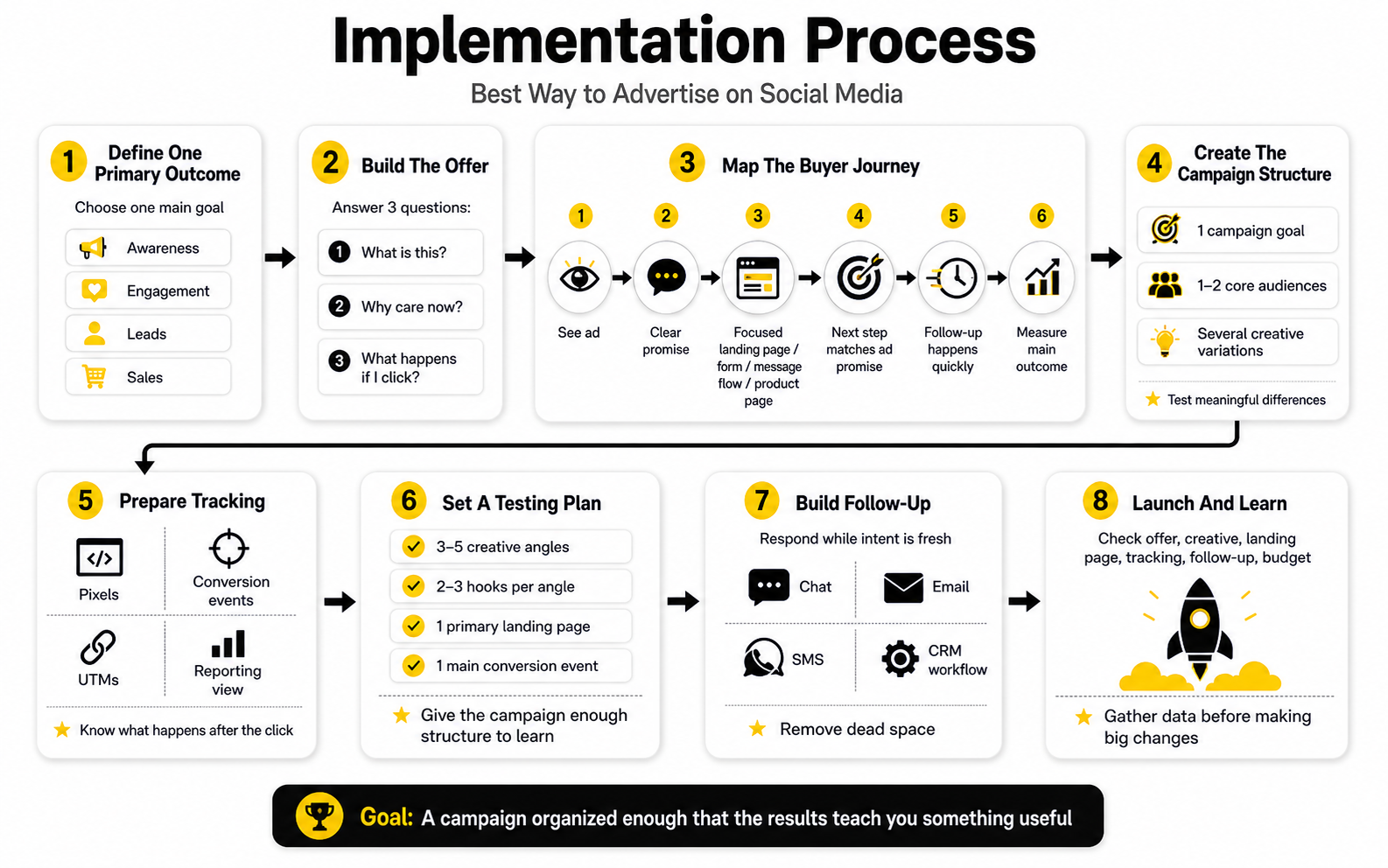
A basic journey can look like this:
That simple journey is often enough to expose weak spots. If the ad promises a fast quote but the form is long and vague, the journey is broken. If the campaign generates leads but nobody follows up for hours, the journey is broken. If the product ad sends people to a generic homepage, the journey is broken.
Create The Campaign Structure
The campaign structure should make testing easier, not harder. A clean structure usually starts with one campaign goal, one or two core audiences, and several creative variations built around different angles. That gives the platform enough room to learn without turning the account into chaos.
For cold audiences, test broad problem and desire angles. For warm audiences, test proof, comparison, objection handling, and urgency. For retargeting, remind people what they looked at, why it matters, and what they should do next.
Do not create too many tiny ad sets too early. Small budgets spread across too many audiences often produce weak data. A better approach is to keep the structure lean, test meaningful differences, and let the early results show where the campaign deserves more budget.
Prepare The Tracking Before Spending Money
Tracking is not exciting, but it is non-negotiable. You need to know what happened after the click. Without proper tracking, you are guessing which ads, audiences, pages, and offers are actually producing results.
At minimum, set up platform pixels, conversion events, UTMs, and a clear reporting view before launch. If leads are the goal, make sure form submissions, calls, booked appointments, and CRM stages are tracked as cleanly as possible. If sales are the goal, make sure purchases, revenue, average order value, and checkout behavior can be reviewed.
This is where tools matter because manual tracking gets messy fast. A business using GoHighLevel can connect lead capture, pipelines, SMS, email, and follow-up workflows in one place. Ecommerce teams using dedicated landing pages can also build focused sales paths with tools like Replo when the normal product page is not persuasive enough for paid traffic.
Set A Testing Plan Before Launch
A testing plan keeps you from making emotional decisions. Before launching, decide what you are testing first and what success will look like. Otherwise, every early result feels like a reason to panic, tweak, pause, or start over.
Start with the biggest variables first. Test different angles before obsessing over button text. Test different offers before changing tiny design details. Test creative concepts before arguing about whether the headline should be five words or seven.
A clean first testing plan can include:
This gives the campaign enough structure to learn without drowning in variables. You are not trying to test everything at once. You are trying to find the first signal that real buyers care.
Build Follow-Up Into The Campaign
Follow-up is part of the campaign, not something you add later. This is especially true for leads, appointments, quotes, demos, and high-ticket offers. A lead that waits too long for a response gets colder by the minute.
For message-based campaigns, automation can keep the conversation moving immediately. A tool like ManyChat can help route social conversations, qualify prospects, and move people toward the next step without forcing them into a slow email-only process. For email follow-up, platforms like Brevo or Moosend can support nurture sequences after someone opts in.
The point is not to automate everything blindly. The point is to remove dead space. If someone raises their hand, your campaign should respond while the problem, desire, or curiosity is still fresh.
Launch With Enough Discipline To Learn
A disciplined launch does not mean everything will work immediately. It means the campaign is organized enough that the results will teach you something useful. That is a big difference.
Before launch, check the offer, creative, landing page, tracking, follow-up, and budget. Make sure the ad promise matches the destination. Make sure the conversion event is correct. Make sure the person who takes action gets a clear next step.
Then let the campaign gather enough data before making big changes. Early results can be noisy, especially with new creative and new audiences. The goal is not to react to every fluctuation. The goal is to identify which part of the system needs improvement first.
Statistics And Data
Measurement is where social media advertising stops being a guessing game. The numbers tell you whether people are noticing the ad, clicking with intent, converting after the click, and becoming profitable customers. But the numbers only help if you understand what each one is actually saying.
Do not treat benchmarks like commandments. A “good” click-through rate means nothing if the leads are junk. A cheap cost per lead means nothing if nobody books, buys, or replies. The best way to advertise on social media is to use data as a diagnostic tool, not as a scoreboard for vanity metrics.
The goal is not to collect more numbers. The goal is to know what to do next.
What The Main Metrics Actually Mean
Impressions tell you how many times your ad was shown. Reach tells you how many people saw it. Frequency tells you how often the same person saw it. Those three numbers help you understand whether the campaign has enough exposure, whether the audience is too small, and whether creative fatigue may be starting.
Click-through rate shows whether the ad is creating enough interest to earn a click. Cost per click shows how expensive that attention is. But neither metric proves that the campaign is healthy, because a click can be curious, accidental, low-intent, or completely unqualified.
Conversion rate is where the picture gets more serious. It tells you whether the destination, offer, and audience are aligned after the click. If CTR is strong but conversion rate is weak, the ad may be doing its job while the landing page, form, price, checkout, or follow-up is failing.
Use Benchmarks As Context, Not Strategy
Benchmarks help you understand the market environment, but they should not make decisions for you. Meta’s own 2025 results showed that ad impressions across its Family of Apps increased 12% year over year, while the average price per ad increased 9%. That matters because rising supply and rising ad prices can both be true at the same time, which means advertisers still have reach but must work harder to convert it profitably.
This is why platform averages can be misleading. A campaign selling a $39 impulse-buy product should not be judged the same way as a campaign selling a $5,000 service. A cold awareness campaign should not be judged the same way as a warm retargeting campaign. A lead magnet campaign should not be judged the same way as a purchase campaign.
Use benchmarks to ask better questions. If your CPC is high, is the audience too competitive or is the creative weak? If your CPL is low, are the leads actually qualified? If your ROAS looks good, is it still good after returns, discounts, payment fees, shipping, and customer support?
Build A Simple Analytics System
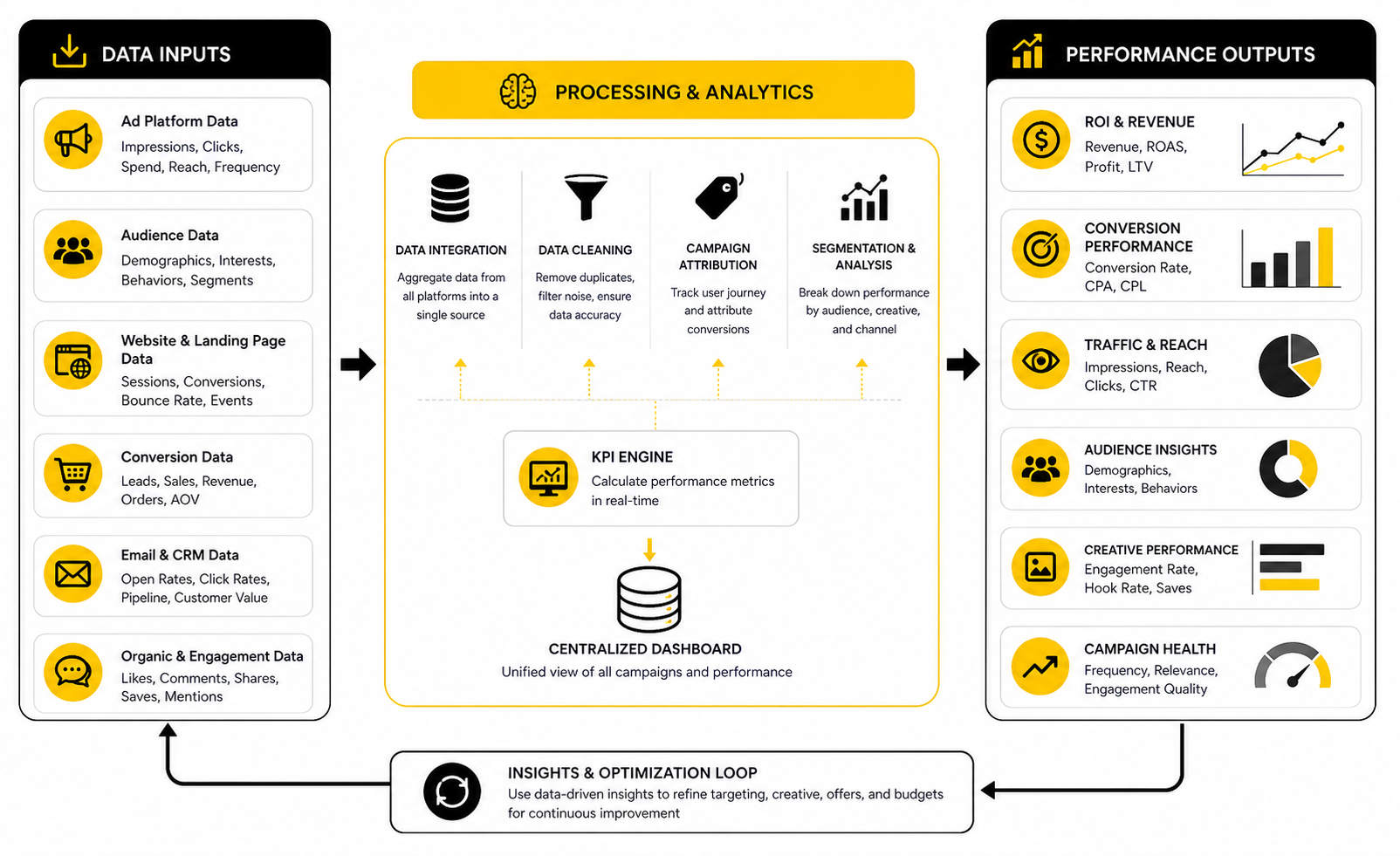
A simple analytics system should connect the ad platform to the business result. That means you need to see what happened before the click, after the click, and after the lead or sale entered your actual business process. Without that full view, you will optimize whatever is easiest to measure instead of what actually matters.
For most campaigns, the reporting stack should answer five questions:
This does not require an enterprise dashboard. A smaller business can track paid social performance with platform data, UTM links, landing page analytics, CRM stages, and a weekly reporting sheet. If the sales process includes calls, quotes, or appointments, a CRM like GoHighLevel can make the handoff from ad click to pipeline much easier to understand.
Read Performance Signals In The Right Order
Read the data in sequence. Start with delivery, then attention, then intent, then conversion, then revenue. This order matters because each stage depends on the one before it.
If delivery is weak, the campaign may have a budget, audience, approval, bid, or learning issue. If delivery is healthy but attention is weak, the creative probably is not earning the scroll-stopper moment. If attention is strong but conversions are weak, the problem is likely the offer, landing page, form, checkout, or trust gap.
Revenue is the final judge, but it is not the first clue. Waiting until the campaign spends heavily before diagnosing earlier signals is expensive. Good advertisers look upstream and fix the first meaningful bottleneck.
Know The Difference Between Leading And Lagging Metrics
Leading metrics show early signs of performance. Hook rate, thumb-stop rate, video hold, CTR, CPC, landing page view rate, and form start rate can show whether the campaign is moving in the right direction before enough conversions arrive. These metrics are useful because they help you spot problems faster.
Lagging metrics show the business result. Cost per qualified lead, booked call rate, show-up rate, close rate, cost per acquisition, average order value, lifetime value, and ROAS tell you whether the campaign is actually worth scaling. These are slower to measure, but they matter more.
The mistake is optimizing only for leading metrics because they update quickly. A campaign with strong engagement can still be a bad business campaign. A campaign with expensive clicks can still be profitable if the buyers are high-value and the conversion path is strong.
Diagnose Problems Without Guessing
When performance drops, do not randomly edit everything. Diagnose the campaign like a system. The fastest way to waste money is to change the creative, audience, budget, landing page, and offer at the same time, then have no idea which change caused the next result.
If CTR is low, review the hook, visual, first line, offer clarity, and audience relevance. If CPC is high but CTR is strong, the audience may be competitive or the platform may need more conversion data. If conversion rate is low, compare the ad promise against the landing page and remove friction from the next step.
If cost per lead looks good but sales are poor, the issue is usually lead quality, qualification, follow-up speed, sales process, or offer mismatch. That is not an ad problem alone. That is a campaign system problem.
Measure Creative Fatigue Before It Hurts
Creative fatigue happens when the same people see the same ad too many times and stop responding. Frequency rises, CTR softens, CPC climbs, conversion rate may drop, and comments can become less useful. This does not always happen at the same frequency number, so do not rely on one universal rule.
The practical move is to watch performance trends by creative. If an ad used to produce efficient results and now costs more without a clear external reason, the audience may be tired of it. You can refresh the hook, opening visual, format, proof angle, or call to action instead of rebuilding the entire campaign.
This is why creative volume matters. Measurement should not only tell you which ad won. It should tell you what angle deserves more variations. When a message works, your job is not to worship one ad. Your job is to turn the winning insight into the next batch of stronger ads.
Turn Data Into Weekly Decisions
A weekly review rhythm keeps the campaign grounded. Daily checks are useful for catching obvious problems, but daily emotional decision-making is dangerous. Paid social needs enough data to show patterns.
A simple weekly review should cover spend, delivery, top creatives, weak creatives, landing page performance, lead or sales quality, and the next test. Keep the review focused on decisions, not just reporting. Every week should end with a clear action: keep, cut, improve, test, or scale.
This is the part that separates professional implementation from casual boosting. The data does not need to be complicated. It needs to be connected to action.
Turning Clicks Into Leads And Sales
Clicks are not the finish line. They are the handoff between attention and action. If that handoff is weak, the campaign can look busy in the ad account while quietly failing in the business.
This is why the best way to advertise on social media is to think beyond the ad itself. A winning campaign needs a destination that continues the same promise, removes friction, builds trust, and makes the next step feel obvious. When the click lands in a confusing place, the user does not patiently investigate. They leave.
The advanced move is to design the post-click experience before scaling spend. That includes the page, the form, the offer, the proof, the follow-up, the sales process, and the quality control around every lead or purchase. Paid social does not forgive sloppy handoffs for long.
Build Landing Pages Around Intent
A landing page should match the intent created by the ad. If the ad promises a quick quote, the page should make getting a quote feel fast. If the ad promotes a product demonstration, the page should show the product clearly before asking for commitment. If the ad offers a guide, checklist, or webinar, the page should explain why that resource is worth exchanging contact information for.
Do not send cold traffic to a generic homepage unless the homepage is built to convert that specific traffic. Most homepages are designed to explain the whole company, not complete one focused action. Paid social traffic needs a tighter path because the person did not arrive with the same intent as someone searching for your brand.
For ecommerce, a product page can work if it is persuasive enough. If it is not, a dedicated landing page built with a tool like Replo can help bridge the gap between the ad angle and the buying decision. For service businesses, a focused funnel through ClickFunnels or Systeme.io can make the next step cleaner than a broad website visit.
Reduce Friction Without Reducing Lead Quality
Reducing friction does not mean asking for nothing. It means asking for only what is necessary at that stage of the buying journey. A cold prospect may not want to complete a long application, but a serious buyer may appreciate a few qualifying questions if they make the next conversation more relevant.
The tradeoff is simple. Shorter forms usually create more leads, but not always better leads. Longer forms can improve qualification, but they may also suppress volume too much if the value exchange is weak. The right balance depends on your offer, price point, sales capacity, and how much bad-fit leads cost your team.
A practical approach is to separate lead capture from lead qualification. Capture interest with a low-friction first step, then qualify through a second step, automated questions, calendar routing, or CRM stages. A tool like Fillout can work well when the form experience needs to feel cleaner than a default platform form.
Make Follow-Up Fast And Useful
Speed matters because intent decays quickly. When someone clicks an ad, fills out a form, sends a message, or books a call, they are in a small window of attention. If your business responds slowly, another tab, notification, competitor, or life event can easily take over.
But fast follow-up alone is not enough. A bad automated message sent instantly is still a bad message. The follow-up should confirm the next step, remind the person why they responded, and help them move forward without making them repeat information they already provided.
This is where paid social becomes a revenue system instead of a traffic system. GoHighLevel can connect forms, pipelines, SMS, email, calendars, and sales follow-up so leads do not fall into a spreadsheet graveyard. For conversational campaigns, ManyChat can keep the interaction inside the channel where the person first raised their hand.
Use Retargeting To Continue The Conversation
Retargeting should not just repeat the same ad to people who ignored it. That is lazy retargeting. The better approach is to treat retargeting as the next chapter of the conversation.
Someone who watched a video may need proof. Someone who visited a product page may need comparison, reviews, or urgency. Someone who started a form but did not finish may need a simpler next step or a reminder of the value they were about to receive.
The key is to match the message to the behavior. Retargeting is powerful because it lets you respond to signals people already gave you. If you use every warm audience the same way, you waste one of the biggest advantages paid social gives you.
Protect Profit When You Scale
Scaling is not just increasing the budget. Scaling means increasing spend while protecting efficiency, lead quality, and customer experience. If those pieces break, higher spend only makes the problem bigger.
The first risk is creative fatigue. As spend rises, more people see the same angles more often, and performance can soften. The second risk is audience expansion. The platform may start reaching people who look cheaper on the surface but are less likely to become profitable customers.
The third risk is operational capacity. More leads are not helpful if the team cannot respond fast, qualify properly, show up prepared, or fulfill the promise after the sale. Scaling a campaign before the business can handle the volume is one of the fastest ways to turn a good offer into a bad customer experience.
Know When To Scale Vertically Or Horizontally
Vertical scaling means increasing budget on what already works. It is simple and tempting because the campaign is already producing results. The risk is that the same audience and creative may not hold performance as spend rises.
Horizontal scaling means expanding into new creative angles, audiences, offers, placements, or platforms. It takes more work, but it often creates a healthier growth path. Instead of forcing one winning ad to carry the whole account, you build more ways for the market to respond.
The best advertisers usually use both. They raise budgets carefully on proven campaigns while building new creative and conversion paths beside them. That keeps the account from depending on one audience, one ad, or one temporary pocket of cheap traffic.
Keep Brand Trust In The System
Performance marketing can get aggressive fast. Strong hooks, urgency, bold claims, and direct calls to action can all work, but they must stay believable. If the campaign wins the click by damaging trust, it creates a hidden cost that shows up later in poor lead quality, refunds, complaints, or weak referrals.
Trust is not soft. It affects conversion rate, sales calls, retention, and lifetime value. A campaign that attracts the wrong people with exaggerated promises will usually cost more than it appears to save.
Use proof carefully, explain limits honestly, and make the next step clear. Do not imply guaranteed results if the outcome depends on the buyer’s situation, budget, skill, or execution. The best way to advertise on social media is to create urgency without turning the ad into a hype machine.
Use Automation Without Losing The Human Touch
Automation is useful when it removes delay, organizes follow-up, and makes the buyer’s path easier. It is dangerous when it makes the brand feel careless. People can tell when automation is helping them, and they can also tell when it is just pushing them through a sequence.
Use automation for reminders, routing, qualification, confirmations, nurture, and simple answers. Use human input for complex questions, high-value prospects, objections, proposals, and relationship-building moments. That split keeps the system efficient without making it cold.
This is especially important for services, agencies, consultants, coaches, and B2B offers. The ad can create the opportunity, but the human sales process often closes the gap. Automation should support that process, not replace the parts where trust is built.
Build A Campaign You Can Actually Manage
A sophisticated campaign is not the same as a complicated campaign. If the structure is too hard to understand, report on, or maintain, it will eventually become messy. Complexity should only be added when it creates better decisions or better customer experience.
Keep naming conventions clear, organize creative by angle, document major tests, and review the full funnel on a regular rhythm. When something works, record why you think it worked. When something fails, record what you learned instead of pretending the spend disappeared into the void.
That discipline compounds. Over time, your campaign history becomes an asset. You stop starting from scratch and start building from evidence.
Measuring, Optimizing, And Scaling Your Campaigns
By this point, the campaign has a platform, a clear offer, a working structure, a measurement system, and a conversion path. Now the real work is keeping the system healthy. This is where most advertisers either become better operators or start making expensive emotional decisions.
The best way to advertise on social media is to treat optimization as a rhythm. You are not constantly changing things because you are nervous. You are reviewing the right signals, making one useful improvement at a time, and protecting the link between ad performance and business performance.
Scaling comes after that. Not before. A campaign that cannot be managed at a small budget usually becomes more chaotic at a bigger one.
Create A Weekly Optimization Rhythm
A weekly optimization rhythm keeps the campaign from drifting. Daily monitoring is fine for checking spend, delivery, comments, disapprovals, broken links, and obvious tracking issues. But meaningful decisions usually need enough data to reveal a pattern.
A useful weekly review should answer what happened, why it likely happened, and what action should happen next. Do not make the meeting about admiring dashboards. Make it about decisions.
A clean review rhythm can look like this:
This is simple, but it is powerful. It stops you from treating every metric like it has equal importance. It also keeps the campaign connected to the business outcome instead of letting the ad account become its own little universe.
Optimize The Biggest Bottleneck First
The biggest bottleneck is the first serious point where the campaign loses momentum. If people are not stopping, the creative needs work. If people stop but do not click, the message or offer may be unclear. If people click but do not convert, the destination needs attention.
Do not fix the wrong layer. Changing the landing page will not solve a boring hook. Changing the audience will not solve a weak offer. Changing the budget will not solve poor follow-up.
The cleanest optimization question is this: where is the journey breaking first? Once you know that, your next action becomes much easier. You are not guessing. You are improving the part of the system that is blocking the next step.
Build A Full-Funnel Advertising Ecosystem
A mature paid social system does not depend on one ad doing everything. Cold ads create attention. Warm retargeting builds trust. Lead capture turns interest into a trackable relationship. Follow-up turns that relationship into action.
This ecosystem mindset matters because most buyers do not move in a perfectly straight line. They may watch a video, leave, see a second ad, visit a page, check reviews, come back later, and only then take action. If your campaign only measures the first click or last click, you may misunderstand what is actually helping the sale.
A full-funnel ecosystem also gives you more ways to improve performance. You can create better cold hooks, stronger retargeting proof, cleaner landing pages, faster follow-up, and more relevant nurture. The campaign becomes a living system instead of one lonely ad fighting for its life.
Scale Only When The System Is Stable
Scaling should feel boring. That is a good sign. If the campaign already has stable conversion tracking, consistent creative winners, reliable follow-up, and clear economics, increasing spend becomes a controlled decision instead of a gamble.
The danger is scaling because one ad had a good week. A short-term win can come from a small audience pocket, a temporary creative spike, or a lucky cluster of high-intent buyers. That does not mean the entire system is ready for a bigger budget.
Before scaling, check the basics. Can the team handle more leads or orders? Is the cost per acquisition still profitable after real costs? Are there enough fresh creatives ready? Is the landing page holding up under higher traffic? If the answer is no, fix the system before increasing spend.
What is the best way to advertise on social media?
The best way to advertise on social media is to build a full campaign system instead of relying on one boosted post. Start with the buyer, choose the right platform, create a clear offer, test platform-native creative, send traffic to a focused conversion path, and measure the result against a real business outcome. The ad matters, but the system around the ad is what makes the campaign profitable.
Which social media platform is best for advertising?
The best platform depends on your audience, offer, and goal. Meta is usually strong for broad reach, ecommerce, retargeting, local services, and lead generation. TikTok is better when your product or idea can be shown quickly through video, while LinkedIn is stronger for B2B offers that depend on job title, industry, company size, or professional context.
How much should I spend on social media ads?
Your starting budget should be large enough to generate useful data, not just random impressions. A small local campaign may begin with a modest daily budget, while ecommerce and B2B campaigns often need more room for creative testing, conversion tracking, and retargeting. The better question is whether your budget can test enough creative and reach enough people to make decisions with confidence.
Should I boost posts or run proper ad campaigns?
Boosting posts can be useful for simple visibility, but it is not the best approach when you need leads, appointments, sales, or measurable growth. A proper ad campaign gives you more control over objectives, audiences, creative testing, placements, tracking, and optimization. If money is tied to a business outcome, use a real campaign structure.
What makes a good social media ad?
A good social media ad earns attention quickly, speaks to a specific buyer, makes one clear promise, and leads to a logical next step. It should feel native to the platform instead of looking like a generic banner dropped into the feed. The best ads are usually built around a strong hook, a relevant problem or desire, clear proof, and a simple call to action.
How many ads should I test at once?
You should test enough ads to compare real creative angles without creating chaos. For many campaigns, starting with 3 to 5 angles and several hooks is a practical first test. The goal is not to create endless variations. The goal is to learn which message the market responds to before scaling spend.
What metrics matter most in social media advertising?
The most important metrics depend on the campaign goal. For awareness, reach, frequency, video retention, and engagement quality matter. For leads and sales, focus on cost per qualified lead, conversion rate, booked call rate, cost per acquisition, revenue, and return on ad spend. Clicks and engagement are useful signals, but they should never replace business outcomes.
Why are my social media ads getting clicks but no sales?
Clicks without sales usually mean there is a mismatch after the click. The ad may be attracting curiosity instead of buying intent, the landing page may not continue the promise, the offer may be weak, or the checkout process may create too much friction. Review the full path from ad to purchase before blaming the platform.
How long should I run a campaign before judging it?
A campaign should run long enough to gather meaningful data for the objective you chose. Do not judge a purchase campaign only on early clicks, and do not judge a lead campaign before reviewing lead quality and follow-up performance. The right evaluation window depends on budget, conversion volume, sales cycle length, and how quickly the platform can learn.
How do I know when an ad is fatigued?
An ad may be fatigued when frequency rises, click-through rate drops, cost per click increases, conversion rate softens, or the same audience stops responding. Do not rely on one metric alone. Look at the trend across delivery, attention, and conversion before deciding whether to refresh the creative.
Should I use automation for social media ad leads?
Yes, but only when it improves the buyer experience. Automation is useful for instant replies, qualification, reminders, confirmations, email sequences, SMS follow-up, and routing leads to the right person. It becomes a problem when it feels robotic, ignores context, or replaces the human conversation needed to close higher-value deals.
Can social media ads work for small businesses?
Yes, social media ads can work well for small businesses when the campaign is focused. Small businesses usually do not have the budget to waste on vague awareness, weak offers, or slow follow-up. The advantage is speed: a small business can test angles, respond to leads, adjust offers, and improve the customer journey faster than a larger company if the system is disciplined.
What is the biggest mistake beginners make with social media advertising?
The biggest mistake is launching ads before the offer, landing page, tracking, and follow-up are ready. Beginners often focus on the visible part of the campaign and ignore the business system behind it. That creates cheap clicks, weak leads, messy reporting, and frustration.
How do I scale social media ads without wasting money?
Scale gradually and only after the campaign has stable economics. Increase budget on proven campaigns, keep creating fresh ads, monitor lead or sales quality, and protect the customer experience as volume grows. If performance drops, diagnose the bottleneck instead of blindly adding more spend.
Build a stronger local presence with BAAM AI
Turn your website, Google profile, social channels, and AI visibility into one growth engine
Most businesses do not need more random marketing activity. They need a consistent presence system that helps the right people find them, trust them, and take action. BAAM AI brings strategy, local SEO, website updates, Google Maps visibility, social content, AI-search readiness, media production, and reporting into one practical monthly engine.
If you want your marketing to keep working after the campaign ends, start with a free BAAM AI presence audit. See how your business shows up today and where the fastest visibility wins are at BAAM AI.