
BAAM AI Blog
Best Social Media for Small Business
Choosing the best social media for small business is not about chasing the loudest platform. It is about matching your customer, offer, content format, sales cycle, and available time to the channels most likely to...
Choosing the best social media for small business is not about chasing the loudest platform. It is about matching your customer, offer, content format, sales cycle, and available time to the channels most likely to create attention, trust, and revenue. That sounds obvious, but it is where most small businesses get stuck.
Social media is still too big to ignore. Global social media user identities reached 5.79 billion at the start of April 2026, while U.S. usage data shows that YouTube and Facebook remain the most widely used online platforms among adults. At the same time, the 2025 Sprout Social Index found that social is now central to how consumers interact with brands, based on surveys of more than 4,000 consumers and 1,200 marketers.
The problem is not whether social media matters. The problem is that a small business does not have unlimited time, content capacity, or ad budget. So the real question is sharper: which social platform deserves your focus first, and what should you actually do there?
this guide is split into six parts so the strategy builds in a practical order instead of dumping every platform into one confusing list. Part 1 sets the foundation and gives you the decision framework. The rest of the article will use that same framework to compare platforms, match them to business types, and turn the final choice into an execution plan.
Why the Best Platform Depends on the Business
The best social media for small business is not the same for a local bakery, a tax consultant, a fitness coach, a SaaS startup, and an ecommerce store. A local service business may get more value from Facebook groups, Google-adjacent discovery, Instagram posts, and short local videos than from posting daily on LinkedIn. A B2B consultant may get far more from LinkedIn authority content than from trying to copy TikTok trends.
This matters because platform advice often ignores context. “Post on TikTok” can be good advice for a visually interesting brand with a strong creator or founder voice, but terrible advice for a business that needs high-trust local leads and has no one willing to appear on camera. “Use LinkedIn” can be powerful for professional services, but weak for a product that needs impulse discovery and visual proof.
The more carefully move is to stop asking which platform is biggest and start asking which platform gives you the best overlap between audience, intent, content fit, and conversion path. Meta reported that its family of apps had 3.58 billion daily active people in December 2025, which proves scale, not automatic suitability. Scale helps only when the right people are there and your business can show up in a way that makes them care.
The Small Business Social Media Framework
A useful platform decision starts with four questions. Who are you trying to reach? What are they already doing on the platform? What kind of content can you consistently create? What action do you want people to take after they find you?
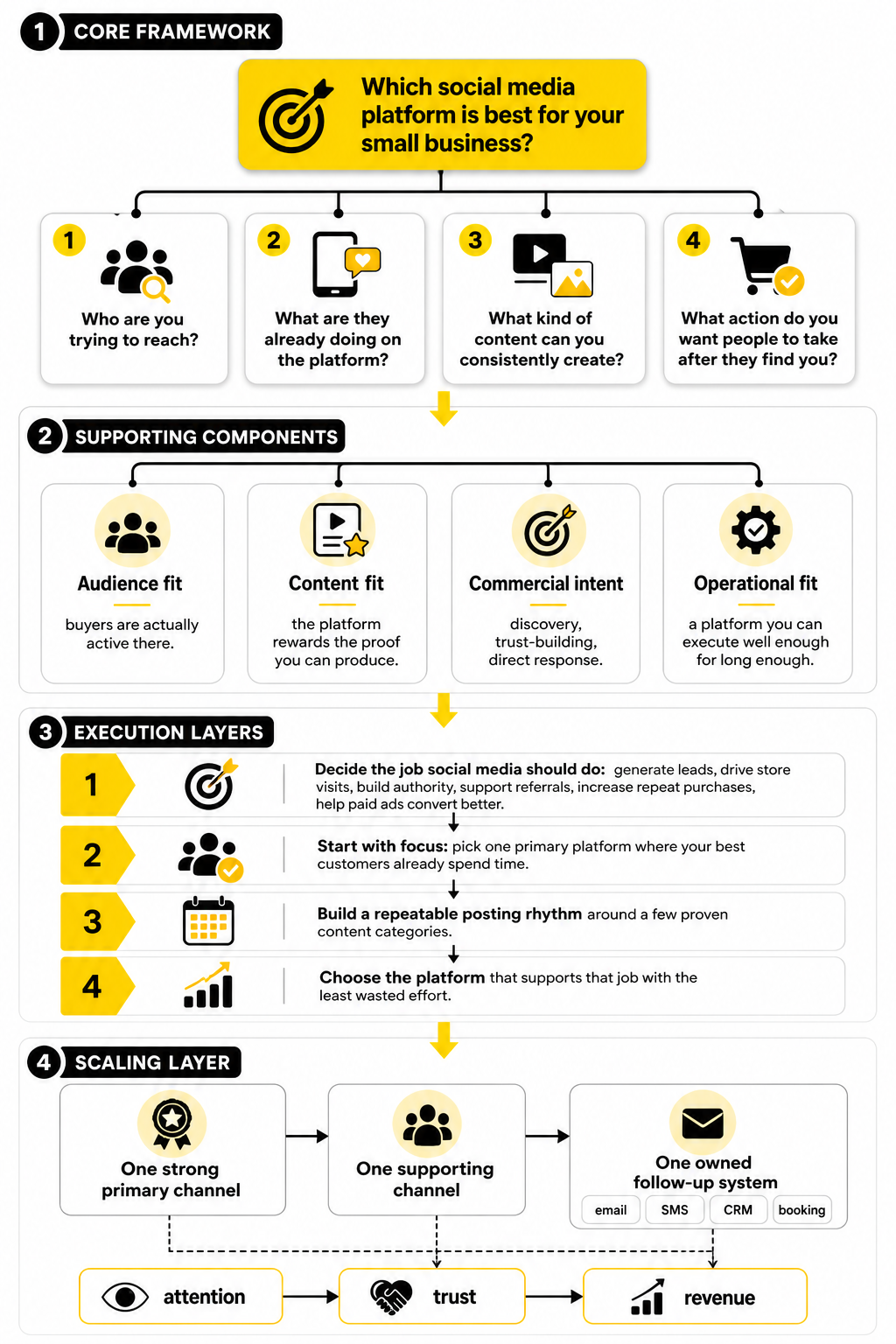
This framework keeps the conversation practical. A platform can be popular and still be wrong for your business if the audience is passive, the content style is a bad fit, or the path from attention to sale is too weak. A smaller platform can outperform a larger one when the audience has higher intent and your offer makes sense there.
For small businesses, the goal is not to be everywhere. The goal is to build one strong primary channel, one supporting channel, and one owned follow-up system such as email, SMS, CRM, or booking. That is why tools like Buffer can be useful later in the process, but only after the platform choice and content strategy are clear.
The Core Components of a Good Platform Choice
A good platform choice has four components: audience fit, content fit, commercial intent, and operational fit. Audience fit means your buyers are actually active there, not just technically present. Content fit means the platform rewards the type of proof your business can produce, whether that is education, before-and-after visuals, founder commentary, tutorials, reviews, demonstrations, or community interaction.
Commercial intent is where many small businesses misjudge social media. Some platforms are better for discovery, some are better for trust-building, and some are better for direct response. Instagram may help a customer feel familiar with a brand, YouTube may help them research deeply, LinkedIn may help them evaluate expertise, and Facebook may help local businesses stay visible in community-driven contexts.
Operational fit is the part nobody wants to talk about, but it is often the deciding factor. If you only have three hours a week, you should not pick a platform that requires daily filming, editing, trend monitoring, and comment management unless that content directly drives revenue. The best platform is the one you can execute well enough for long enough to learn what works.
Professional Implementation Starts With Focus
A professional social media strategy usually starts smaller than people expect. Pick one primary platform where your best customers already spend time, then build a repeatable posting rhythm around a few proven content categories. Do not try to launch on five platforms at once just because competitors appear to be everywhere.
The first version of the system should be simple. Decide what you want social media to do, such as generate leads, drive store visits, build authority, support referrals, increase repeat purchases, or help paid ads convert better. Then choose the platform that supports that job with the least wasted effort.
This is the foundation for the rest of the article. From here, the platform comparison becomes much clearer because each network can be judged by what it is actually good for. The point is not to crown one universal winner; it is to help you choose the best social media for your small business based on the way your customers buy.
The Main Social Platforms Small Businesses Should Consider
Once the framework is clear, the platform comparison becomes easier. You are not looking for the most fashionable app. You are looking for the place where your ideal customer already spends attention, where your content can earn trust, and where the next step toward a sale feels natural.
For most small businesses, the realistic shortlist includes Facebook, Instagram, TikTok, YouTube, LinkedIn, Pinterest, and sometimes Snapchat or X. You do not need all of them. You need to understand what each platform is best at, then choose based on your customer and business model.
The best social media for small business usually comes down to a tradeoff. Some platforms give you fast discovery but require more creative volume. Others build deeper trust but take longer to compound. The winner is the platform where your business can show up consistently without turning marketing into a full-time content treadmill.
Facebook: Still Strong for Local Reach and Community
Facebook is not the shiny new option, but small businesses should not dismiss it. It remains one of the broadest platforms by adult usage, and U.S. survey data shows Facebook is still used by a large share of adults, especially in older age groups where many local buyers, homeowners, parents, and decision-makers sit. That makes it especially relevant for local services, restaurants, home improvement, wellness providers, real estate, events, and community-based businesses.
The biggest advantage of Facebook is context. People use it for groups, recommendations, events, local updates, family networks, and community conversations. That means a small business can win through helpful posts, customer reviews, neighborhood visibility, event promotion, and active participation in relevant groups.
The downside is that organic reach from a business page alone is usually not enough. Facebook works best when it is paired with community activity, local proof, retargeting, and direct response offers. Meta’s family of apps reached 3.58 billion daily active people in December 2025, so the audience is clearly there; the real question is whether your business has a reason to appear in someone’s feed.
Instagram: Best for Visual Trust and Brand Desire
Instagram is often one of the strongest choices for small businesses that can show the result of what they sell. Beauty brands, restaurants, fitness coaches, boutiques, designers, photographers, local experiences, home decor businesses, creators, ecommerce brands, and personal brands can all use Instagram well. The platform rewards visual proof, consistent style, short-form video, customer transformation, and behind-the-scenes content.
Instagram is not just about pretty posts anymore. Reels help with discovery, Stories help with daily relationship-building, Highlights help organize proof, and DMs can turn attention into conversations. For small businesses, that mix is powerful because people can discover you, check your credibility, and contact you without leaving the app.
The risk is that Instagram can become a vanity platform if you only post attractive content without a commercial path. Followers are nice, but profile visits, saves, DMs, bookings, email signups, and purchases matter more. If Instagram is your primary platform, every content category should connect to trust, proof, education, offer clarity, or conversation.
TikTok: Best for Discovery and Personality-Led Growth
TikTok is strongest when a business can create short, native, personality-driven content. It is not the best fit for every small business, but when it fits, it can create reach faster than more mature platforms. The platform’s own public milestone showed more than 1 billion monthly users globally, and more recent third-party market estimates place TikTok far above that level, though exact current global figures vary by source.
TikTok works especially well for businesses that can teach, demonstrate, entertain, react, compare, or show a process. A bakery can show the making of a custom cake. A fitness coach can explain one mistake in a squat. A tax professional can simplify a confusing rule. A product brand can show why its item solves a specific frustration.
The catch is that TikTok rewards creative volume and native delivery. Repurposed ads, stiff corporate videos, and generic product promos usually fall flat. If you choose TikTok, treat it like a testing platform: post ideas, watch retention, learn what gets saved or shared, and turn winning angles into stronger offers elsewhere.
YouTube: Best for Search, Trust, and Long-Term Content
YouTube is one of the most valuable platforms for small businesses that can educate buyers before they purchase. It is both a social platform and a search engine, which makes it different from feed-first networks. People go there to learn, compare, fix, research, and decide.
That makes YouTube especially strong for consultants, coaches, software businesses, trades, financial professionals, educators, product brands, and service businesses with complex buying decisions. U.S. adult usage data shows YouTube remains the most widely used online platform in Pew’s 2025 survey, with very high usage across younger and middle-age groups. That matters because YouTube content can meet people at the moment they are actively looking for an answer.
The downside is production effort. Even simple videos require planning, recording, editing, titles, thumbnails, and topic selection. But the upside is durability: a strong YouTube video can keep attracting views and leads long after a short-form post disappears from the feed.
LinkedIn: Best for B2B Authority and Professional Services
LinkedIn is usually the best social platform for small businesses selling to professionals, founders, executives, recruiters, agencies, consultants, enterprise buyers, or high-value B2B customers. It is less about entertainment and more about expertise, credibility, relationships, hiring, partnerships, and professional identity. That makes it ideal for businesses where trust and competence matter more than impulse.
LinkedIn content does not need to be overly polished. In fact, practical posts, opinion-led insights, lessons from client work, industry commentary, and clear explanations often perform better than generic corporate updates. A small business owner can build authority by showing how they think, what problems they solve, and what buyers should understand before making a decision.
The platform is not perfect for every business. A local pizza shop probably should not make LinkedIn its main channel. But a fractional CFO, cybersecurity consultant, recruiter, B2B SaaS founder, agency owner, or leadership coach should seriously consider it as a primary channel.
Pinterest: Best for Visual Discovery and Purchase Planning
Pinterest is different from most social platforms because people often use it to plan. They are looking for ideas, inspiration, products, designs, recipes, outfits, events, home projects, and future purchases. That gives Pinterest a stronger search-and-discovery feel than many feed-based apps.
Pinterest reported 619 million monthly active users in Q4 2025, which makes it much larger than many small business owners realize. It can be a strong fit for ecommerce, home decor, fashion, beauty, food, weddings, travel, printables, digital products, design, crafts, and lifestyle brands.
The key is that Pinterest is not where you go for daily banter. It rewards searchable, useful, visually clear content that connects to a website, product page, blog post, landing page, or email opt-in. If your business has evergreen visual content and a clear destination, Pinterest can become a quiet but valuable traffic source.
Snapchat and X: Useful in Specific Cases, Not Universal Defaults
Snapchat can work for brands targeting younger audiences, local events, entertainment, lifestyle, campus markets, and highly visual promotions. Snap reported 474 million daily active users in Q4 2025, so the platform still has serious scale. But for many small businesses, Snapchat is not the first platform to master unless the audience fit is obvious.
X can be useful for founders, media personalities, analysts, investors, tech builders, journalists, creators, and people who thrive in fast-moving public conversation. It is less predictable for local businesses and visual consumer brands unless the owner has a strong voice and a clear niche. The platform can build authority, but it requires consistent commentary and a willingness to engage in public discussion.
For most small businesses, these platforms are secondary bets. They can be valuable when your customers are clearly active there or when your founder voice fits the environment. But they should not distract from more obvious channels if Facebook, Instagram, YouTube, LinkedIn, TikTok, or Pinterest already match your buyer better.
How the Platforms Compare at a Glance
A simple comparison helps, but do not treat this as a rigid rule. The same platform can play different roles depending on your business, offer, and audience. Use this as a starting point, then pressure-test it against your actual customers.
The most practical move is to pick one primary platform and one supporting platform. For example, a local home services business might choose Facebook as the primary platform and YouTube as the trust-building library. A fitness coach might choose Instagram as the primary platform and TikTok as the discovery engine. A B2B consultant might choose LinkedIn as the primary platform and YouTube as the proof platform.
That is how the best social media for small business becomes easier to choose. You stop judging platforms as abstract marketing channels and start judging them by the job they need to do. In the next part, the decision gets even sharper by looking at audience fit, buyer behavior, and how to choose based on the people you actually want to reach.
How to Choose the Right Platform for Your Audience
The platform decision starts with your buyer, not your personal preference. A business owner who loves Instagram may still need LinkedIn if the buyer is a B2B decision-maker. A founder who hates Facebook may still need it if their local customers ask for recommendations inside community groups.
This is where the best social media for small business becomes practical. You are not trying to predict the entire internet. You are trying to identify where your best customers already pay attention, what they expect to see there, and how they usually move from interest to action.
A good audience decision has three layers. First, look at demographics so you are not building on the wrong platform. Second, look at buyer behavior so you understand how people use the platform. Third, look at content expectations so your posts feel native instead of forced.
Start With Who Already Buys From You
Your current customers are the cleanest signal. Before you choose a platform, look at your last 20 to 50 customers and ask what they have in common. Age, location, income level, job role, household situation, purchase reason, and urgency all matter more than a generic platform ranking.
For a local business, geography can matter more than global platform size. A neighborhood restaurant needs local attention, local recommendations, and repeat visibility. A professional service firm may care less about local foot traffic and more about reaching owners, executives, or managers who have the authority to buy.
This step also protects you from copying the wrong competitors. A national creator brand can afford to post across every major platform because content is the product. A small business usually cannot. Your job is to find the smallest platform mix that puts you in front of the people most likely to buy.
Match Platform Demographics to Real Buying Power
Demographics should not make the decision alone, but they can quickly rule platforms in or out. Pew’s 2025 U.S. adult survey shows YouTube and Facebook have the broadest reach, with YouTube used by 84% of U.S. adults and Facebook by 71%. That makes both platforms useful starting points when your audience spans several age groups.
The same Pew data shows sharper age differences on platforms like Instagram, TikTok, Snapchat, and Reddit. That matters because a platform can look massive in total and still be inefficient for your specific buyer. If your customer is a homeowner in their fifties, the platform decision should look very different from a brand selling low-cost accessories to college students.
Do not confuse youth with opportunity or age with weakness. Younger platforms can be excellent for trend-driven discovery, but older audiences often have more buying power for home services, professional services, healthcare, finance, travel, and premium local offers. The smart move is to match platform energy with purchase likelihood, not just attention volume.
Understand What People Are Doing on Each Platform
People do not use every platform with the same mindset. On YouTube, they often search, compare, learn, and evaluate. On Instagram, they browse, follow, message, and build familiarity. On LinkedIn, they judge expertise, credibility, career relevance, and business insight.
That difference changes your content strategy. A short entertaining clip may work beautifully on TikTok but fail to answer the questions someone asks before booking a high-ticket consultation. A detailed educational video may work on YouTube but feel too slow for Instagram Reels unless it is broken into sharper pieces.
Small businesses should think in terms of buyer intent. Discovery platforms help strangers notice you. Trust platforms help prospects believe you. Conversion paths help interested people take the next step. The best platform is usually the one that can support at least two of those jobs without creating too much friction.
Turn Audience Research Into a Platform Shortlist
Audience research does not need to become a giant research project. You can make a strong first decision by combining customer interviews, platform demographics, competitor observation, and your own content capacity. The goal is not perfection. The goal is to avoid random posting.
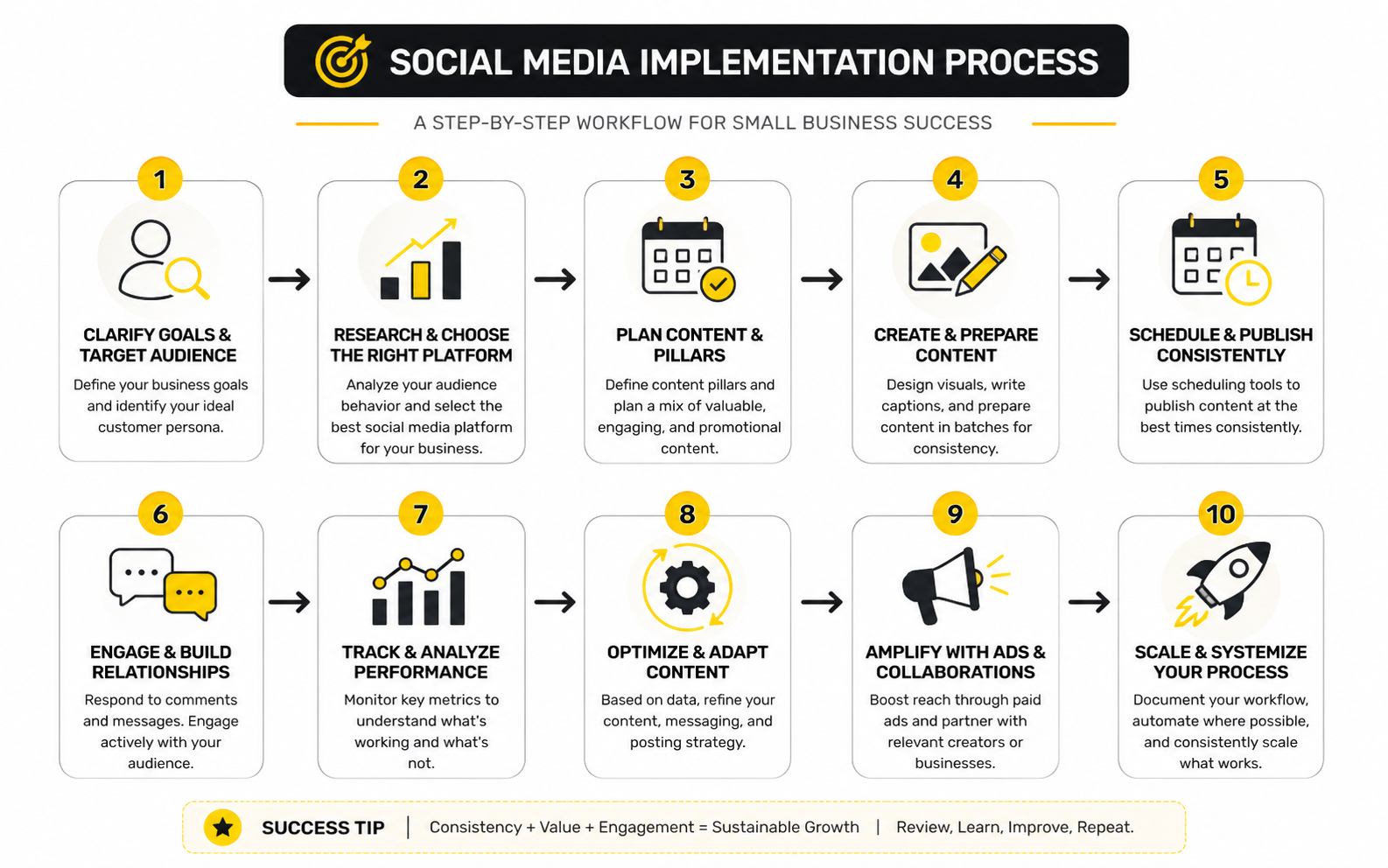
Use this process before committing to a platform:
This is the point where social media stops being random. You are not posting because the platform exists. You are posting because that platform has a clear role in the customer journey.
Pick a Primary Platform Before You Add More
Most small businesses should start with one primary platform. That does not mean you ignore every other platform forever. It means you build competence, rhythm, proof, and data before spreading your attention too thin.
The primary platform should be where your best content and best buyer overlap. If you sell expertise to professionals, LinkedIn may be the main platform. If you sell visual products or local lifestyle services, Instagram may be better. If people need education before buying, YouTube may become the strongest long-term asset.
The supporting platform should have a clear job. It might help with discovery, retargeting, community, search, or customer service. For example, Instagram can build familiarity while YouTube handles deeper education. LinkedIn can create authority while email handles follow-up through a tool like Brevo when prospects are not ready to buy immediately.
Build Around the Customer Journey
A social platform is not the whole marketing system. It is one part of the journey from stranger to buyer. That journey usually moves through awareness, trust, action, and follow-up.
Awareness content helps people recognize a problem, desire, or opportunity. Trust content proves you know what you are doing through education, examples, reviews, demonstrations, or clear opinions. Action content tells people exactly what to do next, whether that is book, call, buy, message, subscribe, or request a quote.
Follow-up is where many small businesses lose money. A prospect may like your post today and buy three weeks later, but only if there is a path back to you. That path can be email, SMS, retargeting, CRM follow-up, or a simple booking flow through tools such as GoHighLevel when the business needs leads, pipeline tracking, and client communication in one place.
Use Content Fit as a Reality Check
A platform can be perfect on paper and still fail if you hate creating the required content. TikTok and Reels need short-form video comfort. YouTube needs deeper teaching or demonstration. LinkedIn needs clear thinking and professional commentary. Pinterest needs searchable visual assets with a destination.
This is not about laziness. It is about operational truth. The best social media for small business is the one you can execute well enough to learn from, improve, and sustain.
If a platform requires a content style you cannot realistically produce, either change the content format or pick a different platform. A camera-shy accountant may be better with LinkedIn posts and simple YouTube screen-recorded explainers than daily talking-head TikToks. A designer with strong visuals may get more from Instagram and Pinterest than from long text posts.
Decide What Success Looks Like Before You Start
Do not judge every platform by the same metric. A YouTube channel may win through search traffic, watch time, and qualified inquiries. Instagram may win through profile visits, DMs, saves, and story replies. LinkedIn may win through connection requests, consultation calls, comments from target buyers, and referral conversations.
This matters because the wrong metric can make a good platform look bad. A local service business may not need 100,000 followers if 2,000 local people recognize the brand and 20 qualified leads come in every month. A B2B consultant may not need viral posts if the right operators, founders, or executives are paying attention.
Set the success metric before you start posting. Track a small group of useful numbers for 60 to 90 days, then decide whether to double down, adjust the content, or change platforms. That discipline is what separates a real strategy from social media noise.
Statistics and Data That Actually Matter
Measurement is where the platform decision becomes real. A small business can have a strong opinion about the best social media for small business, but the numbers will either support that opinion or expose the weak spot. The goal is not to collect every metric available; the goal is to know which signals prove that attention is turning into business value.
The biggest mistake is treating all metrics as equal. A like is not the same as a save. A view is not the same as a qualified lead. A follower is not the same as a buyer. Each metric answers a different question, so the first job is to connect the number to the decision it should drive.
This is especially important because social usage keeps growing, but attention is fragmented. Global social media user identities reached 5.79 billion at the start of April 2026, which proves the category is massive. It does not prove that every small business should post everywhere, and it definitely does not prove that every post is worth the same effort.
Start With Business Outcomes, Not Platform Metrics
The cleanest measurement system starts with the action you want. A local service business may care about calls, quote requests, appointment bookings, and repeat customers. An ecommerce brand may care about product page visits, add-to-cart activity, first purchases, repeat purchases, and email list growth.
This keeps social media from becoming a popularity contest. A post that gets 300 likes from the wrong audience may be less valuable than a post that gets 12 saves, 4 DMs, and 1 booked consultation. Small businesses need honest numbers because time and cash are limited.
Use platform analytics to understand behavior, but use business metrics to judge success. Reach can tell you whether people saw the content. Engagement can tell you whether it created interest. Leads and sales tell you whether the platform deserves more investment.
The Four Numbers to Track Every Week
You do not need a complicated dashboard at the beginning. You need a small set of numbers that show whether the platform is moving people from attention to action. Track the same numbers every week so you can see patterns instead of reacting emotionally to one strong or weak post.
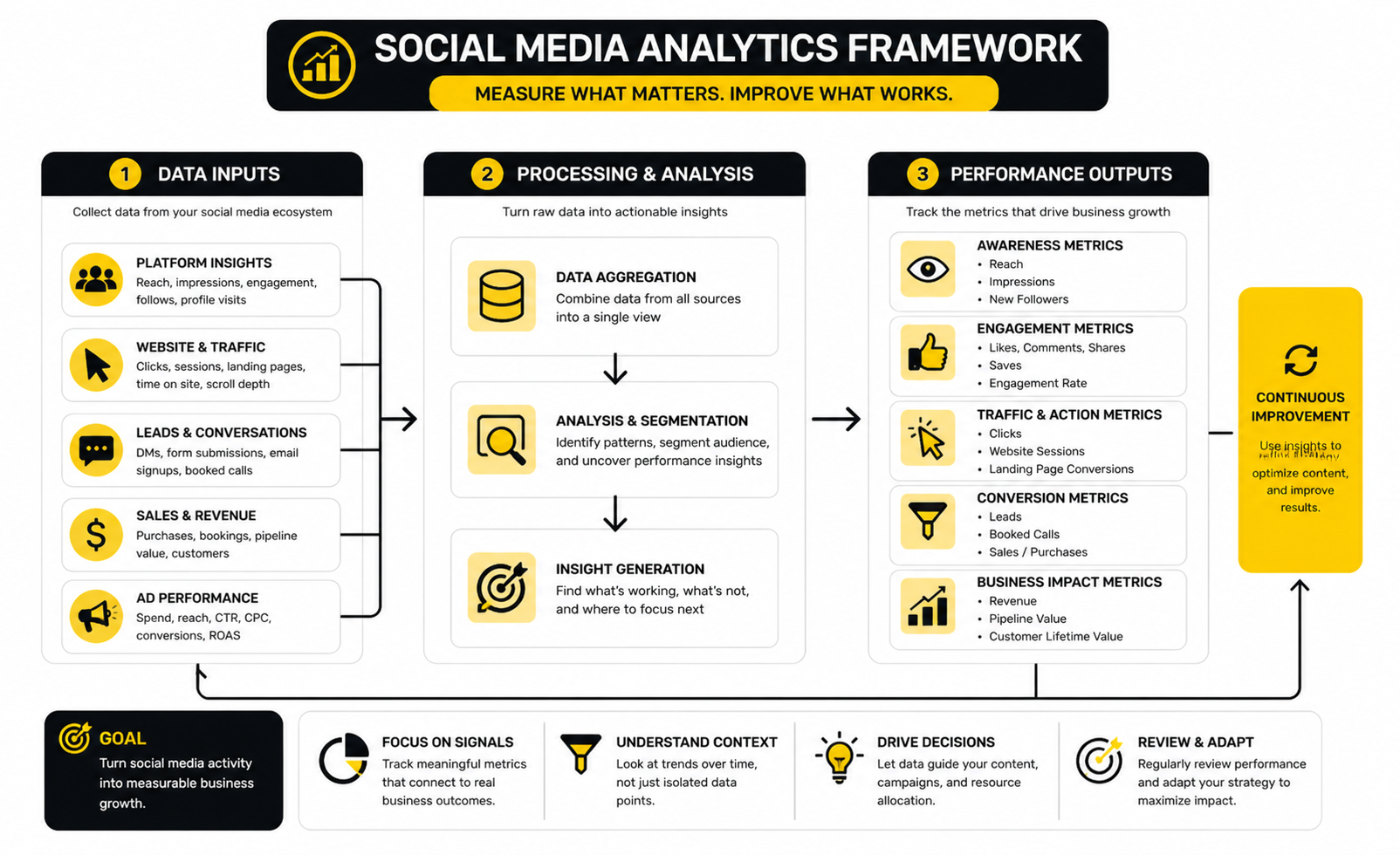
Track these four numbers first:
This simple scorecard works because it follows the customer journey. First they see you. Then they react. Then they take a step. Then the business either earns money, builds pipeline, or learns what needs to change.
Reach Tells You Whether the Platform Has Potential
Reach is useful, but only when interpreted correctly. A platform with no reach gives you limited learning because not enough people are seeing the content. But reach without relevance is just noise.
For example, TikTok may create fast exposure for short-form videos, while LinkedIn may create smaller but more commercially relevant reach for a B2B consultant. Neither is automatically better. The better platform is the one where reach includes people who can realistically buy, refer, or influence the sale.
Do not panic if reach is small in the first few weeks. Early content is often a test of positioning, format, hook, and consistency. If reach stays low after consistent posting, improve the content angle before assuming the platform is wrong.
Engagement Shows What People Care About
Engagement is where you learn what your audience finds useful, emotional, surprising, practical, or worth sharing. The important part is to separate shallow engagement from strong intent. A like is a light signal, while a save, share, reply, comment, or direct message usually carries more weight.
Benchmarks can help you avoid unrealistic expectations, but they should not run the strategy. Rival IQ’s 2025 benchmark report found that engagement rates vary heavily by platform and industry, with its cross-industry benchmark data showing that TikTok, Instagram, Facebook, and X do not behave the same way. That matters because a “good” number on one platform may be weak on another.
Use engagement to improve content categories. If tutorials get saves, make more educational content. If comparison posts get comments, explain tradeoffs more often. If behind-the-scenes posts get replies from buyers, use them to build trust before asking for the sale.
Clicks and Conversions Reveal Buyer Intent
Clicks are a bridge between attention and action. They show that someone cared enough to leave the feed, open a link, visit a profile, book a call, read a page, or start a purchase. For most small businesses, this is where social media starts becoming measurable in a serious way.
HubSpot’s 2025 social media report found that 84% of marketers agree consumers will search for brands on social media this year, which makes the profile, link, offer, and follow-up path more important than ever. If people are using social to research brands, your content cannot stop at awareness. It has to answer the questions that help someone decide whether to trust you.
This is why every serious platform test needs a conversion path. That path might be a booking page, lead form, product page, email opt-in, DM automation, phone number, or quote request. Without that path, you are measuring attention but not intent.
Revenue Is the Final Filter
Revenue does not always show up immediately, especially for high-ticket services, B2B offers, and businesses with longer buying cycles. Still, revenue or pipeline value has to be part of the measurement system. Otherwise, you can keep growing numbers that make the dashboard look good while the business stays flat.
This is where lead tracking matters. If someone finds you on Instagram, messages you, books a consultation, and buys two weeks later, the platform deserves credit. If a YouTube video educates a prospect before they fill out a form, that content has commercial value even if the sale closes later.
A CRM or simple pipeline tracker can make this much easier. Businesses that need social leads, forms, messages, booking, and follow-up in one place may eventually want a system like GoHighLevel, while a simpler creator or solo business might begin with a spreadsheet and a booking link. The tool matters less than the habit: track where qualified opportunities come from.
Benchmarks Are Useful, But Context Wins
Benchmarks are reference points, not rules. They help you understand whether your numbers are unusually weak, normal, or strong for the platform. But a benchmark cannot know your offer, your market, your creative quality, your location, your sales cycle, or your customer value.
For example, a local contractor may care more about five serious quote requests than a high engagement rate. A restaurant may care about saves, shares, map searches, event responses, and repeat visits. A coach may care about DMs, call bookings, email opt-ins, and webinar attendance.
This is why the best benchmark is often your own trend line. Are the right people engaging more often? Are better leads mentioning your content? Are profile visits turning into conversations? Are certain topics repeatedly creating action?
What Good Performance Looks Like by Platform
Each platform has different performance signals, so the same dashboard should not be copied everywhere. Instagram often rewards saves, shares, story replies, profile visits, and DMs. YouTube rewards search impressions, click-through rate, watch time, returning viewers, comments, and website clicks.
LinkedIn is different again. A small number of comments from ideal buyers can be more valuable than a large number of reactions from irrelevant people. For B2B businesses, connection requests, inbound messages, referral conversations, and consultation requests are often better signals than raw engagement.
Facebook should be judged partly by local relevance and community interaction. Group comments, event responses, recommendations, messages, page actions, and retargeting audiences can matter more than page likes. Pinterest should be judged by saves, outbound clicks, search visibility, and traffic quality because the platform is often used for planning rather than immediate conversation.
Build a 90-Day Measurement Loop
The cleanest way to evaluate a platform is to run a 90-day measurement loop. Thirty days is often too short because content needs time to find patterns. A full year is too long because small businesses need faster decisions.
Use the first 30 days to test topics, formats, hooks, and posting rhythm. Use the second 30 days to double down on the content categories showing the strongest meaningful engagement and conversion actions. Use the final 30 days to decide whether the platform deserves more effort, a different strategy, paid support, or a downgrade to secondary status.
The loop should end with action, not vague reflection. Keep the platform if it is producing qualified attention and a clear path to leads or sales. Adjust the content if reach exists but conversions are weak. Reconsider the platform if the audience fit, content fit, and commercial signals are all consistently poor.
Turn Data Into Decisions
Data only matters when it changes what you do next. If saves are high but clicks are low, the content may be useful but the offer or call to action may be unclear. If reach is high but leads are weak, the audience or message may be too broad. If DMs are strong but sales are weak, the follow-up or offer may need work.
This is where a small business can outperform bigger competitors. You can move faster, listen closer, and adjust without waiting for a large team to approve everything. A simple weekly review can show which content deserves to become a recurring series, which platform deserves more budget, and which topics should be retired.
The point is not to make social media feel like accounting. The point is to stop guessing. Once you measure the right signals, the best social media for small business becomes less of an opinion and more of a business decision.
Building a Simple Social Media System
Once measurement is in place, the next step is turning social media into a system. This is where most small businesses either gain control or quietly burn out. The platform choice matters, but the operating rhythm matters just as much.
A good system answers five questions. What will you publish? Who will create it? Where will it go? What happens when someone responds? How will you know whether it worked? If those questions are not clear, even the best social media for small business becomes messy fast.
The point is not to make your content feel mechanical. The point is to remove the daily guesswork so you can be creative inside a clear structure. That is how a small team can stay consistent without living on every app all day.
Create Content Pillars Before You Create Content
Content pillars are the repeatable themes your business talks about. They prevent you from waking up every morning asking, “What should we post today?” They also help your audience understand what you stand for and why they should keep paying attention.
For most small businesses, four to six pillars are enough. A local service business might use education, proof, behind-the-scenes, customer questions, local community, and offer reminders. A consultant might use point-of-view posts, client problem breakdowns, industry mistakes, process explanations, case-style lessons without fake claims, and direct calls to action.
The best pillars connect business goals to customer needs. If a content pillar gets attention but never supports trust, demand, or conversion, it probably does not deserve much space. Social media should feel human, but it still needs a job.
Balance Evergreen Content With Timely Content
Evergreen content stays useful for weeks, months, or even years. It includes tutorials, buying guides, explainers, comparisons, myth-busting posts, checklists, and answers to common customer questions. This kind of content is especially valuable on YouTube, Pinterest, LinkedIn, blogs, and search-friendly social posts.
Timely content responds to what is happening now. It includes trends, events, launches, seasonal campaigns, industry changes, local news, and cultural moments. It can create fast attention, but it usually has a shorter shelf life.
Small businesses need both, but the balance depends on the platform. TikTok and Instagram Reels may reward timely hooks and fast testing. YouTube, Pinterest, and LinkedIn often reward stronger evergreen thinking. If you only chase trends, your content expires too quickly; if you only publish evergreen posts, your brand may feel slow and disconnected.
Repurpose Without Becoming Repetitive
Repurposing is not copying and pasting the same post everywhere. It means taking one strong idea and adapting it to the native behavior of each platform. A YouTube tutorial can become a LinkedIn lesson, an Instagram carousel, a short TikTok answer, a Pinterest graphic, and an email tip, but each version should feel like it belongs where it appears.
This matters because small businesses rarely have the resources to create totally original content for every channel. Repurposing gives you leverage. It also helps you test the same idea across different audiences and formats without rebuilding from zero every time.
The key is to keep the message consistent while changing the packaging. A direct professional insight may work on LinkedIn, while the same insight needs a stronger visual hook on Instagram. A detailed explanation may fit YouTube, while TikTok may need the sharpest 30-second version of the same point.
Protect the Business From Platform Risk
Social platforms are rented land. Your reach can change because of algorithm updates, account issues, policy changes, ad costs, audience fatigue, or new competitors. That does not mean social media is bad. It means you should not build the entire business on one platform with no backup.
This is why an owned audience matters. Email lists, SMS lists, customer databases, communities, and CRM records give the business a way to follow up outside the feed. Social media can create discovery and trust, but owned channels protect the relationship.
A simple email system through a tool like Brevo or Moosend can be enough at the start. The point is not to overbuild the tech stack. The point is to make sure your best prospects do not disappear every time an algorithm changes.
Know When to Add Paid Social
Paid social should amplify a working message, not rescue a weak one. If your organic content gets no meaningful response, running ads usually just helps you learn faster that the message is not landing. Paid budget works best when you already know which offer, hook, audience, and conversion path have signs of life.
Small businesses are clearly putting more money into social advertising. Intuit’s 2025 small business advertising trends report found that among businesses increasing ad spend in 2025, 48% said they were using the extra money to expand social media advertising. That does not mean every small business should immediately increase spend, but it does show that social is competing for serious budget.
Start paid social with a narrow goal. Retarget website visitors, promote a proven lead magnet, boost a strong local offer, or test a clear product angle. Do not launch broad campaigns with vague objectives and then blame the platform when the numbers are muddy.
Build a Follow-Up System Before Scaling
Scaling attention without follow-up is wasteful. If people comment, click, message, book, or download something and nothing happens next, the business is leaking opportunity. The more social media starts working, the more important follow-up becomes.
For service businesses, follow-up may include missed-call text back, appointment reminders, pipeline stages, proposal tracking, and review requests. For ecommerce brands, it may include welcome emails, abandoned checkout flows, post-purchase education, and repeat purchase campaigns. For coaches or consultants, it may include lead magnets, calendar booking, nurture emails, and sales call reminders.
This is where a platform like GoHighLevel can make sense for businesses that need CRM, automation, booking, forms, and messaging under one roof. For a simpler funnel, Systeme.io or ClickFunnels may fit when the main need is capturing leads and moving them through a clear offer path.
Use Automation Carefully
Automation can save time, but it can also make a small business sound robotic. Scheduling posts, collecting leads, sending reminders, routing inquiries, and organizing follow-up are useful. Auto-replying to every human conversation with generic messages is not.
The right automation removes friction without removing trust. A customer who asks for pricing should get a helpful next step quickly. A lead who books a call should receive confirmation and reminders. A person who downloads a guide should receive relevant follow-up instead of being ignored.
Tools like ManyChat can be useful when a business has active Instagram, Facebook, or messaging-based demand. But automation should support conversations, not replace the judgment that makes a small business feel personal.
Avoid the Content Treadmill
The content treadmill starts when the business keeps posting more without getting more carefully. More posts, more platforms, more tools, more formats, more pressure. At some point, the team is busy but the business is not better.
This is a real risk because modern social rewards constant output. Creator burnout has become visible enough that research covered in 2025 found that half of surveyed creators said they had experienced burnout as a direct result of their work. Small business owners are not immune to the same pressure, especially when they are also handling sales, delivery, operations, and customer service.
The solution is not to disappear. The solution is to create fewer, stronger assets and reuse them intelligently. One strong weekly idea can become multiple native posts, a short email, a sales talking point, and a website update if the system is built properly.
Decide What Not to Do
Strategy is not only about choosing what to do. It is also about choosing what to ignore. A small business that says yes to every platform usually ends up doing mediocre work everywhere.
You may need to ignore a platform even if it is popular. You may need to skip a trend even if competitors are copying it. You may need to stop posting a format that gets likes but attracts the wrong audience.
This is uncomfortable because social media makes every opportunity feel urgent. But focus is the advantage small businesses actually have. You can choose the few moves that matter, execute them well, and build momentum while everyone else is chasing the next tactic.
When It Makes Sense to Scale
Scaling makes sense when one platform is already producing repeatable signals. That might mean consistent qualified DMs, reliable website traffic, booked calls, local visits, email signups, or sales that can be traced back to social. Until then, scaling usually creates complexity before clarity.
There are three good ways to scale. You can increase content volume on the winning platform. You can add paid support to amplify proven content. Or you can expand to a second platform that uses similar assets without doubling the workload.
The wrong way to scale is to add channels because growth feels slow. Slow progress with clear learning is better than fast activity with no signal. The best social media for small business is not always the platform with the biggest audience; it is the one your business can turn into a repeatable growth system.
Recommended Tools, Common Mistakes, and Final System
At this point, the answer should be clear: the best social media for small business is not one universal platform. It is the platform that matches your buyer, your offer, your content capacity, and your follow-up system. Everything else is noise.
The final system is simple. Choose the right platform, publish useful content, measure meaningful signals, capture demand, and follow up until the buyer is ready. That is not glamorous, but it works because it treats social media as part of the business instead of a separate popularity game.
This is also where tools can help, but only when they support the strategy. A scheduling tool cannot fix weak positioning. A funnel builder cannot fix an unclear offer. A CRM cannot fix bad follow-up habits unless the business actually uses it.
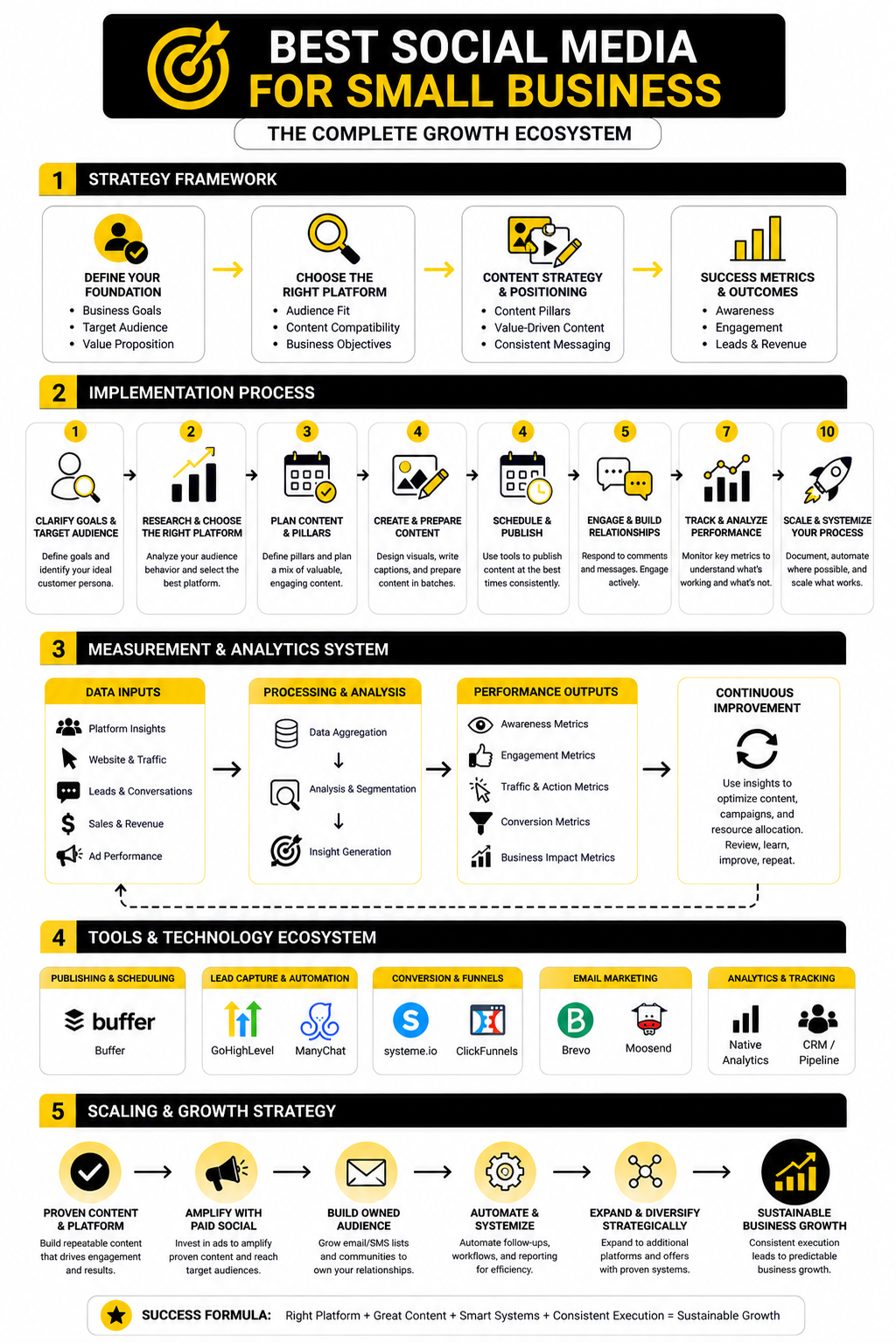
Tools That Support a Small Business Social Media System
The first tool most small businesses need is a simple scheduling and publishing workflow. A platform like Buffer can help when the business has already chosen its channels and needs a cleaner way to plan posts. This is useful for staying consistent, but it should not become an excuse to post bland content everywhere.
The second tool category is lead capture and follow-up. If social media sends people to a booking flow, form, email list, or sales pipeline, the business needs a reliable place to collect and manage those opportunities. For service businesses that need CRM, booking, forms, automations, and messaging in one place, GoHighLevel can make sense.
The third category is conversion infrastructure. If you need simple funnels, landing pages, and email sequences, Systeme.io or ClickFunnels can help turn attention into action. If most of your conversations happen in Instagram or Facebook DMs, ManyChat can help route interest without losing people in the inbox.
Common Mistakes That Make Social Media Harder
The first mistake is choosing a platform because it is popular instead of because it fits the customer. Social media usage is huge, with 5.79 billion social media user identities worldwide in April 2026, but that does not mean every channel deserves your time. Big numbers only matter when your buyers are part of the audience and your content fits the platform.
The second mistake is posting without a conversion path. If someone likes your post, visits your profile, and wants the next step, that next step should be obvious. A small business should not make interested people hunt for a booking link, offer page, phone number, email signup, or product page.
The third mistake is measuring the wrong thing. A platform can look successful because reach is up while revenue stays flat. A different platform can look smaller but create better leads, stronger referrals, and more qualified conversations. The numbers that matter are the ones that help you decide what to do next.
The Final Decision Rule
Use this rule when you are still unsure: choose the platform where your best customer is easiest to reach, easiest to educate, and easiest to move into the next step. That simple filter cuts through a lot of bad advice. It also keeps you from chasing every trend just because other businesses are doing it.
For a local service business, that may mean Facebook plus Instagram. For a B2B service provider, that may mean LinkedIn plus YouTube. For a visual product brand, that may mean Instagram plus Pinterest or TikTok. For an education-heavy business, YouTube may become the long-term trust engine.
Once the primary platform is chosen, commit long enough to learn. Give the strategy a serious 90-day test, track the right signals, and improve based on evidence. The business that keeps learning usually beats the business that keeps switching platforms every month.
What is the best social media for small business overall?
There is no single best platform for every small business. The best choice depends on your audience, offer, location, content style, and sales process. For many small businesses, Facebook, Instagram, YouTube, LinkedIn, TikTok, and Pinterest are the strongest platforms to evaluate first.
Is Facebook still worth using for small businesses?
Yes, Facebook can still be valuable, especially for local businesses, community-driven brands, events, service providers, and businesses targeting adults across several age groups. U.S. usage data shows Facebook remains one of the broadest platforms, with 71% of U.S. adults using it in Pew’s 2025 research. The strongest results usually come from community activity, groups, reviews, events, messages, and retargeting rather than only posting on a business page.
Is Instagram better than Facebook for small business?
Instagram is often better for visual brands, creators, lifestyle businesses, restaurants, beauty, fitness, ecommerce, design, and personal brands. Facebook is often better for local communities, older audiences, groups, events, recommendations, and broad local trust. The better choice depends on how your customers discover and evaluate businesses like yours.
Should a small business be on TikTok?
A small business should consider TikTok if it can create short, native, personality-led content. TikTok can be strong for discovery, education, behind-the-scenes videos, demonstrations, and founder-led brands. It is not ideal if the business has no appetite for video, no clear content angles, or no follow-up path for turning attention into leads.
Is YouTube good for small businesses?
YouTube is excellent for small businesses that can teach, demonstrate, compare, explain, or answer buyer questions. It works especially well when customers research before buying, because videos can keep working long after they are published. The tradeoff is that YouTube usually requires more planning than quick-feed platforms.
Is LinkedIn useful for small businesses?
LinkedIn is very useful for B2B businesses, consultants, agencies, recruiters, coaches, software companies, and professional service providers. It is strongest when the owner or team can share expertise, opinions, lessons, and practical insights. It is usually weaker for businesses that rely mostly on impulse, local foot traffic, or highly visual consumer discovery.
How many social media platforms should a small business use?
Most small businesses should start with one primary platform and one supporting platform. That is enough to build consistency without spreading the team too thin. More platforms can be added later when one channel is already producing repeatable leads, sales, or audience growth.
How often should a small business post on social media?
The right posting frequency depends on the platform and the team’s capacity. Consistency matters more than posting constantly. A strong rhythm might be three to five posts per week on Instagram or LinkedIn, one useful video per week on YouTube, or several short-form tests per week on TikTok if the business can sustain it.
What metrics should small businesses track?
Small businesses should track reach from the right audience, meaningful engagement, conversion actions, and revenue or pipeline value. Saves, shares, comments, DMs, clicks, bookings, calls, form fills, and purchases usually matter more than likes alone. The goal is to understand whether social activity is creating business momentum.
How long should I test a social media platform before changing strategy?
A 90-day test is usually more useful than judging a platform after a few posts. The first month helps you test topics and formats. The second month helps you improve what is already showing signals. The third month helps you decide whether to keep, adjust, scale, or downgrade the platform.
What is the biggest social media mistake small businesses make?
The biggest mistake is posting without a clear strategy. Many businesses choose platforms randomly, copy competitors, chase trends, and then wonder why the results feel weak. A better approach is to define the buyer, choose the platform based on fit, create content around the customer journey, and track whether the platform produces qualified action.
Do small businesses need paid ads on social media?
Paid ads can help, but they should not be the first fix for a weak message. Ads work best when the business already has a clear offer, a working conversion path, and content or messaging that has shown signs of demand. Start small, test carefully, and use paid social to amplify what is already working.
What should I do if I do not have time to create content?
Start with fewer platforms and stronger repeatable formats. Use customer questions, objections, tutorials, proof, behind-the-scenes moments, and simple opinion posts as content sources. One strong idea can often become several pieces of content if you adapt it properly for each platform.
Should I hire someone to manage social media?
Hiring can help if the strategy is clear and the business knows what outcomes matter. Do not hire someone just to “post more.” Hire for a specific job: content strategy, editing, community management, paid social, analytics, creative production, or lead follow-up.
What is the easiest social media platform for beginners?
The easiest platform depends on the business owner’s strengths. If you are comfortable writing, LinkedIn or Facebook may feel easier. If you are visual, Instagram or Pinterest may be easier. If you are comfortable teaching on camera, YouTube or TikTok may be more natural.
Build a stronger local presence with BAAM AI
Turn your website, Google profile, social channels, and AI visibility into one growth engine
Most businesses do not need more random marketing activity. They need a consistent presence system that helps the right people find them, trust them, and take action. BAAM AI brings strategy, local SEO, website updates, Google Maps visibility, social content, AI-search readiness, media production, and reporting into one practical monthly engine.
If you want your marketing to keep working after the campaign ends, start with a free BAAM AI presence audit. See how your business shows up today and where the fastest visibility wins are at BAAM AI.