
BAAM AI Blog
Best Social Media Campaigns 2022: What Still Works, What Aged Badly, And What To Copy Carefully
The best social media campaigns 2022 gave marketers a clean break from the old “post more content” playbook. That year rewarded brands that understood culture, creators, community behavior, short-form video, and...
The best social media campaigns 2022 gave marketers a clean break from the old “post more content” playbook. That year rewarded brands that understood culture, creators, community behavior, short-form video, and shareable identity. It also punished brands that tried to force virality without a real reason for people to care.
The context matters. In January 2022, the world had 4.62 billion social media users, which meant social was no longer a side channel for awareness. Meta still reported 2.96 billion daily active people across its family of apps in December 2022, while YouTube Shorts, TikTok, Instagram Reels, and creator-led content were changing what “campaign performance” even meant.
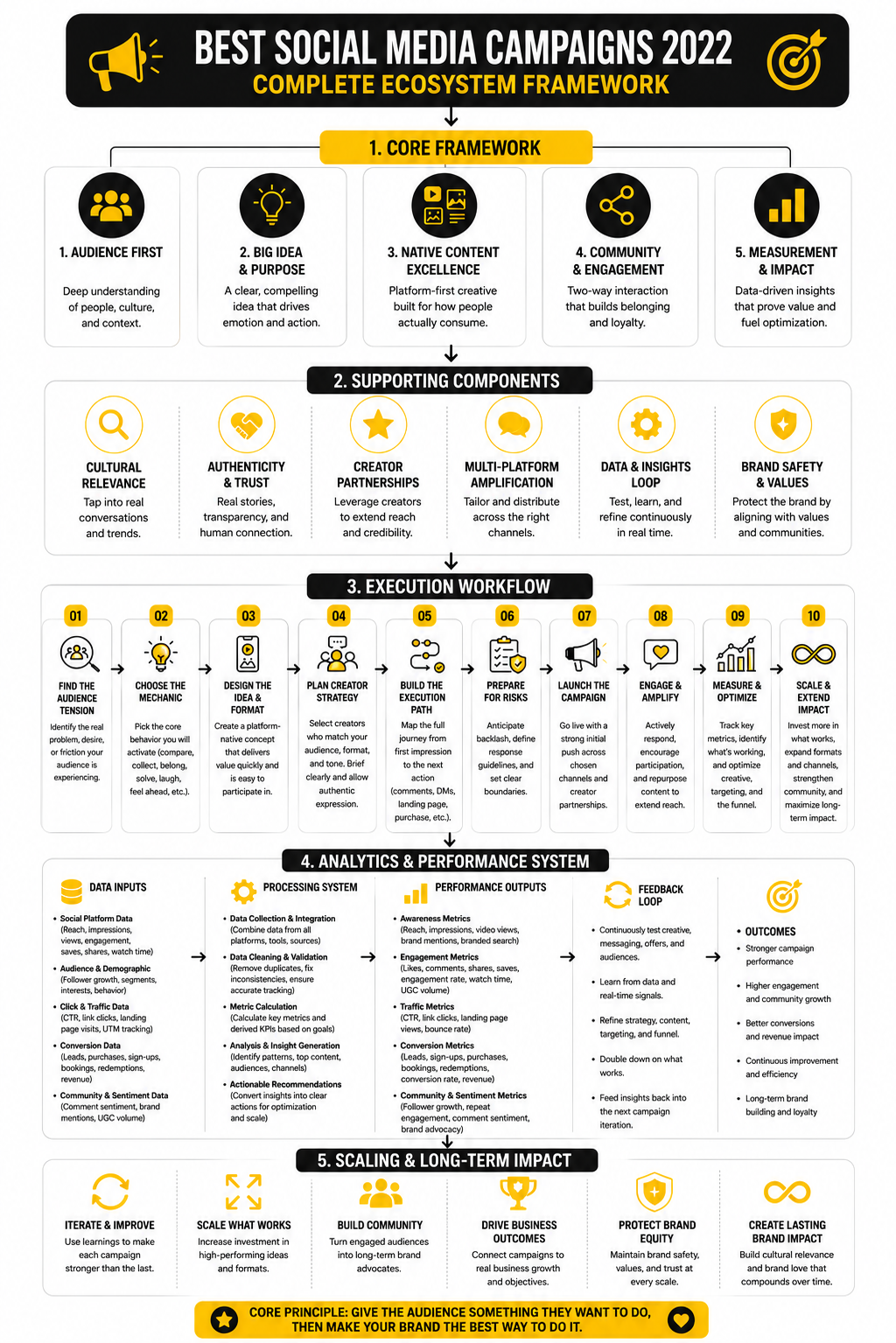
That is why this guide will not just list campaigns and call them clever. A useful breakdown has to explain why they worked, what conditions made them work, and what a smaller brand can realistically adapt without copying the surface-level gimmick. The goal is practical: understand the mechanics behind the best social media campaigns 2022, then turn those mechanics into a repeatable planning system.
this guide is split into six parts so each section can build on the last without turning into a random list of viral posts. The first part sets the context, explains why 2022 still matters, and gives you the framework we will use to judge each campaign. The later parts will move from campaign analysis into implementation, measurement, and practical takeaways for brands, agencies, creators, and founders.
Why The Best Social Media Campaigns Of 2022 Still Matter
The best campaigns from 2022 are still useful because they sit at the turning point between polished brand calendars and culture-led social execution. Brands were learning that social media was not just a place to distribute finished creative. It was where ideas were tested, remixed, challenged, memed, defended, and sometimes turned into revenue faster than traditional planning cycles could handle.
Short-form video became impossible to ignore. YouTube said Shorts had passed 30 billion daily views in 2022, and that shift pushed marketers to think in hooks, loops, comments, stitches, duets, saves, and watch behavior instead of only impressions and reach. The best campaigns did not simply resize TV ads for vertical video; they built content that felt native to the way people were already using each platform.
That is also why the year is still worth studying now. A campaign from 2022 may look old visually, but the strategic lessons are not old. The strongest examples show how brands used timing, participation, creator fluency, platform-native formats, and a clear emotional trigger to make people do something more valuable than passively view an ad.
Framework Overview For Judging Each Campaign
A campaign is not “best” just because it went viral. Virality can be accidental, short-lived, and commercially useless when it has no connection to brand memory, audience growth, product adoption, or sales. For this guide, the best social media campaigns 2022 will be judged by whether they created attention that had a strategic job.
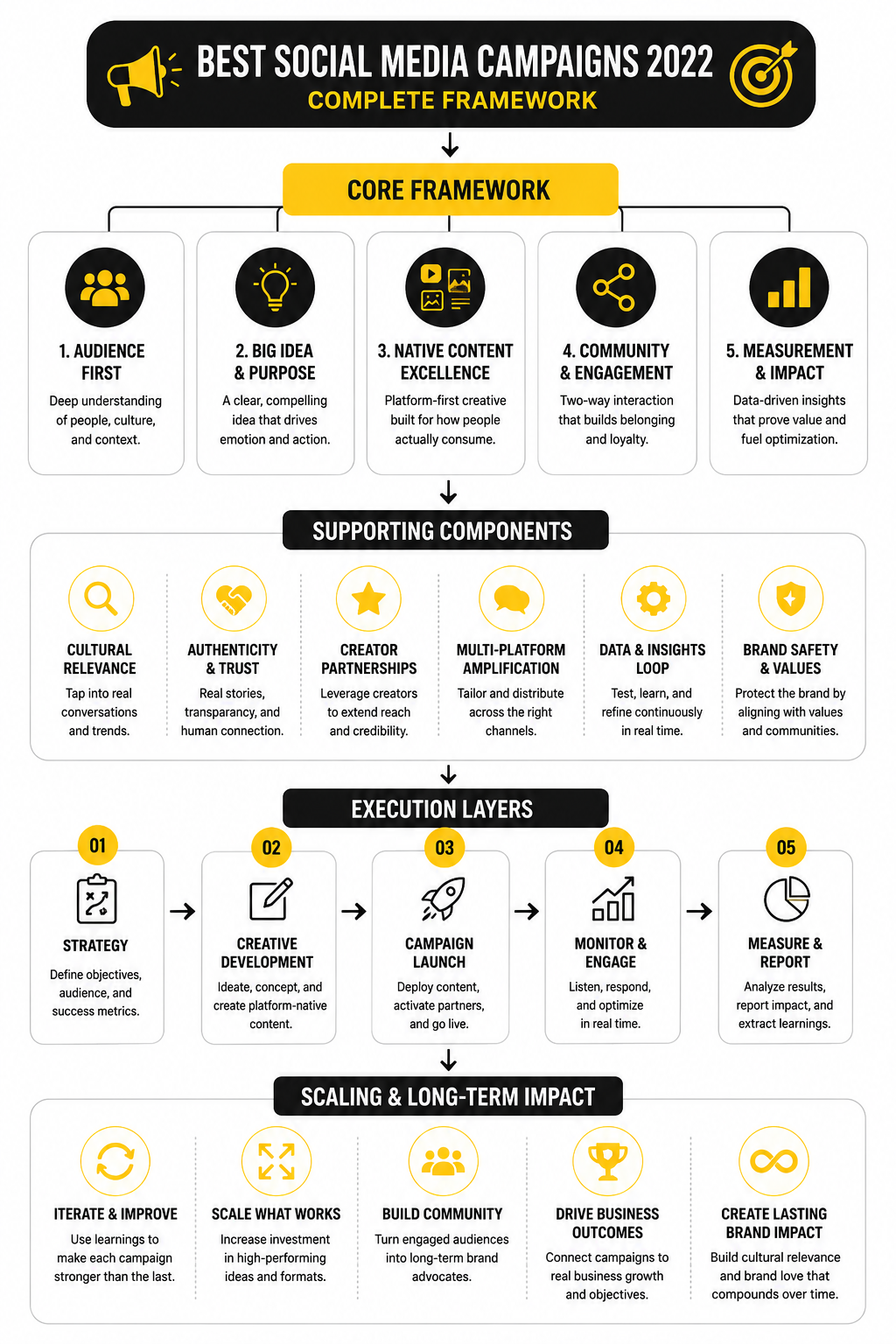
The framework is simple: cultural fit, platform fit, creative distinctiveness, participation design, business connection, and longevity. Cultural fit asks whether the campaign entered a conversation people already cared about. Platform fit asks whether the idea behaved naturally on TikTok, Instagram, YouTube, X, Reddit, LinkedIn, Pinterest, or another channel instead of feeling like a pasted-in ad.
The business connection matters most. A funny post can win the internet for a day and still do nothing for the brand. A stronger campaign gives people a reason to remember the brand, talk about it, click, sign up, buy, share, join, or come back later.
Core Components Of A Strong 2022-Style Social Campaign
The first component is a sharp audience insight. Not a demographic like “Gen Z” or “millennials,” but a real behavior, frustration, desire, joke, identity signal, or social habit. Campaigns that understood how people wanted to be seen online had an advantage because they gave audiences something personal to share.
The second component is a format that matches the platform. A campaign designed for TikTok needs movement, speed, personality, tension, or remix potential. A campaign designed for LinkedIn needs credibility, professional relevance, and a reason for people to attach their own opinion before sharing.
The third component is a conversion path that does not ruin the experience. For example, a brand can use a social scheduling workflow through Buffer, a DM automation flow through ManyChat, or a funnel builder like ClickFunnels only when the click or message feels like the natural next step. The best campaigns make the action feel obvious, not bolted on.
Professional Implementation Starts Before The First Post
Professional execution starts with deciding what the campaign must prove. Is the goal awareness, community growth, creator partnerships, product education, app installs, lead capture, sales, retention, or brand repositioning? Each goal changes the creative brief, platform mix, content cadence, and measurement plan.
A serious campaign also needs rules for speed. Social teams need enough freedom to respond to culture quickly, but enough strategic discipline to avoid chasing every trend. The brands that performed well in 2022 were not just “more creative”; they were often better organized around fast approval, clear voice, and a tighter understanding of what they would never say or do.
The rest of this guide will use that lens. We will look at the campaigns that defined the year, then pull out the repeatable patterns behind them. The point is not to recreate 2022; it is to understand why those campaigns worked so you can build something sharper now.
The Campaigns That Defined The Year
The best social media campaigns 2022 had one thing in common: they did not treat social as a dumping ground for finished ads. They created moments people could participate in, argue about, remix, screenshot, collect, or use to say something about themselves. That is the real difference between a campaign that gets seen and a campaign that gets carried by the audience.
This section focuses on campaigns that captured the year’s biggest social shifts. Some were polished and planned. Some were scrappy and platform-native. Some worked because they made people feel seen, while others worked because they gave people a very simple action at exactly the right time.
Spotify Wrapped 2022 Turned Personal Data Into Social Identity
Spotify Wrapped remains one of the clearest examples of a campaign people actively wait for. In 2022, Spotify expanded the experience with features like Audio Day, Listening Personality, share cards, top artists, top songs, top podcasts, and creator-focused Wrapped tools, all built around the idea that listening behavior can become a public identity signal. Spotify described the campaign as a way to celebrate how millions of creators and fans connect through audio, which is exactly why it works so well on social.
The genius is not just personalization. Plenty of companies have user data, but most present it like a dashboard. Spotify packages the data as a story people want to post because it says something about their taste, personality, mood, and year.
That is why Wrapped deserves a place among the best social media campaigns 2022. It did not beg people to share; it gave them a mirror with better design. When a campaign makes the user the hero, distribution becomes much easier.
Coinbase Made A QR Code Feel Like A Cultural Event
Coinbase’s Super Bowl QR code ad was not a typical social campaign, but it became a social media event immediately. The spot showed a bouncing QR code on a black screen, sending viewers to a landing page with a crypto offer, and the unusual execution triggered huge online discussion because it broke the expected rules of Super Bowl advertising. The campaign later won the Cannes Lions Direct Grand Prix, with the case study reporting more than 20 million site visits.
The social lesson is simple: curiosity can outperform explanation when the context is strong enough. Coinbase had the advantage of a massive live audience, but the execution still mattered because people had to talk about what they had just seen. A normal celebrity-led crypto ad would have blended into the night; the QR code became the conversation.
There is also a caution here. Coinbase gained massive attention, but crypto brands were entering a turbulent period, and attention alone cannot protect a category from trust problems. The useful takeaway is not “use a QR code.” The useful takeaway is that frictionless curiosity plus a clear landing action can create an enormous response when the audience already understands how to interact.
Duolingo Made Its Mascot The Main Character
Duolingo’s TikTok presence became one of the strongest brand social stories of the period because it understood platform behavior before many larger brands did. Instead of making educational content feel like a classroom, the brand turned Duo the owl into a chaotic, funny, emotionally exaggerated character that could participate in trends without sounding like a corporate account. TikTok’s own business case study highlighted Duolingo’s platform-native work, noting that the campaign’s average click-through rate was 39% above the education market benchmark.
The important part is not that the mascot was funny. The important part is that the character gave the brand permission to behave in a way a normal logo could not. A mascot can be jealous, dramatic, needy, petty, proud, or absurd while still keeping the brand at a safe distance.
That is why Duolingo became such a strong reference point for marketers studying the best social media campaigns 2022. The brand did not simply follow trends; it built a repeatable character system. Once that system worked, every trend became raw material instead of a random one-off post.
Dove Used Social Media Criticism As The Campaign Itself
Dove’s Toxic Influence and #DetoxYourFeed work stood out because it addressed a painful social media problem directly: the beauty advice young people encounter in their feeds. The campaign used the language and patterns of harmful influencer content to show how easily toxic beauty standards can enter everyday scrolling. Dove’s later body image research continued to show the weight of the issue, including that 1 in 2 girls said toxic beauty advice on social media causes low self-esteem.
This was not a light entertainment play. It worked because the brand had a long-running connection to self-esteem and beauty standards, so the message felt anchored rather than opportunistic. A weaker brand would have looked like it was borrowing a serious issue for attention.
The campaign also showed that social media campaigns do not always need to chase humor, memes, or trends. Sometimes the strongest move is to name the thing your audience already feels but has not fully articulated. When a campaign gives language to a shared discomfort, people share it because it validates their experience.
McDonald’s And Cactus Plant Flea Market Made Nostalgia Collectible
McDonald’s Cactus Plant Flea Market Box turned the adult Happy Meal into a social object. The collaboration mixed childhood memory, streetwear scarcity, collectible toys, app ordering, and limited-time availability in a way that made people want to post what they got. The boxes launched nationally in October 2022, and reports quickly noted that some locations sold out while toys appeared on resale marketplaces for much higher prices, with Axios reporting some toys listed for as much as $250.
The campaign worked because it did not ask adults to pretend they were kids. It reframed a childhood ritual through fashion, scarcity, and internet culture. That made the product familiar enough to understand instantly but fresh enough to discuss online.
The bigger lesson is that nostalgia performs best when it has a new social reason to exist. McDonald’s did not just bring back old characters. It made the characters collectible, slightly strange, visually distinctive, and tied to a brand people in streetwear culture already recognized.
Heinz Hidden Spots Solved A Real Gamer Problem
Heinz Hidden Spots was smart because it did not interrupt gamers with a generic brand message. It identified a real behavior: people playing long online sessions often need a safe moment to eat, but games like Call of Duty do not pause. Heinz worked with streamers to map snack-safe zones, and D&AD’s archive notes that the community then helped map hidden spots in other games.
This is a different kind of social campaign because the brand acted like a useful participant inside a culture. It did not say, “Gamers like ketchup, so let’s sponsor gaming content.” It found a tiny but specific pain point and built the idea around that.
That specificity is the lesson. Broad audience labels like “gamers” are not enough. Strong campaigns find the exact moment where the product, behavior, and community tension overlap.
Chipotle Buy The Dip Connected A Meme To A Product Moment
Chipotle’s Buy The Dip campaign showed how a brand can borrow market language without becoming a finance brand. The campaign used a fictional crypto-style tracker where rewards members could “buy the dip” for a chance to win crypto, connecting a popular phrase to guacamole, queso, and dip culture. Marketing Dive reported that Chipotle committed to awarding more than 500 people a combined $200,000.
The idea worked because the phrase already had momentum. Chipotle did not need to explain the joke from scratch, but it also did not rely on the joke alone. The campaign connected the meme to a simple reward mechanism, which gave people a reason to engage beyond recognizing the reference.
This is where many brands get trend marketing wrong. They copy the language but forget the action. Chipotle gave the audience a game, a possible reward, and a reason to associate the phrase with its own menu.
The Pattern Behind The Winners
These campaigns were different on the surface, but they shared a deeper structure. Spotify gave people identity. Coinbase created curiosity. Duolingo built a character. Dove gave language to a serious social problem. McDonald’s made nostalgia collectible, Heinz made itself useful, and Chipotle turned a meme into a mechanic.
That is the real reason the best social media campaigns 2022 are still worth studying. They were not successful because they posted more often or used the right hashtag. They won because each campaign had a clear social behavior at the center.
The next step is to look underneath the creative and find the repeatable components. Once you strip away the platform-specific details, the strongest campaigns used similar strategic moves: emotional clarity, native format, audience participation, cultural timing, and a business action that made sense.
What The Winning Campaigns Had In Common
The best social media campaigns 2022 looked very different from each other, but they were not random wins. Under the creative layer, they followed a pattern: they understood the audience’s behavior first, then built the campaign around a social action people already wanted to take. That is why Spotify Wrapped, Duolingo, Dove, McDonald’s, Heinz, Chipotle, and Coinbase all worked in different ways without relying on the same tactic.
A strong campaign starts by asking a better question. Not “what should we post?” but “what would people be proud, curious, entertained, relieved, or motivated to share?” That shift matters because social distribution is not controlled by the brand once the campaign goes live.
The strongest campaigns also had a clear relationship between attention and action. Spotify turned listening history into identity. Dove turned feed hygiene into a family conversation. Heinz turned a gaming problem into a useful branded behavior. The creative was memorable because the audience knew what to do with it.
They Started With A Real Social Behavior
The best campaigns were built around behaviors that already existed. People already wanted to compare their music taste. Gamers already needed safe moments inside long sessions. Fans already liked collecting limited-edition items tied to nostalgia, streetwear, or food culture.
That is where many brands get social wrong. They invent a campaign mechanic first, then try to force the audience to care. The better move is to find a behavior that already has energy and build the brand idea around it.
This does not mean copying trends blindly. A trend is only useful when it connects to the brand, the product, and the audience’s reason to participate. Without that connection, the campaign becomes noise with a logo attached.
They Made Participation Easy
Participation was not complicated in the strongest campaigns. Spotify Wrapped gave users ready-made share cards. Coinbase made the action as simple as scanning a QR code. McDonald’s gave people a collectible box they could photograph, compare, and talk about immediately.
Easy participation matters because most users are not going to work hard for a brand. They might share something if it makes them look funny, tasteful, informed, nostalgic, generous, or ahead of the curve. They probably will not share something that requires a long explanation.
This is especially important for brands trying to build campaigns with limited budgets. You do not need the biggest media spend if the participation mechanic is obvious. You need a simple action that gives the audience social value.
They Had A Native Creative System
The strongest campaigns were not just platform-specific; they had a creative system that could flex across platforms. Duolingo’s mascot could work in TikTok videos, comments, memes, replies, and trend formats because the character had a recognizable personality. Spotify Wrapped could travel across Instagram Stories, X posts, TikTok reactions, creator content, and group chats because the output was personal and visual.
A native creative system gives the campaign room to move. It lets the idea show up differently without losing the core concept. That matters because a campaign rarely lives in one post or one channel anymore.
This is also why short-form video became so important. Research on YouTube Shorts found that Shorts attracted more views and likes per view than regular videos in many categories, while also changing how frequently creators published short-form content across the platform. That shift pushed brands to design campaign ideas that could survive fast scrolling, quick reactions, and algorithmic discovery through formats people already understood.
They Connected Emotion To A Business Outcome
A campaign cannot survive on emotion alone. The emotion has to connect to a business outcome, whether that outcome is app usage, signups, store visits, orders, loyalty participation, product trials, or brand preference. The best campaigns made that connection feel natural instead of desperate.
Spotify Wrapped made people open the app to view and share their results. McDonald’s pushed people toward a limited-time product and digital ordering behavior. Chipotle linked a meme-friendly mechanic to rewards participation and brand engagement.
That is the part marketers should copy carefully. You do not need to make every campaign hard-sell. But you do need to know what the campaign is supposed to move, because attention without direction is expensive entertainment.
They Used Timing Instead Of Chasing Noise
Timing was a major reason these campaigns worked. Spotify Wrapped arrives when people are already reflecting on the year. Super Bowl advertising gave Coinbase a perfect stage for a curiosity play. Dove’s work landed in a moment when social media’s impact on body image was becoming harder for parents, platforms, and brands to ignore.
Good timing does not always mean reacting fast. Sometimes it means owning a predictable calendar moment. Sometimes it means waiting until the audience is emotionally ready for a topic.
This is where strategic discipline matters. A brand does not need to respond to every meme, platform update, celebrity moment, or cultural debate. It needs to know which moments make sense for its voice, product, customer, and risk tolerance.
The Implementation Process Behind A Strong Social Campaign
The process is where campaigns become real. Creative ideas are exciting, but execution decides whether the campaign becomes a coordinated market moment or a messy batch of posts. A professional process gives the team enough structure to stay consistent and enough flexibility to respond when the audience starts interacting.
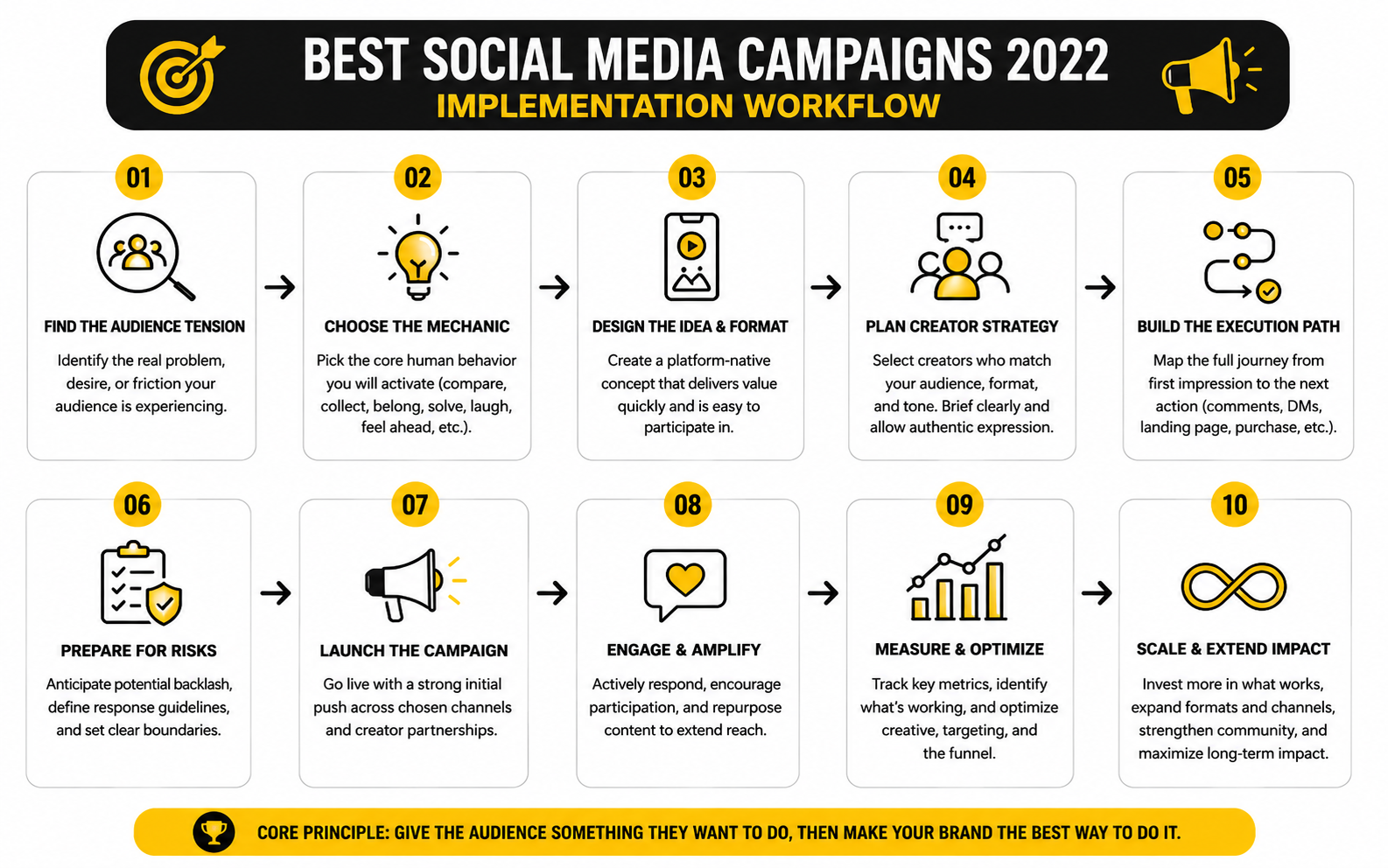
Use this process before committing budget, creators, production time, or paid amplification:
This process keeps the campaign grounded. It stops teams from confusing “fun idea” with “working strategy.” More importantly, it forces every creative choice to answer a practical question: what should the audience feel, do, and remember?
The Best Ideas Had A Clear Role For The Audience
The audience was not passive in the best social media campaigns 2022. They were the proof, the distribution engine, the joke, the collector, the critic, the participant, or the storyteller. That role gave the campaign life beyond the brand’s own account.
Spotify’s audience became the content by sharing their personal listening data. Duolingo’s audience helped reward the brand’s character by reacting, commenting, and inviting more absurdity. McDonald’s customers turned the physical product into a social object through photos, resale chatter, and scarcity conversations.
This is the mindset shift that matters. A campaign should not just ask, “What will the brand publish?” It should ask, “What role does the audience get to play once this is live?”
The Creative Was Distinct Before It Was Optimized
Optimization is useful, but it cannot rescue a bland idea. The strongest campaigns had a distinctive creative angle before performance teams touched budgets, targeting, or reporting dashboards. That distinction made people stop, react, and remember.
This is why a bouncing QR code could beat overproduced Super Bowl ads in conversation value. It is why a slightly unhinged green owl could outperform safer educational content. It is why Wrapped keeps returning as a benchmark even though most users know the format is coming.
Distinctiveness does not mean being loud for no reason. It means the campaign has a recognizable shape, tone, behavior, or mechanic that people can identify quickly. If a campaign could come from any competitor in the category, it is probably not strong enough yet.
What Smaller Brands Should Copy
Smaller brands should not copy the budget, celebrity access, or cultural scale of these campaigns. That is the wrong lesson. The right lesson is to copy the strategic sequence: behavior first, emotion second, mechanic third, platform fourth, conversion fifth.
A small ecommerce brand can turn buyer choices into shareable identity. A local service business can turn customer questions into short-form content that feels useful instead of promotional. A creator-led business can build repeatable characters, recurring formats, or DM-based campaigns with tools like ManyChat when the audience already wants a fast next step.
The key is not to look bigger than you are. The key is to be more specific than your competitors. Specific behavior, specific emotion, specific format, specific action - that is where strong campaigns come from.
Statistics And Data
The data behind the best social media campaigns 2022 matters because it shows why those campaigns had to be more than clever posts. Social platforms were already crowded, paid media was under pressure, and organic attention was becoming harder to earn consistently. That means the strongest campaigns needed two things at the same time: a creative idea worth sharing and a measurement system that proved the attention was useful.
A good analytics section should not start with random benchmark screenshots. It should start with the job of the campaign. If the campaign is built for awareness, you measure reach, frequency, video completion, share rate, branded search, and earned mentions. If it is built for conversion, you measure clicks, opt-ins, purchases, redemptions, cost per result, and post-campaign retention.
The mistake is treating every campaign like it has the same scoreboard. Spotify Wrapped and Dove’s #DetoxYourFeed should not be judged the same way. One is a mass participation and identity-sharing engine, while the other is a trust, purpose, and cultural conversation campaign.
Why Surface Metrics Can Mislead You
Views are useful, but views alone are weak evidence. A campaign can get a lot of views because it was controversial, heavily boosted, placed in front of the wrong audience, or watched for the wrong reason. That is why the first measurement question should be, “What did this attention cause?”
In 2022, paid social was also getting more complicated. Meta reported that its ad impressions increased by 18% year over year in 2022, while its average price per ad decreased by 16%. That combination tells you the market was not simply about who could buy the most impressions; brands also had to fight harder for meaningful response inside larger, more competitive feeds.
For campaign analysis, this changes how you read performance. A big reach number may show distribution, but it does not prove resonance. A better signal is when reach is paired with shares, saves, comments with substance, repeat participation, creator pickup, search lift, and measurable movement toward the campaign’s business goal.
Benchmarks Are A Starting Point, Not A Strategy
Benchmarks help you understand whether a campaign is underperforming, average, or unusually strong for its platform and industry. They do not tell you whether the campaign was strategically good. A high engagement rate on a small post can still mean less business impact than a lower engagement rate on a campaign that reaches the right audience and drives qualified action.
This is especially important when comparing platforms. Socialinsider’s 2024 benchmark data placed TikTok’s average engagement around 2.65% by followers and 4.07% by views, while Instagram and Facebook sat much lower in the same reporting context. That does not mean every brand should move everything to TikTok. It means TikTok may create stronger interaction in certain formats, but the business still has to ask whether that interaction reaches buyers, subscribers, fans, applicants, or advocates.
The same logic applies to posting frequency. Sprout Social’s 2024 content research noted that brands published about 10 posts per day across networks in 2023, but posting more is not automatically a strategy. If more output lowers quality, weakens brand voice, or trains the team to chase filler content, the campaign gets busier without getting stronger.
The Measurement System For A Social Campaign
A strong measurement system has layers. You need leading indicators that show whether the creative is catching attention early, mid-campaign signals that show whether the audience is participating, and outcome metrics that show whether the campaign created business value. Without those layers, the team either overreacts to early noise or waits too long to fix something obvious.
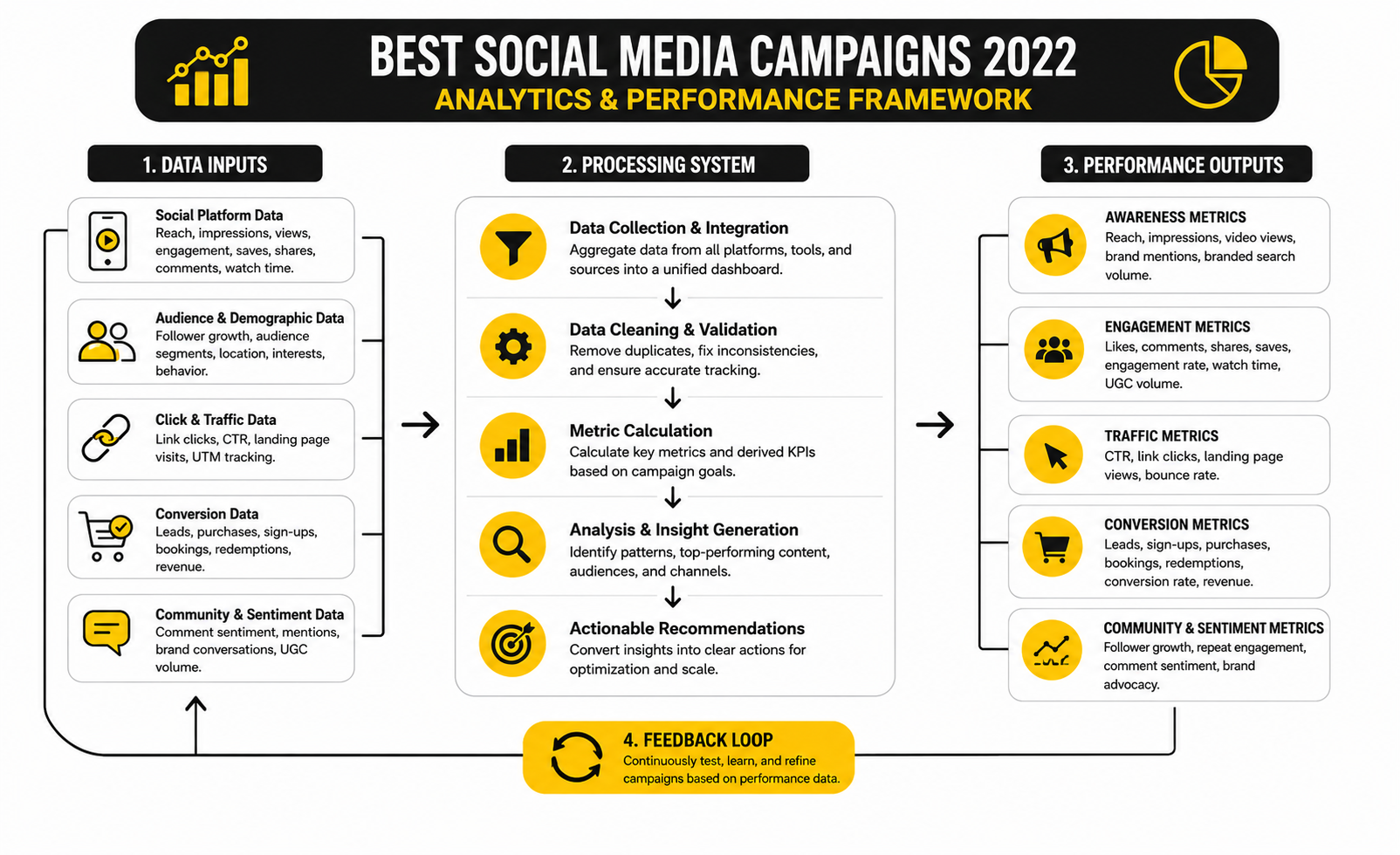
A practical system should track four levels:
This structure is simple, but it prevents bad decisions. If attention is strong and action is weak, the offer or landing path may be the issue. If action is strong but attention is weak, the creative may need sharper hooks or better distribution. If resonance is strong but memory is weak, the campaign may be entertaining people without building brand association.
What The Numbers Should Make You Do
Data should drive decisions, not decorate reports. If a campaign gets strong saves but weak shares, it may be useful but not socially expressive enough. That should push the team to create more opinionated, identity-driven, or comparison-based assets that people would actually want to pass along.
If a campaign gets high views but low completion, the hook may be doing the wrong job. It may attract curiosity but fail to pay it off. In that case, the answer is not always “make it shorter”; sometimes the answer is to make the opening more honest, the pacing tighter, or the payoff clearer.
If comments are high but sentiment is messy, the team needs to separate productive debate from reputation risk. Dove could handle serious conversation because the topic matched its long-term brand platform. A brand with no credibility in the topic would need a much stronger moderation and response plan before stepping into that kind of campaign.
Reading Platform Data Without Fooling Yourself
Each platform rewards different signals, so the same number can mean different things depending on where it appears. On TikTok, early watch behavior and rewatch potential can matter heavily because discovery is driven by content performance beyond the follower graph. On Instagram, saves, shares, Reels performance, and story interaction can show whether the content has utility or social value.
On LinkedIn, comments can carry more weight because people attach professional identity to what they engage with. On YouTube, retention and session behavior matter because people choose to spend longer periods with content. On X, speed, replies, quotes, and reposts can make a campaign feel culturally present, but the conversation can also turn quickly.
That is why a single dashboard view is not enough. Campaign reporting should include platform-native performance, cross-platform movement, and business impact. Otherwise, a team may mistake a strong channel-specific spike for a strong campaign.
The Role Of Funnel And CRM Data
Social analytics tell you what happened in the feed. Funnel and CRM data tell you what happened after people left the feed. That second layer is where many campaigns either prove their value or expose the gap between attention and revenue.
For lead-driven campaigns, the basic flow should connect the post, click, landing page, form, email or SMS follow-up, sales conversation, and close. A team can build that path with tools like GoHighLevel, ClickFunnels, Systeme.io, or Brevo, but the tool is not the strategy. The strategy is making sure every social action has a clean next step.
For ecommerce campaigns, the same principle applies. Track the creative that drove the click, the landing page that received the traffic, the product or bundle that converted, and the follow-up sequence that brought people back. If the campaign created first purchases but no repeat behavior, the front-end creative may have worked while the customer journey still needs fixing.
What Strong Campaign Reporting Should Include
A useful campaign report should be short enough for decision-makers to read and detailed enough for the team to improve the next campaign. It should not be a screenshot dump from every platform. It should explain what happened, why it happened, what changed, and what to do next.
A strong report usually includes:
This is where the best social media campaigns 2022 are useful beyond nostalgia. They remind us that measurement is not just about proving success after the fact. Measurement should help the team make the next creative decision with more confidence.
The Real Benchmark Is Momentum
The most useful benchmark is not always an industry average. It is whether the campaign created momentum the brand did not have before. That could mean more people searching for the brand, more creators referencing it, more customers sharing it without being asked, or more sales conversations starting with “I saw you on…”
This is why campaign measurement should look beyond the launch window. Some campaigns create immediate spikes, while others build memory and trust that convert later. If the reporting period is too short, the team may undervalue campaigns that are building durable brand effects.
The cleanest takeaway is this: measure the behavior you wanted to create. If you wanted people to share, track share rate and share quality. If you wanted people to buy, connect social analytics to revenue. If you wanted people to trust the brand, look at sentiment, repeat engagement, direct traffic, and the quality of the conversation after the campaign ends.
How To Build A 2022-Inspired Campaign Without Copying The Past
The danger of studying the best social media campaigns 2022 is that marketers copy the visible part and miss the strategic part. They see Spotify Wrapped and try to make a year-end recap. They see Duolingo and try to make the brand “unhinged.” They see Coinbase and think a weird stunt is enough.
That is not strategy. The real move is to extract the underlying mechanism, then rebuild it for your audience, offer, category, and timing. You are not trying to recreate 2022. You are trying to use what worked then to make more carefully decisions now.
Copy The Mechanic, Not The Costume
Every strong campaign has a costume and a mechanic. The costume is the visible creative layer: the mascot, QR code, collectible box, share card, influencer format, meme language, or visual style. The mechanic is the reason people participate.
Spotify Wrapped’s costume is colorful annual music data. The mechanic is self-expression. McDonald’s adult Happy Meal costume is a limited-edition box and toy. The mechanic is nostalgia mixed with collectability.
This distinction matters because costumes expire quickly. Once enough brands copy the surface, the audience gets bored. Mechanics last longer because they are tied to human behavior: people want to compare, collect, belong, signal taste, solve small problems, laugh at shared frustrations, and feel ahead of the curve.
Choose The Right Strategic Tradeoff
Every campaign has a tradeoff. A campaign built for speed may sacrifice polish. A campaign built for cultural commentary may carry reputation risk. A campaign built for conversion may lose some organic shareability if the call to action feels too heavy.
You need to pick the tradeoff on purpose. A brand with a small team and a clear offer may be better off with a tightly measured lead-generation campaign than a broad cultural play. A brand with strong community trust may be able to take creative risks that would look fake coming from a colder brand.
The worst choice is trying to optimize for everything. A campaign that tries to be funny, educational, premium, viral, safe, conversion-focused, platform-native, brand-polished, and universally appealing usually becomes forgettable. Strong campaigns make choices.
Build Around One Audience Tension
Audience tension is the gap between what people feel and what they can easily say, buy, share, or do. Dove tapped into tension around toxic beauty advice. Heinz tapped into a tiny but real gaming tension. Duolingo tapped into the tension between learning goals and procrastination.
This is where campaign planning should slow down. Before choosing formats, ask what your audience is already wrestling with. Are they overwhelmed by too many options? Embarrassed by a problem? Proud of a niche identity? Annoyed by a category norm? Excited by scarcity? Looking for a shortcut?
When the tension is sharp, the campaign gets easier to write. The hook becomes clearer. The participation mechanic becomes more obvious. The comments section becomes more useful because people are responding to something real.
Do Not Confuse Creator Access With Creator Fit
Creator partnerships can scale a campaign fast, but only when the creator’s audience, tone, and credibility match the idea. The creator economy keeps growing, with industry projections pointing toward a $500 billion market by 2027, but bigger spending does not automatically mean better fit. A campaign can still fail if the creator feels rented instead of relevant.
Creator fit has three layers. The first is audience fit: the right people actually follow and trust the creator. The second is content fit: the campaign can live inside the creator’s normal format without feeling like an interruption. The third is belief fit: the creator can explain or demonstrate the idea in a way that feels natural.
This is especially important for brands trying to scale. Ten smaller creators with real category credibility can outperform one huge creator who does not make the product believable. Reach is not the same as influence.
Plan For Backlash Before You Need It
Social campaigns create public response, and public response is not always polite. If the campaign touches identity, politics, health, body image, money, children, sustainability, or social issues, the brand needs a response plan before launch. Waiting until comments turn negative is amateur hour.
Risk planning should answer practical questions. What criticism is fair? What criticism is predictable but inaccurate? What should the brand respond to publicly? What should be handled privately? What topics should the brand avoid completely?
This does not mean playing scared. It means knowing the difference between useful tension and reckless provocation. Dove could address harmful beauty standards because the message was connected to years of brand positioning. A brand with no history in that conversation would need to earn the right before entering it.
Scale The System, Not Just The Spend
Scaling a campaign is not just increasing budget. More money can amplify a weak idea and make the weakness more visible. Before scaling, the team needs evidence that the creative, audience, offer, and follow-up path are working together.
The first layer of scale is creative variation. Build multiple hooks, formats, edits, captions, creator briefs, and landing angles around the same core mechanic. This gives the algorithm and the audience more ways to discover the idea without diluting the campaign.
The second layer is operational scale. The team needs someone watching comments, someone tracking performance, someone updating landing pages, someone coordinating creators, and someone making decisions quickly. Tools can help here, but the operating rhythm matters more than the software.
Keep The Conversion Path Clean
A campaign can win attention and still lose money if the next step is confusing. This is common. The post is strong, the landing page is generic, the offer is unclear, the form is too long, the follow-up is slow, and the campaign report blames “low intent.”
The fix is not always more creative. Sometimes the campaign needs a cleaner path from social action to business action. A social campaign that asks people to comment should have a fast DM flow. A campaign that sends people to a product page should match the promise made in the post. A campaign that collects leads should trigger follow-up before the audience forgets why they clicked.
For practical execution, a brand might use ManyChat for social messaging, Fillout for lightweight forms, Brevo for email follow-up, or GoHighLevel for a broader CRM and funnel workflow. The point is not to stack tools for the sake of it. The point is to remove friction between interest and action.
Protect Brand Memory While Chasing Performance
Performance marketing can push teams toward endless testing, but campaign memory comes from consistency. If every post looks, sounds, and behaves like a different brand, the audience may engage without remembering who created the moment. That is a real problem.
The best campaigns create recognizable assets. That might be a recurring character, phrase, structure, visual system, challenge format, community ritual, or product behavior. The audience should be able to identify the brand before the logo appears.
This is where creative discipline matters. A campaign can test hooks and formats without changing its core identity every three days. Performance data should sharpen the campaign, not erase the brand.
Avoid The Biggest 2022 Copycat Mistakes
The best social media campaigns 2022 created a lot of bad imitators. Some brands copied platform slang without understanding the audience. Others tried to make mascots behave strangely without building a character system. Some launched purpose campaigns without credibility, then looked opportunistic when people questioned the message.
The first mistake is trend-chasing without strategic fit. A trend may be huge, but that does not make it yours. If the product, audience, and brand voice do not connect naturally, the campaign will feel like a costume party.
The second mistake is treating creators like media placements. Creators are not banner ads with faces. Give them a clear strategy, but leave enough room for their actual voice, pacing, and audience relationship.
The third mistake is measuring only the launch spike. A campaign can get early attention and still fail if it does not create memory, community growth, or a useful next step. Momentum after the launch is often where the real value shows up.
Build A Campaign That Can Survive The Algorithm
Algorithms change, but human behavior changes more slowly. That is why the strongest campaigns are not dependent on one platform trick. They can move across short-form video, comments, creator content, landing pages, email, community posts, and offline conversation because the underlying idea is strong.
This matters even more now as platforms continue shifting toward recommendation-driven feeds. Recent research on TikTok’s For You Page found that the algorithm is sensitive to explicit and implicit signals, but users can still struggle to stop certain topics from reappearing once the system has learned an interest pattern. For marketers, the lesson is not to game the feed harder; it is to create content that earns clear, positive signals from the right audience.
A durable campaign should still make sense if one channel underperforms. If TikTok reach drops, can the idea work through Instagram Reels, YouTube Shorts, creators, email, paid social, or community distribution? If not, the campaign may be too dependent on a temporary platform condition.
The Expert-Level Question
Before launching, ask one hard question: what would make people talk about this if we were not paying to distribute it? That question exposes weak creative fast. It also forces the team to respect the audience’s time.
The answer does not have to be entertainment. People share useful things, emotional things, identity-driven things, controversial things, beautiful things, practical things, and things that make them feel early. But there has to be a reason beyond “the brand wants attention.”
That is the strategic lesson sitting underneath the best social media campaigns 2022. Great social campaigns are not built by asking the audience to care about the brand. They are built by giving the audience something they already want to do, then making the brand the easiest, sharpest, most memorable way to do it.
Final Takeaways For Turning Campaign Research Into Action
The best social media campaigns 2022 are useful because they show how strong social strategy works under pressure. They were built around behavior, not just content. They gave people a role, made participation simple, connected emotion to action, and measured more than vanity metrics.
That is the system to take forward. A campaign needs a clear audience tension, a platform-native creative idea, a participation mechanic, a conversion path, a response plan, and a reporting loop. Miss one of those pieces and the campaign may still look busy, but it becomes harder to scale, harder to defend, and harder to learn from.
The social landscape has only become more competitive since 2022. There were 5.24 billion active social media user identities worldwide at the start of 2025, and users now discover brands through multiple sources instead of one clean channel. That means the best campaigns are no longer isolated posts; they are small ecosystems designed to move people from attention to trust to action.
What were the best social media campaigns 2022?
The best social media campaigns 2022 included Spotify Wrapped, Duolingo’s TikTok-led mascot strategy, Dove’s #DetoxYourFeed work, Coinbase’s QR code Super Bowl moment, McDonald’s Cactus Plant Flea Market Box, Heinz Hidden Spots, and Chipotle’s Buy The Dip campaign. They worked for different reasons, but each one gave the audience a clear reason to participate. The common thread was not platform choice; it was a sharp connection between behavior, emotion, and action.
Why do 2022 campaigns still matter now?
They matter because 2022 was a turning point for social strategy. Short-form video, creator-led content, social commerce, meme fluency, and community participation were becoming impossible to ignore. The campaigns from that year still show how brands can earn attention without relying only on polished ads or paid reach.
What made Spotify Wrapped so effective?
Spotify Wrapped worked because it turned private listening behavior into public self-expression. People shared it because it made them look interesting, funny, emotional, nostalgic, or culturally specific. The campaign did not just show data; it packaged personal identity in a format designed for social sharing.
Why did Duolingo perform so well on TikTok?
Duolingo performed well because it built a character system around Duo the owl instead of posting generic language-learning tips. The mascot gave the brand permission to be dramatic, funny, reactive, and native to TikTok culture. That made the account feel like a participant in the platform rather than a company trying to advertise on it.
What is the biggest lesson from Coinbase’s QR code campaign?
The biggest lesson is that curiosity can create action when the context is strong and the next step is simple. Coinbase used a stripped-down creative idea in a high-attention media moment, then gave people one clear action. The caution is that attention still has to connect to trust, product value, and long-term business fundamentals.
How should small brands apply lessons from these campaigns?
Small brands should copy the mechanics, not the budget or surface-level style. That means identifying one real audience behavior, choosing one emotional trigger, creating one simple participation mechanic, and connecting it to a clean next step. A smaller brand does not need a Super Bowl spot; it needs a sharper reason for people to care.
What metrics matter most in a social media campaign?
The right metrics depend on the campaign goal. Awareness campaigns should track reach, retention, shares, earned mentions, and branded search. Conversion campaigns should track clicks, form fills, purchases, bookings, redemptions, and follow-up performance. Community campaigns should track comment quality, repeat engagement, sentiment, creator pickup, and audience-generated content.
Are views a reliable way to judge campaign success?
Views are useful, but they are not enough. A video can get a lot of views without creating trust, memory, leads, sales, or community growth. Strong reporting connects views to deeper signals like watch time, shares, saves, comments, clicks, conversions, and post-campaign momentum.
How do you avoid copying a campaign too closely?
Separate the costume from the mechanic. The costume is the visible execution, like a mascot, QR code, share card, or collectible product. The mechanic is the human behavior underneath, such as identity sharing, curiosity, nostalgia, usefulness, or scarcity. Copying the mechanic is strategic; copying the costume usually looks lazy.
What is the biggest risk in trend-based campaigns?
The biggest risk is using a trend without brand fit. If the trend does not connect naturally to the product, audience, voice, or offer, people can feel the brand is forcing relevance. Trend-based campaigns need discipline because cultural speed can make weak ideas look tempting.
How should brands use creators in campaigns?
Creators should be chosen for fit, not just reach. A good creator partnership matches the audience, content format, credibility, and tone of the campaign. The creator should be able to express the idea naturally, not just read a brand message with their face attached.
What tools help execute a modern social campaign?
The tool stack depends on the campaign path. Scheduling and content operations can run through Buffer, social messaging can run through ManyChat, and funnel or CRM workflows can run through GoHighLevel, ClickFunnels, or Systeme.io. The tool should support the campaign strategy, not replace it.
How long should a social campaign run?
A campaign should run long enough to test creative, gather response data, optimize the best-performing angles, and capture the follow-up value. Some campaigns work as short cultural moments, while others need weeks of creator content, paid amplification, retargeting, email follow-up, and community response. The stronger question is not “how long should it run?” but “what signal will tell us to scale, adjust, or stop?”
What is the difference between a campaign and regular social posting?
Regular social posting keeps the brand present. A campaign creates a focused push around a specific audience behavior, message, offer, product, moment, or business goal. The best campaigns have a beginning, a clear idea, a participation mechanic, a measurement system, and a reason to exist beyond filling the content calendar.
Can B2B brands use lessons from the best social media campaigns 2022?
Yes, but B2B brands need to translate the lessons into professional behavior. Instead of nostalgia boxes or music recaps, a B2B campaign might use benchmark reports, calculators, founder POVs, customer transformation content, industry debates, useful templates, or expert-led video series. The same principles apply: make the audience look more carefully, solve a real problem, and give them something worth sharing.
Build a stronger local presence with BAAM AI
Turn your website, Google profile, social channels, and AI visibility into one growth engine
Most businesses do not need more random marketing activity. They need a consistent presence system that helps the right people find them, trust them, and take action. BAAM AI brings strategy, local SEO, website updates, Google Maps visibility, social content, AI-search readiness, media production, and reporting into one practical monthly engine.
If you want your marketing to keep working after the campaign ends, start with a free BAAM AI presence audit. See how your business shows up today and where the fastest visibility wins are at BAAM AI.