
BAAM AI Blog
Best SMM Service: How to Choose a Social Media Marketing Partner That Actually Grows the Business
The best SMM service is not the one that posts the most, promises viral growth, or sells the cheapest monthly package. It is the service that connects social media activity to a real business outcome: leads, sales...

The best SMM service is not the one that posts the most, promises viral growth, or sells the cheapest monthly package. It is the service that connects social media activity to a real business outcome: leads, sales, booked calls, retention, recruiting, community growth, or brand demand. That sounds obvious, but it is exactly where most businesses get burned.
Social media has become too important to treat like a content calendar with invoices attached. Global social media user identities have reached 5.66 billion worldwide, and Meta alone reported 3.58 billion daily active people across its family of apps in December 2025. When the audience is that large, the real question is not whether your business should be active on social. The real question is whether your SMM partner knows how to turn attention into trust, and trust into revenue.
A good social media marketing service should help you clarify positioning, choose platforms intelligently, build repeatable content systems, measure performance, and adapt quickly without chasing every trend. A weak one hides behind vanity metrics. Likes, reach, and follower growth can matter, but only when they support a bigger commercial strategy.
This guide is written for business owners, marketers, agencies, SaaS teams, ecommerce brands, coaches, consultants, and local service businesses that want a practical way to evaluate the best SMM service for their situation. Not the flashiest provider. Not the cheapest package. The best fit for the way your business actually grows.
Why the Best SMM Service Matters More Than Ever
Social media is no longer just a visibility channel. It influences discovery, comparison, customer support, reputation, hiring, partnerships, and sales conversations. That is why choosing the best SMM service is not a small vendor decision; it affects how the market understands your business.
The pressure is also higher because platforms move faster than most internal teams can handle alone. HubSpot’s 2025 social media research found that social media professionals are dealing with a mix of challenges, including trend changes, ROI measurement, and creating engaging content, based on survey data from 1,100+ social media professionals. In plain English, brands are not struggling because they lack places to post. They are struggling because they lack a clear system.
The best SMM service gives you that system. It helps you decide what to say, who to say it to, where to publish it, how often to show up, what to test, and how to know whether the work is paying off. Without that structure, social media becomes expensive noise.
The Real Problem With Most SMM Services
Most disappointing SMM relationships start with a simple mismatch. The client wants growth, but the provider sells output. The client expects a strategy, while the provider delivers captions, graphics, hashtags, and monthly reports that do not explain what should happen next.
That mismatch gets worse when the provider uses vague promises. “We will grow your brand online” sounds nice, but it does not define the audience, the offer, the funnel, the creative angle, or the business metric. A serious SMM service should be able to explain how each activity supports a measurable objective.
There is also a big difference between social media management and social media marketing. Management keeps accounts active. Marketing uses social platforms to create demand, capture demand, and support conversion. The best SMM service should be honest about which one you are buying.
The SMM Service Framework: Strategy Before Posting
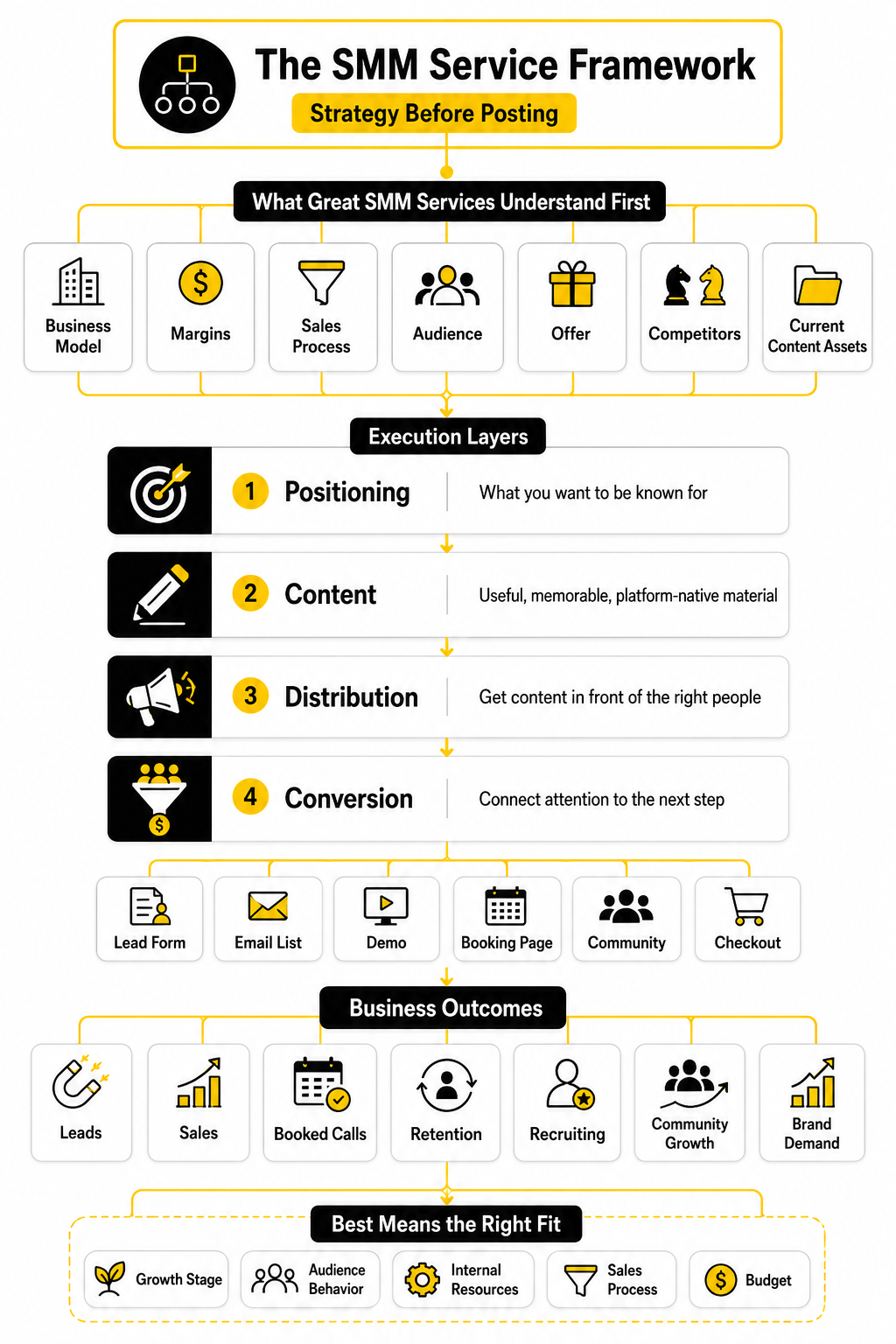
The best way to evaluate an SMM service is to look at the framework behind the work. A strong provider does not start by asking how many posts you want per week. They start by understanding your business model, margins, sales process, audience, offer, competitors, and current content assets.
From there, the service should build a strategy around four layers: positioning, content, distribution, and conversion. Positioning defines what you want to be known for. Content turns that positioning into useful, memorable, platform-native material. Distribution gets that content in front of the right people. Conversion connects attention to the next step, whether that is a lead form, email list, demo, booking page, community, or checkout.
This is where tools can help, but only after the strategy is clear. For example, a business that relies on Instagram comments and DMs may benefit from ManyChat automation when the goal is to capture leads from social interactions. A local agency or service business that needs CRM, follow-up, booking, and pipeline visibility may prefer GoHighLevel as the operational layer behind social campaigns.
What “Best” Really Means in an SMM Service
The word “best” is easy to abuse. The best SMM service for a funded SaaS company may be a poor fit for a local roofing company. The best service for an ecommerce brand with paid creative needs may not work for a consultant who needs authority content and booked calls.
A better definition is this: the best SMM service is the one that matches your growth stage, audience behavior, internal resources, sales process, and budget. If you already have strong strategy but weak execution, you need production support. If you post consistently but generate no pipeline, you need positioning and conversion work. If you have no internal marketing team, you may need a full-service partner that can manage content, community, reporting, and campaigns.
This distinction matters because social media success is not created by one magic tactic. It comes from the fit between message, market, channel, creative, cadence, and follow-up. A service that understands that will usually beat a service that simply sells more deliverables.
The Main Outcome of This Guide
By the end of this guide, you should be able to judge an SMM provider with more confidence. You will know what services should be included, what questions to ask, which red flags to avoid, and how to connect social media work to business results. That matters because a bad provider does not only waste budget; it also wastes time, weakens positioning, and trains your audience to ignore you.
The goal is not to make every business choose the same agency, freelancer, platform, or tool stack. The goal is to help you understand what a serious social media marketing service looks like when it is built properly. Once you see the structure, the sales pitches become much easier to evaluate.
Core Components of a High-Quality SMM Service
A strong SMM service is not one thing. It is a combination of research, planning, content production, publishing, community handling, analytics, and conversion support. When those pieces work together, social media becomes a growth system instead of a random posting habit.
The best smm service should be able to explain what each component does and why it matters. If the provider cannot clearly connect the work to a business goal, that is a problem. You are not paying for “activity”; you are paying for focused execution that makes the brand easier to discover, trust, and buy from.
This is also why cheap social media packages often become expensive later. They may include posts, captions, and basic scheduling, but they usually skip the deeper thinking that makes those assets effective. The result is content that fills the feed but does not move the business forward.
Audience and Market Research
Every serious SMM engagement starts with audience research. The provider should understand who the brand needs to reach, what those people already believe, what objections stop them from buying, and which platforms shape their decisions. Without this step, content becomes generic very quickly.
Good research goes beyond demographics. Age, location, and job title are useful, but they do not tell you what someone is worried about on a Tuesday afternoon when they are comparing options. A better SMM team studies pain points, buying triggers, competitor messaging, search behavior, comments, reviews, customer questions, and sales conversations.
This matters because social media is crowded. Sprout Social’s 2025 benchmark research analyzed 3 billion messages across 1 million active public profiles, which shows how much content brands are competing against every day. A provider that does not research the audience properly is basically guessing in a noisy room.
Positioning and Message Strategy
Positioning decides what the brand should be known for. It gives the content direction, sharpens the offer, and makes the brand easier to remember. Without positioning, even well-designed posts can feel disconnected from the business.
A strong SMM service should help clarify the core message before building the calendar. That means defining the main promise, the category angle, the audience’s problem, the reason to believe, and the point of difference. The goal is not to invent a fake personality for the brand; it is to make the real value easier to understand.
This is where many providers fall short. They jump into content themes before they understand the market. The best smm service will slow this part down because it knows that weak positioning creates weak content, weak ads, weak landing pages, and weak follow-up.
Platform Selection
Not every business needs to be everywhere. A B2B consulting firm may get better results from LinkedIn, YouTube, and founder-led content. A beauty brand may need Instagram, TikTok, creator partnerships, and social commerce. A local service business may need Facebook, Instagram, Google Business Profile support, and strong review-driven trust signals.
The right platform mix should come from audience behavior and business model, not from trends. HubSpot’s 2025 social media research highlights that marketers are juggling platform choice, trend changes, community building, AI content, and social shopping at the same time, based on survey data from more than 1,100 social media professionals. That is exactly why platform selection needs strategy, not panic.
A good provider should also be honest about trade-offs. Short-form video may create reach, but it requires creative volume. LinkedIn may build authority, but it needs strong ideas and credible expertise. Pinterest may work for visual discovery, but it needs search-led planning and patience.
Content Pillars
Content pillars are the main themes the brand returns to again and again. They keep the content focused while still leaving room for variety. A good SMM service should create pillars that support the buyer journey, not just categories that sound tidy in a spreadsheet.
Useful pillars often include education, proof, product or service explanation, founder or team perspective, customer objections, industry commentary, and conversion-focused content. The exact mix depends on the business. An ecommerce brand may need more product demonstration and UGC-style creative, while a B2B service firm may need more thought leadership and problem-aware education.
The key is balance. If every post teaches, the brand may become useful but forgettable. If every post sells, the audience tunes out. If every post entertains, the brand may grow attention without creating enough commercial intent.
Content Production
Content production is where strategy becomes assets. This can include captions, carousels, short-form videos, long-form posts, graphics, scripts, product clips, founder content, customer proof, repurposed podcast clips, email-to-social adaptations, and ad creative. The best SMM service should have a repeatable production workflow instead of creating every post from scratch in chaos.
Production quality matters, but not in the way many people think. The most polished asset is not always the strongest asset. Native, clear, fast-moving content often performs better than overproduced brand content, especially on platforms where people expect authenticity.
That said, “authentic” does not mean lazy. Strong production still needs good hooks, clean editing, readable design, tight messaging, and a clear reason for the audience to care. The best providers know how to make content feel natural while still being intentional.
Publishing and Scheduling
Publishing is not just pressing “post.” Timing, frequency, platform format, caption structure, hashtags, tagging, thumbnails, link placement, and first-hour engagement can all influence performance. A professional SMM service should manage these details without turning them into fake complexity.
A practical publishing schedule should match the team’s capacity and the platform’s demands. Posting once per week on a fast-moving platform may not create enough learning. Posting three times per day without a strong content engine may create burnout and lower quality.
Tools can help here, especially when a business needs consistency across multiple channels. A scheduling platform like Buffer can make sense for teams that want cleaner publishing workflows without overcomplicating the stack. The tool is not the strategy, but it can protect the strategy from messy execution.
Community Management
Community management is one of the most underrated parts of social media marketing. Comments, DMs, mentions, reviews, replies, and private conversations often reveal what the market actually thinks. A provider that ignores this layer is leaving insight and revenue on the table.
Good community management does three things. It protects the brand’s reputation, keeps conversations alive, and identifies opportunities for sales, support, partnerships, and content ideas. This is especially important for brands that get questions before purchase, because the reply quality can directly affect trust.
There also needs to be a clear escalation process. The SMM team should know which questions they can answer, which ones need sales input, which ones need customer support, and which ones should never be handled casually. Social media may look informal, but the operational discipline behind it should be serious.
Analytics and Reporting
Reporting should answer one question first: what did we learn that changes what we do next? A report that only lists impressions, reach, likes, comments, shares, and follower growth is incomplete. Those numbers can be useful, but they do not automatically prove business impact.
A better report connects platform metrics to commercial signals. That may include profile visits, link clicks, landing page conversion, booked calls, email signups, product page visits, assisted revenue, cost per lead, sales conversations, or customer retention touchpoints. The right metric depends on the role social media plays in the funnel.
This is not optional anymore. Sprout Social’s 2025 ROI research found that leaders increasingly want direct connections between social campaigns and business goals, while many marketers still struggle to measure social ROI clearly through social media ROI reporting. The best smm service should help close that gap, not hide behind engagement screenshots.
Conversion Support
Social media does not end at the post. If a user clicks through and lands on a confusing page, a slow funnel, a weak offer, or a broken booking flow, the social team can drive attention but still lose the outcome. That is why conversion support matters.
For lead-generation businesses, this may include landing pages, forms, calendar booking, CRM follow-up, email nurture, and sales handoff. For ecommerce brands, it may include product pages, offer testing, social proof, abandoned cart flows, creator landing pages, and campaign-specific collections. For agencies and consultants, it may include authority pages, case studies, lead magnets, and direct-response follow-up.
This is where the best providers separate themselves from basic posting services. They understand that social media is part of a larger customer journey. If the journey breaks after the click, the content gets blamed even when the real problem is the conversion path.
Professional Implementation: How Great SMM Services Operate
Once the strategy and core components are clear, implementation becomes the real test. This is where a social media marketing service proves whether it has a working process or just a polished sales deck. Strategy is valuable, but only if it turns into consistent execution.
A professional SMM process should feel organized without becoming slow. The team needs enough structure to protect quality, but enough flexibility to react when platform behavior, audience feedback, or campaign performance changes. That balance is one of the biggest signs you are dealing with a serious provider.
The best smm service will usually have a visible operating rhythm. You should know what happens during onboarding, how content is planned, who approves what, when reports arrive, and how decisions are made. If everything depends on scattered messages and last-minute posting, the service is not mature enough.
Step 1: Audit the Current Social Presence
The first implementation step is a proper audit. This should cover platform profiles, bios, pinned content, visual consistency, content themes, engagement quality, audience signals, competitor positioning, publishing history, and conversion paths. The point is not to criticize the old work; the point is to find what can be improved quickly and what needs deeper repair.
A useful audit looks for patterns. Which posts earned saves, shares, comments, clicks, or qualified conversations? Which topics created silence? Which offers were clear, and which ones created confusion? This is where the provider starts separating assumptions from evidence.
The audit should also include the journey after the click. If people move from social to a landing page, form, checkout, booking page, or DM flow, that path needs to be reviewed. A social team that only audits the feed may miss the reason campaigns are not converting.
Step 2: Define Goals and Success Metrics
After the audit, the provider should define the goal hierarchy. A brand awareness campaign should not be measured the same way as a lead-generation campaign. A customer retention program should not be judged by the same numbers as a launch campaign.
The most useful metric stack usually has three layers. First, there are visibility metrics, such as reach, impressions, video views, and follower growth. Second, there are engagement metrics, such as saves, shares, comments, replies, and profile visits. Third, there are business metrics, such as leads, booked calls, trial starts, sales, customer support deflection, or pipeline influence.
This matters because leadership teams increasingly expect social to connect with business goals. Sprout Social’s 2025 ROI research found that 65% of leaders want direct connections between social campaigns and business goals, while only 30% of marketers say they can measure social media ROI. A good SMM service should build measurement into the process from the beginning, not try to reverse-engineer it at the end of the month.
Step 3: Build the Content Operating System
The content operating system is the internal workflow behind the feed. It includes content pillars, campaign themes, production tasks, creative briefs, asset requirements, review deadlines, publishing dates, and reporting checkpoints. It sounds boring, but this is what makes consistency possible.
A strong operating system prevents two common problems. The first is random content, where every post feels disconnected from the last one. The second is approval chaos, where content gets delayed because nobody knows who owns feedback, edits, or final sign-off.
This is also where the provider should decide what gets created natively and what gets repurposed. A webinar can become short clips, carousel ideas, quote posts, email content, and sales enablement material. A customer question can become a post, a reel, a FAQ answer, and a landing page improvement.
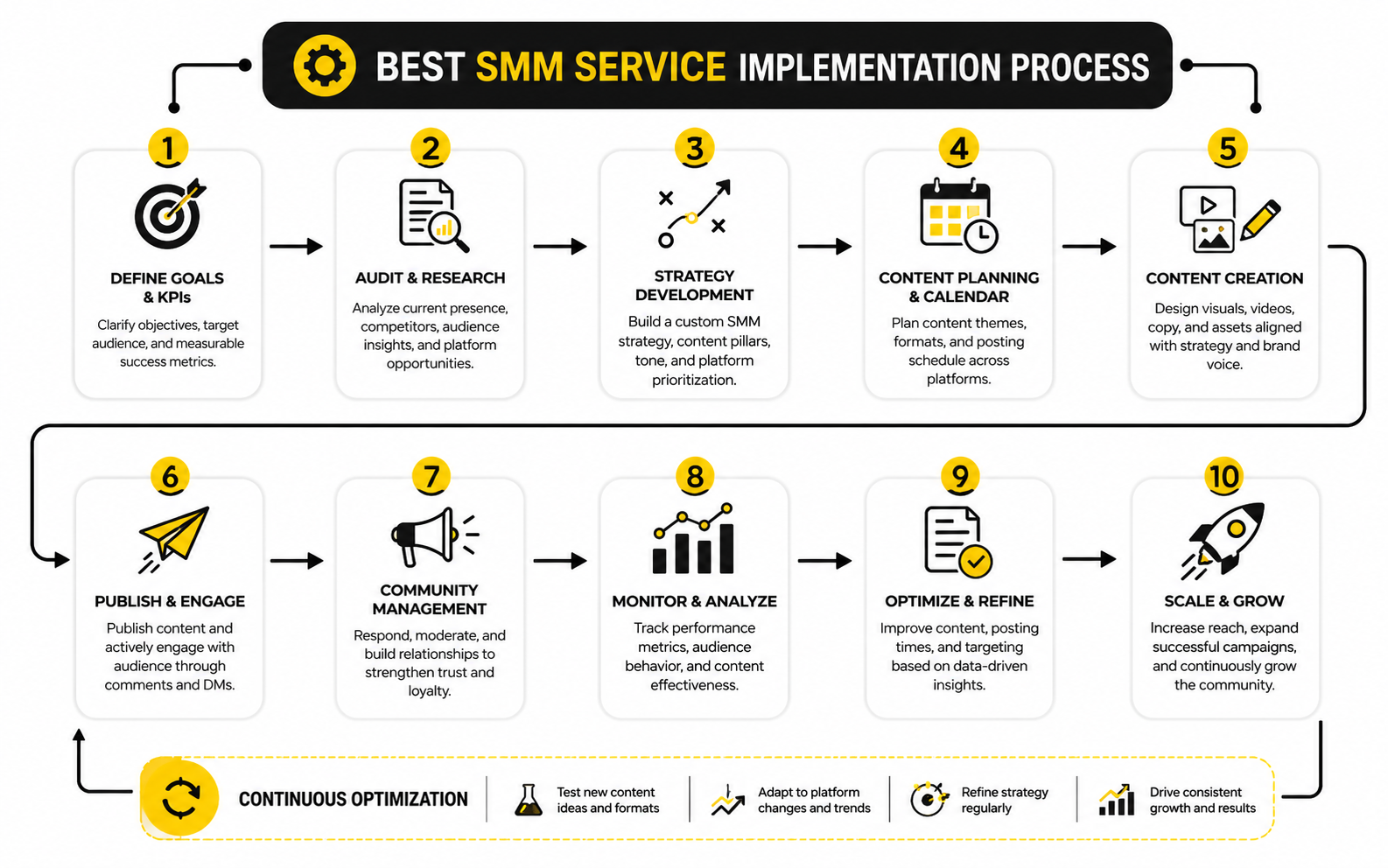
Step 4: Create the First Campaign Cycle
The first campaign cycle should be focused enough to learn from. Instead of posting everything at once, the provider should choose a clear objective, target audience, message angle, content mix, and conversion path. This creates a clean testing environment.
For example, a service business may run a 30-day campaign around one high-intent offer, using educational posts, objection-handling content, short-form video, customer proof, and DM follow-up. An ecommerce brand may test product-led creative, creator-style videos, social proof, and landing page variations. A SaaS company may focus on problem-aware content, feature education, demo requests, and founder-led authority posts.
The point is not to make the first cycle perfect. The point is to create enough structured activity to learn what the audience responds to. The best smm service uses early campaigns to sharpen the message, not to pretend it already has every answer.
Step 5: Set Up Review and Approval Workflows
Approval workflows can make or break execution. If the process is too loose, mistakes get published. If the process is too rigid, the brand misses timely opportunities. The right system gives the client control without turning every caption into a committee meeting.
A practical workflow usually defines who reviews strategy, who reviews facts, who reviews brand voice, and who gives final approval. It should also set deadlines, because delayed feedback creates rushed content. This is especially important when social posts involve regulated claims, product details, pricing, hiring, legal topics, or customer references.
The provider should also create rules for fast-turnaround content. Not every post needs a five-person review cycle. A mature SMM team knows which content can move quickly, which content needs approval, and which content should not be published without senior input.
Step 6: Publish, Monitor, and Respond
Publishing is only the beginning of the live work. Once content goes out, the provider should monitor comments, replies, shares, DMs, mentions, sentiment, and early performance signals. The first few hours can reveal whether a post is resonating, confusing people, or creating an unexpected opportunity.
Community response should be handled with care. A simple reply can start a sales conversation, calm a frustrated customer, or give the brand a more human voice. Social platforms reward interaction, but the bigger benefit is relationship-building.
This is where automation can support the process when it is used responsibly. If a campaign relies on comment-to-DM flows, lead capture, or automated follow-up, ManyChat can help turn engagement into structured conversations. The key is to keep the experience useful and human, not spammy.
Step 7: Review Performance and Adjust the Plan
The review process should happen on a steady rhythm. Weekly reviews can catch tactical issues, while monthly reviews can evaluate bigger patterns. Quarterly reviews are useful for strategy, budget, platform mix, and broader business alignment.
A good report should not drown the client in charts. It should explain what worked, what did not work, what changed, what the team learned, and what happens next. Benchmarks can help, but they should not replace the brand’s own data.
This is where a professional provider becomes more valuable over time. Sprout Social’s 2025 benchmark work, built on 3 billion messages across 1 million active public profiles, shows why context matters when judging performance. The best providers compare your results against your industry, your competitors, and your own historical performance before making recommendations.
Step 8: Connect Social Activity to the Sales System
The strongest SMM implementation connects social activity to the sales system. That means leads should not disappear into inboxes, spreadsheets, or untracked DMs. If social creates demand but the follow-up is slow or disorganized, the business loses money quietly.
For service businesses and agencies, this often means connecting social leads to CRM records, pipelines, reminders, bookings, email follow-up, and sales tasks. A platform like GoHighLevel can make sense when the business needs one place to manage lead capture, nurture, appointments, and client communication. The important part is not the logo of the tool; it is whether the handoff from attention to sales is reliable.
For ecommerce, the same principle applies through product pages, email flows, SMS, retargeting audiences, and post-purchase campaigns. Social media may start the relationship, but the revenue often comes from the system around it. The best smm service will care about that system because it knows content alone is rarely enough.
Step 9: Improve Creative Based on Real Feedback
Creative improvement should be based on what the audience actually does. Comments, watch time, saves, shares, click behavior, DMs, and sales conversations can all show where the message is landing or missing. This is better than guessing from internal opinions.
A strong provider should keep a learning log. Which hooks worked? Which pain points created replies? Which formats drove qualified traffic? Which posts attracted the wrong audience? These insights become more valuable with every campaign cycle.
This is also where the team should protect the brand from trend-chasing. The 2025 Hootsuite Social Trends report argues that top-performing teams are not simply jumping on every trend, but looking deeper at what is actually working through social media trend research. That is the right mindset: move fast, but do not let the algorithm drag the brand away from its strategy.
Step 10: Scale What Works Without Diluting the Brand
Scaling social media does not always mean posting more. Sometimes it means improving creative quality, adding a new platform, turning organic winners into paid ads, building creator partnerships, expanding community management, or connecting content to stronger funnels. The right move depends on what the data shows.
This is where many businesses make a mistake. They see one post perform well and try to copy it until the audience gets bored. A better provider studies why it worked, then develops variations that keep the core insight while changing the angle, format, proof, or call to action.
The best smm service scales with discipline. It protects positioning, keeps the audience in focus, and uses performance data to make sharper decisions. That is how social media becomes an asset instead of an endless content treadmill.
Statistics and Data
Measurement is where a best smm service stops sounding impressive and starts proving whether the work is moving in the right direction. The point is not to collect more numbers. The point is to understand which numbers explain attention, trust, intent, and revenue.
Bad reporting makes social media look either better or worse than it really is. A viral post can look successful while bringing the wrong audience, and a quieter post can be valuable if it creates qualified conversations or sales opportunities. That is why the right analytics system needs context, not just screenshots from platform dashboards.
The best smm service should help you read data like a decision-maker. The numbers should tell you what to keep, what to fix, what to stop, and what to test next. If the report does not lead to action, it is decoration.
Why Social Media Metrics Are Easy to Misread
Most social media metrics are useful only when you know what job the content was supposed to do. Reach is useful when the goal is visibility, but it is weak proof of business impact by itself. Engagement is useful when the goal is resonance, but it can be misleading if the engagement comes from people who will never buy.
This is where many brands get stuck. They judge every post with the same scorecard, even though different posts play different roles. A top-of-funnel educational post, a customer proof post, a launch announcement, and a direct-response offer should not be measured in exactly the same way.
A professional SMM provider should define the purpose before judging the performance. If a post is designed to attract new people, reach and watch time matter. If a post is designed to create sales conversations, replies, clicks, booked calls, and qualified DMs matter much more.
The Three Benchmark Layers That Actually Matter
Benchmarks are helpful, but only when they are used carefully. Industry benchmarks show how similar brands perform, competitive benchmarks show how your direct alternatives behave, and personal benchmarks show whether your own account is improving. The last one is usually the most important because it reflects your audience, offer, creative quality, and historical baseline.
Sprout Social’s 2025 benchmark research analyzed 3 billion messages across 1 million active public profiles, which makes it useful for understanding the scale of platform activity and industry-level comparison. But a benchmark should never become an excuse. If your industry has low engagement, that does not mean your content should be lazy.
The best smm service will compare performance against all three layers. It will ask whether the content is improving against your past results, whether competitors are creating stronger market signals, and whether the industry average is a realistic reference point. That is much more useful than saying, “This post did well because it got likes.”
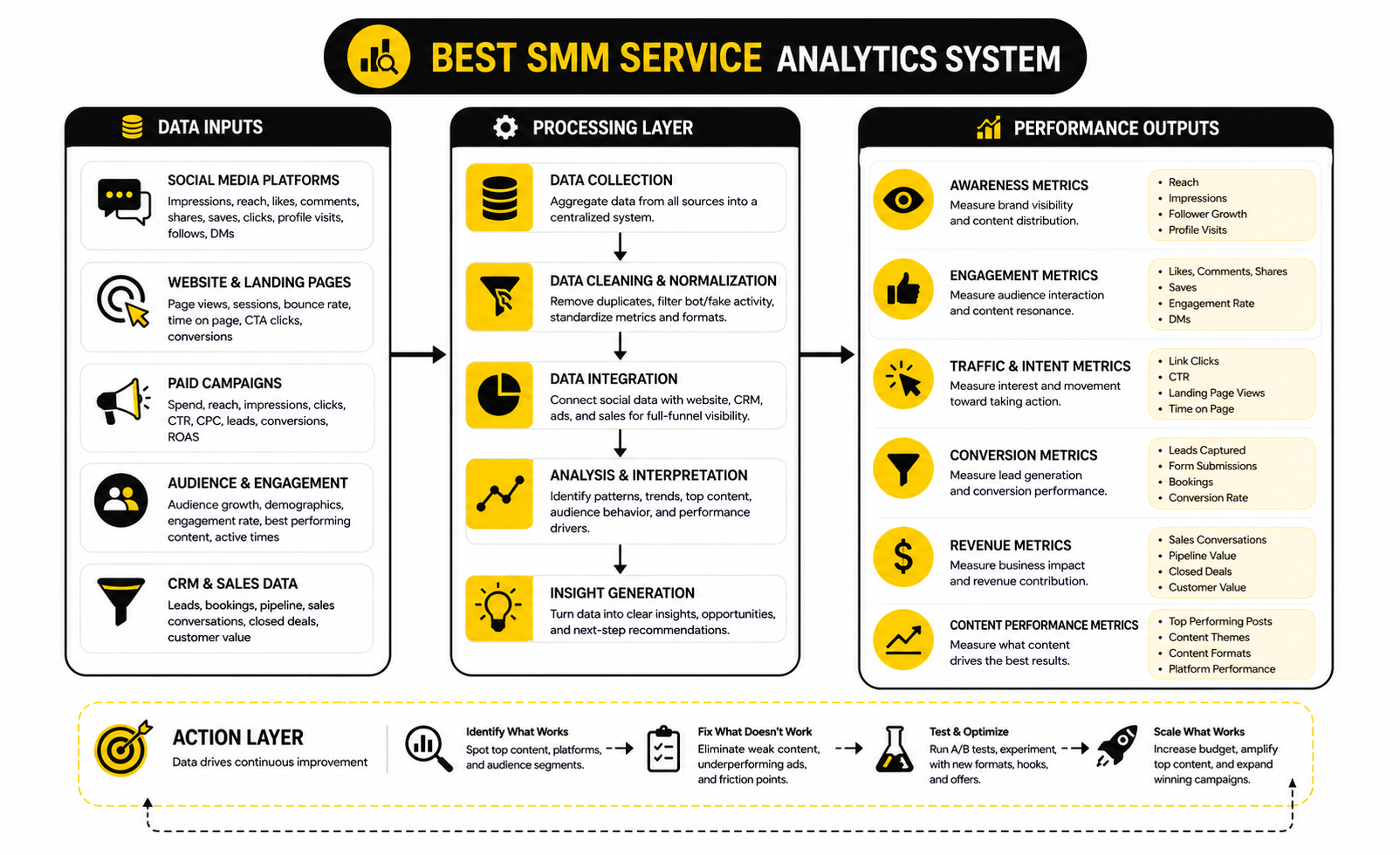
The Analytics System a Serious SMM Service Should Use
A strong analytics system should connect content performance to business movement. It should show how people move from seeing content, to interacting with the brand, to taking a meaningful next step. That does not mean every post must create direct sales, but the system should make the relationship visible.
The simplest useful structure is a four-stage measurement model:
This model keeps the team honest. It shows whether the problem is visibility, message resonance, conversion path, or sales follow-up. Without that separation, the business may blame the content when the real issue is the offer, landing page, CRM process, or response speed.
What the Data Should Change
Data is only useful when it changes behavior. If short-form videos get reach but no qualified traffic, the next move may be stronger calls to action, clearer audience targeting, or better content angles. If educational posts get saves but no inquiries, the brand may need more proof, offer clarity, and conversion content.
If comments reveal repeated objections, those objections should become future content. If DMs show that people are interested but confused, the offer may need simpler language. If social traffic reaches the website but does not convert, the provider should look beyond the platform and inspect the landing page, form, booking flow, or follow-up sequence.
This is why reporting should not be treated as an end-of-month ritual. The best smm service uses analytics as a feedback loop. Every useful insight should make the next campaign sharper.
Vanity Metrics Versus Business Metrics
Vanity metrics are not useless. They become dangerous when they are treated as final proof. A post with high reach can support awareness, but it does not automatically mean the brand is winning commercially.
Business metrics are closer to revenue, but they also need interpretation. A low number of booked calls may still be strong if the calls are highly qualified and the average deal size is high. A high number of leads may be weak if the sales team spends hours filtering out bad-fit inquiries.
The best measurement approach uses both. Vanity metrics help diagnose the top of the funnel, while business metrics show whether attention is turning into opportunity. You need both views, but you should never confuse one for the other.
The ROI Gap You Should Discuss Early
ROI is one of the most important social media conversations, but it is also one of the most misunderstood. Many businesses want a clean answer immediately, while many social campaigns influence buyers over multiple touches. The provider should be honest about what can be tracked directly, what can be inferred, and what should be judged over a longer window.
Sprout Social’s 2025 ROI research found that 65% of leaders want direct connections between social campaigns and business goals, while only 30% of marketers say they can measure social media ROI. That gap matters because it explains why so many client-provider relationships become tense. Leadership wants proof, but the measurement setup is often too weak to provide it.
A serious provider should address this before the campaign starts. They should define tracking links, conversion events, lead sources, CRM fields, attribution assumptions, and reporting cadence. If your SMM service waits until month three to ask how revenue is tracked, that is a red flag.
Platform Data Needs Business Context
Each platform rewards different behavior. TikTok may create fast discovery, Instagram may support visual trust and DMs, LinkedIn may build authority, YouTube may compound over time, and Facebook may still matter for local communities, groups, and certain paid campaigns. A number that looks weak on one platform may be normal on another.
That is why platform-native interpretation matters. A short-form video with strong watch time but low clicks may still be useful if the goal is awareness. A LinkedIn post with fewer impressions but several relevant comments from decision-makers may be more valuable than a broad viral post.
The best smm service should explain platform performance in plain business language. It should not hide behind algorithm talk. It should say what the numbers mean, why they likely happened, and what action the team will take next.
How to Measure Content Quality
Content quality is not just design quality. A beautiful post can fail if the hook is weak, the message is vague, or the audience does not care. A simple post can perform well if it says the right thing at the right moment.
Useful quality signals include retention, saves, shares, qualified comments, reply depth, profile visits, and downstream action. If people save a post, it may be useful. If people share it, it may be relevant to a broader conversation. If people reply with specific questions, it may be creating intent.
This is also where qualitative review matters. Numbers can tell you what happened, but comments and conversations often explain why. A good provider reads the audience, not just the dashboard.
How to Measure Community Health
Community health is harder to measure than reach, but it is often more valuable. A brand with a smaller but responsive audience can outperform a larger account with weak trust. The strength of the relationship matters.
Useful community signals include repeat commenters, quality of DMs, customer questions, sentiment, user-generated content, referrals, mentions, and the speed at which people respond to new content. These signals show whether the audience is passive or actually engaged with the brand. They also reveal whether the brand is becoming easier to trust.
Community data should influence the content plan. If people repeatedly ask beginner questions, the brand may need clearer education. If advanced users ask detailed implementation questions, the brand may be ready for deeper content, demos, or higher-intent offers.
How to Measure Conversion From Social
Conversion tracking should be practical, not overcomplicated. At minimum, a business should know which campaigns, platforms, and content types are creating clicks, leads, calls, purchases, or sales conversations. The setup does not need to be perfect to be useful, but it does need to be consistent.
For service businesses, this usually means tracking social-driven form fills, booked calls, qualified DMs, pipeline value, and closed revenue. For ecommerce, it means tracking product page visits, add-to-cart behavior, checkout starts, purchases, repeat purchases, and assisted conversions. For SaaS, it may include trial starts, demos, activation behavior, and expansion opportunities.
A CRM can make this much easier when social leads need structured follow-up. For businesses that want social activity connected to pipelines, appointments, automation, and lead nurturing, GoHighLevel can be a practical option. The point is not to buy more software; the point is to stop losing attribution and follow-up in messy inboxes.
The Reporting Cadence That Keeps Everyone Aligned
The best reporting cadence usually has three layers. Weekly check-ins catch tactical issues, monthly reports explain performance patterns, and quarterly reviews revisit strategy. This keeps the team from overreacting to one post while still moving fast enough to improve.
Weekly reviews should stay focused. They can cover publishing status, early winners, weak spots, comments, DMs, campaign issues, and immediate next actions. Monthly reviews can go deeper into content categories, platform performance, conversion paths, and audience learning.
Quarterly reviews should ask bigger questions. Are we on the right platforms? Is the offer clear enough? Are we attracting the right audience? Is the social strategy still aligned with the business model? This is where a provider becomes a strategic partner instead of a posting vendor.
The Numbers That Should Trigger Action
Not every metric needs a reaction. Some movement is normal, especially when platforms shift, campaigns change, or the audience is still learning what the brand stands for. The danger is reacting emotionally instead of analytically.
A few signals deserve attention quickly. If reach is low across every content type, the hooks, formats, publishing cadence, or platform fit may need work. If engagement is low but reach is healthy, the content may be too broad, too promotional, or not useful enough. If engagement is strong but conversions are weak, the offer, CTA, landing page, or follow-up path may be the bottleneck.
This is the practical value of measurement. It helps the team diagnose the constraint. The best smm service does not simply report that performance went up or down; it explains what likely caused the movement and what should happen next.
How to Know Whether the Service Is Improving
A good SMM service should get more carefully over time. The content should become more specific, the reporting should become more useful, and the strategy should become more connected to what the audience actually does. If month six feels as random as month one, something is wrong.
Improvement may show up in different ways. The brand may earn more qualified conversations, better-performing creative, stronger sales alignment, clearer positioning, more efficient content production, or better conversion from social traffic. Not all progress looks like a viral spike.
This is why the best smm service is measured by learning velocity as much as raw output. The team should be building a clearer picture of the audience, the offer, the channel mix, and the conversion path every month. That is what turns social media from a guessing game into a growth engine.
How to Compare SMM Service Providers Without Getting Misled
At this stage, the big question is not whether social media matters. It clearly does. The real question is how to choose a provider without getting pulled into attractive promises that do not match how growth actually works.
The best smm service should be evaluated like a strategic partner, not like a content vendor. That means looking beyond price, post volume, follower promises, and pretty portfolio screenshots. You need to understand how the provider thinks, how they operate, how they measure performance, and how they handle pressure when the first version of the plan does not work perfectly.
This is where many businesses make the wrong call. They compare packages instead of comparing judgment. A cheaper package may look better on paper, but if it skips strategy, conversion, reporting, or sales alignment, it can cost far more than it saves.
The Tradeoff Between Specialists and Full-Service Teams
A specialist can be the right choice when the business already has a strong internal strategy. For example, if you know exactly what you need and only lack short-form video editing, LinkedIn ghostwriting, paid social creative, or community management, a focused specialist may give you better output for the money. Specialists are often faster, sharper, and more cost-effective inside a narrow scope.
A full-service team makes more sense when the business needs strategy, production, publishing, analytics, and conversion support handled together. This is especially useful for founders, small teams, and agencies that do not have enough internal marketing capacity. The advantage is coordination, because one team can connect messaging, content, distribution, reporting, and follow-up.
The risk is that “full-service” can become a vague label. Some providers use it to mean they can do everything, but not necessarily well. The best smm service is honest about what it does deeply, what it does adequately, and what should be handled by another expert.
The Tradeoff Between Organic and Paid Social
Organic social is strong for trust, education, community, founder visibility, customer conversations, and long-term brand memory. Paid social is strong for controlled distribution, faster testing, retargeting, lead generation, and scaling proven messages. A smart SMM strategy does not treat these as enemies.
The problem starts when a provider pushes one side because that is the only thing they know how to sell. An organic-only provider may blame the algorithm when distribution is too limited. A paid-only provider may spend heavily before the message, offer, or creative system is strong enough.
The better approach is sequencing. Use organic content to learn what people care about, what they save, what they share, what questions they ask, and what proof they need. Then use paid distribution to amplify the best-performing angles, not to rescue weak messaging.
The Tradeoff Between Speed and Brand Control
Social media rewards speed, but businesses still need brand control. If the approval process is too slow, the brand misses trends, conversations, and market moments. If the process is too loose, the brand risks publishing inaccurate, off-tone, or legally sensitive content.
This tradeoff becomes more important as the business grows. A founder-led brand may be comfortable moving fast with rougher content. A regulated company, enterprise brand, health-related business, finance brand, or public-facing employer needs a tighter review process.
A serious provider should build guardrails, not bottlenecks. That means clear brand voice rules, approved claim language, escalation paths, pre-approved content formats, and defined review deadlines. The best smm service helps the brand move faster because the rules are clear.
The Tradeoff Between Volume and Quality
More content can create more learning, but only when the content has a purpose. Posting more weak content usually creates more noise. Posting less but with sharper positioning, stronger hooks, better creative, and clearer calls to action can often outperform a bloated calendar.
Volume matters most when the brand has enough strategic clarity and production capacity to sustain it. Short-form video platforms may need a higher testing rhythm, while LinkedIn or YouTube may reward depth, originality, and consistency over raw frequency. The right cadence depends on the platform and the business goal.
The provider should be able to explain why the recommended volume makes sense. If the answer is simply “the algorithm likes consistency,” that is not enough. Consistency matters, but only when the content is worth being consistent with.
The Tradeoff Between Automation and Human Judgment
Automation can improve speed, follow-up, and organization. It can help capture leads from comments, route DMs, tag prospects, send reminders, and keep opportunities from slipping through the cracks. But automation becomes a problem when it replaces real judgment.
This is especially true in community management. People can tell when a brand is replying with canned responses that ignore context. A social media system should make the human team faster and more consistent, not colder and more robotic.
For campaigns that rely on comments, DMs, and simple lead capture, ManyChat can be useful when the experience is designed carefully. For businesses that need social leads connected to CRM, appointments, nurture, and sales follow-up, GoHighLevel can support a more complete operating system. The tool choice should follow the process, not the other way around.
The Risk of Buying Followers, Engagement, or Fake Reach
This is the ugly side of the SMM market. Some services still sell followers, likes, comments, views, or “growth” that looks good for a moment and damages the account long term. It is not a shortcut. It is a liability.
Fake engagement pollutes your data. It makes it harder to understand who your real audience is, what they care about, and which content actually works. It can also reduce trust when real buyers notice that the numbers do not match the quality of conversation.
The best smm service will never need to sell fake proof. It should be comfortable building slower, cleaner, more durable growth. Real audience quality beats inflated vanity metrics every time.
The Risk of Trend Chasing
Trends can be useful, but they are not a strategy. A trend is only worth using when it fits the audience, brand voice, platform, and business objective. Otherwise, the brand becomes forgettable because it is borrowing attention without building meaning.
The 2025 Hootsuite Social Trends report highlights the shift toward deeper analysis of what actually works instead of copying trends blindly through social media trend research. That is the right lens. You can move quickly and still think strategically.
A good provider should know when to join a trend, when to adapt it, and when to ignore it. The last option is underrated. Saying no to the wrong trend protects positioning.
The Risk of Weak Offer Alignment
Social media cannot fix a weak offer forever. It can make more people aware of the offer, but if the market does not understand it, want it, trust it, or believe the value is worth the price, the campaign will struggle. This is why offer clarity is not separate from SMM.
A provider should be willing to challenge the offer when the data points there. If posts get attention but nobody clicks, the CTA may be weak. If people click but do not convert, the landing page or offer may be unclear. If leads come in but do not close, the sales process or qualification may need work.
This is where the best smm service becomes more valuable than a content factory. It does not just produce more posts when performance is weak. It asks where the real constraint is.
The Risk of Poor Attribution
Attribution is rarely perfect, especially when social media influences buyers over time. Someone may see five posts, watch a founder video, read comments, visit the website, leave, return through search, and book a call later. If the business only credits the final click, social may look less valuable than it is.
That does not mean attribution should be ignored. It means the provider should use a practical mix of tracking links, CRM source fields, platform analytics, post-purchase questions, sales-team feedback, and assisted conversion analysis. Clean enough is better than pretending everything can be measured perfectly.
This is especially important when comparing organic and paid social. Paid platforms may show clearer campaign numbers, while organic may shape trust before the buyer converts elsewhere. A serious SMM partner should help leadership understand both roles.
How to Evaluate a Proposal
A good proposal should make the provider’s thinking visible. It should explain the current problem, the opportunity, the recommended approach, the scope, the workflow, the reporting structure, and the expected learning period. It should not rely on vague claims about “boosting your online presence.”
Look for specific language. The proposal should explain which platforms matter, what content types will be produced, how approvals work, what metrics will be tracked, what the first 30 to 90 days will focus on, and what the client needs to provide. If the proposal is mostly deliverables and adjectives, ask better questions.
A strong proposal also includes boundaries. No provider can honestly guarantee viral growth, exact revenue, or permanent algorithm success. The best smm service will give you a realistic plan, a clear testing process, and a practical way to improve.
Questions to Ask Before Hiring
The right questions reveal how the provider thinks under the surface. You are not trying to trap them. You are trying to understand whether they have a real operating system or just confidence.
Ask questions like these:
The final question is one of the most important. A provider that can clearly say what it does not do is usually more trustworthy than one that claims to do everything. Confidence is good, but honest boundaries are better.
Red Flags That Should Slow You Down
Some warning signs are obvious. Guaranteed followers, guaranteed virality, suspiciously cheap packages, fake-looking testimonials, and no reporting process should all make you pause. But other red flags are more subtle.
Be careful when a provider talks only about posting frequency and never asks about the business model. Be careful when they focus on aesthetics but cannot explain messaging. Be careful when they report engagement but never discuss leads, sales conversations, or conversion paths.
Also be careful when the provider avoids accountability by blaming the algorithm for everything. Algorithms matter, but they are not the whole story. Strong providers diagnose performance across creative, audience, platform, offer, timing, and follow-up.
When to Keep SMM In-House
Hiring a service is not always the right answer. If your brand depends heavily on founder expertise, fast internal knowledge, or sensitive industry context, you may need to keep strategy and voice in-house. In that case, an external provider can support production, editing, scheduling, or reporting without owning the whole message.
In-house can also work well when the company has enough volume of ideas and customer insight. The internal team hears objections, product feedback, sales calls, customer wins, and operational details every day. That raw material is incredibly valuable.
The tradeoff is capacity. Internal teams often know the business better but lack time, creative production skill, or platform expertise. A hybrid model can work beautifully when the internal team owns insight and the external team turns it into consistent execution.
When to Hire an External SMM Service
An external provider makes sense when the business needs faster execution, better structure, specialized skills, or an outside perspective. This is common when the team is too busy, the brand has been inconsistent, or social media has become important enough to require a serious system. It can also help when leadership wants clearer reporting and accountability.
External support is especially useful when content needs to connect with a broader funnel. If social campaigns need landing pages, email follow-up, booking flows, or CRM tracking, the provider should understand the whole journey. For simple funnel building and offer testing, tools like ClickFunnels or Systeme.io may fit certain businesses better than a heavy custom setup.
The decision should come down to leverage. If an SMM service gives the business better thinking, better execution, better learning, and better follow-up than the internal team can manage alone, it is worth considering. If it only adds more posts, it is not enough.
How to Scale Without Breaking the Strategy
Scaling should happen after the team has evidence. That evidence may be a content angle that repeatedly earns qualified engagement, a platform that produces better leads, a campaign that converts, or a message that sales conversations keep confirming. Scaling too early usually amplifies confusion.
The safest scaling path is usually simple. Improve what already works, repurpose strong assets, add distribution gradually, turn organic winners into paid tests, strengthen conversion paths, and expand production only when quality can hold. This is not glamorous, but it is how durable growth is built.
The best smm service will not scale just to increase the invoice. It will scale when the signal is strong enough. That discipline matters because social media rewards consistency, but the business rewards profitable consistency.
Final Checklist, Tools, and FAQs for Choosing the Best SMM Service
The final decision should feel simple, not rushed. If you have read this far, you already know that the best smm service is not defined by post volume, trendy captions, or a big promise on a sales call. It is defined by fit, process, accountability, and the ability to connect social media work to a real business system.
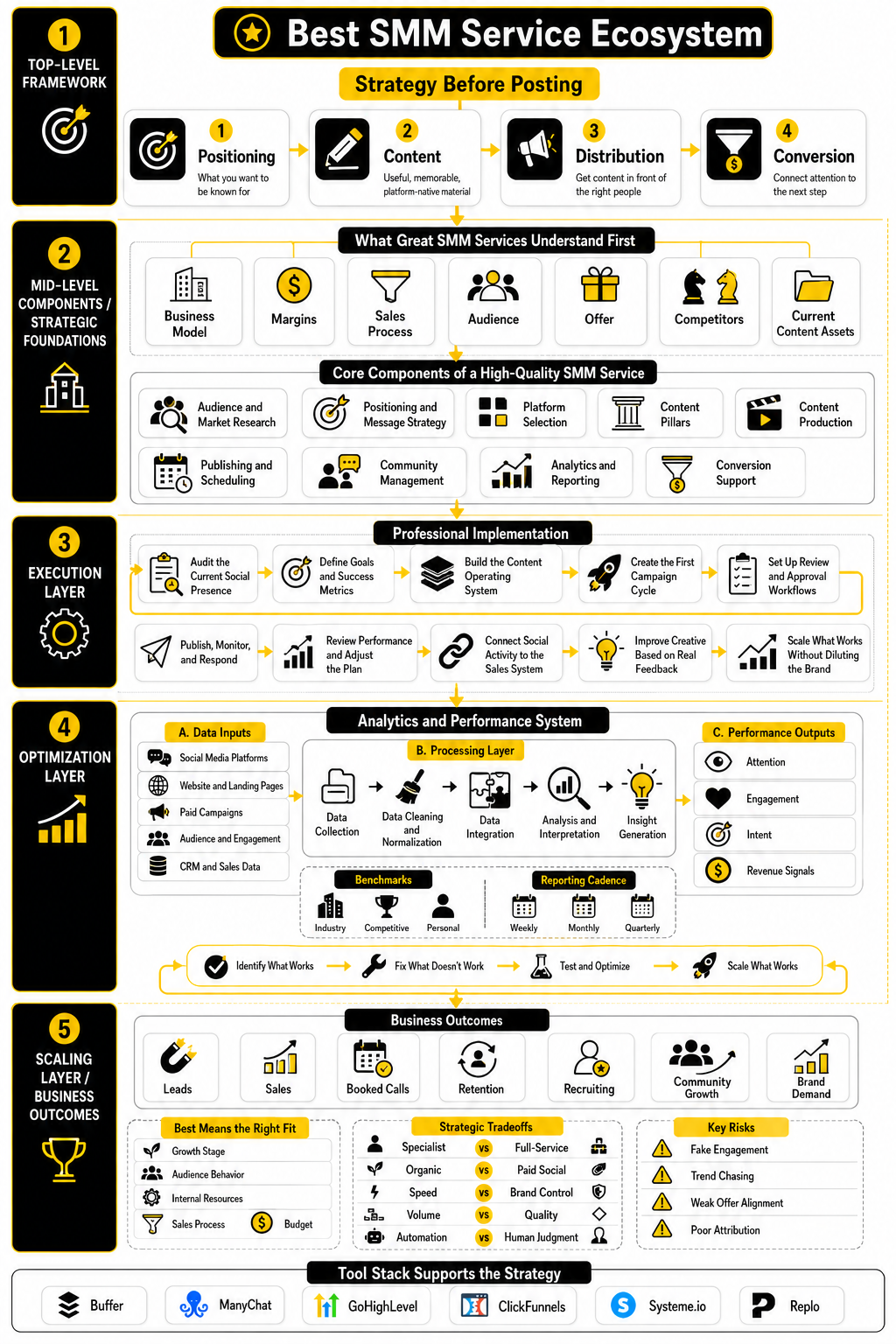
Before hiring anyone, step back and look at the full ecosystem. Social media touches positioning, content, community, analytics, conversion, follow-up, and customer experience. If one of those pieces is weak, even strong content can underperform.
That does not mean you need a massive team or complicated stack. It means you need a clear operating model. The right provider should help you make better decisions, not just publish more content.
The Final Selection Checklist
Use this checklist before you sign a contract. It will not make the decision for you, but it will expose weak proposals quickly. A provider that struggles with these basics is probably not ready to own an important growth channel.
A good SMM partner should make you feel more in control of the channel. You should understand the plan, the tradeoffs, the risks, and the next steps. If you feel confused after the proposal, that is usually a signal.
The Tool Stack Should Support the Strategy
Tools can improve the workflow, but they should never become the strategy. The best smm service may use scheduling tools, analytics dashboards, CRM systems, landing page builders, automation platforms, creative tools, and reporting templates. The question is whether those tools make the system clearer and more effective.
For scheduling and publishing, a platform like Buffer can help teams stay consistent across channels. For comment-to-DM flows and lead capture from social engagement, ManyChat can support campaigns where conversations are part of the conversion path. For CRM, pipeline, appointments, and follow-up, GoHighLevel can help service businesses avoid losing leads after the first social touch.
For funnel-focused campaigns, ClickFunnels and Systeme.io may fit businesses that need simple landing pages, lead magnets, and offer paths. For ecommerce teams that need higher-converting landing pages connected to social campaigns, Replo can make sense. Again, the principle is simple: pick tools because they support the process, not because they sound impressive.
What is an SMM service?
An SMM service is a social media marketing service that helps a business plan, create, publish, manage, measure, and improve content across social platforms. A basic provider may focus only on posting and scheduling. A stronger provider connects content with positioning, community, lead generation, reporting, and sales follow-up.
The important distinction is between social media activity and social media marketing. Activity keeps the account alive. Marketing uses the account to build trust, create demand, capture interest, and support revenue.
What makes the best smm service different from a regular social media manager?
The best smm service thinks beyond the content calendar. It starts with business goals, audience research, positioning, platform fit, campaign structure, and measurement. A regular social media manager may be excellent at execution, but they may not always own strategy or conversion.
That difference matters because businesses do not just need posts. They need a system that turns social media effort into learning, trust, pipeline, and growth. The best provider should bring both creative execution and commercial judgment.
How much should a business pay for an SMM service?
Pricing depends on scope, platform count, content volume, creative complexity, reporting depth, and whether strategy is included. A small execution-only package will cost much less than a full-service program with video, community management, analytics, paid creative, CRM coordination, and conversion support. The better question is whether the service can produce enough business value to justify the cost.
Do not compare prices without comparing responsibilities. One provider may charge less because they only schedule posts. Another may charge more because they handle strategy, production, reporting, and campaign improvement.
How long does it take to see results from SMM?
Some signals can appear quickly, especially engagement, comments, reach, DMs, profile visits, and clicks. Stronger business outcomes usually take longer because the team needs to test messaging, improve creative, build trust, and connect social activity to a conversion path. Social media is fast-moving, but buyer confidence is still built over time.
A serious provider should set expectations around learning cycles. The first phase is often about fixing the foundation and finding signal. The next phase is about repeating what works and improving what does not.
Which platforms should an SMM service manage?
The right platforms depend on the audience, offer, market, and content capacity. A B2B service company may prioritize LinkedIn, YouTube, and founder-led content. An ecommerce brand may lean into Instagram, TikTok, Pinterest, creator content, and paid social. A local business may need Facebook, Instagram, reviews, short-form video, and community-focused content.
The wrong answer is “everywhere” by default. Being active on too many platforms without enough quality control usually creates weak execution. A good provider should choose platforms based on strategy, not fear of missing out.
Should an SMM service create content or just manage posting?
Most businesses need more than posting management. Scheduling content is useful, but it does not solve positioning, creative quality, audience research, campaign planning, or conversion. If you already have a strong internal content team, posting support may be enough. If not, you probably need a provider that can create and improve the content itself.
The best arrangement depends on your internal strengths. Some companies keep strategy in-house and outsource editing or scheduling. Others need the SMM partner to own the full workflow.
How do I know if an SMM provider is using fake engagement?
Look for strange follower growth, generic comments, low-quality accounts, sudden engagement spikes with no business impact, or an audience that does not match your market. Fake growth often looks impressive in screenshots but weak in real conversations. It can also make reporting less useful because the data becomes polluted.
Ask the provider directly how they grow accounts and what tactics they avoid. If they talk about guaranteed followers, engagement pods, bot traffic, or suspicious “network promotion,” walk away. Real growth may be slower, but it is much safer.
Should SMM include paid ads?
Not always, but paid social can be powerful when the message and conversion path are ready. Organic content is often useful for testing ideas, building trust, and learning what the audience cares about. Paid ads can then amplify proven angles and drive more predictable distribution.
The mistake is spending heavily before the foundation is clear. If the offer, landing page, tracking, and creative are weak, paid ads simply make the problem more expensive. A strong provider will know when paid support is useful and when the brand needs more organic learning first.
What should be included in an SMM report?
A useful SMM report should include performance, interpretation, and next actions. It should show key metrics by objective, explain what the team learned, identify bottlenecks, and recommend what changes next. A report that only lists impressions, likes, and follower growth is not enough.
The strongest reports connect social metrics to business signals. That can include link clicks, DMs, lead quality, booked calls, product page visits, sales conversations, pipeline influence, or campaign-specific conversions. The exact metrics should match the campaign goal.
Can social media marketing work for small businesses?
Yes, but small businesses need focus. They usually cannot afford to waste time posting random content across five platforms. A small business should prioritize the channels where customers already spend time and create content that answers real buying questions.
The advantage small businesses have is proximity to the customer. They hear objections, questions, and feedback directly. A smart SMM service can turn that raw insight into content that feels practical, trustworthy, and useful.
Is AI useful for SMM services?
AI can be useful for research organization, content drafts, repurposing, brainstorming, reporting summaries, and workflow speed. It should not replace strategy, taste, brand judgment, customer understanding, or human community management. Used badly, AI makes content sound generic and forgettable.
The best providers use AI as an assistant, not as the voice of the brand. They still check facts, shape ideas, protect tone, and make sure the content reflects real expertise. That is the difference between faster production and lower-quality noise.
What is the biggest mistake businesses make when hiring an SMM service?
The biggest mistake is hiring for output instead of outcomes. Businesses often ask how many posts they will get before asking how the provider will improve positioning, learning, conversion, and reporting. That leads to busy calendars and weak results.
The better approach is to ask how the service will diagnose the current situation, build the first campaign cycle, measure performance, and improve over time. The best smm service should make the business more carefully every month. If it only makes the feed busier, it is not enough.
Do I need a CRM with an SMM service?
You do not always need a CRM, but you do need a reliable way to capture and follow up with opportunities. If leads come from DMs, comments, forms, bookings, or landing pages, those conversations should not be left in scattered inboxes. A CRM becomes more important as volume and sales complexity increase.
For service businesses, agencies, consultants, and local companies, a CRM can help connect social activity to appointments, pipelines, reminders, and nurture. That makes the sales side of social media easier to manage. Without it, the provider may create demand that the business fails to capture.
How do I choose between two good SMM providers?
Choose the provider that understands your business model better. Portfolios matter, but judgment matters more. A provider with a slightly smaller portfolio but a sharper grasp of your audience, offer, process, and measurement may outperform a bigger team with generic thinking.
Compare how they explain tradeoffs. The better provider will be honest about platform fit, timelines, risks, internal responsibilities, and what needs to happen after content is published. That kind of clarity is worth more than a polished pitch.
Build a stronger local presence with BAAM AI
Turn your website, Google profile, social channels, and AI visibility into one growth engine
Most businesses do not need more random marketing activity. They need a consistent presence system that helps the right people find them, trust them, and take action. BAAM AI brings strategy, local SEO, website updates, Google Maps visibility, social content, AI-search readiness, media production, and reporting into one practical monthly engine.
If you want your marketing to keep working after the campaign ends, start with a free BAAM AI presence audit. See how your business shows up today and where the fastest visibility wins are at BAAM AI.