
BAAM AI Blog
Best Email Marketing Strategies
Email marketing is not dead. Bad email marketing is dead. The brands still winning with email are not blasting random promotions to everyone on a list and hoping something sticks; they are building owned audiences...
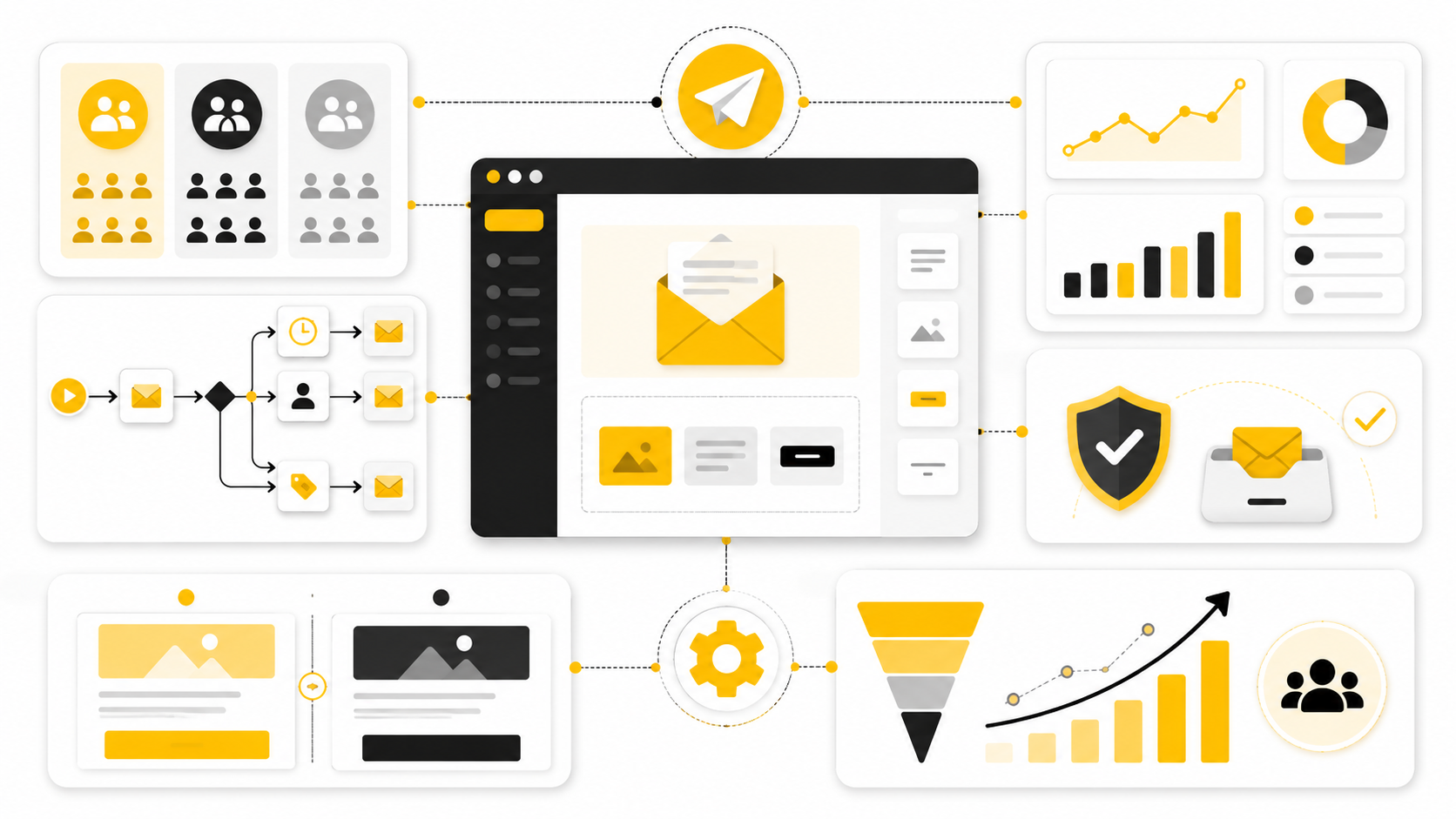
Email marketing is not dead. Bad email marketing is dead. The brands still winning with email are not blasting random promotions to everyone on a list and hoping something sticks; they are building owned audiences, collecting better signals, sending more relevant messages, and measuring the parts of the funnel that actually connect to revenue.
That is why the best email marketing strategies now look less like “send a newsletter every Tuesday” and more like a full customer communication system. Your list growth, segmentation, deliverability, offers, automation, creative, and reporting all have to work together. When one part breaks, the whole channel gets weaker.
This guide is built as a practical six-part playbook. Part 1 gives you the map. The next parts will go deeper into each section, so by the end, you will have a clear strategy you can use whether you run a small newsletter, an ecommerce brand, a service business, a SaaS funnel, or a local business follow-up system.
Why Email Marketing Strategy Still Matters
Email still matters because it is one of the few marketing channels where you are not completely dependent on an algorithm. Social platforms can change reach overnight, paid ads can get expensive fast, and search traffic can fluctuate with every major update. A well-built email list gives you a direct line to people who have already shown interest in your brand.
That does not mean every email list is valuable. A list full of cold, unengaged, or poorly matched contacts can hurt deliverability and waste time. A smaller list of people who actually want your emails is usually worth more than a huge list that ignores you.
The business case is also simple: email is measurable, repeatable, and easy to connect to the customer journey. Recent benchmark data from Mailchimp’s email marketing benchmarks shows that average performance varies heavily by industry, which is exactly why strategy matters more than generic best practices. You should not copy someone else’s open rate goal, send frequency, or automation structure without understanding your audience, offer, and buying cycle.
The Email Marketing Framework That Actually Works
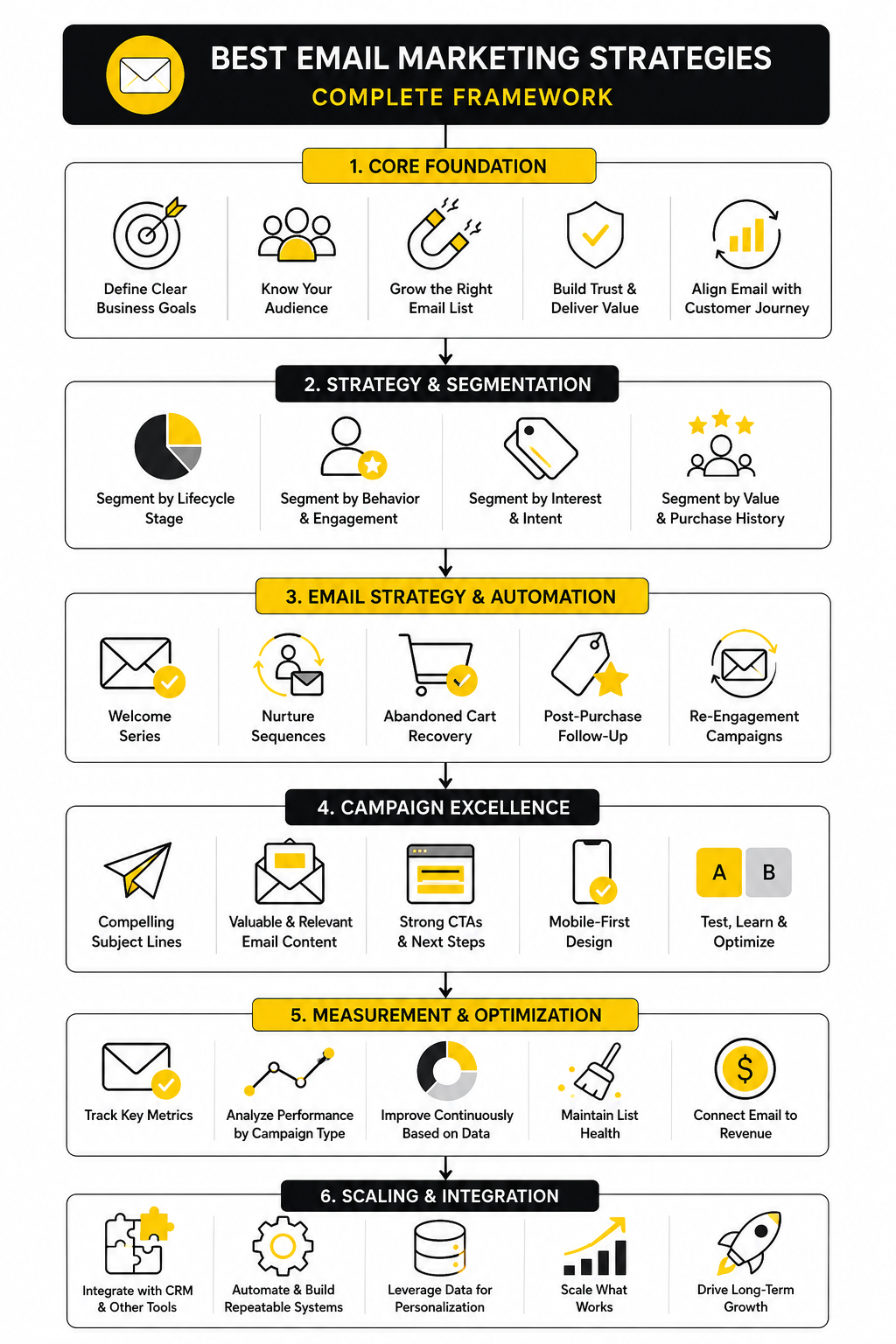
The best email marketing strategies usually follow the same core framework: attract the right subscribers, collect useful data, segment intelligently, send relevant messages, protect deliverability, and improve based on revenue-focused metrics. This sounds simple, but most businesses skip steps. They either focus too much on design, obsess over subject lines, or add automations before their positioning and offer are clear.
A strong framework starts before the first email is sent. You need to know who should be on the list, why they joined, what problem they want solved, and what next step makes sense for them. Without that, even the best automation software will only help you send irrelevant messages faster.
This is also where your tool stack matters. A business that mainly needs simple newsletters might use a platform like Brevo or Moosend, while an agency or local service business may need CRM, pipeline, SMS, and automation inside GoHighLevel. The right platform is the one that supports the strategy, not the one with the longest feature list.
Core Components of a Strong Email Marketing Strategy
A strong email strategy has four core components: list quality, message relevance, delivery trust, and measurable outcomes. List quality decides whether you are attracting the right people in the first place. Message relevance decides whether subscribers keep opening, clicking, replying, and buying.
Delivery trust is the part many marketers ignore until results drop. Gmail’s sender guidelines require authentication practices such as SPF, DKIM, and DMARC for different sender types, and bulk senders face stricter expectations around authentication, spam complaints, and unsubscribe access through Google’s email sender guidelines. If your emails cannot reliably reach the inbox, your copy, design, and offer do not get a fair chance.
Measurable outcomes keep the strategy honest. Opens can be useful directional signals, but clicks, replies, conversions, revenue, booked calls, retained customers, and unsubscribe behavior tell a clearer story. The goal is not to “do email marketing”; the goal is to create a communication system that helps subscribers take the next useful step.
Professional Implementation Starts With the Customer Journey
Professional email implementation starts by mapping the customer journey instead of writing random campaigns. A new subscriber does not need the same message as a repeat buyer, a dormant lead, or someone who abandoned a checkout. Each person is in a different context, so the strategy should match that context.
For most businesses, the first step is to define the major lifecycle stages. These usually include new subscriber, engaged lead, sales-qualified lead, first-time customer, repeat customer, inactive subscriber, and win-back opportunity. Once those stages are clear, you can design emails that move people forward instead of pushing the same promotion to everyone.
This is where automation becomes powerful, but only when it is built with restraint. Welcome sequences, lead nurture flows, abandoned cart emails, post-purchase follow-ups, review requests, and re-engagement campaigns can all work well when they are tied to real behavior. The mistake is building a huge automation map before you understand what the subscriber actually needs at each stage.
Building a High-Quality Email List
A high-quality list starts with permission, not volume. You want people who understand what they are signing up for, why it benefits them, and what kind of emails they will receive. That one detail changes everything because subscribers who join with clear expectations are more likely to engage and less likely to mark your emails as spam.
The best email marketing strategies usually avoid vague opt-ins like “join our newsletter” unless the brand already has strong trust. A better opt-in gives the reader a specific reason to subscribe. That could be a discount, checklist, guide, quiz result, product recommendation, private training, early access list, quote request follow-up, or useful ongoing content.
List growth should also match the buying journey. Someone reading an educational blog post may want a practical guide, while someone viewing a pricing page may want a demo, comparison, or offer. Treating those two people the same is lazy marketing, and lazy marketing gets ignored.
Use Lead Magnets That Attract Buyers, Not Just Subscribers
A lead magnet should attract the kind of person who could realistically become a customer. This is where many businesses go wrong. They create a freebie that gets downloads but has no connection to the paid offer, so the list grows while revenue stays flat.
A good lead magnet sits close to the problem your product or service solves. For example, an ecommerce brand could offer a sizing guide, buying checklist, product quiz, or first-order incentive. A service business could offer a calculator, audit, consultation, template, or decision guide that helps the prospect understand the problem before booking a call.
Tools can help, but the offer matters first. If you are building landing pages for ecommerce campaigns, Replo can fit naturally into product-specific list growth. If you need simple forms, surveys, quizzes, or intake flows, Fillout can help collect better subscriber data before the first email is sent.
Make Signup Intent Clear
Clear signup intent protects your deliverability and improves subscriber trust. People should not have to guess whether they are signing up for promotions, educational emails, appointment reminders, product updates, or all of the above. Confusion at the signup stage creates friction later.
This matters even more now because inbox providers are stricter about unwanted bulk email. Gmail defines a bulk sender as someone sending close to 5,000 or more messages to personal Gmail accounts in a 24-hour period, and its email sender guidelines emphasize authentication, easy unsubscribe, and low spam complaints. Even smaller senders should pay attention because these rules reflect where inbox filtering is heading.
Your forms should use plain language. Instead of hiding consent in tiny text, say what the subscriber will get and how often they can expect to hear from you. That does not make your marketing weaker; it filters out the wrong people before they damage your engagement.
Build Owned Data From the Start
The best list is not just a collection of email addresses. It is a database of useful customer signals. Those signals can include signup source, product interest, location, industry, budget, content topic, purchase history, quiz answers, lifecycle stage, and engagement behavior.
You do not need to collect everything at once. In fact, asking for too much information too early can reduce opt-in rates. Start with the data that helps you send a better next email, then collect more over time through clicks, forms, purchases, replies, and preference centers.
This is where email becomes more than a broadcast channel. When your email platform, CRM, forms, checkout, and calendar tools share clean data, you can build messages around real context. For service businesses, a CRM-driven platform like GoHighLevel can make sense because lead capture, pipeline stages, follow-up, and automation live closer together.
Segmentation, Personalization, and Customer Intent
Segmentation is not about creating complicated lists for the sake of looking advanced. It is about sending fewer irrelevant emails. That is the real win.
The simplest useful segments are based on what someone did, what they want, and where they are in the customer journey. A person who clicked a pricing link is showing different intent from someone who opened a general newsletter. A repeat customer deserves a different message from someone who has never bought.
Modern benchmark reports keep pointing in the same direction: performance depends heavily on relevance. Klaviyo’s 2024 ecommerce benchmark report was based on more than 325 billion emails, and the wide performance gaps across industries and campaign types make one thing clear: generic benchmarks are only useful when you compare them against your own audience, offer, and segment behavior.
Segment by Lifecycle Stage
Lifecycle segmentation is the cleanest place to start because it matches how people actually move through a business. A new subscriber needs orientation. A warm lead needs trust and proof. A first-time customer needs reassurance and onboarding. A loyal customer needs deeper value, cross-sells, replenishment, referrals, or VIP treatment.
This also stops you from over-promoting to the wrong people. Someone who just purchased should not immediately receive the same discount offer sent to non-buyers. That kind of mistake trains customers to wait for discounts and makes your brand feel careless.
Lifecycle stages do not need to be complex at the beginning. Start with new subscribers, engaged leads, customers, repeat customers, and inactive contacts. Once those are working, you can add more specific segments based on products, deal stage, purchase frequency, or predicted value.
Segment by Behavior
Behavioral segmentation is powerful because it is based on action, not assumptions. Opens are a weak signal on their own, but clicks, page visits, form submissions, purchases, booked calls, abandoned carts, and replies are much stronger. These actions show what the subscriber is actually interested in.
For ecommerce, behavior might include browsing a product category, abandoning checkout, buying a specific item, or reaching a replenishment window. For a service business, it might include watching a webinar, requesting pricing, booking a call, or not showing up for an appointment. Each behavior should trigger a message that feels like a helpful next step, not a robotic follow-up.
The key is to avoid overreacting to every tiny signal. One click does not always mean someone is ready to buy. Use behavior to guide the conversation, then let the subscriber’s next actions determine how aggressive or educational the follow-up should be.
Personalize With Context, Not Gimmicks
Personalization is not just adding a first name to the subject line. Real personalization changes the message based on what the person cares about. That could mean different offers, examples, product recommendations, proof points, send timing, or calls to action.
The goal is to make the email feel more relevant, not more creepy. Referencing every action someone took can feel uncomfortable. Using their behavior to send a better recommendation or remove irrelevant content feels useful.
This is especially important with AI becoming easier to plug into marketing tools. AI can help draft variations, summarize customer data, and speed up campaign production, but it should not replace strategy. The best email marketing strategies use automation to scale relevance while keeping the message grounded in real customer intent.
Campaigns, Automations, and Lifecycle Messaging
Once your list quality and segmentation are in place, the next step is execution. This is where email marketing becomes practical: what gets sent, when it gets sent, who receives it, and what action the email is supposed to create. Without that process, even the best email marketing strategies turn into random campaigns.
Think of your email program in two lanes. Campaigns are timely messages you send to a segment on purpose, such as launches, promotions, announcements, newsletters, seasonal offers, and content updates. Automations are behavior-based messages that run in the background, such as welcome sequences, abandoned checkout reminders, lead nurture flows, post-purchase emails, review requests, and win-back campaigns.
Both lanes matter. Campaigns help you stay active and create momentum. Automations help you follow up at the right moment without manually chasing every subscriber.
Build the Core Email Flows First
The biggest mistake is trying to build a massive automation system before the basics work. You do not need twenty flows on day one. You need the few flows that cover the moments where subscribers are most likely to need guidance.
Start with the lifecycle moments that almost every business has. A person joins your list, shows interest, considers buying, buys, needs onboarding, and eventually either comes back or goes quiet. Your first automations should support those moments clearly.
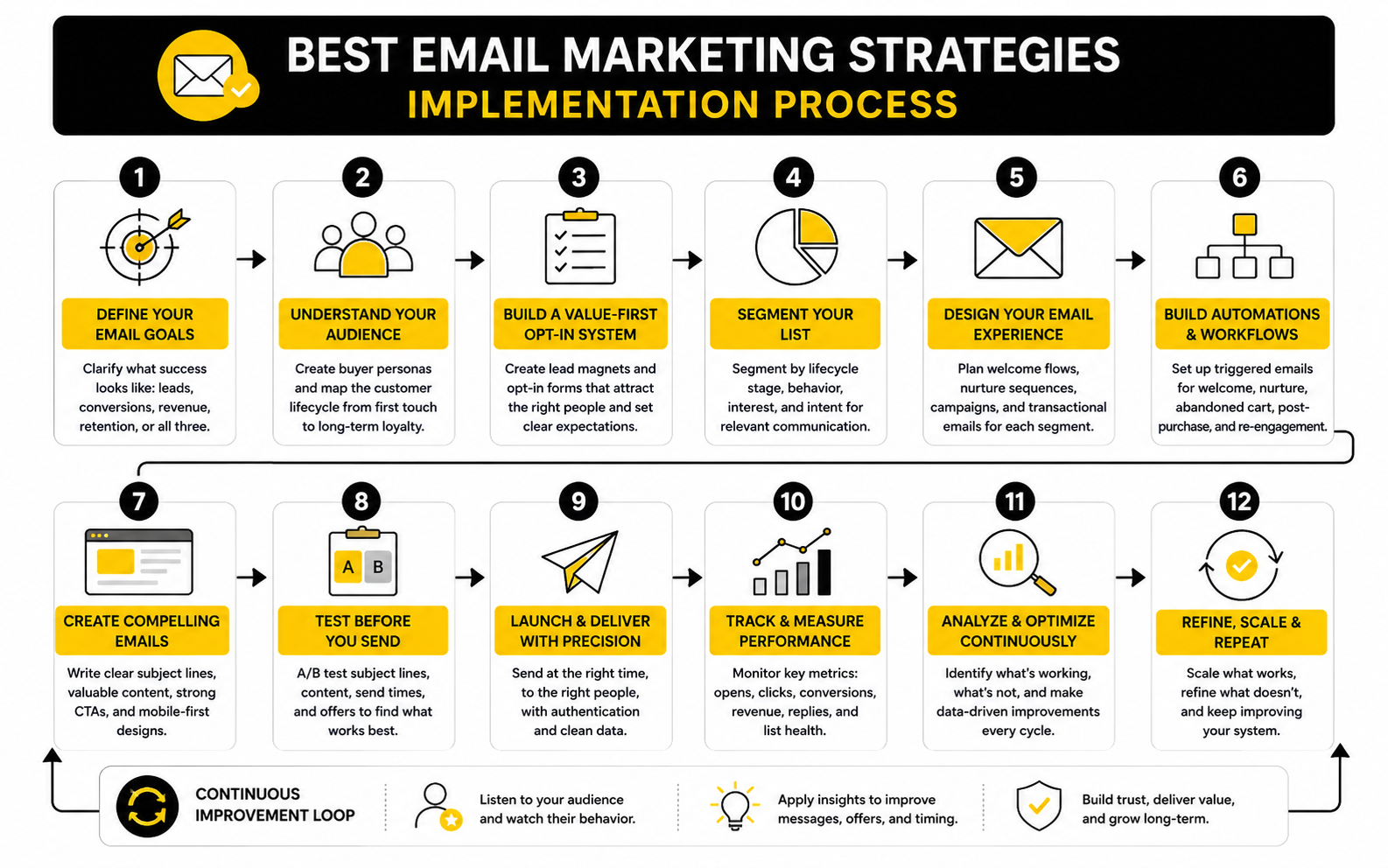
A simple implementation order looks like this:
This order keeps you focused. You are not building automations because they sound impressive; you are building them because each one supports a clear step in the customer journey.
Welcome Sequence
The welcome sequence sets the tone for the entire relationship. It should remind people why they joined, deliver the promised value, introduce your brand, and guide them toward the next logical step. This is not the place to throw every offer, link, and brand story at them at once.
A clean welcome sequence usually starts with immediate delivery. If someone requested a guide, discount, quiz result, checklist, or training, give it to them quickly. Then use the next few emails to explain the problem you solve, show useful proof, answer common objections, and invite the subscriber to take one clear action.
Keep the language human. The first emails should feel like a helpful handoff, not a corporate brochure. If the subscriber feels understood early, every later email has a better chance of working.
Lead Nurture Sequence
A lead nurture sequence is for people who are interested but not ready to buy yet. They may need education, trust, clarity, timing, budget approval, or a stronger reason to act. Your job is to help them move from curiosity to confidence.
Good nurture emails usually answer one question per message. What problem is costing them money? What mistakes should they avoid? What should they compare before choosing a solution? What does success look like after they take action?
For service businesses, this sequence can connect naturally to booking. A tool like Cal.com can make the call-to-action simple when a lead is ready to schedule. The email should not beg for the booking; it should make the next step feel obvious.
Sales and Offer Sequence
A sales sequence should focus on one offer, one audience, and one desired action. When you try to sell multiple things in one flow, the subscriber has to do the work of figuring out what matters. That usually reduces clicks and conversions.
A strong offer sequence builds pressure ethically. It explains the outcome, shows who the offer is for, handles objections, adds proof, and gives a clear reason to act now. Urgency should be real, not fake.
For funnel-based businesses, platforms like ClickFunnels or Systeme.io can support the page and checkout side of the campaign. The email sequence should do the trust-building and decision support, while the funnel page handles the focused conversion experience.
Match Email Type to Subscriber Intent
Not every subscriber needs the same kind of message. Someone who just joined from a blog post may need education. Someone who clicked a pricing page may need proof, comparison, or a reason to talk to sales. Someone who abandoned checkout may need reassurance, not another generic newsletter.
This is why intent-based email planning works better than calendar-only planning. A content calendar is useful, but it should not override subscriber behavior. If a person takes a high-intent action, your follow-up should reflect that action quickly.
The best way to think about intent is simple: low intent needs clarity, medium intent needs trust, and high intent needs help making a decision. When your emails match that stage, they feel useful instead of pushy.
Low-Intent Emails
Low-intent emails are for people who are still learning. They may have downloaded a guide, joined a newsletter, or clicked a general educational article. These subscribers are not necessarily ready for a sales pitch.
Your job here is to create familiarity and trust. Send practical advice, useful frameworks, mistakes to avoid, simple comparisons, and clear explanations. You can still include a soft call-to-action, but the main goal is to make the subscriber want to keep hearing from you.
Low-intent emails should not be boring. They should give the reader a small win or a sharper way to think about their problem. That is how you earn the right to send stronger offers later.
Medium-Intent Emails
Medium-intent emails are for subscribers who have shown interest in a specific solution, product, service, category, or outcome. They are warmer than a casual reader but may still need more confidence before taking action. This is where segmentation starts to pay off.
These emails should connect the subscriber’s interest to a relevant next step. If they viewed a product category, send buying guidance. If they attended a webinar, send the most important takeaway and the next action. If they started a quote request but did not finish, make it easy to continue.
Medium-intent emails are often where brands become too passive. Do not hide the offer. Explain why the next step makes sense, make it easy to act, and remove friction from the decision.
High-Intent Emails
High-intent emails go to people who are close to buying, booking, replying, or completing a conversion. These include abandoned checkout contacts, sales page clickers, demo request visitors, cart abandoners, repeat product viewers, and leads who have asked direct questions. This is not the time for vague education.
The message should be clear, specific, and action-oriented. Remind them what they were considering, address the likely blocker, and give one direct path forward. If support, urgency, guarantee, comparison, or social proof matters, include it.
High-intent does not mean aggressive. It means relevant. When someone has already shown buying behavior, a focused follow-up feels helpful because it matches what they were already trying to do.
Create a Repeatable Email Production Process
Professional email marketing needs a repeatable process. If every campaign starts from scratch, your team will move slowly, make more mistakes, and struggle to improve. A simple workflow keeps the strategy consistent without making the work feel robotic.
Start with the campaign goal. Then define the audience, offer, message angle, proof, call-to-action, send timing, suppression rules, and success metric. This keeps every email tied to a business purpose instead of becoming another “we should send something” task.
A practical production process looks like this:
This process is simple on purpose. You can add complexity later, but you should not need a giant operating manual to send good emails consistently. The basics done well beat a complicated workflow nobody follows.
Write Emails Around One Main Action
Every email should have one main job. That job might be getting a click, booking a call, completing checkout, replying to a question, reading a guide, watching a training, or using a product feature. If you cannot name the main action, the email is not ready.
This does not mean every email can only have one link. It means the message should point toward one decision. Multiple competing calls-to-action create hesitation, especially when the subscriber is reading quickly on mobile.
Before sending, ask one question: what should the reader do next? If the answer is unclear, simplify the email. Clarity is a conversion tool.
Use Templates Without Sounding Templated
Templates save time, but they should not make your emails feel copied and pasted. A good template gives you structure while still leaving room for real context. The goal is consistency, not sameness.
You can create templates for newsletters, product launches, promotions, nurture emails, abandoned checkout reminders, post-purchase follow-ups, and re-engagement campaigns. Each template should include the basic sections you need, such as opening hook, problem, value, proof, offer, and call-to-action. Then you customize the message based on the segment and intent.
This is where AI tools can help with speed, especially for first drafts, summaries, variations, and repurposing. But do not let AI flatten your voice. The final email should still sound like it came from a real brand with a real point of view.
Connect Email With the Rest of the Funnel
Email does not work in isolation. The email can create the click, but the landing page, checkout, booking page, sales call, onboarding experience, and product experience all influence the final result. If those pieces are weak, email gets blamed for problems it did not create.
For example, a strong abandoned checkout email cannot fully fix a confusing checkout page. A great nurture sequence cannot save an offer nobody understands. A polished newsletter will not create revenue if the landing page does not continue the same promise.
This is why implementation should include the whole path after the click. If the email promises a guide, the landing page should deliver it cleanly. If the email promotes a consultation, the booking flow should be simple. If the email sells a product, the product page should answer the questions that matter before the customer hesitates.
Align the Landing Page With the Email
The landing page should feel like the natural next step from the email. The headline, offer, proof, and call-to-action should match the promise that earned the click. Any mismatch creates doubt.
If the email says “get the checklist,” do not send people to a generic homepage. If the email promotes one product, do not send them to a broad category page unless that is the intended experience. Specific emails need specific destinations.
Tools like Replo can be useful when ecommerce teams need dedicated pages for campaigns, launches, bundles, or product education. For broader funnel builds, ClickFunnels and Systeme.io can help connect opt-ins, pages, offers, and follow-up into one flow.
Keep CRM and Email Data Clean
Clean data makes the whole system easier to run. Dirty data creates duplicate contacts, wrong segments, broken automations, awkward personalization, and bad reporting. This is not exciting work, but it is absolutely necessary.
Create simple rules for how contacts enter the system, how tags are applied, how lifecycle stages change, and when someone should be removed from a sequence. If multiple tools are involved, decide which one is the source of truth. Otherwise, every platform tells a different story.
For agencies, sales teams, and service businesses, a CRM-first setup can be practical because the email strategy is tied to lead status, pipeline movement, and follow-up tasks. GoHighLevel fits that kind of implementation when the goal is not just email sending, but managing the full lead-to-customer process.
Deliverability, Testing, Metrics, and Optimization
This is where email marketing gets serious. Sending emails is easy. Building a system where the right people receive the right emails, take the right action, and create measurable business value is the real work.
The best email marketing strategies do not treat analytics as a report you check after a campaign is over. They use measurement before, during, and after sending. Before sending, data helps you choose the audience and message. During sending, it helps you catch deliverability or engagement problems. After sending, it shows what to improve next.
Statistics and Data
Email data only matters when it changes your next decision. A high open rate is not automatically good, a low click rate is not automatically bad, and a strong revenue number can still hide serious list health problems. The goal is not to collect more metrics; the goal is to understand what the metrics are telling you.
Benchmarks are useful as reference points, not as universal targets. The DMA Email Benchmarking Report 2025 reported 98% delivery rates in 2024, 35.9% open rates, and 2.3% unique click rates. Those numbers help you see the broader market, but your own list quality, industry, offer, sender reputation, and audience intent will decide what “good” looks like for your business.
A better way to use benchmarks is to compare by email type. A welcome email should usually outperform a general newsletter because the subscriber just signed up. An abandoned checkout email should be judged differently from a thought-leadership campaign because the intent is much higher. If you compare every email against one average, you will make bad decisions from decent data.
Open Rate
Open rate is still useful, but it is no longer clean enough to be your main success metric. Apple’s Mail Privacy Protection changed how opens are reported because some opens can be automatically inflated or obscured. That does not make open rate useless, but it does mean you should treat it as a directional signal.
Use open rate to spot subject line strength, audience fatigue, sender recognition, and broad engagement trends. If open rates fall sharply across multiple campaigns, you may have a deliverability issue, list quality problem, weak subject lines, or too much sending volume. If one campaign has lower opens but higher revenue, the subject line may have filtered out casual readers and attracted better buyers.
The practical move is simple: track open rate, but do not worship it. Pair it with click rate, conversion rate, reply rate, unsubscribe rate, spam complaints, and revenue. That gives you a much clearer picture than obsessing over one number that may not fully represent human attention.
Click Rate
Click rate is usually a stronger engagement signal than open rate because it shows action. Someone had to see enough value in the email to move forward. That does not mean every email needs a high click rate, but it does mean clicks deserve serious attention.
When click rate is low, look at the offer, audience match, call-to-action, email clarity, and link placement. Many campaigns fail because the reader understands the message but does not see a strong enough reason to click. Others fail because the call-to-action is buried, vague, or competing with too many other links.
Click rate should also be read by segment. A 2% click rate from a cold newsletter segment may be fine, while the same number from a high-intent abandoned checkout segment may be weak. Context matters more than the raw percentage.
Conversion Rate
Conversion rate tells you whether the click turned into the outcome you wanted. That outcome could be a purchase, booking, form submission, reply, trial signup, quote request, or demo request. This is where email starts connecting to business value instead of vanity performance.
A weak conversion rate does not always mean the email failed. The landing page may be confusing, the offer may be unclear, the checkout may have friction, or the audience may not be ready. That is why you should measure the full path from send to open, click, landing page action, and final conversion.
For ecommerce, conversion rate should be viewed by campaign type and customer stage. For service businesses, it should be tied to booked calls, qualified opportunities, and closed revenue. The more expensive or complex the sale, the more important it becomes to track email influence across the full pipeline instead of only measuring last-click conversions.
Build an Email Analytics System
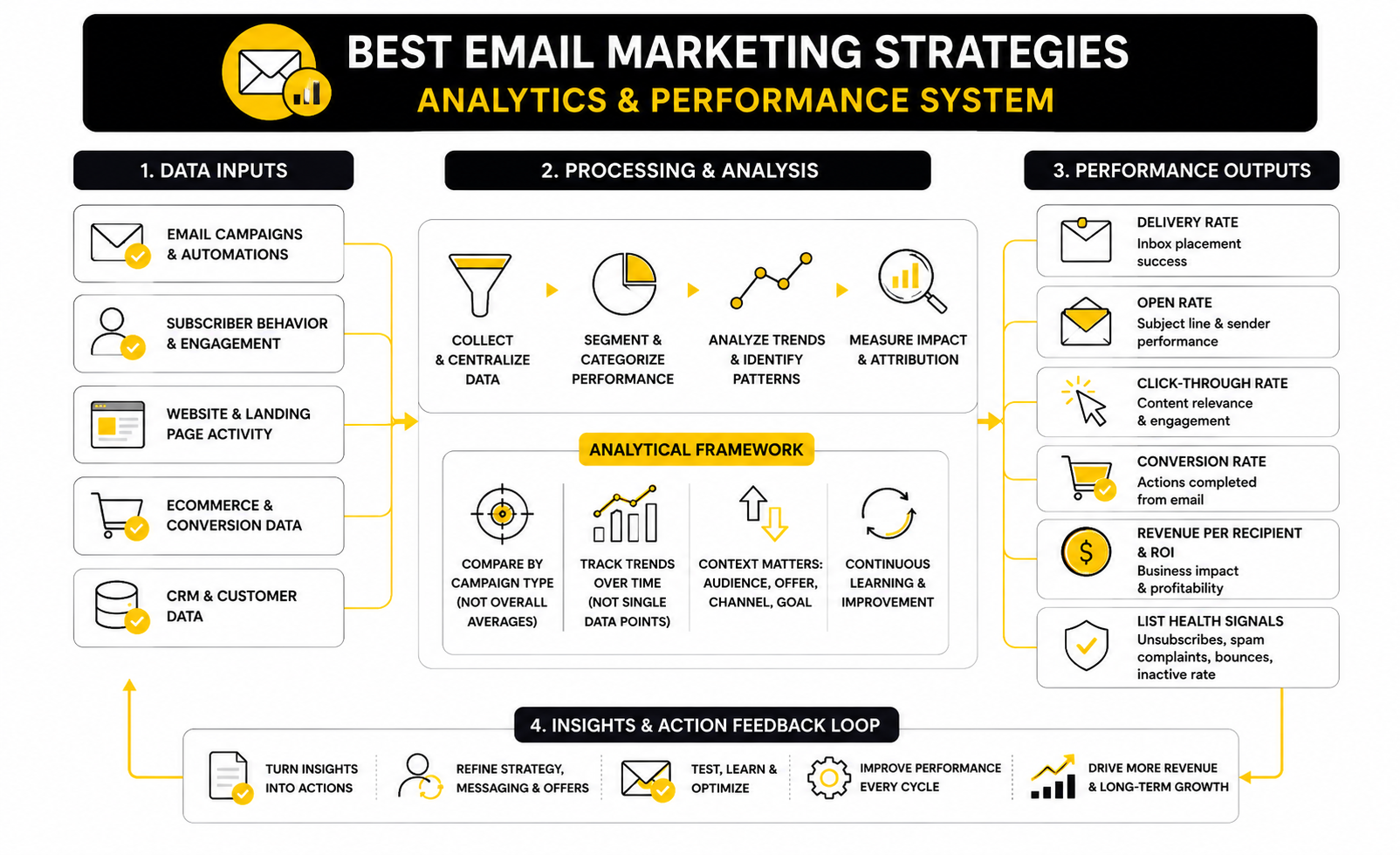
A useful analytics system should answer four questions: did the email reach people, did the right people engage, did they take the next step, and did that step create business value? If your reporting cannot answer those questions, it is incomplete. Pretty dashboards do not matter if they do not help you make better decisions.
Start with a simple scorecard for every campaign and automation. Track delivery rate, bounce rate, open rate, click rate, conversion rate, unsubscribe rate, spam complaint rate, revenue or pipeline created, and notes about the offer, audience, and send timing. The notes matter because numbers without context are easy to misread.
Then review performance by category, not just by individual email. Compare welcome emails against welcome emails, promotions against promotions, nurture emails against nurture emails, and win-back emails against win-back emails. This shows you what is improving and what is broken without letting one unusually good or bad campaign distort the whole strategy.
Track Deliverability Before It Hurts Revenue
Deliverability is not just a technical problem. It is a revenue problem. If your emails do not reach the inbox, your copy, segmentation, and offer never get a real chance.
Google’s sender requirements make this very clear. Bulk senders need proper authentication, low spam complaints, and easy unsubscribe, and Google’s sender guidelines specifically emphasize SPF, DKIM, DMARC, and user-friendly unsubscribe practices. The Gmail sender guidelines FAQ also states that bulk senders remain ineligible for mitigation when user-reported spam rates are greater than 0.3%.
Do not wait until performance collapses to care about this. Monitor bounce rates, spam complaints, domain authentication, blocklist issues, and sudden engagement drops. If your list is old, inactive, or poorly sourced, cleaning it can improve the entire program.
Separate Campaign Metrics From Automation Metrics
Campaigns and automations should not be judged the same way. A campaign is usually tied to a moment in time, such as a launch, promotion, newsletter, or announcement. An automation is tied to behavior and runs continuously.
Campaign reporting should focus on audience match, offer strength, creative angle, send timing, and short-term action. Automation reporting should focus on flow health, step-by-step drop-off, conversion by trigger, time delay performance, and lifecycle impact. A welcome flow, for example, should be judged on whether it turns new subscribers into engaged leads or customers over time.
This separation makes optimization easier. If a campaign underperforms, you may need a better offer or segment. If an automation underperforms, you may need to adjust timing, message order, trigger logic, or suppression rules.
Measure Revenue Without Getting Lazy
Revenue is one of the most important email metrics, but it can also be misleading. Last-click revenue may undercount emails that influenced the decision earlier. Platform-attributed revenue may overcount if the attribution window is too generous.
The practical answer is not to ignore revenue. It is to understand how your platform counts it. Look at last-click revenue, assisted revenue, total campaign revenue, revenue per recipient, average order value, booked calls, pipeline value, and repeat purchase behavior where relevant.
For ecommerce, revenue per recipient is especially useful because it connects performance to list quality and offer strength. For service businesses, pipeline and closed-won revenue often matter more than instant conversions. The best email marketing strategies connect email activity to the real way the business makes money.
Testing That Actually Improves Performance
Testing should help you make better decisions, not create busywork. Randomly testing subject lines every week without a hypothesis will not build a more carefully email program. You need to test things that can change future campaigns.
Start with high-impact variables. Test audience segments, offers, calls-to-action, email angles, send timing, landing pages, and flow timing before obsessing over tiny design changes. A button color test is rarely more important than whether the email is going to the right people with the right offer.
Good testing also requires patience. If your list is small, one test may not produce a reliable answer. In that case, look for patterns across multiple campaigns instead of pretending one result proves everything.
Test the Offer Before the Design
The offer usually matters more than the design. A clear, relevant offer in a simple email can outperform a beautiful email with weak positioning. Design supports the message, but it does not replace the reason to act.
Before testing layout details, test what the subscriber is being asked to do. Try different lead magnets, bundles, consultation angles, discounts, urgency windows, proof points, or educational promises. These tests teach you what your audience actually values.
This is where many teams waste time. They polish the email while ignoring the fact that the offer is not compelling. Fix the reason to click first, then make the email easier to read and act on.
Test Segments Against Each Other
Segment testing helps you understand where demand is strongest. Instead of sending one campaign to everyone, test how different segments respond to the same message. You may find that one audience is far more profitable, even if it is smaller.
This can guide future content, offers, and list growth. If buyers from one lead magnet consistently convert better, promote that lead magnet more. If a specific product-interest segment clicks but does not buy, the problem may be the landing page or offer, not the email.
Segment testing also prevents false conclusions. A campaign may look average overall because one segment loved it and another ignored it. When you separate the data, the next move becomes obvious.
Test Timing and Frequency Carefully
Send frequency is not about how often you want to email. It is about how often your subscribers find your emails useful. That answer changes by audience, industry, season, and lifecycle stage.
A daily email can work for a highly engaged audience that expects frequent value. A monthly email can fail if it shows up with no context and no relationship. Frequency is not good or bad by itself; relevance decides whether it feels welcome or annoying.
Watch the combination of engagement, unsubscribes, spam complaints, and revenue. If revenue rises while complaints and unsubscribes stay controlled, frequency may be helping. If engagement drops and complaints rise, you are probably pushing past the list’s trust limit.
Turn Data Into Better Decisions
Data should lead to action. If a report does not change what you send, who you send to, or how you build the customer journey, it is not useful enough. The point is to create a feedback loop that improves the next campaign.
Review every campaign with three questions. What worked? What did not work? What will we change next time? Keep the answers short and practical so the team actually uses them.
Over time, this gives you a real email playbook. You will know which segments respond, which offers convert, which subject line angles create quality attention, which flows drive revenue, and which messages create fatigue. That is when email stops feeling like guesswork and starts becoming a reliable growth channel.
Best Email Marketing Tools and Platform Choices
The best email marketing strategies are not built around tools first. They are built around the customer journey, then supported by tools that make the journey easier to manage. That distinction matters because switching platforms will not fix weak offers, unclear segmentation, poor deliverability, or emails nobody wants to read.
A good platform should help you capture leads, organize subscriber data, send relevant messages, automate follow-up, measure performance, and stay compliant. A great platform should do those things without forcing your team into a workflow that is too complicated to maintain. The right choice depends on your business model, list size, sales cycle, technical skill, and how deeply email needs to connect with your CRM, landing pages, checkout, calendar, and support process.
Do not choose a tool because everyone on social media is talking about it. Choose the tool that matches your operating reality. A creator with a simple newsletter, an ecommerce brand with product-based automation, and an agency managing local business follow-up all need different systems.
Choose Based on Business Model
For ecommerce, the platform needs strong segmentation, product feeds, abandoned checkout flows, post-purchase automation, replenishment timing, customer lifetime value reporting, and revenue attribution. This is where automation and segmentation can become serious growth levers because purchase behavior gives you rich intent data. The closer your platform is to product and customer data, the easier it becomes to send emails that feel relevant instead of generic.
For service businesses, the priority is usually lead capture, CRM stages, appointment booking, pipeline visibility, reminders, and sales follow-up. Email is still important, but it is only one part of the conversion path. A platform like GoHighLevel can make sense when you need email, SMS, forms, calendars, pipelines, and automation working together instead of scattered across disconnected tools.
For funnels, digital products, and simple online offers, the system needs to connect opt-ins, landing pages, checkout, email follow-up, and upsells cleanly. ClickFunnels and Systeme.io can fit when the main goal is building a focused conversion path from subscriber to buyer. The tool should reduce friction, not add another layer of technical work.
Do Not Overbuy Too Early
Advanced software can become a liability when the team is not ready for it. If you only need basic newsletters, one lead magnet, and a simple welcome sequence, you probably do not need an enterprise-level automation setup. Paying for complexity before you have a clear process is one of the fastest ways to slow yourself down.
Start with the features you will actually use in the next 90 days. You need reliable sending, clean contact management, basic segmentation, simple automations, reporting, and easy integration with your existing funnel. Once those pieces are working, upgrading becomes a strategic move instead of a panic decision.
This is also why simpler tools still have a place. Platforms like Brevo or Moosend can work well when the strategy is straightforward and the team needs speed more than a heavy CRM buildout.
Make Integration a Priority
Email performance depends heavily on the data flowing into the platform. If your email tool does not know who purchased, who booked, who abandoned, who replied, or who became inactive, your segmentation will always be limited. That is why integration matters more than most people think.
At minimum, your email system should connect with your forms, landing pages, checkout, CRM, analytics, and calendar. If those tools cannot share data reliably, your automations will either miss important signals or trigger at the wrong time. Both problems make the brand look less professional.
A clean stack also makes reporting more trustworthy. When your email platform, CRM, and sales data agree, you can make decisions with confidence. When they disagree, the team wastes time debating dashboards instead of improving the customer journey.
Common Email Marketing Mistakes to Avoid
Most email marketing problems are not caused by one bad subject line. They usually come from a broken system. The list is too broad, the segmentation is weak, the offer is unclear, the sending frequency is random, or the follow-up does not match the subscriber’s intent.
The good news is that these mistakes are fixable. You do not need to rebuild everything overnight. You need to identify the highest-leverage problem first and improve the system one layer at a time.
The dangerous part is ignoring the warning signs. If engagement is falling, complaints are rising, conversions are weak, or revenue attribution is unclear, do not keep sending more of the same. More volume rarely fixes a trust problem.
Sending to Everyone
Sending every campaign to every subscriber feels efficient, but it usually weakens performance over time. A broad send may create short-term clicks, yet it also trains people to ignore you when the message is not relevant. That damage compounds.
Segmentation does not need to be complicated to help. Separate customers from non-customers, engaged contacts from inactive contacts, and high-intent leads from casual readers. Even those basic splits can improve message fit and reduce unnecessary list fatigue.
The goal is not to create hundreds of tiny segments nobody can manage. The goal is to stop treating different people as if they are in the same situation. That is the foundation of practical email strategy.
Letting Inactive Contacts Drag Down the List
Inactive contacts are not harmless. If a large portion of your list consistently ignores your emails, inbox providers may read that as a negative engagement signal. Over time, that can make it harder for engaged subscribers to see your messages too.
This does not mean you should delete everyone who missed a few emails. It means you need a clear process for re-engagement and suppression. Give inactive contacts a chance to confirm they still want to hear from you, then stop sending regular campaigns to people who do not respond.
List cleaning feels uncomfortable because the subscriber count goes down. But subscriber count is not the asset. Attention is the asset.
Confusing Automation With Strategy
Automation can make a good strategy faster. It can also make a bad strategy louder. If the message is irrelevant, automating it does not make it more carefully.
Before building a flow, define the trigger, audience, goal, timing, message logic, exit condition, and success metric. If you cannot explain why the automation exists, it probably should not exist yet. A simple flow with a clear purpose beats a complicated flow full of unnecessary branches.
This matters even more as AI becomes common in email tools. AI can speed up drafting, testing, and segmentation ideas, but it should not decide the entire strategy without human judgment. The brand still needs a point of view.
Ignoring Compliance and Consent
Compliance is not just legal housekeeping. It is part of trust. Subscribers should know what they signed up for, have a clear way to unsubscribe, and receive messages that match the permission they gave.
Rules vary by region, but the direction is clear: permission, transparency, authentication, and easy opt-out matter. Google’s sender guidance pushes senders toward authentication, low spam complaints, and simple unsubscribe experiences, and the Gmail sender FAQ says senders should keep spam rates below 0.1% and avoid reaching 0.3% or higher. Treat that as a practical trust benchmark, not just a technical rule.
A clean unsubscribe is not a loss. It is better for someone to leave normally than to report you as spam. Protecting sender reputation protects future revenue.
Advanced Email Marketing Strategies for Growth
Once the fundamentals are working, the next level is not “send more emails.” The next level is using email to support better customer experiences, stronger retention, higher lifetime value, and more carefully acquisition. This is where email becomes a growth system instead of a campaign channel.
Advanced strategy usually means better timing, better context, and better coordination with the rest of the business. It also means accepting tradeoffs. More personalization can improve relevance, but it requires cleaner data. More automation can improve speed, but it increases maintenance. More sending can increase revenue, but it can also create fatigue.
The key is to scale carefully. Growth should not come at the cost of trust.
Use Predictive Signals Carefully
Predictive signals can help you decide who is likely to buy, churn, repeat purchase, or respond to an offer. That can make email more efficient because you are not treating every subscriber the same. But predictive data is only useful when the underlying behavior is reliable.
Do not build an entire strategy around a score you do not understand. Look at what drives the prediction, how often it updates, and whether it matches real customer outcomes. If a predictive segment looks promising, test it against a control group before making it central to your strategy.
The practical use is prioritization. High-intent or high-value segments may deserve more direct offers, earlier access, or sales follow-up. Lower-intent segments may need education, content, or slower nurture before a conversion ask.
Build Retention Into the Email Strategy
Acquisition gets attention, but retention often creates the profit. Once someone buys, the email strategy should not go quiet or instantly jump to another hard sell. The post-purchase experience is where you can reduce regret, improve product use, encourage repeat purchases, and create stronger customer loyalty.
A good retention system may include onboarding, usage tips, replenishment reminders, care instructions, customer education, review requests, referral prompts, and VIP offers. Each email should help the customer get more value from the decision they already made. That is how you earn the next purchase.
Retention email also gives you better data. Repeat purchases, product preferences, review sentiment, support questions, and engagement patterns can all improve future segmentation. The customer relationship gets more carefully with every useful interaction.
Coordinate Email With SMS, Chat, and Retargeting
Email works better when it is part of a coordinated communication strategy. Some messages belong in email because they need space and context. Others work better as SMS, chat, or retargeting because the timing is urgent or the action is simple.
Do not use every channel just because you can. Use each channel for the job it does best. Email is strong for education, storytelling, offers, onboarding, and relationship-building. SMS is better for short, timely prompts. Chat can be useful for direct questions, quick qualification, and interactive support.
For brands using conversational follow-up, ManyChat can support messaging flows that complement email instead of replacing it. The point is not to spam people across more channels. The point is to make the next step easier in the channel that fits the moment.
Use Preference Centers to Reduce Fatigue
A preference center gives subscribers more control. Instead of forcing them to choose between receiving everything or unsubscribing completely, you can let them choose topics, frequency, product interests, or message types. That can preserve relationships that would otherwise be lost.
This is especially useful for brands with multiple product lines, content categories, locations, or audience types. Someone may want educational content but not promotions. Another person may want product drops but not weekly newsletters. Giving people options can keep them engaged longer.
Keep the preference center simple. Too many choices create friction. Offer the few choices that actually change what you send, then respect those choices consistently.
Scale With Governance
As the email program grows, governance becomes important. That means clear rules for who can send, what gets approved, how segments are used, how often subscribers can be contacted, how tests are documented, and how data is maintained. Without governance, growth turns into chaos.
This is not about slowing the team down. It is about protecting the channel. Email is an owned asset, and owned assets need discipline.
Create a simple operating rhythm. Review campaign performance weekly, automation health monthly, list quality regularly, and strategy quarterly. That keeps the system improving without letting small problems quietly become expensive ones.
Email Marketing Strategy Checklist
At this point, the strategy should feel like a system, not a pile of disconnected tactics. You have the list, the segments, the lifecycle flows, the campaign process, the measurement layer, and the tool choices. Now the job is to keep everything aligned so the channel can grow without becoming messy.
Use this checklist as a final pressure test before scaling. If one area is weak, fix that first instead of adding more campaigns. The best email marketing strategies get stronger because each part supports the next part.
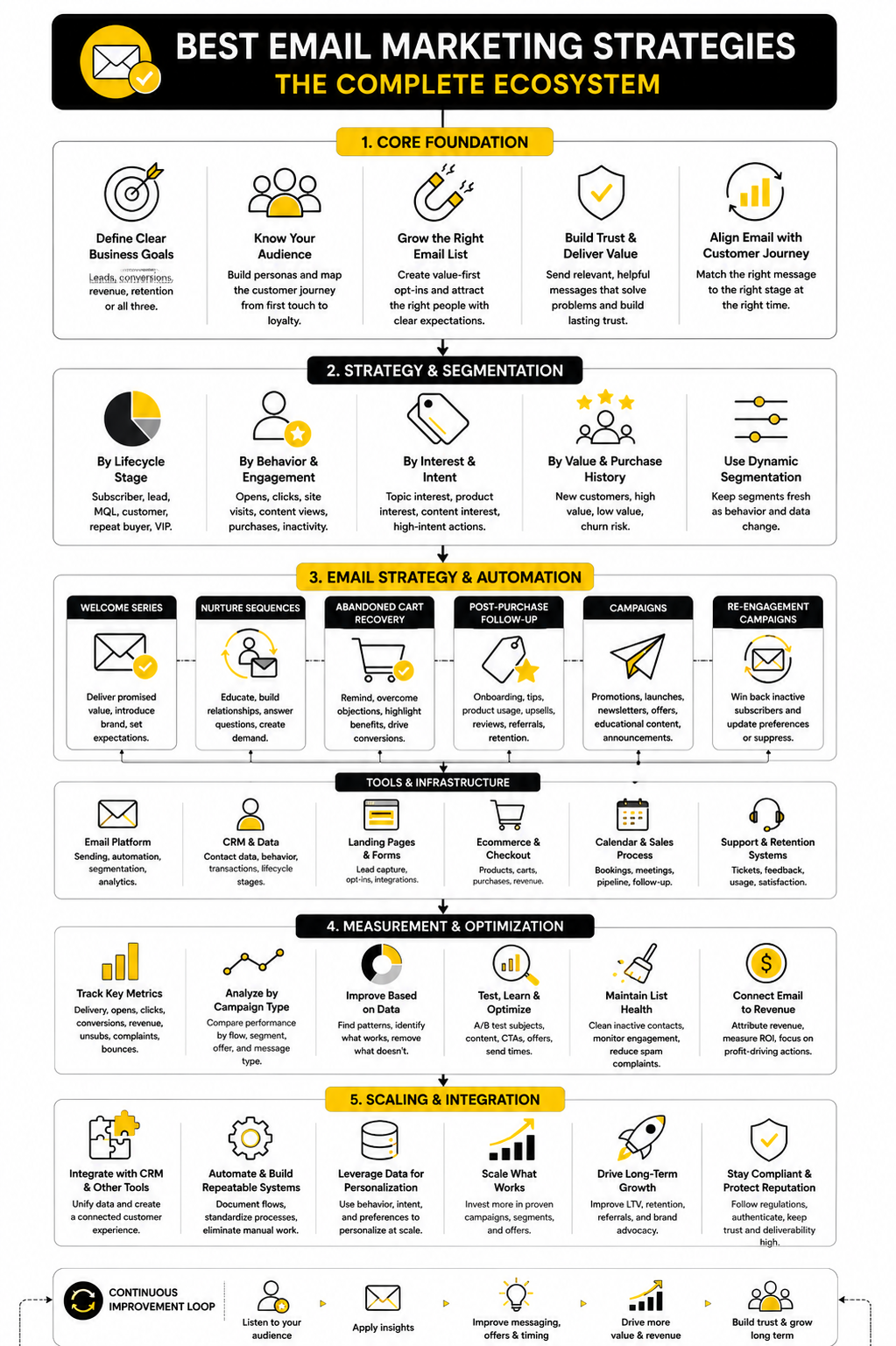
Pulling the Full Email Ecosystem Together
A strong email ecosystem has three jobs: attract the right people, move them through the customer journey, and protect the relationship long enough to create repeat value. That is the whole game. Everything else is just a tactic inside that system.
The mistake is treating email as a single channel that sits off to the side. In reality, it should connect to your website, content, ads, checkout, CRM, sales process, support experience, and retention strategy. When those pieces work together, email becomes the thread that keeps the customer journey moving.
This is why the best email marketing strategies are not built around clever subject lines alone. They are built around relevance, timing, trust, and follow-through. If the subscriber gets the right message at the right moment and the next step makes sense, email becomes one of the most reliable growth assets in the business.
What are the best email marketing strategies for beginners?
The best place to start is with a clear opt-in, a useful welcome sequence, basic segmentation, and one consistent campaign rhythm. Beginners should avoid building complicated automations before they understand their audience and offer. A simple system that sends relevant emails consistently will beat a complex system that nobody maintains.
Start by separating new subscribers, active leads, customers, and inactive contacts. Then create messages for each group based on what they need next. That gives you enough structure to improve without drowning in complexity.
How often should I send marketing emails?
The right frequency depends on your audience, offer, and relationship with subscribers. A brand with frequent product drops may email several times per week, while a high-ticket service business may send fewer but more strategic emails. Frequency is only a problem when relevance drops.
Watch engagement, unsubscribes, spam complaints, replies, clicks, and revenue together. If more emails increase revenue without damaging trust, frequency may be working. If engagement falls and complaints rise, you are probably sending too much or sending the wrong content.
What is the most important email marketing metric?
There is no single metric that tells the full story. Revenue, conversions, click rate, spam complaints, unsubscribe rate, delivery rate, and engagement trends all matter. The most important metric depends on the purpose of the email.
For newsletters, clicks and replies may matter more than immediate revenue. For abandoned checkout emails, conversions and revenue per recipient matter more. For deliverability, spam complaints and bounce rates deserve close attention.
Are open rates still useful?
Open rates are useful, but they should not be treated as the final truth. Privacy changes and automated opens can make open data less precise than it used to be. That means open rate is better for spotting broad trends than proving exact engagement.
Use open rates to compare subject lines, sender recognition, and general list health. Then validate the result with clicks, conversions, replies, and revenue. If opens look good but nobody clicks or buys, the campaign still needs work.
What makes a good welcome email sequence?
A good welcome sequence delivers the promised value, confirms expectations, introduces the brand, and guides the subscriber toward one useful next step. It should feel helpful, not overwhelming. The first few emails are about trust and clarity.
The sequence should also match the signup source. Someone who joined for a discount may need product guidance, while someone who downloaded a guide may need education before an offer. Context makes the welcome flow stronger.
How do I improve email deliverability?
Start with the fundamentals: use permission-based lists, authenticate your domain, keep spam complaints low, make unsubscribing easy, avoid deceptive subject lines, and remove inactive contacts. Google’s sender guidance emphasizes authentication, low complaint rates, and simple unsubscribe practices through its email sender guidelines. Those are not optional details if you care about reaching the inbox.
Deliverability also depends on subscriber behavior. If people ignore, delete, or complain about your emails, performance can suffer. Better targeting and cleaner lists usually help more than trying to game the inbox.
Should I use AI for email marketing?
AI can be useful for drafting, summarizing research, creating subject line options, repurposing content, and brainstorming segment ideas. It can save time, especially when you already have a clear strategy. But AI should not replace customer understanding, offer strategy, or final human editing.
The risk is generic output. If every email sounds like the same polished robot wrote it, subscribers will tune out. Use AI for speed, then add real judgment, specificity, and brand voice.
What is the difference between campaigns and automations?
Campaigns are one-time or scheduled sends, such as newsletters, launches, announcements, and promotions. Automations are triggered by behavior or lifecycle stage, such as welcome flows, abandoned checkout reminders, post-purchase emails, and re-engagement sequences. Both matter, but they serve different jobs.
Campaigns help you create timely momentum. Automations help you follow up consistently when a subscriber takes a meaningful action. A strong strategy uses both without letting either one become random.
How do I know if my email list is healthy?
A healthy list has steady engagement, low spam complaints, manageable unsubscribes, clean deliverability, and a clear connection to business outcomes. The exact numbers vary by industry and email type, so compare performance against your own historical data and relevant benchmarks. Sudden drops are usually more important than small week-to-week changes.
Look at engagement by segment, not just the full list. Your best customers, active leads, and inactive subscribers will behave differently. When you separate those groups, list health becomes much easier to understand.
What should I do with inactive subscribers?
Start with a re-engagement sequence that asks whether they still want to hear from you. Give them a clear reason to stay, such as useful content, updated preferences, or a relevant offer. If they still do not engage, suppress them from regular campaigns.
This feels counterintuitive because the list gets smaller. But a smaller engaged list is usually more valuable than a large ignored list. Attention is the asset, not the raw subscriber count.
What is the best email marketing platform?
The best platform depends on your business model. Ecommerce brands usually need strong product-based segmentation and revenue reporting. Service businesses often need CRM, calendars, pipelines, and follow-up automation. Funnel-based businesses need landing pages, checkout, offers, and email connected cleanly.
For simple email sending, tools like Brevo or Moosend can make sense. For CRM-heavy follow-up, GoHighLevel may be a better fit. For funnels, ClickFunnels or Systeme.io can support the conversion path.
How long should marketing emails be?
Email length should match the decision being asked of the reader. A simple announcement or reminder can be short. A higher-priced offer, complex service, or educational nurture email may need more explanation.
Do not make emails long just to sound persuasive. Make them long enough to create clarity and short enough to keep momentum. If the reader understands the value and the next step, the email has done its job.
How do I turn email marketing into a real growth channel?
Treat email like a customer journey system, not a broadcast tool. Build the list intentionally, segment by intent, send lifecycle-based messages, protect deliverability, connect campaigns to strong landing pages, and review performance consistently. That is how email becomes predictable.
The real advantage comes from learning over time. Every campaign should teach you something about your audience, offer, timing, or funnel. When you apply those lessons, email compounds.
Build a stronger local presence with BAAM AI
Turn your website, Google profile, social channels, and AI visibility into one growth engine
Most businesses do not need more random marketing activity. They need a consistent presence system that helps the right people find them, trust them, and take action. BAAM AI brings strategy, local SEO, website updates, Google Maps visibility, social content, AI-search readiness, media production, and reporting into one practical monthly engine.
If you want your marketing to keep working after the campaign ends, start with a free BAAM AI presence audit. See how your business shows up today and where the fastest visibility wins are at BAAM AI.