
BAAM AI Blog
Best Email Marketing Services 2022: A Practical Framework For Choosing The Right Platform
Searching for the best email marketing services 2022 usually means one of two things. Either you want to understand which tools were already trusted during that period, or you are comparing older recommendations...
Searching for the best email marketing services 2022 usually means one of two things. Either you want to understand which tools were already trusted during that period, or you are comparing older recommendations against what still makes sense today. That distinction matters because email marketing has not disappeared, but the way good teams choose software has changed.
The best service is no longer just the one with the prettiest email builder or the cheapest monthly plan. You now have to think about deliverability, automation depth, list growth, CRM fit, ecommerce data, AI features, compliance, reporting, and whether the platform can actually support the way your business sells. Email still deserves attention because Litmus reports that 35% of companies see email ROI of 36:1 or more, while its broader State of Email research also shows how central email remains to lifecycle marketing teams.
this guide will break the decision down in a practical way. Instead of treating every provider like they all solve the same problem, we will separate the market into use cases: simple newsletters, ecommerce campaigns, creator funnels, agency systems, sales-driven follow-up, and all-in-one marketing platforms. That is how you avoid buying a tool that looks good in a comparison table but feels painful once your list, offers, and automations become more complex.
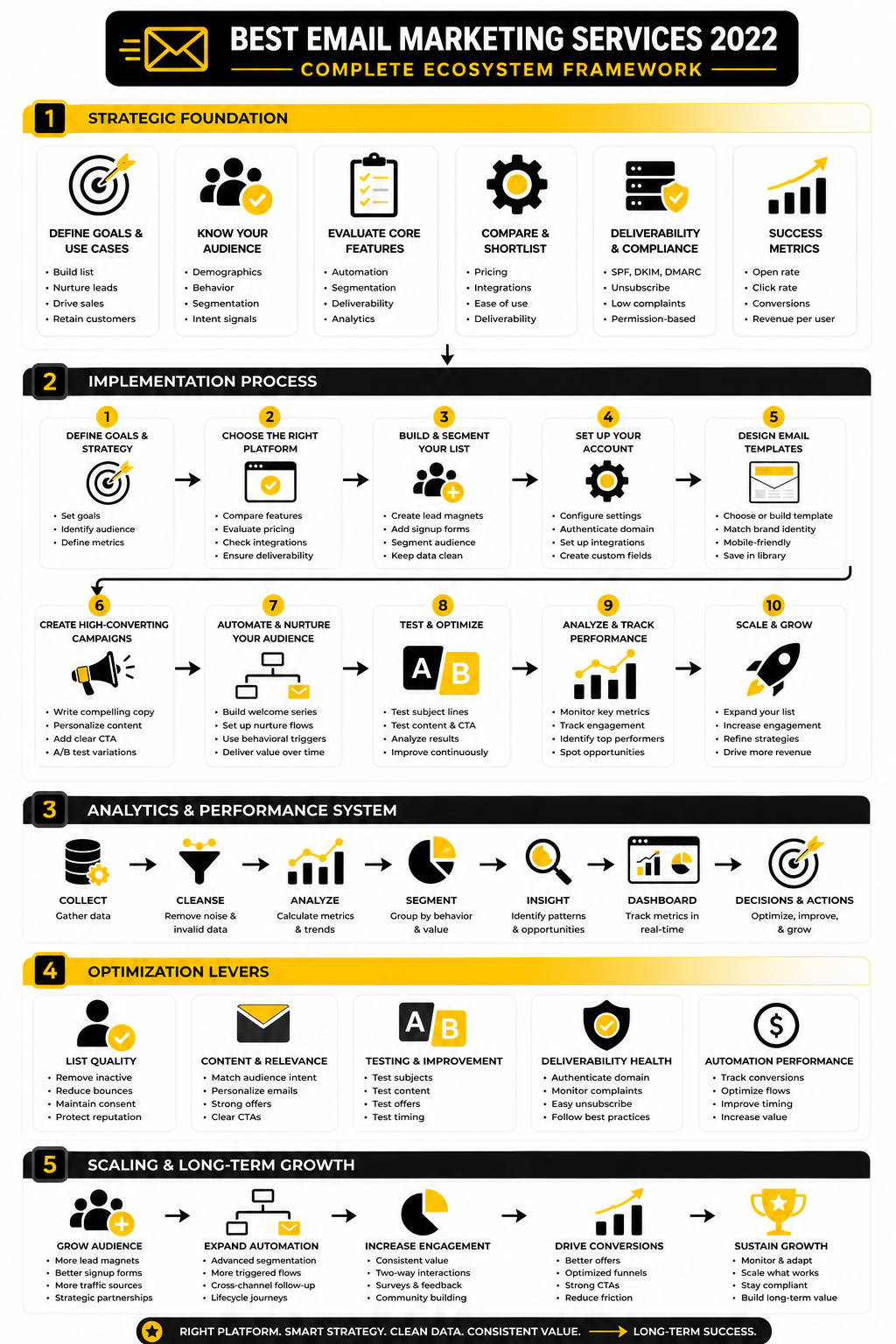
This guide is structured as a six-part article so each section can build naturally from the previous one. Part 1 sets the decision framework, because choosing email software without a framework usually leads to feature overload. The later parts will compare service categories, shortlist strong options, and end with a practical FAQ only after the core buying logic is clear.
Why Email Marketing Software Still Matters
Email marketing still matters because it gives you something most rented channels do not: a direct line to people who have already raised their hand. Social platforms can change reach overnight, ad costs can move fast, and search traffic can fluctuate when algorithms shift. A healthy email list gives you a more stable asset that can support launches, retention, onboarding, education, and repeat purchases.
The real value comes from timing and relevance. A generic newsletter is easy to ignore, but a useful welcome sequence, abandoned-cart flow, post-purchase series, appointment reminder, or reactivation campaign can move revenue without requiring a new ad click every time. That is why the right email platform should be judged by how well it helps you send the right message to the right segment at the right moment.
This is also where older “best tools” lists become dangerous. A service that looked perfect in 2022 may still be excellent, but only if its automation, consent tools, reporting, and integrations still match your current business model. For example, a small business that mainly needs email campaigns and CRM-style contact management may look at Brevo, while a creator or lean online business may prefer an all-in-one setup like systeme.io.
Framework Overview
The cleanest way to compare email marketing services is to stop asking, “Which one is best?” and start asking, “Best for what job?” A local service business, a Shopify store, a B2B consultant, and a digital product creator all need email, but they do not need the same system. The best email platform is the one that fits your customer journey without forcing you to rebuild your business around the software.
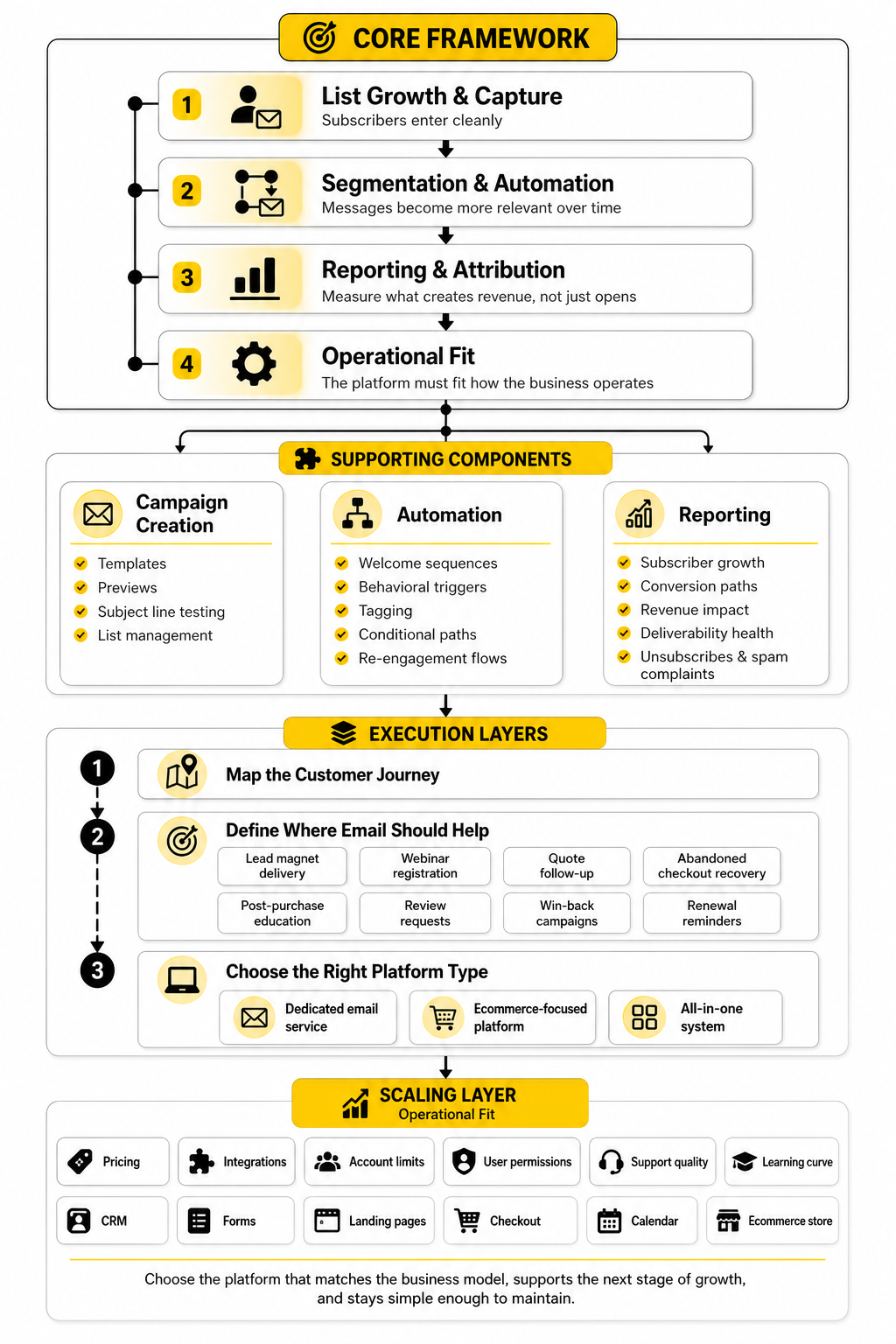
A practical framework has four layers. First, look at list growth and capture, because your email system is useless if people are not entering it cleanly. Second, examine segmentation and automation, because those two features determine whether your messages become more relevant over time. Third, check reporting and attribution, because you need to know what campaigns actually create revenue, not just what gets opened.
The fourth layer is operational fit. This includes pricing, integrations, account limits, user permissions, support quality, learning curve, and whether the platform connects to your CRM, forms, landing pages, checkout, calendar, or ecommerce store. A tool like Moosend can make sense for teams that want focused email automation, while GoHighLevel fits better when email is only one part of a larger sales, CRM, funnel, and follow-up system.
Core Components Of A Strong Email Marketing Service
A strong email marketing service starts with reliable campaign creation. You should be able to build clean emails, save reusable templates, preview messages, test subject lines, manage lists, and send without needing a developer every time. The editor matters, but it should not be the only reason you choose a platform.
Automation is the second core component. At minimum, a serious platform should support welcome sequences, behavioral triggers, tagging, segmentation, conditional paths, and re-engagement flows. If your business depends on consultations, demos, abandoned checkouts, onboarding, or renewals, automation depth becomes more important than template design.
Reporting is the third component, and this is where many teams underinvest. Opens and clicks can be useful directional signals, but they are not enough on their own. You want to understand subscriber growth, conversion paths, revenue impact, deliverability health, unsubscribe patterns, spam complaints, and which automations are doing meaningful work.
Professional Implementation Starts Before You Pick A Tool
Professional implementation does not begin after you buy software. It begins when you map your customer journey and decide what your email system actually needs to do. Without that step, even a powerful platform becomes a messy collection of lists, tags, forms, and half-finished automations.
Start by writing down the moments where email should help. Those moments might include lead magnet delivery, webinar registration, quote follow-up, abandoned checkout recovery, post-purchase education, review requests, win-back campaigns, or renewal reminders. Once those moments are clear, choosing between a dedicated email service, an ecommerce-focused platform, or an all-in-one system becomes much easier.
This is the key idea that will guide the rest of the article: the best platform is not always the biggest platform. It is the one that matches your business model, supports your next stage of growth, and keeps your marketing simple enough to actually maintain. Part 2 will move from the framework into the specific features the best email marketing services should include.
What The Best Email Marketing Services Should Include
The next step is turning the framework into a checklist. When people search for the best email marketing services 2022, they often land on lists that rank tools by popularity, free plans, or template libraries. Those things matter, but they are not enough to choose software you can trust with real customer relationships.
A good email marketing service should help you collect subscribers properly, organize them clearly, send useful campaigns, automate follow-up, protect deliverability, and measure outcomes. That sounds obvious until you compare platforms side by side and notice how many tools are strong in one area but weak in another. The goal is not to find a platform with every possible feature; the goal is to find one that covers the core jobs your business actually needs.
The most important features fall into five practical categories:
Contact Capture And Consent Management
Your email platform should make it easy to collect subscribers without creating a messy list. That means forms, landing pages, embedded signup boxes, popup options, double opt-in settings, unsubscribe handling, and clear consent records. If your list growth process is sloppy, the rest of your email marketing will suffer because you are building on weak data.
This matters even more now because inbox providers have become stricter about sender reputation and authentication. Google’s sender guidelines recommend setting up SPF, DKIM, and DMARC for sending domains, while Yahoo’s sender guidance emphasizes visible unsubscribe options, one-click unsubscribe support for some senders, and fast processing of unsubscribe requests. These are not glamorous features, but they directly affect whether your emails reach the inbox or disappear into spam.
For smaller teams, this is one reason a practical platform like Brevo can be appealing. It combines email campaigns with forms, contact management, transactional email options, and CRM-style workflows, so you are not forced to stitch together too many tools too early. The best setup is the one your team can keep clean every week, not the one that looks most advanced in a demo.
Segmentation And Personalization
Segmentation is where email starts becoming useful instead of noisy. A basic platform lets you send one campaign to everyone, but a better platform helps you send different messages based on behavior, source, purchase history, lifecycle stage, interests, tags, or engagement. That difference is huge because a new subscriber, a repeat customer, and a cold lead should not always receive the same message.
Personalization should go deeper than adding a first name. You want the platform to help you tailor content, offers, send timing, and follow-up logic based on what people have actually done. HubSpot’s marketing research highlights the importance of first-party data as teams adapt to a more privacy-conscious environment, and email is one of the clearest channels where that data can be used responsibly.
This is where you should be honest about your business model. A newsletter-first creator may only need light segmentation by topic or signup source. A service business using calls, quotes, and pipeline stages may need stronger CRM logic, where a platform like GoHighLevel becomes more relevant because email can work alongside SMS, forms, calendars, pipelines, and sales follow-up.
Campaign Creation And Testing
A good email builder should make publishing easier without making every email look generic. You need clean templates, mobile previews, reusable blocks, simple branding controls, and the ability to send plain, direct messages when that performs better than a heavily designed campaign. Fancy design is useful only when it supports the message.
Testing also matters because small changes can compound over time. Subject lines, preview text, calls to action, send times, audience segments, and content structure can all influence performance. Mailchimp’s benchmark resources frame email metrics as a way to compare performance against industry averages, but the more useful habit is comparing your own campaigns against your own past results.
The best platforms make this improvement loop easy. They do not just show you a dashboard full of numbers; they help you understand what to change next. If a campaign gets opens but weak clicks, the issue might be the offer, the email structure, or the link placement. If clicks are strong but sales are weak, the problem may be the landing page, checkout, or audience intent rather than the email itself.
Automation And Customer Journey Building
Automation is the feature that separates serious email marketing from occasional broadcasting. A broadcast campaign goes out once, but an automation can support the customer journey every day without requiring manual work. That is why welcome sequences, lead nurture flows, abandoned checkout reminders, post-purchase education, review requests, and reactivation campaigns should be part of your evaluation.
The performance difference can be dramatic when automation is done well. Omnisend’s email, SMS, and push report found that automated emails produced higher open rates, higher click rates, and nearly four times better conversion rates than regular campaign emails. That does not mean automation magically fixes a weak offer, but it does show why behavior-based messages often outperform one-size-fits-all campaigns.
This is where the best email marketing services 2022 lists need to be read with context. A platform that was excellent for newsletters may not be the best choice for complex customer journeys. If you sell digital products, courses, or funnels, an all-in-one tool like systeme.io may reduce tool clutter, while a funnel-heavy business may also consider ClickFunnels when email needs to support pages, offers, and conversion paths.
Deliverability And Sender Reputation
Deliverability is not just a technical detail. It is the difference between paying for subscribers you can reach and paying for a list that quietly underperforms. A beautiful campaign is worthless if the domain is poorly authenticated, the list is unhealthy, or the sending behavior looks suspicious to inbox providers.
A serious email service should guide you through domain authentication, bounce handling, unsubscribe compliance, spam complaint monitoring, and list hygiene. It should also make it easy to suppress inactive contacts, avoid purchased lists, and separate transactional emails from marketing campaigns when needed. EmailToolTester’s deliverability testing shows why this matters: different providers can perform very differently in inbox placement tests, even when the sender thinks they are doing the same basic thing.
This is one area where you should not chase the cheapest tool blindly. Low pricing can be attractive, especially for a young list, but poor deliverability can cost more than the monthly subscription difference. If your business depends on email for sales, onboarding, appointments, or retention, inbox placement deserves the same attention as design and automation.
Reporting That Connects Email To Business Results
Reporting should help you make decisions, not just admire charts. Opens, clicks, bounces, unsubscribes, spam complaints, conversions, revenue, and automation performance all tell different parts of the story. A useful platform helps you see which campaigns create movement, which segments are responding, and which automations deserve improvement.
Open rates became less reliable after privacy changes from major email clients, so you need to look beyond vanity metrics. Clicks, replies, purchases, booked calls, form submissions, and customer retention are usually better indicators of business impact. The DMA’s 2024 Email Benchmarking Report also challenges marketers to think beyond conventional open-rate measurement and use benchmarks in a more strategic way.
The best reporting setup depends on your sales motion. Ecommerce teams need product and order data. Agencies need client-level reporting. Consultants need lead and appointment attribution. SaaS teams need lifecycle and activation signals. This is why tool choice should follow the business model instead of the other way around.
Integrations And Workflow Fit
Email rarely works alone. Your platform may need to connect with forms, landing pages, checkout tools, ecommerce stores, CRMs, calendars, webinar platforms, payment processors, analytics tools, and customer support systems. The fewer manual handoffs your team has to manage, the more consistent your marketing becomes.
This does not mean every business should buy the biggest all-in-one platform immediately. Sometimes a focused email tool plus a few clean integrations is better than a large system nobody uses properly. A creator might pair email with checkout and landing pages, while a sales-led business might prioritize CRM, pipeline automation, and appointment booking.
The key question is simple: where does email sit in your workflow? If email is mainly a newsletter and nurture channel, a focused platform may be enough. If email is part of a broader conversion system with funnels, calls, SMS, forms, and client follow-up, then a more integrated platform such as GoHighLevel may be a better long-term fit.
Best Email Marketing Services By Use Case
The best way to choose from the best email marketing services 2022 lists is to match the platform to the job it needs to perform. A tool can be excellent and still be wrong for your workflow. That is why this section moves from features into use cases, because implementation becomes much easier when the category is clear.
Think of email software as part of your operating system, not just a place to send newsletters. If your business sells appointments, you need follow-up and pipeline visibility. If you sell products, you need ecommerce data and lifecycle automation. If you sell digital offers, you need pages, checkout, email, and simple delivery working together without creating unnecessary friction.
Best For Small Businesses That Need Simple Email And CRM
Small businesses usually need clarity more than complexity. They need to collect leads, send campaigns, follow up with contacts, organize basic customer data, and keep communication professional. A platform like Brevo can fit this situation because it combines email marketing with contact management, automation, and practical business communication tools.
This type of business should not start with an overbuilt automation map. The better move is to create a clean lead capture form, a short welcome sequence, a monthly newsletter rhythm, and one or two follow-up flows tied to real buyer intent. That gives the business a working system without turning email marketing into a full-time technical project.
The biggest mistake here is choosing a platform only because it has a generous free plan. Free can be useful, but only if the tool still supports the workflow you are building toward. If you know you will need contact organization, sales follow-up, and simple automations, pick a platform that can grow into that without forcing a painful migration later.
Best For Creators And Digital Product Sellers
Creators and digital product sellers need email to do more than announce new content. They need to build trust, deliver lead magnets, launch offers, segment subscribers by interest, and turn attention into revenue. For this group, the best email platform is often the one that reduces the number of tools needed to move someone from subscriber to buyer.
That is where systeme.io can make sense. It combines email campaigns with funnels, landing pages, checkout, course features, and automation, which is useful when a creator wants a simpler stack. Instead of connecting five tools before making the first sale, the creator can build the basic journey in one place and improve it over time.
The implementation should stay lean. Start with one lead magnet, one landing page, one welcome sequence, and one offer sequence. Once that path is working, add segmentation based on clicks, purchases, or topic interest instead of trying to build a giant automation machine before the offer has been proven.
Best For Funnel-Based Businesses
Funnel-based businesses care about the full conversion path. Email is important, but it usually supports a bigger sequence that includes landing pages, order forms, upsells, webinars, sales pages, and post-purchase follow-up. In this environment, email marketing software should not be judged alone; it should be judged by how well it supports the funnel.
A tool like ClickFunnels is built around that type of journey. The core question is not only, “Can it send emails?” The better question is, “Can it help move a lead from opt-in to offer to purchase to follow-up with fewer weak points?”
This use case needs discipline because funnel software can tempt people into building too much too soon. The more carefully process is to build one primary funnel, connect the essential emails, test the offer, and only then add upsells, downsells, retargeting audiences, or more advanced segmentation. Complexity should be earned by results, not added because the software makes it possible.
Best For Agencies And Service Businesses
Agencies and service businesses usually need email to support lead response, appointment booking, pipeline movement, reviews, client communication, and reactivation. In that case, a standard newsletter tool may not be enough. The business needs a system that connects email with the rest of the sales process.
This is where GoHighLevel becomes relevant. It is not only an email platform; it is a broader CRM, automation, funnel, calendar, and follow-up system. For agencies especially, the value comes from having client accounts, templates, workflows, pipelines, and reporting inside a structure that can be repeated.
The implementation should focus on revenue moments first. Set up lead capture, instant response, appointment reminders, no-show follow-up, quote follow-up, review requests, and old-lead reactivation before worrying about advanced newsletters. Those flows are closer to money, and they usually create faster proof that the system is worth maintaining.
Best For Lean Ecommerce Email Automation
Ecommerce businesses need email to react to behavior. A visitor browsing a product, a customer abandoning checkout, a first-time buyer, and a loyal repeat customer all need different messages. That means the platform has to understand customer actions, product data, purchase timing, and lifecycle stage.
The core implementation should begin with the flows that sit closest to revenue. These usually include welcome emails, abandoned checkout recovery, browse abandonment, post-purchase education, review requests, cross-sell campaigns, and win-back sequences. Once those are working, regular campaigns become easier because the automated foundation is already handling the predictable parts of the customer journey.
This is also where list hygiene matters more than many brands expect. Ecommerce lists grow quickly through discounts, popups, giveaways, and checkout opt-ins, but not every subscriber has the same intent. Segmenting customers by purchase behavior, engagement, and product interest keeps campaigns more relevant and protects the list from turning into a discount-only audience.
Best For Newsletter-First Brands
Newsletter-first brands need a different mindset. Their product is often the relationship itself: the reader opens because the content is useful, entertaining, credible, or timely. For this use case, the email service should make writing, publishing, list growth, segmentation, and simple sponsorship or offer tracking easy.
The implementation should focus on consistency before complexity. A clear signup promise, a predictable sending rhythm, clean templates, and a strong archive or content workflow matter more than a huge automation map. The goal is to build a habit with readers, not bombard them with complicated sequences.
That does not mean automation is irrelevant. A newsletter-first brand should still have a welcome sequence that introduces the point of view, sets expectations, and directs readers to the best past content or current offer. The difference is that automation supports the relationship; it does not replace the ongoing editorial rhythm.
A Practical Selection Process
Once you understand the use case, the selection process becomes much cleaner. You are no longer comparing random feature lists; you are checking whether each platform can support the actual path from subscriber to customer. This is where execution becomes tangible.
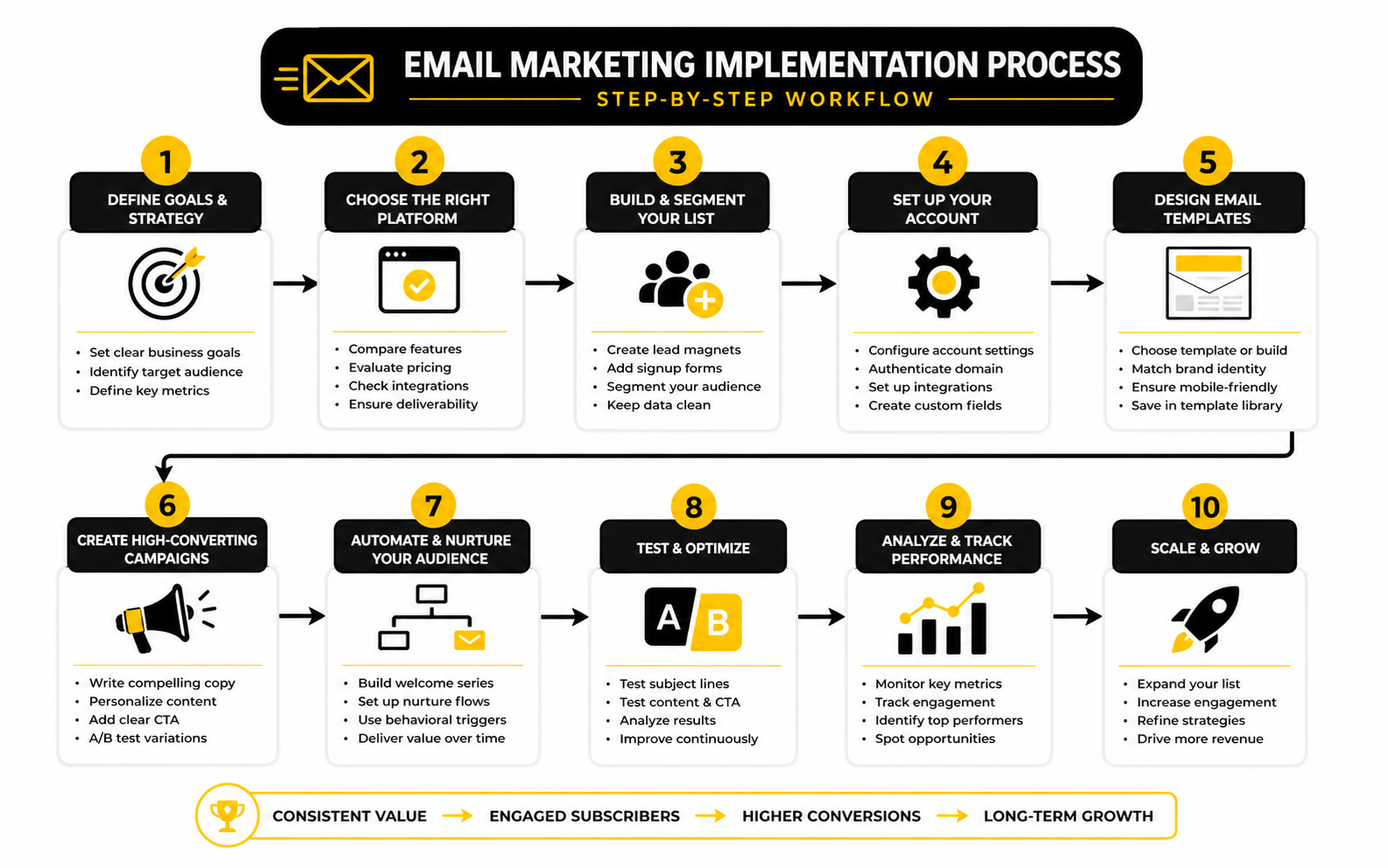
Use this process before committing to a platform:
This process prevents the classic software mistake: choosing the tool with the most features and then using only 10% of it badly. It also prevents the opposite mistake, where a team chooses the simplest tool and outgrows it within a few months. The sweet spot is a platform that supports your next stage without making your current stage harder.
How To Match Tools To Your First Workflow
Your first workflow should decide the platform shortlist. If the first workflow is a newsletter with occasional promotions, you need clean writing, easy list management, and simple segmentation. If the first workflow is lead capture into booked calls, you need forms, notifications, calendar logic, reminders, and follow-up.
For a service business, the first workflow might be a new lead sequence. Someone fills out a form, receives a confirmation, gets a helpful follow-up, books a call, receives reminders, and gets a post-call next step. That is a very different workflow from an ecommerce customer who joins through a discount popup, browses products, abandons checkout, and later receives a product-specific recovery email.
This is why the best email marketing services 2022 comparisons should be treated as starting points, not final answers. The right tool is the one that handles your first workflow cleanly and gives you room to build the next two. Once those early journeys are clear, pricing and feature comparisons become much easier to interpret.
When An All-In-One Platform Makes Sense
An all-in-one platform makes sense when the cost of connecting separate tools becomes higher than the cost of using one integrated system. This is common for agencies, coaches, consultants, local service businesses, and digital product sellers who need email, funnels, forms, calendars, payments, and follow-up in the same operating flow. In that case, paying for a broader platform can be simpler than managing several subscriptions and integrations.
For example, GoHighLevel can be a strong fit when email is part of a sales and client management system. systeme.io can be a strong fit when the goal is to sell digital products, build funnels, and keep the stack simple. ClickFunnels can be a strong fit when the funnel itself is the center of the business model.
The warning is simple: do not buy an all-in-one platform just because it sounds efficient. Buy it because your workflow actually needs the pieces to work together. If your business only needs a clean newsletter and a few automations, a focused email tool may be faster, cheaper, and easier to maintain.
When A Focused Email Platform Is The Better Choice
A focused email platform is often better when email is the main channel and the surrounding workflow is already handled elsewhere. This can work well for small businesses, content teams, newsletter operators, and ecommerce teams that already have a separate store, CRM, or website stack. The advantage is focus: fewer distractions, cleaner email workflows, and often a faster learning curve.
A tool like Moosend can be useful when the priority is email campaigns, automation, and list communication without adopting a full business operating system. A tool like Brevo can work when email, contact management, and practical business communication need to sit close together. The better choice depends on whether you want a dedicated email engine or a broader customer communication setup.
The decision should always come back to maintenance. A focused platform wins when it helps you send better emails with less operational drag. An all-in-one platform wins when separating tools would create gaps, delays, duplicate data, or missed follow-up.
How To Compare Pricing, Automation, And Deliverability
By this point, the shortlist should be shaped by use case, not hype. Now the question becomes more practical: which platform gives you the best mix of cost, automation depth, deliverability support, and measurement? This is where many comparisons of the best email marketing services 2022 become too shallow, because they focus on monthly price without looking at what the numbers actually mean.
A cheap platform can become expensive if it makes segmentation painful, hides key reporting, charges heavily as your list grows, or requires extra tools to do basic follow-up. A more expensive platform can be a bargain if it replaces several subscriptions and helps you recover more revenue from leads or customers you already have. The right comparison is not “lowest price.” It is “lowest friction for the workflow that makes money.”
Pricing should always be evaluated against three things:
Statistics And Data
Email benchmarks are useful, but only when they are interpreted correctly. A benchmark tells you whether your numbers are broadly healthy, not whether your strategy is good. A campaign can have a strong open rate and still fail if the offer is weak, the call to action is unclear, or the landing page does not match the email promise.
Open rates are especially tricky because privacy changes and inbox behavior can distort the signal. That does not mean opens are useless; it means they should be treated as directional. The DMA Email Benchmarking Report 2024 specifically challenges marketers to think beyond conventional open-rate measurement, which is the right mindset for anyone choosing software today.
The more useful metrics are the ones tied to movement. Click rate shows whether the message created enough interest to earn action. Conversion rate shows whether the action led to the desired result. Revenue per recipient, booked calls, completed forms, purchases, replies, and retention signals usually tell you more than a single top-line engagement metric.
The Metrics That Actually Matter
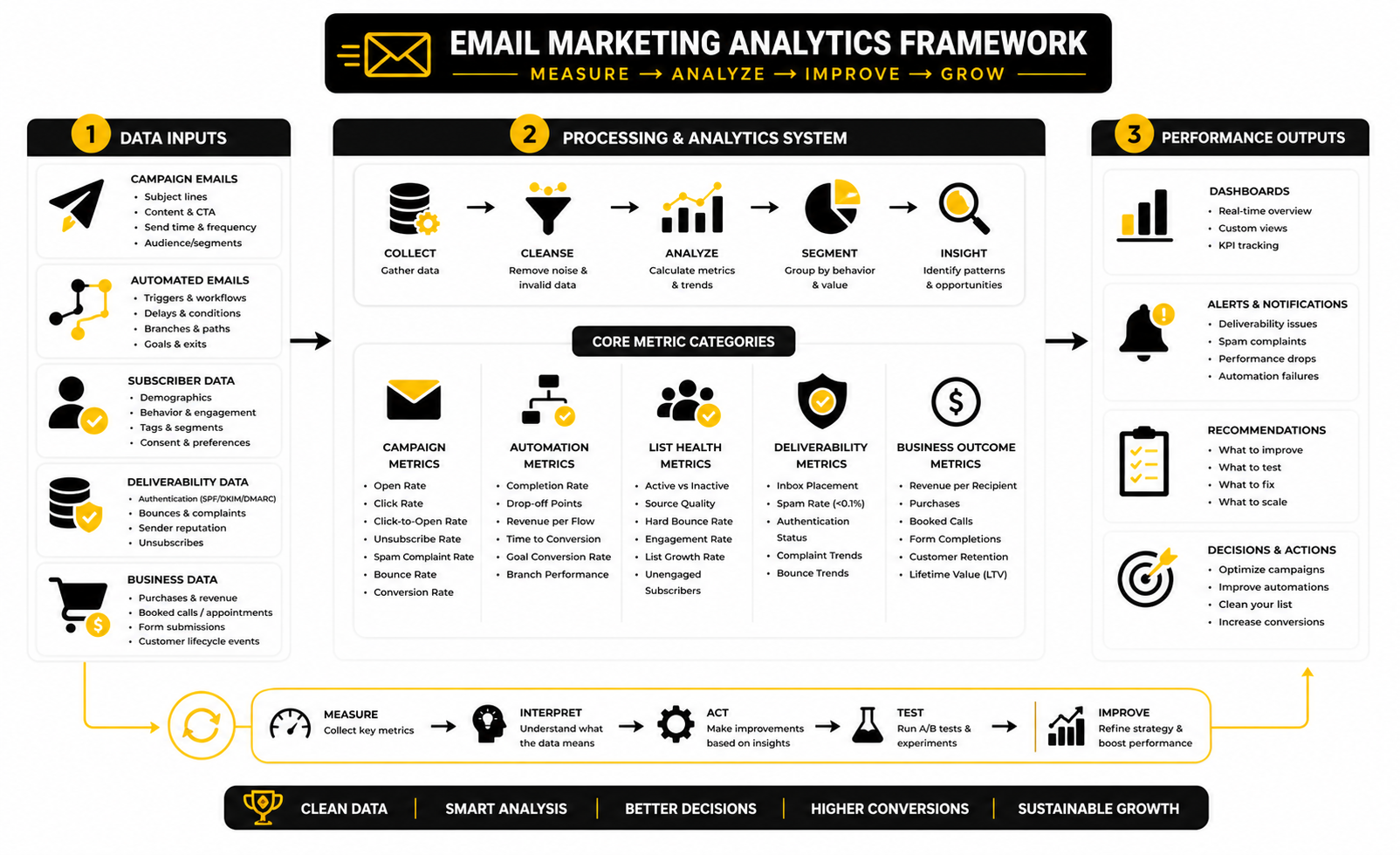
The best email platform should make important metrics easy to see without forcing you to export everything into spreadsheets. At minimum, you want visibility into deliverability health, engagement, list quality, automation performance, and business outcomes. If the reporting cannot help you decide what to improve next, it is mostly decoration.
For campaign emails, watch open rate, click rate, click-to-open rate, unsubscribe rate, spam complaint rate, bounce rate, and conversion rate. For automated emails, watch completion rate, drop-off points, revenue per flow, time to conversion, and how each branch performs. For list health, watch inactive subscribers, source quality, hard bounces, and whether certain signup sources create low-quality contacts.
This is where the best email marketing services 2022 comparisons should be updated with a modern analytics lens. A platform that only reports opens and clicks may be enough for a simple newsletter, but it is weak for ecommerce, agencies, and sales-led businesses. If email is tied to revenue, the platform needs to show what happens after the click.
How To Read Benchmarks Without Fooling Yourself
Benchmarks are not targets. They are context. If your industry average click rate is around a certain range, that does not mean every campaign below it is bad or every campaign above it is good. A small, high-intent audience can produce lower open volume but better revenue, while a large giveaway list can generate attractive opens and weak buyers.
The cleanest way to use benchmarks is to compare at three levels. First, compare against industry data to see whether anything looks unusually weak. Second, compare against your own past campaigns so you can see whether performance is improving. Third, compare segments against each other, because a buyer segment, new subscriber segment, and cold lead segment should not be judged by the same expectation.
For example, MailerLite’s 2025 benchmark study covers millions of campaigns and shows why industry, region, and list type can change what “normal” looks like. That is useful context, but it should not replace your own baseline. Your list, offer, source quality, sending frequency, and customer journey are what determine whether a number is actually good.
Deliverability Signals You Cannot Ignore
Deliverability is the measurement layer most teams notice too late. They look at campaign performance dropping and assume the copy got worse, but the real issue may be authentication, spam complaints, bounces, inactive subscribers, or poor list acquisition. A strong email service should surface these issues early.
Google’s sender guidance recommends SPF, DKIM, and DMARC authentication for sending domains, and its sender FAQ explains that bulk senders should keep spam rates below 0.1% and avoid reaching 0.3% or higher. Yahoo’s sender guidance also emphasizes one-click unsubscribe requirements for promotional mail and ongoing complaint monitoring. These rules matter because inbox providers are judging sender behavior continuously, not just campaign by campaign.
The action is straightforward. Authenticate your domain, stop using purchased or scraped lists, remove hard bounces, suppress chronically inactive contacts, and make unsubscribing easy. That may sound conservative, but it protects the asset. A smaller list that reaches the inbox is more valuable than a bloated list that slowly damages your sender reputation.
Automation Performance Signals
Automation should be measured differently from campaigns. A campaign is a moment; an automation is a system. That system should be judged by whether it moves people from one stage to the next with less manual effort.
For a welcome sequence, measure confirmation, engagement, first click, first purchase, booked call, or reply. For an abandoned checkout flow, measure recovered revenue, time to purchase, and whether discounts are being used too early. For a lead nurture sequence, measure qualified actions such as booked appointments, demo requests, quote requests, or visits to high-intent pages.
Automated messages often perform better because they are triggered by behavior and timing. Omnisend’s ecommerce marketing report has repeatedly shown stronger conversion performance for automated messages than standard campaigns, which lines up with what most operators see in practice: relevant timing beats random broadcasting. The action is not to automate everything. The action is to automate the moments where intent is already visible.
Pricing Data Means Nothing Without Usage Context
Pricing pages can be misleading because they usually show the starting point, not the real operating cost. A plan may look affordable until you add more contacts, build automation features, need more users, remove branding, add transactional email, or connect advanced integrations. That is why pricing should be modeled against your next stage, not only your current list size.
A practical comparison should include the monthly subscription, contact limits, email send limits, automation limits, number of users, landing page needs, CRM needs, reporting depth, and any extra tools the platform replaces. For example, GoHighLevel may look different in a pricing comparison if it replaces CRM, calendars, forms, funnels, and follow-up tools for an agency or service business. systeme.io may look different if it replaces landing pages, email, funnels, checkout, and course hosting for a creator.
The mistake is comparing a focused email tool against an all-in-one platform as if they are the same category. They are not. One charges mostly for email and contacts; the other may replace parts of your sales and delivery stack. The number only makes sense when you compare total workflow cost.
What Good Reporting Should Make You Do Next
Good reporting should lead to action. If a campaign has weak opens, test the subject line, sender name, segment, or sending promise. If opens are fine but clicks are weak, improve the offer, structure, relevance, or call to action. If clicks are strong but conversions are weak, inspect the landing page, pricing, checkout, booking flow, or sales message.
If unsubscribes spike, check whether the content matched the signup promise. If spam complaints rise, review acquisition sources, frequency, consent, and message relevance. If automation revenue drops, inspect whether the trigger still matches buyer intent or whether the sequence has become outdated.
This is why analytics should be part of platform selection from the start. The best platform is not just the one that sends emails. It is the one that helps you see what is working, what is leaking, and what to fix next.
Professional Implementation And Migration Tips
At this stage, the decision is not only which platform looks best. The real question is whether you can move into it cleanly, maintain it without chaos, and scale it without breaking deliverability, reporting, or the customer experience. This is where a lot of businesses underestimate the work.
A messy migration can damage performance even if the new tool is better. Contacts get imported with weak tags, automations fire at the wrong time, unsubscribed people accidentally re-enter campaigns, and reporting becomes impossible to compare. The best email marketing services 2022 lists rarely talk about this part, but implementation quality often determines whether the platform feels powerful or painful.
The safest approach is to treat migration as a controlled project, not a quick export and import. Before moving anything, document your lists, segments, tags, automations, forms, templates, sender domains, suppression rules, and current performance baselines. That gives you a clear map of what must be rebuilt, what should be improved, and what can finally be deleted.
Clean Data Before You Move
Your migration is only as good as your contact data. If the old account is full of duplicate contacts, outdated tags, inactive subscribers, imported leads, broken fields, and unclear consent sources, moving everything into a new platform only transfers the problem. You want to clean the data before it enters the new system.
Start by separating active subscribers, customers, leads, unsubscribed contacts, bounced addresses, and cold contacts. Do not treat them all as one list. Active buyers and recent subscribers deserve a different migration path from people who have not opened, clicked, purchased, replied, or engaged in a long time.
This is especially important for deliverability. Google’s sender guidance recommends authentication through SPF, DKIM, and DMARC, while Yahoo’s sender best practices also focus heavily on authentication, complaints, and unsubscribe handling. Clean data makes those technical requirements easier to support because you are not sending to contacts who never asked to hear from you or have stopped engaging completely.
Preserve Consent And Suppression Records
Consent is not something to casually rebuild from memory. If someone unsubscribed in the old platform, that status needs to be preserved. If a contact bounced repeatedly, that should not be ignored just because the new platform makes it possible to import them again.
Before switching tools, export suppression lists, unsubscribes, hard bounces, spam complaints, and consent-related fields. Then confirm how the new provider handles those records before sending any campaign. This is boring work, but it protects you from one of the most damaging migration mistakes: accidentally emailing people who should not be contacted.
This also matters legally and reputationally. Email compliance is not only about avoiding fines; it is about respecting the relationship with the subscriber. If people asked out, keep them out. Simple.
Rebuild Automations Instead Of Copying Them Blindly
Old automations should not be copied exactly unless they still match the business. A migration is a chance to review every workflow and ask whether it still serves the customer journey. Some automations will be worth rebuilding, some should be shortened, and some should be retired.
The best process is to rebuild automations in order of business impact. Start with the flows closest to revenue or customer experience, such as lead response, welcome sequences, checkout recovery, appointment reminders, customer onboarding, review requests, and reactivation. Leave nice-to-have nurture branches, advanced scoring, and experimental flows for later.
When rebuilding, check every trigger, delay, condition, tag, goal, and exit rule. A small mistake in automation logic can create a bad customer experience at scale. Someone should not receive a beginner welcome email after they already bought, and a customer should not get a discount recovery message after paying full price.
Warm Up Sending Carefully
A new email platform does not automatically inherit trust from the old one. Even if you keep the same domain, inbox providers still evaluate sending patterns, authentication, complaints, engagement, and consistency. That means you should not move platforms and immediately blast the full list.
Start with your most engaged subscribers. Send to people who have recently opened, clicked, purchased, booked, replied, or otherwise interacted with your brand. Gradually expand the audience while monitoring bounces, complaints, unsubscribes, and engagement.
This is not being overly cautious; it is protecting the channel. Mailbox providers are stricter now, and sudden volume changes can create deliverability issues. A slower warm-up usually beats a rushed migration that damages inbox placement for months.
Decide What Should Stay Outside Email
Not every customer communication belongs inside email marketing software. Transactional emails, support conversations, SMS reminders, sales outreach, and lifecycle campaigns can overlap, but they should not be thrown into one bucket without a plan. The more your business grows, the more important this separation becomes.
Transactional messages should be reliable, immediate, and clearly tied to user actions. Marketing messages should respect consent, segmentation, and sending frequency. Sales follow-up should connect to pipeline context, not just newsletter behavior.
This is where platform category matters. A business using GoHighLevel may want email, SMS, forms, calendars, pipelines, and follow-up in one place because the sales process is tightly connected. A creator using systeme.io may prefer keeping funnels, checkout, course access, and email together because the offer journey is simpler that way. A team with separate ecommerce, support, and analytics systems may prefer a focused email platform that integrates cleanly instead of replacing everything.
Watch For Scaling Traps
Email platforms often feel easy when the list is small. The problems show up when the list grows, the team expands, automations multiply, and reporting becomes more important. A tool that felt simple at 1,000 contacts can feel restrictive at 50,000 contacts if segmentation, permissions, testing, or attribution are weak.
The first scaling trap is tag sprawl. Teams keep creating new tags for every campaign, source, product, webinar, and behavior until nobody knows what anything means. Tags should have naming rules, ownership, and cleanup cycles, or they eventually become unusable.
The second scaling trap is automation overlap. Multiple workflows can start reacting to the same behavior, which creates duplicated messages or conflicting offers. Before adding a new automation, check what already triggers around the same event and whether the subscriber needs one message or a coordinated sequence.
The third scaling trap is reporting fragmentation. If email revenue, ad spend, CRM stages, ecommerce orders, and customer support data all live in separate tools, performance analysis becomes guesswork. This does not mean every business needs one giant platform, but it does mean integrations and naming conventions need to be planned before growth makes the system harder to fix.
Build A Testing Rhythm
Testing should not be random. It should be a simple operating habit that helps the team improve one variable at a time. If every campaign changes the audience, subject line, offer, template, timing, and landing page at once, you will not know what actually caused the result.
A practical testing rhythm can be simple:
This rhythm keeps the team focused. You are not testing for the sake of testing. You are testing because a specific metric points to a specific bottleneck.
Use AI Carefully
AI can help with email marketing, but it should not replace strategy. It can draft subject lines, summarize customer segments, generate variations, clean up copy, suggest campaign angles, and help repurpose content. That is useful, especially for small teams moving quickly.
The risk is generic output. If AI writes emails without clear positioning, audience context, offer knowledge, and brand voice, the result can sound polished but empty. That is dangerous because email works best when it feels specific, relevant, and earned.
Use AI as a production assistant, not the strategist. Feed it customer context, past campaign learnings, product details, objections, testimonials, and segmentation rules. Then edit like a human. Your subscribers can tell the difference.
Protect The Subscriber Experience
The subscriber does not care how advanced your platform is. They care whether the emails are useful, timely, clear, and respectful. That should guide every advanced decision.
Before adding a new campaign or automation, ask what it does for the subscriber. Does it help them decide? Does it remind them of something they asked for? Does it teach them something useful? Does it make the buying or onboarding process easier?
If the answer is no, do not send it just because the platform can. More automation is not always better. Better timing, better relevance, and better restraint usually win.
Prepare For The Final Decision
By now, the choice should be much clearer. You know the core features that matter, the use cases that separate platforms, the metrics that should guide performance, and the implementation risks that can make or break the move. That puts you in a much better position than simply reading a ranked list and picking whatever appears first.
The final decision should come down to fit. Choose the platform that supports your current workflow, gives you room to grow, protects deliverability, and makes the next 90 days of execution easier. Not theoretically better. Actually easier.
For a service or agency model, GoHighLevel may be the strongest fit because email connects to the broader sales and client workflow. For creators and digital product sellers, systeme.io can keep the stack lean. For small businesses that want practical email and contact management, Brevo deserves a close look. For focused email automation, Moosend can be a practical option.
The closing section will pull these threads together into final recommendations and answer the most common questions people still have before choosing an email marketing service.
Final Recommendations
The best email marketing service is the one that fits the system you are actually building. That may sound obvious, but it is the point most comparison articles miss. A platform can look impressive on paper and still be the wrong choice if it creates more work, more integrations, or more confusion than your team can realistically handle.
For small businesses that want practical email campaigns, contact management, and simple automation, Brevo is worth considering. For creators and digital product sellers who want email, funnels, checkout, and delivery in one place, systeme.io is a practical fit. For agencies, consultants, and service businesses where email is part of a broader sales and follow-up system, GoHighLevel can make more sense than a standalone newsletter tool.
For funnel-heavy businesses, ClickFunnels deserves a look because the email layer supports the larger conversion path. For teams that want focused email marketing and automation without adopting a full business operating system, Moosend can be a cleaner choice. The right answer depends less on brand popularity and more on whether the platform supports your first three workflows without turning marketing into a technical maze.
The Final System To Build Around
A good email platform should become part of a complete customer system. Leads should enter cleanly, consent should be recorded, segments should make sense, automations should match real intent, and reporting should show what deserves improvement. When those pieces work together, email stops being a random campaign channel and becomes a reliable growth asset.
This is why the final decision should not be rushed. Before committing, test the editor, build one real automation, import a small clean segment, check the reporting, and confirm how the platform handles authentication, unsubscribes, bounces, and integrations. A short hands-on test will tell you more than a long feature comparison.
The strongest setup is usually simple at the start and expandable later. Build the journeys closest to revenue first, keep your data clean, and avoid automation sprawl. You can always add complexity after the foundation is working.
What are the best email marketing services 2022 lists still useful for?
The best email marketing services 2022 lists are useful as historical starting points, especially if you want to see which platforms were already established and trusted. They are less useful when they rank tools without explaining business model, workflow, deliverability, automation depth, or pricing growth. Use those older lists to build an initial shortlist, then evaluate each platform against your current needs.
Should I choose the cheapest email marketing service?
Not automatically. The cheapest platform can work well if your needs are simple, your list is small, and you only need basic campaigns and light automation. But if a cheaper tool forces you to add extra software, creates manual work, or limits reporting, it can become more expensive in practice.
What matters more: templates or automation?
Templates matter because they help you publish faster and keep emails visually consistent. Automation matters more when your business depends on follow-up, customer journeys, abandoned carts, booked calls, onboarding, or reactivation. If you have to choose, prioritize automation and deliverability over a huge template library.
Is email marketing still worth it?
Yes, but only when it is used with discipline. Email works best when the list is built ethically, messages are relevant, and automations support real customer behavior. Random blasting, weak offers, and messy lists will underperform no matter which platform you use.
What is the best email marketing service for agencies?
Agencies usually need more than email campaigns. They often need CRM, forms, pipelines, calendars, client accounts, follow-up automation, and reporting. That is why GoHighLevel can be a strong fit for agencies that want email to sit inside a broader client acquisition and retention system.
What is the best email marketing service for creators?
Creators usually need a simple way to capture leads, send newsletters, launch offers, deliver digital products, and run basic funnels. systeme.io can work well here because it combines several creator-friendly tools in one place. The main advantage is reducing tool clutter while still giving the creator a path from subscriber to buyer.
What is the best email marketing service for small businesses?
Small businesses should usually look for ease of use, contact management, automation, forms, deliverability support, and clear pricing. Brevo is a practical option for small businesses that want email and customer communication tools without overcomplicating the stack. The key is choosing a service your team will actually use consistently.
When should I use an all-in-one marketing platform?
Use an all-in-one platform when your email marketing depends on other connected workflows. If email needs to work closely with funnels, forms, bookings, payments, CRM stages, SMS, or client follow-up, an integrated system can reduce friction. If you only need newsletters and a few simple automations, a focused email platform may be easier.
How important is deliverability when choosing email software?
Deliverability is critical. If your emails do not reach the inbox, the platform’s templates, automations, and reports do not matter much. Choose a service that helps with authentication, bounces, unsubscribes, complaint monitoring, suppression lists, and clean sending practices.
Should I migrate my entire list at once?
Usually, no. A safer migration starts with clean data, preserved suppression records, and your most engaged contacts. This protects deliverability and gives you time to verify that automations, forms, tags, and reporting work correctly before sending at full volume.
How many automations do I need at the beginning?
Most businesses should start with a small number of high-impact automations. A welcome sequence, lead follow-up, abandoned checkout flow, post-purchase sequence, appointment reminder, or reactivation campaign can often create more value than a huge automation map. Build the flows closest to revenue first, then expand once the foundation is proven.
What is the biggest mistake when choosing email marketing software?
The biggest mistake is choosing based on features instead of workflow. A long feature list does not matter if the tool does not support how your business actually attracts, nurtures, sells to, and retains customers. Start with the customer journey, then choose the platform that makes that journey easier to run.
Build a stronger local presence with BAAM AI
Turn your website, Google profile, social channels, and AI visibility into one growth engine
Most businesses do not need more random marketing activity. They need a consistent presence system that helps the right people find them, trust them, and take action. BAAM AI brings strategy, local SEO, website updates, Google Maps visibility, social content, AI-search readiness, media production, and reporting into one practical monthly engine.
If you want your marketing to keep working after the campaign ends, start with a free BAAM AI presence audit. See how your business shows up today and where the fastest visibility wins are at BAAM AI.