
BAAM AI Blog
Best Copywriters: How To Think Like The People Who Turn Attention Into Revenue
The best copywriters are not just clever writers. They are translators of desire, risk, timing, proof, and buying friction. They take what a business wants to say and turn it into what a real person needs to hear...
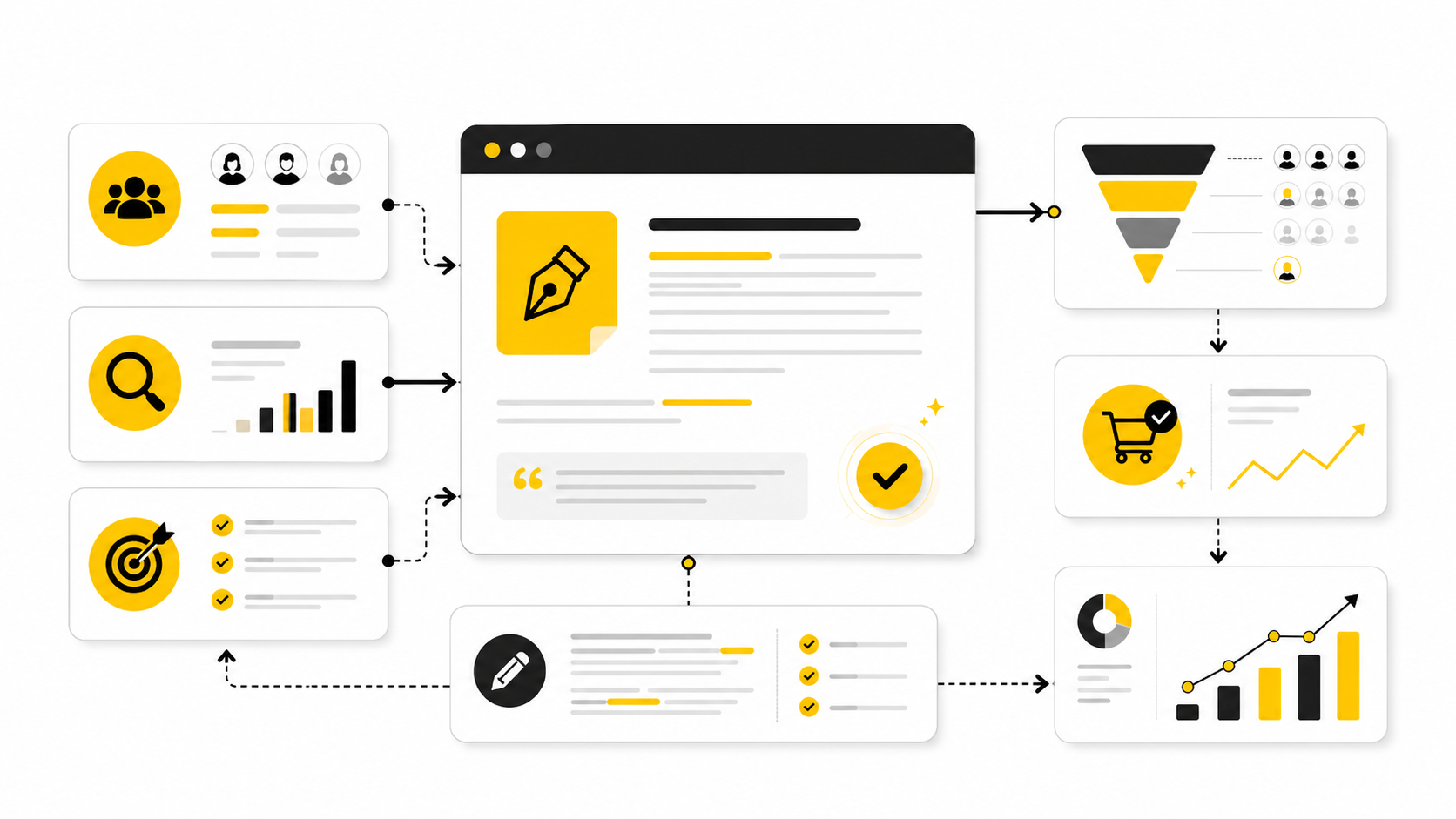
The best copywriters are not just clever writers. They are translators of desire, risk, timing, proof, and buying friction. They take what a business wants to say and turn it into what a real person needs to hear before they act.
That matters more now because the internet is noisier, faster, and more automated than ever. AI can produce drafts in seconds, but a strong copywriter still decides what should be said, what should be cut, what angle deserves attention, and what proof makes the claim believable. That judgment is the difference between content that fills space and copy that moves revenue.
Modern marketing also puts more pressure on words than most people realize. B2B marketers are increasing investment in areas like video, thought leadership, AI-assisted content, and paid campaigns, which means copy has to work across more formats, funnels, and customer touchpoints than before, not just on a sales page or email blast. The 2025 B2B content marketing research shows that teams are investing heavily in formats where positioning, narrative, and message clarity decide whether the content earns trust or gets ignored.
So when people search for the best copywriters, they are usually looking for one of three things. They either want famous copywriters to study, practical skills to improve their own writing, or a way to hire someone who can make their offer sound sharper and sell better. this guide covers all three without treating copywriting like magic.
This guide is built as one complete article split into six parts. Each part focuses on a different layer of what makes the best copywriters effective, from mindset and strategy to execution, hiring, and long-term improvement. The goal is not to create a museum of famous names; it is to help you understand what great copy actually does in the real world.
Best Copywriters And The Framework Behind Great Copy
The best copywriters do not start with words. They start with the market, the offer, the buyer’s awareness level, and the tension between what the buyer wants and what they currently believe. Once those pieces are clear, the writing becomes much easier because the copy is no longer guessing.
This is why great copy often feels simple on the surface. The headline is clear, the offer makes sense, the proof arrives at the right time, and the call to action does not feel forced. Underneath that simplicity is a chain of decisions about positioning, psychology, structure, objections, and evidence.
For businesses, this matters because copy is attached to expensive things. Ads, funnels, emails, landing pages, webinars, product pages, onboarding flows, and sales scripts all depend on words doing their job. A tool like ClickFunnels, GoHighLevel, or Systeme.io can help you build the funnel, but the copy still has to make the offer feel worth taking seriously.
Why This Topic Matters
Copywriting matters because every business eventually has to answer the same question: why should someone choose this instead of doing nothing, delaying the decision, or buying from someone else? That question cannot be solved with prettier design alone. It requires clear thinking, strong positioning, and language that reduces uncertainty.
The stakes are higher when acquisition costs rise and attention gets harder to earn. If an ad gets the click but the landing page fails, the copy has wasted the media spend. If an email gets opened but never makes the next step feel obvious, the campaign leaves money on the table.
The best copywriters protect against that waste. They do not just “make it sound better”; they diagnose why people hesitate, what they misunderstand, and what proof they need before moving forward. That is why strong copywriting is not decoration. It is sales strategy expressed through language.
Framework Overview
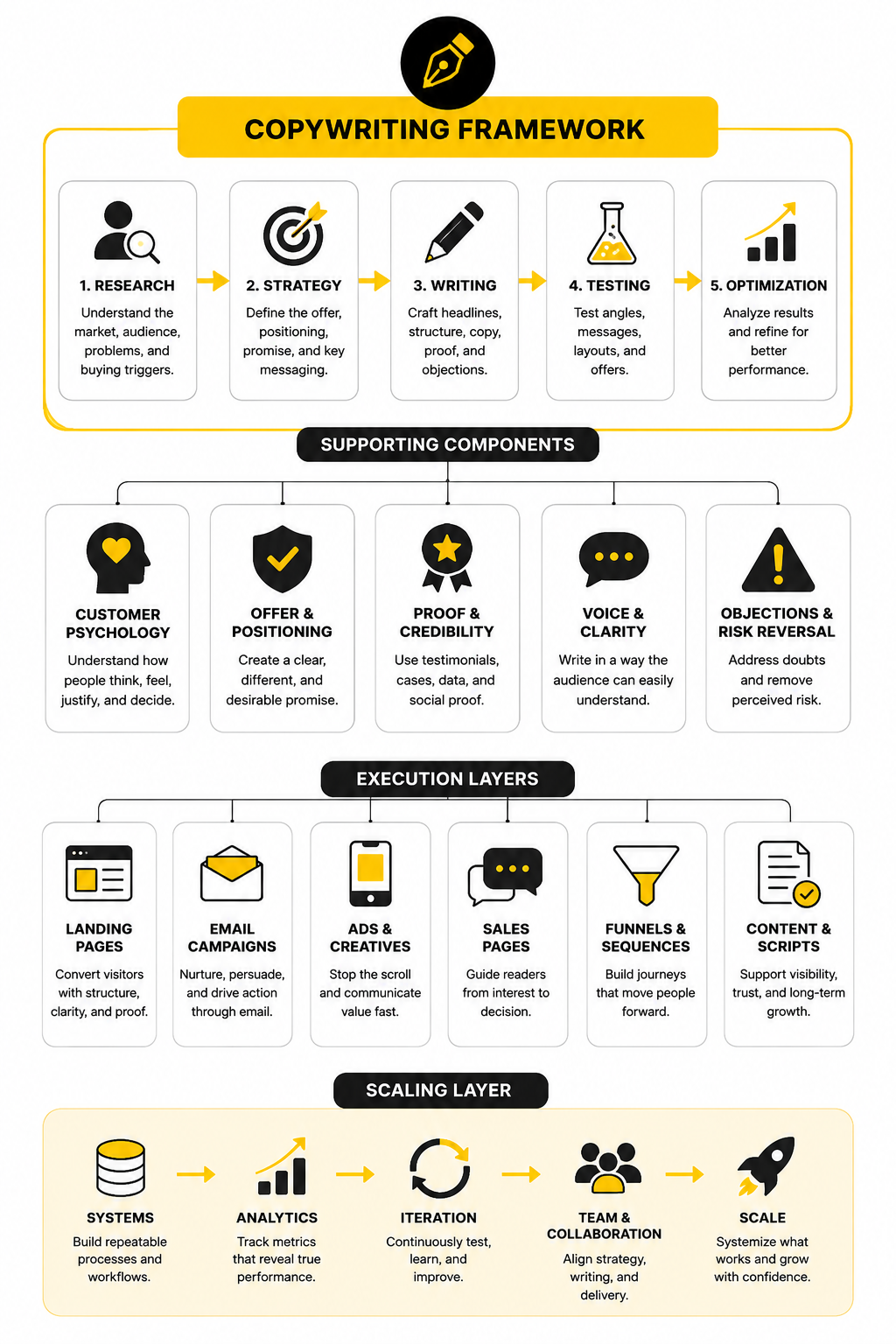
A useful way to understand the best copywriters is to look at their work through four layers: market, message, mechanism, and movement. The market tells you who is buying and what they already believe. The message turns the offer into a clear promise that fits that buyer’s situation.
The mechanism explains why the offer works differently from other options. This is where a copywriter turns a generic claim into a believable reason to care. Without a mechanism, copy sounds like every competitor saying “save time,” “grow faster,” or “get better results.”
Movement is the final layer. It is the path from attention to action, whether that action is booking a call, starting a trial, clicking a product page, joining a list, or replying to an email. Tools like ManyChat, Brevo, and Buffer can help distribute and automate the message, but the framework keeps the copy from becoming random content.
Core Components Of Great Copywriting
Great copy usually depends on a few core components working together. The first is clarity, because confused people rarely buy. A strong copywriter removes vague claims, replaces abstract benefits with specific outcomes, and makes the next step easy to understand.
The second component is relevance. The best copywriters know that the same offer should not be explained the same way to every audience. A founder, a marketing manager, a freelancer, and a local business owner may all want growth, but they do not experience the problem in the same language.
The third component is proof. This can include customer results, product demonstrations, transparent comparisons, expert credibility, data, guarantees, or a clear explanation of the process. Copy becomes much stronger when the reader does not have to rely on trust alone.
The fourth component is momentum. Good copy has rhythm, but not in a poetic way. It moves the reader from problem to possibility, from skepticism to proof, and from interest to a reasonable next action.
Professional Implementation
Professional copywriting is not about writing one impressive paragraph and hoping it converts. It is a process that usually includes research, message strategy, drafting, editing, testing, and refinement. The best copywriters treat each project like a business problem before they treat it like a writing task.
In practice, this means they ask better questions before they write. They want to know who the customer is, what alternatives they compare, what objections show up in sales calls, what past campaigns have taught the team, and where the copy will live. A landing page, nurture email, onboarding sequence, and paid ad all need different levels of detail.
Implementation also means pairing copy with the right system. A high-converting message needs somewhere to go, whether that is a landing page built in Replo, a funnel inside ClickFunnels, or a CRM and follow-up workflow in GoHighLevel. Copy performs best when the message, page, traffic source, and follow-up are all built around the same buyer decision.
Why Great Copywriting Still Matters In An AI-Heavy Market
AI changed the speed of content production. It did not change the reason people buy. Buyers still pause when an offer feels vague, inflated, risky, poorly timed, or disconnected from their real problem.
That is why the best copywriters are becoming more valuable, not less. When everyone can generate average copy, the advantage moves to people who can recognize a sharp idea, find the real buying trigger, and make the message feel specific instead of mass-produced. AI can help create options, but it does not automatically know which angle deserves to win.
The bigger issue is trust. Marketing teams are using AI for content, personalization, workflows, and campaign production, but buyers are also becoming more sensitive to generic messaging. The Salesforce State of Marketing report highlights how marketers are prioritizing AI, data, and personalization, which means the copywriter’s job is no longer just writing words; it is making automated communication feel relevant, credible, and human.
AI Makes Average Copy Easier To Produce
The internet already had too much mediocre content before AI became mainstream. Now the barrier to producing more of it is almost gone. A business can generate blog posts, emails, ad variants, landing page sections, social posts, and chatbot replies without hiring a traditional writer for every asset.
That sounds efficient, and sometimes it is. But it also creates a dangerous illusion: because the copy exists, the message must be good. In reality, generated copy often sounds polished while still missing the actual reason the buyer should care.
The best copywriters do not compete with AI by typing faster. They compete by thinking better. They know how to pressure-test the promise, remove soft claims, challenge weak positioning, and turn a generic draft into something a real buyer can believe.
The Human Advantage Is Judgment
Judgment is the skill that separates useful copy from clean-looking noise. A copywriter has to decide what matters most, what can be removed, what objection needs to be handled first, and what claim sounds impressive but unsupported. Those decisions require context.
This is where human experience still matters. The best copywriters listen to sales calls, read customer reviews, study competitor positioning, analyze support tickets, and look for patterns in how buyers describe the problem in their own words. That raw material gives the copy texture that a generic prompt usually misses.
AI can assist with structure, variations, and speed, but it still needs direction. Without a strong operator, it tends to flatten the message into safe language. The result may be grammatically correct, but correct is not the same as persuasive.
Buyers Are More Skeptical Than Ever
Most buyers have seen every empty promise already. They have been told they can save time, grow faster, make more money, simplify operations, build growth, and transform their business. After a while, those claims blur together.
This is why specificity matters so much. A strong copywriter does not just say an offer is better. They explain who it is better for, when it works best, what problem it solves first, and why the reader should believe the promise now.
Skepticism is not a problem to avoid. It is a signal to respect. The best copywriters write for smart readers who need enough clarity and proof to move forward without feeling manipulated.
Personalization Raises The Bar
Personalization used to mean adding a first name to an email. That is not enough anymore. Modern buyers expect messages to reflect their role, problem, timing, behavior, and level of awareness.
Research on personalized marketing from McKinsey shows how AI is pushing brands toward more tailored customer experiences. But personalization only works when the underlying message is worth personalizing. Bad copy sent to the right segment is still bad copy.
This is where the best copywriters become strategic. They help decide which audience segments need different angles, which objections matter by stage, and which offer should be presented first. The technology can deliver the message, but the thinking behind the message still decides whether it lands.
Distribution Does Not Fix Weak Messaging
A bigger audience does not rescue a weak offer. More impressions, more emails, more posts, and more automation simply expose the weakness faster. If the copy is unclear, scaling it only scales confusion.
This matters for businesses using content calendars, email platforms, social scheduling, funnels, and CRM automations. Tools like Buffer, Brevo, and ManyChat can help you reach people consistently, but consistency only helps when the message is worth repeating.
The best copywriters understand this relationship. They do not treat distribution as a separate problem from persuasion. They make sure the message matches the channel, the buyer’s stage, and the action you want that person to take next.
Great Copy Builds A Decision Path
A reader does not usually jump from first contact to purchase in one clean step. They notice a problem, compare options, look for proof, hesitate, revisit the offer, and then decide whether the next action feels worth it. Good copy supports that entire path.
That means every asset has a job. An ad earns attention. A landing page clarifies the promise. An email builds trust. A case study reduces risk. A sales page turns interest into a decision.
The best copywriters know where each piece fits. They do not overload a short ad with every detail or make a product page feel like a vague brand manifesto. They understand the purpose of each touchpoint and write accordingly.
The Best Copywriters Use AI Without Hiding Behind It
Strong copywriters are not anti-AI. That would be impractical. They use AI for research organization, draft expansion, headline variation, customer language clustering, content repurposing, and faster iteration.
The difference is that they do not outsource the core thinking. They still own the angle, the promise, the proof standard, the structure, and the final edit. That ownership is what makes the work valuable.
For a business, this is the practical takeaway. Do not ask whether AI or copywriters matter more. Ask whether your copy has a clear strategy behind it. The best copywriters use better tools without letting the tools make the important decisions.
The Core Components The Best Copywriters Get Right
The best copywriters do not rely on one trick. They stack several components together until the message becomes clear, believable, and easy to act on. That is why strong copy can feel simple when you read it, even though the thinking behind it is usually very deliberate.
This is also why copying someone else’s headline rarely works. The visible words are only the final layer. Underneath them are customer research, offer positioning, proof selection, objection handling, page structure, and a decision about what the reader needs to believe next.
If you want better copy, do not start by asking, “How do I make this sound more persuasive?” Start by asking, “What has to be true for the right person to feel ready to take the next step?” That question forces you to build copy from the buyer’s reality instead of your own excitement about the offer.
Customer Research Comes First
The best copywriters spend a serious amount of time understanding the customer before they write. They look for the exact language people use when they describe the problem, the moment the problem became urgent, and the alternatives they already tried. This matters because the strongest copy often sounds like the reader’s own thoughts, just organized better.
Good research is not just demographics. Knowing someone’s age, job title, or industry can help, but it does not tell you what they fear, what they want to avoid, or what makes them hesitate. Real copywriting research digs into reviews, sales calls, surveys, support conversations, community discussions, competitor pages, and customer interviews.
The goal is not to collect random quotes. The goal is to spot patterns. When the same frustration, objection, or desired outcome keeps appearing across multiple sources, that is a signal the copy should probably address it directly.
Positioning Turns Information Into Meaning
A weak copywriter lists features. A strong copywriter gives those features meaning. Positioning is the bridge between what the product does and why the right person should care now.
For example, “automation” is not automatically persuasive. Automation could mean saving time, reducing human error, responding faster, personalizing follow-up, or making a small team look more professional. The copywriter has to choose which meaning matters most for the buyer and the offer.
This is where the best copywriters are ruthless. They do not try to say everything. They decide what deserves the most attention and what should stay in the background, because a message that tries to win every angle usually wins none of them.
The Offer Has To Be Easy To Understand
Great copy cannot rescue an offer that nobody understands. Before the writing gets polished, the offer needs to be clear. The reader should quickly know what they get, who it is for, what problem it solves, and what action they should take.
This sounds basic, but it is where many businesses lose people. They use internal language, vague package names, clever labels, or broad promises that make sense to the team but not to the buyer. The best copywriters simplify that confusion without making the offer feel smaller.
A clean offer also makes every downstream asset easier to write. Ads become sharper, landing pages become easier to structure, emails become more focused, and sales conversations become more consistent. If you are building a funnel in ClickFunnels, Systeme.io, or GoHighLevel, this clarity matters before the first page is built.
Proof Makes The Promise Believable
Every strong promise creates a question in the reader’s mind: “Why should I believe this?” Proof answers that question. Without it, even good writing can feel like hype.
Proof can come from testimonials, demonstrations, screenshots, benchmarks, process breakdowns, before-and-after comparisons, customer quotes, transparent guarantees, or a clear explanation of how the result happens. The best copywriters do not throw proof onto the page randomly. They place it near the claims that need support.
The strongest proof is specific to the objection. If the reader worries the product is complicated, show simplicity. If they worry it will not work for their industry, show relevant use cases. If they worry it takes too long, explain the implementation path clearly.
Objection Handling Keeps The Reader Moving
Objections are not interruptions. They are part of the buying process. A reader may like the offer and still wonder whether it is too expensive, too complicated, too risky, too time-consuming, or too good to be true.
The best copywriters handle those objections before they become exit points. They do not bury them at the bottom of the page or pretend they do not exist. They answer them naturally inside the flow of the copy.
This is where tone matters. Objection handling should not feel defensive. It should feel like the business understands what a reasonable buyer needs to know before making a decision.
A Practical Copywriting Process
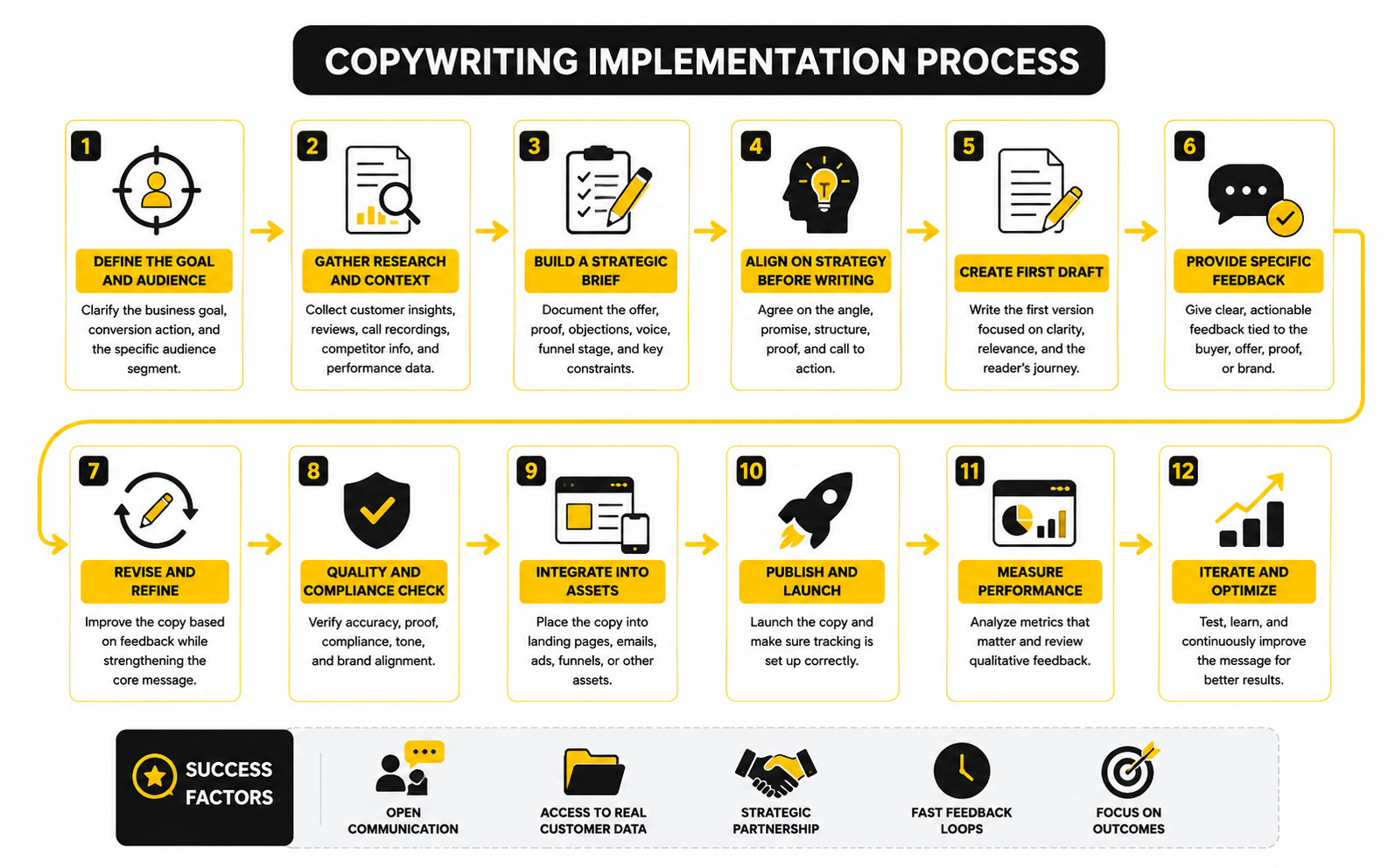
A strong copywriting process gives the work structure without making it rigid. The exact steps can change depending on the project, but the logic usually stays the same. You move from research to strategy, then from strategy to draft, then from draft to testing and refinement.
A simple process looks like this:
This process matters because it keeps copy from becoming random. Instead of guessing what sounds good, you build around what the buyer needs to understand and believe. That is how the best copywriters make their work feel intentional.
The First Draft Is Not The Final Asset
A first draft is where the idea becomes visible. It is not where the work ends. In many cases, the best copy appears during editing, because editing forces the writer to remove weak claims, tighten the structure, and replace vague language with concrete meaning.
The first edit should focus on strategy. Is the promise clear? Is the reader obvious? Does the copy address the real buying situation? If the strategy is weak, polishing the sentences will not fix the problem.
The second edit should focus on flow. Each section should make the next section feel natural. The reader should not feel like they are being dragged through a list of claims; they should feel like the copy is answering the questions that appear in their mind as they read.
Channel Fit Changes The Copy
The same message should not be written the same way everywhere. An ad has to earn attention quickly. A landing page has to build enough confidence for action. An email has to feel personal enough to keep the relationship moving.
The best copywriters adjust the message for the channel without losing the core positioning. They understand that a strong social post may lead with tension, while a product page may need clearer structure and proof. They also know that automation tools only work when each message fits its place in the buyer journey.
For example, a follow-up sequence in Brevo may need short, trust-building emails, while a chatbot flow in ManyChat may need faster branching based on user intent. The copy must respect the environment where it appears.
Testing Turns Opinion Into Evidence
Copywriting always involves judgment, but it should not stay trapped in opinion. Once the message goes live, behavior gives you feedback. Clicks, replies, conversions, scroll depth, form starts, bookings, and sales conversations all reveal where the copy is working and where it is leaking attention.
The best copywriters do not treat testing as a way to prove they were right. They use it to learn faster. A headline may attract the wrong people, a call to action may feel too aggressive, or a proof section may arrive too late.
The key is to test meaningful changes. Do not obsess over tiny word swaps before the core message is strong. First test the promise, angle, offer framing, proof placement, and page structure, because those decisions usually matter more than cosmetic edits.
What The Best Copywriters Do Differently In Practice
The best copywriters do not judge copy by how clever it sounds. They judge it by what it helps the reader do next. That shift matters because copy can feel impressive in a document and still fail when it meets traffic, attention limits, objections, and real buying behavior.
In practice, great copywriters connect writing to measurement. They want to know whether the headline is attracting the right people, whether the offer is understood quickly, whether proof is reducing doubt, and whether the call to action feels like a natural next step. The numbers are not there to make the work look analytical. They are there to reveal where the message is strong and where it is leaking.
This is why performance copy is never finished the moment it goes live. A launch gives you the first real feedback. Then the best copywriters read the data, compare it against the buyer journey, and improve the message based on evidence instead of ego.
Statistics And Data
Data matters because copywriting sits between attention and action. A reader may click an ad, open an email, scroll through a page, start a form, book a call, or leave without doing anything. Each action tells you something different about the message.
The mistake is treating one number as the whole truth. A high open rate does not mean the email persuaded anyone. A high click-through rate does not mean the landing page converted. A strong conversion rate does not always mean the campaign is profitable if lead quality is weak.
Benchmarks help only when they give you context, not excuses. Email research from MailerLite’s 2025 benchmark data puts average click rates near 2%, while B2B-focused email analysis from Powered by Search shows how open rates, click rates, and conversion rates can vary by category and intent. The useful takeaway is not that every campaign should chase the same average. The useful takeaway is that your copy should be measured against the job it was meant to do.
The Metrics That Actually Matter
The best copywriters separate vanity metrics from decision metrics. Vanity metrics make the campaign look busy. Decision metrics show whether the copy is moving the buyer closer to revenue.
For a landing page, the useful numbers include conversion rate, scroll depth, form starts, form completions, button clicks, time on page, and traffic source performance. For email, they include reply rate, click rate, conversion rate, unsubscribe rate, spam complaints, and downstream revenue. For ads, they include click-through rate, cost per click, cost per lead, lead quality, and eventual sales conversion.
The key is matching the metric to the copy’s role. If a top-of-funnel post creates qualified traffic, it may be doing its job even if it does not immediately sell. If a sales page attracts attention but does not create action, the copy may be interesting without being convincing.
What Benchmarks Can And Cannot Tell You
Benchmarks are useful because they stop you from evaluating performance in a vacuum. If your email click rate is far below market averages, your offer, audience, subject line, or body copy may need work. If your landing page converts far above average, you may have a message worth expanding into ads, emails, and sales scripts.
But benchmarks can also mislead you. A cold traffic page, warm referral page, checkout page, webinar registration page, and demo request page should not be judged by the same standard. Intent changes everything.
Conversion research across B2B categories often shows wide variation by industry, offer type, and funnel stage, with some 2025 B2B benchmark summaries placing software conversion rates much lower than higher-intent service categories like legal or professional services. That spread matters because the best copywriters do not ask, “Is this number good in general?” They ask, “Is this number good for this audience, this promise, this traffic source, and this next step?”
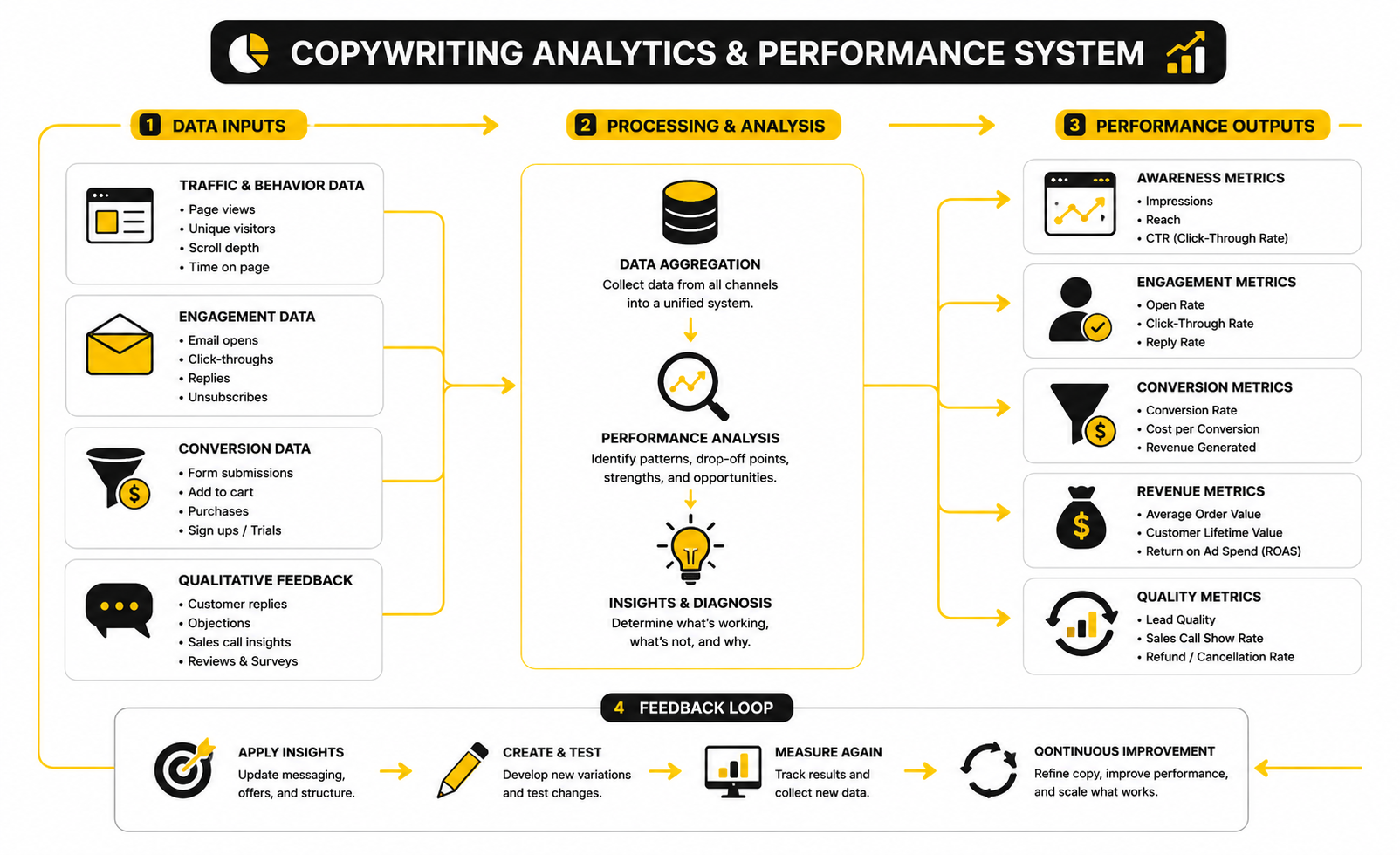
The Copywriting Analytics System
A simple analytics system should show the path from first contact to meaningful action. You do not need to track everything. You need to track the few signals that explain where people are dropping off and why.
Start with the sequence. The reader sees a message, clicks or ignores it, lands on a page, engages or bounces, considers the offer, takes action or exits, and then either becomes a qualified lead, buyer, subscriber, or missed opportunity. Each step should have one main metric and one diagnostic question.
For example, if ad click-through rate is low, the hook may not be relevant enough. If clicks are strong but landing page conversions are weak, the page may not match the promise that earned the click. If form starts are high but completions are low, the friction may be in the form, the ask, or the perceived risk.
How To Read Performance Signals
Good data interpretation starts with behavior, not blame. If people are not clicking, that does not automatically mean the copy is bad. It may mean the audience is wrong, the offer is too broad, the creative is weak, or the message is appearing too early in the buyer journey.
The best copywriters look for patterns across multiple signals. A high bounce rate with low scroll depth suggests the page is losing people immediately. Strong scroll depth with weak conversions suggests the copy may be interesting but not decisive. High clicks with poor lead quality suggests the promise may be attracting curiosity instead of commitment.
This is where measurement becomes practical. Every signal should lead to a next action. If the headline is not earning attention, test a sharper problem or outcome. If the proof is being missed, move it earlier. If the call to action feels too big, test a lower-friction next step.
Measuring Copy Across The Funnel
Copy should be measured differently depending on where it appears. Top-of-funnel copy earns attention and qualifies interest. Middle-of-funnel copy builds trust, explains the mechanism, and handles objections. Bottom-of-funnel copy reduces risk and makes action feel obvious.
This matters because the same metric can mean different things at different stages. A short educational email may be successful if it earns replies or repeat engagement. A product page is successful only if it helps the right visitors move closer to purchase. A sales follow-up is successful when it removes uncertainty and creates a clear next step.
Tools can help keep this organized. A business using GoHighLevel can connect pipeline stages, follow-up sequences, and appointment outcomes. A funnel built in ClickFunnels can make it easier to see where visitors drop between pages. An email system like Brevo can show whether the message is earning clicks, unsubscribes, or silence.
What To Test First
The best copywriters do not start by testing tiny wording changes. They test the big levers first. A stronger promise, clearer offer, better proof placement, more relevant angle, or lower-friction call to action can change results much more than swapping one adjective.
A practical testing order looks like this:
This order keeps the work focused. It also prevents teams from wasting time on surface-level edits while the real problem sits in the offer, audience, or proof.
When The Numbers Look Good But Sales Do Not
Sometimes the dashboard looks healthy and the business still feels stuck. This usually means the copy is generating activity, not qualified demand. People are clicking, reading, or opting in, but they are not becoming the kind of prospects who buy.
That problem often starts with overpromising, vague benefits, or curiosity-driven hooks that attract the wrong people. A headline can increase clicks while lowering lead quality. A free resource can build a list that never converts if the topic is too far from the paid offer.
The best copywriters watch for this early. They care about conversion rate, but they also care about who converted. Strong copy should not just increase numbers. It should attract the right people, set the right expectations, and make the sales process easier.
Turning Data Into Better Copy
Data becomes useful when it changes what you write next. If analytics show that readers leave before the offer section, the opening needs to create a stronger reason to continue. If readers reach the pricing section but do not act, the value, proof, guarantee, or risk reversal may need work.
Qualitative data matters here too. Sales call notes, customer objections, chat transcripts, survey responses, and support tickets often explain the “why” behind the numbers. The best copywriters combine analytics with customer language so they can see both what happened and what the buyer was probably thinking.
That is the real advantage. The best copywriters do not worship data, and they do not ignore it. They use it as feedback, then turn that feedback into clearer promises, stronger proof, smoother flow, and more confident next steps.
How To Hire, Brief, And Work With A Professional Copywriter
Hiring one of the best copywriters is not the same as hiring someone who writes clean sentences. Clean writing matters, but it is only the entry point. The real value is strategic judgment, research discipline, offer understanding, and the ability to turn messy business context into copy that helps buyers make decisions.
This is where many teams get hiring wrong. They look for personality, style, or a portfolio that “sounds good,” but they do not test whether the writer can understand the business model, customer journey, and sales constraints. A great copywriter should make your message clearer, but they should also make your thinking sharper.
The relationship works best when the business treats the copywriter like a strategic partner, not a word vendor. If you only hand them a blank page and ask for magic, you will probably get surface-level copy. If you give them access to customer insight, offer context, performance data, and decision-makers, you give them the raw material to do serious work.
The Tradeoff Between Specialist And Generalist Copywriters
A specialist copywriter brings pattern recognition. They have likely seen similar offers, similar objections, similar funnel structures, and similar buying situations before. That can make the work faster and sharper, especially in technical markets, high-ticket services, ecommerce, SaaS, health, finance, or B2B lead generation.
A generalist copywriter can be useful when the project requires range. They may be better suited for a brand that needs website messaging, email, social, ads, and content all connected under one voice. The tradeoff is that they may need more time to understand industry-specific nuance.
The best choice depends on the risk in the project. If a mistake in terminology, compliance, or buyer psychology could cost you trust, lean specialist. If the challenge is creating consistent messaging across multiple channels, a strong generalist with solid research habits can be the better fit.
Portfolio Quality Is Not Enough
A portfolio shows what a copywriter has produced. It does not always show how they think. You need to look beyond the final copy and ask what role the writer played, what constraints existed, what the goal was, and what changed after the work went live.
Be careful with polished samples that have no context. A beautiful landing page may have been driven by a strategist, designer, founder, or agency team, with the copywriter only contributing a small piece. That does not make the sample useless, but it does mean you should ask better questions.
Strong evaluation looks for reasoning. Ask why they chose the angle, what objections they prioritized, what research shaped the message, and what they would test next. The best copywriters can explain their decisions without hiding behind vague creative language.
What A Good Copywriting Brief Should Include
A copywriter should not need a perfect brief, but they do need a useful one. The brief should explain the business goal, audience, offer, traffic source, conversion action, proof assets, brand voice, and known objections. Without that context, the writer has to guess, and guessing is expensive.
A strong brief should include:
This is not bureaucracy. It is leverage. A detailed brief helps the copywriter spend less time decoding the business and more time improving the message.
Give The Copywriter Access To The Real Customer Voice
The best copywriters want raw customer language because it reveals what polished internal documents usually hide. Sales decks often describe the offer from the company’s point of view. Customers describe the problem from the buyer’s point of view.
Give the copywriter access to reviews, call recordings, support tickets, chat logs, testimonials, community discussions, and survey responses whenever possible. Even a small batch of real customer language can reveal repeated objections, emotional triggers, and buying criteria. That material often becomes the difference between copy that sounds generic and copy that feels immediately relevant.
This is especially important when using AI-assisted workflows. Reports like the 2025 State of Marketing AI Report show how marketers are using AI more deeply across content and strategy, but AI still needs high-quality input to produce useful output. Better customer data gives both the copywriter and the tools a stronger foundation.
Strategic Alignment Comes Before Drafting
Before a serious copy project moves into drafting, everyone should agree on the strategic basics. Who exactly is this for? What does the reader already believe? What is the primary promise? What proof can support it? What action are we asking for?
Skipping this step creates painful revisions later. The copywriter writes one version, the founder expects another, the sales team disagrees with the promise, and the designer starts building around a message nobody has fully approved. That is how copy projects become slow and frustrating.
A simple strategy review prevents most of this. Lock the audience, angle, offer, proof, structure, and call to action before polishing the language. The best copywriters usually welcome this because it protects the work from random opinion.
How To Give Useful Feedback
Bad feedback sounds like “make it punchier,” “this does not feel premium,” or “can we make it more exciting?” Those comments may contain a real concern, but they are too vague to act on. A copywriter has to guess what you mean, which usually creates another round of weak revisions.
Useful feedback is specific. It points to the section, explains the concern, and ties it back to the buyer, offer, proof, or brand. For example, “This section may overpromise because our onboarding usually takes three weeks” is much more helpful than “tone this down.”
The best working relationships separate personal preference from strategic concern. You may dislike a phrase, but the more important question is whether the phrase helps the right buyer understand and act. That distinction keeps revisions focused on performance instead of taste.
Common Risks When Scaling Copy
Scaling copy creates new problems. The message has to stay consistent across ads, emails, pages, sales scripts, onboarding, retargeting, and support. If each channel uses different promises, buyers receive a fragmented story.
The first risk is message drift. A campaign starts with one strong positioning idea, but as more people create assets, the language becomes diluted. The offer gets described slightly differently everywhere until nobody knows which version is true.
The second risk is automation without quality control. A business may build follow-up systems in GoHighLevel, email campaigns in Brevo, funnels in ClickFunnels, and landing pages in Replo. That stack can be powerful, but only if the messaging system is clear enough to scale without becoming chaotic.
Build A Message Library Before You Scale
A message library is one of the most practical assets a business can create. It gives your team a shared source of truth for the audience, pain points, claims, proof, objections, comparisons, voice, and approved language. It stops every campaign from starting from zero.
A useful message library should include:
This makes copywriting faster without making it lazy. The goal is not to force every asset to sound identical. The goal is to keep the core message consistent while allowing each channel to adapt the delivery.
When To Use Freelancers, Agencies, Or In-House Talent
Freelancers are often best for specific projects. A strong freelancer can write a landing page, email sequence, sales page, ad campaign, or messaging audit without adding permanent headcount. This works well when the scope is clear and the business can provide fast feedback.
Agencies are useful when the copy is part of a larger system. If you need strategy, design, funnel buildout, ads, automation, and analytics connected, an agency may be easier to manage than several separate specialists. The risk is that you need to know who is actually doing the copy and whether they understand your market.
In-house copywriters make sense when messaging is constant and deeply tied to the product, sales team, or brand voice. They can build institutional knowledge over time, which is hard to replace. The tradeoff is that in-house teams can become too close to the business, so they still need customer research and outside perspective to stay sharp.
The Best Copywriters Protect The Buyer Relationship
There is a line between persuasion and pressure. The best copywriters know where that line is. They make the decision easier, not more manipulative.
This matters because aggressive copy can create short-term conversions and long-term damage. If the promise is inflated, the sale becomes harder to fulfill. If the urgency is fake, trust erodes. If the copy hides important tradeoffs, buyers eventually feel misled.
Strong copy respects the reader’s intelligence. It clarifies the value, addresses risk honestly, and gives the buyer enough confidence to move forward for the right reasons. That is how copy becomes an asset instead of a liability.
Advanced Copywriting Is Really Business Clarity
At a high level, copywriting exposes business clarity. If the offer is weak, the copy will struggle. If the audience is too broad, the message will feel soft. If proof is missing, the promise will feel risky.
That does not mean a copywriter can only work with perfect businesses. Far from it. The best copywriters often help uncover the gaps that need fixing before the message can scale. They may reveal that the offer needs a stronger guarantee, the audience needs narrowing, the proof needs organizing, or the funnel needs a better next step.
This is why expert copywriting feels valuable beyond the words. It improves how the business explains itself, sells itself, and learns from the market. By the time the copy goes live, the team should not just have better assets. They should have a clearer understanding of why buyers should care.
Copywriting Tools, Final Checklist, And FAQ
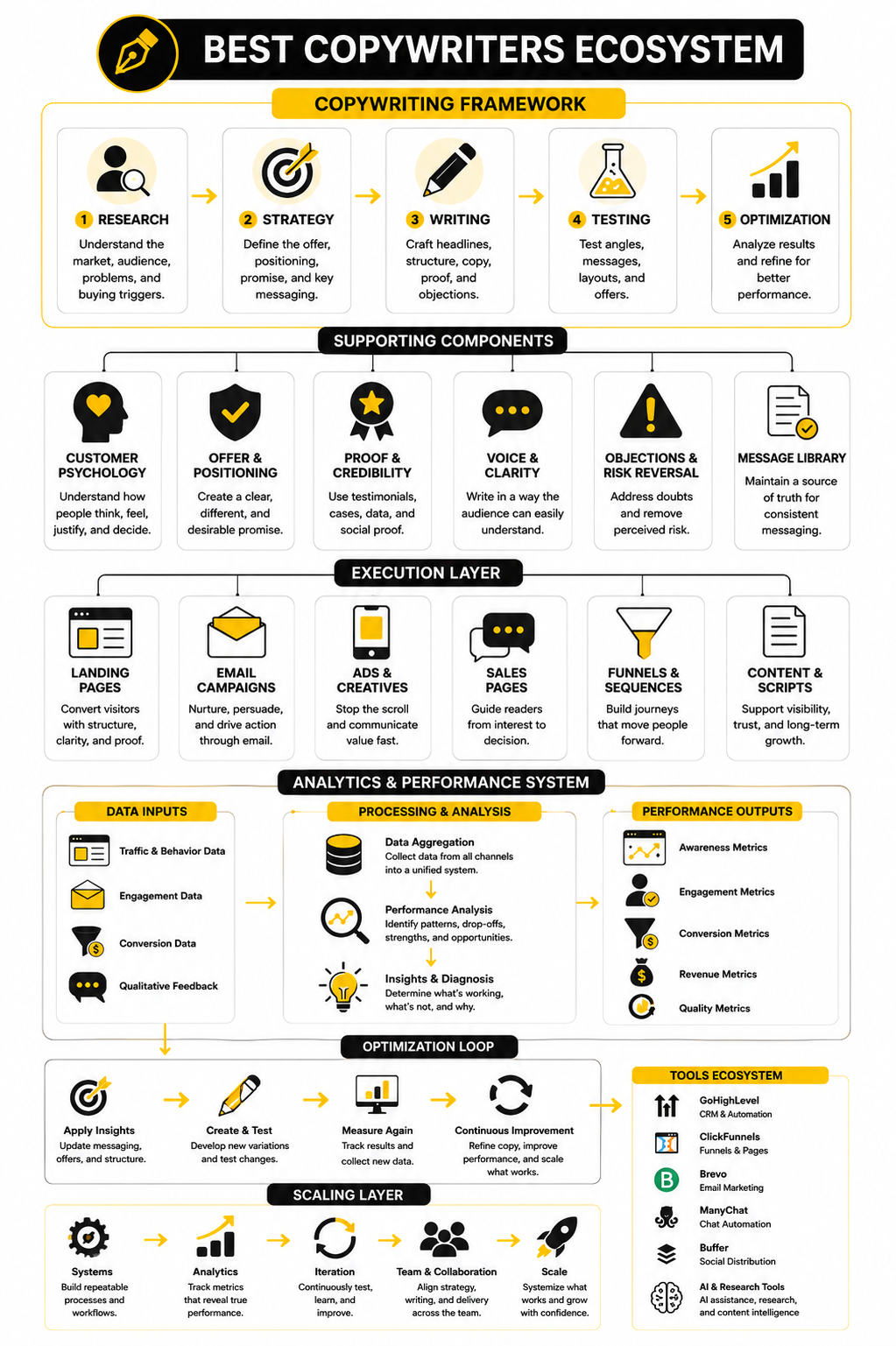
The final piece is the system around the copy. The best copywriters do not treat tools, workflows, analytics, and creative decisions as separate worlds. They connect them so the business can produce better campaigns, learn faster, and keep the message consistent as the team grows.
That system does not need to be complicated. It needs to be clear enough that every page, email, ad, chatbot flow, social post, and follow-up message supports the same buyer journey. When the ecosystem is aligned, copy stops feeling like scattered content and starts working like a revenue asset.
This is where strategy becomes practical. A business can use GoHighLevel to manage leads and follow-up, ClickFunnels to build funnel paths, Brevo to run email campaigns, ManyChat to handle conversational automation, and Buffer to distribute social content. The tools help, but the message system decides whether those tools amplify clarity or chaos.
The Final Copywriting Ecosystem
A strong copywriting ecosystem has five parts: research, strategy, assets, distribution, and feedback. Research gives you the buyer’s language. Strategy decides the promise, positioning, proof, and next action. Assets turn that strategy into pages, emails, ads, scripts, and content.
Distribution puts the message in front of the right people. Feedback shows what the market did with it. The best copywriters keep these five parts connected instead of treating every campaign like a fresh guess.
This is also where AI fits best. Reports like the 2025 State of Marketing AI Report show how deeply marketers are adopting AI, and broader content research from Orbit Media found AI adoption among surveyed content marketers rising from 65% to 95% over two years. The lesson is simple: AI can speed up production, but the system still needs human judgment, brand context, customer insight, and performance review.
The Final Checklist For Better Copy
A checklist will not turn weak strategy into great copy, but it can stop obvious mistakes from slipping through. Use it before publishing any important page, email, ad, or funnel sequence. The best copywriters build their own version of this because they know performance usually comes from disciplined basics done well.
Before copy goes live, check these points:
This checklist is intentionally practical. Do not use it as a decoration. Use it to catch friction before the market does.
How To Keep Improving As A Copywriter
Improvement comes from studying real buyer behavior, not just saving clever headlines. Read ads, landing pages, emails, sales pages, reviews, comments, and transcripts with one question in mind: what belief is this copy trying to change? That one question will sharpen how you see persuasion.
Build a swipe file, but do not copy it blindly. Label each example by the job it performs: attention, differentiation, objection handling, proof, urgency, risk reversal, or call to action. That makes the file useful instead of turning it into a folder of random inspiration.
Most importantly, publish and review results. Copywriting improves faster when you connect the words to actual outcomes. The best copywriters learn from what people click, ignore, question, buy, refund, share, and reply to.
Who are the best copywriters to study?
The best copywriters to study depend on what you want to learn. For direct response fundamentals, people often study names like Eugene Schwartz, Gary Bencivenga, John Caples, David Ogilvy, Claude Hopkins, and Gary Halbert. For modern digital copy, it is also useful to study strong SaaS pages, ecommerce offers, creator funnels, email sequences, and high-performing ad libraries.
The key is not memorizing famous names. The key is understanding why the copy worked in its market. A classic ad may teach positioning, but a modern landing page may teach onboarding friction, pricing clarity, or proof placement.
What makes the best copywriters different from average writers?
The best copywriters understand business, psychology, research, and sales context. They do not just make sentences sound better. They clarify the offer, identify the buyer’s hesitation, organize proof, and guide the reader toward a specific decision.
Average writers often start with style. Strong copywriters start with the market. That is the difference.
Can AI replace copywriters?
AI can replace some low-level drafting, rewriting, and variation work. It can also help with outlines, ideation, research organization, and repurposing. But it does not automatically replace strategic judgment.
The best copywriters use AI as leverage. They still control the angle, message, proof, tone, structure, and final edit. That is where the value is.
How do I know if my copy is working?
Your copy is working when it moves the right person closer to the right action. That may mean more qualified calls, more trial starts, more replies, more purchases, better lead quality, or fewer objections in sales conversations. The exact metric depends on the asset.
Do not judge copy by one number alone. Look at the full path from attention to action. A campaign that gets clicks but attracts bad leads still needs work.
What should I give a copywriter before a project starts?
Give them your offer details, target audience, customer research, sales notes, testimonials, past performance data, competitor examples, brand voice guidance, and compliance limits. The more relevant context they have, the less they have to guess. Good copy comes from good inputs.
You do not need to have everything perfectly organized. But you should be ready to share what the business already knows about the customer. That is usually where the strongest copy starts.
How much should I pay for a copywriter?
Pricing depends on the project, market, experience level, and expected business impact. A simple email may cost much less than a complete sales page, funnel strategy, or full messaging system. The more strategic risk involved, the more you should expect to invest.
Do not choose only by price. Cheap copy can become expensive if it wastes traffic, weakens positioning, or attracts the wrong buyers. The right question is whether the copywriter can improve the business outcome enough to justify the cost.
Should I hire a niche copywriter or a generalist?
Hire a niche copywriter when the market has complex buyers, technical language, compliance concerns, or high trust requirements. Their industry pattern recognition can save time and reduce mistakes. This is especially useful in SaaS, finance, healthcare, legal, ecommerce, and high-ticket B2B.
Hire a strong generalist when the project needs broad messaging across channels or when the writer has excellent research skills. A generalist can still do great work if they know how to learn the market quickly. The deciding factor is not the label; it is the quality of thinking.
What is the biggest mistake businesses make with copywriting?
The biggest mistake is treating copy as decoration after the strategy is already decided. The business builds the offer, page, funnel, or campaign, then asks a writer to “make it sound good.” That usually limits the result.
Copy should influence the strategy earlier. The writing process often reveals unclear positioning, weak proof, confusing offers, or missing objections. That insight is too valuable to leave until the end.
What is the difference between content writing and copywriting?
Content writing usually educates, informs, nurtures, or builds authority over time. Copywriting is more directly focused on persuasion and action. The two overlap, but they are not identical.
A blog post can include copywriting if it moves readers toward a decision. A sales page can include education if the buyer needs context before acting. The best marketers understand when to teach and when to sell.
How long does it take to become a good copywriter?
You can learn basic copywriting principles quickly, but becoming good takes practice, feedback, and exposure to real buyer behavior. The timeline depends on how often you write, how seriously you study results, and whether you work on real offers. Copywriting is a skill, not a personality trait.
The fastest improvement comes from writing for actual campaigns and reviewing outcomes. Theory helps, but the market teaches faster. Pay attention to what people do, not just what other writers praise.
What tools should copywriters use?
Copywriters should use tools that help with research, drafting, collaboration, distribution, and measurement. AI writing assistants can help with speed, while analytics tools reveal where the message is working or failing. CRM, funnel, and email platforms help connect the copy to the buyer journey.
The tool stack should support the strategy, not distract from it. A simple system used consistently beats a complex stack nobody understands.
Are the best copywriters always direct response writers?
Not always. Direct response copywriters are often strong because their work is tied closely to measurable action. But brand copywriters, product marketers, UX writers, email strategists, and conversion copywriters can also be excellent.
The best copywriters understand the job of the asset. Sometimes the goal is immediate conversion. Other times the goal is trust, clarity, onboarding, retention, or sales enablement.
How do I become one of the best copywriters?
Start by learning research, positioning, offer structure, proof, and editing. Then write often, study real campaigns, and ask for feedback from people who understand business results. Do not build your identity around cleverness; build it around clarity and usefulness.
Work on real projects as early as possible. Even small campaigns teach you more than endless theory. The best copywriters keep improving because they stay close to the market.
Build a stronger local presence with BAAM AI
Turn your website, Google profile, social channels, and AI visibility into one growth engine
Most businesses do not need more random marketing activity. They need a consistent presence system that helps the right people find them, trust them, and take action. BAAM AI brings strategy, local SEO, website updates, Google Maps visibility, social content, AI-search readiness, media production, and reporting into one practical monthly engine.
If you want your marketing to keep working after the campaign ends, start with a free BAAM AI presence audit. See how your business shows up today and where the fastest visibility wins are at BAAM AI.