
BAAM AI Blog
Best Brands On Social Media
The best brands on social media are not winning because they post more often, chase every trend, or have the biggest creative budget. They win because people recognize their voice, understand what the brand stands...

The best brands on social media are not winning because they post more often, chase every trend, or have the biggest creative budget. They win because people recognize their voice, understand what the brand stands for, and feel like the content belongs in the feed instead of interrupting it. That sounds simple, but it is exactly where most brands fail.
Social media is now too big to treat as a side channel. Global social media user identities reached 5.24 billion in 2025, and the typical internet user spends around 2 hours and 21 minutes per day on social platforms, based on the Digital 2025 Global Overview. That means a brand’s social presence is often not the follow-up to the customer experience. It is the customer experience.
The brands that stand out today understand one uncomfortable truth: attention is not the same thing as trust. A brand can go viral once and still build nothing. The real advantage comes from turning social media into a repeatable system for relevance, community, proof, and conversion.
Why The Best Brands On Social Media Matter
The best brands on social media matter because they show what modern brand-building actually looks like in public. People no longer experience a brand only through ads, stores, websites, or sales calls. They experience it through comments, creator posts, employee videos, founder opinions, memes, replies, product demos, customer complaints, and the way the brand reacts when the internet pushes back.
That changes the job of marketing. Social media is no longer just a distribution channel for campaigns that were planned somewhere else. The strongest brands use it as a live feedback loop where positioning, content, community, customer support, product education, and cultural relevance all meet in one place.
This is also why copying a successful brand rarely works. Duolingo’s chaotic mascot content works because it fits the product, the audience, and years of consistent behavior, not because every company needs an unhinged owl. The deeper lesson is that winning brands build a social identity people can recognize before they even see the logo.
The Framework For Studying Great Social Brands
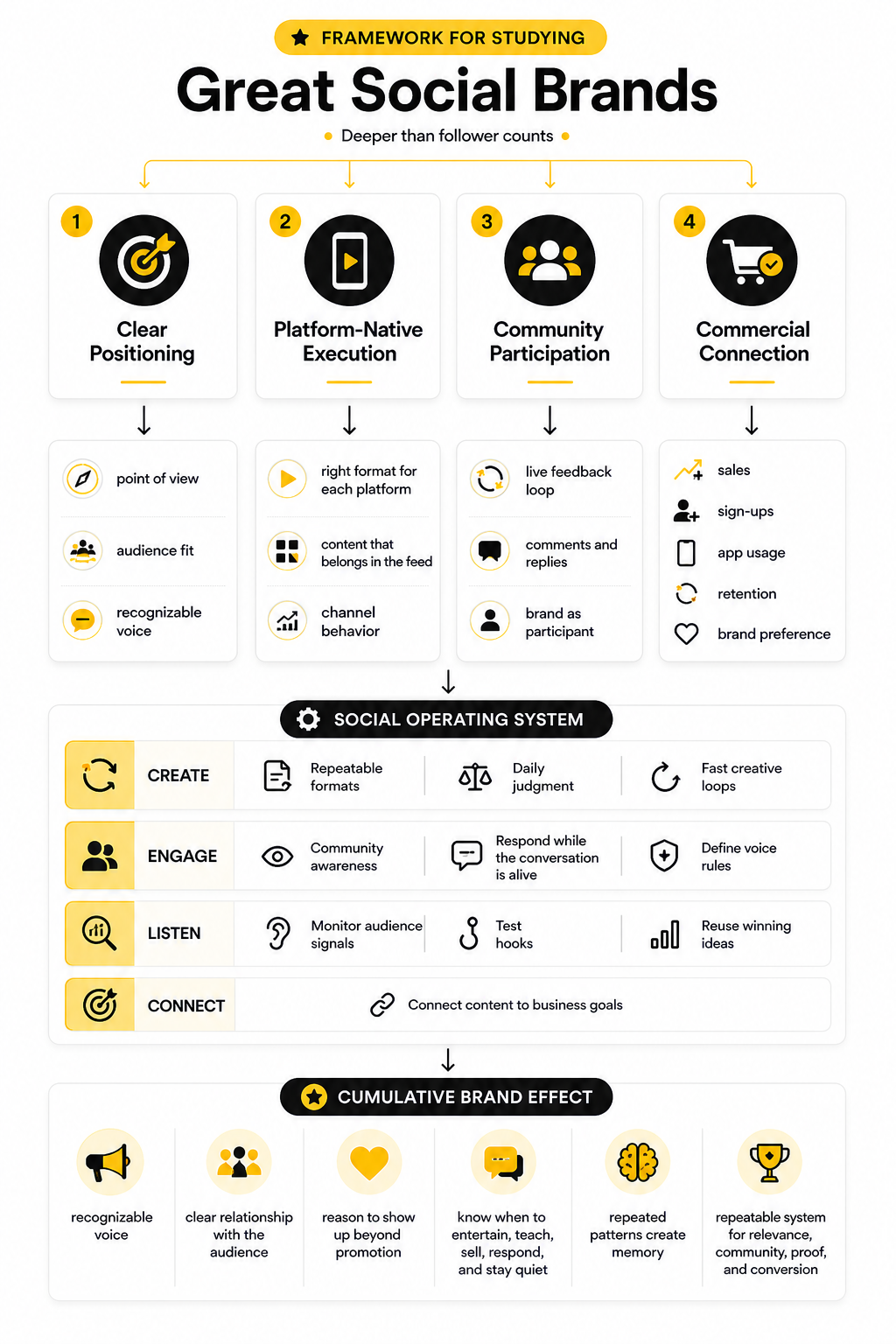
To understand why some brands dominate social media, we need a framework that goes deeper than follower counts. Follower numbers can be useful, but they do not explain whether a brand earns attention, creates memory, builds trust, or drives action. A more carefully framework looks at the system behind the content.
The best brands usually perform well across four areas: clear positioning, platform-native execution, community participation, and commercial connection. Clear positioning gives the brand a point of view. Platform-native execution makes the content feel right for TikTok, Instagram, LinkedIn, YouTube, X, Reddit, or whichever channel the audience already uses.
Community participation is where the brand stops broadcasting and starts behaving like a real participant. Commercial connection is where attention becomes useful to the business, whether that means sales, sign-ups, app usage, retail demand, lead quality, retention, or brand preference. Without that final connection, even entertaining content can become expensive noise.
this guide will be split into six parts so each section can go deep without turning into a shallow list of famous accounts. The structure starts with the strategy behind strong social brands, then moves into examples, execution, tools, measurement, and practical implementation. The goal is not to crown one universal winner, because the best brand for inspiration depends on your market, audience, risk tolerance, and business model.
What Counts As A Great Social Media Brand
A great social media brand is not simply a brand with a large audience. Some companies have millions of followers but very little cultural weight, while smaller brands can own a niche with far more intensity. The better question is whether people would notice if the brand stopped posting tomorrow.
A strong social brand has a recognizable voice, a clear relationship with its audience, and a reason to show up beyond promotion. It knows when to entertain, when to teach, when to sell, when to respond, and when to stay quiet. That judgment matters because social media punishes brands that confuse visibility with permission.
The best brands also understand that social media performance is cumulative. One good post can create a spike, but repeated patterns create memory. Over time, the audience learns what to expect, what the brand believes, and why it deserves attention again.
The Shift From Campaigns To Social Operating Systems
Traditional campaigns still matter, but the best brands on social media are not built only through campaign thinking. Campaigns have start dates, end dates, assets, approvals, and reporting decks. Social brands need all of that sometimes, but they also need daily judgment, fast creative loops, community awareness, and the ability to respond while the conversation is still alive.
That is why leading teams treat social media more like an operating system than a content calendar. They build repeatable formats, define voice rules, monitor audience signals, test hooks, reuse winning ideas, and connect content back to business goals. This makes the brand more consistent without making it boring.
The shift is visible in current research, too. The 2025 Sprout Social Index is built around the idea that social media now sits at the center of how consumers and marketers understand brands. Deloitte’s 2025 State of Social research also points to social-first brands doubling down on community, content, and conversion instead of treating social as a lightweight publishing function.
The Standard this guide Will Use
this guide will judge the best brands on social media by usefulness, not hype. A brand is worth studying if its social presence teaches us something repeatable about positioning, creative strategy, audience participation, trust, or conversion. That means we will look at famous names, but we will not praise them just because they are famous.
Some examples will be strong because of voice. Others will be strong because of community, creator collaboration, product education, founder visibility, customer support, or cultural timing. The point is to separate the surface-level tactic from the underlying system.
That distinction matters for your own brand. You do not need to become Duolingo, Liquid Death, e.l.f. Beauty, Ryanair, Patagonia, or Nike to learn from them. You need to understand what they do well, why it works for their audience, and which pieces can be adapted without turning your brand into a copycat.
What The Best Social Media Brands Have In Common
The best brands on social media are not identical, but they do share patterns. Some are funny, some are polished, some are founder-led, some are community-led, and some barely feel like traditional brands at all. Underneath the surface, though, the strongest ones tend to make the same strategic choices.
They know who they are for. They understand what their audience already cares about. They build repeatable content formats instead of starting from zero every week. Most importantly, they treat social media as a brand behavior system, not a dumping ground for announcements.
This is where the difference becomes obvious. Average brands ask, “What should we post today?” Strong brands ask, “What role should we play in our audience’s life, and how do we prove it repeatedly?”
They Have A Clear Point Of View
A strong social brand has an opinion. That does not mean it needs to be controversial all the time, and it definitely does not mean picking fights for reach. It means the brand has a recognizable way of seeing the category, the customer, the problem, and the culture around it.
This matters because bland content gets ignored. Social feeds are crowded with brands saying the same safe things in the same safe formats. When a brand has a point of view, people can decide whether they agree, disagree, relate, laugh, share, or come back for more.
The best brands on social media make their point of view easy to feel. Patagonia’s environmental stance is not just a campaign angle. Liquid Death’s anti-plastic, entertainment-first positioning is not just packaging. Duolingo’s playful chaos is not random when you understand that the app itself is built around habit, reminders, and making language learning feel less intimidating.
They Match The Platform Instead Of Fighting It
Great brands do not simply resize one asset and push it everywhere. They understand that each platform has its own behavior, language, pacing, and social contract. A post that feels natural on LinkedIn can feel painfully corporate on TikTok, while a TikTok trend can look forced if it gets copied into the wrong context.
This is why platform-native execution matters so much. Short-form video, creator collaborations, comment-led posts, carousels, livestreams, long-form YouTube content, and community threads all do different jobs. The best brands choose the format based on how people actually use the platform, not based on what is easiest for the marketing team.
The data backs up that shift. Social teams are under pressure to connect creative work to business outcomes, and the 2025 Sprout Social Index frames social as a central place where consumers discover, evaluate, and remember brands. That means the winning move is not just being present everywhere. It is showing up in a way that feels native enough to earn attention.
They Build Repeatable Content Formats
One viral post is nice. A repeatable format is better. The best brands on social media create content systems that can be used again and again without feeling stale.
A repeatable format could be a recurring video series, a recognizable meme structure, a customer spotlight, a product teardown, a founder lesson, a behind-the-scenes ritual, or a weekly community prompt. The format gives the team creative boundaries, and boundaries make execution faster. Instead of inventing a new strategy every Monday, the team can improve what already works.
This is also how brands become familiar. People remember patterns faster than isolated posts. When the audience starts recognizing the setup before the brand even finishes the message, the content has moved from random publishing into brand memory.
They Make The Audience Feel Involved
The strongest social brands do not treat the audience like a passive crowd. They invite people into the brand’s world through comments, reposts, creator partnerships, user-generated content, community jokes, product feedback, challenges, polls, and direct replies. The audience becomes part of the content engine.
This is not just about engagement for the sake of engagement. When people participate, they build a stronger relationship with the brand because the interaction feels personal. A comment reply can do more for affinity than a polished campaign if it arrives at the right moment and sounds like a human wrote it.
Community also creates useful market intelligence. People tell brands what they like, what confuses them, what they want next, and what they are tired of seeing. Smart brands listen to that signal and use it to shape content, offers, product education, and even product development.
They Balance Entertainment With Usefulness
Entertainment gets attention, but usefulness earns return visits. The best brands understand the balance. They do not post only jokes, and they do not post only educational content that feels like a classroom slide.
A great brand can entertain while still making the product, mission, or customer problem more memorable. A beauty brand can teach technique while showing personality. A software company can explain workflows without sounding like a manual. A consumer brand can use humor without disconnecting the joke from what it sells.
This balance is especially important because attention without relevance does not compound. A funny post that has nothing to do with the brand may get views, but it rarely builds durable demand. The strongest brands make people feel something and understand something at the same time.
They Use Creators Without Losing The Brand
Creator partnerships work best when the creator’s voice and the brand’s identity can coexist. Weak partnerships feel like a script. Strong partnerships feel like the creator found a natural way to bring the brand into their own world.
This is becoming more important as creator investment grows. Recent coverage of creator marketing reported that U.S. advertisers were projected to spend heavily on creator-driven content in 2026, while brands still struggled with measurement, scale, and treating creators too much like traditional media placements in The Wall Street Journal. The lesson is simple: creators are not just ad inventory. They are distribution, trust, context, and creative interpretation.
The best brands give creators enough direction to protect the brand but enough freedom to make the content believable. That balance is hard, but it is where the upside lives. Over-controlled creator content usually looks like an ad, and people scroll past it like one.
They Connect Social Content To A Real Business Path
Great social media does not have to sell in every post. In fact, it usually should not. But the overall system still needs a path from attention to action.
That path could lead to a product page, an email list, a store visit, a booked demo, a community, an app download, a waitlist, or a conversation in DMs. For ecommerce brands, tools like Replo can help turn campaign traffic into landing pages that match the message people clicked on. For service businesses and agencies, platforms like GoHighLevel can support the follow-up system behind leads, appointments, and customer communication.
This is where many brands lose the plot. They build attention at the top of the funnel, then send people into a slow, generic, confusing experience. The best brands make the next step feel obvious, useful, and connected to the content that created the interest in the first place.
They Measure More Than Vanity Metrics
Follower count, likes, and views can be useful signals, but they are not the whole scoreboard. A brand can grow followers and still fail to build trust, demand, or revenue. The best brands measure social performance in layers.
At the content level, they look at retention, saves, shares, comments, click-throughs, watch time, and format performance. At the brand level, they look at sentiment, share of voice, branded search, community growth, creator impact, and audience quality. At the business level, they connect social activity to leads, sales, pipeline, repeat purchases, customer support efficiency, and retention.
This is why social-first brands keep gaining influence inside serious companies. Deloitte’s social research highlights how leading brands are repositioning social closer to the center of brand experience, customer experience, and revenue growth through social business transformation. That is a much more mature view than treating social as the place where junior marketers schedule posts.
They Protect Trust Even When Chasing Attention
Attention is powerful, but trust is harder to rebuild once it is damaged. The best brands on social media understand that not every trend is worth joining. They know when speed helps and when restraint protects the brand.
This matters more now because audiences are increasingly sensitive to manipulation, fake authenticity, AI-generated content, undisclosed partnerships, and brands pretending to be something they are not. The backlash against fake virality in entertainment marketing, covered by The Guardian, shows how quickly audiences can turn when they feel a campaign is manufacturing culture instead of participating honestly. Brands should pay attention to that.
The best social brands do not need to fake being loved. They earn participation by being clear, consistent, useful, entertaining, and honest about what they are doing. That is less flashy than a manufactured viral moment, but it is much stronger over time.
Brand Examples Worth Studying
The best way to study the best brands on social media is not to copy their captions, jokes, colors, or posting schedule. That is surface-level imitation, and it usually looks awkward when a different brand tries it. The useful move is to reverse-engineer the operating principle behind each brand’s social presence.
A strong example should teach you something practical. Maybe the brand is excellent at turning product education into entertainment. Maybe it has a community that creates a large share of the content. Maybe it uses a founder, mascot, creator network, or customer base as the emotional center of the brand.
This section is not a trophy case. It is a working list of brands with social systems worth studying, then translating into your own category without becoming a cheap copy.
Duolingo: Make The Brand Character Impossible To Ignore
Duolingo is one of the clearest examples of a brand turning a recognizable character into a full social media engine. The green owl is not just a logo asset. It behaves like a personality, and that personality gives the brand a repeatable way to react, joke, remind, and stay culturally relevant.
The lesson is not that every brand needs a mascot. The lesson is that a brand needs a repeatable social identity people can recognize quickly. Duolingo can use trends because the audience already understands the character’s role, tone, and exaggeration.
This also connects back to the product. The app is about habit, reminders, persistence, and making language learning feel less dry. The social content exaggerates those same ideas in a way that feels native to TikTok and other short-form platforms instead of feeling like a classroom ad.
Liquid Death: Turn A Boring Category Into A Cultural Object
Liquid Death is useful to study because it took a category that could have been painfully plain and gave it entertainment value. Water is not naturally dramatic, but the brand built a world around heavy-metal aesthetics, anti-plastic messaging, absurd humor, and merchandise-like packaging. That gave people something to talk about beyond the product itself.
The practical lesson is category reframing. If your product is not exciting on its own, the social strategy can still make the brand culturally interesting. You do that by building contrast, not by pretending the product is more complex than it is.
Liquid Death also shows how social media can make packaging, tone, and mission work together. The content does not feel separate from the can, the website, the retail shelf, or the brand name. That consistency is why the brand feels bigger than “water in a can.”
Ryanair: Use A Distinct Voice To Make Constraints Work
Ryanair is not trying to look luxurious on social media, and that is exactly the point. The brand’s social presence leans into sharp humor, customer complaints, budget-airline realities, and platform-native formats. It does not hide every rough edge behind corporate polish.
This works because the voice fits the positioning. A low-cost airline pretending to be premium would feel fake. A low-cost airline joking about the trade-offs can feel more honest, as long as the tone stays aligned with what customers already understand about the brand.
The lesson is not to be rude online. The lesson is to stop forcing a brand voice that contradicts the business model. Social media rewards brands that understand how customers already perceive them and then turn that perception into a controlled advantage.
e.l.f. Beauty: Build With Creators, Culture, And Speed
e.l.f. Beauty is one of the strongest examples of a modern beauty brand using social media as a growth engine, not just a content channel. The brand has leaned into TikTok, creator collaboration, community participation, and fast-moving cultural moments while keeping the product accessible. That combination makes the brand feel current without losing its value positioning.
The practical lesson is that speed works only when the brand already has a clear filter. Fast content without a filter becomes chaos. Fast content with a clear audience, tone, and product promise becomes momentum.
Beauty is also a category where social proof matters heavily. Tutorials, reactions, product comparisons, and creator-led demonstrations can reduce uncertainty faster than polished brand claims. That is why social-first execution is not just a visibility play for beauty brands; it is part of how customers evaluate the product.
Patagonia: Let The Brand Belief Lead The Content
Patagonia is not a brand to study for meme velocity. It is a brand to study for conviction. Its social presence works because the brand’s environmental stance is consistent across messaging, activism, product decisions, and public behavior.
That consistency matters because audiences can usually feel when a brand is borrowing a cause for engagement. Patagonia has spent years connecting its business to environmental action, which makes its content feel like an extension of the company rather than a seasonal campaign. The social media is stronger because the brand belief exists outside social media.
The lesson is simple but demanding. If a brand wants to lead with values, the receipts need to be real. Otherwise, the audience will treat the content as positioning theater, and social media is very good at exposing that.
Nike: Turn Brand Memory Into Modern Moments
Nike remains useful to study because it understands long-term brand memory. The brand does not need every post to explain who it is from scratch. Decades of association with athletes, effort, competition, identity, and achievement give its social content a foundation to build on.
That does not mean legacy brands can coast. They still need to translate the brand into current formats, creators, athletes, communities, and conversations. Nike’s advantage is that its core emotional territory is already clear, so new content can build from a strong base.
The practical takeaway is that social media should not replace positioning. It should activate positioning. If the brand’s deeper idea is weak, social content has to work too hard. If the deeper idea is strong, every post has more weight.
How To Turn Brand Examples Into Your Own Process
Studying examples is useful only when it turns into action. The mistake is looking at a brand like Duolingo or Liquid Death and saying, “Let’s do that.” The more carefully move is to extract the mechanism, then adapt it to your audience, product, and risk level.
Start by identifying what the brand is really doing. Is it using a character, a founder, a customer community, a creator network, a strong belief, a product demonstration format, or a recognizable content series? Once you know the mechanism, you can decide whether your brand has the credibility, resources, and audience permission to use something similar.
This process keeps you from blindly copying trends. It also gives your team a practical way to build a social system that fits. The goal is not to sound like the best brands on social media. The goal is to become more unmistakably yourself.
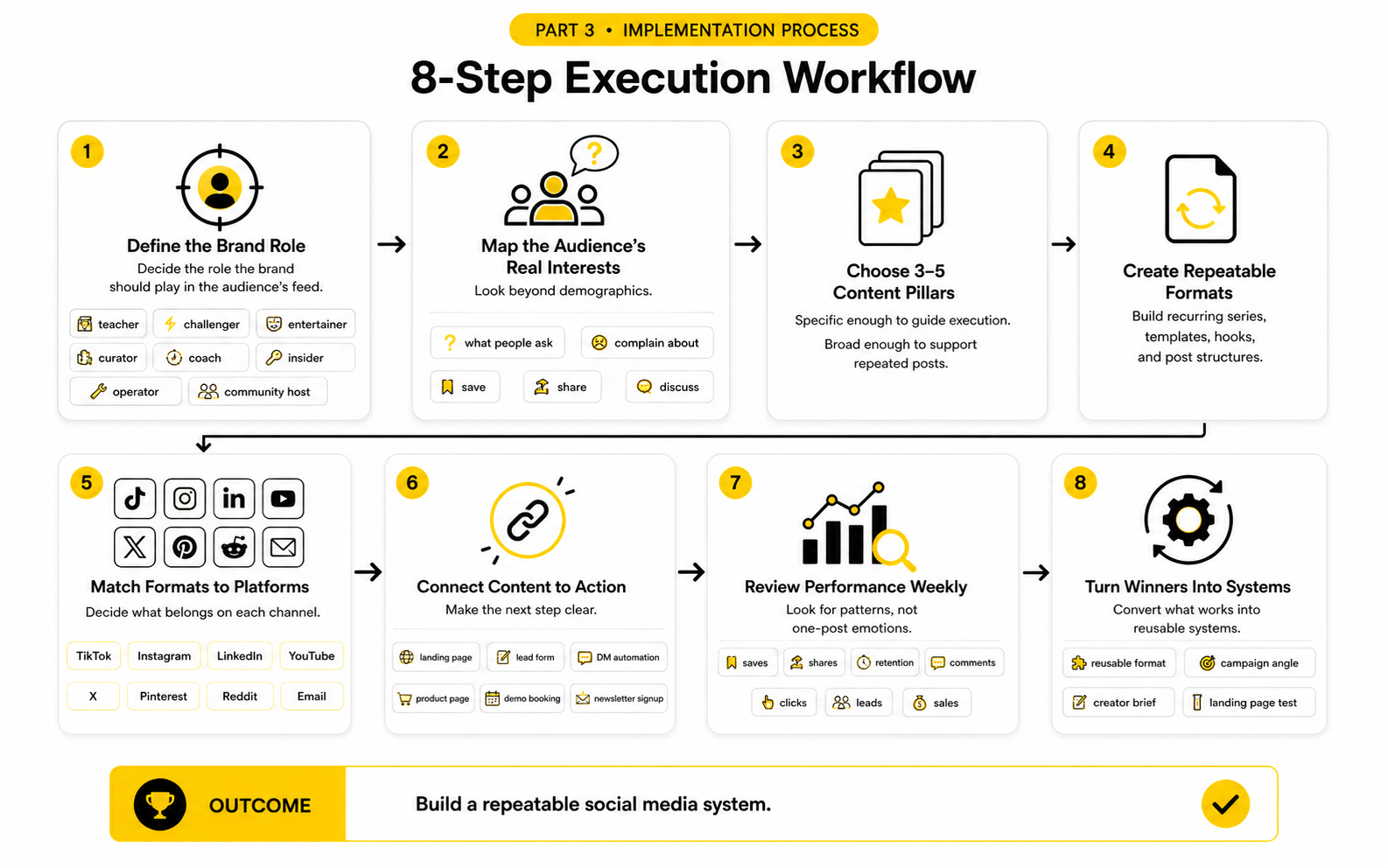
A Practical Implementation Process
A professional social media process starts with diagnosis, not posting. Before you build a calendar, you need to understand your audience, competitors, content gaps, brand voice, offers, and conversion path. Without that work, the calendar just becomes a prettier version of guessing.
A simple implementation process looks like this:
This is where tools can help, but only after the strategy is clear. A scheduling tool like Buffer can help keep publishing organized. A DM automation platform like ManyChat can help turn comments and messages into a follow-up flow when there is real intent. The tool should support the system, not replace the thinking.
The Content Pillar System Behind Strong Social Brands
Content pillars are useful when they are based on audience behavior, not internal departments. “Product,” “company news,” and “blog posts” are usually weak pillars because they describe what the brand wants to publish. Strong pillars describe what the audience wants to consume and why they would care.
A better pillar system might include education, proof, personality, community, product use cases, founder perspective, category commentary, and customer transformation. Each pillar should have a clear job. Education builds trust, proof reduces doubt, personality creates familiarity, community builds belonging, and product use cases create buying context.
The best brands on social media rarely rely on one pillar alone. They mix them so the feed does not become too sales-heavy, too vague, or too entertainment-driven. That balance keeps the brand useful while still making the business visible.
The Role Of Landing Pages And Follow-Up
Social content creates attention, but attention leaks fast if the next step is weak. A person might click from a strong post and land on a page that feels disconnected, slow, generic, or confusing. That is where a lot of social media ROI quietly dies.
For ecommerce campaigns, a focused landing page built around the same message as the post can make the transition feel natural. That is where tools like Replo can fit, especially when teams need campaign-specific pages without waiting on a full development cycle. For coaches, agencies, local businesses, and service providers, a platform like GoHighLevel can support the pipeline behind the content, including forms, calendars, messages, and follow-up.
This part matters because the best brands do not treat social media as isolated performance art. They connect the post, the click, the page, the conversation, and the offer. When that chain is tight, social media becomes much easier to measure and much harder to dismiss.
How To Avoid Copycat Execution
Copycat execution usually starts with good intentions. A team sees a brand winning and wants to borrow the energy. The problem is that the audience can feel when the borrowed tactic does not match the brand behind it.
The safer approach is to copy the principle, not the personality. If a brand wins through humor, ask what kind of tension the humor resolves. If it wins through creators, ask why those creators are trusted. If it wins through education, ask what the audience needs to understand before buying.
This keeps your brand from becoming a weaker version of someone else. It also gives your team more creative confidence. You are no longer asking, “Which trend should we copy?” You are asking, “Which social behavior would make our brand more useful, memorable, and trusted?”
Statistics And Data
Measurement is where social media strategy gets serious. The best brands on social media do not treat data like a scoreboard for ego. They use it to decide what to create next, what to stop doing, where the audience is paying real attention, and whether the content is helping the business.
The mistake is looking for one magic number. There is no single metric that proves a brand is winning. Views can be inflated, engagement can be shallow, follower growth can be low-quality, and clicks can fail to convert if the offer or landing page is weak.
A better approach is to read the numbers in context. The data should answer practical questions: Are people noticing us? Are they staying with the content? Are they interacting in meaningful ways? Are they moving closer to trust, purchase, signup, or repeat engagement?
Start With Reach, But Do Not Worship It
Reach tells you whether the content is getting distribution. That matters because even brilliant content cannot build the brand if nobody sees it. But reach alone does not prove the content worked.
A post can reach a large audience because it was controversial, confusing, funny for the wrong reason, or pushed by a short-lived trend. That can create a spike without creating durable brand value. The question is not only “How many people saw this?” but “Did the right people see it, and did it strengthen the brand memory we want?”
This is why reach should be paired with audience quality and downstream signals. If reach grows while saves, comments, profile visits, clicks, branded search, or qualified leads stay flat, the brand may be getting attention without traction. That is not failure, but it is a warning.
Engagement Shows Whether People Care Enough To React
Engagement is useful because it shows whether people cared enough to do something. Likes are the lightest signal. Comments, shares, saves, reposts, DMs, and replies usually tell you more because they require more effort.
Benchmarks help, but they should not become excuses. Rival IQ’s social benchmark research shows that engagement rates vary heavily by platform and industry, with TikTok still generally producing stronger interaction than legacy social feeds in its 2025 Social Media Industry Benchmark Report. That matters because a “good” engagement rate for one platform, audience size, or category can be weak somewhere else.
The practical move is to benchmark against yourself first, then compare externally. Look at your last 30 to 90 days by format, topic, platform, hook, and audience segment. If one format consistently earns more saves or shares, that is not a lucky post. That is a signal worth turning into a system.
Retention Reveals Whether The Creative Actually Holds Attention
Short-form video made retention one of the most important creative metrics. A view does not mean someone watched. A three-second glance and a complete watch are not the same thing, and treating them the same will ruin your analysis.
Retention shows where the content wins or loses the audience. A drop in the first second usually points to a weak hook, slow opening, unclear visual, or topic mismatch. A drop halfway through may mean the setup was good but the payoff was too slow, too generic, or not valuable enough.
This is where creative teams should get practical. Do not just celebrate the video with the most views. Study the videos where people stayed, rewatched, saved, clicked, or commented with real intent. Those are the posts that teach you how your audience thinks.
Saves And Shares Are Stronger Signals Than Likes
Saves and shares often matter more than likes because they suggest usefulness, identity, or social value. People save content they expect to need again. They share content when it helps them express something, help someone else, make a point, or join a conversation.
This is why educational content, checklists, frameworks, templates, controversial-but-useful opinions, and highly relatable posts can outperform content that looks more polished. The audience is not rewarding production value alone. They are rewarding relevance.
The action step is simple. If a post gets many saves, ask what made it useful enough to keep. If a post gets many shares, ask what made it socially valuable enough to pass along. Those are two different insights, and both can shape your next content pillar.
Comments Need Qualitative Review
Comment volume can look impressive, but the quality of the comments matters more. A post full of spam, one-word reactions, giveaway entries, or angry confusion is not the same as a post full of customer questions, peer discussion, product interest, or thoughtful disagreement. The best brands read comments like market research.
This is especially important for brands using humor or strong opinions. A polarizing post can drive comments, but it can also attract the wrong audience or damage trust if the tone feels careless. Data needs judgment.
Build a habit of tagging comment themes. Separate product questions, objections, praise, confusion, complaints, requests, objections, and community jokes. Over time, those themes become inputs for content, sales pages, FAQs, product education, customer support, and creator briefs.
Clicks And Conversions Show Whether Interest Becomes Action
Clicks are where attention starts becoming measurable intent. Someone who clicks from a social post is doing more than reacting inside the feed. They are taking a step toward a page, offer, product, event, form, or conversation.
But clicks are not automatically valuable. A high click-through rate with weak conversions can mean the post created curiosity but the landing page failed to deliver. It can also mean the offer was unclear, the page loaded slowly, the message did not match the post, or the audience was not ready to buy.
This is why strong brands connect social analytics to landing page analytics, CRM data, and revenue data. If the social team only sees likes and the sales team only sees leads, nobody sees the full system. Tools like GoHighLevel can help service businesses connect forms, appointments, messages, and follow-up, while ecommerce teams may use campaign landing pages from Replo to keep the post-click experience aligned with the content.
The Analytics System That Actually Works
A useful analytics system has layers. Each layer answers a different question, and together they show whether the social strategy is building attention, trust, and business value. Without layers, teams either obsess over vanity metrics or ignore valuable early signals because they are not immediate revenue.
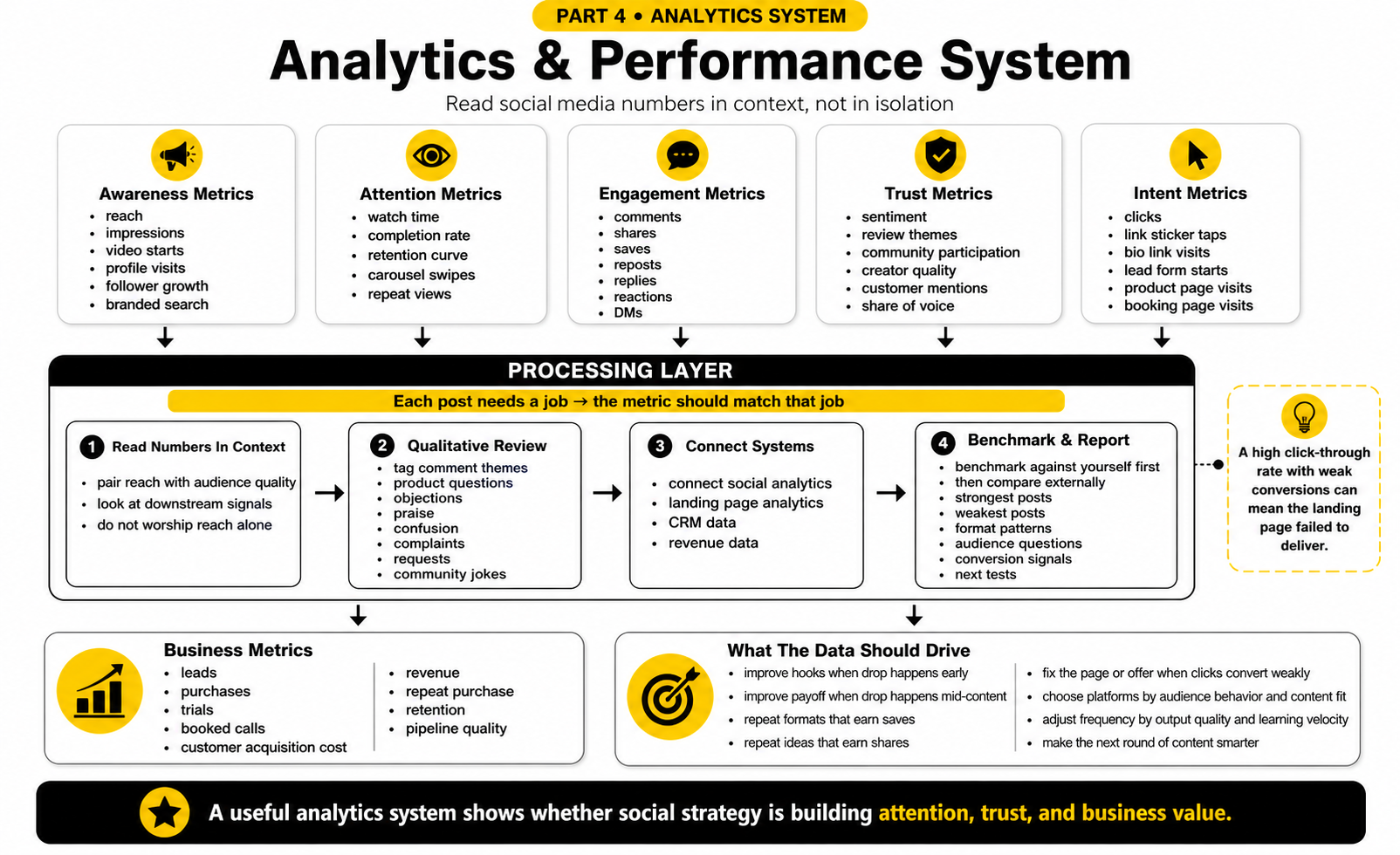
The system should work like this:
This structure keeps the team honest. A top-of-funnel post should not be judged only by sales. A direct-response post should not be celebrated only because people liked it. Each post needs a job, and the metric should match that job.
Benchmarks Are Useful, But Context Wins
External benchmarks help you understand the market, but they should not control your strategy. A nonprofit, SaaS company, beauty brand, local service business, creator-led startup, and airline will naturally perform differently. Even within the same category, audience size, creative style, posting frequency, paid support, and brand awareness can change the numbers dramatically.
Industry benchmark reports can still be valuable because they prevent emotional decision-making. If engagement is down across a platform or category, your team may not be failing. If one format is outperforming across the market, it may deserve testing before you dismiss it internally.
The best approach is to use benchmarks as a reality check, not a target tattooed on the wall. Compare your performance against relevant external data, then focus harder on your own trend lines. A brand improving from weak to solid every month is usually healthier than a brand chasing someone else’s average without understanding the context.
What The Data Says About Platform Choice
Platform choice should follow audience behavior, content fit, and business model. DataReportal’s 2025 social research shows that people use social platforms for multiple reasons, including keeping up with friends, filling spare time, reading news, finding content, researching brands, and following entertainment accounts through the state of social media in 2025. That variety matters because not every platform plays the same role in the customer journey.
A brand should not choose TikTok only because it is popular, LinkedIn only because it is professional, or Instagram only because competitors are there. The better question is where your audience already pays attention and what kind of content they expect in that environment. Then you decide whether your team can create that content consistently.
For many brands, the answer will be a focused mix instead of everywhere at once. One platform may drive discovery, another may build authority, another may support community, and another may convert high-intent traffic. The best brands on social media understand the role of each channel instead of pretending all platforms are equal.
How Often Should Brands Post?
Posting frequency is one of the most misunderstood measurement topics. More posts can create more learning, more distribution chances, and more surface area for discovery. But more bad posts can also train the audience to ignore you faster.
The right frequency depends on creative capacity, platform behavior, content quality, and review speed. If a team can publish five useful short videos per week and learn from each one, that may be smart. If the same team publishes five rushed posts just to hit a quota, the calendar is creating noise.
Measure frequency by output quality and learning velocity. Ask whether posting more helps you test hooks, formats, offers, and audience angles faster. If it does, increase volume carefully. If it only fills the feed, reduce volume and improve the work.
Reporting Should Drive Decisions, Not Just Updates
A social media report should not be a graveyard of screenshots. It should tell the team what happened, why it probably happened, and what to do next. If a report does not change decisions, it is decoration.
A useful weekly report should identify the strongest posts, weakest posts, format patterns, audience questions, conversion signals, and next tests. A monthly report should connect social performance to broader goals such as lead quality, sales, customer education, brand sentiment, or community growth. That is how social earns more trust inside the business.
Keep the reporting simple enough that people actually use it. A small number of meaningful metrics beats a dashboard nobody reads. The goal is not to prove that the social team is busy. The goal is to make the next round of content more carefully.
How To Implement A Professional Social Media System
A professional social media system is not built by hiring one creative person and telling them to “make us go viral.” That may create a few good posts, but it does not create a durable brand. The best brands on social media scale because they build a system that protects quality while still letting creative work move fast.
The tradeoff is real. Too much process kills timing, voice, and experimentation. Too little process creates inconsistency, legal risk, brand drift, and content that depends entirely on one person’s instincts.
The goal is not bureaucracy. The goal is creative speed with guardrails.
Build A Brand Voice That Can Survive More Than One Person
A brand voice is weak if only one person knows how to write it. That creates a bottleneck, and it also creates risk when the team changes. Strong brands document the voice clearly enough that multiple people can create within it without making the brand sound like a committee.
This does not mean writing a stiff brand book nobody opens. It means defining practical voice rules, content examples, forbidden tones, response principles, approval boundaries, and platform-specific guidance. The team should know what the brand sounds like when it teaches, jokes, apologizes, challenges, sells, responds, and stays silent.
The best test is simple. If three people on the team wrote a comment reply, would all three sound like the same brand? If the answer is no, the voice is still living in someone’s head instead of inside the operating system.
Separate Strategy, Production, And Response
A lot of social teams get messy because every task is treated as the same type of work. Strategy, production, publishing, community management, reporting, and crisis response all require different thinking. When one person or one meeting tries to handle everything at once, the work gets slower and weaker.
Strategy should define the audience, point of view, content pillars, platform roles, and business goals. Production should turn those choices into assets, scripts, captions, edits, creator briefs, and publishing plans. Response should handle comments, DMs, customer issues, trend opportunities, and real-time decisions.
This separation matters more as the brand grows. A small team can keep things informal for a while, but scaling without role clarity creates duplicated work, missed opportunities, and avoidable mistakes. The system should make it obvious who decides, who creates, who approves, who replies, and who reports.
Create Approval Rules That Match The Risk
Not every post needs the same approval process. A product launch announcement, legal claim, medical statement, financial promise, crisis response, or creator contract needs more review than a light community reply. Treating every piece of content like a legal emergency slows the brand down for no reason.
A better system uses risk tiers. Low-risk content can move quickly with pre-approved formats and voice rules. Medium-risk content may need brand or product review. High-risk content should involve legal, compliance, leadership, or customer support before it goes live.
This is where process protects speed. Hootsuite’s guidance on social approval workflows frames approval as a practical system for keeping content high-quality, brand-safe, and reviewed before publishing through a clear social media approval workflow. The point is not to add more steps. The point is to stop every post from getting trapped in the same slow, unclear review loop.
Scale Creator Partnerships Without Losing Control
Creator partnerships become harder when they move from one-off experiments to a serious acquisition or brand channel. Early on, a team may manually choose creators, approve scripts, and review posts one by one. At scale, that approach breaks.
The risk is not only bad content. The risk is unclear disclosure, weak brand fit, audience mismatch, exaggerated claims, inconsistent usage rights, and creators who generate short-term reach while hurting long-term trust. As creator investment grows, brands need stronger systems around briefs, contracts, claims, safety checks, approvals, performance reporting, and relationship management.
Creator spending is becoming too large to manage casually. IAB projected U.S. creator economy ad spend to reach $37 billion in 2025, growing faster than the broader media market, through its Creator Economy Ad Spend & Strategy Report. That scale makes creator strategy a serious business function, not a side experiment.
Treat AI As Leverage, Not A Brand Personality
AI can speed up research, repurposing, caption drafts, content variations, reporting summaries, and customer response workflows. Used well, it helps a small team move faster. Used badly, it turns the brand into generic sludge.
The danger is not that AI exists. The danger is letting AI replace judgment, taste, customer understanding, and brand voice. People are already more sensitive to fake authenticity, synthetic influencers, undisclosed AI content, and content that feels like it was produced only to fill a calendar.
This is why the best brands use AI behind the scenes more carefully than they use it in public. They keep humans responsible for claims, tone, humor, cultural context, and final approval. The brand can use AI to move faster, but it should not sound like a machine trying to imitate the audience.
Protect Trust In An Era Of Manufactured Virality
Manufactured virality is tempting because the pressure to perform is high. A brand sees competitors using fake fan pages, paid hype, undisclosed creator posts, engagement pods, or staged conversations, and it starts to feel like everyone is gaming the system. That path is dangerous.
The problem is that audiences eventually notice when attention feels fake. Recent reporting on fake fan pages and engineered hype in music marketing shows how quickly people push back when they feel social buzz has been manufactured instead of earned through real community behavior in The Guardian’s coverage of phony virality. Brands outside music should treat this as a warning, not as an industry-specific drama.
Trust is slower than hype, but it compounds better. A brand can buy attention, but it cannot easily buy belief. The strongest social strategies make the brand more visible without making the audience feel tricked.
Prepare For Social Media Crises Before They Happen
A social media crisis rarely waits for the weekly marketing meeting. It can start from a customer complaint, creator controversy, employee post, product issue, misunderstood joke, platform trend, leaked internal message, or badly timed campaign. The first response often matters because silence, defensiveness, or confusion can make the story bigger.
Strong brands prepare before the crisis. They define escalation rules, response owners, legal review paths, holding statements, customer support coordination, and platform monitoring responsibilities. They also decide what types of issues require a public response and what should be handled privately.
Reputation risk is now a serious business issue because social platforms can amplify problems fast. Aon’s 2025 risk research notes that damage to reputation or brand remains a major global risk, especially in an environment shaped by distrust, cyber threats, ESG scrutiny, and social media amplification through its Global Risk Management Survey. That is why crisis planning belongs inside the social system, not in a forgotten document nobody opens.
Decide Where The Brand Should Not Play
A mature social strategy includes boundaries. Not every trend fits. Not every platform deserves investment. Not every comment needs a reply. Not every creator is worth the risk. Not every cultural moment is a brand opportunity.
This restraint is part of why the best brands on social media feel confident. They do not behave like they are desperate to join every conversation. They understand their role, their audience, and their limits.
A simple rule helps: if the brand has no credibility, no useful perspective, and no real connection to the moment, do not force it. The internet can smell forced relevance quickly. Silence is often more carefully than a weak post.
Build For Teams, Not Heroics
A social media system should not depend on heroic effort every week. If the strategy only works when one person is online constantly, catching every trend, replying to every comment, editing every video, writing every caption, and reporting every result, the system is fragile. It may look productive for a while, but it will eventually break.
A stronger setup uses shared documentation, repeatable formats, content libraries, reporting templates, creator guidelines, response rules, and clear ownership. This makes the brand less dependent on memory and more dependent on process. That is how social media becomes scalable without becoming lifeless.
Tools can support this structure when they are chosen for the right reason. Buffer can help teams organize publishing and review rhythms. Brevo can help connect social-driven interest to email and customer communication. ManyChat can support message-based follow-up when comments or DMs show real intent.
Know When To Centralize And When To Decentralize
As brands grow, social media often becomes a coordination problem. Headquarters wants consistency. Regional teams want speed and local relevance. Product teams want accuracy. Sales wants leads. Customer support wants fewer complaints. Creators want freedom.
Centralization helps protect brand standards, legal safety, messaging, design quality, and reporting. Decentralization helps local teams move faster, respond to cultural nuance, and produce content that does not feel like it was approved by twelve people in a different time zone. Neither model is automatically better.
The best structure is usually hybrid. Central teams own the brand system, strategic direction, core assets, measurement framework, and high-risk approvals. Local or channel teams adapt execution within those guardrails. That gives the brand consistency without crushing relevance.
Make Experimentation Safe And Repeatable
Experimentation is not random posting. It is controlled learning. The best brands test new formats, hooks, platforms, creators, offers, and posting patterns without letting every test rewrite the strategy.
A good experiment has a clear question. For example: does founder-led video improve trust with buyers? Do customer teardown posts drive more saves than product tips? Does a DM automation flow convert better than sending people to a generic link in bio?
Each test should have a time frame, success signal, and next action. If it works, turn it into a format or process. If it fails, write down what was learned and move on. That is how a brand gets sharper instead of just busier.
Keep The Business Model In The Room
Social media advice often gets too disconnected from the business model. A low-ticket ecommerce brand, B2B SaaS company, local service business, media brand, luxury retailer, nonprofit, and creator-led education business should not all use the same social strategy. Their buying cycles, proof requirements, trust barriers, and conversion paths are different.
For a low-ticket product, the path from content to purchase may be short. For a high-ticket service, social content may need to build authority and reduce perceived risk before anyone books a call. For a community-led brand, participation may matter more than immediate conversion.
This is why the best brands on social media do not chase generic best practices blindly. They ask what social media needs to do for their specific business. Then they build the content, measurement, creator strategy, and follow-up around that job.
Metrics, Mistakes, Tools, And FAQ
At this point, the pattern should be clear. The best brands on social media are not just better at posting. They are better at connecting positioning, content, community, measurement, operations, and conversion into one system.
That is the real difference between a brand that gets occasional attention and a brand that becomes recognizable. One is chasing moments. The other is building an ecosystem where each platform, format, creator, comment, landing page, email, and follow-up path has a job.
This final section ties the system together. Use it as a practical filter before you copy a trend, hire a creator, choose a tool, or judge your results too quickly.
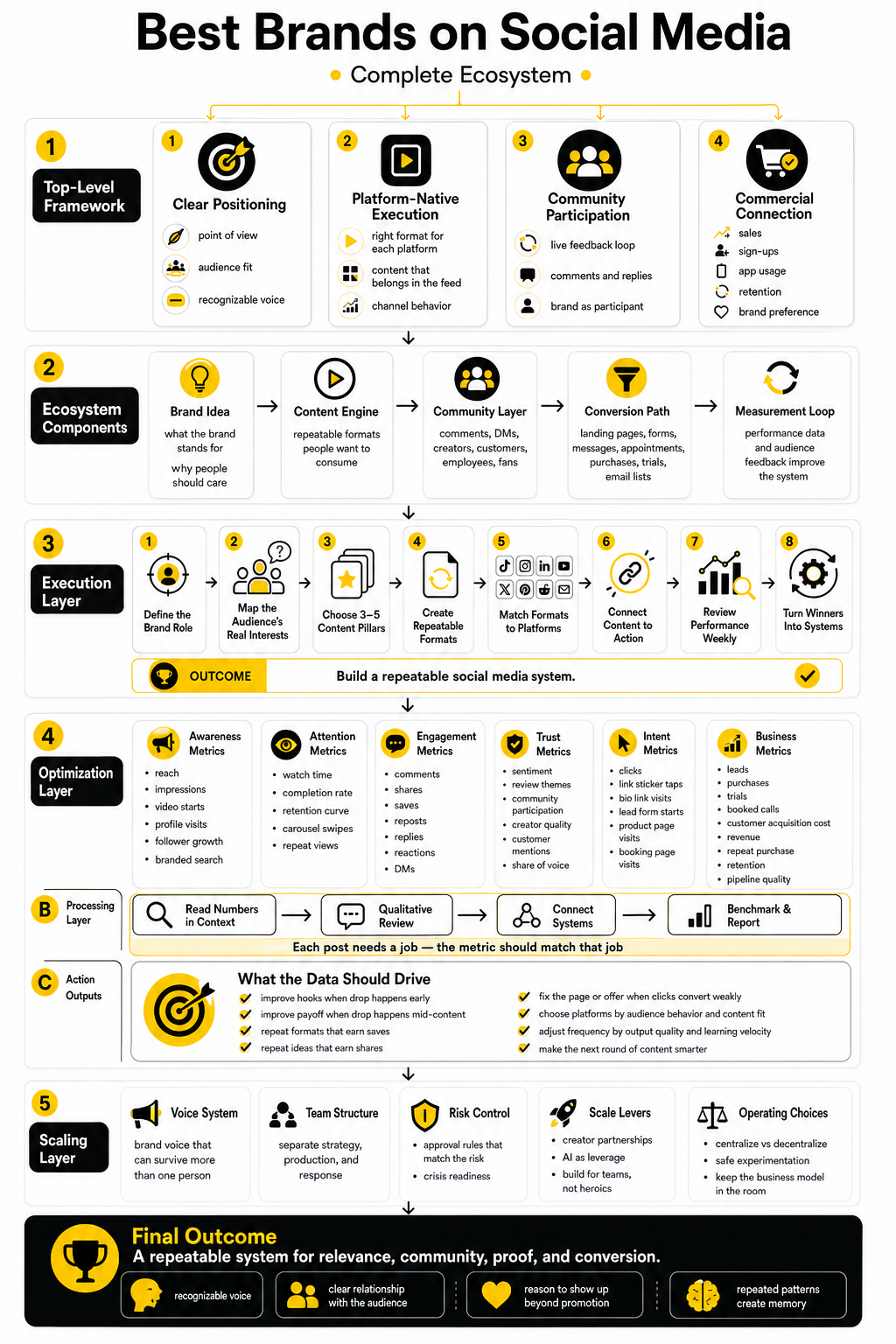
The Final Social Brand Ecosystem
A serious social brand ecosystem has five moving parts. The first is the brand idea, which defines what the brand stands for and why people should care. The second is the content engine, which turns that idea into repeatable formats people actually want to consume.
The third is the community layer, where comments, DMs, creators, customers, employees, and fans become part of the brand’s momentum. The fourth is the conversion path, where social attention connects to landing pages, forms, messages, appointments, purchases, trials, or email lists. The fifth is the measurement loop, where the team uses performance data and audience feedback to improve the system.
When those pieces work together, social media stops feeling random. The brand is no longer asking every week, “What should we post?” It is asking better questions: what should we test, what should we improve, what should we repeat, and what should we stop doing?
The Biggest Mistakes Brands Make On Social Media
The first mistake is confusing activity with progress. A brand can publish every day and still build nothing if the content has no point of view, no audience insight, no recognizable format, and no connection to the business. More posting does not fix weak strategy.
The second mistake is copying famous brands without earning the same permission. A serious B2B brand trying to imitate Duolingo’s tone can look desperate if the audience does not expect that behavior. A brand should learn from the mechanism behind great social media, not steal the costume.
The third mistake is measuring every post the same way. Some posts exist to create reach, some to build trust, some to educate, some to generate leads, and some to deepen community. If every post is judged only by likes or immediate sales, the team will make bad creative decisions.
The fourth mistake is letting tools replace thinking. Scheduling platforms, AI tools, DM automation, landing page builders, and CRMs can be useful, but they cannot decide what your brand should mean. The tool stack should support the strategy, not become the strategy.
Tools That Can Support The System
Tools are useful when they remove friction from a system that already makes sense. They are not useful when they make a weak strategy faster. Before choosing software, decide what problem you are solving: publishing, engagement, reporting, landing pages, follow-up, email, customer communication, creator management, or conversion tracking.
For publishing and team organization, Buffer can help keep content planning and scheduling cleaner. For DM-based flows around comments, giveaways, lead magnets, product questions, or creator campaigns, ManyChat can help turn social intent into a conversation instead of letting it disappear.
For ecommerce teams that need social-specific landing pages, Replo can support faster campaign page creation. For service businesses, agencies, coaches, local companies, and consultants that need forms, calendars, pipelines, automations, and follow-up, GoHighLevel can help connect attention to sales activity. For email and customer communication after the first click, Brevo can fit naturally into the backend of the system.
What are the best brands on social media?
The best brands on social media are the ones that combine a clear identity, strong creative execution, audience participation, and a real business path. Duolingo, Liquid Death, Ryanair, e.l.f. Beauty, Patagonia, Nike, and other standout brands are worth studying because they each show a different version of social strength. The real lesson is not to copy them directly, but to understand the system behind why they work.
What makes a brand good on social media?
A good social media brand is recognizable, useful, consistent, and relevant to its audience. It has a voice people can identify, content formats people want to engage with, and a reason to exist in the feed beyond promotion. The best brands also know how to turn attention into trust, and trust into measurable business outcomes.
Why do some brands go viral while others get ignored?
Brands often go viral when the content hits a strong emotional, cultural, educational, or identity-based trigger. That could be humor, surprise, usefulness, controversy, status, relatability, or timing. But virality without brand connection is weak, because people may remember the post and forget who made it.
Should every brand try to be funny on social media?
No. Humor works only when it fits the brand, audience, category, and execution quality. A brand with no natural comedic voice can damage trust by forcing jokes, especially in serious, regulated, or high-stakes industries.
A better question is whether the brand should be more human. That might mean being clearer, warmer, sharper, more useful, more opinionated, or more responsive. Funny is one option, not the whole strategy.
Which social media platform is best for brands?
There is no universal best platform. TikTok, Instagram, YouTube, LinkedIn, X, Pinterest, Reddit, Facebook, and other platforms all serve different audience behaviors and business goals. The right choice depends on where your audience spends attention, what type of content your team can create well, and how the platform supports your customer journey.
For many brands, the best answer is a focused mix. One platform may drive discovery, another may build authority, and another may support conversion or community. Trying to dominate every channel at once usually creates average work everywhere.
How often should brands post on social media?
Brands should post as often as they can maintain quality, consistency, and learning. A higher posting frequency can create more testing opportunities, but only if the posts are useful and aligned with the brand. Publishing weak content just to hit a quota trains the audience to ignore you.
A practical starting point is to build a sustainable rhythm first. Then increase volume when the team has enough formats, ideas, and review capacity to keep the quality high. Consistency matters, but consistency without value is just noise.
What metrics matter most for social media brands?
The most important metrics depend on the job of the content. Reach and impressions help measure visibility. Watch time, retention, saves, shares, and comments help measure attention and relevance.
Clicks, leads, purchases, booked calls, trials, and revenue show whether social activity is moving people toward business outcomes. Strong teams look at the full chain instead of judging every post by one vanity metric. That is how they avoid overreacting to short-term spikes.
How can a small brand compete with big brands on social media?
Small brands can compete by being sharper, faster, more specific, and more personal. Big brands often have larger budgets, but they also have slower approval processes and more constraints. A small brand can win a niche by understanding the audience better and creating content that feels closer to their actual problems.
The key is focus. Do not try to look like a global brand if you are still building traction. Own a smaller conversation first, build trust, and turn repeatable content formats into a recognizable presence.
Should brands work with creators or influencers?
Brands should work with creators when the creator has real audience trust, brand fit, and a natural way to explain or demonstrate the product. Creator partnerships work poorly when the brand forces a generic script or chooses people only because of follower count. Relevance beats raw reach.
Creator marketing is now a major investment area, with U.S. creator ad spend projected to reach $37 billion in 2025 in the IAB Creator Economy Ad Spend & Strategy Report. That growth makes creator strategy important, but it also makes quality control, disclosure, measurement, and long-term relationship building more important.
How do brands turn social media engagement into sales?
Brands turn engagement into sales by connecting the content to a clear next step. That might be a product page, landing page, email signup, lead form, booking calendar, DM automation, free trial, or community invite. The next step should match the intent created by the post.
If someone engages with a broad awareness post, they may not be ready to buy immediately. If someone comments on a product demo, asks for pricing, saves a comparison, or clicks from a high-intent post, the follow-up should be more direct. The best brands design these paths instead of hoping people figure it out.
What is the difference between a social media campaign and a social media system?
A campaign is usually temporary. It has a launch window, creative assets, goals, and a reporting period. A social media system is ongoing, and it includes the brand voice, content pillars, formats, publishing rhythm, community management, analytics, tools, and conversion paths.
Campaigns can still be useful. But without a system, each campaign starts from zero. The strongest brands use campaigns inside a larger social operating system, so every launch benefits from existing audience trust and repeatable execution.
How do you know if your brand voice is working?
Your brand voice is working when people can recognize the brand without needing the logo. It is also working when comments, shares, saves, replies, and customer conversations show that the audience understands the personality and value of the brand. Recognition is the first signal.
The second signal is consistency under pressure. A voice that works only in polished posts is not enough. The brand should still sound like itself in replies, complaints, creator briefs, product education, launches, apologies, and real-time moments.
Can AI help brands create better social content?
AI can help with research, brainstorming, repurposing, caption variations, reporting summaries, and workflow speed. It can be useful when it gives a good team more leverage. It becomes a problem when it replaces original thinking, customer insight, taste, or brand judgment.
The best use of AI is usually behind the scenes. Let it support the process, but keep humans responsible for voice, claims, humor, emotion, cultural context, and final decisions. A brand should use AI to become faster, not more generic.
What should a brand do before hiring a social media manager?
Before hiring a social media manager, the brand should clarify its positioning, audience, offers, goals, approval process, content expectations, and measurement system. Otherwise, the new hire inherits a vague job with impossible expectations. That is how brands burn through talented people.
A social media manager can execute, improve, and build momentum, but they should not be expected to fix unclear business strategy alone. Give them a real system to work inside. Then give them enough trust and information to make smart decisions.
What is the safest way to improve social media performance?
The safest way is to improve the fundamentals before chasing trends. Clarify the audience, sharpen the point of view, create repeatable formats, improve hooks, study retention, respond to the community, and connect high-intent content to a better next step. These moves compound.
Trends can help, but they should sit on top of a strong base. If the base is weak, trends only create temporary noise. If the base is strong, trends become fuel.
Build a stronger local presence with BAAM AI
Turn your website, Google profile, social channels, and AI visibility into one growth engine
Most businesses do not need more random marketing activity. They need a consistent presence system that helps the right people find them, trust them, and take action. BAAM AI brings strategy, local SEO, website updates, Google Maps visibility, social content, AI-search readiness, media production, and reporting into one practical monthly engine.
If you want your marketing to keep working after the campaign ends, start with a free BAAM AI presence audit. See how your business shows up today and where the fastest visibility wins are at BAAM AI.