
BAAM AI Blog
B2C Social Media Marketing: A Practical Framework For Turning Attention Into Customers
B2C social media marketing is no longer just posting brand updates, running giveaways, and hoping the algorithm does the rest. For consumer brands, social is now where people discover products, compare alternatives...
Affiliate disclosure: this article may include compensated links. Recommendations should still be evaluated against your use case, budget, and current provider terms.
Should you choose this tool?
this tool is worth considering when the use case, budget, and implementation effort match what you actually need to do next.
teams that want a practical tool decision without reading another generic feature list
Check this toolB2C social media marketing is no longer just posting brand updates, running giveaways, and hoping the algorithm does the rest. For consumer brands, social is now where people discover products, compare alternatives, ask questions, watch creators use the product, check social proof, and sometimes buy without leaving the platform. That makes it both a media channel and a customer journey layer.
The mistake many brands still make is treating social media as a content calendar instead of a business system. A calendar helps you publish, but it does not automatically clarify your audience, sharpen your offer, create trust, capture demand, or prove what is working. Good B2C social media marketing connects all of those pieces so the brand can move from scattered posting to repeatable growth.
The opportunity is real, but it is not automatic. U.S. adults still use major social platforms at scale, with YouTube used by 84% of U.S. adults and Facebook by 71%, while Instagram, TikTok, Pinterest, Reddit, Snapchat, and WhatsApp each play different roles by age, intent, and category. Globally, people use multiple platforms every month, and social behavior keeps blending entertainment, search, messaging, shopping, and community into one messy but valuable consumer environment.
this guide is structured as one complete six-part guide, not as a list of disconnected tips. Each section builds on the previous one, starting with the role of social in the B2C customer journey and ending with a practical execution model. The goal is to help you understand what to build, why it matters, and how to make social media contribute to revenue instead of just activity.
Why B2C Social Media Marketing Matters Now
B2C brands compete in a market where attention is fragmented, trust is harder to earn, and consumers often discover products before they ever search for the brand by name. Social media sits directly inside that discovery process because people are already scrolling, watching, saving, sharing, commenting, and comparing. That is why social media cannot be treated as a side channel if the brand depends on consumer demand.
The buying journey has also become less linear. A customer might first see a product in a creator video, check comments for honest reactions, search TikTok or YouTube for reviews, visit Instagram for brand credibility, sign up for a discount, leave, get retargeted, and only then purchase. Social media supports each of those moments, but only when the brand has a clear system behind the content.
Social commerce is one reason this matters even more now. Gen Z is especially active in social shopping behavior, with 76% discovering products and 39% purchasing through social media platforms. That does not mean every B2C brand should chase every new platform feature, but it does mean social is now closer to the transaction than it used to be.
The B2C Social Media Marketing Framework
A strong B2C social media marketing framework has four jobs: attract the right people, build trust before the sale, make the next action obvious, and learn from performance data. If one of those jobs is missing, the strategy usually becomes noisy. The brand may post often, but the content does not create enough movement toward awareness, consideration, conversion, retention, or advocacy.
The framework starts with audience clarity because platform tactics do not matter until the brand knows who it is trying to reach and what those people already believe. A skincare brand, a fitness app, a meal delivery service, and a DTC home goods company may all use Instagram, TikTok, YouTube, and email capture, but their content angles, proof points, creator mix, and conversion paths should look very different. The strategy has to match the consumer’s motivation, risk level, buying frequency, and decision timeline.
From there, the framework connects content, distribution, engagement, conversion, and measurement. Content earns attention, distribution helps it reach the right audience, engagement turns passive viewers into active prospects, conversion paths capture demand, and measurement shows what deserves more investment. This is the difference between “being active on social” and building a social system that can actually support growth.
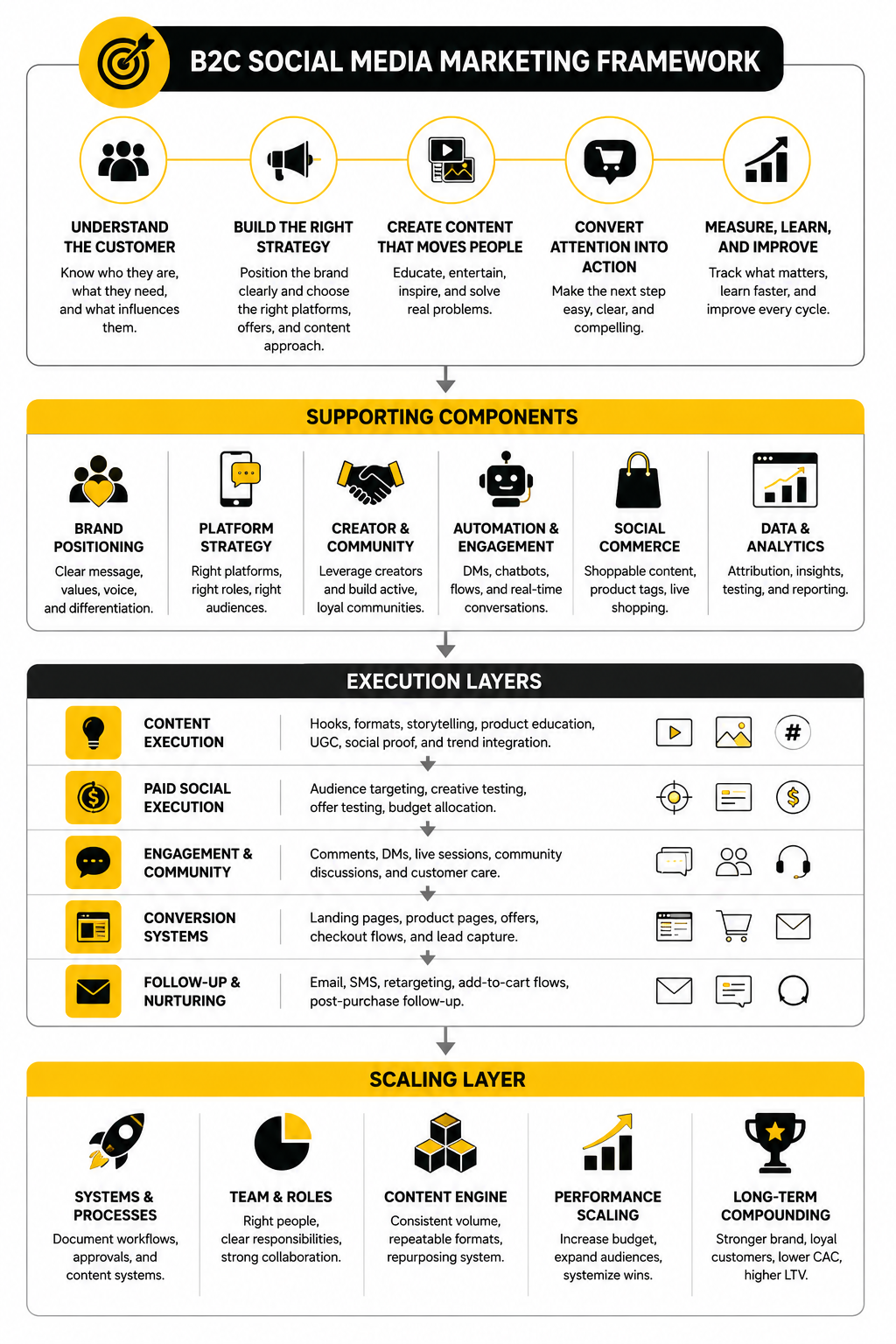
The practical way to use the framework is to map every social effort to a specific job. A product demo may be built for consideration, a creator review may be built for trust, a short-form trend may be built for reach, and a Messenger automation may be built for conversion or support. When every post has a job, the brand stops arguing about vague engagement and starts asking a better question: what business movement did this create?
That matters because social performance is not just about one viral post. The stronger play is building a system where paid, organic, creator, community, and owned channels support each other. For example, a consumer brand can use organic content to test hooks, turn the best-performing angles into ads, route high-intent comments into DMs with ManyChat, and send warmer prospects into email or SMS flows. That is not random posting. That is a customer acquisition system.
Core Components Of A High-Performing B2C Social Strategy
A strong B2C social strategy starts with positioning, not platforms. Before deciding whether to post on TikTok, Instagram, YouTube Shorts, Pinterest, Reddit, Facebook, or LinkedIn, the brand needs to know why a consumer should care. The clearest social strategies are built around a simple promise, a specific audience, and a sharp point of view that can survive repeated exposure.
The second component is audience intent. People use different platforms in different states of mind, and the same person may behave differently across them. A customer might use TikTok for discovery, YouTube for deeper research, Instagram for brand validation, Pinterest for inspiration, Reddit for unfiltered opinions, and Facebook groups for community. Treating every platform the same is lazy, and it usually shows in the results.
The third component is proof. B2C buyers often want to know whether the product works, whether people like them use it, whether the brand is trustworthy, and whether the purchase feels safe. That proof can come through reviews, comments, creator content, customer videos, expert demonstrations, transparent comparisons, and consistent brand behavior over time. The more considered the purchase, the more proof the brand needs before asking for the sale.
Audience Clarity
Audience clarity is not the same as a broad demographic profile. “Women aged 25 to 44” may be useful for media buying, but it is not enough for content strategy. Social content needs sharper human insight: what the audience wants, what frustrates them, what they already tried, what they distrust, what language they use, and what would make them stop scrolling.
For B2C social media marketing, this is where many brands get stuck. They create content for an internal idea of the customer instead of the customer’s actual buying situation. A better approach is to separate the audience into behavior-based groups, such as first-time problem-aware buyers, comparison shoppers, loyal customers, deal seekers, gift buyers, and category enthusiasts.
Each group needs different content. A first-time buyer may need education and reassurance, while a loyal customer may respond better to new drops, behind-the-scenes content, rewards, and community moments. When the brand understands these differences, the content stops sounding generic and starts feeling like it was made for the person watching it.
Platform Roles
Every platform in the strategy should have a role. That does not mean the brand needs to be everywhere. It means the brand should know why each selected platform exists in the customer journey and what type of content belongs there.
TikTok and Reels are often useful for fast discovery, entertainment-led education, product demonstrations, and creator-style content. YouTube can support deeper product research, tutorials, comparisons, and long-term search visibility. Pinterest can work well when the category is visual, planned, seasonal, or inspiration-driven, while Reddit can reveal honest objections and category language that polished surveys often miss.
The point is not to chase platform stereotypes. The point is to avoid copying and pasting the same asset everywhere without thinking. A short video might work across multiple platforms, but the hook, caption, pacing, format, and call to action often need to change if the brand wants the content to feel native.
Content Pillars
Content pillars are useful only when they are specific enough to guide decisions. Generic pillars like “education,” “inspiration,” and “promotion” are too broad on their own. Better pillars connect directly to the customer journey, such as problem education, product proof, lifestyle fit, objection handling, comparison, community, founder perspective, and offer-led conversion.
A good content mix gives the audience multiple reasons to pay attention. Some content should attract new people by making the problem obvious. Some should build trust by showing the product in real situations. Some should deepen desire by showing outcomes, rituals, transformations, or identity fit. Some should remove friction by answering the questions people ask right before buying.
This is where consistency matters more than volume. Posting daily does not help if every post says the same thing in a slightly different format. A strong content system creates variety without losing the brand’s core message, which is why the best teams often build repeatable formats instead of reinventing the strategy every week.
Offers And Conversion Paths
Social content creates attention, but attention needs somewhere to go. For B2C brands, that next step might be a product page, quiz, landing page, bundle, waitlist, email capture, SMS signup, store locator, DM conversation, or limited-time offer. The right path depends on how ready the audience is to buy.
Low-intent viewers usually need a softer next step. They may not be ready to purchase, but they might save the post, follow the account, join a list, answer a quiz, or ask a question in the comments. Higher-intent viewers need a cleaner route to action, and that is where fast-loading landing pages, simple offers, and clear product education matter.
This is also where tools can help when they fit the workflow. A brand running campaign-specific landing pages can use Replo for ecommerce page creation, while a service-led B2C business or local consumer brand may use GoHighLevel to manage follow-up, funnels, pipelines, and automations. The tool is not the strategy, but the right tool can make the strategy easier to execute.
Measurement And Learning
Measurement should separate surface signals from business signals. Likes, views, shares, saves, comments, follower growth, click-through rate, cost per click, add-to-cart rate, conversion rate, repeat purchase, and customer acquisition cost all tell different parts of the story. The problem starts when a brand treats one metric as the whole truth.
A post with low engagement can still drive qualified clicks. A viral video can create reach but attract the wrong audience. A creator campaign can look average in direct attribution while improving branded search, retargeting performance, and customer trust. That is why B2C social media marketing needs both platform-level reporting and business-level reporting.
The best measurement systems are built for learning, not just reporting. Each campaign should help the brand understand which hooks, audiences, products, creators, offers, and formats are getting traction. Over time, that learning compounds, and social media becomes less of a guessing game.
Content, Creators, And Community In The Buying Journey
Once the strategy is clear, execution becomes much easier. The brand knows who it is trying to reach, what role each platform plays, what proof the audience needs, and where attention should go next. Now the work shifts from planning to production, and this is where many B2C teams either build momentum or lose it completely.
B2C social media marketing works best when content is built around buying behavior, not just brand preference. Consumers do not wake up wanting to watch branded content. They watch because something is useful, entertaining, relevant, surprising, relatable, or immediately tied to a problem they already care about.
That means the execution process needs to respect the customer’s stage of awareness. A cold viewer may need a sharp problem hook. A warmer viewer may need proof, comparison, or a reason to trust the brand. A high-intent viewer may need the final push: offer clarity, urgency, objection handling, or an easier path to purchase.
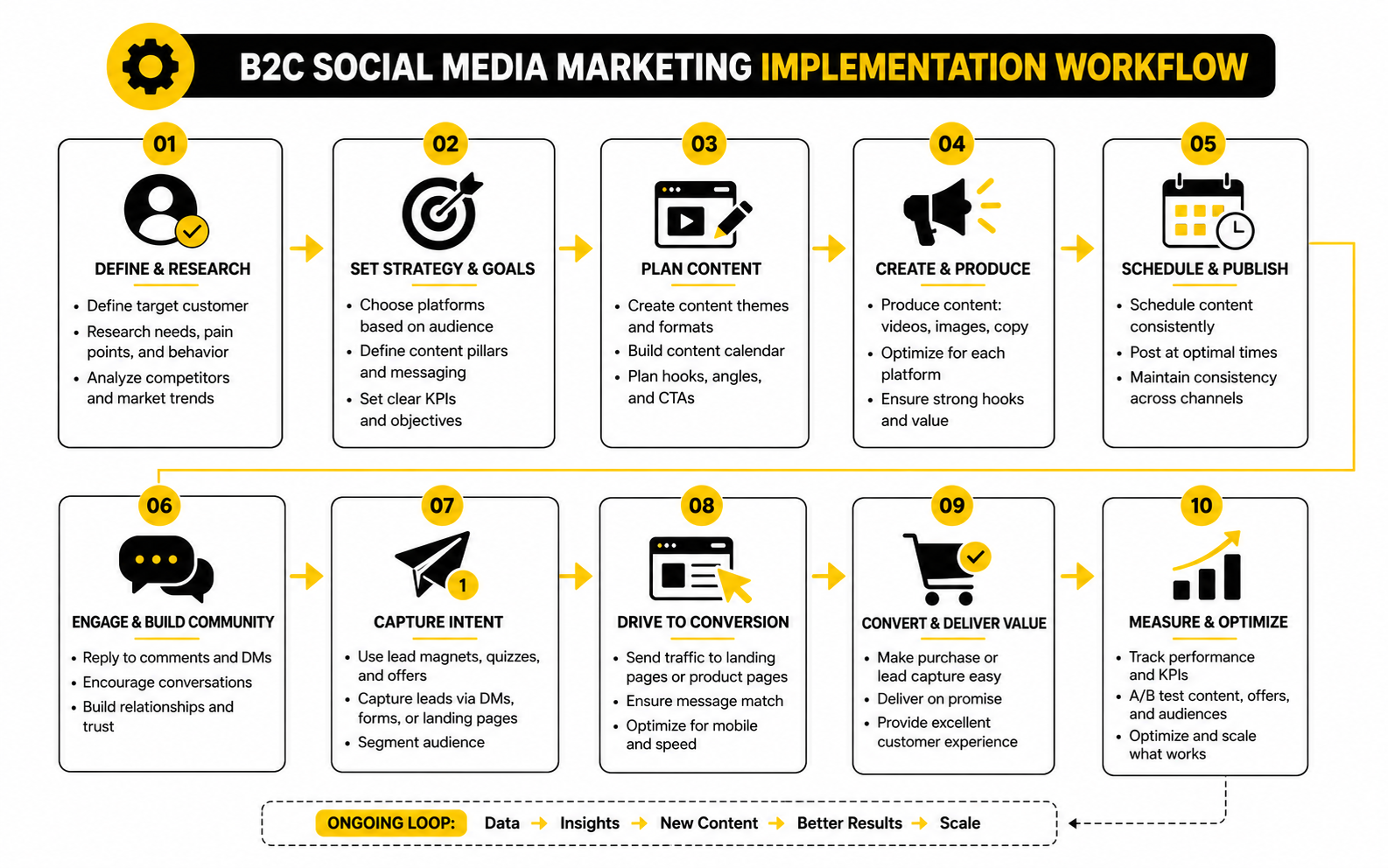
Step 1: Build Content Around Customer Intent
The first implementation step is to translate customer intent into content themes. This is different from guessing what might perform well. The brand should identify the real questions, doubts, desires, and triggers that appear before a customer buys.
A simple way to do this is to organize content around four intent levels. Problem-aware content helps people recognize the issue. Solution-aware content explains the available options. Product-aware content shows why this brand or product is different. Purchase-ready content removes friction and gives people a clear reason to act now.
This keeps the content mix balanced. Without problem-aware content, the brand struggles to reach new people. Without purchase-ready content, the brand earns attention but leaves too much demand uncaptured. The job is not to post more; the job is to post with purpose.
Step 2: Turn Product Truths Into Repeatable Formats
Strong social content usually starts with product truth. What does the product actually do? What problem does it solve? What makes it easier, faster, better, more enjoyable, more reliable, or more desirable than the alternative?
Once those truths are clear, the team can turn them into repeatable content formats. A beauty brand might use side-by-side texture demos, routine breakdowns, customer reactions, ingredient explanations, and shade comparisons. A fitness brand might use short coaching clips, transformation context, myth-busting videos, progress tracking, and founder-led education.
Repeatable formats matter because they reduce creative fatigue. The team is not starting from zero every time. They are testing hooks, angles, edits, creators, offers, and proof points inside a consistent system, which makes performance easier to understand.
Step 3: Match Creative To The Platform
Execution breaks down when brands treat every platform as a dumping ground for the same asset. A video that works on TikTok might need a different opening on Instagram Reels. A YouTube Short may need clearer context because the viewer might find it through search or recommendations rather than a trend-based feed.
Platform-native does not mean chasing every meme. It means understanding how people consume content in that environment. On TikTok and Reels, the first few seconds carry a lot of weight, so the hook needs to be immediate. On YouTube, search intent and retention matter more, so the concept needs to hold attention beyond the first scroll-stopping moment.
This is also where scheduling tools can help, as long as they do not make the content feel automated in a bad way. A lean team can use Buffer to organize publishing across channels, but the creative decisions still need to happen before the post is scheduled. The tool should support the process, not replace the thinking.
Step 4: Use Creators For Trust, Not Just Reach
Creators are not only media inventory. They are trust carriers. Their value comes from the relationship they have with their audience, the way they explain products, and the context they bring that a brand account often cannot create on its own.
For B2C brands, the strongest creator work usually happens when the creator’s real style is protected. Over-scripted creator content often feels like an ad pretending not to be one. The brand should provide clear product education, compliance guardrails, key proof points, and campaign goals, then let the creator translate the message into their own language.
This approach matters because social users are trained to spot forced promotion quickly. Research from Deloitte Digital’s 2025 State of Social highlights how B2C brands are investing across creators, social commerce, AI, and community management, which shows how central creator-led execution has become. The opportunity is not just getting more mentions; it is getting more believable moments of product discovery.
Step 5: Design Comment And DM Workflows
A social post should not be the end of the interaction. Comments and DMs are often where buyer intent becomes visible. Someone asking about sizing, shipping, ingredients, pricing, compatibility, availability, or use cases is not just “engaging”; they may be close to buying.
This is where the brand needs a clear response system. Common questions should have approved answers. High-intent comments should be routed quickly. Repeated objections should be logged and turned into future content, because every objection in the comments is probably shared by more people who stayed silent.
For brands that generate a lot of comment-driven demand, automation can make the process smoother. A product launch, giveaway, quiz, or “comment keyword to get the link” campaign can use ManyChat to move interested users from public engagement into a private conversation. That is useful when it feels helpful, fast, and relevant rather than spammy.
Step 6: Connect Social Content To Owned Channels
Social platforms are powerful, but the brand does not own the audience there. Reach can change, ad costs can move, and platform behavior can shift quickly. That is why strong B2C social media marketing usually connects social attention to owned channels like email, SMS, loyalty programs, communities, and customer databases.
The handoff should feel natural. A viewer who is not ready to buy may still want a checklist, quiz result, early access list, style guide, discount, sample, consultation, or product recommendation. The right lead capture offer depends on the product category and the buying timeline.
Email and CRM tools become more valuable when they are connected to social intent. A brand can use Brevo for email and marketing automation, or GoHighLevel when the business needs funnels, CRM, follow-up, booking, and pipeline management in one place. The important part is not the software name; it is making sure social demand does not disappear after the first click.
Step 7: Create A Weekly Execution Rhythm
The best social teams work in cycles. They plan, publish, engage, measure, learn, and adjust. This rhythm sounds simple, but it is the difference between a team that improves every week and a team that keeps posting because the calendar says so.
A practical weekly rhythm can look like this:
This process keeps the team focused on learning instead of opinions. It also makes creative work less chaotic because every week has a clear feedback loop. Over time, the brand gets better at spotting what the audience actually responds to, not what the team hoped would work.
Step 8: Build Campaigns Around Moments, Not Random Posts
Individual posts can perform well, but campaigns create stronger memory. A campaign gives the audience repeated exposure to the same product, offer, story, or idea from multiple angles. This is especially useful for launches, seasonal promotions, new collections, product education pushes, retail partnerships, and creator activations.
A good campaign has a clear central message. It also has supporting assets that handle different stages of the journey: awareness content, proof content, creator content, comparison content, offer content, and follow-up content. The audience should feel like the brand is building a case, not just shouting the same announcement ten times.
This is where landing pages and funnels become part of the social process. A campaign-specific page built with Replo, ClickFunnels, or Systeme.io can keep the message consistent after the click. That consistency matters because every gap between the post and the page creates friction.
Statistics And Data
The data behind B2C social media marketing is useful only when it changes what the brand does next. A benchmark should not become a vanity scoreboard. It should help the team understand whether a result is strong, weak, misleading, or simply normal for the platform and category.
The first thing to measure is not “how many likes did we get?” The first thing to measure is whether social is doing the job assigned to it. A campaign built for reach should be judged differently from a campaign built for sales, retention, product education, waitlist growth, retail traffic, or customer support.
This is why good analytics starts with intent. A post that creates a lot of comments may be valuable if the goal is conversation, but less useful if the comments are low-quality or unrelated to the product. A video with fewer views may be more valuable if it sends qualified buyers to a landing page, generates saves from people comparing options, or answers an objection that normally blocks purchase.
The Four Levels Of Social Measurement
A clean measurement system separates social data into four levels. This keeps the team from mixing signals that do not mean the same thing. It also makes reporting easier because everyone can see where performance is improving and where the funnel is leaking.
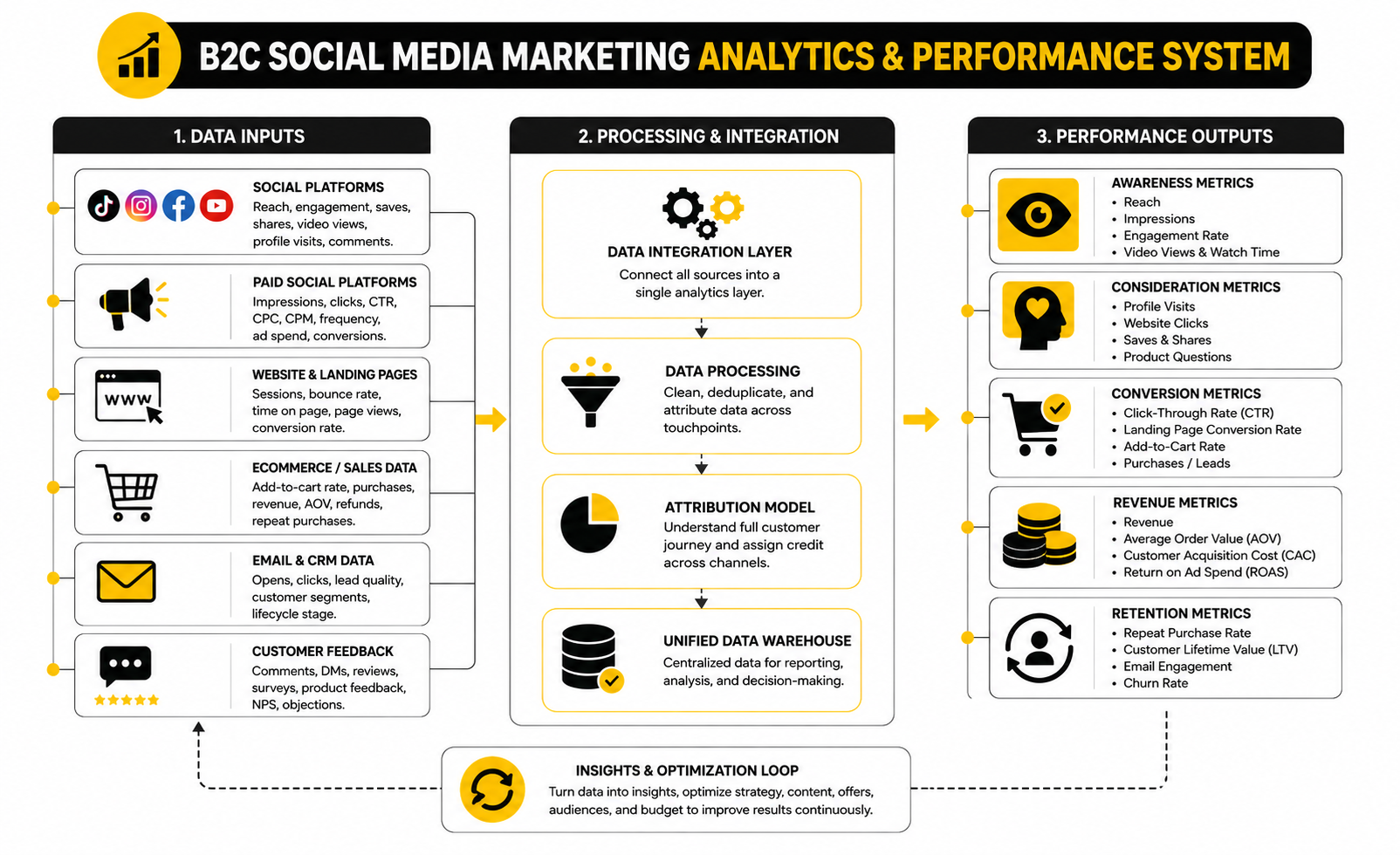
The key is to read these levels together. High attention with low engagement may mean the hook is broad but the message is weak. Strong engagement with weak traffic may mean the content is interesting but the next step is unclear. Good traffic with poor conversion may mean the page, offer, price, or trust signals need work.
Benchmarks Are Context, Not Strategy
Benchmarks are useful because they stop teams from judging results in a vacuum. If a brand sees a 0.5% engagement rate, that number means nothing until it is compared against platform norms, industry norms, account size, content type, and campaign goal. The same number can be excellent in one context and poor in another.
Public benchmark reports also show why platform-by-platform thinking matters. Rival IQ’s 2025 benchmark analysis covers brand performance across Facebook, Instagram, TikTok, and X, and its findings show that engagement varies heavily by industry and channel, which is exactly why a single “good engagement rate” is a weak target for serious reporting. The practical takeaway is simple: compare each channel against its own role, not against a generic social average.
Benchmarks should drive better questions. If TikTok engagement is below category norms, is the issue the hook, the editing pace, the creator fit, or the product angle? If Instagram saves are strong but clicks are weak, does the content inspire interest without making the next step obvious? If paid social costs are rising, does the brand need stronger organic testing before scaling ads?
The Metrics That Actually Matter By Funnel Stage
For awareness, the useful metrics are reach, qualified impressions, video retention, shares, and follower growth from relevant audiences. Views alone are not enough. A brand needs to know whether the right people are seeing the right message long enough to understand it.
For consideration, the useful metrics are saves, profile visits, comments with buying intent, product page clicks, comparison content performance, creator content retention, and repeat exposure. These signals show that people are not just entertained; they are evaluating. That is a big difference.
For conversion, the useful metrics are landing page views, add-to-cart rate, checkout starts, purchases, booking completions, lead quality, and cost per acquisition. This is where tools like ClickFunnels, Systeme.io, Replo, or GoHighLevel can be useful because the post-click journey needs to be tracked and improved, not guessed.
Social Commerce Data Needs A Different Lens
Social commerce changes measurement because the buying journey can happen inside the platform, outside the platform, or across both. A customer may discover a product in a short video, click through later from a retargeting ad, search the brand on Google, return through email, and then buy. If the brand only looks at last-click attribution, social may look weaker than it really is.
This is why social commerce reporting should combine platform analytics, website analytics, CRM data, coupon codes, post-purchase surveys, creator links, and blended revenue trends. None of these sources is perfect alone. Together, they show a more realistic picture of how social contributes to demand.
Social commerce is also becoming more normal for consumers, not just experimental for brands. UK data reported around the 2025 Sprout Social Index showed that 35% of social users make spontaneous purchases based on social content a few times a year, while 33.5% reported doing so monthly. The action point is not “push harder for impulse buys”; it is to make the path from discovery to trust to purchase easier when intent appears.
How To Read Engagement Correctly
Engagement is one of the most misunderstood areas in B2C social media marketing. A lot of engagement can mean the content is valuable, but it can also mean the post is controversial, vague, funny, polarizing, or attracting people who will never buy. That is why engagement quality matters more than engagement volume.
A useful comment is not the same as a random emoji. A save is not the same as a passive like. A share can be a stronger signal than a view because someone is choosing to pass the content to another person, which often indicates relevance or identity fit. The deeper the action, the more seriously the team should inspect it.
The best way to read engagement is to tag it by meaning. Comments can be grouped into buying questions, objections, praise, complaints, confusion, creator reactions, feature requests, and off-topic chatter. Once the team sees the pattern, engagement becomes research, not just reporting.
How To Read Reach And Views Correctly
Reach is useful when the brand needs market exposure, but it can easily become a distraction. A viral post that reaches the wrong people can inflate reporting and still do very little for sales. A smaller post that reaches the right niche can create better downstream results.
Video views have the same problem. A view can mean someone watched long enough to count as a view, not that they understood the product or cared about the offer. Watch time, retention curves, completion rate, rewatches, saves, and click behavior give much better context.
This is where creative diagnostics matter. If people drop in the first few seconds, the hook is probably weak or the opening is unclear. If people watch but do not click, the content may educate without creating enough desire. If people click but do not buy, the issue may be the landing page, offer, pricing, proof, or checkout experience.
How To Read Conversion Data Correctly
Conversion data should connect social activity to money, but it should not be read lazily. Paid social platforms, analytics tools, ecommerce platforms, and CRMs may all attribute revenue differently. That does not make the data useless; it means the team needs to understand what each system is measuring.
For ecommerce, the brand should watch add-to-cart rate, checkout start rate, purchase conversion rate, average order value, new customer revenue, repeat purchase behavior, and margin after acquisition costs. For service-led B2C, the focus may shift toward booked calls, form completions, lead quality, show-up rate, close rate, and revenue per lead. The right metrics depend on the business model.
A good conversion report should explain the story behind the numbers. If clicks increased but revenue fell, maybe the content attracted curiosity without purchase intent. If revenue increased while engagement stayed flat, maybe the campaign reached fewer people but better buyers. The job is to interpret the data, not worship it.
A Practical Weekly Reporting System
A weekly reporting system should be simple enough to use and detailed enough to guide action. Overcomplicated dashboards often die because nobody wants to maintain them. A practical system focuses on the few signals that help the team decide what to do next.
Start with five questions:
This turns reporting into a creative and commercial feedback loop. The team can spot what to repeat, what to cut, what to improve, and what to scale with paid media. That is how analytics becomes useful instead of becoming a meeting where everyone stares at charts and pretends the answer is obvious.
The Real Goal Of Measurement
The real goal of measurement is better decisions. It should help the brand choose better hooks, better creators, better platform priorities, better offers, better landing pages, and better follow-up. If the report does not change behavior, it is probably too decorative.
B2C brands should also be careful with attribution debates. Perfect attribution does not exist in modern social media because consumers move across platforms, devices, creators, search, retail, email, and dark social. The more carefully goal is directional confidence: enough evidence to know what is working, what is not, and where the next test should happen.
The brands that win are not always the ones with the most complex dashboards. They are the ones that learn the fastest without lying to themselves. That means reading the numbers honestly, connecting them to customer behavior, and turning the insight into better execution the following week.
Social Commerce, Automation, And Conversion Paths
At this stage, the strategy has moved beyond content planning and performance reporting. The next question is how the brand turns social attention into owned demand, cleaner buying journeys, and repeatable revenue. This is where advanced B2C social media marketing becomes less about posting and more about system design.
Social commerce matters because consumers do not always want to leave the platform, open a browser, search for the product, compare options, and then remember to come back later. Every extra step creates friction. The brand’s job is to reduce that friction without making the experience feel pushy, automated, or disconnected from the content that created the interest in the first place.
The challenge is that not every product should be sold the same way. A low-cost impulse product can often move from video to checkout quickly. A higher-ticket, personal, technical, or trust-heavy product may need education, reviews, creator validation, email follow-up, live chat, consultation, or a stronger landing page before the sale happens.
Social Commerce Is Not Just A Buy Button
The simplest version of social commerce is selling directly through social platforms. That can work, especially for visual products, fast-moving trends, limited drops, and creator-led discovery. But the more strategic version is bigger than an in-app checkout.
Social commerce includes every moment where social content helps a buyer move closer to purchase. That might be a shoppable post, a TikTok Shop listing, an Instagram DM, a creator discount code, a product-tagged Reel, a live shopping event, a quiz, a social ad, or a landing page built for a specific campaign. The channel may change, but the job stays the same: make the next step easy and believable.
This distinction matters because many brands over-focus on the transaction layer. They ask whether people can buy from the post, but they ignore whether the post gives people enough reason to buy. A smoother checkout cannot fix weak positioning, vague proof, poor creative, or a product page that does not answer obvious questions.
The Tradeoff Between Speed And Trust
There is always a tradeoff between speed and trust. A fast path to purchase is useful when the buyer already understands the product and feels low risk. A slower path is better when the buyer needs more context, reassurance, comparison, or proof.
This is why brands should not force every social campaign into the same conversion flow. Some campaigns should send buyers directly to a product page. Others should send them to a quiz, guide, collection page, consultation, waitlist, product comparison, or email capture. The right path depends on the buyer’s intent, not the brand’s desire to close faster.
A good rule is simple: the more expensive, personal, unfamiliar, or high-risk the product feels, the more trust-building the path needs. That does not mean making the journey complicated. It means giving people the right information before asking them to act.
Automation Should Feel Like Service
Automation is powerful, but it can damage trust if it feels lazy. A consumer who comments with a product question does not want to be trapped in a generic bot loop. They want a fast, relevant answer that helps them make a better decision.
Used well, automation can handle repetitive actions and free the team to focus on higher-value conversations. It can send a product link after someone comments a keyword, collect quiz answers, route support questions, deliver discount codes, follow up after a launch, or segment people based on what they asked for. Used badly, it turns social into a spam machine.
This is where brands need restraint. A DM flow built with ManyChat should be short, clear, and genuinely useful. If the person asked for a link, send the link. If they asked a question, answer the question. Do not turn every interaction into a five-step funnel unless the buyer actually needs that guidance.
Landing Pages Need Message Match
The post-click experience is one of the most common weak points in B2C social media marketing. The content creates interest, the person clicks, and then the landing page feels like it belongs to a different campaign. That disconnect kills momentum.
Message match means the page continues the promise made in the social content. If the video showed a specific product benefit, the page should reinforce that benefit quickly. If the creator handled a specific objection, the page should support it with reviews, details, comparison, or proof. If the campaign promoted a bundle, the page should not drop the buyer onto a generic homepage and make them hunt for it.
This is why campaign-specific pages often outperform broad destinations. A brand can use Replo for ecommerce landing pages, ClickFunnels for funnel-driven offers, or Systeme.io when the team needs a simpler funnel and email setup. The platform matters less than the principle: keep the promise consistent after the click.
Scaling Requires Creative Volume, Not Just Bigger Budgets
Scaling social does not mean taking one winning ad and spending more forever. Creative fatigue is real. Audiences get used to angles, platforms reward fresh signals, and competitors copy what works.
That means scaling requires a creative pipeline. The brand needs new hooks, new formats, new creator assets, new objections, new product angles, and new proof points. Without that pipeline, paid social gets expensive, organic growth slows down, and the team starts blaming the algorithm for a production problem.
A better scaling system separates creative testing from media scaling. Organic content and low-budget paid tests can reveal which angles deserve more investment. Once an angle works, the team can build variations around it instead of starting from scratch. That is how social becomes more predictable without becoming repetitive.
AI Can Help, But It Cannot Replace Taste
AI has made content planning, repurposing, editing, scripting, customer research, and reporting faster. That is useful. But speed without taste just creates more average content.
For B2C brands, AI should support the team’s judgment rather than replace it. It can summarize comments, organize objections, draft hook variations, repurpose long-form content, identify patterns in reviews, and help structure campaign briefs. It should not be trusted blindly with brand voice, compliance claims, customer sensitivity, or final creative direction.
The brands that benefit most from AI are usually the ones with the clearest strategy. They know the audience, the offer, the proof, and the message. That gives AI better inputs, which leads to better outputs. Without that foundation, AI mostly helps the brand produce weak ideas faster.
Brand Safety And Compliance Cannot Be An Afterthought
As social programs scale, risk scales too. More creators, more claims, more posts, more DMs, more ads, and more automation all create more chances for something to go wrong. The brand needs guardrails before it needs damage control.
This matters especially in categories like health, finance, beauty, supplements, children’s products, food, and any product where performance claims can be misunderstood. The FTC’s endorsement guidance makes clear that material connections between brands and endorsers should be disclosed clearly, which affects creator campaigns, affiliate relationships, gifted products, and paid collaborations. The practical rule is simple: do not hide the relationship, and do not let creators make claims the brand itself could not support.
Compliance does not have to make content boring. It just needs to be built into the workflow. Creator briefs, approval processes, claim libraries, disclosure rules, comment response guidelines, and escalation paths protect the brand while still leaving room for creative work.
Community Management Becomes More Important As Reach Grows
A bigger audience does not automatically mean a stronger brand. More reach can also mean more questions, complaints, confusion, spam, criticism, and public comparison. If the brand does not manage that well, growth can expose weaknesses instead of hiding them.
Community management is not just replying with emojis. It is a public trust function. The way a brand answers questions, handles complaints, thanks customers, corrects misunderstandings, and responds to criticism becomes part of the buying experience.
This is especially important because comments are not only read by the person who wrote them. They are read by future buyers. A helpful response under one post can answer the silent objection of hundreds or thousands of viewers who never comment at all.
Creator Scaling Needs A Portfolio Approach
One creator partnership rarely carries an entire B2C social strategy. The stronger model is a portfolio. That portfolio can include customers, nano creators, micro creators, category experts, lifestyle creators, affiliates, paid partners, employees, founders, and community advocates.
Each creator type plays a different role. Nano and micro creators may bring stronger niche trust. Larger creators may create faster reach. Experts can support credibility. Customers can create relatable proof. Employees and founders can bring behind-the-scenes context that polished ads often lack.
The mistake is treating all creators as interchangeable media placements. They are not. A good creator program matches the person, message, product, platform, and buying stage. When that match is right, the content feels natural. When it is wrong, the audience can tell immediately.
Budget Allocation Should Follow Evidence
B2C brands often underinvest in what is working and overinvest in what feels familiar. They keep funding the same platform, same agency, same content type, or same campaign structure because it is already in the plan. That is not strategy. That is inertia.
Budget should move toward evidence. If creator content is producing strong retention and high-quality traffic, the brand should test more creator concepts. If a landing page is converting well, more campaign traffic should be routed there. If a platform is producing engagement but no meaningful downstream action, the team should either change the role of that platform or reduce its priority.
This does not mean cutting every channel that does not convert immediately. Some channels build demand earlier in the journey. But every channel should have a clear reason to exist, and the brand should be honest about what it expects from that channel.
The Biggest Scaling Risk Is Losing The Customer
As teams grow, social strategy can become strangely internal. Meetings become about calendars, approvals, dashboards, brand guidelines, templates, tools, and reporting formats. Those things matter, but they are not the customer.
The customer is still asking basic questions. Does this solve my problem? Do I trust this brand? Is this worth the price? Is this right for someone like me? What happens if it does not work? Why should I buy now?
Advanced B2C social media marketing never loses sight of those questions. The tactics can get more sophisticated, but the core remains human. The brand wins by understanding the buyer better than competitors do and making every social touchpoint feel clearer, more useful, and more trustworthy.
Professional Implementation, Measurement, And Optimization
A complete B2C social media marketing system needs one final layer: ownership. Someone has to decide what the brand stands for, what the customer needs next, which platforms deserve attention, which offers are worth pushing, which creators fit the brand, and which data signals actually matter. Without that ownership, social becomes a pile of disconnected tasks.
The best teams treat social as an ecosystem. Content creates attention, creators build trust, community turns passive followers into active participants, automation captures intent, landing pages convert demand, and reporting improves the next round of execution. None of those pieces should live in isolation.
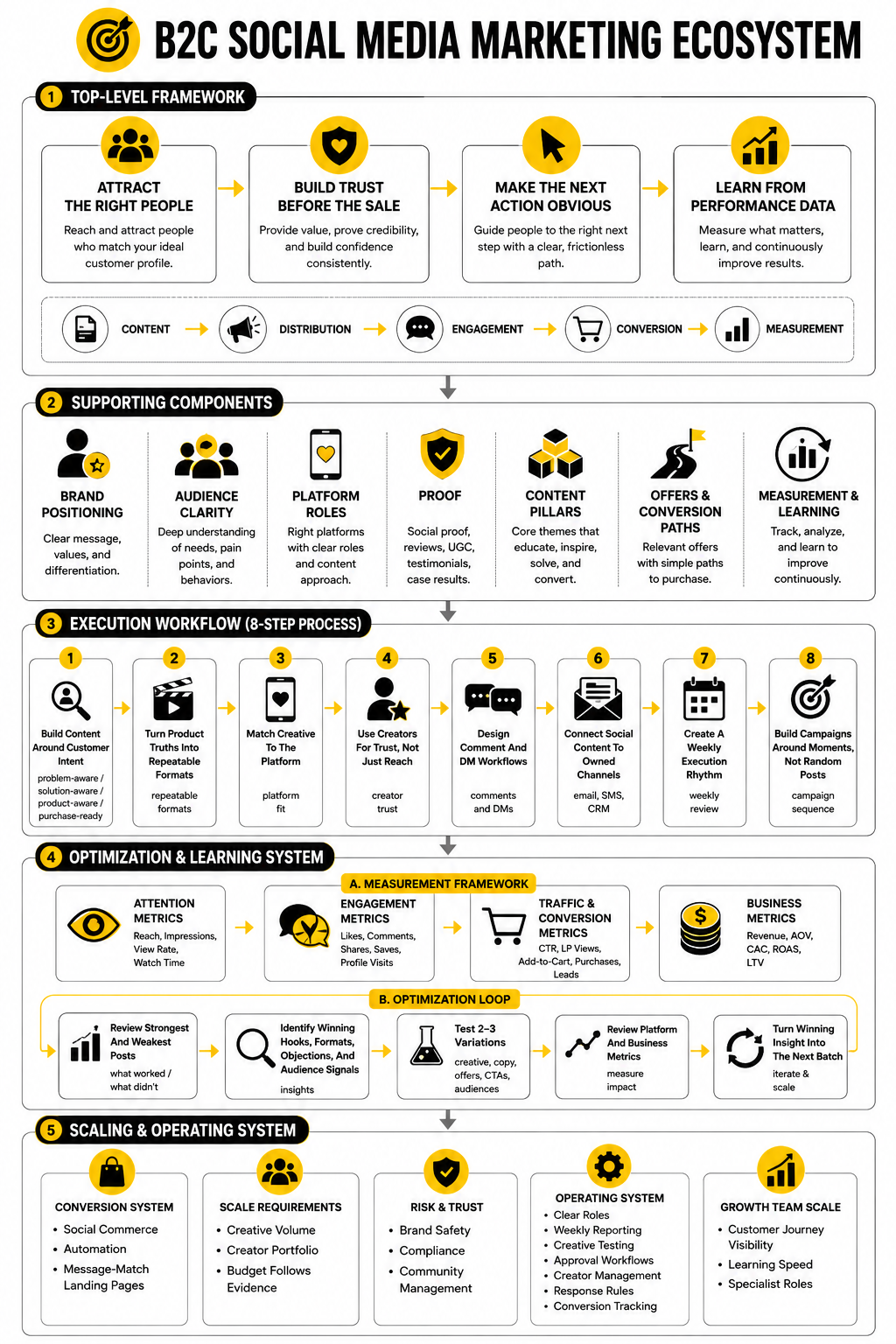
This is where professional implementation matters. A junior team can publish posts. A stronger team can build a growth loop. The difference is that the stronger team connects strategy, creative, media, analytics, conversion, compliance, and customer experience into one operating system.
Build The Operating System Before Scaling
Before scaling budget, the brand needs a reliable operating system. That means clear roles, weekly reporting, creative testing, approval workflows, creator management, community response rules, and conversion tracking. Scaling a messy system usually just makes the mess more expensive.
A practical operating system should answer a few simple questions. Who owns content strategy? Who approves claims? Who responds to comments and DMs? Who decides which organic posts become paid tests? Who reviews landing page performance? Who turns customer objections into new creative?
When those answers are clear, the team moves faster with fewer mistakes. Social media stops being a reactive channel and becomes a repeatable process. That is the point where growth becomes easier to diagnose, improve, and defend.
Keep The Customer Journey Visible
The customer journey should be visible to everyone working on social. The content team needs to know which posts drive traffic. The paid team needs to know which creative angles came from organic learning. The CRM team needs to know which social campaigns are generating leads, purchases, or repeat customers.
This visibility prevents channel silos. If the social team only looks at engagement, they may miss conversion problems. If the performance team only looks at last-click sales, they may undervalue social content that creates demand earlier in the journey. If the retention team never sees social comments, they may miss product feedback that could improve customer experience.
This is especially important because consumers use social platforms at serious scale. Pew’s 2025 data shows that 84% of U.S. adults use YouTube, 71% use Facebook, and 50% use Instagram, which means social often touches a large share of the market before, during, and after purchase. The brand needs to see that journey clearly instead of pretending social is only a top-of-funnel activity.
Optimize For Learning Speed
The brands that improve fastest usually have the best learning loops. They do not wait three months to realize an offer is weak, a creator angle is working, or a landing page is confusing. They review signals often enough to adjust before too much time or budget is wasted.
A useful optimization rhythm looks like this:
This is not complicated, but it requires discipline. Random testing creates random learning. Structured testing creates reusable insight.
Know When To Bring In Specialists
At some point, a growing brand needs specialists. That might mean a paid social buyer, creator manager, conversion copywriter, landing page designer, community manager, email marketer, analytics specialist, or fractional strategist. The right hire depends on the bottleneck.
If content gets attention but does not convert, the bottleneck may be the offer, landing page, or follow-up. If paid campaigns fatigue quickly, the bottleneck may be creative volume. If comments are full of unanswered buying questions, the bottleneck may be community management. If reports are messy, the bottleneck may be analytics and attribution.
This is why hiring should follow the system, not ego. Do not hire a platform specialist just because that platform is trending. Hire the person who can remove the constraint that is actually holding back growth.
What Is B2C Social Media Marketing?
B2C social media marketing is the process of using social platforms to reach, engage, educate, and convert individual consumers. It includes organic content, paid social, creator partnerships, community management, social commerce, DMs, and post-click conversion paths. The goal is not just visibility; the goal is to move people closer to buying, returning, and recommending the brand.
Why Is B2C Social Media Marketing Important?
It matters because consumers use social media for discovery, validation, entertainment, research, and shopping. A buyer may not search for a product until social content makes the problem or desire obvious. Salesforce’s 2025 social shopping data shows that 76% of Gen Z consumers discover products on social media and 39% have purchased through social platforms, which makes social a real buying environment, not just a branding channel.
Which Social Media Platform Is Best For B2C Brands?
There is no single best platform for every B2C brand. The right choice depends on the audience, product category, content format, buying journey, and available creative resources. YouTube, Instagram, TikTok, Facebook, Pinterest, Reddit, Snapchat, and other platforms can all work when they have a clear role in the strategy.
How Often Should A B2C Brand Post On Social Media?
A brand should post as often as it can maintain quality, relevance, and learning. Posting more does not help if the content is repetitive, unclear, or disconnected from the customer journey. A smaller number of strong posts with clear intent will usually beat a high-volume calendar filled with weak filler content.
What Type Of Content Works Best For B2C Social Media Marketing?
The best content usually does one clear job. It may educate the customer, show the product in use, handle an objection, compare options, create desire, explain a routine, highlight proof, or make the next step easier. The strongest content feels native to the platform while still reinforcing the brand’s core message.
How Do Creators Fit Into A B2C Social Strategy?
Creators help brands build trust in a way brand-owned accounts often cannot. They can show the product in real context, explain it in their own language, and make discovery feel more human. The key is to choose creators whose audience, style, and credibility match the product instead of treating creator partnerships like generic ad placements.
Should B2C Brands Use Automation In DMs?
Yes, but only when automation improves the user experience. Automation can send product links, deliver quiz results, route questions, share discount codes, or handle repetitive campaign actions. It should feel like fast service, not like a trap that pushes every person through the same funnel.
What Metrics Matter Most In B2C Social Media Marketing?
The most useful metrics depend on the goal. Awareness campaigns should focus on reach, retention, shares, and qualified attention. Consideration campaigns should look at saves, product questions, profile visits, creator performance, and repeat engagement. Conversion campaigns should track clicks, landing page views, add-to-cart rate, purchases, bookings, lead quality, and revenue.
How Should Brands Measure Social Media ROI?
Brands should combine platform data, website analytics, CRM data, ecommerce performance, paid media reporting, coupon codes, creator links, and post-purchase surveys. No single source gives a perfect view of social ROI. The practical goal is directional confidence: knowing which campaigns, platforms, creators, and offers are creating profitable movement.
What Is The Biggest Mistake B2C Brands Make On Social Media?
The biggest mistake is treating social as a posting calendar instead of a business system. A calendar can help with consistency, but it does not solve positioning, creative quality, conversion, trust, or measurement. The brand needs a connected system that turns attention into customer movement.
How Can A Small B2C Brand Compete With Bigger Brands?
A small brand can compete by being sharper, faster, and closer to the customer. Big brands often have more budget, but smaller brands can test faster, respond personally, use founder-led content, build niche creator relationships, and turn customer feedback into content quickly. Speed and clarity can beat size when the strategy is focused.
When Should A Brand Invest In Paid Social?
A brand should invest in paid social when it has enough creative learning, a clear offer, and a conversion path that can handle traffic. Paid spend cannot rescue weak positioning or a confusing landing page. It works best when the brand already knows which messages, products, and audiences are showing signs of demand.
How Does Social Commerce Change The Strategy?
Social commerce makes the buying journey shorter and more interactive. It allows consumers to move from discovery to purchase through shoppable content, creator recommendations, DMs, live shopping, product tags, and campaign landing pages. The strategy still needs trust, proof, and message match because a faster checkout does not fix weak demand.
What Tools Help With B2C Social Media Marketing?
The right tools depend on the workflow. A team may use Buffer for scheduling, ManyChat for DM automation, Replo for ecommerce landing pages, Brevo for email automation, or GoHighLevel for CRM, funnels, and follow-up. Tools help, but they only work when the strategy behind them is clear.
How Do You Know If A Social Strategy Is Working?
A strategy is working when social activity produces clearer customer signals and better business outcomes over time. That can mean stronger reach from the right audience, higher-quality engagement, more qualified traffic, better conversion rates, lower acquisition costs, stronger retention, or more repeatable creator performance. The key is not one perfect metric; it is whether the system is learning and improving.
Build a stronger local presence with BAAM AI
Turn your website, Google profile, social channels, and AI visibility into one growth engine
Most businesses do not need more random marketing activity. They need a consistent presence system that helps the right people find them, trust them, and take action. BAAM AI brings strategy, local SEO, website updates, Google Maps visibility, social content, AI-search readiness, media production, and reporting into one practical monthly engine.
If you want your marketing to keep working after the campaign ends, start with a free BAAM AI presence audit. See how your business shows up today and where the fastest visibility wins are at BAAM AI.