
BAAM AI Blog
B2B Social Media Marketing Strategy: A Practical Framework for Turning Attention Into Pipeline
A strong B2B social media marketing strategy is not a posting calendar with nicer graphics. It is a disciplined system for earning trust before buyers are ready to talk, staying visible while they compare options...

A strong B2B social media marketing strategy is not a posting calendar with nicer graphics. It is a disciplined system for earning trust before buyers are ready to talk, staying visible while they compare options, and giving sales teams useful proof when conversations finally become serious.
That distinction matters because B2B buyers rarely move in a straight line. They research quietly, ask peers, compare vendors, watch how leaders communicate, and form opinions long before a demo request appears in the CRM. Gartner’s research on the B2B buying journey shows that 75% of B2B buyers prefer a rep-free sales experience, but purely self-service buying can also increase regret when buyers do not get the right mix of digital and human guidance from vendors.
Social media sits right in the middle of that tension. It gives buyers a low-friction way to learn from your company without becoming a lead too early. It also gives your team a way to shape the conversation with practical insights, credible proof, expert voices, and timely distribution instead of waiting for search demand or paid campaigns to do all the work.
The goal is not to “be everywhere.” The goal is to build a repeatable strategy that connects audience insight, positioning, content, distribution, engagement, conversion, and measurement. That is how social becomes a revenue asset instead of another channel your team feeds because everyone else is doing it.
Why B2B Social Media Strategy Matters Now
B2B social media used to be treated like a brand-awareness side project. A company posted product updates, event photos, hiring announcements, and the occasional thought leadership article, then judged success by impressions or follower growth. That approach is too weak for how B2B buying works now.
Buyers are more independent, more skeptical, and more influenced by external sources than many companies admit. Forrester predicted that in 2025, more than half of younger B2B buyers would rely on external sources, including social media and their value networks, to help make buying decisions. That means your prospects are not only evaluating your website, your sales deck, and your case studies. They are also evaluating your public thinking, your people, your proof, your consistency, and the conversations around your category.
This is why a serious b2b social media marketing strategy has to do more than publish content. It has to help buyers make sense of a problem, understand the cost of inaction, compare possible approaches, and build enough internal confidence to move forward. In complex sales, social media is not just a traffic channel. It is a trust-building layer across the entire buying journey.
The data also points to a clear platform reality: LinkedIn remains the dominant B2B social channel, but strategy cannot stop there. Content Marketing Institute’s 2025 B2B research found that 85% of B2B marketers said LinkedIn delivered the best value for their organization, far ahead of Facebook, YouTube, and Instagram. That does not mean every company should copy the same LinkedIn playbook. It means LinkedIn is often the starting point, while the broader strategy should still consider video, executive content, community, employee advocacy, paid distribution, and owned conversion paths.
The deeper shift is that B2B buyers now expect useful digital experiences before they ever speak to sales. McKinsey’s B2B research describes a “rule of thirds,” where at any stage of the buying journey, roughly one-third of customers prefer in-person interactions, one-third prefer remote communication, and one-third prefer digital self-serve options. Social media supports all three because it can educate self-serve buyers, warm up remote sales conversations, and make in-person meetings more credible before they happen.
The B2B Social Media Strategy Framework
A practical framework keeps your team from confusing activity with progress. Without one, social media turns into a random mix of posts, trends, approvals, opinions, and last-minute requests from different departments. With one, every post has a job, every platform has a reason to exist, and every metric connects to a business outcome.
The framework for this guide has six connected layers. First, you define the audience and buying context. Then you sharpen your positioning so your content has a clear point of view. After that, you build content pillars, choose platforms, create distribution workflows, and measure what actually moves the business forward.
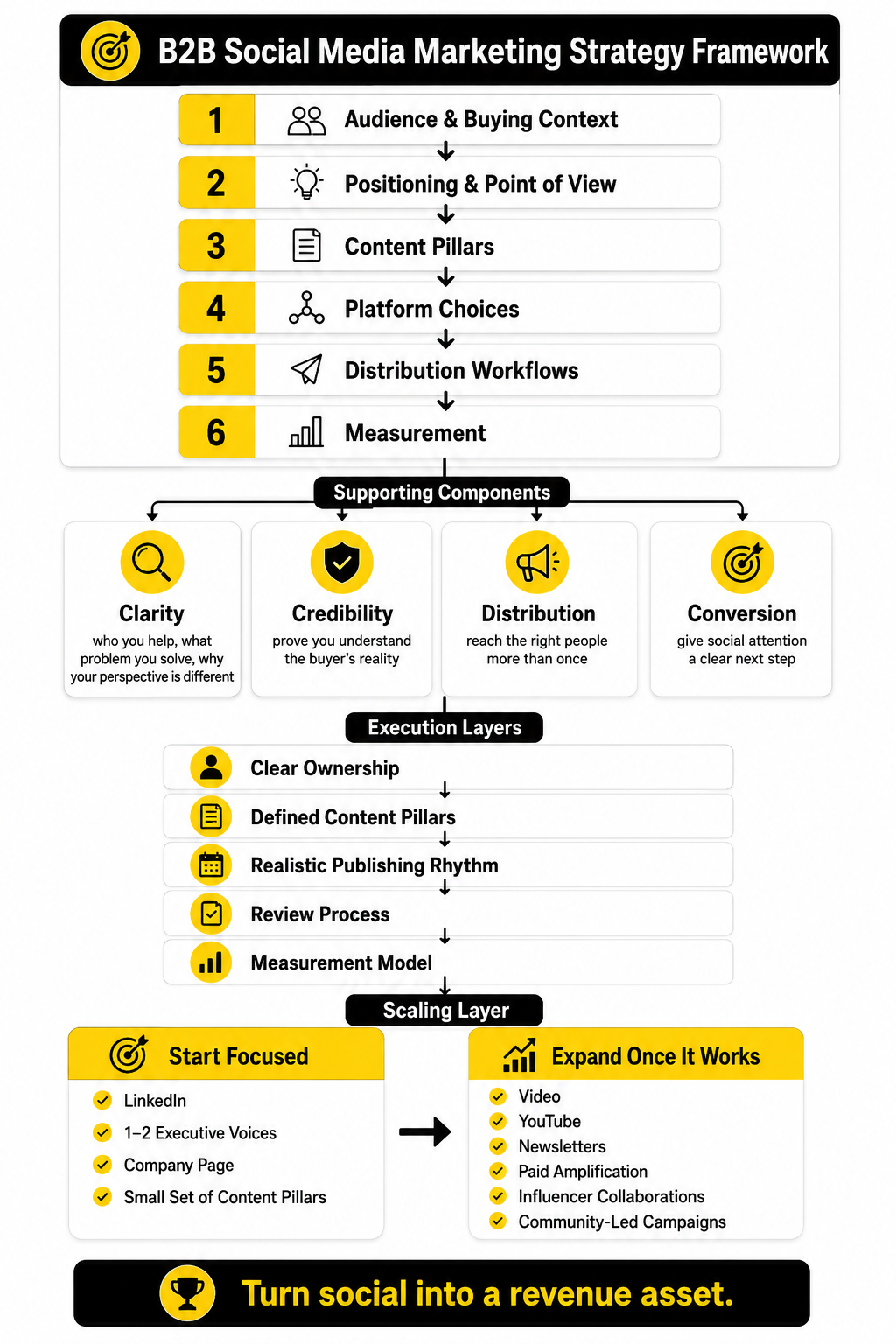
The important part is sequence. Many teams jump straight to content formats before they understand the buyer’s problem, the internal buying committee, or the company’s strongest angle in the market. That is why their posts feel interchangeable. They may be active, but they are not memorable.
A better B2B social media marketing strategy starts with the buyer’s world. What pressures are they under? What decisions are they trying to justify? What risks make them hesitate? What does the buying committee need to believe before the deal can move? When those answers are clear, content becomes easier because the strategy is no longer based on “what should we post today?” It is based on what the market needs to understand before it can buy.
The framework also protects your team from chasing every new tactic. Short-form video may matter. Founder-led content may matter. Employee advocacy may matter. AI-assisted production may matter. But none of them matter equally for every company, every audience, or every sales motion.
Tools can support the system once the strategy is clear. For example, teams that need consistent scheduling and channel management may use Buffer, while teams that want to connect social engagement with CRM follow-up, automation, and pipeline workflows may look at GoHighLevel. The tool is not the strategy. The tool should make the strategy easier to execute without adding more chaos.
Core Components of a Strong B2B Social Media Strategy
A strong B2B social media strategy has four core components: clarity, credibility, distribution, and conversion. If one of these is missing, performance usually becomes uneven. You may get attention without trust, trust without reach, reach without pipeline, or pipeline without a repeatable system.
Clarity means the audience understands who you help, what problem you solve, and why your perspective is different. This has to show up in your company page, executive profiles, content themes, comments, creative, and calls to action. If your social presence sounds like every other vendor in the category, buyers have no reason to remember you.
Credibility means your content proves you understand the buyer’s reality. This can come from original research, customer evidence, expert commentary, product education, practical breakdowns, or sharp category analysis. The 2025 Edelman-LinkedIn B2B Thought Leadership Impact Report found that more than 40% of B2B deals stall because of internal misalignment within buying groups, which is exactly why credible content has to help buyers explain the problem internally, not just admire your brand externally.
Distribution means the content reaches the right people more than once. Organic posting alone is often too fragile, especially for companies with small audiences or niche markets. A mature strategy blends company channels, founder and executive profiles, employee advocacy, partner amplification, paid social, email, webinars, sales enablement, and retargeting.
Conversion means social attention has a clear next step. That step does not always need to be “book a demo.” Early-stage buyers may need a guide, checklist, webinar, newsletter, diagnostic, calculator, or product walkthrough. Later-stage buyers may need case studies, comparison content, implementation proof, or a direct sales conversation.
This is where many B2B teams lose momentum. They create useful content, earn engagement, and then send everyone to a generic homepage. A better approach is to build focused conversion paths around specific buyer problems. If your team uses funnels or campaign pages, platforms like ClickFunnels or systeme.io can help create simple paths from social attention to lead capture, nurture, and follow-up.
Professional Implementation Starts With Focus
Professional implementation does not mean turning social media into a slow corporate approval machine. It means building enough structure that your team can move quickly without becoming random. The best B2B social programs usually have clear ownership, defined content pillars, a realistic publishing rhythm, a review process, and a measurement model that leaders actually understand.
The starting point is focus. Pick the primary audience, the primary business objective, and the primary platform before expanding. For many B2B companies, that means starting with LinkedIn, one or two executive voices, a company page, and a small set of content pillars tied to active sales priorities. Once that works, you can add video, YouTube, newsletters, paid amplification, influencer collaborations, or community-led campaigns.
This is especially important because most teams do not fail from a lack of ideas. They fail from too many disconnected ideas. One person wants viral posts, another wants product announcements, another wants event promotion, and another wants every post to generate leads immediately. A real strategy gives each content type a role, so the team stops judging every post by the same metric.
The next parts of this guide will build the system step by step. First, we will define the audience and positioning work that should happen before content creation. Then we will map the content pillars, platform choices, distribution workflows, engagement habits, conversion paths, and measurement process that turn B2B social media into a practical growth channel.
Audience, Positioning, and Message-Market Fit
Before you decide what to post, decide who the strategy is really for. That sounds obvious, but it is where many B2B social programs get weak. They write for “decision-makers,” “business leaders,” or “companies that need growth,” which is so broad that every post ends up sounding safe, vague, and forgettable.
A useful b2b social media marketing strategy starts with a sharper view of the buyer’s world. You need to understand the person who feels the pain, the person who owns the budget, the person who blocks the deal, and the person who quietly influences the final decision. The 2025 Edelman-LinkedIn B2B Thought Leadership Impact Report highlights how “hidden buyers” can influence purchases even when they are not the primary users of the product, and that matters because social content often reaches these people before sales ever knows they exist.
This is why audience research cannot stop at job titles. Job titles help with targeting, but they do not explain motivation. A VP of Marketing, Head of Sales, RevOps Manager, CFO, and founder may all care about the same solution for completely different reasons. Your social strategy has to make room for those differences without turning your content into a messy pile of disconnected messages.
Map the Buying Committee, Not Just the Persona
In B2B, the buyer is rarely one person. Even when one person fills out the form, the decision usually depends on a group of stakeholders with different priorities, objections, and definitions of risk. If your content only speaks to the most obvious user, you may generate engagement but still fail to help the deal move forward.
Start by mapping the buying committee around four roles. The user cares about daily pain, workflow, ease of use, and whether the solution will actually make their job better. The economic buyer cares about cost, risk, return, and whether the investment is defensible. The technical or operational evaluator cares about integration, security, implementation, and support. The internal champion cares about making the case without looking reckless.
Each of these people needs different proof. A user may respond to practical how-to content. A CFO may need a clean business case. A technical evaluator may want implementation details and clear documentation. A champion may need simple language they can copy into a business case or internal Slack thread.
This is where social media becomes more useful than most teams realize. You can use different content angles to support different stakeholders without forcing all of them into one landing page or one sales deck. A single company can publish operator-focused posts, executive POVs, customer proof, implementation breakdowns, and market education as long as the overall message stays consistent.
Define the Problem in the Buyer’s Language
The best B2B content does not begin with what the company sells. It begins with what the buyer is trying to fix, avoid, improve, explain, or prove. If your content uses your internal language instead of the buyer’s language, it may sound polished to your team but still fail in the market.
Good audience research should capture the words buyers use when they describe the problem. Look at sales calls, demo notes, support tickets, review sites, customer interviews, community discussions, LinkedIn comments, webinar questions, and CRM notes. You are looking for repeated phrases, emotional triggers, objections, and moments where the buyer’s language is sharper than your marketing copy.
This matters because social media rewards clarity fast. A buyer scrolling LinkedIn does not have time to decode your positioning. They need to see the problem and think, “Yes, that is exactly what is happening here.” When that happens repeatedly, your brand starts to become associated with a problem the market already cares about.
Do not overcomplicate this step. Write down the top five problems your best customers had before they bought. Then write down what they tried before you, why it failed, what changed when they solved it, and what they had to believe before they moved forward. That gives you the raw material for stronger posts, sharper hooks, better carousels, clearer videos, and more useful sales enablement.
Build Positioning That Creates a Point of View
Positioning is not a slogan. It is the strategic choice that tells the market why your company is the right answer for a specific audience with a specific problem. Without positioning, social content becomes a collection of tips, trends, and announcements with no clear reason to remember the brand behind them.
Your positioning should answer four questions clearly:
That fourth question is the one most companies avoid. They describe features, benefits, and outcomes, but they do not take a clear stand. Strong B2B social content needs a point of view because buyers are not only choosing software, services, or agencies. They are choosing a way to think about the problem.
For example, a company selling marketing automation could say, “We help teams automate campaigns.” That is technically clear, but it is not very memorable. A stronger point of view might be, “Most B2B teams do not need more automation; they need cleaner buyer journeys before automation scales the mess.” That gives the content a sharper angle and creates room for practical education.
Connect Social Content to Buying Triggers
Not every buyer who sees your content is ready to buy. Most are not. But many are going through moments that will eventually create demand, and your strategy should be built around those moments.
Buying triggers can come from growth, pressure, failure, change, or risk. A company may hire a new leader, enter a new market, miss a revenue target, adopt a new technology, face compliance pressure, outgrow a manual process, or realize a competitor is moving faster. These moments create urgency because the old way starts to feel too expensive, too slow, or too risky.
Your social content should help buyers recognize these moments before they become formal projects. That means writing about symptoms, trade-offs, common mistakes, internal bottlenecks, decision criteria, and the real cost of waiting. When content does this well, it does not feel like a pitch. It feels like useful clarity at the exact moment the buyer is trying to understand what is changing.
The practical move is to create a buying-trigger map. List the events that usually happen before a company enters your sales pipeline. Then turn each trigger into content angles that educate the buyer, challenge old assumptions, and show what better execution looks like. This gives your b2b social media marketing strategy a stronger connection to revenue without making every post aggressively sales-driven.
Separate Awareness Content From Decision Content
A common mistake is expecting one post to do every job. Teams want every piece of content to build the brand, educate the market, create engagement, generate leads, answer objections, and push buyers toward a demo. That pressure usually produces bland content because the post tries to serve too many goals at once.
Awareness content should help the right people understand the problem better. It can challenge assumptions, explain trends, name hidden costs, or simplify a confusing topic. The goal is not immediate conversion. The goal is relevance and memory.
Decision content has a different job. It should help buyers compare approaches, evaluate risk, understand implementation, justify budget, and build confidence. This is where customer proof, product walkthroughs, comparison content, implementation timelines, ROI logic, and objection handling become valuable.
Both content types matter, but they should not be judged by the same metric. Awareness content may earn saves, comments, shares, profile views, and follower growth from the right audience. Decision content may earn fewer public reactions but perform better in retargeting, sales follow-up, nurture sequences, and late-stage conversations.
Turn Message-Market Fit Into a Feedback Loop
Message-market fit means the market understands and responds to the way you describe the problem, the stakes, and the solution. You cannot fully guess this in a workshop. You have to test it in public and listen carefully.
Social media is one of the fastest ways to test message-market fit because feedback appears in multiple forms. People comment, save, share, click, ignore, push back, ask questions, quote your ideas, or repeat your language in sales calls. The signal is not only engagement volume. The better signal is whether the right people respond in ways that show recognition, urgency, or curiosity.
Look for patterns over individual post performance. One strong post can be luck. Five posts around the same angle that attract the right audience may reveal a message worth building around. Ten posts that fall flat may show that the topic is too generic, the pain is not urgent, or the language is too far from the buyer’s reality.
This is where documentation matters. Keep a simple message-testing log with the angle, audience, format, hook, key claim, performance, and qualitative reactions. Over time, this becomes a strategic asset because your social team, content team, sales team, and leadership team can see which ideas are actually landing.
Make the Strategy Specific Enough to Execute
A strategy that sounds impressive but cannot guide daily decisions is not useful. Your team should be able to look at the audience, positioning, buying triggers, and message pillars and know what belongs on social and what does not. That is the standard.
For each priority audience, define the problems you will talk about, the beliefs you want to build, the objections you need to address, and the proof points you can support. Then decide which voices should carry which messages. Some ideas belong on the company page, some are stronger from a founder, some need a subject-matter expert, and some should be turned into sales enablement instead of public content.
If your team needs cleaner handoffs between social engagement and sales follow-up, a CRM like Copper can help keep relationship context visible. If your strategy includes diagnostic forms, surveys, or lead qualification flows, Fillout can support that layer without forcing every social CTA into a demo request. The point is simple: the tools should support the buyer journey you designed, not replace the strategic thinking behind it.
The next step is content architecture. Once the audience and positioning are clear, you can build content pillars that give your social presence consistency without making it repetitive. That is where the strategy starts to turn into a practical publishing system.
Core Content Pillars for B2B Social Media
Once the audience and positioning are clear, the next job is to turn strategy into repeatable content pillars. This is where a b2b social media marketing strategy becomes easier to execute because the team is no longer inventing ideas from scratch every week. The pillars create boundaries, but they also create momentum.
A content pillar is not a broad topic like “marketing,” “sales,” or “AI.” That is too loose. A strong pillar is a repeatable angle that connects a buyer problem, your point of view, and the proof your company can credibly bring to the conversation.
For example, “marketing automation” is a topic. “Why automation fails when teams scale broken buyer journeys” is a pillar. One gives you generic tips. The other gives you a strong lane for posts, videos, carousels, webinars, comparison content, and sales enablement.
Start With the Buyer’s Questions
The easiest way to build useful pillars is to start with the questions buyers ask before they trust you. These questions usually show up in sales calls, discovery notes, demo objections, customer interviews, LinkedIn comments, webinar chat logs, and support conversations. If the same question appears again and again, it deserves a place in the content system.
Some questions are simple and practical. Buyers want to know how something works, what it costs, how long it takes, what can go wrong, and how it compares to what they already use. These questions are not glamorous, but they are the raw material for content that helps real decisions move forward.
Other questions are more strategic. Buyers want to understand whether a problem is urgent, whether their current process is holding them back, whether competitors are ahead, and whether a new approach is worth the internal effort. This is where thought leadership becomes useful because it helps buyers reframe the problem before they start comparing vendors.
The strongest content systems use both types. Practical content earns trust because it is useful. Strategic content earns attention because it gives the market a sharper way to think. Together, they make your social presence feel helpful, not random.
Build Pillars Around Business Problems
A good pillar should map to a real business problem, not just a content category. If your team sells into revenue organizations, the pillar might focus on pipeline quality, sales cycle friction, handoff problems, or campaign attribution. If you sell into operations, it might focus on process bottlenecks, implementation risk, reporting gaps, or team adoption.
This matters because buyers do not wake up wanting your content pillar. They wake up wanting fewer missed targets, fewer manual workflows, fewer bad decisions, fewer internal fights, or a clearer path to growth. Your content has to meet them there.
A practical pillar structure can include:
This structure works because it covers the buyer’s mental journey. First, they need to understand the problem. Then they need to believe there is a better approach. Then they need enough confidence to act.
Turn One Strategic Idea Into Multiple Assets
One of the biggest execution problems in B2B social media is underusing good ideas. A team spends hours creating one strong post, publishes it once, watches it disappear, and then starts from zero again. That is not strategy. That is content waste.
A better process starts with one strong idea and turns it into multiple assets. A customer insight can become a founder post, a sales enablement slide, a short video, a carousel, a newsletter section, a webinar topic, and a paid retargeting angle. The message stays consistent, but the format changes based on how people consume information.
This is especially important because content consumption is fragmented. Some buyers read long posts. Some skim carousels. Some watch short videos. Some ignore the public post but click later from a newsletter or sales email. The idea should travel across formats because the buyer journey is not confined to one feed.
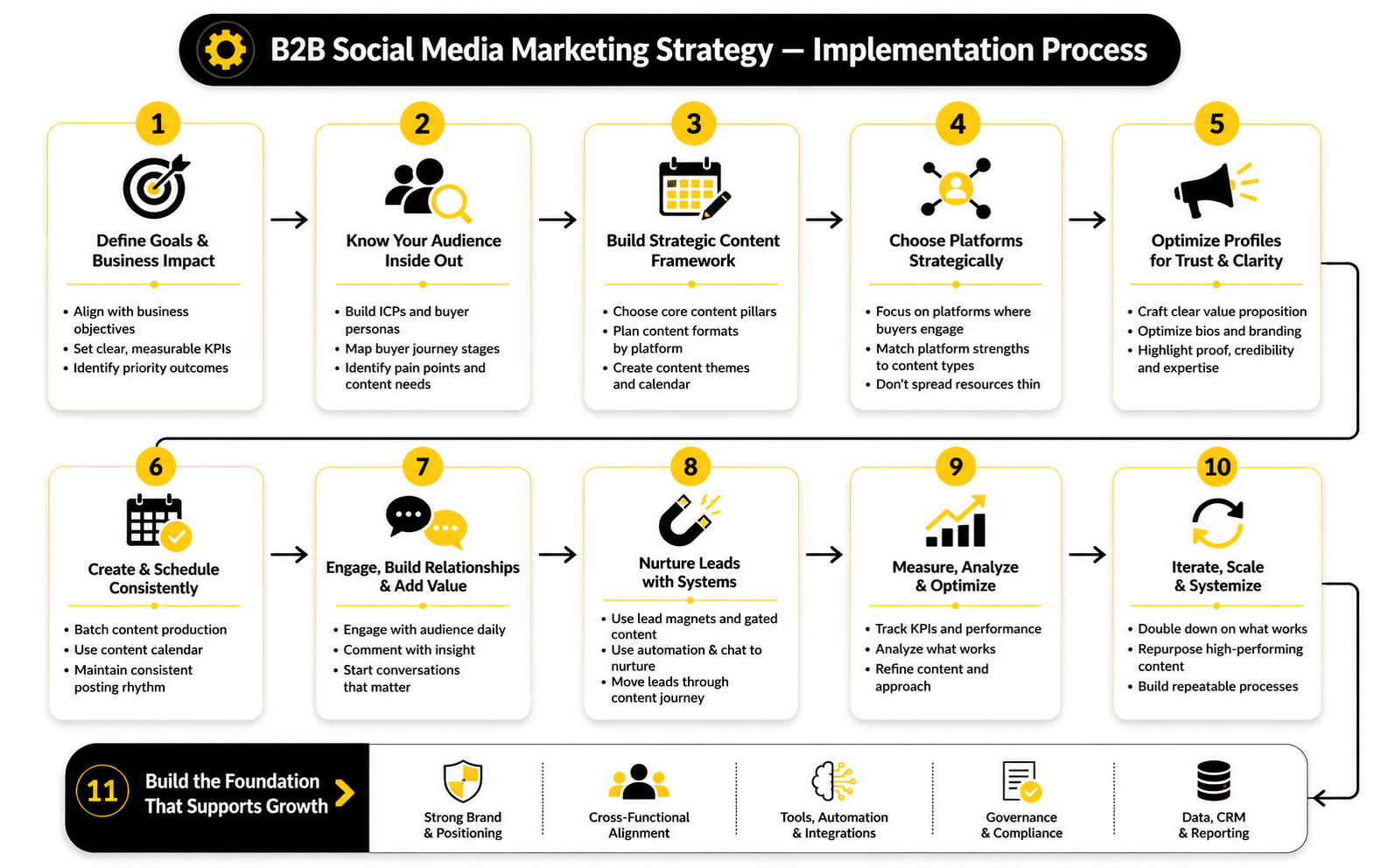
The execution process can be simple:
This approach creates leverage. You are not posting more for the sake of posting more. You are giving important ideas enough repetition and enough formats to actually reach the market.
Match Formats to the Job
Formats should serve the message, not the other way around. A carousel can simplify a framework. A short video can explain a sharp opinion. A text post can make a practical point quickly. A webinar can handle complexity. A customer story can create confidence when buyers are comparing options.
The mistake is choosing formats because they are trendy. Short-form video may be useful, but it is not automatically the right format for every B2B message. A complex implementation topic may need a written breakdown first. A contrarian market insight may work best as a founder post. A tactical workflow may need a screen recording, checklist, or live session.
Use the buyer’s situation as the filter. If the buyer is trying to understand a problem, give them clarity. If they are comparing solutions, give them criteria. If they are trying to convince a team, give them proof. If they are worried about implementation, give them process.
Tools can help here, but only after the format logic is clear. A social scheduling tool like Buffer can keep the publishing rhythm organized. A writing tool like Wispr Flow can help turn raw expert thinking into drafts faster. But the tool should never decide the message. The buyer problem should.
Use Executive and Expert Voices Deliberately
Company pages are useful, but B2B trust often grows faster through people. Executives, founders, product leaders, consultants, customer success leaders, and technical experts can all carry different parts of the strategy. The key is to use these voices deliberately instead of asking everyone to “post more.”
Executive content is strongest when it explains market shifts, strategic beliefs, customer patterns, and decisions leaders need to make. Expert content is strongest when it explains how things actually work. Company content is strongest when it connects the brand, the proof, the product, and the broader narrative.
These roles should complement each other. The founder should not be forced to post generic product updates. The subject-matter expert should not be asked to write vague inspiration. The company page should not be the only place where the brand has a point of view.
A good implementation process gives each voice a lane. Define what each person should talk about, how often they can realistically contribute, and how their ideas will be captured. For busy experts, interviews, voice notes, and short internal prompts usually work better than asking them to write full posts from scratch.
Create a Real Review Workflow
B2B social content often gets stuck because nobody knows who needs to approve what. Legal wants control. Product wants accuracy. Sales wants stronger CTAs. Leadership wants polish. Marketing wants speed. Without a workflow, every post becomes a small negotiation.
The solution is not to remove review. The solution is to define it. Decide which content needs legal approval, which content needs product review, which content can be published by trained team members, and which content requires executive sign-off. Then document the rules so the team can move without asking the same questions every week.
A practical workflow can look like this:
This keeps the process professional without making it painfully slow. More importantly, it protects quality. Fast content is only useful when it is still accurate, relevant, and aligned with the brand’s point of view.
Build a Publishing Rhythm You Can Sustain
Consistency matters, but unrealistic consistency breaks teams. A B2B company does not need to publish five times a day to have a serious social presence. It needs a rhythm that is frequent enough to build memory and realistic enough to maintain quality.
Start with a simple cadence. For example, the company page might publish three to five strong posts per week, the founder might post two to four times per week, and one or two experts might contribute weekly. That is enough to test messages, build visibility, and support ongoing campaigns without turning the team into a content factory.
The rhythm should also match the sales and marketing calendar. If a product launch, industry event, webinar, report, or campaign is coming up, social content should start warming the market before the announcement. Waiting until launch week usually creates a spike of activity but not enough context for buyers to care.
A sustainable publishing rhythm includes room for planned content and timely response. Planned content gives the strategy structure. Timely response lets the brand participate in relevant market conversations without chasing every trend. You need both.
Connect Content Production to Sales Enablement
Social content should not live in a separate marketing silo. The best posts often become useful sales assets because they explain a problem in a way buyers understand. If a post earns strong reactions from the right audience, sales should know about it.
Create a simple system for passing useful social content to sales. This can include weekly internal roundups, a shared library of posts by topic, suggested copy for follow-up messages, and links to customer proof or educational assets. The goal is to help sales use public content in private conversations without sounding scripted.
This also works in the other direction. Sales teams hear objections, questions, and competitor comparisons every day. Those insights should feed the content calendar. If three prospects ask the same question in one week, that is not just a sales note. It is a content opportunity.
For teams that want social engagement, lead capture, nurture, and follow-up under one operational roof, GoHighLevel can support the workflow. For teams that rely heavily on email nurture after social conversion, Brevo can help manage campaigns and follow-up sequences. The important thing is not the software itself. The important thing is that social activity does not stop at the feed.
Measure Content Pillars Before You Scale Them
Do not scale a pillar just because the team likes it. Scale it because the market responds and the response is commercially useful. That means looking beyond surface engagement and asking whether the content is attracting the right people, creating sales conversations, improving nurture performance, or helping buyers understand the problem faster.
Track performance by pillar, not only by post. One post may overperform because of timing, format, or a strong hook. A pillar that consistently performs across formats is more valuable because it shows repeatable market interest. That is the signal you want.
Useful pillar-level metrics include saves, shares, comments from target accounts, profile visits, qualified clicks, newsletter signups, demo assists, sales usage, and pipeline influence where attribution is possible. Not every metric needs to be perfect. But every metric should help you decide what to keep, improve, or stop.
This is how implementation becomes strategic. You create a focused set of pillars, execute them through a repeatable process, and use market response to make the next cycle sharper. That is the bridge between content planning and platform strategy, which is where the article goes next.
Statistics and Data
Data should make your B2B social media marketing strategy sharper, not noisier. The point is not to collect every possible number from every platform. The point is to understand what is working, what is attracting the right people, and what should change in the next execution cycle.
This is where many teams get distracted. They look at impressions, likes, and follower growth because those numbers are easy to see. Those metrics are not useless, but they only become meaningful when you connect them to audience quality, content intent, platform behavior, and downstream business movement.
A good measurement system answers practical questions. Are we reaching the right people? Are the right people paying attention? Are our strongest content pillars creating repeatable response? Are social touchpoints helping sales conversations, lead quality, nurture performance, or pipeline creation? If the data cannot help answer those questions, it is probably dashboard decoration.
Start With the Business Question
Before you measure anything, decide what the business needs social media to support. A company trying to create category awareness should not judge success the same way as a company trying to accelerate enterprise deals. A startup building founder-led demand has different signals than a mature B2B brand running paid LinkedIn campaigns across multiple regions.
The measurement question should come before the metric. If the question is “Are we reaching more of the right market?” then audience growth, target-account reach, profile visits, and share of voice may matter. If the question is “Are we creating demand?” then qualified clicks, newsletter signups, webinar registrations, retargeting pools, and high-intent content engagement become more useful.
This sounds basic, but it prevents a lot of bad decisions. A post with modest engagement from the right buying committee can be more valuable than a viral post that attracts the wrong audience. In B2B, relevance usually beats raw reach.
Understand What Benchmarks Can and Cannot Tell You
Benchmarks are useful when they give you context, but dangerous when they become the goal. The 2025 B2B content research from Content Marketing Institute found that 85% of B2B marketers said LinkedIn delivers the best value for their organization. That tells you LinkedIn is still a serious B2B channel, but it does not tell you what your audience wants, what your category requires, or what your sales motion needs.
The same logic applies to engagement benchmarks. Industry studies can show average engagement rates, format performance, posting trends, and platform shifts, but your own baseline matters more than a generic average. If your LinkedIn engagement rate improves from weak to healthy while the audience quality also improves, that is a stronger signal than simply chasing a public benchmark that may not match your market.
Use benchmarks to identify whether something looks unusually low, unusually high, or worth investigating. Do not use them to copy tactics blindly. A software company selling to CFOs, a cybersecurity company selling to CISOs, and an agency selling to founders may all use LinkedIn, but their content mix, sales cycle, buyer risk, and conversion path will look very different.
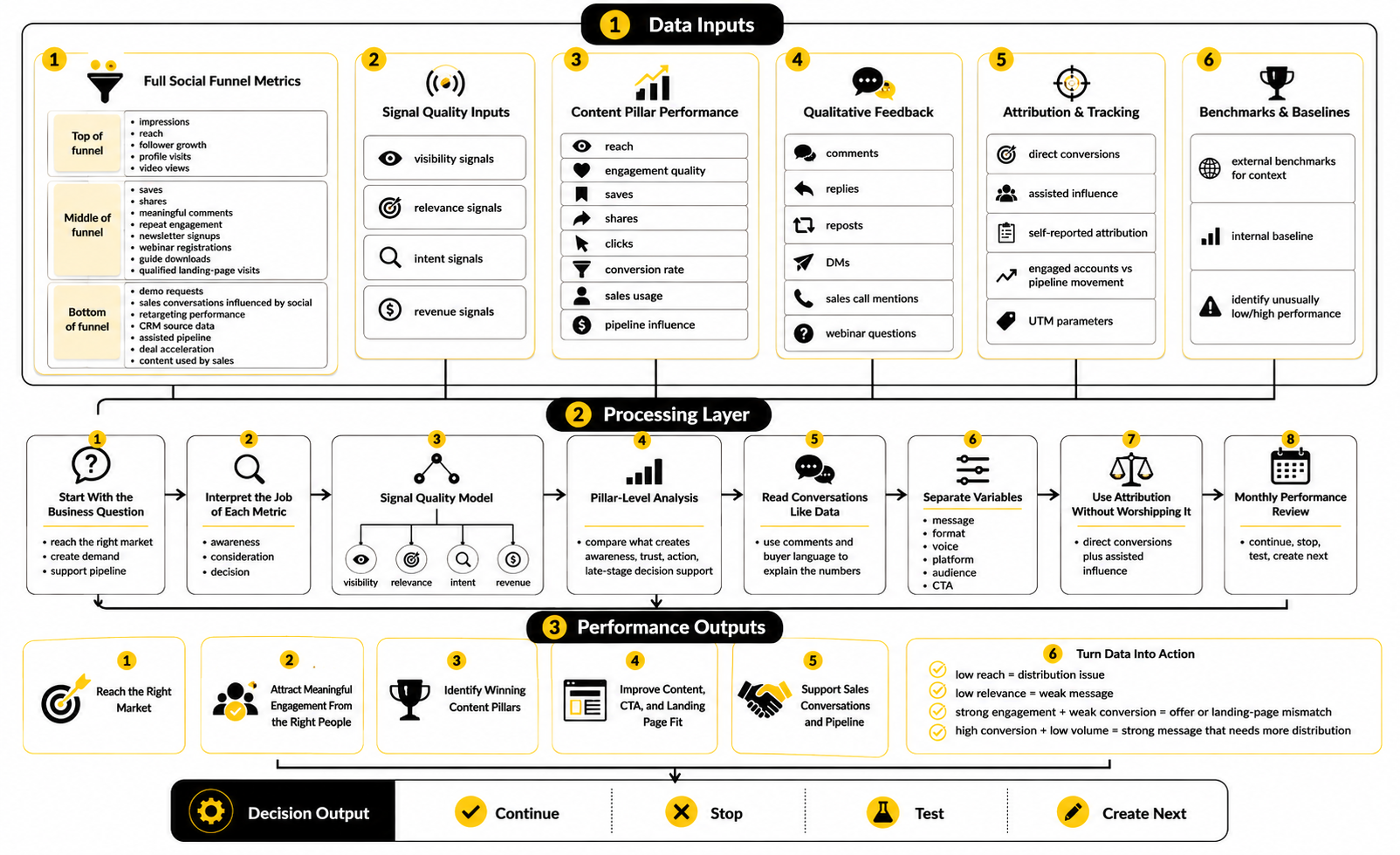
Measure the Full Social Funnel
A strong analytics system tracks more than the post. It looks at how social media supports attention, trust, action, and sales movement. This gives you a cleaner view of the role social plays across the buyer journey instead of forcing every post to prove direct revenue immediately.
At the top of the funnel, measure whether the right market is seeing you. This includes impressions, reach, follower growth, profile visits, audience demographics, target-account visibility, and brand search movement. These metrics show whether your content is entering the right conversations.
In the middle of the funnel, measure whether people are engaging in ways that show real interest. Saves, shares, meaningful comments, repeat engagement, newsletter signups, webinar registrations, guide downloads, and qualified landing-page visits are stronger signals than passive likes. They show that your content is useful enough for buyers to keep, pass along, or act on.
At the bottom of the funnel, measure whether social activity supports business outcomes. Look at demo requests, sales conversations influenced by social, retargeting performance, CRM source data, assisted pipeline, deal acceleration, and content used by sales during active opportunities. The attribution will never be perfect, but directional evidence is still valuable when it is interpreted honestly.
Build a Measurement System Around Signal Quality
The best B2B teams do not treat every engagement as equal. A comment from a target-account executive means something different from a like from someone outside the market. A save on a detailed implementation post means something different from a reaction to a light brand update.
This is why signal quality matters. Strong signals usually show intent, relevance, or influence. Weak signals may show visibility but not much commercial meaning. You need both, but you should not confuse them.
A practical signal model can separate metrics into four groups:
This model keeps the team honest. Visibility is not bad. It just should not be mistaken for demand. Intent is not always revenue. Revenue influence is not always direct attribution. Each signal has a job, and the strategy improves when you interpret each one in the right place.
Track Content Pillars Separately
If you only review individual posts, you will miss the bigger pattern. One post can win because of timing, format, personality, or a strong hook. A content pillar that performs repeatedly across formats is more important because it reveals what the market consistently cares about.
Track each pillar by reach, engagement quality, saves, shares, clicks, conversion rate, sales usage, and pipeline influence where possible. Then compare pillars against each other. The goal is not to crown one winner forever. The goal is to understand which topics create awareness, which create trust, which drive action, and which support late-stage decisions.
For example, a market-trend pillar may drive reach and comments, while an implementation pillar may drive fewer reactions but stronger sales usage. A customer-proof pillar may not go viral, but it may help prospects feel safer when comparing vendors. Each one can be valuable if you understand the job it performs.
This is where a b2b social media marketing strategy becomes more mature. You stop asking, “Did this post do well?” and start asking, “What role did this content play, and should we create more of it?”
Read Comments and Conversations Like Data
Quantitative metrics are useful, but qualitative feedback often explains why something is happening. Comments, replies, reposts, DMs, sales call mentions, and webinar questions can show whether the message is landing in the buyer’s language. They can also reveal objections, confusion, urgency, and new content angles.
Do not only count comments. Read them. A small number of thoughtful comments from the right people can be more useful than hundreds of generic reactions. The language people use in response to your content can help improve positioning, landing pages, sales scripts, email nurture, and future posts.
This is especially important for thought leadership. The 2025 Edelman-LinkedIn report found that more than 40% of B2B deals stall because of internal misalignment within buying groups. When your content creates comments that reveal internal debates, objections, or hidden stakeholder concerns, that is not just engagement. That is market research.
Separate Platform Performance From Message Performance
A post can fail for more than one reason. The message may be weak. The format may be wrong. The platform may not fit the audience. The hook may be unclear. The timing may be bad. If you treat every poor result as a message failure, you will kill good ideas too early.
This is why you should test important messages across more than one format. A point of view might fail as a text post but work as a carousel. A practical workflow might be ignored on the company page but perform well from an expert’s personal profile. A customer insight might not get many public reactions but work beautifully in sales follow-up.
Review performance by separating the variables. Look at message, format, voice, platform, audience, and CTA. This gives you better decisions than saying “LinkedIn works” or “video does not work” based on one narrow sample.
Use Attribution Without Worshipping It
Attribution matters, but it is not a perfect picture of reality. B2B buying journeys are long, multi-touch, and influenced by private conversations that do not show up cleanly in analytics. A buyer may read five posts, hear about your company from a peer, attend a webinar, ignore an email, then search your brand directly three weeks later.
If your model only credits the final click, social will often look weaker than it really is. If your model credits every touch equally, social may look cleaner than it really is. The right approach is to use attribution as one input, not the whole truth.
Track direct conversions where possible, but also look at assisted influence. Ask sales whether prospects mention social content. Add self-reported attribution fields to forms. Compare engaged accounts against pipeline movement. Review whether social-exposed audiences convert better in retargeting or email nurture.
For cleaner tracking, use UTM parameters consistently. A link management tool like Dub.co can help keep campaign links organized, especially when multiple people and channels are sharing content. The point is not to create a perfect attribution machine. The point is to reduce guesswork enough to make more carefully decisions.
Create a Monthly Social Performance Review
Weekly reporting is useful for operational adjustments, but monthly review is where strategy improves. A weekly view tells you what happened. A monthly view helps you understand patterns, pillar performance, audience quality, and whether the social program is moving closer to business outcomes.
A strong monthly review should cover:
Keep this review practical. Do not turn it into a 40-slide report nobody reads. The output should be decisions: what to continue, what to stop, what to test, and what to create next.
Turn Data Into Action
The real value of analytics is not the report. It is the next move. If a pillar earns strong saves but low clicks, the topic may be useful but the CTA may be weak. If a post drives clicks but poor conversion, the landing page may not match the promise. If founder posts outperform company posts on the same topic, the message may need a more human voice.
Every metric should point to a possible action. Low reach may suggest distribution issues. Low engagement from the right audience may suggest weak relevance. Strong engagement but weak conversion may suggest a mismatch between content and offer. High conversion but low volume may suggest the message is strong and needs more distribution.
This is how measurement becomes a growth system. You create content with a clear purpose, track the right signals, interpret the data based on buyer intent, and improve the next cycle. That is much more useful than reporting a pile of numbers and pretending the dashboard is the strategy.
Platform Strategy, Distribution, and Engagement
By this point, the strategy has the right foundation: audience, positioning, content pillars, execution process, and measurement. The next challenge is distribution. This is where a lot of B2B teams quietly lose because they create good content and then rely on one organic post to do all the work.
A mature b2b social media marketing strategy treats distribution as a system, not an afterthought. The same idea should move through company channels, executive profiles, employee networks, paid campaigns, email, sales outreach, partner relationships, events, and retargeting where it makes sense. The goal is not to spam the market. The goal is to give important ideas enough reach, repetition, and context to create memory.
This is also where strategy becomes more selective. You do not need every platform. You need the right platforms for the audience, the message, the buying journey, and the internal resources you can actually support.
Choose Platforms Based on Buyer Behavior
Platform choice should start with where your buyers spend professional attention. For most B2B companies, LinkedIn is still the core channel because it combines professional identity, company data, content distribution, paid targeting, and peer visibility in one place. The 2025 B2B content research from Content Marketing Institute found that 85% of B2B marketers said LinkedIn delivers the best value for their organization, which makes it difficult to ignore.
But “LinkedIn first” does not mean “LinkedIn only.” YouTube may be stronger for educational depth, product walkthroughs, expert interviews, and search-driven discovery. X can still matter in certain founder, developer, investor, AI, media, and tech circles. Reddit, Slack groups, Discord communities, and private communities can matter when buyers trust peer discussion more than brand content.
The smart move is to define the job of each channel. LinkedIn might create professional visibility and thought leadership. YouTube might host deeper educational content. Email might nurture serious buyers. Webinars might convert complex interest into live engagement. Retargeting might keep decision-stage buyers close after they interact with your best assets.
Do Not Confuse Channel Expansion With Growth
Adding more platforms can look like progress, but it often creates operational drag. Every new channel needs content adaptation, publishing discipline, moderation, analytics, and a reason to exist. If the team is already struggling to create strong LinkedIn content, adding four more platforms usually makes the strategy weaker, not stronger.
Expansion should happen only when one of three things is true. First, the audience is clearly active on the platform. Second, the content format fits the platform naturally. Third, the team has enough capacity to maintain quality without weakening the main channel.
This is especially important for small teams. A focused strategy executed consistently on one or two channels will usually outperform a scattered presence across six. The market does not reward you for having empty profiles everywhere. It rewards you for being useful, recognizable, and present where the right buyers actually pay attention.
Start narrow, learn fast, then expand. That is boring advice, but it works.
Build Distribution Around Content Strength
Not every asset deserves the same distribution push. A quick post, a strong point of view, a research-backed guide, a customer proof asset, and a webinar should not all receive the same treatment. Distribution should match the value and strategic importance of the content.
High-value assets need a full distribution plan. That may include teaser posts, founder commentary, employee amplification, partner sharing, paid promotion, newsletter placement, sales follow-up, remarketing, and follow-up content that expands on the original idea. If an asset took real time to create, it should not disappear after one announcement.
Lower-value posts can still be useful, but they should not consume the same level of effort. Some posts are for testing an idea. Some are for staying visible. Some are for responding to a timely conversation. Some are for supporting a campaign already in motion.
The discipline is knowing the difference. Treat every post like a major launch and the team burns out. Treat every major idea like a disposable post and the strategy underperforms.
Use Paid Social to Amplify What Already Works
Paid social should not be used to rescue weak messaging. It should amplify messages, assets, and offers that already show signs of relevance. If a post earns strong engagement from the right audience organically, that may be a signal worth testing with paid distribution.
This is where B2B teams need patience. Paid social often works best when it supports a sequence, not a single hard conversion. A cold buyer may not book a demo from one ad, but they may engage with a strong point of view, watch a product education video, download a useful resource, attend a webinar, and later enter a sales conversation with much more context.
Use paid social to support different stages of the journey. Promote educational content to relevant audiences. Retarget engaged visitors with deeper proof. Show comparison or implementation content to people who have already taken meaningful action. Give late-stage buyers assets that reduce risk and help them build internal support.
The targeting should also reflect the buying committee. Do not only target the obvious decision-maker. If hidden influencers, technical evaluators, finance stakeholders, or operational leaders shape the decision, your paid strategy should include them when the message fits.
Make Employee Advocacy Useful, Not Forced
Employee advocacy can be powerful, but only when it feels human. If employees are asked to copy and paste corporate posts, the content usually looks stiff and performs poorly. Worse, it can make the brand feel less trustworthy because everyone is suddenly saying the same thing in the same words.
The better approach is to make advocacy easy and flexible. Give employees short summaries, suggested angles, key points, visuals, and optional post drafts they can adapt. Let them add their own perspective. The goal is not message control at all costs. The goal is aligned individuality.
This works especially well when employees have real expertise. Product leaders can explain technical trade-offs. Customer success teams can share patterns from implementation. Sales leaders can talk about buyer objections. Founders can explain market beliefs and strategic decisions.
Do not pressure everyone to become a creator. Some people will be active. Some will amplify occasionally. Some will contribute ideas behind the scenes. All of those roles can be useful if the system respects how people actually work.
Protect Trust While Scaling Content
Scaling content is where quality often breaks. The company starts with strong thinking, then turns it into templates, automation, generic AI drafts, and rushed approvals. The output increases, but the market stops paying attention because the content loses its edge.
AI can help with research, drafting, repurposing, summarizing calls, and turning raw expertise into usable formats. But AI should not replace the actual point of view. Buyers can feel the difference between content that has real field experience behind it and content that sounds like a polished summary of the internet.
This is especially important as more teams use AI in marketing workflows. The advantage will not go to the companies that generate the most posts. It will go to the companies that use AI to move faster while still publishing sharper, more specific, more credible ideas.
The rule is simple: automate production support, not strategic judgment. Use tools to speed up drafting, editing, formatting, and repurposing. Keep positioning, claims, proof, examples, and final judgment in human hands.
Manage Compliance Without Killing Momentum
Some industries have more risk than others. Finance, healthcare, cybersecurity, legal, HR tech, enterprise software, and regulated markets often need tighter review. That does not mean social media has to become slow and lifeless. It means the rules need to be clear before content enters production.
Create categories of content based on risk. Low-risk content might include general education, event promotion, culture posts, and broad market observations. Medium-risk content might include product explanations, competitive commentary, and customer outcomes. High-risk content might include claims about performance, compliance, security, pricing, legal interpretation, financial results, or regulated advice.
Each category should have a review path. Low-risk content can move quickly. Medium-risk content may need subject-matter review. High-risk content may require legal, compliance, or executive sign-off. This keeps the team from treating every post like a legal emergency.
The worst system is informal review, where nobody knows the rules and everyone is afraid to publish. The best system gives people enough structure to move confidently.
Balance Brand Voice and Personal Voice
B2B social media works best when the company has a clear brand voice and its people have room to sound like themselves. If everything sounds corporate, the content feels distant. If everything is personal and disconnected, the brand narrative becomes fragmented.
The company voice should carry the main positioning, proof, product story, and campaign themes. Personal voices should add interpretation, experience, opinion, and practical context. Together, they make the brand feel both credible and human.
This balance matters because buyers trust people, but they also need confidence in the company. A founder post can create attention, but the company still needs clear proof, useful resources, and a reliable conversion path. An expert post can explain a technical problem, but the brand still needs to connect that insight to its broader solution.
The goal is not to make every person sound like the brand. The goal is to make every voice reinforce the same strategic direction without losing individuality.
Create Stronger Paths From Engagement to Action
Engagement is valuable, but it should not be the end of the journey. If someone repeatedly interacts with your content, visits your profile, clicks your links, attends your webinar, or downloads your resources, they need a sensible next step. That next step should match their intent.
Early-stage engagement might lead to a newsletter, guide, diagnostic checklist, or educational webinar. Mid-stage engagement might lead to a comparison page, implementation breakdown, calculator, or product walkthrough. Late-stage engagement might lead to a consultation, demo, audit, or pricing conversation.
This is where landing pages and forms matter. A strong post can create interest, but a weak landing page can kill momentum. If you are running campaigns from social traffic, tools like Replo can help teams create more focused landing pages, while Fillout can support better intake, qualification, and diagnostic flows.
Do not make every CTA a demo request. That is one of the fastest ways to waste good attention. Give buyers a next step that matches how ready they actually are.
Plan for International and Regional Differences
A B2B social strategy that works in one market may need adjustment in another. Buyers in different regions may respond to different proof, communication styles, privacy expectations, platform preferences, and sales motions. This matters even more for companies selling across North America, Europe, the UK, APAC, or multilingual markets.
The core positioning can stay consistent, but execution may need localization. That includes examples, terminology, compliance references, customer proof, event tie-ins, posting times, and preferred formats. A message that feels direct and clear in one market may feel too aggressive or too vague in another.
Regional teams should not simply translate corporate posts. They should adapt the message to the buyer context while keeping the same strategic spine. The best global strategy is consistent enough to build brand memory and flexible enough to feel relevant locally.
This also affects measurement. A lower engagement rate in one region does not automatically mean the strategy is failing. The audience size, platform behavior, competitive density, language, and sales cycle may all differ. Compare markets carefully before making big decisions.
Avoid the Biggest Scaling Mistakes
As social programs grow, mistakes become more expensive. A small team can correct course quickly. A larger program with multiple markets, executives, agencies, and approval layers can drift for months before anyone realizes the strategy has become diluted.
The most common scaling mistakes are predictable:
These problems are fixable, but only if leadership understands that social media is not just a marketing task. It is a visible expression of the company’s thinking, trustworthiness, and commercial focus.
Know When to Standardize and When to Customize
Standardization creates efficiency. Customization creates relevance. The challenge is knowing which parts of the strategy should be standardized and which parts should stay flexible.
Standardize the framework, positioning, review process, measurement model, brand principles, campaign planning, and content pillar structure. These give the program consistency and make scaling easier. Without them, every team invents its own version of the strategy.
Customize the examples, hooks, executive voice, local market references, platform formats, and sales enablement use cases. These give the content life. Without them, the program starts to feel like corporate wallpaper.
This is the balance mature teams aim for. They are not improvising every week, but they are also not publishing lifeless templates. They have a system strong enough to scale and flexible enough to stay human.
Make the Strategy Harder to Copy
Competitors can copy your content formats. They can copy your posting cadence. They can copy your hooks, your carousels, and even your topics. What they cannot easily copy is your combination of customer insight, internal expertise, market point of view, proof, and execution discipline.
That is where the real advantage is. A strong b2b social media marketing strategy should become more defensible over time because it is built on what your company is learning from the market. Your sales calls, customer wins, implementation lessons, product decisions, research, and leadership beliefs should all feed the content system.
This is why generic best practices only take you so far. They can help you get organized, but they cannot give you a point of view worth following. The strongest B2B brands do not just post consistently. They teach the market how to think about a problem.
The final part will bring everything together with professional implementation guidance, practical closing advice, and an FAQ that answers the questions teams usually ask before they build or improve their social strategy.
Professional Implementation, Measurement, and Optimization
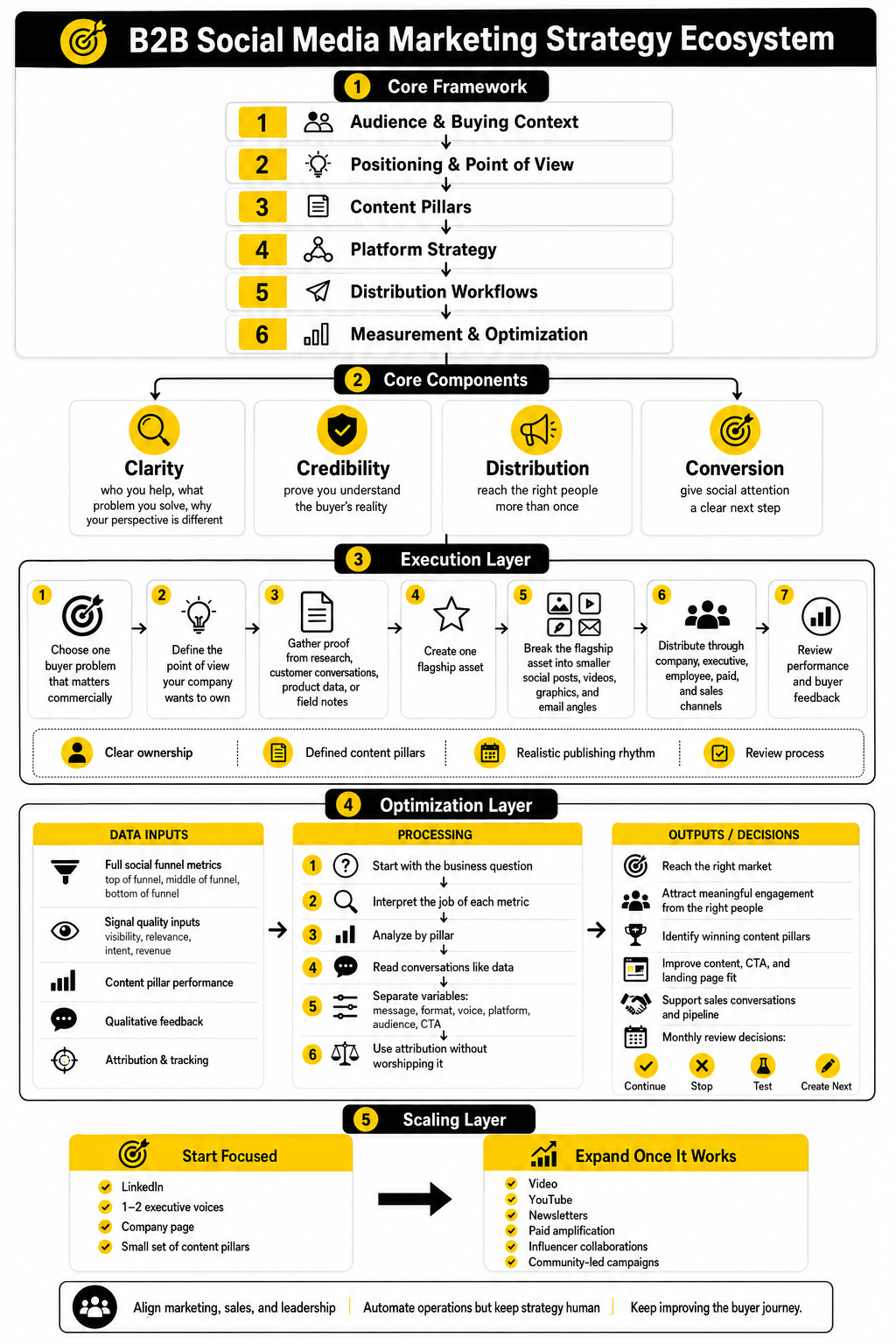
A complete b2b social media marketing strategy does not end with content, platforms, or reporting. It becomes valuable when the whole system works together: audience insight, positioning, content pillars, distribution, engagement, conversion, sales feedback, and optimization. That is the difference between having a social presence and having a social engine.
The professional version is not complicated for the sake of looking sophisticated. It is simply more connected. Content is shaped by real buyer questions, distributed through the right voices, measured against meaningful signals, and improved based on what the market and sales team are actually seeing.
This is also where leadership has to be realistic. Social media will not fix weak positioning, poor offers, unclear proof, or a broken sales process. It will expose them faster. That is useful if the company is willing to learn from the signal instead of blaming the channel.
Build the Operating System
The operating system is the behind-the-scenes structure that keeps social media from becoming random. It defines who owns strategy, who creates content, who reviews it, who publishes it, who engages, who reports, and who turns insights into the next cycle. Without that structure, the strategy slowly turns into scattered posting.
A simple operating system can run on a monthly cycle. Start with business priorities, campaign themes, sales feedback, and message tests. Turn those into content pillars, format choices, distribution plans, and conversion paths. Then review the results and decide what deserves more investment.
This cycle should be documented clearly enough that a new team member could understand how the system works. That does not mean every sentence needs a process document. It means the important decisions should not live only in someone’s head.
Align Marketing, Sales, and Leadership
B2B social media performs better when marketing, sales, and leadership agree on what the channel is supposed to do. Marketing may focus on visibility and demand creation. Sales may care about conversations and deal movement. Leadership may care about brand credibility, category presence, and pipeline influence.
Those priorities can work together, but only if they are discussed directly. If sales expects every post to generate demo requests and marketing expects every post to build long-term awareness, the team will argue about performance forever. The solution is to define different content jobs and connect each job to the right metric.
Leadership also has to participate in the right way. The best executive involvement is not endless approval. It is clear direction, useful perspective, and willingness to put real thinking into the market. Buyers notice when a company’s leaders have something to say beyond polished announcements.
Decide What to Automate and What to Keep Human
Automation can make the system faster, but it can also make the brand forgettable if used carelessly. Scheduling, reporting, link tracking, lead routing, workflow reminders, and draft organization are good candidates for automation. Strategic judgment, customer insight, executive voice, sensitive claims, and final editorial decisions should stay human.
This line matters more now because AI has made it easy to produce content at scale. Easy production is not the same as strong strategy. If the content does not contain real insight, buyers will ignore it no matter how efficiently it was made.
Use automation to remove friction, not responsibility. A tool can help publish posts, organize campaigns, summarize calls, or trigger follow-up. It cannot replace a sharp understanding of what buyers care about, why deals stall, or what your company believes about the market.
Keep Improving the Buyer Journey
The strongest social strategies do not treat conversion as a single CTA. They build a journey. A buyer might first notice a founder post, then read a practical guide, then see a customer proof asset, then attend a webinar, then receive a sales message that finally feels relevant.
That journey should become smoother over time. If people engage but do not click, improve the offer. If they click but do not convert, improve the landing page. If they convert but do not become qualified opportunities, improve the targeting, form, nurture, or qualification process.
This is why social media should be connected to the rest of the go-to-market system. If you use landing pages, funnels, scheduling tools, CRM workflows, chat experiences, or email nurture, they should all support the same buyer logic. For example, Cal.com can make meeting booking cleaner after high-intent engagement, while Chatbase can help answer common questions on pages where buyers need quick guidance before taking the next step.
Make Optimization a Habit
Optimization should not be a panic reaction after a bad month. It should be a normal part of the strategy. Every month, the team should know what improved, what weakened, what surprised them, and what they will test next.
The best improvements are usually specific. Change the hook style. Rewrite the CTA. Shift a pillar toward a stronger buyer pain. Move an expert voice to the front. Add proof where the content feels too abstract. Retarget people who engaged with deeper assets instead of asking cold audiences to book a demo immediately.
Small improvements compound. One stronger message, one better landing page, one clearer offer, one more useful sales handoff, and one sharper executive post may not look dramatic alone. Together, they make the whole system more effective.
What is a B2B social media marketing strategy?
A B2B social media marketing strategy is a structured plan for using social platforms to reach business buyers, build trust, support the buying journey, and contribute to pipeline. It defines the audience, positioning, content pillars, platforms, distribution, engagement process, conversion paths, and measurement system. It is not just a posting schedule.
The best strategies connect social activity to real business outcomes. That means content should help buyers understand problems, compare approaches, reduce risk, and take the next logical step. When the strategy is strong, social media supports both brand credibility and revenue conversations.
Why does B2B social media matter if buyers are not ready to buy?
Most buyers are not ready to buy when they first see your content. That is exactly why social media matters. It gives your company a way to earn attention and trust before a formal buying process begins.
B2B buyers often research quietly, compare options privately, and involve internal stakeholders before they contact vendors. Gartner’s B2B buying research has shown that 75% of B2B buyers prefer a rep-free sales experience, which makes useful digital content even more important. Social media helps your company show up during that quiet research phase.
Which platform is best for B2B social media?
LinkedIn is usually the strongest starting point for B2B companies because it combines professional identity, company data, content discovery, and paid targeting. Content Marketing Institute’s 2025 B2B research found that 85% of B2B marketers said LinkedIn delivers the best value for their organization. That makes LinkedIn hard to ignore for most B2B strategies.
Still, the best platform depends on the audience and content format. YouTube may be better for deep education. Email may be better for nurture. Communities may be better for peer-led conversations. The right question is not “Which platform is popular?” The right question is “Where does our buyer pay attention when they are trying to solve this problem?”
How often should a B2B company post on social media?
A realistic cadence is better than an aggressive cadence the team cannot sustain. Many B2B companies can start with three to five strong company posts per week, supported by founder or expert posts where appropriate. The exact number matters less than the quality, consistency, and strategic focus of the content.
Posting more only helps if the content is useful and aligned with the buyer journey. If higher frequency leads to generic posts, weaker thinking, and poor review, it is not worth it. Start with a rhythm your team can maintain, then increase volume once the message and process are working.
What should a B2B company post on social media?
A B2B company should post content that helps buyers understand problems, evaluate options, reduce uncertainty, and see why the company has credible expertise. That can include practical frameworks, market analysis, customer proof, implementation lessons, expert commentary, product education, comparison guidance, and event or webinar content.
The strongest content usually comes from real buyer questions. Sales calls, customer interviews, support conversations, implementation notes, and webinar questions are all useful sources. If buyers keep asking about the same issue, that issue probably deserves content.
How do you measure B2B social media performance?
Measure social media based on the job each content type is supposed to do. Awareness content may be judged by reach, audience quality, profile visits, and engagement from the right people. Consideration content may be judged by saves, shares, qualified clicks, webinar registrations, and repeat engagement. Decision content may be judged by demo assists, sales usage, influenced pipeline, and late-stage buyer conversations.
Do not rely on one metric. Likes, impressions, and follower growth can be useful, but they do not tell the full story. A stronger measurement system separates visibility signals, relevance signals, intent signals, and revenue signals.
How long does it take for a B2B social media strategy to work?
A strategy can create early signals within weeks, but meaningful business impact usually takes longer. Early signals might include better engagement from target buyers, stronger comments, more profile visits, more qualified clicks, and sales teams using posts in conversations. Pipeline impact often takes more time because B2B buying cycles are longer and involve more stakeholders.
The key is to avoid changing direction too quickly. Test messages, formats, and distribution patterns with enough consistency to see real patterns. One weak post does not mean the strategy failed. One strong post does not mean the strategy is proven.
Should executives post on LinkedIn?
Yes, if they have a clear role in the strategy and something useful to say. Executive content can make the company more human, credible, and memorable. It works especially well when leaders share market beliefs, strategic lessons, customer patterns, and practical observations instead of generic motivational content.
Executives should not be forced into a fake personal brand. Their content should fit their expertise, voice, and schedule. A strong support process can help capture their thinking through interviews, voice notes, short prompts, or internal conversations, then turn that thinking into posts that still sound like them.
How should social media support sales?
Social media should support sales by creating useful public content that can also be used in private conversations. A strong post can help explain a problem, answer an objection, show proof, or make a buying committee more confident. Sales teams should have easy access to the best posts, guides, webinars, customer stories, and comparison assets.
Sales should also feed insights back into the content system. If prospects keep asking the same questions or raising the same objections, marketing should turn those patterns into content. This creates a loop where sales makes content sharper and content makes sales conversations easier.
What are the biggest mistakes in B2B social media?
The biggest mistakes are usually strategic, not tactical. Companies post without clear positioning, chase trends that do not fit the buyer, copy competitors, measure only surface engagement, and expect every post to create immediate leads. They also underuse strong ideas by posting them once and moving on.
Another major mistake is separating social from the rest of the go-to-market system. If social engagement does not connect to landing pages, email nurture, sales follow-up, retargeting, or CRM insight, a lot of value gets lost. Social should not sit in a corner. It should support the full buyer journey.
Can AI help with B2B social media marketing?
AI can help with research, outlining, repurposing, summarizing interviews, drafting variations, organizing ideas, and speeding up production. It can be useful when the team already has a clear strategy and strong human input. It is especially helpful for turning expert knowledge into multiple formats faster.
AI becomes a problem when it replaces original thinking. Generic AI content often sounds polished but empty. Buyers do not need more average posts. They need useful insight, credible proof, and a clear point of view.
How do you choose content pillars for B2B social media?
Choose content pillars by connecting buyer problems, company expertise, market positioning, and commercial priorities. A pillar should be specific enough to guide content creation and broad enough to support multiple posts, videos, webinars, guides, and sales assets. It should not be a vague category like “growth” or “technology.”
A good test is whether the pillar can produce content for different stages of the buying journey. If it can educate early buyers, help active evaluators, and support sales conversations, it is probably strong. If it only creates generic tips, it needs to be sharper.
Should B2B companies use paid social?
Paid social can be useful when the message, audience, and offer are already clear. It is especially helpful for amplifying strong organic content, promoting high-value assets, retargeting engaged audiences, and reaching specific buying-committee roles. It should not be used to compensate for weak positioning or unclear content.
Start by testing what already works organically. If a message earns quality engagement from the right audience, it may deserve paid support. Then build sequences instead of relying on one cold ad to generate immediate demo requests.
How does thought leadership fit into a B2B social media strategy?
Thought leadership helps buyers understand a problem in a sharper way. It is not just opinion content. It should combine expertise, market insight, buyer relevance, and a point of view that helps people make better decisions.
This matters because B2B decisions are shaped by more than the obvious buyer. The Edelman-LinkedIn 2025 B2B Thought Leadership Impact Report found that more than 40% of B2B deals stall due to internal misalignment within buying groups. Strong thought leadership can help hidden stakeholders understand the issue, align around the stakes, and support a more carefully decision.
Build a stronger local presence with BAAM AI
Turn your website, Google profile, social channels, and AI visibility into one growth engine
Most businesses do not need more random marketing activity. They need a consistent presence system that helps the right people find them, trust them, and take action. BAAM AI brings strategy, local SEO, website updates, Google Maps visibility, social content, AI-search readiness, media production, and reporting into one practical monthly engine.
If you want your marketing to keep working after the campaign ends, start with a free BAAM AI presence audit. See how your business shows up today and where the fastest visibility wins are at BAAM AI.