
BAAM AI Blog
B2B PPC: A Practical Framework For Turning Paid Clicks Into Pipeline
B2B PPC is not just “running ads for leads.” That is the lazy version, and it is usually why budgets get burned before anyone can prove revenue impact. In a real B2B environment, paid search, LinkedIn ads...
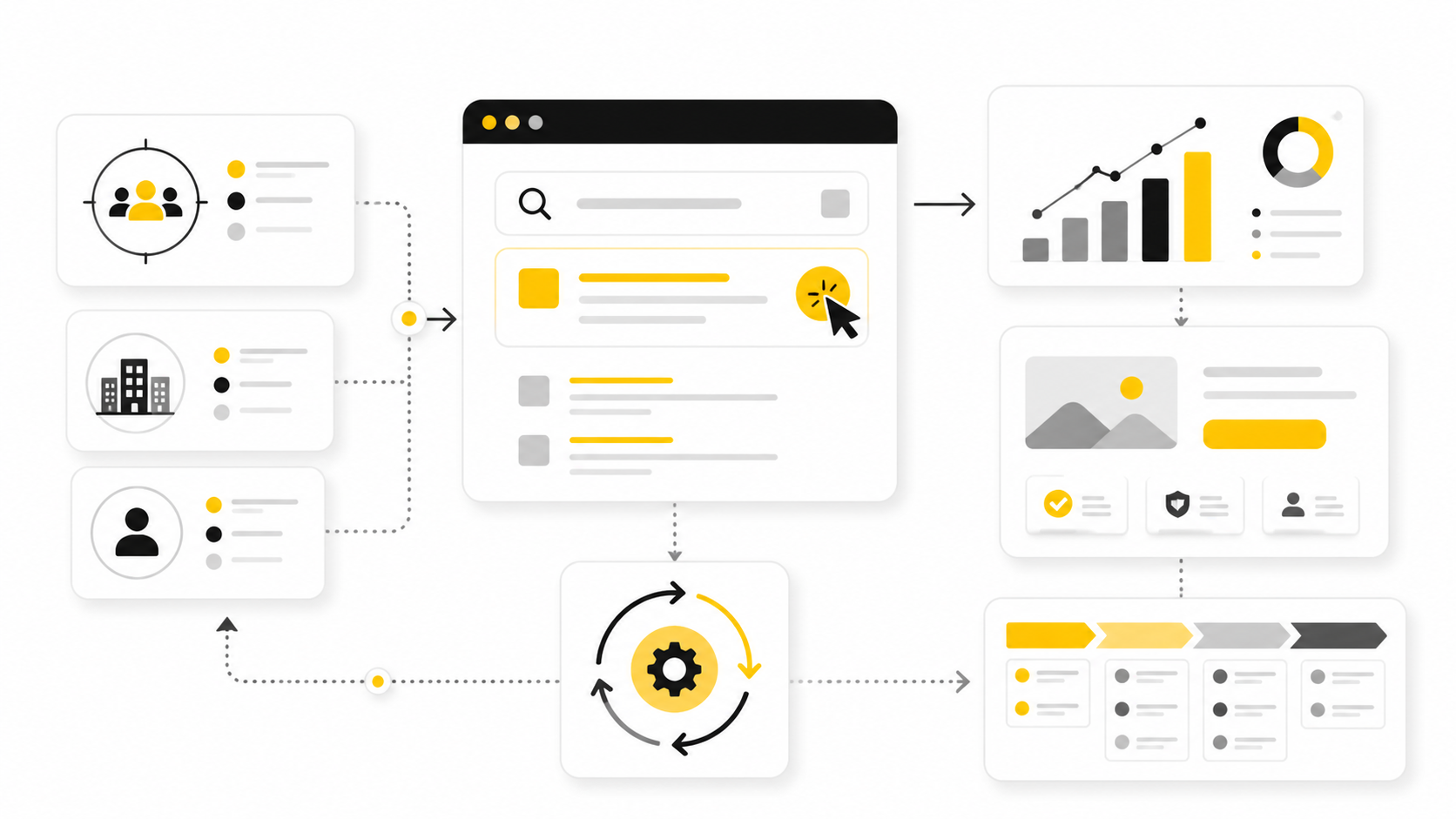
B2B PPC is not just “running ads for leads.” That is the lazy version, and it is usually why budgets get burned before anyone can prove revenue impact. In a real B2B environment, paid search, LinkedIn ads, retargeting, landing pages, CRM routing, sales follow-up, and pipeline reporting all have to work together.
The stakes are higher because B2B buyers are not impulse buyers. They compare vendors, involve colleagues, check review sites, read third-party content, and often return to the same problem several times before they speak to sales. Gartner’s 2025 buyer research found that 61% of B2B buyers prefer a rep-free buying experience, which means your ads are often entering the conversation long before a salesperson does.
That changes how B2B PPC should be managed. The goal is not to squeeze the cheapest possible form fill out of Google Ads or LinkedIn Ads. The goal is to create a paid acquisition system that reaches the right accounts, matches the buyer’s intent, gives them a clear next step, and tracks whether that click eventually becomes qualified pipeline.
this guide is structured as one complete six-part guide. Each part builds on the previous one, so the strategy moves from buyer behavior and planning into execution, optimization, reporting, and scaling. The section names below are the same names the rest of the article will continue using.
Why B2B PPC Matters Now
B2B PPC matters because buyer behavior has shifted faster than most campaign structures. Buyers want to research independently, but they still need proof, clarity, and confidence before they commit. That creates a gap where good paid campaigns can do serious work: capturing active demand, shaping evaluation criteria, and bringing buyers back when they are ready to compare options.
Paid channels are also getting more expensive, which makes sloppy execution harder to hide. WordStream’s 2025 Google Ads benchmark data shows that the average cost per click across industries reached $5.26, while the average cost per lead reached $70.11. Those numbers are not B2B-specific enough to use as a direct target, but they are a useful warning: every irrelevant click, weak landing page, and poorly qualified lead has a real cost.
At the same time, B2B buyers are using more sources before they shortlist vendors. G2’s 2025 buyer research found that AI search has changed how 79% of software buyers conduct research, and Forrester predicted that more than half of large B2B transactions worth $1 million or more would be processed through digital self-serve channels. In simple terms, buyers are doing more work before they talk to you, so your PPC campaigns need to support the full decision process, not just the first conversion.
The Shift From Lead Capture To Pipeline Creation
Old-school B2B PPC was built around one question: how many leads did we get? That question is still useful, but it is not enough. A campaign can generate a full spreadsheet of leads and still fail if those leads are students, competitors, tiny companies, bad-fit regions, or people with no buying authority.
A stronger B2B PPC strategy asks better questions. Which accounts are engaging? Which keywords produce sales conversations? Which audiences move from ad click to demo to opportunity? Which offers help buyers self-educate without attracting junk leads?
This is where B2B PPC becomes a revenue system rather than an ad account. Search campaigns can capture urgent demand from people already looking for a solution. LinkedIn campaigns can reach specific job titles, industries, and account lists before the buyer searches directly. Retargeting can keep the conversation alive after a visitor reads a comparison page, watches a product video, or visits pricing.
Framework Overview
A useful B2B PPC framework has four layers: audience, intent, experience, and measurement. Audience defines who should see the ads. Intent defines what the buyer is trying to solve at that moment. Experience defines what happens after the click. Measurement defines whether the campaign is creating business value.
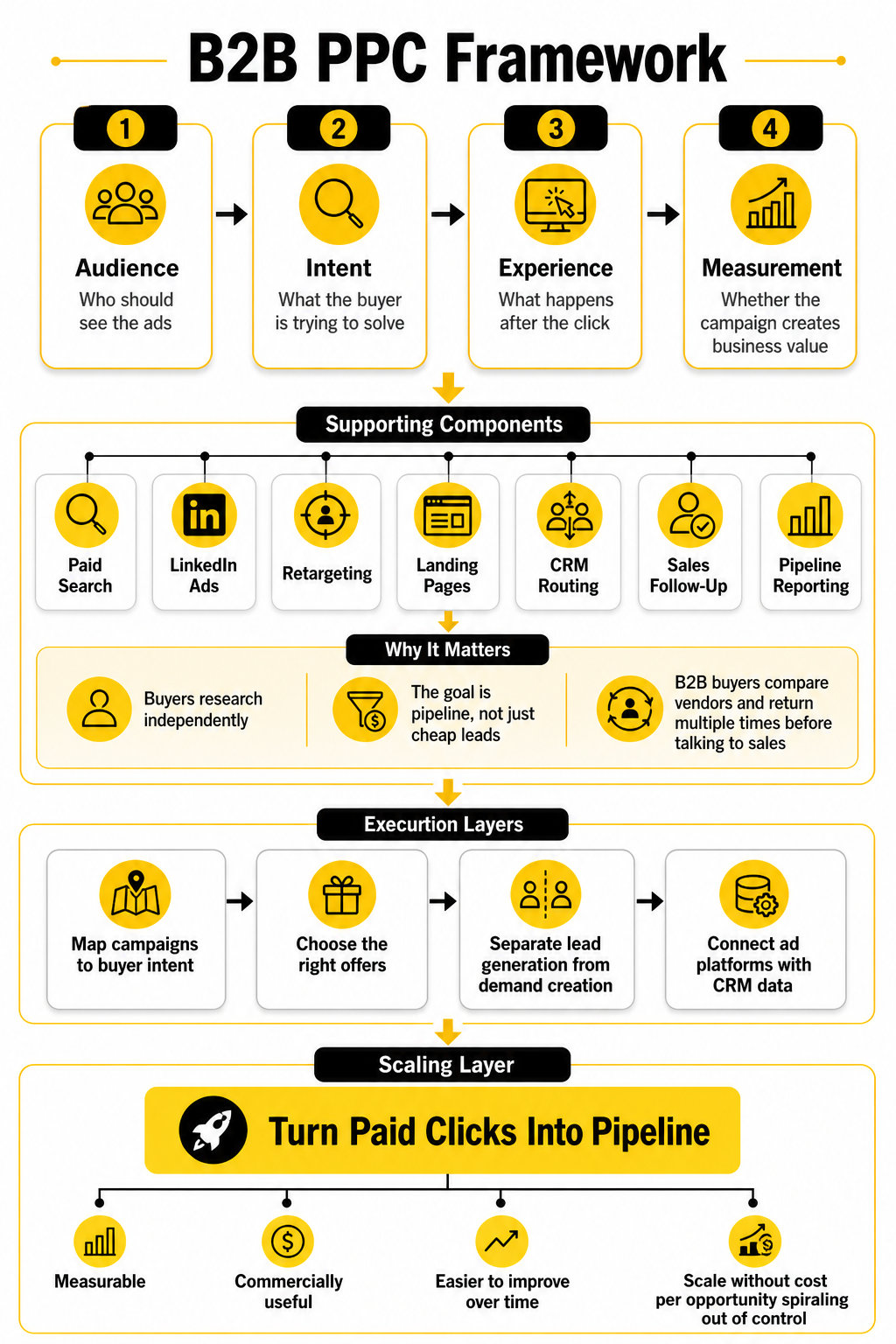
This framework keeps the work practical. You are not guessing whether Google Ads, LinkedIn Ads, or retargeting is “best.” You are deciding which channel fits the buyer’s stage, what message matches their intent, what offer deserves the click, and how that action will be tracked through the CRM.
The most important point is that these layers are connected. A high-intent keyword with a vague landing page will waste money. A precise LinkedIn audience with a weak offer will underperform. A strong demo request campaign with no offline conversion tracking will make optimization feel like gambling.
What Makes B2B PPC Different From B2C PPC
B2B PPC has longer buying cycles, more stakeholders, and a higher penalty for poor qualification. A consumer campaign may only need to persuade one person to buy now. A B2B campaign often has to help one person persuade several other people later.
That means the conversion path is rarely linear. A buyer may click a search ad, read a category guide, leave, see a LinkedIn ad two weeks later, ask a colleague for recommendations, return through branded search, and then book a demo. If your reporting only credits the final click, you will misunderstand what actually influenced the deal.
It also means the best offer is not always “book a demo.” Some buyers are ready for that, but many are still diagnosing the problem, comparing approaches, or building internal consensus. Strong B2B PPC gives each stage a relevant next step instead of forcing every visitor into the same sales motion.
The Practical Goal Of This Guide
The goal of this guide is to help you build B2B PPC campaigns that are measurable, commercially useful, and easier to improve over time. We are not going to treat paid traffic as magic. We are going to treat it as a controllable system with inputs, constraints, feedback loops, and clear decisions.
That means the rest of the article will focus on structure before tactics. We will cover how to map campaigns to buyer intent, how to choose offers, how to separate lead generation from demand creation, how to connect ad platforms with CRM data, and how to scale without letting cost per opportunity spiral out of control.
By the end, you should be able to look at a B2B PPC account and know what each campaign is supposed to do. More importantly, you should be able to tell whether it is doing that job profitably. That is the difference between buying clicks and building pipeline.
The B2B PPC Framework
A strong B2B PPC framework starts with a simple truth: not every buyer is at the same stage, and not every click deserves the same follow-up. Some people are actively searching for a vendor today. Others are still trying to understand the problem, compare approaches, or build internal agreement before they talk to anyone.
That is why the framework needs to separate demand capture from demand creation. Demand capture targets people who already show buying intent through searches, comparison behavior, or direct competitor research. Demand creation reaches qualified buyers before they are ready to search, then gives them a reason to remember, trust, and eventually evaluate your company.
The mistake is treating every channel like it should produce the same conversion at the same cost. Google Search, LinkedIn Ads, YouTube, retargeting, review-site campaigns, and partner placements all play different roles. When you force them all into one lead-generation box, you end up cutting campaigns that influence revenue and scaling campaigns that only look good on the surface.
Start With The Buyer Stage
The first layer of the framework is buyer stage. This matters because the same person can respond very differently depending on where they are in the buying process. A finance leader searching “best spend management software for mid-market companies” is in a very different mindset than a finance leader casually scrolling LinkedIn after reading about budget planning.
For B2B PPC, buyer stages usually fall into four practical groups:
This structure keeps your campaign planning honest. You should not expect problem-aware buyers to book demos at the same rate as decision-ready buyers. You should not judge a thought-leadership LinkedIn campaign by the same immediate conversion standard as a high-intent search campaign. Each stage needs its own message, offer, landing page, and success metric.
Match Channels To Intent
The second layer is channel intent. In B2B PPC, channel choice is not just a media buying decision. It is a buyer psychology decision.
Search ads work well when buyers are already expressing intent. If someone searches for “enterprise payroll software demo” or “best CRM for agencies,” they are giving you a clear signal. That does not mean every search click will be qualified, but it does mean your landing page can be more direct because the buyer already understands the need.
LinkedIn Ads usually work differently. You can target by company size, industry, job function, seniority, and account list, but many of those buyers are not actively looking at that exact moment. LinkedIn’s own B2B Institute has repeatedly pushed the idea that B2B growth depends on being remembered before buyers enter market, and its 95-5 rule argues that only a small share of buyers are actively in-market at any given time through the 95-5 rule. That is useful because it explains why direct-response expectations often break when applied to awareness and consideration campaigns.
Retargeting sits between the two. It works best when it responds to behavior, not just generic site visits. Someone who viewed a pricing page, comparison page, webinar registration page, or integration page should not see the same message as someone who bounced from a blog post after 12 seconds.
Build Campaigns Around Jobs, Not Platforms
The third layer is campaign job. This is where many B2B PPC accounts get messy. Teams create campaigns based on platform defaults instead of business purpose, so the account slowly becomes a pile of disconnected experiments.
A better approach is to assign each campaign a clear job before launch. One campaign may exist to capture bottom-funnel search demand. Another may exist to introduce a specific pain point to senior decision-makers. Another may exist to bring warm visitors back to a proof-heavy page. Another may exist to convert demo-ready traffic from branded and competitor searches.
This makes optimization much easier. If the job is demand capture, you care about qualified conversions, cost per opportunity, sales acceptance, and pipeline. If the job is education, you may care more about engaged visits, account-level reach, content progression, and assisted influence. The point is not to invent soft metrics to avoid accountability. The point is to measure the campaign against the job it was actually built to do.
Choose Offers Based On Commitment Level
The fourth layer is offer fit. B2B PPC fails when the offer asks for more commitment than the buyer is ready to give. A cold executive who has never heard of your company may not want a demo, but they may read a sharp benchmark report, watch a practical breakdown, or compare approaches if the topic is relevant enough.
Lower-commitment offers are useful when the buyer is early. These include ungated guides, calculators, webinars, diagnostic checklists, short videos, and comparison resources. They should help the buyer make progress without feeling trapped in a sales process.
Higher-commitment offers belong closer to the bottom of the funnel. These include demos, consultations, audits, free trials, pricing requests, and sales conversations. Tools like GoHighLevel can help teams connect forms, follow-up workflows, pipelines, and sales activity in one place, which matters when paid traffic needs fast handling after conversion.
Separate Lead Quality From Lead Volume
The fifth layer is qualification. This is where B2B PPC becomes painfully practical. Lead volume is visible immediately, but lead quality usually shows up later in the CRM, sales notes, opportunity stages, and closed-won data.
That delay creates a dangerous temptation. Marketers optimize toward the conversions the ad platform can see fastest, even when those conversions are not the ones sales wants. If the platform gets rewarded for low-friction form fills, it will usually find more low-friction form fills.
The fix is to define quality before the campaigns scale. That can include firmographic filters, company size, geography, role, use case, urgency, budget signals, product fit, and sales acceptance. It can also include negative criteria, which are just as important: students, job seekers, vendors, unsupported regions, tiny accounts, or industries you cannot serve profitably.
Connect PPC Data To Revenue Data
The sixth layer is measurement. This is the part that separates mature B2B PPC from expensive guessing. Platform metrics are helpful, but they are not the full truth because ad platforms cannot automatically understand sales conversations, buying committees, deal quality, or revenue outcomes without proper data flow.
At minimum, a B2B PPC system should connect ad clicks to landing page behavior, form submissions, CRM records, sales qualification, opportunity creation, and revenue. This does not have to be perfect from day one. It does need to be good enough to show which campaigns attract real opportunities instead of just cheap conversions.
This matters even more as buyer journeys become less trackable. Gartner found that 61% of B2B buyers prefer a rep-free buying experience, and G2’s 2025 research found that 79% of software buyers say AI search has changed how they conduct research. If more buying activity happens before a visitor converts, then your measurement system has to combine platform data, CRM data, and buyer behavior signals instead of pretending one dashboard tells the whole story.
Use A Simple Campaign Map
A practical B2B PPC campaign map does not need to be complicated. In fact, simpler is better when the team needs to understand what is running, why it exists, and what should happen next. The map should show the buyer stage, channel, audience, message, offer, landing page, conversion action, follow-up owner, and success metric.
A basic version could look like this:
This map gives the account structure a reason to exist. You are no longer launching ads because a platform suggested a new campaign type. You are building a paid acquisition path that mirrors how B2B buyers actually move from problem to decision.
Keep The Framework Flexible
The framework is not meant to be rigid. B2B markets vary too much for one universal campaign structure to work everywhere. A founder-led SaaS company selling to small agencies will not need the same PPC architecture as an enterprise cybersecurity vendor selling through long committees.
What should stay consistent is the logic. Know the buyer stage. Match the channel to the intent. Give the campaign a job. Choose an offer that fits the commitment level. Measure quality and revenue, not just clicks and leads.
That is the foundation. Once this framework is clear, the next step is to build the actual system: channels, audiences, creative, landing pages, tracking, follow-up, and reporting. That is where B2B PPC stops being theory and starts becoming an operating machine.
Core Components Of A High-Performing B2B PPC System
Once the framework is clear, the next step is building the system itself. This is where B2B PPC becomes more than channel selection. You need the right audience inputs, campaign structure, landing pages, tracking, qualification rules, and sales handoff working together.
The point is not to make the setup complicated. The point is to remove the weak links that quietly destroy performance. A brilliant keyword list cannot save a confusing landing page, and a strong LinkedIn audience cannot save a follow-up process that takes three days.
A serious B2B PPC system has seven core components:
Define The Market Before You Build Campaigns
The first implementation mistake is launching campaigns before the market is clearly defined. “B2B companies” is not a target market. “Marketing leaders at 50-500 employee SaaS companies struggling with attribution after scaling paid acquisition” is much closer to something you can actually advertise to.
Start by defining the accounts you want more of. That includes company size, geography, industry, sales cycle, contract value, tech stack, buying committee, and use case. This matters because PPC platforms will happily spend your money on people who match a keyword but do not match your business model.
Then define the roles involved in the decision. The economic buyer, technical evaluator, daily user, and executive sponsor may all care about different things. If you sell software to operations teams, the COO may care about efficiency and risk, while the operator cares about speed and ease of use. Your campaigns should not speak to both people in exactly the same way.
Build Campaigns Around Intent Levels
After the market is defined, structure campaigns by intent level. This keeps reporting cleaner and makes budget decisions easier. You do not want high-intent demo searches mixed with broad educational keywords because the blended average will hide what is actually working.
A practical structure separates campaigns into clear groups. Bottom-funnel search campaigns can target vendor, competitor, pricing, demo, and comparison terms. Mid-funnel campaigns can target category, problem, and solution terms. Top-funnel paid social campaigns can target qualified audiences with educational or point-of-view content.
This is also where exclusions matter. Negative keywords, audience exclusions, customer exclusions, employee exclusions, and geography controls can protect the budget from obvious waste. In B2B PPC, not spending on bad-fit traffic is often just as valuable as finding new qualified traffic.
Create Messages For Specific Buying Questions
Good PPC messaging answers the question already in the buyer’s head. A problem-aware buyer may be asking, “Why is this process so inefficient?” A solution-aware buyer may be asking, “Which approach should we use?” A vendor-aware buyer may be asking, “Why should we trust this company over another one?”
That means the ad copy should not be generic. “Grow faster with our platform” is weak because it could belong to almost any B2B company. Stronger messaging names the pain, the audience, the outcome, or the risk being removed.
The landing page needs to continue that same conversation. If the ad promises a comparison, the page should compare. If the ad promises implementation speed, the page should explain the process, timeline, proof, and next step. Message match is not a cosmetic detail; it is how you reassure the buyer that they clicked the right thing.
Align Offers With The Buyer’s Commitment Level
The offer should match the amount of trust the buyer has already given you. Asking for a demo too early can suppress useful engagement. Offering only educational content too late can slow down buyers who are ready to speak with sales.
For early-stage campaigns, use offers that help the buyer clarify the problem. These can include guides, calculators, checklists, benchmarks, webinars, or ungated comparison pages. For mid-stage campaigns, use assets that help the buyer evaluate options, such as product explainers, ROI tools, integration pages, and implementation guides.
For late-stage campaigns, make the conversion path direct. Demo requests, pricing conversations, audits, consultations, and trials should be easy to find and easy to complete. If your team needs a simple funnel builder for paid campaigns, ClickFunnels can fit straightforward landing page and conversion flow use cases, while GoHighLevel is more relevant when you also need CRM, pipeline, forms, booking, and follow-up workflows connected.
Make The Execution Process Step By Step
This is where the work becomes tangible. You are not just “launching ads.” You are building a controlled path from target account to click, from click to conversion, and from conversion to revenue feedback.
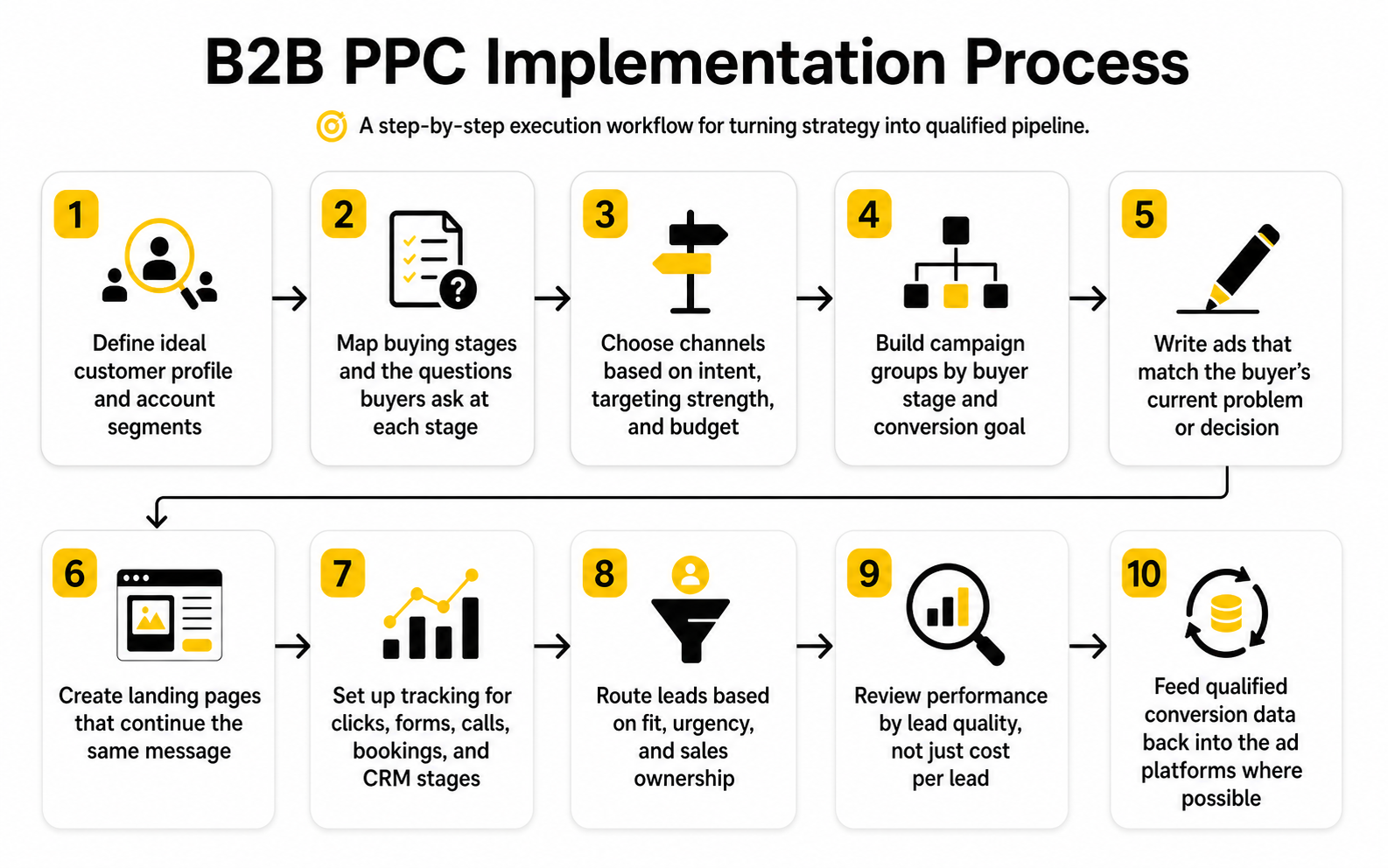
A practical B2B PPC implementation process looks like this:
This process keeps the launch disciplined. It also creates a checklist for diagnosing problems later. If performance is weak, you can inspect each step instead of randomly changing bids, headlines, and audiences.
Set Up Tracking Before Spend Scales
Tracking should not be an afterthought. If you cannot see which campaigns generate qualified opportunities, your optimization will be based on partial truth. That is especially risky in B2B because the cheapest lead source is often not the best pipeline source.
At minimum, track primary conversions separately from secondary conversions. A demo request, booked meeting, pricing request, or qualified consultation should not be treated the same as a newsletter signup or generic content download. This distinction helps the ad platforms learn from better signals and helps the team avoid overvaluing shallow engagement.
For Google Ads, enhanced conversions for leads can use user-provided data to improve offline conversion matching after a lead moves through sales, as explained in Google’s documentation for enhanced conversions for leads. Google’s API documentation also describes offline conversion imports using hashed user data through offline conversion upload workflows. The practical takeaway is simple: when sales data can flow back into the ad account, bidding and reporting become much more useful.
Build The Landing Page Around The Decision
A B2B PPC landing page should not be a prettier version of your homepage. It should be a focused decision page for one audience, one intent level, and one next step. The page has to answer the buyer’s immediate questions quickly, then give deeper proof for people who need more confidence.
Strong landing pages usually include a clear promise, specific audience fit, proof, product relevance, friction reducers, and a direct call to action. For bottom-funnel traffic, that might mean customer logos, integrations, security details, implementation expectations, and a demo form. For mid-funnel traffic, it might mean a guide, calculator, comparison table, or problem-specific breakdown.
Page speed and clarity matter too. If the buyer has to work hard to understand what you do, who it is for, and why it matters, the campaign is already leaking money. Tools like Replo can be useful for teams building conversion-focused pages, especially when the paid traffic strategy depends on fast page iteration rather than waiting on a full development cycle.
Route Leads While Intent Is Fresh
Speed matters after conversion. A high-intent buyer who requests a demo is not giving you unlimited attention. They may have also contacted two competitors, asked an internal stakeholder for input, or moved on to another task before your team responds.
Lead routing should be based on fit and urgency. High-fit demo requests should move to sales quickly. Lower-fit or early-stage leads can enter nurture, retargeting, or a lighter-touch follow-up path. The mistake is treating every form fill the same and then blaming PPC when sales spends time on the wrong conversations.
This is where operational tools matter. A booking tool like Cal.com can reduce scheduling friction when buyers are ready to speak. A CRM like Copper can help teams keep sales activity tied to relationships and opportunities, which is important when PPC leads need visible ownership.
Create A Feedback Loop With Sales
The final component is the feedback loop. Without sales feedback, PPC optimization becomes too platform-driven. The ad account may celebrate conversions while the sales team quietly complains that the leads are weak.
Set a recurring review rhythm between marketing and sales. Look at search terms, landing pages, form answers, company quality, booked meetings, no-shows, objections, opportunity creation, and deal progression. The discussion should be specific, not emotional.
This feedback loop also improves messaging. Sales hears the buyer’s real objections every week. Marketing sees which messages and offers create engagement at scale. When both sides share what they know, the campaigns become sharper, the landing pages become more useful, and the budget starts moving toward revenue instead of vanity metrics.
Statistics And Data That Actually Matter
Measurement is where B2B PPC either becomes a revenue engine or stays stuck as a reporting exercise. The wrong dashboard can make weak campaigns look successful. The right dashboard can show you exactly where money is turning into pipeline, where buyers are dropping off, and where the account needs sharper decisions.
The trap is looking at averages without context. A $150 cost per lead might be terrible for a low-ticket service and excellent for an enterprise software company with a six-figure contract value. A high click-through rate might mean your message is strong, or it might mean your targeting is too broad and the ad is attracting curious people who will never buy.
So the goal is not to collect more numbers. The goal is to understand what each number tells you, what it does not tell you, and what action it should drive.
Start With The Revenue Question
Before you look at CPC, CTR, or conversion rate, start with the revenue question. How much can you afford to pay for a qualified opportunity? That number should come from average contract value, gross margin, sales close rate, and payback expectations.
For example, if your average customer is worth $30,000 annually and your sales team closes 20% of qualified opportunities, a $1,000 cost per qualified opportunity may be perfectly workable. If your average customer is worth $3,000 annually and close rates are low, the same number could break the model. This is why generic PPC benchmarks are useful as context, not as commandments.
B2B PPC performance should be judged against unit economics. The campaign is not “good” because it has cheap leads. It is good when it can repeatedly produce qualified opportunities at a cost the business can afford.
Read CPC As A Competition Signal
Cost per click tells you how expensive attention is in a market. It does not tell you whether that attention is valuable. A high CPC can be acceptable when intent is strong and close rates are healthy, while a low CPC can still be a waste if the audience is weak.
Google Ads benchmark data for 2025 puts the average search CPC across industries at $5.26, with costs rising in many categories. That matters because B2B teams often compete in expensive auctions where every click needs a job. If your clicks cost more each year, weak landing pages and poor lead qualification become more expensive mistakes.
Use CPC to diagnose pressure. If CPC rises but lead quality stays strong, you may need better conversion rates or a higher close rate rather than cheaper traffic. If CPC rises and lead quality drops, the issue may be match types, search terms, broad targeting, or aggressive automation chasing the wrong signals.
Treat CTR As Message And Targeting Feedback
Click-through rate shows whether your ad earns attention from the audience seeing it. A weak CTR can mean the message is unclear, the offer is boring, the audience is wrong, or competitors are making a more relevant promise. It is a useful early signal, but it should never be treated as the final measure of success.
A high CTR is not automatically good. If an ad gets clicks because it is broad, vague, or curiosity-driven, it can make the account look active while sending poor-fit traffic to the site. That is especially dangerous in B2B PPC because some of the most clickable messages attract people who like free resources but have no buying power.
The action is simple: compare CTR with downstream quality. If CTR is low and conversion quality is high, test clearer messaging without abandoning the audience. If CTR is high and sales quality is poor, tighten the promise, qualify harder on the page, and review search terms or audience settings.
Use Conversion Rate To Find Friction
Conversion rate shows how well the post-click experience turns traffic into a defined action. It is affected by intent, page clarity, offer fit, form friction, brand trust, and device experience. This is why a single “good conversion rate” number can mislead you.
WordStream’s 2025 benchmark data shows an average Google Ads conversion rate of 7.52%, but B2B campaigns should interpret that carefully. A bottom-funnel demo page for high-intent search may need a very different target from a cold LinkedIn campaign sending executives to a report. The benchmark only becomes useful when you compare similar intent levels and similar conversion actions.
If conversion rate is weak, do not immediately blame the ads. Check whether the landing page repeats the ad promise, whether the form asks for too much too early, whether proof is visible, and whether the next step is obvious. A campaign with decent traffic and weak conversion is often a page problem, not a media problem.
Separate Cost Per Lead From Cost Per Qualified Lead
Cost per lead is one of the most abused numbers in B2B marketing. It is easy to measure, easy to report, and easy to optimize. It is also easy to manipulate accidentally by encouraging platforms to find people who convert cheaply but never become real opportunities.
Average Google Ads cost per lead across industries reached $70.11 in 2025. That number gives you a market reference, but it does not tell you whether your campaign is healthy. A $70 lead from an unsupported region is worthless, while a $300 lead from a perfect-fit account may be a bargain.
The better number is cost per qualified lead or cost per sales-accepted lead. This forces the campaign to pass through a quality filter before you celebrate it. If cost per lead improves while cost per qualified lead gets worse, your optimization is moving in the wrong direction.
Measure Pipeline, Not Just Form Fills
Pipeline is where B2B PPC becomes accountable. You want to know which campaigns create opportunities, how much pipeline they influence, and whether those opportunities eventually close. This is not always perfectly clean, but it is much better than treating every conversion as equal.
A strong measurement model should show the path from spend to click, click to conversion, conversion to qualified lead, qualified lead to opportunity, and opportunity to revenue. This does not mean every campaign needs to produce immediate pipeline. It means every campaign needs a clear role in moving the right accounts forward.
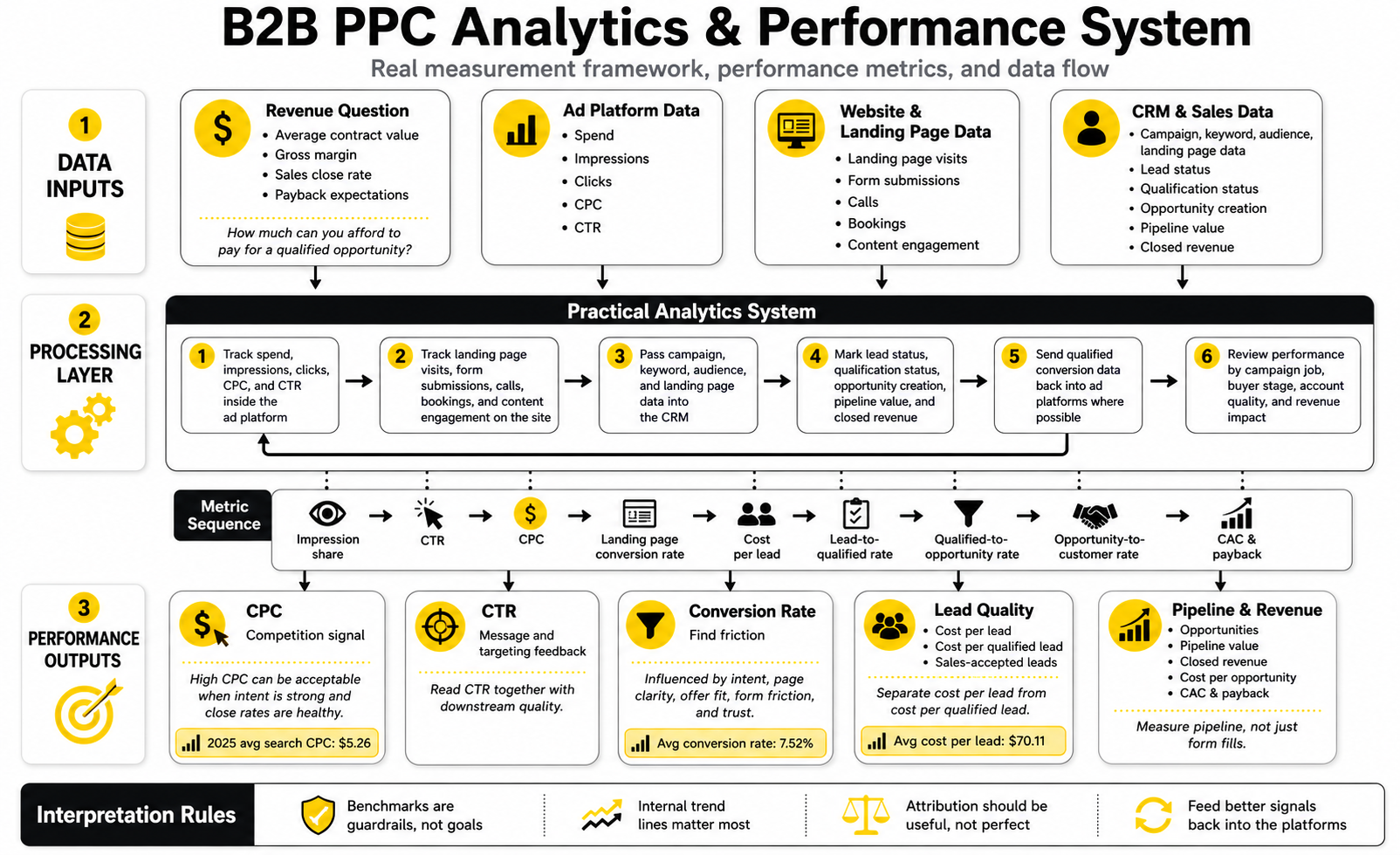
The practical system looks like this:
This creates a feedback loop instead of a flat report. You can see whether a campaign is failing before the click, after the click, during qualification, or inside the sales process. That is the difference between guessing and managing.
Watch The Metrics In Sequence
B2B PPC metrics should be read in sequence because each one explains a different part of the journey. If you skip the sequence, you will fix the wrong problem. A campaign can have strong CTR and poor conversion, or weak CTR and excellent sales quality.
The sequence usually looks like this:
This sequence makes diagnosis cleaner. If impressions are low, you may have a budget, bid, audience, or keyword coverage problem. If clicks are strong but conversions are weak, inspect the page and offer. If leads are strong but opportunities are weak, the issue is usually qualification, targeting, or sales alignment.
Use Benchmarks As Guardrails, Not Goals
Benchmarks are helpful because they stop you from operating in a vacuum. They can show whether your CPC is unusually high, whether your conversion rate is low for the intent level, or whether your cost per lead needs deeper inspection. But benchmarks should never replace your own economics.
The best internal benchmark is your own trend line. Are qualified lead rates improving? Is cost per opportunity becoming more stable? Are more opportunities coming from the campaigns that were designed to capture buying intent? Are sales notes confirming that the leads understand the problem and fit the market?
External benchmarks help you ask better questions. Internal benchmarks help you make better decisions. When the two disagree, your actual revenue data should win.
Make Attribution Useful, Not Perfect
Attribution will never be perfect in B2B. Buyers use multiple devices, share links internally, research through AI tools, compare vendors quietly, and return through branded search after seeing earlier ads. If you wait for perfect attribution, you will never make decisions.
The goal is useful attribution. You need enough visibility to know which channels create first engagement, which campaigns assist evaluation, and which touchpoints convert active demand. That usually means combining platform data, analytics data, CRM data, self-reported attribution, and sales feedback.
Do not fight over first-touch versus last-touch like it is a religion. Use both. First-touch helps you understand what creates new demand. Last-touch helps you understand what captures demand. Multi-touch and account-level review help you see how the buying journey actually behaves.
Feed Better Signals Back Into The Platforms
Modern ad platforms optimize toward the signals you give them. If you only send form fills, they will optimize for form fills. If you send qualified leads, opportunities, or closed revenue where supported, the system has a better chance of learning what quality looks like.
Google’s enhanced conversions and offline conversion workflows are designed to improve matching between ad interactions and later sales outcomes using privacy-conscious user-provided data, including hashed customer information through offline conversion imports. Google has also announced that enhanced conversions for web and leads will be combined into a simplified setting starting in June 2026, which makes proper conversion setup even more important for advertisers relying on lead quality data.
This is not just a technical detail. Better conversion data changes bidding decisions, budget allocation, and campaign confidence. If your CRM is connected cleanly through a tool like GoHighLevel, you can manage forms, follow-up, pipeline stages, and reporting closer to the revenue conversation instead of leaving PPC performance trapped inside the ad account.
Know What Each Metric Should Trigger
Data only matters when it changes action. If your dashboard gets reviewed every week but nothing changes, it is decoration. A good B2B PPC measurement system should make decisions easier.
Use these triggers as a starting point:
This is the discipline that separates real PPC management from random tweaking. You do not change things because the dashboard looks boring. You change things because the data points to a specific bottleneck.
Build A Weekly And Monthly Review Rhythm
Weekly reviews should focus on live campaign health. Look at spend pacing, search terms, CTR, CPC, conversion rate, lead quality indicators, broken tracking, and obvious waste. This is where you catch problems before they burn the monthly budget.
Monthly reviews should focus on business performance. Look at qualified leads, sales acceptance, opportunity creation, pipeline value, cost per opportunity, deal movement, and segment-level performance. This is where you decide whether to shift budget, change offers, expand channels, or rebuild weak parts of the funnel.
The mistake is trying to make strategic decisions from daily noise. Daily data is useful for spotting fires. Weekly data is useful for managing campaigns. Monthly and quarterly data are better for judging whether B2B PPC is creating meaningful pipeline.
Optimization, Budget Control, And Pipeline Measurement
Once the measurement system is in place, the next challenge is control. This is where many B2B PPC programs get uncomfortable. The account may have some working campaigns, some promising experiments, and some areas that look good in-platform but fail once sales quality is reviewed.
Optimization is not about changing random settings every few days. It is about making disciplined decisions based on intent, quality, economics, and confidence. If the data says one campaign creates qualified pipeline and another only creates cheap leads, the budget should move accordingly.
The hard part is that B2B PPC does not always give instant answers. Sales cycles take time, attribution is imperfect, and low-volume accounts can look noisy from week to week. That is why the best teams optimize in layers instead of reacting emotionally to every short-term movement.
Scale What Has A Proven Job
Scaling should start with campaigns that have a clear job and a proven business outcome. That does not always mean the campaign with the lowest cost per lead. It means the campaign has shown it can attract the right accounts, create qualified conversations, and support revenue at a reasonable cost.
A bottom-funnel search campaign with expensive clicks may deserve more budget if it consistently creates sales-accepted opportunities. A LinkedIn campaign may deserve continued investment even with a higher immediate CPL if it reaches strategic accounts and later assists pipeline. The decision depends on the campaign’s role, not one isolated metric.
Before increasing budget, check whether the current performance is stable enough to trust. Look at qualified lead rate, opportunity creation, sales feedback, conversion volume, and segment consistency. If the campaign only worked for one week because of a lucky cluster of good leads, scaling too fast can turn a promising signal into a budget leak.
Do Not Scale A Broken Funnel
More spend does not fix a weak funnel. It only exposes the weakness faster. If the landing page is unclear, the offer is misaligned, or sales follow-up is slow, increasing budget will usually increase waste.
This matters because rising ad costs make funnel leaks more painful. Google Ads benchmark data showed average search CPC reaching $5.26 in 2025, with most industries seeing higher costs. When attention is getting more expensive, conversion quality becomes the real lever.
Fix the bottleneck before you scale. If traffic is relevant but conversions are low, work on the page and offer. If conversions are strong but sales acceptance is weak, tighten qualification. If sales accepts the leads but opportunities stall, review fit, urgency, pricing expectations, and buyer enablement.
Protect The Budget With Guardrails
Budget control is not just about daily caps. It is about defining what the account is allowed to spend money on. Without guardrails, platforms will often find volume in places that look efficient but do not match your actual market.
Use guardrails at the campaign, audience, keyword, geography, and conversion level. Keep high-intent campaigns separate from exploratory campaigns. Keep branded, competitor, category, and broad problem campaigns separated enough that you can judge each one fairly. Do not let one blended average hide completely different buyer behaviors.
Set clear decision rules before performance gets emotional. For example, a campaign may need a minimum number of qualified conversions before budget increases. A segment may need to show a specific lead-to-opportunity rate before expansion. A campaign with rising spend and declining sales acceptance should be paused, narrowed, or rebuilt before it gets more budget.
Balance Demand Capture And Demand Creation
A mature B2B PPC strategy needs both demand capture and demand creation. Demand capture is easier to defend because buyers already show intent. Demand creation is harder to measure because it often works before the buyer is ready to convert.
That does not make demand creation optional. LinkedIn’s B2B Institute has popularized the 95-5 rule, which argues that only a small share of potential buyers are actively in-market at one time through the 95-5 rule. If you only advertise to people searching right now, you compete for a limited pool of visible demand and ignore the future buyers who will enter the market later.
The tradeoff is budget allocation. Early-stage campaigns should not be judged by immediate demo volume alone, but they still need accountability. Use account engagement, retargeting pool growth, content progression, branded search lift, influenced opportunities, and sales feedback to understand whether these campaigns are creating useful future demand.
Avoid Over-Optimizing For Platform Signals
Ad platforms optimize toward the data they can see. That is useful when the data is high quality. It is dangerous when the platform is trained on weak conversion signals.
If the main conversion is a low-friction content download, the platform may find more people who like downloading content. If the main conversion is a broad contact form, it may find more people willing to fill forms. Neither outcome guarantees qualified pipeline.
This is why feeding better signals matters. Use qualified leads, booked meetings, sales-accepted leads, opportunities, and closed-won data where possible. Google’s documentation for offline conversion imports shows how advertisers can connect later sales outcomes back to ad interactions, which is much more useful than optimizing only for the first form submission.
Build Experiments With Real Hypotheses
Testing is not the same as changing things. A real experiment starts with a hypothesis, a clear variable, a defined audience, and a decision rule. Without that discipline, the account becomes messy and nobody knows what actually caused the result.
Good B2B PPC experiments usually test one of five things: audience, intent, message, offer, or landing page. For example, you might test whether CFO-focused messaging outperforms operations-focused messaging for the same software category. Or you might test whether a pricing-focused page produces fewer leads but a higher qualified rate than a generic demo page.
Do not test everything at once. If you change the audience, message, offer, and landing page together, you may improve performance but learn very little. That makes future scaling harder because you cannot tell which part mattered.
Use Segmentation Before Automation
Automation can be powerful, but it needs clean structure. If you feed a bidding system mixed intent, mixed audiences, and mixed conversion quality, it can optimize in a direction that looks efficient but damages pipeline. This is especially common when top-funnel and bottom-funnel conversions are treated as equal.
Segment the account before you rely heavily on automation. Separate campaigns by buyer intent, offer type, audience quality, and conversion goal. Then automation has a cleaner job because each campaign has a clearer definition of success.
The same principle applies to Performance Max, broad match, and algorithmic audience expansion. These can work in some B2B accounts, but they need strong exclusions, high-quality conversion data, and close monitoring. If the account does not have enough reliable revenue signals, aggressive automation can amplify bad assumptions.
Treat Competitor Campaigns Carefully
Competitor campaigns can be useful, but they are not magic. They often attract buyers who are actively comparing vendors, which makes them tempting. They can also bring high CPCs, low quality scores, legal review concerns, and buyers who are loyal to the competitor already.
The landing page matters a lot here. Do not send competitor traffic to a generic homepage. The buyer needs a clear reason to compare, a respectful explanation of differences, and proof that your solution fits their use case.
Keep the tone professional. Aggressive comparison copy can create clicks but reduce trust. The best competitor campaigns focus on fit, tradeoffs, migration concerns, integrations, implementation, and business outcomes rather than cheap shots.
Manage Brand Search Without Getting Lazy
Brand search usually converts well because the buyer already knows you. That makes it useful, but it can also make reporting misleading. If brand campaigns are grouped with non-brand campaigns, the account may look healthier than it really is.
Separate brand search from non-brand search. Brand traffic helps protect demand, capture returning buyers, and control the message on important searches. Non-brand traffic shows how well you are reaching people who may not already know you.
The strategic question is not whether brand search is “good.” It usually is. The question is how much incremental value it creates, whether competitors are bidding on your name, and whether your organic presence already captures enough demand without paid support.
Watch For Lead Quality Decay
Lead quality can decay slowly. A campaign may start strong, then gradually attract weaker traffic as the easiest qualified demand is exhausted. If nobody watches sales acceptance and opportunity rates, the decline can hide behind stable CPL.
Common signs of decay include more small companies, more unsupported regions, more vague form responses, more no-shows, more junior titles, and more leads who do not remember requesting information. These are not small details. They are warnings that targeting, messaging, or platform optimization may be drifting.
When this happens, do not just cut budget immediately. First isolate where the decay is coming from. It may be one keyword group, one audience expansion setting, one geography, one content offer, or one conversion action polluting the data.
Improve Follow-Up Before Buying More Traffic
Many B2B PPC problems are not ad problems. They are follow-up problems. A campaign can generate high-intent demo requests, but if the sales process is slow, generic, or poorly routed, performance will look worse than it should.
Gartner’s 2026 sales research found that 67% of B2B buyers prefer a rep-free experience, which makes the handoff even more important. Buyers may want control, but when they do ask for help, the response needs to be fast, relevant, and useful. A delayed generic email is not enough.
This is where workflow quality directly affects PPC economics. Forms should route cleanly. Booked calls should land on the right calendars. Sales should see the source, keyword, page, offer, and form context before reaching out. Tools like GoHighLevel, Cal.com, and Fillout can support this kind of routing and conversion flow when the paid traffic system needs tighter operational control.
Know When To Narrow And When To Expand
Scaling does not always mean going broader. Sometimes the best move is to narrow the account around the segments that are already producing real pipeline. This can increase CPC or CPL while improving total economics.
Narrow when the account has too much waste, sales quality is inconsistent, or the team cannot follow up properly. Focus on the strongest industries, company sizes, geographies, keywords, and offers. Make the system profitable before asking it to grow.
Expand when the account has stable qualified demand and the funnel can handle more volume. Expansion can come from new keyword clusters, new account lists, new geographies, new job functions, new offers, or new channels. Each expansion should be treated as a controlled test, not a permanent budget commitment from day one.
Prepare For Longer And Messier Buyer Journeys
B2B buyer journeys are getting harder to track cleanly. Buyers research through search engines, AI tools, review sites, communities, analyst content, peer conversations, and vendor websites before they convert. That means the visible PPC click may be only one part of a larger decision.
G2’s 2025 buyer research found that 79% of software buyers say AI search changed how they conduct research. For B2B PPC, this means landing pages and ads need to be clear enough for direct buyers and useful enough to support buyers who are comparing information across multiple sources. Thin pages and vague claims will not hold up.
This also changes reporting expectations. Some campaigns will create direct conversions. Others will assist evaluation, increase retargeting quality, or make branded search more likely later. The expert move is not to pretend every touch can be perfectly credited. The expert move is to combine directional attribution, CRM evidence, account behavior, and sales feedback into better decisions.
Keep Creative Fresh Without Chasing Novelty
Creative fatigue is real, especially in paid social and retargeting. The same audience can only see the same claim so many times before it becomes invisible. But chasing novelty for its own sake is also a mistake.
Refresh creative around buyer questions, not random design changes. Test new angles based on objections, use cases, proof points, outcomes, and competitive differences. A new background color is less important than a sharper reason to care.
Strong creative in B2B PPC usually does one of three things. It makes the problem painfully clear. It makes the cost of inaction visible. Or it makes the next step feel lower-risk and more useful. If a new ad does none of those things, it is probably just decoration.
Use Retargeting With More Precision
Retargeting is often underused or overused. The underused version treats every visitor as gone forever. The overused version follows everyone with the same demo ad, even if they only visited one early-stage article.
Better retargeting is behavior-based. Visitors who viewed pricing, comparison, demo, integration, or case study pages deserve different messages from visitors who only read educational content. Returning visitors from target accounts should be treated differently from low-fit traffic.
The message should reflect what the person already did. A pricing visitor may need risk reducers, implementation proof, or a direct call booking option. A guide reader may need a deeper resource, webinar, or comparison page. Retargeting works best when it feels like a relevant next step, not a desperate chase.
Make Budget Allocation A Strategic Decision
Budget allocation should reflect market opportunity, buying intent, funnel maturity, and sales capacity. It should not be based only on last month’s CPL. That is too shallow for serious B2B PPC.
A simple allocation model can divide spend into three buckets:
This keeps the account balanced. Capture protects near-term pipeline. Develop builds future opportunity. Explore prevents the program from becoming dependent on the same shrinking set of keywords and audiences.
Cut Faster When The Evidence Is Clear
Patience is useful when sales cycles are long. Excuses are not. If a campaign has enough data and still produces poor-fit leads, weak sales acceptance, and no meaningful opportunity movement, it should not keep getting budget just because it was hard to build.
Cutting does not always mean deleting. You can pause, narrow, rebuild, change the offer, change the landing page, or move the campaign back into testing. The key is to stop pretending poor-quality volume will magically become pipeline later.
This is especially important when budgets are tight. Every dollar spent defending a weak campaign is a dollar that cannot go toward a stronger segment, better page, stronger offer, or faster follow-up. B2B PPC rewards honest decisions. It punishes wishful thinking.
Scaling B2B PPC Without Wasting Spend
Scaling B2B PPC is not about spending more because one campaign had a good month. It is about expanding a system that already proves it can turn qualified attention into pipeline. If the foundation is weak, scale simply makes the weak parts louder.
The safest way to scale is to protect what works, improve what is close, and test what is unknown. That sounds basic, but it prevents one of the most expensive PPC mistakes: pushing budget into new channels before the current funnel is stable. A mature account grows through controlled expansion, not random enthusiasm.
By this stage, your campaigns should already have clear jobs, cleaner tracking, stronger qualification, and a feedback loop with sales. Now the work shifts from “can this produce results?” to “can this produce results repeatedly without destroying economics?”
Build The Final Paid Growth Ecosystem
A complete B2B PPC system does not rely on one campaign, one channel, or one conversion action. It connects paid search, paid social, retargeting, landing pages, CRM data, sales follow-up, and revenue reporting into one operating loop. Each piece has a role, and each role supports the next step in the buyer journey.
The ecosystem should include demand capture for buyers who are already searching, demand creation for future buyers, retargeting for warm accounts, and revenue feedback from the CRM. It should also include practical operations like lead routing, booking flows, nurture sequences, and sales context. Without those pieces, the ad account may look active, but the business impact stays inconsistent.
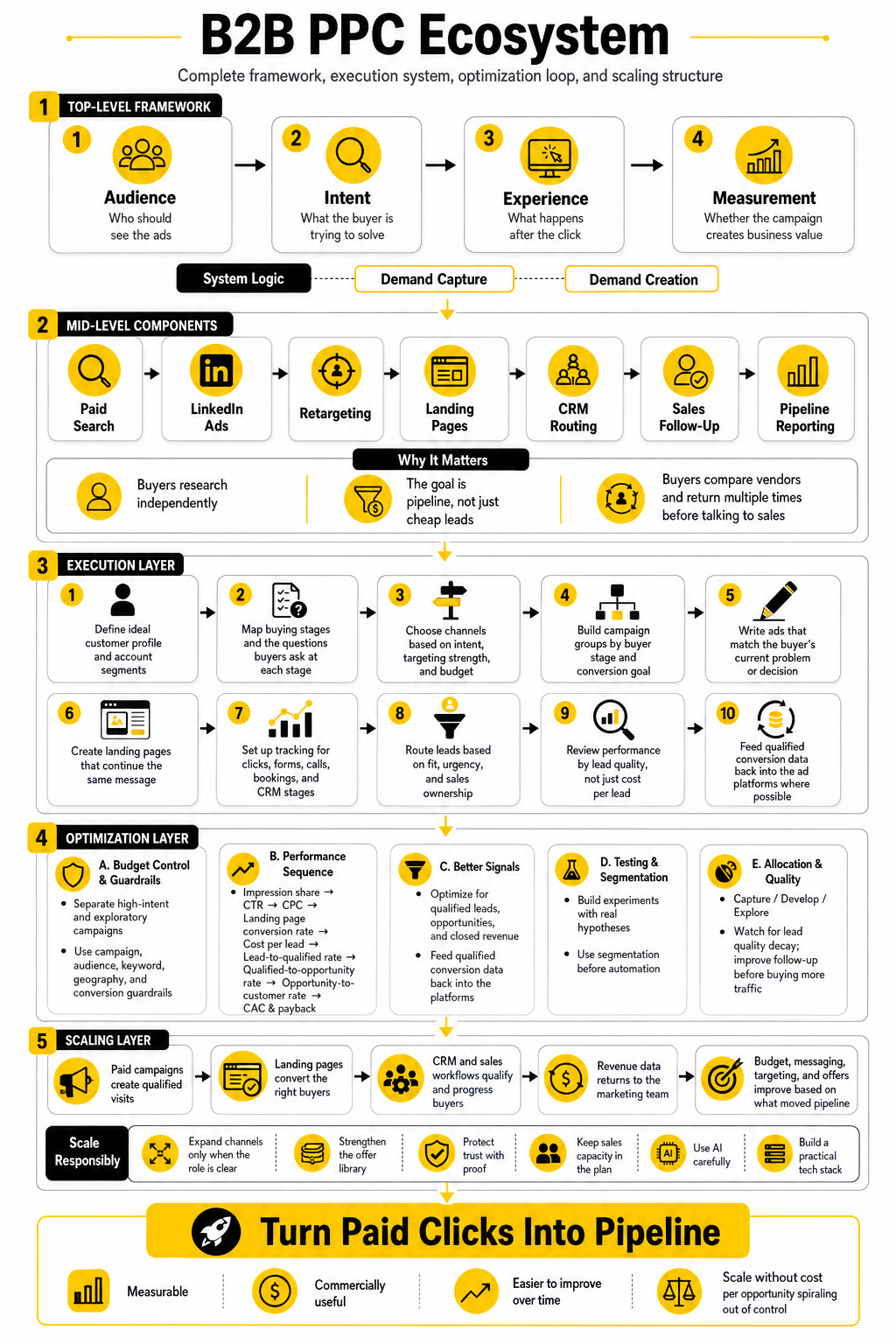
Think of the final system as a loop. Paid campaigns create qualified visits. Landing pages convert the right buyers. CRM and sales workflows qualify and progress those buyers. Revenue data returns to the marketing team. Then budget, messaging, targeting, and offers improve based on what actually moved pipeline.
Expand Channels Only When The Role Is Clear
Every new channel needs a reason to exist. Do not add LinkedIn, YouTube, Reddit, review-site ads, or programmatic just because competitors are there. Add a channel because it solves a specific constraint in the current system.
If search demand is limited, paid social may help you reach qualified buyers earlier. If buyers need more proof before converting, retargeting and comparison content may help. If sales needs warmer conversations from known accounts, account-based campaigns may make more sense than broad lead generation.
The decision should always connect back to the buyer journey. A channel is not “good” or “bad” in isolation. It is useful when its targeting, intent level, cost, creative format, and measurement fit the job you need it to do.
Strengthen The Offer Library
Scaling gets easier when you have more than one offer. A single demo request can work for decision-ready buyers, but it leaves too many earlier-stage buyers with no useful next step. A stronger offer library gives your campaigns more ways to create movement.
A practical B2B PPC offer library can include:
The point is not to create content for the sake of content. The point is to give each buyer stage a relevant path forward. When the offer matches the buyer’s commitment level, campaigns can scale without forcing every click into the same conversion.
Protect Trust As You Grow
Trust becomes more important as spend increases. More impressions mean more people see your claims, compare your positioning, and judge whether your company feels credible. Weak proof, vague promises, and overhyped ads can damage performance even when targeting is technically correct.
B2B buyers are usually risk-sensitive. They are not just asking whether your product works. They are asking whether choosing you will make them look smart, reduce internal friction, and avoid implementation headaches.
That is why proof should become more specific as campaigns scale. Use clearer use cases, better comparison pages, stronger implementation details, sharper product screenshots, and more useful buyer enablement. If a claim would make a serious buyer ask “prove it,” the landing page should already answer that question.
Keep Sales Capacity In The Scaling Plan
Scaling paid media without checking sales capacity is reckless. More leads are not helpful if the team cannot respond quickly, qualify properly, or follow up with context. The campaign may get blamed even when the bottleneck is operational.
Before increasing spend, check whether sales can handle the expected volume. Look at response times, calendar availability, no-show rates, lead ownership, and handoff quality. A strong PPC campaign can still underperform if the sales process treats every buyer the same.
This is especially important for high-intent campaigns. When someone requests pricing, books a demo, or asks for a consultation, they are showing active intent. Slow follow-up wastes the most valuable traffic in the account.
Use AI Carefully In B2B PPC
AI can help with research, clustering search terms, writing ad variants, summarizing sales calls, finding patterns in CRM notes, and speeding up reporting. Used well, it can make PPC teams faster and more consistent. Used badly, it can produce generic campaigns that sound like every other vendor in the market.
The danger is letting AI replace judgment. B2B PPC depends on market understanding, buyer nuance, sales feedback, and commercial logic. A tool can help generate options, but it cannot decide your ideal customer profile, your positioning, your acceptable acquisition cost, or your sales capacity.
Use AI to accelerate the work you already understand. Do not use it to hide the fact that the strategy is unclear. That distinction matters a lot.
Build A Practical Tech Stack
The best tech stack is the one that supports the operating system without creating extra complexity. You need tools for landing pages, forms, booking, CRM, analytics, automation, and reporting. You do not need ten disconnected tools that make attribution and follow-up harder.
For many teams, the practical setup is simple. Use one system for CRM and pipeline ownership, one clear landing page workflow, one form or booking flow, and one reporting view that connects spend to qualification and opportunity movement. If the team needs an all-in-one sales and marketing workflow, GoHighLevel can fit that role. If the main need is building campaign-specific pages quickly, Replo or ClickFunnels may be more relevant.
The rule is simple: the stack should make the buyer journey easier to manage. If a tool adds friction, hides data, or slows the team down, it is not helping the PPC system.
Know What Great Looks Like
A great B2B PPC program does not feel chaotic. The campaigns have clear roles. The landing pages match intent. Sales knows where leads came from and what the buyer saw. Reporting shows quality, not just activity.
You also see better conversations. Sales hears fewer confused prospects and more buyers who understand the problem, recognize the category, and have a reason to evaluate your solution. That is when PPC stops being just a traffic source and becomes part of the company’s buying experience.
Great does not mean perfect. There will still be noise, failed tests, tracking gaps, and campaigns that do not work. The difference is that a mature system finds those issues quickly and uses them to improve instead of letting them drain budget quietly.
What Is B2B PPC?
B2B PPC is paid advertising designed to reach business buyers through channels like Google Ads, LinkedIn Ads, retargeting, YouTube, and other paid placements. The goal is usually to generate qualified leads, sales conversations, opportunities, or pipeline. It differs from consumer PPC because the buying process often involves longer timelines, multiple stakeholders, higher deal values, and more careful evaluation.
Is B2B PPC Worth It?
B2B PPC is worth it when the economics make sense and the system is built properly. It works best when campaigns target a clear market, use intent-based messaging, send traffic to relevant landing pages, and connect conversion data to CRM outcomes. It is usually not worth it when the business only tracks cheap leads and ignores sales quality.
Which Channels Work Best For B2B PPC?
The best channel depends on the buyer stage. Google Search is strong for capturing active intent, especially when buyers are already searching for a solution, competitor, comparison, or demo. LinkedIn Ads can work well for reaching specific job roles, industries, and account lists before buyers search directly.
How Much Should A Company Spend On B2B PPC?
The right budget depends on average contract value, sales close rate, target market size, cost per click, and the number of qualified opportunities needed. A small test budget should be large enough to generate meaningful data, not just a handful of clicks. The better question is how much the company can afford to pay for a qualified opportunity while still maintaining healthy customer acquisition economics.
What Is A Good Cost Per Lead For B2B PPC?
A good cost per lead depends on lead quality and revenue potential. A cheap lead that never becomes qualified is not actually cheap. A more expensive lead from a strong-fit account can be valuable if it turns into a real opportunity.
What Is More Important: CPL Or Cost Per Opportunity?
Cost per opportunity is usually more important because it is closer to revenue. Cost per lead can help diagnose campaign efficiency, but it does not prove business value by itself. If cost per lead improves while cost per opportunity gets worse, the campaign is probably attracting weaker leads.
Should B2B PPC Campaigns Send Traffic To The Homepage?
Usually, no. A homepage has too many jobs and often speaks to too many audiences at once. Dedicated landing pages usually work better because they can match the ad message, buyer stage, use case, and conversion goal more tightly.
How Long Does B2B PPC Take To Work?
Some bottom-funnel campaigns can create leads quickly, especially when search intent is strong. Pipeline impact usually takes longer because B2B sales cycles involve qualification, meetings, evaluation, internal discussion, and deal progression. The first goal is to prove traffic quality and conversion quality, then connect those signals to opportunities and revenue over time.
How Do You Improve Lead Quality In B2B PPC?
Improve lead quality by tightening targeting, separating buyer stages, qualifying on the landing page, using stronger form questions, excluding bad-fit traffic, and feeding sales feedback into campaign decisions. Lead quality also improves when campaigns are optimized for qualified conversions instead of every possible form fill. The point is not to create friction for good buyers, but to stop bad-fit leads from polluting the system.
Should B2B PPC Use Gated Content?
Gated content can work when the asset has enough value and the buyer is willing to trade information for it. It can also create low-quality leads if the offer is too broad or attracts people who only want a free resource. For many B2B teams, a mix of ungated education, selective gated assets, retargeting, and bottom-funnel offers works better than gating everything.
How Should B2B Companies Use Retargeting?
Retargeting should be based on buyer behavior. Someone who visited a pricing page should not see the same message as someone who read one educational article. The best retargeting campaigns use the visitor’s previous action to offer a relevant next step, such as proof, comparison content, implementation details, or a direct booking option.
What Is The Biggest Mistake In B2B PPC?
The biggest mistake is optimizing for the wrong conversion. If the ad platform is trained to find cheap form fills, it will often find people who convert easily but do not buy. B2B PPC needs to optimize toward qualified leads, opportunities, pipeline, and revenue whenever the data is available.
Do Small B2B Companies Need PPC?
Small B2B companies can use PPC effectively, but they need to be focused. Broad campaigns usually waste money because the budget cannot support too many audiences, offers, and keywords at once. A smaller company is usually better off starting with high-intent search, strong landing pages, tight qualification, and clear follow-up.
How Do You Know When To Scale B2B PPC?
Scale when the campaign has produced enough qualified data to trust the pattern. That means the traffic is relevant, conversion quality is acceptable, sales feedback is positive, and the economics make sense. Do not scale just because the platform shows a low cost per lead.
Can B2B PPC Work Without A CRM?
It can generate leads without a CRM, but it is much harder to manage properly. Without CRM data, you cannot reliably see which campaigns create qualified leads, opportunities, or revenue. For serious B2B PPC, a CRM is not optional for long.
Build a stronger local presence with BAAM AI
Turn your website, Google profile, social channels, and AI visibility into one growth engine
Most businesses do not need more random marketing activity. They need a consistent presence system that helps the right people find them, trust them, and take action. BAAM AI brings strategy, local SEO, website updates, Google Maps visibility, social content, AI-search readiness, media production, and reporting into one practical monthly engine.
If you want your marketing to keep working after the campaign ends, start with a free BAAM AI presence audit. See how your business shows up today and where the fastest visibility wins are at BAAM AI.