
BAAM AI Blog
B2B Nurture Campaign Examples: A Practical Framework for Turning Interest Into Pipeline
Most B2B nurture campaigns fail because they act like a follow-up sequence instead of a buying journey. A prospect downloads one asset, gets dropped into five generic emails, and then sales wonders why the account...
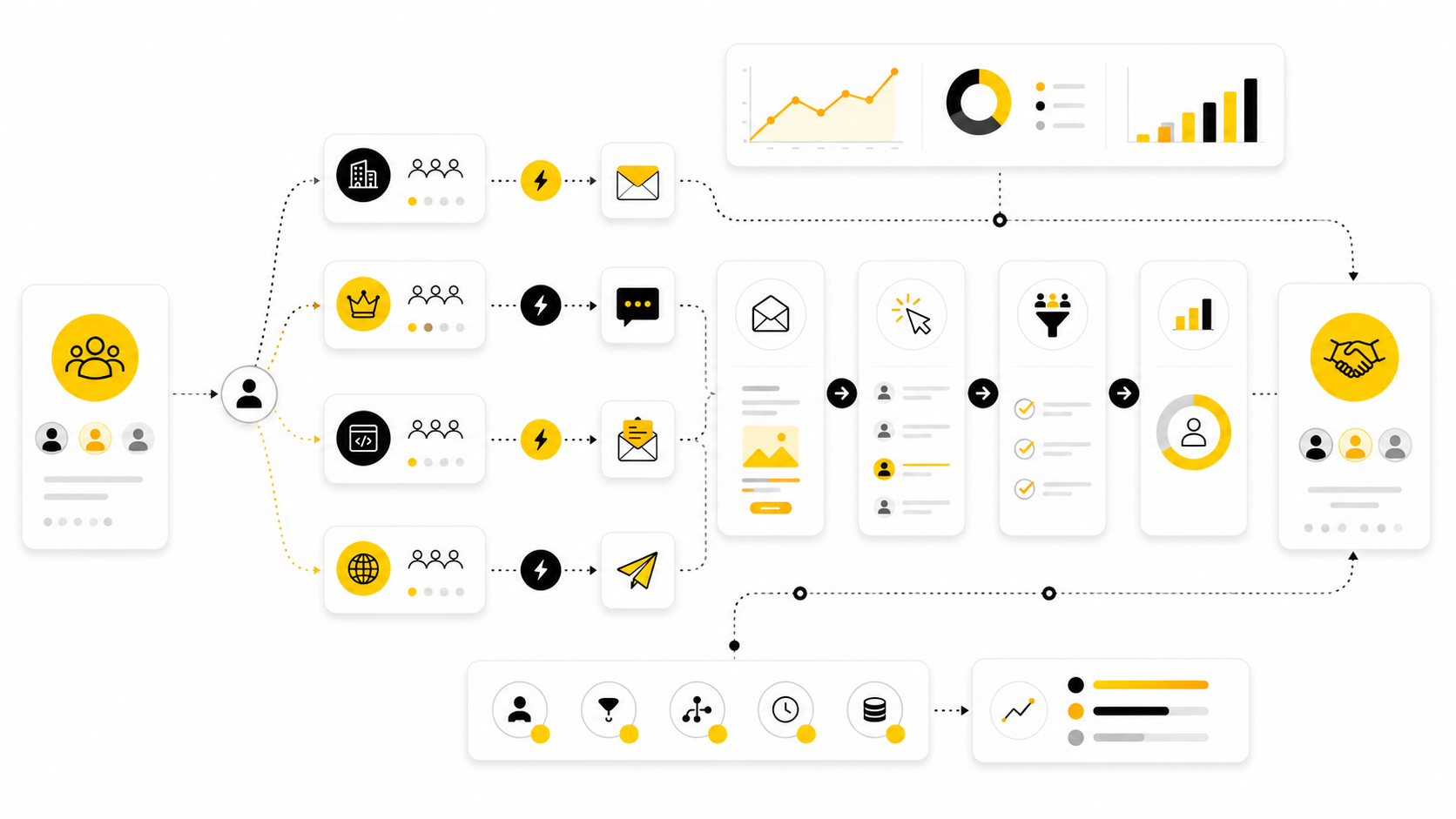
Most B2B nurture campaigns fail because they act like a follow-up sequence instead of a buying journey. A prospect downloads one asset, gets dropped into five generic emails, and then sales wonders why the account goes quiet. That is not nurturing. That is reminding someone you exist without giving them a better reason to move forward.
Good nurturing is different. It helps a real buying group make progress from problem awareness to internal confidence, vendor comparison, and decision readiness. That matters because modern B2B buyers do not move in a clean funnel, and many prefer to research without talking to sales early in the process; Gartner has reported that a majority of B2B buyers prefer a rep-free buying experience.
The best b2b nurture campaign examples are not clever because they send more emails. They work because each touch has a job. One message clarifies the pain. Another builds urgency. Another handles internal objections. Another gives the champion something useful to forward to their CFO, RevOps lead, technical evaluator, or founder.
Why B2B Nurture Campaigns Matter
A B2B nurture campaign matters because most prospects are not ready to buy the moment they enter your database. They may be curious, problem-aware, researching options, comparing vendors, building a business case, or simply waiting for budget timing to line up. If you treat all of those people the same, your messaging becomes either too aggressive or too vague.
This is why nurture campaigns should not be built around “send email one, then email two, then email three.” They should be built around what the buyer needs to believe before the next step feels safe. That shift sounds simple, but it changes the whole campaign from seller-centered follow-up into buyer-centered momentum.
It also explains why content still plays such a big role in B2B nurturing. The Content Marketing Institute’s 2025 B2B research found that B2B marketers use content not only for awareness and demand generation, but also for nurturing audiences and leads. That makes sense because a nurture campaign is really a structured content delivery system with timing, segmentation, and intent signals layered on top.
The Framework Behind Strong Nurture Campaigns
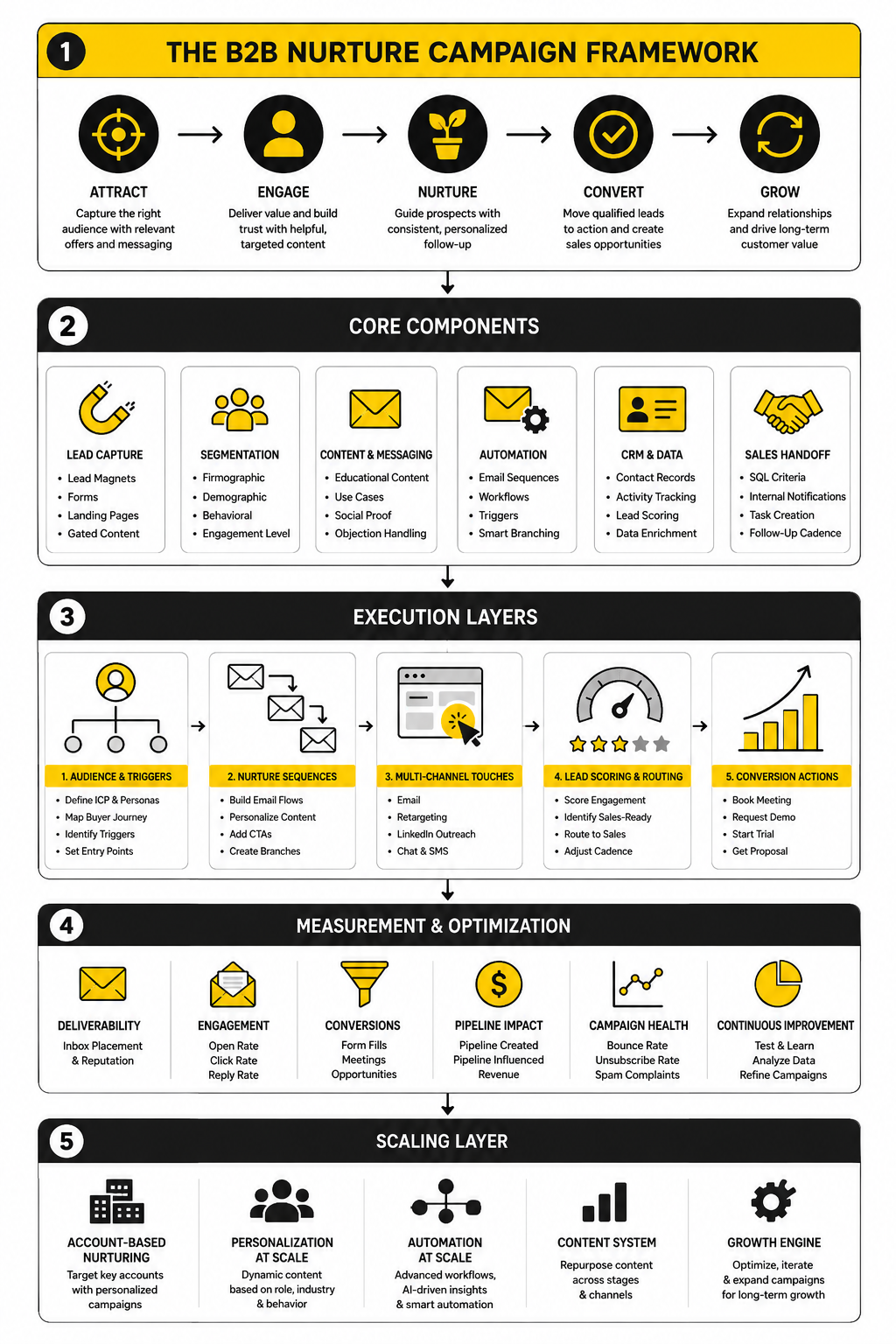
A strong nurture framework connects four things: audience segment, buyer stage, message objective, and next action. Without those four parts, you usually end up with a campaign that sounds busy but does not actually guide anyone. The goal is not to “stay top of mind” in a fluffy way; the goal is to remove friction from the buying process.
For example, an early-stage campaign may focus on naming the problem and showing the cost of doing nothing. A mid-stage campaign may compare approaches, explain tradeoffs, and introduce proof. A late-stage campaign may support internal consensus with ROI material, implementation details, security answers, pricing context, or a clear demo path.
This is where automation tools can help, but only if the strategy is already clear. A platform like GoHighLevel can organize pipelines, automations, lead follow-up, and campaign workflows, but the tool cannot decide what your buyer needs to hear. The framework has to come first.
The Simple Nurture Logic
Every campaign should answer three questions before you write a single email. Who is this person or account? What decision are they trying to make? What would help them make that decision with less confusion, less risk, and more confidence?
That logic keeps the campaign practical. Instead of stuffing a sequence with random blog posts, you choose assets based on the job they perform. A benchmark report can create urgency, a comparison guide can reduce confusion, a case study can build belief, and a sales handoff email can make the next step feel natural.
This is also why the best b2b nurture campaign examples often look simple from the outside. They are not necessarily using complicated copy or flashy design. They are using clear timing, relevant content, smart segmentation, and a next step that matches the buyer’s current level of intent.
Core Components of a B2B Nurture Campaign
A B2B nurture campaign needs more than a list of emails. It needs a clear entry point, a reason for each message, a smart segmentation rule, a conversion path, and a way to measure whether the sequence is helping buyers move forward. Without those pieces, even strong copy can turn into noise.
Think of the campaign as a guided path. Someone enters because they showed interest, but the campaign should not assume that interest equals buying intent. A webinar attendee, pricing page visitor, cold lead, demo no-show, and closed-lost opportunity all need different messaging because they are carrying different levels of urgency, trust, and internal pressure.
This is where many b2b nurture campaign examples become useful. They show patterns you can adapt, but they should not be copied blindly. The real goal is to understand why a campaign works, then rebuild it around your market, offer, sales cycle, and buying committee.
Entry Trigger
The entry trigger is the moment that places someone into a nurture path. It could be a form fill, lead magnet download, demo request, webinar registration, product page visit, abandoned booking, event scan, chatbot conversation, or manual sales handoff. The trigger matters because it tells you what the prospect just did, but not necessarily what they believe yet.
A common mistake is treating every trigger like a sales-ready signal. For example, someone who downloads a report may only be researching the category, while someone who returns to your pricing page three times in one week may be much closer to a buying conversation. The campaign should respond to the strength of the signal, not just the existence of the signal.
For practical implementation, this is where your CRM and automation setup becomes important. If your team needs one place to manage lead stages, follow-up workflows, appointment reminders, and sales pipeline movement, GoHighLevel can fit that kind of operational use case. The important part is making sure the trigger reflects real buyer behavior, not just marketing convenience.
Audience Segment
Segmentation decides who receives which message. Basic segmentation might use industry, company size, role, geography, or lead source. Better segmentation also considers behavior, buying stage, account fit, product interest, and the person’s likely role in the buying committee.
This matters because B2B decisions are rarely made by one person. The person reading your emails might be the end user, the budget owner, the technical evaluator, the founder, the department head, or the internal champion trying to convince everyone else. If your campaign speaks only to one of those roles, it may fail even when the lead is genuinely interested.
A useful nurture campaign separates people by what they need to understand next. An operations leader may care about process efficiency, while a finance leader may care about risk, cost control, and payback. The same product can be framed differently without becoming dishonest or overly complicated.
Message Objective
Every message in a nurture campaign needs one clear objective. That objective might be to educate, create urgency, clarify the cost of inaction, introduce a new use case, compare approaches, answer objections, build trust, or invite the prospect to take the next step. If you cannot explain the job of an email in one sentence, the email is probably doing too much.
This is where nurture campaigns often get messy. Teams try to include a product pitch, a customer quote, a blog link, a demo CTA, and a feature explanation in the same message. The result feels unfocused, and the reader has to work too hard to understand why the email matters.
A stronger approach is to give each touch one job. One email can help the reader diagnose the problem. Another can show why the problem gets expensive when ignored. Another can explain how teams usually solve it. Another can invite a demo only after the buyer has enough context to care.
Content Asset
The content asset is the proof or teaching material that supports the message. It could be a guide, checklist, comparison page, calculator, webinar replay, customer story, product walkthrough, implementation plan, or short plain-text explanation. The asset should match the buyer’s stage instead of forcing every lead toward the same sales page.
Early-stage leads usually need clarity. They are trying to understand the problem, name the symptoms, and decide whether the issue is worth prioritizing. Mid-stage leads need options, tradeoffs, and examples of what good looks like. Late-stage leads need proof, implementation confidence, pricing context, and internal buy-in material.
This is also why landing pages matter inside nurture campaigns. If your email sends people to a confusing page, the campaign loses momentum. For teams building focused campaign pages or offer pages, Replo can be useful when the goal is to ship polished pages without waiting on a full development cycle.
Timing and Frequency
Timing controls the rhythm of the campaign. Send too often and the sequence feels pushy. Send too slowly and the buyer forgets the context that made them engage in the first place. The right cadence depends on intent level, sales cycle length, and the seriousness of the trigger.
A high-intent trigger deserves faster follow-up. A demo request, pricing visit, or abandoned booking should usually get a tighter sequence because the buyer has shown active interest. A low-intent trigger, like downloading a broad educational resource, should usually get a slower campaign that builds trust before asking for a meeting.
Frequency should also change based on engagement. If someone clicks multiple times, visits key pages, or replies, the campaign can become more direct. If someone ignores everything, the campaign should slow down, change angle, or eventually stop instead of grinding their inbox forever.
Conversion Path
The conversion path is the next step you want the reader to take. It might be booking a demo, replying to a question, viewing a comparison page, using a calculator, joining a webinar, starting a free trial, or talking with sales. The key is that the next step must feel reasonable based on where the buyer is in the journey.
Not every email should push the same CTA. Early emails may ask for a small action, like reading a guide or choosing the problem that best matches their situation. Later emails can ask for a stronger action, like booking a call or reviewing a tailored recommendation. That progression makes the campaign feel natural instead of desperate.
Tools can support this path, but the logic still matters most. A scheduling tool like Cal.com can reduce friction when the right moment is booking a meeting. But if the message has not created enough reason to meet, even the smoothest booking page will not fix the campaign.
Sales Handoff
The sales handoff is where marketing nurture turns into human follow-up. This moment should not be vague. Sales needs to know what the person did, what content they engaged with, what pain points they likely care about, and which next step makes sense.
A bad handoff sounds like this: “This lead is warm.” That gives sales almost nothing. A better handoff says the prospect attended a specific webinar, clicked the implementation guide, visited the pricing page, and works at a company that fits the target account profile.
That level of context changes the sales conversation. Instead of opening with a generic pitch, the rep can continue the buyer’s journey from the exact point where the campaign left off. This is how nurture becomes pipeline support, not just marketing activity.
B2B Nurture Campaign Examples by Funnel Stage
Once the campaign components are clear, the next step is turning them into actual paths. This is where the article becomes more practical, because nurture strategy only matters if it can be executed inside real workflows. The best b2b nurture campaign examples usually map to buying stage first, then adjust by persona, account fit, and behavior.
Do not start by asking, “How many emails should we send?” Start by asking, “What does this buyer need to understand before the next action makes sense?” That one question keeps the whole process grounded. It also stops you from building long sequences that exist only because your automation tool makes them easy to create.
Example 1: Educational Lead Magnet Nurture
An educational lead magnet nurture starts when someone downloads a guide, checklist, template, benchmark report, or similar resource. This person has shown interest, but not necessarily buying intent. They may be researching a problem, collecting ideas, or trying to understand whether the issue is worth solving now.
The campaign should begin by delivering the asset clearly, then expand the conversation around the problem the asset solves. The next few touches can help the buyer recognize symptoms, compare common approaches, and see what happens when the issue stays unresolved. The CTA should usually stay soft at first, such as reading a related guide, answering a simple question, or checking a relevant framework.
A practical sequence could look like this:
This type of nurture works because it respects the buyer’s current stage. It does not pretend that one download means someone is ready for a sales call. It builds belief first, then creates a natural reason for the buyer to take the next step.
Example 2: Webinar Registration and Attendance Nurture
A webinar nurture should not only remind people to attend. It should increase attendance before the event, deepen engagement during the event window, and create a follow-up path after the session. That means registrants, attendees, no-shows, and high-engagement viewers should not all receive the same sequence.
Before the webinar, the campaign should frame the problem and make the session feel worth protecting time for. After the webinar, the campaign should split based on behavior. Someone who attended most of the session and clicked a link deserves a more direct follow-up than someone who registered but never showed up.
A clean webinar nurture could follow this process:
For no-shows, the tone should stay useful instead of guilt-based. A simple replay email with a few bullet-point takeaways can work better than a dramatic “you missed it” message. For engaged attendees, the campaign can move faster because the buyer has already spent meaningful time with the topic.
Example 3: Pricing Page or Demo Intent Nurture
A pricing page visit, demo request, or booking page visit is a stronger buying signal than a content download. The prospect is no longer only learning; they are evaluating. This kind of nurture should be more direct, faster, and more focused on reducing risk.
The campaign should help the buyer understand fit, value, implementation, and next steps. This is where you can use comparison content, ROI explanations, short product walkthroughs, integration details, and answers to common objections. The tone should still be helpful, but the CTA can become more conversion-focused.
A high-intent nurture might include:
For teams that sell through funnels, demos, or offer pages, ClickFunnels can support the page and conversion side of this process. The campaign still needs the right message sequence, but a focused funnel can remove distractions once the buyer is ready to act.
Professional Implementation: Automation, Segmentation, and Measurement
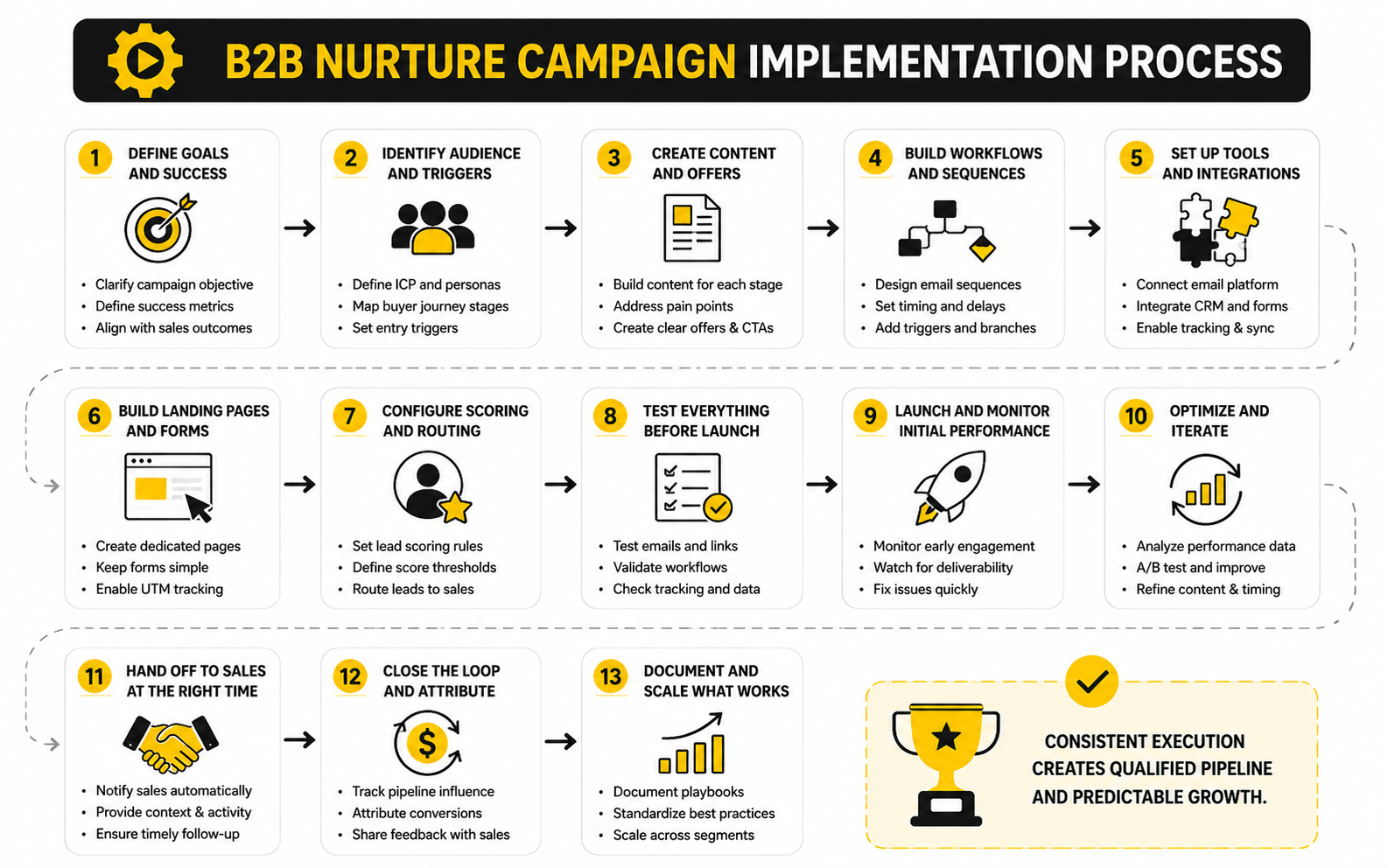
Professional implementation starts when you turn the strategy into a working system. This means defining triggers, mapping branches, writing the messages, connecting the CRM, setting alerts, and deciding what counts as progress. It is not glamorous, but this is where nurture campaigns either become revenue infrastructure or stay trapped as marketing theory.
The process should be simple enough for the team to maintain. Overbuilt workflows can look impressive in a diagram and still become impossible to manage. A good nurture system gives you enough segmentation to stay relevant without creating a maze nobody wants to update.
Step 1: Define the Campaign Goal
Every nurture campaign needs one primary goal. That goal might be booking qualified demos, increasing webinar attendance, reviving stalled opportunities, converting trial users, educating new leads, or accelerating sales handoffs. If the goal is vague, the workflow will be vague too.
The goal should connect to a business outcome, not just an email metric. Opens and clicks can be useful signals, but they are not the finish line. A campaign that gets fewer clicks but creates more qualified meetings may be doing a better job than a campaign with high engagement and no pipeline movement.
Once the goal is clear, write it in a plain sentence. For example, “Move high-fit report downloaders toward a demo request within 30 days” is much better than “nurture leads.” Clear goals make every later decision easier.
Step 2: Map the Buyer Stage
After the goal, map the buyer stage. Ask whether the person is problem-aware, solution-aware, vendor-aware, actively comparing, or close to purchase. This prevents the campaign from jumping too quickly into a pitch.
Stage mapping matters because the buyer’s questions change over time. Early buyers ask, “Is this problem real?” Mid-stage buyers ask, “What are my options?” Late-stage buyers ask, “Why this solution, why now, and why should my team trust it?”
The campaign should meet the buyer at the stage their behavior suggests. A content download usually points to education. A pricing page visit usually points to evaluation. A repeated demo page visit may indicate active intent, especially when the account also fits your ideal customer profile.
Step 3: Build the Workflow Logic
Workflow logic decides what happens after each signal. This includes delays, branches, exits, sales alerts, lead score changes, and suppression rules. The point is not to automate everything; the point is to automate the parts that make the buyer experience more relevant and the sales process more consistent.
A simple workflow might have one main sequence and three branches. One branch handles people who click high-intent links. Another handles people who do not engage. Another exits people who book a meeting or enter an active sales opportunity. That is often enough for a strong first version.
For small teams, tools like Brevo or Moosend can support email automation without making the setup feel too heavy. For teams that need CRM, pipeline, booking, and workflow automation in one place, GoHighLevel is often the more complete operational layer.
Step 4: Write Messages Around Buyer Friction
The writing should focus on buyer friction, not product excitement. Your product may be good, but the buyer is usually dealing with uncertainty, competing priorities, internal politics, budget pressure, and fear of choosing badly. The campaign should make the decision feel clearer and safer.
Each message should answer one practical question. Why does this problem matter? What are the common options? What should the buyer watch out for? What proof exists? What happens after they take the next step? Those questions create useful emails without forcing fake urgency.
This is where conversational writing wins. A good nurture email should sound like a smart person helping the buyer think, not a brand shouting through a template. Keep the message direct, specific, and easy to act on.
Step 5: Set Measurement Rules Before Launch
Measurement should be defined before the campaign goes live. Otherwise, the team will cherry-pick whatever metric looks good later. Decide in advance which numbers matter and what action you will take if performance is weak.
Useful metrics can include conversion to meeting, reply rate, content engagement, opportunity creation, sales acceptance, pipeline influenced, unsubscribe rate, and time from first touch to qualified action. The right mix depends on the campaign goal. A webinar nurture and a demo-intent nurture should not be judged by exactly the same scorecard.
Do not optimize too early based on tiny numbers. Let the campaign collect enough activity to reveal patterns, then improve the weak points. If people click but do not book, the offer or landing page may be weak. If people do not click at all, the message or segment may be wrong.
Statistics and Data That Actually Matter
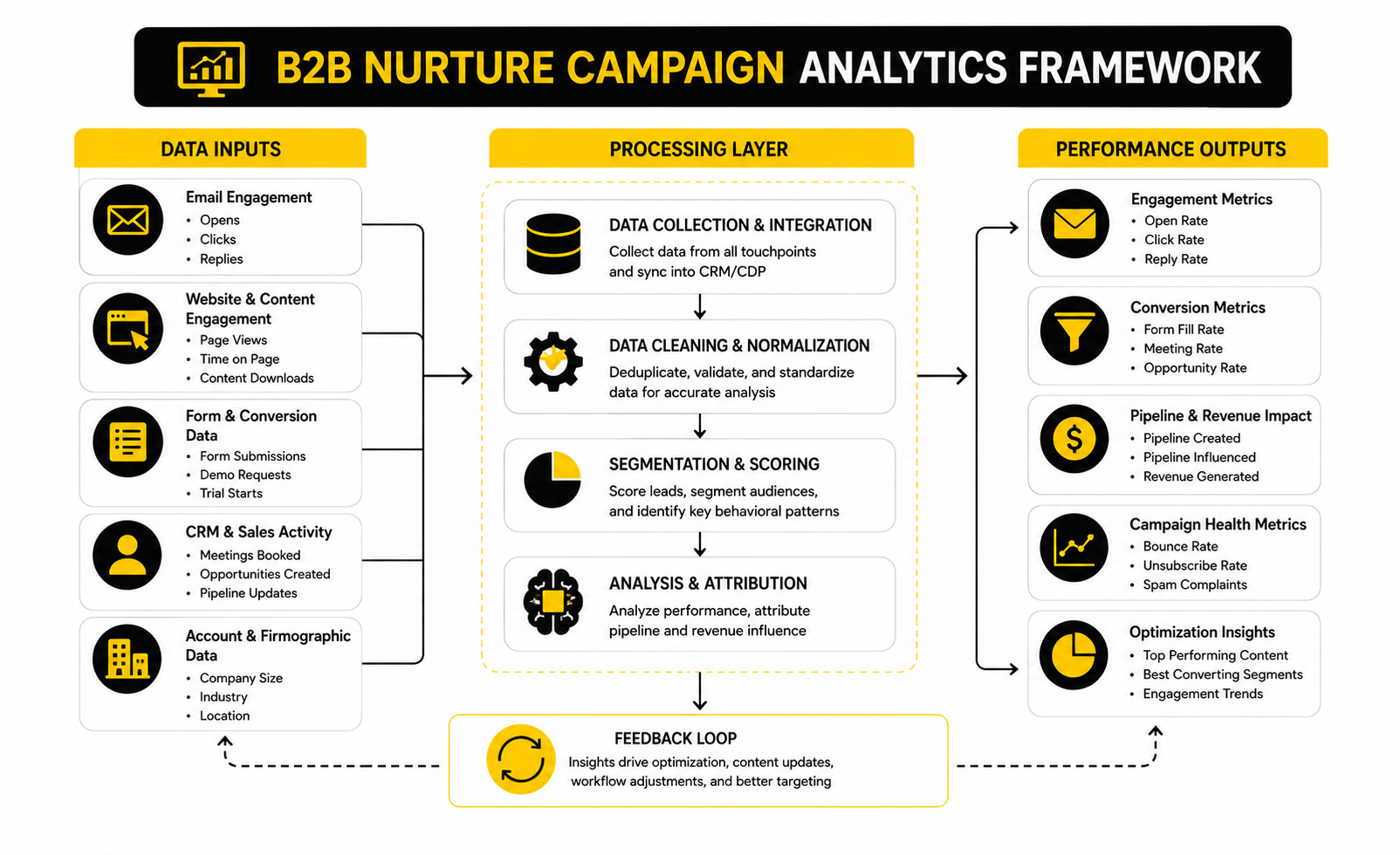
Measurement is where a nurture campaign becomes honest. Without data, it is easy to mistake activity for progress. You can send polished emails, build beautiful workflows, and still have no idea whether the campaign is creating qualified conversations, accelerating deals, or simply keeping your brand in someone’s inbox.
The wrong move is to dump every metric into one dashboard and call it analytics. Opens, clicks, replies, page visits, form fills, bookings, opportunity creation, sales acceptance, pipeline value, and revenue all tell different parts of the story. The useful question is not, “What number went up?” The useful question is, “What does this number reveal about buyer intent, campaign fit, or sales readiness?”
This is especially important when comparing b2b nurture campaign examples. A nurture sequence built for educational leads should not be judged the same way as a sequence built for pricing-page visitors. The first may need to create problem awareness over time, while the second should move quickly toward a qualified sales conversation.
Open Rate Shows Attention, Not Revenue
Open rate can help you spot subject line performance, sender trust, list quality, and basic deliverability. It is useful at the top of the measurement stack, but it is not a serious revenue metric by itself. A campaign can have a strong open rate and still fail if the reader does not click, reply, book, or move deeper into the buying journey.
Recent email benchmarks show why open rate needs context. MailerLite’s 2025 benchmark data reported an average open rate of 42.35% across more than 3 million campaigns, while its later 2025 dataset showed an average open rate of 43.46% across 2025 campaigns. Those numbers are useful as directional reference points, but they should not become your main target.
For B2B nurture, a lower open rate from the right accounts can beat a higher open rate from the wrong audience. If your ideal customer profile is engaging, sales-qualified leads are increasing, and unsubscribes stay controlled, the campaign may be working even if the open rate looks average. Measure attention, but do not worship it.
Click Rate Shows Content Relevance
Click rate is usually a stronger signal than open rate because it shows that the message created enough interest for someone to take action. It tells you whether the email promise, content asset, and CTA are aligned. If people open but do not click, your subject line may be doing its job while the body copy or offer is falling flat.
The benchmark range is often humbling. MailerLite reported a global average click rate of 2% in its 2025 email marketing statistics, and its 2025 benchmark update placed the average click rate at 2.09%. That does not mean a nurture campaign should celebrate weak engagement, but it does show why small percentage changes can matter when the list quality is strong.
The real interpretation depends on the CTA. A click to a lightweight blog post does not mean the same thing as a click to a pricing page, implementation guide, comparison page, or booking link. Track click quality, not just click volume.
Reply Rate Shows Conversation Potential
Reply rate matters because B2B is still built on trust, context, and timing. A reply often gives you information that clicks cannot provide. The prospect may explain their current priority, ask a buying question, mention a blocker, or tell you they are not the right person.
This is why plain-text emails can still work inside nurture campaigns. Not every touch needs to push a landing page. Sometimes the best CTA is a simple question like, “Is this something your team is actively trying to fix this quarter?” That kind of question can surface intent faster than another generic resource link.
Reply quality matters more than reply count. A campaign that creates five thoughtful replies from high-fit accounts may be more valuable than one that creates fifty low-intent clicks from poor-fit contacts. Sales should review replies with marketing so the campaign can be improved around real buyer language.
Conversion Rate Shows Whether the Campaign Moves the Buyer
Conversion rate connects nurture activity to the next meaningful step. Depending on the campaign, that step might be a booked demo, a qualified consultation, a sales-accepted lead, a trial activation, a webinar attendance, or a return visit to a high-intent page. This is where measurement starts to become practical.
The mistake is using the same conversion goal for every lead source. Someone who downloaded an early-stage guide may not convert to a demo within seven days, and that is fine. Someone who requested pricing and then ignored every follow-up is a bigger concern because the intent signal was stronger.
A good analytics system separates micro-conversions from macro-conversions. Micro-conversions show progress, such as clicking a comparison guide or watching a replay. Macro-conversions show business movement, such as booking a call, becoming an opportunity, or entering a sales pipeline.
Pipeline Metrics Show Commercial Impact
Pipeline metrics are the reason nurture exists in the first place. If a campaign never influences qualified opportunities, sales conversations, deal velocity, or revenue, it may be educational content distribution rather than true nurture. That does not make it useless, but it does change how you should evaluate it.
The cleanest setup tracks which campaign influenced each stage of the journey. Did the lead become sales accepted after a specific sequence? Did the account revisit high-intent pages after a nurture touch? Did the opportunity move faster because the champion had better internal material? These questions connect marketing effort to buying progress.
This is where a CRM and workflow platform becomes more than a place to store contacts. If you want campaign activity, lead status, booking behavior, and pipeline movement in one operational view, GoHighLevel can help centralize the execution layer. The important part is not the software label; it is whether the team can see which nurture paths are creating real pipeline.
Unsubscribe Rate Shows Pressure and Fit
Unsubscribes are not always bad. Some people should leave your list because they are not a fit, not interested, or no longer in-market. A healthy nurture system should create clarity, and clarity sometimes means the wrong people opt out.
The warning sign is when unsubscribes rise because the campaign is too aggressive, too generic, or too disconnected from the original trigger. MailerLite’s 2025 benchmark data placed average unsubscribe rate at 0.08% in one 2025 dataset, while its later 2025 benchmark update reported 0.22%. The exact number is less important than the trend inside your own segments.
Watch unsubscribe rate by campaign type. If your low-intent educational nurture has a high unsubscribe rate, you may be pushing too hard too soon. If your high-intent pricing nurture has a modest unsubscribe rate but strong meeting conversion, that may be an acceptable tradeoff.
ROI Shows Whether the System Deserves More Budget
ROI is the executive-level metric, but it is also one of the easiest to fake with sloppy attribution. Email can be a high-return channel, but nurture ROI should be measured against real business outcomes, not vanity engagement. Litmus has reported that many marketers see email returns in the 10:1 to 36:1 range, while also noting that some teams still struggle to prove ROI clearly.
For B2B nurture, ROI should include more than direct last-click conversions. A campaign may help revive a stalled opportunity, educate a buying committee, support a sales rep, or create confidence before a demo. Those effects are harder to measure, but they are not imaginary.
The practical move is to build a simple attribution model before launching. Track first-touch source, campaign engagement, sales handoff, opportunity creation, and revenue influence. It will not be perfect, but it will be much better than arguing about whether nurture “feels like it is working.”
What to Do When the Numbers Look Bad
Bad numbers are not a failure if they tell you what to fix. Low opens usually point to weak subject lines, poor sender trust, list fatigue, or deliverability problems. Low clicks usually point to weak relevance, unclear value, or the wrong CTA for the buyer stage.
Low conversions require deeper diagnosis. The email may be doing its job, but the landing page, booking flow, sales follow-up, or offer may be creating friction. This is why nurture analytics should not stop at email performance; the full path matters.
Use this simple action logic:
The Best Benchmark Is Your Own Trendline
External benchmarks are useful for orientation, but your own trendline is more useful for decisions. Your market, list source, ACV, buying cycle, brand trust, deliverability, and offer maturity all affect performance. A campaign selling a complex enterprise platform should not expect the same behavior as a campaign promoting a simple self-serve tool.
This is why each nurture campaign should have a baseline, a test plan, and a review rhythm. Review early engagement after launch, but give pipeline metrics enough time to mature. B2B sales cycles can be slow, and judging revenue impact too early can lead to bad decisions.
The smartest teams do not chase random benchmark numbers. They use benchmarks to sanity-check performance, then optimize against their own best segments, strongest messages, and clearest pipeline signals. That is how measurement becomes a growth system instead of a reporting chore.
Advanced Nurture Strategy: What Changes When You Scale
Once a nurture system starts working, the next challenge is scale. More leads, more segments, more sales motions, more content, and more automation can create growth, but they can also create confusion fast. This is where teams need to stop thinking like campaign builders and start thinking like revenue system designers.
Scaling a nurture campaign does not mean adding more emails to every sequence. It means making the right message easier to deliver to the right person at the right moment without overwhelming your team or your buyers. That requires sharper rules, cleaner data, stronger handoffs, and a willingness to remove anything that no longer helps the buyer move forward.
The advanced level is not about complexity for its own sake. It is about control. You want enough sophistication to handle different buyer journeys, but not so much automation that nobody understands what is happening inside the system.
Segment by Buying Context, Not Just Persona
Persona-based nurturing is useful, but it is not enough. A CFO, operations leader, or founder can all behave differently depending on whether they are casually researching, actively comparing, renewing a contract, replacing a tool, or responding to pressure from their team. The same person can need very different messaging at different moments.
Buying context gives your segmentation more accuracy. It looks at behavior, urgency, fit, account activity, and where the person appears to be in the decision process. A high-fit account with multiple engaged contacts should usually be treated differently from a single low-fit lead who clicked one educational article.
This is especially important in longer B2B sales cycles. Academic work on B2B purchase prediction has shown why individual behavior alone can be incomplete, because business buying decisions often involve account-level activity across multiple people rather than one clean individual journey. That means advanced nurture should look for account patterns, not just contact clicks.
Build for the Buying Committee
A single lead is rarely the whole deal. In many B2B purchases, one person researches, another owns the budget, another checks security or operations, and another signs off on the final decision. If your nurture campaign only speaks to the original lead, you may be helping the wrong person in isolation.
This is where buying committee nurturing becomes powerful. Instead of sending everyone the same sequence, you create assets that help the champion bring other stakeholders into the conversation. That could include a one-page business case, technical overview, implementation checklist, comparison guide, ROI explanation, or internal proposal template.
The goal is simple: make your champion look prepared. When they forward your material internally, it should answer the questions their team will actually ask. That is one of the most overlooked lessons from strong b2b nurture campaign examples.
Decide When Automation Should Stop
Automation is useful until it becomes annoying. A lead who books a meeting should not keep receiving generic nurture emails that push them to book a meeting. A prospect in an active sales conversation should not get a conflicting promotional sequence. A closed-lost opportunity should not immediately receive the same early-stage education they already consumed.
Suppression rules are not optional. They protect the buyer experience and prevent your brand from looking disorganized. At minimum, you should suppress or redirect contacts when they book a call, become an opportunity, enter a customer lifecycle stage, unsubscribe from a topic, or show clear disinterest.
This is why workflow governance matters. Someone needs to own the logic, review overlapping automations, and check that contacts are not trapped in outdated sequences. A messy automation system can quietly damage trust even when each individual email looks fine.
Use Lead Scoring Carefully
Lead scoring can help prioritize follow-up, but it becomes dangerous when teams treat it as truth. A score is only a model. It reflects the assumptions you built into it, the data you collect, and the behaviors you choose to value.
For example, a prospect who reads five educational articles may be curious, but not ready. Another prospect who visits one pricing page from a high-fit account may deserve faster sales attention. If both actions are scored poorly, sales will chase the wrong people or miss the right ones.
A better scoring model separates fit from intent. Fit tells you whether the account looks like a good customer. Intent tells you whether the account appears to be moving. When both are strong, the nurture campaign should become more direct and the sales handoff should happen quickly.
Personalization Has to Earn Its Place
Personalization can improve relevance, but only when it is based on something meaningful. Adding a first name or company name is not strategy. Mentioning a real pain point, role-specific concern, use case, or previous engagement is much stronger.
The risk is fake personalization. Buyers can feel when a message is pretending to be personal while clearly coming from a template. That does more harm than a clean, honest automated email. Be direct about what the person did and why you are following up.
For example, “You downloaded our implementation checklist, so I thought this rollout planning guide may help” feels natural. It connects the message to a real action and gives the reader a reason to care. That is the level of personalization worth scaling.
Match Content Depth to Intent
Advanced nurture depends on knowing when to use short, direct messages and when to use deeper assets. Early-stage buyers may appreciate educational content, but high-intent buyers often need sharper decision support. Sending another broad thought-leadership article to someone who is already comparing vendors can slow the deal down.
Content depth should increase as the decision becomes more serious. Early touches can be lighter and easier to consume. Later touches should provide proof, comparison, implementation clarity, risk reduction, and financial logic.
This does not mean every late-stage asset needs to be long. Sometimes a simple one-page checklist is more useful than a 40-page report. The question is whether the asset helps the buyer make a decision, not whether it looks impressive.
Protect Deliverability Before It Becomes a Problem
Deliverability is one of those issues teams ignore until performance drops. If your emails are not reaching the inbox, your nurture strategy does not matter. Strong copy cannot save a campaign that mailbox providers do not trust.
Good deliverability starts with clean lists, permission-based sending, sensible frequency, authentication, engagement monitoring, and removing people who never interact. It also means avoiding aggressive blasting when a segment has shown low interest. More volume is not automatically better.
This is another reason to avoid bloated nurture systems. Too many unnecessary emails can reduce engagement and increase spam complaints over time. The best campaign is often the leanest campaign that still moves the buyer forward.
Align Marketing and Sales Before You Add More Automation
A nurture campaign can only scale well when sales and marketing agree on definitions. What counts as a qualified lead? When should sales follow up? What behavior deserves an alert? When should a contact stay in nurture instead of being pushed to a rep?
Without alignment, automation creates friction. Marketing says the lead is warm because they clicked three emails. Sales says the lead is weak because the account has no budget or authority. Both sides may be right, which is why the rules need to be defined together.
A shared service-level agreement helps. It should explain lead stages, handoff criteria, follow-up expectations, disqualification reasons, and feedback loops. This keeps nurture connected to revenue instead of turning it into a separate marketing machine.
Avoid the Most Common Scaling Mistakes
Most nurture problems at scale are not caused by bad ideas. They are caused by too many ideas running at once without enough control. Every new campaign adds another layer of logic, and eventually the system becomes harder to manage than the buyer journey itself.
The most common scaling mistakes are easy to spot:
These mistakes are fixable, but only if someone audits the system regularly. A quarterly nurture review can catch broken logic, outdated assets, weak conversion points, and unnecessary complexity. That review should include both marketing and sales because both teams feel the consequences when nurture works or fails.
Choose the Right Operating Model
Not every company needs the same nurture setup. A founder-led B2B business may only need a few clean sequences and a simple CRM. A mid-market SaaS team may need lifecycle campaigns, product intent triggers, lead scoring, and sales alerts. An enterprise team may need account-based nurture, buying committee mapping, regional segmentation, and complex attribution.
The right operating model depends on deal size, sales cycle, team size, data quality, and content maturity. Do not copy an enterprise workflow if your team cannot maintain it. A simple system that gets reviewed and improved will beat a complex system that nobody trusts.
For lean teams, a practical stack might combine a CRM, email automation, booking flow, and a few focused landing pages. For example, GoHighLevel can make sense when you want CRM, pipeline, automations, and follow-up in one place, while Fillout can help capture cleaner form data for segmentation and routing. The tool choice should support the strategy, not become the strategy.
Keep the System Human
The more automated a nurture system becomes, the more important the human layer gets. Buyers do not want to feel like they are being pushed through a machine. They want useful information, relevant timing, and a clear next step when they are ready.
This is why the best advanced nurture systems still create space for human judgment. A rep can step in when an account shows meaningful intent. A marketer can adjust messaging when replies reveal a new objection. A founder or subject-matter expert can send a direct note to a high-value prospect when the situation deserves it.
Automation should handle consistency. Humans should handle context. When those two work together, nurture stops feeling like a sequence and starts feeling like a guided buying experience.
What is a B2B nurture campaign?
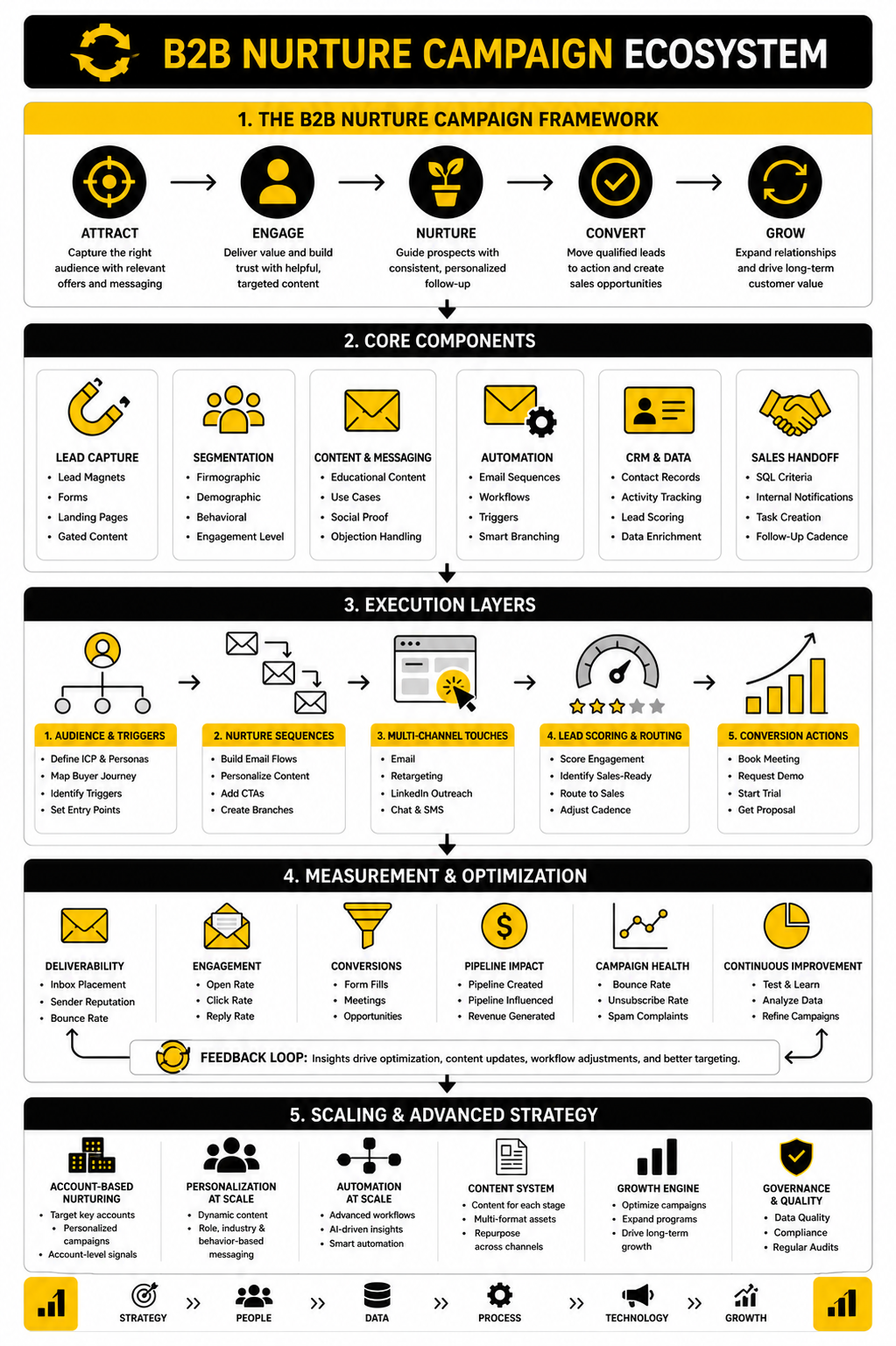
A B2B nurture campaign is a structured series of messages, content assets, workflow rules, and sales handoffs designed to help business buyers move from interest to decision. It usually includes email, retargeting, sales alerts, CRM updates, landing pages, and content recommendations. The goal is not just to “follow up,” but to help the buyer understand the problem, compare options, reduce risk, and take the next logical step.
What are the best B2B nurture campaign examples?
The best b2b nurture campaign examples usually include educational lead magnet nurture, webinar nurture, demo-request nurture, pricing-page nurture, free-trial nurture, closed-lost nurture, customer expansion nurture, and event follow-up nurture. Each example works best when it matches the buyer’s current intent. A lead magnet sequence should educate, while a pricing-page sequence should move faster toward sales readiness.
How many emails should a B2B nurture campaign have?
Most B2B nurture campaigns work best with enough touches to build context, but not so many that the buyer feels trapped. A simple campaign may have 4 to 7 emails, while a longer lifecycle program may include multiple branches across several weeks or months. The better question is not how many emails to send, but what each email needs to accomplish.
How often should you send nurture emails?
Cadence depends on the strength of the buyer signal. High-intent actions like demo requests, pricing visits, or abandoned booking pages usually deserve faster follow-up over a shorter window. Lower-intent actions like downloading an educational guide usually need a slower rhythm that builds trust before asking for a meeting.
What should the first email in a nurture campaign say?
The first email should connect directly to the action the prospect just took. If they downloaded a guide, send the guide and explain how to use it. If they registered for a webinar, confirm the session and clarify the value. If they visited a high-intent page or requested a demo, make the next step obvious and easy.
What metrics should you track in a B2B nurture campaign?
Track open rate, click rate, reply rate, unsubscribe rate, content engagement, form conversion, meeting bookings, sales acceptance, opportunity creation, and pipeline influence. Email metrics show whether the campaign is getting attention, but pipeline metrics show whether it is helping the business. The strongest measurement systems connect marketing engagement to CRM movement.
Are open rates still useful for nurture campaigns?
Open rates are useful, but they should not be treated as the main success metric. They can show whether your subject lines, sender reputation, and deliverability are healthy. They cannot prove that a campaign is creating qualified pipeline, sales conversations, or revenue.
How do you know when a lead is ready for sales?
A lead is usually ready for sales when strong fit and strong intent appear together. Fit means the company matches your ideal customer profile. Intent means the person or account is taking meaningful actions, such as returning to high-intent pages, clicking comparison content, requesting pricing, engaging with implementation material, or replying with buying questions.
Should nurture campaigns be personalized?
Yes, but personalization has to be meaningful. Using a first name is basic and does not make a campaign relevant by itself. Strong personalization connects the message to the buyer’s role, industry, account stage, pain point, previous action, or likely decision concern.
What is the difference between lead nurture and demand generation?
Demand generation creates interest and awareness in the market. Lead nurture helps known prospects or accounts continue moving after they have already engaged in some way. They work together, but nurture is more focused on progression, education, qualification, and sales readiness.
What is the difference between lead nurturing and email marketing?
Email marketing is a channel. Lead nurturing is a strategy. A nurture campaign may use email, but it can also include CRM workflows, sales tasks, retargeting audiences, chatbot routing, booking links, landing pages, and account-based follow-up.
Should you use automation for B2B nurture campaigns?
Automation is useful when it makes follow-up more consistent and relevant. It can deliver content, update CRM stages, notify sales, route leads, and suppress contacts from the wrong campaigns. But automation should not replace judgment; it should support a clear buyer journey.
What tools do you need for a nurture campaign?
At minimum, you need a way to capture leads, segment contacts, send emails, track engagement, manage CRM stages, and measure conversions. Some teams use separate tools for forms, email, CRM, landing pages, and scheduling. Others prefer a broader system like GoHighLevel when they want CRM, workflows, pipeline, and follow-up in one place.
Can small teams run effective B2B nurture campaigns?
Yes, and small teams often have an advantage because they can move fast and keep messaging simple. You do not need a huge marketing operation to build a useful nurture system. Start with one high-value segment, one clear trigger, one strong sequence, and one measurable conversion goal.
What is the biggest mistake in B2B nurturing?
The biggest mistake is sending generic follow-up that ignores buyer intent. A prospect who downloaded a broad educational asset should not receive the same sequence as someone who visited a pricing page three times. Strong nurture campaigns respond to behavior, context, and buying stage.
How do you improve a weak nurture campaign?
Start by finding the weakest point in the journey. If opens are weak, fix subject lines, sender trust, and list quality. If clicks are weak, improve relevance and CTA clarity. If clicks are strong but conversions are weak, fix the landing page, booking flow, offer, or sales handoff.
How do B2B nurture campaigns support the buying committee?
They help the original lead share useful information with other decision-makers. A strong campaign gives the champion business-case material, comparison content, implementation clarity, risk answers, and proof they can forward internally. That matters because buying decisions often involve multiple stakeholders with different concerns.
When should you stop nurturing a lead?
Stop or change the nurture path when the lead books a meeting, becomes an active opportunity, unsubscribes, shows long-term inactivity, becomes a customer, or clearly does not fit your ideal profile. Continuing to send generic messages after the buyer has moved stages makes the company look disconnected. Good suppression rules protect both the relationship and your deliverability.
Can AI help with B2B nurture campaigns?
AI can help with research, segmentation ideas, draft variations, message summaries, lead routing, and content repurposing. It should not replace strategy, buyer insight, or human review. The safest use is to let AI speed up execution while humans own the positioning, offer logic, and quality control.
What makes a nurture campaign feel human?
A human nurture campaign is specific, useful, and respectful of timing. It references the buyer’s real context, explains why the message matters, and gives them a reasonable next step. It does not over-automate, over-personalize, or pretend a template is a one-to-one note.
Build a stronger local presence with BAAM AI
Turn your website, Google profile, social channels, and AI visibility into one growth engine
Most businesses do not need more random marketing activity. They need a consistent presence system that helps the right people find them, trust them, and take action. BAAM AI brings strategy, local SEO, website updates, Google Maps visibility, social content, AI-search readiness, media production, and reporting into one practical monthly engine.
If you want your marketing to keep working after the campaign ends, start with a free BAAM AI presence audit. See how your business shows up today and where the fastest visibility wins are at BAAM AI.