
BAAM AI Blog
B2B Copywriting: A Practical Framework for Turning Complex Offers Into Clear Buyer Action
B2B copywriting is the discipline of writing persuasive, useful, sales-focused messages for people buying on behalf of a business. That sounds simple until you look at how B2B decisions actually happen. One person...
B2B copywriting is the discipline of writing persuasive, useful, sales-focused messages for people buying on behalf of a business. That sounds simple until you look at how B2B decisions actually happen. One person rarely reads a landing page, likes the promise, and buys on the spot.
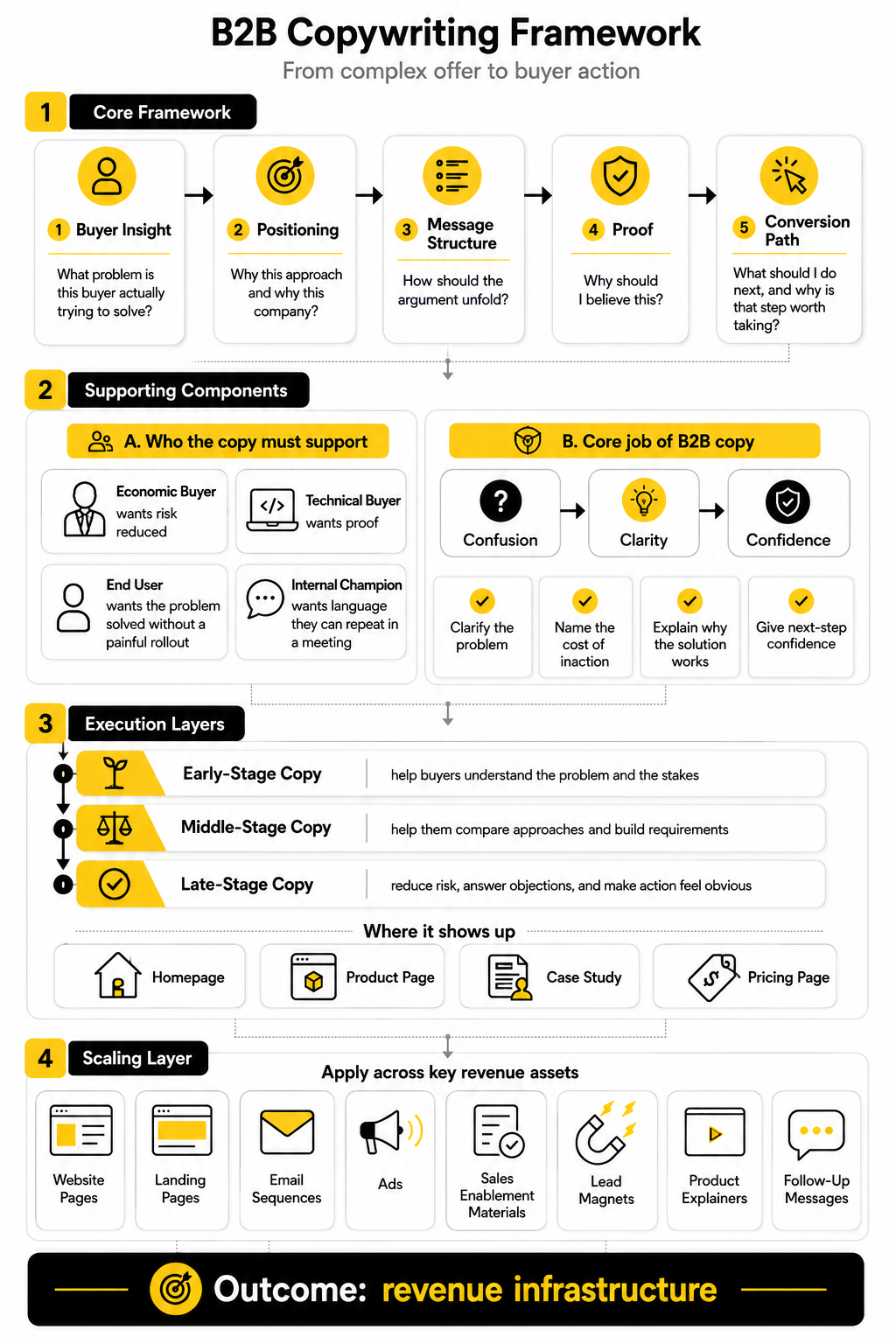
A strong B2B page, email, ad, sales deck, or nurture sequence has to help several people feel confident at the same time. The economic buyer wants risk reduced. The technical buyer wants proof. The end user wants the problem solved without a painful rollout. The internal champion wants language they can repeat in a meeting without sounding like they are overselling.
That is why b2b copywriting cannot be treated like clever wordplay with a CTA slapped on the end. It is closer to decision architecture. Your job is to translate a complex offer into a clear business case, then give buyers enough language, proof, and next-step confidence to keep the deal moving.
The bar is getting higher. Gartner’s B2B buying research shows that 75% of B2B buyers prefer a rep-free sales experience, while the same research warns that purely self-service buying can create more regret when buyers do not get enough guidance. That matters because your copy is often the guidance buyers see before they ever talk to sales.
Forrester’s 2025 buying research also shows how crowded the decision has become: 73% of B2B purchases involve three or more departments, with an average of 13 internal participants. So the copy cannot only persuade one reader. It has to survive forwarding, screenshots, internal Slack threads, procurement reviews, and skeptical leadership questions.
this guide breaks b2b copywriting into a practical six-part system. The goal is not to make your writing sound more “marketing.” The goal is to make your copy easier to believe, easier to act on, and easier for a real buying committee to use.
Why B2B Copywriting Matters Now
B2B buyers are doing more research before they contact sales, but they are not necessarily becoming more confident. They are comparing more vendors, involving more stakeholders, checking third-party proof, and pressure-testing claims against budget risk. That means weak copy does not just fail to persuade; it creates friction that slows down the entire buying process.
The old way of writing B2B copy was mostly company-centered. It led with product features, internal terminology, vague benefit statements, and calls to action that assumed the buyer was already convinced. That approach breaks down when buyers are still trying to define the problem, compare options, understand tradeoffs, and justify the decision internally.
Modern b2b copywriting has to meet buyers where they are. It needs to clarify the problem, name the cost of inaction, explain why the solution works, and make the next step feel safe. It also has to do this without sounding inflated, because experienced buyers can smell generic claims immediately.
Content quality is part of the same problem. The Content Marketing Institute’s 2025 B2B research found that 45% of B2B marketers lack a scalable model for content creation, which often leads to scattered messaging, inconsistent claims, and copy that changes from one channel to another. When your website says one thing, your outbound emails say another, and your sales deck says something else, the buyer has to do extra work.
That extra work is dangerous. Buyers already have enough internal complexity to manage. Good copy reduces that complexity by making the argument clear, consistent, and usable across the entire buying journey.
What Makes B2B Copywriting Different
B2B copywriting is different because the buyer is not only asking, “Do I want this?” They are also asking, “Can I defend this decision?” That one shift changes almost everything about the writing.
In consumer copy, urgency, desire, identity, and simplicity often carry much of the weight. In B2B copy, those still matter, but they are not enough. The copy must also handle risk, consensus, implementation, opportunity cost, switching pain, compliance, budget timing, and the political reality of making a recommendation inside a company.
This is why the best B2B copy feels calm, specific, and grounded. It does not need to shout. It needs to make the buyer think, “Yes, that is exactly the problem we have, and this company understands what it would take to solve it.”
The buying journey is also nonlinear. Gartner describes B2B buying as a set of buying jobs that teams revisit, including problem identification, solution exploration, requirements building, and supplier selection. In practical copywriting terms, that means one page may need to serve readers at different levels of readiness without becoming messy.
A strong homepage might help an early-stage buyer understand the category. A product page might help a mid-stage buyer compare capabilities. A case study might help a champion prove value internally. A pricing page might help finance understand fit, limits, and risk. All of that is copywriting.
The Core Job of B2B Copy
The core job of B2B copy is to move a buyer from confusion to clarity, then from clarity to confidence. That does not always mean asking for a demo immediately. Sometimes the right conversion is reading a comparison page, downloading a technical guide, using a calculator, replying to an email, or sharing a page with a colleague.
This is where many companies get the strategy wrong. They write every asset as if the buyer is ready for sales. Then they wonder why conversion rates stay flat even though traffic, content production, or outbound volume goes up.
Good b2b copywriting respects buying intent. Early-stage copy should help buyers understand the problem and the stakes. Middle-stage copy should help them compare approaches and build requirements. Late-stage copy should reduce risk, answer objections, and make action feel obvious.
The 6sense 2025 Buyer Experience Report notes that buyers are often able to complete two-thirds of their buying journey before engaging sellers. That does not mean sales no longer matters. It means your copy has to do more of the early educational, framing, and confidence-building work before the first conversation happens.
This is also why copy and sales should not be separated. Sales calls reveal the real objections. Customer success reveals what customers value after purchase. Product teams understand what the solution actually does. Strong B2B copy pulls those inputs together and turns them into language buyers can trust.
The B2B Copywriting Framework
A practical framework keeps B2B copy from becoming random. Without one, teams tend to write from whatever is loudest that week: a product launch, a sales objection, a competitor’s claim, or a founder’s favorite phrase. A framework forces the copy to serve the buyer’s decision process instead.
The framework used throughout this guide has five connected layers: buyer insight, positioning, message structure, proof, and conversion path. Each layer answers a different question the buyer has in their head. Together, they create copy that feels clear rather than forced.
Buyer insight answers, “What problem is this buyer actually trying to solve?” Positioning answers, “Why this approach and why this company?” Message structure answers, “How should the argument unfold?” Proof answers, “Why should I believe this?” The conversion path answers, “What should I do next, and why is that step worth taking?”
How the Framework Works in Practice
The framework starts with buyer insight because copy written without research usually sounds polished but empty. You need to know what buyers are trying to accomplish, what they are afraid of, what alternatives they are comparing, and what language they already use to describe the pain. That insight gives the copy its direction.
Positioning comes next because buyers need a clear reason to place you in one mental category instead of another. If your copy makes you sound like every other vendor, the buyer will compare you on price, features, brand recognition, or whatever is easiest to measure. Strong positioning gives the reader a sharper way to understand why your offer exists.
Message structure turns that positioning into a persuasive sequence. This is where you decide what to lead with, what to explain, what to prove, and when to ask for action. The structure should feel natural, but it should not be accidental.
Proof gives the message weight. In B2B, proof can include customer outcomes, implementation details, product screenshots, security documentation, benchmarks, reviews, integrations, analyst recognition, or transparent process explanations. The point is not to pile on evidence. The point is to remove the specific doubts that would otherwise stop the buyer from moving forward.
The conversion path ties everything together. A buyer should never finish reading and wonder what the next useful step is. The call to action should match their intent, their level of trust, and the amount of risk they feel at that moment.
What this guide Will Help You Build
By the end of the full article, you will have a practical way to write B2B copy across your most important revenue assets. That includes website pages, landing pages, email sequences, ads, sales enablement materials, lead magnets, product explainers, and follow-up messages. The same principles apply because the buyer’s core questions stay surprisingly consistent.
You will also be able to spot why B2B copy underperforms. Sometimes the problem is weak positioning. Sometimes it is a vague headline. Sometimes the copy makes a big claim but does not support it. Sometimes the CTA asks for too much too soon.
Most importantly, you will have a system for making copy more useful to the buyer. That is the real advantage. When your copy helps buyers understand the problem, compare their options, and feel confident about the next step, it stops acting like decoration and starts acting like revenue infrastructure.
The B2B Copywriting Framework
A useful B2B copywriting framework does one thing very well: it keeps the copy tied to the buyer’s decision instead of the company’s internal wish list. That matters because most weak B2B copy is not weak because the writer has no talent. It is weak because the message is built around what the company wants to say, not what the buyer needs to understand before moving forward.
The framework has five layers: buyer insight, positioning, message structure, proof, and conversion path. Each layer makes the next one stronger. When one layer is missing, the copy usually starts to wobble, even if the sentences sound polished.
Think of this as a practical operating system for b2b copywriting. You can use it for a homepage, landing page, outbound email, product page, webinar registration page, sales deck, nurture sequence, or comparison page. The format changes, but the buyer’s mental process stays consistent.
Layer 1: Buyer Insight
Buyer insight is the foundation because copy cannot create clarity from guesswork. Before you write a headline, you need to understand what the buyer is trying to fix, why the problem matters now, what they have already tried, and what would make them hesitate. This is not fluffy persona work; it is the raw material that makes the message feel real.
Good buyer insight comes from actual buyer language. Sales calls, customer interviews, demo notes, onboarding feedback, review sites, support tickets, lost-deal notes, community discussions, and search data can all show you how buyers describe the problem before marketing cleans it up. The strongest phrases usually sound less polished than the copy you planned to write, which is exactly why they work.
The mistake is assuming that the buyer’s problem is the same as your product category. A company may not be looking for “marketing automation.” They may be trying to stop leads from falling through the cracks after a webinar. A team may not be looking for “AI support software.” They may be trying to reduce repetitive tickets without making customers feel ignored.
That distinction matters. Category language helps buyers place you. Problem language helps buyers feel understood. Strong B2B copy needs both, but it should usually start closer to the buyer’s lived problem.
What To Look For During Research
The goal of research is not to collect a giant pile of notes. The goal is to find decision-shaping patterns. You are looking for the pains, triggers, objections, outcomes, and internal pressures that keep appearing across buyer conversations.
Useful research usually answers questions like these:
These answers prevent copy from drifting into generic benefit statements. Instead of saying “streamline your workflow,” you can name the actual workflow problem. Instead of saying “save time,” you can explain where time is being lost and why that loss is becoming expensive.
Buyer insight also protects you from writing for the wrong level of awareness. Someone comparing vendors does not need the same message as someone who is still trying to understand why their current process keeps breaking. When your copy matches the buyer’s stage, it feels helpful. When it misses the stage, it feels either too basic or too aggressive.
Layer 2: Positioning
Positioning answers a simple but brutal question: why should this buyer choose this approach over every other reasonable option? If the copy cannot answer that clearly, the buyer will default to easier comparisons. They will compare prices, feature checklists, brand familiarity, or whatever a competitor has made easiest to understand.
Strong positioning does not mean inventing a dramatic claim. It means making your real difference obvious and relevant. The buyer should quickly understand who the offer is for, what problem it solves best, what makes the approach distinct, and why that difference matters in a business context.
This is where many B2B companies get too clever. They create a new category, slogan, or abstract phrase before the buyer understands the basic value. The result sounds strategic in a boardroom but vague on the page.
Clear positioning usually beats clever positioning. If your product helps agencies manage leads, appointments, follow-up, and client accounts in one place, say that before you dress it up. A platform like GoHighLevel is easiest to understand when the copy connects the system to the operational mess it replaces, not when it hides behind broad language about growth.
The Positioning Sentence
A simple positioning sentence can keep the entire copy project grounded. It does not have to appear word-for-word on the page, but it should guide what the page says. The sentence should define the audience, the painful situation, the offer, the key difference, and the outcome.
A practical version looks like this:
This structure forces discipline. If you cannot fill it in clearly, the copy is not ready. You may have a writing problem on the surface, but underneath it is probably a strategy problem.
The best positioning also makes exclusion easier. Not every buyer is your buyer. When B2B copy tries to appeal to everyone, it usually becomes vague enough to persuade no one.
Layer 3: Message Structure
Message structure is the order in which the argument unfolds. This is where copywriting becomes more than writing nice sentences. The same ideas can perform very differently depending on what comes first, what gets explained, what gets proven, and when the call to action appears.
A strong structure follows the buyer’s mental sequence. First, the reader needs to recognize the problem. Then they need to understand why the current way is not working. Then they need a clear explanation of the better approach. Then they need proof. Then they need a next step that feels appropriate.
This does not mean every B2B page has to follow the same formula. A high-intent demo page can move faster than an educational landing page. A comparison page can lead with differentiation. A cold email may need to earn attention in two lines before it can make any argument at all.
Still, the underlying logic is similar. The copy should reduce uncertainty one section at a time. If a section does not answer a buyer question or create momentum, it probably does not belong.
A Practical Page Flow
For many B2B landing pages and service pages, this flow works because it mirrors how buyers evaluate a serious offer. It gives the reader enough context before asking for action, but it does not bury the point under endless explanation.
A practical flow can look like this:
This structure works because it respects skepticism. It does not assume the buyer believes you yet. It earns belief by building the case in a sequence that feels natural.
For example, if you are writing copy for a B2B funnel or lead-generation offer, the page should not jump straight into “book a call” before the buyer understands what makes the funnel strategy credible. Tools like ClickFunnels or Systeme.io can support the build, but the copy still has to make the offer, audience, proof, and next step obvious. Software can host the journey; the message has to move the buyer through it.
Layer 4: Proof
Proof is where B2B copy earns the right to be believed. Buyers do not reject most copy because the promise sounds bad. They reject it because the promise sounds unsupported, too broad, or too disconnected from their situation.
Proof can take many forms. Case studies, customer logos, screenshots, performance data, third-party reviews, implementation timelines, security details, product documentation, analyst mentions, testimonials, and process breakdowns can all help. The right proof depends on the buyer’s fear.
If the buyer doubts the outcome, show results. If they doubt implementation, show the process. If they doubt adoption, show user experience and onboarding. If they doubt credibility, show recognizable customers or expert validation.
This is the part many teams underuse. They put one testimonial near the bottom of the page and expect it to carry the whole argument. Better copy distributes proof near the claims it supports.
Match Proof To The Claim
Every meaningful claim should have the right kind of support nearby. If the copy says the product is easy to launch, the proof might be a setup timeline, onboarding steps, migration support, or a short quote from a customer who switched without disruption. If the copy says the service improves pipeline quality, the proof should show how quality is measured, not just how many leads were generated.
This is where specificity matters more than volume. Ten vague testimonials are weaker than one concrete proof point that resolves a real objection. Buyers do not need endless praise; they need evidence that reduces risk.
The best proof also helps internal champions. A champion may believe your offer, but they still have to explain it to finance, operations, IT, leadership, or procurement. Give them language and evidence they can reuse without embarrassment.
That is one reason strong B2B copy often includes comparison tables, business cases, technical notes, implementation details, and objection-focused sections. Those assets may not feel as exciting as a bold headline, but they help deals survive internal review. In serious B2B buying, that is not optional.
Layer 5: Conversion Path
The conversion path is the route from interest to action. It includes the CTA, but it is bigger than the button. It covers what the buyer is asked to do, how much effort it requires, what they expect to get, and whether the step feels aligned with their current intent.
A common mistake is asking every visitor to book a demo. That may work for high-intent traffic, but it can feel too heavy for buyers who are still exploring. A better conversion path gives buyers a next step that matches their readiness.
For some pages, the right action is “book a demo.” For others, it might be “see pricing,” “compare plans,” “calculate ROI,” “watch a product tour,” “download the guide,” “view integrations,” or “send this to your team.” The goal is not always to force the biggest possible commitment. The goal is to keep the buyer moving with confidence.
This is especially important in b2b copywriting because the reader may not be the final decision-maker. They may need to gather information before they can take a sales call. They may need to check technical fit. They may need to bring the idea to a weekly meeting. Your conversion path should help that reality instead of fighting it.
Make The Next Step Feel Safe
A CTA becomes stronger when the surrounding copy reduces uncertainty. Instead of relying on “Get Started,” explain what happens after the click. Tell the buyer whether they will see pricing, speak to a specialist, get a custom plan, access a template, or start a trial.
This is not a small detail. Buyers hesitate when they cannot predict the next step. Clear microcopy can make the difference between curiosity and action.
For example, a stronger CTA area might explain that the buyer can book a 20-minute walkthrough, see how the setup would work for their team, and leave with a clear recommendation even if they are not ready to buy. That feels safer than a vague “Contact Sales” button. It respects the buyer’s time and lowers the perceived cost of engaging.
The same principle applies to forms. Ask only for what you need at that stage. A long form may be reasonable for a serious consultation, but it is usually too much for a simple guide, checklist, or early-stage resource.
How The Layers Work Together
The framework works because each layer strengthens the next. Buyer insight gives you the raw truth. Positioning turns that truth into a clear market stance. Message structure turns the stance into a persuasive argument. Proof makes the argument believable. The conversion path turns belief into action.
When copy underperforms, you can usually trace the issue to one of these layers. If the message feels generic, the buyer insight is probably weak. If the page attracts the wrong leads, the positioning may be too broad. If people read but do not act, the structure, proof, or CTA may not be doing enough work.
This is also why random copy tweaks rarely solve serious conversion problems. Changing a headline can help, but only if the new headline reflects sharper insight or positioning. Rewriting a CTA can help, but only if the buyer already has enough confidence to click.
The framework gives you a better diagnostic process. Instead of asking, “How do we make this sound better?” you ask, “Where is the buyer losing clarity, trust, or momentum?” That is a much more useful question.
Using The Framework Across Channels
The same framework applies across channels, but each channel has a different job. A homepage has to orient multiple buyer types quickly. A landing page has to keep one promise focused. A cold email has to earn attention without trying to close the entire deal in one message. A sales deck has to help a champion communicate the case internally.
This is why copy consistency matters. Buyers may see a LinkedIn post, visit a product page, read a case study, receive a sales email, and then compare your pricing page. If each asset uses different language, the buyer has to rebuild the argument from scratch every time.
Consistency does not mean every sentence should sound identical. It means the core problem, promise, proof, and next step should feel connected. The buyer should feel like they are moving deeper into the same argument, not jumping between disconnected campaigns.
Practical tools can help teams keep the journey organized. A CRM or marketing automation system like GoHighLevel can support follow-up and pipeline movement, while email platforms like Brevo or Moosend can help deliver nurture sequences. But the tool only amplifies the message you put into it. If the copy is unclear, automation just scales confusion faster.
The Framework Checklist
Before you publish any serious B2B asset, run it through a simple checklist. This keeps the writing practical and stops internal preferences from overpowering buyer needs. It also gives teams a shared way to review copy without turning every edit into a subjective debate.
Use these questions before a page, email, ad, or sales asset goes live:
That last question is more important than it looks. Many B2B buyers skim before they read. If your headings do not carry the argument, the page may lose them before the body copy gets a chance to help.
A strong framework does not make copy formulaic. It does the opposite. It removes the guesswork so the writing can become sharper, more specific, and more useful. Once the structure is clear, the next step is research: finding the real buyer language, market context, and positioning insight that make the copy believable.
Research, Positioning, and Buyer Insight
The execution process starts before you write. That is the part many teams skip, and it is the reason so much B2B copy sounds interchangeable. If the research is thin, the message becomes thin, even when the writing is technically clean.
Good b2b copywriting starts by finding the buyer’s real decision language. Not the language the company uses internally. Not the phrases from the product roadmap. The buyer’s language: what they are trying to fix, what they are comparing, what makes them nervous, and what they need to prove before they can say yes.
This process does not need to become academic. It needs to become disciplined. You are collecting enough truth to make the copy specific, credible, and useful to someone who is under pressure to make a smart business decision.
Start With The Buying Situation
Every B2B copy project should begin with the buying situation, not the product. The same product can require very different copy depending on why the buyer is looking, what triggered the search, and what kind of internal pressure they are facing. A team replacing a broken system thinks differently from a team buying for growth.
This is why “who is the target audience?” is not enough. You need to know what is happening around the buyer when they become active. The buying trigger shapes urgency, objections, proof needs, and the next step they are willing to take.
A good buying situation includes four pieces: the buyer’s role, the painful event, the business consequence, and the decision pressure. When you have those four, the copy starts sounding less like marketing and more like a useful conversation. That is the tone B2B buyers respond to because it respects the reality of their work.
Identify The Trigger
The trigger is the moment the problem becomes too visible to ignore. It could be missed revenue targets, rising support volume, a failed implementation, poor lead quality, a compliance requirement, a new executive mandate, or a competitor forcing the company to move faster. Without a trigger, the copy has no urgency.
The trigger also tells you what kind of promise is believable. If the buyer is under pressure to fix pipeline quality, a broad productivity message will feel weak. If the buyer is preparing for a major launch, speed, reliability, and risk reduction may matter more than long-term optimization.
Do not invent urgency. Find the real pressure. Real urgency always writes better than artificial scarcity because it connects to a problem the buyer already feels.
Define The Cost Of Staying The Same
B2B buyers often delay decisions because doing nothing feels safer than choosing wrong. Your copy has to show why staying the same carries its own cost. That cost may be financial, operational, strategic, reputational, or political inside the company.
This does not mean using fear in a cheap way. It means making the hidden cost visible. If a manual process causes slow follow-up, lost leads, messy reporting, and inconsistent customer experience, the copy should connect those dots clearly.
The strongest version is specific but not exaggerated. “Your team wastes time” is too soft. “Sales cannot see which leads were followed up, marketing cannot prove what converted, and leadership cannot trust the pipeline report” is much sharper because it shows how the pain spreads.
Build A Buyer Language Bank
A buyer language bank is a simple document where you collect the exact phrases buyers use to describe problems, goals, objections, and outcomes. It is one of the most useful assets in B2B copywriting because it keeps the writing grounded. When the copy starts sounding too polished, the language bank pulls it back to reality.
Sources can include sales call transcripts, demo recordings, customer interviews, onboarding notes, support tickets, reviews, competitor reviews, LinkedIn comments, communities, search queries, and internal Slack threads from customer-facing teams. The goal is not to copy random comments word for word. The goal is to find repeated patterns.
You are looking for phrases that reveal tension. Buyers often say things like “we do not have visibility,” “we cannot keep doing this manually,” “the team does not trust the data,” “handoffs keep breaking,” or “we need something the team will actually use.” Those phrases are gold because they show the problem in the buyer’s own frame.
Sort Language By Decision Stage
Not all buyer language belongs in the same place. Early-stage buyers use problem language. Mid-stage buyers use comparison language. Late-stage buyers use risk language. If you mix those stages carelessly, the copy feels confusing.
A practical language bank can be organized into these groups:
This sorting makes the writing process faster. Headlines can pull from problem and outcome phrases. Comparison sections can pull from alternative phrases. Proof sections can pull from objection and justification phrases.
It also helps teams stop arguing about wording based on personal taste. When a phrase keeps appearing in buyer conversations, it deserves attention. The buyer’s language should carry more weight than the loudest opinion in the room.
Map The Buying Committee
B2B copy has to serve more than one reader. Even if one person fills out the form, other people often influence the decision before and after that moment. Forrester’s recent business buying research describes buying decisions involving 13 internal stakeholders and nine external influencers, which is exactly why single-person messaging often falls short.
The practical takeaway is simple. You need to know who the copy must help. The economic buyer may care about cost, efficiency, risk, and strategic fit. The technical buyer may care about integrations, security, reliability, and implementation. The end user may care about usability, workload, and whether the new system makes their day harder.
Do not try to write one paragraph for everyone at once. That usually creates vague copy. Instead, structure the page so each stakeholder can find the information they need without forcing every reader through every detail.
Give Each Stakeholder A Reason To Believe
Different stakeholders believe different kinds of proof. A CFO may trust a cost model or payback logic. A sales leader may trust pipeline impact and adoption signals. An operations leader may trust process clarity. An IT stakeholder may trust documentation, security posture, and integration details.
This is why proof should not sit in one lonely section at the bottom. It should appear near the claim it supports. When you mention faster implementation, show what makes implementation faster. When you mention better visibility, show what the dashboard or reporting actually clarifies.
The copy should also help the internal champion. That person may need to sell the idea when you are not in the room. Give them clean language, specific proof, and simple framing they can repeat in a meeting.
Turn Research Into Positioning
Research is not finished until it becomes a sharper market position. Notes alone do not improve copy. The research has to clarify what you say, what you ignore, what you emphasize, and how you separate the offer from alternatives.
Positioning should connect buyer pain with a distinct point of view. You are not only saying what the product does. You are saying why this way of solving the problem is the right way for this buyer, at this moment, compared with other options.
This is where many companies get stuck because they want to include every possible benefit. But strong positioning requires tradeoffs. If every message gets equal weight, nothing feels important.
Choose The Main Angle
The main angle is the central idea that organizes the copy. It is not always the biggest feature. It is the most persuasive way to frame the value for the buyer’s current situation. The right angle makes the rest of the page easier to write.
For example, a CRM offer could be framed around sales visibility, faster follow-up, pipeline discipline, client communication, automation, reporting, or agency scalability. All of those may be true, but one should lead. If the buyer’s urgent problem is missed follow-up, then follow-up and pipeline control should drive the message.
A platform like GoHighLevel can be relevant to agencies because the operational story is easy to understand: leads, conversations, appointments, automation, and client management can live in one connected system. That does not mean every page should list every feature. The copy should lead with the angle that matches the buyer’s strongest pain.
The same applies to funnel builders, email tools, form tools, calendar tools, and chat automation platforms. A landing page built in ClickFunnels or Systeme.io still needs one clear angle. A tool can help publish the asset, but positioning decides whether the asset makes sense.
Build The Message Map
A message map turns research and positioning into a usable writing plan. It shows the main promise, supporting points, proof, objections, and conversion path before the copy is written. This prevents the draft from becoming a collection of disconnected sections.
The message map should be short enough to use and clear enough to guide decisions. If it becomes a 40-page strategy document, the team will ignore it. The point is to create a practical bridge between research and execution.
A strong message map usually includes the primary buyer, buying trigger, main pain, core promise, differentiated mechanism, supporting benefits, proof points, objections, and CTA logic. Once those are clear, writing becomes much easier. You are no longer asking, “What should this page say?” You are asking, “What is the clearest way to say what we already know?”
The Step-By-Step Process
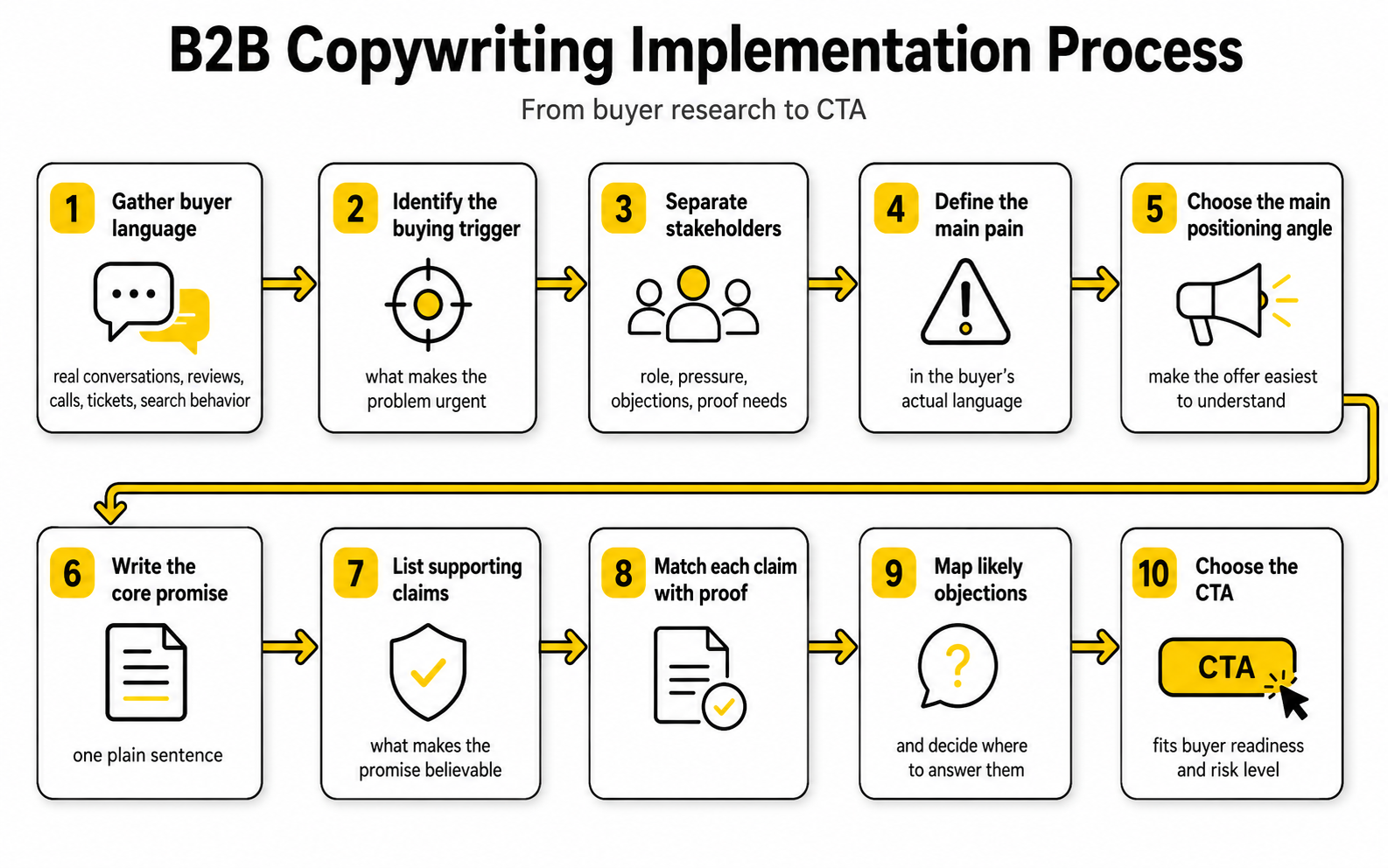
The implementation process should be simple enough to repeat. You want a workflow that can support one landing page today and a full messaging system later. The process below gives you that structure without making the work heavier than it needs to be.
This process makes the copy more objective. Instead of debating whether a headline “sounds good,” you can ask whether it reflects the trigger, promise, and positioning angle. Instead of adding another section because someone likes it, you can ask whether it answers a real buyer question.
That discipline matters. B2B copy gets messy when every stakeholder inside the selling company adds their favorite point. The process keeps the buyer’s decision at the center.
Write The Core Promise
The core promise is the clearest statement of what the buyer gets and why it matters. It should be specific enough to create interest but grounded enough to feel believable. If it sounds like any competitor could say it, it is not finished.
A weak core promise says something like “grow faster with more carefully automation.” It sounds positive, but it does not tell the buyer enough. A stronger promise connects the offer to a real operational outcome, such as improving lead response, reducing manual handoffs, increasing visibility, or making campaign execution easier.
The promise should also avoid overclaiming. In B2B, credibility is fragile. A buyer may keep reading after a bold claim, but they will quietly discount the entire page if the proof does not support it.
Test The Promise Against Buyer Reality
A useful test is to ask whether the buyer could repeat the promise internally without sounding naive. If they would feel uncomfortable saying it to their boss, the copy is probably too inflated. If they can repeat it clearly, the message is moving in the right direction.
Another test is to compare the promise with the buyer’s alternative. Are they replacing spreadsheets, manual follow-up, disconnected tools, a legacy platform, an agency, an internal process, or doing nothing? The promise should make the advantage over that alternative obvious.
For example, if the alternative is manual scheduling and back-and-forth email, a scheduling tool like Cal.com should not only be framed as a calendar link. The stronger angle is reducing coordination friction and making the next meeting easier to book. The buyer does not care about the tool category as much as the annoying problem it removes.
Create The Proof Inventory
A proof inventory is a list of the evidence you can use to support the copy. This should be built before drafting because proof often changes the structure. If you have strong implementation proof, you may want an implementation section higher on the page. If you have strong customer outcomes, you may want those outcomes close to the promise.
Proof can include metrics, customer quotes, product screenshots, workflow examples, integrations, security details, customer logos, review patterns, founder expertise, process documentation, or third-party validation. The point is to choose proof that matches the buyer’s doubt. More proof is not automatically better.
Do not use proof you cannot stand behind. Do not stretch a customer quote into a claim it does not support. Do not turn a small win into a universal promise. Buyers are skeptical for a reason, and the copy should reward their skepticism with clarity.
Connect Proof To Objections
Objections are not interruptions to the copy. They are part of the copy. If buyers are likely to worry about migration, adoption, cost, complexity, support, or time to value, those concerns should shape the proof inventory.
A simple way to connect proof to objections is to make a two-column list. On one side, write the objection in the buyer’s language. On the other side, write the proof that would make the concern feel smaller.
For example:
This makes the final copy much stronger. You are no longer hoping the buyer ignores their doubts. You are answering them directly, calmly, and before they become deal blockers.
Plan The Asset Before Drafting
Once the research, positioning, message map, promise, and proof inventory are clear, you can plan the actual asset. This is where you decide the format, section order, CTA, and level of detail. A landing page, outbound email, product page, and sales deck should not all carry the same weight.
A landing page has room to build the argument. A cold email has to create enough relevance for a reply, not explain the entire offer. A product page needs clarity and proof. A sales deck needs to help the buyer retell the story internally.
This planning step prevents overloading the asset. One of the biggest mistakes in b2b copywriting is trying to make one page do every job. When a page tries to educate, compare, prove, qualify, onboard, and close all at once, it becomes heavy and unfocused.
Match The Asset To The Buyer’s Intent
Buyer intent should decide how much explanation the copy needs. High-intent traffic can handle a more direct CTA because the buyer is already closer to action. Low-intent traffic needs more context, education, and trust-building before the ask.
This is why source matters. Someone clicking a branded search result knows more than someone clicking a cold ad. Someone visiting a comparison page is asking different questions than someone reading a thought leadership article. The copy should respond to that context.
The CTA should match the same logic. A high-intent buyer may be ready to book a demo. A lower-intent buyer may need a checklist, calculator, webinar, product tour, or email sequence first. Tools like Fillout can support forms and intake flows, but the form should only ask for information that makes sense at that stage.
Turn The Process Into A Repeatable System
The real value of this process appears when you repeat it. One strong page is useful. A repeatable message system is much more valuable because it improves campaigns, sales conversations, onboarding, and customer communication at the same time.
A repeatable system gives your team shared language. Marketing stops writing in one direction while sales explains the offer another way. Product marketing gets cleaner inputs. Sales enablement becomes easier because the proof, objections, and positioning are already organized.
This is where b2b copywriting becomes more than a writing task. It becomes a revenue discipline. The better your company gets at turning buyer insight into clear messaging, the easier it becomes to create assets that actually help deals move.
The next step is applying this system to the assets buyers actually see: pages, emails, ads, and sales materials. That is where the framework becomes visible, and where strong copy starts doing practical work in the market.
Writing Copy For B2B Pages, Emails, Ads, And Sales Assets
Once the research and message map are clear, the work becomes execution. This is where b2b copywriting turns into visible assets: pages, emails, ads, sales decks, lead magnets, comparison pages, nurture flows, and follow-up messages. The goal is not to make every channel sound identical, but to make every channel carry the same core argument.
Each asset has a different job in the buying journey. A landing page needs to focus attention. A nurture email needs to create momentum. An ad needs to earn the next click without overpromising. A sales asset needs to help the internal champion explain the case when your team is not in the room.
This is also where measurement starts to matter. You cannot judge B2B copy only by whether it sounds good. You need to know whether it attracts the right buyers, helps them understand the offer, moves them to the right next step, and improves the quality of the pipeline.
Statistics and Data
Data should make your copy decisions sharper, not noisier. The mistake is grabbing a benchmark, comparing it to your page, and making a random change because the number looks low. Benchmarks are useful only when you understand what was measured, who was included, and what action the number should drive.
For example, Unbounce’s conversion benchmark work found a median conversion rate of 6.6% across industries, based on a large dataset of landing pages, pageviews, and conversions. That number is useful as a rough reference, but it does not mean every B2B landing page below 6.6% is broken. A demo request for enterprise software, a free checklist, and a webinar registration page are not the same conversion.
Email benchmarks require the same caution. MailerLite’s 2025 benchmark data shows an average email open rate of 43.46% and average click rate of 2.09%, but open rates are less reliable than they used to be because privacy features can distort tracking. For B2B copy, clicks, replies, booked calls, qualified opportunities, and sales conversations usually tell you more than opens alone.
The buyer journey data matters even more than channel averages. Gartner’s 2025 sales research found that 61% of B2B buyers prefer a rep-free buying experience, while 73% actively avoid suppliers that send irrelevant outreach. That should change how you interpret copy performance. If the copy is vague, irrelevant, or too pushy too early, the issue is not only conversion rate; the issue is buyer trust.
What Measurement Should Actually Tell You
Measurement should answer one practical question: where is the buyer losing clarity, trust, or momentum? If you cannot answer that, you are just collecting numbers. A dashboard full of metrics is not the same as insight.
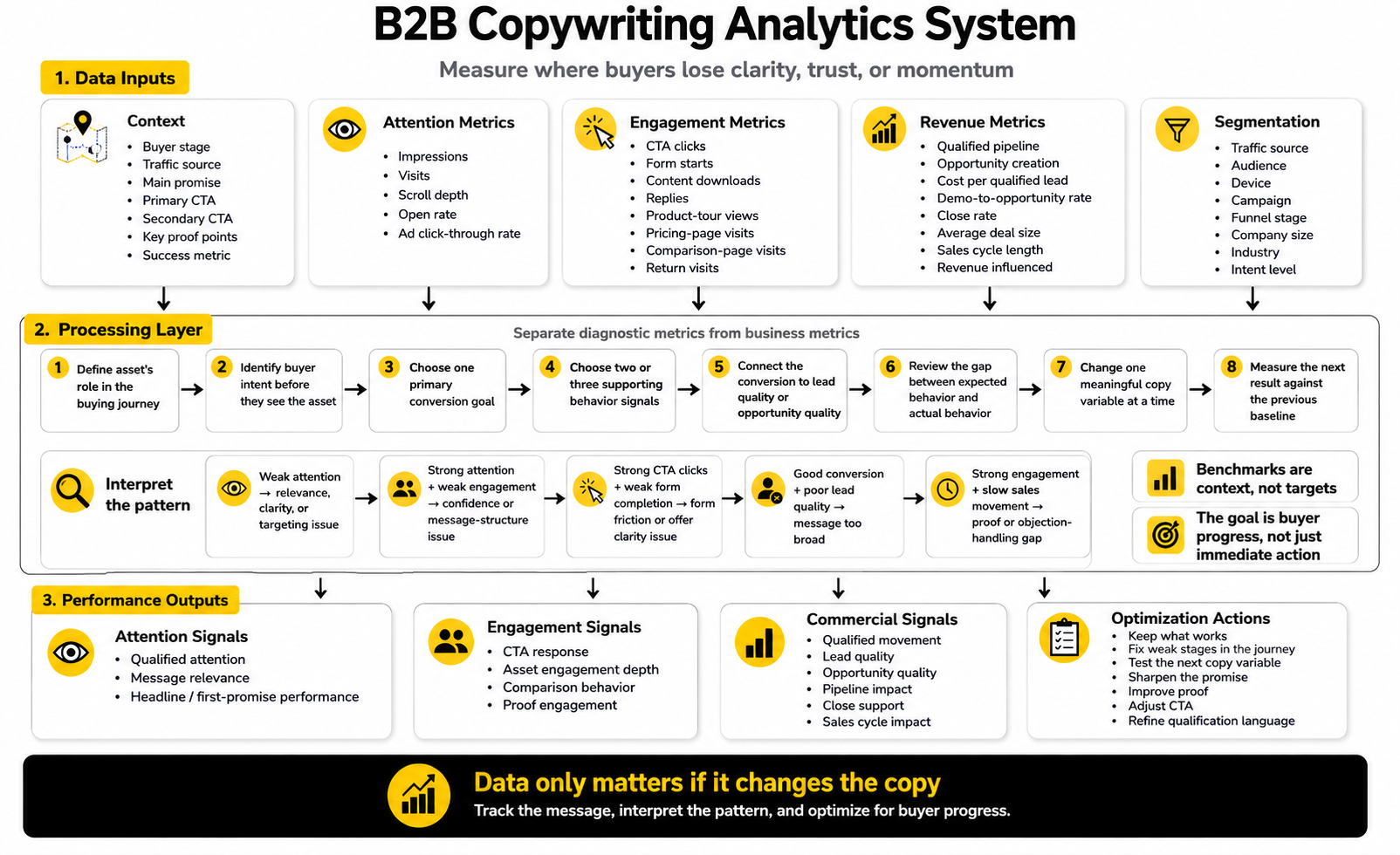
For B2B copy, the most useful metrics usually sit in layers. The first layer shows attention, such as impressions, visits, scroll depth, open rate, and ad click-through rate. The second layer shows engagement, such as clicks, form starts, content downloads, replies, video completion, comparison-page visits, and pricing-page visits. The third layer shows commercial quality, such as demo requests, qualified leads, opportunities, pipeline value, win rate, sales cycle length, and deal quality.
You need all three layers because one layer alone can mislead you. A page can get plenty of traffic and still attract the wrong buyers. An email can get clicks and still produce weak leads. A landing page can convert well on a low-friction offer while doing nothing meaningful for pipeline.
Attention Metrics
Attention metrics tell you whether the message is earning enough initial interest. They include ad click-through rate, organic click-through rate, email open rate, page visits, time on page, scroll depth, and content starts. These metrics are early signals, not final proof.
If attention is weak, the issue is usually relevance, clarity, or targeting. The headline may not connect to the buyer’s trigger. The ad may be promising something the landing page does not continue. The email subject line may be too generic to stand out in a crowded inbox.
Do not overreact to attention metrics without checking quality. A curiosity-driven headline can lift clicks while lowering trust. A broad promise can increase traffic while reducing conversion quality. In b2b copywriting, the best attention is qualified attention.
Engagement Metrics
Engagement metrics show whether the buyer is doing something meaningful after the first touch. This includes CTA clicks, form starts, asset downloads, reply rates, product-tour views, pricing-page clicks, comparison-page visits, and return visits. These signals are stronger than raw traffic because they show active evaluation.
If attention is healthy but engagement is weak, the copy may be creating curiosity without building enough confidence. The page might name the problem but fail to explain the mechanism. The email might get opened but not give the reader a reason to reply. The ad might earn the click but send people to a page that feels disconnected.
Engagement metrics are especially useful for diagnosing message structure. If readers drop before proof, the page may be too slow. If they reach the CTA but do not click, the offer may feel unclear, too risky, or poorly matched to intent. If many people start a form but do not finish, the form may be asking for too much too soon.
Revenue Metrics
Revenue metrics show whether the copy is helping the business, not just the marketing report. These include qualified pipeline, opportunity creation, cost per qualified lead, demo-to-opportunity rate, close rate, average deal size, sales cycle length, expansion, and revenue influenced. This is where copy performance becomes serious.
If conversion volume is strong but sales quality is weak, the copy may be attracting the wrong segment or overpromising the outcome. If demo requests are low but close rates are high, the message may be too hidden, too narrow, or not visible to enough qualified buyers. If sales cycles are long, the copy may not be answering objections early enough.
Revenue metrics should also feed back into copy. Sales calls reveal where buyers still feel uncertain. Lost-deal notes show which claims failed to land. Closed-won analysis shows which messages attracted the best-fit customers.
Build A Copy Analytics System
A copy analytics system does not need to be complicated. It needs to connect the message, the asset, the audience, the conversion point, and the commercial outcome. Without that connection, you will keep optimizing surface metrics while missing the real issue.
The system should start with a simple performance map. For every major asset, define the buyer stage, traffic source, main promise, primary CTA, secondary CTA, key proof points, and success metric. This creates context before you look at the numbers.
Then separate diagnostic metrics from business metrics. Diagnostic metrics help you find the problem. Business metrics tell you whether the asset is worth scaling. You need both, but you should not confuse them.
The Measurement Flow
A practical measurement flow starts with the buyer journey, not the dashboard. First, define what the asset is supposed to do. Then choose the signals that prove whether it is doing that job. Then decide what action you will take if the signal is weak.
For example, a cold email should not be judged like a long-form landing page. Its job may be to earn a reply, start a conversation, or drive a qualified click. A product page has a different job: it needs to clarify fit, explain value, support comparison, and move qualified buyers toward a deeper step.
A simple flow looks like this:
This keeps optimization clean. If you change the headline, offer, proof, CTA, page structure, and audience all at once, you may improve the result but learn nothing. A disciplined system helps you understand what actually moved the number.
Benchmarks Are Context, Not Targets
Benchmarks are useful because they stop you from operating in a vacuum. They help you see whether your numbers are wildly outside a normal range. But they should not become the main goal.
A high conversion rate can be bad if the leads are unqualified. A low conversion rate can be acceptable if the page is attracting enterprise buyers with serious intent and high deal value. The only useful benchmark is one that fits your offer, audience, traffic source, conversion type, and sales motion.
This is why your internal baseline matters more than most external averages. If your demo page converts at 2.5% today and moves to 3.4% with the same traffic quality, that may be a meaningful win. If your email sequence increases reply rate but lowers opportunity quality, that is not a win.
Segment Before You Judge
Before judging copy performance, segment the data. Break results down by traffic source, audience, device, campaign, funnel stage, company size, industry, and intent level where possible. Aggregated averages often hide the real story.
A page may look weak overall because paid social traffic is cold, while branded search converts well. An email sequence may look average overall because one segment is highly engaged and another segment should not be receiving that message at all. A pricing page may show low conversion because many visitors are early-stage researchers, not sales-ready buyers.
Segmentation turns vague opinions into useful questions. Instead of saying “the page is not converting,” you can say “paid search traffic from this pain-aware campaign clicks the CTA, but enterprise visitors abandon the form.” That is a much better problem to solve.
What Different Performance Signals Mean
Every metric is a clue, not a verdict. The job is to interpret the pattern. One weak number rarely tells the whole story, but several weak numbers together usually point to a specific copy problem.
If traffic is strong but scroll depth is low, the opening may not be relevant enough. If scroll depth is strong but CTA clicks are weak, the argument may be interesting but not persuasive. If CTA clicks are strong but form completion is weak, the offer may be appealing but the ask may feel too heavy.
If leads convert but do not become opportunities, the copy may be too broad. If opportunities are created but deals stall, the copy may not be supporting internal consensus, implementation confidence, or business justification. If deals close but churn later, the copy may be setting expectations the product or service cannot consistently meet.
Low Click-Through Rate
A low click-through rate usually means the first promise is not compelling enough for that audience. In ads, that could mean the hook is too broad, the pain is not urgent, or the creative does not match the buyer’s current concern. In email, it could mean the subject line gets attention but the body does not create a reason to act.
The fix is not always to make the copy louder. Often, the better fix is to make it more specific. A specific pain, audience, trigger, or outcome can outperform a dramatic but vague claim because it creates recognition.
You should also check message match. If the traffic source promises one thing and the page continues with something else, buyers feel friction immediately. That friction shows up as low engagement, quick exits, and weak conversion quality.
High Traffic, Low Conversion
High traffic with low conversion is one of the most common B2B copy problems. It usually means the page is attracting attention but not building enough confidence to earn action. The issue may be targeting, but copy often plays a major role.
Start by checking whether the page answers the buyer’s main decision questions. What is this? Who is it for? Why does it matter now? How does it work? Why should I believe it? What happens if I click?
If those answers are buried or vague, conversion will suffer. The buyer should not have to assemble the argument themselves. The copy should make the path obvious.
Good Conversion, Poor Lead Quality
Good conversion with poor lead quality is a warning sign. It means the copy is persuading people, but possibly the wrong people. That can happen when the promise is too broad, the offer is too easy, or the qualification language is too soft.
This is where B2B marketers need discipline. More leads are not always better. If sales spends more time filtering bad-fit inquiries, the copy is creating operational drag.
The fix is to sharpen the message, not hide the CTA. Name the right audience more clearly. Show who the offer is not for when appropriate. Add qualifying details around use case, company type, budget, maturity, or required commitment if those details protect sales quality.
Strong Engagement, Slow Sales Movement
Strong engagement with slow sales movement means buyers are interested but not fully convinced. They may be reading, clicking, and booking calls, but still struggling to build the internal case. This is where proof, objection handling, and sales enablement copy become critical.
Look at what buyers ask after they convert. If the same questions appear repeatedly on sales calls, the pre-sales copy is not doing enough. If buyers keep asking about implementation, add implementation clarity earlier. If they ask about ROI, give them a simple business case before the call.
This is also where comparison pages, security pages, use-case pages, and post-demo follow-up assets can improve pipeline movement. The goal is not to drown buyers in content. The goal is to answer the questions that slow deals down.
Measure Copy By Buyer Stage
Different buyer stages need different metrics. Early-stage assets should not be judged by the same standard as high-intent demo pages. When you use one measurement model for every asset, you end up punishing useful content for not acting like sales pages.
Early-stage copy should be measured by qualified attention, engagement depth, assisted conversions, return visits, and movement to middle-stage assets. Middle-stage copy should be measured by comparison behavior, CTA clicks, lead quality, and sales-readiness signals. Late-stage copy should be measured by demo requests, opportunity creation, sales cycle impact, objection reduction, and close support.
The 6sense 2025 Buyer Experience Report highlights that the favored vendor before seller engagement wins roughly 80% of the time. That makes early and middle-stage copy more important than many teams realize. Buyers are forming preferences before they ever become visible in your CRM.
Early-Stage Metrics
Early-stage metrics should show whether your copy is attracting the right problem-aware audience. Useful signals include organic impressions, search clicks, content engagement, newsletter signups, return visits, and movement from educational content to product or use-case pages. These metrics do not prove revenue by themselves, but they show whether the market is engaging with your point of view.
The key is to avoid vanity measurement. A blog post with high traffic but no movement to relevant next steps may be good media, but weak demand generation. A smaller article that consistently sends qualified readers to a comparison page, calculator, or email sequence may be more valuable.
Early-stage copy should also be judged by message resonance. Look at search queries, comments, internal shares, sales mentions, and qualitative feedback. Sometimes the strongest signal is not a conversion event; it is that buyers start using your language back to you.
Middle-Stage Metrics
Middle-stage metrics should show whether buyers are evaluating the offer seriously. Useful signals include case study views, comparison-page visits, pricing-page visits, product-tour engagement, webinar attendance, calculator use, and email clicks into proof-heavy assets. These behaviors suggest the buyer is moving from curiosity to consideration.
If middle-stage engagement is weak, the copy may not be giving buyers enough reason to compare you seriously. The problem might be unclear differentiation, weak proof, missing use cases, or a lack of practical detail. This is where positioning and proof have to work together.
Middle-stage assets should help the buyer build confidence. They should clarify fit, explain tradeoffs, and make the internal conversation easier. If they only repeat the homepage promise, they are not doing their job.
Late-Stage Metrics
Late-stage metrics should show whether copy is helping buyers take serious action and move through sales with fewer doubts. Useful signals include demo requests, meeting show rates, opportunity creation, proposal requests, close rate, sales cycle length, and objections raised during calls. These are the metrics closest to revenue.
If late-stage conversion is weak, look carefully at the CTA, form, proof, pricing clarity, and risk-reversal language. Buyers may believe the problem but not trust the next step. They may want to act but not know what happens after they submit the form.
Late-stage copy should reduce uncertainty. It should tell buyers what they will get, how the process works, who the offer fits, and why taking the next step is worth their time. Small clarity improvements here can have a serious commercial impact.
Turn Analytics Into Copy Decisions
Analytics only matter when they lead to action. A monthly report that says traffic is up, conversions are down, and bounce rate changed is not enough. The report should recommend what to change and why.
The best copy decisions come from combining quantitative and qualitative signals. Quantitative data shows where the friction happens. Qualitative data helps explain why. You need both because numbers can show the leak, but buyer language often explains the cause.
For example, if many visitors reach the pricing section but do not convert, the issue may not be price itself. It could be unclear packaging, missing proof, weak differentiation, or uncertainty about implementation. Analytics points you to the room. Buyer research tells you what is happening inside it.
Use A Simple Decision Tree
A decision tree keeps optimization focused. It prevents teams from changing random parts of the copy just because a metric looks uncomfortable. Start with the weakest stage in the journey, then diagnose backward.
Use this simple logic:
This keeps the team honest. You are not “optimizing copy” in a vague way. You are fixing the specific point where the buyer loses momentum.
Tools Should Support The Measurement Model
Tools can help you collect, connect, and act on performance data, but they cannot decide what matters for you. Before choosing tools, define the measurement model. Otherwise, you end up with more dashboards and the same confusion.
For funnel and landing-page execution, platforms like ClickFunnels can help teams publish and test conversion paths. For agencies and service businesses that need CRM, automation, pipeline tracking, and follow-up in one place, GoHighLevel can support the operational side of the buyer journey. For attribution-friendly links and campaign tracking, Dub.co can help keep link performance cleaner.
The point is not to chase a perfect stack. The point is to make sure your tools can answer the questions your copy strategy depends on. Which message brought the buyer in? Which page created action? Which CTA produced qualified pipeline? Which asset helped sales move the deal forward?
Track The Promise, Not Just The Page
One of the smartest things you can do is track performance by promise. If you test three different angles across ads, emails, and landing pages, tag them clearly. That lets you see which promise creates not just clicks, but qualified conversations.
This matters because a page-level report can hide message-level insight. Two campaigns may send traffic to the same landing page, but one promise may attract better buyers than the other. Without tracking the promise, you will not see that.
Promise-level tracking also improves future copy. You learn which pain points, outcomes, and proof themes create commercial movement. Over time, your b2b copywriting becomes less dependent on opinion and more grounded in buyer behavior.
What To Review Every Month
A monthly copy review should be short, practical, and tied to decisions. The goal is not to admire the dashboard. The goal is to decide what to keep, what to fix, and what to test next.
Review the highest-impact assets first. These are usually the homepage, key product or service pages, demo pages, paid landing pages, outbound sequences, nurture emails, comparison pages, and sales follow-up materials. Small improvements on these assets can matter more than rewriting low-traffic content.
The monthly review should answer five questions:
This is enough to keep momentum without drowning the team. The best B2B copy systems improve through steady, focused iteration. Not chaos. Not endless redesigns. Just better buyer insight, clearer messaging, stronger proof, and cleaner measurement every month.
The Data Only Matters If It Changes The Copy
The purpose of measurement is better decisions. If the data does not change what you write, emphasize, remove, prove, or test, it is not helping much. It is just reporting.
Good data makes your copy sharper. It shows which buyer segments respond, which promises create qualified demand, which objections slow deals, and which assets help sales. It also keeps teams from confusing activity with progress.
This is where b2b copywriting becomes a performance discipline. The copy is not finished when it goes live. It is finished when the market has responded, the data has been interpreted, and the next version is stronger because of what buyers actually did.
Proof, Objection Handling, And Conversion Optimization
At this stage, the copy is no longer just explaining the offer. It has to carry the buyer through the harder part of the decision: trust, comparison, internal agreement, and risk reduction. This is where advanced b2b copywriting separates itself from surface-level messaging.
The buyer may already understand the problem. They may already believe your product or service could help. But belief is not the same as readiness to act, especially when the purchase affects budget, team workflow, reporting, operations, customer experience, or executive visibility.
The copy now has to do a more mature job. It has to make the decision feel safer without sounding defensive. It has to sharpen the argument without oversimplifying the tradeoffs. It has to help the buyer move from “this looks interesting” to “this is the option we can justify.”
The Real Role Of Proof
Proof is not decoration. It is a risk-reduction system. Every meaningful proof point should answer a specific doubt the buyer might have before moving forward.
This is why a wall of logos is not enough. Logos can create familiarity, but they do not explain what changed for the customer, how the product was implemented, what tradeoff was solved, or why the result is relevant to the current buyer. In complex B2B decisions, proof needs context.
Gartner’s 2025 sales research found that 69% of B2B buyers report inconsistencies between information on a supplier’s website and what sellers provide. That number matters because proof is not only about persuasion. It is also about message consistency. If the website says one thing and the sales conversation says another, buyer confidence drops.
Use Proof Where The Doubt Appears
The best place for proof is near the claim that creates the doubt. If your copy says implementation is fast, proof should appear right there. If your copy says reporting becomes clearer, show what becomes clearer and for whom. If your copy says the platform replaces multiple tools, show the workflow or consolidation logic before the buyer has to ask.
This makes the reading experience smoother. The buyer does not have to hold a question in their head for five sections before you answer it. You reduce friction at the moment it appears.
A practical proof placement system looks like this:
This does not mean every section needs a heavy proof block. Sometimes one specific sentence is enough. The point is to connect evidence to the buyer’s doubt instead of treating proof as a generic credibility section.
Handle Objections Before They Become Sales Problems
Objection handling is not something that only happens on sales calls. Good copy handles predictable objections before the buyer has to raise them. That is not pushy; it is respectful.
If buyers consistently ask the same question after reading your page, the page is probably incomplete. If sales keeps explaining the same implementation detail, migration concern, pricing logic, or use-case fit, the copy should absorb that work. Sales should not have to patch holes that marketing could have closed earlier.
The key is to handle objections calmly. Do not write like you are arguing with the buyer. Write like you understand why a smart person would hesitate, then give them the information they need to keep evaluating.
The Five Objection Categories
Most B2B objections fall into a few predictable categories. Once you know the category, it becomes much easier to decide what the copy should say. This also helps you avoid random FAQ-style answers that do not actually reduce risk.
The main categories are:
Each category needs a different type of answer. Fit needs use cases, segmentation, and clear qualification. Value needs business impact, cost logic, and outcome clarity. Risk needs proof, transparency, and process. Effort needs onboarding, templates, integrations, or support detail. Consensus needs language and evidence the champion can share internally.
This is one of the most practical ways to improve b2b copywriting quickly. Do not start by rewriting everything. Start by listing the top objections, then check whether the page answers them clearly.
The Consensus Problem
B2B copy often fails because it persuades one person but does not help that person persuade the group. That is a different challenge. The reader might like the offer and still be unable to get approval.
Modern buying groups are larger, more cautious, and more dependent on validation from multiple sources. Forrester’s 2025 buying research shows that 73% of purchases involve three or more departments, with an average of 13 internal participants. That means your copy has to travel. It has to make sense when forwarded, summarized, screenshotted, quoted in a meeting, or compared against a competitor.
This changes the job of your assets. A landing page should persuade the reader, but it should also equip the reader. A case study should build trust, but it should also give the champion a clean story to retell. A pricing page should explain cost, but it should also help the buyer defend the spend.
Write For The Internal Champion
The internal champion is often your most important reader. They may not control the final budget, but they can keep the deal alive. They need clear language, credible proof, and a simple argument they can repeat.
This is where vague copy becomes a real liability. A champion cannot walk into a meeting and say, “This vendor helps us build growth with a smooth platform.” That sounds like marketing fog. They need something sharper, such as “This would reduce manual follow-up, centralize lead activity, and give sales and marketing one view of pipeline activity.”
Give champions phrases they can use. Give them short summaries, comparison points, business-case logic, and implementation clarity. Make them look smart for bringing the idea forward.
The same principle applies to sales follow-up. After a demo, send language that reinforces the decision. A tool like GoHighLevel can help manage follow-up workflows and pipeline stages, but the follow-up copy still needs to help the buyer build internal agreement. Automation should support consensus, not just send reminders.
The Tradeoff Between Clarity And Completeness
One of the hardest parts of advanced B2B copy is deciding what to leave out. Complex offers create pressure to explain everything. Product teams want feature depth. Sales wants every objection covered. Leadership wants the big vision. Buyers want clarity.
If you include everything, the copy becomes heavy. If you simplify too much, the buyer may not have enough information to trust the offer. The skill is finding the right level of detail for the asset’s job.
A homepage should not act like a technical implementation guide. A technical page should not act like an ad. A cold email should not try to replace a sales deck. Each asset should do its own job well and point to the next useful step.
Use Progressive Disclosure
Progressive disclosure means giving buyers the right amount of information at the right moment. You lead with the clearest argument, then offer deeper detail when the buyer needs it. This keeps the main copy readable without hiding important substance.
For example, a landing page might lead with the core promise, show the main use cases, include proof, and answer the most important objections. Then it can link or point to deeper resources such as technical documentation, case studies, comparison pages, implementation guides, or pricing details. The buyer gets clarity first and depth second.
This is especially useful for software, consulting, infrastructure, analytics, automation, and other complex B2B offers. The copy does not have to carry every technical detail in the main flow. It has to make the next layer of detail easy to find.
A form tool like Fillout can support progressive intake when the next step requires more context from the buyer. The copy around that form should explain why each step is useful. When buyers understand the reason for the ask, friction feels lower.
Comparison Copy Needs Discipline
Comparison copy is powerful because buyers compare anyway. If you do not help shape the comparison, they will do it without you. But comparison copy has to be handled carefully because it can either build trust or make the brand look insecure.
A good comparison page does not attack competitors. It clarifies tradeoffs. It helps buyers understand which option fits which situation, where your offer is stronger, and what buyers should consider before choosing. That tone feels more credible than exaggerated “us versus them” messaging.
The best comparison copy is confident enough to be fair. It can admit where another approach may be better for a different buyer while still explaining why your approach is stronger for your ideal customer. That kind of honesty builds trust because it shows you are not trying to win every possible deal.
Compare Buying Criteria, Not Just Features
Feature tables can be useful, but they are often too shallow. Buyers are not only comparing whether tools have a feature. They are comparing whether the feature solves the problem well enough, whether the team will use it, whether it fits their workflow, and whether the vendor can support the decision.
Better comparison copy focuses on buying criteria. These might include implementation effort, workflow fit, reporting depth, customization, support model, integrations, scalability, pricing structure, compliance, or time to value. This helps the buyer think more clearly.
For example, comparing funnel platforms only by page-builder features misses the bigger decision. A buyer may care about speed to launch, templates, checkout flow, analytics, email follow-up, integrations, or how easy it is for a small team to manage campaigns. A platform like ClickFunnels may fit buyers who want a focused funnel-building environment, while Systeme.io may appeal to buyers looking for a broader all-in-one setup at a different level of simplicity. The copy should help the buyer understand the tradeoff, not pretend every option serves the same need.
Pricing Copy Is Part Of The Sale
Pricing pages are often treated as administrative pages. That is a mistake. In B2B, pricing copy is part of the persuasion process because it frames value, risk, qualification, and trust.
A pricing page should do more than list plans. It should help buyers understand which option fits them, what is included, what might affect cost, what happens next, and why the investment makes sense. If the pricing model is complex, the copy should make the logic clear.
Do not hide behind vague language unless there is a real reason. Buyers do not need every detail upfront in every sales motion, but they do need enough clarity to know whether continuing is worth their time. If pricing feels intentionally opaque, some buyers will leave before sales ever gets a chance.
Reduce Pricing Anxiety
Pricing anxiety usually comes from uncertainty. The buyer wonders whether the cost will change, whether the plan includes what they need, whether implementation is extra, whether usage will create surprises, or whether they will be pressured after booking a call. Good pricing copy reduces that uncertainty.
Useful pricing copy can explain:
This is not about making everything cheap. It is about making the decision feel understandable. Buyers can handle serious pricing when the value and process are clear.
AI Raises The Bar For Human Judgment
AI can help with research synthesis, outlining, repurposing, draft variation, and message testing. It can speed up B2B copy production dramatically. But it also makes generic copy easier to produce at scale, which means buyers will see even more average content.
That creates a higher bar for human judgment. The advantage is not simply producing more copy. The advantage is using better inputs, sharper positioning, stronger proof, and more specific buyer insight. AI can help execute, but it cannot replace strategic taste.
Edelman and LinkedIn’s 2025 B2B thought leadership research is based on nearly 2,000 global professionals, including visible and hidden decision-makers, and the takeaway is useful for copywriters: buyers reward content that helps them think, align, and evaluate. Thin content is easy to ignore. Useful thinking still stands out.
Use AI Without Flattening The Message
The risk with AI-assisted copy is sameness. If the prompt is generic, the output will be generic. If the source material is weak, the draft will sound smooth but empty.
Use AI after the strategic work is done, not instead of it. Feed it buyer language, positioning notes, proof points, objections, competitor context, and the asset’s role in the journey. Then use human judgment to sharpen, cut, verify, and make the final copy sound like a real brand talking to a real buyer.
AI is also useful for creating variations. You can test different headline angles, email openings, CTA phrasing, proof placements, and objection sections faster. But the final decision should not be based on which version sounds flashiest. It should be based on which version best matches buyer intent and reduces decision friction.
For teams building AI-supported workflows, tools like Chatbase can help create conversational experiences around existing knowledge, while Firecrawl can support structured web data collection for research workflows. The important part is governance. Better tools do not excuse unverified claims.
Scaling B2B Copy Without Losing Quality
Scaling copy is not the same as producing more assets. A team can publish more pages, emails, and ads while making the message weaker. Real scaling means increasing output while protecting strategic consistency.
The foundation is a messaging system. This includes the core promise, positioning angle, buyer language bank, proof inventory, objection library, CTA rules, tone guidance, and approved claims. When those pieces are documented, writers can move faster without reinventing the message every time.
This is especially important when multiple people touch the buyer journey. Demand generation, content, product marketing, sales, customer success, and leadership all influence the message. Without a system, every channel starts drifting.
Build Reusable Message Assets
Reusable message assets make quality easier to maintain. They give teams tested language and proof blocks that can be adapted across channels. This saves time and protects consistency.
Useful reusable assets include:
These assets should not become rigid scripts. They should become reliable starting points. Good writers still adapt the copy to the channel, audience, and intent.
A social scheduling tool like Buffer can help distribute message variations across channels, but distribution should come after message discipline. Scaling a weak message only makes the weakness more visible.
The Risks Of Over-Optimization
Optimization is useful until it starts making the copy smaller. If every decision is driven by short-term conversion data, teams can slowly strip out the nuance, education, and trust-building that B2B buyers actually need. That is how brands end up with aggressive pages that convert some traffic but weaken long-term confidence.
The danger is especially real when teams optimize only for form fills. A more dramatic promise may increase conversions. A shorter page may increase clicks. A stronger incentive may increase leads. But if those leads are less qualified, less trusting, or less likely to close, the “win” is fake.
B2B copy should be optimized for buyer progress, not just immediate action. Sometimes the best-performing asset is not the one that gets the most clicks. It is the one that helps the right buyer understand the business case and move forward with fewer doubts.
Protect Trust As A Performance Metric
Trust is harder to measure than clicks, but it affects everything. It affects whether buyers believe the claim, share the page, reply to the email, show up for the demo, involve stakeholders, and stay engaged through the sales process. If your copy sacrifices trust for short-term attention, you pay for it later.
Protecting trust means avoiding inflated claims, fake urgency, misleading comparisons, cherry-picked proof, and unclear pricing logic. It also means admitting tradeoffs when honesty would help the buyer make a better decision. Confidence is attractive. Hype is expensive.
The best B2B copy feels like it was written by a company that understands the buyer and respects the decision. That tone is not soft. It is commercially smart.
When To Rewrite, Refresh, Or Leave The Copy Alone
Not every underperforming asset needs a full rewrite. Sometimes the problem is one section, one proof gap, one CTA mismatch, or one traffic source. Rewriting everything can waste time and destroy useful learning.
A full rewrite makes sense when the positioning has changed, the audience has changed, the offer has changed, or the existing copy is built around the wrong buying situation. A refresh makes sense when the strategy is still right but the proof, examples, structure, or CTA needs improvement. Leaving the copy alone makes sense when the asset is performing its job and there are higher-impact problems elsewhere.
This requires discipline. Teams often rewrite copy because they are tired of looking at it, not because buyers are struggling with it. Internal fatigue is not the same as market failure.
Use Evidence Before You Touch The Page
Before rewriting, check the evidence. Look at analytics, heatmaps, form behavior, sales feedback, CRM quality, call recordings, search queries, and customer language. The pattern should tell you whether the issue is attention, engagement, conversion, qualification, or sales movement.
Then decide the smallest meaningful change. If the headline is unclear, fix the headline. If proof is missing, add proof. If the CTA is too heavy, adjust the next step. If the entire positioning is wrong, then rewrite the page properly.
This is how expert-level b2b copywriting stays practical. It does not chase perfection. It improves the message where improvement will actually affect buyer progress.
The Strategic Standard For Strong B2B Copy
Strong B2B copy should pass a higher standard than “does it sound persuasive?” It should make the buyer’s decision easier. That is the real test.
The copy should clarify the problem, frame the cost of inaction, position the offer, explain the mechanism, support the claims, handle objections, guide the next step, and help internal consensus. If it does those things well, it can create commercial impact across the entire journey.
It should also stay honest. No fake certainty. No inflated numbers. No empty urgency. No hiding important tradeoffs behind polished language.
That is the mature version of b2b copywriting. It is not just writing to get attention. It is writing to help serious buyers make serious decisions with more confidence.
Implementation, Measurement, And FAQ
The final step is turning b2b copywriting into a working system. Not a one-off page. Not a clever campaign. A system your team can use to research buyers, write stronger assets, measure performance, improve conversion quality, and support sales conversations with fewer gaps.
This matters because B2B copy touches more of the revenue journey than most teams admit. It shapes what buyers believe before they talk to sales. It affects which leads convert, which objections appear, how internal champions explain the offer, and whether the final buying group feels confident enough to move.
The best copy systems are not complicated. They are clear, repeatable, and connected to real buyer behavior. They help the team make better decisions without rewriting everything from scratch every month.
Build The Final B2B Copywriting System
A strong system starts with ownership. Someone needs to protect the message, maintain the research, update proof, and make sure the copy does not drift as campaigns multiply. Without ownership, every new page, ad, email, and sales deck slowly becomes its own version of the truth.
The system should include a buyer language bank, positioning document, proof inventory, objection library, asset map, CTA rules, measurement dashboard, and review rhythm. That may sound like a lot, but each part has a practical job. Together, they stop the team from guessing.
The buyer language bank keeps the copy grounded. The positioning document keeps the strategy consistent. The proof inventory keeps claims believable. The objection library helps writers answer doubts earlier. The asset map shows what each page or sequence is supposed to do. The CTA rules keep next steps aligned with buyer intent. The dashboard shows what is working. The review rhythm keeps the system alive.
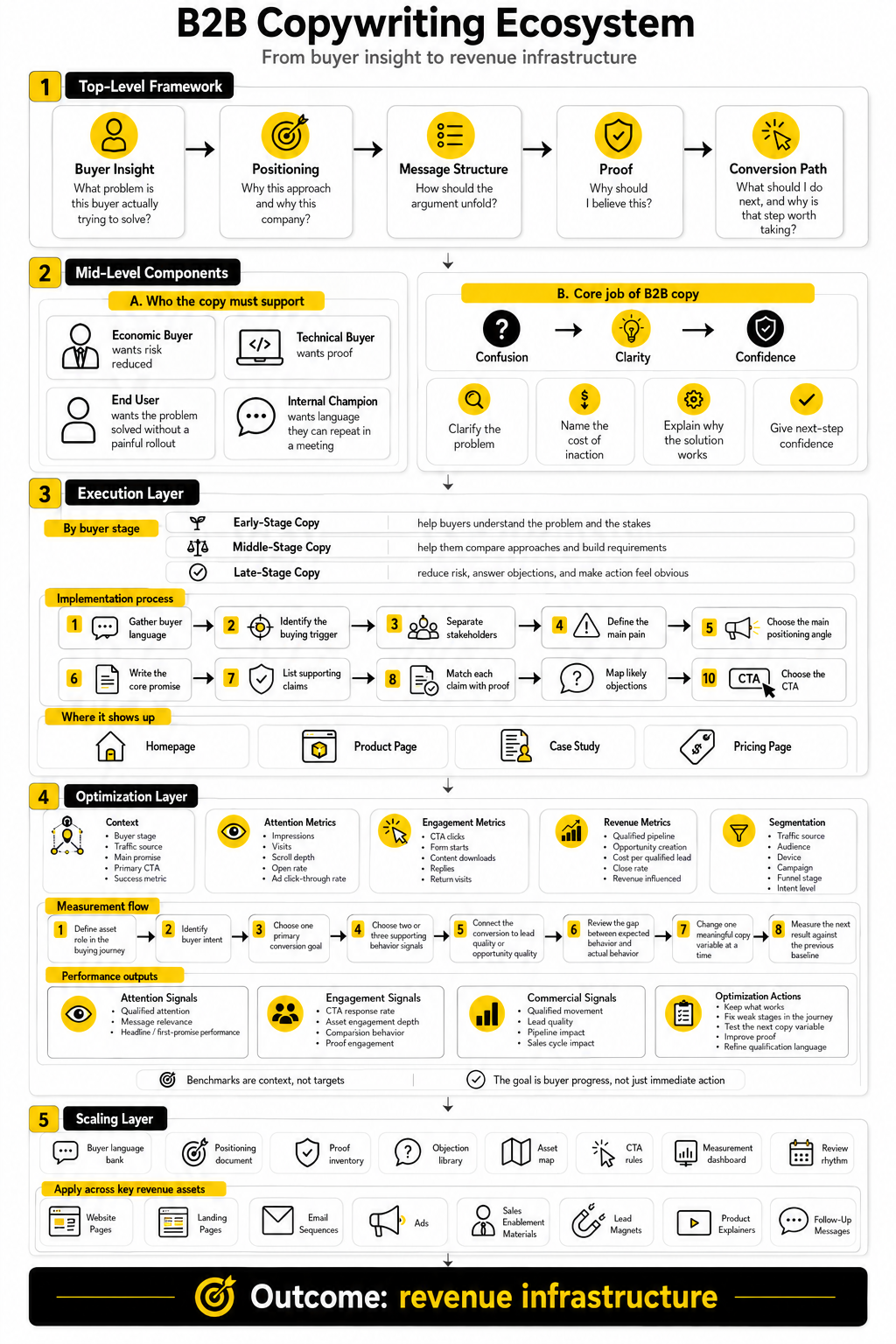
Keep The System Small Enough To Use
The system should not become a giant internal document that nobody opens. If the team cannot use it quickly, it will not survive. B2B copywriting improves when the system is practical enough to guide everyday decisions.
A useful version can be built around a few core assets:
This gives writers, marketers, founders, and sales teams a shared source of truth. It also makes onboarding easier because new contributors can understand the message faster. That becomes more important as the team scales.
Use AI Carefully Inside The System
AI can make this system faster, but it can also make weak messaging spread faster. That is the tradeoff. If the inputs are specific and verified, AI can help produce drafts, variations, summaries, repurposed assets, and research synthesis. If the inputs are vague, it will produce polished sameness.
The right way to use AI in b2b copywriting is to feed it real buyer language, positioning notes, proof points, objections, and channel context. Then use human judgment to edit for accuracy, tone, differentiation, and credibility. AI should speed up the work, not replace the thinking.
HubSpot’s 2025 AI marketing research is built around data from more than 1,500 marketers worldwide, which shows how quickly AI has moved into mainstream marketing workflows. That does not mean every AI-generated asset is good. It means teams need clearer standards, better source material, and stronger review processes than before.
Create A Review Standard
Every AI-assisted draft should pass a simple review before it goes live. The question is not “does this sound good?” That is too shallow. The question is whether the copy is accurate, specific, useful, and aligned with the buyer’s decision.
A practical review should check:
This is where human expertise still matters. AI can produce options quickly. A skilled marketer decides which option deserves to represent the business.
Align Marketing, Sales, And Customer Success
B2B copy gets stronger when marketing, sales, and customer success share what they know. Marketing sees traffic, engagement, and campaign performance. Sales hears objections, urgency, and competitive comparisons. Customer success understands what buyers value after they become customers.
If those teams do not share insight, the copy becomes incomplete. Marketing may write promises sales cannot defend. Sales may explain value in language that never appears on the website. Customer success may know the strongest retention drivers, but those points never make it into acquisition copy.
A monthly message review can fix this. It does not need to be long. The goal is to collect what buyers are saying, what deals are stalling on, what customers praise, and what claims need stronger proof.
Ask Better Internal Questions
The quality of internal feedback depends on the questions you ask. “What do you think of this page?” usually produces subjective opinions. Better questions produce useful copy input.
Ask sales:
Ask customer success:
Ask marketing:
Those answers are copy fuel. They are also strategy fuel.
Make The Copy Easier To Update
B2B offers change. Markets shift. Competitors adjust. Buyers become more educated. Proof improves. Pricing changes. If your copy system is hard to update, it will become outdated quietly.
That is why modular copy matters. Instead of treating every page as a completely separate project, build reusable message blocks. These can include proof sections, objection responses, industry-specific pain points, product explanations, CTA blocks, and short summaries for sales follow-up.
This makes refreshes faster and safer. When the core proof changes, you can update the proof block across key assets. When a new objection appears, you can add it to the objection library and decide which pages need it. When positioning changes, you can update the source document before rewriting public pages.
Refresh Based On Buyer Change
Do not refresh copy only because the team is bored with it. Internal boredom is not a strategy. Refresh copy when buyer behavior, market context, offer positioning, proof, performance data, or sales feedback shows that the message needs improvement.
A useful refresh rhythm might look like this:
This keeps the copy current without creating constant chaos. The goal is steady improvement, not endless rewriting.
What Is B2B Copywriting?
B2B copywriting is writing that helps businesses sell products or services to other businesses. It can appear on websites, landing pages, emails, ads, sales decks, case studies, comparison pages, product pages, and follow-up sequences. The goal is to make the offer clear, credible, and easy for a buying group to act on.
How Is B2B Copywriting Different From B2C Copywriting?
B2B copywriting usually has to persuade more than one person. The buyer may need approval from finance, operations, IT, legal, leadership, or end users before a purchase happens. That means the copy has to handle proof, risk, implementation, internal justification, and business impact more directly than most consumer copy.
Why Does B2B Copy Need So Much Proof?
B2B purchases often involve budget risk, workflow change, team adoption, and professional reputation. Buyers need to know that the promise is realistic before they recommend the solution internally. Proof reduces uncertainty by showing outcomes, process, customer fit, product details, and credible evidence near the claims that need support.
What Makes A Good B2B Headline?
A good B2B headline makes the right buyer recognize the problem, outcome, or opportunity quickly. It should be clear before it is clever. The best headlines usually connect a specific audience with a specific business result or painful situation, without exaggerating what the offer can do.
How Long Should B2B Copy Be?
B2B copy should be as long as the decision requires and as short as clarity allows. A cold email may need only a few focused lines. A complex product page, comparison page, or enterprise landing page may need more depth because the buyer has more questions, risks, and stakeholders to satisfy.
What Research Should Come Before Writing B2B Copy?
Start with buyer interviews, sales calls, customer success notes, support tickets, reviews, search behavior, competitor positioning, and lost-deal feedback. The goal is to understand the buyer’s trigger, language, objections, alternatives, and desired outcome. Without that research, the copy usually becomes generic.
How Do You Measure B2B Copywriting Performance?
Measure the asset based on its job in the buying journey. Early-stage copy can be measured by qualified attention, engagement, return visits, and movement to deeper assets. Middle-stage copy should be measured by comparison behavior, proof engagement, and lead quality. Late-stage copy should be measured by demo requests, opportunity quality, sales cycle movement, and close support.
What Is The Biggest Mistake In B2B Copywriting?
The biggest mistake is writing from the company’s perspective instead of the buyer’s decision process. Companies often lead with features, internal terminology, and vague claims. Buyers need problem clarity, business context, proof, tradeoffs, and a next step that makes sense for their level of intent.
Should B2B Copy Be Formal Or Conversational?
B2B copy should be clear, professional, and human. Formal does not automatically mean credible, and casual does not automatically mean relatable. The best tone sounds like a sharp expert explaining the issue plainly to a smart buyer who does not have time for fluff.
How Do You Write Copy For A Buying Committee?
Write for the main reader, but support the people around them. The economic buyer needs value and risk clarity. The technical buyer needs fit, security, integration, and implementation details. The end user needs usability and workflow confidence. The internal champion needs simple language and proof they can repeat in a meeting.
How Often Should B2B Copy Be Updated?
High-impact assets should be reviewed regularly, especially when performance changes, buyer objections shift, competitors reposition, or the offer evolves. A monthly review works well for core conversion assets. Larger positioning reviews can happen quarterly or after major market, product, pricing, or customer changes.
Can AI Replace B2B Copywriters?
AI can help draft, summarize, repurpose, and test variations, but it cannot replace strategic judgment. Strong b2b copywriting still depends on buyer insight, positioning, proof selection, market understanding, and editorial taste. AI is most useful when a skilled human gives it strong inputs and reviews the output carefully.
What Tools Help With B2B Copywriting Execution?
The right tools depend on the workflow. Funnel tools like ClickFunnels, all-in-one platforms like GoHighLevel, email tools like Brevo, scheduling tools like Cal.com, and form tools like Fillout can all support execution. But tools do not fix weak messaging. The strategy has to come first.
What Should A B2B Copywriter Deliver?
A strong B2B copywriter should deliver more than finished words. They should help clarify the buyer, positioning, core promise, message structure, proof needs, objections, and conversion path. The final copy should be easier for marketing to publish, easier for sales to use, and easier for buyers to understand.
How Do You Know If B2B Copy Is Working?
The copy is working when the right buyers understand the offer faster, take the right next step, ask better questions, move through sales with fewer repeated objections, and produce stronger pipeline quality. Traffic and clicks matter, but they are not enough. The real test is buyer progress.
The Practical Standard
Strong b2b copywriting makes serious buying decisions easier. That is the standard. Not cleverness, not volume, not keyword repetition, and not surface-level polish.
The copy should help buyers understand what is broken, why it matters, what approach solves it, why this offer is credible, what tradeoffs exist, and what step makes sense next. If it does that, it becomes more than marketing content. It becomes part of the sales system.
The companies that win with copy are usually not the ones shouting the loudest. They are the ones explaining the clearest, proving the strongest, and respecting the buyer’s decision process at every step.
Build a stronger local presence with BAAM AI
Turn your website, Google profile, social channels, and AI visibility into one growth engine
Most businesses do not need more random marketing activity. They need a consistent presence system that helps the right people find them, trust them, and take action. BAAM AI brings strategy, local SEO, website updates, Google Maps visibility, social content, AI-search readiness, media production, and reporting into one practical monthly engine.
If you want your marketing to keep working after the campaign ends, start with a free BAAM AI presence audit. See how your business shows up today and where the fastest visibility wins are at BAAM AI.