
BAAM AI Blog
Automotive Email Marketing: A Practical Framework For Turning Leads, Buyers, And Service Customers Into Revenue
Automotive email marketing is not about sending monthly blasts to a tired list and hoping someone books a test drive. It is the discipline of using email to move real people through real moments: early research...
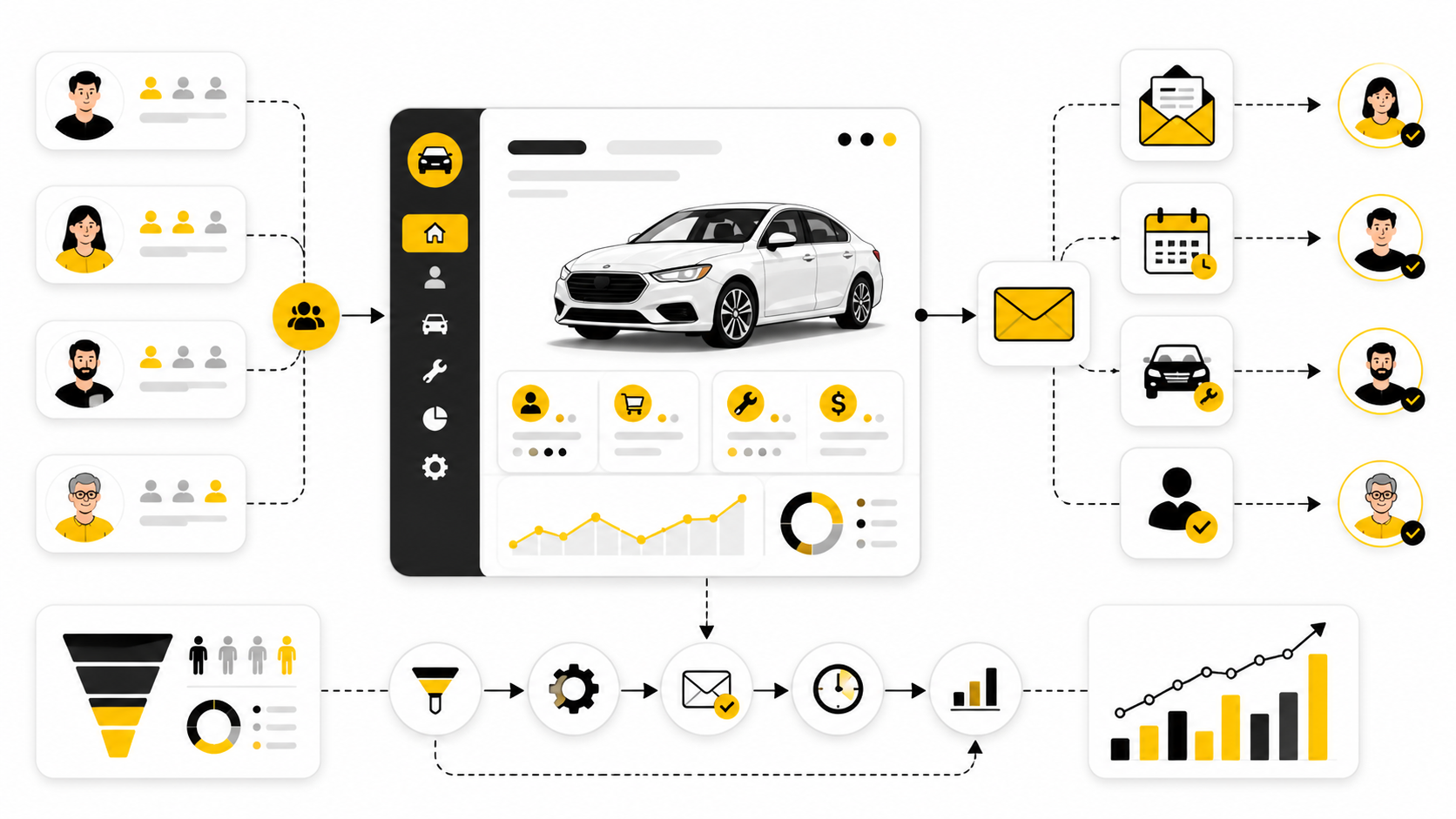
Automotive email marketing is not about sending monthly blasts to a tired list and hoping someone books a test drive. It is the discipline of using email to move real people through real moments: early research, vehicle comparison, financing questions, appointment scheduling, post-sale onboarding, service reminders, trade-in timing, loyalty, and repeat purchase.
That matters because automotive buying is long, emotional, and expensive. Shoppers rarely wake up, click one ad, and buy a vehicle the same day. They research, compare, delay, ask family, check payment options, revisit inventory, and often switch between online and showroom interactions before making a decision.
Email sits in the middle of that journey because it gives dealers, OEMs, brokers, service centers, and automotive marketers a direct channel they can own. Paid ads can create attention, search can capture intent, and social can build familiarity, but email is where the relationship can keep moving after the first click. The dealers that win with email are not necessarily the loudest; they are the most relevant, timely, and useful.
The opportunity is bigger than a simple newsletter. The latest Cox Automotive Car Buyer Journey research shows how much of the car-buying process now depends on digital efficiency, transparency, and smoother online-to-offline handoffs. At the same time, Salesforce’s State of Marketing research shows that marketers broadly recognize the shift toward personalized, two-way messaging, while many still struggle to use data well enough to deliver it. That gap is exactly where a more carefully automotive email marketing system can create leverage.
Email also remains one of the few channels where the economics can still make sense when acquisition costs rise. Litmus reports that many companies continue to see strong email ROI, but that return does not come from random sending. It comes from segmentation, lifecycle timing, clear offers, clean data, deliverability discipline, and follow-up that respects where the customer is in the buying or ownership journey.
this guide will break automotive email marketing into six connected parts. Each part builds on the previous one, so the full strategy feels like one operating system rather than a pile of disconnected tactics.
Automotive Email Marketing And Why It Still Matters
Automotive email marketing matters because the vehicle customer journey has too many important moments to leave follow-up to memory. A shopper who viewed a used SUV, requested trade-in information, or abandoned a finance application is not the same as a cold newsletter subscriber. Treating those people the same is how dealerships lose revenue without realizing where it leaked.
The channel is especially valuable because automotive decisions combine urgency with hesitation. A buyer may be ready to act because their lease is ending, their car needs repairs, or a new family situation changes their needs. That same buyer may still need reassurance around monthly payment, warranty, availability, delivery, documentation, or whether the dealership will waste their time.
Good email solves those micro-frictions. It can confirm the appointment, answer the obvious objection, show relevant inventory, explain finance steps, remind the customer about service, and invite them back when their ownership cycle suggests they may be ready for a trade-in. Poor email does the opposite: it sends generic offers, repeats stale promotions, ignores behavior, and trains customers to stop opening.
The bigger shift is that email is no longer just a marketing department activity. It connects sales, BDC, service, finance, parts, customer experience, and management reporting. When those teams use the same customer data and lifecycle logic, email becomes a revenue system instead of a campaign calendar.
The Real Role Of Email In Automotive Growth
The real role of email is to make the next step easier. That sounds simple, but it changes the entire strategy. Instead of asking, “What can we promote this week?” the better question is, “What does this customer need next to keep moving?”
For a new lead, that may be a fast, helpful response with the vehicle they asked about and one clear appointment path. For an active shopper, it may be a comparison email, payment estimate, availability update, or reminder that a viewed vehicle is still in stock. For an owner, it may be service timing, recall information, maintenance education, accessories, warranty renewal, or a trade-in valuation.
This is why automotive email marketing works best when it is lifecycle-based. The customer relationship does not end at delivery. In many cases, the service lane, ownership experience, and future upgrade path are where the most durable profit and retention are created.
A simple email platform can handle basic sends, but automotive teams usually need a stronger CRM and automation layer once follow-up becomes more serious. For agencies and dealerships that want one system for lead capture, pipeline automation, SMS, appointment workflows, and email follow-up, GoHighLevel can fit naturally into that conversation. The tool is not the strategy, but the right tool can make the strategy easier to execute consistently.
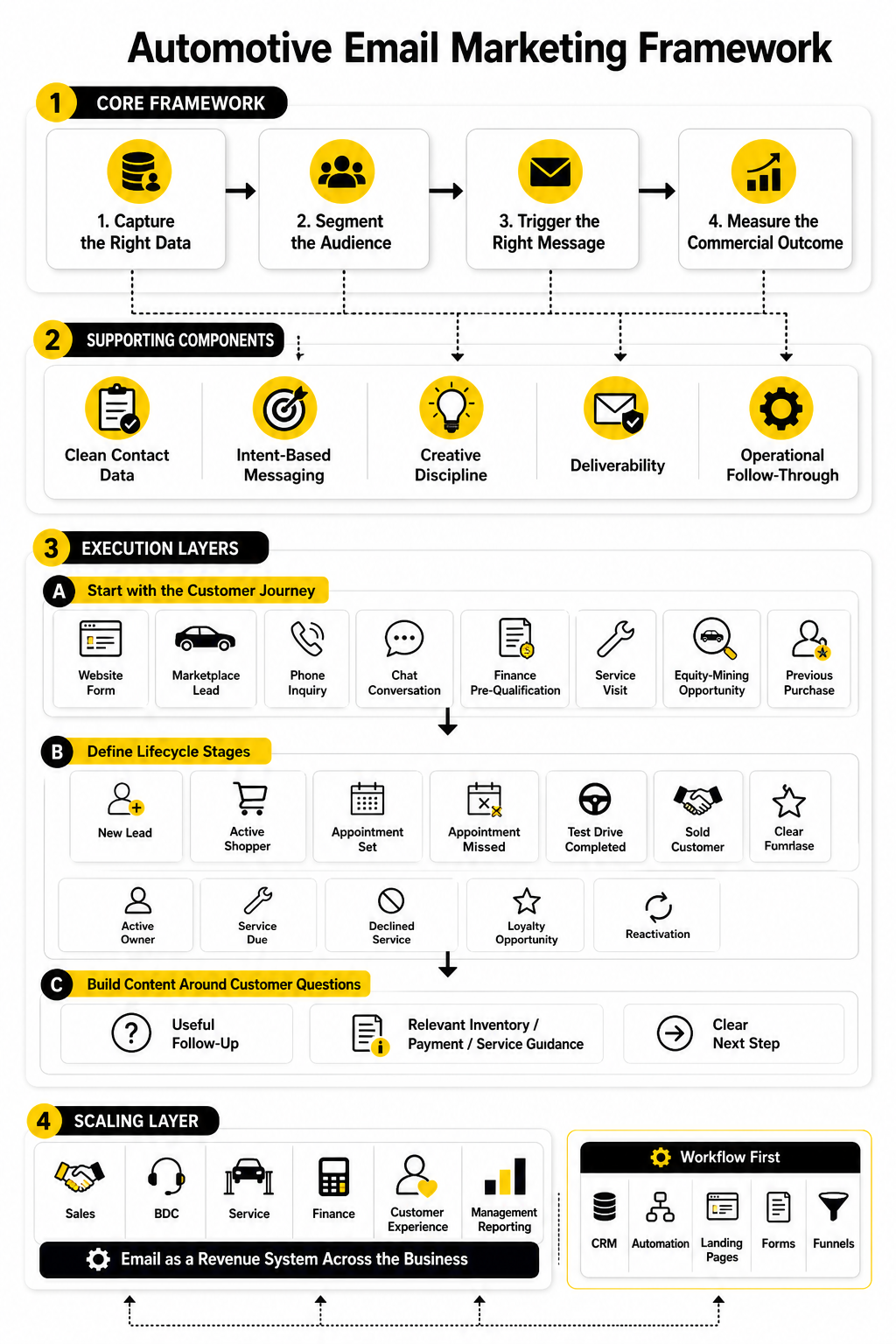
Framework Overview
A strong automotive email marketing framework has four jobs: capture the right data, segment the audience, trigger the right message, and measure the commercial outcome. Miss one of those jobs and the system becomes weaker. Miss all four and email becomes noise.
The first layer is data capture. This includes lead source, vehicle interest, budget range, trade-in status, finance intent, appointment history, purchase history, service history, and engagement behavior. You do not need every data point on day one, but you do need enough context to avoid treating every contact like a stranger.
The second layer is segmentation. A truck shopper, EV researcher, first-time buyer, declined finance lead, recent service customer, and lease-end customer should not receive the same message. Segmentation does not have to be complicated at first; even basic groups based on intent, lifecycle stage, and vehicle interest can improve relevance quickly.
The third layer is automation. This is where email becomes scalable without becoming robotic. Automation should handle predictable moments like inquiry follow-up, appointment confirmation, no-show recovery, post-test-drive follow-up, post-sale onboarding, service reminders, declined-service follow-up, and reactivation.
The fourth layer is measurement. Open rates can be useful as a directional signal, but they are not enough. Automotive marketers should also track clicks, replies, appointment bookings, showroom visits, sold units, repair orders, gross profit influence, unsubscribe rate, spam complaints, and list health.
Core Components Of A Serious Automotive Email System
A serious automotive email system starts with clean contact data. Duplicate records, missing vehicle interest, old ownership details, and disconnected CRM notes make personalization unreliable. If the database is messy, the email strategy will eventually show it.
The next component is intent-based messaging. Someone who downloaded a buying guide needs a different email than someone who asked whether a specific VIN is available. Someone who declined a brake repair needs a different email than someone who just bought a certified pre-owned vehicle.
The third component is strong creative discipline. That does not mean fancy design. It means clear subject lines, useful copy, one primary action, mobile-friendly formatting, and offers that match the customer’s situation.
The fourth component is deliverability. Automotive teams often underestimate this until performance drops. List hygiene, consent quality, sending frequency, authentication, bounce management, and complaint rates all affect whether the email reaches the inbox in the first place.
The fifth component is operational follow-through. Email cannot promise a fast appointment process if the store does not respond quickly. It cannot promote transparent pricing if the landing page creates confusion. It cannot create trust if the sales team ignores the context already captured in the CRM.
Professional Implementation Starts With The Customer Journey
Professional implementation starts by mapping the journey before writing campaigns. This keeps the strategy grounded. You are not building “an email sequence”; you are building a communication path around how people actually shop, buy, service, and return.
The map should begin with the first known signal. That signal could be a website form, marketplace lead, phone inquiry, chat conversation, finance pre-qualification, service visit, equity-mining opportunity, or previous purchase. Each signal should point to a next-best-message that helps the customer move forward.
From there, define the major lifecycle stages. A practical version might include new lead, active shopper, appointment set, appointment missed, test drive completed, sold customer, active owner, service due, declined service, loyalty opportunity, and reactivation. The names matter less than the operational clarity.
Once the stages are clear, the content becomes easier to write. You can build emails around customer questions instead of dealership pressure. That is the difference between “Huge sale this weekend” and “Here are the three things to check before you choose between these two SUVs.”
Tools can support this implementation, but the workflow should come first. Landing pages, forms, and funnels can help when a campaign needs a dedicated conversion path, and platforms like ClickFunnels or Systeme.io can be useful for building focused campaign flows. The key is to connect those flows back to the CRM so the email follow-up reflects what the customer actually did.
What The Rest Of this guide Will Build
The next part will turn this into a practical framework. It will define how automotive email marketing should work across lead capture, nurture, sales follow-up, service retention, and reactivation. The goal is not theory; the goal is a system a real automotive business can implement.
After that, the article will break down the core campaigns that matter most. That includes lead response, inventory alerts, appointment reminders, post-test-drive follow-up, post-sale onboarding, service reminders, declined-service recovery, trade-in campaigns, win-back emails, and loyalty campaigns. Each campaign type needs a different message because each customer moment carries a different intent.
Then the article will move into segmentation, personalization, automation, tools, measurement, optimization, compliance, and mistakes to avoid. By the end, automotive email marketing should feel less like “send more emails” and more like a disciplined revenue engine. That distinction is everything.
The Automotive Email Marketing Framework
The framework is simple: send the right message to the right customer at the right moment, then make the next step easy to take. That is the whole game. Everything else is just execution detail.
But simple does not mean casual. Automotive email marketing becomes profitable when it is built around customer intent, lifecycle stage, inventory reality, and operational follow-up. If a campaign ignores those four things, it may still look polished, but it will not create the kind of trust that moves someone closer to a purchase, service booking, or repeat visit.
This framework works because automotive customers do not all need the same conversation. A fresh lead wants speed and clarity. A comparison shopper wants confidence. A sold customer wants reassurance. A service customer wants convenience. A past customer wants a reason to come back before another dealer earns their attention.
Start With The Customer Stage
The first step is to define where the customer is in the journey. This matters because the same email can be helpful in one stage and annoying in another. A trade-in email might be perfect for a customer approaching the end of a finance cycle, but completely irrelevant to someone who just submitted their first inquiry on a new model.
A practical automotive email marketing system should separate contacts into clear stages. The exact names can vary by business, but the logic should stay consistent. Each stage should tell the team what the customer likely needs next and which message should be sent.
Useful lifecycle stages include:
These stages should not live only in a marketing spreadsheet. They need to exist inside the CRM or automation platform so the sales, BDC, service, and marketing teams can act from the same customer view. A lead should not receive a generic sales blast after they already booked an appointment, and a service customer should not get a “we miss you” message two days after visiting the store.
Match The Message To The Moment
Once the customer stage is clear, the message becomes much easier to write. You are no longer trying to create a clever email from scratch. You are answering the question that naturally belongs to that moment.
A new inquiry needs confirmation, speed, availability, and a low-friction next step. An appointment-booked customer needs reassurance, directions, documents to bring, and maybe a short note explaining what will happen during the visit. A post-test-drive customer needs a useful follow-up that removes friction, not another vague “checking in” email.
This is where many automotive campaigns become too dealership-centered. They talk about the store, the sale, the offer, the inventory, and the urgency. Those things can matter, but the customer is still thinking about their own situation: payment, timing, trade-in value, reliability, family needs, commute, fuel costs, insurance, and whether the experience will be worth their time.
The strongest message usually connects dealership goals with customer clarity. For example, a finance follow-up should not simply say, “Apply now.” It should explain what the customer can expect, why pre-approval may save time, and what information helps the team prepare realistic options.
Build Around First-Party Data
First-party data is the fuel behind better automotive email marketing. It is the information your business collects directly from customer interactions: forms, calls, chats, appointments, CRM notes, purchases, service visits, vehicle interests, trade-in details, and engagement behavior. This data is more useful than broad audience assumptions because it reflects what the person actually did.
The automotive market is especially suited to first-party data because customer signals are concrete. Someone viewed a specific model. Someone requested a payment estimate. Someone booked service for a specific VIN. Someone declined a repair. Someone bought a vehicle three years ago and may be entering a logical replacement window.
The challenge is that many automotive businesses collect data but do not organize it well enough to use it. Fields are missing, sources are inconsistent, and customer activity sits across tools that do not talk to each other. When that happens, personalization becomes guesswork.
The fix is to decide which data points are truly operational. You do not need hundreds of fields to improve email performance. You need the few that change the message:
A platform like GoHighLevel can be useful when a dealership, broker, or automotive marketing agency wants to connect forms, pipelines, email, SMS, automations, and appointment workflows in one place. The important part is not the software label. The important part is whether the data can trigger the right follow-up without making the team manually rebuild every conversation.
Use Segmentation Before Personalization
Segmentation comes before personalization because it creates the structure. Personalization without segmentation often turns into surface-level tricks like adding a first name to a generic blast. That is not enough.
Segmentation groups customers by meaningful differences. A customer shopping for a family SUV has different concerns than someone looking for a performance coupe. A lease-end customer has different timing than a first-time buyer. A service customer who declined tires needs a different message than an owner due for routine maintenance.
Once the segments are clear, personalization becomes more useful. The email can reference the relevant vehicle category, ownership stage, service need, or next step without sounding forced. The message feels more human because it is built around context, not decoration.
A practical segmentation model can start with five categories:
This is enough to make campaigns dramatically more relevant without overcomplicating the system. Automotive email marketing should become more advanced over time, but it should not start as a monster no one can maintain.
Create Clear Campaign Paths
A campaign path is the sequence of messages and actions that follow a specific customer signal. It should not be random. It should have a clear starting trigger, a clear purpose, and a clear stopping point.
For example, a new inquiry path might begin when someone submits a form on a vehicle detail page. The first message confirms the request and provides the next step. The second message addresses availability or alternative options. The third message encourages an appointment or call. The path should stop or change if the customer replies, books, buys, or goes cold.
A service reminder path works differently. It may begin based on mileage, time since last visit, manufacturer maintenance interval, or upcoming MOT or inspection timing depending on the market. The email should make booking easy and explain why the service matters, but it should not feel like a panic message unless there is a genuine safety issue.
A declined-service path is different again. The customer already came in, received a recommendation, and decided not to move forward. The follow-up should be respectful, specific, and helpful. It can remind them what was recommended, explain the risk of waiting, and give them an easy way to schedule the work.
The path matters because one-off emails rarely carry the full weight of the customer journey. People are busy. They compare options. They delay decisions. A good path keeps the conversation useful without forcing a sales rep to remember every follow-up manually.
Connect Email With The Sales And Service Process
Email cannot be treated as a separate marketing island. It must connect with the actual sales and service process. Otherwise, the customer receives one message from automation and a completely different experience from the team.
This is where the handoff matters. If an email invites someone to book an appointment, the store needs a real appointment process behind it. If the email says a vehicle is available, inventory needs to be accurate. If the email references a service recommendation, the advisor should know what the customer saw.
The best automotive email marketing systems reduce friction for both the customer and the team. Salespeople should know which emails a lead received, which links they clicked, and what action they took. Service advisors should know when a customer received a maintenance reminder or declined-service follow-up.
This does not mean every employee needs to become a marketing automation expert. It means the system should surface useful context at the right time. When the customer calls or visits, the team should not sound like they are starting from zero.
Use Automation Without Losing The Human Feel
Automation is powerful, but it can easily become lazy. The purpose of automation is to make timely, relevant communication consistent. It is not to remove judgment from the customer experience.
A good automated email still sounds like it came from a business that understands the customer. It uses plain language. It respects timing. It gives one clear action. It does not pretend to be a personal note if the content is obviously generic.
The best automation usually supports human follow-up rather than replacing it. For example, an automated post-inquiry email can confirm the request instantly while the sales team prepares a real response. A post-appointment email can summarize next steps while the salesperson follows up personally. A service reminder can prompt the customer to book while the advisor focuses on higher-value conversations.
This balance is important. If every email sounds automated, trust drops. If every email depends on manual work, consistency drops. The professional answer is to automate the predictable parts and keep the human team focused on moments where judgment, empathy, and negotiation matter.
Measure The Framework By Revenue Movement
The framework should be measured by movement, not vanity. Opens and clicks can help diagnose performance, but they do not prove that the email program is creating revenue. Automotive businesses need to connect email activity to appointments, showroom visits, sold vehicles, repair orders, service revenue, reactivation, and retention.
That does not mean every email must close a sale directly. Some emails reduce no-shows. Some speed up response. Some educate the buyer. Some bring a service customer back earlier. Some protect the relationship after delivery. All of that can matter commercially, but it needs to be tracked with the right expectation.
A useful measurement model should separate leading indicators from business outcomes. Leading indicators show whether the message is getting attention. Business outcomes show whether the system is creating value.
Track these leading indicators:
Track these business outcomes:
This is where discipline pays off. If a campaign gets clicks but no bookings, the issue may be the landing page or offer. If emails are opened but ignored, the next step may not be compelling enough. If appointments are booked but customers do not show, the reminder path may need work.
Keep The Framework Practical
The biggest mistake is trying to build the perfect system before sending anything useful. Start with the journeys that matter most. For most automotive businesses, that means new lead follow-up, appointment reminders, post-test-drive follow-up, sold-customer onboarding, service reminders, and declined-service recovery.
Once those are working, add more sophistication. Build better segments. Add behavior triggers. Improve landing pages. Test subject lines. Connect finance paths. Create trade-in campaigns. Layer in reactivation.
This is how automotive email marketing becomes an asset instead of another task. You build the core paths first, measure what happens, and improve the system based on real customer behavior. Practical beats perfect every time.
Core Email Campaigns For Leads, Buyers, And Owners
Once the framework is clear, the next question is obvious: what do you actually send? This is where automotive email marketing becomes practical. You stop thinking in vague campaign ideas and start building specific paths for the moments that drive revenue.
The best campaigns are not random promotions. They are structured conversations around buying intent, appointment behavior, ownership needs, and service timing. Each campaign should have a reason to exist, a clear trigger, and one primary action for the customer to take.
The mistake is trying to write one campaign for everyone. That creates bland emails nobody cares about. A serious system uses different campaign types because a new lead, a missed appointment, a recent buyer, and a service customer are living in completely different contexts.
New Lead Response Campaign
The new lead response campaign is the first real test of the system. The customer has raised their hand, and the business now has a small window to prove it is responsive, organized, and worth dealing with. If the first email feels slow, generic, or disconnected from the request, trust starts leaking immediately.
This campaign should confirm the inquiry, reference the customer’s interest, and make the next step easy. If the person asked about a specific vehicle, the email should stay close to that vehicle or offer relevant alternatives only when needed. If they requested financing information, the follow-up should explain the process clearly instead of pushing them into a vague sales call.
Speed matters here, but speed alone is not enough. A fast bad email is still a bad email. The goal is a quick, useful response that shows the customer their request was understood.
A simple new lead path can include:
The tone should be calm and helpful. Do not overhype. Do not pretend every lead is ready to buy today. Give the customer a clear path forward and make replying feel easy.
Inventory Interest Campaign
Inventory interest campaigns work when they are tied to real behavior. If someone viewed a specific model, clicked a vehicle detail page, asked about availability, or saved a search, that action gives you useful context. The email can now speak to something the customer has already shown interest in.
This campaign should help the shopper compare and decide. It can highlight availability, similar vehicles, key differences between trims, fuel economy, cargo space, warranty coverage, or payment range. The goal is not to dump inventory into an email; the goal is to reduce the customer’s research burden.
Inventory emails must stay accurate. Nothing damages trust faster than promoting a vehicle that is gone, priced differently, or unavailable when the customer asks. If the inventory system cannot stay synced, keep the message broader and invite the customer to confirm current availability.
This campaign is especially useful for used vehicles because scarcity is real. A used car shopper may be comparing mileage, condition, price, history, and timing all at once. A good email can help them act without sounding desperate.
Appointment Confirmation And Reminder Campaign
Appointment emails are operational emails, but they still influence revenue. A booked appointment is not a win until the customer shows up. That means confirmation and reminder emails deserve more care than most dealerships give them.
The confirmation email should make the customer feel confident about the visit. It should include time, location, who to ask for, what to bring, and what will happen when they arrive. If the appointment is for a test drive, the email should remove uncertainty around vehicle availability and timing.
Reminder emails should be useful, not annoying. A short reminder the day before and another closer to the appointment can work well, especially when the customer has a simple way to confirm, reschedule, or ask a question. The easier you make rescheduling, the fewer leads disappear completely.
For service appointments, the reminder can also include practical details. Mention drop-off instructions, estimated duration, transportation options, or anything the customer should prepare. Convenience is part of the sale.
No-Show Recovery Campaign
No-shows happen, but they should not be treated like dead leads. A missed appointment often means the customer got busy, found friction, lost confidence, or kept shopping elsewhere. The recovery campaign should reopen the door without sounding irritated.
The first message should be light and respectful. It can acknowledge that the appointment was missed and offer an easy way to reschedule. The tone matters because guilt-based follow-up rarely improves trust.
The next message can return to the customer’s original reason for booking. If they wanted to view a vehicle, reference that interest. If they were coming in for service, remind them why the appointment mattered. If they were exploring finance options, offer a simpler way to continue.
A no-show campaign should also notify the team. If the customer clicks to reschedule or replies with a question, someone needs to respond quickly. Automation can restart the conversation, but the team still has to carry it forward.
Post-Test-Drive Follow-Up Campaign
The post-test-drive campaign should feel personal because the customer has already invested time. This is not the moment for a generic “Thanks for stopping by” email. It is the moment to help them decide.
The email should summarize the next step clearly. That might include a payment estimate, trade-in discussion, finance application, comparison with another vehicle, or a direct invitation to move forward. If the customer had an objection during the visit, the follow-up should address it in a useful way.
This campaign works best when sales notes feed the email path. If the shopper was worried about monthly payment, send finance clarity. If they were comparing two SUVs, send a comparison. If they needed to speak with a partner, send a concise recap they can forward.
The post-test-drive campaign should not drag on forever. The first few days matter most. After that, the customer can move into a longer nurture path if they are still undecided.
Finance And Trade-In Campaign
Finance and trade-in emails are high-intent because they touch the real decision. Many customers are not just asking, “Do I like this vehicle?” They are asking, “Can I afford this, and does the deal make sense?” That is where good communication can reduce hesitation.
A finance email should explain the process in plain language. Tell the customer what happens after they submit information, what factors may affect options, and how pre-approval can save time. Avoid making promises that depend on credit approval, lender terms, or vehicle availability.
A trade-in email should be equally clear. Customers want to know what their current vehicle may be worth, what information affects the estimate, and whether trading in can simplify the buying process. This is also a natural place to ask for vehicle condition, mileage, payoff status, and photos when appropriate.
These campaigns should be handled carefully because trust is fragile around money. Be direct. Be transparent. Do not use pressure when clarity would work better.
Sold Customer Onboarding Campaign
The sale is not the end of the relationship. It is the beginning of the ownership experience. A sold customer onboarding campaign helps the buyer feel supported after the emotional high of delivery fades.
This campaign can include thank-you messaging, vehicle setup guidance, service department introduction, warranty reminders, accessory options, review requests, referral invitations, and first-service expectations. The point is to make the customer feel like the business still cares after the paperwork is done.
This is also where sales and service should connect. The customer should know where to go for maintenance, who to contact with ownership questions, and how to book their first service visit. A smooth handoff can make the next revenue opportunity feel natural instead of forced.
Automotive email marketing is powerful here because ownership is long. The relationship can continue for years if the business communicates in a helpful way. Ignore the customer after delivery, and another brand or dealer gets a chance to own the next conversation.
Service Reminder Campaign
Service reminder campaigns are among the most important campaigns in the entire system. They support customer retention, fixed operations revenue, vehicle safety, and long-term loyalty. They also create a reason to stay connected when the customer is not actively shopping.
The reminder should be specific enough to feel relevant. A vague “time for service” message is weaker than a message tied to mileage, time interval, seasonal needs, or known maintenance schedules. If the business has service history, use it.
The message should make booking easy. That means a clear appointment link, phone option, service hours, and any relevant convenience details. Customers are busy, so the email should remove steps instead of adding them.
Service emails should avoid fear unless the issue is genuinely safety-related. Most reminders can be calm, practical, and helpful. The customer should feel guided, not manipulated.
Declined-Service Follow-Up Campaign
Declined service is one of the clearest revenue recovery opportunities in automotive email marketing. The customer already came in, received a recommendation, and decided not to approve it at that moment. That does not mean they will never approve it.
The follow-up should mention the declined work in a respectful way. It can explain why the repair or maintenance was recommended, what could happen if it is delayed, and how the customer can schedule when ready. The tone should be educational, not scolding.
This campaign works better when it is specific. “You declined recommended brake service” is more useful than “Come back for service.” The more precise the email is, the easier it is for the customer to understand why it matters.
The timing should also be thoughtful. Some declined services need quick follow-up, while others can be revisited later. The service advisor’s recommendation should guide the cadence.
Reactivation Campaign
Reactivation campaigns are for customers who have gone quiet. They may be past leads, former service customers, previous buyers, or people who engaged once and then disappeared. The purpose is to restart the relationship with a useful reason, not to blast them with generic urgency.
For past leads, the reactivation angle might be new inventory, updated pricing, changed incentives, or a simple check-in asking whether they are still looking. For service customers, it might be overdue maintenance, seasonal inspection, or a reminder that online booking is available. For previous buyers, it might be an ownership milestone, trade-in opportunity, or loyalty offer.
This campaign should be conservative with frequency. If someone has been inactive for a long time, do not hammer them with daily emails. Send a relevant message, watch engagement, and suppress contacts who do not respond over time.
A clean reactivation campaign can also protect deliverability. Sending forever to disengaged contacts is risky. A good system gives customers a chance to reengage, then removes or suppresses them if they show no interest.
Referral And Review Campaign
Referral and review campaigns work best after a positive experience. The timing matters. Ask too early, and the customer may not feel ready. Ask too late, and the emotional momentum is gone.
A review request should be simple and direct. Thank the customer, remind them that feedback helps the team, and give one clear action. Do not overload the message with five review links and a long explanation.
Referral emails should focus on the relationship. A customer who trusts the business may be willing to recommend a friend, family member, or colleague, but the ask should feel respectful. Make it easy for them to share, and make sure the referred person receives a good experience.
This campaign is not just about social proof. It is about turning customer satisfaction into future demand. That only works when the experience was actually worth talking about.
The Step-By-Step Implementation Process
At this point, the campaign map becomes tangible. You know the stages, you know the campaign types, and now you need to build the operating process. This is where many teams either create a real system or get stuck in endless planning.
Start with the highest-impact customer paths first. Do not try to automate every possible scenario in week one. Build the paths that solve obvious revenue leaks: new lead response, appointment reminders, no-show recovery, post-test-drive follow-up, sold customer onboarding, service reminders, and declined-service follow-up.
Then connect each path to a trigger. The trigger might be a form submission, CRM stage change, appointment status, purchase date, service date, declined recommendation, or inactivity period. Without triggers, automation becomes manual work wearing a fancy name.
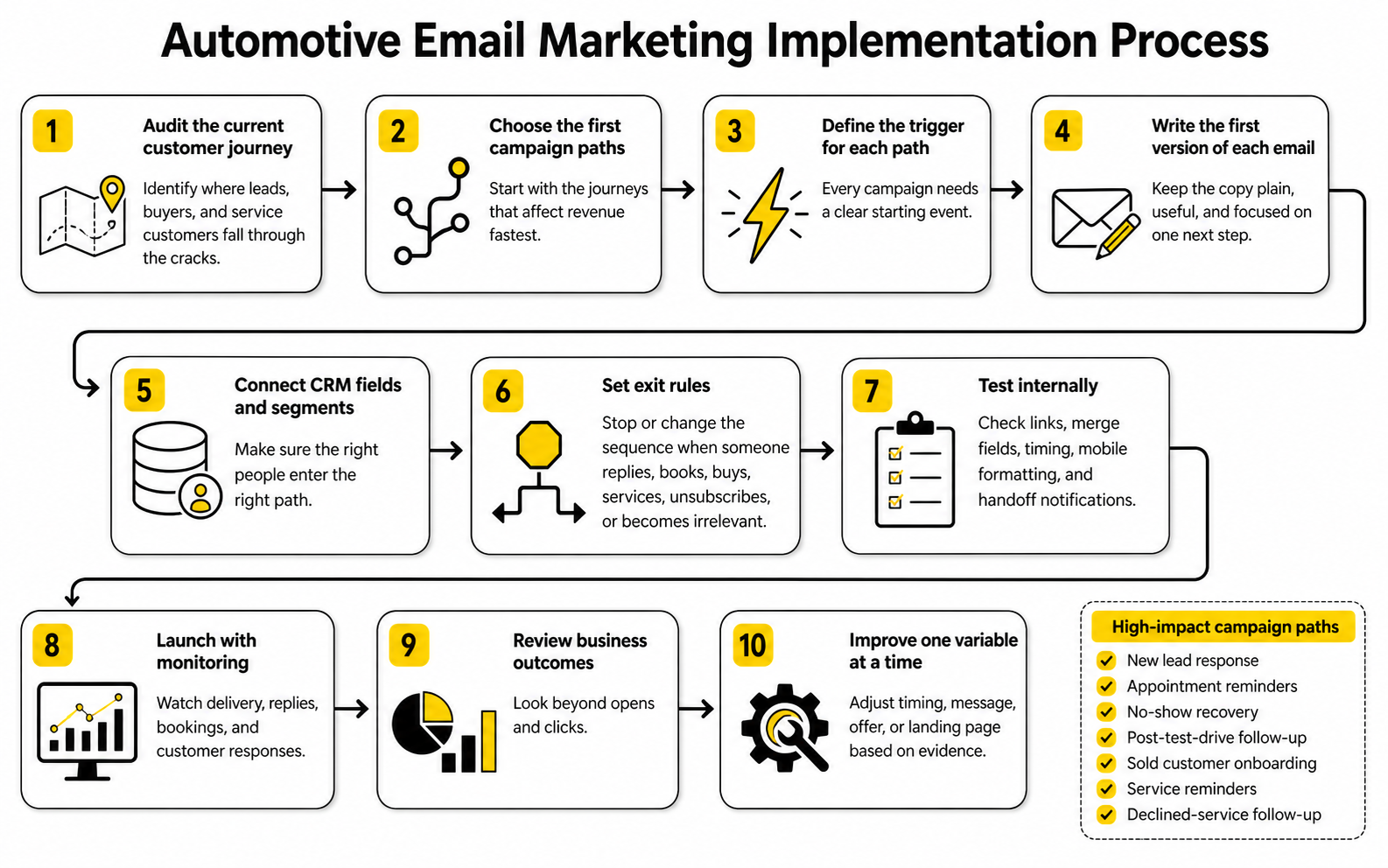
A practical implementation sequence looks like this:
This is not complicated, but it does require discipline. The system should be easy enough for the team to understand and strong enough to run consistently when the store gets busy. That is the standard.
Write Emails Around One Clear Action
Every email should have one main job. That does not mean every email needs only one link, but it does mean the reader should instantly understand what to do next. Confused customers do nothing.
A lead follow-up might ask the customer to book a test drive. A finance email might ask them to complete a secure application. A service reminder might ask them to schedule an appointment. A post-sale email might ask them to save the service contact or review the vehicle setup guide.
Too many automotive emails fail because they ask for everything at once. They promote inventory, service, finance, trade-ins, reviews, referrals, and seasonal offers in the same message. That feels busy, and busy does not convert.
The stronger approach is to match one email to one customer moment. If the moment is service, focus on service. If the moment is trade-in, focus on trade-in. If the moment is appointment confirmation, focus on attendance.
Build Landing Pages That Match The Email
The email is only half the experience. If the customer clicks and lands somewhere confusing, the campaign loses momentum. This is especially common when emails point to generic homepages instead of specific next-step pages.
A test-drive email should lead to a booking flow or relevant vehicle page. A finance email should lead to a clear application or pre-qualification step. A service reminder should lead directly to scheduling. A trade-in email should lead to a valuation form or conversation path.
Dedicated landing pages can help when the campaign has a specific goal. Tools like ClickFunnels and Systeme.io can support simple campaign funnels when the team needs focused pages for lead capture, trade-in offers, finance paths, or event campaigns. The page should still connect back to the CRM, or the team will lose the context that made the click valuable.
The message and page must feel like one continuous experience. If the email says “Book your service appointment,” the page should not make the customer hunt through five menu options. Keep the promise.
Set Exit Rules Before Launch
Exit rules are one of the most overlooked parts of automotive email marketing. They decide when a customer should stop receiving a sequence or move into a different one. Without them, people get awkward, irrelevant emails after they already took action.
A customer who books an appointment should leave the lead nurture path and enter the appointment confirmation path. A customer who buys should leave the sales path and enter onboarding. A customer who completes a service visit should leave the service reminder path. A customer who unsubscribes should not be touched again by promotional email.
Exit rules protect the customer experience. They also protect the team from embarrassment. Nobody wants to call a sold customer because an old automation still thinks they are shopping.
These rules should be documented clearly. Do not hide them in someone’s head. The team needs to know what happens when a status changes, when a customer replies, and when a campaign should stop.
Test The System Like A Customer
Before a campaign goes live, test it like a customer would experience it. Submit the form. Click the link. Open the email on mobile. Check the merge fields. Book the appointment. Reply to the message. Try the entire path from start to finish.
This catches issues that dashboards miss. A broken booking link can ruin a campaign. A bad merge field can make the email look careless. A confusing landing page can kill intent. A delayed internal notification can cost a hot lead.
Testing should include the operational handoff too. When the customer acts, who gets notified? What does the CRM show? Does the salesperson or advisor see the right context? Does the customer receive the correct next message?
Do not skip this step. It is not glamorous, but it saves money. A clean implementation beats a clever campaign with broken plumbing.
Launch Small And Improve Fast
The best implementation approach is controlled, not timid. Launch the first version of the most important campaigns, measure the response, and improve based on what customers actually do. Waiting for perfection usually delays revenue.
Start with a limited set of segments or locations if needed. Watch replies, bookings, unsubscribes, and team feedback. If customers are confused, simplify the message. If they click but do not convert, fix the destination. If they ignore the email, revisit timing, relevance, or the offer.
This is where automotive email marketing becomes a process instead of a project. You are not “setting it up” once and forgetting it. You are building a system that gets sharper over time.
The next layer is segmentation and personalization. Once the core campaign paths are live, the real gains come from making each path more relevant to the customer’s intent, vehicle interest, ownership stage, and behavior. That is where the system starts to feel less like automation and more like a smart, useful conversation.
Statistics And Data
The data side of automotive email marketing should answer one question: what is actually moving the customer closer to revenue? Not what looks impressive in a dashboard. Not what makes a campaign report feel busy. What moves the customer closer to booking, showing up, buying, servicing, returning, or referring?
This matters because email metrics can be misleading when they are read in isolation. A high open rate can hide weak intent. A low click rate can still produce strong replies if the email asks people to respond directly. A campaign with fewer clicks may outperform a bigger blast if it reaches a smaller, better-qualified segment.
So the goal is not to collect more numbers. The goal is to build a measurement system that tells you what to fix next. If the data does not lead to a decision, it is probably noise.
Start With The Buyer Journey, Not The Dashboard
Automotive analytics should begin with the customer journey. A buyer might research online, submit a lead, compare new and used options, book a test drive, negotiate finance, visit the showroom, and then decide later. That journey has multiple conversion points, so one email metric cannot explain the whole result.
The latest Cox Automotive Car Buyer Journey research shows why measurement needs to account for complexity. In 2025, 66% of buyers considered both new and used vehicles, and 29% of new-vehicle shoppers weighed leasing versus buying. That means customers are not moving through a neat, linear path; they are comparing options, changing assumptions, and looking for confidence before they act.
This is why automotive email marketing should measure movement between stages. Did the lead book? Did the booked customer show? Did the test-drive customer request numbers? Did the sold customer schedule service? Did the declined-service customer return? Those are the signals that matter because they reflect progress, not just attention.
Open Rates Are A Signal, Not The Scoreboard
Open rates still have some diagnostic value, but they should not be treated as the main scoreboard. They can help you spot subject line problems, sender-name issues, or major list fatigue. They cannot reliably tell you whether a real person read the message with genuine intent.
Privacy changes are a big reason. Litmus notes that Apple Mail Privacy Protection can inflate opens, obscure open times, and hide location data, which makes open rates less reliable than they used to be. If a dealership judges performance only by opens, it may reward the wrong campaigns and miss the campaigns that actually create appointments.
Use open rate as a weak signal near the top of the funnel. If opens collapse, investigate deliverability, list quality, sender reputation, subject lines, and send timing. But once the email is getting into the inbox, shift attention to clicks, replies, bookings, show rate, service appointments, and revenue influence.
Clicks Show Interest, But Context Decides Meaning
Click rate is stronger than open rate because it shows that the customer took an action. Still, a click does not automatically equal buying intent. Someone may click to browse, compare, check pricing, reschedule, unsubscribe, or simply see what the offer means.
Generic benchmarks can help set expectations, but they should not become the strategy. MailerLite’s 2025 benchmark data reported a 43.46% average open rate, 2.09% average click rate, and 0.22% average unsubscribe rate across its email dataset. Those numbers are useful as broad context, but an automotive business should judge performance by campaign type, audience intent, and downstream outcome.
A service reminder should not be judged the same way as a cold reactivation email. A post-test-drive follow-up should not be judged the same way as a newsletter. A finance email may have a lower click rate but higher commercial value if the clicks come from serious buyers.
Campaign Benchmarks Need A Real Automotive Lens
Automotive email marketing has several campaign types that naturally perform differently. Service reminders, appointment confirmations, post-purchase onboarding, inventory alerts, trade-in messages, and reactivation emails all carry different levels of intent. Comparing them as if they are the same makes the data less useful.
Aftersales email is a good example. Marketing Delivery’s Q2 2025 automotive benchmark data reported that service and MOT reminder emails generated a 53% open rate, 13% average click rate, and more than 104,000 bookings across its client base. Those numbers matter because they show how powerful timely, practical reminders can be when the customer already has a known ownership need.
But the action is not “try to copy the benchmark.” The action is to ask why that type of campaign performs well. It has clear relevance, clear timing, and a clear next step. That is the lesson to apply across the whole system.
Measure The Funnel In Layers
The cleanest way to measure email is to separate the funnel into layers. Each layer answers a different question. When something underperforms, the layer tells you where to look.
Delivery metrics tell you whether the message reached the mailbox. Engagement metrics tell you whether the customer paid attention. Conversion metrics tell you whether the customer acted. Revenue metrics tell you whether the action mattered commercially.
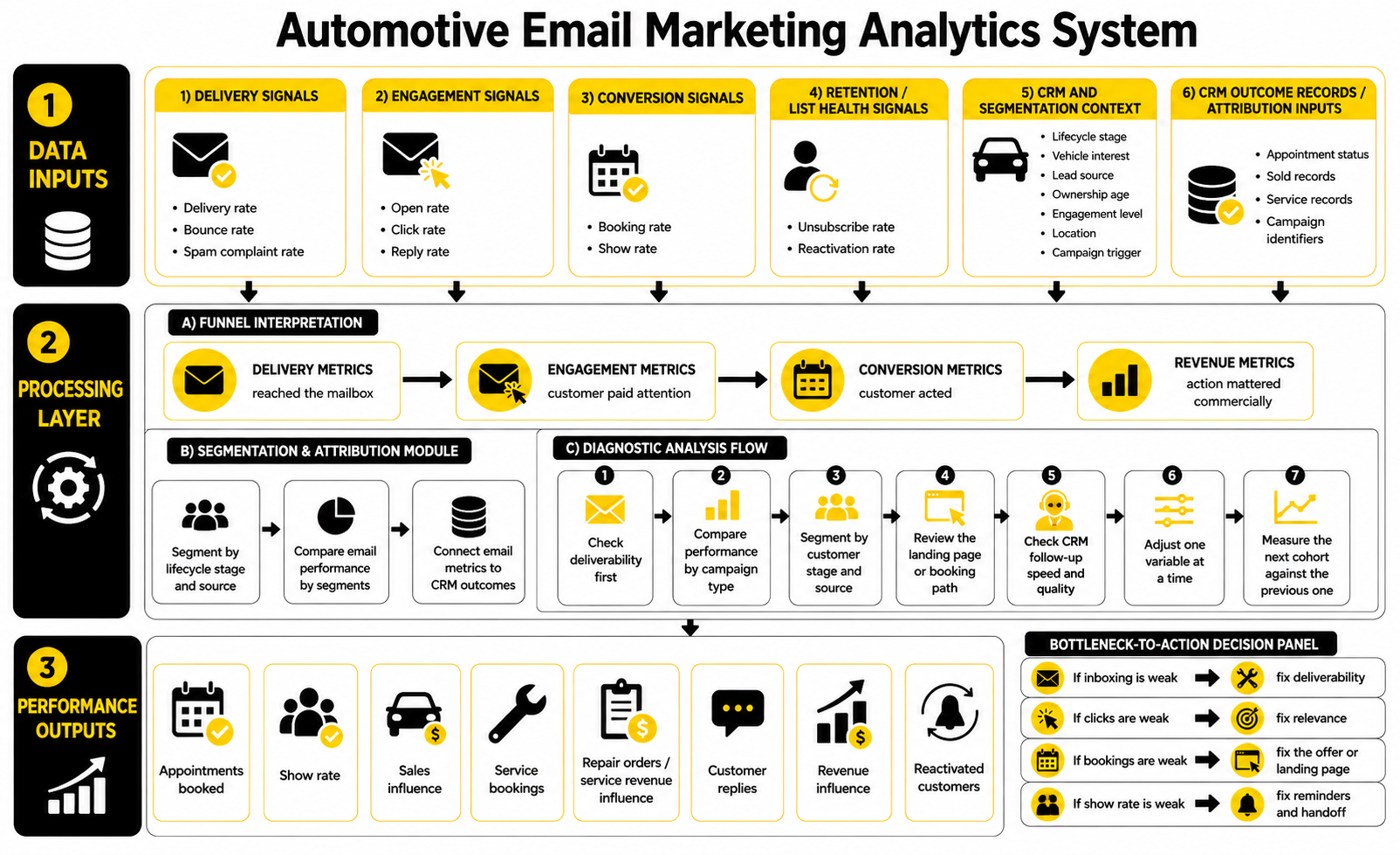
A practical automotive email marketing analytics system should track:
This layered view prevents lazy conclusions. If delivery is strong but clicks are weak, the message or offer may be the issue. If clicks are strong but bookings are weak, the landing page or scheduling process may be broken. If bookings are strong but show rate is weak, reminders and appointment quality need work.
Watch The Metrics That Protect Deliverability
Deliverability is not glamorous, but it decides whether the entire system has oxygen. If your emails do not reach the inbox, the copy, offer, and automation logic do not matter. That is why deliverability metrics belong in the main dashboard, not in some forgotten technical corner.
The big signals are bounce rate, spam complaints, unsubscribes, inactive contacts, authentication status, and engagement trends. Yahoo’s sender best practices tell senders to authenticate mail and keep spam complaints below 0.3%, while Google’s sender guidelines emphasize SPF, DKIM, and DMARC alignment for authenticated sending. This is not optional plumbing anymore; it is part of professional email execution.
For automotive teams, deliverability problems often come from old lead lists, over-mailing inactive contacts, weak consent, and promotional blasts sent to people with no current intent. The fix is not only technical. Clean the list, suppress disengaged contacts, segment better, and send messages people have a real reason to receive.
Connect Email Metrics To CRM Outcomes
Email data becomes much more valuable when it connects to CRM outcomes. A click is useful, but a click tied to a booked appointment is better. An opened service reminder is interesting, but a reminder tied to a completed repair order is what management should care about.
This is where field discipline matters. The CRM needs clean stages, appointment statuses, lead sources, sold records, service records, and campaign identifiers. If those are missing or inconsistent, attribution becomes messy and the team starts guessing.
A CRM-focused platform like GoHighLevel can help when an automotive business needs pipeline stages, automations, email, SMS, forms, appointment workflows, and reporting connected in one operating layer. The real value is not just sending emails. The value is seeing whether email activity creates pipeline movement and customer action.
The dashboard should make decisions easier. If a lead nurture path creates appointments but few shows, fix reminders or qualification. If a service reminder gets clicks but weak bookings, fix the scheduler. If a reactivation campaign creates replies but no sales follow-up, fix the handoff.
Read Benchmarks By Campaign Type
Benchmarks are useful only when they are compared against the right type of email. Automated flows usually behave differently from one-time campaigns because they are triggered by customer behavior. A person receiving a timely appointment reminder is in a different state of mind than someone receiving a broad monthly offer.
Klaviyo’s 2026 benchmark data reported that automated email flows produced click rates more than three times higher than campaigns and placed-order rates thirteen times higher than campaigns across its dataset. That does not mean every automotive business will see the same numbers. It does reinforce the point that timing and relevance usually beat volume.
For automotive email marketing, this supports a practical rule: build triggered lifecycle emails before obsessing over newsletters. Lead response, appointment reminders, post-test-drive follow-up, sold-customer onboarding, service reminders, and declined-service recovery should come before broad promotional calendars. The money is usually closer to behavior-triggered moments.
Use Revenue Per Recipient Carefully
Revenue per recipient can be useful, but it needs context in automotive. A dealership may not sell directly inside an email like an ecommerce store does. A customer may click an email, call the store, visit the showroom, negotiate in person, and buy days later.
That means revenue attribution should be handled with reasonable windows and clear definitions. You can track email-assisted sales, email-generated appointments, service bookings, and repair orders influenced by reminder campaigns. Just avoid pretending that attribution is cleaner than it really is.
For vehicle sales, measure assisted outcomes over a defined period. For service, the link between email and booking may be more direct. For trade-in and equity campaigns, track appraisal requests, appointments, and sold replacements instead of only clicks.
The point is not to create perfect attribution. The point is to make better budget and process decisions. If a campaign consistently creates high-quality appointments, keep improving it even if the attribution model is imperfect.
Segment Performance Before You Rewrite Copy
When a campaign underperforms, do not immediately rewrite the email. First, segment the performance. The same message may work for one audience and fail for another.
Break results down by lifecycle stage, vehicle interest, lead source, ownership age, engagement level, location, and campaign trigger. A finance email may perform well for recent inventory leads but poorly for old newsletter subscribers. A service reminder may work for customers with recent service history but underperform for people who have not visited in years.
This is where the data becomes useful. It tells you whether the problem is message quality, audience quality, timing, offer, or operational follow-through. Without segmentation, you may fix the wrong thing.
A clean analysis process looks like this:
That is how improvement compounds. Not through random testing. Through controlled diagnosis.
Use Unsubscribes And Complaints As Feedback
Unsubscribes are not always bad. Sometimes they remove people who were never going to buy, service, or engage again. But a spike in unsubscribes is feedback, and feedback should be respected.
Complaint rate is more serious. When customers mark email as spam, inbox providers treat that as a trust signal. If complaints rise, the issue may be weak consent, irrelevant targeting, excessive frequency, misleading subject lines, or old list quality.
The fix is to make the program more respectful. Send fewer irrelevant emails. Suppress inactive contacts. Make preference management easy. Keep subject lines honest. Give customers a clear way to opt out.
The FTC’s CAN-SPAM compliance guidance also reinforces basic legal expectations: accurate header information, non-deceptive subject lines, clear identification, a physical address, and a working opt-out process. Legal compliance is the floor. Customer trust is the real standard.
Turn Data Into Decisions
The final test of measurement is whether it changes what the team does. If the dashboard does not change timing, targeting, copy, landing pages, follow-up, offers, or suppression rules, it is just decoration. Automotive email marketing needs data that leads to action.
A strong weekly review can be simple. Look at delivery health, top-performing campaigns, underperforming campaigns, appointment movement, service bookings, revenue influence, unsubscribes, complaints, and customer replies. Then choose one or two improvements that can be made before the next review.
Do not chase every metric at once. Fix the biggest bottleneck first. If inboxing is weak, fix deliverability. If clicks are weak, fix relevance. If bookings are weak, fix the offer or landing page. If show rate is weak, fix reminders and handoff.
That is the mindset that makes email analytics useful. The numbers are not there to impress anyone. They are there to show where revenue is getting stuck and what to improve next.
Professional Implementation, Tools, And Scaling
Once the core campaigns and measurement system are in place, the next challenge is scale. This is where automotive email marketing gets more serious. The work shifts from “Can we send better emails?” to “Can we operate a reliable customer communication system across sales, service, finance, inventory, and leadership?”
That shift matters because scale exposes weak foundations. A campaign that works for one salesperson may break when ten people touch the same lead. A service reminder that works for one location may become messy across multiple rooftops. A CRM field that looks harmless when empty can become a reporting problem when thousands of contacts depend on it.
Professional implementation is not about adding complexity for the sake of it. It is about building a system that stays accurate, useful, compliant, and profitable as volume increases. That requires better data governance, clearer ownership, stronger automation rules, and more disciplined campaign management.
Choose Tools Around The Workflow
The tool should serve the workflow, not the other way around. This sounds obvious, but many automotive teams make the mistake of buying software first and designing the process later. Then the system becomes a collection of features nobody uses properly.
Start by defining what the business needs the tool to do. Does it need CRM pipelines, email automation, SMS follow-up, appointment booking, landing pages, reporting, call tracking, service reminders, or multi-location management? Does it need to support a dealership group, an independent dealer, a broker, a repair shop, or a marketing agency serving automotive clients?
Once the workflow is clear, the tool decision becomes more grounded. A platform like GoHighLevel can make sense when the business wants CRM pipelines, automations, email, SMS, forms, calendars, and client-style reporting in one place. A lighter email platform may work for simpler newsletters, but it can become limiting when the strategy depends on CRM triggers, appointment states, and sales handoffs.
For campaign-specific funnels, tools like ClickFunnels or Systeme.io can support dedicated paths for trade-in offers, finance inquiries, event campaigns, or seasonal promotions. The key is integration. If the landing page captures intent but the CRM does not receive clean data, the campaign creates another disconnected island.
Avoid The All-In-One Trap
All-in-one systems are useful, but they can also create a false sense of control. Just because a platform can do email, SMS, funnels, calendars, chat, and reporting does not mean the business has a working strategy. The software only executes what the team defines.
The all-in-one trap happens when teams enable too many features before the customer journey is clear. They launch email sequences, SMS reminders, pipeline automations, forms, chat widgets, and dashboards at the same time. Then nobody knows which message triggered which action, which team owns the follow-up, or why customers are receiving overlapping communication.
A more carefully approach is to scale in layers. First, make lead capture and CRM stages clean. Then add the most important email paths. Then connect appointment automation. Then add service reminders, reactivation, and advanced segmentation. Each layer should prove it works before the next one is added.
This is not slow thinking. It is mature implementation. Speed without control creates mess. Controlled rollout creates a system the team can actually trust.
Build A Clean Data Standard
Data quality is the quiet difference between basic email and serious automotive email marketing. If the data is messy, automation becomes risky. The wrong customer gets the wrong message, reporting becomes unreliable, and personalization starts to feel fake.
A clean data standard defines which fields matter and how they should be used. Vehicle interest, lead source, lifecycle stage, appointment status, purchase date, service date, ownership vehicle, trade-in status, finance interest, and last engagement date should not be optional guesses. They should be captured consistently enough to guide communication.
This does not mean every field must be perfect before launch. That is unrealistic. But the business should know which fields control automations and which fields are only nice to have.
A simple data standard should define:
This is where many campaigns either mature or stall. Better copy can improve an email. Better data can improve the entire system.
Manage Frequency Across Departments
Automotive customers do not think in departments. They do not care whether an email came from sales, service, finance, parts, marketing, or the BDC. They only know the business keeps showing up in their inbox.
That is why frequency control matters. A customer should not receive a sales blast, service reminder, trade-in offer, review request, and event promotion within the same short window unless there is a very good reason. Too much communication creates fatigue, even when each individual email seems reasonable.
The solution is a global communication view. The team should be able to see how many messages a customer receives across all paths. High-intent transactional messages, like appointment confirmations, should take priority over generic promotional messages. Lifecycle relevance should beat campaign volume.
Frequency rules should account for customer stage. An active buyer may tolerate more communication for a short period because they are making a decision. An inactive past lead may need a slower cadence. A loyal service customer may respond well to practical reminders but ignore broad sales offers.
Use AI Carefully
AI can help with automotive email marketing, but it should not run the strategy unsupervised. It can speed up drafts, generate variations, summarize CRM notes, suggest segments, identify campaign patterns, and help teams respond faster. Used well, it removes friction.
The risk is that AI can also produce vague, overconfident, or inaccurate messages. In automotive, that matters. A bad email can imply a vehicle is available when it is not, overpromise financing, mishandle warranty language, or create a tone that feels detached from the customer’s real situation.
The current car-buying environment makes AI relevant, but not as a replacement for trust. Cox Automotive’s 2025 Car Buyer Journey research found that buyers are increasingly using digital and AI-powered tools, with 25% of new-vehicle buyers engaging AI tools during shopping. That means customers may become more comfortable with AI-assisted research, but they will still expect accurate answers and human accountability when money, availability, and service decisions are involved.
Use AI for support, not abdication. Let it help create first drafts, summarize intent, suggest next steps, and personalize at scale. Keep humans responsible for offers, claims, compliance, pricing, finance language, and customer-sensitive situations.
Protect Trust Around Pricing And Finance
Pricing and finance emails need a higher standard than general marketing emails. Customers are sensitive to payment language, credit approval, trade-in values, incentives, and final price. If the email creates confusion here, it damages trust fast.
Avoid vague promises that sound better than the actual buying experience. Do not imply approval is guaranteed. Do not promote a payment without explaining that terms may depend on credit, lender approval, down payment, taxes, fees, vehicle availability, or market-specific requirements. The email should create clarity, not legal or customer-experience risk.
Trade-in messaging also needs care. A valuation range can start a conversation, but it should not be presented as a guaranteed offer unless the process truly supports that. Vehicle condition, mileage, accident history, market demand, payoff status, and inspection results can all affect the final number.
Professional automotive email marketing uses finance and trade-in content to reduce anxiety. It explains the process, sets expectations, and invites the customer into a clear next step. That is much stronger than pushing a flashy number the store cannot defend later.
Respect Compliance Before It Becomes Expensive
Compliance is not the exciting part, but it is part of the job. Email marketing must respect consent, identification, unsubscribe requirements, data protection, and market-specific advertising rules. The exact requirements depend on the country, region, and type of message.
In the United States, the FTC’s CAN-SPAM compliance guide outlines requirements such as accurate header information, non-deceptive subject lines, a physical postal address, and a clear way to opt out. In the European Union and United Kingdom, privacy and direct marketing rules are stricter around consent, legitimate interest, and personal data handling, so automotive teams should get proper legal guidance before scaling campaigns in those markets.
Technical compliance also matters. Google’s sender guidelines emphasize authentication through SPF, DKIM, and DMARC, while sender reputation and complaint rates affect whether campaigns reach the inbox. This is not only a legal issue. It is a revenue issue because poor sending practices can quietly destroy deliverability.
The practical rule is simple: do not treat compliance as something to clean up later. Build it into list collection, CRM permissions, unsubscribe handling, suppression rules, sender authentication, and campaign review from the start.
Create A Campaign Governance Process
As the email program grows, somebody needs to own the system. Without ownership, campaigns pile up, automations conflict, old offers keep sending, and nobody knows which sequence is still active. This is how good intentions become customer confusion.
Campaign governance does not need to be bureaucratic. It needs to be clear. Every campaign should have an owner, a purpose, a trigger, an audience, an exit rule, a review date, and a performance expectation.
A basic governance checklist should include:
This prevents automation clutter. It also makes scaling easier because new campaigns have to fit into the existing system instead of fighting against it.
Balance Personalization With Privacy
Personalization works when it feels helpful. It fails when it feels invasive. Automotive businesses need to understand that difference.
A customer usually appreciates an email that remembers their vehicle interest, service timing, appointment status, or ownership stage. That information is directly relevant to the relationship. But overly detailed behavioral references can feel uncomfortable if the message sounds like surveillance.
The best personalization is subtle and useful. Mention the vehicle category they asked about. Remind them of a service need tied to their ownership history. Offer a trade-in conversation when the timing makes sense. Avoid making the customer feel like every click has been watched.
Privacy-first personalization will become even more important as third-party tracking becomes less dependable and first-party data becomes more valuable. Cox Automotive’s marketing guidance points toward first-party data and cookieless tracking as important for future automotive targeting and personalization. The opportunity is real, but the trust standard is higher too.
Scale Across Multiple Locations Carefully
Multi-location automotive email marketing adds another layer of complexity. Each rooftop may have different inventory, staff, service capacity, local offers, hours, customer history, and market conditions. A campaign that works in one store may not transfer perfectly to another.
The risk is centralizing too much or decentralizing too much. If everything is centralized, local teams may feel the messaging does not reflect their reality. If everything is local, brand consistency, data standards, and compliance can fall apart.
The best model usually combines central strategy with local controls. The central team defines lifecycle logic, templates, compliance standards, reporting, and data rules. Local teams adjust inventory, appointment availability, staff contacts, and market-specific offers within approved boundaries.
This creates consistency without making the messages feel generic. It also makes reporting more useful because locations can be compared against a shared framework instead of completely different campaign structures.
Plan For Service Capacity
Service campaigns can create real demand, so they need to be coordinated with capacity. This is an advanced point, but it matters. A strong reminder campaign is not helpful if it overwhelms the shop, creates long waits, or forces advisors into rushed conversations.
Service email should consider appointment availability, technician capacity, parts availability, seasonal peaks, and declined-service priority. A tire campaign, MOT reminder, winter check, air conditioning service, or recall-related communication can create operational pressure if the store is not ready.
This is where marketing and fixed operations need to work together. The campaign calendar should not be built in isolation. It should support the service department’s ability to deliver a good experience.
When service capacity is tight, email can help smooth demand. Instead of pushing everyone into the same week, campaigns can stagger reminders, promote lower-demand time slots, or prioritize higher-risk maintenance needs. That is more carefully than simply sending more emails.
Do Not Over-Automate High-Emotion Moments
Some moments need a human touch. A customer who had a bad delivery experience, disputed a repair, received difficult finance news, or complained publicly should not be thrown into a generic automation path. The system needs safeguards for sensitive situations.
This is where suppression rules and manual review matter. Certain tags or CRM statuses should pause promotional messages until the issue is resolved. Customer experience problems should not be ignored by automation. They should be escalated.
High-value opportunities may also deserve human handling. A serious buyer with a trade-in, a repeat customer considering an upgrade, or a fleet prospect may need personalized communication from a manager or specialist. Automation can support the process, but it should not flatten the relationship.
The point is not to avoid automation. The point is to know where automation belongs. Use it for consistency, reminders, and scalable education. Use people for judgment, emotion, negotiation, and trust recovery.
Build A Testing Culture Without Chasing Tricks
Testing matters, but it should be tied to meaningful questions. Too many teams test tiny subject line variations while ignoring bigger problems like poor segmentation, weak offers, broken landing pages, or slow follow-up. That is busy work pretending to be optimization.
A useful test should answer a business question. Does a payment-focused email create more appointment requests than an availability-focused email? Does a shorter service reminder convert better than a more educational one? Does a trade-in campaign work better when sent at a specific ownership milestone?
Test one meaningful variable at a time when possible. Keep the audience clean. Measure the downstream action, not just the click. Then apply what the data shows.
Good testing compounds over months. It teaches the team which messages reduce friction, which offers create serious intent, and which segments are worth more attention. That is much better than chasing generic “best practices” from another industry.
Know When To Suppress Instead Of Send
One of the most advanced decisions in email is choosing not to send. That sounds counterintuitive, but it protects deliverability, brand trust, and list quality. More emails do not automatically mean more revenue.
Suppress contacts who are invalid, unsubscribed, chronically inactive, or poorly sourced. Suppress customers in sensitive complaint states. Suppress people who are already in a more relevant campaign path. Suppress audiences where the offer does not match the lifecycle stage.
This restraint is especially important for automotive databases because old leads can sit for years. Just because the contact exists does not mean the business has a strong reason to email them. A smaller, cleaner, more engaged list can outperform a bigger list that damages sender reputation.
Professional automotive email marketing is not about squeezing every name forever. It is about communicating with the right people when the message has a real chance to be useful.
Make The Team Part Of The System
The best email strategy will fail if the team does not understand it. Salespeople, service advisors, BDC reps, managers, and marketing staff all need to know what the campaigns are doing. Otherwise, the customer receives one experience in the inbox and another experience in the store.
Training should be practical. Show the team which emails customers receive, what triggers them, what customers may ask about, and how to see engagement in the CRM. Give them simple scripts or talking points for common replies.
This also creates feedback loops. Sales can tell marketing which follow-ups create better conversations. Service can identify reminders that confuse customers. Managers can spot gaps between campaign promises and store operations.
When the team participates, email becomes part of the operating rhythm. That is the goal. Not a marketing side project. A customer communication system that the business actually uses.
Prepare The Final Optimization Layer
By this point, the system has a clear structure: lifecycle stages, campaign paths, triggers, data standards, analytics, tools, governance, and team ownership. The final layer is refinement. This is where the program becomes sharper, safer, and more durable.
The next part should focus on optimization, common mistakes, compliance reminders, and the questions automotive teams usually ask before they commit to a full email system. It should also bring the strategy back to the core idea: email works when it helps customers move forward.
That is the standard to keep. Every campaign, tool, segment, and metric should support that purpose. If it does not help the customer take the next right step, it probably does not belong in the system.
Optimization, Compliance, Mistakes, And FAQ
The final layer of automotive email marketing is refinement. By this point, the system has campaigns, triggers, analytics, tools, data standards, and team ownership. Now the job is to keep improving without breaking the trust that makes email valuable in the first place.
Optimization is not about chasing clever subject lines forever. It is about removing friction from the customer journey. If more people book, show up, buy, service, return, and refer because the email system is clearer and more relevant, the program is working.
This is also where discipline matters most. A business can build a strong email system and still damage it with bad list hygiene, weak compliance, over-sending, misleading offers, or disconnected follow-up. The closer you get to scale, the more the details matter.
Optimize For The Next Right Step
Every campaign should be judged by whether it helps the customer take the next right step. That step might be booking a test drive, confirming an appointment, completing a finance form, scheduling service, approving declined work, requesting a trade-in estimate, or replying with a question. The action should match the customer’s stage.
This keeps optimization practical. If the email is supposed to generate service bookings, do not obsess over opens while ignoring the scheduling path. If the email is supposed to recover missed appointments, look at rescheduled visits and show rate. If the email is supposed to support trade-in conversations, measure appraisal requests and sales opportunities.
The best improvements usually come from removing one piece of friction. Shorten the email. Make the link clearer. Change the timing. Improve the landing page. Add a better handoff notification. Fix the CRM trigger. Small improvements compound when the system is already structured.
Improve Timing Before You Add More Volume
When performance drops, many teams respond by sending more. That is usually the wrong move. More volume can make a weak message louder, but it rarely makes it more relevant.
Timing is often the better lever. A new lead follow-up should happen quickly. A post-test-drive message should arrive while the experience is still fresh. A service reminder should arrive early enough for the customer to plan, not so early that it feels irrelevant. A declined-service follow-up should respect the urgency and seriousness of the recommendation.
The data supports this logic because triggered lifecycle messages often outperform broad campaigns. Klaviyo’s benchmark data shows that automated flows can generate stronger engagement and order behavior than one-time campaigns across its dataset. Automotive is not ecommerce, but the lesson still applies: behavior and timing usually beat generic volume.
Keep The Offer Honest
Automotive customers are highly sensitive to trust. They notice when an email promotes a vehicle that is unavailable, a payment that does not reflect realistic terms, or a trade-in message that sounds too good to be true. Once that trust drops, the campaign may still get clicks, but the customer experience suffers.
Offers should be clear, specific, and defensible. If availability can change, say so. If financing depends on approval, say so. If a trade-in range depends on inspection, mileage, condition, and market demand, make that clear. Strong marketing does not need to hide the truth.
This is especially important because car buyers are already doing more research across digital tools, dealers, marketplaces, and AI-powered experiences. Cox Automotive’s 2025 Car Buyer Journey research shows how digital tools and efficiency now shape satisfaction. Email should support that expectation with clarity, not undermine it with vague promises.
Fix The Most Common Mistakes
Most automotive email marketing mistakes are not mysterious. They happen because the business sends before the system is ready or scales before the process is clean. The result is usually customer confusion, weak engagement, poor deliverability, or missed revenue.
The first mistake is sending the same message to every contact. A recent buyer, active lead, overdue service customer, and inactive old lead should not receive the same campaign. Segmentation is not optional if the business wants email to feel relevant.
The second mistake is failing to stop campaigns after the customer acts. Someone who bought should not keep receiving sales nurture. Someone who booked service should not keep receiving the same reminder. Someone who complained should not be pushed into a promotional sequence without review.
The third mistake is using email as a substitute for operational follow-up. Email can create action, but the team must still respond, confirm, schedule, prepare, and deliver. If the store experience does not match the message, the campaign did its job and the process failed.
Keep Deliverability Healthy
Deliverability is one of the most important long-term assets in the system. If inbox providers stop trusting your sending domain, performance can fall quietly and quickly. That is why deliverability should be reviewed before campaigns are blamed.
Authentication is the first layer. Google’s email sender guidelines require SPF or DKIM for all senders and SPF, DKIM, and DMARC for bulk senders. This protects the domain, reduces spoofing risk, and helps inbox providers understand that the messages are legitimate.
List quality is the second layer. Remove invalid addresses, suppress chronically inactive contacts, respect unsubscribes, and avoid sending promotional campaigns to people with weak or unclear consent. A smaller engaged list is healthier than a huge list that keeps creating bounces, spam complaints, and ignored messages.
Relevance is the third layer. Inbox providers watch engagement signals, but customers are the real judges. If the email is consistently useful, people are more likely to open, click, reply, book, and stay subscribed.
Treat Compliance As A Trust System
Compliance is not just legal housekeeping. It is part of the customer experience. A customer should know who is contacting them, why they are receiving the email, and how to opt out if they no longer want messages.
For U.S. commercial email, the FTC’s CAN-SPAM compliance guide outlines core requirements such as accurate header information, non-deceptive subject lines, a physical postal address, and a clear opt-out process. Other regions may have stricter privacy and consent rules, so automotive teams should get proper legal guidance for the markets they operate in.
The practical standard is simple. Be honest. Make the sender clear. Do not trick people into opening. Honor opt-outs quickly. Keep suppression lists clean. Do not let one department re-add a customer another department already removed from promotional communication.
Build A Final Email Ecosystem
At the highest level, automotive email marketing should become an ecosystem. Lead capture feeds the CRM. CRM stages trigger campaign paths. Campaign paths create customer actions. Customer actions update the CRM. Analytics reveal bottlenecks. The team improves the system based on what the customer actually does.
That ecosystem should include sales, service, finance, marketing, BDC, and management. If one team is missing, the customer experience can break. Sales may not know what the email promised. Service may not be prepared for the booking demand. Marketing may not see which campaigns actually create revenue.
When the ecosystem works, the customer feels guided instead of chased. The emails arrive at logical moments, the links make sense, the team has context, and the next step is easy. That is the standard worth building toward.
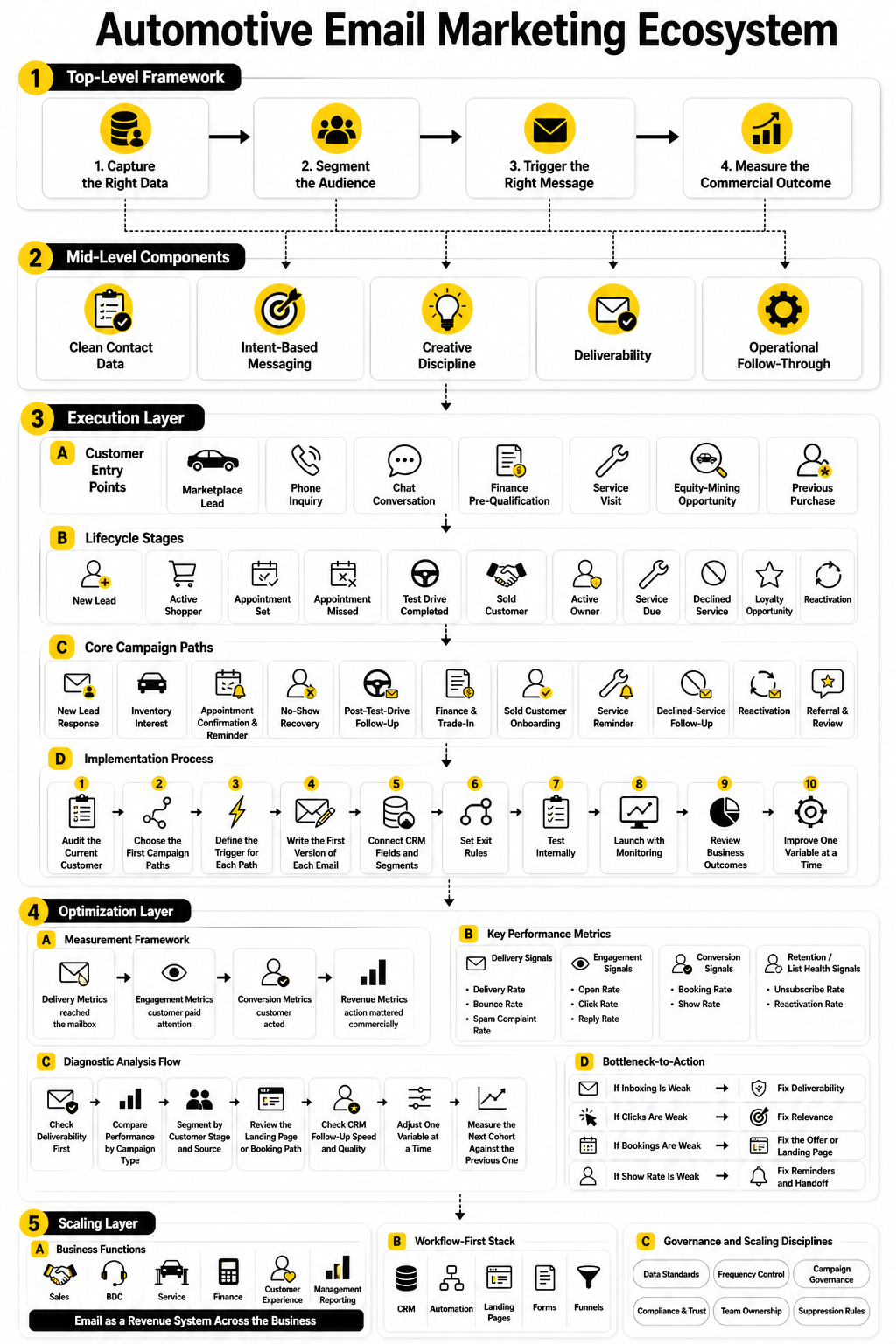
What is automotive email marketing?
Automotive email marketing is the use of email to communicate with leads, shoppers, buyers, owners, and service customers across the vehicle lifecycle. It includes lead follow-up, inventory updates, appointment reminders, finance communication, sold-customer onboarding, service reminders, declined-service follow-up, trade-in campaigns, reactivation, reviews, and referrals.
The goal is not just to send promotions. The goal is to help customers move through buying, ownership, and service decisions with less friction. Done properly, it connects marketing activity to real commercial outcomes like booked appointments, sold vehicles, service revenue, and repeat business.
Why is email still important for automotive businesses?
Email is still important because automotive decisions take time, research, comparison, and follow-up. A customer may interact with ads, search results, websites, marketplaces, showroom teams, finance forms, and service advisors before making a decision. Email gives the business a direct way to keep that journey moving.
It also works across the full lifecycle. Paid ads are often strongest for acquisition, but email can support buying, delivery, service, retention, loyalty, and reactivation. That makes it one of the most flexible channels in the automotive marketing mix.
What emails should a dealership send first?
Start with the emails that fix obvious revenue leaks. New lead response, appointment confirmation, no-show recovery, post-test-drive follow-up, sold-customer onboarding, service reminders, and declined-service follow-up are usually the strongest starting points.
These campaigns are practical because they connect to moments where the customer has already shown intent. You are not inventing demand from nothing. You are improving follow-up around actions that already happened.
How often should automotive businesses email customers?
Frequency depends on customer stage and message relevance. An active shopper may need several useful emails in a short period, while an inactive old lead should receive a much slower cadence. A service customer should receive reminders based on timing, mileage, maintenance needs, or ownership history.
The safest rule is to send when there is a real reason. Appointment confirmations, service reminders, and post-inquiry follow-ups can be timely and expected. Generic promotional emails should be used more carefully because they can create fatigue if they are not relevant.
What makes an automotive email campaign successful?
A successful campaign has a clear audience, trigger, message, next step, and measurement plan. It should speak to the customer’s current situation instead of pushing a generic dealership agenda. It should also be connected to the CRM so the team can see what happened after the email was sent.
The real proof is customer movement. Did the lead book? Did the customer show up? Did the buyer move closer to purchase? Did the owner schedule service? Did the inactive customer reengage? That is where success becomes meaningful.
Should automotive email marketing use automation?
Yes, but automation should be used carefully. It is excellent for predictable moments like lead confirmation, appointment reminders, post-sale onboarding, service reminders, and reactivation. It keeps communication consistent when the team is busy.
Automation should not replace human judgment in sensitive moments. Complaints, finance concerns, serious objections, trade-in negotiations, high-value opportunities, and trust recovery usually need human handling. The best systems automate consistency and preserve human attention where it matters most.
What metrics should automotive marketers track?
Track delivery, bounce rate, spam complaints, open rate, click rate, replies, appointment bookings, show rate, sales influence, service bookings, repair orders, unsubscribes, and reactivation. Do not rely on one metric to explain the whole system.
Open rates can help diagnose attention, but they are not the final score. Clicks show action, but they need context. Bookings, show rate, sold units, service revenue, and recovered declined work are closer to the outcomes that matter.
How can dealerships improve email deliverability?
Start with authentication, list quality, and relevance. Set up SPF, DKIM, and DMARC properly. Remove invalid addresses, suppress disengaged contacts, honor unsubscribes, and avoid sending to poorly sourced lists.
Then improve the customer value of the emails. Inbox placement is not only technical. If customers ignore, delete, unsubscribe, or complain, the sending reputation can suffer. Relevant lifecycle emails usually create healthier engagement than broad blasts to cold contacts.
What is the biggest mistake in automotive email marketing?
The biggest mistake is treating every contact the same. A fresh lead, missed appointment, recent buyer, service customer, declined-service customer, and inactive past lead all need different communication. When everyone receives the same campaign, relevance drops.
Another major mistake is failing to connect email to the store process. If an email creates a booking but nobody follows up properly, the campaign cannot reach its full value. Email should be part of the operating system, not a separate marketing activity.
How should automotive teams use personalization?
Use personalization to make the message more useful, not more invasive. Vehicle interest, appointment status, ownership stage, service history, and trade-in timing can all help create better emails. The customer should feel understood, not watched.
The best personalization is practical. Mention the relevant model category, service need, ownership milestone, or next step. Avoid overloading the email with behavioral details that make the customer uncomfortable.
Do service emails matter as much as sales emails?
Yes, and in many businesses they may be more dependable. Service emails support retention, fixed operations revenue, safety, ownership satisfaction, and future sales opportunities. A strong service relationship can keep the customer connected long after delivery.
Service reminders, declined-service follow-ups, seasonal maintenance campaigns, and first-service onboarding are all important. They give the business a reason to communicate when the customer is not actively shopping for a vehicle.
What tools are useful for automotive email marketing?
The best tool depends on the workflow. If the business needs CRM pipelines, automation, email, SMS, forms, appointment booking, and reporting in one place, GoHighLevel can be a practical option. If the business needs dedicated landing pages or campaign funnels, ClickFunnels or Systeme.io may fit specific campaign needs.
The tool should never be the strategy by itself. Choose software around the customer journey, team workflow, CRM requirements, compliance needs, and reporting goals. A simple tool used well will beat a powerful tool used chaotically.
How long does it take to see results from automotive email marketing?
Some campaigns can show useful signals quickly, especially appointment reminders, new lead follow-up, service reminders, and declined-service recovery. These campaigns are tied to existing customer intent, so the feedback loop is faster. You can usually see whether people are clicking, replying, booking, or showing up after the first few sends.
Longer-term campaigns take more time. Sold-customer onboarding, loyalty, trade-in timing, reactivation, and lifecycle nurture build value over weeks or months. The system becomes stronger as the CRM data improves and the team learns which messages move each customer stage.
Is automotive email marketing only for dealerships?
No. Dealerships are a natural fit, but the same principles apply to independent dealers, brokers, repair shops, detailers, parts businesses, finance teams, leasing companies, rental operators, fleet service providers, and automotive marketing agencies. The customer journey changes, but the communication logic stays similar.
Every automotive business has customer moments that need follow-up. The business just needs to map those moments clearly and build email paths around them. That is where the strategy becomes useful.
Build a stronger local presence with BAAM AI
Turn your website, Google profile, social channels, and AI visibility into one growth engine
Most businesses do not need more random marketing activity. They need a consistent presence system that helps the right people find them, trust them, and take action. BAAM AI brings strategy, local SEO, website updates, Google Maps visibility, social content, AI-search readiness, media production, and reporting into one practical monthly engine.
If you want your marketing to keep working after the campaign ends, start with a free BAAM AI presence audit. See how your business shows up today and where the fastest visibility wins are at BAAM AI.