
BAAM AI Blog
Automotive Digital Marketing Agency: The Practical Guide To Choosing, Structuring, And Measuring Growth
An automotive digital marketing agency is not just a vendor that runs ads for dealerships, repair shops, auto parts brands, detailers, rental companies, or automotive service businesses. At its best, it becomes the...
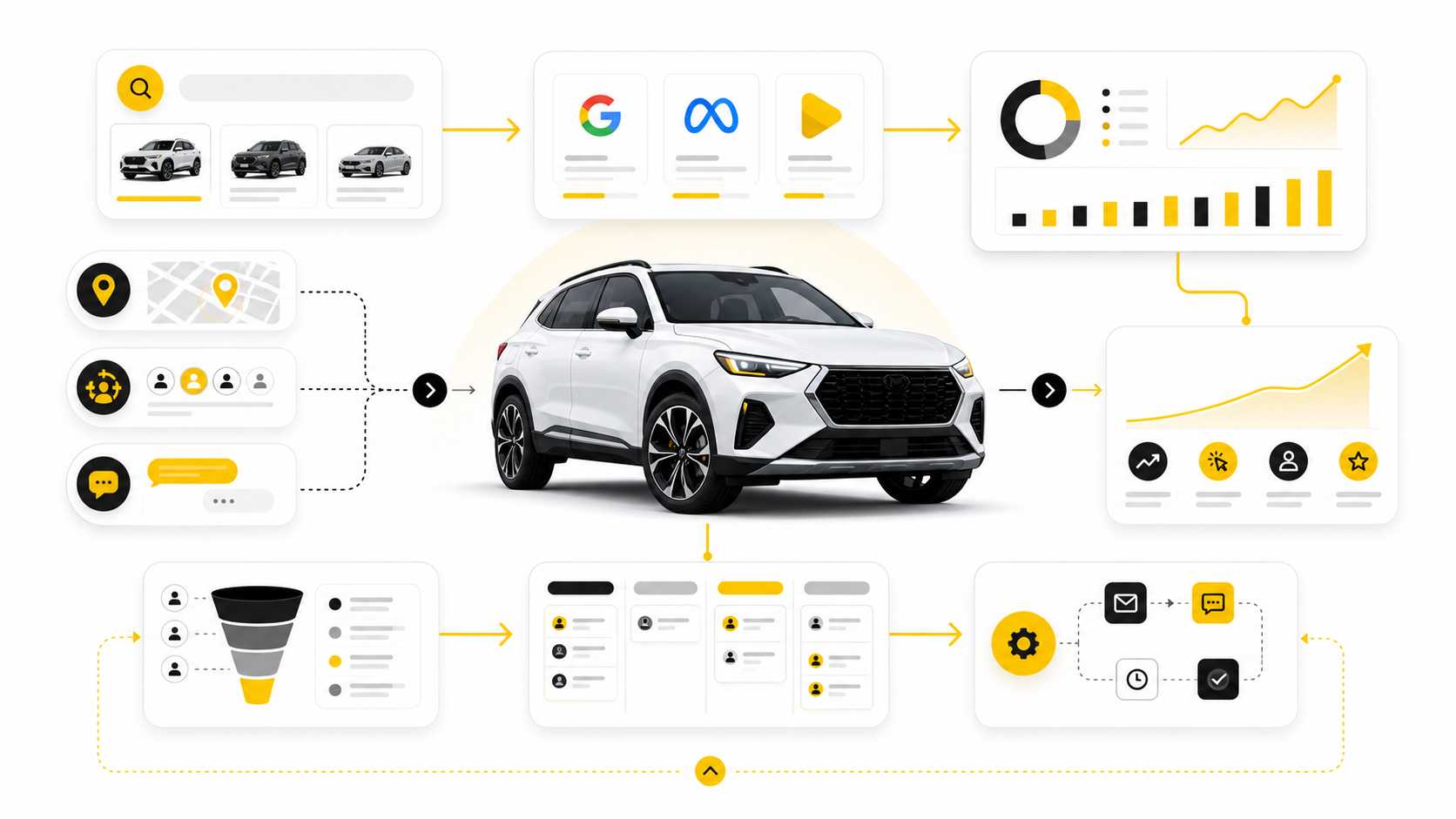
An automotive digital marketing agency is not just a vendor that runs ads for dealerships, repair shops, auto parts brands, detailers, rental companies, or automotive service businesses. At its best, it becomes the system that connects search demand, paid media, inventory or service offers, landing pages, CRM follow-up, reputation, reporting, and sales accountability into one growth engine.
That matters because automotive buyers do not move in a straight line anymore. They research online, compare pricing, check reviews, browse inventory, message businesses, call sales teams, and still often want an in-person experience before making a high-value decision. The latest Cox Automotive research shows that digital tools and omnichannel buying experiences are now tied directly to record buyer satisfaction, with 76% of new-vehicle buyers highly satisfied with the dealership experience in the 2025 Car Buyer Journey Study summarized by Cox Automotive.
The agency you choose has to understand that reality. A generic performance marketing shop might know how to lower cost per lead, but that is not enough if the leads are low intent, the CRM is messy, the sales team responds late, the landing page hides the offer, or reporting stops at form fills instead of booked appointments, showroom visits, repair orders, or sold units.
This guide breaks down what an automotive digital marketing agency should actually do, how the best ones structure campaigns, where most agencies underperform, and how to measure whether the relationship is producing real business growth. The goal is not to make digital marketing sound complicated. The goal is to make it easier to separate useful strategy from expensive noise.
Why An Automotive Digital Marketing Agency Matters
Automotive is a high-intent, high-friction category. People rarely buy a car, book a major repair, finance a vehicle, or choose a fleet partner casually. They compare options, look for proof, evaluate trust, and often need several digital and human touchpoints before taking action.
That is why an automotive digital marketing agency has to think beyond traffic. Traffic is only useful when it turns into qualified conversations, appointments, quote requests, financing applications, service bookings, or sales opportunities. NADA’s 2025 data shows the scale of the industry clearly: franchised light-vehicle dealers sold 16.2 million light-duty vehicles, generated more than $1.3 trillion in sales, and handled more than 276 million repair orders, with service and parts sales exceeding $164 billion, as reported in NADA Data 2025.
The challenge is that the customer journey is fragmented. A buyer might discover a vehicle through Google, compare it on a marketplace, check the dealership website, read reviews, submit a lead, call the store, and then arrive with objections that were shaped long before the sales conversation began. If the agency only manages ads, it misses the bigger job: controlling the path from attention to trust to action.
This is where specialist automotive knowledge becomes valuable. The agency needs to understand inventory urgency, OEM rules, local competition, fixed ops demand, seasonal patterns, lead quality, call handling, attribution gaps, compliance, and the difference between a cheap lead and a serious buyer. Without that context, campaigns can look successful in a dashboard while the business still feels no meaningful lift.
The Automotive Growth Framework
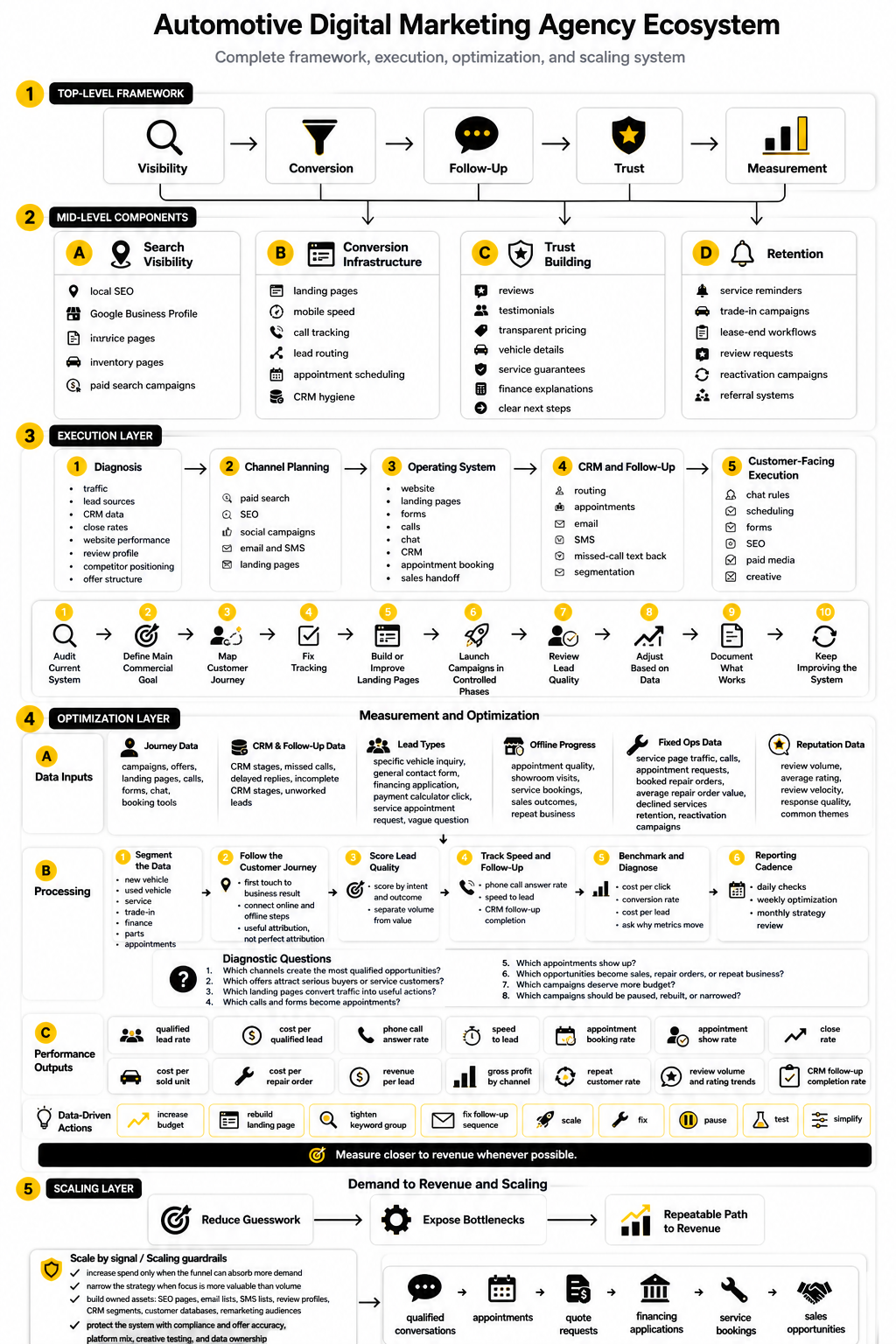
A strong automotive digital marketing agency should organize growth around a simple framework: visibility, conversion, follow-up, trust, and measurement. Visibility gets the business found by the right people. Conversion turns that attention into an action. Follow-up makes sure leads do not die in the CRM. Trust reduces friction before the customer speaks to sales. Measurement proves what actually created revenue.
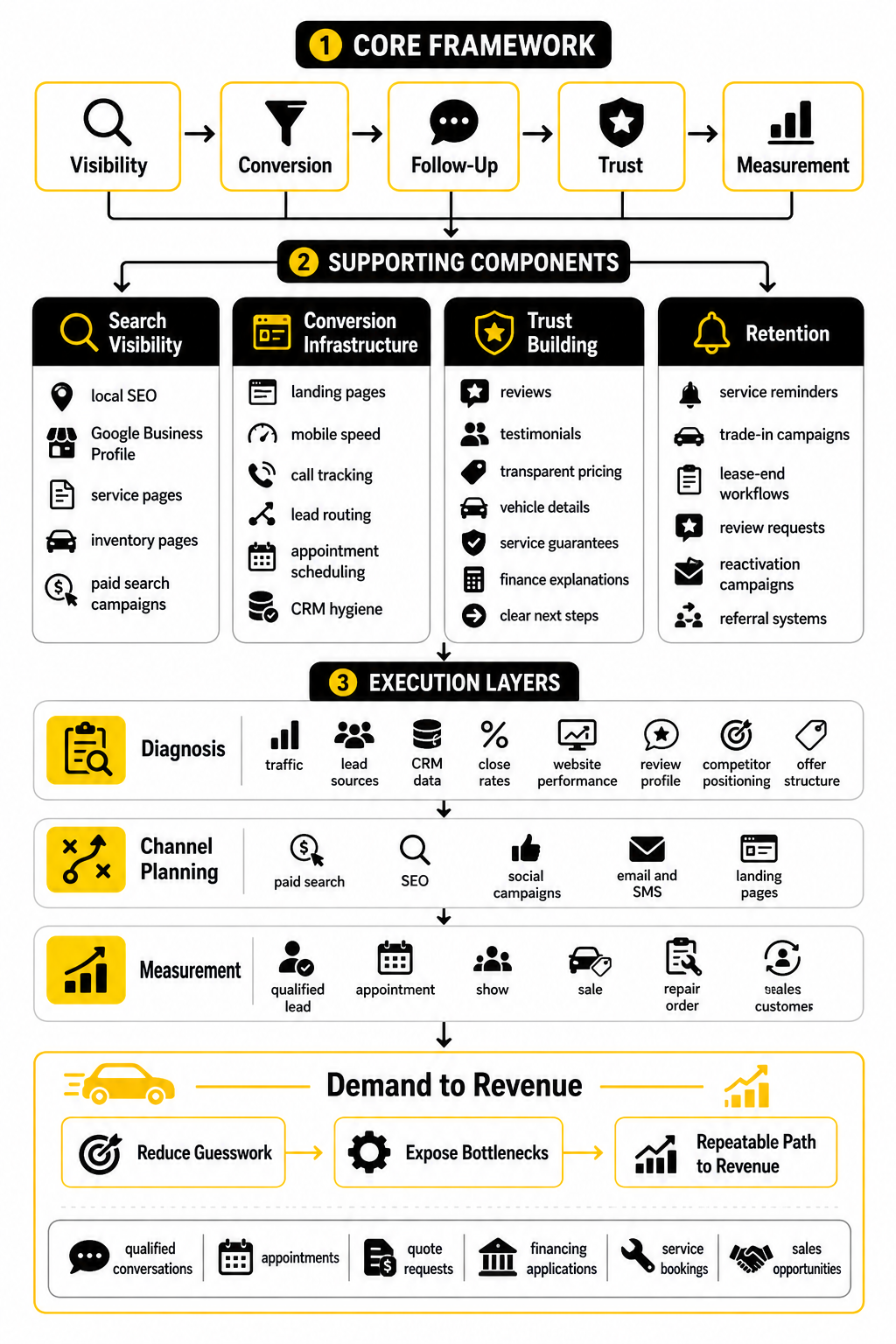
This framework matters because automotive marketing is not won by one channel alone. Paid search can capture urgent demand, SEO can build durable visibility, social campaigns can create awareness and retargeting pools, email and SMS can revive prospects, and landing pages can focus attention on a specific offer. A platform like GoHighLevel can support CRM, automation, pipeline tracking, and follow-up workflows when an agency needs one place to manage campaigns and customer communication.
The key is integration. Cox Automotive’s 2025 Digitization of Automotive Retail research found that 43% of dealers now offer every step of the car-buying process online, up from 34% in 2022, while many dealers still struggle with disconnected tools and repeated customer steps, as covered by Cox Automotive. That gap is exactly where a capable agency can create leverage.
A weak agency sells isolated tactics. A strong agency builds a connected system. The difference shows up in lead quality, speed to contact, appointment rates, cost per sold opportunity, customer experience, and how clearly leadership can see what is working.
Core Components Of Automotive Digital Marketing
The first core component is search visibility. When someone searches for a dealership, mechanic, body shop, tire service, EV charger installer, auto parts supplier, or specific vehicle near them, the business needs to appear with a strong offer and a credible presence. That includes local SEO, Google Business Profile optimization, service pages, inventory pages, review signals, and paid search campaigns that match real buying intent.
The second component is conversion infrastructure. Automotive businesses often lose money not because demand is missing, but because their website, forms, calls, chat, and follow-up process create friction. A good automotive digital marketing agency looks at landing pages, mobile speed, call tracking, lead routing, missed-call workflows, appointment scheduling, offer clarity, and CRM hygiene before scaling spend.
The third component is trust building. Reviews, testimonials, transparent pricing, vehicle details, service guarantees, finance explanations, staff credibility, and clear next steps all reduce hesitation. This is especially important because even when digital shopping is strong, most buyers still do not want a fully detached online transaction; Cox’s 2025 buyer research, also discussed by WIRED, found that only a small share of shoppers complete the entire purchase online, while many still value seeing, touching, and test-driving the vehicle.
The fourth component is retention. Automotive businesses should not depend only on new customer acquisition when service reminders, trade-in campaigns, lease-end workflows, review requests, reactivation campaigns, and referral systems can compound value over time. The best agency strategy connects front-end acquisition with lifetime customer value.
How Professional Implementation Works
Professional implementation starts with diagnosis, not ad spend. The agency should review current traffic, lead sources, CRM data, close rates, call recordings when available, website performance, review profile, competitor positioning, and offer structure. This gives the strategy a baseline instead of forcing the business into a generic campaign template.
Next comes channel planning. A dealership with strong inventory but weak local visibility may need SEO, search ads, vehicle listing optimization, and retargeting. A repair shop with strong word of mouth but inconsistent bookings may need local SEO, Google Ads, review generation, service reminder automations, and a clearer booking flow. An automotive ecommerce brand may need product pages, paid social, email flows, and conversion-focused landing pages rather than dealership-style lead generation.
Then comes measurement. The agency should define what counts as a qualified lead, appointment, show, sale, repair order, or repeat customer before campaigns scale. This is where many relationships fall apart, because the agency celebrates impressions and leads while the business owner cares about revenue, margin, and capacity.
The right automotive digital marketing agency makes the whole system easier to manage. It should reduce guesswork, expose bottlenecks, and create a repeatable path from demand to revenue. That is the standard the rest of this guide will use.
How To Evaluate An Automotive Digital Marketing Agency
Choosing an automotive digital marketing agency should not start with the agency’s pitch deck. It should start with your business model, your sales process, and the numbers you actually need to improve. A dealership, repair shop, collision center, parts ecommerce brand, detailing business, finance company, and fleet service provider may all live inside the automotive category, but they do not need the same marketing machine.
The first thing to check is whether the agency understands how automotive revenue is created. For a dealership, that may mean new vehicle sales, used vehicle sales, finance and insurance, service absorption, trade-ins, and retention. For a repair or service business, it may mean booked appointments, average repair order value, repeat visits, maintenance plans, and local search visibility.
The second thing to check is whether the agency can explain your customer journey clearly. If they cannot map how someone moves from search, social, marketplace browsing, review checking, website visits, phone calls, forms, chat, and CRM follow-up into a real appointment, they are probably selling channels instead of outcomes. That is dangerous, because automotive businesses rarely have a traffic problem only; they usually have a conversion, trust, follow-up, or attribution problem hiding behind the traffic.
Industry Experience Is Useful, But Specific Experience Matters More
A lot of agencies say they work with automotive clients. That phrase alone does not mean much. You need to know whether they have experience with your actual category, your sales cycle, your margins, and your operational constraints.
For example, a dealership campaign has to account for inventory changes, OEM compliance, vehicle pricing, model-level demand, lead routing, and showroom performance. A repair shop campaign has to account for local urgency, service capacity, customer trust, quote sensitivity, and repeat maintenance behavior. An automotive ecommerce brand has to think about product feeds, landing pages, paid social creative, email flows, cart recovery, and fulfillment expectations.
The best agency will ask practical questions before recommending anything. They will want to know your current lead volume, close rate, average response time, booked appointment rate, no-show rate, gross profit, capacity, and customer lifetime value. That is the difference between a vendor that runs ads and a partner that understands growth.
The Agency Should Audit Before It Sells
A serious automotive digital marketing agency should be able to review what is already happening before asking you to commit to a major spend increase. That audit should cover search visibility, website structure, page speed, local listings, Google Business Profile quality, call tracking, form tracking, CRM routing, offer clarity, review profile, campaign structure, and reporting accuracy. It does not need to be theatrical, but it should be specific.
This matters because many automotive businesses already have demand. The leak is often somewhere else. Calls go unanswered, forms land in the wrong inbox, landing pages are too generic, service pages do not match search intent, or sales teams cannot see which campaigns produced the best opportunities.
A useful audit gives you a prioritized list. It should separate urgent fixes from nice-to-have improvements. If every recommendation sounds equally important, the agency has not done the thinking yet.
Ask How They Define A Qualified Lead
Lead volume is one of the easiest metrics to inflate. A campaign can generate more form submissions while lowering the quality of conversations your team actually wants. That is why you should ask the agency exactly how it defines a qualified lead.
For dealerships, a qualified lead may include a specific vehicle inquiry, finance application, trade-in request, appointment request, or high-intent phone call. For service businesses, it may include a booking request, estimate request, emergency repair call, or returning customer inquiry. For ecommerce brands, it may include product page engagement, add-to-cart activity, email signup quality, repeat purchase rate, or revenue from segmented campaigns.
The agency should be comfortable tying marketing activity to deeper funnel outcomes. They may not control whether your sales team closes every opportunity, but they should care about whether the leads are serious. If they stop the conversation at cost per lead, push harder.
Budgeting, Reporting, And Performance Metrics
Budgeting for automotive marketing should be tied to the role each channel plays. Search campaigns usually capture existing demand. SEO compounds long-term visibility. Social campaigns can build awareness, retarget shoppers, and promote offers. Email, SMS, and CRM automation help convert and retain people who already showed interest.
A smart automotive digital marketing agency will not treat every dollar the same. Some spend should create immediate opportunities, while some should build assets that reduce dependence on paid traffic over time. The balance depends on your market, competition, margins, timeline, and how much existing demand your brand already captures.
The mistake is budgeting only around ad spend. Media spend matters, but it is not the whole system. Landing pages, tracking, creative, automation, CRM cleanup, call handling, reporting, and offer testing can be the difference between a campaign that looks busy and one that actually creates revenue.
What A Real Marketing Budget Should Include
A complete budget usually has three layers: media, management, and infrastructure. Media is the money spent on platforms like Google, Meta, YouTube, programmatic placements, or other acquisition channels. Management is what you pay the agency to plan, execute, optimize, report, and communicate.
Infrastructure is the part many businesses ignore. This includes landing pages, CRM setup, automation workflows, call tracking, form tracking, review generation, analytics, creative production, and appointment scheduling. Tools like GoHighLevel can make sense when the business needs CRM, funnels, automation, pipeline tracking, and client communication in one environment.
The budget should also leave room for testing. Automotive markets shift quickly because inventory, incentives, financing conditions, seasonality, and local competition change. If the whole budget is locked into one fixed plan, the agency has no room to respond when the market moves.
The Metrics That Actually Matter
The right metrics depend on the business model, but the principle is simple: measure closer to revenue whenever possible. Impressions, clicks, and form fills help diagnose activity, but they do not prove business impact by themselves. The stronger metrics are qualified lead rate, appointment rate, show rate, close rate, cost per appointment, cost per sold unit, cost per repair order, revenue per lead, and customer lifetime value.
For dealerships, the reporting should connect marketing to inventory movement, appointment quality, sales outcomes, and fixed ops opportunities where possible. For service businesses, reporting should separate low-value inquiries from booked appointments and completed work. For ecommerce brands, reporting should include conversion rate, average order value, repeat purchase behavior, abandoned cart recovery, and contribution margin.
This is where agency transparency becomes non-negotiable. You should know what is being measured, where the data comes from, and what the agency can or cannot prove. Clean reporting does not mean perfect attribution; it means honest visibility into the strongest signals available.
Reporting Should Create Decisions, Not Just Dashboards
A monthly report should not be a decorated screenshot collection. It should explain what happened, why it happened, what changed, what the agency learned, and what should happen next. If a report does not lead to better decisions, it is not doing its job.
Good reporting connects marketing performance to operational reality. For example, a campaign may be generating calls, but call recordings may show that customers are asking about pricing that is unclear on the website. A service campaign may produce bookings, but capacity may be full on the days with the highest demand. A used vehicle campaign may drive leads, but the sales team may need faster follow-up to compete with nearby dealers.
This is why dashboards alone are not enough. The agency should be able to translate the data into action. That is where the value is.
Common Mistakes Automotive Businesses Should Avoid
The first major mistake is treating marketing as a replacement for sales process. Marketing can create demand, sharpen offers, and improve lead quality, but it cannot fix slow follow-up, poor phone handling, weak appointment setting, or unclear ownership inside the business. If leads are not contacted quickly and professionally, even strong campaigns will underperform.
The second mistake is copying competitors without understanding their economics. A dealership across town may be bidding aggressively because it has different inventory pressure, manufacturer support, margins, or sales capacity. A repair shop may promote a low-cost offer because it has a strong upsell and retention process behind it. Copying the visible ad without copying the business logic is a fast way to waste money.
The third mistake is changing direction too often. Automotive campaigns need enough data to separate a bad idea from an under-tested idea. If the agency launches a campaign, changes the offer, edits the audience, swaps the landing page, and rewrites the follow-up sequence every few days, the business never learns what actually worked.
Do Not Chase Cheap Leads Blindly
Cheap leads can feel exciting in a report. They can also bury your team in low-intent conversations that never become appointments or revenue. A lower cost per lead is only useful if the quality stays strong enough to support the business goal.
This is especially true in automotive, where one serious buyer or high-value service customer can be worth far more than dozens of weak inquiries. The better question is not, “How many leads did we get?” The better question is, “Which leads moved far enough through the pipeline to justify more investment?”
A good automotive digital marketing agency will help you separate volume from value. That means looking at lead source, search intent, call quality, appointment outcomes, and closed revenue. It is less flashy than celebrating cheap leads, but it is how serious growth gets built.
Do Not Ignore Fixed Ops And Retention
Many automotive businesses put too much focus on front-end acquisition and too little focus on retention. That is a missed opportunity. Service reminders, seasonal campaigns, warranty follow-ups, tire promotions, inspection reminders, review requests, and reactivation campaigns can create durable revenue without constantly buying new attention.
NADA’s industry data shows how important fixed operations are, with franchised dealers handling more than 137 million repair orders and generating more than $81 billion in service and parts sales in the latest annual dataset shown by NADA Data. That should influence how an agency thinks about strategy. The customer should not disappear after the first sale, appointment, or repair order.
Retention also improves marketing economics. When a business can bring customers back through email, SMS, CRM workflows, and useful reminders, paid acquisition does not have to carry the entire revenue burden. That is the practical reason lifecycle marketing matters.
Do Not Let Tools Become The Strategy
Tools are helpful, but they are not the strategy. A CRM, funnel builder, chatbot, scheduler, email platform, or analytics dashboard only creates value when it supports a clear customer journey. Without that, the business just adds more software to an already messy process.
A tool like Cal.com can make booking easier when appointment scheduling is the bottleneck. A tool like ManyChat can support messaging workflows when social conversations and follow-up are important. But neither tool fixes a weak offer, unclear positioning, poor response process, or bad measurement.
The agency should recommend tools only when they solve a real problem. That is the standard. Software should remove friction, not add another layer of confusion.
Tools, Automation, And AI In Automotive Marketing
The next layer is execution technology. Once the strategy is clear, the agency needs a practical way to capture demand, route leads, follow up quickly, measure outcomes, and keep campaigns moving without creating chaos for the sales or service team. This is where tools, automation, and AI become useful, but only when they are tied to a real process.
The automotive customer journey still has a lot of human friction. A shopper may want digital convenience, but they also want confidence before making a high-value decision. Recent buyer research shows that mostly digital buyers are often the most satisfied, while many shoppers still complete important steps in person, which is why the execution system has to support both online speed and offline trust through the same workflow Cox Automotive.
An automotive digital marketing agency should treat automation as a way to make the customer experience cleaner, not colder. Faster responses, better routing, clearer reminders, and more consistent follow-up can all improve the experience. But the second automation starts sending generic messages that ignore context, it damages trust.
Build The Operating System Before Scaling Campaigns
Before adding more paid traffic, the agency should make sure the operating system can handle more demand. That means the website, landing pages, forms, calls, chat, CRM, appointment booking, sales handoff, and reporting have to work together. If one of those pieces breaks, the campaign may still generate leads, but the business will not capture the full value.
This is especially important in automotive because customers often compare multiple businesses at once. If your response is slow, unclear, or disconnected, the customer simply keeps moving. A good agency will test the lead path from the customer’s point of view before it scales spend.
The operating system should answer a few simple questions. Where does the lead go? Who owns it? What happens in the first five minutes? What happens after one hour, one day, three days, and thirty days? If nobody can answer those questions clearly, the agency has implementation work to do before it asks for a bigger budget.
The Practical Execution Process
A professional implementation process should feel simple from the outside and disciplined behind the scenes. The business should know what is being built, why it matters, who owns each step, and how success will be measured. The agency should not disappear into vague “optimization” language.
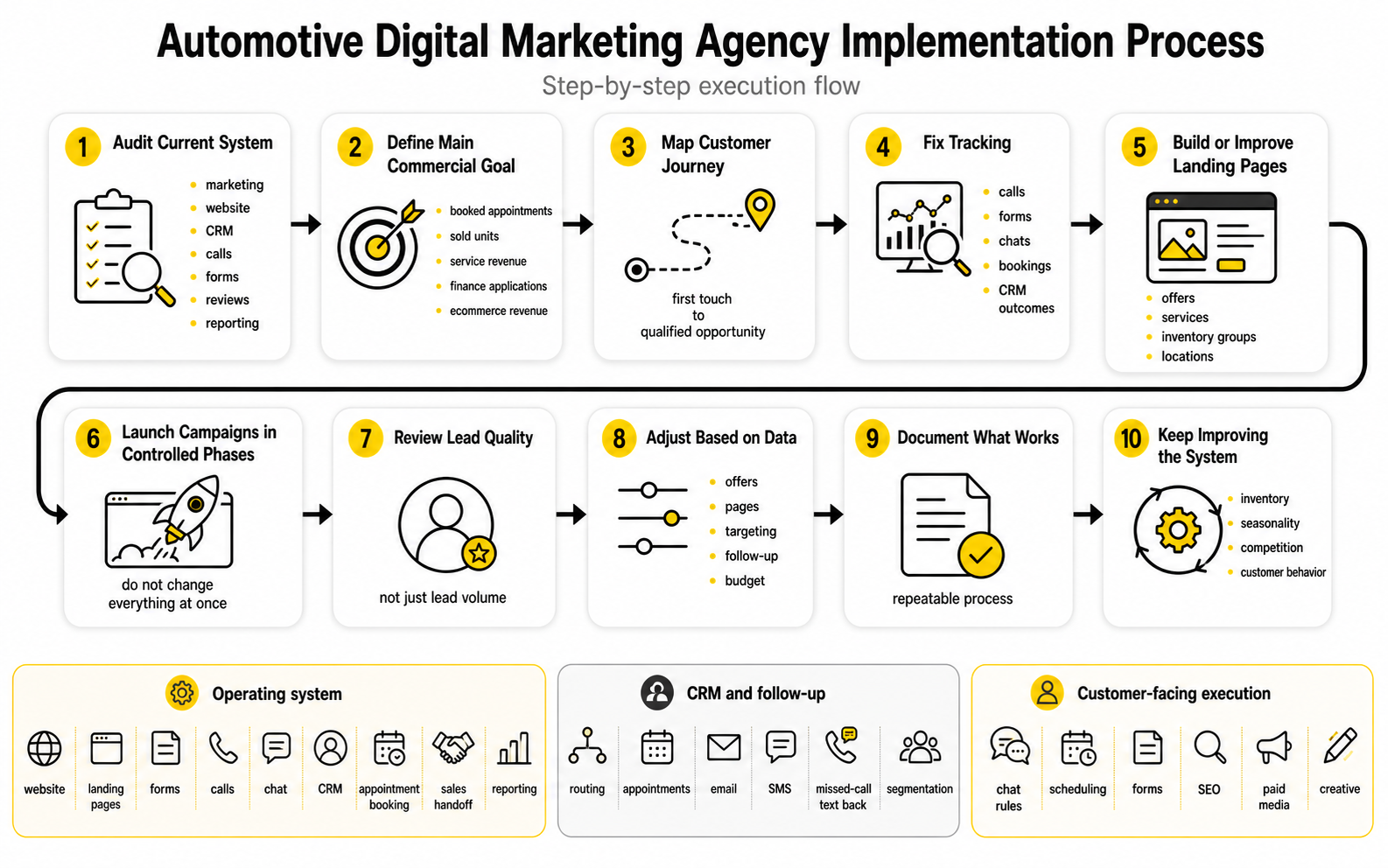
A clean rollout usually follows this sequence:
This sequence keeps the agency honest. It also protects the business from random marketing activity that looks productive but does not create a better pipeline. Execution should always become more measurable over time.
CRM And Follow-Up Are Not Optional
The CRM is where marketing either becomes revenue or disappears. If leads are not tagged correctly, routed correctly, followed up quickly, and updated consistently, the agency loses visibility and the business loses opportunities. This is one of the most common reasons automotive marketing feels weaker than the reports suggest.
For many automotive businesses, a platform like GoHighLevel can be useful when the agency needs funnels, CRM pipelines, missed-call text back, appointment reminders, email workflows, SMS follow-up, and reporting in one place. That does not mean every business needs the same setup. It means the agency should choose tools that reduce operational drag and make follow-up easier to manage.
The best follow-up systems feel human because they are based on intent. A service customer asking about brake repair should not receive the same message as a shopper asking about financing. A trade-in lead should not be treated like a cold newsletter signup. Segmentation is what keeps automation practical instead of annoying.
Landing Pages Should Match Intent
A landing page should not try to do everything. It should match one clear customer intent and make the next step obvious. If someone clicks an ad for transmission repair, the page should talk about transmission repair, trust signals, diagnostic process, location, availability, and booking.
For dealerships, the same principle applies to inventory campaigns, model campaigns, trade-in campaigns, financing campaigns, and fixed ops campaigns. Each page should reduce uncertainty and move the customer toward the next action. If the page is too broad, the customer has to work harder, and every extra moment of confusion lowers conversion potential.
Tools like Replo can fit when an automotive ecommerce or direct-response team needs faster landing page production and testing. Funnel tools like ClickFunnels can also work when the offer is built around a focused lead capture or appointment flow. The tool matters less than the discipline: one page, one intent, one next step.
AI Should Support The Team, Not Replace Judgment
AI is becoming more useful in automotive marketing, especially for research, campaign analysis, content briefs, customer segmentation, call summaries, chatbot routing, and CRM workflow suggestions. That is a real advantage when it helps the agency move faster and spot problems earlier. It is not an excuse to let generic machine-written content run the brand.
The better use of AI is operational. It can help summarize call patterns, identify common objections, draft first-pass ad variations, cluster search queries, review CRM notes, and flag missed follow-up opportunities. Those tasks save time without pretending that software understands the local market better than the people running the business.
This distinction matters. The customer still wants clarity, trust, and relevance. AI should help the agency provide those things faster, not flood the internet with bland content that sounds like every other dealership, repair shop, or auto brand.
Chat And Messaging Need Clear Rules
Chat can help automotive businesses capture more conversations, especially when customers are comparing options after hours or browsing on mobile. But chat only works well when it has rules. It should know when to answer simple questions, when to collect contact details, when to offer booking, and when to escalate to a real person.
A messaging platform like ManyChat can support structured conversations for social channels and follow-up flows when the agency has a clear journey to build. A tool like Chatbase can be useful when a business wants an AI assistant trained around approved information, common questions, and support content. The important part is control: the customer should not receive confident answers that the business cannot honor.
Messaging should also be measured properly. Look at booked appointments, qualified conversations, response time, escalation quality, and customer satisfaction signals. Do not judge chat only by the number of messages started.
Scheduling And Forms Should Remove Friction
Appointment scheduling is one of the easiest places to lose a motivated customer. If the customer has to wait for a callback, guess available times, or repeat information already submitted, the experience feels outdated. That is a problem when competitors are one search result away.
For service businesses, scheduling should make it easy to choose a service type, location, date, and time. For dealerships, scheduling should support test drives, consultations, appraisal appointments, finance calls, and service visits. The agency should help make the path clear enough that the customer can act without needing extra explanation.
Tools like Cal.com can help when the business needs flexible booking links and cleaner appointment coordination. Tools like Fillout can help when forms need to collect better information before routing a lead. Used well, these tools reduce back-and-forth and give the team cleaner data from the start.
Content And SEO Execution Must Match Local Demand
SEO for automotive businesses is not just about publishing blog posts. It is about showing up for the specific searches that indicate intent: local service searches, vehicle research, financing questions, trade-in searches, parts searches, dealership comparisons, maintenance questions, and brand-specific queries. The agency needs to build pages that match how people actually search.
Local search is especially important because many automotive decisions are location-sensitive. People want a nearby repair shop, a dealer with inventory they can visit, a service department they trust, or a parts provider that can deliver quickly. Strong local SEO usually depends on location pages, service pages, review signals, accurate listings, internal linking, and useful content that supports real buying or booking decisions.
The content should also reflect the sales process. A page about brake repair should help someone understand symptoms, urgency, inspection, pricing variables, and how to book. A page about used SUVs should help someone narrow choices, understand financing, and take the next step. Content is not decoration; it is sales support.
Paid Media Needs Controlled Testing
Paid media should start with a clear hypothesis. The agency should know which offer, audience, keyword group, location, or inventory segment it is testing. Without that, campaign changes become guesswork.
Search campaigns often work best when they capture specific intent, such as emergency repair, financing, trade-in, service near me, or vehicle model searches. Social and video campaigns can work well for awareness, retargeting, seasonal promotions, and offer education. Retargeting can help bring back shoppers who viewed inventory, started a form, visited service pages, or engaged with content.
The agency should avoid spreading the budget too thin. It is better to run a few campaigns with clear goals than many campaigns with weak data. Once the winners are clear, scaling becomes safer.
Creative Should Make The Offer Obvious
Automotive creative does not need to be overproduced to work. It needs to be clear, relevant, and believable. The customer should understand what is being offered, why it matters, where the business is located, and what to do next.
For dealerships, creative can focus on inventory availability, payment range, trade-in value, financing options, model benefits, service offers, or local trust. For repair and service businesses, it can focus on urgency, expertise, convenience, warranty, diagnostics, and customer confidence. For ecommerce brands, it can focus on product fit, installation, proof, guarantees, and shipping clarity.
A good automotive digital marketing agency will test angles instead of guessing. Price, convenience, trust, speed, expertise, availability, and financing can all pull different types of customers. The point is to learn which message attracts the right customer, not just the most clicks.
Statistics And Data
Data should make an automotive digital marketing agency more useful, not more confusing. The point is not to throw every metric into a dashboard and hope the client feels impressed. The point is to understand what the numbers reveal about demand, friction, trust, follow-up, and revenue.
Automotive marketing data is easy to misread because the buying journey is mixed. Some customers research heavily online but still want to visit in person. Some submit a form but prefer a phone call. Some look low intent at first, then become serious after financing, trade-in value, or service urgency becomes clearer.
That is why measurement has to connect marketing activity with real commercial movement. A click is useful only if it helps you understand intent. A lead is useful only if it creates a qualified conversation. A campaign is useful only if it helps the business sell, book, retain, or reactivate customers more efficiently.
Why Automotive Benchmarks Need Context
Benchmarks are useful when they help you ask better questions. They are dangerous when they become lazy targets. A dealership selling used trucks in a competitive metro area should not expect the same numbers as a rural service center, a luxury dealer, an EV installer, or an automotive ecommerce brand.
The broader industry shows why context matters. Franchised light-vehicle dealers sold 16.2 million light-duty vehicles, generated more than $1.3 trillion in total sales, and wrote more than 276 million repair orders in the latest NADA annual dataset shown by NADA Data. Those numbers are huge, but they do not tell you whether your campaign is good or bad by themselves.
The action is to compare your own numbers by segment. New vehicle leads should be reviewed separately from used vehicle leads. Service campaigns should be reviewed separately from sales campaigns. Trade-in, finance, parts, and appointment campaigns should each have their own performance expectations because each one reflects a different customer mindset.
The Numbers That Matter Most
A strong automotive digital marketing agency should build reporting around the metrics that reveal movement through the funnel. That starts with traffic quality, but it cannot stop there. You need to know how many visitors became leads, how many leads became qualified conversations, how many conversations became appointments, and how many appointments became revenue.
The most useful metrics usually include:
These metrics work because they expose the handoff points. If traffic is strong but lead volume is weak, the website or offer may be the problem. If leads are strong but appointments are weak, follow-up or lead quality may be the issue. If appointments are strong but sales are weak, the problem may sit in pricing, inventory, sales process, trust, or capacity.
The Analytics System Should Follow The Customer Journey
The analytics system should show the path from first touch to business result. That means campaigns, landing pages, calls, forms, chat, booking tools, CRM stages, and revenue outcomes need to be connected as much as possible. Perfect attribution is rarely realistic, but useful attribution is absolutely possible.
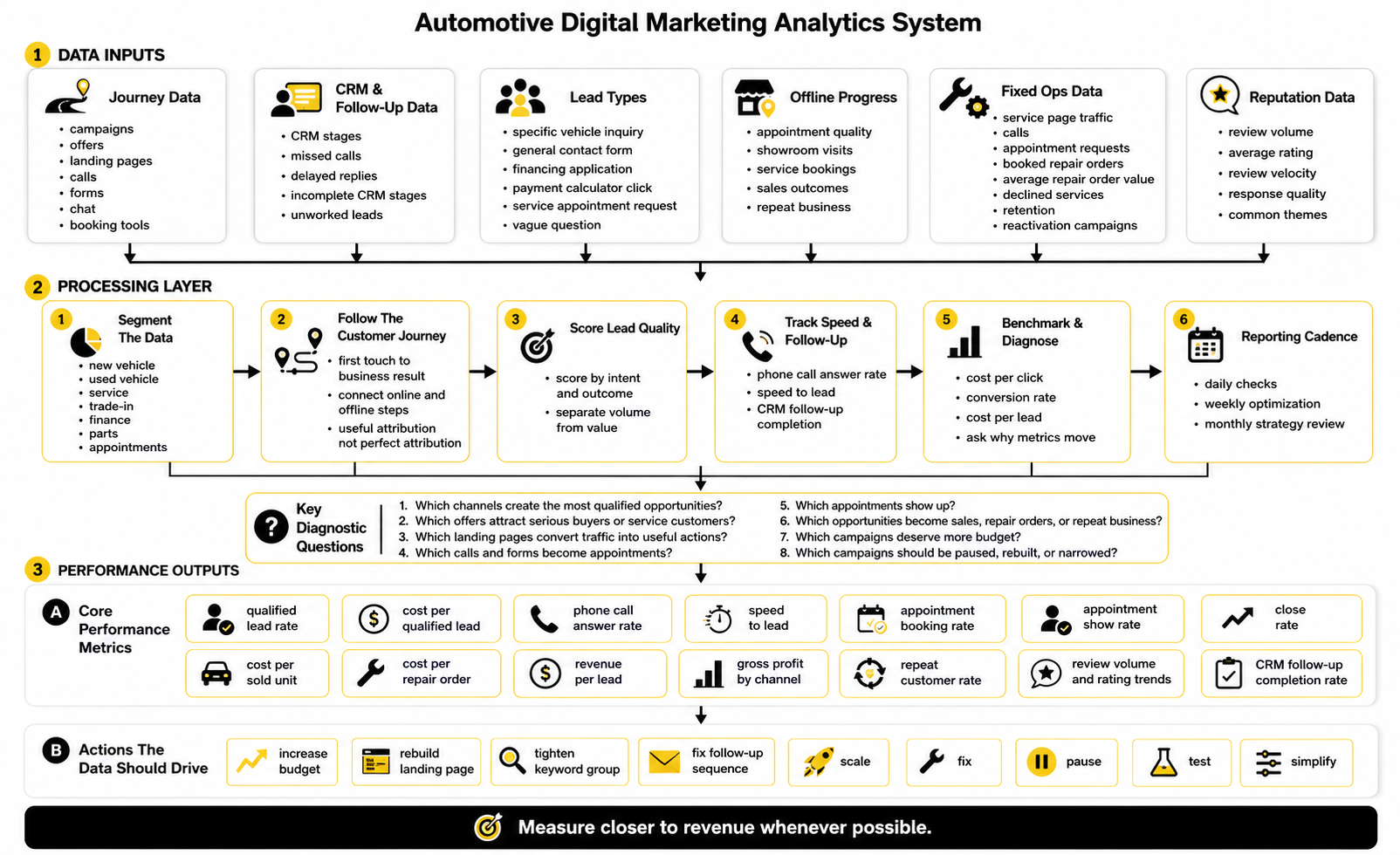
A practical analytics system should answer these questions clearly:
This is where the agency’s discipline shows. If the dashboard only reports impressions, clicks, spend, and leads, it is not enough. The agency should help the business see where money turns into pipeline and where pipeline gets stuck.
Digital Retail Data Shows The Journey Is Hybrid
The automotive journey is more digital than it used to be, but it is not fully online for most buyers. That matters because the agency should not build campaigns as if every customer wants a one-click transaction. The better approach is to make digital steps easier while supporting the in-person confidence customers still want.
Cox Automotive’s 2025 research found that “mostly digital buyers,” meaning buyers who completed more than half of the required process online, were among the most satisfied vehicle buyers, as summarized by Cox Automotive. At the same time, reporting on the same buyer behavior noted that only 7% of buyers completed the entire transaction online, while many still preferred physical inspection, test drives, and in-person paperwork, as covered by WIRED.
The action is simple: measure both online and offline progress. Do not judge a campaign only by online form fills if the customer journey often continues by phone or in store. Track the digital steps, but also review appointment quality, showroom visits, service bookings, and sales outcomes.
Lead Volume Is Not The Same As Demand Quality
More leads can be a good sign, but only when the quality holds. A campaign that doubles form submissions while filling the CRM with weak inquiries may create more work without creating more revenue. This is where many automotive businesses get misled by surface-level reporting.
The agency should separate lead types. A specific vehicle inquiry is different from a general contact form. A financing application is different from a casual payment calculator click. A service appointment request is different from someone asking a vague question with no timeline.
The action is to score leads by intent and outcome. The business should know which sources produce serious conversations, which sources produce price shoppers, and which sources produce customers who actually book, show, and buy. Once that is clear, budget decisions become much easier.
Speed And Follow-Up Data Reveal Hidden Revenue
Speed to lead is one of the most practical metrics in automotive marketing. When customers are comparing multiple dealerships, repair shops, or service providers, slow follow-up quietly kills performance. The agency can generate the opportunity, but the business still has to capture it.
This is why CRM and call data should be reviewed alongside campaign data. Missed calls, delayed replies, incomplete CRM stages, and unworked leads are not just operational details. They are revenue leaks.
Tools like GoHighLevel can help when an agency needs pipelines, automations, missed-call workflows, appointment reminders, and follow-up sequences in one system. The goal is not to automate everything for the sake of it. The goal is to make sure serious prospects do not disappear because nobody responded clearly and quickly.
Paid Media Benchmarks Should Trigger Diagnosis
Paid media benchmarks can help you spot whether a campaign needs investigation, but they should not be treated as universal truth. Cost per click, conversion rate, and cost per lead vary by location, competition, offer, brand strength, device, keyword intent, and landing page quality. A higher cost per lead can still be profitable if the lead quality and close rate are strong.
Recent Google Ads benchmark reporting shows that search advertising costs have continued rising across many industries, with WordStream’s 2025 benchmark report noting ongoing increases in search ad costs and providing updated industry comparisons for cost per click, conversion rate, and cost per lead WordStream. That should push automotive marketers to improve conversion quality, not just chase cheaper traffic.
The action is to use benchmarks as a starting point for questions. If cost per lead is high, check whether the keywords are too broad, the offer is weak, the landing page is unclear, or the location targeting is too wide. If cost per lead is low but sales are weak, check lead quality, CRM handling, appointment rate, and close rate before celebrating.
Fixed Ops Data Deserves Its Own Reporting
Service and parts should not be treated as a side note in automotive reporting. Fixed ops can create steadier demand, stronger retention, and more predictable revenue than front-end sales campaigns alone. The data should reflect that.
NADA’s 2025 figures show service and parts sales exceeding $164 billion across franchised light-vehicle dealers, with more than 276 million repair orders written in the same annual dataset NADA Data. That scale makes fixed ops a major strategic category, not a minor campaign add-on.
The action is to measure service marketing with its own funnel. Track service page traffic, calls, appointment requests, booked repair orders, average repair order value, declined services, retention, and reactivation campaigns. A good automotive digital marketing agency will not bury fixed ops performance under general lead reporting.
Reviews And Reputation Are Performance Signals
Reviews are not just a branding metric. They influence trust before a customer contacts the business, and they can affect local visibility, click behavior, and conversion. A business with weak reviews often pays more to overcome hesitation.
The right measurement approach tracks review volume, average rating, review velocity, response quality, and common themes inside customer feedback. If people mention slow communication, unclear pricing, poor handoff, or confusing booking, that is not just a reputation issue. It is a conversion issue.
The action is to feed review insights back into marketing and operations. Strong review themes can become landing page proof, ad angles, service page language, and sales enablement. Negative patterns should become operational fixes, not just public replies.
Reporting Cadence Should Match Decision Speed
Not every metric needs daily review. Some numbers, like spend pacing, broken forms, campaign errors, missed calls, and urgent lead flow issues, need fast visibility. Other numbers, like SEO growth, retention, close rate trends, and lifetime value, need longer windows.
A practical reporting cadence usually separates daily checks, weekly optimization, and monthly strategy review. Daily checks protect the system from obvious waste. Weekly reviews help the agency improve campaigns, pages, and follow-up. Monthly reviews connect performance to business direction.
The action is to avoid both extremes. Do not obsess over every daily fluctuation, but do not wait a month to discover that tracking broke or leads stopped routing correctly. Good measurement creates calm, not panic.
The Best Data Leads To A Clear Decision
The real test of reporting is whether it leads to action. If a report does not help the business decide what to scale, fix, pause, test, or simplify, it is not useful enough. Pretty dashboards are not the goal.
A good automotive digital marketing agency should turn data into clear recommendations. Increase budget here because qualified appointments are strong. Rebuild this landing page because mobile conversion is weak. Tighten this keyword group because calls are irrelevant. Fix this follow-up sequence because leads are stalling before appointments.
That is what performance data is for. It should make the next move easier to see.
How To Choose The Right Agency Partner
At this stage, the question becomes practical: which automotive digital marketing agency should you actually trust? The answer is not always the agency with the flashiest website, the largest client logo wall, or the most aggressive promise. The right partner is the one that can understand your business model, build the right system, and explain performance in plain language.
A strong agency should be able to tell you what it will do first, what it will not touch yet, and why. That last part matters. If an agency wants to launch everything at once without diagnosing your current lead flow, sales process, tracking, and customer journey, you are probably buying activity instead of strategy.
The best partner will make your business sharper. You should come out of early conversations with a clearer view of your bottlenecks, not just a quote for services. If the agency cannot help you think better before you sign, do not expect miracles after the contract starts.
Strategy Fit Comes Before Channel Fit
Many automotive businesses choose agencies based on the channel they think they need. They look for a Google Ads agency, an SEO agency, a social media agency, or a website agency. That can work for a narrow project, but it is risky when the real problem crosses multiple parts of the customer journey.
For example, paid search may not fix weak landing pages. SEO may not fix poor phone handling. Social ads may not fix unclear offers. CRM automation may not fix a bad sales handoff. The agency has to understand how each part affects the rest.
This is where strategic fit matters more than channel preference. A good automotive digital marketing agency should recommend the highest-leverage move, even when that move is not the most expensive service it sells. Sometimes the smartest first step is fixing tracking, rebuilding one landing page, improving lead routing, or cleaning up Google Business Profile issues before increasing media spend.
Local Market Knowledge Changes The Plan
Automotive demand is shaped by geography. A dealer in a high-income urban market faces different pressure than a rural dealer with limited nearby competition. A repair shop in a dense city may compete heavily on convenience and reviews, while a suburban service center may win through trust, location, and repeat customers.
Local market knowledge affects keyword strategy, offer positioning, ad scheduling, radius targeting, inventory messaging, review strategy, and even creative. It also affects how quickly the agency should scale. If competition is intense, the business may need tighter offers and stronger conversion assets before spending aggressively.
This does not mean the agency has to be located in your city. It means the agency has to research like it cares. It should understand competitors, pricing signals, search behavior, local review patterns, and the customer’s real alternatives.
Compliance And Offer Accuracy Are Non-Negotiable
Automotive marketing has real compliance risk, especially around pricing, availability, fees, financing claims, incentives, and advertising language. The agency does not need to act as your legal counsel, but it does need to respect the category. Sloppy creative can create problems fast.
This is especially important now because regulators continue to scrutinize dealership advertising. In March 2026, the FTC warned 97 auto dealership groups that advertised prices must reflect the total price consumers are required to pay, including mandatory fees, as stated in the agency’s dealer pricing warning. Even after the CARS Rule was vacated in 2025, legal analysis has emphasized that existing rules against unfair or deceptive practices still apply, as explained by Holland & Knight.
The action is simple: make offer accuracy part of the workflow. Inventory availability, pricing, disclaimers, finance terms, incentives, expiration dates, and service conditions should be checked before campaigns go live. If the agency treats compliance as an annoyance, that is a red flag.
Advanced Tradeoffs When Scaling Automotive Marketing
Scaling is not just spending more money. Scaling means increasing profitable volume without breaking lead quality, team capacity, customer experience, or margin. That is harder than it sounds.
The first tradeoff is volume versus quality. When campaigns expand into broader keywords, wider audiences, or more aggressive offers, lead volume can rise while intent falls. The agency has to know when more leads are actually helping and when they are creating noise.
The second tradeoff is automation versus human judgment. Automation can speed up response, reminders, segmentation, and reporting, but customers still need context. High-value automotive decisions often require a real conversation, especially when financing, trade-ins, repairs, warranties, or availability are involved.
When To Increase Spend
You should increase spend when the funnel can absorb more demand. That means the lead path works, tracking is stable, qualified opportunities are coming through, follow-up is consistent, and the business has capacity to handle more volume. Scaling before those pieces are ready usually amplifies the leaks.
The agency should recommend more budget only when it can explain what the extra spend is expected to do. More search budget may capture additional high-intent demand. More retargeting may bring back undecided shoppers. More social budget may expand awareness around a seasonal offer or inventory push.
The key is to scale by signal, not by emotion. If cost per qualified opportunity, appointment rate, show rate, and revenue outcomes are strong, more budget may make sense. If those signals are weak, the next dollar should probably go toward conversion, follow-up, or offer improvement instead.
When To Narrow The Strategy
Sometimes the best move is not expansion. Sometimes the best move is narrowing. That can mean focusing on one service line, one location, one inventory segment, one audience, one offer, or one follow-up workflow until the economics are proven.
Narrowing is powerful because it creates cleaner learning. A campaign for all services tells you very little. A campaign for brake repair, winter tires, used SUVs, trade-in appraisals, or first-time financing tells you much more because the intent is clearer.
A confident agency will not be afraid to narrow the plan. Weak agencies often keep adding campaigns because it makes the account look busy. Strong agencies simplify until the business can see what is actually working.
When To Build Owned Assets
Paid media is useful, but rented attention gets expensive when competition rises. Owned assets reduce that dependency. These include SEO pages, email lists, SMS lists, review profiles, CRM segments, educational content, service reminder workflows, customer databases, and remarketing audiences.
The shift toward digital retailing makes owned assets more valuable because customers often complete research and comparison before they ever speak to the business. Cox Automotive’s 2025 retail digitization research found that 7 in 10 buyers say completing steps online saves time and improves the experience, while 83% of dealers say customers often repeat steps in-store because online data is inconsistent, as summarized in Cox Automotive’s 2025 digitization study. That gap creates an opening for businesses that build clearer, more connected digital assets.
A good agency should help you decide when to invest in long-term infrastructure. SEO, content, CRM cleanup, and lifecycle marketing may not always produce instant wins, but they can improve the economics of every future campaign. That is how marketing becomes an asset instead of a monthly expense.
Risk Management For Automotive Campaigns
Risk management sounds boring until it saves money. Automotive campaigns carry risks around wasted spend, bad tracking, misleading offers, weak lead quality, poor handoff, platform dependency, compliance, and operational overload. The agency should actively manage those risks instead of reacting after damage is done.
The first risk is tracking failure. If forms break, call tracking fails, CRM stages are inconsistent, or offline outcomes are not updated, the agency can start optimizing toward bad data. That is how budgets drift into campaigns that look good but do not create revenue.
The second risk is offer mismatch. A promotion may generate attention but attract the wrong customer, overload the wrong department, or create expectations the team cannot meet. The agency should pressure-test offers before launch so marketing does not create operational problems.
Platform Dependency Is A Real Issue
It is risky to rely too heavily on one acquisition channel. Google Ads can become more expensive. Social performance can swing with creative fatigue or algorithm changes. Organic visibility can shift after search updates. Marketplace traffic can become more competitive.
That does not mean every automotive business needs every channel. It means the agency should build a channel mix that fits the business’s maturity and risk tolerance. Early on, the business may focus on the fastest path to qualified demand. Over time, it should build assets that make growth less fragile.
The practical balance is simple. Use paid media to capture and test demand. Use SEO and content to build durable visibility. Use email, SMS, and CRM workflows to improve retention. Use reputation management to strengthen trust. Use reporting to decide where the next dollar belongs.
Creative Fatigue Needs A System
Creative fatigue happens when the same message stops working. In automotive, it can happen quickly because offers, inventory, seasons, and customer objections change. If the agency waits until performance collapses, it is already behind.
A good agency keeps a creative testing system running. That means testing different angles around availability, trust, convenience, pricing clarity, financing, speed, expertise, warranty, location, and urgency. It also means refreshing creative before the audience has seen the same message too many times.
For social scheduling and content operations, a tool like Buffer can support organized publishing when the agency or internal team needs a cleaner workflow. The tool is not the strategy, but it can help keep execution consistent. Consistency matters when brand trust is built over many small interactions.
Data Ownership Should Be Clear
Data ownership is one of the most overlooked parts of agency relationships. The business should retain access to advertising accounts, analytics, CRM data, landing pages, call tracking, creative assets, and reporting history. If leaving the agency means losing your data, your setup is too fragile.
This should be discussed before signing. Who owns the ad accounts? Who owns the landing pages? Who owns the CRM workflows? Who owns call recordings, lead history, and campaign learnings? These questions are not awkward; they are responsible.
A strong agency will not need to trap you to keep you. It will keep you because the work is useful. That is the standard.
In-House Team Or Agency Partner?
Some automotive businesses should hire internally. Others should work with an agency. Many need both. The right answer depends on complexity, budget, speed, and whether the business already has strategic marketing leadership.
An in-house team can be powerful when the business needs deep daily involvement, brand knowledge, cross-department coordination, and fast internal communication. But hiring one person rarely covers strategy, paid media, SEO, creative, analytics, CRO, automation, content, compliance coordination, and reporting. That is a lot to expect from one role.
An agency can bring broader expertise, faster implementation, and a more complete team. The tradeoff is that the agency must understand the business well enough to make smart decisions. If communication is weak, the relationship becomes transactional.
The Best Model Is Often Hybrid
A hybrid model usually works best for serious automotive businesses. The internal team owns business context, offers, sales feedback, operational constraints, and approvals. The agency owns strategy, execution, optimization, technical setup, and reporting discipline.
This split keeps both sides accountable. The agency cannot blame the business for everything, and the business cannot expect marketing to fix operational issues without cooperation. Both sides have to share the same performance language.
The hybrid model also makes scaling easier. As the business grows, the agency can support specialized execution while the internal team becomes better at using marketing insights. That creates compounding improvement.
What The First 90 Days Should Look Like
The first 90 days should focus on clarity, setup, early wins, and clean learning. It should not be treated as a magic window where every long-term result appears immediately. SEO, retention, reputation, and conversion systems take time, while paid campaigns and tracking fixes can produce faster signals.
A strong first 90 days usually includes:
By the end of that period, the business should understand the agency’s working style. You should know whether they communicate clearly, solve problems quickly, and make decisions based on evidence. If the relationship still feels vague after 90 days, that is a signal.
Expert-Level Questions To Ask Before Signing
The questions you ask before signing will tell you a lot. Generic questions produce generic answers. Specific questions reveal how the agency thinks.
Ask how they would diagnose your current funnel before launching campaigns. Ask which metrics they would use to judge lead quality. Ask what they need from your sales or service team. Ask how they handle tracking gaps between online leads and offline revenue. Ask what they would do if lead volume rises but sales do not.
You are not looking for perfect answers to every scenario. You are looking for structured thinking. A serious automotive digital marketing agency will welcome these questions because they show that you care about business outcomes, not vanity metrics.
Questions That Reveal Real Competence
The best questions force the agency to connect marketing with operations. That is where weak agencies get exposed. They may know how to run campaigns, but they cannot explain how campaigns become revenue inside your business.
Ask questions like:
The answers should be practical. If the agency responds only with buzzwords, that tells you enough. You need a partner that can operate in the real world.
Red Flags To Take Seriously
Some red flags are obvious. Guaranteed results, vague reporting, no access to ad accounts, no discussion of lead quality, and pressure to sign quickly are all problems. Other red flags are quieter.
Be cautious if the agency talks only about traffic and never about the sales process. Be cautious if it recommends a large media budget before reviewing your tracking. Be cautious if it cannot explain how it will learn from the first 30 to 60 days. Be cautious if it uses the same strategy for every automotive client.
The biggest red flag is a lack of ownership. Marketing has many variables, and no agency controls all of them. But a strong agency will still take responsibility for diagnosing, improving, and communicating clearly. That is what you are paying for.
Final Checklist Before Hiring An Automotive Digital Marketing Agency
By now, the pattern should be clear. A strong automotive digital marketing agency does not just run campaigns. It helps you build a connected growth system where visibility, conversion, follow-up, trust, measurement, and operational execution work together.
Before signing, slow down and pressure-test the basics. The wrong agency can make marketing feel busier while your actual pipeline stays weak. The right agency will simplify the system, expose the bottlenecks, and help your team make better decisions.
Use this checklist before you commit:
That final point is important. More campaigns do not automatically mean more growth. The best agency partner is usually the one that can tell you what to ignore, what to fix first, and what to scale only after the numbers support it.
What does an automotive digital marketing agency do?
An automotive digital marketing agency helps automotive businesses attract, convert, follow up with, and retain customers through digital channels. That can include SEO, paid search, paid social, landing pages, CRM automation, email, SMS, reputation management, analytics, and conversion optimization. The real value is not one isolated service; it is the way those pieces work together to create qualified opportunities.
For a dealership, that may mean more vehicle inquiries, trade-in leads, finance applications, test drive bookings, and service appointments. For a repair shop, it may mean more local search visibility, booked service calls, repeat customers, and stronger reviews. For an automotive ecommerce brand, it may mean better product pages, stronger paid media, email flows, and higher conversion rates.
How is an automotive digital marketing agency different from a general marketing agency?
A general marketing agency may understand traffic, creative, and basic campaign management. An automotive digital marketing agency should also understand inventory, fixed ops, local intent, dealership workflows, service capacity, lead quality, compliance, CRM handoff, and customer trust. That difference matters because automotive revenue often depends on offline actions that happen after the click.
The automotive buying journey is also more complex than many smaller-ticket categories. Cox Automotive’s 2025 buyer research found that digital tools and omnichannel retailing are tied to record buyer satisfaction, while many customers still value in-person steps before completing the purchase through the Car Buyer Journey Study. A specialist agency should build around that hybrid reality.
How much should an automotive business spend on digital marketing?
There is no universal budget that works for every automotive business. The right number depends on your market, margins, competition, goals, capacity, current visibility, and whether you need immediate demand capture or long-term asset building. A dealership in a competitive metro area will need a different budget than a local repair shop or niche parts brand.
A practical budget should include media spend, agency management, tracking, creative, landing pages, CRM setup, and automation. Do not judge the budget only by how much goes into ads. If the conversion path is weak, more ad spend can simply produce more wasted opportunities.
Which channels work best for automotive marketing?
The best channels depend on the goal. Paid search is strong for high-intent demand because people are actively looking for a vehicle, service, quote, part, or local provider. SEO is valuable for long-term visibility across local searches, service pages, inventory research, and educational content.
Paid social, video, and retargeting can help create awareness, bring back undecided shoppers, and promote seasonal or inventory-specific offers. Email and SMS are useful for retention, service reminders, trade-in campaigns, lease-end workflows, and reactivation. The best automotive digital marketing agency will choose channels based on customer intent and business economics, not because every client gets the same package.
What metrics should I ask an agency to report?
Ask for metrics that show movement toward revenue. That includes qualified lead rate, cost per qualified lead, call answer rate, speed to lead, appointment booking rate, show rate, close rate, cost per sold unit, cost per repair order, revenue per lead, gross profit by channel, repeat customer rate, and CRM follow-up completion.
Clicks and impressions can still be useful, but they should not dominate the conversation. They help diagnose attention and traffic quality. They do not prove that marketing is creating business value by themselves.
How long does it take to see results?
Some results can show up quickly, especially when tracking, landing pages, paid search, lead routing, or follow-up have obvious problems. Other results take longer, especially SEO, reputation building, lifecycle marketing, and CRM improvement. A strong agency should separate quick wins from compounding work instead of pretending everything moves at the same speed.
The first 30 to 90 days should produce better visibility into the funnel, cleaner reporting, early campaign learnings, and practical fixes. That does not mean every growth target will be fully reached in 90 days. It means the business should understand what is working, what is broken, and what needs to happen next.
Should an automotive agency manage our CRM too?
It depends on the scope, but the agency should at least understand the CRM process. If leads enter the CRM and nobody can see what happens next, campaign optimization becomes guesswork. Marketing and CRM cannot be treated as separate worlds when revenue depends on follow-up.
For many businesses, tools like GoHighLevel can help connect landing pages, pipelines, automations, appointment reminders, missed-call workflows, and reporting. The platform is not the strategy, but it can support the strategy when the agency knows how to build a clean follow-up system.
Do automotive businesses still need SEO if they run paid ads?
Yes, because paid ads and SEO solve different problems. Paid ads can capture demand quickly, but the business stops getting that paid traffic when the spend stops. SEO builds durable visibility for local searches, service topics, inventory research, financing questions, trade-in intent, and customer education.
SEO also supports trust. When a customer finds useful pages, strong reviews, clear service information, and consistent local listings, the business feels more credible before the first conversation. That makes paid traffic work better too.
How should dealerships measure fixed ops marketing?
Fixed ops should have its own reporting. Service and parts are too important to bury inside general lead numbers. NADA’s latest annual dataset shows more than 276 million repair orders and more than $164 billion in service and parts sales across franchised light-vehicle dealers through NADA Data.
Useful fixed ops metrics include service page traffic, calls, appointment requests, booked repair orders, average repair order value, declined services, repeat visits, reminder campaign performance, and review trends. The goal is to understand not just how many people ask about service, but how many actually book, show, and return.
What are the biggest red flags when hiring an agency?
The biggest red flags are vague reporting, guaranteed results, no access to your own ad accounts, no discussion of lead quality, no CRM visibility, and no audit before major recommendations. Be careful with agencies that talk only about traffic while ignoring calls, appointments, show rates, sales process, and revenue. That usually means they are optimizing for surface metrics.
Also be cautious if the agency ignores compliance and offer accuracy. Automotive advertising is heavily scrutinized, and in March 2026 the FTC warned 97 auto dealership groups that advertised prices must include mandatory fees in the total price consumers are required to pay through its pricing warning. Marketing that creates legal or trust risk is not good marketing.
Should a dealership use AI in its marketing?
AI can help, but it should not replace judgment. It can support research, campaign analysis, content planning, call summaries, chatbot routing, CRM segmentation, and workflow suggestions. That can save time and reveal patterns faster.
The danger is using AI to create generic content, generic responses, or inaccurate answers that customers cannot rely on. Automotive customers care about pricing, availability, financing, service details, warranties, and trust. AI should help the team respond better, not make the brand sound automated and careless.
What should happen in the first 90 days with an agency?
The first 90 days should focus on diagnosis, setup, early execution, and learning. The agency should audit your current system, fix tracking issues, clarify qualified lead definitions, improve priority pages or offers, launch controlled campaigns, and review lead quality with the sales or service team. This period should create clarity.
By the end of the first 90 days, you should know whether communication is strong, whether reporting is useful, and whether the agency understands your business. You may not have every long-term result yet, but you should have better data and a clearer path forward. If everything still feels vague, the relationship probably needs to be challenged.
Is it better to hire an in-house marketer or an agency?
It depends on the business. An in-house marketer can bring daily context, faster internal communication, and deep knowledge of the company. An agency can bring broader execution resources across SEO, paid media, creative, analytics, automation, and conversion work.
For many automotive businesses, the best setup is hybrid. The internal team owns business context, offers, approvals, sales feedback, and operational reality. The agency owns strategy, technical execution, optimization, and reporting discipline.
How do I know if my agency is actually improving performance?
You know performance is improving when the quality of decisions improves. The agency should help you see which channels create qualified opportunities, which offers deserve more budget, which landing pages need work, where leads stall, and how campaigns connect to appointments, sales, repair orders, or retention. That is the practical test.
You should also see fewer blind spots over time. Tracking should get cleaner, lead definitions should get sharper, and reporting should become more useful. If every month feels like a fresh excuse with no deeper learning, the agency is not doing enough.
Build a stronger local presence with BAAM AI
Turn your website, Google profile, social channels, and AI visibility into one growth engine
Most businesses do not need more random marketing activity. They need a consistent presence system that helps the right people find them, trust them, and take action. BAAM AI brings strategy, local SEO, website updates, Google Maps visibility, social content, AI-search readiness, media production, and reporting into one practical monthly engine.
If you want your marketing to keep working after the campaign ends, start with a free BAAM AI presence audit. See how your business shows up today and where the fastest visibility wins are at BAAM AI.